Introduction
Organizing a country music festival lineup is both an art and a science. One proven strategy to keep festival programming fresh and grounded is building an advisory bench of diverse experts. This approach – bringing together Nashville insiders and local heroes – helps ensure the festival’s artist lineup stays balanced, relevant, and free from the “echo chamber” effect. By tapping into seasoned industry voices and community champions, festival organizers can better spot emerging trends, avoid repetitive bookings, and deliver a lineup that resonates with audiences from Nashville to New Zealand.
Why an Advisory Bench Matters
Relying on a single talent buyer or a small in-house team can sometimes lead to echo-chamber programming. This is when lineups start to look the same every year, or when they favor only certain styles and miss out on new movements in the genre. For country music festivals, this risk is real – fans notice when the same headliners rotate through each summer, or when promising local acts are overlooked. An advisory bench counters this by injecting multiple perspectives into the curation process:
– Industry trends: Nashville insiders (like label A&R reps or veteran booking agents) know which artists are on the rise nationally. They bring insight into broader market trends – for example, the surge of pop-country collaborations or a traditional honky-tonk revival – ensuring the festival rides the wave of what’s current.
– Local flavor: Local heroes (such as regional radio programmers or beloved venue operators) understand what the hometown crowd loves. They can highlight local talent with a strong fan base or suggest niche subgenres popular in the area. This grounds the lineup in the community’s tastes and gives local artists a moment to shine alongside big names.
– Diversity of taste: Each advisor has unique musical tastes and connections. One might champion female singer-songwriters, another might push for legacy country legends, while another is excited about crossover artists from Canada or Australia. This mix prevents any single preference from dominating and leads to a more diverse, inclusive lineup.
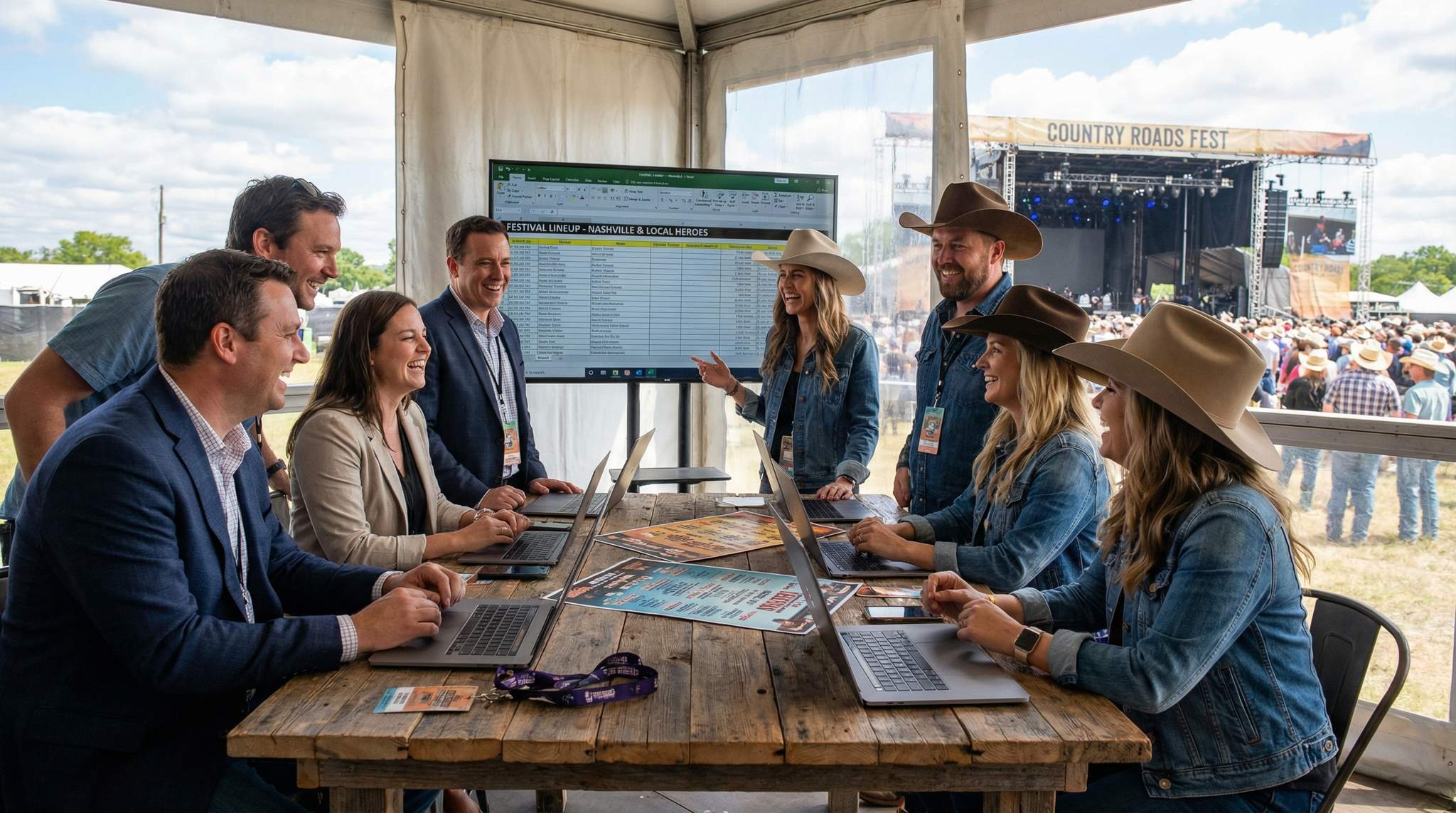
By creating an advisory committee, a festival producer essentially builds a feedback loop into programming. The lineup ideas are constantly “pressure-tested” by people with different viewpoints, much like a writer gets feedback from an editor. The result is a richer festival experience that can appeal to die-hard country fans, casual listeners, and curious newcomers alike.
Recruiting Nashville Insiders and Local Heroes
Building a strong advisory bench starts with recruiting the right people. Aim for a small committee (think 4–6 members) that balances industry expertise with local scene knowledge. Here are key profiles to consider:
– Booking Agents or Talent Bookers: These individuals often have deep connections with artists and their management. A booking agent from Nashville (or any country music hub) will know which artists are touring, which acts are hot on the circuit, and who might be a great fit for your festival’s size. Their insider knowledge can help secure rising stars before they break big.
– Songwriters and Producers: Country songwriters (especially those based in Nashville’s prolific writing circles) are often the first to spot emerging talent. They collaborate with up-and-coming artists in writing rooms and hear new musical directions from the ground up. Having a respected songwriter or music producer on the committee can provide an artistic perspective – ensuring the lineup isn’t just about who’s popular now, but also who is creating exciting, quality music. For example, a veteran songwriter might point out a young artist with brilliant songwriting chops who hasn’t yet topped the charts but could be the next big thing.
– Radio Station Programmers (or DJs): Radio remains a powerful force in country music, from the United States to Australia. A country radio program director or popular DJ knows what songs listeners are requesting and which new artists are getting buzz on the airwaves. They can advise if your potential lineup has the hits that will draw crowds or if it’s missing a current radio favorite. Additionally, their involvement can create a promotional bridge – a local radio personality on your advisory board might be more inclined to hype your festival on-air, especially if they’ve had a hand in shaping it.
– Venue Owners or Operators: The folks who run local honky-tonks, clubs, or mid-size venues have firsthand experience with live country music trends. They see which local bands consistently sell out a bar or which touring acts left the crowd begging for more. A venue operator from your festival’s region (be it Nashville’s Broadway district, London’s country music clubs, or a Texas dance hall) brings practical knowledge of what works live. They’ll ensure your lineup includes artists who can deliver great live performances, not just those with streaming hits.
– Local Country Music Heroes: Consider inviting someone who’s a respected “local hero” in the country scene. This could be a long-time festival volunteer coordinator, a music journalist covering country music in your city, or even a retired country artist who’s a hometown legend. Their presence signals community involvement and can keep the festival rooted in local tradition. For instance, the Calgary Stampede in Canada often involves local country veterans in planning, maintaining a strong Alberta flavor in its events.
Turn Fans Into Your Marketing Team
Ticket Fairy's built-in referral rewards system incentivizes attendees to share your event, delivering 15-25% sales boosts and 30x ROI vs paid ads.
Each member of the advisory bench should bring something unique to the table. Strive for a mix of ages, backgrounds, and specialties so that you get a 360-degree view of the country music landscape. While Nashville is the heart of country music in the U.S., don’t hesitate to include voices from other country music hotbeds around the world – whether it’s Austin, Texas; Tamworth, Australia; or London’s growing country scene. The goal is to ensure your festival isn’t blind to any corner of the genre or any corner of the globe.
Empowering the Committee (With Boundaries)
Once you have the right people on board, it’s crucial to give them real influence. This isn’t meant to be a token committee just for show – their feedback should have a tangible impact on decision-making:
– Regular input in lineup decisions: Share your prospective lineup or target artist list with the advisory bench early and update them as artists are confirmed. Encourage them to critique it. Is there an important subgenre missing? Have we booked too many similar-sounding acts? Which emerging local artist deserves one of the smaller stage slots? By openly discussing these questions, festival organizers can catch blind spots early.
– Influence, not control: Make it clear that the festival’s production team has final say (since they handle budget, scheduling, and other constraints), but also genuinely integrate the advisors’ suggestions. For example, if the committee strongly feels a certain young songwriter should be included, find a way to fit them in, perhaps on a side stage or as an opening act for a headliner. When advisors see their ideas implemented, it reinforces that their role is meaningful.
Planning a Festival?
Ticket Fairy's festival ticketing platform handles multi-day passes, RFID wristbands, and complex festival operations.
While empowering your advisors, set clear conflict-of-interest rules to keep the process fair and transparent:
– Disclosure of interests: Require each advisor to disclose any direct professional ties to artists (or venues, sponsors, etc.) that might be considered for the festival. If one of your advisors is a booking agent, it’s natural they’ll suggest artists from their roster. That’s okay – their roster might have great talent – but everyone should know the relationship upfront.
– Recusal when necessary: If the committee is voting or formally recommending artists, an advisor should recuse themselves from decisions that present a conflict. For instance, a radio DJ on the board shouldn’t be the sole voice pushing to book a band in which they have a financial stake. Or a venue owner shouldn’t promise a slot to a house band they manage without the group’s consensus.
– Balanced representation: By having multiple advisors, no single member can dominate the lineup selections. If one advisor has a conflict (say they manage Artist X and advocate for them), the others can provide counterpoints (maybe Artist X is great, but perhaps there’s an even better local band to consider for that slot). This system of checks and balances keeps the lineup selection honest and based on merit and fit, rather than insider favoritism.
Communicate these guidelines clearly when recruiting members. Emphasize that the goal is to serve the festival’s audience and reputation. Most industry professionals will respect that – after all, being part of a well-curated, successful festival is in their interest too. With trust and transparency established, your advisory bench can operate as a cohesive unit working towards the best lineup possible.
Ongoing Collaboration and Trend Spotting
Establish a routine for ongoing collaboration with the advisory bench. A great practice is to hold quarterly calls or meetings throughout the year:
– Quarterly check-ins: These scheduled calls (or video conferences) keep advisors engaged year-round, not just right before the festival. In each session, review the current state of the lineup planning. Are there new artists making waves since the last meeting? Did one of the confirmed acts cancel or go on hiatus, creating a gap to fill? Regular check-ins mean the lineup can evolve with the times, rather than being set in stone months early.
– Pressure-testing the lineup: Use these meetings to pressure-test the lineup’s balance. Run through the roster with the committee:
– Is there a good mix of headliners, mid-tier acts, and newcomers? A festival bill should have marquee names to sell tickets, solid mid-level acts to keep fans engaged all day, and fresh faces that could be tomorrow’s stars.
– Does the lineup represent the spectrum of country music? For example, if your festival heavily features mainstream Nashville artists, perhaps an advisor will suggest adding a Red Dirt country act from Oklahoma or a bluegrass ensemble to get some roots representation. Conversely, if it’s all traditional country, maybe include a country-pop artist or two to attract younger fans.
– Are we noticing any emerging trends or fan movements that should influence the lineup? Advisors might point out, for instance, the growing popularity of country artists on TikTok, indicating you might book an “internet famous” country singer before they hit radio. Or they might discuss the rise in Americana/folk influences and recommend a crossover artist who appeals to both country and folk audiences.
– Local vs. national balance: Check that the festival is championing local talent without compromising draw. A local hero band might not pull massive ticket sales, but placing them in an afternoon slot could boost local attendance and goodwill. Advisors can help decide how many local acts are appropriate and even identify which ones have that special spark to hold their own.
– Trend forecasting: Beyond immediate lineup choices, use the advisory bench as a mini think-tank for where country music is heading. Maybe the songwriting advisor talks about a lyrical trend (like more songs about social issues in country), or the venue operator notes more young people showing up for line-dancing nights, indicating a traditional danceable country segment might be fun to include. These insights can inspire festival extras too (like adding a line-dance workshop or a songwriter circle on a side stage).
Document the outcomes of each meeting – perhaps maintain a shared spreadsheet or a running list of potential artists and notes from the advisors. This way, nothing falls through the cracks. When it’s time to finalize the lineup, you’ll have months’ worth of diverse input to reference, which is far more effective than scrambling for ideas at the last minute.
Free Tool: Size Your Festival Site
Zoned capacity planning for arena, campsite, parking and entry lanes — against UK Purple Guide and NFPA density standards. Finds your bottleneck zone.
Valuing and Acknowledging Your Advisors
To keep your advisory bench motivated and respected, it’s important to value and acknowledge their contributions:
– Provide a stipend or honorarium: While some advisors might be happy to contribute for the love of music and the community, offering a stipend shows professionalism. It doesn’t have to be exorbitant – it could be a nominal per-meeting fee or an annual honorarium. In some cases, festival organizers cover travel and accommodations for advisors to attend the festival, especially if they’ll be participating in meet-and-greets or on-stage announcements. The key is to recognize that their time and expertise have value.
– Public credit: Shine a spotlight on your advisory committee in festival communications. This can be a section on your website or in the festival program that lists the advisors by name, with a brief descriptor (e.g., “Jane Smith – Talent Booker, XYZ Nashville Agency”, “Carlos Rodriguez – Program Director, Country 101 FM Mexico City”, “Aliyah Khan – Country Music Journalist, Mumbai”, “Ben Miller – Owner, Lone Star Dance Hall, Texas”). By publicly crediting them, you:
– Build credibility: Fans and artists see that respected figures are backing the festival, which can increase trust. If an emerging artist knows a well-known songwriter is on the advisory board, they might be more excited to accept an invitation to play, knowing the festival has industry respect.
– Foster accountability: Advisors know their name is attached, so they’re incentivized to give thoughtful input and stand behind the lineup choices. It also deters any potential conflict of interest behavior – with public recognition comes a level of scrutiny and responsibility.
– Strengthen community ties: Local media or the country music community might take note of the names on your advisory bench. This can lead to additional coverage (e.g., “Local radio host joins CountryFest advisory board to help curate lineup”) and cements the idea that the festival is working with the community, not apart from it.
– Engage them during the festival: When the event arrives, involve your advisors on-site if possible. Invite them on stage to introduce an act they championed, or hold a small reception to thank them publicly. This not only rewards them but also lets the audience see the faces helping to shape the festival. For example, a programmer from a London country station could host an artist Q&A on a side stage, or a Nashville agent might appear in a panel discussion about the future of country music. Such activities leverage their presence and further integrate them into the festival experience.
Remember, the advisory bench members are essentially festival ambassadors. Treating them well means they’ll naturally talk up your event in their professional circles and to fans. That word-of-mouth marketing is invaluable – it’s like having knowledgeable influencers who are personally invested in the festival’s success.
Need Festival Funding?
Get the capital you need to book headliners, secure venues, and scale your festival production.
Avoiding the Echo Chamber
The ultimate payoff for building and maintaining an advisory bench is avoiding the dreaded echo chamber in festival programming. Here’s how this approach keeps your festival lineups vibrant and forward-looking:
– Fresh talent pipeline: With songwriters, radio programmers, and venue owners feeding you names of exciting new artists throughout the year, you’re less likely to miss the “next big thing.” This proactive scouting means your festival could be the first to showcase a future superstar, giving you a reputation as a trend-setter. (Imagine having booked an unknown Luke Combs or Maren Morris just before they blew up, because a Nashville insider on your board had a hunch about them!)
– Balanced programming: The variety of voices ensures balance. If your lineup was unknowingly leaning too heavily in one direction – say, too many male solo acts – a diverse advisory team can catch that. For instance, an advisor might say, “We’ve got a lot of modern country-pop this year; how about adding a Texas red-dirt band for the traditionalists?” The result is a more well-rounded festival that offers something for everyone in the audience.
– Community relevance: Incorporating local heroes in decision-making means the festival reflects local tastes and values, not just what’s trending nationally. This can prevent disconnects where a festival brings in big-name acts but ignores beloved regional artists. Community members will recognize and appreciate that the festival lineup isn’t formulated in a corporate vacuum – it has local fingerprints on it. The festival becomes their festival.
– Continuous innovation: Regular brainstorming with knowledgeable insiders keeps ideas flowing. Your festival won’t stagnate because each year there’s an infusion of new thoughts – whether it’s a suggestion to try a songwriter round stage, a tribute to a late country icon, or a cross-genre collaboration set. Festival programming becomes more dynamic and less formulaic.
– Risk management: An echo chamber can be risky if it means the festival is out of touch – tickets might not sell if the lineup misses the mark. The advisory bench is like an early warning system. If one of your concepts or headliner choices is met with lukewarm enthusiasm by this panel of experts, that’s a cue to reconsider before it’s too late. It’s much better for a few insiders to critique a lineup in private than for thousands of fans to critique it on social media after it’s announced.
In short, a grounded advisory bench serves as a compass, continually pointing the festival toward authenticity, variety, and relevance. It prevents the insular decision-making that often leads to stale or controversial festival lineups, and instead encourages a culture of listening, learning, and adapting.
Conclusion
As country music festivals evolve in a competitive and fast-changing music landscape, curating standout lineups is more challenging – and more crucial – than ever. Building an advisory bench of Nashville insiders and local heroes is a savvy way to rise to that challenge. It blends the best of industry foresight with grassroots insight. The festival benefits from a wealth of knowledge that no single event organizer, no matter how experienced, could have alone.
From Nashville to New Delhi, every country music festival can gain from a broader brain trust guiding its programming. The process is collaborative and iterative: recruit passionate experts, give them a voice (with guardrails for fairness), listen and adapt regularly, and show appreciation for their contributions. Do this, and your festival will be rewarded with lineups that feel both fresh and true to the spirit of country music.
Free Tool: Project Your Bar Revenue
Per-head spend benchmarks by event type turned into projected bar and food revenue, with a stock-mix estimate and gross-margin line. Free calculator.
In the end, the advisory bench approach isn’t just about booking artists – it’s about honoring the community and culture behind the festival. It sends a message that the festival is not an island, but a gathering place built with input from all corners of the country music family. And that’s the kind of authenticity fans notice. By preventing echo chambers and embracing a chorus of knowledgeable voices, a festival can strike the perfect chord year after year.
Frequently Asked Questions
What is an advisory bench for a country music festival?
An advisory bench is a small committee of diverse experts, such as Nashville insiders and local heroes, used to curate festival lineups. This strategy helps organizers spot emerging trends, avoid repetitive echo-chamber programming, and ensure the artist roster resonates with audiences by incorporating multiple perspectives on industry movements and local tastes.
Who should be included on a festival advisory committee?
A strong advisory committee typically consists of 4–6 members balancing industry expertise with local knowledge. Key profiles include booking agents and songwriters who spot national trends, alongside local radio programmers, venue operators, and community heroes who understand regional tastes. This mix ensures the lineup reflects both current hits and authentic local culture.
How does an advisory bench prevent echo-chamber programming?
An advisory bench prevents echo-chamber programming by injecting multiple viewpoints into the curation process, countering the limitations of a single talent buyer. By gathering feedback from diverse sources like label reps and local venue owners, festivals avoid repetitive headliners and overlook blind spots, resulting in a more inclusive lineup that appeals to a wider demographic.
How should festivals manage conflicts of interest with advisors?
Organizers manage conflicts by establishing clear rules requiring advisors to disclose professional ties to artists or venues. If a committee member has a financial stake in a potential act, they must recuse themselves from voting or decision-making. This system of checks and balances ensures lineup selections remain honest, merit-based, and free from insider favoritism.
How often should festival organizers meet with their advisors?
Organizers should establish a routine of quarterly calls or meetings throughout the year to keep collaboration active. These regular check-ins allow the team to pressure-test the lineup for balance, fill gaps caused by cancellations, and adjust programming based on real-time trends, ensuring the final roster remains dynamic and relevant rather than set in stone.
Why is it important to compensate festival advisory board members?
Compensating advisors with a stipend, honorarium, or travel coverage demonstrates professionalism and values their expertise. Beyond financial rewards, providing public credit on festival materials builds credibility and fosters accountability. Treating advisors well transforms them into motivated festival ambassadors who actively promote the event within their professional circles and to fans.