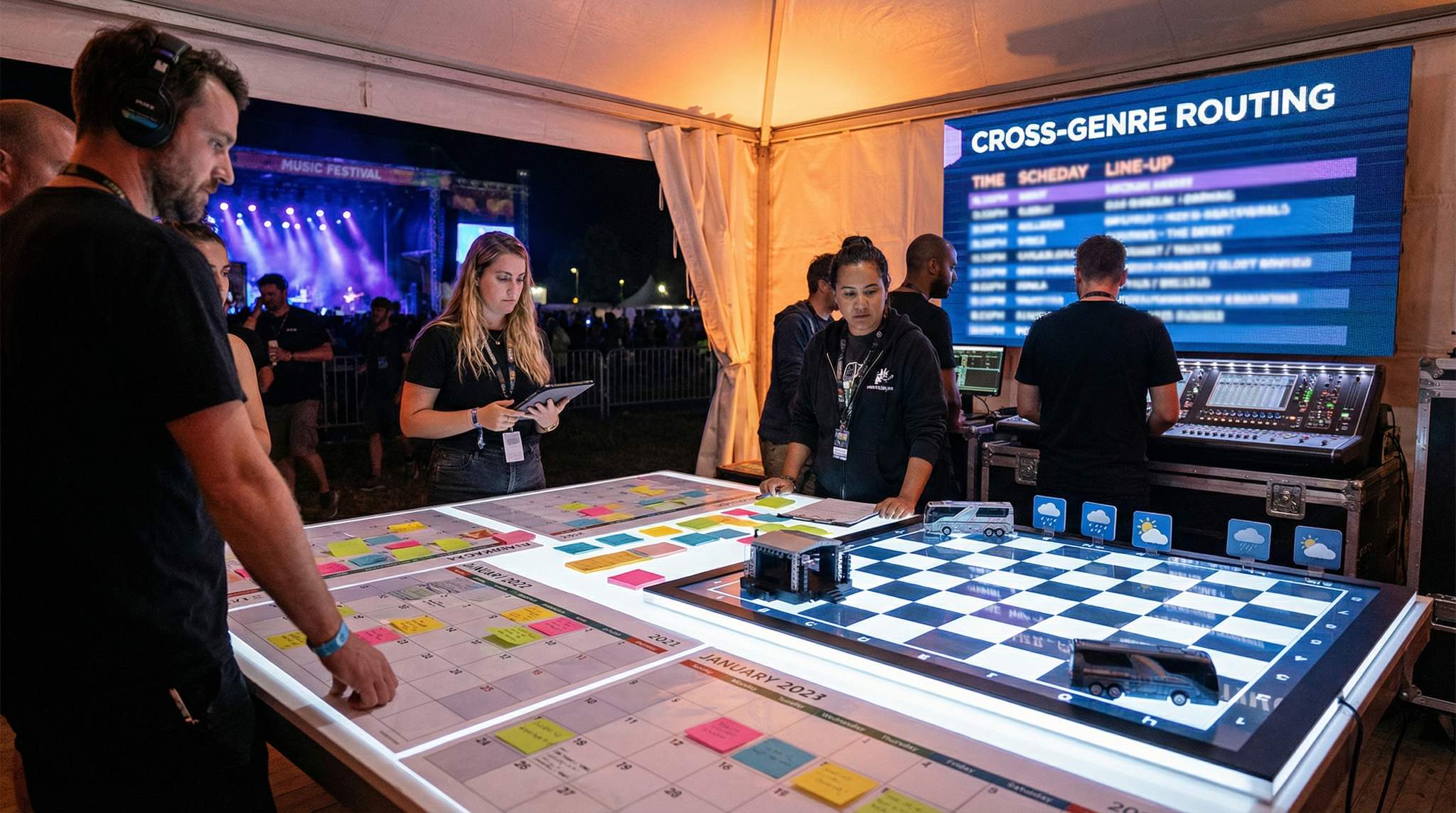
Choosing the right dates for a multi-genre, multi-stage festival can feel like playing chess with the calendar. Picking the optimal weekend involves balancing artist availability, audience schedules, weather patterns, and competitor events in the region. The most seasoned festival organizers approach date selection strategically, ensuring that each move (or date decision) sets the event up for success. This guide shares veteran insights on how to navigate touring seasons, academic calendars, holidays, weather windows, and competitive considerations when scheduling a festival.
Optimize Artist Availability Across Circuits
Cross-genre festivals draw artists from different touring circuits, so timing is critical. Most major festivals worldwide take place in the summer months, as NPR reports on the festival season, when many artists are on tour and available for festival bookings. For example, Europe’s big rock and pop festivals traditionally cluster in late June through August, and North America’s festival season ramps up from spring (April/May) into late summer. Aligning your event with these peak touring seasons means artists are more likely to be on the road (and in your region) seeking festival slots. If you’re aiming to book top international DJs for an EDM stage, remember that electronic music tours often peak around spring and summer break periods when fans flock to big dance events. Alternatively, if your festival includes genres like jazz or folk, you might find more artist availability in shoulder seasons or during specific cultural circuits (e.g. jazz festival circuits in summer Europe or winter in the southern hemisphere).
Research the touring patterns of the artists and genres you plan to feature. A veteran festival producer will check when target headliners have album releases or tour cycles. Many pop and rock artists schedule album tours in the spring or fall, which might make them open to one-off festival dates in summer. On the other hand, some genres have unique timing – for instance, college-town indie bands often tour during spring break or early summer, while jam bands might coordinate around summer festival circuits and fall gatherings. By choosing dates that intersect with these cycles, you increase your chances of securing a diverse, high-quality lineup. A practical tip is to stay in close contact with booking agents – they can signal when artists are routing through your area. For instance, if several desired artists will already be in your country for a major festival tour in mid-July, scheduling your event just before or after that window can make artist logistics and travel easier. Artists routing between major festivals might gladly add your event if it fits seamlessly into their schedule.
Another aspect of artist availability is being mindful of radius clauses and exclusive periods imposed by other big events. Many major festivals require artists to not play other shows in the region for a certain time. For example, Coachella’s well-known radius clause forbids artists from performing at any other North American festivals from December through May, since Coachella is in April, a restriction detailed in industry analysis by NPR. This means a mid-sized festival in the U.S. or Canada during early spring would struggle to book artists already tied to Coachella. The lesson: avoid pitting your event against a giant that monopolizes artists with such contracts. If you know a massive festival (with potentially restrictive artist contracts) happens in a given month, consider picking a date outside that window or far enough away geographically. Aligning with artists’ touring routes and avoiding blackout periods will dramatically improve your booking prospects.
Free Tool: Size Your Festival Site
Zoned capacity planning for arena, campsite, parking and entry lanes — against UK Purple Guide and NFPA density standards. Finds your bottleneck zone.
Align with Audience Schedules and Calendars
A successful festival date also syncs with when your target audience is free and eager to attend. This means considering academic calendars, public holidays, and cultural or religious events that might conflict or complement your timing. If your festival appeals strongly to students or young adults, avoid exam periods and capitalize on school holidays when possible. In the United States and Canada, late spring and summer (mid-May through August) are prime times for college students on break – which helps explain why so many festivals happen in June-July. In contrast, early May or mid-December (finals season for many universities) would be risky timing for youth-oriented events, as students are tied up with academics. Similarly, in countries like India, many colleges have major exams in March-April, so a festival targeting that demographic often opts for winter dates (November, December, or January) when students are on break and the weather is cooler. Knowing the academic cycle in your region is crucial: a festival organizer in Australia might plan for mid-summer January when students are on summer holiday, whereas one in the UK might choose late August after A-level results when teens are free to celebrate.
Be mindful of public holidays and long weekends – they can be both opportunities and pitfalls. On one hand, scheduling your festival adjacent to a holiday can boost attendance, since people have time off work to travel and enjoy a long weekend. For example, the iconic Reading and Leeds Festivals in England take place over the August Bank Holiday weekend, leveraging that Monday off to attract crowds from all over the UK. In the U.S., events like Movement in Detroit utilize Memorial Day weekend when many have free time. On the other hand, holidays can come with family commitments or conflicting activities. A festival scheduled on Easter weekend or during Christmas might struggle as people often prioritize family or travel. Cultural wisdom comes into play – consider the norms of your audience. In some cultures, a festival during Lunar New Year or Diwali would face an uphill battle as those holidays are reserved for family and home. In contrast, a festival during a secular holiday like a national independence day might thrive if it positions itself as the celebratory thing to do on that day.
Planning a Festival?
Ticket Fairy's festival ticketing platform handles multi-day passes, RFID wristbands, and complex festival operations.
Religious observances deserve special attention as well. Avoid planning a music festival during significant religious periods if those would prevent a chunk of your audience (or artists) from participating. For example, expecting a strong turnout in parts of the Middle East or Indonesia during Ramadan would be unrealistic – the entire month is a fasting period and culturally not conducive to all-day concerts. Likewise, scheduling during important holy days (Eid, Christmas, Yom Kippur, Diwali, etc.) could limit who will attend or perform. The key is to identify dates that don’t clash with major commitments for your core audience. If you find a potentially free window – say, mid-fall after back-to-school but before the winter holidays – that might be a sweet spot to capture people looking for a getaway.
On the flip side, leveraging academic and holiday calendars might also open creative opportunities. Some festivals specifically cater to spring break travelers (think of beachside music fests in March that draw college crowds on vacation), while others tie into local cultural festivals to enhance the experience (for instance, a city arts festival aligning with a national culture week). As a festival producer, know your audience demographics intimately: their work schedules, school terms, and cultural habits. Choose a date where attending your festival is not only possible for them, but ideal.
Plan for Weather and Daylight Window
Once you’ve narrowed down a season when artists and fans are available, factor in the weather and daylight conditions for those dates. Outdoor festivals live and die by the weather – a well-timed sunny weekend can make for bliss, while a poorly timed monsoon or heatwave can wreak havoc. Start by researching the historical climate for your location around your intended dates. Look for the “Goldilocks” zone of weather: not too hot or cold, minimal rainfall risk, and mild nights for camping (if applicable). For example, festivals in Europe often avoid the late autumn and winter due to cold and rain, whereas in tropical regions like Southeast Asia, organizers steer clear of peak monsoon months (opting for drier periods like after the rains). In Mexico, many big outdoor events take place in the dry season (roughly November to April) to ensure clear skies. In India, the prime festival window is often December-January when temperatures drop and rains are scarce, avoiding the scorching summer and unpredictable monsoon. Choosing the right weather window is about minimizing risks – you can’t guarantee perfect weather, but you can avoid the worst seasons and have contingency plans for surprise storms.
Daylight is another subtle yet important factor – especially for a multi-genre festival where certain styles thrive under specific lighting conditions. Genres with heavy bass and visually intense production (think EDM, techno, or any act that brings tons of lasers, LEDs and fireworks) are far more impactful after dark. If your festival features such acts, you’ll want to schedule them in the evening hours when darkness amplifies the light show and the crowd’s energy peaks. That means ensuring your festival programming extends into the night, or at least scheduling in a season when night falls early enough to give you dark hours. For instance, an electronic stage headliner set at 9 PM in mid-summer Sweden might still face daylight (thanks to late sunsets), whereas the same set in Spain at 9 PM in late September would be in full dark – a very different vibe. If operating in high latitudes with very long summer days, consider running that stage later at night or using light-controlled tents to simulate darkness for daytime sets. On the flip side, some genres like acoustic, indie folk, or family-oriented performances might work better in daylight or at golden hour, creating a warm, relaxed atmosphere. Map out your festival’s daily schedule around the sun: what time will sunset be on those dates, and how can you position each genre or stage to take advantage of (or avoid) the sunlight?
Free Tool: Project Your Bar Revenue
Per-head spend benchmarks by event type turned into projected bar and food revenue, with a stock-mix estimate and gross-margin line. Free calculator.
Also account for temperature swings between day and night. A desert location (like Nevada or Rajasthan) might be roasting at noon but chilly after sundown. Placing high-energy DJ sets at night when it’s cooler can keep the crowd dancing comfortably, while scheduling mellower acts during the scorching mid-day can encourage attendees to relax in shaded areas. This kind of weather-aware scheduling ensures both artists and attendees are in their element – figuratively and literally. Noise and local ordinances are part of the equation too. If your heavy-bass stage will run at night, check local noise regulations and community sensitivities. Ignoring local noise ordinances can lead to fines or even an event shutdown, so you may need to adjust hours or sound levels. In urban areas with strict 10 PM noise curfews, for example, the “best hours” for bass-heavy genres might be early evening before the cut-off, whereas in rural or festival-dedicated sites, you can push those booming sets into the late-night safely.
Finally, always have a weather backup plan even after choosing an optimal season. Climate these days can be unpredictable – a wise festival organizer models different scenarios (rain, extreme heat, wind) for the chosen dates and has contingencies like tents, cooling stations, or evacuation plans. A famous example is England’s Glastonbury Festival, which despite being held in “flaming June” often battles heavy rain and mud. Veteran producers there plan far ahead with drainage, plastic pathways, and extra amenities for muddy conditions. Learn from such cases: pick the best window you can, then prepare for the worst just in case. Your chosen date should maximize the chance of great weather and appropriate daylight, but resilience is key.
Need Festival Funding?
Get the capital you need to book headliners, secure venues, and scale your festival production.
Avoid Clashes with Competitors (Within ~500 Miles)
In the busy festival landscape, your event’s date doesn’t exist in a vacuum – you must account for other events happening regionally at the same time. Mapping out competitor festivals (and even large events like major concerts or sporting events) within a few hundred miles and within a week or two of your target date is a crucial planning step. The reason is twofold: talent and tickets. If a similar festival or big concert is scheduled too close in time and location to yours, you risk cannibalizing your audience – fans will choose one or the other, reducing your attendance. Just as importantly, competing events can make it harder to book artists, since performers may have exclusivity deals or simply logistical conflicts that prevent them from doing back-to-back shows in the same region.
Start by researching the festival calendar for your region (500 miles is a rough guideline, but in some cases even events 1,000 miles away can impact you if they’re huge enough and draw from your market). If you run a multi-genre festival in California, for example, you’d be unwise to schedule it the same weekend as another big West Coast music festival or even a world-class event like Coachella – many fans travel and won’t be available, and many artists will already be booked (or restricted). If your event is in Germany, check the dates of other European festivals that attract a similar crowd; you wouldn’t want to clash with, say, Tomorrowland in neighboring Belgium if you aim to book EDM acts or draw international attendees around the same time. Even at a smaller scale, consider local and regional happenings: a popular citywide food festival, a national sports final, or a major state fair can pull local attention and resources away from your festival. Staggering your date a week before or after a nearby big event can give breathing room so that eager fans (and stage crews, vendors, etc.) can participate in both.
Another strategic reason to avoid date clashes is the competition for suppliers and staff. Festivals within the same region that fall on the same weekend will be fighting over the same pool of staging equipment, sound and lighting rentals, security staff, medical teams, and other critical infrastructure. This can drive up costs or even make it impossible to secure enough quality gear and crew. By steering clear of direct overlaps, you ensure better access to vendors and more negotiating power (e.g., the top staging company isn’t already fully booked by a bigger festival down the road). Think of it like ensuring you’re the only game in town for that weekend – it not only draws maximum audience but also simplifies logistics.
Professional festival producers often keep an internal calendar or subscribe to industry newsletters that list major events worldwide. It pays to network with other event organizers as well – sometimes a quick call or email exchange can reveal if someone else is eyeing the same weekend in your area, allowing you to coordinate or adjust. While you won’t eliminate all competition (especially in peak season), aim to be distinctive in time or geography. For instance, scheduling your multi-genre festival in mid-September might avoid the saturated July-August period and attract fans looking for a season-closing event. Or if you’re fixed to a certain holiday, differentiate by theme or genre so you’re not chasing the exact same audience as a nearby event.
Data-Driven Event Marketing
Track ticket sales, demographics, marketing ROI, and social reach in real time. Exportable reports give you the insights to make smarter decisions.
In summary, do your homework on competing events. The goal is to pick dates that stand out on the calendar rather than get lost in a pile-up of similar festivals. By reducing direct competition, you not only boost your potential attendance but also make your festival more attractive for artists (no routing conflicts or tough radius clauses to navigate). It’s a classic win-win: fans aren’t forced to choose, and you get more breathing room to shine.
Establish a Consistent Annual Weekend
Once you’ve found a date that checks all the boxes – artist-friendly, audience-friendly, good weather, and competition-free – strongly consider sticking with that timing every year. Locking in a recurring weekend for your festival can be a game-changer for building a loyal following and operational efficiency. Many of the world’s most successful festivals have cemented their place in the calendar: people know exactly when to expect them each year. For example, Coachella is always held across two weekends in April (and has been for decades)—a scheduling strategy discussed by NPR—while Australia’s Splendour in the Grass reliably falls in late July each winter, and Spain’s Primavera Sound often kicks off the European summer festival season in late May or early June. This consistency “trains” both the market and suppliers to anticipate your event.
From the audience perspective, a consistent date helps turn your festival into a yearly tradition. Fans will mark their calendars a year in advance — sometimes literally buying tickets nearly as soon as the previous edition ends — because they know when it’s coming. It removes uncertainty and allows them to plan vacations, save money, and rally friends for the pilgrimage each year. Over time, a stable date builds trust: attendees come to expect that “last weekend of July = our music getaway” or “first weekend of February = that big cultural fest” and they organize their lives around it. This kind of reliability is gold in an industry where there are endless options; if your festival’s timing is dependable, you become the go-to choice for that slot in people’s lives.
Consistency pays off with partners and suppliers as well. Vendors, production crews, and sponsors will pencil in your festival on their annual schedules, making it easier to secure their services and negotiate deals. For instance, if local staging companies know your festival is every first weekend of June, they can reserve the equipment for you each year before other gigs come calling. Cities and local authorities also appreciate regularity – it helps them slot your event into their annual permitting and policing plans (which can streamline approvals). In some cases, being recurring on the same weekend can even foster community support, as nearby businesses and tourism boards gear up for the expected annual influx of visitors and revenue.
Building a brand around a specific weekend can also create compelling marketing angles. People begin to associate that time of year with your festival’s vibe – think “summer kickoff party” versus “end-of-season celebration” depending on when your dates fall. You can use this in your promotions, essentially owning that time frame in the minds of your target demographic. As years go by, the tradition reinforces itself: newcomers hear that “this is the festival to attend every Memorial Day weekend” or “every Diwali holiday, there’s an amazing festival here.” The weekend, in essence, becomes part of your festival’s identity.
Of course, locking into a weekend should still be predicated on it being a good weekend as we’ve discussed. If unforeseen issues arise (say, a new competitor moves to that weekend, or a weather pattern shift makes it less ideal), a festival producer might re-evaluate and pick a better recurring date. But avoid unnecessary date drift – changing your dates drastically every year will confuse your audience and disrupt all the advantages of consistency. The best practice is to choose wisely, then stick with it. Over time, that weekend becomes your festival’s home, and everyone from ticket buyers to touring agents will know to keep it open for you.
Frequently Asked Questions
How do radius clauses affect festival date selection?
Radius clauses restrict artists from performing at other events within a specific geographic area for a set time. For instance, Coachella’s clause prevents artists from playing other North American festivals from December through May. Organizers must schedule outside these blackout periods or far enough away to secure desired talent.
When is the best time to schedule a festival for college students?
The optimal timing for student-oriented festivals aligns with academic breaks, specifically late spring through summer (mid-May to August) in North America. Organizers should strictly avoid exam periods like early May or mid-December. In the Southern Hemisphere, this window shifts to mid-summer January when students are on holiday.
Why is daylight planning important for music festivals?
Daylight conditions dictate the impact of stage production, particularly for genres like EDM and techno that rely on lasers and light shows requiring darkness. Organizers must schedule these acts for evening hours or choose seasons with earlier sunsets. Conversely, acoustic or folk genres often benefit from the natural lighting of daytime slots.
How does weather impact outdoor festival scheduling?
Weather determines the viability of outdoor events, requiring organizers to research historical climate data for a “Goldilocks” zone of mild temperatures and low rainfall. Festivals in tropical regions avoid monsoon months, while European events target summer. Organizers must also prepare contingency plans, such as drainage and tents, for unpredictable conditions.
Why should festival organizers avoid nearby competitor events?
Scheduling an event within 500 miles and two weeks of a competitor risks cannibalizing ticket sales and limiting artist availability. Direct competition also creates shortages in essential resources, such as production crews, security staff, and equipment rentals. avoiding clashes ensures better access to vendors and higher attendance.
What are the benefits of a consistent annual festival date?
Locking in a recurring weekend allows fans to plan their attendance a year in advance, building a loyal tradition. Consistency also streamlines logistics, as suppliers and local authorities can anticipate the event for permitting and rentals. Major festivals like Coachella use this strategy to own a specific timeframe in the market.