Measure your event's footprint and share it with sponsors

See your waste by stream, generator fuel and your audience's travel emissions from buyer postcodes. Share a public summary, and turn Fai's suggestions into next year's plan.

  • Waste, fuel and audience travel together
  • A public summary for your audience and sponsors
  • Next year's greener changes, suggested by Fai

See what each waste stream adds up to

Your report totals your waste by stream. You know how much went to general waste, how much was recycled and which streams to work on next. When your council, your landowner or a sponsor asks what your event produced, you have the figures ready.

With the streams side by side, waste stops being a line on the contractor's invoice and becomes something your team can improve. The next change pays off on the stream that is larger than you expected. That might mean more recycling points or a reusable cup scheme.

  • Waste by stream: what each waste stream adds up to
  • Totals for the event: ready when your council or sponsors ask
Count the fuel your generators burned

Your generator fuel goes into the same report, so the power behind your stages, bars, traders and campsites counts in your footprint. It is also a number your production team can bring down.

Your power crew keeps a fuel log as they refuel each generator on their rounds, with an alert before a generator runs low. With your fuel beside your waste and travel, you can decide what to plan for next year. That might be a smaller generator, a mains connection or a battery for the quieter areas.

  • Generator fuel: the fuel your site used
  • Part of your footprint: beside your waste and travel

Estimate your audience's travel emissions

Audience travel is often the largest part of an event's footprint and the hardest to measure. Your report estimates your audience's travel emissions from the postcodes your buyers give. You see the impact of where your crowd comes from without surveying anyone.

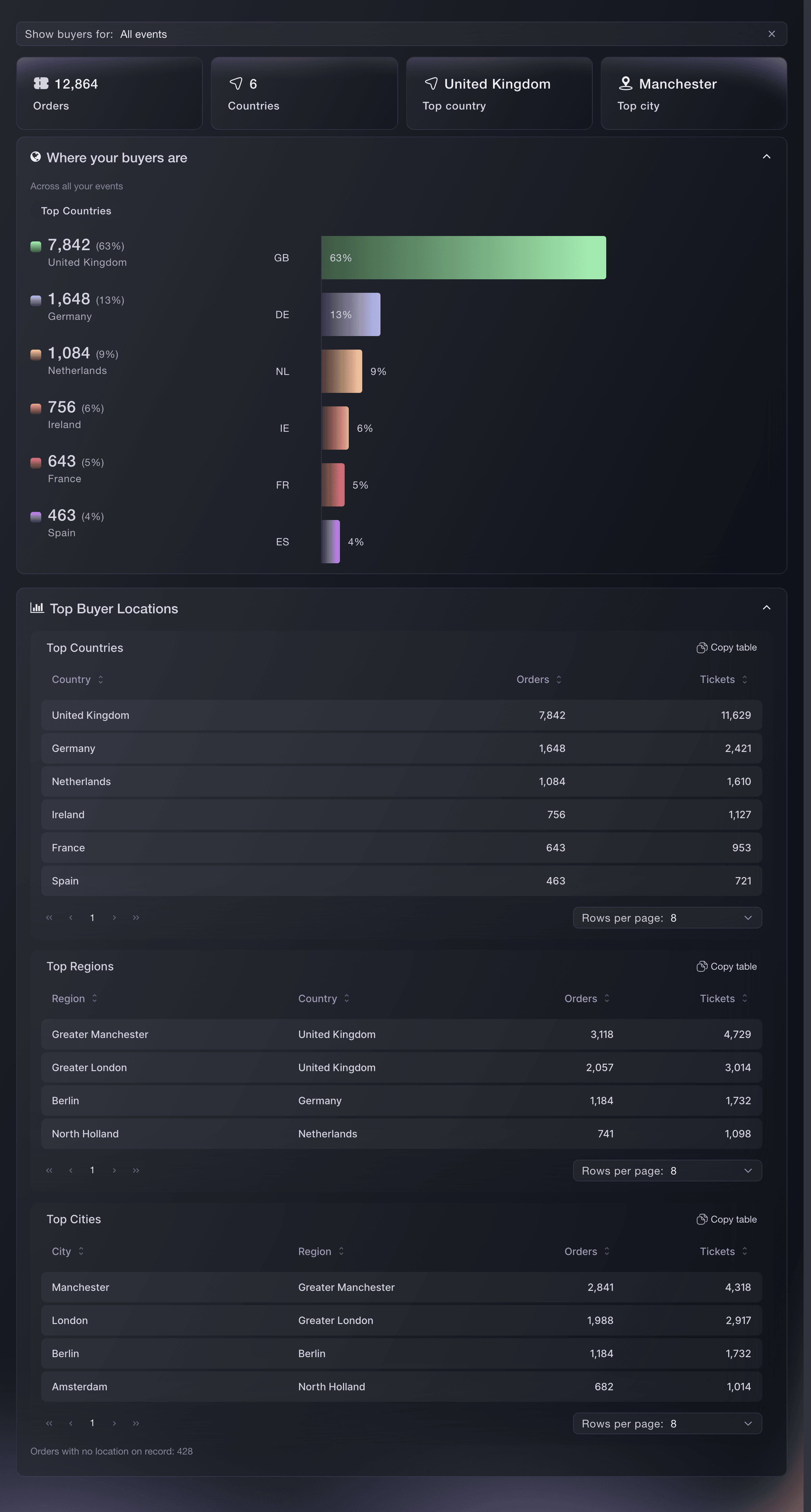
The same buyer addresses already show in the Geographics report which cities and countries your audience orders from. You can see it across all your events or for one series, venue or city. Put the two side by side. You see where a shuttle from one city, a car-share push or a rail partnership would cut the most travel.

Ask Fai where your buyers are based across the brand or for a group of events. She finds the matching series, venue or city and checks the report for you. A question you would otherwise take to a spreadsheet takes one sentence.

  • From buyer postcodes: where your audience travels from
  • Travel emissions: an estimate for your whole audience
  • Geographics: the cities and countries your buyers order from
Ticket Fairy brand Geographics report for all events, with order totals, a country chart and the country, region and city tables

Share a public summary with your audience

Publish a public summary of your report, so your audience, sponsors and partners see what your event did. A clear summary shows the work your team put in. It gives fans who care one more reason to choose your event again.

Sponsors increasingly ask for these figures before they renew. Councils and landowners ask for them before the next licence or lease. A summary you can point them to saves you rebuilding the same document each year. What you tell your audience and what you tell your partners stays the same.

  • Public summary: what your event did, shared openly
  • For sponsors and partners: the figures they ask you for

Turn Fai's suggestions into next year's plan

Fai looks at your report and suggests changes for next year. You choose the ones you agree with, and your next edition starts with a plan rather than a good intention.

Fai suggests and you decide, just as everywhere else in your dashboard. Put the changes you choose on next year's event as tasks, beside the improvements your attendees asked for. A greener event is on your team's list from the first planning meeting.

  • Fai's suggestions: changes to make next year
  • Your choice: the changes you agree with go on your plan

Hear what your attendees thought the morning after

Email a short survey to everyone who checked in, the morning after the event, in their own language and with their own link. The standard survey asks for an overall rating, how likely people are to recommend you and what to improve. You can change the questions before it goes out, such as asking how people travelled or what they thought of the recycling points.

See the answers as they come in, with your recommend score beside last year's and a rating for each stage, act and trader. Fai picks out the themes in the comments, with quotes in people's own words. When you ask, Fai sets up and schedules the survey for you. She always asks before scheduling, because it emails your attendees.

  • Survey the morning after: in each attendee's own language
  • Your own questions: changed before the survey goes out
  • Themes from Fai: what people said, in their own words
Ticket Fairy survey questions for a festival, with the overall rating, the recommend question, the questions people answer in their own words and ratings for each stage read from the event

Start the next edition with this year's lessons

Add the top things to improve from your feedback as tasks on next year's event in one step. The changes you choose from your sustainability report go on the same plan. Everything you learned this year is waiting for your team when the next edition starts.

When you start next year's event from this one, you choose what to bring across. That can be stages, accreditation zones and pass types, the site map, the radio plan and the kit list. It can also be dressing rooms, arrival times, hotel blocks and the budget plan with no actual costs. People, bookings, answers and actual costs are never copied. Copying only adds what is missing, so running it again never doubles anything.

The tasks from your feedback and your sustainability report sit on the event your team opens first. Nobody has to dig last year's debrief notes out of a shared drive. The reusable parts of this year's setup, from the site map to the kit list, are ready to improve.

  • Add as tasks: the improvements you choose, in one step
  • On the next edition: waiting when your team starts planning
Ticket Fairy dialog to add two improvements from the feedback as tasks on next year's festival

How organisers use their sustainability report

  • A greenfield festival renewing its licence

    Ahead of the licensing meeting, the festival shares its waste by stream, generator fuel and audience travel figures with the council. It points the landowner to the same public summary.

  • A festival with a sustainability sponsor

    The sponsor asks for this year's figures before renewing. The organiser sends the public summary and the changes Fai suggested, already on next year's plan as tasks.

  • A conference with delegates from abroad

    Travel from buyer postcodes shows that most of the footprint comes from a handful of cities. The organiser adds a question about travel to the post-event survey and plans a rail partnership for next year.

  • A venue reporting across a season

    The venue uses the Geographics report to see which cities its audience travels from across the season. It shares each show's public summary with the promoters who book the room.

  • A sports event in a city park

    The report shows general waste far larger than recycling, and the post-event survey says the recycling points were hard to find. More recycling points go on next year's tasks.

Questions About Your Sustainability Report

Sustainability report

Your waste by stream, your generator fuel and your audience's travel emissions, with a public summary you can share.

They are estimated from the postcodes your buyers give. They show your audience's travel as an estimate, not a measurement of each journey.

No. Fai suggests changes, and you choose which ones go on your plan.

Yes. Audience travel from buyer postcodes counts for any event, and the waste and fuel totals cover whatever your site uses.

From the billing addresses on your orders. It shows which cities and countries your buyers order from. You can see all your events or a series, venue, city, country or the events you choose.

Everyone with a ticket that was checked in, once per email address, even with several tickets. Crew and guest passes are left out. You can also ask ticket holders who did not come what stopped them.

No. The questions are fixed once sending starts, so each answer means the same thing. Change them before the send time. A survey can have up to 20 questions.

Once at least 5 comments are in, and again as more arrive. Each theme says how many people raised it, with their own words as quotes.

The event's owners and admins. Other roles see each answer without the person's name and email address.

On your brand's next edition of the event, or on this event when there is no next edition yet.

Ready to Build a Stronger Event Business?

Book a live demo, and we will set up your first event on the Event Operating System with your team.

Start Selling Tickets Online

Sign up without a credit card and build a test event before you commit. Go on sale in minutes when you are ready.

No monthly subscription required for ticketing
Start selling tickets immediately
Ticketing tools included in the service fee
Get Started for Free Talk to Fai Now

Ask Fai, our AI assistant, about Ticket Fairy’s features, pricing and how it could work for your event.

No credit card required

Book a demo call

See the referral model that drives 20% more ticket sales on average, learn which campaigns sell tickets, answer buyers faster and keep queues moving.

45-Minute Video Call
Pick a Time That Works for You

The Ticket Fairy, Inc. is a fintech company and technology platform. The Ticket Fairy, Inc. is not a bank, financial institution, or regulated financial services provider. Vault banking services are provided through regulated banking partners. Ticket Fairy Capital financing is provided by third-party private credit partners. The Ticket Fairy, Inc. does not make credit decisions, and all funding terms, approvals and conditions are determined by those lending partners.