Richie Brains – The Once-in-a-Lifetime Bass Music Supergroup
We revisit a pivotal moment in bass music history, when seven of the scene’s most forward-thinking names came together for a groundbreaking album on dBridge’s Exit Records.

We revisit a pivotal moment in bass music history, when seven of the scene’s most forward-thinking names came together for a groundbreaking album on dBridge’s Exit Records.
In the spring of 2016, something unusual began appearing across the bass music landscape that would go on to change the trajectory of how we view the sound in 2025. dBridge, the visionary behind Exit Records and former Bad Company UK member, embarked on one of electronic music’s most enigmatic promotional campaigns.
The Lead-up to a Historic Collaboration
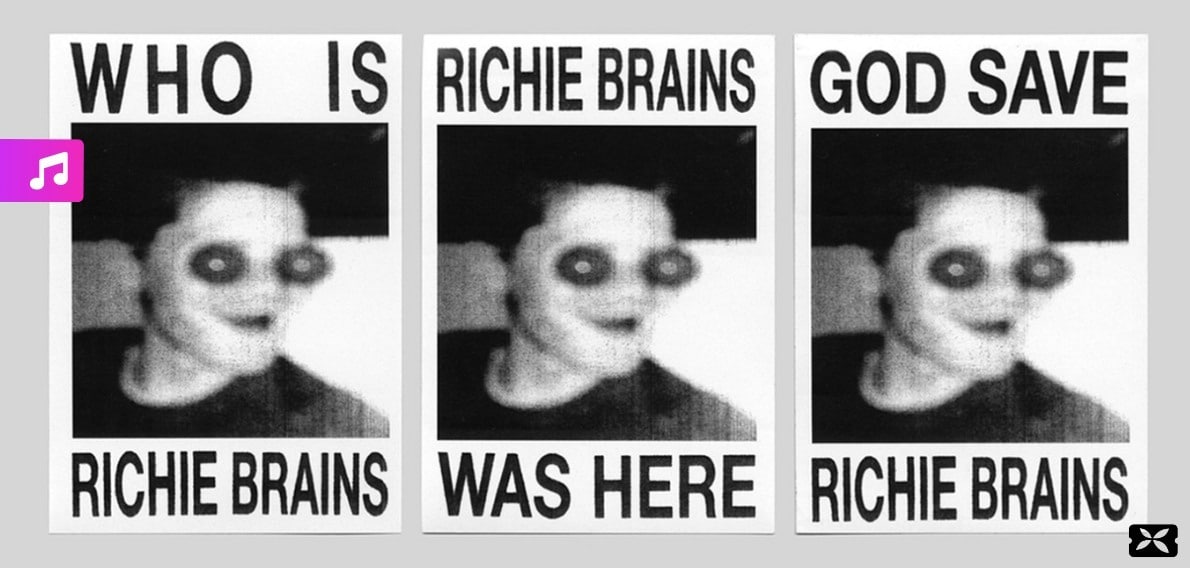
Armed with an arsenal of stickers featuring a peculiar alien-headed figure and the cryptic text, he systematically plastered them across every conceivable surface he could find. He was spotted everywhere: in clubs, at record shops, during hangouts with friends, sticking up a cryptic image of a shadowy figure accompanied by the words “Who Is Richie Brains?” By May 2016, the anticipation had reached fever pitch.

The cryptic posts across social media, the mysterious track previews, and the global sticker campaign had created a level of intrigue that hadn’t been seen in bass music for nearly a decade. Theories ran rampant across forums and social media. Was it a Manchester collective? A London supergroup? And since all the tunes eventually showed up on Alix Perez‘s heavy rotation list, then maybe just a single-person project? Too many questions, and effectively no answers.
When dBridge finally orchestrated the grand reveal at London’s Phonox, it was revealed that the project was not just a person, but as a seven-headed supergroup, and a giant collaboration on a scale drum & bass hadn’t seen in nearly a decade comprising seven of bass music’s most forward-thinking minds: Alix Perez, Chimpo, Fixate, Fracture, Om Unit, Sam Binga, and Stray.
In true Exit Records fashion, the project embodied the label’s mantra of staying “True To The Craft.” The line-up was staggering:
- Alix Perez, the DnB tastemaker and technical wizard.
- Chimpo, bringing his playful, wonky, grime-soaked chaos.
- Sam Binga and Fixate, architects of halftime swagger.
- Fracture, the king of intricate, razor-sharp beatwork.
- Om Unit, master of deep explorations and cosmic textures.
- Stray (then part of Ivy Lab), whose meditative yet mischievous touch tied the madness together.
The logistics alone seemed impossible. Coordinating schedules, creative visions, and production techniques across three different studios over a period that stretched back two years. What came up was the ‘Who Is Richie Brains?’ record – a genre-bending showpiece rooted in drum & bass but constantly morphing and taking cues from footwork, grime, hip-hop, jungle, and halftime that felt like a love letter to bass culture itself.
The Sound of Richie Brains – Track by Track
The LP opens deceptively calmly with ‘Game Shades’ and ‘Sk8 M8,’ moody, floating sketches that feel more like scene-setters than full-blooded tracks. They tease tension before the floor drops away into urgency.
That urgency arrives with ‘Bring Dat Back’ (feat. Killa P), a halftime weapon dripping with grime swagger. It’s no surprise it became a DJ set staple, practically writing the playbook on how to infuse hip-hop attitude into drum & bass. Then comes ‘The Nine Two Three,’ a hypnotic clash of jungle and techno dynamics. Its playful yet pounding aesthetic would become a blueprint for the hybrid, breakbeat-heavy club sound that’s exploded in recent years.
‘The Blips’ pulls back into brooding, sci-fi territory before the intensity spikes with ‘Buss It,’ a G-funk-infused bass storm, and ‘Splatta’ featuring MC Fox, a grime-driven cut that highlights the vital chemistry between MCs and producers. The six-minute odyssey ‘B Boy 900000’ stretches across hip-hop, breakbeat, and raw experimentation, while ‘Heartbreaker’ introduces emotional synth work and faster-paced rhythms. ‘Likkle Som’ nods to Alix Perez’s Shades project with Eprom, wobbling between halftime weight and slinky grooves.
‘Dem A Talk Bout’ (feat. Trigga) leans into streetwise dancehall-grime-DnB crossover, bringing playful grit, while ‘Voyage’ and ‘Tantrum’ dive into full-blown jungle-techno chaos, tense, distorted, unrelenting. Finally, the album closes with ‘Respeck Due’ (feat. Rider Shafique), whose dubwise poetics provide a reflective, emotional finale underpinned by heavy bass force. A fitting send-off that honors the culture while pushing its edges.
Why Richie Brains Mattered
The Richie Brains project arrived at a pivotal moment when drum & bass was seeking new directions beyond traditional 4-to-the-floor industrial formats. The album’s release coincided with a scene increasingly receptive to futuristic experimentation, and its timing proved perfect for catalyzing broader changes within bass music culture
Before Richie Brains, halftime was niche. After the album, halftime became a serious lane for experimentation, influencing labels like 1985 Music, Critical, Astrophonica, and crews like Ivy Lab. The way grime MCs were woven into futuristic bass productions also redefined the MC/DJ relationship, paving the way for today’s hybrid club sets.
The collaborative methodology pioneered by this project demonstrated that established artists with distinct sonic identities could successfully merge into a cohesive creative entity. This proved that supergroup dynamics weren’t limited to rock or hip-hop; electronic music could sustain similar collaborative ambitions while maintaining artistic integrity.
The Legacy of Richie Brains
The project’s lasting mystique partly stems from its singular nature. Unlike typical supergroups that release multiple albums or tour extensively, Richie Brains remained a beautiful moment frozen in time; a once-in-a-lifetime convergence that may never be repeated.
The question of whether these seven artists could recreate such magic again, or whether the original’s impact would be diminished by repetition, remains tantalizingly unanswered. Perhaps the project’s greatest achievement lies in this restraint; by remaining a single, perfect statement, ‘Who Is Richie Brains’ avoided the pitfalls that often plague successful collaborations when commercial pressures demand sequels.
In an era where bass music continues to evolve at breakneck speed, the Richie Brains album stands as both a historical artifact and an ongoing influence; a reminder that sometimes the most profound artistic statements emerge from the most unexpected collaborations. The album’s continued relevance nearly a decade later suggests that its genre-bending approach wasn’t just innovative for its time, but prophetic of bass music’s future directions.
Will Richie Brains ever return? Probably not. But maybe that’s the point. Its seismic impact lies in its singularity, and in the lingering hope that lightning might strike again.
For more insights into electronic music, keep up with TFword on Instagram | Facebook | X
You May Also Like:
DNB Evolution: Modern-Day Drum & Bass
London Elektricity on His Fast Soul Journey and Crafting Breathtaking Drum & Bass
The Eurodance Comeback We Didn’t See Coming