The Caribbean Carnival of Trinidad and Tobago
The country of Trinidad and Tobago consists of two Islands located in the Caribbean Islands. The nation had many colonizers over the years, with each leaving their influence on them.

The country of Trinidad and Tobago consists of two Islands located in the Caribbean Islands. The nation had many colonizers over the years, with each leaving their influence on them. The likes of French, Spanish, Dutch, British, to name a few. Notable industries here are oil, natural gas, steel, cocoa, cotton textiles, etc. Trinidad and Tobago achieved independence in 1962.
Soaked in an array of local and foreign cultures, The Trinidad and Tobago Carnival celebrates the country’s rich tradition and diversity with great enthusiasm. Like many carnivals around the world, this too is held prior to Ash Wednesday. This year, the Trinidad and Tobago Carnival is scheduled between 28 February and 1 March.
Roots of Trinidad and Tobago Carnival
[youtube https://www.youtube.com/watch?v=xhlNEXhPmRM&w=640&h=480]The French were among the first to bring in slaves as a workforce from Africa and other colonies to the islands. European colonizers established their presence by setting up industries of cotton, sugarcane, cocoa, oil, etc. They shared their cultures with the Caribbean islands amidst colonization. Part of their culture included hosting lavish balls and masquerade parties. These parties would include a feast of food and drink, elaborate costumes, and headgear.
Their slaves were not allowed to participate in any way. Throughout the festivities, they would tend to the needs of their masters and mistresses. Eventually, the slaves hosted their own parties. Mimicking and mocking the activities of their colonizers, while bringing their respective cultures and traditions forward.
It was not until 1833 that these parties took a more lively tone. The year marked the abolishment of slavery throughout the British Empire and thus started ‘Canboulay’, a street procession. This Canboulay set the tone for what today has become the carnival in Trinidad and Tobago.
Canboulay, or ‘Cannes Brulees’ means “burning cane”. It refers to having slaves stride hurriedly to the fields to put out fires, collect and save as much cane as possible. They were forced into the sugarcane fields to the beat of horns and shells. Each year during the carnival, children and adults reenact the tragedy with folk dance, music and theater to celebrate resistance and emancipation.
[related-post id=”12616″]
The Parade!
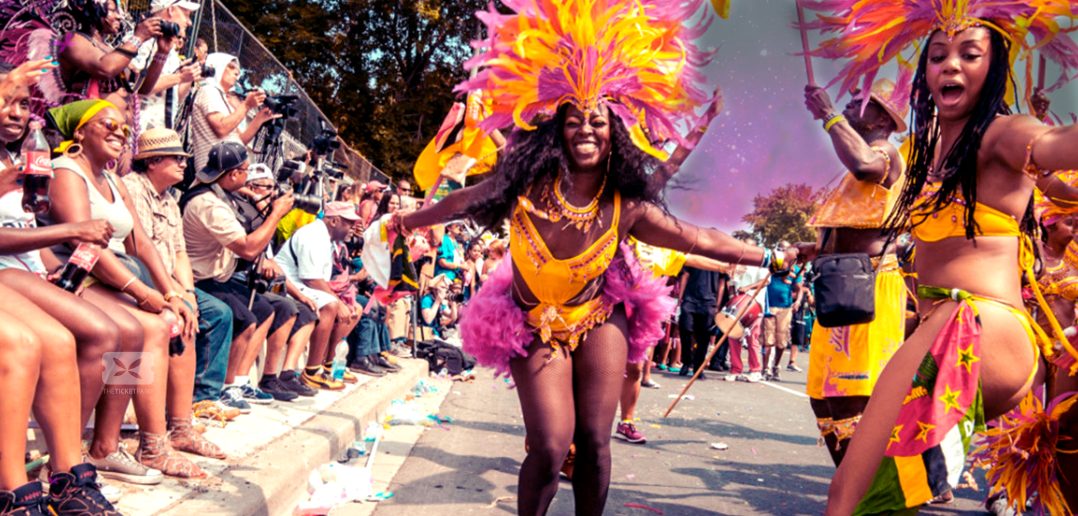
[youtube https://www.youtube.com/watch?v=U7hJEme4-eA&w=853&h=480]The parade is a melange and a blend of cultures. It includes the ones within the Island, those imbibed from colonial rulers and what the slaves brought into the countries through trade. The parade features over 2,000 different masquerades attires and draws over 40,000 marching bands participants. Costumes, symbols and objects were inspired by items banned by the rulers in order to suppress the culture of the original inhabitants and slaves.
The costumes were exhibited at a ‘Canboulay’ indicated to mock the demeanor and attire of the colonial masters. This led to the origin of the ‘Mas’ in the parade, which has participants dressing in colorful costumes, donning masks, and wearing disguises as they dance in procession through the parade route. Currently, the parade boasts floats and costumes of characters from African and European traditions and cultures.
Costumes also include elaborate dresses and headpieces, sailors, birds, dragons, clowns, and cultural outfits. Dame Lorraine (character resembling French planters who would parade in groups at private events), Jab Jab (devil), the burrokeet (donkey), the midnight robber, and moko jumbies (stilt walkers) are also some of the characters present at the parade.
Calypso arising from ‘kaiso’, the traditional folk song, can be heard echoing through the parade along with soca – ‘soul of calypso’, Rapso, Extempo, Chutney music (fusion of Indian and Caribbean folk music), and more recently electronic music. Calypso came about as a means of communication and storytelling, while Soca is seen as a music of upliftment.
The in-sync marching bands use many musical instruments, including steel pan drums, Tassa drums, bamboo drums, bongos, and many strings and woodwind instruments. The steel pan drums, a creation resulting from the use of barrels in the oil industry are handmade since the 1930s.
[related-post id=”12203″]
Food, Music, Dance and More!
[youtube https://www.youtube.com/watch?v=7L-Slgxz7PM&w=853&h=480]Trinidad and Tobago Carnival take place in the capital, Port of Spain. The planning for the celebrations takes place many months in advance. Being influenced by their roman catholic rulers, the carnival is scheduled on the Monday and Tuesday before Ash Wednesday, prior to the season of fasting and abstinence.
The festivities begin with a traditional ‘J’Ouvert’ or ‘sunrise march’ that takes place late Sunday night and Monday morning. It includes traditional and modern dances, live music, local cuisine, handmade handicrafts stores, and much more. The cuisine includes an assortment of food recipes accumulated from around the world. Doubles (curried chickpeas sandwiched between pieces of fried flatbread), fried shark meat, curried crab along with dumplings, rotis with cooked chicken, beef or seafood, along with locally brewed beers and fermented rum are some delicacies served here.
A major competition held is selecting the King and Queen of Carnival. This is determined from costumes worn by a King and a Queen leading their respective bands/floats. Soca Monarch – to determine the best music at the carnival, and Calypso Monarch – the prize given to the best marching band is also part of the carnival festivities. The Panorama is an annual steel band competition held since 1963, having bands from throughout the country participate and play a ten-minute calypso music piece.
The Carnival is celebrated in many other Caribbean countries such as the Dominican Republic, Jamaica, Puerto Rico Haiti, etc. These countries share similar stories of emancipation.
You May Also Like:
The Ancient Carnival Of Oruro In Bolivia
Maddar Youth Club: 9 Times Float Parade Winners Of Goa Carnival!
The Oldest Carnivals In The World
Feature Image Via exie-ahia.