Events and Programming
Cromwell Racecourse is primarily a racing and equestrian venue rather than a dedicated concert arena. Its regular programme centres on thoroughbred racing, harness racing, dressage, show jumping, pony-club activities and community gatherings. Larger seasonal events add food vendors, hospitality marquees, live entertainment, markets and family activities.
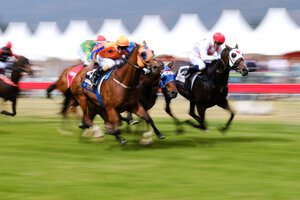
The main annual racing period is late November and early December. The Central Otago Racing Club holds a Friday meeting at Cromwell, followed shortly afterwards by the Otago Racing Club’s Christmas at the Races meeting. The Central Otago fixture features the Clare Memorial Cup and is promoted as a relaxed, family-friendly day with entertainment on and off the track. The 2026 Central Otago meeting is scheduled for Friday 27 November, with free admission listed for the public.
Christmas at the Races is the venue’s most recognisable large-scale social event. The 2026 edition is scheduled for Sunday 29 November from 11am to 5pm, combining racing, seasonal entertainment and hospitality packages that include food, drinks and seating. Earlier editions have included fashion activities, DJs, live musicians, food stalls, hospitality marquees and appearances by Santa.
Recent racing history shows a consistent late-November pattern. Records confirm Central Otago and Otago meetings at Cromwell in 2021, 2022, 2023, 2024 and 2025, with programmes ranging from maiden and rating races to open handicaps and the Cromwell Cup. The 2023 Cromwell Cup carried a $50,000 stake, while the 2025 Clare Memorial Cup was a $35,000 open handicap over 2030 metres.
Harness racing is also part of the recent programme. Wyndham Harness Racing Club has used Cromwell for summer grass-track meetings, including fixtures in January and February 2026. These meetings are more sporting than concert-like, with the emphasis on racing, form, betting and trackside viewing.
Equestrian programming is a major part of the reserve’s identity. Published calendars include Central Otago dressage tournaments, show-jumping and show-hunter events, pony-club training camps and eventing activities. A 2026 pony-club camp is scheduled for 10–11 October, while the 2026–27 dressage calendar includes a Central Otago Spring Tournament at Cromwell Racecourse on 17–18 October.
The most substantial non-racing event announced for 2026 is the World Gold Panning Championships, running from 25 September to 3 October. Cromwell Racecourse is the main competition location, with daily contests, a locals’ fun day, live performances, market stalls, food trucks, an outdoor movie night, kapa haka, a hangi and a final hoedown. This demonstrates that the reserve can support a temporary festival-style programme when event infrastructure is installed.
Looking further ahead, Central Otago Tracks & Wheels is planned for Easter weekend 2027, from 26–28 March. The proposed event will focus on working machinery, vintage equipment, truck and tractor displays, demonstrations, a parade, a family zone, market stalls and food trucks. Planning and site improvements were under way in 2026, but the event is not a conventional music festival.
There is no verified evidence of a frequent touring-concert programme or a permanent schedule of major headline music acts. Live music appears as part of selected race days, fairs and festivals rather than as the venue’s core booking model.
Tickets and Booking
Ticketing varies substantially by event. The 2026 Central Otago Races listing shows free public admission, while hospitality packages for Christmas at the Races are booked as separate food, drink and seating experiences. Community events may sell tickets at the gate, use a simple adult-and-child price structure or introduce multi-day passes.
Past pricing gives a useful guide rather than a guaranteed current rate. Thoroughbred race days have historically used modest admission charges, including examples of $10 and $15 for adults, with under-18s admitted free at some fixtures. The 2024 Festive Fête charged $15 for adults and admitted children under 14 free. Prices, age thresholds and payment methods are event-specific.
For popular race days, hospitality packages and marquees should be arranged before the event. The 2023 Christmas meeting hosted more than 40 hospitality tents, many used by local businesses for staff functions. General admission is usually simpler, but entry arrangements can change according to licensing, weather, crowd management and the event organiser.
There is no permanent Cromwell Racecourse box office with one universal price list. The organising racing club or event promoter sets the ticketing method for each occasion. Some events use advance bookings, some sell at the gate and some are free. Always treat the event listing as the authority for the applicable price, gate time and age policy.
About Cromwell Racecourse
Cromwell Racecourse sits within the 93.5-hectare Cromwell Racecourse Reserve on Ripponvale Road. The land is managed by the Central Lakes Equestrian Club under a lease from the Central Otago District Council. It is both a racecourse and a broad public recreation reserve, with equestrian facilities, open event space, grazing areas and the adjacent Cromwell Racecourse aerodrome.
Racing was recorded at Cromwell as early as 1862, and the Cromwell Jockey Club formed as an official body in 1869. The Cromwell Racecourse Reserve Act was passed in 1876, establishing a public-racecourse framework and allowing the reserve’s income to be directed towards cultivation and improvement. The Cromwell Jockey Club operated until financial difficulties led to its winding-up in 1999.
The Central Lakes Equestrian Club was established in 1999 and took over day-to-day reserve management. Otago Racing Club continued racing at the course, while the Central Otago Racing Club transferred its annual meeting from Omakau to Cromwell in 2020 after roughly 135 years at its former venue.
The course is a left-handed 1600-metre thoroughbred track with a 350-metre straight. It is used by Central Otago Racing Club and Otago Racing Club for thoroughbred meetings, and by Wyndham Harness Racing Club for selected harness fixtures.
A new grandstand and amenities facility was built in 2007. Recent historical material also records new stabling blocks and other amenity improvements. No authoritative public source located for this guide gives a current total spectator capacity, fixed grandstand capacity or a certified event-capacity figure, so those numbers should not be inferred from historic attendance. A 2011 Christmas meeting drew nearly 6,000 people, but that is an attendance record, not a stated venue limit.
Seating and Layout
The venue is laid out around the grass track, with the grandstand and amenities building providing the principal built spectator area. Most large community and equestrian events use open lawns, temporary marquees, paddocks, arenas or trackside viewing areas rather than a theatre-style seating plan.
There is no published numbered-seat map or standard concert configuration. Race-day admission is generally organised around access to the reserve and viewing areas, while hospitality guests may receive dedicated marquee seating or package seating. The best position for racing is usually close to the home straight or in an elevated grandstand position, while equestrian spectators often need to follow the event layout because arenas and jumping courses can move between fixtures.
For festival-style events, bring a suitable outdoor seating plan unless the ticket specifically includes a chair or reserved hospitality table. Grass, dust, sun and wind are more relevant considerations than auditorium acoustics.
Architecture, Production and Technical Facilities
Cromwell Racecourse has the character of a working Central Otago racecourse: a large grass track, open reserve, grandstand, racing and equestrian areas, stabling, paddocks and temporary event zones. Historic descriptions from the early twentieth century mention a grandstand, luncheon rooms, officials’ rooms, jockeys’ rooms, loose boxes and saddling and weighing paddocks. The 2007 grandstand and amenities project brought a more recent layer of built infrastructure to the site.
No verified public specification was found for a permanent concert sound system, installed stage lighting, theatrical rigging, fixed video screens, broadcast control room or venue-owned production inventory. Live music and entertainment at race days and festivals therefore appear to depend on event-specific suppliers and temporary infrastructure.
The 2025 reserve management plan identifies future lighting and toilet provision as matters to be addressed during later project development. It does not publish a completed technical upgrade or promise a concert-grade production system.
Getting There and Parking
The venue address is 57 Ripponvale Road, Cromwell. The main entrance is on the east-west section of Ripponvale Road, and the reserve is reached from the State Highway 6 corridor near Cromwell. Ord Road also serves parts of the racecourse reserve and the adjacent aerodrome.
Driving is the most practical way to reach large events. Parking arrangements are event-specific and may use grassed areas or temporary fields within the reserve. The 2024 Festive Fête advertised plentiful parking, while the proposed 2027 Tracks & Wheels event states that on-site parking will be available. The cost of parking is not published as a universal venue charge.
Public-transport and shuttle information is not consistently published for the racecourse. Visitors should not assume that an event has a dedicated bus, taxi rank or rideshare holding area unless the individual event notice says so. Allow extra time for traffic on Ripponvale Road during major race meetings, when vehicle movements increase sharply.
Inside the Venue
Expect an outdoor, seasonal experience rather than a conventional entertainment-venue arrival. Entry may involve a gate ticket, wristband, identity check or event-specific accreditation. At the 2023 Christmas meeting, identification was checked at the gates and coloured wristbands identified guests old enough to purchase alcohol.
Food and drink are normally event-led. The 2023 Christmas meeting included food vendors, a DJ, live musicians and more than 40 hospitality tents. The 2024 Festive Fête offered food, boutique beverages and live music, while the 2026 Gold Panning Championships will add food trucks, markets and festival entertainment.
Do not assume that every event has the same bars, food stalls, merchandise, toilets, seating or connectivity. Race days and festivals may add temporary facilities, while equestrian training days can be considerably more basic. No verified permanent specification was found for Wi-Fi, cloakroom storage, merchandise counters or charging facilities.
Nearby Amenities
Cromwell township is the nearest base for accommodation, meals, groceries and fuel. The racecourse itself does not publish a permanent nearby-amenities guide, and event conditions can make travel slower during the late-November racing carnival. Visitors attending hospitality or evening entertainment should arrange their return journey before arriving, particularly if they are not staying in Cromwell.
For a full race day, arriving before the first race is sensible. It gives time to park, pass through the gate, find the grandstand or marquee, collect a race book and understand the layout before the track becomes busy. Festival days may require an earlier arrival if parking, markets or family activities are part of the programme.
What Makes This Venue Special
Cromwell Racecourse is unusual because it combines a long racing history with the scale and flexibility of a large community reserve. Racing has continued on the site since the gold-rush era, while the reserve now supports thoroughbred and harness racing, dressage, jumping, pony-club activities, community events and major temporary gatherings.
The course’s history includes colourful early traditions. A nineteenth-century programme featured a “Cheroot Race”, in which riders had to complete a circuit while keeping a lit cigar alight. The famous New Zealand jockey Hector Gray also began riding at Cromwell before recording extensive success in New Zealand and overseas.
The venue’s signature social tradition is Christmas at the Races. The event brings together racing, fashion, corporate hospitality, outdoor entertainment and Central Otago’s summer atmosphere. It has become an important occasion for local businesses as well as a public day out, with earlier meetings attracting crowds approaching 6,000.
The reserve also has a significant future-planning role. The 2025 management plan retains equestrian use while allowing for sports fields, community-event space and a possible indoor multisport complex. The plan envisages four sports fields in the medium term and up to eight in the longer term, although it does not itself commit funding or construction dates.
Visitor Tips and Information
Dress for Central Otago’s changeable outdoor conditions. A hat, sunscreen, water, sunglasses and a warm layer are sensible even on a summer race day. Wind can make marquees and open lawns feel cooler than expected, while strong sun can make long periods trackside uncomfortable.
Check whether the event permits outside food, alcohol, chairs, umbrellas, cameras or dogs before attending. At the 2023 Christmas meeting, BYO alcohol was not permitted. The 2024 Festive Fête specifically requested that visitors leave dogs at home. These are event-specific rules rather than a single published policy for every use of the reserve.
Accessibility information is limited. No public source located for this guide provides an ADA-style access audit, a permanent accessible-seating map, confirmed step-free routes across the reserve or a detailed accessible-toilet specification. Because the site includes large grassed and temporary-event areas, access conditions may vary by weather, event layout and parking location. Visitors who require a specific route or viewing position should verify the arrangements for the particular event before purchasing.
There is no published venue-wide dress code. Race-day clothing ranges from casual outdoor wear to formal or themed outfits for Christmas hospitality events. Fashion activities may be part of the programme, but participation is not generally required for admission.
Frequently Asked Questions
What type of venue is Cromwell Racecourse?
Cromwell Racecourse is a working racing and equestrian reserve rather than a dedicated concert hall. Its core uses are thoroughbred racing, harness racing, dressage, jumping, pony-club activities and community events. Larger fixtures can add temporary marquees, food stalls, live entertainment, markets and family programming, but the site’s layout and facilities remain centred on outdoor sport.
What is happening at Cromwell Racecourse in 2026?
Confirmed 2026 programming includes the World Gold Panning Championships from 25 September to 3 October, pony-club activities in October, equestrian tournaments, the Central Otago Racing Club meeting on 27 November and Christmas at the Races on 29 November. Harness meetings also took place earlier in 2026. Dates and event formats vary, so each listing should be checked separately.
Is Cromwell Racecourse used for concerts?
Music is part of selected community and race-day programmes, including live entertainment at Christmas at the Races and live performances planned during the 2026 Gold Panning Championships. However, Cromwell Racecourse is not primarily a concert venue and does not publish a regular touring-concert calendar. Any stage, sound system, lighting and seating for a music event are likely to be temporary.
Is admission free for the Central Otago Races?
The 2026 Central Otago Races listing shows free public admission for the Friday 27 November meeting. This applies to that advertised event and should not be treated as a permanent rule for every race day at the reserve. Hospitality, private marquees, club membership benefits or special activities may have separate arrangements even when general admission is free.
How much do tickets usually cost?
Prices depend on the organiser and event. Historical race-day examples include adult admission of $10 or $15, with children under 18 admitted free at some fixtures. The 2024 Festive Fête charged $15 for adults and allowed children under 14 in free. Hospitality packages, multi-day festivals and equestrian entries use different pricing structures and may require advance booking.
Can tickets be bought at the gate?
Some community events at the reserve sell admission at the gate, while other events use advance booking or provide free entry. The 2024 Festive Fête sold tickets on the day, and race meetings have historically offered straightforward gate admission. Christmas hospitality and specialist equestrian competitions are more likely to require advance arrangements. Always follow the individual event’s stated ticket instructions.
Does Cromwell Racecourse have a published capacity?
No current authoritative spectator-capacity figure was located. The reserve covers 93.5 hectares, but that area is not a seating capacity. The site has hosted large race-day crowds, including nearly 6,000 people in 2011, yet that attendance does not establish a permanent legal or operational maximum. Event organisers may set lower limits according to layout, licensing and safety planning.
What are the track dimensions?
The thoroughbred track is listed as 1600 metres with a 350-metre straight and a left-handed layout. These dimensions are relevant to race-day viewing, especially near the home straight and finish. Harness-racing configurations may use different race distances and temporary or discipline-specific arrangements, so the thoroughbred dimensions should not be assumed to describe every competition area.
Are seats reserved at Cromwell Racecourse?
There is no published numbered-seat map or standard reserved seating plan. General race-day viewing uses the grandstand, lawns and trackside areas, while hospitality packages may include allocated tables or seating. Equestrian events can use different arenas and viewing zones. If sitting is important, check whether the event supplies chairs or bring an appropriate outdoor seat where permitted.
Where is the main entrance?
The racecourse is at 57 Ripponvale Road, Cromwell. The principal entrance is on the east-west section of Ripponvale Road, with Ord Road also serving parts of the reserve and nearby aerodrome. Entrance gates can change for temporary events, so follow event signage rather than relying only on the regular race-day access point.
Is parking available?
Parking is available for major events, usually in temporary or grassed areas within the reserve. The 2024 Festive Fête promoted plentiful parking, and the proposed 2027 Tracks & Wheels event includes on-site parking. There is no universal published parking fee. Space, access routes and drop-off arrangements can change according to the event layout and expected crowd.
Can visitors reach the venue by public transport?
Venue-specific public-transport and shuttle information is not consistently published. Cromwell Racecourse is primarily a road-accessed reserve on Ripponvale Road, so visitors should plan their arrival around driving, pre-arranged taxi transport or a designated event shuttle if one is announced. Do not assume that a normal local bus service stops at the event gates.
What food and drink is available?
Food and drink are event-dependent. Recent large events have included food vendors, food trucks, hospitality marquees, tea and other refreshments, while community fairs have offered meals and boutique beverages. Licensed alcohol rules can apply, and BYO may be prohibited, as it was at the 2023 Christmas meeting. Smaller equestrian days may offer fewer services than race carnivals.
Are dogs allowed at the racecourse?
Dog rules vary by activity and event. The 2024 Festive Fête asked visitors not to bring dogs at the racecourse’s request. The 2025 reserve-management process also identified the need to clarify dog rules for the wider reserve. Because horses, vehicles and temporary event infrastructure create safety issues, visitors should treat dogs as restricted unless the particular event expressly permits them.
Is Cromwell Racecourse wheelchair accessible?
Detailed permanent accessibility information is not publicly specified in the sources reviewed. The reserve includes outdoor grassed areas, temporary parking and changing event layouts, so accessible routes and viewing positions may differ from one event to another. Visitors needing step-free access, accessible toilets, close parking or a firm viewing surface should confirm those arrangements for the specific fixture before attending.
What should visitors bring?
For outdoor events, bring sun protection, water, a warm layer and footwear suitable for grass or uneven ground. A compact chair may be useful where permitted. Avoid assuming that every event provides shelter, seating, charging points or extensive food service. Check alcohol, animal, bag and photography rules before arrival, since these conditions are set by the individual organiser.
Does the venue have permanent concert lighting and sound?
No verified public inventory confirms permanent concert-grade sound, stage lighting, rigging or video equipment at Cromwell Racecourse. Entertainment at race days and festivals appears to use temporary event production. The 2025 reserve plan refers to future lighting and toilet matters being addressed during later project development, so visitors should not expect a standard theatre or arena technical fit-out.
What is planned for the reserve beyond 2026?
The main confirmed future event is Central Otago Tracks & Wheels, planned for Easter weekend 2027. Longer-term reserve planning also allows for continued equestrian use, community-event space, sports fields and a possible indoor multisport complex. The management plan provides a framework rather than a construction guarantee, and it does not commit funding or specify a final delivery timetable.