Modern live events in 2026 are pushing boundaries with intelligent lighting and advanced show control systems. Audiences now expect breathtaking synchronized experiences where lighting, video, and effects all work in perfect concert. Behind the scenes, event technologists orchestrate this magic using automated lights, AI-driven tracking, and time-coded control that ties every cue to the beat. The result? Concerts, festivals, and stage shows that immerse attendees in a multi-sensory spectacle – when everything works as planned. This article dives into how these systems work, practical insights on integrating lighting with other AV, and the all-important lessons on reliability and efficiency to ensure your high-tech show dazzles without a hitch.
The Rise of Intelligent Lighting in 2026
LED Revolution and Smart Fixtures
The backbone of modern stage lighting is the intelligent fixture – overwhelmingly LED-based by 2026. Traditional halogen and discharge lights are rapidly being replaced by LED wash lights, spots, and moving heads. LED fixtures offer huge efficiency gains: a typical LED moving head delivers comparable brightness while using 40–80% less power than its older discharge-lamp equivalent, according to data on energy-efficient wholesale stage lighting. This means events can deploy bigger lighting rigs without overloading power supplies. Beyond energy savings, LEDs boast longer lifespans (often 20,000+ hours) and minimal heat output, reducing cooling costs and making stages safer to work on. Early adopters who upgraded to energy-saving LEDs that slash costs have not only cut power bills but also unlocked creative flexibility – like running all-day visuals at festivals without constant lamp changes.
Moving Heads, Lasers, and Beyond
Intelligent lights in 2026 are truly intelligent. High-end moving head fixtures come with on-board microprocessors that precisely control pan/tilt movement, color mixing, iris and zoom, and even digital gobo effects. This allows dynamic looks that transform a venue’s atmosphere at the push of a button. For example, a single moving light can sweep across an arena, morph from a narrow spotlight to a wide wash, and display intricate patterns synchronized to video content. Laser and pixel-based fixtures are also common on major tours – these devices have arrays of controllable LED pixels or laser diodes, enabling stunning visuals like mid-air 3D effects and graphics. The key advancement is that all these fixtures can be pre-programmed to execute complex cue sequences flawlessly. A 5,000-seat theatre that once relied on a static wash can now deploy a palette of moving beams and color chases rivaling a high-end concert tour. In fact, venues known for dynamic lighting effects that leave fans in awe tend to become favorites on the circuit. Furthermore, upgrading your lighting console and infrastructure ensures you can handle these modern demands. Investing in intelligent lighting today means investing in memorable atmospheres that drive word-of-mouth buzz.
Smarter Control and Sensor Integration
Modern lighting isn’t just about the fixtures – it’s how you control them. Advanced consoles and controllers have made it easier to harness hundreds (or even thousands) of fixtures in a show. Top-of-the-line lighting desks (think MA Lighting’s grandMA3 or ETC’s EOS family) can manage huge numbers of lights with ease. They offer features like multi-touch programming, 3D visualizers, and pixel mapping (treating an array of lights like an image display) to create unified visuals. Crucially, today’s consoles speak multiple languages – outputting not just the old DMX commands, but networked protocols and even triggers to media servers or pyro controllers. Many consoles also support remote device management (RDM), letting techs monitor fixture status (bulb life, temperature, errors) in real time and receive automatic alerts if something’s wrong.
Smooth Entry With Mobile Check-In
Scan tickets and manage entry with our mobile check-in app. Supports photo ID verification, real-time capacity tracking, and multi-gate coordination.
Increasingly, lighting systems are incorporating sensors and AI for adaptive control. For instance, some venues tie house lights into smart building sensors and automation: if an area is empty, lights automatically dim to save energy. On the show side, real-time adaptive lighting can adjust on the fly. Imagine a theatre performance where a lead actor misses their mark – AI systems can sense the deviation (via motion sensors or camera vision) and subtly re-aim or refocus intelligent spots to compensate, a technique increasingly used in AI-driven stage lighting design. This keeps the look consistent even if the human element is unpredictable. Experienced event technologists know that giving the system some “smarts” can smooth out the rough edges of live events. However, they also know to keep a human in the loop for creative decisions and to override the automation if it ever misbehaves.
AI-Powered Spotlight Tracking Systems
From Followspots to Automated Tracking
Followspot operators – the folks manually highlighting performers with bright beams – have long been staples of concerts and theatre. In 2026, many events are augmenting or even replacing these manual spotlights with AI-driven tracking systems. Traditional followspots required a skilled operator perched high above or at the back of the venue, continuously aiming a heavy spotlight to keep the singer or lead actor in the halo of light. Now, automated systems use cameras, sensors, and intelligent algorithms to do the job. Some setups rely on performers wearing small tracking devices or infrared markers; ceiling-mounted sensors then triangulate the person’s position in real time. Other systems employ computer vision, literally watching for movement and faces on stage and instructing motorized lights to follow them. The aim is precision and consistency: a performer can wander freely, and the system smoothly keeps them lit from multiple angles without a human riding the fader.
How AI Followspot Systems Work
These high-tech followspot systems come in a few flavours. One leading solution uses a 3D infrared tracking approach: tiny IR beacons are attached to performers’ costumes, emitting signals that an array of sensors around the stage can detect. A central software brain (often powered by AI algorithms for prediction) calculates each performer’s exact coordinates and directs automated fixtures to track them. This was famously used in Carrie Underwood’s Las Vegas residency, where production teams had to find a solution for lighting the artist on a stage with moving platforms and set pieces. The complexity of the setup was described as like launching space shuttles. The production team employed a tracking system that could hand off the spotlight between multiple moving lights as Carrie moved, even predicting her path to adjust lights proactively. The system allowed up to 32 intelligent lights to lock onto a performer’s movements with uncanny accuracy. Another approach is pure computer vision: high-resolution cameras feed video to AI software trained to recognize the lead performer (by outfit or even facial recognition). As the performer moves, the AI software sends pan/tilt commands to motorized fixtures or mirrors to keep the target illuminated. In both cases, the latency is tiny – often just a few milliseconds – so the spotlight feels instantaneous.
Benefits and Challenges of Automated Spots
AI-driven followspots offer clear benefits. They enable effects that humans can’t replicate, like perfectly synchronized multi-spotlight pickups (one performer suddenly lit from five angles for a dramatic reveal). They also reduce labour needs – one technician can supervise the system instead of a whole team of followspot operators. Safety is improved too: no operators have to climb into the rafters or hang off trusses, which is a welcome change for venues prioritizing risk management. Additionally, these systems never get tired or distracted, and they hit their marks with machine precision every time. That consistency can elevate the show’s polish, especially in complicated productions. However, challenges remain. Setting up an automated tracking system is an “all or nothing” endeavour – it requires careful calibration of sensors, fine-tuning the software, and thorough rehearsals. If something interferes (say a performer’s tracking beacon fails or a camera’s view is blocked by smoke), the followspot could lose its target at a critical moment. There’s also less on-the-fly creativity; a human operator might artistically fade out on a vocalist for effect, whereas an AI system will do exactly what it’s told unless programmed otherwise. Savvy lighting designers often use a hybrid approach: they let the AI track the basics, but keep a human-operated spot as a backup or for nuanced moments. It’s a balance of technological consistency and human artistry.
Comparing Followspot Methods
To decide between manual or automated followspots, consider your event’s scale, budget, and creative needs. Each method has its pros and cons:
| Followspot Method | Controlled By | Key Benefits | Drawbacks & Risks |
|---|---|---|---|
| Traditional Manual | Human operator (on-site) | Human intuition for timing and adjustments; immediate creative decisions | Labour-intensive; operators in high, risky positions; potential for human error or fatigue |
| Remote Followspot (ROBO) | Human operator (remote via camera/joystick) | Keeps operator safely on ground; one op can manage multiple fixtures; still allows human judgement | High equipment cost (camera rigs, remote units); relies on camera feed; still manual aiming workload |
| Automated AI Tracking | Computer vision or sensor-AI system | Precise and steady tracking; can control many lights on one target; no fatigue, works in darkness or through mild obscurants | Requires complex setup and calibration; can mis-track if sensors fail or performer goes out of defined range; limited creative spontaneity |
No one method is “best” for all situations. Large pop concerts with repeatable choreography often lean into AI tracking for the consistent look, whereas a one-off play with unpredictable blocking might stick to manual followspots for flexibility. Many tours in 2026 actually carry both: automated tracking for big production numbers and a couple of manual or remote spots as backup and for encores. The consensus among seasoned production managers is clear – never put complete blind faith in automation. It’s fantastic when it works, but always have a contingency in case an AI-driven spot loses the plot (literally) and you need a human to take over.
Data-Driven Event Marketing
Track ticket sales, demographics, marketing ROI, and social reach in real time. Exportable reports give you the insights to make smarter decisions.
Time-Coded Show Control: Syncing Every Element
The Power of Timecode in Live Shows
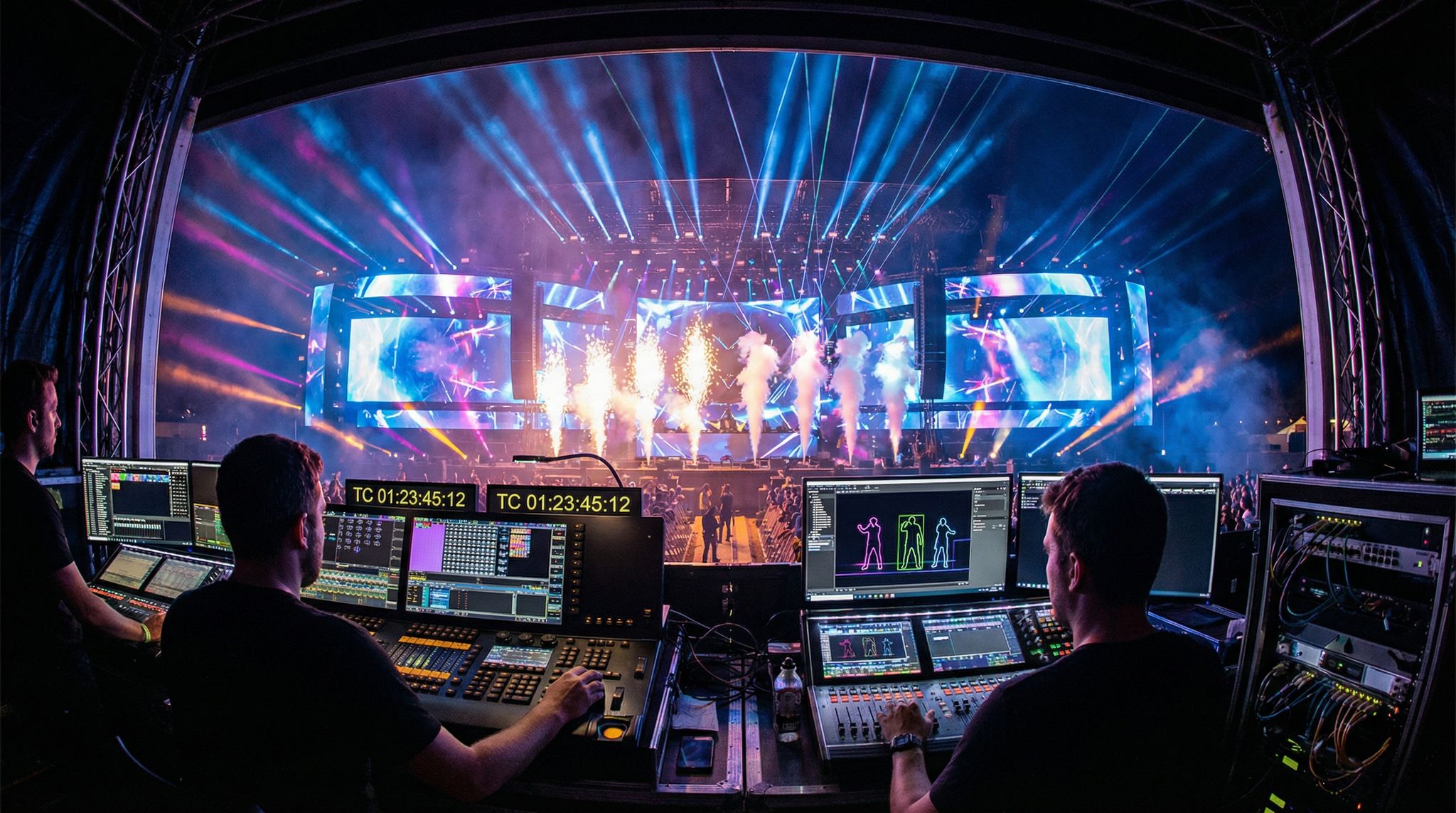
In the quest to synchronize lights, video, audio, and effects, timecode has become the secret weapon of show control. Timecode is basically a continuously running timestamp (often SMPTE timecode) that can be shared across all production systems. Think of it as a global show clock: lighting consoles, video/media servers, pyrotechnic controllers, laser systems, even fountain and motion controllers can all listen to this clock and execute their cues at precise predetermined moments. In 2026, fully timecoded shows are common for big tours and festival headline sets. The music, whether performed live or as a DJ set, is aligned to a timecode track so that every beat drop triggers exactly the right flash of light, every chorus cue launches coordinated CO2 jets or confetti. The result is a level of precision and spectacle that wows audiences – you get perfect synchrony that a human crew busking live could rarely achieve. Massive festival main stages (from EDC Las Vegas to Tomorrowland in Belgium) rely on timecode to keep their immersive lighting, video, and pyro effects in lockstep for the biggest acts. It’s how a DJ’s set can come with a perfectly programmed light show that feels “alive” with the music.
When to Use Timecode vs. Live Busking
Timecode isn’t always the right choice – it depends on the nature of the performance. Repetitive shows with fixed setlists or theatrical performances with the same cues nightly are prime candidates for timecoding. If you know a production will be the same each night (or you want it identical for every festival stop), timecode ensures every audience sees the same jaw-dropping synchronized show. It’s also essential when multiple technical elements must fire together precisely; for example, a complex EDM festival opener that combines lighting, LED wall content, laser graphics, and flames must use timecode, or the whole presentation risks looking off-beat. On the other hand, improvisational performances or DJ sets that can change on a whim are not ideal for strict timecoding, where a house LD busking is more effective. In underground music scenes – say a techno DJ in Berlin or a jam band in a spontaneous encore – a rigid pre-programmed sequence would crumble if the performers stray from the script. In those cases, a talented lighting operator “busking” (improvising live control through pre-prepared effects) is preferable. They can ride the energy of the room and adapt instantly to the performers. Many mid-size stages with limited programming time also choose busking with a few pre-programmed looks, because they can’t afford the days or weeks of prep a full timecoded production might need. Artist preference matters too: some artists love a timed spectacle; others want freedom to extend a solo or interact with the crowd without being slaves to the clock.
Ready to Sell Tickets?
Create professional event pages with built-in payment processing, marketing tools, and real-time analytics.
Implementing Timecode: Tools and Techniques
Getting a timecoded show up and running involves tight integration between departments. First, a master timecode source is chosen – this could be a dedicated playback machine running timecode audio, or the digital audio workstation (DAW) playing backing tracks might generate MIDI timecode. Lighting consoles, video servers (like Disguise or Resolume), laser controllers, etc., are all configured as “slaves” to this master clock. When rehearsals happen, the lighting designer and video designer will program their consoles along the timeline. For example, at 00:01:23.500 into the show, trigger cue #10 (strobe hit + camera zoom + pyro burst). Every cue is locked to a timestamp down to frames (1/30th of a second). It’s painstaking work – effectively coding the show like a film – but the payoff is incredible precision. Shows often use MIDI Timecode (MTC) or linear SMPTE timecode delivered as an audio channel to sync equipment. Modern consoles can also follow timecode from software like Ableton Live or timecode apps on show control systems. A pro tip from veteran production specialists: always ensure redundant timecode sources. Often two machines run in parallel, or a backup timecode file is ready to go, so a single laptop failure doesn’t stop the show clock.
Backup Plans for Synced Performances
While timecoded shows are impressive, they come with a risk: if the sync is lost, everything can fall apart spectacularly. That’s why experienced crews program safety nets. Lighting designers will include an “auto-continue” or default look that the console can fall back to if timecode input dies. For instance, if a DJ skips a song or the timecode signal drops, the lighting desk might automatically hold a static look or trigger a basic chaser in time with an average BPM. This prevents a sudden blackout or awkward pause. Backup cues for when sync fails are a must—allowing the operator to simply hold some lighting looks manually—essentially a secondary plan the moment the system senses “no timecode.” Similarly, pyro and special effects operators often have a big “pause” button – if something goes off timing, they can disarm triggers and revert to manual control until things align again. Communication is key here: the stage manager or show caller should immediately announce “Switching to backup” so all departments know to go manual. Many high-end productions even rehearse a “timecode dropout” scenario so the team isn’t caught off guard. The mantra is hope for the best, but plan for the worst. In 2026’s largest shows, nothing is left to chance – multiple timecode sources, rehearsed contingencies, and staff ready to grab manual control ensure that even if the master clock stops, the show can roll on with most in the audience none the wiser.
Networked Lighting Protocols and Infrastructure
From DMX to Networked Control
For decades, stage lighting was controlled by DMX512 – sending data over daisy-chained cables to each fixture. It’s reliable but limited to 512 channels per chain and not very flexible for large rigs. In 2026, most productions have moved to network-based lighting control to handle the huge channel counts of LED-rich shows. Protocols like Art-Net and sACN guide network installations to carry many DMX universes over standard Ethernet networks, removing the old 512-channel bottleneck. Instead of running a bundle of DMX cables from the console, you can run a single network cable (or fiber) to the stage and distribute data to network nodes that output DMX locally. This massively simplifies wiring for big stages with hundreds of fixtures. It also extends range – Ethernet can go much further than DMX’s ~100m limit, and you can use network switches and fibre to reach delay towers, remote trusses, etc. A mid-sized arena show might be sending 10, 20, or even 100 universes of data when you add up intelligent lights, pixel-mapped LED panels, and special effects. With an Ethernet-based lighting network using sACN or Art-Net, that’s no problem: these protocols are designed to handle high bandwidth and even multicast data efficiently to many devices at once. The move to networked control also enables more advanced integration – lighting data can coexist on the same network as media control signals, opening the door for tight coupling between lights and visuals.
Designing a Robust Lighting Network
Building a lighting network for show control requires IT-style thinking. Simply plugging everything into a cheap router won’t cut it for a mission-critical live show. Professionals deploy enterprise-grade network switches, often with redundant paths. A common design is a star topology with managed switches: the lighting console feeds into a core switch, which then links to nodes or secondary switches near fixture clusters (like one per truss or stage zone). Using protocols like sACN (which supports multicast), tech teams will also configure IGMP on switches – this ensures that multicast lighting data (essentially one-to-many streams of DMX universes) is handled efficiently without flooding the network, as broadcast traffic can overload cheaper switches. VLANs might be used to isolate lighting from other data (like audio or guest Wi-Fi) to prevent interference. Many large events run a completely separate network just for production, often with fiber optic cables for long runs across festival sites or stadiums. Crucially, networks are built with redundancy: switches with dual power supplies, spare network lines run in parallel, and even a secondary lighting console networked as a hot backup. In practice, this means if any single component fails – a switch dies or someone fractures a cable – the system switches over in seconds or the backup controller takes the helm, and the show goes on without a hiccup.
Protocols and Interoperability
Interoperability is a big theme in 2026. With so many devices and systems, open protocols ensure everything can talk to each other. Art-Net, one of the earliest Ethernet lighting protocols, essentially tunnels DMX data over UDP/IP and has broad support in consoles and fixtures due to Art-Net’s simplicity and device support. sACN (Streaming ACN) is an ANSI/ESTA standard, meaning it’s a more formalised protocol embraced by many manufacturers for its efficiency and scalability regarding multicast needs and switch infrastructure. In practice, both achieve the same goal: moving lighting control data via networks, and many shows use a mix (for example, Art-Net for media server pixel data and sACN for conventional lighting cues). Modern controllers can input and output both, converting as needed. There’s also RDMnet emerging – essentially remote device management over the network – which extends RDM so you can configure fixtures (addresses, modes, etc.) remotely across the network, not just on one DMX line. This is a boon when you have hundreds of fixtures – techs can use software dashboards to see every light device on the network, identifying if something is off or needs attention. Another key integration protocol is OSC (Open Sound Control), often used to link lighting and other show elements. For example, a custom show control app might send OSC messages to both a lighting console and a sound system to trigger a coordinated effect. The use of MIDI Show Control (MSC) continues too, bridging older gear and triggering lighting cues from timeline software or musical instruments. The bottom line is flexibility: today’s intelligent lighting rigs are expected to play nicely with whichever protocol a guest LD (Lighting Designer) or visiting production uses. Venues that invest in these standardised, networked systems find it easier to host high-profile tours – their infrastructure is a destination for tech-forward productions that need robust capabilities to create looks quickly for the show.
Wireless Control and Emerging Tech
Wireless DMX has matured by 2026 as well. For certain scenarios – remote set pieces, fast changeovers, or theatrical scenes with no time for running cables – wireless lighting control is a lifesaver. Systems like LumenRadio or City Theatrical’s Multiverse transmit DMX or sACN data over radio frequencies with very low latency and high reliability. They are commonly used for small runs of practical lights (like a lamp on a moving prop, or fixtures on a performer’s costume) or for architectural lighting across a plaza where cabling would be impractical. That said, wireless introduces another potential failure point: interference or signal loss can spell disaster if not managed. High-profile events will scan and coordinate RF spectrum usage to avoid Wi-Fi or comms interference with their wireless DMX. A cautionary tale comes from tech expos where everything – even the stage lighting control – was on Wi-Fi and went offline when the network crashed, causing kiosks and digital signage to go blank. The lesson: use wireless wisely, and never as the sole control path for mission-critical lights. Many productions use wireless as a backup or for non-essential visuals, keeping primary show control on wired networks for guaranteed performance. Looking ahead, some events are experimenting with mesh network lighting, where each fixture relays signals to the next, and even with hybrid approaches where lights carry some onboard logic to follow pre-programmed routines if they lose contact (preventing sudden darkness). As IoT and distributed processing grow, the concept of resilient, self-healing lighting networks is on the horizon.
Grow Your Events
Leverage referral marketing, social sharing incentives, and audience insights to sell more tickets.
Integrating Lighting with Video, Audio, and Effects
Unified Show Control Systems
One hallmark of 2026’s most immersive events is the unification of all production elements under a cohesive control system. Instead of siloed departments (lighting separate from video separate from special FX), forward-thinking shows integrate everything through central show control or tightly linked triggers. Specialized show control software (like Medialon, TAIT Navigator, or custom integrations built on protocols like OSC) can serve as a master orchestrator, launching cues across lighting consoles, media servers, pyro controllers, laser systems, and even stage automation in a timed sequence. For example, a master timeline in Medialon might send a “GO” command at time 5:12 that tells the lighting desk to execute Cue 45, the video server to play clip 12, and the flame units to fire a burst – all within the same half-second. This high level of automation ensures complex shows run exactly as designed, which is critical for spectaculars like Olympic ceremonies or theme park night shows. However, it requires extensive pre-programming and testing. Events that use unified control often have a dedicated show control operator in the production booth, whose sole job is making sure the central brain is ticking and to manually trigger backup sequences if any subsystem fails to respond.
Lighting and Video in Sync
The line between lighting and video effects continues to blur. Many concerts and festivals now treat LED video walls and lighting fixtures as part of one big canvas. This is achieved through media servers and pixel mapping. Essentially, the lighting console can send data to the media server or vice versa, so that visuals on screen correspond to the lighting hues on stage. A common technique is feeding a low-resolution video or animation into a lighting console’s pixel mapper; the console then translates that into color intensities for an array of LED lights. The result might be the entire stage glowing blue with rippling waves in unison with ocean content on the backdrop video. Conversely, lighting cues can drive video effects – for example, a strobe hit could signal the media server to briefly advance video frames in a jitter effect. This deep integration means the lighting designer and video content designer must collaborate closely. Pre-visualisation software is a huge help here: teams use 3D modeling and previz programs to see how lights and video will look together long before arriving on site. By 2026, it’s standard for major tours to spend weeks in a rehearsal studio with 3D renderings of the stage, fine-tuning the synchronization of lighting and LED content to ensure one seamless visual choreography. When done right, the audience can’t tell where the light show ends and the digital content begins – it’s all one panorama of color and motion.
Tying in Audio and Music
Lighting has always danced with music, but technology is making that connection more direct and data-driven. Beyond the obvious (lights change on the beat), some productions use audio analysis tools to drive lighting in real time. For instance, an AI-based audio analyzer can listen to a live band and generate metadata: beat markers, intensity levels, even identifying instruments or vocals. This data can feed into the lighting control system to trigger appropriate looks on the fly. A drum hit might trigger an accent light, or the absence of vocals (a cappella moment) might cue a certain soft lighting scene. While purely automated audio-reactive lighting isn’t common for big shows (designers prefer control over the artistic choices), it’s a powerful tool for smaller venues or immersive installations where a DJ or performer can effectively “play” the lights by what they play in the music. Additionally, spatial audio technology is emerging as an exciting frontier. With immersive sound systems placing audio in 3D space, lighting designers are now experimenting with corresponding lighting placement – e.g., if a sound moves from the back of the room to the front, moving lights trace that path with beams. This creates a multi-sensory illusion that’s incredibly enveloping. Events at the cutting edge leverage spatial sound technology elevating live events to complement their advanced lighting, ensuring that what you hear and what you see are in perfect harmony for maximum impact.
Integrating Special Effects (SFX)
Intelligent lighting doesn’t exist in a vacuum – it’s often the hub that connects to special effects like pyrotechnics, CO2 jets, haze/fog machines, and even drone shows or kinetic set pieces. Synchronization here is both for show and for safety. Pyro, for instance, is typically handled by a licensed pyro technician with a dedicated firing system. But in a tightly synced show, the pyro controller can be triggered via the same MIDI or timecode events as the lighting console. One example is a concert finale where on the final beat, the lights go full white, confetti cannons blast, and flames shoot up – all cued by the drummer’s final hit. That magic moment happens by design: the drummer might be on a click track, and the final hit is timecoded so that the lighting desk and the pyro system both execute at T=60.00 seconds exactly. Achieving this requires careful programming and often interlinking systems: many lighting consoles have relay or GPIO outputs to trigger external effects, or they send a MIDI message to a pyro control laptop. On the flip side, an SFX system might send a “confirmation” back to the console (e.g., flame launched successfully) which advanced consoles can log or even use to trigger a secondary cue (like turning a light blue to indicate a CO2 cooldown). Integration extends to lasers and fountains too. Lasers are usually run by specialist controllers, but shows will utilize timecode or network triggers so that lasers and moving lights don’t clash or blind each other – for instance, programming a slight delay so a blinding white strobe and a audience-scanning laser effect aren’t hitting at the same microsecond, avoiding safety issues. The big picture: the more each element knows about the other, the smoother and safer the overall production. In 2026, the best experiences come from this holistic design approach where lighting is the central choreographer, coordinating with all other systems to put on a unified spectacle.
Ensuring Reliability and Power Efficiency
Redundancy: The Show Saver
With so much riding on technology, redundancy is king in event production. Professionals treat critical lighting and show control systems the way IT datacenters treat servers – assume anything can fail, and have a backup ready. At major shows, it’s routine to have a second lighting console running in parallel (mirroring the main one via network) so that if the primary desk crashes or loses power, the backup seamlessly takes over control within a heartbeat. Similarly, media servers are often deployed in primary-backup pairs, and networking gear is set up as redundant loops. For instance, lighting network switches might be arranged in a ring with spanning tree protocol: if one link breaks, data flows the other way around the ring. Power redundancy is also critical. Lights, consoles, and servers should be on uninterruptible power supplies (UPS) to ride through brief outages and surges, so if one fails the other takes over. Large festivals will have multiple generator sets – one more than needed (N+1) – so that if a generator fails, an automatic transfer brings a spare online and the lights don’t even blink, ensuring redundancy if one fails. This level of backup planning saved a world-famous DJ’s show recently: when the main lighting rig’s power distribution tripped mid-set, the crew switched to an alternate feed in seconds, and most fans only noticed a brief dip in effects rather than a total blackout.
Disaster Recovery Protocols
Even with hardware redundancy, things can still go wrong – a network hiccup, a software bug, or the unpredictable nature of live events (rain on outdoor connectors, etc.). That’s why teams develop disaster recovery protocols and practice them. These are essentially step-by-step plans for various failure scenarios, covering who does what when trouble hits. For example, if the wireless lighting control is knocked offline mid-event (say, due to an overloaded Wi-Fi network or interference), the plan might be: lighting op immediately switches the console output from wireless to a backup cable line, or triggers a pre-programmed all-lights-on look for safety while the network team resets the system. Another scenario: if the timecoded sequence goes awry (e.g., the band deviates, or timecode PC crashes), the lighting op and stage manager might have a pre-arranged code word to revert to manual control. Training is vital – all operators should know these backup modes and how to execute them under pressure. Regular drills or at least simulated run-throughs are advised, especially for complex integrated shows. Many veteran production managers insist on a full tech rehearsal without an audience, specifically to intentionally kill one system at a time and see that the backups kick in and crew respond correctly. When an AV glitch does occur live, the response should be instant: for example, they might immediately bring up extra stage lighting to compensate for a massive set piece failure or when projection mapping fails. These quick saves keep the audience engaged and safe. The goal is resilience – not just having backup gear, but having a team that knows how to adapt in real time, so a technology failure becomes a minor footnote instead of an event-ending crisis.
Power Management and Efficiency
In 2026 there’s also a strong emphasis on power efficiency and sustainability in event tech. Beyond the cost savings of using lower-wattage LED fixtures, many events are judged on their environmental footprint. Promoters and venue operators are keen to minimise generator fuel usage and grid draw. Intelligent lighting control contributes here through features like preset dimming profiles – for example, some shows program their moving lights to default to 80% intensity for white scenes instead of full 100%, because the difference in brightness is minor to the eye but it reduces power draw (and heat) significantly over the course of a night. Likewise, sequential power-on routines avoid huge inrush currents: lights are programmed to boot up in small groups rather than all at once, preventing spikes that strain power systems. On the larger scale, venues have started to integrate show lighting with building energy management. One practice is monitoring the total power consumption of all lighting in real time and automatically shedding non-essential loads if it approaches a threshold – essentially a governor to prevent blowing breakers when everything is at full tilt. Another efficiency gain is managing HVAC and lighting together. Since LED lights produce far less heat than older lamps, air conditioning use can be reduced, but only if the venue adjusts HVAC settings accordingly during the show. Smart venue systems are tying these pieces together, utilizing occupancy sensors to control lighting, so if a concert’s lighting plot is entirely LED, the arena’s climate control might automatically ease off to save energy without warming the audience. Every watt saved counts when you multiply it by hundreds of fixtures over many hours.
Extending Equipment Lifespan
Efficiency isn’t just about immediate power draw – it also extends to maintaining equipment for longevity. The more you can protect and intelligently use your lighting gear, the longer it lasts (which is both cost-effective and eco-friendly by reducing waste). Intelligent fixtures often include self-monitoring that can alert crews to replace a fan or clean the optics before a failure occurs. Scheduling regular maintenance cycles in between event days keeps lights running efficiently (clean lenses and filters ensure maximum brightness for minimum power). Some venues have adopted policies like rotating fixtures – if a show uses 100 moving lights but the venue owns 120, they cycle which 100 are used each time so that wear-and-tear is more evenly distributed. This prevents having a subset of fixtures aging rapidly while others sit idle. In terms of control systems, keeping software and firmware updated is key; manufacturers often release updates that, among other things, optimise algorithms for smoother movement (resulting in less mechanical stress and power use) or better thermal management. Finally, training the crew in proper handling of the high-tech gear can’t be overlooked. A single power surge due to improper shutdown, or rough handling of an intelligent light’s motors, can shorten its lifespan. So standard operating procedures – like allowing lights to cool down and complete their reset cycles before cutting power – are drilled into crew operations. These little steps, multiplied over the life of a lighting system, significantly impact reliability. In short, a well-maintained, smartly-operated rig not only performs better in the moment but pays dividends by avoiding premature failures (no mid-show lamp blowouts or fixtures dying) and delaying expensive replacements or repairs.
Case Studies: Immersive Triumphs and Tech Lessons
Case: A Dazzling Synchronized Spectacle
To see intelligent lighting and show control at their best, look at global festival main stages. One standout example was a 2025 international EDM festival’s closing set (comparable to Tomorrowland’s scale), where every element of the show was timecoded and in sync. The headliner DJ’s set had been pre-visualized for months: 200 moving lights, a giant LED backdrop, dozens of flame units, and even 300 drones forming patterns in the sky. When the show kicked off, it was like watching a gigantic music video unfolding live. Each musical phrase had a matching visual: fast arpeggios drove quick strobing lights and flickering LED content; a melodic swell brought up a wash of colour across the crowd via LED wristbands handed to attendees; and every bass drop hit with an explosion of pyrotechnics that punctuated the beat. This level of synchronization was achieved by a unified show control system sending triggers to all departments. The lighting console followed timecode from the DJ’s track, the media server had content cued to the same timeline, and the drone controller received a synced timeline as well – even the outdoor laser show around the festival grounds was on the clock. The festival’s production director noted that while such a tightly coordinated show took a lot of upfront work (and required locking in the setlist well in advance), it paid off with a truly immersive experience that had the crowd roaring. The entire venue became an instrument played by the music. This spectacle illustrates how far we’ve come: an audience of 80,000 can be literally surrounded by light and sound moving in perfect harmony, leaving attendees with goosebumps and memories of “that one incredible moment” when the night, the music, and the technology all clicked together.
Case: The Night the Lights Went Out
Not every foray into cutting-edge tech goes smoothly. A cautionary tale comes from a 2024 arena tour by a world-famous electronic artist, which underscored the importance of backups. The show relied heavily on a central media server that also fed data to the lighting console – a bold setup where lighting cues were essentially being triggered live by the music and video playback system. During one sold-out arena show, about 30 minutes in, the media server software crashed unexpectedly, taking down the timecode and all synced lighting cues with it. Instantly, the elaborate lighting that had been tracking the music went off-script – moving heads froze in place, some LED walls went blank, and the stage was much darker than it should have been. The artist was mid-song and the crowd grew uneasy as the visual spectacle they’d been enjoying suddenly fizzled. However, this tour had prepared for scenarios like this. Within seconds, the lighting operator recognized the issue and flipped the console into manual mode, bringing up a basic bright look to keep the stage visible. The production had a backup media server on hot standby; the team initiated the switch, and after about two minutes, the secondary server took over the feed. Those two minutes felt like an eternity on stage, and there was a noticeable dip in the show’s energy. The artist bravely kept performing under the house lights-like look while crews worked feverishly. Once the backup took over, a stagehand gave the all-clear and the lighting op smoothly transitioned back into the programmed cues at the next song. The crowd cheered when the full visuals roared back, thinking it was a planned dynamic moment. Behind the scenes, though, it was a masterclass in crisis management – the team’s rehearsal of “server failure scenarios” – such as preparing a tour with duplicate gear or knowing to revert to backup lighting if projection mapping fails – clearly paid off. The incident reinforced that even high-profile tours with big budgets are at the mercy of software bugs or technical gremlins, and that having people who can keep cool under pressure and execute Plan B is what separates a minor hiccup from a show-stopping disaster.
Lessons from the Front Lines
Real-world experiences like these drive home a few key lessons for anyone implementing intelligent lighting and show control:
– Plan and rehearse backups: No matter how advanced your system, have fallback looks and manual control ready. Practice the handover so it’s muscle memory for the crew.
– Invest in reliable infrastructure: Cutting corners on networks, power distribution, or consoles invites failure. Use enterprise-grade switches, proper power conditioning, and proven control hardware to minimise risk.
– Don’t over-automate without oversight: Automation like AI tracking and timecode is powerful, but always keep skilled humans in the loop to monitor and intervene. Balance machine precision with human creativity and intuition.
– Test integration thoroughly: When syncing lighting with video, audio, or effects, test each link in the chain multiple times. A small timing glitch between systems can cascade into a visible error, so do full run-throughs with all systems together.
– Optimise for efficiency: Leverage the energy savings of modern LED fixtures and smart control. You’ll reduce costs and be kinder to the environment – and possibly avoid power capacity issues at venues. Features like occupancy-based dimming and intelligent power-on sequencing are there for a reason.
– Keep learning and training: 2026’s tech is complex. Ensure your team is trained on the latest consoles, protocols, and safety procedures. Cross-train lighting folks with basic IT networking knowledge – today’s lighting tech is as much about Cat6 cables and IP addresses as it is about gels and gobos.
– Evaluate vendors and partners carefully: Not all technology is created equal. Do your due diligence when choosing lighting systems or integrated show control solutions – look for tech providers with proven integration, scalability, and support to avoid nasty surprises mid-show.
– Aim for immersion, but not at the expense of stability: Ultimately, the goal is an unforgettable audience experience. Pursue the cutting edge – AI spots, 360° audio, interactive lighting – but temper it with solid engineering. An immersive show only impresses if it runs without a hitch; a failed tech stunt impresses no one.
Frequently Asked Questions
How do AI-driven followspot systems work in live events?
AI-driven followspot systems utilize cameras, sensors, and intelligent algorithms to automatically track performers without manual operators. Some setups use 3D infrared tracking with beacons attached to costumes, while others employ computer vision to recognize faces and movement. These systems direct motorized fixtures to illuminate targets with high precision, ensuring consistent lighting from multiple angles.
Why is timecode essential for synchronized light shows?
Timecode acts as a global show clock that synchronizes lighting, video, audio, and special effects down to the frame. By using SMPTE or MIDI timecode, production teams ensure every cue triggers at a precise, predetermined moment. This technology enables complex, fully automated spectacles where pyrotechnics and lighting shifts align perfectly with musical beats.
What are the benefits of using sACN or Art-Net for lighting control?
Network-based protocols like sACN and Art-Net allow productions to transmit vast amounts of DMX data over standard Ethernet cables, overcoming the 512-channel limit of traditional DMX. They support high bandwidth and multicast data for thousands of intelligent fixtures. This infrastructure simplifies wiring, extends range through fiber optics, and enables advanced integration with media servers.
How much energy do modern LED stage lights save compared to traditional fixtures?
Modern LED moving heads and wash lights deliver comparable brightness while consuming 40–80% less power than older discharge-lamp equivalents. Beyond immediate energy savings, LED fixtures generate minimal heat, reducing venue cooling costs, and offer long lifespans exceeding 20,000 hours. This efficiency allows events to deploy larger lighting rigs without overloading power supplies.
What backup strategies ensure reliability for high-tech stage lighting?
Professional productions implement redundancy by running secondary lighting consoles in parallel and using backup media servers that can take over instantly if primary systems fail. Crews also program “auto-continue” looks or manual overrides for when timecode drops out. Essential gear connects to uninterruptible power supplies (UPS) and backup generators to prevent blackouts during power failures.
How does pixel mapping integrate lighting with video content?
Pixel mapping treats an array of lighting fixtures as a low-resolution video display, allowing lighting consoles to translate video content into color intensities. This technique unifies stage visuals by matching lighting hues with LED wall content. Media servers feed data to the lights, creating a seamless visual panorama where stage illumination extends the video backdrop.