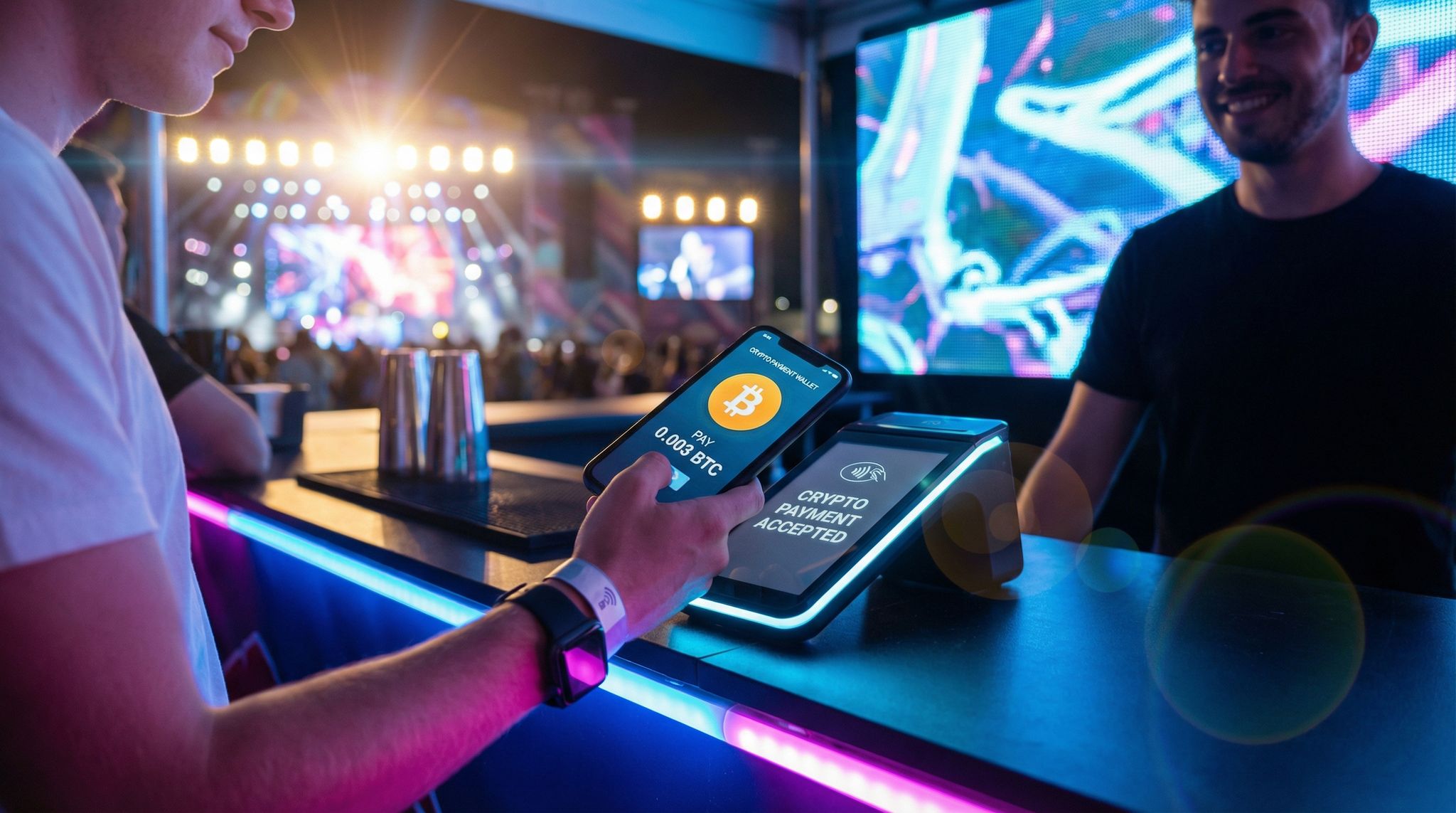
Introduction: The New Frontier of Event Payments
Crypto Hype vs. Real-World Adoption
The idea of buying concert tickets or beer with Bitcoin sounded futuristic a few years ago. By 2026, that future is edging closer to reality – but is it mostly hype or a real convenience? Cryptocurrency payments at live events have gained buzz as a cutting-edge alternative to cash and cards. High-profile festivals and venues have made headlines by announcing crypto acceptance, sparking debates across the industry. Early trials show both promise and pitfalls. While interest in crypto at events is rising, mainstream adoption remains low despite continued penetration in the industry, and many organizers are wary of whether the benefits outweigh the challenges. This article cuts through the hype to examine if paying with Bitcoin or other digital currencies is a practical next-level convenience or just a headline-grabbing experiment.
Why 2026 Might Be a Turning Point
Several trends converge in 2026 to make this question timely. Major payment platforms are embracing crypto: PayPal’s new service now lets US merchants accept over 100 cryptocurrencies, allowing users to link wallets for easy payouts, converting them into a stablecoin for easy payouts. Visa, Stripe, and other processors are piloting crypto settlement, hinting that the infrastructure for crypto transactions is maturing. Meanwhile, cashless culture is the norm at events – many festivals already run on RFID wristbands and mobile wallets, implementing the right payment tech for seamless transactions, so adding a crypto option is a natural extension of going fully digital. Attendee demographics are shifting too. Surveys show younger audiences are more likely to own cryptocurrency, and tech-savvy festivalgoers are eager for new payment experiences. At the same time, organizers have fresh memories of 2022’s crypto volatility and high-profile failures, which temper enthusiasm. The stage is set with cautious curiosity: event professionals want to know if crypto payments can genuinely enhance the attendee experience or if they’ll introduce more headaches than convenience.
Common Questions from Event Organizers
Event organizers worldwide – from indie festival promoters to stadium executives – are asking practical questions:
– “Will accepting crypto boost ticket sales, or will hardly anyone use it?”
– “How would we actually implement Bitcoin payments for tickets or merch?”
– “What if the price of crypto swings wildly during our event?”
– “Is it secure? Could transactions be faked or lost?”
– “Do we need special tech at the gate or bar to handle crypto?”
This guide will demystify crypto payments at events by answering these questions with real-world examples, hard-won implementation lessons, and an objective look at the pros and cons. By the end, you’ll have a realistic roadmap for when embracing crypto makes sense – and how to do it right alongside traditional payment systems.
Benefits of Accepting Cryptocurrency at Events
Instant, Borderless Transactions
One of the biggest touted benefits of crypto payments is the ability to transact instantly across borders. Traditional payments, especially international credit cards or bank transfers, can incur exchange fees or delays. Cryptocurrencies like Bitcoin and Ethereum allow borderless payments that aren’t tied to any one country’s banking system. For global events or those with a significant percentage of international attendees, this can simplify things – an attendee from Berlin can pay the same way as one from New York without worrying about currency exchange. In theory, crypto transactions can be fast and frictionless. Modern blockchains and layer-2 networks offer confirmation times of seconds to a few minutes. For example, Ethereum’s recent upgrades have reduced congestion and made transactions quicker, lowering costs for network registration. And Bitcoin’s Lightning Network enables near-instant payments with negligible fees, which could be ideal for high-volume, small purchases like drinks at a festival. The result could be shorter lines and a smoother purchase flow if implemented well, similar to what ultra-low-latency cashless RFID systems achieve at large festivals. The borderless nature also means events can tap into broader audiences – a fan in another country who holds crypto might find it easier to pay in Bitcoin than to deal with an unknown foreign payment portal.
Lower Fees and New Revenue Streams
Another motivation for organizers is the potential for lower transaction fees. Credit card processors typically charge around 2-3% per transaction, which adds up when selling thousands or millions worth of tickets and concessions. Crypto payment processing fees can be lower: using a direct blockchain transaction might cost a flat network fee (which varies but can be pennies on certain networks), and some crypto payment processors charge around 1% or less. For instance, PayPal’s crypto merchant service charges a 1.5% fee after an introductory 0.99%, helping merchants increase profit margins – still lower than many credit cards. Over time, saving a percent or two on each sale can significantly improve margins for events with tight budgets. Additionally, accepting crypto can unlock new revenue streams in unexpected ways. Crypto enthusiasts often seek out places to spend their holdings – there are cases of fans purchasing VIP packages or large merch orders in Bitcoin, something they might not have done with cash. Some events even experimented with their own tokens or NFTs as part of VIP ticket packages, creating collectible value on top of the event experience. While this veers into advanced territory, forward-thinking festivals are already exploring hybrid models (like offering exclusive NFT collectibles that can be bought with crypto) to generate buzz and extra income. This overlaps with trends in fan engagement – for those interested in deeper innovations like fan tokens or NFT ticketing, several festivals have launched blockchain-driven fan programs – though that’s beyond pure payments, it shows the revenue potential of embracing crypto and blockchain holistically.
Tech-Savvy Branding and PR Appeal
In a competitive event landscape, being seen as an innovator can boost an event’s brand. Accepting cryptocurrency is still novel enough in 2026 to generate positive PR and excitement, especially for events targeting a younger, tech-savvy crowd. Media coverage often follows the “firsts” – for example, when a regional music venue or festival announces Bitcoin payments, it tends to get press attention (at least in tech circles) as a pioneering move, such as the Black Iris Social Club accepting Bitcoin and other cryptocurrencies for purchases. This publicity can raise an event’s profile beyond its usual audience. More importantly, it signals to attendees that the organizer is forward-thinking and trying to enhance the fan experience with modern technology. In a world where festivals compete on creative offerings, having a crypto payment option could set an event apart (even if only a niche portion of attendees use it). The mere option might attract crypto enthusiasts to attend. For instance, a festival that publicly embraces crypto might see increased chatter in online communities and shares on social media by the crypto community – essentially free marketing. It’s similar to how offering cutting-edge biometric payments or AR experiences can brand an event as cutting-edge; indeed, some venues are simultaneously testing biometric payments alongside crypto to be at the forefront of convenience tech, continuing blockchain conversations post-pandemic. The key is to back up the hype with seamless execution – because a tech failure would turn PR upside down, a point we’ll revisit in challenges.
Ready to Sell Tickets?
Create professional event pages with built-in payment processing, marketing tools, and real-time analytics.
Enhanced Security and Ownership Control
Cryptocurrency transactions, by design, don’t require sharing sensitive personal data like credit card numbers. For attendees worried about data breaches or identity theft, paying with crypto can feel more secure – there’s no credit card number to steal, and the transaction doesn’t expose personal info beyond perhaps an email. For organizers, chargeback fraud (a headache with credit cards) is virtually eliminated, because blockchain payments are irreversible by default. Once a ticket is paid for in Bitcoin and confirmed on-chain, the attendee can’t later dispute the charge to claw it back – this can reduce losses from fraudulent chargebacks. Some events have also explored issuing tickets as blockchain tokens to give attendees provable ownership, making ticket transfer or resale more transparent. While that veers into the realm of NFT ticketing, it dovetails with crypto payments. The core idea is that crypto can provide a very secure transaction layer. Advanced users might even appreciate paying from a cold wallet or using smart contracts for escrow in high-value VIP packages, though those remain edge cases. Importantly, security is a double-edged sword – if someone loses access to their crypto wallet, there’s no bank to call. We’ll address later how to handle those support issues. But overall, when done right, crypto can add a layer of security and trust: no more “card declined” errors due to bank fraud flags, and a reduced attack surface for hackers targeting payment systems.
Beyond the financial transaction itself, the underlying technology enables robust blockchain ticket verification. By linking the payment directly to a unique, cryptographically secure token (like an NFT), organizers can virtually eliminate counterfeit tickets. When an attendee arrives at the gate, scanners verify the token’s authenticity on the public ledger in milliseconds. This transparent verification process not only stops scalpers from selling duplicate QR codes but also gives venue operators a real-time, immutable record of exactly who holds valid entry rights at any given moment.
Challenges and Risks of Crypto Payments
Volatility: Handling Price Swings
The volatility of cryptocurrencies is the most commonly cited risk. Prices of Bitcoin, Ethereum, and others can swing dramatically even within a day. For an event organizer, this creates uncertainty: if you sell a $500 ticket for 0.015 BTC, that Bitcoin might be worth $480 or $520 by the time you actually settle it. A sharp overnight drop could effectively discount your revenue. This volatility risk is a major reason many events haven’t embraced crypto more fully. However, there are mitigation strategies. One approach is using stablecoins (cryptocurrencies pegged to fiat currency, like USD Coin (USDC) or Tether (USDT)) for transactions. If an attendee pays $20 worth of USDC for a t-shirt, the value is $20 – it doesn’t fluctuate. Some events that accept crypto encourage stablecoin use for this reason. Another common strategy is instant conversion: using a payment processor that converts the crypto to your local currency the moment it’s received. For instance, an event could accept Bitcoin at checkout via a service like BitPay or Coinbase Commerce, which immediately turns it into USD or EUR for the organizer. This way, the event isn’t holding volatile crypto – they get fiat in their account, and the risk (and upside) of price changes is borne by the payment processor or the attendee during the transaction window. Of course, converting removes some of the true crypto aspect, but most organizers are interested in the tech convenience, not speculating on coins. It’s worth noting that during extreme volatility, even instant conversion can have slight slippage or be temporarily paused if liquidity issues arise. Transparent communication with finance teams is crucial: you’ll need policies for whether you hold any crypto as an asset or always convert, and how to account for any gains or losses if you do hold it. Many events simply choose not to hold it at all to avoid turning their ticketing department into a mini hedge fund. In summary, volatility is a real challenge but can be managed by pegging to stable value – either via stablecoins or immediate conversion to fiat.
Transaction Speeds and Network Congestion
While crypto transactions can be fast, they’re not always instant like swiping a card. Transaction speed depends on the blockchain and current network load. Bitcoin’s base layer averages ~10 minutes per block confirmation, which is far too slow at a busy ticket gate or bar queue. Ethereum is faster (a block in ~12 seconds), but in periods of congestion a payment could still take minutes to confirm, especially if the user doesn’t pay a high gas fee. Imagine a thirsty attendee waiting for confirmation on the blockchain to get their beer – not a good experience. Some early attempts at on-site crypto payments learned this the hard way. For example, one large festival in the Netherlands piloted Bitcoin payments for drinks, but had to carefully manage it because on-chain transactions would have been impractical mid-festival, highlighting the need for the right payment tech. The solution was to use Lightning Network for Bitcoin (which settles in seconds) or to accept on trust and batch-settle later – but the latter reintroduces some risk. Another approach is using private or centralized crypto systems: essentially letting attendees preload a festival account with crypto and then the transactions on-site are off-chain (similar to how cashless wristbands work internally). This requires a robust system and perhaps a custom integration, which can be complex. Scalability is also a question: if thousands of attendees decided to pay simultaneously in crypto, could the network handle it? In early 2025, popular blockchains faced congestion as usage spiked, leading to slow transactions and high fees at times, sparking debate throughout the music tech community. Newer blockchains or layer-2 networks claim high throughput, but an event organizer has to pick technology that’s proven. The bottom line: to ensure acceptable speed, events likely need to use crypto solutions designed for quick payments (Lightning, Solana, Polygon, etc.) rather than relying on slow main chains. This adds complexity, and if not done right, could result in longer lines – the very problem tech is supposed to solve. Many experts advise having a “speed threshold”: if a crypto payment isn’t confirmed in e.g. 30 seconds, have a protocol (like move that customer aside or complete the sale and get back to them). This is far from the seamless tap-and-go of contactless cards or RFID, so it’s a major practical hurdle.
Smooth Entry With Mobile Check-In
Scan tickets and manage entry with our mobile check-in app. Supports photo ID verification, real-time capacity tracking, and multi-gate coordination.
A critical metric for on-site operations is the average Bitcoin transaction confirmation time in 2026. While the base layer of the Bitcoin network still targets a 10-minute block interval, actual confirmation times can spike during periods of high global trading volume. For a festival bar or merchandise tent, waiting even five minutes is operationally impossible. This reality forces organizers to bypass base-layer settlements for on-site sales, relying entirely on Layer-2 scaling solutions like the Lightning Network or utilizing third-party payment gateways that assume the zero-confirmation risk on behalf of the merchant.
Low Adoption and User Education
Even if you build the crypto payment option, will anyone use it? As of 2026, mainstream attendee adoption of crypto payments is still minimal in most regions. Reports indicate that while interest is growing, actual usage at events remains niche, despite continued penetration of crypto in the industry. Many fans either don’t own cryptocurrency or don’t think to use it for purchases. In a likely scenario, an event might go through all the effort to enable Bitcoin payments and then see only a handful of transactions made in crypto. For instance, some sports teams that enabled crypto ticket purchases (like certain NBA franchises accepting Bitcoin or Dogecoin) found uptake to be extremely low – the vast majority still used credit cards. Part of this is due to convenience: paying with Apple Pay or a credit card is just easier for most people than dealing with a crypto wallet QR code. User education is a related challenge. If you offer crypto payments, you’ll need to explain to attendees how to use it. This may involve FAQs on your website like “How to pay with Ethereum,” instructions at checkout, or even an on-site help desk for crypto payments. Without clear guidance, users might be hesitant and revert to what they know. Additionally, there’s the issue of wallet compatibility. Newcomers might think they can pay with crypto via an exchange account screenshot or something – your system needs to guide them to use a proper wallet and ensure the right network (sending USDC on Ethereum to a Bitcoin address, for example, would be a disaster). All this adds friction, which can deter usage. It’s worth noting that over time this could change – younger generations are growing up with digital wallets. But in 2026, an organizer should have realistic expectations: offering crypto is likely a value-add for a small segment of attendees, not a majority. It might be similar to offering an installment payment plan – a great option for some buyers (like Buy Now, Pay Later plans boosting conversions for certain ticket purchases), but still not used by everyone.
Grow Your Events
Leverage referral marketing, social sharing incentives, and audience insights to sell more tickets.
Regulatory and Tax Implications
Accepting cryptocurrency isn’t just a technical decision, it’s a regulatory and financial one. Different countries treat crypto in various ways: in some places, crypto transactions are lightly regulated, whereas in others, using crypto for payments could trigger additional compliance requirements. For example, as of mid-2020s, some governments require KYC (Know Your Customer) checks on crypto transactions above certain thresholds, similar to bank transfers. If you suddenly start taking large Bitcoin payments, you might need procedures to ensure compliance with anti-money laundering laws. Taxation is another complex area. Many tax authorities consider cryptocurrency as property, not currency – meaning if your event holds crypto and it increases in value, that could be a taxable gain (and vice versa for losses). Even if you convert straight to fiat, you’ll need good records of the conversion rates for accounting. Accounting systems often aren’t set up for crypto, so your finance team might need to work out how to record a sale in Bitcoin. Using a payment processor that converts to fiat can simplify this, essentially making it like any other sale in your books. But if you decide to keep crypto (perhaps an event aimed at crypto enthusiasts might keep funds in crypto to pay crypto-native vendors), you take on the role of managing those assets on your balance sheet. In some jurisdictions, there are also regulatory considerations like obtaining a money transmitter license if you custody crypto on behalf of others (likely not applicable if you just accept payment and convert immediately). Legal advice is strongly recommended before turning on crypto payments. Large organizers have their legal teams review terms of service of crypto processors and any disclaimers needed for customers. One more thing: refunds in crypto can be tricky – if you refund someone in crypto and the price has changed, do you refund the original crypto amount or the fiat value? Most fair policies refund the original crypto amount, but if the value soared, the attendee gets a windfall; if it crashed, they may complain they didn’t get full value back. Defining these policies upfront (and stating them clearly in terms and conditions) is vital to avoid disputes.
Technical and Security Risks
Implementing crypto introduces new technical and security considerations. On the technical side, there’s the risk of software bugs – if you build a custom integration for crypto payments on your website or in your event app, a flaw could result in payments not being recorded, or funds sent to the wrong address (which in crypto, usually means irretrievably lost). You must thoroughly test any crypto payment flow. Security is paramount: accepting crypto means you’ll have wallets or accounts that store crypto (even if briefly). These can be targets for hackers. High-profile hacks of crypto exchanges and wallets are a reminder that if not secured properly, those funds could vanish. Using known, reputable payment processors can offload much of this risk – they handle the wallet security. But if you’re doing it yourself (say, a DIY approach where you display your own Bitcoin address for payments), you need to secure the private keys, possibly in cold storage or at least encrypted. Phishing and human error are another risk. Attendees might be tricked by fake payment URLs or scam QR codes if communications aren’t locked down. Imagine someone putting a fraudulent “Pay with Crypto” sign at your venue that points to their own wallet – unlikely, but possible in a large chaotic event environment. Staff need to be trained to only use official channels for payments. There’s also the risk of lost payments – if an attendee sends crypto to the wrong address or uses the wrong network (like sending Binance Chain tokens to an Ethereum address), the funds might be lost. Your customer support will then face dilemmas that traditional payments don’t have. Finally, consider system failures: if your crypto payment gateway goes down due to a network issue or a bug, do you have a backup plan? Redundancy is trickier here because you can’t exactly route Bitcoin payments through Visa if the blockchain is offline. We’ll discuss in later sections how to mitigate these technical risks with proper planning and partnerships. But any event considering crypto must treat it with the same seriousness as handling cash – with robust controls, audits, and fail-safes.
Infrastructure Requirements for Crypto Payments
Online Ticket Sales: Integrating Crypto at Checkout
Implementing crypto payments for ticket sales on your website is usually the first step, since it can be done in a controlled environment ahead of the event. There are two primary ways to integrate crypto at checkout:
1. Using a Crypto Payment Processor (Third-Party Service) – Many events choose services like BitPay, CoinGate, Coinbase Commerce, or even PayPal’s crypto checkout for a turnkey solution. These act somewhat like a PayPal or Stripe, but for crypto: at checkout, the user selects the crypto option, then the service handles the payment (often via a hosted payment page or widget). The service will usually let the user choose from multiple cryptocurrencies (e.g., BTC, ETH, USDC) and show a real-time conversion of the ticket price into the selected coin. Once the user pays (by scanning a QR code or clicking a wallet link), the service confirms the transaction and typically converts it to fiat for the organizer, depositing the money or sending it via bank transfer. This approach requires relatively little development – you just integrate via API or plugin – and it shields you from volatility if you auto-convert. It does, however, introduce fees (the processor’s cut) and dependency on that provider’s uptime. Make sure to compare providers on supported currencies, fees, payout options, and geographical availability (some only operate in certain countries).
2. In-House (Direct Wallet) Integration – This is more complex and usually only attempted by crypto-oriented events. It means you’d directly accept crypto to your own wallets. For example, your website could generate a unique Bitcoin address for each order and present that QR code to the buyer. The buyer sends BTC, and your system waits for detection of payment on the blockchain (perhaps one confirmation) then marks the order as paid. This gives you full control (no third-party fees and you keep the crypto), but it’s technically challenging. You’d need a secure way to generate and manage addresses (often using something like XPUB keys for Bitcoin), and a process to monitor the blockchain for incoming payments. You also then bear all custody risk of holding the crypto. For most general events, this is not worth the effort unless you have a strong internal blockchain dev team and specific reason to keep crypto assets. One compromise some do: a hybrid, where you manually handle a simple single wallet. E.g., “Send ETH to this address and email us the tx hash to verify.” This is very manual and doesn’t scale or provide a great UX, so it’s rare for ticket sales.
When evaluating blockchain payments for event ticketing, organizers must also consider the user journey from the initial click to the final digital asset delivery. Utilizing decentralized ledgers for ticketing doesn’t just process the financial transaction; it can automatically trigger smart contracts that issue the ticket directly to the buyer’s wallet. This dual-action capability ensures that the payment and the ticket issuance happen simultaneously, reducing the risk of failed deliveries or database desyncs that sometimes plague traditional ticketing servers during high-demand on-sales.
Data-Driven Event Marketing
Track ticket sales, demographics, marketing ROI, and social reach in real time. Exportable reports give you the insights to make smarter decisions.
No matter which approach, integration with your ticketing platform is crucial. If you use an all-in-one ticketing provider, you’ll need to see if they support crypto payments or can integrate with one of the crypto processors. Some modern ticketing platforms (like Ticket Fairy) emphasize integration flexibility – for instance, Ticket Fairy’s system integrates with many payment gateways (Stripe, Adyen, Razorpay, etc.), so in theory connecting a crypto-capable gateway or an API like Coinbase Commerce is feasible if not already available out-of-the-box. If your current ticketing system is more closed or doesn’t support adding new payment methods, you may have a decision to make: stick to traditional payments only, or consider switching to a more flexible solution. When evaluating ticketing systems, it can be helpful to examine how different platforms handle payment options and integrations, especially as new methods like crypto emerge. Remember to also test the user flow thoroughly. The checkout process should clearly present the crypto option and guide the buyer. It’s wise to have a sandbox mode where you can test buying a ticket with crypto to make sure the order confirmation, ticket issuance, and all accounting flow through properly.
On-Site Payments: Points of Sale and Hardware
Accepting crypto at the event venue for things like food, beverages, or merchandise adds another layer of complexity. Unlike online sales, on-site transactions need to be extremely fast and reliable even in challenging environments (crowds, possibly spotty connectivity). To enable crypto at the point of sale (POS), you’ll need to set up one or more of the following:
– Mobile POS Apps: The simplest method is often to use a mobile app on a tablet or smartphone that can generate QR codes and accept payments to your crypto account. Some crypto payment processors offer merchant apps – for example, an app where a cashier types in the amount (in fiat or crypto), it produces a QR code, the attendee scans and pays, and the app shows when payment is received. This route requires minimal hardware changes; you can even use existing tablets if they’re connected to Wi-Fi or cellular. However, you must consider the speed of confirmation – typically these apps use zero-confirmation or instantaneous detection which can be fine for smaller purchases, but have a small risk of double-spend (very low if using Lightning or if trust is okay for small amounts).
– Dedicated Crypto POS Terminals: There are emerging hardware devices specifically for crypto payments (some look like credit card terminals but with a QR scanner). These are popular in some retail settings and could be deployed at concession stands. They often support multiple cryptos and use either a vendor’s processing backend or your own wallet. The advantage is they’re purpose-built and sometimes can even print receipts. The downside is added cost and vendor lock-in. Given the experimental nature at events, many opt for apps before investing in hardware.
– Integration with RFID/Cashless Systems: If your event is already using RFID wristbands or a cashless card system, you could integrate crypto by allowing attendees to top-up their wristband via crypto. For example, an attendee could use your festival app or a top-up station to convert, say, 0.01 BTC into $300 of wristband credit. The wristband then works as usual at all vendors. This way, you’re not asking every bartender to handle crypto – only the centralized top-up points need to handle it. This was the approach that some European festivals explored: treating crypto as just another funding source for the existing cashless infrastructure, similar to how European festivals utilize wristband top-ups. It minimizes disruption on the front lines of service. The challenge is you need a real-time conversion system and possibly someone to manage rates and top-ups.
For organizers mapping out exactly how to accept contactless Bitcoin payments with QR code displays in 2026, the operational workflow has become remarkably streamlined. Modern point-of-sale integrations allow a vendor’s tablet to dynamically generate a unique, transaction-specific barcode on a customer-facing screen. The attendee simply opens their digital wallet, scans the display from a comfortable distance, and authorizes the transfer without ever handing over a physical card or touching a keypad. This touch-free approach not only speeds up bar queues but also aligns with the broader industry shift toward hygienic, frictionless event operations. To implement this successfully, venue managers must deploy a compatible merchant gateway that automatically calculates the real-time exchange rate and locks in the exact Satoshi amount required for the purchase.
Regardless of method, network connectivity at the venue is non-negotiable for crypto. Every crypto transaction (unless fully off-line token based, which is rare) will need an internet connection to either reach the blockchain or at least the payment processor’s server. This means your event’s network and Wi-Fi setup must be robust. We’re essentially adding one more critical system (payment) relying on connectivity, on top of your ticket scanning, live streaming, etc. For remote or off-grid locations, this is a serious consideration – you might need to invest in satellite internet backups or private LTE networks to ensure uptime, choosing the perfect payment tech infrastructure and implementing seamless transaction systems. It’s wise to consult a network infrastructure guide for events (like off-grid connectivity solutions for events in 2026) if your venue is challenging, because a dropped connection could mean no crypto payments can be processed at that moment. In practice, many events trialing crypto on-site start with just a few locations (say, one specialty bar or the merch booth) to contain any issues and learn before scaling wider.
Integration with Existing Systems
To avoid creating information silos, any crypto payment channel should be integrated with your overall event management systems as much as possible. For ticketing, that means crypto purchases should flow into the same database as other ticket orders – with indicators of payment method – so your check-in scanners or access control see those tickets as valid exactly like others. If you use an all-in-one platform, ensure that crypto payments won’t break things like automated attendee emails or capacity counts. It may require working with your ticketing provider’s support or technical team; some organizers have shared that close collaboration with multiple tech vendors is key to smooth integrations, especially when adding something novel like a crypto payment provider alongside a ticketing system.
For on-site sales, integration might mean feeding the crypto sales data into your point-of-sale system or inventory management. If your merch stand sells 10 shirts paid in Ether, you’d want that to reflect in the inventory count and sales total for the day. Some modern POS systems allow custom payment types – you might set up “Crypto” as a tender type. Alternatively, your crypto payment app might provide its own sales reports that you then manually combine with other sales. It’s important to plan how reconciliation will work: end of day, how do you tally cash vs card vs crypto? Ideally, your systems or procedures account for all, so nothing falls through the cracks. To facilitate this, it can be useful to do a dry run or pilot at a smaller event: integrate the crypto solution, make a handful of test purchases both online and on-site, and then run through your reconciliation process to see if finance can easily account for it. Think of it as an integration test across departments: technical, operations, and finance all need to handle the new payment method smoothly.
Finally, consider customer support integration. If an attendee has an issue with a crypto payment (say their transaction didn’t confirm but their crypto wallet was debited), who do they contact? Your support team should be briefed and ideally the issue should appear in whatever customer service dashboard you use. Often, this means having a way to look up crypto transactions associated with an order or purchaser. If you use a third-party processor, they might have a merchant portal you can check. Make sure your process for customer queries includes crypto scenarios. Training up your support or on-site customer service with basic crypto troubleshooting (e.g., “If a payment is pending too long, here’s what to do…”) will save everyone frustration.
Security Considerations and Best Practices
Securing Crypto Funds and Wallets
When you start accepting crypto, you essentially start holding digital cash – which requires strong security hygiene. If using a third-party processor that converts everything to fiat and deposits it to your bank, your security exposure is lower (mostly just securing your account logins with that processor). But if you hold any crypto funds or manage wallets, follow best practices:
– Use secure wallets: For any significant crypto amounts, consider using hardware wallets (physical devices that store keys offline) or at least encrypted software wallets. Avoid keeping large balances on devices that are regularly online or easily accessible.
– Implement multi-signature approval for organizational wallets. Multi-sig means two or more private keys are required to move funds. For example, your CFO and Tech Lead might both need to approve a transaction. This prevents any one person from running off with funds or a single compromised key from draining the wallet.
– Separate wallets per function: Keep ticket revenue in one set of wallets, on-site sales in another, etc. This compartmentalization can make accounting easier and limit damage if one wallet is compromised.
– Immediately transfer out large accumulations. If you suddenly receive 50 ETH from high ticket sales, you might automatically sweep most of it to a more secure cold wallet or convert to fiat, rather than letting it sit in a hot wallet. Many payment processors even auto-transfer to your secure wallet after each transaction or each day.
– Protect private keys and recovery phrases. They should be treated like crown jewels. Use encrypted storage and limit access to a need-to-know basis. Consider one or two trusted individuals who hold backups, stored in secure physical locations (like vaults or safes). This protects against both cyber theft and someone losing a password.
Additionally, insurance options are emerging. Some providers or insurers offer policies against crypto theft for business accounts – though these may still be niche and costly. If you’re dealing with large sums and decide to hold crypto, it might be worth investigating. But for most events, the safer path is converting to fiat quickly and not holding large crypto balances for long.
Smart Contract and Platform Security
If your foray into crypto is simply accepting basic coin payments, you might not touch smart contracts. However, some advanced scenarios (like issuing tokens, or using stablecoin payment channels) could involve smart contracts. If so, audit any custom contracts thoroughly. Even experienced technologists have been burned by small bugs in smart contracts leading to big losses. Use templates and well-tested libraries when possible instead of writing from scratch. In general, stick to battle-tested solutions: for example, use the official Lightning Network wallets and protocols rather than some new unproven payment channel tech at your live event. This is one reason many organizers partner with known crypto payment processors – their technology is likely vetted across many transactions.
Beyond blockchain-specific security, don’t forget the basics of IT security: the devices (laptops, tablets) used in managing crypto payments should be kept up-to-date and free of malware. Enable two-factor authentication on any accounts (e.g., your Coinbase Commerce account login). Teach staff to recognize phishing – e.g., an email that looks like an automated crypto alert could trick someone into clicking a malicious link. It’s not unheard of for hackers to target companies announcing crypto adoption, hoping someone will slip up. Make sure your web developers also sanitize inputs and follow standard secure coding practices – a vulnerability in your website’s crypto payment integration could be exploited to redirect payments. Penetration testing or at least a code review by someone knowledgeable in crypto could be a worthwhile investment if you’re doing a custom build. It’s akin to how events handle credit card security – we train staff to guard terminals, we comply with PCI standards. Crypto might not have an official PCI equivalent, but applying the same rigor is wise.
Preventing Fraud and Scams
While crypto eliminates chargebacks, fraud can still occur in different forms. One scenario is price fraud – if your system relies on real-time price conversion (e.g., converting $100 to 0.0025 BTC at the moment of purchase), a malicious actor could try to manipulate or game that (although using trusted APIs and a short time window pretty much prevents this). More likely is social engineering or scams around the payment process. Attendees could be targeted by scams claiming “Send crypto to this address for a discount on tickets” or other unofficial deals. It’s important to clearly communicate how official payments work and that you do not, for example, ever ask people to send crypto via email solicitations. Stick to on-site or on-website transactions.
Another risk is fake QR codes at the event, as mentioned earlier. To counter this, if you do allow on-site payments, have all crypto transactions handled at official terminals or by staff – discourage any situation where a random person could put up a print-out for payments. Also, consider using static QR vs. dynamic: some systems use a static wallet address for all payments (simpler but less secure/organized) versus generating unique addresses per transaction (more secure but requires an active generation system). If static, someone could copy that and claim it’s theirs. So dynamic is preferable when possible.
One more subtle issue: double spending. On networks like Bitcoin, there’s a theoretical risk that someone could pay, get their goods, then try to broadcast a conflicting transaction that makes the first one invalid (if they controlled mining, etc.). In practice at an event scale this is extremely unlikely, especially for modest purchase amounts – a determined attacker likely wouldn’t bother for the price of a few drinks. And using Lightning or waiting for one confirmation essentially mitigates it. But just be aware of the concept. For larger items (like a $5,000 VIP table paid in crypto), you might have terms that require X confirmations or payment in a stablecoin, etc., to be extra safe.
Finally, maintain a fraud response plan: identify a point person or team who will monitor crypto transactions during the event. Unusual activity (like numerous failed payments, or someone trying to pay with obviously unsupported coins) should be flagged. If any security incident does occur – say a device with a crypto wallet is lost or an address is compromised – have a protocol to immediately alert the team, freeze that wallet (if possible), and investigate. This is similar to how you’d treat a lost cash box or suspicious credit card activity. Quick response can limit damage.
Privacy and Compliance
Crypto has a reputation for anonymity, but in truth, blockchain transactions are traceable and often subject to compliance rules. If your event is in a region with strict data privacy laws or financial regulations, you need to ensure that adopting crypto doesn’t accidentally cause a compliance breach. For instance, GDPR in Europe means if you’re collecting any personal data along with a payment (like an email associated with a crypto purchase), you must handle it properly and perhaps update your privacy policy. On the financial side, be aware of limits on cash-like transactions. Some countries consider crypto similar to cash for anti-money laundering, meaning large payments could require identity verification. If you’re selling a $10,000 sponsorship in Bitcoin, you might technically need to KYC that buyer – check local laws or consult a specialist. Thankfully, most ticket purchases are lower value and under thresholds, but large VIP packages or bulk token purchases deserve a review.
Using established payment processors can offload some compliance. Many crypto processors will handle things like sanctions screening (making sure you’re not receiving funds from blacklisted addresses) and can provide records needed for audits. If you run it yourself, you might need to use blockchain analysis tools for such purposes, which is likely beyond the scope of most event organizers. As always, aligning your approach with legal counsel advice is prudent when venturing into new territory like crypto. You don’t want a well-intentioned tech upgrade to inadvertently cause legal troubles. Often, the conclusion is it’s manageable – events, after all, have been dealing with cash (which is much more opaque than crypto) for centuries by implementing basic controls. Crypto is just a new form of cash-like value; standard principles of transparency and record-keeping apply.
Real-World Examples of Crypto Payments at Events
Festivals and Concerts Pioneering Crypto Payments
Some forward-thinking music festivals and concerts have dipped their toes (or jumped headfirst) into crypto payments. By 2025, a few prominent examples emerged:
– Consensus Festival (Austin, TX) – A unique hybrid of a blockchain conference and music festival, Consensus integrated Ethereum for all transactions on-site, creating unique opportunities with industry leaders. Attendees were provided a digital wallet pre-loaded with some crypto, and vendors from food stalls to merch accepted payments through a simple QR scan. This event, catering to crypto enthusiasts, was a natural testing ground and reportedly operated entirely on Ethereum transactions to showcase decentralized finance in action, unlike typical real-world settings. It doubled as an educational experience, but also proved that a closed-loop crypto economy can work at a live event – albeit one where the audience is highly crypto-literate.
– Electric Daisy Carnival (Las Vegas) – One of the world’s largest EDM festivals, EDC, publicly announced it would embrace Ethereum payments in 2025 for certain purchases at Electric Daisy Carnival in Las Vegas. This was a landmark because it’s a mainstream festival brand. EDC partnered with a crypto payments company to enable attendees to buy official merchandise and even some food/drink items with ETH at designated kiosks. They promoted it as a convenience for international attendees and a glimpse of the future. While traditional payments still dominated, this pilot generated buzz and gave organizers real data on usage and viability.
– Tomorrowland (Belgium) – Europe’s iconic mega-festival reportedly tested accepting crypto (Ethereum) for select VIP ticket packages and on-site experiences at Tomorrowland in Belgium. Tomorrowland is known for tech innovation (they’ve experimented with cashless tech for years), so adding crypto was in line with their brand. They took a cautious approach: limited items could be bought with crypto, and they closely monitored the process. An interesting aspect here was Tomorrowland’s global audience – with fans flying in from around the world, offering a universal payment option like crypto had a certain appeal. They also explored NFT collectibles tied to purchases, blending the payment with a digital souvenir.
– Smaller Niche Festivals – Beyond the giants, numerous indie festivals, especially those themed around technology, gaming, or blockchain, have accepted crypto for tickets. For instance, events like Lightning in a Bottle in California embraced sustainable tech and allowed Ethereum payments, aligning with their innovative ethos. Niche genre festivals and fan conventions have followed suit when their demographics overlapped with crypto users. These smaller events often share valuable lessons – usually organizing teams report that having a tech-savvy staff member or consultant was critical to handle the intricacies.
The experiences from these festivals show that crypto payments can work, but they often remain a minority of transactions. Organizers highlight the importance of choosing the right moment and scope for the pilot. Many started with pre-sale tickets or online merch sales in crypto before attempting the chaos of onsite payments. By learning in a low-pressure environment (like online sales where a 10-minute wait isn’t catastrophic), they refined processes for identity verification, confirmations, and customer support. Then, for onsite, they typically rolled it out at a single bar or merch tent rather than festival-wide on day one. This incremental approach prevented major disruptions and allowed training of a subset of staff who could become the internal experts.
Sports Venues and Ticketing Embracing Crypto
Professional sports have played a surprising role in normalizing crypto payments. Several teams and venues announced crypto initiatives:
– NBA and MLB Teams: The Dallas Mavericks (NBA) famously started accepting Bitcoin (and even Dogecoin) for tickets and merchandise as early as 2021, under owner Mark Cuban’s direction. By 2025, other teams like the Oakland Athletics (MLB) were selling season suites for Bitcoin, and the idea of paying your game tickets in crypto no longer felt abstract. However, uptake was modest – Cuban noted that while the option was there, fans weren’t using it en masse. It did serve as a PR boost and positioned the team as innovative. The key takeaway for events is that just because you build it doesn’t mean they’ll come – adoption needs time and perhaps incentives.
– Crypto.com Arena (Los Angeles): With naming rights sold to a crypto company, it’s no surprise this venue explored crypto payments. They enabled certain concessions and merchandise stands to take payments via the Crypto.com app (which supports various tokens). Attendees could buy a soda with Crypto.com’s token CRO or other crypto during select games. This was part promotional (to drive app usage) and part experiment. The venue integrated it with their existing POS by essentially treating the app’s QR code as a payment source (like scanning a mobile wallet). It highlighted the importance of partnership – working closely with a crypto company to leverage their tech and support made it easier to deploy.
– Soccer Clubs in Europe: Across the pond, football (soccer) teams in the UK and Europe started dabbling as well. Clubs like Benfica (Portugal) and some English Premier League teams allowed fans to purchase tickets or club merchandise with Bitcoin via their online stores. Often this was facilitated by a vendor like Utrust or BitPay. Given soccer’s massive global fan bases, accepting crypto was seen as a way to cater to international supporters buying from team shops. Again, volumes weren’t huge, but it showcased use cases like a fan in Asia easily buying a jersey from a European team using crypto without worrying about currency conversion.
– Venue Season Passes: A noteworthy case was a luxury suite membership at a major stadium being offered for crypto – essentially targeting crypto-rich clients. One arena offered a year-long VIP box for a certain amount of Bitcoin. They reported serious inquiries and a couple of sales, indicating that for high-end purchases, crypto can be attractive to those who hold significant digital assets and want to spend them in style.
For sports and large venues, integration often meant working through existing ticketing providers. If a team’s ticketing is handled by a big platform that didn’t natively support crypto, they had to create a workaround (sometimes a separate sales portal for crypto purchases). This is where management had to weigh if the juice was worth the squeeze. In most cases, these venues treated it as a parallel channel – small volume, not fully integrated – basically a beta test. The result: they caught headlines and learned a lot, but didn’t overhaul their main systems. As crypto matures, we may see deeper integration, particularly if payment giants or ticketing platforms add native support.
Conferences and Tech Events Leading the Way
Unsurprisingly, blockchain and tech conferences themselves have been among the earliest adopters of crypto payments for event registration. Events like “Bitcoin 2025” conferences, Ethereum meetups, and various Web3 summits not only accept crypto – some mandate it. For example, Bitcoin Amsterdam, a major European Bitcoin event, sells tickets exclusively in BTC via their platform, providing FAQ details on ticket registration. These events operate almost as showcases for the technology: attendees expect a fully crypto-enabled experience, from tickets to buying coffee at the venue (often with Lightning Network payments to speed things up). One could argue these are niche cases since the whole point is crypto, but they’ve served as real proving grounds for the payment flow and infrastructure.
In the broader tech space, major events like CES (Consumer Electronics Show) have not adopted crypto for attendee payments (too mainstream, and unnecessary friction for their audience), but some mid-size tech expos have tried offering a crypto payment option to align with their forward-looking image. For instance, a leading AI conference in 2025 offered a discount if you paid in a particular cryptocurrency that was a sponsor of the event. This incentive model (small discounts or perks for paying with crypto) is a clever way to encourage usage, essentially offsetting the user’s perceived hassle or transaction fee. The sponsor covered the cost difference, and in return they got more people using their coin – a win-win promotion.
Tech events also provide insight into infrastructure: many have tested blockchain-based ticketing (tokens as tickets) in tandem with payments. The general finding is that purely blockchain-based ticketing is still in its infancy – it can work, but it’s not as seamless yet as traditional methods, and it usually requires attendees to be a bit techy. That’s why most events, even crypto-friendly ones, still issue regular QR code tickets (or RFID badges) and just use crypto for the payment part. They keep the user experience of ticket scanning and entry separate from the crypto realm to ensure reliability (after all, scanning a PDF or RFID is instantaneous and offline-capable, whereas checking a wallet on-chain isn’t).
The key lesson from these real-world examples: start small and learn. The events that had smooth sailing were those that tightly controlled the rollout – a targeted use case, a tech-savvy subset of attendees, and lots of testing. Those that experienced issues often admitted they were too ambitious too fast, or they under-estimated the need for specialized knowledge. Hearing from early adopters, one recurring theme is the importance of having team members or partners who deeply understand both event ops and crypto tech. This ensures that unrealistic plans are caught early (e.g., expecting a blockchain transaction to settle as quickly as a credit card swipe) and that contingency plans are in place.
Lessons Learned from Early Adopters
From all these examples, what have we learned?
– Crypto users will use crypto if it’s easy: Adoption was highest when the UI was seamless – e.g., at festivals where attendees were given a ready-to-use wallet and simple instructions for payment integration and future event discounts. When users had to jump through hoops (like copy an address, switch apps), many gave up. Convenience is king; ironically, to prove crypto’s convenience, you might need to do extra setup work (like pre-issuing wallets or integrating with popular wallet apps via QR codes).
– Have a backup for everything: Early adopters stressed having a fallback. If the crypto payment fails for any reason, staff should be able to politely move the customer to another method (maybe even comp the item if it was a small purchase to avoid an escalated issue). Redundancy in connectivity (Wi-Fi and cellular, for instance) was key at the point of sale.
– Staff training and empowerment: Events that succeeded trained a subset of staff extensively on the crypto system. These became the go-to “crypto captains” who could assist colleagues and attendees. They wore special badges or something identifying them as knowledgeable. Also, those staff had direct lines to tech support in case something went wrong, to get quick guidance. One festival organizer mentioned they ran through mock scenarios with staff: “What if the payment doesn’t go through after 30 seconds? What if a customer sends to wrong address? What if our app shows an error?” – giving the team playbooks to handle each.
– Marketing vs reality: A few events admitted that their crypto payment option was more of a marketing play – and that’s okay if acknowledged. They didn’t actually expect many to use it, but the announcement garnered positive buzz. However, even in those cases, they had to ensure the few users who did try it got a good experience, or the PR would turn negative. So they still invested in making it solid. Essentially, don’t launch it just for show without doing the homework, because if it fails publicly, it can generate bad press about “Festival’s Bitcoin payments flop”.
– Monitor and iterate: Those who continue to offer crypto treat the first year as a beta. They gather metrics – how many used it, what was the average transaction size, which crypto was most popular, at what times did issues occur, etc. Then they refine: maybe they’ll drop a coin that no one used, or integrate a faster network after seeing slowdowns. Like any tech feature, it’s an iterative process to get right.
– Community engagement: Interestingly, events found that engaging the crypto community can help. Some brought in blockchain meetup volunteers as on-site assistants, or had a booth by the local crypto club to help attendees set up wallets. It fostered a sense of community and offloaded some work from event staff. Also, hooking into the enthusiasm of crypto communities (through forums or social media) helped spread the word – basically leveraging word-of-mouth marketing among crypto enthusiasts, who are thrilled to see real-life use and will become unofficial ambassadors for your event if you welcome them.
Integrating Crypto Payments with Traditional Systems
Offering Crypto Alongside Traditional Methods
No savvy event organizer is suggesting replacing all traditional payment methods with crypto. The practical strategy is offering crypto as an additional payment option alongside credit cards, mobile payments, and cash (where cash is still accepted). The goal is to integrate it such that it feels like just another option in the checkout flow or at the register. To do this effectively, maintain consistent pricing and policies across methods. For example, if you sell a ticket for $100 or the equivalent in crypto, make sure any service fees, refund rules, etc., apply equally. One mistake to avoid is creating totally separate purchase flows – e.g., a “crypto tickets site” with different terms – unless absolutely necessary. That can confuse customers and even create arbitrage or customer service headaches.
Alignment with existing business processes is key. For instance, if you typically do early-bird sales through one ticketing platform and phase into general sales, the crypto option should ideally be available throughout, or you clearly communicate if it’s only for certain phases. A good integration means a customer who might initially check out with crypto but has an issue can still switch to card or vice versa without starting from scratch. In technical terms, this might mean if a crypto transaction isn’t completed within a certain time, your system cancels it and releases those tickets back to inventory, allowing the customer to choose another method. These details ensure crypto remains a convenience add-on, not a blocker.
On-site, the parallel approach means you never want a point where crypto is the only way to pay for something essential (unless you’re intentionally running a crypto-only promo booth as a novelty). Every bar, merch stand, etc., should still take normal payments; crypto is just a bonus option where feasible. This parallel rollout was practiced at events like EDC Las Vegas and Tomorrowland – only some lanes or specific registers took crypto, the rest were standard. Over time, if crypto proved extremely popular (which hasn’t happened yet at scale), one could expand, but for now it’s additive.
Integrating with traditional systems also means preparing your staff and signage. For example, if an attendee walks up to buy a t-shirt, they should see logos or notices of all accepted payment types (Visa, MasterCard, Apple Pay, Bitcoin, Ethereum, etc.). Staff should be able to answer “How can I pay with Bitcoin here?” accurately: perhaps pointing them to a specific register or pulling out a tablet with the crypto app. Some events gave staff cheat sheet cards with step-by-step of the crypto process, so even those not primarily handling it could assist curious customers. This cross-training prevents a scenario where an attendee asks about crypto payment and gets a blank stare – that would undermine the integration effort and the attendee’s confidence.
Instant Conversion and Stablecoin Strategies
As mentioned earlier, one popular integration strategy is instant conversion of crypto to fiat. In practice, this usually happens via your payment processor or exchange integration. When a customer pays, say, 0.005 BTC for a $150 ticket, the processor immediately converts that to $150 (minus fees) and deposits it to your account. This strategy means your finance team and your primary bank accounts see no difference between a crypto sale and a credit card sale – everything ends up in dollars, pounds, euros, etc. It simplifies accounting and removes the volatility risk. The important integration point is making sure those conversions are recorded properly in your sales systems. Your ticketing or POS system might get a webhook or callback from the processor saying “Payment received, order confirmed.” That victory signal should carry the info that it was via crypto (maybe for your analytics later), but the amount should be locked in your normal currency.
One downside of conversion can be the fees or conversion rates – watch out that the rates offered by the processor are fair and clearly defined. Some processors charge a spread on the exchange rate. For transparency, you might want to lock a rate for a few minutes for the customer during checkout, which most systems do to account for crypto price fluctuation during payment. If that timer expires, it may requote the price. Ensure that’s communicated to users – e.g., “Complete payment in 15:00 minutes or the price will refresh.” This avoids confusion if someone takes too long and suddenly owes slightly more or less crypto.
Another approach is using stablecoins for integration. If you’re comfortable holding digital assets as long as they’re stable in value, you could encourage (or limit) crypto payments to stablecoins like USDC, USDT, or a local currency stablecoin. For example, an Australian event might say “We accept crypto – USDT accepted at our current AUD exchange rate.” This way, each transaction is effectively in a dollar-pegged token, which you could keep in crypto form (and maybe even pay some vendors or artists with, if they want) without worrying about day-to-day fluctuation. Some crypto payment platforms allow you to choose which coins you accept – an event could opt to only take stablecoins (plus maybe the major ones like BTC/ETH for flexibility but internally convert them). The benefit of stablecoins is you might reduce conversion steps: you could conceivably hold USDC from ticket sales and then convert to fiat when needed or even spend it if you have use for it (like paying a DeFi-savvy contractor). Just remember stablecoins still have to be managed and potentially cashed out through exchanges or financial institutions, which introduces some overhead.
From a user perspective, stablecoin payments are not much different – they likely have to have stablecoins in their wallet, which not all casual users do. But crypto-savvy customers may appreciate the option, and it signals that you’re trying to minimize risk. One integration tip: if you use stablecoins, double-check with your processor or exchange about liquidity and limits. Stablecoins usually have good liquidity, but if you plan to convert millions, you want to ensure the platform can handle it without slippage.
Payment Gateway and Platform Choices
Choosing the right payment gateway for crypto is a critical decision. When integrating with traditional systems, you want a gateway that “plays nice” with your existing tech stack. Key factors to consider:
– Compatibility with your sales channel: Does the gateway have ready-made plugins or APIs for your ticketing website, mobile app, or on-site system? If you run a Shopify merch store, for example, some crypto gateways have plugins that make adding a crypto option trivial. For a custom event registration site, look for well-documented APIs and perhaps client libraries in your programming language.
– Currency support: Ensure the gateway supports the cryptocurrencies you think your audience might use. Common ones are BTC and ETH of course, but if your audience is more likely to use others (maybe a regional favorite or something like Solana, or asking about Dogecoin), see if those are on the list. Also, check what fiat currencies it can settle in – ideally your local currency to avoid double conversion.
– Fees and payout: Compare transaction fees. Some gateways charge a flat percentage, some add a small fixed fee. Also, consider payout frequency – do they settle daily, instantly, weekly? And via what method – wire transfer, ACH, into your bank, or transfer crypto to your exchange account? These logistics matter to cash flow. A hidden cost to note: if the gateway doesn’t auto-convert and you have to manually move funds to an exchange to sell, you’ll incur exchange trading fees too.
– Reputation and support: Given this is still a somewhat nascent area, pick a gateway with a solid reputation and good customer support. If something goes wrong mid-event, you need to be able to reach them. Look for providers with 24/7 support and ideally phone support during critical hours. Also check their uptime track record – crypto markets run 24/7, so there’s no concept of banking hours; your gateway needs to be reliable at all times.
– Security and compliance credentials: Use gateways that are known for strong security (no major hacks) and that comply with regulations (for instance, in the US, a gateway operating legally will be FinCEN registered). This reduces the chance that you’ll wake up to a frozen account due to regulatory issues.
As the market matures, organizers are also looking closely at specialized B2B tools for handling large-scale funds. For instance, a common point of research is finding a reliable Coinify crypto mass payments review for 2026, as platforms like Coinify and its competitors expand their enterprise offerings. These mass payment solutions are particularly attractive for festival producers who need to disburse funds to hundreds of international artists, vendors, or affiliate promoters simultaneously. Evaluating these platforms involves looking at their batch processing capabilities, fiat-to-crypto conversion rates, and automated compliance reporting, ensuring that bulk payouts are as seamless as individual ticket purchases.
Some event organizers opt for mainstream platforms adding crypto capabilities – for example, since Stripe has been piloting crypto payouts and partnerships, one might be more comfortable when a familiar name like Stripe or Adyen integrates a crypto option, rather than a crypto-only startup. By 2026, we expect more of these traditional payment giants to have offerings. In that case, adding crypto might be as straightforward as ticking a box in your payment settings. Keep an eye on your current payment providers’ roadmaps; they might save you the trouble of onboarding a separate crypto-specific platform.
Staff Training and Operational Integration
Bringing a new payment method into the mix means training your team to handle it as smoothly as any other method. A well-integrated crypto payment process looks invisible to attendees – they shouldn’t see fumbling or confusion from staff. To achieve that, plan a comprehensive training module for relevant staff well before the event. Training should include:
– Technical how-to: If a staff member is at a POS that will accept crypto, they need to know step by step how to initiate a crypto transaction. This might be using a special tablet or an app on the register system. Walk them through screens, from selecting crypto as tender to confirming a sale. Provide hands-on practice with test transactions (perhaps using a testnet version of the crypto or small real amounts). People learn best by doing, so simulate a pretend customer scenario multiple times.
– Customer interaction scripts: It helps to arm staff with simple explanations for attendees. For example, if someone wants to pay with crypto, the staff could say: “Sure, we accept crypto – I’ll generate a QR code you can scan with your wallet. Once it shows paid on my end, you’re all set!” This kind of confident explanation reassures customers and avoids any tech intimidation. If an issue arises (like a delay), staff can say: “It’s taking a little longer to confirm – it usually goes through in a minute or two. If not, we have other options.” and be ready with a backup. Training might even include some basic crypto concepts so staff aren’t utterly perplexed – they should at least know that a confirmation delay might happen, that the price is converting at the time of sale, etc.
– Troubleshooting: Provide a FAQ for staff of possible issues and responses. E.g., “What if the QR code isn’t scanning?” (Answer: try increasing screen brightness or have the user manually copy the address), “What if the transaction is pending a long time?” (Answer: politely ask if they can check their wallet if it sent with enough fee, or if comfortable, complete the order with a promise to follow up if it later doesn’t confirm – depending on your risk appetite). Also instruct on what not to do – like never ask the customer for their private keys or to do anything insecure.
– Escalation paths: Identify if there’s a dedicated support person or hotline. Staff should know who to call or radio for help if a transaction issue goes beyond their training. Maybe your event IT or finance manager is on-call for crypto issues. In some cases, contacting the payment processor’s support might be necessary – so have those numbers handy too.
– Security reminders: Remind staff that crypto devices must be guarded like a cash drawer. Don’t leave a tablet unlocked and unattended. If a device is lost, report immediately. And never type seeds or passwords into any device if prompted unexpectedly – basically, be alert for phishing on the devices.
It might sound like a lot, but remember that we train staff for new technology all the time in events – think of when RFID wristbands were first introduced, or when mobile scanners replaced paper checklists. The principles are the same: invest time in staff training to ensure smooth adoption of new tech. Often a small group gets more intensive training (superusers) and the rest get basic training, with the knowledge that they can call a superuser for help. This tiered approach can work well for crypto payments – maybe each sales area has one person deeply trained, others just know the basics.
Operational integration also involves cash management adaptation. For example, end-of-day closing procedures might need to include printing out a crypto sales report and verifying it. Your finance team might need to integrate that into their reconciliations. Make sure those staff (accountants, etc.) are also introduced to how the system works, not just the frontline staff. Sometimes, a misalignment happens where the front sells something in crypto but back-office doesn’t know how to log it properly, causing confusion after the event. Integrating crypto is as much a people/process challenge as a tech one – get all stakeholders, from IT to accounting to customer service, on the same page early on.
When Does Embracing Crypto Make Sense?
Audience Demographics and Demand
Before rushing to implement crypto payments, event organizers should honestly evaluate whether their audience wants or needs this option. Crypto payments make the most sense if a substantial segment of your attendees are likely crypto users. Demographic factors play a role – younger audiences (Gen Z, Millennials) have higher crypto ownership rates than older groups, although interest spans all ages to some degree. If you run an anime gaming convention or a music festival with a futuristic theme, chances are higher that many attendees have digital wallets and would appreciate the option. On the other hand, if you organize a classical music series with an older subscriber base, crypto payments might go untouched and only add confusion.
One way to gauge interest is to survey your audience. A simple question in a pre-event email or on social media like “Would you use cryptocurrency to buy tickets or merch if we accepted it?” can yield insight. If you get a big positive response (and maybe follow-up like “which crypto would you use?”), that’s a green light. If it’s met with silence or indifferent feedback, that suggests few are clamoring for it. You could also observe behavior: have attendees ever asked customer support if they can pay with crypto? Some events decided to add the option after getting repeated inquiries from fans, or noticing a segment of their community is heavy into NFTs and crypto.
Geography and local adoption matter too. In some countries, crypto usage for payments is more common – for example, in parts of Latin America, due to currency instability, people are more fluent with using crypto day-to-day. If you have a sizable audience in such regions, offering crypto might not only make sense, it might eventually become expected. Contrast that with countries where credit card penetration is high and crypto is mostly seen as an investment, not a payment method – there, the use-case is weaker. If your event draws an international crowd, crypto can be a way to offer a universal method that bypasses needing multiple currency options (e.g., large conferences often have attendees from 50+ countries; accepting crypto could complement credit card options for those who’d rather not deal with currency conversion fees on their cards).
It’s also worth considering the type of event experience you want to craft. Some cutting-edge festivals want to cultivate an image of being ahead of the curve. Even if only 5% of attendees use crypto, the fact that it’s there contributes to the overall innovative atmosphere. Other events might prioritize simplicity – a folk music festival in the countryside might consciously avoid overly high-tech solutions to keep the vibe simple, in line with the concept of avoiding event tech overload when it’s not adding value. In those cases, adding crypto payments might conflict with the attendee experience goals.
Event Type and Scale Considerations
The scale of your event will influence whether crypto payments are feasible or beneficial. For small events (hundreds of attendees), implementing crypto could be overkill if only a handful might use it, and you may not have the IT resources on hand. However, small events can also be agile testbeds – a local meetup or a boutique festival could try crypto as an experiment more easily than a massive event with entrenched systems. The stakes are lower, and any issues are contained. On the flip side, mega-events (tens of thousands of attendees) have more resources to deploy technology, but they also have near-zero tolerance for disruptions. A large music festival might pilot crypto in one controlled area rather than across all vendors because an unproven system at scale could create bottlenecks that affect thousands of people.
The type of event matters: Conferences and trade shows often have more controlled environments and tech-savvy participants, making them suitable for crypto payments. They also usually have robust IT infrastructure (good connectivity, etc.) as they might already support things like event apps, live streaming, etc. Music festivals and concerts are trickier given the fast-paced, sometimes chaotic environment, but they are also where cashless innovation has thrived (RFID wristbands, mobile pay) so crypto is a logical next experiment in that domain. Sports events that are recurring (like a season of games) could try crypto at one or two games as a trial and expand if it goes well, since they have multiple iterations to refine the process.
Consider also if your event or organization has a philosophical or strategic reason to embrace crypto. For example, a festival focused on decentralization, freedom of expression, or tech utopia themes might adopt crypto as part of its ethos. Or a company-run event by a tech firm might do it to align with their company’s innovation goals. If it aligns with the brand or mission, it can resonate more authentically with attendees. Conversely, doing it just because it’s trendy, without a clear fit to your event’s context, might ring hollow.
Finally, scale and type influence risk tolerance. A one-off charity event might not want to risk any hiccup that could hurt fundraising, so they stick to what’s proven. A recurring festival might take a longer view – willing to invest in a new system that might stumble in year one but pay off in years to come. Scale also influences how you handle things like volatility: a huge event with millions in sales could see big nominal impacts from price swings, whereas a small event with a few thousand in crypto sales might treat any gains/losses as negligible rounding errors in the budget.
Market Conditions and Timing
Timing is everything, especially with something as hype-driven as crypto. If you roll out crypto payments just when the market is in a slump or there’s negative press (like an exchange collapse or regulatory crackdown), audience sentiment might be poor. On the other hand, if crypto is on an upswing and lots of positive buzz (like Bitcoin hitting new highs or mainstream companies integrating it), people might be more eager to use it. This is somewhat out of your control, but you can choose how you message and time your initiatives. For instance, some events plan announcements about accepting crypto to coincide with related news or partnerships (maybe launching it when a sponsor in the crypto industry comes on board, so there’s a joint PR boost).
Regulatory timing matters too. Ensure you’re not launching something right when laws are changing that could affect you. For example, if your country is about to roll out new rules for crypto transactions or taxes next quarter, either wait to understand the impact or structure your system to readily comply. A positive regulatory development (like clear legalization or recognition of crypto payments) could also encourage adoption – you might even reference it in communications to reassure users that it’s all above board.
Another timing factor: consider event cashless evolution. If your event is just transitioning from cash to digital in general, adding crypto at the same time might be too much change at once. It could be wiser to first implement a stable cashless system (like RFID or mobile pay) and let attendees get used to that, then introduce crypto as an additional novelty later. However, if you’ve been cashless for years and staff and attendees are pros at digital payments, they may be ready for another option to be thrown in without overwhelming them.
Also, if you find that key components are not ready – for example, you want to accept crypto on-site but realize your venue’s Wi-Fi is spotty – then the timing isn’t right until that infrastructure is improved. Or if the only payment processor available in your region doesn’t meet your needs, perhaps wait until a better partner is available. Rushing to do it “in 2026” just to hit a trend might backfire if conditions aren’t favorable.
In summary, crypto payments make sense when: your audience is inclined to use it, your event scale and type can accommodate a new method, and the broader market and timing align to reduce risk. If those stars aren’t aligned, it may be better to prioritize other tech improvements that deliver clearer ROI in the short term, and keep an eye on crypto for a future year.
Step-by-Step Guide to Implementing Crypto Payments
Planning and Feasibility Assessment
Step 1: Team Discussion and Goals – Start by gathering your key stakeholders (finance, ticketing, operations, IT, marketing) to discuss why you want to accept crypto and what success looks like. Are you doing it to increase sales, as a marketing angle, or to provide convenience to a certain attendee segment? Defining the goals will guide decisions. For example, if the goal is marketing buzz, you might start with a high-profile but small-scale implementation that’s easy to publicize. If the goal is revenue, perhaps you focus on ticket sales in crypto to potentially unlock a new customer base.
Step 2: Research and Feasibility – Investigate what it would take technically for your specific event. Research suitable crypto payment providers (as covered in prior sections). Check if your ticketing platform already has integrations or if they can support a manual process. Identify potential legal issues by consulting with legal counsel early – you don’t want to find out later that you needed a specific license. Also, assess internal capability: do you have someone on the team knowledgeable about crypto? If not, consider hiring a consultant or assigning a tech-savvy team member to deep-dive and become the internal expert. During this phase, reach out to a few similar events who have done it (if possible) – sometimes a quick conversation can provide valuable reality checks. The lessons learned by early adopters portion of this article can be a starting point to generate questions for them.
Step 3: Cost-Benefit Analysis – Any new payment method has costs, so outline them. Include things like: payment processor fees, any hardware (maybe you need tablets or an upgraded Wi-Fi AP at that crypto-enabled bar), development costs (for integration or UI changes), training time (hours spent). Then consider the potential benefits: increased sales (quantify if possible, maybe based on that survey of how many people might use it), savings on fees, or intangible marketing value (harder to quantify but you can assign a notional value). If the cost side far outweighs likely benefits, you may need to adjust scope or timing. Sometimes starting with a limited pilot can keep costs low. For instance, choose one cryptocurrency to accept initially (like just Bitcoin or just USDC) rather than many, which simplifies things. Or only enable it for online ticket sales, not on-site, to reduce complexity. The analysis might result in a phased approach recommendation.
Selecting Technology and Partnerships
Step 4: Choose a Payment Solution – Based on your research, decide whether you’re using a third-party crypto processor or building it in-house. For 99% of events, a third-party solution is the way to go in 2026 due to speed and security. Pick the provider that best fits your needs (compatibility, fees, currency support, payout). Initiate the signup process early – it might require business verification, setting up bank accounts for payout, etc., which can take days or weeks. Also, ensure the provider is operational in all regions relevant to your event (some might not operate in certain U.S. states or countries due to regulations).
Step 5: Integrate with Ticketing Platform – Work with your ticketing platform’s support or use their developer documentation to add the crypto option. This could be as simple as toggling on a plugin or as complex as writing some custom code. If it’s not straightforward, loop in a developer (could be an in-house web developer or a contractor) to assist. Many platforms have a testing or staging environment – use that to simulate purchasing a ticket with crypto without real money. Create test transactions using testnet coins or small amounts to verify the flow from start to finish: user selects crypto, pays, the order gets marked paid, confirmation email goes out, ticket is delivered. Make sure things like QR codes in tickets or RFID assignment still work normally; the payment method should not affect those downstream processes.
Step 6: Plan On-Site Implementation (if applicable) – If you’re also doing on-site payments, decide on the scope (which stands or how many devices). Then set up the necessary tech. This might involve acquiring tablets or installing a payment app on existing devices. Configure those devices with whatever accounts or keys needed – for example, logging them into your crypto payment app with merchant credentials, or loading a wallet with a small float if needed. Test the network in your venue spaces: go to the exact spot where a transaction will happen (like a food booth) and test making a crypto payment from a phone to the POS app to see if connectivity is solid. It’s advisable to have a separate network SSID for POS devices to ensure they aren’t competing with public Wi-Fi usage. If possible, have an IT person do a quick site survey for signal strength and maybe deploy additional hotspots or range extenders where needed. Also design the user interface at point of sale: e.g., if using a handheld device, consider mounting a small sign “We Accept Crypto – ask me!” but also ensure the cashier can easily show the QR to the customer. Ergonomics can matter; a clumsy process can slow things down.
Step 7: Security Setup – Before going live, implement the security best practices decided on. This could include creating necessary wallets (and backing up their keys securely), setting up multi-factor authentication on merchant accounts, and perhaps whitelisting withdrawal addresses (some services let you restrict where funds can be sent, adding protection). If using an exchange account to collect funds, enable all security features (2FA, withdrawal whitelist, etc.). Limit who has access to these systems; for example, only the finance manager and one tech lead might have login access to the payment processor dashboard. Write down procedures for handling the crypto funds post-event – will you manually trigger withdrawals to your bank or does it auto-withdraw daily? Knowing this ensures nothing is left sitting longer than intended.
Testing, Training, and Dry Runs
Step 8: Internal Testing – Now that everything is hooked up, do comprehensive testing. Test every scenario you can think of: a successful payment, an expired payment window, an underpayment (e.g., user sent not enough crypto), a refund process if you plan to allow refunds, etc. If doing on-site, simulate a busy scenario: have staff pretend to be a line of customers, have one person be slow or send a wrong coin to see how staff handle it (in testing environment only, obviously). Test across devices – different smartphones and wallet apps from the customer side, to ensure compatibility. Document any hiccups or confusing steps and adjust the process or training materials accordingly.
Step 9: Staff Training Sessions – Conduct training as discussed. Ideally, do this not too far from the event so it’s fresh (within a few weeks prior), but after you’ve ironed out most issues in testing. Use real demos: for example, during training, have staff actually complete a transaction with a training wallet so they see what a confirmation looks like. Provide cheat sheets or quick reference guides as handouts. Make the session interactive – encourage questions. Some staff might ask “What if someone’s crypto app is in another language?” or “What if they send the money to the wrong address?” – these are great questions to tackle. Also inform them of the why: some might be curious or skeptical why the event is doing this. Giving a brief motivation (“We want to offer more convenience and cater to new technologies, and also gain some PR buzz, which helps our event’s profile and potentially attendance”) can get staff on board with the idea rather than seeing it as a hassle.
Step 10: Dry Run / Soft Launch – If feasible, do a small pilot before the main event. This could be at a pre-event gathering, an artist welcome party, or even internally among staff. For example, one festival had a staff-only merch sale a day before opening, where staff could use the system to buy shirts with a test crypto wallet – it helped catch a last-minute configuration issue. If a separate pilot event isn’t possible, consider at least launching the crypto option for ticket sales quietly a week early and maybe have a few friendly customers (or employees) try it. Essentially, a controlled environment test with real usage. Monitor those transactions closely to ensure tracking and reconciliation works.
Launch, Monitoring, and Post-Event
Step 11: Public Launch and Communication – Announce the crypto payment option to your attendees in a clear way. Add the info on your website’s FAQ (“How can I pay – we accept credit cards, and also cryptocurrency X, Y”). If on-site, include on event info or maps where crypto is accepted (if limited locations). If you want people to use it, a bit of marketing helps here. Some events even put out a press release or social media post about it to boost awareness. However, temper expectations – you might add a line like “We’re excited to pilot crypto payments at select bars – try it out and let us know your feedback!” to let people know it’s new. Also, be transparent about any limitations (“we accept only Bitcoin and Ethereum at this time”, or “available at Main Stage Bar, VIP Lounge, and Merch Tent only”). This way, users aren’t frustrated trying to use it where it’s not supported.
Step 12: Event-Day Monitoring – During the live event, assign someone (or a small team) to specifically monitor the crypto payment system. This involves watching for any technical issues (e.g., transactions not confirming, system downtime) and also roaming to the points of sale to observe or assist. This person or team should be equipped to quickly liaise with the payment processor support if needed. Ideally, they have a dashboard up that shows incoming payments in real time – many processors offer a merchant dashboard that lists transactions. By keeping an eye, they might spot something like a particular user’s payment not coming through and can proactively assist. Also monitor user feedback via social media or on-site surveys if you have them; sometimes attendees will tweet “Tried to pay with Bitcoin at X stand, it didn’t work!” – you want to catch and resolve that in real time if possible.
Step 13: Backup Plans in Action – Hopefully it won’t be needed, but be ready to execute backup plans. If you encounter a severe issue – say the crypto network for a coin is down or the processor goes offline – you might decide to suspend crypto payments. In training, staff should have been told an alternative (like “Sorry, that method is unavailable right now, we can take card”). You might even have a small sign ready to tape up, e.g., “Crypto payments temporarily unavailable due to network issues.” It’s better to acknowledge than to frustrate users with failed attempts. If on the other hand only a minor glitch happens (like one device acting up), swap it out or reroute people to another queue while you fix it. Because you planned parallel acceptance, the event can go on without major disruption.
Step 14: Post-Event Reconciliation and Review – After the event (or at end of each day if multi-day), reconcile the crypto transactions. Confirm the expected amounts reached your accounts or wallets. If you auto-converted to fiat, check that the deposits match your sales records. Resolve any mismatches by tracing transaction logs. Also handle any pending customer service issues: if someone’s payment never confirmed and they ended up paying by card later, you might need to arrange a crypto refund if their transaction eventually went through late. Ideally, you’ll have avoided that scenario, but it’s possible. Now, gather the team again for a debrief. What went well, what didn’t? Did many people use it? Which locations had the most usage? Was there a particular coin that was popular or problematic? Collecting these insights is gold for deciding next steps. You might find that 50 people used it and it worked flawlessly – maybe next time you enable it at all bars. Or you might find only 2 people tried, and it gave headaches – maybe you pause and rethink for the future. Include quantitative data (usage stats) and qualitative feedback (staff anecdotes, any attendee comments).
This step-by-step approach, summarized below in a table, can help ensure you cover all bases:
| Phase | Key Actions & Milestones | Timeline Before Event |
|---|---|---|
| Initial Planning | Set goals, gauge audience interest, involve stakeholders | 4-6 months prior (or earlier) |
| Feasibility & Research | Assess legal/regulatory, research payment providers, estimate costs vs benefits | 4-5 months prior |
| Vendor Selection | Choose crypto payment processor or solution, sign up and configure accounts | 3-4 months prior |
| Integration Development | Implement crypto option in ticketing checkout (and POS if applicable), conduct unit tests | 3 months prior |
| Security Prep | Set up wallets (if needed), enable security features, establish fund handling procedures | 2-3 months prior |
| Internal Testing | Test end-to-end transactions in staging and small real tests, adjust as needed | 2 months prior |
| Staff Training | Train staff on crypto payments usage and support procedures | 1 month prior (refresher close to event) |
| Soft Launch | Pilot the system in a controlled way (small pre-event test or limited release of crypto payments) | 2-4 weeks prior |
| Public Announcement | Communicate crypto payment availability and instructions to attendees | 1-2 weeks prior (and reminders at event) |
| Event Execution | Monitor system actively, support staff and attendees, implement backup plans if needed | During event |
| Post-Event Wrap-up | Reconcile transactions, convert funds if not auto, gather feedback, evaluate results | Immediately after event |
Following these steps provides a structured pathway rather than a leap of faith. Each stage de-risks the next. Even if something goes awry, because you planned methodically, you’re likely to spot it early (in testing or soft launch) rather than when 100 people are in line waiting.
Ensuring a Seamless Attendee Experience
User-Friendly Payment Process
No matter how technically robust your crypto integration is, it will fall flat if the user experience (UX) for attendees is clunky or confusing. Strive to make the crypto payment process as simple as tapping a card. On your online checkout, provide clear instructions: for instance, if a user chooses “Pay with Crypto,” the next screen might show a QR code and a plaintext address, plus instructions like “Scan this QR with your crypto wallet app to pay. Please send exactly 0.0032 BTC. You have 15 minutes to complete the payment.” If possible, display a confirmation in real-time (“Payment received!”) to reassure them. Some systems auto-detect and update the page, which is great. Also, offer help links like “How to Pay with Crypto – Learn More” that expand a short FAQ on what wallets are supported, etc. The idea is to anticipate questions and reduce fear of doing it wrong.
For on-site payments, signage and interface matter. If a customer walks up wanting to pay with crypto, they should see maybe a small standee or sticker that indicates it’s accepted (the logos of Bitcoin, Ethereum, etc., alongside Visa/MC perhaps). When proceeding, the cashier might say “Total is $18, you can scan this now.” Make sure the QR code screen is easily visible – tilt the tablet, or if using customer-facing displays ensure they are working. Ideally, show the amount in both fiat and crypto on that screen (e.g., “$18 = 0.00045 BTC”). After scanning, if the app used by the cashier has a loading indicator or checkmark on completion, that feedback should be shown or communicated: “Got it! It’s confirmed.” In case of any wait, politely ask the customer to give it a moment. Having a dedicated queuing or waiting area for crypto payers could be considered if you expect many, so they aren’t blocking the next customer – similar to how some coffee shops handle mobile order pickups separate from the main line. Though unless crypto usage is high, that’s probably unnecessary.
Consistency in experience is also part of seamlessness. If you accept crypto in multiple places, try to ensure the process is the same everywhere. Don’t make attendees learn different procedures (e.g., one bar uses one app, another uses a different coin only). Standardize as much as possible, which also simplifies training. If you have an event mobile app, consider integrating guidance there: maybe an article or push notification reminding “We accept crypto at X locations – have your mobile wallet ready!” Some events even integrated crypto payment into their own mobile app (like a built-in wallet), but that’s an advanced move and only worth it if you have a long lead time and a very committed user base. Otherwise, leveraging existing popular wallets is the pragmatic approach.
Another UX aspect is language and accessibility. Crypto comes with jargon that can alienate people. In your communications, use plain language: say “cryptocurrency (like Bitcoin or Ethereum)” rather than just “digital assets” or something overly technical. Provide translations or multi-language support if your attendee base is international and your materials usually are multilingual – don’t forget to translate the crypto instructions too. Also consider accessibility: visually impaired users or those with disabilities – is there a way for them to know their payment went through? These might edge cases, but it’s good practice to extend your usual accessibility policy to the new payment option (e.g., making sure any textual info on a screen is also spoken or available to screen readers if you have such setups).
Clear Communication and Signage
Good communication can make the difference between a frustrated user and an empowered one. As you roll out crypto payments, be upfront in your event materials about how it works. If a significant number of your attendees are likely new to crypto, maybe include a short section in your pre-event email like “New: Crypto Payments – This year we’re accepting cryptocurrency for payment at select locations. If you’d like to try it, here’s what you need: a smartphone with a Bitcoin or Ethereum wallet app. We’ll have signs at the bar showing you where to scan. Our staff can help guide you through it. (Of course, we still accept cards and other forms of payment too!)”. This kind of messaging sets expectations that it’s optional and supported.
At the venue, directional signage helps: A simple “Crypto Accepted Here” at the top of a menu board or on the vendor booth can attract those interested. If only some booths accept it, list those in the event guide or app. Conversely, don’t put the sign where it’s not available. If you have a central info desk or help booth, ensure those staff know about the crypto experiment so they can answer questions or redirect people appropriately.
One clever approach seen at some events: an on-site demo or “Crypto Help” station. For example, at a tech festival they had a small booth with volunteers explaining how to set up a wallet and do a test transaction (with test tokens) for anyone curious. While not every event can afford that, if you expect dozens of people who want to try but are a bit uncertain, dedicating a knowledgeable person to field questions can maintain the flow at point of sale. Otherwise, those questions might clog up the line. Alternatively, have a printed mini-guide at the vendor: “How to Pay with Crypto in 3 Easy Steps” with illustrations. People might read that while in line and be ready by the time they reach cashier.
Be transparent about any fees or conditions that affect the customer. For instance, if your processor adds a small transaction fee that you pass on (some merchants do, though many absorb it), it’s ethical to mention “Note: A network fee may apply”. Or if you only accept a certain crypto, say so (“Bitcoin and Ethereum accepted here”). Also, communicate the refund policy for crypto in advance – e.g., “Crypto purchases are final and non-refundable in crypto. In case of event cancellation, refunds will be offered in USD at the original ticket price.” This is important to avoid misunderstandings in worst-case scenarios.
Finally, after the event or during, use your social channels to acknowledge and gather feedback on the crypto payment rollout. A tweet like “We’ve seen over 100 crypto transactions this weekend at [Event Name]! If you tried it out, let us know how it went for you!” invites engagement. It shows you’re proud of innovating but also care about the user experience. Some attendees will eagerly reply – hopefully with positive notes, but also maybe with “this was cool, but my only gripe is X” which you can learn from. Publicly engaging on it also reinforces your event’s image as forward-thinking.
Handling Issues: Support and Refunds
No system is perfect, so being prepared to handle issues gracefully is part of ensuring a good experience. We touched on training staff for troubleshooting – equally important is having a support plan for attendees. If something goes wrong with a crypto payment, how can the attendee get help and not feel stranded? Ensure your customer service channels (both on-site and online) are prepped. On-site, that might be the manager at the merch booth or a roaming supervisor with authority to make exceptions. Online (for ticket purchase issues), that’s your customer support email or hotline. Provide them with the tools to investigate (like access to the payment dashboard or transaction lookup) and some standard responses.
For example, a likely scenario: an attendee says “I sent the crypto but the booth says they didn’t get it.” The support response could involve checking if the transaction is pending (maybe network is slow) and advising them to wait a bit, or if something failed, perhaps offering a different resolution (maybe let them through and take contact info to follow up later – risky but sometimes done for small items to keep goodwill). In worst case, maybe you eat the cost of a beer if $5 went missing in the crypto ether – cheaper than a social media rant about how bad the experience was. Setting a small discretionary budget for crypto hiccups might make sense: basically petty cash to resolve minor issues on the spot, which you reconcile later.
Refunds in crypto can be tricky operationally, so think through the scenarios. For instance, if someone buys a ticket in Bitcoin and then wants a refund (maybe the event is canceled or they can’t attend and you allow refunds), how will you handle it? One method: refund the exact crypto amount to the address they paid from. But identifying that address and executing the refund is manual and prone to error (plus, if the value moved, they might complain if they got less dollars worth back). Another approach: refund in fiat via bank transfer or PayPal equivalent, with the amount equal to what they originally paid in fiat terms. This might actually be simpler (and many terms & conditions state the organizer can choose the refund method). However, a customer might consider that less ideal if the crypto they spent doubled in the interim (rare in short spans, but possible). There’s no perfect solution; just define a policy and communicate it. Many events simply state “All crypto payments are final – no refunds except in event cancellation, which will be handled in USD at face value.” If you choose to allow refunds, maybe set a short window (like 24 hours from purchase) and work closely with your payment processor which may have some partial refund mechanism.
Another issue is lost tickets or disputes related to crypto: imagine someone claims they paid you in crypto but didn’t get a ticket confirmation email. You need a way to verify if a payment took place. This is where the transaction logs come in. Usually, every crypto payment request has an ID or you can search by the wallet address or transaction hash. Your support team should know how to check if a transaction was received or not. If it wasn’t, then it’s like a bounced check – no ticket. If it was, maybe the email failed – then you can resend it. Essentially, treat crypto payment proof similar to a bank statement or payment receipt in other systems.
Escalation path: have a plan for what issues get escalated to whom. Simple ones (like how do I do this?) can be answered by frontline staff or a standard FAQ. Trickier ones (“I sent ETH to the BTC address!” which is a user error that might result in lost money) might need a manager to decide on a gesture of goodwill or simply explaining the irreversibility kindly. If any security issues occur (like suspected fraudulent activity), that should escalate to your security/IT team immediately.
Post-Event Follow-Up and Evaluation
Ensuring a great experience doesn’t end when the event ends. Follow-up can reinforce the positive and address any negative. After the event, consider sending a survey or including a question in your post-event feedback form about the payment options. For those who selected crypto as payment, ask about their satisfaction. For those who didn’t use it, you might even ask if they noticed it was available and if there was any reason they didn’t try – this could yield insights like “didn’t understand how” or “didn’t trust it,” which are areas you could improve through better communication next time.
If any attendees had a bad experience, proactively reach out if you have their data. For example, if one crypto transaction got stuck and the person waited 10 minutes, maybe later you send them a small discount code for the inconvenience or a friendly apology email explaining what happened (network congestion, etc., if that was the case). This level of customer care can turn a frustrated attendee into a loyal one, as they see you genuinely care and are ironing out kinks.
From an internal perspective, hold a debrief specifically on the crypto initiative. Gather data: how many transactions, total volume in crypto (and what that was in fiat), any anomalies. Compare it to your expectations. Did it meaningfully contribute to sales or was it essentially negligible? If it was negligible, was that okay because the goal was PR and you achieved that? Or do you think with more awareness it could grow? Use the data to decide on adjustments: maybe you need to support more coins, or simplify the process, or maybe you decide it wasn’t worth it and allocate resources elsewhere next time. If it was a success, plan how to scale it: perhaps more locations on-site or a greater push in marketing that this option exists. Also, review the cost side: how much time did it take, any extra fees, any losses (hopefully none)? Is the ROI acceptable for repeating?
A valuable part of follow-up is also updating your knowledge base: all the things you learned, document them. Update training docs with “if we do this again, note that X was an issue” or improve the clarity of instructions that were commonly misunderstood. Essentially, treat it as a pilot feeding into an improved version 2.0.
Finally, celebrate the wins. If it did present a cool factor, maybe showcase some numbers in a press release or company blog: “At Event X, fans embraced the option to pay with crypto – over $50,000 of sales were made in Bitcoin and Ethereum, showing the potential for digital currencies in live events.” This not only is a pat on the back, but it contributes to industry knowledge-sharing. Other event professionals will be keen to hear how it went for you – just as you may have sought out case studies, your case study can help others. Contributing to that dialogue (maybe via a LinkedIn post or an industry webinar) can bolster your event’s reputation and yours as a forward-thinking organizer.
By meticulously supporting the attendee journey and learning from the experience, you ensure that crypto payments (if you continue with them) become a seamless, accepted part of your event’s ecosystem – perhaps even a selling point – rather than a one-time stunt.
Conclusion: Next-Level Convenience or Just Hype?
Cryptocurrency payments at events in 2026 occupy a fascinating crossroads between cutting-edge innovation and practical reality. On one hand, the promise of next-level convenience is real: nearly instantaneous, borderless transactions that can streamline purchases for a global audience, potentially lower costs, and add a modern shine to the event experience. The technology has matured to a point where major players like PayPal and Visa are on board, and some festivals and venues have demonstrated that it can work on the ground. For tech-forward audiences and certain event niches, paying with crypto might soon feel as normal as tapping a phone.
On the other hand, the challenges we’ve explored show that crypto payments are not a one-size-fits-all solution – at least not yet. Volatility, technical complexity, and low user adoption are significant hurdles. For many events, especially those serving audiences who just want things simple and reliable, crypto could indeed be more hype than help at this stage. As the TIME article on early crypto dining experiments aptly put it, “there’s no indication that leading with crypto is the right answer” for mainstream adoption just yet, according to discussions on mainstream crypto adoption. In events, the attendee experience is paramount, and any payment method must enhance, not detract from, that experience.
So, is it hype or convenience? The verdict: it depends on the context. For events with a tech-savvy crowd or a brand identity tied to innovation, embracing crypto payments (in a well-planned, limited way) in 2026 can offer an edge and valuable learning experience. It can be both a service to attendees who choose to use it and a signal to the market that the event is ahead of the curve. The convenience for those users can be next-level – imagine international attendees not worrying about currency exchange, or VIP clients smoothly paying large sums via a secure blockchain transaction.
For other events, the smartest move might be to watch and wait. The ecosystem is evolving fast: solutions are becoming easier to use, and pitfalls are being addressed by those blazing the trail. Being informed and ready is crucial so that if and when you decide the time is right, you can implement crypto payments with eyes wide open. As with any emerging technology in live events – whether it was RFID wristbands, biometric entry, or AR activations – early adoption comes with wrinkles to iron out, but also the opportunity to differentiate and improve gradually.
The key is to make decisions based on data and audience needs, not FOMO (fear of missing out). By using the guidance in this article – assessing benefits vs. challenges, ensuring proper infrastructure, and learning from real examples – event organizers can cut through the hype. You can identify if crypto payments align with your event’s goals and, if so, execute them in a controlled, attendee-centric way that safeguards the experience.
In conclusion, cryptocurrency isn’t going to replace traditional payment systems at events overnight. But it’s no longer a theoretical concept; it’s a tool in the toolbox of event technology. Handled wisely, it can be a convenient complement that wows a subset of your audience and prepares your event for a more digital financial future. Handled poorly or for the wrong reasons, it can indeed be more trouble than it’s worth. The difference lies in strategic implementation. By staying practical, focusing on seamless integration, and keeping the attendee at the heart of the decision, you’ll ensure that if you do step into the crypto world, it will be with confidence and clarity rather than blind hype.
Frequently Asked Questions
Do music festivals accept cryptocurrency payments?
Major music festivals like Electric Daisy Carnival and Tomorrowland have piloted cryptocurrency payments for tickets and merchandise. While mainstream adoption remains low in 2026, events increasingly offer digital currency options to attract tech-savvy audiences and facilitate borderless transactions for international attendees.
What are the benefits of accepting crypto at events?
Accepting cryptocurrency provides events with lower transaction fees compared to credit cards and eliminates chargeback fraud. Additionally, crypto enables instant borderless payments for international attendees without currency exchange hassles and positions the event brand as a forward-thinking, innovative leader in technology.
How do events handle cryptocurrency price volatility?
Event organizers mitigate cryptocurrency price volatility by using payment processors that instantly convert digital assets into fiat currency like USD or EUR upon receipt. Alternatively, accepting stablecoins pegged to fiat values ensures revenue stability while still offering the convenience of blockchain technology.
How can event organizers implement crypto payments for ticket sales?
Organizers can implement crypto payments by integrating third-party processors like BitPay, Coinbase Commerce, or PayPal directly into their ticketing platform. These services handle the technical complexity, manage wallet security, and often provide real-time currency conversion to simplify accounting and reduce financial risk.
Are crypto transactions faster than credit cards at festivals?
Cryptocurrency transaction speeds vary significantly by network; while Bitcoin can take 10 minutes to confirm, Layer-2 solutions like the Lightning Network or faster blockchains offer near-instant settlement. However, network congestion can still cause delays compared to the instant authorization of traditional NFC card payments.
What hardware is required for on-site crypto payments?
On-site crypto payments typically require mobile tablets or smartphones running merchant apps to generate QR codes for attendees to scan. While dedicated crypto POS terminals exist, most events utilize existing devices connected to a robust Wi-Fi or cellular network to process transactions and verify blockchain confirmations.
Is paying with cryptocurrency secure for event attendees?
Paying with cryptocurrency offers enhanced security by not requiring attendees to share sensitive personal data or credit card numbers, reducing identity theft risks. Blockchain transactions are also irreversible, which protects vendors from fraud, though users must secure their own digital wallets against unauthorized access.
Do crypto payments have lower transaction fees for events?
Cryptocurrency processing fees are generally lower than traditional credit card fees, often costing around 1% or less compared to the standard 2-3% charged by card processors. Direct blockchain transactions can cost even less, allowing event organizers to significantly improve profit margins on high-volume ticket and merchandise sales.
How does crypto integrate with RFID cashless systems?
Crypto integrates with RFID cashless systems by allowing attendees to use cryptocurrency to top-up their wristband credits at designated stations or via a mobile app. This hybrid approach keeps the fast tap-and-go experience at the bar while using crypto strictly as a funding source behind the scenes.
What are the tax implications of accepting crypto at events?
Tax authorities often classify cryptocurrency as property rather than currency, potentially triggering capital gains taxes if the asset value increases before conversion. Organizers must maintain detailed records of the fiat value at the time of every transaction to ensure compliance with local tax regulations and accurate financial reporting.
Can fans buy sports tickets with Bitcoin?
Professional sports teams, including the Dallas Mavericks and Oakland Athletics, allow fans to purchase tickets and merchandise using Bitcoin and other cryptocurrencies. These venues often partner with major crypto platforms to facilitate payments, catering to crypto-holding fans and leveraging the technology for high-value suite sales.
Why should events use stablecoins for payments?
Events use stablecoins like USDC or USDT to avoid the price fluctuations associated with volatile assets like Bitcoin. Because stablecoins are pegged to fiat currencies, they offer the speed and borderless benefits of blockchain technology without the risk of the payment losing value before it is settled.
How do refunds work for event tickets bought with crypto?
Refunds for crypto ticket purchases are typically handled by returning the fiat value of the original transaction to avoid exchange rate disputes. Event policies must clearly state whether refunds are issued in the original cryptocurrency or local currency to manage expectations regarding value fluctuations between purchase and refund dates.
Do people actually use crypto to pay at events?
Mainstream adoption of crypto payments at events remains low in 2026, with most attendees still preferring credit cards or mobile wallets. Usage is highest among niche, tech-savvy demographics or at specific blockchain-themed conferences, serving primarily as a convenience option rather than a primary payment method.
What is the biggest challenge of crypto payments at festivals?
The biggest challenge for on-site crypto payments is ensuring robust network connectivity and transaction speed. Reliance on internet access for blockchain verification means that spotty Wi-Fi can halt sales, and slow block confirmation times on certain networks can create long queues at high-volume concession stands.
How does blockchain ticket verification prevent event fraud?
Blockchain ticket verification uses decentralized ledgers to authenticate entry passes. When a ticket is issued as a cryptographic token, its ownership is recorded publicly and immutably. At the gate, scanners verify the token’s origin and current owner, making it impossible for scalpers to sell duplicate or counterfeit QR codes.
What is the expected Bitcoin transaction confirmation time in 2026 for live events?
On the base layer, the Bitcoin transaction confirmation time in 2026 remains around 10 minutes per block, which is too slow for live event environments. To achieve the instant settlement required at festival bars or gates, organizers must utilize Layer-2 solutions like the Lightning Network or integrated crypto payment gateways that process transactions off-chain.
Can organizers use platforms like Coinify for mass vendor payouts?
Yes, many festival producers evaluate enterprise crypto solutions to handle bulk disbursements. Platforms offering mass crypto payments allow organizers to efficiently pay international artists, contractors, and vendors simultaneously, often with built-in fiat conversion and compliance reporting to streamline accounting.
How do venues accept contactless Bitcoin payments using QR codes in 2026?
To accept contactless Bitcoin payments with a QR code in 2026, event organizers typically deploy customer-facing displays linked to a crypto-compatible point-of-sale system. When an attendee orders a drink or merchandise, the POS dynamically generates a unique barcode representing the exact transaction amount in BTC or Satoshis. The customer scans this code using their mobile digital wallet from a distance, authorizing the transfer without touching any hardware. This touch-free method requires a reliable internet connection and a merchant gateway that locks in the real-time exchange rate to prevent volatility during the checkout process.