The Rise of Biometric Payments in Live Events
From Cashless to Touchless: A New Era of Event Transactions
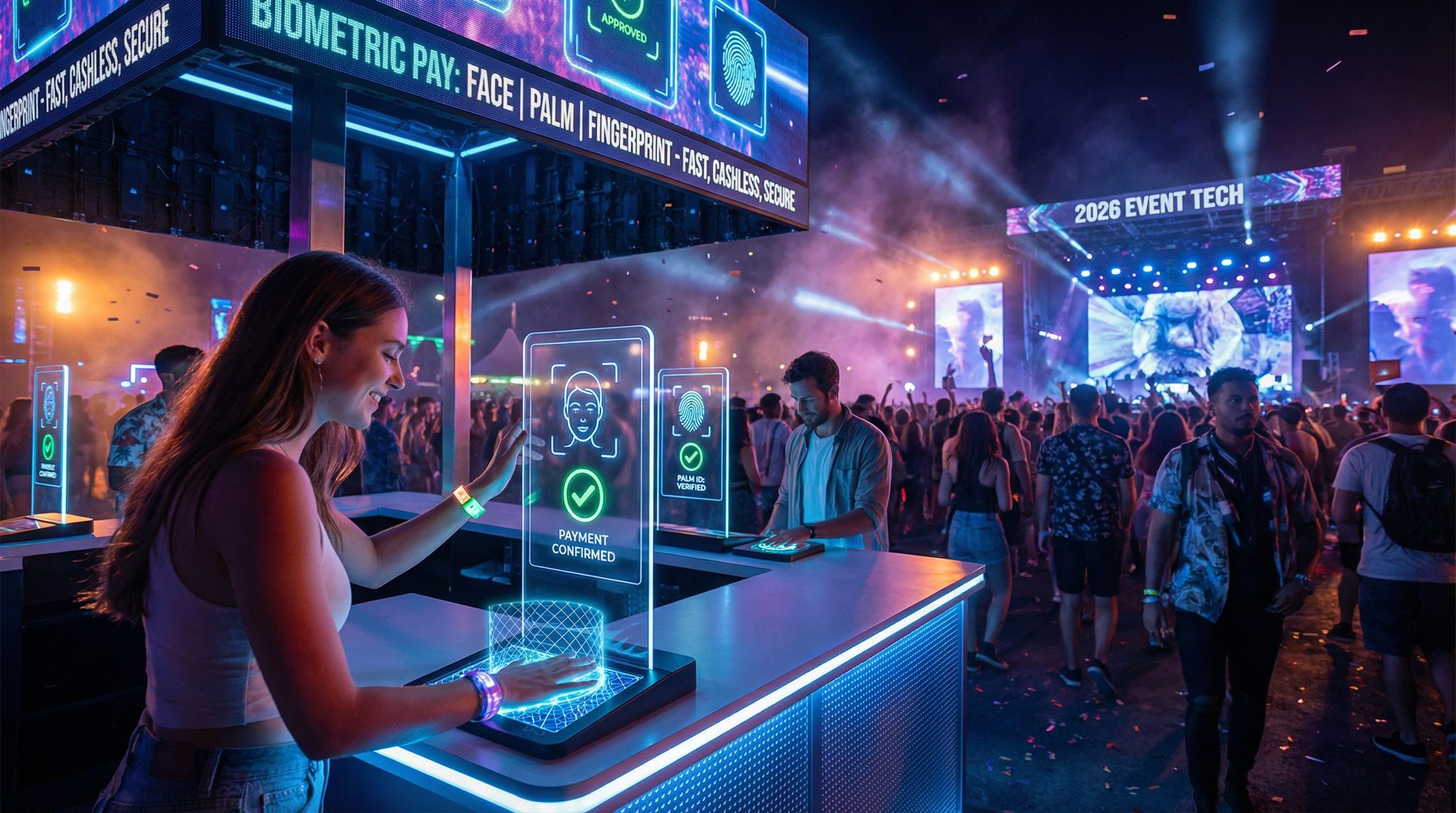
The live event industry has been steadily moving towards cashless transactions for years. By 2026, many festivals and venues have replaced paper money and even cards with digital alternatives, implementing the right payment tech for seamless transactions. Biometric payments are the latest evolution in this cashless journey. Rather than swiping a card or tapping a wristband, attendees can pay using unique biological identifiers – a fingerprint, facial scan, or palm vein pattern – for truly touchless transactions. Major payment providers and tech firms are piloting these systems, promising lightning-fast purchases with nothing more than a glance or a wave of the hand. It’s a world where buying a T-shirt or a beer at a concert could be as simple as placing your fingertip on a scanner.
Early Adopters and Tech Trialblazers
Digital wallet apps and RFID wristbands have already proven that making spending easier boosts sales (some festivals saw 20%+ higher on-site spending after implementing tap and go convenience at festivals). Building on that success, forward-looking venues began experimenting with biometrics. In the US, sports stadiums have led the way. Back in 2018, Seattle’s CenturyLink and Safeco Fields rolled out fingerprint scanners at concession stands, allowing enrolled fans to buy food and drinks with a tap of their finger as CLEAR introduces biometric payments and ID checks. This system, provided by CLEAR, also doubled as instant age verification for beer purchases – no physical ID needed. Across the Atlantic, tech-savvy festivals in Europe and Asia have watched closely, and a few have run small pilot programs letting VIP guests pay with a face scan linked to their ticketing account. These early trials generate buzz and data, helping organizers gauge if biometric payments genuinely speed up lines and increase spending.
Why 2026 Could Be a Turning Point
Several converging factors make biometric payments especially relevant in 2026. Health and hygiene concerns post-pandemic have fueled demand for contact-free interactions, giving technologies like facial and palm recognition a boost. At the same time, consumer tech familiarity has grown – millions use Face ID or fingerprint sensors to unlock phones and authorize mobile wallet payments daily. This means attendees are increasingly comfortable authenticating with biometrics (in one survey, over half of 18–34 year-olds in France were open to biometric payments seeing palm vein biometric payments as a promising future). Event organizers also face pressure to keep innovating the fan experience. Competition among venues is fierce, and offering futuristic conveniences – from smart queuing systems that eliminate waiting to tap-and-go payments – can be a differentiator. With major players like Amazon and MasterCard investing in biometric payment tech, 2026 might see these systems shift from novelty to a practical option at mainstream events. The big question is: will this new tech truly deliver benefits that outweigh the concerns?
How Biometric Payments Work at Events
Fingerprint vs. Face vs. Palm: The Main Biometric Methods
Not all biometric payments are created equal – multiple technologies exist, each with pros and cons for event use. Fingerprint payment systems use scanners (similar to those on smartphones) to read a person’s unique fingerprint ridges. Facial recognition uses cameras and AI to identify an individual based on their face. Palm scanning (pioneered by systems like Amazon One) reads either the surface of your palm or the unique vein patterns beneath the skin. Less common methods include iris scanning (using your eye’s pattern) or even voice recognition, though these are rare at noisy events. Organizers need to choose a modality that fits their environment: for example, fingerprint readers require physical contact and can be slowed by dirty or wet fingers, while facial systems must work in varied lighting and crowds. Palm vein scanners are contactless and work quickly, which is why companies like Amazon tout them as ideal for fast-moving event queues. The table below summarizes key differences:
Go Cashless With RFID Technology
Enable contactless payments, faster entry, and real-time spending analytics with RFID wristbands and NFC-enabled ticketing for your events.
| Biometric Method | How It Works | Pros for Events | Cons for Events | Who’s Using It |
|---|---|---|---|---|
| Fingerprint Scan | Touch sensor reads fingerprint ridges | Quick verification (1-2 seconds); familiar tech (phones) | Requires physical touch (hygiene issues); can fail if finger dirty or injured; sensors at every POS | Stadium concessions (e.g. Seahawks with CLEAR); theme parks for season pass ID |
| Facial Recognition | Camera scans facial features, matches to photo ID | Completely hands-free; can be very fast (multiple faces scanned in real time) | Needs good lighting and camera angle; accuracy can vary with appearance changes; some attendees find it intrusive | Pilot programs at festivals and arenas (VIP entry lanes); some retail stores |
| Palm Vein Scan | Infrared scans unique vein pattern in hand | Contactless (just hover hand); very accurate and hard to fake; works quickly | Requires special scanner; less familiar to users; initial enrollment takes time | Amazon One deployments at venues; trials in UAE stores and stadiums |
| Iris Scan | Camera focuses on iris (eye) pattern | Extremely accurate; works even if face covered | Requires user to stare at camera up close; slower enrollment; not practical for high-volume lines | Rare at events (more in airports); security checkpoints |
Each method brings trade-offs. Fingerprint systems benefit from people’s familiarity – attendees know how to press a finger on a sensor – but events must keep scanners clean and manage failures (e.g. if a fingerprint doesn’t read after a few attempts, the cashier must fall back to another payment method). Facial systems can be very fast once set up; for instance, a well-tuned camera at an entry gate might verify several faces each second, enabling a continuous flow. However, achieving that at a busy bar is tricky – people don’t naturally pause and pose when ordering a drink. Palm vein technology is emerging as a dark horse: it’s highly secure (vein patterns are internal and nearly impossible to spoof) and can work swiftly with a simple hand wave. Amazon’s trials show palm pay transactions can be completed in under 3 seconds, rivaling or beating the speed of tap-to-pay cards. Ultimately, the “best” biometric method may vary by event context – a dark nightclub might favor fingerprint or palm scanners over facial recognition, whereas a daylit stadium concourse could trial face-based kiosks.
Enrollment: Linking Attendees to Payment Accounts
Rolling out biometric payments requires a secure enrollment process to link attendees’ biometrics with their credit card or digital wallet. Typically, attendees must pre-register through an app or at a designated kiosk. For example, a festival introducing fingerprint payments might invite ticket buyers to sign up online before the event: the attendee would create a profile, provide payment details, and use their smartphone’s fingerprint sensor or webcam to capture their biometric. On-site enrollment is also possible – some events set up registration booths at the entrance or in the vendor village where attendees can opt in by scanning their finger, face, or palm on the spot.
Crucially, identity verification is often part of enrollment, especially if the biometric will serve for age-restricted sales. This means pairing the biometric with an official ID check. A platform like CLEAR, for instance, requires users to show a driver’s license and face scan during sign-up, ensuring the person’s age and identity are confirmed. Once enrolled, the attendee’s biometric template (a digital representation of their fingerprint/face/etc.) is stored securely, and their chosen payment method (credit card, digital wallet, or prepaid event account) is linked to that profile. From that point on, paying is as simple as a scan: when the attendee goes to buy something, the system matches their live biometric to the stored profile and charges their linked payment source. The entire lookup and charge happen in seconds over the event’s network.
One lesson experienced event technologists emphasize is promoting enrollment ahead of time. If thousands of people turn up on event day needing to scan their biometrics for the first time, you’ll face long lines – exactly what you’re trying to avoid. Successful pilots often use incentives like “Skip the line at the bar – enroll your biometrics online before Day 1!” to encourage early sign-ups. And for any on-site enrollment, dedicated staff and clear signage are a must. The motto here is onboard early, onboard often – the smoother the enrollment phase, the better the biometric system will perform during the event.
For many organizers, the most seamless way to introduce these payment profiles is by integrating them directly into biometric ticketing platforms. When a fan purchases their admission, the ticketing flow can prompt them to securely register their face or fingerprint as their primary credential. This unified approach means the attendee’s physical body becomes both their ticket and their wallet. By merging access control with point-of-sale authentication, venues reduce the friction of separate enrollment steps, driving higher adoption rates for cashless systems.
Infrastructure and Integration Requirements
Implementing biometric payments isn’t just a matter of plugging in a new device – it requires a robust tech stack and integration across multiple systems. At the front line, you need hardware scanners or cameras at each point of sale or gate where you want to accept biometric payment. These might be USB fingerprint readers attached to POS terminals, specialized facial recognition tablet kiosks, or standalone palm scanning units. They must be durable (able to handle outdoor festival dust or nightclub lighting) and ideally work quickly offline if connectivity hiccups (more on offline modes shortly).
These hardware requirements are also expanding beyond traditional staffed counters. Innovative organizers are exploring how to integrate these readers into automated self-serve kiosks and modern vending machine payment systems, allowing attendees to grab a water bottle or snack and authenticate the charge entirely unassisted.
Behind the scenes, the biometric system has to connect with your payment processing backend. This can be achieved via APIs or middleware that link the biometric provider’s platform to your event’s POS software or central payment gateway. For example, if you’re using a modern event ticketing platform, it may offer integrations with cashless payment solutions or allow exporting attendee data to third-party systems. (When managing multiple tech vendors – ticketing, payments, access control – planning these integration touchpoints in advance is key to reimagining the concessions experience.) In practice, many events partner with a specialist vendor that provides a turnkey solution: hardware, software, and a cloud service that matches biometrics to stored payment tokens. CLEAR and Amazon are examples of full-stack providers (they handle enrollment, matching, and payment processing through linked cards). Other events might integrate a biometric authentication SDK into their existing mobile app or POS system – for instance, using a facial recognition library that triggers a Stripe payment when a face match is confirmed.
Ready to Sell Tickets?
Create professional event pages with built-in payment processing, marketing tools, and real-time analytics.
Networking and IT infrastructure also deserve attention. Reliable internet connectivity at transaction points is critical if the biometric matching is done in the cloud. Some systems perform matching locally on-device for speed, but even then, the payment itself usually needs to be authorized online. Event Wi-Fi or wired LAN for vendors must be robust and secure. Seasoned production architects recommend setting up redundant networks and offline fallbacks – for example, caching biometric data locally for quick matches, with periodic sync to the cloud, and having a plan B (like preloaded RFID cards) if the biometric system goes down. Indeed, a biometric solution should complement, not entirely replace, other cashless options. Many events choose to run biometrics in parallel with conventional payment methods at first, to gauge performance and ensure there’s a safety net if anything fails.
To summarise the components needed, consider the following overview of a biometric payment tech stack:
| System Component | Role in Biometric Payments | Example Solutions |
|---|---|---|
| Biometric Capture Devices | Hardware to scan fingerprint, face, or palm at POS or entry | Fingerprint readers (e.g. HID, SecuGen); Face-recognition cameras (Wicket kiosks); Palm vein scanners (Fujitsu, Amazon One) |
| Enrollment & Identity Platform | Software for registering users, storing biometric templates, linking to IDs and payment methods | CLEAR’s enrollment app; In-house festival app integration; Third-party services (Yoti for age verification, etc.) |
| POS Integration Middleware | Connects biometric auth to point-of-sale and payment gateway | API integration with POS (Micros, Square, etc.); Custom middleware linking biometric match to Stripe/Adyen transaction |
| Payment Processor | Processes the actual payment once biometric is confirmed | Stripe, Adyen, PayPal – handling card charges or wallet debits once a user is authenticated |
| Data Security & Storage | Secure databases or cloud storage for biometric data and transaction logs | Encrypted cloud vault (with hashed biometric templates); On-site server for fast matching (with regular syncing to cloud) |
| Network Infrastructure | Connectivity to allow biometric data lookup and payment authorization | Dedicated Wi-Fi/ethernet for vendors; backup 4G/LTE routers; QoS to prioritize payment traffic |
When evaluating biometric contactless payments deployment methods, organizers generally choose between phased rollouts and full-scale venue integrations. A phased approach might introduce the technology exclusively at VIP bars or fast-track entry lanes, allowing staff to acclimate to the new hardware. Conversely, a comprehensive deployment integrates biometric authentication across all point-of-sale terminals simultaneously. Regardless of the chosen strategy, successful rollouts through 2025 and 2026 rely heavily on robust pre-event enrollment campaigns and seamless API connections with existing ticketing platforms.
Each piece must work seamlessly to deliver the promised tap-and-go convenience. As an event organizer, you’ll likely rely on a vendor or integrator to tie these components together. However, understanding what’s under the hood is vital for planning and troubleshooting. For instance, knowing that your payment processor imposes a 2-second authorization time is important – if the biometric auth adds 1-2 seconds on top, you can anticipate each transaction will take ~4 seconds. Multiply that by thousands of transactions and it influences how many scanners or lanes you deploy. The bottom line: a well-architected biometric payment system demands solid groundwork, from device selection and software integration to network optimization, to ensure it actually improves the event experience rather than complicating it.
Smooth Entry With Mobile Check-In
Scan tickets and manage entry with our mobile check-in app. Supports photo ID verification, real-time capacity tracking, and multi-gate coordination.
Real-World Trials and Case Studies
Stadiums and Arenas Leading the Way
Large sports venues have been the natural testbeds for biometric payments, often in partnership with tech companies. Seattle’s sports stadiums were early adopters – as mentioned, the Seahawks (NFL), Mariners (MLB), and Sounders (MLS) teamed up with CLEAR to let fans buy concessions via fingerprint scan as CLEAR introduces biometric payments and ID checks. Enrolled fans loved the convenience of not digging for a wallet mid-game, and stadium management reported faster service at the pilot stands. These trials also showed an ancillary benefit: linking fingerprint pay with age verification meant ordering a beer could be a one-scan action, speeding up bar lines that used to crawl due to ID checks.
Other stadiums soon followed. Baseball parks like Yankee Stadium and Citi Field in New York enabled opted-in fans to use face or fingerprint ID to enter special “fast lanes” and, in some cases, purchase refreshments tied to loyalty accounts. In 2024, a survey of venue executives worldwide found that 47% considered biometric solutions a top tech priority for the coming year, with biometrics becoming a high priority for stadiums. While much of that was focused on entry control and VIP access, nearly 7% were already using biometrics for concession payments indicating increasing biometric deployments – a figure expected to rise sharply as the technology proves itself. The same survey noted that cashierless concession systems (which include biometric self-checkouts and AI-powered grab-and-go stores) were high on the roadmap for over half of venues, focusing on integrations that improve fan experience.
Grow Your Events
Leverage referral marketing, social sharing incentives, and audience insights to sell more tickets.
A notable real-world example is at Major League Baseball (MLB) parks: a partnership between CLEAR and MLB’s Tickets.com brought biometric ticketing to select ballparks, and by extension made it easier to integrate biometric payments at those venues, bringing payment and age verification to concessions. Fans who linked their profiles could enter with just a fingerprint scan and then make cashless purchases inside. Feedback from these stadium implementations has been cautiously positive – transaction times dropped (anecdotally, staff noted peak halftime rushes became more manageable) and some venues saw increased per-fan spending due to the streamlined process. However, adoption rates are still relatively modest; typically only a fraction of attendees choose to use the biometric option, since it’s voluntary. Stadium tech managers have also highlighted the importance of redundant systems: during one football game in 2025, a network glitch temporarily took fingerprint payments offline, forcing fans back to cards and causing confusion at a busy hotdog stand. The lesson learned was to always have staff trained to quickly switch to backup payment methods (and politely explain the issue) – a reminder that even advanced systems need contingency plans.
For venue operators wondering, “Are biometric ID checks available for event or stadium access right now?” the answer is a resounding yes. Beyond just concessions, biometric ticketing and identity verification are actively used to manage VIP entrances, staff restricted areas, and premium club access. This dual-use approach—combining entry access with payment profiles—maximizes the return on investment for the hardware deployed at the gates.
When evaluating the operational impact of CLEAR biometric entry across stadiums, arenas, and major sporting events, venue managers consistently highlight the dramatic reduction in ingress bottlenecks. By shifting the verification burden away from manual ticket scanning and physical ID checks, these automated lanes allow high-capacity venues to process thousands of fans per hour with minimal staffing. Furthermore, international venues are taking note of these North American successes. For instance, following early VIP tests, the O2 Arena biometric entry protocols have provided a blueprint for European operators looking to balance stringent GDPR compliance with frictionless access. For promoters and facility directors, investing in these specialized entry gates is no longer just about VIP perks; it is a scalable strategy to optimize crowd flow, reduce perimeter security costs, and elevate the overall event day operations.
Beyond just entry gates, the broader ecosystem of CLEAR biometric solutions for sporting events, stadiums, and multi-purpose venues demonstrates the value of interoperability. When a fan enrolls in a trusted identity network at an airport or a partner facility, that same credential can seamlessly authenticate them at a local ballpark or arena. For venue operators, tapping into an existing, pre-verified user base drastically lowers the barrier to entry for new cashless initiatives. Instead of forcing attendees to download a proprietary app or register at a standalone kiosk, stadiums can leverage these established networks to instantly activate frictionless payments, age verification, and VIP access for thousands of pre-enrolled guests.
Data-Driven Event Marketing
Track ticket sales, demographics, marketing ROI, and social reach in real time. Exportable reports give you the insights to make smarter decisions.
Festival Experiments and Lessons Learned
Compared to sports arenas, music festivals and concerts have been more cautious with biometric payments. The most high-profile trial – and perhaps cautionary tale – was the attempt to deploy Amazon One palm scanners at the famous Red Rocks Amphitheatre in 2021, raising questions about facial recognition at festival entrances. The idea was for concertgoers to link a credit card and ticket to their palm print, then pay for drinks or merchandise with a wave of their hand. Technically, the system worked: Amazon’s palm-vein tech is quick and accurate. But the optics were another story. News of the implementation sparked a public backlash – privacy activists and even 200+ artists (including some scheduled to play the venue) objected strenuously, arguing that facial recognition could be misused. They argued that turning your hand into a ticket and wallet might seem convenient, but it introduced “a tool of corporate surveillance” into music spaces, as noted in reports about Amazon One palm scanning at Red Rocks. Under pressure, the venue halted the palm-payment program within months. The Red Rocks incident is now a staple case study in why understanding fan sentiment is as important as the tech itself. Even a well-run system can falter if a significant chunk of your audience perceives it as creepy or invasive.
That said, not all festival biometric trials have met resistance. Some smaller and genre-specific events have quietly tested biometric payments on a limited scale. For example, a large electronic music festival in Europe invited a few thousand VIPs to enroll their face via a mobile app ahead of the event; at certain expedited entry lanes and premium bar areas, cameras recognized their faces so they could walk up to a POS and be automatically charged for their order (with a confirmation text sent immediately). The result was ultra-personalized service – bartenders greeted VIP attendees by name as the system flashed their profile, and transactions were almost instant. Reports from this trial indicated a shorter average wait time at the VIP bar and positive feedback from those who opted in, but the festival has not yet rolled it out event-wide. Organizers noted operational wrinkles, such as dealing with lighting variations (day vs. night, stage lights in the background) that affected camera accuracy, and ensuring backup payment options were always on hand if a face match failed.
In Asia, where cashless society trends are strong, a few festivals and theme parks have tried blending biometric payments with RFID. Attendees might still wear an RFID wristband, but instead of topping it up with cash, they verify their identity at top-up stations via face scan linked to mobile payment apps (like Alipay or WeChat Pay). This hybrid approach leverages biometric authentication to load money or approve large purchases, while using the familiar wristband tap for day-to-day buys, which can ease concerns since the biometric data is used in a limited way. Early results from such approaches show promise in reducing fraud (it’s much harder to use a found/stolen wristband if the big top-ups require the owner’s face).
Overall, festivals are learning from both the successes and stumbles. The key takeaway is that biometric payments can work at events – the tech is there – but implementation must be handled with care. Real-world trials underscore the importance of transparency (letting fans know what’s being tested and why), opt-in participation, and a respect for attendee comfort levels. As one festival operations veteran put it, “We gained more goodwill by offering the cool new tech rather than forcing it. Those who used it loved the speed, and those who didn’t weren’t affected – that balance was critical.”
Trade Shows and Exhibitions Adopting Touchless Tech
Beyond music and sports, corporate event producers are increasingly exploring cashless for exhibitions and large-scale trade shows. In these environments, attendees often transition between networking lounges, keynote halls, and expansive vendor floors. By integrating biometric authentication or advanced RFID solutions into attendee badges, organizers can create a frictionless commercial environment. Exhibitors benefit from streamlined point-of-sale interactions, allowing them to process merchandise sales or premium booth upgrades instantly without handling physical currency or managing bulky card terminals. Furthermore, deploying touchless payment infrastructure at convention centers provides organizers with granular data on attendee spending patterns, helping to optimize future floor plans and vendor placements.
Implementing a comprehensive cashless strategy for trade shows also drastically reduces the logistical burden on individual exhibitors. Instead of requiring hundreds of booth operators to manage their own cash floats or secure independent merchant accounts, organizers can provide a unified digital payment ecosystem. This centralized approach not only simplifies international transactions for overseas attendees but also allows event producers to bundle lead retrieval and payment processing into a single smart badge or biometric profile. Consequently, the transition to fully digital transactions elevates the professional atmosphere and provides real-time revenue dashboards for the entire exhibition floor.
Accept Payments Across 13 Countries
Local currency processing via Stripe, Razorpay, Xendit, Paystack, and OXXO across 13 countries with region-specific payment methods.
Global Developments: Where Biometrics Are Trending
Around the world, acceptance of biometric payments varies widely, often depending on local technology culture and privacy norms. In parts of Asia and the Middle East, there is notable momentum. For instance, the United Arab Emirates announced plans to roll out a national palm-print payment system across thousands of stores by 2024, allowing users to just wave your palm for purchases. This initiative, backed by government and banks, normalizes paying with a hand wave – so it’s easy to imagine future events in the UAE plugging into that infrastructure (e.g. a concert in Dubai where attendees use the same Palm Pay system already on their phone). Information on how customers can sign up is becoming widely available. China has been a pioneer in face recognition payments, with Alipay’s “Smile-to-Pay” deployed in fast-food restaurants and malls. At large-scale events like expos and theme parks in China, visitors can often link their face to a pre-paid account and spend on-site with a quick face scan at kiosks. Chinese consumers have generally been more accepting of facial payment tech, which means festivals there may embrace it faster – although even in China, there have been pushbacks and new laws to curb excessive use of facial recognition in public places due to privacy concerns.
In Europe, biometric deployments are approached more cautiously, largely because of stringent privacy regulations (like GDPR) and higher public sensitivity. Trials tend to focus on speeding up entry or VIP experiences rather than replacing all payment methods. For example, London’s O2 Arena ran a test where VIP lounge guests could enter using facial recognition, and then inside the lounge use that same verification to charge purchases to their account. But widespread adoption in EU events will likely hinge on proving absolute data safety and getting clear consent from attendees. European organizers are also exploring anonymous biometric solutions – for example, systems that verify you’re over 18 via face or fingerprint without actually tying the data to your name or storing it long-term, to comply with privacy laws.
North America, particularly the US, sits somewhere in between. Some American venues and state fairs have embraced biometrics quickly (often via partnerships with firms like CLEAR or local startups), while others have been deterred by the kind of backlash seen at Red Rocks. One interesting development is in age verification laws: places like Illinois have strict Biometric Information Privacy laws (BIPA) that require explicit consent and even compensation for use of biometrics, which affects any Illinois events thinking about these tech. Meanwhile, states like Georgia and New York have seen their big arenas use biometrics for season ticket holder perks and express lines. In Canada and Australia, a few pilot programs are underway, but generally these regions mirror the cautious stance of Europe, awaiting more evidence and public comfort before going all-in.
The global landscape shows that biometric payments are not just a futuristic concept – they are already happening here and there – but the rate of adoption is uneven. Cultural attitudes, legal frameworks, and the presence (or absence) of large tech vendors pushing the tech all influence whether an event in a given country will take the plunge. By 2026, we’re seeing a patchwork: some places where paying with your body is normal, and others where it’s still viewed with a raised eyebrow. Event organizers with an international perspective should keep an eye on these trends, because what works in one market (like palm payments in the UAE) might soon make its way to festivals and venues elsewhere.
Benefits of Biometric Payments: Convenience and Beyond
Speedy Transactions and Shorter Queues
One of the biggest selling points of biometric payments is speed. In theory, identifying someone by a fingerprint or facial scan can be almost instantaneous – no fumbling for cash or entering PIN codes. This translates to shorter lines at bars, food stalls, and merch stands. Imagine an attendee stepping up to a kiosk, scanning their palm, and walking away with their item in a matter of seconds. In practice, events that have tested biometrics have indeed measured faster transaction times. A standard chip-and-PIN card transaction can take 5–10 seconds, whereas a biometric payment (especially if it’s pre-authenticated) might take as little as 1–3 seconds to recognize the person and another 1–2 seconds to process the charge. Over hundreds of transactions, those seconds add up.
Faster checkouts mean higher throughput – more people served per minute. This is crucial during peak rushes (like a 15-minute intermission). For example, a stadium that trialed fingerprint payments found that a concession stand could handle 12–15% more customers per hour after introducing the biometric “fast lane”, simply because each service was quicker and fewer people abandoned the line. And it’s not just about raw numbers; the perceived improvement in the fan experience is significant. Attendees value their time at an event – they don’t want to miss part of the show waiting to buy a drink. By cutting queue times, biometric payments can boost attendee satisfaction. In fact, survey data from the smart stadium industry consistently shows that long lines are a top complaint, and that fans are eager for solutions that get them back to the action sooner, as highlighted in digitising stadium payments resources. Biometric tech offers a compelling way to tackle this pain point.
Another speed-related perk is how biometrics can streamline age-restricted sales. Normally, checking ID for alcohol or 18+ content is a manual process that slows transactions. But if an attendee’s age is verified as part of their biometric profile, the system can automatically confirm they’re old enough during the payment scan, bypassing the need for a staff member to double-check ID. This was a notable success in the Seattle stadium deployments – it not only kept lines moving but also freed up staff from having to play bouncer and cashier at the same time. For event organizers focused on improving crowd flow and eliminating bottlenecks, biometrics are a promising tool in the arsenal, complementing other strategies like mobile ordering and virtual queue systems.
Higher Spending and Revenue Uplifts
It’s a well-documented phenomenon in retail and events: the easier it is to spend money, the more people tend to spend. Biometric payments remove even more friction than standard cashless methods. Attendees no longer need to carry wallets or even phones; their ability to purchase is literally at their fingertips (or in their face). This frictionless experience can lead to impulse buys and additional sales that might not have happened if a patron had to fish out cash or swipe a card. For instance, at a festival merch pop-up, someone might hesitate to buy a T-shirt if the line looks long or they’re low on cash – but if they can zip through a fast biometric checkout, that hesitation diminishes.
There is evidence that cashless payments boost spending: for example, festivals that moved from cash to RFID wristbands saw on-site spending jump by 15–30% on average after implementing tap and go convenience at festivals. Biometric payments are essentially the next generation of cashless, so organizers anticipate similar or greater gains. By 2026, early data from pilots hints that venues using biometric pay are observing a notable uptick in average transaction value. One arena reported that fans using facial recognition to pay at a self-service kiosk bought 20% more items per purchase on average (perhaps because the streamlined process made adding that extra item feel seamless). Another theory is that when attendees aren’t thinking about the mechanics of payment (tapping a card or pulling out bills), they focus more on what they want – leading to slightly higher indulgence in food, drinks, or souvenirs.
There’s also a psychological comfort at play. People worry less about losing money or being pickpocketed when they aren’t carrying physical currency or credit cards at an event. Knowing your wallet is essentially “built-in” can encourage fans to relax and engage more – and a relaxed, happy attendee might decide to go for that second beer or try the premium cocktail. Additionally, biometric systems can be tied into loyalty programs and upselling. For example, if the system recognizes a VIP customer at the point of sale, it could automatically apply a discount or suggest an exclusive item (“Would you like to add the limited edition poster for $10?”) in a personalized way. Being identified by biometrics makes these interactions more fluid than scanning a separate loyalty card or voucher.
All of this can contribute to a healthier bottom line for events. While there’s an investment cost to implementing biometric payment technology, the ROI can be attractive if increased spending and higher concession throughput translate to thousands of dollars in extra revenue per event day. Organizers should, however, temper expectations and closely track these metrics during any trial. The boost in revenue might vary depending on the crowd and event type. A family-oriented festival, for instance, might see less of a biometric bump than a music festival where young adults are more likely to splurge. It’s wise to compare sales data between biometric users and non-users. If early results mirror broader cashless trends, we can expect biometric payments to join other technology tools that drive event revenue by encouraging that extra spend.
Security, Fraud Reduction, and Accountability
Counterintuitively, making payments with your body can be more secure than traditional methods. For one, biometrics are unique to each individual – unlike a credit card that could be stolen and used by anyone, your fingerprint or face can’t easily be used by someone else. This means a stolen or lost credential is less of an issue. Events that issue RFID wristbands or NFC payment cards know the headache if a patron loses their band or card: staff have to freeze the old one and provision a new one, and any stored balance might be at risk until reported. Biometric payments sidestep this – there’s nothing physical to misplace or have stolen. A fraudster can’t simply “grab” your face or finger and use it in the field. (In theory, advanced fraud attempts like using high-res photos or fake fingerprints could occur, but modern biometric systems have liveness detection and other safeguards to prevent spoofing.)
This is particularly relevant for multi-day festivals or family entertainment centers. When evaluating the primary benefit of using biometric fingerprint scanners at amusement parks or weekend-long events, operators consistently point to the ability to prevent ticket fraud. Since a fingerprint cannot be handed off to a friend like a paper pass or wristband, revenue leakage from shared credentials is virtually eliminated.
From the organizer’s perspective, biometrics provide a clear audit trail tied to individuals. This can deter employee theft and mistakes as well. Consider a scenario with a traditional cash till – it’s hard to know which cashier processed which transaction or if cash went missing. With biometric checkouts, each transaction is inherently linked to an identity (even if anonymized on the backend, internally the system knows a specific user made that purchase). If there’s a dispute or refund request, having that data can be invaluable. It’s like having a receipt with the customer’s name (or ID number) automatically attached. Some systems even take a photo at the moment of facial payment to document the interaction, adding an extra layer of proof.
Biometric payments can also help enforce purchase limits and safety rules. For example, if an attendee has been flagged (perhaps they reached a bar tab limit or exhibited problematic behavior), a biometric system could be set to decline further alcohol purchases for that person that night. While this is an advanced use case, it shows how the tech can contribute to responsible service. It’s similar to how casinos monitor big spenders – but at events, it could be used for positive outcomes like preventing over-consumption or quickly identifying a VIP for white-glove treatment.
Another security angle is age verification and compliance. We touched on how linking age to biometrics speeds up service; it also reduces the chance of human error in checking IDs. Using biometric age verification can virtually eliminate underage sales if implemented correctly. In venues or countries with strict liquor laws, this is a compelling benefit – no more relying on a busy bartender’s quick glance at an ID. Biometric proof of age (especially if tied into government databases or verified IDs) can be extremely reliable.
Finally, there’s an overarching benefit: trust through transparency. If an event can confidently say, “Only you can use your payment account – nobody else – not even if they find your wristband or phone,” that’s a strong trust-builder for attendees. It assures them that the event values security. However, to fully realize this benefit, organizers must educate users on how their data is used and protected (more on that in the next section). It’s worth noting that security cuts both ways: strong safeguards make biometric systems secure, but any lapse could undermine that trust entirely. On the whole, though, the potential to reduce fraud and error is a compelling part of the biometric value proposition, adding to the convenience story a layer of accountability that traditional payment methods can’t quite match.
Privacy and Security Concerns: The Other Side of the Coin
Sensitive Data at Stake: What Happens to Your Biometrics?
For all their advantages, biometric payment systems carry a heavy responsibility: they deal with extremely sensitive personal data. Unlike a password or credit card number, your biometric identifiers (fingerprints, face patterns, iris scans) are irreplaceable. If a database of biometric data were ever breached, the fallout is serious – you can reset a password or cancel a credit card, but you can’t change your fingerprints or face. This sobering fact raises the stakes for event organizers and vendors implementing these systems. They must use state-of-the-art security to protect biometric data both in transit and at rest. Typically, biometric scans are converted into encrypted mathematical templates, not stored as raw images – this is a crucial practice. It means that even if someone intercepted the data, they shouldn’t be able to reverse-engineer it into a fingerprint or photo. Event tech teams need to verify that any biometric solution they use follows this principle, and ideally has third-party security certifications to back it up.
To achieve this level of protection, enterprise vendors often utilize military-grade biometric scanner technology and advanced encryption standards. This ensures that the hardware capturing the data at the gate meets the highest compliance thresholds, protecting both the venue from liability and the attendee from identity theft.
Despite these safeguards, many attendees have reasonable fears about how their data might be used. Will their fingerprints be shared with advertisers or law enforcement? Could face data be cross-referenced to track which booths they visited at a festival? These scenarios sound dystopian, but public concern is real. Transparency is key here. Events should clearly communicate what data is being collected and for what purpose (e.g. “We store an encrypted hash of your fingerprint to verify payments – we do not save any actual fingerprint images or share them with any other entity”). Furthermore, data retention policies matter: Some fans might be okay with biometric use during the event but expect that data to be wiped afterward. If an event plans to keep biometric data for convenience at future events, that needs to be explicit and ideally under the user’s control (opt-in for “save my info for next time”).
A major concern is how to handle the worst-case scenario – a breach. Forward-thinking organizers will have a plan: robust incident response, notifications to affected users, and perhaps even insurance or funds set aside for such emergencies. In recent years, companies that mishandled biometric data have faced hefty lawsuits and fines (under laws like Illinois’ BIPA, even paper sign-in sheets with fingerprints have led to multi-million dollar class actions). So beyond the moral responsibility, there’s a financial and legal imperative to guard this data tightly. In essence, when an event asks for a person’s biometrics, it is asking for a lot of trust. Reputable operators treat that trust as sacred, implementing military-grade encryption, conducting regular security audits, and often partnering with established biometric providers that have a proven security track record, rather than trying to DIY a solution.
In the end, the success of biometric payments will depend not just on the tech’s performance, but on maintaining attendee confidence that their personal characteristics aren’t being misused or put at risk. A single high-profile incident could sour public perception for years, so every event considering this tech must weigh whether they are ready to shoulder this responsibility.
Public Perception and Biometric Backlash
When introducing biometric payments, event organizers must navigate the court of public opinion carefully. While some attendees are tech-savvy and eager to try new things, others are immediately wary of anything that sounds like “Minority Report” or Big Brother. The backlash against Amazon’s palm scanners at Red Rocks was a wake-up call: what might seem like a neat innovation to an organizer can be seen as creepy surveillance by the audience, raising concerns about facial recognition at festival entrances. Privacy advocacy groups and even artists have vocalized that they don’t want the live music experience turning into a data-harvesting exercise, as seen in the reaction to Amazon One palm scanning at Red Rocks. In 2026, with data privacy a common topic in the news, people are arguably more conscious than ever of how their information is used. Facial recognition, in particular, has gotten a bad rap in some circles due to its use in law enforcement and surveillance – so using it at events can trigger those broader societal concerns.
Surveys show a split perspective: younger generations tend to be more accepting of biometrics (having grown up unlocking phones with fingerprints and faces), whereas older attendees often voice more concern. But even among Gen Z and Millennials, support for biometric payments comes with conditions – they want assurances on privacy and the option to opt out at will. Another aspect of perception is cultural context. In some countries, people trust national ID systems and are used to biometric IDs (like national ID cards or biometric passports), so using biometrics for payment doesn’t feel like a big leap. In others, any mention of fingerprinting can conjure images of criminal booking, which is not the association you want at a fun event.
Boost Revenue With Smart Upsells
Sell merchandise, VIP upgrades, parking passes, and add-ons during checkout and via post-purchase emails. Increase average order value by up to 220%.
Event organizers have found that the way biometrics are framed and presented makes a huge difference. If you emphasize convenience (“skip the line with just your fingerprint – no wallet needed!”) and voluntary participation, many fans respond positively or at least with curiosity. If, however, people feel it’s being forced or sneaked in without proper explanation, expect backlash. Transparency is key: some festivals have published Q&As or held community forums when rolling out biometric ticketing or payments, tackling questions head-on (e.g., “Will this data be shared with police? No, here’s why…”). Such efforts can mitigate fears. Additionally, having respected artists or figures endorse the system can help – but it can also backfire if other artists come out against it, as we saw with the Amazon case.
The bottom line is that social acceptance of biometric tech at events is still in an early phase. Organizers should monitor sentiment closely. For example, keeping an eye on social media chatter when announcing a biometric feature can alert you to possible issues. If a tweet about “fingerprint pay at XYZ Festival” starts trending with negative comments, that’s a sign to ramp up your public education or reconsider the approach. On the flip side, positive word-of-mouth from one successful implementation can help others. Fans who had a great experience paying with their palm at one festival might become proponents, telling friends how quick and easy it was. Many technology adoption curves have a moment where the narrative flips from fear to “hey, this actually works well and I like it.” The challenge for 2026 is that biometric payments are hovering between those two narratives, and each event that experiments with it plays a part in shaping the overall perception in the industry.
Legal and Regulatory Considerations
Biometric data is not just another data point – in many jurisdictions, it’s legally considered highly sensitive personal information. This means event organizers venturing into these waters must navigate a patchwork of laws and regulations designed to protect individuals. Foremost among these is the General Data Protection Regulation (GDPR) in the European Union, which explicitly calls out biometric data (when used to uniquely identify someone) as a “special category” requiring explicit consent and stringent safeguards. Under GDPR, to use biometrics, an event would need a lawful basis (consent being the most straightforward for a voluntary system) and must adhere to principles of data minimization and purpose limitation (i.e., collect only what’s needed and use it only for the stated purpose). Additionally, EU events might have to conduct a Data Protection Impact Assessment (DPIA) before launch, because biometric processing is considered high-risk.
In the United States, there isn’t a federal equivalent of GDPR, but certain states are filling the gap. Illinois’ BIPA is the most famous: it requires written consent for biometric data collection, and importantly, it gives individuals the right to sue for violations. BIPA has teeth – companies have paid millions in settlements for not following its rules. Texas and Washington have similar laws (though without the private lawsuit provision). New York City even has a law requiring businesses to post clear signs if they collect biometric identifiers from customers. What this means for event organizers is that the location of your event can dictate your approach. A festival in Chicago, IL must be extremely careful – getting explicit opt-in and providing a policy – whereas an event in a state with no biometric law might have more leeway (though it’s still wise to adhere to best practices, both ethically and anticipating future laws).
Beyond privacy-specific laws, consider consumer protection and financial regulations. If the biometric payment system ties into credit card processing, you must ensure PCI DSS compliance (the standard for handling credit card data) on top of the biometric concerns. And if an event is international or draws attendees from abroad, there might be cross-border data transfer issues (for example, if EU attendee data is processed on US servers, GDPR’s transfer rules apply – often necessitating standard contractual clauses or other mechanisms between the organizer and the tech vendor).
Additionally, labor and employment laws might come into play if you use biometrics for staff or crew payments (or even time tracking). Some countries ban mandatory biometric clock-in for employees. This is tangential to attendee payments, but worth noting if you expand biometric usage internally.
Free Tool: Size Your Festival Site
Zoned capacity planning for arena, campsite, parking and entry lanes — against UK Purple Guide and NFPA density standards. Finds your bottleneck zone.
A diligent event organizer will involve legal counsel early in the planning. Draft a clear consent form or user agreement for participants that outlines what data is collected, how it’s used, who it’s shared with, and how long it’s kept. Also, plan for data subject rights: If someone later says, “I want you to delete my biometric data,” you should have a process for that (even if not legally mandated, it’s good practice to honor such requests to build trust). Compliance isn’t just avoiding lawsuits; it’s demonstrating to your attendees that you take their privacy seriously. Many venues are actively promoting their privacy credentials as a selling point, highlighting things like “GDPR-compliant technology” or “strict data protection policies for venue operations.” This can turn a potential pitfall into a marketing positive, assuring fans that convenience won’t come at the cost of their privacy.
In summary, while the regulatory landscape can seem daunting, it essentially pushes organizers toward best practices that they should be doing anyway: get clear consent, secure the data, use it only as advertised, and respect people’s rights over their own personal information. Doing your homework here is non-negotiable in 2026 – the era of “move fast and break things” with user data is over, especially for something as sensitive as biometrics.
When Technology Falters: Reliability and Fault Tolerance
Aside from philosophical or legal concerns, there’s a very practical consideration with biometric payments: what if the system fails? No technology is 100% uptime or error-free, and biometrics introduce new points of failure that organizers must anticipate. For example, if you’re using facial recognition and the lighting at a venue concert becomes very dim (or strobe lights confuse the camera), the accuracy of face matches can drop. If you’re relying on fingerprint scanners and it starts raining at an outdoor festival, people’s wet hands might not read properly. Even something as simple as a food vendor’s greasy fingers from serving fries might smudge a scanner and halt the process. Experienced event tech teams conduct stress tests and real-world scenario tests to identify these failure modes. They might simulate low-light conditions, or have people try scans with various obstructions (glasses, facepaint, muddy hands) to see how the system copes.
Network dependency is another biggie. Many biometric systems are cloud-based or require an active internet connection to match biometrics and authorize payments. If your event’s network goes down or even slows significantly, biometric transactions can bottleneck or time out. It’s one thing for a contactless card reader to lose signal (often they can store transactions offline for a while); it’s another if your biometric system can’t even verify someone. That’s why having an offline mode or local server is critical. Some providers offer an on-premises appliance that stores all the enrolled biometric templates locally, so matches can be done on-site at high speed even if the outside internet link is down, and then sync up later. It’s wise to make use of such options if available.
There’s also the human factor: failure to match. No biometric is perfect. There will always be a small percentage of people whose biometrics are hard to capture or who get false negatives (the system doesn’t recognize them even though they’re enrolled). Fingerprint ridges can wear out for manual laborers or older people; facial recognition can struggle with certain ethnicities or if someone drastically changes their hairstyle or accessories. Event staff need training on how to gracefully handle these situations without causing embarrassment or delays. A common practice is to immediately defer to an alternate method – e.g., “No problem, the scanner can be finicky – here, you can tap your card or use the RFID wristband instead,” and perhaps invite the person to re-enroll their biometric later if they want. Training event staff on new tech is absolutely essential, as detailed in guides on implementing the right payment tech. Frontline staff and volunteers should know the ins and outs of the biometric system, and particularly how to troubleshoot common issues (like cleaning a fingerprint scanner, adjusting a camera, or switching to manual mode if needed).
In the context of reliability, one must consider peak load too. If thousands of people all decide to buy something at set break, can the system handle a surge of biometric authentications per second? Load testing with realistic numbers is important. Some events learned this the hard way when an under-provisioned server led to a slowdown – biometric payments that normally took 2 seconds were taking 20, causing confusion and backups at registers. The fix was scaling up the server capacity and optimizing the matching algorithm, but ideally that would be sorted out pre-event.
Finally, a nuanced challenge: user error or resistance can cause hiccups. Someone might not scan their finger correctly (pressing too lightly or moving too fast), or they might be confused about where to look for a face scan. Each of these adds a few seconds and potentially frustration. Clear signage with simple instructions (“Align your face here until the green light shows”) and occasional staff assistance keeps things moving.
In short, robust planning for the “what ifs” ensures that biometric payments remain a convenience, not a hindrance. Think of it as having a safety net under your high-wire act. If everything works perfectly, great – the show dazzles. But if a rope (or in this case, a scanner) snaps, you want that net (backup systems and trained staff) to be there to catch the situation before it impacts the attendee experience.
Best Practices for Adopting Biometric Payments Responsibly
Make It Optional and Provide Alternatives
The golden rule for introducing biometrics at events is keep it optional. Attendees should always have a choice to use traditional payment methods (or other cashless options) if they aren’t comfortable with biometric scanning. By framing biometric pay as an opt-in perk rather than a requirement, you respect individual preferences. Many successful implementations have followed this route: they advertise the biometric system as a VIP convenience or a faster option, but still maintain card readers, mobile pay terminals, or RFID wristbands for those who decline. This dual approach also serves as a built-in backup – if the biometric lane runs into problems, attendees can still fall back on other methods without the transaction grinding to a halt.
When planning, an organizer might set up, say, one or two biometric-enabled lanes at a busy bar and keep the rest standard. Clear signage like “Fast Scan Pay Here (Finger & Face)” versus “All Payments Here” can direct people. Interestingly, offering the choice often allows you to gauge real consumer interest. If the biometric lanes see heavy use and positive feedback, you can expand them next time; if they’re mostly empty because people stick to known methods, that’s valuable insight too. The existence of alternatives also eases social pressure – nobody feels forced to do something they find invasive just to get a drink. For instance, when a UK festival tested face-pay at a beer tent, they explicitly had a “privacy lane” for cash/card and made sure the face-scan was only at one dedicated counter. The result was minimal complaints; those intrigued by the new tech tried it, those who were skeptical simply ignored it and paid normally.
Also, consider attendees who might face issues with biometrics: e.g., someone with a hand disability might not be able to do a fingerprint scan, or someone whose appearance is often changing (cosplayers, performers in makeup, etc.) might not be a good fit for face ID. Ensuring these guests have equal access to services via other payment means is part of an inclusive design. In marketing materials and FAQs, stress that biometric payments are optional and outline the other accepted forms (credit/debit, mobile wallets, etc.). This up-front communication prevents misperceptions like “Oh no, the festival is forcing everyone to submit fingerprints!” which could trigger backlash. Instead, the narrative becomes “They’re offering this neat feature if I want it, but I don’t have to use it.”
In summary: never put all your eggs (or dollars) in the biometric basket. Especially in 2026, it’s a technology to augment, not replace, existing payment channels. By providing parallel options, you make the adoption process organic – people will adopt it if it truly offers them value, and those unconvinced won’t feel alienated. Over time, if biometric payments prove their worth, more attendees will voluntarily opt in, and it can grow naturally without coercion.
Communicate Transparently and Educate Attendees
Launching a biometric payment system should come with a robust public communication plan. Openness and education are your allies in building trust. Start by informing your audience well in advance. For example, if your festival in 2026 is rolling out facial recognition payments at some vendors, include that info in pre-event emails, blog posts, and ticket purchase pages. Explain in plain language how the system works, what data it uses, and why you’re introducing it. Emphasize the benefits (faster lines, convenient purchases, enhanced safety) but also openly acknowledge the privacy aspect and how you’re addressing it (“We know your privacy is important. Here’s what we do – and don’t do – with your data…”).
Having a Biometric Payments FAQ page on the event website is a great idea. Cover questions like: Do I have to use this?, How do I sign up?, Is my fingerprint/face data stored securely?, Can I opt out after enrolling?, What if I change my mind or want data deleted?, What if it doesn’t work?. By proactively answering these, you reduce fear of the unknown. Some events have even created short video explainers (e.g., a 1-minute walkthrough of someone enrolling and then buying a soda with a finger scan) to demystify the experience. Visualizing the process helps attendees understand it’s not scary – it’s just a high-tech version of what they already do.
Transparency also means being honest if the biometric rollout is a trial or learning experience. Attendees tend to be more forgiving and cooperative if you frame it as “We’re experimenting with this new system to improve your experience. We welcome feedback.” This invites them into the process. Provide an easy channel for feedback – perhaps a quick post-event survey question for those who used biometric pay, or even on-site staff asking users how they found it. Not only does this give you insights, it makes people feel their opinion matters in refining the tech.
On-site, you’ll want clear signage and instructions wherever biometric payments are offered. Use friendly language and maybe a bit of branding or fun, like “Pay with a Smile – Face ID Checkout Here” or “Fast Finger Pay – Tap Your Finger, Grab & Go”. The goal is to make the process intuitive. Staff or volunteers stationed near the biometric points can assist first-timers. Often a 5-second tip (“hold your hand a bit closer… perfect!”) can ensure a smooth experience and leave a positive impression.
Finally, part of communication is also how you respond if concerns are raised. Should an attendee or even an activist group ask tough questions, have a well-considered response ready. If someone tweets “Are they storing our data forever?”, a prompt reply from the event account clarifying your policies can prevent misinformation from spreading. As with any innovative tech, narrative control is crucial. By leaning into transparency and education, you earn your attendees’ trust – which is arguably just as important as the tech’s trustworthiness, because perception will determine whether people use it at all.
Choose Reputable Partners and Technology
For most event organizers, implementing biometric payments will involve external vendors or technology partners. Choosing the right partner can make or break your success. It’s tempting to go with the newest startup promising AI-powered everything, but when it comes to something as sensitive as biometrics, proven track record matters. Established biometric providers (like CLEAR, Amazon One, or biometric tech companies with years in the field) have invested heavily in security, accuracy, and compliance. They also have case studies and references you can check. For example, if a vendor claims “we handled biometric payments at X Conference with 20,000 attendees,” you should follow up – how did that go? Do they have data or testimonials? A responsible vendor will be eager to share their success metrics and also candid about challenges overcome.
Also, evaluate the technology’s accuracy and performance. Ask potential partners for specifics: What’s the false acceptance rate and false rejection rate of your system? (In lay terms, how often could it match the wrong person, and how often would it fail to recognize the right person?) For payment purposes, false acceptance should be virtually zero (since you don’t want to ever charge the wrong person). If a face recognition system has a 1 in 100,000 chance of a false match, that might sound good, but at a festival of 50,000 people, does that statistically mean it could happen? These are the discussions to have. Good vendors will have done extensive testing and can provide such statistics, possibly even certifications or independent audit results of their algorithms.
Integration capability is another factor. You likely already have a ticketing system, a POS system, and maybe an event app – the biometric solution should ideally connect smoothly with these. Look for partners who offer APIs and support for integration. If your event ticketing platform supports open integrations, you might plug the biometric enrollment into the ticket purchase flow (for example, Ticket Fairy’s system could potentially send user data to a biometric vendor via API if authorized). The more turnkey the integration, the less custom development you’ll need and the fewer points of failure. A vendor who has done similar deployments at events will know the typical pitfalls (for example, how to synchronize a ticket scan at entry with enabling biometric payments for that attendee’s account).
Don’t forget to vet the vendor’s data policies. Essentially, you’re entrusting them with your attendees’ biometric data. Review their privacy policy and security measures. Will they use the data for anything beyond your event? (The answer should be no, and ideally contractually bound to no.) Where do they store data (region, cloud provider)? Do they comply with regulations like GDPR and have appropriate legal agreements (like Data Processing Addendums) in place? If a vendor has been involved in any controversies or breaches in the past, dig into how that was resolved. Sometimes a company that had an issue and addressed it transparently is more trustworthy than one that’s untested.
Lastly, consider scalability and support. If your event is successful and grows, can the tech scale with you? If you plan to expand biometric payments from 5 kiosks to 50 next year, is the partner ready for that? And on the day of the event, what support is provided? Many vendors will send a support team on-site (especially for initial deployments) – this can be invaluable, as they’ll know how to quickly fix device issues or network configs. Alternatively, ensure you have direct lines for immediate help if something goes wrong mid-event. Some events in 2025 recounted that having vendor engineers right there allowed them to tweak face-recognition settings in real time when sunlight glare was causing misses – an adjustment that saved the day.
In summary, do your due diligence like you would for any critical supplier. Given that biometric payments touch on finance, security, and attendee experience all at once, you want a partner who excels in all three domains. It’s often better to stick with trusted names or thoroughly vetted newcomers because there’s truth in the saying: “Trust takes years to build and seconds to break.” With biometrics, you’re asking attendees to trust in something new – make sure you, in turn, trust the people providing it.
Prioritize Security and Compliance in Implementation
When rolling out biometric payments, security must be baked in from the start – it’s not something to address after the fact. Begin by conducting a thorough risk assessment. Identify what data will be collected (e.g. fingerprint templates, facial scan data, etc.), where it will flow, and where it will be stored. At each point, ask “How is this secured?” For instance, when a fingerprint is scanned at the event, is that data encrypted immediately on the device? Does it travel over a secure (HTTPS) connection to the server? Is multifactor authentication required for any admin accessing the system? Treat biometric data with the highest sensitivity level – akin to how you’d handle passwords or credit card numbers. Many events bring in a cybersecurity consultant during planning to poke holes in the plan (e.g., could someone intercept the Wi-Fi signal at the bar and grab face data packets? let’s ensure they can’t).
Implement data minimization: only collect what you need. If you don’t need to store actual images (and you usually don’t), ensure the system discards them after creating the template. If you don’t need names attached to biometric IDs on the backend, perhaps store an anonymized user ID instead. Some systems are designed such that even if an attacker got into the database, they couldn’t easily map templates to real identities without a separate key. Those architectural choices matter.
Compliance was discussed earlier, but in implementation, it means actually operationalizing those requirements. For example, if using biometrics in the EU, set up the system to record consent (have a digital audit log that John Doe agreed to biometric processing on 01/01/2026, with a checkbox or e-signature). If someone revokes consent, you need to be able to delete their data promptly. In places like California, if a user inquires about their data (CCPA allows this), you should have a process to extract and report what biometric data you have on them. These might seem like edge cases, but being prepared elevates your trustworthiness and avoids last-minute scrambles.
A big part of security is also testing and training. Before the event, do a dry run with staff pretending to be attendees to see if you can “break” the system. Simulate a small-scale cyberattack (like someone trying to log in to the admin portal incorrectly many times – does it lock out? It should). Train your team on security protocols: for example, if using tablets as biometric kiosks, ensure they’re physically secured so nobody can walk off with one; ensure default passwords are changed; restrict event network access so that only authorized devices (scanners, POS) are on the payment VLAN. Little things like this contribute to a holistic security posture.
Don’t forget post-event data handling. After the event, if you’re not continuing to use the biometric data, have a plan to purge or archive it safely. If you intend to keep it for next year’s event, double-check that your privacy policy allows for that duration and ideally send a reminder to users like “Your biometric profile is saved for your convenience for future events. If you wish to delete it, click here.” It’s much better that attendees delete their data via an official channel than, say, doing a chargeback on their card out of fear or filing a complaint.
In essence, prioritizing security and compliance is about being proactive, not reactive. It might add extra steps and consultations early on, but it pays off by preventing incidents that could tarnish your event’s reputation. Many an IT director has said that the most successful security story is the one that never gets told – because nothing bad happened. Aim for that kind of success: boring from a news perspective, but incredibly reassurring for your business and customers.
Train Staff and Prepare Operationally
Even the most advanced payment tech can falter without the human element being ready. Training your event staff and vendors on the biometric payment system is absolutely crucial for smooth operations. Start with those who will be directly interfacing with it: cashiers, bartenders, merch sellers, and any roaming customer service staff. They should be comfortable with how the system works from the user perspective – for example, how to prompt someone to position their finger correctly, or how to guide them to look at a camera. Role-playing common scenarios in training helps. One scenario might be: a customer’s face isn’t being recognized because of a hat and sunglasses – how does the staff politely ask them to adjust, or swiftly switch to a backup payment method if needed? Another scenario: the biometric system is momentarily slow – how does the staff manage the customer’s expectations (perhaps engaging in brief chit-chat) while it processes, and at what point do they decide to use plan B?
Additionally, staff should know the basic troubleshooting steps. If a fingerprint reader shows an error light, is the fix to clean the sensor? Reboot the device? If the network is lagging, is there a manual offline mode they should activate? Give them a simple checklist or quick reference guide. Often, event employees are part-time or volunteers, so the tools should be idiot-proof where possible (like color-coded lights on a scanner, or on-screen prompts that clearly say what to do). Still, human intuition and problem-solving fill the gaps.
Communication between the tech team and front-line staff is also important. Consider having a channel (radio or messaging group) specifically for payment tech issues during the event. If a few staff report “hey, the face pay is slow at my stand,” the tech team can immediately investigate if there’s a wider issue, rather than finding out after 50 frustrated tweets. Some events designate a “tech support roamer” who moves around key points of sale, checking in and ready to troubleshoot on the spot. This person can also politely assist attendees who have questions about the system, acting as an on-site evangelist and troubleshooter in one.
Operationally, it’s wise to do a small-scale pilot before a full deployment. Perhaps test biometric pay at a minor event or a controlled environment (like one section of a stadium) before using it event-wide. This pilot approach was recommended in a comprehensive guide on training event staff on new tech. The pilot provides a chance to iron out kinks and refine training materials based on real user interactions.
Finally, loop in all stakeholders: not just your hired staff, but also vendors and concessionaires, and even security personnel. Vendors need to know this system exists since it could affect their sales and inventory process (imagine a food vendor who usually counts cash at end of night – now they’ll reconcile digital sales reports, so ensure they know how to access those or get that info). Security staff should know that if they see a weird device at a bar, it’s not some rogue scanner but officially part of the event (reduce internal confusion). Also, if an attendee approaches security with a concern like “I think that machine charged me wrong because it thought I was someone else”, the security or customer help teams should know the basics to reassure or direct the person appropriately (even if it’s just “Let’s get our tech manager to verify that, we have logs for each transaction”).
In essence, treat biometric payments not just as a tech install, but as a new operational workflow that touches multiple facets of event delivery. The more holistic your training and preparation, the less likely you’ll be caught off guard, and the more likely the system will achieve its intended benefits with minimal friction.
The Future Outlook: Will Biometrics Become the Norm?
Mainstream Adoption or Niche Feature?
Looking ahead, event industry experts are debating whether biometric payments will become a standard expectation or remain a niche offering in the next few years. By 2026, we’re at a pivotal point. On one hand, many underlying trends favor wider adoption: people are increasingly at ease using biometrics in daily life (unlocking cars, authorizing banking apps, etc.), and the cost of biometric hardware is gradually coming down. Some predict that as soon as 2027 or 2028, mid-size events will begin offering biometric pay by default, much like how contactless card readers are ubiquitous today. In sectors like sports, the momentum suggests biometrics could indeed go mainstream – a recent industry report noted that walk-through face recognition and biometric concessions were among the top deployment priorities for venues moving into the latter 2020s, with integrations that improve fan experience. If big arenas fully embrace it, that will likely trickle down to smaller venues and festivals in time.
Tracking the trajectory of biometric contactless payments deployment through 2025 and 2026 reveals a clear shift from experimental pilots to permanent infrastructure. As major ticketing platforms and payment gateways finalize their native integrations over the next two years, the barrier to entry for mid-sized festivals will drop significantly.
However, significant barriers could keep biometrics in the “novelty/optional” category for a while longer. Privacy concerns are not going away – if anything, they may intensify as more incidents or debates arise globally about surveillance and data rights. It could take just one major scandal (for example, a hack of a concert’s biometric database or a high-profile artist boycott) to create a chilling effect. Also, legislation tends to lag technology, but when it catches up, it can alter the landscape. If more regions enact strict biometric privacy laws, some organizers might shy away, deeming it too risky or cumbersome compliance-wise.
Another consideration: demographics and attendee makeup. Family events or conferences with older audiences might not see much ROI in deploying cutting-edge payment tech that those attendees may avoid. Young, tech-forward crowds at EDM festivals or e-sports tournaments, for instance, might be the ones to fully embrace paying with a finger or face – for them it might even become an attraction or badge of honor (“I was part of the face-pay pilot at X festival!”). As these demographics shift, what’s niche now could become normal. Today’s college students will be tomorrow’s spending thirty-somethings; if they graduate expecting seamless tech experiences, events will adapt to meet those expectations, biometrics included.
We should also watch the consumer device ecosystem. An interesting twist is that personal devices might bridge the gap. If people become uncomfortable giving their biometrics to third parties, an alternative future could be more reliance on device-based biometrics (for example, using your own phone’s Face ID or fingerprint to authorize a payment, rather than the event scanning you directly). This hybrid model keeps the sensitive data in the user’s device but still achieves a quick, contactless pay. In fact, mobile wallets already do this – when you use Apple Pay at a festival, you’re using biometrics (Face/Touch ID) but the event doesn’t see it. So one could argue biometric payments are already here via personal gadgets. The question is whether event-managed biometrics (the ones we’ve been discussing, with separate scanners and databases) become equally common.
Industry insiders suspect that the timeline to mainstream might be slower than the hype suggests. Many recall the buzz around things like Google Glass or NFC payments years before they actually took off (or in some cases, fizzled out). Biometrics at events will likely see a gradual ramp-up: more pilots in 2026, broader opt-in availability in 2027-28, and perhaps by 2030 a significant minority of events worldwide using them regularly. Full mainstream status (like everyone expects it and it’s weird if you don’t have it) could be a decade out, pending how the concerns are addressed.
In summary, the near future will probably keep biometric payments as a differentiator – a cool feature at progressive events, a selling point for tech-friendly audiences, and a competitive edge for platforms that can offer it safely. Whether it crosses the chasm to ubiquitous adoption will depend on building public trust, demonstrating clear advantages, and aligning with the evolving legal landscape. Event organizers will need to stay nimble, watching both success stories and stumbles as the tech matures.
Evolving Technology and Improvements on the Horizon
If we peer into the technological roadmap, there are several advancements in biometric payments that could address current limitations and make the systems more appealing. One area of rapid progress is accuracy and AI algorithms. Facial recognition, for instance, has made leaps in reducing biases and errors – new AI models are getting better at recognizing faces in diverse conditions (different angles, expressions, lighting). By 2026, some vendors are touting next-gen 3D facial recognition that works reliably even if you’re not looking directly at a camera or are moving. If these live up to their promise, we could see facial payment that truly is as effortless as walking past a sensor (sometimes called “walk-by payment”). Similarly, fingerprint sensors are improving with technologies like ultrasonic scanning, which can read deeper into the skin layer and even work when the surface is a bit dirty or wet. This could mitigate one of the current pain points of fingerprint pay.
Multi-modal biometrics are another trend – combining two methods for greater reliability. An event kiosk might simultaneously use face + palm, or fingerprint + a quick selfie, to get the best of both. The idea is to reduce false negatives (if one method misses, the other catches it) and false positives (it’s nearly impossible to fool two systems at once). From a user perspective, this could be done cleverly so they hardly notice (e.g., a palm scanner with a built-in camera can capture both palm vein and face in one go). Multi-modal could also be offered as a user choice: someone might prefer to enroll face and finger, giving them flexibility to use either at different points. This adaptability might improve user experience across different environments at an event (face might work better at a gate, fingerprint might be more convenient at a point-of-sale handing items, etc.).
Another area to watch is the integration of biometrics with digital IDs and ticketing. Governments around the world are slowly rolling out digital identity wallets (some including biometrics like your face or fingerprint as the unlock mechanism). If those become common, event systems might tap into them. Picture this: when buying a ticket, you verify yourself with a government digital ID app (which uses your face). That verification might allow the ticketing system to flag you as age-verified for the event and even generate a biometric identifier for you that can be used on-site for entry and payment without separate enrollment. Essentially, interoperability between public ID and event systems could streamline things and also reassure users (“I’m just using my government-verified ID to prove I’m me, not giving away new info.”). There are pilot projects in Europe exploring such linkages for access control, which could extend to payments if standard protocols emerge.
On the hardware side, expect to see smaller, more mobile biometric devices. Instead of bulky kiosk towers or wired fingerprint readers, we might get hand-held or wearable scanners that event staff can carry. For instance, a roving vendor selling snacks in the stands could have a small device on their wrist that scans a fan’s finger or face and charges them right there – no need to queue at all. Companies are also working on better liveness detection (to ensure it’s a live person, not a photo/fake). This includes things like infrared cameras to detect blood flow (for faces) or AI that notices blinking. These will make biometric systems harder to spoof and thus more secure, which in turn builds trust to expand usage for payments.
Biometric payment tech is also likely to become more affordable and plug-and-play. Right now, cost can be a barrier – special scanners and custom software aren’t cheap. But as demand scales, prices should come down. We might see packages tailored for events, where you can rent a biometric kit for the weekend rather than invest in full infrastructure. Additionally, standards may develop so that, say, any standard POS terminal could accept a universal biometric module. The big payment processors (Visa, Mastercard) are already exploring standards for biometric authorizations in retail, with palm and face biometrics in competition, which could trickle into event tech. If an off-the-shelf terminal supports fingerprint pay out-of-box, adoption could accelerate because it’s not a bespoke add-on anymore.
In short, the technology environment in the next few years will likely solve some of the current pain points (making systems faster, more accurate, and user-friendly). These improvements are crucial – they lower the friction for both organizers and attendees. It’s a virtuous cycle: the easier and safer the tech becomes, the more people will use it; the more it’s used, the more feedback and investment go into refining it. Event professionals should keep an eye on these developments, perhaps even participating in beta programs or pilots of new tech, to stay ahead of the curve. It’s not far-fetched to imagine that by the late 2020s, paying with biometrics at events will be as uneventful as tapping a contactless card today – as long as the tech continues to address its present shortcomings.
Balancing Experience and Privacy in the Long Run
The crux of the biometric payment debate – convenience vs. privacy – isn’t going away, and the long-term success of this technology at events will hinge on finding the right balance. The ideal future many envision is one where attendees get the benefits of seamless, personalized experiences (like walking through entry gates or up to a bar and being instantly recognized and served) without feeling like they’ve sacrificed their privacy or autonomy. Achieving this means the industry must evolve not just technologically but also ethically.
We may see the emergence of industry standards or certifications for “privacy-friendly biometrics”. Just as venues tout green certifications for sustainability, in a few years they might showcase privacy certifications. For example, an independent body could audit an event’s biometric system and certify that it doesn’t retain unnecessary data, that it anonymizes transactions, etc. This would give attendees an easy way to know which events are handling their data responsibly. If such standards gain traction, it can push the whole industry to up its game. Events might even compete on this front, promoting that they offer cutting-edge convenience while strictly adhering to privacy best practices – in essence, having their cake and eating it too.
Another balancing mechanism is greater user control. The future might allow attendees to manage their biometric data in real-time – perhaps through the event’s app or a portal. Imagine being able to turn on/off your biometric payment capability with a toggle, or to see a log of every time your biometric was used to charge something and quickly flag if something looks amiss. Empowering users in this way can build trust. It shifts the dynamic from attendees feeling monitored to feeling like they are participants in a high-tech experience that they oversee.
Public attitudes also tend to shift over time. What is controversial today can become accepted tomorrow if people grow accustomed to it and if misuse is rare. A parallel might be how location data from smartphones was once a big worry, but now tens of millions willingly share location for the sake of convenience (food delivery, ride-share, finding friends) because they see the direct benefit and have some assurances. Biometric payments could follow a similar path: early adopters prove it can be done right, word spreads that it’s actually pretty handy, and gradually more folks opt in, especially if they don’t hear horror stories. However, that acceptance can be fragile – transparency needs to continue even in the long run, avoiding complacency like “oh people are fine with it now, no need to explain anymore”.
From the experience angle, events will likely integrate biometric payments into a broader personalization ecosystem. Your biometric might not just pay for a drink; it could also pull up your loyalty status (“Hi Alex, welcome back!” on a screen), apply your member discount, or alert the chef that you have a food allergy (if you opted to link that info). This creates richer experiences that attendees value. The trade-off, of course, is more data being utilized – so it must be consensual and safe. The companies that find the sweet spot – where fans genuinely feel the wow factor of being recognized and served faster, while also feeling respected and secure – will set the template for others.
In conclusion, the long game is about building trustworthy experiences. Biometric payments at events can either become a poster child for dystopian surveillance, or a shining example of tech enhancing human-centric service – depending on how they’re implemented. Industry veterans often say that technology should augment the magic of live events, not distract or detract from it. If biometric payments are approached with that philosophy, the scales can tip toward convenience without tumbling into the pitfall of privacy invasion. It’s a balancing act, but one that can be achieved with thoughtful policies, open communication, and a commitment to putting attendees’ interests first.
Frequently Asked Questions
How do biometric payments work at live events?
Biometric payments allow attendees to pay using unique biological identifiers like fingerprints, facial scans, or palm vein patterns instead of cash or cards. Users pre-register by linking their biometrics to a digital wallet or credit card. At the event, a quick scan verifies identity and processes the transaction in seconds.
What are the benefits of using biometric payments for festivals and stadiums?
Biometric systems significantly increase transaction speed, reducing processing time to 1-3 seconds compared to 5-10 seconds for chip cards. This efficiency shortens lines and increases throughput. Additionally, the frictionless experience often leads to higher per-capita spending, with some venues reporting a 20% increase in sales volume due to the convenience.
What are the different types of biometric payment methods used at venues?
The main biometric methods include fingerprint scanning, facial recognition, and palm vein scanning. Fingerprint systems are familiar but require contact, while facial recognition offers hands-free speed ideal for entry gates. Palm vein scanning, used by systems like Amazon One, provides a contactless, highly secure option that works in under three seconds.
How is biometric data secured during event transactions?
Event organizers secure biometric data by converting scans into encrypted mathematical templates rather than storing raw images. This data is protected using military-grade encryption and secure cloud vaults. To ensure safety, systems often use tokenization to link biometrics to payment methods without exposing sensitive financial details to the venue.
What are the privacy concerns associated with biometric payments at concerts?
Privacy concerns center on the permanent nature of biological data and potential misuse for surveillance. High-profile backlash, such as the reaction to palm scanning at Red Rocks, highlights fears of data breaches. Legal compliance with regulations like GDPR and Illinois’ BIPA is critical, as mishandling data can lead to significant lawsuits.
How do attendees enroll in biometric payment systems for events?
Attendees typically pre-register through a dedicated app or online portal before the event. The process involves creating a profile, linking a credit card or digital wallet, and capturing the biometric identifier using a smartphone camera or fingerprint sensor. On-site enrollment kiosks are also available for last-minute registration and identity verification.
Are biometric ID checks available for event or stadium access?
Yes, biometric ID checks are currently available and actively deployed for event and stadium access. Venue operators use these systems—often powered by facial recognition or fingerprint scanners—to expedite VIP entry, manage staff access to restricted zones, and streamline age verification at the gates. When integrated with biometric ticketing platforms, these checks allow fans to enter the venue and make purchases using a single enrolled profile.
How does biometric ticketing integrate with event payment systems?
Biometric ticketing platforms allow organizers to use a single biological identifier—such as a facial scan or fingerprint—for both gate access and on-site purchases. By linking a fan’s payment profile to their admission credential during the initial purchase or registration phase, venues can create a unified, frictionless experience that speeds up entry lines and concession queues simultaneously.
What are the recommended biometric contactless payments deployment methods for festivals?
Event organizers typically utilize two primary biometric contactless payments deployment methods: phased rollouts and comprehensive venue integrations. Phased rollouts introduce the technology at specific high-traffic areas, such as VIP lounges or dedicated fast lanes, minimizing operational risk while testing attendee adoption. Comprehensive integrations deploy biometric scanners across all vendor point-of-sale systems simultaneously. For deployments spanning 2025 and 2026, industry experts recommend starting with a phased approach supported by robust pre-event enrollment campaigns.
How does cashless technology benefit exhibitions and trade shows?
Implementing cashless for exhibitions streamlines transactions across expansive vendor floors and networking lounges. By utilizing biometric profiles or RFID-enabled badges, organizers eliminate the need for physical currency, reducing queue times at food courts and exhibitor booths. This touchless infrastructure also provides valuable B2B data on attendee spending patterns, helping producers optimize future event layouts and vendor placements.
What are the operational steps for deploying cashless for trade shows?
Deploying cashless for trade shows requires a centralized approach where organizers provide unified payment infrastructure for all exhibitors. Key steps include selecting a payment partner that integrates with event registration, distributing smart badges or biometric credentials to attendees, and equipping exhibitor booths with standardized point-of-sale terminals. This ensures seamless transactions, simplifies international currency conversions, and provides real-time revenue analytics across the entire exhibition floor.
How do systems like CLEAR biometric entry improve operations at stadiums, arenas, and sporting events?
Deploying CLEAR biometric entry at stadiums, arenas, and sporting events allows venue operators to automate ticket validation and identity verification simultaneously. This reduces ingress bottlenecks, lowers the staffing requirements at main gates, and provides a highly secure, frictionless experience that moves thousands of fans into the venue faster than traditional scanning methods.
What makes established biometric networks advantageous for large-scale venues?
Partnering with established identity networks allows large-scale venues to leverage a pre-existing base of enrolled users. For operators managing major sporting events and stadiums, integrating with widely adopted biometric platforms means fans can use the same secure credentials they already use for travel or other secure access points, significantly boosting adoption rates for on-site cashless payments and expedited entry.