The 2026 Retargeting Challenge: Privacy, Costs & Hesitant Buyers
Privacy Regulations Tighten the Rules
New data laws and platform policies are reshaping how event marketers retarget audiences in 2026. Major platforms now require explicit user consent for tracking, sharply limiting traditional cookie-based retargeting. In late 2023, European regulators effectively banned serving personalized ads without opt-in, a move that signaled a sharp escalation in privacy enforcement, forcing marketers to rethink strategies. Likewise, Apple’s App Tracking Transparency means about 75% of iOS users opt out of cross-app tracking, leaving Facebook pixels “blind” to many iPhone users’ actions and impacting how advertisers track website events. Seasoned event promoters have adapted by shifting to privacy-first tactics. They focus on opted-in, first-party data and server-side tracking to keep retargeting effective while respecting user choices. The key is playing by the new rules – embracing transparency, consent, and creative alternatives – rather than giving up on retargeting altogether.
Rising Ad Costs Demand Smarter Spend
At the same time, digital ad costs are climbing, making inefficient campaigns untenable. Facebook and Google ads have become more expensive due to competition and the loss of easy targeting data. Every impression and click must count. Experienced event marketers know they can’t afford to blanket the internet with generic ads and hope for the best. Instead, they are doubling down on high-ROAS retargeting campaigns that squeeze more conversions from the audience they already reached. Research shows retargeting consistently outperforms other ad targeting strategies in driving engagement. And the financial logic is compelling: acquiring a brand-new ticket buyer often costs far more than maximizing attendee loyalty and lifetime value by re-engaging someone who’s already shown interest. In a tightening economy, focusing ad budget on the warmest prospects is simply the smartest way to boost ROI. Campaign veterans recommend reviewing your budget allocation – if less than 15-20% is devoted to retargeting, you could be leaving easy sales on the table.
Hesitant Ticket Buyers & Multi-Touch Decisions
Today’s ticket buyers are more hesitant and last-minute than ever. It’s not uncommon for fans to visit an event page multiple times or click “Interested” on social media, yet delay purchasing until weeks later. In fact, industry data shows the average time between a fan’s first website visit and buying a ticket has grown – as of 2024, 57% of tickets were being purchased only in the final week before showtime, reflecting the growing last-minute ticket rush trend. This procrastination trend means initial interest doesn’t guarantee an immediate sale. Event marketers must be ready to stay engaged with fence-sitters over an extended consideration window. Marketing veterans understand that very few attendees convert on the first touch. One analysis found consumers engage with 28+ touchpoints on average before purchasing an event ticket, highlighting the need for mapping the event attendee journey. Retargeting is the engine that powers those multiple touches, keeping your event top-of-mind. The goal is gentle persistence – reminding indecisive prospects about the event, addressing their doubts, and nudging them closer to purchase with each interaction.
Why Retargeting Still Delivers Results
Despite the challenges, retargeting remains one of the most cost-effective tools for selling tickets when done right. There’s a simple reason: most potential attendees don’t buy on their first encounter. According to Marketo, around 96% of website visitors don’t purchase on their initial visit, suggesting you should use retargeting campaigns while promoting your events. They might be interested but not yet ready to commit. Retargeting allows you to follow up with that huge 96% majority and capture sales that would otherwise be lost. And it works – studies indicate retargeted ads get far higher response than cold outreach. For example, 3 out of 4 online viewers notice and consider retargeted ads they see, according to comprehensive retargeting statistics and trends. Meanwhile, marketing surveys show only 11% of people feel negatively about retargeting ads, whereas 30% react positively and the rest are neutral, proving that consumer sentiment toward retargeting remains largely favorable. In other words, when your retargeting is relevant and respectful, audiences often appreciate the reminders. Experienced event marketers have seen this first-hand: campaigns that include retargeting consistently convert more ticket buyers at a lower cost per acquisition than those that don’t. The bottom line is clear – in 2026’s challenging landscape, smart retargeting is not just beneficial, it’s essential for cost-effective ticket sales.
Recover Lost Ticket Sales
Automated abandoned cart emails re-engage potential buyers at the optimal time, recovering lost sales and boosting your conversion rate.
Building a Privacy-First Retargeting Foundation
Capturing First-Party Data for Remarketing
The foundation of effective, privacy-compliant retargeting is first-party data – the information you collect directly from your audience. This includes email addresses from sign-ups, phone numbers, past ticket purchase history, and website behavior tracked with consent. Unlike third-party cookies, first-party data is yours to use (responsibly) for marketing. Promoters in 2026 are investing heavily in growing these data assets. They add prominent “Subscribe for Updates” forms on event sites and encourage fans to opt in for announcements and presales. At the event itself, they’ll entice attendees to register for loyalty programs or contests to capture contact info. Why is this so critical? Because first-party data unlocks more personalized and reliable retargeting. Brands leveraging their own audience insights have seen conversion rates jump nearly 3× higher by segmenting their event marketing strategy. For instance, if you have a list of 5,000 past attendees or interested sign-ups, you can upload that securely to ad platforms to create custom audiences for retargeting. These platforms (like Meta and Google) will match the emails to users, letting you serve ads specifically to people who already know your brand. The result is often dramatically higher click-through and purchase rates than broad targeting. In short, building a rich first-party database – and keeping it updated – is step one for any privacy-first retargeting strategy.
Pixel Tracking and Server-Side Conversions
In addition to contact lists, modern retargeting still relies on tracking pixels – but implemented in privacy-conscious ways. A tracking pixel is a tiny code snippet on your site that tags visitors for later advertising. Given cookie restrictions, server-side tracking and APIs are now game-changers. Experienced marketers configure tools like the Facebook Conversions API or Google Analytics 4 server events, which send purchase and behavior data from your server to the ad platform, rather than relying solely on the user’s browser. This yields more complete conversion tracking even when browser cookies are blocked. For example, if someone clicks a Ticket Fairy event page and registers interest, your server can securely notify Facebook so that person ends up in your retargeting audience (subject to consent policies). It’s important to prioritize the most meaningful events: page views, ticket cart additions, checkout initiations, and purchases. Platforms often limit how many conversion events you can optimize for (Facebook currently allows 8 standard events post-iOS14). Pick the ones that map to your funnel stages. Proper pixel setup is key – ensure your ticketing or registration pages fire the pixel events correctly for ViewContent, AddToCart, Purchase, etc. Many ticketing platforms, including Ticket Fairy, support easy integration of Meta and Google pixels on event pages, so you can track these actions seamlessly. The effort is worth it: one campaign analysis showed that when a promoter implemented pixel tracking of page visits and cart abandons, they could retarget those users with follow-up ads and emails that ultimately boosted ticket conversions by 20% compared to no tracking. The takeaway is to make sure the technical groundwork is in place. In 2026, that means upgrading to cookie-less tracking solutions and verifying your pixels (or their server-side equivalents) are firing on all cylinders, so you’re capturing your valuable audience data for retargeting use.
Ready to Sell Tickets?
Create professional event pages with built-in payment processing, marketing tools, and real-time analytics.
Ensuring Consent and Trust
Part of a privacy-first foundation is earning your audience’s trust and permission. Gone are the days of silently dropping cookies without notice. Now you should be upfront: let visitors know you’d like to stay in touch and give them a reason to say yes. Effective tactics include a brief pop-up on your site that says, “We’d love to send you a reminder about this event – opt in for a 10% discount code later!” By framing data collection as a benefit (exclusive news, early access, deals), you’ll see higher consent rates. Always provide a clear privacy policy and honor user choices – if someone says no to tracking, respect that and exclude them from retargeting pools. Not only is it legally required in many jurisdictions, it’s also good business. Ethical marketing builds goodwill, while aggressive tactics can alienate potential attendees. Experienced event marketers treat data like a two-way street: if fans trust you with their information, you must use it in ways that provide value back to them. This means tailoring your retargeting content so it’s genuinely useful – not creepy. For example, if a user shared their email to get lineup announcements, ensure your retargeting emails indeed give them exciting lineup news, not unrelated spam. Keeping frequency reasonable is also part of respecting consent. If someone opts in to be reminded about your festival, you might send them an email or show an ad a few times a week at most – not bombard them daily across every channel. A balanced, user-centric approach will keep opt-outs low and engagement high. In fact, many promoters find that by being transparent and thoughtful, retargeting can enhance customer relationships rather than hurt them. Fans come to appreciate the timely reminders and special offers when it’s done with care. Bottom line: build retargeting on a foundation of permission and trust, and you’ll not only comply with privacy rules – you’ll also nurture a loyal audience that welcomes your marketing.
Leveraging Your Ticketing Platform & CRM
Don’t overlook the tools at your disposal: modern ticketing platforms and CRM systems often have built-in features to aid retargeting. Ticket Fairy’s event management platform, for instance, provides promoters with detailed analytics and marketing integrations that make retargeting easier. Experienced marketers make a habit of exporting key audience segments from their ticketing backend – such as everyone who clicked the ticket link but didn’t complete a purchase, or all attendees from last year’s event. These segments can be uploaded securely to ad channels (Facebook Custom Audiences, Google Customer Match) or used in email automation. Many ticketing systems also support direct pixel integration. If you add your Meta Pixel ID to the event page settings, every page view and purchase on that page can automatically flow into your Facebook Ads Manager reporting via a free event ticketing system integration. This ensures your retargeting audiences update in real-time without manual work. The savviest promoters set up CRM-triggered campaigns too: for example, configuring their email platform so that if a known contact visits the ticket page but doesn’t buy, it triggers an automated follow-up email the next day saying “Still thinking about coming? Here’s what you’ll miss if you don’t join us…”. These kinds of cross-channel retargeting flows – connecting your website, ad platforms, and email tool – are much more feasible now thanks to integrations. Take time to explore your ticketing software’s marketing features; you might find you can do things like segment by past purchase behavior, send tailored offers to VIP customers, or even retarget “abandoned carts” (people who started buying a ticket on Ticket Fairy but didn’t check out) with just a few clicks. Make your tech stack work together: when your platforms sync data seamlessly, you’ll deliver a cohesive retargeting experience and recover many more hesitant buyers as a result.
Identifying High-Value Retargeting Audiences
Not all event prospects are the same – smart retargeting starts with segmenting who you’re going after. Campaign veterans recommend breaking down your audience into specific groups based on their actions and engagement level. Here are some of the highest-value segments (“fence-sitters”) and how to re-engage them:
Website Visitors Who Didn’t Buy
These are the people who visited your event page or ticketing site but left without purchasing. They’ve shown interest – maybe reading about the lineup or dates – but for some reason, they didn’t pull the trigger. This is often the largest retargeting pool, and a crucial one. Use your pixel or analytics to build a “Website Visitors – No Purchase” audience. You might refine it further by pages viewed (e.g. differentiate those who viewed the Lineup page vs. the Pricing page) to tailor your messaging. Experienced promoters view site visitors as warm leads who just need a nudge or more information. According to event marketing data, focusing your ad budget on people already familiar with your event significantly improves efficiency, yielding higher conversion rates and less wasted spend when you use custom audiences for festival marketing. The key is to remind these folks about the event and reignite the excitement that brought them to your site initially. Perhaps they got distracted or wanted to “think about it.” Your retargeting should bring back the FOMO. For example, a music festival might retarget site visitors with an ad that says “? Liked what you saw? 10 new artists just added! Get your tickets before they’re gone.” By highlighting fresh content or a special offer, you give them a reason to return. Even a simple friendly reminder works – an enticing image from last year’s event with copy like “Still thinking about [Event Name]? Imagine yourself here!” can rekindle interest. Plan to reach these visitors across channels: Facebook/Instagram ads, Google Display banners, and YouTube pre-roll ads can all keep your event in their line of sight. Since they’ve been to your site, you can also use Google’s RLSA (Remarketing Lists for Search Ads) to bid higher when they search related terms (“[Event Name] tickets” or even generic “[Genre] festival near me”) – ensuring your event appears at the top of their search results with a reminder. These tactics combined repeatedly turn “maybe later” visitors into ticket buyers.
Built-In Email Marketing for Events
Send targeted campaigns, automated purchase confirmations, and post-event follow-ups directly from your ticketing dashboard.
Cart Abandoners and Checkout Drop-offs
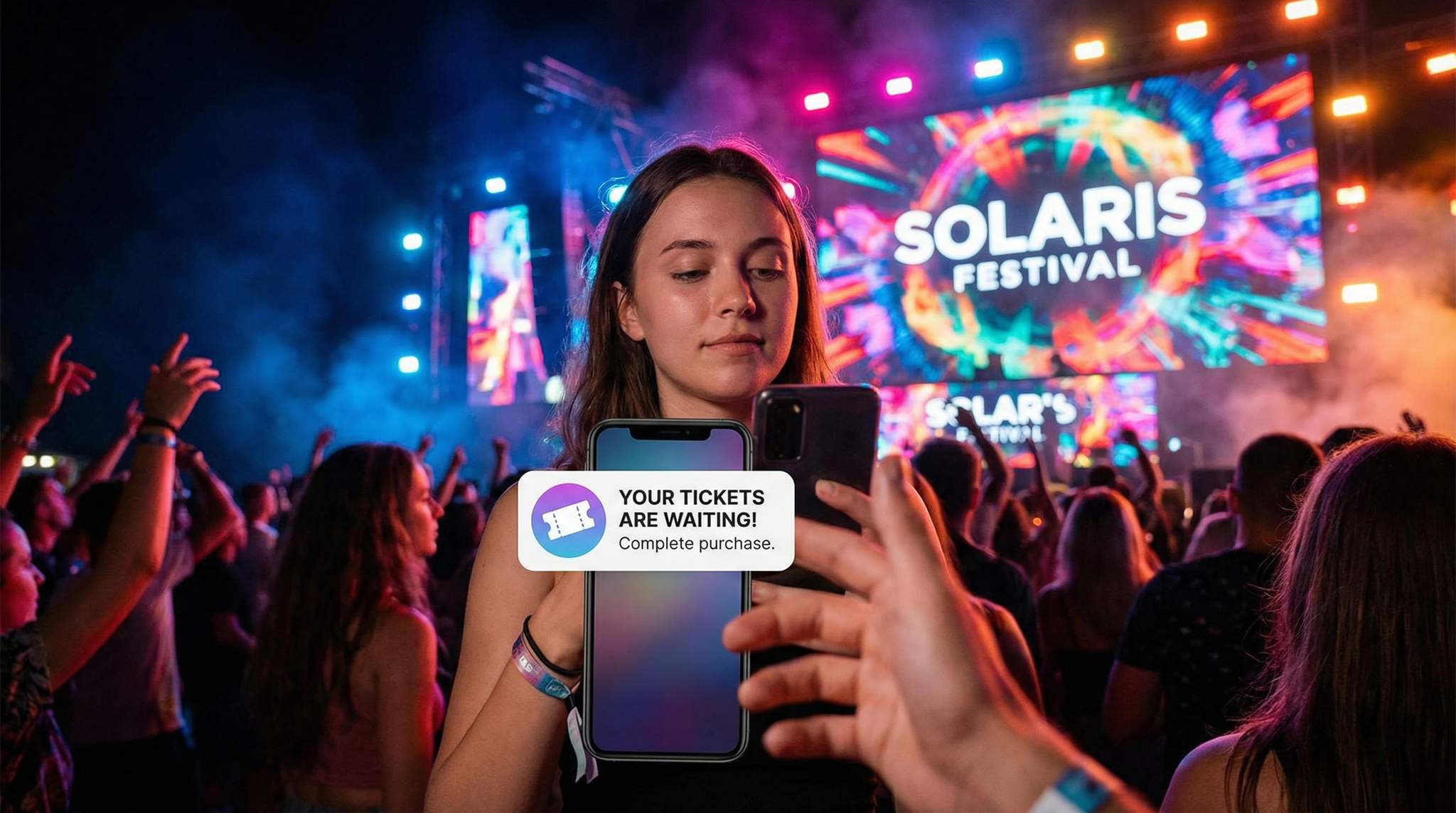
Perhaps the hottest audience segment is those who started buying a ticket but didn’t finish – for instance, they clicked “Buy Tickets” and maybe even began checkout, but didn’t complete payment. These people have extremely high intent; often something small stopped them (the phone rang, their card wasn’t handy, or they hesitated at the final step). Retargeting this group can yield some of the highest conversion rates of any marketing activity. Experienced event marketers treat abandoned carts like gold. For one, you have more concrete data on them – if your ticketing page captures an email address early in checkout, you can send an abandoned cart email soon after. A simple, personalized note like: “Hey Anna, you were so close to getting tickets to ComicCon XYZ! Your 2 tickets are still waiting in your cart – complete your purchase to secure your spot ?” works wonders. These emails boast incredibly high open and conversion rates – industry averages show remarketing emails can average a 57% open rate and a 15% click-through rate, far above normal email blasts, as seen in retargeting email campaign statistics. And when people click these retargeting emails, about 30% end up converting and buying, versus under 5% conversion from standard marketing emails, highlighting the effectiveness of timely follow-up emails. Those are hard numbers to ignore. At the same time, you should hit cart abandoners with ad retargeting from multiple angles. Set up a Facebook/Instagram retargeting campaign specifically for “Initiated Checkout but Not Purchased” (both Meta and Google allow creating audiences based on this funnel stage). In those ads, use messaging that reduces friction and adds urgency. For example: “Don’t forget to complete your order – only a few tickets left at the current price!” or “Secure your tickets – your cart is waiting (VIP upgrades still available!).” According to veteran promoters, timing is critical here: get your follow-ups out within 1-3 days of the abandoned action while the excitement is still fresh in the prospect’s mind. In one real-world case, a concert venue retargeted everyone who left at checkout with a limited 48-hour $5 discount code; they recaptured 25% of those would-be buyers, turning lost sales into a sold-out show. Even without a discount, sometimes all it takes is a well-timed reminder. As one campaign manager put it, “If they added to cart, they want to go – we just have to help them over the finish line.” Using tracking pixels, your ads can literally show someone the exact tickets they left behind (“2 × Weekend Pass for $180 – finish your purchase now!”), which grabs attention and spurs action, a sentiment echoed in strategies for mastering personalization for event promotion. By zeroing in on cart abandoners with prompt, helpful nudges, you’ll convert a big share of these nearly-converted fans.
Social Media Engagers and Video Viewers
Another valuable retargeting pool is people who have engaged with your event on social media or watched your videos, but haven’t bought tickets. These might include those who responded “Interested” or “Going” on a Facebook Event (but didn’t actually purchase yet), followers who liked or commented on your event posts, or viewers who watched a certain percentage of your promo video on platforms like Facebook, Instagram, TikTok, or YouTube. They’ve demonstrated interest, just not on your own website. Fortunately, you can often capture these groups for retargeting too. Facebook and Instagram let you create Custom Audiences from engagement – e.g. everyone who engaged with your Instagram account or specific posts, or all users who clicked “Interested” on your Facebook event. Likewise, you can build audiences of people who watched your video ads (say, those who viewed at least 50% of your trailer). These folks may need a different approach since they haven’t visited the ticket page yet – your goal is to drive them to the site to consider buying. Tailor your retargeting creative to deepen their interest. For instance, suppose you have a 2-minute festival aftermovie and thousands watched it on Facebook; you could retarget those viewers with shorter, punchier follow-up videos or carousel ads highlighting key attractions (“Liked what you saw? Check out our killer lineup and epic stages ?”). The idea is to connect the dots from their initial engagement to a purchase intent. Experienced marketers often sequence content here: first they run a captivating video ad broadly, then retarget the engagers with something like “Meet the Headliners: [Big Artist] is coming to [Your Event]!” to reinforce the value. On newer platforms like TikTok, you can retarget users who engaged with your TikTok videos or profile using TikTok’s Pixel and custom audiences. For example, if a TikTok of your DJ lineup reveal went semi-viral locally, retarget those viewers with a follow-up TikTok Ad that uses the same style/humor but ends with a clear call to action to get tickets. Even Twitter (now X) and Snapchat offer retargeting based on engagement, which niche promoters can leverage if those are popular in your demographic. Don’t forget YouTube retargeting via Google Ads: you can serve YouTube ads specifically to users who watched your channel’s videos. Perhaps show them a new teaser or an artist interview to further entice them. The overarching strategy is to recognize that a like, comment, or video view is the start of the journey. By retargeting those social engagers with more info, social proof, and easy next steps (“Get Tickets” buttons), you can convert passive interest into an active ticket purchase. Marketers who master this report significantly higher return on ad spend, since they’re focusing efforts on those who already raised their hand virtually to say “this looks cool.”
Grow Your Events
Leverage referral marketing, social sharing incentives, and audience insights to sell more tickets.
Past Attendees and Loyal Fans
Your previous attendees and loyal followers are arguably your warmest audience of all. They’ve bought tickets to your events before – maybe last year’s festival or a past show in the concert series. It’s a no-brainer to retarget them for your upcoming events, because they’re far more likely to convert again if they had a good time before. In fact, experienced promoters emphasize that retaining attendees is cheaper and more profitable than constantly acquiring new ones. Retention marketing stats back this up: improving customer retention by just 5% can boost profits 25% to 95%, underscoring the importance of maximizing attendee loyalty and lifetime value. So how do we remarket to past attendees? First, email is your best friend here. Hopefully you’ve been building an email list of all ticket buyers (Ticket Fairy and most ticketing providers give organizers access to attendee emails, assuming appropriate permissions). Send these folks a heartfelt announcement when you have a new event, like “We loved having you at [Last Event] – come join us again!”. Offering an exclusive alumni presale or loyalty discount works wonders: for example, “As a thanks, here’s 10% off if you book by Friday” or “Loyalty Presale: Get your tickets a week before public on-sale.” Many festivals run VIP presales for past attendees knowing they’ll jump at the chance to secure their spot again, a key tactic to turn one-time attendees into loyal fans. Beyond email, you should upload your past customer list to Facebook/Instagram and Google as custom audiences for ads. This way, your ads specifically reach people who have attended before, reinforcing the community and FOMO. The messaging might be along the lines of “The party’s back! Don’t miss Year 2 of [Event]. Welcome back, we’d love to see you!” Sometimes promoters even create lookalike audiences from their past attendees to find similar new customers – but make sure you separately retarget the actual past attendees with a special touch. Another angle: retarget past attendees during your marketing campaign with upsells or cross-sells. For instance, if you know someone already bought a general ticket for this year, you might retarget them with an offer to upgrade to VIP or to buy an add-on like a parking pass, using custom audiences of current buyers. However, the primary focus is getting past fans back in the door. These people are your brand ambassadors – they often bring friends (referral retargeting can be powerful too, like “Invite a friend, get a perk”). By re-engaging past attendees through personalized emails, targeted ads, and even direct mail or SMS if you have those contacts, you can significantly boost repeat attendance. The ROI is huge: loyal fans typically spend 67% more on average than new customers, since they might opt for VIP tickets, merch, or attend multiple events, proving the value of the lifetime attendee. In short, segment out your prior ticket buyers and show them the VIP treatment in your remarketing. They are the most likely to go from fence-sitter to buyer with minimal persuasion – after all, they already know the value of your event.
To summarize the key retargeting audiences and how to approach them, here’s a handy reference:
| Audience Segment | Effective Retargeting Tactics | Primary Channels |
|---|---|---|
| Website visitors (no purchase) | Show ads highlighting event benefits they viewed (e.g. lineup, theme). Use dynamic content reflecting pages they saw. Remind them what excited them and include a call-to-action to “Learn More” or “Get Tickets.” | Facebook/Instagram Ads; Google Display & YouTube (video teasers); RLSA search ads |
| Abandoned cart/checkout | Serve reminders of pending tickets: “Your tickets are still in the cart!”. Offer a limited-time incentive (small discount or bonus) if needed. Send automated cart recovery emails within 24-48h. Use urgency: “Almost sold out – complete your purchase.” | Email (triggered); Facebook/IG Dynamic Ads (show cart items); Google Display; even SMS for last-minute reminder |
| Social engagers & video viewers | Retarget those who engaged with posts or watched videos. Provide more info or a new angle to spark action. e.g. “You watched the trailer – here’s a peek at the schedule.” Use engaging creatives (short videos, carousels) to drive them to the site. | Facebook/Instagram Custom Audiences (engagement-based); TikTok Ads retargeting; YouTube Ads for video viewers |
| Past attendees | Send personalized invites: “We loved having you – join us again!” Include loyalty perks (alumni presale, discount, VIP upgrade). Highlight “what’s new” to give them a fresh reason to return. Use lookalikes to find similar new audiences while primarily targeting these proven fans. | Email campaigns; Facebook/IG Custom Audience (past buyers); Google Customer Match (past buyers on YouTube/Gmail); Direct mail or SMS (if appropriate) |
Each of these segments responds best to tailored messaging that meets them where they are in the decision process. By zeroing in on these high-value audiences one by one, you ensure your remarketing spend goes to the prospects most likely to convert – which is the essence of efficient event marketing.
Social Media Retargeting Strategies
Social platforms are often the first stop for event retargeting because they offer rich data and engaging ad formats. In 2026, Facebook and Instagram remain powerhouses for reaching event-goers (despite the challenges in tracking), and newer platforms like TikTok have become viable retargeting channels too. Here’s how event marketers are mastering social media remarketing in a privacy-first world:
Facebook & Instagram: Retargeting in a Post-iOS14 World
Meta’s platforms (Facebook and Instagram) still provide some of the most sophisticated retargeting capabilities – but marketers have had to adapt their tactics post-iOS14 and under new privacy pressures. The good news is Facebook can still track and target users who visit your website on many devices, especially if they opt in via the Facebook Cookie Consent or if you implement the Conversions API as discussed. Additionally, Meta has a treasure trove of on-platform behavior to draw from: you can retarget people who viewed your event details or clicked a ticket link inside Facebook, or those who engaged with your event-related posts. Start by defining your core Custom Audiences in Facebook Ads Manager:
– Website Visitors (past 30/60/90 days) – you can even segment by those who visited specific pages (e.g. the ticketing page).
– AddToCart/Initiated Checkout – using the pixel events, capture those high-intent folks separately.
– Facebook Event Engagers – people who marked Interested/Going or viewed your event on FB.
– Instagram Engagers – people who interacted with your IG content (profile visits, likes, story replies, etc.).
– Video Viewers – if you have a promo video, target those who watched say >50% of it.
By setting up these audiences, you have the building blocks. Now, craft platform-specific ads for each. On Facebook News Feed, you might use a horizontal image or short video with an enticing caption. For example, a theater show could run a video snippet of a standout scene with text like “You saw a sneak peek – now experience the full show live! ? Tickets waiting for you.” On Instagram, ensure you also create Story-format ads (vertical, fullscreen). Stories and Reels retargeting can be very effective – e.g. show a 15-second highlight of fans dancing at last year’s festival with a swipe-up “Get Tickets” call-to-action. One pro tip from veteran social advertisers: use Sequential Ads on Facebook/IG. This means showing users a series of different ads over time rather than the same one repeatedly. For instance, first they see an ad focusing on the lineup, next time an ad focusing on the immersive stage design, third time maybe an ad with a testimonial or quote from a past attendee. This ad sequencing approach keeps content fresh and engages people from multiple angles, increasing the chance one of the messages resonates enough for them to click through. (Facebook’s ad rotation settings or campaign budget optimization can handle this automatically if you upload a few variations.) Also, mind your frequency cap – on Meta, you generally don’t want to serve more than say 3-5 impressions per user per week for retargeting (exact frequency might vary by campaign length). Too high and people start feeling spammed; seasoned marketers find the sweet spot where the ads are a friendly reminder, not an annoyance.
Another change in 2026 is Facebook’s introduction of ad consent modes and subscription options in some regions. In Europe especially, some users may see an option to use Facebook ad-free (for a fee) or to limit personal data use. This could reduce the size of your retargetable audience on FB/IG. The strategy here is to make the most of the audience you can target. Focus on quality creative and compelling offers so you convert the reachable users at a higher rate. Also, diversify to Instagram’s explore, Reels, and even Messenger ads – Meta’s algorithms will try to find where your retargeted audience is most likely to respond. Experienced advertisers also leverage lookalike expansion carefully: for example, if your retargeting list of site visitors in NYC is small, you might use a Lookalike Audience (1-2%) on top of it to let Facebook show ads to people very similar to those visitors, effectively broadening reach while staying relevant. This isn’t pure retargeting, but it complements it under Meta’s “Advantage Detailed Targeting” and other AI targeting options. The key is still your seed audiences – those first-party data points. As long as you feed Meta good seeds and compelling creative, Facebook and Instagram remain extremely powerful for converting fence-sitters. Many promoters report their highest ad ROAS coming from these retargeting campaigns on Meta, even post-iOS changes. They’ve simply had to lean more on consented data, creative diversification, and Meta’s own machine learning to hit those results. The payoff: turning social media scrollers who showed a glimmer of interest into excited ticket purchasers.
TikTok and Emerging Social Platforms
TikTok has exploded in popularity and as of 2026, it’s become an intriguing retargeting channel for events – especially those targeting Gen Z and young Millennials. TikTok’s advertising platform now offers Retargeting via the TikTok Pixel and Custom Audiences similar to Facebook. You can track website actions (page views, purchases) with the TikTok Pixel and then create audiences of people who did or did not complete certain events. Additionally, TikTok allows retargeting of engagers: for example, people who watched your TikTok videos to the end, or who followed your account, or interacted with your TikTok posts. For an event with a decent TikTok presence, this is gold. Imagine you posted a viral clip of last year’s festival drop on TikTok and it got 100k views – you could retarget those viewers with a new TikTok ad promoting this year’s tickets. The creative style on TikTok needs to be very native and attention-grabbing. Seasoned social marketers advise using TikTok retargeting ads that feel like TikToks, not polished commercials. Use vertical video, trending sounds or music, captions, and a fast pace. For example, an experiential art show might run a TikTok ad that starts with “POV: You almost missed the trippiest art event of the year” and then quickly flashes highlights, ending with “Don’t sleep on it – tickets still available.” It addresses the viewer in the platform’s own language. Keep it fun and FOMO-inducing. TikTok’s algorithm can be a bit of a black box, but it’s adept at finding people likely to engage. Retargeting helps narrow it to those who already touched your content or site. One caveat: TikTok’s user base might not overlap fully with your website visitors (some people see your TikTok but never visit your site, and vice versa). So you may need to run separate retargeting streams: one for on-TikTok engagers and one for site visitors (via pixel) who use TikTok. The platform now supports combining audiences with logic (e.g. target “Site visitors AND TikTok engagers”) to maximize coverage.
Other emerging or niche social platforms have retargeting options too. Twitter/X allows retargeting using Twitter Pixel (called the Twitter Tag) and custom audiences from email lists or engagement (like people who viewed your tweets). If you run ads on Twitter, you could, for instance, retarget everyone who clicked on your tweet about the event but didn’t buy, with a follow-up Promoted Tweet that adds urgency or more context. LinkedIn might be relevant for B2B conferences or networking events: LinkedIn Ads let you retarget website visitors and also those who engaged with your LinkedIn content or event page. For a professional audience event, showing them LinkedIn Sponsored Content that says “Still time to register for the [Industry Summit]. Join 500+ peers – don’t miss out!” can catch them in work-mode and drive conversions. Snapchat too has a Snap Pixel for web retargeting and custom audience features. Some music festivals have used Snapchat Ads to retarget viewers of their Snapchat stories or AR lenses with last-minute ticket offers, leveraging Snapchat’s younger demographic and location filters.
While Facebook and Google remain the core, the lesson of 2026 is go where your audience is. If your target attendees are heavy on TikTok or Snapchat, allocate some budget there for retargeting. Just keep the creative highly platform-appropriate; what works on Facebook (longer text, more informational) won’t work on TikTok (needs instant hook and entertainment value). Experienced event marketers test and learn on new platforms, often with small experiments. They might try a TikTok retargeting campaign for one concert and measure results. If the CPA is on par or better than Facebook, they scale it up for more events. Many have found TikTok’s ad costs still relatively affordable, and the engagement high, making it a great complement to the usual channels. And because TikTok and others started in a privacy-conscious era, they’ve built their ad tech around aggregated data and algorithms that can perform even with limited personal tracking. This sometimes means their targeting isn’t as pinpoint as Facebook’s once was, but by using retargeting you feed them very relevant signals to work with. In summary, diversifying your social retargeting to platforms like TikTok, Twitter, LinkedIn, and Snapchat can unlock incremental ticket buyers you might miss if you rely on just one channel. The key is aligning the message and creative style with each platform’s norms, so your ads resonate rather than feel off-putting.
Tailoring Ad Creative to Each Platform
One size does not fit all when it comes to retargeting ad creative across social platforms. High-performing event campaigns invest effort into customizing content for each social channel, even if the underlying message is consistent. Why? Because an Instagram user idly tapping through Stories at night needs a different approach than a professional scrolling LinkedIn at lunch, or a teen watching TikToks. Let’s talk specifics:
On Facebook, you have flexibility for longer text and mixed media. You might use a multi-paragraph ad caption to tell a quick story: e.g. “Remember how electric the crowd was at last year’s show? We do. That’s why we’re bringing it back even bigger… [Event Name] returns in 4 weeks. If you haven’t got your ticket yet, here’s what you’re missing… [lineup highlights].” Paired with a photo album or a 30-second montage video, this can work well for those who need more convincing via information and imagery. The tone can be a bit more formal or detailed, since Facebook skews to a broad adult audience. Ensure the first sentence is attention-grabbing to avoid the “See more” cut-off without engagement.
On Instagram, visuals are king. Use eye-catching imagery or short videos (Reels) with minimal text overlay. The copy should be punchy and concise because many users don’t read long captions. For Story ads, use features like polls or swipe-up if possible: e.g. a Story that says “?? Still need your ticket?” with a swipe-up link. Use Instagram’s aesthetic to your advantage – polished, vibrant images for a sophisticated event, or raw, live-shot footage for an underground rave, to match the vibe. Also consider Instagram Carousel ads for retargeting: you can show multiple slides – one with lineup, one with a testimonial, one with a pricing tier – so a user swiping through gets a fuller picture of the event. This format can be very engaging for retargeting because it’s interactive and lets you present more info without overwhelming a single image.
On TikTok, as mentioned, embrace trends and authenticity. User-generated style content often wins. You might literally film a TikTok video of someone saying, “POV: you keep seeing [Event] ads but still haven’t bought tickets ? – here’s 3 reasons you’ll be sad if you miss this:” and then list cool things about the event in a playful way. Use text overlays, sounds, and fast cuts to match typical TikTok content. Humor or bold claims in the first 3 seconds help (e.g. start with a clip “Me at work thinking about [Event Name]” then cut to fun footage). The idea is to make the ad blend into the content feed so the user doesn’t immediately skip it. Many event marketers partner with influencers or charismatic staff to appear in these retargeting TikToks, lending a relatable face to the promotion.
On YouTube, if you’re doing retargeting ads (via Google), you likely have 15 or 30-second video slots. Remember that viewers can skip most TrueView ads after 5 seconds, so front-load your hook. For retargeting, you can be pretty direct because you know this viewer showed interest. For example: “Still thinking about [Event]? Here’s a sign to book your tickets!” – said by a narrator or on-screen text in the first 5 seconds, while showing exciting footage – can capture attention. Then use the remainder of the ad to amplify the excitement or answer a question. Maybe include a quick testimonial clip like an attendee saying “It was the best weekend of my life!” or highlight a headliner’s name in big text. End with a clear call-to-action on screen (like the event date and a “Get Tickets – Don’t Miss Out” message). YouTube also offers bumper ads (6-second non-skippable) – those can be great retargeting touches for awareness like “Only 3 days to [Event]! Last chance for tickets.” They aren’t likely to get a direct click, but they reinforce urgency and event name recall, which can lead the user to go directly search your event later.
On LinkedIn, assume a professional tone and highlight value prop. For a conference, a retargeting ad might say “Join 500+ industry leaders at [Conference]. Sharpen your skills and grow your network – limited spots left.” Keep it straightforward, with maybe an image from last year’s keynote or networking reception to visually appeal. LinkedIn users respond to thought leadership and career growth angles, so emphasize what they gain by attending, not just the fun.
No matter the platform, maintain consistent branding (use your event logo, colors, hashtag) so people recognize it’s the same event across channels. But do vary the content format and tone to suit the medium. Campaign veterans often create a matrix of assets – images, videos, short clips, text variations – mapped to each platform and audience segment. Yes, it’s more work than running one generic ad everywhere, but it pays off in higher relevance scores, engagement, and conversion. Platforms reward you (with lower costs) when your ads perform well with users. By tailoring creative, you not only win over those hesitant buyers, you do so efficiently. As an example, one festival reported their Facebook retarget ads (with detailed info) had a higher click-through rate among 30+ aged viewers, while their Instagram Story retarget (with just visuals and a swipe) captured more of the 18-24 crowd. Both running simultaneously maximized overall conversions. The takeaway: meet your audience where they scroll and speak their language there. Your retargeting will feel like a natural, welcome part of their feed rather than a disjointed ad, leading to more ticket sales.
Google & Programmatic Retargeting Tactics
Beyond social media, Google’s advertising network and programmatic display ads offer powerful ways to re-engage event prospects across the wider web. These channels ensure your event stays visible as people browse news sites, watch videos, or use apps – reaching them during moments when social media might not. Here’s how to harness Google and programmatic retargeting effectively:
Google Display Network & YouTube Retargeting
Google’s ecosystem provides multiple retargeting opportunities. The Google Display Network (GDN) reaches 90%+ of internet users across millions of websites and apps. By setting up a Display Retargeting campaign in Google Ads, your banners can appear on relevant sites to remind past visitors about your event. For instance, someone who checked out your EDM festival page might later see your banner ad on a music blog or while reading the news, saying “Don’t forget [Festival Name] – Tickets Available Now,” with a vibrant image from last year’s crowd. GDN targeting can be refined by contextual keywords too, so you might bid more to show on pages about nightlife or music if you know that interest aligns. One advantage of GDN is relatively cheap impressions (CPMs) – you can get thousands of banner views for modest cost. While click-through rates for display banners are typically low (~0.2-0.5% on average), remember that view-through influence matters; even if someone doesn’t click the banner, seeing your event repeatedly can build familiarity and trust, making them more likely to search and buy later. Google Ads provides view-through conversion metrics to estimate how many saw your ad and converted without clicking. Monitoring those helps you gauge the true impact. To boost performance, use responsive display ads that adjust size/text to fit placements, and include compelling images (performer photos, venue shots) plus a clear call-to-action text on the ad (“Get Tickets”). Also, frequency-cap your Google display ads (e.g. 5 impressions per user per day) so you don’t overdo it.
YouTube retargeting is another gem. Through Google Ads, you can retarget people on YouTube who either visited your website or interacted with your YouTube channel/videos. For example, show a YouTube pre-roll ad to anyone who searched for your event or watched your videos previously. If you have a great aftermovie or a sizzle reel, use that as a YouTube ad targeted specifically to those who showed prior interest. They’re more likely to watch it fully, since it’s relevant to what they care about. Even a 15-second ad before music videos, with text like “Remember [Event]? Only 2 weeks left – join the experience!” can capture attention. A pro tip for YouTube: use call-to-action extensions that overlay a clickable button on the video ad, saying “Buy Tickets” – this can drive direct action more easily, especially on mobile where tapping the screen is easier than remembering a URL. And if you have longer video content (like artist interviews or stage build diaries), consider using YouTube’s Discovery ads to promote those to engaged users as a way to deepen their connection and excitement, indirectly nudging them to purchase.
Another Google feature: Remarketing Lists for Search Ads (RLSA). This lets you adjust your search ad strategy for people who have already visited your site. For instance, if someone searched “electronic music festivals” and clicked your site but didn’t buy, the next time they search anything related (or even search your event name again), you can have a tailored ad appear. You might increase your bid to ensure you appear at the top for them, and customize the ad copy: “Still thinking about [Event]? Tickets are going fast – secure yours now.” RLSA is powerful because it catches people right when their intent is high (they’re actively searching). It often leads to higher conversion rates than plain search ads to cold audiences. Just ensure you have enough data – Google typically requires at least 1,000 users in a remarketing list to use it for search ads due to privacy thresholds.
All in all, Google’s retargeting channels cast a wide net – from Gmail ads (you can even retarget users with ads in their Gmail promotions tab, using Customer Match emails) to mobile apps. Seasoned event marketers use Google as a follow-up mechanism that complements social. Maybe a potential attendee didn’t click the Facebook ad, but later that night while browsing a travel blog they see your display ad and that reminds them to go back and buy. Or they ignored your email, but when they open YouTube the next day, your event trailer plays and convinces them. It’s this multi-channel persistence that makes retargeting so effective. One caution: coordinate your messaging across Google and other platforms. If your Facebook retarget ad says “20% off ends Friday”, make sure your Google banners reflect that same offer or urgency during that window. Consistency prevents confusion. Also, watch the frequency overlap – a user could conceivably see your ad on FB and on a website and on YouTube all in one day. That can be powerful reinforcement, or it can veer into overexposure. Experienced marketers often set overall frequency goals (like “let’s try not to exceed 10 impressions per person per week across all our retargeting channels”) and use each platform’s controls to modulate accordingly. By leveraging Google’s vast reach but doing so thoughtfully, you’ll stay front-of-mind without fatiguing your audience – leading those hesitant buyers to finally convert.
Programmatic Display & DSPs for Events
For larger events or those targeting specific niches, programmatic advertising via demand-side platforms (DSPs) can take your retargeting to the next level. Programmatic just means using automated, real-time bidding to place ads across a range of websites and apps. While Google’s Display Network is one slice of this, independent DSPs (like The Trade Desk, MediaMath, etc.) and networks can offer additional inventory and data not directly on Google. Event marketers with bigger budgets (or agencies at hand) use programmatic retargeting to fine-tune where their ads appear and to access premium placements. For example, let’s say you’re promoting an upscale wine & jazz festival. Through a DSP, you could specifically retarget your site visitors on high-end lifestyle sites (maybe Condé Nast publications or food blogs) by buying ad slots there when your tagged user visits. Or if you have a tech conference, you might retarget on TechCrunch or Wired’s site via programmatic deals. This level of placement targeting can lend credibility – your ad appears in a contextually relevant, respected environment, which can reassure fence-sitters about the event’s caliber.
Programmatic also allows use of third-party data segments, even in a privacy-first world, that can enhance retargeting. For instance, you might layer on a filter to serve retarget ads only to users within a certain geo radius (useful if your event mainly draws locals) or who fall into certain demographic buckets (like 25-40 age range, if that’s your sweet spot). While broad third-party targeting has diminished due to cookie opt-outs, some data like context or device type is still available. Additionally, DSPs often provide better cross-device tracking. If someone visited your site on their laptop but is now on their phone’s browser, a unified DSP might catch that and still show your retargeting ad, whereas siloed platforms might not always connect the dots. Seasoned digital marketers recommend programmatic retargeting for campaigns with at least mid-four-figure budgets and up, where the scale and optimization features justify the learning curve or management fees involved.
One tactic made possible by programmatic is Dynamic Creative Optimization (DCO) for retargeting. You can feed a DSP multiple creative elements – headlines, images, calls-to-action – and it will automatically assemble and test different combinations to each user or optimize based on performance. For example, it might learn that users retargeted late at night respond better to a shorter, more urgent ad (“Only a few hours left to buy!”) whereas weekend daytime users click more on an ad showing a scenic photo of the venue. The system will then serve more of whatever works best for each scenario. As noted by experienced advertisers, programmatic platforms and social networks increasingly allow this kind of AI-driven personalization in real time, enabling tailored messaging that boosts ticket sales. Embracing these tools can significantly boost retargeting efficiency. A fan who sees an ad saying “Don’t miss out on the 2 VIP tickets in your cart – final chance to secure your spot!” will recognize the immediate relevance and often take action, leveraging programmatic advertising precision. It feels almost like a personal reminder because the creative speaks exactly to their context. Setting up DCO requires some initial work (designing modular ad components and specifying rules), but can pay off with higher conversion rates.
If you’re new to programmatic, you might start by using offerings like Google DV360 (Display & Video 360) or even Amazon DSP if your event aligns with certain audiences (Amazon has rich data, though more often used for product marketing). There are also self-serve DSPs accessible to smaller advertisers. However, many event promoters lean on specialized agencies or ad tech partners for this. The advantage is reaching beyond the walled gardens of Google and Meta, capturing users throughout their digital day. The challenge is ensuring your ads are seen in brand-safe, relevant contexts and not overspending on flashy placements that don’t convert. It’s wise to keep a close eye on performance metrics – CTR, post-click conversions, view-through conversions – and optimize or cull placements that underperform. Programmatic retargeting can also handle frequency capping across multiple exchanges better; you can manage a unified frequency so that whether a user sees your ad via one ad exchange or another, the DSP can limit the total views per user.
Real-world example: A multi-venue concert series used a DSP to retarget potential attendees on premium music and entertainment sites. They observed that while Google Display provided volume, the programmatic buys on niche sites (like a popular guitar gear forum and a nightlife magazine site) yielded higher click-through and ticket purchase rates – likely because those contexts matched the users’ interests more closely when they saw the ad. By reallocating more budget to those high-performing placements and using DCO to test various images (band photos vs. crowd shots) automatically, they achieved a 25% lower CPA than through Google alone. The learning is that programmatic can uncover pockets of efficiency and performance that broader networks might miss. It’s like having a smarter ad deployment that finds the best opportunities for you. For events with tight margins and specific audiences, that can be a competitive edge to drive more sales cost-effectively.
Search Retargeting and Contextual Tactics
A slightly different angle within programmatic and Google’s realm is search retargeting and contextual retargeting. Search retargeting (not to be confused with RLSA) involves targeting users with display ads based on what they’ve searched for in the past, even if they never visited your site. Some DSPs and networks offer this: for example, you could serve ads to people who recently searched “best New Year’s events 2026” or “tickets Coldplay tour” and then left the search engine – you catch them later on other sites. It’s a way to reach potential attendees who haven’t been to your site but have signaled interest via search. It’s not first-party (it relies on third-party data of search queries), so its availability is diminishing with privacy changes, but certain partners still aggregate anonymized search intent data. Used carefully, it can expand your reach of “warm intent” users. You’d craft ads to speak to those queries, like “Looking for an epic New Year’s event? Join ours – tickets available now.” This is more of a prospecting tactic, but mentioning it here as it blurs with retargeting (targeting people because of a prior behavior).
Contextual advertising is another approach replacing behavioral data in some respects. Instead of targeting the user, you target the content of the page. For instance, you might choose to show your retargeting ad (which might be broadly appealing) on pages about travel to your city, or on a site reviewing concerts. This doesn’t guarantee the viewer is someone who saw your event before, but if your pixel data is limited, contextual placements can approximate reaching likely prospects. Modern programmatic lets you combine contextual with retargeting: e.g. target users who visited your site and/or currently reading a relevant article. The idea is to increase relevance and thus conversion chances.
Finally, don’t forget email retargeting via Google Customer Match and Facebook Custom Audiences as a quasi-programmatic tactic. Uploading your lists of interested leads or past buyers to these platforms allows you to retarget those specific people with ads during their normal browsing (on Gmail, on YouTube, on FB/IG). We touched on this when leveraging your ticketing platform; it’s worth reiterating that this is one of the most precise methods. If 500 people signed up for “notify me when tickets go on sale,” you can bet showing each of them an ad that says “Tickets are on sale now – don’t miss your spot!” will have a great hit rate. These platforms hash and match the emails to user accounts, so you’re effectively doing individual-level marketing at scale. Always ensure you have permission to use emails this way (privacy-wise you generally should disclose that you may use emails for targeted advertising).
In summary, Google and programmatic channels widen your retargeting reach and let you fine-tune delivery. They require more optimization and sometimes a bit more spend to see results, but they add a critical layer to your omnichannel remarketing. The most successful 2026 event campaigns are using both social and programmatic in harmony – social for its rich engagement and creative formats, and programmatic for its reach and precision outside the walled gardens. By covering all bases, you virtually “follow” your interested audience (politely) wherever they go online. As one marketing adage goes, you need to be present when the customer is ready to buy. That could be on any site or app at any time. With a robust retargeting setup, chances are your event’s message will be there at just the right moment to convince them to convert.
Email Retargeting & CRM Remarketing
While flashy ads get a lot of attention, email remains a retargeting powerhouse in 2026. For event marketers, email is often the highest-converting channel for turning interested prospects into ticket buyers – especially when used in a timely, segmented way. Let’s dive into how to use email and CRM (customer relationship management) tactics to win over fence-sitters:
Abandoned Cart & Inquiry Emails
We touched on this earlier, but it bears repeating: if you have someone’s email who started a ticket order or otherwise expressed interest, a well-crafted follow-up email can be your MVP. Many ticketing systems will capture an email address as one of the first checkout steps (e.g. “Enter email to start your order”). If a user drops off after that, you have a direct line to re-engage them. Set up an automated abandoned cart email that triggers within e.g. 1-2 hours of abandonment (or if not possible, at least within 24 hours). This email should be friendly, concise, and focused on helping the customer complete their purchase. For example:
Subject: Your tickets are almost yours – complete your order
Hi [Name],
> We noticed you were securing tickets for [Event Name] but didn’t get to finish checkout. If you had any issues, we’re here to help. Otherwise, just click below to pick up where you left off – your tickets are still waiting for you! ??
> [Resume My Order] (button link)
> Only a few spots remain at the current price tier. Don’t miss out on [Event Name] – it’s going to be an incredible experience.
> Need assistance? Reply to this email and we’ll help you out.
> Hope to see you there!
> – The [Event] Team
This kind of email strikes a helpful tone, creates urgency (mentioning few spots or price tier), and provides a clear path to completion. The conversion rates are often impressive. Some e-commerce studies (and events mirror this) show abandoned cart emails can achieve ~40% open rates and 20-30% conversion of those who click, according to Adobe’s email remarketing statistics. Even if only a small fraction of your visitors reached the cart stage, each one is a high-probability sale – so reclaiming them is huge, as shown by sales recovery data.
Beyond cart abandons, consider inquiry retargeting emails. If your event page has a general inquiry or RSVP interest form (for instance, “Sign up to get more info”), those who filled it out are prime to nurture. Send them a tailored message that nudges toward buying. For example: someone signs up “Tell me more about VIP packages.” Your follow-up email can detail the VIP perks and include a direct purchase link for VIP tickets, perhaps with a limited-time bonus (like “Book in the next 3 days and get a free merch item at the event”). The idea is to move them from interest to action with targeted content that addresses whatever info they might be waiting on.
Timing: In email retargeting, sending promptly while the interest is hot is vital. However, you can also do a multi-email sequence if the first nudge doesn’t get a response. Maybe send one 1 hour after abandonment, then another 24 hours later, and a third a few days later, each with a different angle (gentle reminder, then perhaps an incentive or FAQ answers). Just don’t overdo it to the point of annoyance – if they haven’t engaged after 2-3 retarget emails, it might be better to pull back and put them into a less frequent newsletter list.
Nurture Drip Campaigns for Interested Leads
Not everyone will be ready to buy immediately, even with retargeting. That’s where a drip email campaign can come in. Say someone signs up for your mailing list but hasn’t bought a ticket yet. Instead of blasting them with random newsletters, design a nurture sequence to slowly convince them. For example, an expo or conference might have a 4-part email series to leads:
1. Welcome & Value Proposition: Right after sign-up, send an email thanking them for interest and highlighting what makes the event unmissable (headline speakers, unique experiences). No hard sell, just excitement building.
2. Testimonials/Social Proof: A few days later, share stories or quotes from past attendees: “Why people loved [Event]” – to build trust that others found it worthwhile. Include a subtle call-to-action “Secure your ticket to see for yourself.”
3. Educational or Content Offer: Next, offer something of value related to your event. E.g., “Guide to Getting the Most from [Event]” or a short video of behind-the-scenes or an interview with a performer. This keeps them engaged and reminds them of the upcoming event. It’s not purely sales-y, it’s building a relationship.
4. Urgency Push: As the event nears or as tickets fill up, send an email with a clear urgency trigger: “Don’t wait any longer – only 50 tickets left” or “Early bird discount ends Friday – last chance to save.” By now, they’ve heard all the reasons to attend, seen others excited, engaged with content – this final nudge converts many fence-sitters who just needed that extra push.
This kind of structured approach can significantly lift conversion of leads over just one-off emails. According to email marketing research, sending a series of retargeting emails can recover far more abandoned prospects – one study noted that a series of 3+ abandoned cart emails can recover 69% more carts than a single email alone, emphasizing the power of multi-touch email sequences). Similarly, multiple follow-ups increase response rates; even in B2B contexts, ~50% of sales happen after the 5th follow-up contact, proving that persistence in follow-ups pays off. The lesson for events: polite persistence via email pays off, as long as each touch provides value or new info, not just “BUY NOW” repeated. Just make sure you stop once they do convert! (Integrate your ticket sales data with your email list to suppress buyers from further “please buy” emails, switching them to attendee communications instead.)
Re-Engaging Past Attendees & Dormant Fans
Email is also your best channel for resurrecting past attendees or dormant fans who haven’t bought for the current event yet. We covered a lot under the “Past Attendees” retargeting section, so let’s focus on the execution via email. Your CRM or email platform should allow you to filter contacts by what events they attended or at least who’s on the list vs who’s bought this time. You can then send highly targeted emails. For instance, if you run an annual gaming convention and you have 1,000 people who attended last year but haven’t bought this year, craft an email just for them: “We noticed you haven’t registered for 2026’s GameCon yet – as a 2025 attendee, we don’t want you to miss out! Here’s what’s new this year: [bullet list of 3 cool new things]. We’d love to see you back – secure your badge by [Date] and use code ALUMNI for 15% off.” This kind of personalization (“we know you came last year”) flattered their past commitment and makes them feel part of an insider group. It often jolts people who intended to go but were procrastinating – they think “Oh right, I should grab my ticket, and nice, a discount just for me.” Even without a discount, just acknowledging their previous attendance and highlighting new or improved aspects can re-ignite their interest.
For fans who signed up to your list long ago but haven’t engaged recently, consider a re-engagement campaign. For example, “We miss you – [Event] is back and better!” with an update on what’s been happening. Sometimes people ignore general newsletters but will respond to a more personal “poke.” Include a clear CTA if they’re interested: “Click here if you want to keep receiving updates about [Event].” If they click or visit, great – they’re re-engaged and you can retarget them more. If not, you might sunset them to avoid spamming disinterested contacts (which can hurt deliverability). List hygiene aside, the point is to give dormant leads one strong opportunity to rejoin the excitement, often in conjunction with your event announcement or lineup reveal which naturally increases interest.
Another powerful but often overlooked email retargeting method is the “last chance” or “low inventory” alert to all who showed interest but haven’t bought. For example, a week before your event, you might send an email to everyone who opened at least one of your prior emails or visited the site (if you integrated that data, some CRMs can segment by web behavior), saying “This is it – last call for tickets!” with maybe a countdown timer graphic or at least a bold note “Sales close in 48 hours” or “Only 20 tickets left”. These emails tend to get high open rates because they imply urgency and exclusivity. According to some marketing benchmarks, subject lines with phrases like “last chance” or “ending soon” can uplift open rates significantly – because nobody wants to miss out if they were considering it. Our earlier strategy article on urgency and FOMO in promotions noted that making timing clear (“deadline approaching”) can motivate those who’ve been sitting on the fence, a core tactic when using urgency and FOMO to boost attendance. Similarly, subject lines with phrases like “last chance” or “ending soon” can uplift open rates significantly, helping ramp up urgency in emergency strategies. Just be truthful – don’t fabricate a false urgency (e.g., don’t say “last 20 tickets” if hundreds remain; instead find a real angle like last days of regular pricing, etc.). Trustworthiness is key to maintain; savvy consumers will catch on if every email is a “final chance” every week.
SMS and Direct Messages as Retargeting (Optional)
While email is the focus here, it’s worth noting that SMS marketing and direct messaging (like WhatsApp broadcasts, Facebook Messenger or Instagram DMs via bot) can supplement your retargeting arsenal for those who opt in. Some events, especially festivals and conferences, ask for a mobile number at registration or checkout, or have a keyword fans can text to subscribe to updates. These channels have incredibly high open rates (people almost always read their texts). You must use them sparingly and for important messages. A well-timed SMS such as “Reminder: [Event] is 3 days away. Final tickets selling fast – grab yours: [short link]” can spur immediate action from someone who maybe ignored emails. Similarly, if a user chatted with your Facebook Page’s bot and left their convo unfinished, a polite follow-up in Messenger like “Hi! Tickets for [Event] are still available. Need any help deciding? We’re here.” can re-engage them. However, always have permission and make it easy to opt-out; these channels are personal space and can annoy if overused.
That said, many promoters in 2026 are exploring WhatsApp or Telegram community messages for events in regions where those are prevalent. For example, sending a broadcast or posting in your official Telegram channel something like “Haven’t bought your [Event] ticket yet? Online sales close tonight. [link]– see you there!” might catch some last holdouts. Again, these should complement, not replace, email – and only target those who’ve followed or subscribed on those platforms (so it’s essentially retargeting your engaged base, not cold outreach).
In conclusion, email and CRM retargeting thrive on relevance and timing. By segmenting your contacts based on their actions (opened email, clicked site, past buyer, etc.) and tailoring your messages, you’ll achieve far better results than generic blasts. The numbers speak for themselves: email conversion rates for warm audiences can hit 5-10% or higher, dwarfing the ~1-2% typical of many ad campaigns, demonstrating how subscribers convert to ticket buyers. One analysis indicated email marketing for festivals averages ~8% conversion, versus ~3% for social media referrals, highlighting the strength of festival email marketing and direct outreach. And with an ROI of ~$42 for every $1 spent on email on average, it’s arguably the highest ROI retargeting method for engaging your core audience. So, while you optimize those ad impressions, don’t neglect the humble inbox – it’s often where interest quietly alchemizes into ticket sales.
Crafting High-Converting Retargeting Messages
Getting your ads and emails in front of the right people is half the battle – the other half is what you say and show to persuade them. Crafting effective retargeting creative requires understanding the audience’s mindset and delivering the right message at the right time. Let’s explore key strategies for messaging and creative that turns fence-sitters into buyers:
Sequencing Ads to Tell a Story
One advanced tactic experienced event marketers use is sequential messaging – essentially, telling a story through a series of retargeting ads (or emails) that build on each other. The idea is that each touchpoint reveals a new piece of the puzzle or addresses a different concern, rather than hammering the same pitch repeatedly. For example, the first ad someone sees after visiting your site might be general and inspirational: beautiful shots of the event with “Experience the Magic of [Event] – Tickets on Sale”. If they don’t convert from that, the next retargeting ad a few days later might drill deeper: “Hear What You’ll Experience: [Event] features 5 stages, 40+ artists, gourmet food, and more” with a short highlight reel. A third ad could then leverage social proof: quotes or testimonials from past attendees (“‘Truly life-changing – I met my best friends at [Event]!’”). Finally, a last sequence ad might be the urgency kicker: “Last Chance – [Event] is next week. Only 10% of tickets left!” with a bold countdown visual. By sequencing in this manner, you’re effectively guiding the prospect through the classic marketing funnel via retargeting: from awareness (why it’s awesome) to consideration (details and credibility) to decision (act now).
Platforms like Facebook make sequencing easier with features like Ads Flow or reach-and-frequency buys where you can control order, but even manually, you can approximate it by rotating your creatives over time. On Google and programmatic, similarly, you can set up campaigns to serve different messages after X days since last site visit, etc. Event marketers who do this “ad storytelling” report that it keeps content fresh and engagement high – someone might ignore two ads but click the third when it finally hits the point that matters to them (be it lineup, testimonials, or urgency). For instance, one tech conference found that prospects who didn’t respond to the initial “big speakers announcement” ad later responded to an ad about “networking opportunities for startups” – indicating different value propositions resonate with different sub-segments. So sequencing also helps you cover multiple value props.
Just be sure to maintain consistency in branding and core messaging even as the content varies. All the pieces should feel like parts of the same puzzle, not disconnected ads for different events. Keep the tone and visual style relatively consistent. Think of it like chapters in a book – each chapter moves the story forward, but it’s one cohesive story. If someone sees all four of your ads, it should collectively paint a comprehensive, non-repetitive picture of why they should attend.
Tailoring Messages to User Segments
Retargeting is most powerful when the content speaks directly to the specific audience segment’s interests or barriers. We’ve touched on tailoring by platform; here we focus on tailoring by persona or behavior segment. For example:
– First-time prospect vs. past attendee: A new prospect might need more explanation of the event’s highlights and credibility (“Voted best new festival of the year”, “headliners you love”). A past attendee doesn’t need the event explained – they need to know what’s new/different or simply a “welcome back” vibe. Thus, you might retarget past attendees with copy like “Your festival family is waiting – come reunite at [Event] 2026!” whereas new folks see “Discover why everyone’s talking about [Event] – an experience like no other.”
– Local attendee vs. traveler: If you can detect location (via geo-targeting in ads or segments in email), tailor the messaging. Locals might get “Don’t miss the biggest event in our city this year, right in your backyard.” Out-of-towners might need more incentive: “Worth the trip – join fans from all over the country at [Event]. Travel packages available!” In emails, for instance, some festivals send different drip content to those outside the state (including info on hotels, flights, etc., to ease that decision).
– High-spending VIP prospect vs. deal seeker: Your retargeting content can also adapt to the user’s prior behavior related to price sensitivity. Say your site has both GA and VIP tickets. If someone checked the VIP info page, send them retargeting emphasizing VIP perks, exclusive experiences, etc. If someone only looked at the cheapest tier, emphasize value: “Affordable packages starting at $X – flexible payment options.” Many ticketing platforms can tell you which ticket type a user selected or viewed before abandoning cart, allowing pretty granular retargeting on that basis.
– Different interest tracks: For multi-genre events, segment by interest. If it’s a conference with multiple tracks (tech, design, marketing), note what content they engaged with. Or a festival with multi-genre lineup (rock vs. EDM). Then retarget highlighting what they care about. It could be as simple as making sure the band they likely are interested in is featured in the ad image or copy. For example, if a user spent time on the “EDM Stage lineup” page of your website, retarget them with visuals of the EDM stage and DJs, and a message about the epic rave experience. Someone who browsed the “Family activities” page of a fair event might get an ad focusing on kid-friendly fun and family discounts.
To execute this tailoring at scale, you rely on good segmentation in your pixel and CRM data, as well as dynamic ad capabilities. Facebook’s Dynamic Ads can even pull different content for an ad based on user attributes if set up (commonly used for e-commerce, but can apply to event categories). Alternatively, you create multiple ad sets each targeting a defined segment and use unique creative for each. Yes, it’s more creative variations to produce, but the lift in relevance often means much higher conversion. Experienced promoters often see 2-3x higher click-through rates on tailored ads versus generic ones, because people feel “This is speaking to me.” That also translates to better ad relevance scores and lower costs on platforms like Facebook.
On the email front, tailoring is usually done via merge tags and segmentation. For instance, address people by name (basic personalization) and perhaps reference their city (“Hope things are great in [City] – we’d love to see you at [Event]…”). If your CRM knows someone’s past purchase was VIP, you might highlight “VIP is nearly sold out” specifically to them. Meanwhile, regular attendees might not get that line. The more data points you have (without being creepy), the more you can personalize. But even simple segment splits like past vs new, local vs travel can make a big difference. According to data, segmented email campaigns can yield 100% higher click rates than non-segmented, proving that one size doesn’t fit all in event marketing – an impressive stat that underscores this principle.
In summary, think of your hesitant buyers not as one monolith, but as clusters of individuals each with a particular hold-up or interest. Then craft your retargeting message to address that. If cost is a barrier, hit them with a payment plan option or limited discount. If safety or logistics are a concern (not uncommon post-pandemic or for large events), mention cleanliness policies or ease of entry. If hype is lacking, build FOMO with new announcements or fan testimonials. By tailoring messaging in this way, you not only increase conversions – you show your audience that you understand them, which builds trust and positive sentiment that can carry into their event experience.
Using Urgency and Scarcity (Ethically)
One of the most powerful psychological triggers in marketing is urgency – the fear of missing out (FOMO) on a limited opportunity. Event marketers have long used urgency to spur ticket sales (“Early bird ends soon”, “Only 100 tickets left at this price”). In retargeting, urgency is your ace-in-the-hole to push fence-sitters over the edge, especially as the event draws near or tickets run low. However, it must be used ethically and truthfully to maintain trust (savvy consumers can smell fake scarcity, and it can backfire). Here’s how to leverage urgency right:
Limited Time: Whenever you have a genuine deadline, make it loud and clear in your retargeting messages. For example, maybe your early-bird pricing ends this Sunday. In the days leading up, swap your ads and emails to focus on that: “? Early Bird ends in 3 days – last chance to save 20% on [Event] tickets!” Countdown timers in emails (animated GIFs or real timers) can visually reinforce this; as the clock ticks down, people feel the need to act. In ads, you can update copy or have multiple versions (3 days left, 2 days, 1 day). According to marketing research, countdown timers and phrasing like “now or never” or “last chance” consistently drive higher click and conversion rates by ramping up urgency. Similarly, making timing clear (“deadline approaching”) can motivate those who’ve been sitting on the fence, effectively using FOMO to drive sales. Just ensure when the time is up, you actually end the sale or change the offer; never continuously extend a deadline without explaining (if you do extend, frame it as a special extension due to demand or a new allotment of tickets, etc., not as if the initial urgency was false).
Low Stock: If your ticket tiers are genuinely selling out, let people know. For instance, “Only 50 tickets remaining!” or “90% sold out – don’t get left out!”. Social proof of demand plus scarcity can push someone from “I’ll get to it eventually” to “I need to buy right now or I’ll miss out.” Make sure to tailor this to the audience stage – cart abandoners especially respond to low-stock messages: they almost bought, and hearing that tickets are almost gone creates a sense of regret if they don’t act. A real-world anecdote: an event noticed a big spike in conversions when their retargeting banners switched to show “SOLD OUT” on one ticket tier and “Limited passes left” on the others – seeing one tier was gone and others were going fast triggered a wave of purchases among those who had been dithering. People realized, this is serious, tickets are actually running out!
Price Increases: Many events have tiered pricing (early bird, regular, last call) or promotions that expire. This is another urgency lever: “Prices go up at midnight – secure tickets now to save $$.” Nobody likes to pay more by procrastinating. This can be as effective as low-stock, because even if supply isn’t an issue, money is. Emphasize the specific difference: “Buy now to save $20 before prices rise.” Retargeted individuals who showed interest earlier likely know roughly the price; telling them it’s about to get pricier nudges them to commit. Again, honesty – if your event doesn’t change price, don’t fabricate a “price increase” story. But if tiers are in your sales plan, absolutely use that in messaging.
Ethical Considerations: The word “ethical” was highlighted for a reason. Overusing or faking urgency can erode trust and even damage your brand reputation. Some guidelines:
– Be truthful: If you say “Only 10 tickets left”, it should be roughly accurate (at least for a given tier or section). Don’t claim scarcity if hundreds of tickets remain – instead find a real angle (like limited spots in VIP, or time-based urgency rather than quantity).
– Don’t cause panic: Urgency should motivate, but your tone can still be positive and encouraging rather than fearmongering. e.g. “Last chance to join the fun!” vs “Buy now or regret forever!” Keep it friendly FOMO, not doom.
– Use sparingly: Constant urgency in every message can lead to fatigue or skepticism (“They say everything is last chance…”). Save the strong urgency for key moments (e.g. final week, price deadline). Earlier in the campaign, soft urgency is fine (“Don’t miss early bird rewards”), but the hard “last opportunity” should feel special and real.
– Respect buyer experience: If someone does miss a deadline, honor it. Maybe offer them another incentive later if needed, but don’t simply pretend the deadline never existed. Conversely, if someone buys because you said “offer ends today” and then sees a new better offer tomorrow, they’ll feel cheated. Avoid that scenario.
When used correctly, urgency is incredibly effective. It taps into the natural human tendency to avoid loss – missing out on an experience or discount is perceived as a loss. One festival marketer noted that over 50% of their ticket sales came in the last 10 days before the event, largely driven by urgency messaging and final retargeting blitz, aligning with the last-minute ticket rush. To maximize this period, they did things like daily countdown social posts, final reminder emails, and “last chance” ads everywhere. It’s like shining a spotlight on the ticking clock. But importantly, they paired urgency with excitement. All the final messaging was upbeat: “This is your last chance to join the adventure of the summer! Don’t wake up Monday with regrets – secure your spot now.” By keeping it positive (not scolding them for waiting), the tone remained on-brand and inviting.
The takeaway: create a sense of now-or-never, but keep it honest and on the side of the customer. You’re not trying to bully them into a sale; you’re doing them a favor by ensuring they don’t miss out on something they showed interest in. When a prospect feels that helpful urgency – like a friend reminding them before it’s too late – they are more likely to appreciate the nudge and complete the purchase, rather than feel annoyed by a pushy sales tactic.
Social Proof and Trust Builders
“Hesitant” ticket buyers often hesitate due to uncertainty – Is this event worth it? Will I have a good time? Is the organizer reputable? Your retargeting creative can alleviate these concerns by incorporating social proof and trust signals. Essentially, show them evidence that other people love this event and that it delivers on its promises.
Testimonials & Reviews: One of the best retargeting ads or emails you can deliver is a compilation of glowing attendee testimonials. For example, an email might feature a banner saying “What Past Attendees Are Saying” followed by quotes: “Absolutely mind-blowing production, 10/10 would go again!” – Alex and “The best conference I’ve ever attended, hands down.” – Priya. You could also link to longer case studies or post-event recap articles if available (for a conference, maybe link a blog “5 ways [Event] changed my business”). In social ads, you can use a carousel with each card featuring a short quote and a happy attendee photo (if you have usage rights). Seeing real people’s positive experiences helps fence-sitters imagine themselves there and gives credibility that it’s not just the organizer hyping it up. According to consumer psychology, people place high value on peer opinions; that’s why 90% of consumers trust recommendations from others like them. If you have high ratings on Facebook or Google, you could mention “Rated 4.8? by attendees” in your creative. Or simply mention attendee counts: “Join 5,000+ fans who’ve already secured tickets.”
Media Coverage and Endorsements: If your event has any press quotes or endorsements from known figures, retarget with those. For instance, include a line like “Featured in Eventbrite’s Top 10 Festivals of 2025” or a quote from a media review “‘A must-see experience’ – The Times.” This kind of third-party validation builds trust that your event is legitimate and valued. Ensure it’s something the audience would recognize or respect; niche events might quote industry blogs or associations. Visuals of logos (publication logos, sponsor logos) also subtly convey credibility. An ad showing partner logos of known brands (e.g., “Sponsored by Spotify, Red Bull…”) can tell a viewer: “Big names back this event, it must be solid.” Just be careful not to clutter – choose a few strong logos or quotes.
User-Generated Content: For retargeting on social, consider using user-generated content (UGC) from past events: reposted attendee photos, fan-made aftermovies, etc. Not only do these often come across as more authentic, but they implicitly say “people like you went and had an amazing time.” For example, run an Instagram retarget Story that is actually a series of IG Story clips from attendees at last year’s event – happy crowds, favorite moments – with a tag like “#Throwback to last year! Don’t miss out this year.” This leverages nostalgia and community. It makes the prospect feel like, “wow others loved it, I want to be part of that story.” Just be sure to get permission for UGC if you use specific individuals’ content in ads, or stick to content you’ve collected through official channels but that has that candid vibe.
Money-Back Guarantees or Policies: Another trust builder: if applicable, reassure them with any guarantees or easy refund policies (some events might not have refunds, but some offer ticket insurance or flexible pandemic-related guarantees nowadays). For instance, a workshop event might retarget with “100% satisfaction guarantee – if you don’t find it valuable, we’ll refund you.” Or a festival in uncertain times might say “Full refund if event is rescheduled/cancelled – buy with confidence.” Knowing they won’t lose money if something goes awry reduces a common purchase barrier. Even mentioning safety protocols or improvements can build trust (like “Official COVID-safe event” or “Using secure, verified tickets via Ticket Fairy to prevent fraud”). These points are more likely to belong in landing pages or emails than ad creatives, but a brief line in an email to hesitant registered users could help (“Remember, you can transfer your ticket freely if your plans change – so lock in your price now.” for example, removing risk).
Community and FOMO Cues: Show that this event has a community behind it. Phrases like “Join the family” or “Be part of the legendary crowd” position attending as joining a collective experience, not just a solo purchase. If you have a fan club or a large social following, mentioning it (“500K fans can’t be wrong – experience [Event] for yourself!”) adds weight. Also highlight any user numbers: “Last year 20,000 people attended – will we see you in the crowd this year?” This implies popularity (people like things that others like, due to herd behavior) and that they too might regret missing what so many participated in. One caution: if your event is brand new and doesn’t have those numbers, lean more on testimonials from beta attendees or influencer endorsements, rather than fake it. Transparency is key; if it’s new, say “Be one of the first to experience this new [genre]festival – see why early attendees are raving.” That still uses the early reviewers as social proof.
In practice, a mix of these trust elements often works magic on retargeting creatives. An email example combining them: “Still on the fence? See what others are saying about [Event]!” followed by a big testimonial, a note of media feature, and a final CTA with urgency, like “Don’t miss out on what everyone will be talking about – only 4 days left to get tickets.” You’ve hit social proof (others love it), external validation, and urgency in one go – a potent combo.
Research consistently shows social proof improves conversion rates. For instance, simply adding a line of endorsement or a star-rating can increase click-through rates significantly (sometimes by 10-20% or more in A/B tests). People feel reassured: if others enjoyed it or find it valuable, then it’s likely worth my time and money too. Especially for events, which are experiential and can be hard to convey, hearing from peers cuts through skepticism. So comb through your past attendee feedback, pull those gold nugget quotes, and incorporate them into your retargeting toolkit. Turn your happy customers into your best salespeople – their voices are often more convincing than anything you write yourself.
A/B Testing Creative and Offers
Even with best practices, it’s essential to remember that every audience is different. What resonates for one event might not for another. That’s why savvy marketers lean on A/B testing throughout their retargeting campaigns. By testing variations of creative and offers, you gather real data on what drives conversions and can optimize on the fly.
What to Test: Practically anything in your ads or emails can be A/B tested, but common high-impact elements include:
– Ad Copy Text: Try different headlines or call-to-actions. For example, test “Get Your Tickets Now” vs “Secure Your Spot” vs “Don’t Miss Out – Book Now” to see which phrasing pulls more clicks. Or test emphasizing different benefits: “Join 5,000 Fans” vs “See 20+ Artists Live” – maybe your audience cares more about the community than the lineup, or vice versa.
– Images/Videos: The visuals are huge for engagement. Test a crowd shot vs. a performer close-up. Test a static image vs. a short video clip. Sometimes an image of happy attendees works better than an image of the stage, sometimes not. Only experimentation will tell. On social, you might test whether an ad with people’s faces performs better (often yes, as faces grab attention) or if a dramatic scenic photo of the venue does (if it’s particularly iconic). For emails, test including an image vs text-only – surprisingly, text-only “plain” emails can feel more personal and sometimes convert better for certain audiences.
– Offers/Incentives: If you’re using incentives, test which ones motivate more. For instance, test a small discount vs. a value-add bonus. One group gets “Use code SAVE10 for $10 off” while another gets “Tickets at full price but comes with a free drink voucher at the event”. See which yields more purchases (taking into account the cost of the incentive). Or test a payment plan option mention: maybe surfacing “Book now for just 50% down” versus not mentioning it, to see if it draws in more buyers who are cash-strapped now.
– Urgency Levels: Even how you frame urgency can be tested. Try “Limited tickets remaining” vs “Selling fast” vs no urgency line, to measure difference. Or test numeric urgency (“Only 2 VIP tickets left” vs a generic “Limited VIP tickets”) to see if the specific number compels more action (often it does, but if the number is unbelievably low people might assume it’s sold out or a gimmick).
– Timing & Send times: For emails, A/B test different send times or days. Maybe your audience responds Monday morning better than Friday evening, or vice versa. For ads, you can test dayparting – showing ads more heavily at certain hours and comparing results. If you suspect people buy more when they’re at home in the evening, concentrate your retargeting then and see if conversion rate per impression is higher.
How to Test: Use the platforms’ built-in A/B tools when available. Facebook has an Experiments tool for ads, Google Ads allows ad variations and will auto-optimize if you let responsive ads run. Email platforms usually let you send an A/B test to a subset of your list (say 20% get Version A, 20% get Version B, then the rest 60% get the winner). For retargeting ads, often you’ll run two variants simultaneously to the same audience and compare metrics like click-through rate (CTR) and conversion rate (or ultimately ROAS). Ensure you have enough sample size; a difference of 3 vs 4 clicks isn’t meaningful, but 300 vs 400 likely is.
Iterate: A/B testing is not one-and-done, it’s continuous. Maybe you find one image outperforms – great, now keep that champ and introduce a new challenger to try to beat it. Over the course of a 3-month campaign, you might run dozens of micro-tests, steadily improving performance. Seasoned marketers treat it like a science experiment: isolate one variable at a time as much as possible so you know what caused the change. But also, don’t overcomplicate – sometimes you can test bundles (Ad A vs Ad B that differ in multiple ways) just to see which concept is better, then refine within the winner.
Examples: Let’s say an initial test shows that a video ad gets a 1.2% CTR and a static image ad gets 0.8% CTR. The video’s clearly better at grabbing attention. Now within video, test two different opening scenes or two different lengths. Suppose 15-second videos get more completions than 30-second (common due to short attention). So you stick to 15s. Next, test two captions on the video: one says “The Ultimate Escape Awaits” vs “Don’t Sleep On This Festival.” One might yield higher conversion after click. Bit by bit, you zero in on the optimal combo. These incremental gains can add up: maybe you improve click rate by 50% over the campaign and conversion rate by 20%, which together mean significantly more ticket sales for the same ad spend.
For emails, maybe you test subject lines extensively (since open rate influences everything). Find the style that works (urgent vs curiosity vs straightforward). Then test content: long form story email vs bullet-point concise email. Your audience might prefer one style. If a more personal-sounding email (like from the founder’s voice, “An open letter about why you should join us at [Event]”) outperforms a flashy HTML newsletter, that’s gold insight to use going forward.
One caution: don’t test too many things at once on the same audience because you might confuse the results or worse, confuse the audience with inconsistent messaging. Rotate tests logically and keep track of what each segment saw. If possible, use separate segments or time windows for tests when you have a small audience to avoid overlap.
Data-Driven Decisions: The beauty of digital marketing is the data feedback. Guidelines aside, the proof is in the numbers. You might feel that a certain ad is awesome, yet the data might show a bland-looking one does better – it happens! Trust the metrics, not hunches alone. That said, qualitative feedback (like comments on ads or replies to emails) is valuable too – perhaps people comment “this video is sick!” or conversely “why do I keep seeing this ad?”. Use that to adjust as well.
Experienced event marketers treat each campaign as a learning opportunity. They carry forward insights from tests to future events. For example, they might discover “Live concert footage in ads consistently beats posed artist photos for our rock shows” or “Emojis in subject lines increase open rates for our festival crowd.” These become best practices refined through testing. And as platforms and preferences evolve, the testing continues.
By embracing an experimentation mindset, you ensure your retargeting is always improving, squeezing the most ticket sales out of your efforts. It also means you’re less likely to waste budget on ineffective creatives – you’ll quickly identify and drop losers. In short, listen to what your audience’s behavior is telling you, and optimize accordingly. The result will be a retargeting approach that’s increasingly dialed-in, cost-efficient, and capable of turning even the most hesitant prospects into enthusiastic attendees.
Optimizing Timing and Frequency
Effective remarketing isn’t just what you say – it’s when and how often you say it. Hitting the sweet spot on timing and frequency can dramatically improve your results (and prevent annoying your audience). In 2026’s environment of fragmented attention, scheduling your retargeting intelligently makes all the difference. Let’s examine strategies for timing and frequency optimization:
Campaign Timeline: Early, Middle, Last-Minute Phases
Retargeting should align with your overall event marketing timeline. Broadly, you can think in phases:
– Early Phase (Announcement & Early-Bird): In the weeks just after you announce the event or when early-bird tickets are available, retargeting caters to the initial buzz. People are hearing about the event for the first time; likely your site traffic is surging from ads and PR. Here, retarget soon after their first visit to capitalize on excitement. Perhaps someone visits on launch day but doesn’t buy – show them an ad the next day saying “Early bird pricing ends soon – lock in your tickets!” This phase is about converting the curious into early buyers, leveraging intro deals or just fresh interest. You might run relatively low-frequency (maybe 2-3 ads per week per person) at this stage, since the event is far out and urgency is lower. But do stay in their radar during the initial consideration window (say first 1-2 weeks after they visit).
– Middle Phase (Ongoing Promotion): After early-bird and before the final countdown, there’s typically a lull or steady period. Ticket sales trickle in. During this longer middle period, you should drip retargeting steadily to keep nurturing interest. Maybe an ad or two per week with rotating content (as discussed: lineup updates, content pieces, etc.) to those who visited in the last 30-60 days but haven’t bought. Also use email drips during this time – for example, if someone joined your list a month ago, give them a touchpoint each week or two with new news or insider info. The middle phase is where you might ease off very high urgency (since people know there’s still time) and focus on value-building: why this event is worth it, new features, community building (“Meet others coming” etc.). You’re basically keeping the warm leads warm. Frequency here can be moderate – enough to not be forgotten, but not so much that you burn out potential buyers well before they’re ready. Many veterans recommend something like touch each prospect at least once every 1-2 weeks during the mid-phase (whether via an ad or email), so they don’t completely forget or assume the event sold out.
– Last-Minute Phase (Final 2 weeks or so): This is crunch time, and retargeting intensity should spike. This is when fence-sitters need that final push and when a large chunk of indecisive folks finally decide. Your messaging turns heavily urgent (“Just 5 days left!”) and you likely condense the frequency. It’s not unusual to show one ad per day in the final 3-5 days before an event to recent site visitors or engaged users, because decision time is now. Of course, be mindful of not showing multiple ads per day on the same platform – better to spread across channels (email one day, FB the next, Google the next, etc., or simultaneous multi-channel for reach). But if someone visited again very recently, you might even use day-before or day-of retargeting: e.g. a morning of final-day email like “Event Tonight – Online sales close at 5pm, get your ticket now or tickets will be more at the door.” For many events, a surprising number of sales happen in the last 48 hours (sometimes 10-20% of total tickets), so you want to be very visible to anyone who has shown interest by then. Think of it like a crescendo – your marketing efforts crescendo as the event nears, peaking just before it’s too late.
Consider the cultural context too: in some markets, last-minute buying is the norm (e.g., some Southern European countries or developing markets where advance planning is less common). We’ve seen reports that in emerging festival markets, a strong last-minute buying culture means most tickets sell in the final week, requiring you to adapt your event marketing strategy. If that’s your audience, you may plan for an even more aggressive final phase and accept the earlier phase will be quiet. Conversely, in markets where people plan ahead (maybe some U.S. or Northern European contexts), you might see surges around salary days or early-bird deadlines instead.
Here’s an example timeline of retargeting focus for a hypothetical event 12 weeks out:
| Weeks Before Event | Retargeting Focus | Tactics & Messages |
|---|---|---|
| 12-9 Weeks Out | Early interest & early-bird urgency | Show ads within 1-3 days of site visit highlighting early-bird discount or limited first release. Email subscribers a “Thank you for signing up – here’s why [Event] will be special” welcome. Keep frequency low to avoid fatigue (1-2 touches per week). |
| 8-5 Weeks Out | Sustained nurturing, content drip | Retarget weekly with different value points (lineup highlights, testimonials, new features). Run “Did you know?” style ads or videos. Send bi-weekly emails showcasing unique aspects (artist spotlights, venue amenities). Moderate frequency (an ad every 4-5 days, email every 2 weeks). |
| 4-2 Weeks Out | Building urgency, ticket tiers closing | Increase retargeting frequency as tiers sell out or deadlines approach. Ads mention “Tier 2 nearly gone” or “Price rises next week”. Emails to undecideds emphasizing “time to make your plan” and sharing schedules or logistics (to help decision). Perhaps 2-3 touches per week per person (mix of channels). |
| Final 2 Weeks | Last-chance urgency & max conversion | High-frequency retargeting on all channels: daily countdown ads in final 5-7 days (“7 days left”, “5 days left”). Email at 7 days, 3 days, 1 day to non-buyers with strong CTAs (“It’s now or never”). Use phrases like “Don’t get FOMO, join 10,000 attendees…”, “Gates open in 48 hours – last call!” Possibly integrate SMS day-of. Essentially, saturate likely buyers with reminders, knowing it’s the final push. |
The above table outlines how you can ratchet up your efforts as time progresses. Tailor this to your event’s specific sales curve – some events have a mid-phase bump (like lineup drop 2 or a holiday sale) which you’d plan around.
Frequency Capping and Avoiding Ad Fatigue
While we want to remind people, we don’t want to cross into spamming territory. Ad fatigue is real: when someone sees the same ad too many times, they start to tune it out or get irritated. Worse, they might deliberately avoid your event thinking “I’m sick of these ads.” Finding the right frequency cap is part art, part science.
On platforms like Facebook and Google, you can set frequency limits or observe frequency in reports. A good practice is to watch metrics like CTR over frequency. If CTR drops sharply once frequency per user goes above, say, 5, it suggests fatigue – they’ve seen it and are no longer interested. Also keep an eye on relevance or quality scores; they often decrease with high frequency as users stop engaging or start hiding the ad.
General guidelines:
– During normal periods, try not to show the exact same ad to the same person more than ~3 times a week. If you want more frequency, rotate creatives so at least it’s not identical each time – that can reset perception (they might not realize it’s the same campaign if it looks different). Show them maybe creative A, then B, then C on successive exposures.
– Use frequency capping in Google Display (e.g., max 3 impressions per day per user) to prevent over-serving banner ads especially, which can quickly become wallpaper if overdone. On FB, you might split into multiple ad sets to effectively cap (FB doesn’t give an explicit cap setting in all cases for auction, but you can monitor and adjust budgets if one group is being overexposed).
– Pay attention to user behavior signals: if someone hasn’t engaged (no clicks) after a certain number of impressions, maybe it’s worth excluding them or down-weighting them to save budget. Or try a very different approach for them. For example, if after 10 ad impressions across a month a user never clicked, perhaps they’re not interested or your approach isn’t working – you could remove them from retargeting and instead include them in a future “brand awareness” or content campaign to see if a softer approach warms them up, rather than hammering them with conversion ads.
– Frequency vs. Recency: It’s often better to catch someone soon after they show interest (high recency) with a bit higher frequency for a short window, then taper off. E.g., after a site visit, maybe show 1 ad per day for 3 days (3 impressions total), then slow to 1 every 3 days subsequently. That initial burst keeps the memory fresh when they’re most likely to decide, without exhausting them long-term. Many retargeting systems allow setting membership duration for audiences. You might segment by how recent the visit was: 0-3 days very high priority, 4-14 days medium, 15-30 days low frequency, etc.
Rotating Creatives: Aside from capping, simply giving variety can prevent fatigue. That’s why we emphasize having multiple creatives (testimonials, lineup, urgency, etc.). Even if someone sees 10 impressions of your ads, if 7 of those are different messages or visuals, it’s less fatiguing than the same ad 10 times. They might glean new info each time instead of feeling “oh that again.” Also refresh creatives as the campaign goes – what was fresh in month 1 might feel stale by month 3. Swapping in new imagery or copy periodically (especially for long campaigns) re-engages attention. If you have engagement data, you can see when an ad’s performance dips, indicating creative wear-out, and then replace it.
Cross-Channel Coordination: People will see your messaging in multiple places (Facebook, Instagram, Google, emails). Think holistically about frequency across channels. One might decide: “Okay, a person might get at most 1 email a week, see at most 3-4 ads on FB, 2-3 on Google, etc.” Summed up it’s maybe ~8-10 touches a week in the final stretch, which might be okay if distributed. But if all 10 were on one platform, likely too much. Spread out presence so it doesn’t feel like one channel is bombarding them. Tools or just careful planning can help avoid, for instance, sending an email and an SMS on the same day – better to stagger so each is noticed.
Listening to Feedback: Sometimes the audience gives clues – ex: an uptick in “hide ad” or “unsubscribe” actions is a clear sign you’re overdoing it. Monitor those metrics. If your email unsubscribe rate spikes on a particular reminder, maybe you hit them too frequently or with content that felt too pushy. On social, negative feedback metrics (hides, report spam) are fortunately lower in retargeting typically (because people did express interest), but if you do see them, pull back a bit.
For example, one event marketer found that after setting Facebook ads to reach people 2 times per day, they got comments like “I keep seeing this, guess I’ll go!” which might sound positive, but also a few like “Enough with the ads, I’ll buy it when I’m ready!” They adjusted to 1 impression every 2 days per person, and saw no drop in overall conversions – meaning the extra impressions likely weren’t adding much, just annoying some. It’s a balance: you want to be front-of-mind, but not cause backlash.
Exclude Converters: This should go without saying, but ensure anyone who has bought a ticket gets excluded from further retargeting in your ad platforms (and moved to different messaging like upsells or referral campaigns). Nothing is more fatiguing (and wasteful) than showing “buy now” ads to someone who already did. They might start questioning your coordination or – worst case – if they see a discount they missed, they’ll be upset. So keep your exclusion lists updated frequently via integration or manual upload of buyer lists. Similarly, if someone registers for updates or engages in a way that indicates strong intent (like they added to cart but then actually purchased offline maybe), watch for clues and exclude if appropriate.
In summary, quality over quantity wins in retargeting frequency. The goal is to touch the user enough to guide them, but not so much to aggravate. When in doubt, err on the side of a bit less frequency with higher impact creative, rather than more frequency with boring repetition. Remember that as event promoters, we want to build excitement, not annoyance. By respecting your audience’s time and attention, your retargeting will be seen as helpful reminders as opposed to invasive ads – and that sentiment often makes the difference in whether they convert positively or resist.
Aligning with Attendee Buying Behavior
It’s important to tailor your retargeting timing to when your audience tends to make purchase decisions. Analyze any data or industry patterns for your event type. For example, business conference tickets might mostly sell during work hours on weekdays (when people have budget approvals and are in work mode). In that case, heavy up retargeting ads during 9-5 and send emails Tuesday morning (studies often show Tuesday is a high email engagement day for B2B). Conversely, music festival tickets might spike in evenings and weekends when friends are chatting or after payday at end of month. Then you’d run more ads Friday night or Saturday, and schedule emails on a Thursday evening with a fun tone “Kick off your weekend by grabbing those festival passes while they last!”.
Cultural factors: In some countries, people use messaging apps like WhatsApp or WeChat more – maybe an event will drop a reminder in their WhatsApp group on Sunday when people have free time. Or in cities where paychecks come on the 1st, you might plan a retargeting push around the first of the month (and indeed, a lot of event on-sales align with those cycles). Also consider time zones if your marketing is global – time your retargeting so that it hits during waking hours of your key markets.
If you have past conversion data (e.g., Google Analytics or ticket sales by time), study it. Perhaps you notice most conversions happen within 48 hours of someone’s first site visit (common if event has huge hype), or alternatively many take 2-3 weeks mulling it over. That can inform how aggressively and how long to keep someone in a retargeting pool. Maybe you find that after 3 weeks with no purchase, the likelihood drops off, so you reduce bids or frequency for those older leads, focusing budget on fresher leads. Or you consider a different message for long-term holdouts (like a one-time special offer just to that stale group to try to win them, which you wouldn’t give to early buyers).
Lastly, align retargeting with your other promotions and milestones. If you announce your daily schedule or a surprise guest, that’s a perfect moment to retarget all interested prospects with “Just Announced” messaging, capitalizing on the fresh news. Or if a related event in the news occurs (say one of your performers just won an award or released a hit song), spin up an ad or email connecting that: “Did you see [DJ X] drop their new album? Watch them perform it live at [Event] – tickets available.” In essence, sync your retargeting calendar with any content calendar or external events that could boost interest – timing those right can push fence-sitters who are fans of that artist or are energized by that news.
By fine-tuning timing and frequency according to audience behavior and campaign phase, you maximize impact and minimize waste. The result is a retargeting effort that feels organic and well-timed from the attendee’s perspective – they see the right message at the right moment – which is exactly when they’ll be most likely to click “Buy”.
Measuring Retargeting Success and ROI
Retargeting might be an art, but it’s also a science – and to justify your efforts (and budget), you need to track how well it’s working. In this section, we’ll cover how to measure the performance of your multi-channel retargeting campaign, attribute sales properly in a privacy-first world, and continually optimize for better ROI.
Key Metrics to Monitor
For each channel and overall, keep an eye on these key performance indicators (KPIs):
– Click-Through Rate (CTR): This tells you how engaging your ads are to your retargeted audience. A higher CTR on retargeting vs prospecting is expected (they already know you). If your retargeting CTR is low (e.g. <0.1% on display, <0.5% on FB), it may indicate your creative or messaging isn’t resonating, or you’re retargeting people who weren’t that interested to begin with. As a benchmark, many retargeting campaigns see CTRs 3-10x higher than cold audience campaigns, as shown in PPC retargeting case studies. If not, reevaluate creative relevance.
– Conversion Rate (CVR): Specifically, the percentage of retargeted clicks (or impressions, depending how you measure) that lead to a ticket purchase. This is crucial – it’s your retargeting efficiency. Track conversion rate by segment if possible (e.g., cart abandoner clicks might convert at 20%, whereas general site visitor clicks at 5%). Knowing this helps allocate effort. If one segment has low CVR, you might try different tactics for them. Also measure email conversion rate (what % of those retargeting emails sent resulted in a purchase), which tends to be higher – some data suggests remarketing emails convert ~5-10% of recipients on average, and much higher if they click, according to email campaign benchmarks.
– Cost Per Acquisition (CPA): How much you spend on retargeting ads to get one ticket sale. Calculate separately per channel and combined. For instance, if you spent $500 on Facebook retarget ads and they yielded 25 sales, that’s a $20 CPA. Compare this to your ticket gross or profit per ticket to ensure it’s worthwhile. Often retargeting CPAs are much lower than cold targeting – possibly some single-digit dollars for cheaper events, or just a fraction of the ticket price. If your CPA is higher than acceptable (say you’re paying $50 to sell a $40 ticket – not good), then optimization or spend scaling back is needed. Also compare CPA across channels; maybe Google Display retargeting has a $10 CPA while FB is $20, meaning your Google efforts are more cost-effective and could be scaled up.
– Return on Ad Spend (ROAS): Essentially the inverse of CPA relative to revenue – revenue generated per ad dollar. E.g., if one retargeting channel has ROAS of 5x (you get $5 in ticket sales for each $1 spent on ads), that’s great. Another might be 2x (break-even or low profit after costs), which might need improvement or cutting. Many event marketers aim for high ROAS on retargeting since these are warm leads – often 5-10x or more is achievable if the targeting is tight. Be careful to attribute revenue correctly (more on that below) – you don’t want to double count across channels.
– Frequency & Impressions per Conversion: Monitor how many impressions (or emails) it typically takes to get a conversion. If you find that most converters saw 3 ads on average, that’s useful to know (and means your frequency strategy is working). If people need 10+ touches, perhaps you could shorten that by improving messaging. Also check if very high frequency users never converted – signs of wasted spend on certain individuals.
– Audience Drop-off: Track the size of your retargeting pools over time vs how many eventually buy. For instance, 10,000 people visited site, 2,000 bought (20%). The remaining 8,000 are who you’re retargeting. Over weeks, is that number shrinking as more convert, or are they stagnating? If stagnating around, say, 5,000 who still don’t buy after all your efforts, you might decide to cut back efforts on them and focus on new prospects (or find a drastically different approach). It’s basically funnel analysis: initial interest -> final purchase. The tighter you can make that funnel with retargeting, the better.
– Email Engagement Metrics: Open rates and click rates on your retargeting-focused emails. These indicate if your subject lines and content are effective. We referenced that remarketing emails can hit 60% open, 15% click given a hot audience, according to email campaign benchmarks. If yours are far lower, maybe try more compelling subject lines or ensure you’re sending at the right time. Also track unsubscribe rates or spam complaints on these emails, to ensure you’re not pushing too hard.
– View-Through Conversions: Particularly for Google Display and video ads, not everyone clicks the ad but they might see it and later go to your site directly to buy. View-through conversion metrics estimate how many conversions happened within X days of someone simply viewing your ad (with no click). While not 100% precise (correlation vs causation issues), it gives a fuller picture of your retargeting’s influence. If view-throughs are high, it means your ads are serving more of a reminder/awareness role and still driving people to convert through other channels – which is important to credit.
– ROI Overall: At the end, measure overall return on the retargeting campaign. If you spent $5,000 on all retargeting efforts (ads + maybe email costs if any) and sold 500 tickets at $100 each = $50,000 revenue, that’s a 10:1 return and likely a no-brainer to do again. If the return is lower, consider the lifetime value if applicable (maybe those attendees will come to future events too, which is often true – turning a one-time calc into more like an acquisition cost for a repeat customer). In loyalty terms, retargeting often brings in committed fans who are worth a lot in the long run, helping maximize attendee loyalty and lifetime value, so factor that into ROI if you have those stats.
Attribution in a Privacy-First World
Attribution – knowing which channel or touchpoint gets credit for a sale – has gotten trickier with privacy changes (like iOS tracking opt-outs, cookie loss, etc.). The old model of clicking an ad -> immediate conversion is only part of the story. Here are ways to handle attribution now:
– Use UTM Parameters & Analytics: Add UTM tags to your ad links (e.g., utm_source=facebook&utm_campaign=retarget1 etc.) so that Google Analytics or your ticketing analytics show where hits came from. This will capture many clicks and conversions in your own data, regardless of platform reporting. You can then see multi-channel funnels in GA to know if people clicked multiple sources. GA4, for instance, can do data-driven attribution that splits credit across touchpoints. It may show that, say, social retargeting gets 70% credit and email 30% for a particular user path, etc.
– Matchback Analysis: Post-event or post-campaign, take your buyer list and see if you can link it to those who were in retargeting audiences or email lists. For example, if your email CRM can show that 200 of the buyers had opened the retarget emails, you know those likely influenced them (even if they didn’t click the email’s link, they might have gone direct to buy). Similarly, if you have phone numbers and did SMS, see how many who got SMS ended up buying vs those who didn’t get SMS. This can estimate lift.
– Conversion APIs: Use server-side conversion tracking (like Facebook Conversion API, Google Enhanced Conversions) which can capture conversions even if browser cookie wasn’t present, by matching user data like email or phone in a hashed privacy-safe way. This helps attribute sales to your ad campaigns for those who opted out of cookies but perhaps logged in or provided email at purchase. For instance, Ticket Fairy or your platform might allow a conversion API integration so Facebook knows a particular hashed email bought a ticket, and if they have that same hashed email from when the person saw a Facebook ad, they can attribute it even without a click or cookie.
– Surveys & Promo Codes: Old-fashioned but effective – ask buyers how they heard about the event or decide to buy. Post-purchase surveys can include an option like “Saw reminder ad on Instagram” or “Email from event” etc. If a significant chunk cites your retargeting methods, that validates their impact qualitatively. Or use distinct promo codes in different channels – not always feasible, but maybe your final email used code LASTCALL for 10% off, and you can track how many used it (note: some will buy without using it though). If an exclusive retargeting code got used often, that’s direct proof those comms worked.
– Incremental Lift Testing: The gold standard (though not always easy) is to run an experiment where a randomized control group does not see retargeting ads, and others do, then compare conversion rates. Some platforms allow lift tests (Facebook has a “conversion lift test” feature for larger spends). Or you can DIY: e.g., split your email list randomly and send retarget emails to half, keep half as holdout, see difference in ticket purchase rates. If the group that got emails has a significantly higher purchase rate, you measure that lift percentage and can attribute those extra sales to the emails. This approach directly shows incrementality – whether retargeting is causing additional sales or just capturing those who would buy anyway. In many cases, you’ll find a notable lift, which helps justify the spend. If lift is small, maybe retargeting messaging needs to change or you could be oversaturating those who would have converted regardless.
Given tightening privacy, you might not be able to track every cross-device journey. So triangulate with multiple methods. For example, your platform reports 300 conversions from ads, GA shows 350 (some view-through included), and your lift test suggests maybe 400 is the true number of incremental conversions aided by retargeting. You could then say “we spent $X for roughly 400 extra sales we wouldn’t have otherwise – is that ROI positive?” More data points build confidence in that conclusion.
Attribution also involves not double-counting cross-channel. If someone clicked a Facebook retarget ad and also received an email and then bought, both channels will claim credit by default. Using a data-driven attribution model or at least a consistent rule (like last-click or weighted) in your analysis avoids counting that sale twice in ROI. Many marketers look at last-click attribution as a baseline (where did they click right before buying) but also consider assist metrics (how many saw an ad earlier). A multi-touch model might assign partial credit to each. For pragmatic ROI calculations, sometimes attributing, say, 0.5 of a conversion to email and 0.5 to facebook in such overlaps can be a workaround (if you know typical overlaps). But that can get complex; the key is be aware of overlaps and mention them when presenting results (e.g., “Some sales credited to email may have also seen ads, and vice versa, so total unique conversions from retargeting is X, with ROI Y.”).
Continual Optimization and Learnings
Measuring is not just about proving past results – it feeds back into improving future campaigns. Here’s how to close the loop:
– Identify Top Performers: Which retargeting ad had the highest conversion rate or best CPA? Study it. Why did it work? Maybe the language or the image struck a chord. Use that insight to guide new creative (e.g., “testimonials clearly resonated, let’s gather more and use them” or “our video retargeting far outperformed static – invest in more video content next time”). Create a little internal report of “what worked/what didn’t” so you or the team can reference it for the next event’s marketing.
– Budget Reallocation: If during the campaign you see one channel’s ROI is higher, don’t be afraid to reallocate more budget to it in real-time. The beauty of digital marketing is agility. If, for example, LinkedIn retargeting was surprisingly yielding a bunch of conference ticket sales at cheap CPA, and Facebook retargeting was slow, move dollars over. Always spend where the returns are best until you saturate that channel (returns will diminish eventually once you’ve reached everyone a good number of times). Use metrics like marginal CPA – if increasing FB spend caused CPA to rise beyond acceptability while Google is still low CPA, shift some spend to Google until it too rises, balancing them.
– Learn from Failures: If something flopped – say, you tried a Snapchat retargeting campaign and got almost no response – dig into why. Was it the wrong demographic on that platform, or poor creative, or maybe low reach? This helps avoid repeating mistakes or approach them differently. Sometimes a failure is channel-fit (platform not right for your audience) or execution (maybe you gave up too quickly or didn’t optimize creative for that medium). Document it. E.g., “Snapchat yielded CTR 0.05% vs Instagram 0.5%, likely because our audience is older – we’ll not focus on Snapchat next time or we’d need more native content to succeed.”
– Survey Post-Event: You might include a question in your event’s post-survey like “Which of these communications influenced your decision to attend?” with options like Social media ads, Email reminders, Friend invites, etc. If a significant portion chooses your retargeting channels, that reinforces the metrics. It also reveals perception (e.g., maybe they didn’t realize the ads but did recall the email). This qualitative measure can validate your strategy or highlight if one channel isn’t as noticed as you thought.
– Benchmark and Improve: Compare your retargeting metrics to any industry benchmarks or your own past events. Is your current 5% conversion rate on abandoned cart emails good or could it be 15% like some e-commerce benchmarks? Set goals to incrementally improve – maybe aim to lift email CTR from 10% to 12% next event by tweaking subject lines based on what you learned. Continuous improvement mindset ensures your retargeting ROI gets better year over year. With tracking in place, you’ll know if changes you implement (like more personalization, different frequency) improved the numbers or not.
– Attribution Adjustments: Keep adapting to the evolving privacy landscape. What works to track today might not tomorrow. For instance, if cookies fully disappear in Chrome by 2024 (as planned), your Google retargeting may shift to using Topics API or first-party data only. Prepare to incorporate those changes and test if performance holds. Always set up multiple attribution methods (as described) so you’re not blind if one data source gets murkier.
In short, measurement is both your scorecard and your compass. It tells you how successful you were, and it guides you where to go next. By rigorously analyzing your retargeting efforts and outcomes, you transform isolated campaign results into cumulative wisdom – allowing each event’s marketing to be sharper and more efficient than the last. That, ultimately, is how you drive maximum ticket sales growth and keep your marketing spend justified in the boardroom.