Why Geofencing Is a Game-Changer for Event Promotion in 2026
The Rise of Location-Based Marketing for Events
In 2026, reaching fans where they are has never been more literal. Geofencing – drawing a virtual boundary around a real location to trigger ads or messages – has moved to the forefront of event marketing. With smartphones practically universal and location services on by default, events can pinpoint audiences by physical location with unprecedented precision. Industry data shows the geofencing market is booming, projected to nearly triple from $1.47 billion in 2023 to $4.19 billion by 2028, as Softjourn analyzes how geofencing benefits live event marketing strategies. This surge reflects how mainstream location-based campaigns have become for concerts, festivals, and venue tours alike. Experienced event promoters have taken note: over 90% of marketers believe location-based advertising boosts revenue and engagement, according to data on geofencing benefits for live events. In plain terms, geofencing lets you put your event in front of the right people at the right place and time – whether that’s on attendees’ phones as they leave a rival’s show, or via a push alert just as they stroll near your venue.
Tech Trends Making Geofencing More Powerful in 2026
Several 2026 tech trends are supercharging geofence marketing. 5G and advanced GPS mean faster, more accurate location data – no more lag or “off by a mile” pings. Smartphones and apps now handle AR (augmented reality) and rich media seamlessly, so location-triggered content can be interactive and multimedia-rich. Privacy changes (like tightened app tracking rules) have challenged broad targeting, but geofencing offers a creative workaround in this privacy-first era, aligning with key event marketing trends for 2026. Because users voluntarily share location for useful services (maps, events apps), marketers can ethically leverage that data in ways other restricted data can’t be. Moreover, platforms from Meta to Google have refined their location targeting tools – 2026’s ad dashboards let you geotarget down to specific pin drops or hyper-local radii. Even more futuristic, AR glasses and IoT billboards are emerging, hinting that by 2026 and beyond, location-based promotions could extend into mixed reality overlays on the streets. In short, technology has aligned to make location-based outreach smoother and more impactful than ever.
When analyzing the broader geofencing advertising trends in 2026, one major shift is the move toward automated, dynamic creative optimization based on real-time weather, local traffic, and venue capacity. Promoters are no longer just setting a static radius; they are deploying intelligent campaigns that adapt their messaging instantly to the physical realities of the target zone.
Another defining element of these evolving location-based strategies is the integration of predictive AI. Rather than simply reacting to a fan entering a zone, modern ad platforms analyze historical foot traffic and purchasing behaviors to anticipate where high-value attendees will be before they even arrive. This proactive approach allows venue operators to pre-load hyper-local ad deployments, ensuring that messaging hits the moment a target demographic congregates in a specific district.
Smart Promo Codes & Presale Access
Create percentage or flat-rate discount codes with usage limits, date ranges, and ticket type restrictions. Plus unlock codes for private presales.
Precision Targeting Without Wasted Spend
What makes geofencing so powerful is precision. Instead of blanketing an entire city with ads (and paying for a lot of irrelevant impressions), you can focus your budget on exactly the areas brimming with likely ticket-buyers. For example, a savvy festival promoter might geofence just the neighborhoods and hangouts where their genre’s fans congregate, or even a single competing festival’s venue. The result is dramatically less wasted spend – your ads hit people whose real-world actions show they’re interested, increasing relevance and conversion rates. One recent study found that personalized, location-targeted campaigns drive significantly higher ROI; in fact, advanced targeting (like using geofences or granular segments) can boost engagement 3-4× over generic blasts, supported by research on push notification statistics. Event marketing veterans emphasize that relevance is king in 2026. Geofencing helps achieve relevance by adding the context of “where someone is” to the marketing equation. A concert-goer at the arena tonight is far more likely to buy concert tickets than someone at home watching Netflix – and geofencing is the tool to reach that concert-goer in the moment. By zeroing in on local audiences, you show timely messages only to those who can act on them (e.g. people within driving distance, or already out at an event), which often translates to higher click-through rates and a lower cost per ticket sale. In short, geofencing allows event promoters to trim the fat from ad spend and invest only where interest is hottest.
Location-Based Marketing Strategies for Live Events and Conferences
While music festivals and club nights often dominate the conversation, geofencing for conferences and B2B trade shows is equally transformative. Corporate event organizers use event geofencing to draw a virtual perimeter around convention centers, targeting industry professionals with highly relevant messaging. Effective location-based marketing strategies for live events—whether a massive consumer expo or a niche professional summit—rely on capturing high-intent foot traffic. For instance, a B2B promoter might geofence a competitor’s trade show to promote their own upcoming conference, ensuring their ad spend only reaches qualified professionals actively participating in the industry.
Ready to Sell Tickets?
Create professional event pages with built-in payment processing, marketing tools, and real-time analytics.
When executing geofencing for events in the corporate sector, the ultimate goal often shifts from immediate ticket sales to high-value lead generation and sponsor ROI. By setting up digital perimeters around partner hotels, airport lounges, or after-hours networking mixers, organizers can keep their programming top-of-mind throughout the attendee’s entire trip. Ultimately, mastering geofencing for conferences means mapping out the complete physical journey of a B2B professional and delivering contextual, high-value touchpoints at every stop.
Specifically, executing dedicated hotel geofencing campaigns allows trade show producers to capture the attention of delegates during their downtime. By serving targeted ads for VIP networking breakfasts or exclusive sponsor workshops while attendees are connected to the hotel Wi-Fi or scrolling in the lobby, organizers can drive late registrations and maximize on-site engagement.
Geofenced Mobile Ads: Reaching Nearby Fans in Real Time
How Geofenced Advertising Works
Geofenced advertising uses the location data from mobile devices to serve ads to people within a defined area. Think of drawing a circle (or a custom shape) on a map – anyone who enters that zone with a smartphone can be targeted. Most major ad platforms allow this. On Meta’s ad network (Facebook/Instagram), you can drop a pin at a venue and set a radius (as small as 1 mile/km) to reach users currently in or recently in that area. Google Ads similarly offers radius targeting for Search, YouTube, and Display ads, so your event’s ads show only to users near your chosen spot. Even newer platforms like TikTok and Snapchat support city or zip code targeting, with Snapchat famously offering geofilter ads that appear for users at specific places. Under the hood, phones share location signals (GPS, Wi-Fi, cell tower data) that ad SDKs use – all anonymized and aggregated. When a user opens an app or website that’s part of an ad network, and they’re inside the geofenced zone, they get your targeted ad in real time. This could be a banner in a news app, a sponsored Instagram Story, or a promoted TikTok video. The key is timing and context: your promotion is delivered at the moment and place it’s most relevant. For instance, imagine a fan leaving a sports arena at 10pm and scrolling their phone on the way out – a well-timed geofenced ad might say “Loved the show? Afterparty this Friday at XYZ Club – tickets selling fast!” with a buy link. This is incredibly powerful compared to generic ads, because you’re responding to what that person is doing right now.
Geoconquesting Competitor Events and Venues
One of the most potent uses of geofenced ads is geoconquesting – a fancy term for targeting your competitors’ audiences on their own turf. If another event in your niche is happening, you can literally ring-fence their venue or show location with a digital boundary and serve ads to their attendees. It’s the digital equivalent of sending your street team to flyer outside a rival’s show. Experienced promoters have used this tactic to great effect. For example, a regional EDM festival in 2025 geofenced a major DJ’s concert at a nearby stadium. All attendees of that concert who pulled out their phones saw display ads and social stories promoting the upcoming festival with a special discount code. Over the next week, the festival saw a noticeable spike in traffic and ticket sales traceable to that geofence campaign – effectively converting a rival’s crowd into their own ticket buyers. This works because if someone is at a similar event, they’re a prime candidate for yours. In fact, marketing pros point out that the best predictor of future concert attendance is current attendance. Geofencing lets you intercept those fans in real time. One 2026 approach even captures device IDs during the competitor event and retargets those people for days or weeks afterward, leveraging hybrid event marketing techniques to engage audiences (“Since you’re into live music in Chicago, don’t miss our upcoming festival!”). Just as mastering grassroots street team marketing can be incredibly effective, digital geofencing takes that concept scale: you hit thousands of competitor attendees with your message, without needing boots on the ground. When using geoconquesting, it’s wise to offer something compelling – for instance, an exclusive promo (“Use code ARENA10 for 10% off our festival tickets this week only”). This creates urgency and a reason to act now, lest those rival attendees forget about your event once they get home. Keep the messaging friendly and focus on what makes your event exciting; you don’t need to mention the competitor at all (and in fact, ad policies often forbid naming them directly). A well-executed geofence around another event is a high-ROI play – you’re essentially piggybacking on your competitor’s marketing (they gathered the crowd; you swoop in with the next thing those fans might like).
Turn Fans Into Your Marketing Team
Ticket Fairy's built-in referral rewards system incentivizes attendees to share your event, delivering 15-25% sales boosts and 30x ROI vs paid ads.
Case Example: Turning Rival Fans into Ticket Buyers
To illustrate the impact, consider a real-world style example. In June 2026, the organizers of a new indie music festival in the UK noticed that a major competitor festival would be hosting a warm-up concert in London. Sensing opportunity, the indie fest’s marketing team set up a geofence ad campaign targeting a 0.5-mile radius around the concert venue for the day of the show plus the following 48 hours. They served a catchy mobile video ad saying, “Still buzzing from the show? Keep the vibe going – IndieFest tickets 20% off for you tonight,” with a swipe-up to purchase. Over 10,000 people were at that concert, and in the next two days roughly 6,000 unique devices were served the IndieFest ad. The results were impressive: about 300 people clicked through (a 5% CTR, well above their normal 1% for broad ads), and 50 tickets were sold directly to those fans within a week. The cost per acquisition (CPA) ended up around £8 per ticket, half the cost of their usual digital ads. Even better, many of those ticket buyers turned into word-of-mouth ambassadors, mentioning “saw an ad after X concert” in a post-purchase survey. This example highlights how geofence tactics can yield concrete gains. While every case will differ, campaign veterans report that geoconquesting often produces some of their highest ROAS in the paid media mix. After all, you’re targeting people at the peak of event enthusiasm – and catching them with a well-timed invite to the next experience. One note: be mindful of timing and frequency. It’s smart to start showing the geofenced ads during the end of the competitor event (when attendees are more likely on their phones) and in the crucial days immediately after (while the memory/excitement is fresh). And don’t overdo the ad frequency; seeing your ad a few times is persuasive, but seeing it excessively might annoy the fan. When executed tactfully, geofenced ads around competitor events can become a secret weapon for filling your own venue.
Location-Based Push Notifications: Engaging Fans on the Go
Geofenced Alerts via Mobile Apps
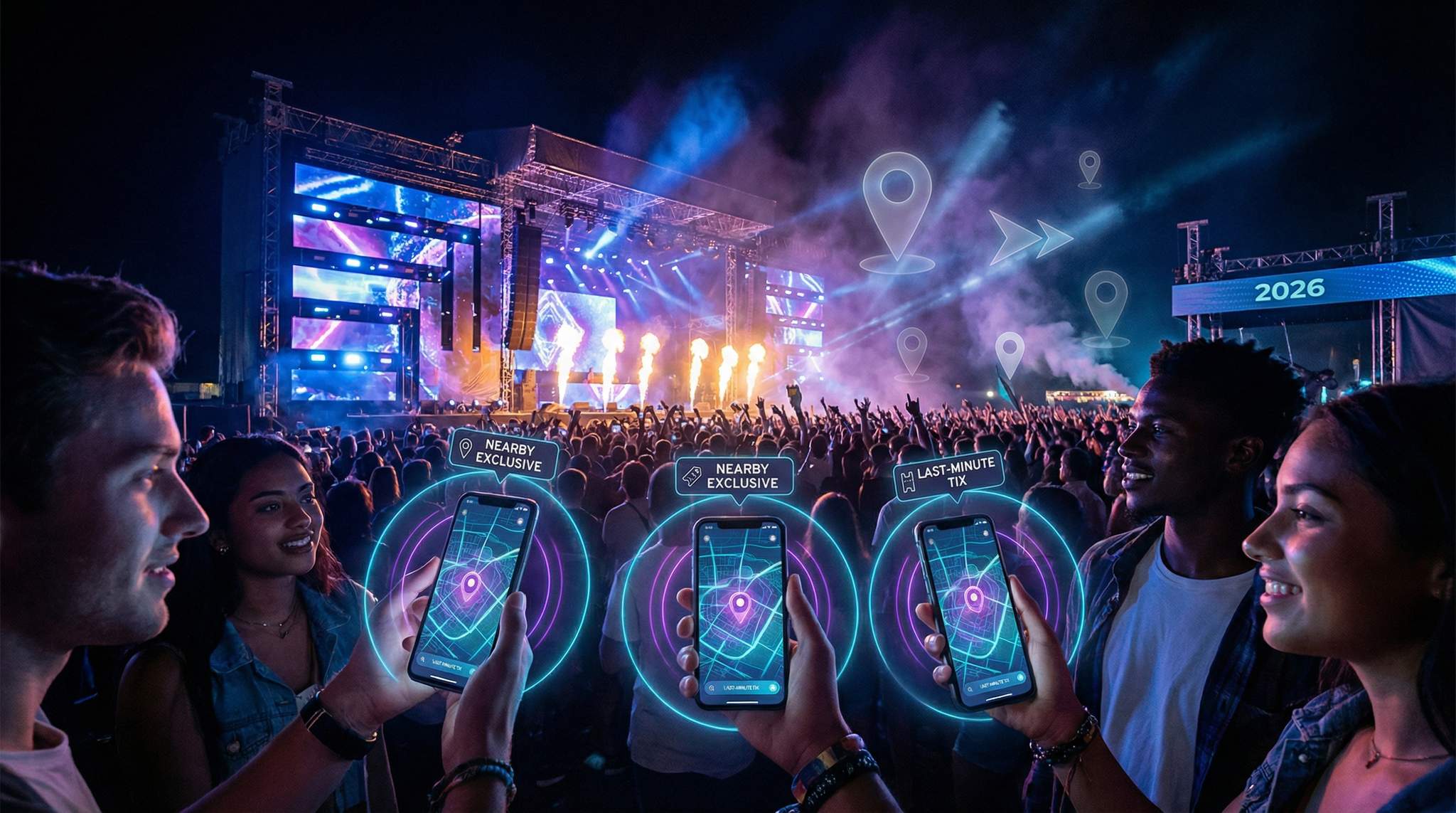
Push notifications offer another powerful way to reach nearby fans – especially those who’ve already engaged with your event or brand. Many event organizers have their own mobile apps or use third-party event apps. By leveraging geofencing within these apps, you can send location-triggered push notifications to users when they enter or exit certain areas. For instance, your festival app might detect when a user arrives in the host city or approaches the festival grounds, and then pop up a “Welcome to Festival City! Here’s your first-day schedule and a 10% merch coupon.” Or, if you have a concert series, your app could send an alert like “At the Arena tonight? Come see our show next door this weekend – show this message for VIP entry.” The beauty of push notifications is their immediacy – they appear right on the lock screen, which almost guarantees they’ll be seen. In 2026, proximity-based push campaigns have become more common as apps integrate map SDKs and beacon technology. For example, many large festivals now deploy Bluetooth beacons around stages and sponsor booths; these can trigger app notifications when attendees are nearby (“You’re close to the ? Taco Tent – get a free topping with code TACOLUV!”). But push isn’t limited to on-site engagement. It can also be used off-site to drive ticket sales. Some promoters set up geofenced push alerts around competitor venues or related events for their own app users. Suppose your event app has, say, 5,000 installs from past attendees – if even a fraction of those users attend a competitor’s show, your app could ping them: “Enjoying the show? Don’t forget [Your Event] is coming up – only 100 tickets left!” This approach requires that users have your app and allow notifications, which is a big ask unless they’re already fans. But the payoff is high engagement – push notification click-through rates can be 3-5x higher than email, especially when finely targeted. In one industry survey, 60% of millennial event-goers said they are interested in receiving location-based notifications for deals or updates while at an event, according to insights on music festivals using proximity marketing. The key is to provide value. If your push message offers helpful info or a relevant perk (not just a generic ad), users will appreciate it rather than feel spammed.
Grow Your Events
Leverage referral marketing, social sharing incentives, and audience insights to sell more tickets.
Driving Urgency with Timely Mobile Messages
Location-based push notifications are particularly effective at creating a sense of urgency and immediacy. Because they reach fans in real time, you can use them to spur quick action. For example, let’s say it’s the final day before your event and you have some tickets left – you could geofence the downtown area of your city during lunchtime and push out “Last chance! Only a few hours left to get tickets for tonight’s show. We’re almost sold out – grab yours if you’re nearby!” That “in your area, happening now” angle can tip people off the fence. Similarly, during an event, you can drive timely upsells: if you geofence around your venue, you might send a push at 9 PM saying “The headliner goes on in 30 minutes – upgrade to VIP at the Box Office now for an exclusive lounge.” Because the user is on-site (your app knows they’re within the geofence), that push is highly relevant to their immediate context. For multi-day festivals, you might remind attendees as they leave day 1: “Loved Day 1? Single-day passes for Day 2 available tonight only at a discount – come back for more!” This taps into FOMO while they’re still buzzing from the experience. Outside of app pushes, SMS marketing can also be location-triggered in some cases. For instance, if you have phone numbers of ticket buyers, you could segment and text those who live in the event city a special last-minute offer (“Seattle locals: come by at 8 PM for door prices on any remaining seats!”). It’s not as precise as app geofencing, but it targets by location broadly. The golden rule for all push/SMS is timing + relevance = conversion. Experienced event marketers will coordinate these messages with strategic moments – lunchtime, event exit times, morning of show – to catch fans when they’re most likely to act. And because these messages feel personal (buzzing in your pocket), they can cut through noise in ways that emails or generic ads might not. High personalization yields big gains: studies show that well-targeted push notifications (by user behavior or location) can improve reaction rates by 300-400%, based on push notification statistics and research. Location is one of the richest forms of context for targeting, so use it to make your outreach feel timely. A fan who gets a push at the exact moment it’s useful (“You’re nearby and we have an offer right now”) experiences a kind of serendipity that can strongly nudge them to buy.
Best Practices: Permission and Relevance
With great power comes great responsibility – and push notifications, if misused, can annoy users or even cause them to uninstall your app. To get it right, follow a few best practices. First, ensure you have permission and clear opt-in. On iOS, for example, users must agree to allow notifications; give them a compelling reason when the app asks (e.g. “Stay informed about schedule changes, special offers, and surprises during the event!”). If you plan to use location-based pushes, some apps explicitly ask for location permission “for personalized updates.” Be transparent about how it benefits the fan (not just you). Second, keep messages relevant and concise. A push triggered by location should clearly tie into where the user is or what they’re doing. If someone’s at a music festival and your push says “Merch 20% off at the main gate until 6 PM” – great, that’s useful. But a random “Hey, check our website” while they’re at work across town is a quick route to opt-outs. Match the tone to the context: on-site pushes can be enthusiastic and urgent, off-site ones should be enticing but not disruptive. It’s also wise to limit frequency. Even if a user wanders through multiple geofenced zones in a day, you wouldn’t send them five notifications – choose the highest-value moment. Many teams cap location-pushes to 1 per day or per event. Another tip: personalize when possible. Some event apps include the attendee’s name or specific info (“Hi Alex, you’re near the VIP lounge – flash your VIP pass for a free drink”). This level of personalization, combined with location, can feel delightfully VIP. However, always test for comfort – you don’t want to cross into “creepy” territory by over-emphasizing that you’re tracking location. A friendly tone helps: e.g. “We thought you might enjoy…” versus “We know where you are, come here now.” Finally, respect any platform rules and user privacy. In some regions, regulations like GDPR treat location data as sensitive, so handle it carefully and only store what’s needed. By following these guidelines, you build trust with your audience such that when your notification pops up, they trust it’s worth reading. When done right, geofenced push notifications can feel like timely tips from a helpful friend – guiding fans to have a better experience and nudging them toward more ticket purchases without the hard sell.
AR Filters and Lenses: Immersive Location-Based Campaigns
Social AR Filters to Boost Event Buzz
Augmented reality (AR) filters and lenses – popularized by Snapchat and now on Instagram, TikTok, etc. – offer a creative way to engage fans at specific locations. In event promotion, AR geofilters can turn nearby fans into viral ambassadors. How does it work? Platforms like Snapchat allow you to create a custom filter or lens that’s only available within a certain geofenced area and time (say, a 1-mile radius around a venue during event weekend). When users in that zone take photos or videos, they can apply your branded filter – perhaps an overlay with your festival logo, dates, or a fun AR effect related to the event. These shared snaps effectively become peer-to-peer ads, as friends see their network using your event’s frame. Back in the mid-2010s, Snapchat’s sponsored geofilters were a hit for festivals and clubs, and in 2026 the concept has evolved further. Now you can include 3D AR elements: for instance, a concert might have a lens that places a virtual stage or animates music notes around the user. Importantly, creating these filters has become more accessible and affordable for promoters of all sizes. You don’t need to be Coachella – even a 500-person local event can design a Snapchat geofilter for a few hundred dollars and set it live in their city for a night. Social media engagement goes through the roof when fans have a fun way to share their experience. An AR face-paint filter with your event’s theme, for example, can prompt thousands of posts. Many attendees actively look for event-specific filters – it’s become part of the modern eventgoing experience to “check in” via a cool AR effect. And here’s the kicker for promotion: those posts reach friends of fans, often in the same city, who then learn about your event secondhand. In marketing terms, it’s earned media and social proof rolled into one. A Snapchat internal statistic reported that location filters were viewed in the billions per year, and 2026 has only seen that trend continue as platforms unify AR tools. If you launch an AR filter, consider tying it to an action – e.g. “Use our filter and tag us to enter to win free VIP upgrades.” This can massively amplify usage. At a 2025 Comic-Con event, a film studio’s geofenced AR lens (which let attendees pose with a virtual character) was used 10,000+ times, reaching an estimated 200,000 people once you count all the shares. For your event, even a few hundred shares of AR-laced content can create a buzz wave that digital ads alone might not achieve.
Interactive AR Experiences That Drive FOMO
Beyond selfie filters, AR opens up interactive experiences that can double as promotional gold. A growing trend is to create AR scavenger hunts or city-wide quests in the lead-up to an event. For example, a music festival might place AR “markers” or clues around town (at record stores, parks, or partner locations). Fans can use an app or social lens to find virtual objects at each location – maybe collecting letters that spell out the headliner’s name or uncovering pieces of a secret lineup. Those who complete the AR hunt could win free tickets or merch. In 2026, such campaigns have been used by innovative promoters to turn marketing into a game. They blend the real world with digital fun, enticing fans to physically explore while sharing their progress on social media. One EDM festival ran a week-long AR treasure hunt where each day a new clue popped up (via an Instagram AR filter) at a popular local hangout. By the end, hundreds of fans had scoured the city, posting AR snapshots of each found “treasure” – essentially flooding Instagram with content hyping the festival. This not only engaged existing fans, but it also caught the attention of friends and followers who wanted to join the excitement (classic FOMO in action). Even those who didn’t participate saw the buzz. Another example: an arena tour created an AR lens that concert-goers could use in the venue to see special effects on stage through their phone (like virtual fireworks around the performer). While primarily an on-site enhancement, the news of this AR feature became a promotion itself, as press and fans talked about it, positioning the tour as a must-see tech-forward experience. AR experiences drive FOMO because they’re novel and shareable. When someone posts, “Look what you can do at this event!” it piques curiosity – people don’t want to miss out on something that looks cutting-edge or exclusive. For event marketers, an AR activation can yield PR coverage as well, since media love to report on “the first festival to do X in AR” or similar angles (it casts your event as innovative). Keep in mind that creating custom AR experiences can range from simple (a basic filter) to complex (a full AR game requires development). If budgets are smaller, leverage platforms like Snapchat’s Lens Studio or Facebook’s Spark AR, which have templates and effects to build from. One creative tactic is to use AR for sponsorship: e.g., partner with a sponsor to create an AR photo booth at a mall that superimposes attendees into a scene from your event – the sponsor covers costs, and both of you benefit from the foot traffic and shares. In summary, AR isn’t just for tech’s sake; it’s a modern word-of-mouth vehicle. Fans become your marketing collaborators by using and sharing these AR moments. And as AR becomes more mainstream (with AR glasses on the horizon), early adoption in your 2026 marketing strategy sets you up to stand out in a crowded landscape. An AR Snapchat filter scavenger hunt or a branded AR lens can leave a lasting impression that pure ads might not, turning nearby fans into enthusiastic promoters of your event.
Data-Driven Event Marketing
Track ticket sales, demographics, marketing ROI, and social reach in real time. Exportable reports give you the insights to make smarter decisions.
Example: Bringing Location to Life with AR
To bring it home, let’s walk through a brief composite example. A 2026 food and music festival in Melbourne wanted a fresh way to stir up local interest. They created a geofenced Instagram AR filter available only in downtown Melbourne. When someone opened it, their phone camera would show a 3D floating festival stage overlaid on the city intersection in front of them, complete with tiny virtual dancers and music playing – an impressive little AR scene. A prompt said, “Dance with us! Move your phone to find the hidden ticket code.” Users could pan around in AR to discover a virtual code in the scene, which gave a discount on tickets. This filter was promoted via the festival’s social channels and a few local influencers. Over two weeks, thousands of Melburnians tried it out during their lunch breaks or commutes. Importantly, many recorded themselves interacting with the AR stage and shared it as Reels/TikToks – “Look, a mini festival stage in the middle of Federation Square!” The local news even picked it up as a human-interest story (free PR). Ticket sales bumped nicely, with the festival attributing around 150 direct ticket purchases to people who redeemed the AR code, and untold brand lift from all the social impressions. Meanwhile, at the festival itself, they continued the AR theme by having an on-site Snapchat lens where attendees could add a funky AR festival hat and dancing cartoon characters to their selfies. In exit surveys, a significant number of attendees said the AR promotions got their attention and made the event seem “innovative” and “can’t miss.” The lesson from this example is that AR brings a layer of interactive spectacle that can set your event apart. By tying it to location (only in Melbourne, only at the venue, etc.), you create that exclusive feel – be here to experience this. And when people are on-site, AR features enhance their enjoyment and likelihood to share their experience online, generating that priceless organic buzz. In sum, AR filters and location-based lenses are much more than gimmicks; they’re tools to deepen engagement and amplify word-of-mouth, turning nearby fans into a marketing force for your event.
Tools & Platforms for Geofence Marketing
Geotargeting on Major Ad Platforms
The good news for event marketers is that you don’t need a computer science degree or fancy software to deploy geofencing – the major ad platforms you already use likely have robust location targeting features built-in. Facebook & Instagram Ads (Meta Ads Manager) let you target people by country, city, zip code, or a specific radius around a dropped pin. Critically, you can also filter by whether someone actually lives in that area or is just there temporarily (e.g. “currently in this location”). For events, this means you can target locals one way and tourists another. Meta’s platform even supports dropping multiple pins – so a concert tour can geofence each tour stop city with one campaign. Google Ads offers similar controls. For Search campaigns, you might geotarget keywords only to people within X miles of your venue (so when someone nearby searches “live music tonight”, your ad shows, but someone 500 miles away sees nothing). On YouTube and Google Display Network, you can serve video and banner ads just to specific DMAs or radii. Google also provides location extensions, which can highlight how close an event is (“5 miles from you” in the ad copy). TikTok Ads allow targeting by geographic parameters like country, state, and in many cases city (with some limitations depending on region). While TikTok doesn’t let you draw a tiny radius on a map the way Meta does, you can still zero in on metro areas. This is great for promoting a show to the Gen Z crowd in your city – TikTok’s algorithm will do its thing, but only within your chosen locality. Twitter (X) Ads provide city-level targeting as well, which can be useful to insert your event into local conversations. For example, promoting a trending hashtag or running a location-targeted trend (Twitter offers promoted Trends by location) can generate buzz specifically in your event’s city. And Snapchat, as noted, is perhaps the king of hyper-local with its Geofilters and Lens targeting – their ad manager lets you draw custom geofence shapes on a map and schedule times for them to be active. Even LinkedIn has gotten into the game (think B2B events) – you can target by city or even a convention center address (handy for, say, geofencing an industry conference to reach its attendees with your competing event ad). Each platform has its nuances: Facebook radius targeting can go as low as 1 mile in some cases, Snapchat can go down to the footprint of one building, and Google can match people who show interest in a location even if they aren’t physically there (based on content they view – though many marketers stick to physical presence targeting for accuracy).
To maintain consistency across these disparate ad networks, many agencies attempt to standardize the city area for event targeting. Because a “10-mile radius” on Meta might yield slightly different audience pools than a “metro area” setting on TikTok, establishing a unified geographic baseline—such as a specific list of zip codes or designated market areas (DMAs)—ensures your cross-platform campaigns are reaching the exact same local fan base.
To summarize some key platform capabilities, see the table below:
| Platform | Geofencing Options & Precision | Ideal Event Use Cases |
|---|---|---|
| Facebook/Instagram | Radius targeting (1-50+ miles/km), city/ZIP targeting; filter by “everyone in,” “living in,” or “visiting” an area. Very granular control via Meta Ads Manager. | Great for broad consumer events. Use small radius for venue-centric ads (e.g. 5-mile radius for local shows) or target key cities for tours. Combines well with interest targeting (e.g. people near venue and fans of similar artists). |
| Google (Search/Display/YouTube) | Radius and location targeting for ads and keywords; can geofence search queries (user must be in area to trigger ad). Also offers local search ads and map extensions. | Perfect for capturing active intent (searches like “events tonight” within your city). Use Display/YouTube geofences to run awareness ads on local news sites or to people physically in town during event week. |
| TikTok | City and region targeting (no custom small radii). Can combine with age, interest, and hashtag targeting. TikTok’s algorithm mostly broad, but location filters ensure viewers are in your chosen area. | Great for reaching young local audiences with entertaining video ads. Promote event challenges or teaser videos to users in your city or state. Good for building pre-event hype with viral potential among nearby fans. |
| Snapchat | Precise geofencing via custom map draw or address radius; plus sponsored GeoFilters and AR Lenses tied to locations. Time-bound geotargeting is available. | Ideal for on-site engagement and peer-to-peer promotion. Use geofilters at your event or competitor events. Target Snap Ads to specific venues or campuses. Particularly strong for festivals, parties, any youth-focused events where Snap usage is high. |
| Programmatic Ad Networks (e.g. GroundTruth, ad exchanges) | Advanced polygon geofencing (draw exact venue boundaries), device ID capture for retargeting over weeks. Serve banners, video on countless apps/sites. Often can target by past visitation (“devices seen at X”). | Useful for sophisticated campaigns: geofence multiple competitor venues, then serve ads to those people across apps for 30 days. Good for trade shows, multi-venue tours, and when you want to reach niche app audiences. Provides scale beyond major social platforms. |
| City-level targeting (primarily by metro area), plus by company/job – not micro-geofencing, but professional geo targeting. | Best for B2B or professional events. e.g., geotarget ads for a marketing conference to people in New York City with marketing job titles. Not used for small radius, but excellent for local professional demographic targeting. |
As the table suggests, choosing the right platform depends on your audience and goals. Social media channels like Facebook and Snap excel at real-time local hype and visual storytelling to nearby fans. Google is great for intent-based capturing of locals actively looking for things to do. Programmatic networks can cast a wider net and even work behind the scenes (less visible than a social post, but those banner ads you see in your news app might be geofenced based on where you were yesterday). Savvy event marketers often use an omnichannel mix – for example, a festival might run Facebook/Instagram ads within 50 miles, Snap filters at specific venues, and Google Search ads in its state, all simultaneously, incorporating gamification strategies for event promotion to boost fan engagement. The key is to leverage each tool for what it does best.
Specialized Geofencing Ad Networks & Tech
In addition to the usual platforms, 2026 offers specialized services that take geofencing to the next level. Companies like GroundTruth, UberMedia, and other programmatic providers let you draw polygonal fences with extreme precision – e.g. outline the exact perimeter of a stadium or park – and then collect device IDs that enter that space. What’s the benefit? These platforms can retarget those devices later on virtually any app or website. For example, if you geofence a rival festival for the three days it runs, you can then serve ads to those same people for weeks afterward (“If you loved Festival X, check out Festival Y coming soon!”). This concept is often called geo-retargeting or “blueprinting.” It’s powerful because it doesn’t rely on someone being in the zone at the exact moment your ad shows – it builds a custom audience you can message later. Some providers claim you can even target devices seen at a location in the past (e.g. “all devices that were at Madison Square Garden in the last 60 days”), though privacy rules are making that trickier. Another interesting angle is using addressable geofencing. This involves uploading a list of physical addresses (say, all the mailing addresses in your ticket buyer database or VIP list) and then geofencing those households digitally. Essentially, it matches devices seen at those addresses (usually home Wi-Fi) and serves ads to them. For event promoters, this lets you target known fans or high-value customers specifically in their homes with special offers (much like direct mail, but via digital ads). Some venues also use address geofencing to reach season ticket holders or lapsed attendees with personalized “come back” messages. There are also emerging proximity marketing tools that integrate with digital out-of-home (DOOH) – like location-based billboards or screens that change content based on who’s nearby. For instance, a digital kiosk in a mall might show an ad for your event only when a certain demographic (determined by phone data) is in proximity. These are more experimental but show how geolocation data can drive not just phone ads, but any digital display. On the smaller scale, if you’re running your own app or website, developers can use geolocation APIs to customize content. For example, Ticket Fairy’s event platform can capture buyer zip codes and help segment by region (useful for tailoring follow-up emails or lookalike audiences), as noted in Softjourn’s analysis of geofencing applications. There are also beacon-based systems that small venues use: a Bluetooth beacon at a club door might trigger a sponsor’s ad or an artist’s content on attendees’ phones as they walk in. These specialized tech options tend to require more setup and sometimes a larger budget or technical integration, so they’re more common for mid-to-large events that have dedicated marketing tech resources. But even smaller events can piggyback on them by working with local agencies or venue partners (a shopping district might have a beacon program you can join, for example). The gist is that beyond Facebook and Google, a whole ecosystem exists to support location-based marketing. If your budget allows, exploring these advanced geofencing tools can give you an edge and deeper data. For example, you could get detailed footfall reports – one provider can show that your geofence ad drove X number of people to actually show up at your venue (by tracking device movement), a holy grail for proving ROI on offline event attendance, effectively tracking traffic through geofencing for entertainment. As the technology evolves, expect geofencing to integrate further with CRMs, ticketing systems, and multi-channel campaigns, making it an ever-more seamless part of the event marketer’s toolbox.
Grow Your Social Following With Every Sale
Require social media follows, shares, or playlist adds to unlock presale access or special pricing. Turn every ticket purchase into audience growth.
In specialized B2B sectors, proximity tech is also solving unique compliance and communication challenges. For example, at political or highly regulated corporate summits, a digital kiosk can be geofenced to display specific legal information—such as mandatory disclosure notices or lobbying guidelines for a registered lobbyist entering the venue. This demonstrates how geofencing for events extends far beyond ticket sales, offering conference organizers a tool for precise, location-based administrative messaging.
Partnering with a specialized advertising technology company for hyper-local ad deployment—such as GroundTruth or similar programmatic platforms—enables promoters to execute highly complex, multi-venue strategies. These advanced networks allow organizers to move beyond basic radius drops and instead utilize precise polygon mapping to capture foot traffic data across dozens of competitor venues simultaneously.
When evaluating the best geofencing push notification advertising platforms for 2025 and 2026, event organizers must look beyond basic social media ad managers. Specialized programmatic solutions like Simpli.fi offer advanced polygon targeting, but many promoters also explore Simpli.fi competitors—such as GroundTruth, Blis, or Radar—to find the right mix of footfall attribution and CRM integration. Choosing the ideal tech stack depends on whether your primary goal is serving display ads across mobile web networks or triggering native push alerts through your own custom event app.
Proximity Marketing Beyond Ads: Beacons & Wi-Fi
While paid ads and apps are the most discussed geofence channels, it’s worth noting some on-site proximity tools that can enhance marketing, especially during events. Bluetooth beacons are small transmitters you can place around a venue; they send out signals that mobile apps can pick up when users come into range (usually within tens of meters). If your event app is configured for it, beacons let you pinpoint someone’s location on-site and trigger ultra-relevant messages (“You found the secret stage!” or “Merch booth is 20 feet to your left”). They’re largely about enhancing attendee experience, but happy attendees become repeat attendees – and they’ll also share cool features with friends (“the festival app guided us to a shorter bar line via AR – so cool!”). Some events use beacon data after the fact to see traffic patterns (e.g. which areas were most crowded) and use that in marketing: if the silent disco was packed, maybe next year they’ll highlight that in promotions. Public Wi-Fi login marketing is another nifty trick. Many festivals or venues offer free Wi-Fi if you sign in via a captive portal. That portal can double as a promo spot: e.g. “Welcome to Venue Wi-Fi – enter your email to connect and get a coupon for the next show.” This way you collect contact info and deliver a marketing message (like upcoming events) right when someone is physically at your location. In 2026, some venues have taken it further by using Wi-Fi analytics to retarget visitors with ads later (similar to geofencing, if the device reconnects to wifi elsewhere that shares data, though this is advanced and less common due to privacy limits). NFC and QR codes at locations also play a role. A poster at a gym with an NFC tag or QR code saying “Tap for a surprise” could deliver a discount on event tickets to the phone instantly – a creative way to tie a physical location to a digital reward. For example, a marathon organizer might place QR codes at local running stores; scanning it reveals a hidden early-bird registration link for those physically in the store. These aren’t geofencing in the pure automated sense (they require user action), but they are location-specific promotions worth mentioning. When planning location-based marketing, think beyond just “ads on a map” – consider every touchpoint that location can provide. If a potential attendee is near something related to your event, how can you engage them? That could be as simple as a well-placed sign with a QR code or as high-tech as an AR billboard. Grassroots tactics also merge here: a street team combined with geotargeted digital follow-up is a powerful combo. For instance, your team flyers a university campus (physical targeting) and you also run a geofenced Instagram ad campaign on that campus (digital targeting) – students see your message in person and on their screens, reinforcing each other, a strategy detailed in guides on mastering grassroots street team marketing. The bottom line on tools: use the major ad platforms to get broad reach, and layer in specialized tech or on-site proximity tactics to create a multi-sensory campaign. The best results often come when these tools are orchestrated together, so fans see and feel your event presence everywhere they turn locally.
Crafting Effective Location-Based Campaigns
Tailoring Offers to Local Audiences
When targeting people by location, one-size-fits-all messaging won’t maximize your results. To really connect, tailor your offers and creative to the local audience and context. This starts with simple things like referencing the city or neighborhood in your copy (“Hello, Austin!” or “Brooklyn’s biggest New Year’s bash”). Hearing their city name piques interest as it feels relevant by default. But go deeper – consider what makes your local fans tick. For instance, if you know a large segment of your audience is coming from a particular suburb or nearby town, you might run an ad saying “Hey Long Beach, ready for an epic night out in LA? Join us for [Event] – just a short drive away!” Such copy resonates more than a generic “Join us for [Event] in LA” when seen by someone in Long Beach. You can even use geofencing to exclude locals when pushing travel packages (“Make a weekend of it in Los Angeles” makes sense to show to out-of-towners, not to people who live in LA). Also, leverage local lingo or landmarks: a club night promo in Chicago could mention “We’re taking over The Loop this Saturday” – instantly recognizable to locals – while the same event’s ads to people 50 miles out might emphasize train routes or parking. Exclusive deals for local residents are another angle. You could offer a “locals discount” only visible to those within 20 miles of the venue, rewarding your immediate community. Sports teams do this often – special ticket prices for in-state fans. For events, maybe it’s “Local Love: use code HOMETOWN for 15% off (only works if you live nearby).” It not only drives sales but builds goodwill. Moreover, think about timing your offers when locals are most likely to engage. A lunchtime geofence ad with a quick promo (“Flash Sale for downtown workers – 2pm to 4pm only!”) could snag impulse buys from people scrolling at the office. Another thoughtful approach is addressing local pain points or preferences. Perhaps parking is tough in your city – a geotargeted message might highlight transit options (“Coming from Brooklyn? We’ve got free shuttle buses from Atlantic Ave!”). Or if you’re in a region with multiple language communities, running geofenced ads in Spanish in the Spanish-speaking neighborhood can be hugely effective (showing you speak their language, literally). Tailoring offers also means aligning with local events or rivalries. For example, “Not going to [Big Festival] this year? We’ve got your live music fix right here in town, no roadtrip needed!” could be a cheeky way to entice those who didn’t travel to a major event. Or during a local sports team’s season, an event might say “After the game, keep the party going at [Event] – just 10 minutes from the stadium.” Ultimately, localization is about relevance. The more a promotion feels like it’s made for people like me, where I live, right now, the more likely those people will respond. Geofencing gives you the power to craft micro-targeted mini-campaigns: you might run slightly different ad creatives for North vs. South of your city if there’s a known cultural divide, or a different call-to-action for urban hipsters vs. suburban families. These nuances can bump your conversion rates significantly. In fact, A/B tests often show a measurable lift when local elements are added to event ads – sometimes a 20-30% higher click rate on ads that named the city or referenced a local landmark, compared to those that didn’t. So don’t treat your geofence targets monolithically; speak to each local audience segment in a way that makes them feel seen.
Understanding exactly how geo-gated offers work for live events is crucial for maximizing these local segments. A geo-gated promotion restricts access to a specific discount code, VIP upgrade, or hidden ticket tier until the user’s device pings within the designated physical boundary. For example, a venue operator might release a block of discounted last-minute tickets that can only be unlocked if the buyer is within a two-mile radius of the box office. This prevents out-of-town scalpers from scooping up local inventory and rewards true neighborhood fans with exclusive access.
Full Pixel & Analytics Integration
Install Meta Pixel with Conversions API, Google Analytics, TikTok Pixel, Reddit Pixel, and Spotify Pixel on your event pages. Server-side tracking for accurate attribution.
Contextual Creative: Crafting the Right Message
A core lesson in location-based marketing is context is king. This means your creative (the ad copy, images, call-to-action) should reflect why the viewer is seeing it at that place and time. Let’s break down a few scenarios and the ideal messaging for each:
- Geofence at a competitor event: Here, context is “you’re at a show.” The creative should acknowledge that experience. For example, an ad served during another festival might say “Enjoying the festival? Next up: Check out [Your Event] – similar vibes, new experience. ? Use code FEST20 for a loyalty discount.” This subtly flatters their current activity and positions your event as the natural next thing. You wouldn’t, say, show a boring generic flyer graphic – instead maybe use a photo of a crowd at dusk with a message “Don’t let the music stop – [Your Event] is coming in July.” The tone is friendly and timely. It’s almost conversational, as if one fan is recommending another event to a fellow fan at the venue.
- City-wide radius targeting for locals: Context: general home/work life in that city. Here you might lean on civic pride or known local hooks. For instance, “Boston, get ready to rock – [Event] lands at TD Garden!” with Boston’s skyline in the image. Or incorporate seasonal nods: if it’s targeting locals in winter, “Heat up your February at the Winter BBQ Fest – right here in town.” This makes the ad feel like part of local culture, not some out-of-town promotion. If your event benefits the local community (charity tie-in, local vendors, etc.), mention that too – locals love supporting local. E.g. “Support Austin artists at Austin Art Expo – a hometown gallery of talent!”
- Targeting travelers or tourists with geofences at airports/hotels: Context: they’re visiting or about to travel. The creative should pitch the event as a cool thing to do while in town. “Visiting NYC? Don’t miss the Broadway Block Party this weekend – a New York experience like no other!” Or a banner in an airport wifi: “Welcome to Los Angeles – Turn your trip up a notch at [Event] happening during your stay!” Include convenient info: distance from tourist hotspots, easy transport (“Just 5 minutes from Convention Center”). The idea is to catch transient audiences and convince them to add your event to their itinerary.
- Proximity to venue on event day (last-minute walk-ups): Context: you’re nearby and could come right now. Creative: extremely urgent and simple. “? Tonight at 8PM: [Band] Live at The Venue – Tickets Available at Door. Just around the corner – join us!” This works for anyone within a mile or two who might be looking for something to do with no planning. Because they’re so close, remove friction: highlight that they can buy at the door or mobile instantly, and that it’s happening now. You might use a map pin emoji or a small map snippet in the ad if possible.
- Post-event retargeting (served days after to those geofenced): Context: they recently had an event experience. Creative: reference the recency. “Still vibing from last weekend? Keep it going – your ticket to the next show awaits!” Or “We saw you rocking out in the city – come do it again at [Your Event].” You can be clever but keep it positive (and not too stalker-ish). Something like “You know that feeling after a great show? We do too. That’s why we’re inviting you to the next one…” This triggers their memory and emotion from the past event to sell yours.
In all cases, use language that speaks to shared experience or immediate benefit. Geofencing often means shorter windows of relevance (no point showing a “three months away” message to someone at a venue right now) – so emphasize near-term action. Words like “tonight, this weekend, coming soon, now open” etc., set the expectation that this is timely. Visuals should also match the location context. If you’re targeting a beach town, bright outdoor imagery fits; if geofencing an indoor convention, maybe show a lively indoor scene. For push notifications (as creative copy too), you have even less text to work with – so you might say something like “? You’re here. So are we! Get $5 off at our event nearby, today only.” That pin icon immediately says “location-based info”.
A pro tip: A/B test variations of location-based copy. For example, run two geofenced ads identical except one says “Hey San Francisco!” at the start and one doesn’t. See which pulls better. Or test different radius messaging – a 1-mile radius ad might mention the neighborhood name, while a 10-mile radius ad might mention driving (“worth the short drive from X!”). Real campaign data in 2025 showed that inserting local references in ad headlines increased click-through by an average of 8-12% for event promotions. In one case, simply adding the city name to the title (“Denver Beer Fest”) versus a generic name boosted ticket conversions by 15%. Data-driven marketers always measure these lifts, using tools to define audience segments and track engagement. If you’re using Ticket Fairy or similar platforms, track which ad variants lead to more ticket page views and sales. Over time, you’ll learn which messages resonate with your local fan segments.
Testing and Optimizing Geofenced Campaigns
Just like any marketing effort, geofencing campaigns benefit from continual testing and optimization. In fact, because location adds another variable, it opens up new test opportunities. One important test is radius size: is a 1-mile super-targeted radius more cost-effective, or a broader 10-mile net? You might hypothesize that ultra-close targets yield higher conversion (since those people can literally walk to your event), but maybe the volume is too low. Alternatively, a wider radius might bring more prospects but at lower intent. The only way to know for sure is to A/B test different geofence sizes. For example, run two identical ad sets for your concert – one targeting 2 miles around the venue, another targeting 15 miles around. Compare results in terms of click-through and actual ticket purchases. A real campaign in 2024 did this and found the 2-mile radius had a conversion rate nearly double the 15-mile, but the cost per impression was higher and total reach smaller. They ended up using a hybrid strategy (spending 70% budget on the tight radius for efficiency, 30% on the wider area to broaden reach). Also test different locations entirely. If you’re geofencing multiple spots (say three college campuses), track which campus’s geofence yields more engagement – it might reveal where interest is strongest. You could then reallocate budget toward the top-performer campus area.
Creative-wise, do the usual A/B testing best practices, such as optimizing visual content for engagement: try two versions of your ad copy, one with a heavy location emphasis (“Calling all Seattle metalheads!”) vs one that focuses on the event and assumes local (“Metal Bash – Tickets on sale now”). See which draws better. Test imagery too: maybe a city skyline backdrop vs. a generic stage photo. Sometimes locals respond better to seeing their city in the ad; other times a photo of a packed crowd (anywhere) might be universally appealing. Test the offer as well. You could split your geofence audience randomly into two groups – one sees an ad with “10% off for nearby fans” and another sees no discount, just hype. Do those offers actually increase conversion enough to justify the discount? The data might surprise you. Many promoters have found that small geo-targeted discounts or perks in the messaging (e.g. “Free drink for local attendees”) can lift click-through by a significant margin – but you need to ensure they’re actually converting to sales.
Here’s an illustrative example of A/B test results comparing a geofenced local campaign vs. a non-geofenced broad campaign for an event:
Free Tool: How Much to Spend on Marketing
Ticket price × capacity × sell-through target produces recommended budget and a channel split (paid social, search, email, PR) based on event type.
| Metric (Campaign Example) | Geofenced Ads (Local 5-mile radius) | Broad Ads (No geofence, city-wide) |
|---|---|---|
| Click-Through Rate (CTR) | 2.0% (highly relevant, local copy) | 1.0% (less specific messaging) |
| Conversion Rate (tickets/visit) | 6% (location-tailored landing page) | 3% (generic landing page) |
| Cost Per Click (CPC) | £0.50 (fewer clicks but high intent) | £0.40 (more clicks but lower intent) |
| Cost Per Acquisition (ticket) | £8.33 (CPA) – better | £13.33 (CPA) – higher cost |
| Return on Ad Spend (ROAS) | 5:1 (for every £1, £5 revenue) | 2.5:1 (for every £1, £2.5 revenue) |
Table Note: In this hypothetical test, the geofenced campaign doubled the CTR and conversion rate, resulting in roughly half the CPA and double the ROAS compared to a broad-target campaign. While CPC was slightly higher for geofencing (as you might bid more for the prime local eyeballs), the efficiency in conversion made it more cost-effective overall. This kind of outcome is common when the geotargeting is well-aligned with strong creative – you pay a bit more to hit a smaller, high-intent audience, but you get more bang for each buck. If your results differ (say the broad campaign did better), that’s equally valuable to know – it might indicate your event draws from all over and you shouldn’t constrain too tightly.
In addition to pre-event tests, monitor and tweak during the campaign. Geofencing allows for some nimbleness. If you see that one area isn’t responding, you can shift budget to another. Or if your push notification open rates are low, perhaps the message timing is off – adjust the geofence schedule (e.g. send in morning instead of afternoon). Watch metrics like heatmaps of engagement if provided – some platforms show which parts of the map are lighting up with clicks. This could even inform real-world decisions (e.g. “hey, a lot of interest is coming from the university area – maybe send the street team there with extra flyers” – the epitome of combining data with grassroots street team marketing tactics). Experienced event marketers treat geofencing campaigns as living experiments. They don’t just set one radius and forget it; they’ll refine radii, creative, timing, and offers across the weeks of promotion. And crucially, they track final ticket sales by segment. For example, you might use a unique ticketing link or promo code for each geofence or campaign so you know exactly how many sales came from “Campus A vs Campus B” or “Snapchat AR filter vs Facebook ads.” This attribution helps in planning the next campaign – you’ll double down on what delivered.
Finally, remember to optimize for the post-click experience too, which can include interactive gamification elements. If someone clicks a geofenced ad for “NYC VIP Party,” don’t dump them on a generic homepage. Take them to a landing page that reinforces the location context (“Welcome New Yorker! Ready to party VIP-style in Manhattan? ?”). Keep purchasing easy – especially for mobile users on the go. Many will be on their phones if they’re out and about seeing your location-based ad, so ensure your ticketing page is mobile-optimized and quick. Every extra step or slow load can cost you conversions. In essence, effective geofencing isn’t just about where you deliver the message, but what you say and how you follow through after the click. Nail those pieces and then continually test small improvements, and your campaigns will keep getting stronger each time.
Privacy, Permissions, and Ethics in Geofencing
Obtaining User Consent and Respecting Privacy
In the excitement of geotargeting capabilities, it’s critical to remember that location data is sensitive personal information. Trust is paramount – abuse it, and you risk backlash or even legal trouble. The first rule is transparency and consent. If you have your own app or are collecting location from users directly, always ask permission in a clear way. Both Apple’s iOS and Android require apps to request location access, and you should explain why: e.g. “Allow location access to get event updates and personalized offers based on where you are.” Users are more likely to opt in if they see a benefit, but also if you’re upfront. Do not try to sneakily gather precise location via an app without proper disclosure – not only is it against app store policies, it can violate regulations like GDPR in Europe or CCPA in California if the user hasn’t consented. Even when using third-party ad networks, be aware that those platforms have their own user consent flows (for instance, many apps now ask users if they allow tracking across apps – if they say no, your geofenced ad might not reach them). Accept that some fraction of audience will be untrackable – that’s okay. Focus on delivering quality to those who have allowed tracking.
Another aspect is anonymity. Good geofencing practice works with anonymized crowds – you’re targeting devices or aggregated groups, not identifying individuals by name. Never attempt to personally identify someone from location data you get. For example, if you see a frequent buyer in your CRM and also have data they were at a competitor event, resist the temptation to send them a personal message like “We noticed you at Rival Fest…” That would come off as downright creepy. Instead, use that insight in aggregate (like targeting all people who attended the rival event with an ad, but not singling anyone out). Keep data secure too – if you’re storing location hits or device IDs, protect it like you would credit card info. Many promoters avoid storing any raw location data in their own systems altogether, relying on vendors who provide aggregated results. If you do run an app with location features, include a way for users to opt-out or turn it off. It’s both ethical and often legally required that users can revoke consent easily (for instance, an app toggle “don’t use my location” or simply respecting OS-level turning off). Also, heed local laws: some cities/countries ban certain uses of location targeting (for instance, geofencing around healthcare facilities for ads can be illegal in places due to sensitivity). While it’s unlikely to apply to most event marketing, always double-check if there are any regulations in your region about marketing to people in specific places (schools, religious venues, etc. may be sensitive zones to avoid).
When communicating with your audience about geolocation, frame it as a benefit. A lot of privacy concerns are eased if users feel in control and see value. For example, when someone logs into your event Wi-Fi and you want to send them a follow-up promo email, have a checkbox or a line that says “? Send me local event updates.” Make it opt-in (checked by default is okay if clearly stated). People don’t like feeling tracked without knowledge, but many are okay giving data if you ask nicely and deliver something useful. Stats show the majority of smartphone users do keep location services on for many apps – location-based marketing thrives on trust. One survey noted over half of consumers are willing to share location for perks or convenience, according to insights on music festivals using proximity marketing. So focus on real value: early access, exclusive deals, real-time info that improves their experience. And absolutely avoid selling or sharing your users’ location info in shady ways – not only unethical, it could destroy your relationship with fans if they find out.
Avoiding Over-Targeting and Intrusion
Just because you can reach someone at any location doesn’t always mean you should. Relevance and frequency are key to not crossing the line into intrusion. One clear guideline: don’t spam multiple notifications or ads to a user in a short span. If you set up several overlapping geofences (say city-wide and venue-level on different platforms), be careful a single person doesn’t get bombarded from both. Coordinate your campaigns – maybe pause a broad campaign during the hours you’re doing a hyper-local push, for instance. Over-targeting can lead to fatigue or annoyance, which is counterproductive. A fan who gets a push at the exact moment it’s useful (“cool”) might buy; if they see it 10 times in an hour, they might develop a negative impression (“ugh, this event is stalking me”). Most ad platforms have frequency capping tools – use them. A reasonable cap might be something like 3 impressions per user per day for geofenced ads, but adjust based on performance. For push notifications, many event apps purposely limit themselves to maybe 1 location-triggered push per day at most, even if the user passes multiple zones.
Context also matters ethically. Consider where and when your message appears. Geofencing a competitor’s fun event – fine, part of healthy competition. But geofencing something like a hospital, protest, or sensitive gathering to advertise an unrelated event could be seen as tasteless. Always imagine the end user’s mindset: “Is this something I welcome at this moment?” If you can foresee a user thinking “that’s inappropriate” or “not now,” then don’t do it. For example, targeting people at a memorial vigil with a party promo – obviously a no-go. Or sending a push at 3 AM because someone passed near a club (they probably don’t want a notification while sleeping). Time your geofence interactions to respect downtime – usually normal waking hours unless it’s explicitly an event-night-of push like “Doors open now!” For ads, the platforms generally serve them when users are active in apps, so less worry there, but you can still schedule campaigns by time of day.
One common ethical debate in our field is whether to mention how you got the data. Generally, you don’t say “since you’re near X” in an ad (it might weird people out, reminding them they’re being tracked). It’s better to use implicit context rather than explicit. For instance, instead of writing “We know you’re at John’s concert”, you’d phrase it as “Love live music? Don’t miss [Your Event] coming up!” – the person might guess they saw it because of being at the show, or they might not, but you’re not calling it out. In a push, where they know your app has location, you can be a bit more direct: “Welcome to [Venue]! While you’re here, check out…” because they understand your app is meant to do that. But as a rule of thumb, don’t make the user self-conscious about being targeted. Keep it natural.
Another area: competitor relations and venue permissions. Is it fair game to geofence someone else’s event? Legally, generally yes – you’re just targeting a geographic area – but it might ruffle feathers if not done tastefully. Some event organizers have gentlemen’s agreements not to aggressively market at each other’s shows (just as physically flyering inside someone’s venue without permission is frowned upon). Digital is more wild-west, but still use class. Focus on your event’s merits rather than slamming the other or causing confusion (“the OTHER festival sucks, come to ours” – bad form). Also, if you partner with a venue, check their policy: a venue might encourage geofencing their spot to attract people, or they might have official sponsors who pay for on-site digital rights. Usually, though, these specifics aren’t issues for typical social ads.
From a user perspective, give ways to control the marketing. In your app settings or email preferences, maybe include “geo alerts” toggle. Even though few might use it, the mere presence shows you respect their choice. If someone opts out of location tracking, ensure your systems honor that (don’t sneakily fallback to IP-based location targeting them – that can break trust if they realize it). Inclusion and respect also mean considering accessibility – e.g., if you’re doing AR promotions, that’s not accessible to everyone (not everyone can use AR or see it if they have disabilities, etc.). So don’t make critical info available only via AR or location pushes; those should augment, not replace, main channels. We often see promoters using geofencing as one layer, with traditional channels (email, web updates) still carrying the core communications for those who don’t engage in location features.
Finally, stay up to date on policy changes. Platforms like Apple/Google can change how location data may be used (remember when iOS 14.5+ forced that “Allow app to track?” prompt – it shook the ad world). As of 2026, more privacy features are likely coming, maybe requiring more transparency for geotargeted ads. Be ready to adapt by doubling down on first-party data (like emails and zip codes collected with user consent) . And always ask, “Would I be comfortable if I were the user receiving this?” If your geofencing strategy passes the golden rule test, chances are you’re on solid ethical ground.
Legal Considerations and Platform Policies
Geofencing for marketing is legal in most places, but there are some caveats and watchdogs. For example, the U.S. Federal Trade Commission (FTC) has guidelines on transparent data use. Using location to target consumers is fine as long as you don’t do anything deceptive or discriminatory. However, a few cases have drawn attention: e.g., a company geofenced women’s health clinics to send ads for alternative services – this raised legal questions about targeting sensitive categories. For events, you mostly won’t hit those sensitive areas, but be aware: if your event is political or health-related (say a cannabis expo geofencing near schools would be a bad idea), you need to avoid certain zones. Some jurisdictions have begun to ban geofencing in contexts like around medical facilities for certain ads, or using it for housing/employment ads to exclude areas (falls under discrimination laws). While promoting a music festival is far from that, just keep an eye on any local quirks (for instance, maybe a city disallows mobile ads in its public transit geofence – not common, but theoretically possible via ordinance).
Platform policies are often stricter than laws. Facebook, Google, etc., each have ad policies that include location targeting usage. Facebook’s policy doesn’t allow you to use location targeting to imply you know a person’s specific whereabouts. So your ad copy can’t say “We see you’re at [Venue] right now”. That could get disapproved. They also forbid targeting certain personal attributes (like health or beliefs) by proxy of location (e.g., geofencing a place of worship then claiming something about beliefs). For events, again, typically not an issue unless your event is extremely niche in a sensitive category (like a political rally – then careful not to imply anything about them in the ad). Google Ads similarly has rules – for instance, “radius around a point” targeting is allowed, but if your ad text tries to single out that radius too specifically, it may be flagged as a “privacy” issue. They prefer generic language. In practice, many event marketers geofence without any policy problems, as long as copy stays generic or positively framed.
If you’re using carrier data or third-party data brokers (less common these days due to privacy clampdown), ensure you abide by their terms. For example, in some cases carriers let you send SMS to people entering a geofence if they opted in to location-based alerts. If you somehow get access to such a system, don’t abuse it. There have been lawsuits when companies sent unsolicited texts triggered by geofence – that can violate anti-spam laws like TCPA in the US if recipients didn’t explicitly opt in for texts. The safest route: only text/push people who opted, and only show ads to users as allowed via the platform’s user agreements (which you inherently do when using Facebook/Google since they handle user consent; just don’t violate their trust by revealing or storing user data improperly).
Another legal aspect: ticketing and pricing. If you offer different prices to people based on location, make sure this doesn’t conflict with resale laws or pricing discrimination rules. Generally, offering a local discount is fine – it’s a promotion. But, say, charging higher prices to people from wealthy ZIP codes might cross a line ethically and possibly legally if not disclosed. Best to stick with positive discrimination (benefits to some) rather than negative (penalties to some). Ticket Fairy, for instance, doesn’t do dynamic pricing that singles out users – they focus on fair pricing for all, a principle supported by mobile marketing strategies and push notification statistics. As a marketer, follow that ethos in geofencing: it’s about including and attracting locals, not excluding others unfairly.
One more consideration: competition and trademark. If you geofence a competitor’s event, be careful not to violate their IP in your creatives. It’s okay to target the location, but don’t use the competitor event’s name or logo in your ad (unless it’s a permissible comparison or something non-trademarked). That could lead to a cease-and-desist. For example, targeting “Coachella Valley” in an ad is fine, but saying “Better than Coachella!” in your ad copy might infringe their trademark usage rules (and it’s not good etiquette either). Keep your promotions centered on your brand. Also, if a competitor complains, as long as you followed ad platform rules, typically nothing happens – but if you share an industry relationship, maintain professionalism. Sometimes festival organizers actually partner, agreeing to promote each other’s events in off-season – in that case geofencing each other’s events could be part of a mutual deal. More commonly, though, it’s independent.
To sum up, legal and ethical geofencing comes down to common sense: get consent, don’t be creepy, follow platform rules, and treat location targeting as a way to help customers, not exploit them. If you do, geofencing will remain a trusty ally in your marketing arsenal without stepping on any regulatory landmines. As privacy laws continue evolving, staying transparent and user-friendly is the best defense – and frankly, it builds trust, which in the long run is what fills venues with loyal fans.
Tracking Success and ROI of Geofencing Efforts
Measuring Engagement and Ticket Conversions
As with any marketing strategy, you’ll want to rigorously track the performance of your geofencing campaigns to prove ROI and learn what’s working. Start with engagement metrics: monitor click-through rates (CTR) on geofenced ads and open rates on location-based push notifications. These give you a sense of initial interest. Often you’ll see higher CTRs on hyper-local ads than your broader campaigns, which is a positive sign that relevance is higher – like in our earlier example, a local radius ad got a 2.0% CTR vs 1.0% broadly. But clicks alone don’t pay the bills – ticket sales do. So, implement tracking that ties those clicks to conversions. The ideal is end-to-end attribution: for example, use UTM parameters or unique referral codes in your ad URLs. If someone clicks your geofence ad and buys a ticket, your Google Analytics or Ticket Fairy dashboard should recognize that source. Many ticketing platforms (Ticket Fairy included) provide built-in analytics or integration with Google Analytics to see conversions by campaign, helping to reward street teams and track sales. Use those tools to attribute sales to “Geofence Campaign A” vs “Campaign B”.
If direct digital attribution is tricky (like someone saw your ad but later went to your site directly to buy), use proxies and old-fashioned methods. Promo codes are an easy one: display a distinct promo code on your geofenced ads (like “LOCALS2026”) and nowhere else. Then track how many orders used that code. It won’t catch everyone (some will buy without it) but it gives a ballpark. Some geofencing vendors also provide footfall tracking: since they see devices, they might report that X number of devices who saw your ad later came to your event location (assuming you geofence your own event to catch them). This is more common for retail, but events can use it too – e.g., an ad network could tell a sports team that 500 people who saw the mobile ad actually showed up at the stadium (device matched against entry geofence). While not perfect, it’s an extra data point to prove your marketing drove bodies through the door. On simpler terms, track engagement spikes around times/places of campaigns. Did web traffic jump on the night you geofenced that other concert? Did your own app’s usage surge when you pushed an alert? These correlations, with proper context, support the story that your tactics had effect.
Don’t forget to measure in-app engagement for pushes: how many tapped the notification, and if possible, what they did next (e.g., “5% of users who got the push clicked through and 1% bought a ticket via the app” – those might sound small, but push conversions can be that slim and still worthwhile in raw numbers). For AR filters, look at the platform metrics: Snapchat and Instagram provide data like number of uses and views. If your AR lens was used 500 times and seen by 50,000 friends, that’s huge awareness value – note it down, screenshot the stats, use it in your marketing report. Same for any scavenger hunt or interactive campaign: track participation rates (how many completed the hunt, etc.) and tie that to ticket sales if possible (maybe those who finished got a discount code, so track redemption). Seasoned marketers compile all this into a dashboard or spreadsheet to get a comprehensive view of geofencing’s impact.
Attribution Challenges and Multi-Touch Impacts
Attribution for location-based campaigns can be challenging because a lot of what happens is in the physical world or multi-step. For instance, someone might see your geofenced ad at a bar, not click it, but later at home Google your event and buy a ticket. The ad influenced them, but standard last-click attribution would give all credit to Google Search. To capture this, you might use post-event surveys to ask attendees “How did you hear about this event?” Include options like “Saw an ad while at [X]” or “Social media ad” etc. If you see an uptick in respondents selecting those, that validates your geofence efforts qualitatively. Also, consider using an attribution model that gives partial credit to view-throughs (impressions that led to later action). Platforms like Facebook offer view-through conversions – configure those in your pixel, so if someone saw the ad (even without click), then converted, it attributes that assist. Similarly, Google’s Analytics can use data-driven or position-based models that might assign some credit backwards in the journey.
Another tactic is unique landing pages or microsites for certain geo-campaigns. For example, if you heavily target University campus areas, maybe have an URL like yourfestival.com/campus where the content is tailored to students. If that page gets sign-ups, you know it was likely from that geo effort. It simplifies tracking because only those targeted get that link (say via a QR code on a campus poster or a special ad). Combining offline and online tracking can be creative: you could include a specific hashtag or SMS keyword in a geofenced ad (“Text NEARBY to 12345 for a chance to win free tickets”). Then track how many texts you got – those came from that location effort for sure.
Multi-touch analysis is also valuable. Perhaps geofencing didn’t directly close the sale, but it was a first touch that generated awareness. In Google Analytics, you could see that many people who eventually converted had an earlier interaction from your geofence campaign (look at Assisted Conversions report). If you find, say, 50 conversions where the first interaction was “Facebook Mobile – Geofence Ad” and the last was “Direct traffic – purchase”, that suggests your location ad planted the seed. Leading event marketers justify budget by considering the full funnel, as highlighted in case studies on proximity marketing for festivals – geofencing often shines as a top-of-funnel tactic with some direct bottom-of-funnel results and a lot of influence in between.
Sometimes, organizers notice bizarre analytics anomalies—for example, a sudden traffic increase accompanied by a search conversion drop of 46% after launching a broad digital campaign for an outdoor “backyard fun” style community festival. This usually indicates that the ads are reaching a wide but unqualified audience who click out of curiosity but have no geographic intent to attend. Implementing strict geofencing for events solves this by filtering out out-of-state clickers, ensuring that your site traffic consists solely of local users who are actually capable of buying tickets and attending.
One challenge: geofencing campaigns might be smaller scale than broad digital ones, so pure volume of tracked conversions might look low. But compare them proportionally or against cost. You might only see 20 tickets directly tied to a geofence ad, but if you spent £200 on it, that’s £10 per ticket (great if tickets are £50 each). Meanwhile, a general campaign might show 100 tickets for £1000 spend (£10 each as well). So relative ROI is equal – but those 20 might undercount true impact as noted. Always contextualize results: e.g., “Our geofenced ads drove 5% of total sales, with an average ROAS 2× higher than our broader social ads.” That holds weight when defending your strategies to stakeholders, especially when considering mobile app budget allocations for events. Also point out qualitative wins like “We acquired 200 new email subscribers via the location campaign” or “We got featured in local news due to the AR stunt” which are hard numbers to put to immediate sales but build long-term value.
On the flip side, be honest if something flopped. Maybe your push notification had a very low conversion or your AR filter was barely used. Analyze why – was it the content, timing, or maybe the location picked wasn’t right? Learn and iterate rather than quietly sweeping it under the rug. Sometimes marketers will assume a geofence will automatically work and then are surprised if it doesn’t move the needle. That’s where testing and segmenting come in. If one location isn’t responding, try a different hotspot next time. If push alerts got ignored, maybe they weren’t enticing or came at inconvenient times. A failure is only a failure if you don’t extract a lesson from it. The ultimate goal is to refine your playbook of what geolocation tactics yield the best return for your event audience.
Maximizing ROI: From Footfall to Ticket Sales
To maximize ROI from geofencing, treat it as an integrated part of your marketing mix that can boost the efficiency of all stages: awareness, consideration, and conversion. One tip is to retarget across channels. For instance, if you collect a list of device IDs from a geofence campaign (via a provider) or even just a custom audience on Facebook of “engaged local viewers,” leverage that in other channels like email or direct mail. Maybe you saw 1,000 people interacted with your geofence promotions – why not send them a follow-up “locals only” email if you have their contacts or run a special promo on your ticketing site that’s only advertised to them? This kind of cross-channel synergy often yields higher lifetime value. You essentially create a mini-funnel: geofence grabs their attention, then another channel closes the sale.
Another ROI booster: focus geofencing on high-value audiences and times. Example, if VIP tickets or higher-priced packages are something you offer, geofence locations where likely VIP buyers are – perhaps the affluent neighborhood or a luxury shopping district. One festival promoter geofenced a luxury mall with ads for VIP festival passes and saw excellent ROI, since those who clicked were more inclined to splurge. Conversely, for general admission volume, geofence colleges and nightlife spots where groups of friends might be convinced to go en masse. Align the value of the audience with the creative offer. If a conversion from a certain geofence is worth more (e.g., B2B conference tickets at $500 each), you can justify spending more to reach them precisely (LinkedIn geotargeted ads might have a high CPM, but one sale covers it). Track Cost per Acquisition (CPA) for each geofence segment to guide budget allocation. Maybe you find targeting Area A costs £20 per sale, Area B costs £50 per sale – you’d then focus on A or adjust strategy for B.
It’s also useful to calculate incremental lift. If you ran geofencing in one city and not in a similar city as a control (or before/after in the same city different years), compare ticket sales growth. Did local sales jump more in the geofenced case? That suggests geofencing added X% lift beyond baseline. Sometimes you can simulate this: for one event, they noticed that usually about 10% of attendees come from walk-ups, but after geofencing heavily on event day, walk-ups were 18%. They attributed that extra 8% largely to the “last-minute nearby” ads and pushes, which cost them relatively little. This incremental approach resonates with finance-minded execs who ask “Would these sales have happened anyway?” – you can argue geofencing captured people who otherwise would have missed out or gone elsewhere.
Don’t shy from converting ROI into monetary terms for clarity. Example: “We spent $1,000 on geofence ads which directly yielded $5,000 in ticket revenue (5:1 ROAS). Plus, it influenced perhaps another $3,000 in sales based on multi-touch attribution. That’s $8,000 returned on $1,000 spent – an excellent investment.” If you have multiple campaigns, use a table or chart to show ROAS or CPA by channel (geofencing often will look good if done right, but if it doesn’t, you need to tweak the approach or consider whether the channel is right for your audience).
ROI isn’t just about money though – consider the intangible benefits of geofencing that standard metrics might not capture. For instance, brand goodwill: your locals might feel more connected because they saw you actively promoting in their community (especially true if you combine digital geofencing with real community presence). Or social following: a cool AR activation could net you new Instagram followers who saw their friend use your filter. Track those bumps around campaign times. Even PR value – if an influencer or local media mentions “hey, I got this neat message from X event while I was at Y place,” that’s publicity you wouldn’t get from a normal ad. All these contribute to long-term ROI through brand building and audience growth, not just immediate sales.
In conclusion, to truly master geofencing ROI, you have to be both analytical and creative. Analytical in measuring everything possible and adjusting spend to where it performs best; creative in leveraging the unique strengths of location-based marketing (context, urgency, personalization) to do things other channels can’t. When you combine those, geofencing transforms from a buzzword into a practical, results-driving part of your event marketing strategy – helping fill those seats and delight your stakeholders with clear evidence of success, as demonstrated by examples of festivals enhancing fan experience.
Conclusion & Key Takeaways
Future Outlook: Evolving Location Strategies
Location-based event marketing in 2026 is powerful, but it’s likely just the beginning. As technology advances, we could see even more granular targeting – perhaps integration with smart city infrastructure or widespread AR glasses bringing real-time event ads into people’s vision. The principles, however, will remain: relevance, timing, and respect for the audience. Looking forward, event marketers who build strong first-party location data (like knowing where their fans travel from, via ticketing analytics such as targeting lookalike audiences by airport location) will be in a great position. They can create personalized experiences city by city. Imagine in a few years automatically tailoring your entire event app content based on where an attendee is on the festival grounds, or sending holographic invites to people walking by a venue. It sounds sci-fi, but the trajectory is already there with today’s AR and geotargeting. The key is to stay adaptable and always keep the fan experience at heart. Geofencing is not about chasing people around with ads – it’s about meeting them where they are and enhancing their journey toward your event. By mastering the tactics now – from mobile ads to push alerts – you’re also prepping your team for the next wave of location-based innovations that will drive ticket sales in the future.
Putting Geofencing into Practice
Ultimately, geofencing and location-based marketing come down to a simple but profound shift in approach: thinking “Where and when is my audience most receptive?” and then delivering value in those moments. As an event promoter, you wear the hat of a local guide and timely friend – not just a marketer. The practical steps are clear. First, plan out the key locations (competitor venues, hotspots, travel hubs) and times (event nights, lunch hours, post-work) where a well-placed message could turn a casual fan into a ticket buyer. Next, decide which tools fit those scenarios – maybe a Facebook radius ad for one, a Snapchat filter for another. Craft messages that feel relevant and urgent to that context, whether it’s a “don’t miss tonight” nudge or a warm “welcome to town” wave. Deploy your campaigns knowing you can monitor and tweak them on the fly. If something resonates, do more of it; if not, iterate your creative or targeting. Keep a close eye on results – watch those click-throughs, redemptions, and ticket sales – and double down on the winning tactics. Also, integrate geofencing with your other efforts: mention the local deals in your emails, have your street team echo the same promo code that nearby folks saw in ads, a tactic reinforced by guides on street team marketing integration. It’s this cohesive orchestration that truly drives success. Remember to stay ethical and transparent, because the goodwill of your audience is worth far more than any one campaign.
For an experienced event marketer reading this, geofencing is another trusty tool in your kit – one that, when used with finesse, can significantly boost your ROI and fan engagement. For someone newer, it might feel like magic that you can essentially talk to fans through their phones based on where they stand. But it’s not magic; it’s a well-honed strategy that mixes data, creativity, and empathy for the fan experience. As we’ve seen, those who have mastered it have sold out shows from underground club nights to massive festivals by activating the people right around them who are most primed to convert. If you take one thing from this guide, let it be that proximity creates opportunity – and in 2026, the tools to seize that opportunity are at your fingertips. Go out there and turn those nearby fans into the next raving attendees of your event!
Frequently Asked Questions About Event Geofencing
What is event geofencing?
Event geofencing is a location-based marketing strategy where organizers draw a virtual boundary around a specific geographic area—such as a competitor’s venue, a college campus, or a convention center. When users enter this area with their mobile devices, they are served targeted digital ads or push notifications promoting the organizer’s event.
How does geofencing for conferences differ from music festivals?
While consumer festivals often target broad demographics within a city radius or rival concert, geofencing for conferences is highly B2B-focused. Trade show organizers typically geofence specific convention centers, corporate headquarters, or industry hubs, often using platforms like LinkedIn to ensure the ads reach professionals with relevant job titles who are physically present at those locations.
Are location-based marketing strategies for live events cost-effective?
Yes. By restricting ad delivery to users within a specific physical proximity who are demonstrating real-world intent, geofencing for events drastically reduces wasted ad spend. Organizers pay a slightly higher cost per click (CPC) but generally see a much higher conversion rate and return on ad spend (ROAS) compared to broad, city-wide campaigns.
What are the primary benefits of geofencing for events compared to broad digital advertising?
Geofencing for events allows organizers to target high-intent audiences based on their physical location, significantly reducing wasted ad spend. Instead of blanketing a whole city, event geofencing pinpoints specific venues, competitor shows, or conference centers, ensuring your marketing budget is spent only on users who are most likely to convert into ticket buyers or attendees.
What are the most effective location-based marketing strategies for live events?
The most effective location-based marketing strategies for live events include geoconquesting competitor venues, deploying hyper-local social media ads within a specific radius of the event site, utilizing proximity-based push notifications via event apps, and running hotel geofencing campaigns to engage out-of-town attendees. Success relies on combining precise geographic targeting with highly contextual, timely messaging.
What are the top geofencing advertising trends for 2026?
The leading geofencing advertising trends in 2026 center around predictive AI targeting, dynamic creative optimization based on real-time environmental factors (like weather or venue capacity), and privacy-first contextual messaging. Event promoters are increasingly moving away from static radius drops toward intelligent, automated campaigns that adapt instantly to the physical realities of the target zone.
How do geo-gated offers work for live events?
Geo-gated offers restrict access to special promotions, such as discounted tickets or VIP upgrades, based on the buyer’s physical location. Event organizers use location-based software to ensure that only fans whose mobile devices are within a specific geographic boundary—like a local neighborhood or a partner venue—can unlock and redeem the exclusive deal.