Introduction
Event marketers in 2026 are finding tremendous success by turning up the volume – literally. With audiences increasingly tuning out traditional visual ads after years of endless banners and social feeds, audio advertising has emerged as a powerful antidote. Smart promoters are now reaching potential ticket buyers where eyes aren’t required – through music streaming services, podcasts, and good old-fashioned radio. This guide explores how to leverage audio ads on platforms like Spotify, popular podcasts, and local radio stations to boost ticket sales for your events. We’ll cover why audio has made a comeback, practical tips for crafting compelling audio spots, advanced targeting by location/genre, and how to track results so you know your investment is paying off.
Even in an era dominated by screens, people still spend hours with earphones in or the car radio on. Savvy event marketers are adding audio to their omnichannel campaigns to ensure they reach fans wherever they’re listening. A fan might discover an event through a TikTok or email, and even hear about it from a local radio spot as part of their journey. By the end of this guide, you’ll know how to craft an audio ad strategy that hits the right notes – and turns listeners into attendees.
Why Audio Advertising Matters in 2026
Cutting Through Ad Fatigue with Sound
Digital ad fatigue is real. After years of display and social media overload, many consumers have become blind to banner ads and quick to skip video promos. Audio advertising offers a fresh way to engage. When someone is listening to content they love – a Spotify playlist, a favorite podcast, a morning radio show – an audio message can capture their attention in a more intimate, less crowded space. Unlike a noisy social feed, audio commands focus; listeners can’t simply scroll past a radio ad or close their ears when a podcast host mentions an event. This gives your message a fighting chance to be heard and remembered. In fact, promotions delivered via podcasts often feel more organic and trusted than obvious digital ads. The result? Listeners are more receptive, making audio ads a powerful tool to break through the clutter.
The Rise of Streaming and Podcast Audiences
The audio audience has exploded in recent years. Music streaming platforms and podcasts now reach hundreds of millions of people globally, including key demographics for live events. For example, Spotify’s ad-supported tier alone boasts about 425 million monthly listeners worldwide – that’s a massive pool of potential ticket buyers accessible through streaming ads. Likewise, podcasts have gone fully mainstream. Over 55% of Americans now tune into podcasts monthly (up from just 24% in 2017), and the weekly podcast audience has more than doubled in the last decade. In many markets, podcast reach for young adults rivals that of primetime TV. This means your target audience is very likely listening to on-demand audio regularly. By advertising on the shows and music channels they already love, you can introduce your event in a context where they’re highly engaged.
Smart Promo Codes & Presale Access
Create percentage or flat-rate discount codes with usage limits, date ranges, and ticket type restrictions. Plus unlock codes for private presales.
Advertisers have taken notice of this shift. Podcast advertising revenue is projected to nearly reach $2.6 billion by 2026, reflecting the confidence marketers have in audio. Music platforms are likewise seeing increased ad spend as brands chase those ears. The bottom line: audio is where the audiences are, and event promoters can’t afford to sit it out.
Radio: Old-School Reach Still Going Strong
What about traditional radio? Despite being one of the oldest media channels, radio remains a powerhouse for reach and trust. In an era of fragmented digital media, broadcast radio offers consistent mass exposure – and often at a cost efficiency that might surprise you. In fact, recent research shows AM/FM radio ranks among the top media for advertising ROI globally, outperforming many digital channels. Marketers who prematurely wrote off radio are rethinking that stance. Radio’s broad accessibility and local focus make it a resilient channel for driving event awareness. In the U.S., radio (along with TV) still accounts for over half of total ad spend, underscoring how vital it is for reaching large audiences.
Ready to Sell Tickets?
Create professional event pages with built-in payment processing, marketing tools, and real-time analytics.
Critically for event promotion, radio excels at local targeting and last-minute buzz. When you need to reach people in a specific city or region – say, to push a concert in its final on-sale week – local radio can blast out your message to tens or hundreds of thousands in that area within a day. Those listeners might not be on your email list or following your social ads, but they likely tune in during commutes or at work. Experienced event promoters know that a well-timed radio blitz (for example, the week before showtime) can drive a surge of late ticket sales from folks who just heard about the event on their favorite station.
In short, audio advertising in 2026 offers the best of both worlds: hyper-targeted reach via streaming and podcasts, plus broad community penetration via radio. Used together, these channels let you engage fans who might otherwise slip through the cracks of visual digital marketing. Now let’s dive into each channel and how to make the most of it.
Spotify & Streaming Audio Ads: Reaching Music Fans
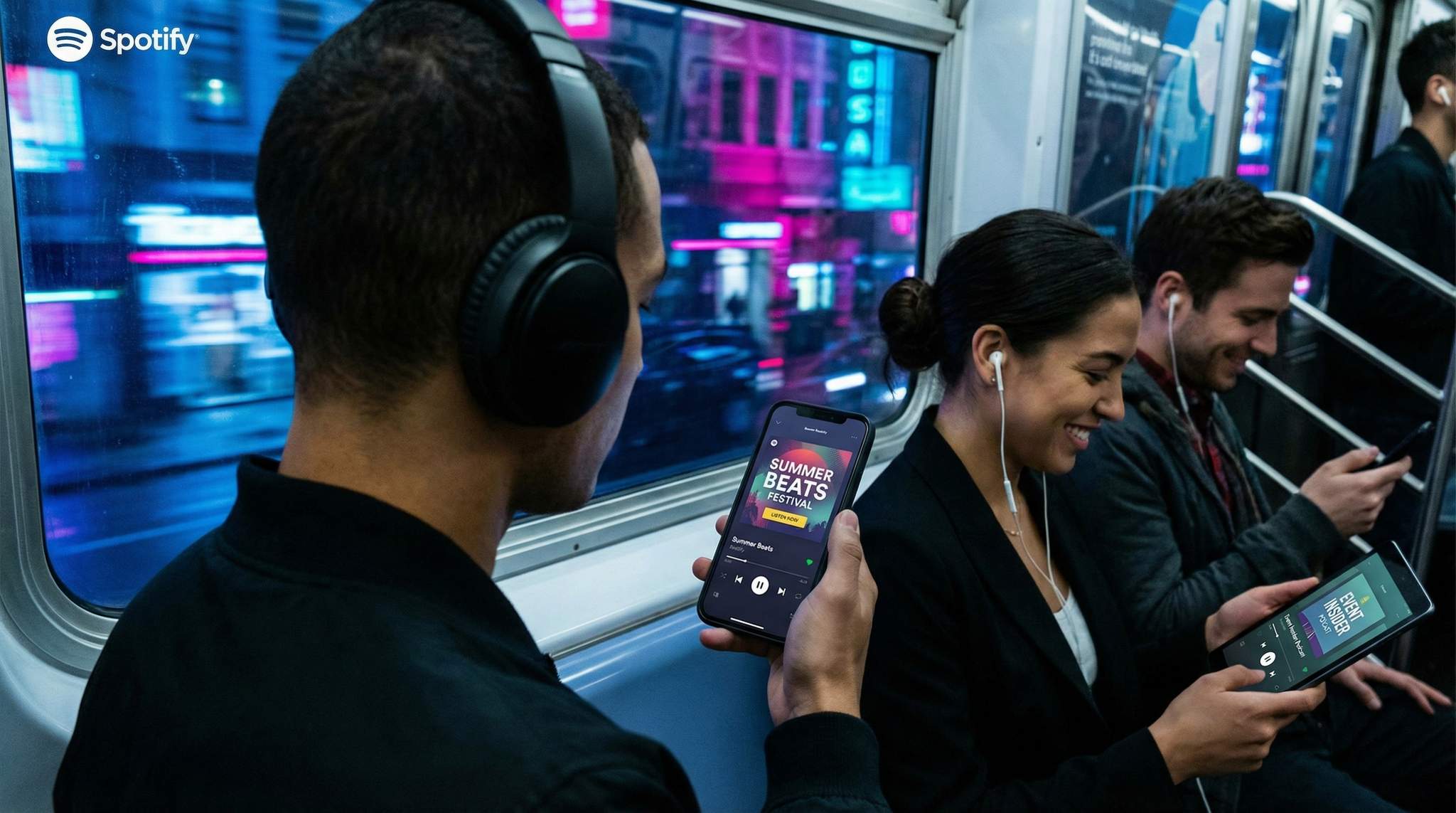
Streaming platforms like Spotify, Apple Music (with ads), Pandora, and others have become go-to channels for event marketers aiming to reach music fans. If you’re promoting a music festival, club night, or concert tour, chances are your ideal attendees are already on these apps jamming to their favorite tunes. Here’s how to capitalize on streaming audio ads to drive ticket sales.
Setting Up Your Campaign on Spotify Ad Platforms
Spotify is the largest global player in ad-supported music streaming, and its self-serve Spotify Ad Studio makes it relatively easy to launch audio campaigns. You can create a campaign in minutes by uploading a 30-second audio file (or even using Spotify’s free voiceover tools), adding a companion image, and defining your targeting parameters. Budget-wise, streaming ads can be accessible even to smaller events – minimum spends on Spotify Ad Studio have historically been a few hundred dollars, making it feasible to run localized campaigns for a single show.
Grow Your Social Following With Every Sale
Require social media follows, shares, or playlist adds to unlock presale access or special pricing. Turn every ticket purchase into audience growth.
When setting up, pay attention to format and frequency. Spotify’s standard ad format is a 15 or 30-second non-skippable audio spot that plays between songs for free-tier users. These usually come with a clickable banner or link on the app screen. You might also explore Spotify’s other offerings like sponsored sessions or playlist sponsorships, but for most events the bread-and-butter will be those short audio spots inserted into listening sessions. Plan your frequency so that your target listener might hear your ad a few times in the lead-up to the event (Spotify will cap excessive repeats automatically). A common approach is to run a 4-8 week campaign, ramping up frequency as the event date nears.
For organizers looking for a current Spotify Ad Studio review for 2025 or 2026, the consensus among festival producers is that the platform’s self-serve interface has become an indispensable tool for targeted event advertising. The dashboard provides granular control over budget pacing and audience segmentation. When planning your campaign, it is crucial to understand the Spotify free plan ad frequency in 2026. The platform carefully manages how often non-paying users hear commercial breaks to prevent listener churn. As a result, event marketers must bid competitively and schedule campaigns well in advance to secure enough share of voice, ensuring their audio advertising reaches the target frequency of three to five impressions per user without hitting the platform’s internal frequency caps.
Grow Your Events
Leverage referral marketing, social sharing incentives, and audience insights to sell more tickets.
Don’t forget other streaming platforms if they fit your market. For instance, Pandora still has a strong user base in the US and offers similar audio ad capabilities (with great genre targeting since users pick stations). iHeartRadio’s app and other internet radio services also sell audio ad inventory, often via programmatic exchanges. The key is to go where your potential attendees listen.
Targeting by Location, Genre, and Behavior
One of the biggest advantages of streaming platforms is the precision targeting they offer. Make sure to narrow your campaign to hit the right ears:
- Geo-Targeting: Use location filters to focus on the city or region of your event. On Spotify, you can target by country, state, DMA, or even radius around a city. This ensures you’re not paying to reach listeners in London if your concert is in Manchester. For tours or multi-city events, you can clone campaigns with different geo targets and localized copy for each stop.
- Genre & Playlist Targeting: Take advantage of contextual targeting to align with relevant music tastes. If you’re promoting a rock festival, target those listening to rock, alternative, or similar genres. Spotify allows targeting by genre and even by specific playlist categories or real-time contexts (like “workout” or “chill” playlists). Reaching listeners in the moment that matches your event vibe can boost resonance. For example, advertise a high-energy EDM show in electronic dance playlists, or your classical music night in a “focus” or classical genre context.
- Demographics & Devices: Most streaming platforms let you target basic demographics like age and gender (drawn from user profiles). Tailor your content and targeting to the group most likely to attend. An 18–24 audience might get a different tone or offer than a 40+. You can also target by platform (mobile vs desktop) – useful if you want mobile users who can click through immediately. Some promoters even choose specific device types or OS (e.g. only iPhones), but generally it’s more important to get the content right for humans!
- Behavioral Targeting: In 2026, data-driven advertising is evolving. On some platforms or via programmatic audio networks, you might have access to segments like “frequent concert attendees” or people with certain brand affinities. For instance, Spotify and partners can overlay third-party data or look at podcast listening habits. If available, consider using these to zero in on likely event-goers (e.g. targeting users who stream live concert recordings or follow festival playlists). Always ensure you have sufficient audience size – over-targeting can limit your reach too much.
Pro Tip: Coordinate your streaming ad targeting with other location-based tactics. For example, if you geofence mobile ads at certain locations, align that with your Spotify campaigns in the same area for a one-two punch. Mastering media partnerships for event promotion can amplify this effect, or you could even coordinate with stunts creating an organic flurry of activity. Fans might hear your audio ad and later see a mobile banner reminding them about the event, reinforcing the message through multiple touchpoints.
Crafting Audio Creative for Streaming Platforms
An audio ad on Spotify or Pandora has to earn attention fast – otherwise it becomes background noise. As experienced advertisers will attest, you have maybe 2–3 seconds before a listener’s mind wanders or they mentally tune you out. Here’s how to make those seconds count:
- Start with a Hook: Lead with something that immediately grabs the listener. It could be an exciting sound effect (cheering crowd, a snippet of a hit song if you have rights), a provocative question, or a bold statement. For instance: “? This Saturday: the biggest EDM party hits Auckland!” is a lot more arresting than “We’d like to tell you about an event coming up…”. Front-loading the most exciting info – headliner name, event name or a unique selling point – can spike curiosity. Use the element of surprise or emotion to jolt listeners to attention.
- Match the Mood: One clever tactic is to match your ad’s tone to the genre context in which it plays. If your ad targets a relaxation playlist, an over-caffeinated hard-sell voiceover might feel jarring. Conversely, a hyped-up, energetic read is perfect for an audience listening to upbeat party music. Many streaming ads even use light background music befitting the genre (e.g. a rock riff behind a rock concert promo) to create a seamless experience. The goal is to make the ad feel relevant, not like an unrelated interruption.
- Concise Event Details: In a 30-second spot, you have time for about 60-75 words – choose them wisely. Focus on the who, what, when, where in a concise, compelling narrative. Example structure: “Get ready, [City] – [Event Name] is coming [Date]! See [Artist A], [Artist B] and more live at [Venue]. [One exciting feature or review quote]. Tickets are going fast – grab yours at TicketFairy.com.” Keep sentences short and punchy. Emphasize what makes the event unmissable (lineup, experience, one day only, etc.). And repeat the event name and date at least twice so it sticks.
- Strong Call to Action: End with a clear call-to-action (CTA) and make it as easy as possible for the listener to act. On streaming apps, you can say “tap the banner now” since there is a clickable component on-screen. For example: “Tap the pop-up to snag your tickets on Ticket Fairy – don’t miss out!”. Mentioning the platform (Ticket Fairy) or a short URL verbally is smart, too, in case they recall it later. Avoid long or complex URLs; something like “TicketFairy.com/ReggaeFest” is ideal if you can set up a custom link. The CTA should also create urgency if appropriate (e.g. “Early bird prices end Friday” or “Tickets are nearly sold out”).
- Test Variations: Just as you might A/B test visual ads, try testing a couple of audio creative variations if budget permits. For example, one version might feature an artist’s voice inviting fans personally (“Hey it’s DJ Mike – join me at UltraBass Fest next month!”), while another uses a narrator. See which one yields more clicks or engagement. Data-driven testing isn’t just for websites – experimenting with different ad approaches can improve your audio ROAS too.
Example: Streaming Ad Channel Comparison
To put things in perspective, here’s a side-by-side look at streaming audio ads versus other audio channels we’ll discuss, highlighting how Spotify and similar platforms stand out:
| Channel | Targeting Options | Ad Formats | Strengths | Challenges |
|---|---|---|---|---|
| Spotify / Streaming | – Precise location (country, city radius) – Demographics (age, gender) – Genre, playlist context – Time of day scheduling |
– 15–30 sec audio spots (non-skippable) – Companion clickable banner – Sponsored playlists/sessions |
– Granular targeting & metrics – Engaged music-loving audience – Low entry budget (self-serve access) |
– Only reaches free-tier users – Limited attention if ad disengages – Requires compelling audio creative |
| Podcasts | – By show topic/genre (choose relevant shows) – Geo-target via ad networks (sometimes) – Demographics via show’s listener data |
– Host-read ads (30–60+ sec) – Pre-recorded inserts (usually 30 or 60 sec) – Mid-roll interviews or segments |
– Highly trusted by niche audiences – Feels organic if host endorses – Longer format allows storytelling |
– Limited inventory on popular shows – Higher cost for big podcasts – Tracking impact not straightforward |
| AM/FM Radio | – By station (format = audience type) – By location (broadcast area/market) – Daypart (time of day slots) |
– Traditional spot ads (15, 30, or 60 sec) – Live DJ reads and mentions – Sponsored promotions/contests |
– Massive local reach in real time – Broad demographics (e.g. commuters) – Stations offer production support |
– Less precise than digital ads – Ads easily missed if only aired once – Harder to attribute conversions |
As the table shows, streaming services like Spotify give you unprecedented control over who hears your message, plus the data to refine campaigns. Next, we’ll look at podcasts – a medium that offers a different kind of influence through trusted voices and deep engagement.
Podcast Advertising: Leveraging Intimacy and Trust
Podcast audiences are among the most loyal and engaged listeners you can find. People who regularly tune into podcasts often develop a bond of trust with the hosts or producers. An event recommendation or ad delivered in this context can feel like advice from a friend, rather than a commercial. Let’s explore how to harness podcasts to promote your event.
Choosing the Right Podcasts for Your Event
The first step is picking podcasts that align with your target audience and event theme. With over 5 million podcasts out there, you need to be strategic:
- Niche Relevance: Look for shows that match your event’s interest area. If you’re promoting a tech conference, target popular tech news or entrepreneurship podcasts. Music festival? Look for music, culture, or festival lifestyle podcasts. The closer the content aligns to your event’s vibe, the more likely the listeners are your ideal customers. Even niche podcasts with a few thousand dedicated listeners can outperform a generic mass-audience show if those listeners are a perfect fit for your event.
- Audience Demographics: Research the listener demographics if available. Many podcasts publish media kits or have data on their audience’s age, gender, and location. For example, if you run a pop-culture convention aimed at 18–34 year olds, a podcast known to skew Gen Z/young Millennial is a good bet. Also consider location – some podcasts have a strong local following (e.g., a city-specific food scene podcast). If you need to reach people in a particular city, a local show could deliver highly concentrated exposure.
- Host Enthusiasm: Not all podcast advertising is created equal. A host who genuinely gets excited about your event will naturally convey that enthusiasm to listeners. It’s worth favoring podcasts where you sense the host might personally dig your event. For instance, if you’re promoting an indie film festival, a movie review podcast hosted by film buffs would likely speak about it with passion. Some hosts even prefer to only endorse events/products they like, which boosts credibility if you can win them over. When you pitch, highlight why their listeners would love your event – and if possible, offer the host free tickets or a VIP experience so they can speak from firsthand excitement.
- Ad Reach vs. Engagement: You might be tempted to go straight for the biggest shows for maximum reach. But remember, a smaller podcast with rabid listeners can drive more ticket sales than a big show with passive listeners. A true-crime comedy podcast might have 50k listeners who tune in casually, whereas a niche techno music podcast with 5k listeners could have an audience where 80% would actually attend a techno rave. Gauge engagement through factors like listener feedback, social media activity, and how aligned the content is to your event. Experienced event marketers often test a few different podcasts to see which yields actual conversions, rather than assuming bigger is better.
Host-Read vs. Pre-Recorded: Crafting Your Message
In podcast advertising, you typically have two formats: host-read ads or pre-recorded spots. Each has its approach:
- Host-Read Endorsements: These are often the most effective because they come in the host’s voice. You provide the host with talking points, and they weave the promo in their own style. It might be a short 30-second blurb at the start (pre-roll) or a longer 60+ second message mid-episode (mid-roll). Listeners tend not to skip host-reads as much, because it feels like part of the show. To get the most out of host-read ads, give the host interesting angles or stories about your event, not just a script. For example, instead of a dry list of details, share a cool anecdote: “This festival actually started as a backyard jam session – and now 5,000 people come every year.” The host can riff on that and make it entertaining. Also, encourage them to add a personal touch – e.g., “If I weren’t on tour myself I’d definitely go to this show!” Such authentic commentary can dramatically boost credibility and intrigue, as podcast marketing relies heavily on trust.
- Pre-Recorded Spots: These are similar to traditional ads – you produce a polished audio ad that gets inserted into the podcast. This might happen via the podcast network or an ad marketplace. The creative for a pre-recorded podcast ad should follow many of the principles we discussed for streaming ads (hook, concise message, CTA), but with a podcast you can be a bit more narrative since listeners are in a content-consuming mindset. Storytelling works well. For instance, you could have a 60-second spot that briefly tells the story of last year’s event experience (“Last summer, 3,000 fans danced under the stars… now the festival returns with an even bigger lineup…”) which draws listeners in like a mini-story. Production quality matters here – invest in good sound mixing and a clear voiceover. However, be careful that the tone matches the podcast. A hyper-produced ad might stand out (in a bad way) on a laid-back, conversational podcast. Sometimes a simpler read can integrate more smoothly.
- Hybrid Approaches: In some cases, podcasts might offer a longer sponsored segment or interview. For example, the host might do a 5-minute interview with one of your event’s artists or speakers as part of the episode. This is gold if you can get it – it provides real content value while plugging your event. It’s essentially an in-context promotion disguised as a segment. Such opportunities usually come from closer partnerships (often unpaid or part of a media partnership deal rather than a paid 60s ad). Keep an open mind to these creative integrations if the podcast is willing.
No matter the format, always include a clear call-to-action and an incentive if you can. A popular approach is to give the podcast listeners an exclusive promo code or special offer. For example, “Use code PODCAST10 for 10% off your ticket” or “podcast listeners get an extra drink coupon with each ticket – just enter the code from this episode on our site.” This not only spurs action but also helps track results (more on tracking soon). Make the code easy to remember and say – typically the podcast’s name or something obvious.
Timing Your Podcast Ad Buys
Timing is crucial with podcasts because unlike radio, many people listen days or weeks later after an episode is released. Here’s how to approach scheduling:
- Start Early Enough: Ideally, begin your podcast advertising 4–8 weeks before your event date (or before a major on-sale if that’s what you’re pushing), aligning with the typical event sales cycle. This gives listeners time to hear the message, tell their friends, and make plans. If your event has a long sales cycle (like a festival where tickets are on sale for months), you might do a burst of podcast ads early to drive awareness and then another burst closer to the event for urgency.
- Frequency and Repetition: Unlike radio where an individual listener might hear your ad multiple times in a week, podcast listeners typically hear an ad once per episode. So it helps to secure placement on multiple episodes of the same show for consistency. For example, instead of one mid-roll ad a month before the event, do a package of four weekly mid-rolls leading up to it. That way, loyal listeners get reminded each episode. If someone hears about your festival in a podcast ad week after week, it builds familiarity and FOMO, and by the third or fourth mention they might finally convert. Many podcasts offer discounted bundles for buying several episodes in a row.
- Choose Ad Position Wisely: Ads can run at the beginning (pre-roll), middle (mid-roll), or end (post-roll) of episodes. Mid-rolls (especially in longer episodes) are often most valuable because listeners are well engaged in the content and less likely to skip. Pre-roll can work too if it’s brief and the show doesn’t start with too much ad clutter. Post-roll ads are generally least impactful (people may have tuned out as the episode ended). If given a choice and budget allows, opt for mid-roll or integrated host mentions within the episode content. They command a premium but usually deliver better results.
- Evergreen vs. Time-Sensitive: If you do host-read ads, remind the host to avoid language that will age badly if someone listens late (like “happening next Friday” might be heard after the event if the episode is played on delay). Instead, have them say the date (“happening July 19”). Also consider the podcast’s shelf life – episodic content might get most listens within a week of release, whereas timeless podcasts (tutorials, true crime series, etc.) get listens for months. If it’s the latter, schedule your ad to run on an episode that will drop within a useful window relative to your event. You don’t want people hearing about your January event on a podcast episode they discover in June!
Case in Point: Podcast Promo Results
To illustrate the impact of a well-executed podcast campaign, consider this real-world style example from 2026. A B2B tech conference (let’s call it TechXPO) partnered with a popular tech podcast in their industry. They arranged for a mix of host-read ads and a special guest segment featuring one of the event’s keynote speakers. The podcast host was genuinely excited about the event and spoke about it in multiple episodes. TechXPO provided a unique 15% discount code for the podcast listeners. The results were telling: within a week of those episodes airing, the organizers saw a significant spike in ticket registrations – enough to sell out their startup demo showcase for the first time. About 40% of the new ticket buyers used the podcast’s promo code during checkout, and many others mentioned the podcast by name when asked how they heard about the event. The attendees said that hearing the event discussed in-depth on a podcast they trusted made it sound “worth checking out.” This example shows how podcast promotions can directly drive sales by tapping into an engaged community.
The takeaway: choose your podcasts wisely, craft authentic messages (ideally delivered by the host), and give listeners a reason to take action. Podcasts may not have the raw reach of radio or streaming, but they can deliver quality leads and attendees who feel a stronger connection to your event brand.
Radio Advertising: Amplify Your Reach Through the Airwaves
Despite all the new digital channels, radio remains a vital piece of the event marketing puzzle – especially for reaching local audiences at scale. FM/AM radio can broadcast your event message to tens or hundreds of thousands of people in your region, including demographics that might not be active on social media. In 2026, radio has evolved with digital but its core value stands: instant local reach, drive-time captive audiences, and trusted personalities. Here’s how to make radio work for your event promotion.
Evaluating Radio Advertising Effectiveness in 2026
When assessing radio advertising effectiveness in 2026, event organizers must look beyond traditional metrics. Today’s broadcast campaigns are highly measurable when paired with digital attribution tools like vanity URLs and dedicated promo codes. The true power of terrestrial radio lies in its ability to generate immediate, localized spikes in ticket sales—particularly during morning and afternoon drive times. Promoters are finding that while digital channels offer precise targeting, the broad, trusted reach of local DJs provides a unique halo effect that lifts overall campaign conversion rates, making terrestrial airwaves a surprisingly resilient asset in a modern marketing mix.
Picking the Right Stations and Timeslots
Successful radio advertising starts with choosing the optimal station(s) and times to reach your target attendees:
- Match Station Format to Your Audience: Radio stations are typically segmented by format (music genre or talk content) which correlates with audience demographics. Align your event with stations that attract your likely attendees. Throwing a hip-hop concert? Urban and Top 40 stations will have the young crowd you want. Promoting a wine tasting festival? The local adult contemporary or light jazz station might reach an older, upscale demographic. If you’re uncertain, ask the station rep for their listener profile – they should have data on average age range, gender split, and interests. Also consider language: for events targeting specific language communities, don’t overlook non-English stations (Spanish, Hindi, etc. in many markets have huge followings).
- Local vs. Regional: Determine how far people typically travel for your event and choose stations accordingly. A single-city nightclub event should focus on stations whose signal covers that metro area. A regional festival drawing from multiple cities might warrant buying spots on a couple of stations in each key city. Many events start local and expand regionally as they grow in popularity, and collaborating with radio partners can scale similarly by adding stations in new markets.
- Dayparts – When to Air: Radio scheduling is divided into dayparts: e.g., Morning Drive (6-10am), Midday, Afternoon Drive (3-7pm), Evenings, Overnight. Prime commuting times (morning and afternoon drive) have the highest listenership but also the highest ad rates. If budget permits, snag some drive-time slots for maximum impact (people are captive in their cars and often listening intently for traffic, news, etc., so your ad will be heard). For nightlife events, afternoon and early evening ads on Friday can catch people as they make weekend plans. If you have a late-night EDM show, a few evening slots on Friday might directly reach people as they’re heading out. Avoid overnight slots (midnight-5am) as they have low audience – these are often thrown in as bonus spots but shouldn’t be your main airtime.
- Consistent Scheduling: Aim to have your ads heard multiple times by the same listeners. It’s usually better to concentrate on one or two stations with enough frequency than to spread thin across many stations. For instance, 4 spots per day on one popular station for a week will make a bigger impression than 1 spot on four different stations in that week. Repetition is key – many radio listeners need to hear about the event 3-5 times before it sinks in. One veteran promoter’s rule of thumb: ensure your target audience hears your radio ad at least once during each phase of your campaign (on-sale announcement, regular reminders, last-call urgency push).
Creating an Effective Radio Spot
A radio ad might only be 30 seconds, but in that time it can spark excitement and drive action if crafted well. Here’s how to make your radio spot stand out on the dial:
- Attention-Grabbing Opening: Just like with streaming ads, you have to hook listeners immediately – possibly even more so on radio, where ad breaks often cause drifting attention. Start with a bang: use sound to your advantage. For example, a few seconds of a hit song by your headliner can jolt music listeners (“Recognize this track? Hear it live at…!”). Or use a theatrical approach: a comedic one-liner, a dramatic sound effect (roaring crowd, laser zaps for a comic-con, etc.), or a question that resonates (“Looking for an epic family adventure this weekend?”). The key is an opening that breaks the pattern of typical ads so the listener perks up.
- Key Details Clearly Stated: In a 30-second radio script, you have room for roughly 70-80 words. Make every word count. Clearly state the event name, date, and location – these are non-negotiable. It’s surprising how many bad ads bury the date or forget to mention the venue until the very end. Mention it up front and again at the end. For example: “Saturday July 22nd at Madison Park – it’s the 2026 Summer Beats Festival!”. If the event name doesn’t obviously convey what it is, add a descriptor (“Summer Beats Festival – a full day of live EDM and hip-hop”). Include 1-2 star attractions to entice (headline artist, keynote speaker, special activity) but don’t try to list everything. Too many names or details will become a blur. Highlight the biggest selling point: e.g., “featuring chart-topping DJ Galaxy” or “with keynote by Elon Musk” – whatever will make the target listener say “Whoa, I’m interested.”
- Voice and Tone: Choose a voiceover style that matches your event. Many radio ads use a professional announcer voice, which can lend authority and clarity. But sometimes, a more relatable or unique voice cuts through better. For a youth-oriented event, you might use a young, enthusiastic voice. For a charity gala, maybe a warm and sincere tone. Consider using talent from the station – listeners recognize their favorite DJs’ voices, so if the station offers to have their host read your script, it can sound more like a recommendation than an ad. However, if you go that route, insist the essential info (date, where to get tickets) is delivered clearly amid their banter.
- Background Audio: Light background music or sound effects can add energy, but be careful not to overpower the speaking. If you include music, usually an instrumental bed that complements the vibe (e.g., a guitar riff for a rock event, or ambient synth for a tech conference) will keep things lively. Some of the most memorable event ads use a short audio clip of a past event (crowd cheering, a memorable quote) to create a FOMO-inducing atmosphere. Just ensure the voiceover is still front and center – clarity is king on radio.
- Call to Action – Make It Memorable: Finish strong with what the listener should do next. This often means repeating the event website or ticket info twice. For example: “Get your tickets now at TicketFairy.com – that’s TicketFairy.com – before they sell out!”. Repetition helps, since a listener can’t click a radio ad; they might need to mentally note the URL or event name. If the URL is long or not intuitive to spell, consider a redirect or vanity URL. Many promoters use something like “YourEvent.com” if available, even if it redirects to a ticketing page, because it’s easier on air. Another trick: incorporate a simple keyword for search – “Google ‘Summer Beats Festival’ for tickets” – though this risks them clicking other links, it’s better than nothing if the URL is complex. Some events set up a dedicated short link for radio (e.g., TicketFairy.com/BEATS) to ensure clear calls to action. Also, instill urgency or benefit: “Tickets are going fast” or “use code RADIO10 for 10% off” if you want to track and incentivize radio responders. Promo codes on radio can be hit-or-miss (people have to remember them), but they can motivate immediate action if the offer is good.
To ensure quality, listen to your spot with fresh ears (and if possible, test it on someone who knows nothing about the event). Do they catch the vital details? Is the value proposition clear? In a cluttered radio break, a clear and compelling ad with a memorable hook will shine.
Integrating Promotions and Partnerships
Buying spot ads isn’t the only way to get mileage from radio. Many stations are open to promotional partnerships – which can amplify your reach without solely relying on paid spots:
- Ticket Giveaways: Trading a small number of tickets for on-air giveaways can yield a lot of free promotion. Stations love giving their listeners prizes. You can arrange for a giveaway where the DJ plugs your event repeatedly (e.g. “Keep listening this week for your chance to win tickets to Summer Beats Festival!”). Each mention is basically free advertising and builds hype. Just be sure to provide clear talking points to the DJs so they mention key details (date, headliner) during the giveaway hype. This kind of media partnership can sometimes be part of a larger ad buy or even done in exchange for some VIP tickets, effectively turning the station into a media sponsor.
- Interviews and Appearances: Local radio shows, especially morning programs, often welcome guests or call-ins to chat about community events. Arrange to have one of your headlining artists, the event organizer, or a noteworthy speaker do a short interview on-air. It’s engaging content for them and promotion for you. A charismatic artist plugging their upcoming concert for 2 minutes on air can do more to drive ticket sales than any 30-second ad, because it feels like a genuine recommendation. Pro tip: schedule these interviews close to the event date or on-sale date for maximum conversion, and coach the guest to naturally mention how to get tickets.
- Sponsored Content: Some stations offer sponsored segments (like an “Event Spotlight of the Week” or a countdown that your event “brought to you by”). These can give you extended mentions. For example, a rock station might have “Concert Calendar, presented by RockFest 2026 – coming August 12th at Grand Park”. The DJ then reads the concert listings, starting with a plug for RockFest. This integrates your event into programming and gives it a halo of relevance.
- On-site Broadcasts: For larger events, consider inviting a radio station to broadcast live from the event or the venue during setup. Many stations love going on-site for big festivals or fairs, setting up a booth and doing live hits. In return, they usually heavily promote that they’ll be at your event (free advertising beforehand) and draw their listeners to attend. You might provide them space and access, and they give you plugs – a fair trade.
These partnership tactics often come as part of a media sponsorship deal, where the station becomes an “official media partner.” In exchange for a package of promos (mentions, interviews, contests), you might give them a sponsorship title, logo placement, VIP perks, etc. It’s not pure advertising, but it can drastically extend your reach. As noted in our guide on media partnerships that amplify event reach, a win-win radio partnership can turn a modest budget into huge buzz by leveraging the station’s influence.
Budgeting and Maximizing Radio ROI
Radio advertising costs can vary wildly based on your market and station popularity. Major market stations in L.A. or London charge a premium, whereas small local stations can be quite affordable. Keep these tips in mind to get the most bang for your buck:
- Understand Rates and Packages: Radio ads are often sold in packages (e.g., a bundle of 30 spots over 2 weeks). Rates might be quoted as cost per spot or cost per thousand listeners (CPM). Don’t be afraid to ask the rep for the station’s reach and typical listenership for the times you’re buying. For instance, if a 30-second drive-time spot costs $200 and the station has ~100,000 listeners in that quarter hour, that’s a $2 CPM, which is quite cost-effective for such mass reach. Midday or smaller station spots could be as low as $20-$50 each. Always negotiate – they often have unsold inventory, and you might snag bonus spots or a lower rate, especially for first-time advertisers or nonprofits.
- Leverage Remnant and Bonus Spots: If your budget is tight, ask about remnant inventory – unsold ad slots that they might sell at a discount on short notice. You’ll have less control on exact timing, but you could fill additional slots cheaply. Also, when buying a schedule, politely push for a couple of bonus spots or mentions (many stations will throw in a few extra off-peak spots at no charge, or include some social media posts on their accounts to sweeten the deal). The worst they can say is no.
- Track Response Diligently: We’ll cover tracking in detail later, but ensure you assign a unique tracking method to radio (like a specific promo code or a unique URL such as TicketFairy.com/Radio). This will help you gauge ROI. It’s easy to spend thousands on radio and be unsure what it achieved if you don’t measure. By tracking sales or web traffic bumps correlated to your ad times, you can justify the spend or adjust strategy. For example, if code “RADIO10” yields 50 ticket sales on a $1000 radio spend, that’s $20 cost per sale – compare that to other channels’ cost per sale to evaluate ROI. Clear calls to action are essential here. Many ticketing platforms allow you to provide the radio station a unique tracking link). Often radio contributes intangible lift (e.g., people hear the ad then later search your event), so track indirect signals like direct website hits or Google searches for your event name during the campaign.
- Know Radio’s Role: Finally, recognise where radio sits in your overall marketing mix. Rarely will radio alone sell out an event (unless maybe it’s a small local show and the station’s audience is exactly your crowd). Instead, radio is a force multiplier: it greatly boosts awareness, which in turn improves the performance of your other channels. We often see that when radio is in play, social ads and search traffic also increase – because radio drives people to seek more info online. So view radio’s ROI holistically. Its impact might be partially via those other channels (which is why asking “how did you hear about us” on your ticket checkout is so important – to capture those multi-touch folks who might otherwise be attributed to just a web ad). If done right, radio can be the push that moves an undecided local attendee to finally buy a ticket because now “they’ve heard about it everywhere.”
With streaming, podcasts, and radio fundamentals covered, the next step is ensuring your audio messages themselves are expertly crafted and your campaign as a whole is optimized. We’ve touched on creative tips in each section; now let’s consolidate the keys to great audio ad content and then dive into tracking and optimizing your results.
Crafting Audio Ads That Convert
Great placement and targeting won’t get far if the content of your audio ad falls flat. This section distills the art and science of audio ad creation – drawing on decades of campaign experience – so you can make your ads as compelling as the events they promote.
Hooking Listeners in Seconds
Whether it’s a radio ad or a podcast mention, those first few seconds are everything. Avoid slow or cliché openings. For example, starting with “Hello, have you heard about…” wastes precious time and sounds like every other ad. Instead, kick off with something that directly addresses a desire or pain point of your target audience, or sparks curiosity. If you’re promoting a comedy show: “Need a good laugh this weekend?” instantly engages someone seeking fun. For a business conference: “Tired of the same old Zoom webinars?” can speak to a frustration and position your event as the exciting solution. Another technique: leading with a question or bold statement that listeners mentally respond to. E.g., “What if your next night out became a legend?” for a nightlife event, or “The future of gaming is coming to San Diego” for a gaming expo. The goal is to prompt an internal “Really, tell me more…” from the listener. In essence, treat your audio ad opening like the subject line of an email or the headline of an article – it must entice the audience to pay attention to the rest .
Clear and Concise Messaging
Once you’ve got their attention, deliver your message with clarity and brevity. Remember, listeners can’t rewind an ad (usually) – if they miss something, it’s gone. Structure your message logically: 1) What is the event and why should they care? 2) When and where is it? 3) What do you want them to do (CTA)? Use simple, vivid language and avoid jargon. If it’s a general public event, don’t assume everyone knows acronyms or insider lingo. For example, instead of “NFT expo”, say “a conference about the latest in NFT technology”. Instead of “GA and VIP tiers available”, say “General admission and VIP tickets are available at different prices”. Paint a quick picture: “Experience a full day of live music across three stages”, “Taste 100+ craft beers from around the world”, “Learn from 50 industry leaders in one incredible weekend”. These phrases give a sense of scale and excitement.
It’s often effective to focus on one big selling point rather than cram in too much. If your event has one huge headliner or a unique feature, lead with that and center the ad around it. E.g., “Don’t miss multi-platinum artist The Weeknd live in concert…” or “Be part of the ultimate cosplay parade at NerdCon 2026…”. Supporting details can then be minimal. Too many points and the listener will recall none; one strong point and they’ll remember. And of course, repeat key info: typically the event name and date at minimum twice, as mentioned earlier. Repetition aids memory – a concept experienced radio advertisers exploit deliberately (ever noticed how many car ads repeat the phone number three times? It’s not by accident!). We’re not going that far, but a tag line like “Summer Beats, July 22nd, Madison Park – don’t miss it!” at both mid-ad and end helps cement it.
Tone, Voice, and Emotional Appeal
Human beings respond to emotion and authenticity. The tone of your audio ad should align with the emotion you want to evoke about your event. If it’s a high-adrenaline sports event, the tone should be thrilling and pumped-up. If it’s an educational seminar, the tone might be inspiring and motivating. Choose a voice that your audience will find relatable and credible. Sometimes that’s a professional voice actor, but it could also be the voice of the event organizer or an artist appearing at the event (with a short cameo line). For instance, a quick line from the headline DJ saying “See you there!” at the end can personalize the ad and excite fans.
Ensure the delivery feels conversational and genuine, not like a robot reading a script. Even in a polished ad, you can incorporate a conversational snippet: “(laughing) We can’t wait – it’s going to be insane.” This kind of aside can make the listener feel the human energy behind the event. Also, consider inclusive language and representation. If your event welcomes all ages or communities, reflect that in your copy (e.g., “everyone’s invited,” “a celebration for the whole family,” etc.). Avoid any phrasing that might unintentionally exclude (don’t presume everyone listening has the same background knowledge or interests – speak broadly but appealingly). If you’re targeting a specific group, speak their slang or language subtly to build trust (but do it authentically, as inclusive marketing strategies emphasize the importance of authenticity – people can sense pandering).
Lastly, appeal to emotion. People attend events largely for emotional reasons – joy, excitement, nostalgia, fear of missing out, desire to learn, etc. Identify the core emotion your event offers and weave it in. Lines like “Relive your teenage nostalgia with all the 90s hits live on stage…” or “Get your adrenaline pumping with extreme sports demos…” speak to feelings, not just facts. The more you can make the listener feel something in those 30 seconds, the more likely they’ll remember your event when it’s time to buy tickets.
Effective Calls-to-Action (CTA)
Every audio ad needs to drive the listener toward an action. A bland “check out our website” won’t cut it – make your CTA specific, urgent, and easy:
- One Clear Action: Decide what the primary next step is for your listener and focus on that. Often it’s “buy tickets at [site]”. Sometimes it could be “register online for free” or “RSVP today”. Don’t confuse with multiple options (e.g., “visit our website or find us on Facebook or call this number”). Too many choices lead to inaction. Pick the one best path and make it crystal clear.
- Remove Barriers: Think from the perspective of someone who’s interested but might procrastinate. A time-limited incentive or reminder of scarcity can push them over the edge ethically. For instance: “Tickets are on sale now, and early bird prices end this Sunday” gives a deadline. Or “Only 200 spots available – secure yours now before it’s too late.” This leverages urgency and scarcity (powerful psychological triggers in event sales) to encourage immediate action. Just be truthful – don’t falsely claim limited tickets if it’s not the case; instead, highlight real milestones (like price increase dates or genuine low inventory if your ticketing data shows it).
- Memorable Info: As noted, say any web URL or code slowly and clearly, and ideally spell it if there’s any ambiguity. Use phonetic clarity – e.g., for a URL like TicketFairy, you might emphasize “Ticket Fairy – like a fairy with wings” if the brand isn’t widely known (though in our case Ticket Fairy is straightforward). If you use a promo code, keep it short (no more than say 5-6 characters). The simpler and more memorable the CTA detail, the more likely listeners will recall it once they can act. Also, consider the context: a commuter hearing the ad can’t write anything down. This is why some events use phone numbers where people can call or text for tickets. For example: “Text COMEDY to 800-123-4567 for a direct ticket link”. This can be very effective as it bridges the gap – the listener just has to remember to send a quick text, and they’ll get the info on their phone to follow up later.
- Consistency: Make sure the action you’re telling them to do in audio is supported on the backend. If you say “use code ROCK10 at checkout,” double-check that it indeed gives the promised discount on your ticketing page and that the code is active. If you direct to a specific URL, ensure that link is live and prominently shows the event info (ideally a landing page tailored to that audience, maybe even with a welcome message like “Thanks for listening on 102.5 FM!” – a nice touch to reinforce tracking and community). Consistency builds trust; any friction like a code not working can turn an eager buyer into a lost one.
To tie it all together, here’s a simple Audio Ad Script Checklist outlining the elements we’ve discussed:
| Audio Ad Script Checklist | Description & Tips |
|---|---|
| Hook (0-5 sec) | Grab attention immediately – intriguing question, bold statement, or relevant sound. Make the listener want to keep listening. |
| Event & Value Prop (5-15 sec) | State event name, date, location, and why it’s unmissable. Highlight the biggest attraction or benefit to the listener. Keep it exciting and on-point. |
| Details (15-25 sec) | One or two key details or features that add credibility (headline acts, unique experiences, limited capacity, etc.). Don’t overload – just the juiciest details that enhance desire. Maintain a tone that matches the event vibe. |
| Call-to-Action (25-30 sec) | Clear instruction on what to do next (buy, register, etc.). Include where (website or platform) and, if applicable, mention any promo code or urgency (deadline/limited spots). Repeat the event name/date if possible as a final reinforcement. |
Using this framework, even a short ad will hit all the crucial notes: it attracts, informs, excites, and directs the listener, increasing the odds they will take action.
Targeting the Right Listeners: Location, Genre & More
Crafting a great audio ad is half the battle – getting it in front of the right audience is the other crucial half. You want your event promo to reach people most likely to convert (buy tickets or RSVP). With audio channels, smart targeting can dramatically improve your ROI by minimizing wasted impressions. We’ve touched on targeting within each channel; now let’s pull back and look at targeting strategies across streaming, podcasts, and radio.
Geographical Targeting Strategies
For local or regional events, location is the single most important filter for your audio ads. There’s little sense in someone 500 miles away hearing a radio ad for a club night in your city (unless they’re a tourist in town that day, which is fringe). Here’s how to target by geography on each medium:
- Streaming Services: Use the built-in geo-targeting tools. On Spotify, for example, you can target by country, state/province, city, or even a radius around a pin on the map in some cases. If your event draws primarily from a metro area, target that city and maybe a reasonable driving radius (e.g., people within 50 miles). For events with attendees flying in (like a huge festival or convention), you might target multiple key cities known to have fan bases, or use broader targeting (national or international), but that’s the exception. Also think about language targeting – if you’re doing an event in Germany and your ad is in German, obviously target German-speaking audiences in that region through the platform’s language settings.
- Podcasts: Many individual podcasts can’t target by listener location on their own. But if you use a podcast advertising network or a dynamic insertion platform (like Acast, Spotify’s Megaphone, etc.), some do allow geo-targeted ad insertion. For instance, you could run an ad that only plays for listeners in California on a nationwide podcast. Investigate these options if your event is location-specific. Another tactic: simply choose podcasts that are themselves location-specific. A “New York City food scene” podcast will naturally have mostly NYC-area listeners, giving you a built-in geo filter. And don’t overlook college and community podcasts if targeting a college town or tight-knit community – their audience might be small but nearly all local.
- Radio: By nature, radio stations are geo-targeted by their broadcast range. Choose stations whose signal covers the area people will travel from. If unsure how far a station reaches, ask the station or look up their coverage map. Some large stations can cover an entire region or multiple cities. If you need hyper-local reach, also consider smaller stations or even campus radio for specific locales. One thing to note: with radio, you can also decide if you want urban vs. suburban targeting by station choice (some cities have different stations popular in the suburbs vs. downtown). If your event is in the city center, maybe focus on stations that index higher with urban listeners, etc. Advanced tip: if your city has digital HD radio subchannels or internet radio specific to local communities, those can further target micro-areas (though those audiences are typically smaller).
- Geo-Fencing Live Events: A creative tactic experienced promoters use is running geo-fenced audio ads around competitor events or relevant gatherings. With programmatic audio ad buys, you could target people listening to streaming audio within the vicinity of a certain venue on certain dates – for example, serving your festival ad to anyone using Pandora at a rival festival’s campsite. This is an offshoot of mobile geo-fencing strategies applied to audio, helping deliver your ideal attendees. It’s cutting-edge, and execution requires a platform that supports hyper-local mobile targeting combined with audio inventory. But it’s worth noting as the tech matures in 2026.
- Travel and Tourism Angle: If you have a destination event (like a festival people travel to), use geo targeting in a two-tiered way: target the local region for obvious attendees, and target a few major cities that have direct transport to your event city (e.g., if your festival is in Croatia, you might run some audio ads in London, Berlin, etc., where a lot of festival-goers fly in from). Tailor the message accordingly – the out-of-town ads might mention travel (“pack your bags for an unforgettable weekend in Croatia…”), whereas local ads focus on pride (“the biggest party of the year in our city…”).
Genre, Context, and Interest Targeting
Beyond location, aligning your ads with content and interests ensures you catch people in the right mindset:
- Music Genre Alignment: On streaming platforms, take full advantage of genre targeting. If someone is currently listening to a genre or artist similar to what your event offers, your ad will feel highly relevant. For example, advertising a country music festival on the “Hot Country” Spotify playlist is likely to hit receptive ears. Spotify’s Ad Studio even lets you target fans of specific artists – a great tool if your event features well-known artists. Imagine being able to target fans who listen frequently to Artist X, right after you book Artist X for your festival – that’s precision marketing. Similarly, Pandora has “station” targeting which effectively keys off of artist or song preferences. This kind of context targeting can dramatically improve engagement with your ad because it doesn’t feel out of place.
- Podcast Topic Targeting: If you can’t geo-target within podcasts, you can definitely topic-target by choosing shows with relevant themes. We covered this, but to emphasize: interest alignment is crucial. A wrestling event advertised on a wrestling podcast, a travel expo on a travel podcast – these pairings yield the best ROI. The podcast’s content acts as a natural qualifier for interest. Some ad networks also let you target by podcast genre (e.g., run ads on any podcasts in the “Comedy” category), which can scale your reach while staying contextually relevant.
- Lifestyle and Demographic Fit: Some streaming services provide audience segments based on lifestyle or demographic data. For instance, Spotify has offered segments like “fitness enthusiasts” (people who listen to workout playlists) or “commuters” (people who listen during commuting hours regularly). Think about your audience’s lifestyle: if it’s an EDM festival, maybe targeting “nightlife enthusiasts” or “party playlists” could find those who go out often. If it’s a professional conference, targeting the “business/news” podcast category or placing ads during business news radio hours might reach that professional demo. Always ask, what would my target attendee likely be listening to on a typical day? Then find a way to get your ad into that content, whether through direct buys or creative partnerships.
- Using First-Party Data for Targeting: If you have your own customer data (like email lists from past attendees), consider using it to refine your audio targeting. While you can’t directly upload an email list to Spotify like you can to Facebook, some platforms (and agencies or programmatic services) can do data onboarding to find those users in audio environments. Another simpler method: survey your existing audience on what media they consume. Ask your followers or email list, “What radio stations or podcasts do you listen to regularly?”. The answers can highlight which outlets might be effective to advertise on. For example, if 30% of your fan survey says they listen to XYZ Rock Radio, you know placing ads or doing a promo on that station could hit a lot of your potential market. Some events have discovered niche podcasts or local media this way that they wouldn’t have otherwise considered.
- Avoiding Mismatch: On the flip side, be mindful to exclude placements that might waste budget. Many platforms let you exclude certain genres or content. For instance, if you’re advertising an 18+ nightclub event, you might exclude “Kids & Family” genres or certain times of day like when children’s programming might run. If you’re promoting a luxury high-end event, you might avoid advertising on a bargain-shopping podcast. These exclusions help refine your spend towards the highest-potential listeners.
Examples of Targeting in Action
To illustrate, here are a couple of hypothetical scenarios showing targeting combinations for different events:
- Indie Music Club Night (City-specific): Target free streaming listeners aged 18-34 within 25 miles of the city, who listen to alternative/indie rock. Run ads on weeknights after 6pm (when they might be making weekend plans) and target fans of similar indie bands. Additionally, sponsor a segment on the local college radio station’s indie show, and advertise on a local music podcast that covers the city’s concert scene.
- Tech Conference (National draw): Target tech and entrepreneurship podcasts with ads nationally, but use a dynamic insertion network to especially hit tech hubs (SF, NYC, Seattle) with more frequency. For streaming, target big cities’ metro areas with audio ads during business hours on business news streaming stations or work-themed playlists (since this is professional development). On radio, buy spots on the local news radio in the host city and a national public radio network if budget allows (many professionals listen to NPR). This blankets both the local and national prospects through content they trust.
- Family Food Festival (Regional): Use Spotify to target 35-54 aged listeners within the region who stream family-friendly pop music or cooking-related podcasts (yes, there are cooking and foodie podcasts to target). Also buy local radio on the top station that parents listen to (maybe an Adult Contemporary station that plays popular hits and has a morning show with parenting segments). Ensure the ad highlights kids under 12 get in free – which will specifically catch a parent’s ear.
These examples show how we combine location, content, and demographic targeting to connect with those most likely to be interested. The better you define and reach your event’s core audience, the less you spend talking to people who won’t convert.
One more thing: monitor and adjust. If you notice early on that a certain station or podcast isn’t delivering results (e.g., no code redemptions or low engagement), be ready to reallocate your budget to higher-performing channels. That agility is part of targeting too – continually honing in on where the fans are.
Measuring Success and Optimizing Audio Campaigns
Audio advertising might not have the instant click-through tracking of online ads, but that doesn’t mean you can’t measure its impact. In 2026, event marketers are increasingly data-driven, even with offline channels. By setting up the right tracking and analytical approach, you can gauge how your Spotify, podcast, and radio campaigns contribute to ticket sales – and refine them for maximum ROI. Let’s break down how to track, analyze, and optimize your audio ad performance.
Tracking Methods: Links, Codes, and Surveys
Since a listener can’t directly click an audio ad (aside from companion banners in streaming), we need creative ways to attribute sales or interest to those ads:
- Unique Promo Codes: Perhaps the most straightforward method is using promo or discount codes specific to each channel. For example, use code SPOTIFY10 for 10% off tickets in your Spotify ads, PODCAST10 in podcast ads, and RADIO10 on radio. These codes let you tally how many people heard the ad and acted on it by using the code at purchase. It’s not foolproof – some listeners might buy without using the code – but it gives a direct indicator. In the earlier TechXPO case, around 40% of new buyers entered the podcast code, which clearly signaled the podcast’s influence on registrations. Even if the discount affects revenue slightly, gaining the tracking insight is often worth it (and the urgency of a limited-time discount can boost conversion rates, offsetting the cost). Just be sure to keep codes easy to remember and say; if they are too long or complex, nobody will recall them.
- Vanity URLs and Redirects: Create custom short URLs for audio channels that redirect to your ticket page. Examples: TicketFairy.com/RadioFest or MyEvent.com/Spotify. These are easier to remember than generic URLs. When someone visits that vanity URL, you know where they likely came from (because you only advertised it via that audio ad). You can either track hits to that URL or, even better, append UTM parameters so that Google Analytics or your ticketing dashboard attribute those visits/sales to the source. Many ticketing platforms (including Ticket Fairy) allow you to set up tracking links or referral codes to capture this data, or even give the radio station a unique URL). Mention the vanity URL in the ad (“get tickets at MyEvent.com/RadioFest”); it’s fine if it forwards to a longer Ticket Fairy URL, the user won’t mind as long as it loads the right page.
- QR Codes (Where Applicable): Obviously, listeners can’t scan a QR from an audio-only medium. But if you pair your audio campaign with any visual component – say, a social post referencing the radio code, or a flyer that ties in – you could use QR codes to complement. This is more for integrated campaigns (like at-event promotions on radio). In pure audio contexts, skip QR and stick to easy spoken URLs.
- “How Did You Hear?” Surveys: One of the simplest and most powerful tools is to just ask your ticket buyers how they heard about the event. Add a dropdown or open-ended question in the ticket checkout flow: “What made you aware of this event?”. Include options like Radio, Spotify/Streaming Ad, Podcast, Social Media, Friend, etc. This self-reported data can be gold. Yes, it’s not 100% reliable (some might misremember or choose the first option), but patterns will emerge. If 20% of respondents say “Radio” and that’s higher than you expected, it validates that spend. Make sure to include this in any post-event analysis. You might be surprised; sometimes a channel you thought was minor ends up being a major awareness driver according to attendees. Experienced campaign veterans never skip this step – it’s inexpensive to implement and yields insight no algorithm can fully give. You can review social media analytics or look for a notable spike in registrations.
- Timing Correlation: Another way to gauge impact is by looking at timing. Note when your ads run (make a schedule log) and watch your web traffic and ticket sales in the minutes and hours after. Radio is great for this if your ticketing platform shows real-time sales – often you’ll see a bump immediately following a big radio push (especially for on-sale announcements). Likewise, with podcast drops – if a podcast releases Tuesday morning and your ad is in it, monitor that day’s traffic and sales versus typical. While correlation isn’t causation, if you see noticeable lifts coinciding with ad activity, it’s a strong hint of effectiveness. You can enhance this by using Google Analytics: look at direct and organic traffic trends during your audio campaign period compared to before. If there’s a sustained lift, audio likely helped drive new people to search for your event or go directly to your site.
- Third-Party Brand Lift Studies: For bigger campaigns, you might use more advanced methods like brand lift studies. For instance, Spotify offers a brand lift measurement service for larger advertisers where they survey listeners on recall and intent. Radio stations sometimes have partnerships with Nielsen or others to measure ad recall. These can be pricy and not usually in the scope for single events (more for big brands), but they’re worth knowing about. For a large festival spending significant budget on audio, a brand lift study could quantitatively show how much awareness increased in the market post-campaign.
By combining these methods, you can triangulate the impact of your audio ads. For example, you might find that your podcast ad yielded 50 code redemptions, plus another 100 sales where people didn’t use the code but said “podcast” in the survey – giving you a fuller picture of its influence.
Key Metrics to Monitor
Once tracking is in place, what metrics should you actually look at to evaluate success? Here are the key ones for audio:
- Impressions Delivered: In streaming and programmatic, you’ll get a report of how many ad impressions were served (and maybe how many unique listeners). This tells you your reach. For instance, 100,000 impressions on Spotify in your target area. If this number is much lower than expected (due to budget or targeting too narrowly), you may need to adjust targeting or budget to reach a meaningful share of your market. If you run spots on radio, impressions are a bit fuzzier but you can estimate using the station’s listener stats (e.g., a station with 50,000 listeners in your slot and you ran 10 ads, roughly 500,000 gross impressions – though real unique reach might be less after repeats). Impressions show how many chances you gave yourself; conversions will always be a subset of this.
- Listen-Through Rate (LTR): Some streaming platforms report what percentage of your ads were heard to completion. If, say, Spotify shows a 90% completion rate on your 30-sec ad, that’s fairly good (most didn’t tune out or mute). If it’s low (e.g. 50%), that could indicate your ad content isn’t holding interest or perhaps is placed in awkward spots. Podcast ads inherently are usually heard fully (since host-reads flow with content). For radio, you can’t measure LTR directly, but high frequency with no response might imply people “tuned out” mentally. Use any LTR data to refine creative – a strong drop-off in the first 5 seconds would scream “fix your intro!” in a streaming context.
- Click-Through Rate (CTR): For streaming ads with companion banners, you’ll see a CTR (clicks/impressions). Audio ad CTRs are typically low (maybe 0.1-0.5%) because many people hear the ad but aren’t in a position to click right then. However, it’s still useful as a relative measure. If one creative had 0.3% CTR and another had 0.1%, the former likely had a more compelling message (or at least a more enticing banner). Use CTR to compare ad variants and improve. But don’t rely on CTR alone – audio often drives later action not immediate clicks.
- Conversions/Ticket Sales Attributed: This is the big one – how many tickets (or sign-ups) can you attribute to the audio campaign? This will come from codes used and tracked link sales. Calculate the revenue from those and compare to what you spent on that channel. For instance, if you spent $2,000 on Spotify ads and you can clearly attribute $10,000 in ticket sales to them (via direct code use or link), that’s a 5:1 ROAS (Return on Ad Spend) – excellent by most standards. Keep in mind some returns are indirect as discussed. If possible, do include an estimate of indirect attributions (like those survey responses). Even if someone didn’t use the code, if they heard the podcast ad and bought a ticket at full price, the podcast still did its job. So you might say “direct ROAS 2:1, but likely higher when including influenced sales.” This is where seasoned marketers articulate the value of multi-touch marketing: audio might assist other channels in conversion .
- Cost Per Acquisition (CPA): This is your cost per ticket buyer from that channel. It’s simply the spend divided by number of ticket buyers attributed. For example, $1,000 on radio / 25 buyers from radio = $40 CPA. Is that good? Depends on your ticket price and lifetime value. If those 25 buyers spent $100 each on tickets, you made $2,500 – a decent return, albeit not considering other overheads. If your average ticket is $20, then $40 per buyer is not sustainable alone. CPA helps compare efficiency across channels. Maybe radio had $40 CPA, but your social ads were getting $20 CPA. Or vice versa if radio was killer and got $10 CPAs from a cheap contest partnership. These insights guide budget allocation – you put more into the channels with lower CPA (as long as they can scale) and trim the higher CPA ones.
- Awareness and Engagement Metrics: Not every result is about immediate sales. You might track things like web traffic uplift, social mentions, or search volume for your event name during the audio campaign. For example, using Google Trends or your Google Analytics, did searches for “Summer Beats Festival” jump in the weeks you ran radio ads? If yes, that likely indicates growing awareness (some of which might convert later or through other channels). Also check social media – did you gain followers or see people commenting “heard about this on the radio/podcast”? These qualitative signs affirm that your audio outreach is resonating.
To organise some of these metrics, here’s a quick table of Audio Campaign Metrics and Benchmarks for reference:
| Metric | Definition | Typical Range / Benchmark |
|---|---|---|
| Impressions | Number of times your ad was heard (or delivered) | Varies by spend – ensure sufficient volume (e.g., 100k+ on streaming for a city-wide event) |
| Listen-Through Rate | % of audio ads heard to completion | High on non-skippable (80-95%); lower on skippable formats if available (50%+) |
| Click-Through Rate | % of impressions that got a click (streaming) | Often 0.1-0.3% for audio ads (less than typical display ad CTR); >0.3% is strong for audio banners |
| Promo Code Usage | Number of redemptions of your tracking code | Depends on offer and audience size; even a few dozen uses can prove a channel’s effectiveness (e.g., 50+ uses is a good sign) |
| Attributed Ticket Sales | Tickets sold that can be tied to the channel (via code or link) | Aim for measurable attribution of 5-15% of total sales per major audio channel (more if it’s a primary channel) |
| ROAS (Return on Ad Spend) | Revenue from attributed sales / ad spend | 3:1+ is excellent, 2:1 is decent in events (remember some effect is untracked) |
| Cost per Acquisition (CPA) | Ad spend divided by number of buyers from channel | Compare to your average ticket price or other channels’ CPA; lower is better (but consider indirect influence) |
Of course, the above are generalized. Your mileage will vary – the key is to measure consistently and compare relative performance rather than chase a universal “good” number.
Optimizing and Iterating Your Audio Strategy
Measurement is not just about proving ROI, but also about learning and improving. As you gather data from initial campaigns, apply those insights:
- Refine Targeting: If you found certain targeting didn’t perform, adjust it. Maybe your streaming ad CTR was highest at night – focus budget on evening slots. Or your podcast code redemptions mostly came from one show and not another – double down on the effective show and drop the dud. Continual refinement is how programmatic advertising pros expand reach efficiently across the web and it holds true for audio too: use data to invest where returns are proven.
- Creative Tweaks: Pay attention to any qualitative feedback. Did a particular message resonate? (e.g., attendees coming up to your box office saying “I heard the ad about 2-for-1 deals on the morning show”). Use that to adjust your creative – emphasize what’s working. If one version of an ad yielded higher CTR or code usage, analyze why. Maybe it mentioned the headliner’s name earlier. Incorporate that insight into all your audio creatives. A/B testing isn’t as instantaneous to read in audio, but you can still test sequentially: run one message for a week, then a slightly altered one next week, see if redemptions improve. Over multiple events, you’ll build a playbook of what messaging drives the most ticket sales for your audience, as data-driven experiments lead to big wins.
- Budget Reallocation: After a campaign, stack up the ROAS or CPA of each channel in a report. Perhaps you discover podcasts delivered a 5x ROI, while a certain radio station was only 1x. Next time, you might increase the podcast budget or add more shows, and negotiate lower on that station or try a different station. Marketing budgets for events are often limited, so putting money where you see impact is essential . That said, don’t be too hasty to cut a channel that underperformed if you believe it has indirect effects. For example, maybe radio showed poor direct attribution but you suspect it lifted overall awareness. You could scale it down rather than out, or try a different approach (like more promotions than ads) to get better value from it rather than eliminating it entirely.
- Frequency and Timing Adjustments: Use sales data to inform ad timing. If you saw most ticket sales happening the day after paydays or over weekends, maybe concentrate some audio ads just before those spikes to influence decision-making. If an early on-sale radio blast didn’t yield immediate sales, consider scheduling radio more into the middle and late sales cycle where urgency is higher. Optimize how long you advertise too – if you ran 8 weeks on a podcast and saw that most code redemptions happened in the last 4 weeks, you might save budget by focusing on that window next time.
- Integrate Feedback Loops: Combine your quantitative data with qualitative feedback from your team, sales, and even customers. If you have street teams or social media, they might hear comments like “I’ve been hearing about this event everywhere – radio, Facebook, you name it.” That indicates your multi-channel approach is working as intended. Conversely, if a lot of target audience folks still say “Never heard of that event,” then despite your efforts, you might not be hitting them sufficiently – a sign to boost reach or targeting. Conduct a brief post-event marketing retrospective: see what sources attendees cite most and identify gaps. Maybe you realize you should have advertised on that popular local podcast that attendees keep mentioning. Feed these learnings into your next campaign plan.
Lastly, an important mindset: continuous improvement. Event marketing is dynamic. Platforms change (remember how quickly TikTok emerged and radio evolved with streaming simulcasts), audience media habits shift, and what worked one year might need tweaking the next. The best event marketers treat every campaign as a chance to gather intel and refine their strategy. Over time, your audio advertising will become more efficient and effective, turning into a well-honed machine driving ticket sales.
Integrating Audio Ads into a Multi-Channel Campaign
Audio ads should not exist in a silo. The most successful event promotions use audio as one component of a holistic, multi-channel marketing strategy. When coordinated with your other channels – social media, email, PR, on-ground – audio can significantly amplify overall impact. Let’s discuss how to blend audio seamlessly into your broader campaign for maximum synergy.
Consistent Messaging Across Channels
While the wording and format might differ, the core message of your event should stay consistent across audio, visual, and text channels. This reinforces recognition. If your radio ad says “Don’t miss the Summer Beats Festival on July 22nd – tickets selling fast!”, your Facebook ads and emails should echo that urgency and highlight the same date and value prop. Consistency doesn’t mean bland repetition, but rather a cohesive theme. Perhaps your campaign slogan is “The party of the summer” – you’d want that idea coming through on radio, in print, on socials, everywhere. This way, each time someone encounters your marketing (no matter the medium), it builds on the last touch. They might not act the first time, but by the third or fourth message – delivered through different channels – it clicks. Event promoters have learned that integrating promotional channels into one cohesive customer journey is key. A unified message also projects professionalism and trustworthiness, which can tip someone from interest to purchase.
Timing and Cadence Coordination
Coordinate the timing of audio ads with other campaign milestones. For example:
- On-sale Announcements: If you’re dropping tickets on Friday at 10am, have a radio spot (or DJ mention) go out at 9:50am that day saying “tickets just went on sale!” so you can plan a few spikes of activity while simultaneously sending an email blast at 10am and a social post. That one-two punch can create a surge of excitement and a sense that “everyone’s talking about it right now.” If a fan hears on the radio that tickets are now available and sees a tweet about it within minutes, it reinforces the call to action.
- Mid-Campaign Reminders: Plan periodic boosts where multiple channels spike together. For instance, two weeks out from the event, you could run a “2 Weeks To Go” podcast ad, a countdown email, and launch a last-phase Facebook Ads campaign. The combined effect signals the final chance to get tickets, leveraging urgency on all fronts.
- Last-Minute Blitz: In the final 3-5 days, align your final audio pushes (like extra radio spots saying “this weekend!”) with final social media pushes, artist posts, and even venue signage. This creates a crescendo effect. People often need that last reminder to overcome hesitation. Hearing an artist promote the show on a podcast, seeing the radio contest winners announced, and getting a push notification all within 48 hours can convert fence-sitters.
Mapping out an integrated timeline is helpful. Here’s how a simplified campaign timeline might look, integrating audio with other channels:
| Campaign Phase | Timing | Audio Ad Tactics | Other Channels & Activities |
|---|---|---|---|
| On-Sale Launch | 8–10 weeks out | First burst of radio ads announcing tickets on sale; Podcast host mentions “just launched”; Spotify ads targeting early adopters with early-bird offer | Press release to media; Email to waitlist/VIP; Social media announcement (artists share too) |
| Awareness Building | 6–8 weeks out | Steady run of weekly podcast ads on relevant shows (focus on storytelling); Mid-frequency streaming ads highlighting lineup; Radio DJ casual mentions (via partnership) | Organic content (blog posts, behind scenes); Influencer posts; Local flyers/posters go up |
| Mid-Campaign Push | 4–5 weeks out | Second radio ad flight focusing on key headliner; Geotargeted digital radio (iHeart/Pandora) ads for region; Continue podcast integrations (maybe guest spot interview with event rep) | Second email campaign (artist profiles); Paid social ads (lookalike audiences); Promotional giveaway on Instagram or with media partner |
| Urgency Phase | 2–3 weeks out | New creative for audio ads stressing “Don’t wait” – increase frequency on radio & streaming in city; Last round of podcast ads with discount code expiring soon | SMS reminder to subscribers; Retargeting ads intensify; Artists push event on their socials; Local news coverage if possible |
| Final Week Blitz | < 1 week | Daily radio mentions (countdown, “this weekend!”); Podcasts (if any episodes drop) mention any last chance offers; Spotify ads with “Last chance!” messaging and maybe higher bid for more impressions | Final email “Last chance to join us!”; Flash sale for remaining tickets; Street team visibility in town; On-site prep and updates on social media |
This coordinated schedule ensures audio ads are not isolated but rather boosting and boosted by other efforts. For instance, someone hears the radio ad in the urgency phase and then sees a retargeting Facebook ad later that day – the combined exposure significantly ups the chance of conversion than either alone.
Cross-Promotion and Leverage
Use audio channels to drive engagement in others and vice versa. For example:
- Encourage Social Follow from Audio: In a longer-form audio (like a podcast interview or DJ chat), slip in “Follow us on Instagram for event updates and behind-the-scenes peeks!”. Radio contests might have people enter via your social media or website, bridging radio listeners into your digital ecosystem. Once they follow or visit, you can further market to them.
- Repurpose Audio Content: If an artist did a great radio interview about your event, share that clip on your website or social (with station permission) – now your social followers hear a radio-style plug. Similarly, if a podcast host gave your event a glowing mention, quote it in your press or marketing (“As heard on X Podcast: ‘This festival sounds incredible…’”). This not only adds credibility but also highlights to those who missed it that “others are talking about us in media.”
- Integrated Experiential Marketing: Consider tying audio into the event experience. For instance, partner with a radio station to play at the event (e.g., the station broadcasts live or DJs between sets). They will promote that on-air, essentially giving you extra advertising. Or have a live podcast taping at your conference – the podcast will hype that episode, attracting their listeners to attend. In 2026, blurring the lines between marketing and experience can amplify both. When media partners become part of the event experience, their promotion of their involvement equals promotion of your event.
- Unified Brand Voice: Ensure that whether someone hears about your event on a podcast, on the radio, in an email, or on TikTok, the tone and values conveyed feel consistent. If your brand is all about high-energy fun, that should come across everywhere. If it’s about inclusivity and community, the audio ads should reflect that just as much as your website copy does. This consistency builds a strong brand in the minds of consumers, which in turn makes your marketing more effective because people emotionally connect with what your event stands for.
By integrating audio ads into the larger whole, you essentially create a surround-sound effect around potential attendees. They might hear the event mentioned in multiple contexts, lending it an air of inevitability – “This thing is happening and everyone’s talking about it, I should go too!” That kind of omnipresence is what sells out shows, as seamless multi-channel campaigns maximize ticket sales.
One caution: while being everywhere is great, ensure you’re targeting smartly on each channel to avoid pure oversaturation or wasted reach (e.g., hitting the same uninterested person 10 times and annoying them). Use frequency capping on streaming, moderate schedules on radio (lots of ads in a short window is better than thinly spread over months), and segment your email lists, etc. The idea is that within your target cohort, they see a well-coordinated campaign. Those not in your target shouldn’t be overexposed (they might catch a whiff, which is fine, but you don’t want to spam the whole world).
In essence, think of audio as a powerful voice in your marketing chorus. When it harmonizes with your other voices – all singing the same tune – you’ll hit that crescendo where ticket sales soar.
Frequently Asked Questions About Audio Event Advertising
How does the Spotify free plan ad frequency in 2026 impact event advertising?
In 2026, Spotify strictly regulates ad frequency on its free tier to maintain a positive user experience. For event promoters, this means your audio advertising campaigns must be strategically paced. You cannot simply flood the platform with impressions over a single weekend; instead, campaigns should be spread across several weeks to ensure your target audience hears the message multiple times without the platform capping your delivery.
Is Spotify Ad Studio worth it for independent festival promoters?
Based on recent industry feedback and any comprehensive Spotify Ad Studio review from 2025 or 2026, the platform is highly recommended for independent organizers. Its low barrier to entry, built-in voiceover tools, and precise geographic targeting make it one of the most cost-effective event advertising channels available for reaching music fans.
How do promoters measure radio advertising effectiveness in 2026?
To accurately gauge radio advertising effectiveness in 2026, event marketers rely on a combination of dedicated vanity URLs, station-specific promo codes, and post-purchase attribution surveys. By tracking these direct response mechanisms alongside localized spikes in organic search traffic during broadcast windows, organizers can clearly calculate the return on ad spend (ROAS) for their terrestrial campaigns.