The New Era of Sponsor Activations
From Banners to Engaging Experiences
Event sponsorships have evolved radically by 2026. Gone are the days when a company’s logo on a stage banner or a simple shout-out would suffice. Sponsors now demand active engagement with attendees. In fact, industry insiders note that passive logo placements are no longer enough – brands expect participation and immersive experiences that truly involve the audience, as brands adapt their festival pitches to meet new expectations. This shift means event organizers must move beyond static displays and create sponsorship activations that attendees can interact with directly.
Sponsors Demand Measurable ROI
With marketing budgets under intense scrutiny, sponsors in 2026 insist on clear return on investment (ROI) metrics from their event partnerships. A recent industry survey revealed that nearly 45% of brands have renegotiated or shortened sponsorship deals due to rising costs and a demand for better results, emphasizing the need for memorable activations that deliver maximum value. The message is clear: if an event can’t prove its worth, sponsors will take their money elsewhere. Brands are looking for concrete numbers – how many attendees engaged with their activation, how long they spent there, how many leads or sales resulted – essentially mirroring the granular data of digital marketing campaigns, a trend highlighted in 2026 trade show marketing forecasts. Events must be ready to deliver these detailed reports to justify the sponsorship fee.
Technology as the Game-Changer
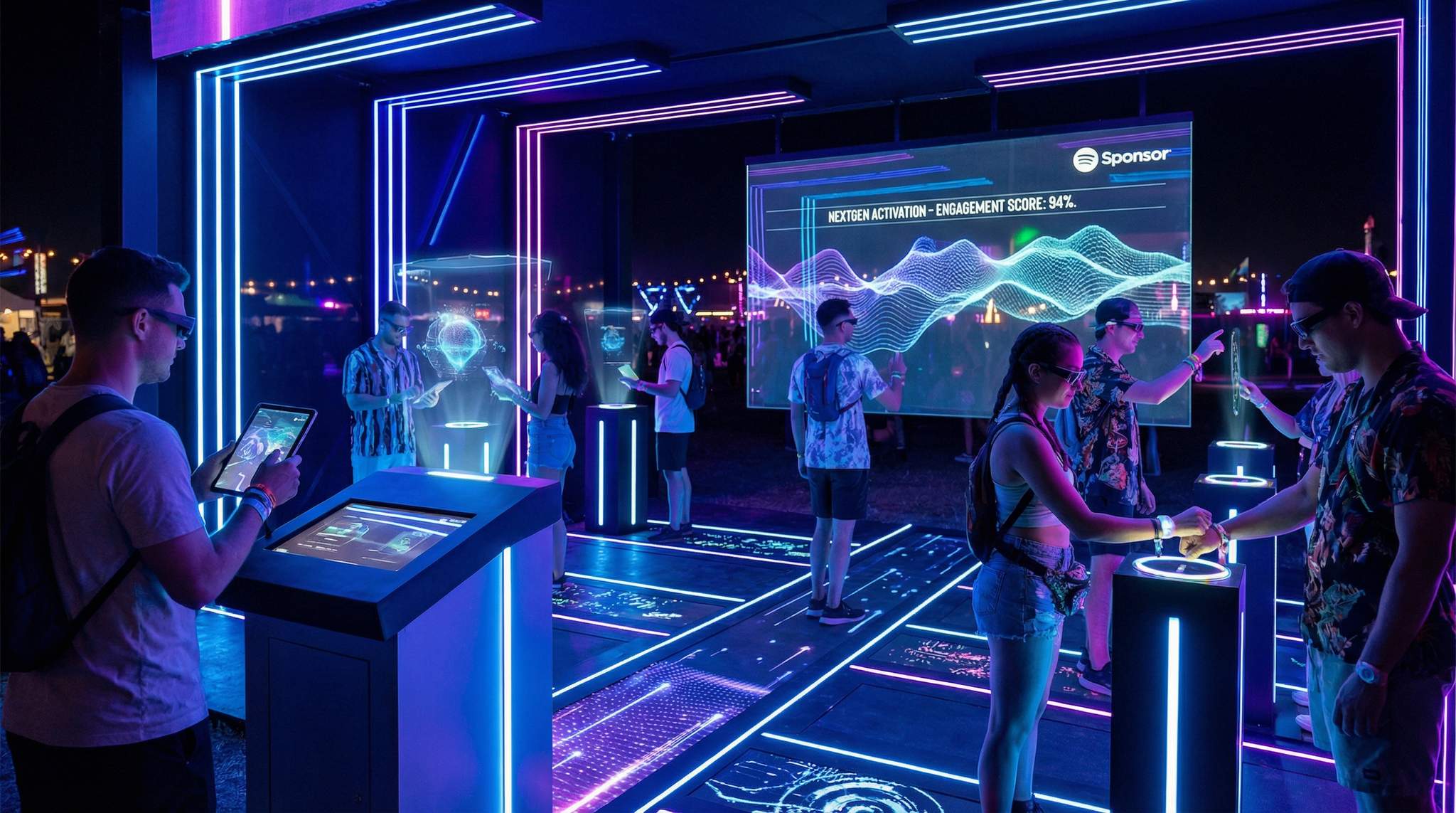
Technology has emerged as the game-changer enabling these high-engagement, data-rich sponsorships. Forward-thinking organizers leverage tools like RFID wristbands, augmented reality apps, and interactive digital platforms to transform sponsor booths into must-visit attractions. These tech-powered activations both wow attendees and capture data at every step. Sponsors get deeper engagement and hard metrics – a win-win that simply wasn’t possible with old-school tactics. As competition for sponsor dollars intensifies, those events that harness technology to provide creative, measurable activations have a distinct edge. In the sections below, we’ll explore how specific technologies – from RFID gamification to AR/VR experiences – are helping events deliver the immersive experiences sponsors want along with the ROI proof they need.
Gamification Through RFID & NFC
Scavenger Hunts and Checkpoint Challenges
RFID (Radio Frequency Identification) and NFC (Near Field Communication) technologies have become pillars of sponsor activations through gamification. Attendees wear RFID wristbands or carry NFC badges that can be tapped at various checkpoints or sponsor booths throughout an event. Organizers design scavenger hunts or challenge trails: for example, a sponsor might invite attendees to visit five specific booths or activation points and tap their wristband at each one. This tap-to-play approach turns a sponsor’s presence into an interactive game. Rather than passively seeing a logo, attendees actively seek out the sponsor’s stations to complete their challenge – driving foot traffic in a fun, organic way. Successful implementations range from music festivals rewarding fans for checking in at all partner installations, to conferences where attendees earn points for meeting exhibitors. The psychology is simple: people love to collect and compete. Add a reward (like a prize entry for completing all taps or bonus swag for high scorers) and you’ve got a recipe for sustained booth engagement.
Data-Driven Event Marketing
Track ticket sales, demographics, marketing ROI, and social reach in real time. Exportable reports give you the insights to make smarter decisions.
Every Tap Captures Engagement Data
Beyond the fun for attendees, RFID/NFC gamification provides a treasure trove of data for sponsors and organizers. Each tap of a wristband or badge is automatically logged by the system – essentially a digital handshake that records an interaction. This means every engagement is countable. Sponsors can see exactly how many people visited their activation, how many completed the full challenge, and even the time of day traffic peaks occurred. For instance, at a major sports fan festival, over 30,000 attendees used RFID cards to participate in skill challenges and simulations, resulting in 85,000 on-site RFID interactions captured and over 45 million online impressions through integrated social sharing, demonstrating the power of RFID brand activations at sporting events. These numbers, delivered via real-time dashboards, translate into concrete ROI metrics: a sponsor can report not just “the booth was popular,” but “X thousand engaged with our activation, generating Y million brand impressions.” RFID data shows which areas attracted the most foot traffic and which activities were most popular, underscoring the role of RFID in sponsorship opportunities, helping sponsors assess impact. This level of insight was unheard of in traditional sponsorship – now, it’s expected.
Table: RFID/NFC Gamification – Key Metrics and Considerations
Ready to Sell Tickets?
Create professional event pages with built-in payment processing, marketing tools, and real-time analytics.
| Strategy | How It Works | Data Captured (ROI Metrics) | Example Outcome |
|---|---|---|---|
| Scavenger Hunt | Attendees tap RFID/NFC at multiple checkpoints to complete a challenge. | Taps per attendee; completion rate (% who finished); time spent at each station. | 5,000 attendees completed all checkpoints, 80% prize redemption rate. |
| Sponsored Game Booth | RFID-embedded game (e.g. trivia kiosk or sports simulation) records each play. | Number of plays; unique participants; repeat plays; score data (for insight into engagement depth). | 10,000 game plays logged, with 60% of participants playing twice or more. |
| Interactive Photo Ops | Attendees tap wristband to take a branded photo or AR selfie. | Photo count; social shares (if auto-posted); opt-ins for follow-up (if attendees enter email to receive photo). | 3,200 photos taken and shared, yielding 1.2 million social impressions. |
Ensuring a Smooth RFID Experience
While RFID gamification can deliver big engagement, it requires solid execution behind the scenes. System integration is crucial – the RFID platform should tie into the event’s registration database (to identify users), mobile app, or CRM so that data flows seamlessly into one profile per attendee. Organizers must also plan the infrastructure: you need reliable RFID readers or scanning kiosks at each checkpoint, all networked to a central system. A major benefit of RFID is that it can work offline or in low-connectivity environments by storing scan data locally and syncing later, unlike purely internet-based tech. Still, it’s wise to have backups. Experienced event technologists always configure offline modes and redundant networks so that even if Wi-Fi blips, the scanning games don’t stall. This reliability is crucial when implementing payment tech for seamless transactions. Clear attendee instructions are another must – make sure participants know how to use their wristband to play (with signage and staff coaching as needed). Finally, test the entire loop before doors open: simulate attendees tapping in and ensure the data shows up correctly in reports. With proper planning, RFID activations run like clockwork, and sponsors receive an abundant dataset proving their activation’s success.
Immersive AR and VR Brand Experiences
Augmented Reality Treasure Hunts
Augmented reality (AR) is unlocking new levels of interactive storytelling for sponsors. Using a smartphone app or AR glasses, attendees can overlay digital content onto the real-world event environment – and sponsors are getting creative with this capability. One attention-grabbing approach in 2026 is the AR treasure hunt. Attendees might open the event’s AR app and see virtual objects or clues scattered around the venue, placed by sponsor brands. By “capturing” these AR targets with their phone camera, participants earn points or entries into a contest. This creates a playful, exploratory engagement with the sponsor’s content. Critically, it also keeps attendees in sponsor areas longer. For example, a pharmaceutical conference transformed its exhibit hall into an AR treasure hunt and saw booth dwell times skyrocket from an average of 47 seconds to 8.3 minutes, with a 340% increase in sponsor engagement – collectively $2.3 million in business value was generated from the leads and meetings that resulted, proving how an AR scavenger hunt generates sponsor value. The implementation cost was relatively low (under $20k) compared to that ROI. Such AR activations turn a normally mundane booth visit into a memorable adventure, all while the app quietly logs each interaction. Every AR scan or game interaction can be counted, and the app can prompt attendees to input contact info for prizes, seamlessly tying into lead capture.
Virtual Reality Demo Booths
Where AR adds a digital layer to the real world, virtual reality (VR) transports attendees into an entirely fabricated world – often one where the sponsor’s story can unfold in an immersive way. At expos and trade shows, we’re seeing sponsors set up VR demo booths where attendees put on a headset and experience something unique: a virtual test-drive of a new car, a tour through a sponsor’s factory or product lineup, or even a gamified VR experience relevant to the brand. These VR activations tend to draw crowds; the novelty and immersion factor attract curious attendees from across the show floor. Sponsors benefit from undivided attention – once the headset is on, the participant is fully engaged with the brand’s content for several minutes. Events have reported lines forming at popular VR attractions, with some demos running hundreds of attendees through per day. Each session can be instrumented to collect data: the system can count how many people tried the VR experience, how long they spent in the simulation, and even what choices they made in interactive VR scenarios. For instance, a tech expo booth featuring a VR gadget showcase might find that 250 attendees spent an average of 5 minutes each in the virtual demo, and perhaps 30% of them requested more info afterward via a linked survey. Those metrics (participation volume, engagement duration, and lead interest) give sponsors tangible evidence of value. The key considerations for VR are hardware and throughput – you may need multiple headsets and a speedy onboarding process to avoid long wait times, and a strong hardware support team in case a device needs troubleshooting. But when done right, VR can create a buzz on-site and yield high-quality engagement data for the sponsor.
Measuring AR/VR Engagement
Both AR and VR activations shine not only in engagement but in measurability. With AR apps, every digital interaction can be logged: the app knows how many people scanned the AR markers, how many completed the AR game, and even how many times they shared AR content on social media. Many AR experiences encourage social sharing (for example, taking an AR-enhanced selfie with the sponsor’s mascot and posting it). This extends the sponsor’s reach beyond the venue; one AR activation at a festival led to thousands of branded selfies shared, multiplying impressions online. VR, while a more contained on-site experience, often yields qualitative insights alongside the counts: sponsors can ask participants brief questions in VR or after removing the headset (“Which product interested you most?” or “Would you like a rep to follow up with more info?”). By embedding a survey or feedback form at the end of a VR demo, one can capture lead information and measure intent directly. In terms of scale, AR has the advantage of leveraging attendees’ own devices – theoretically hundreds or thousands can participate simultaneously if they have the app. In contrast, VR is usually one-at-a-time (limited by number of headsets), but tends to offer deeper engagement per person. Organizers choosing these technologies should align them with sponsor goals: AR is great for broad brand awareness and fun engagement (with metrics like scans and shares), while VR excels at immersive education or product demo (with metrics like dwell time and qualified leads). In either case, sponsors will appreciate that these experiences not only made a splash with attendees, but also produced hard numbers to justify their spend.
Turn Fans Into Your Marketing Team
Ticket Fairy's built-in referral rewards system incentivizes attendees to share your event, delivering 15-25% sales boosts and 30x ROI vs paid ads.
Interactive Mobile App Engagement
In-App Sponsor Content and Challenges
Mobile event apps have become a central hub for attendee engagement, and in 2026 they’re a prime canvas for sponsor activations. Rather than being just digital agendas, modern event apps can host interactive sponsor content that keeps attendees tapping and swiping in between sessions or sets. Organizers can create in-app challenges sponsored by brands – for example, a built-in trivia quiz at a conference where each question is brought to you by a different sponsor, or a photo contest on the app’s social feed with a sponsor’s theme. Some apps feature a “digital passport” game: attendees complete tasks like visiting sponsor booths, attending sponsored sessions, or scanning a QR code at a sponsor’s stand, all tracked in the app. Completing tasks might unlock points or badges (e.g., a “Tech Explorer” badge after visiting all tech sponsor booths), with a leaderboard to spark competition. These gamified elements, clearly marked with sponsor branding, drive attendees to interact both with the app and the sponsor’s real-world presence. The beauty for sponsors is that the app yields click-level analytics – how many users engaged with their content, answered their quiz question, or clicked through to their special offer. For instance, if a sponsor places a “Vote for your favorite product” poll in the app, they can see how many votes were cast and even who showed interest (if tied to user profiles). This not only entertains attendees but gives sponsors data on engagement and preferences.
Location-Based Prompts and Beacons
A powerful feature in event apps is the use of location-based technology like Bluetooth beacons or geofencing. Sponsors can capitalize on this to deliver timely, contextual interactions. Here’s how it works: small BLE beacons placed at a sponsor’s booth or activation zone can trigger a notification or message in the event app when an attendee is nearby. For example, as an attendee walks near the “XYZ Sponsor Lounge,” their phone might buzz with: “Need a recharge? Visit XYZ’s Lounge 10 steps away for free coffee and phone charging!” – a nudge sponsored by that brand. Geofencing can do similar for larger areas: enter the expo hall and receive a welcome message from the title sponsor with a reminder to check out their booth. These proximity-based prompts can significantly increase footfall to sponsor areas by catching attendees at the perfect moment. They also create a sense of personalized experience – attendees feel the event is smart and responsive to where they are. All the while, the app is logging which notifications were delivered and opened, giving sponsors metrics on reach and engagement for these prompts. One caution: don’t overdo it. Attendees should receive genuinely helpful, opt-in messages, not spam. A best practice is to ask users on app install if they’d like “location-based event tips and offers” and make it easy to disable. When done right, beacon-triggered activations have shown strong conversion – e.g., a festival that sent a timely beverage coupon from a beer sponsor when fans were near the bar saw hundreds of instant redemptions. It’s the digital equivalent of catching someone at the door, and it drives measurable action.
Grow Your Events
Leverage referral marketing, social sharing incentives, and audience insights to sell more tickets.
Offline Mode to Guarantee Engagement
Live events can be tough environments for connectivity – and nothing kills a mobile activation faster than a dead zone where the app won’t load. That’s why top event apps in 2026 are built with robust offline capabilities. All sponsor content, games, and interactive features should be available even if the device loses internet. For example, if an attendee is playing a sponsor’s trivia challenge in the app, the questions and answer logic are often pre-downloaded, and the app will record their responses locally if the signal drops, syncing later when back online. Modern event apps increasingly offer offline modes, caching key data like maps, schedules, and sponsored content to keep things running smoothly, similar to requirements for cashless event payment systems. This is critical not just for user experience but for sponsor ROI – you don’t want half the participants to miss the activation because the Wi-Fi was weak in the expo hall corner. Organizers should verify that their chosen app platform supports offline use for key features (and test it!). Additionally, encouraging attendees to download or update the app pre-event is important so all sponsor materials are already on their device upon arrival. Many events include an app download prompt in the ticket confirmation or send an email urging attendees to get the app before they come, sometimes even offering a small incentive (like “show your downloaded app at the door for a bonus drink ticket courtesy of [Sponsor]”). By ensuring the app works flawlessly both online and offline, you maximize the reach of in-app sponsor activations. It means whether on a subway with no signal or in a crowded venue, attendees can still, for example, play that sponsor’s game or view that sponsored map, and all their interactions will count.
Data-Driven Lead Capture & Analytics
Smart Badges and QR Codes for Lead Capture
For many sponsors – especially in B2B events, trade shows, and conferences – lead capture is the holy grail of ROI. The goal isn’t just eyeballs on a logo, but names and contacts of potential customers gathered during the event. Technology has revolutionized this process. Today, instead of fishbowls full of business cards, we have smart badges and QR codes that make lead collection seamless. Attendee badges often come encoded with a QR code or RFID chip that contains their basic info (with consent, obtained during registration). Sponsors equipped with a scanning app or handheld scanner can instantly swipe a badge to capture that attendee’s details into a digital system – no tedious form filling required. Some events give exhibitors an official lead retrieval app that syncs with the registration database, so a quick scan pulls in the attendee’s name, company, title, and email. This drastically speeds up conversations at booths – the rep can focus on engaging, then scan to capture when the chat concludes. Moreover, it improves accuracy (no illegible handwriting or lost cards) and ensures every lead is recorded. QR codes can also be leveraged in creative ways: for example, a sponsor might put up a big QR code on their activation that says “Scan here to see exclusive content & win a prize.” When attendees scan with their phone, it not only directs them to the content (or AR experience, etc.) but quietly logs that scan as a lead or at least an interested prospect (if tied back to their app profile or a simple web form to fill in). Universal lead capture systems allow any scanning device to feed into one central list, making it easy to aggregate all those touches. The technology for this is often provided by the event platform or a third-party vendor that specializes in lead retrieval, and it can usually integrate with the sponsor’s own CRM. The result: sponsors leave the event with a neatly compiled list of qualified leads, often with notes and interaction details attached.
Interactive Kiosks and Touchscreens
Not all data capture needs to be through personal devices – events are also deploying interactive kiosks and touchscreen stations to engage attendees on the spot and funnel data to sponsors. Imagine a self-service kiosk in a sponsor’s booth where attendees can input information or answer questions in exchange for a benefit. For instance, a beverage sponsor at a festival might have a touchscreen game at their stall: “Answer these 3 eco-quiz questions and get a free sample of our new drink.” To play, attendees quickly enter their name and email or tap their RFID wristband – now the sponsor has a lead and some profile info (they know who participated and maybe glean insight from their answers). Another example is a digital product selector: at a tech conference, a sponsor could set up a touchscreen “wizard” that asks what challenges an attendee is facing, then recommends one of the sponsor’s solutions. At the end, it might say “Enter your email to get a tailored report” – data goes straight into the sponsor’s database as a highly qualified lead who expressed a specific need. These kiosks often attract those who may not be comfortable directly chatting with sales reps – they provide a lower-pressure way for prospects to interact. The data captured (emails, preferences, answers) can immediately sync to the cloud. The key is to make the kiosk experience enticing and valuable to the attendee (fun, or useful insights) so that they willingly participate and share their info. We’ve seen events where a well-designed interactive station yields hundreds of new contacts for a sponsor in just a day. The sponsor can then follow up post-event with “you tried our solution finder at the expo – here’s more info on what you showed interest in,” demonstrating the integration of event data into the sales pipeline.
Unified Analytics and Lead Quality
Collecting piles of data is great, but making sense of it is what truly matters for ROI. Modern event tech allows for unified analytics dashboards where all these streams – RFID taps, app clicks, badge scans, kiosk inputs – come together. An organizer can work with their technology providers to consolidate data so that each sponsor gets a comprehensive report. For example, Sponsor A’s report might show: Number of booth visits (from RFID/NFC scans), Number of app engagements (from in-app metrics), Leads captured (from badge scans or form fills), Social media mentions (from event hashtag analytics) and so on, reflecting the shift toward data-driven trade show marketing. By connecting these dots, you tell the full story: perhaps 500 people visited the booth, 300 of them also engaged with the sponsor’s app content, and 120 leads were captured, out of which 50 were flagged as high-quality (e.g., requested a demo or had budget authority). That’s powerful information for a sponsor to take to their CMO or sales VP. Importantly, the focus is shifting to quality of engagement not just quantity. Sponsors would rather have 100 really interested contacts than 1,000 casual swag collectors. So the tech should help qualify leads – through things like poll responses, quiz answers, or specific actions taken by the attendee. Many event platforms now integrate lead scoring: for instance, assigning points to an attendee’s actions (visited booth = 5 points, attended sponsor’s session = 10 points, downloaded sponsor whitepaper = 15 points). By event’s end, sponsors see a score for each lead indicating how engaged that person was. This data-driven approach lets sponsors prioritize follow-up on the hottest prospects first. Furthermore, having all data in one place allows calculation of conversion rates: “Out of 500 booth visits we got 120 leads – a 24% conversion. Out of those 120 leads, 30 requested follow-ups – a 6% highly interested rate.” These metrics demonstrate the sponsor’s marketing efficiency at the event and help them calculate ROI in financial terms, especially if they track eventual sales from those leads, indicating efficient brand visibility for our sponsor, a key strategy in proving event marketing ROI in 2026.
Table: Tech Tools for Sponsor Lead Capture and What They Deliver
| Technology / Tool | Engagement Method | Data Captured for Sponsor |
|---|---|---|
| Badge QR/RFID Scanning | Fast scan of attendee badge at booth entry or exit. | Contact info (from registration); timestamp of visit; frequency of visits. |
| Mobile App Forms | In-app surveys, polls, or contest entry forms. | Responses to questions; attendee interests; opt-in to be contacted (lead info). |
| Interactive Kiosks | Touchscreen games or product finders in sponsor area. | Name, email input; quiz answers or preferences; engagement duration. |
| Beacon Tracking | Monitoring attendee movement via Bluetooth beacons. | Heatmap of booth foot traffic; dwell time in sponsor zone; repeat visits count. |
| Social Media Integration | Event hashtag usage, photo booth shares tied to attendee profiles. | Number of posts or shares attributable to sponsor; social reach/impressions; who posted (if identifiable). |
| Post-Event Follow-up Links | Unique URLs or QR codes given to attendees for special content. | Click-through data; content viewed; subsequent actions (e.g., signup on sponsor website). |
Privacy and Compliance Considerations
Amid the excitement of data collection, organizers must not forget privacy laws and attendee consent. Europe’s GDPR, California’s CCPA, and similar regulations worldwide require transparency about data usage. Always inform attendees during registration if their information will be shared with sponsors or if RFID/NFC tracking is used for engagement purposes. The good news is attendees are often willing to opt in if they see a benefit – for example, knowing that tapping their badge will enter them in contests or personalize their experience. Just be clear and obtain that consent (e.g., via a checkbox during signup like “I agree to share my contact info with event sponsors I engage with”). Within apps, use just-in-time notices: “Scan this code to play – by scanning, you agree to share your contact info with [Sponsor].” Ensuring data security is also key to maintaining trust. All those scans and leads should be stored securely, encrypted if possible, and only accessible to authorized parties (the event team and the specific sponsor in question). We’ve seen events successfully navigate this by using reputable tech platforms that provide built-in compliance features – like automatic anonymization of data after a period, or easy opt-out mechanisms if an attendee requests their data be deleted. Sponsors, for their part, are increasingly aware of these requirements too, and will appreciate an organizer that has a clear data protection plan in place. It signals professionalism and protects both the event and the sponsor from potential legal headaches. Ultimately, treating attendee data with care is not just about avoiding fines – it’s about respecting your audience. And a respectful experience tends to yield better data because attendees will engage more when they trust the process.
Integrating Sponsor Tech into the Event Ecosystem
Unified Systems and API Integrations
One of the biggest challenges (and opportunities) in tech-powered activations is integration. With multiple tools in play – RFID systems, mobile apps, lead capture software, social media feeds – you don’t want each operating in a silo. 2026’s successful events invest in connecting these systems so data flows freely and can be analyzed holistically. Often this means leveraging APIs (Application Programming Interfaces) and choosing platforms that play well with others. For example, if your ticketing or registration system can “talk to” your RFID access control, then when a VIP sponsored lounge scan occurs, you know exactly which attendee (from registration data) was there and you can update their profile accordingly. Many modern event tech suites offer integrated modules, but when using separate vendors, insist on data interchange capabilities – does the mobile app export engagement data in a usable format? Can your lead retrieval app sync leads in real-time to the sponsor’s CRM system? Experienced event technologists recommend building a central data dashboard that pulls inputs from all tech sources, as seen in evolving trade show marketing trends. This might be something built internally or a feature of an event management platform. The goal is to give the event team and sponsors a one-stop view of performance. Integration also reduces duplicate efforts – for instance, if the event app and the RFID system are linked, an attendee could tap their badge at a sponsor booth and immediately receive a personalized message in the app (“Thanks for visiting Sponsor X!”), creating a seamless journey. Achieving this harmony can take some upfront IT work (setting up webhooks, mapping fields between systems, etc.), but it unlocks the full potential of your tech activations by making them part of a cohesive ecosystem rather than isolated gimmicks.
Reliable Connectivity and Infrastructure
All the fancy tech in the world won’t deliver if the on-site infrastructure can’t support it. A tech-powered activation strategy must be underpinned by rock-solid network connectivity and hardware planning. Firstly, consider your event’s internet bandwidth and Wi-Fi design. RFID portals, tablets at booths, AR apps, and live data dashboards often rely on connectivity to function and sync data. Work with a dedicated event Wi-Fi provider if needed to guarantee coverage and capacity (for a large venue with tens of thousands of devices, this is a significant project in itself). Many events set up a separate secure network for sponsors and event operations, to split traffic from public attendee Wi-Fi and ensure mission-critical systems stay online. For high-stakes environments, organizers often invite sponsors to support infrastructure. Beyond internet, ensure you have adequate power sources for all these gadgets – charging stations for tablets, spare batteries for scanners and beacons, and ideally UPS backup for networking gear. It’s wise to have redundancies: backup routers, a secondary internet source (like a 4G/5G hotspot) as a failover, backup scanners, etc. In addition, perform a site survey to identify any dead zones for cellular or Wi-Fi so you can avoid placing a connectivity-dependent activation there (or bolster that area with an access point). Many organizers now also outfit key areas with IoT sensors or use network analytics to monitor crowd density and network load in real time. This can actually feed back into sponsor ROI – for example, if you see via Wi-Fi analytics that one sponsor zone has low visitor numbers, you could intervene by announcing that area on the PA or moving a popular attraction nearby to boost traffic, ensuring you are mastering event sponsorship ROI. Essentially, treat tech activations as part of your event’s vital infrastructure, not an afterthought. Plan infrastructure with the assumption that every attendee might use every tech feature, so it needs to scale. The payoff is activations that run smoothly without hiccups – something both your sponsors and attendees will notice and appreciate.
Testing, Training, and Contingency Plans
When introducing high-tech elements into sponsorships, rigorous testing and staff training are non-negotiable. In the run-up to the event, simulate the entire attendee journey through each tech activation. Do a test scavenger hunt with staff acting as attendees to ensure all taps register. Walk the floor with the mobile app to see that beacon notifications trigger correctly in each zone. If possible, involve the sponsor in UAT (User Acceptance Testing) especially for things like branded app content or VR demos – they may have feedback or last-minute changes. Train your event staff and volunteers on how each activation works. They should be able to guide attendees (“here’s how to scan your badge”) and also troubleshoot basic issues (“try tapping one more time; let me check if this scanner’s connected”). It’s equally important to brief the sponsors’ on-site reps or brand ambassadors about the tech. Provide a one-page cheat sheet or a short training session so they know, for instance, how to pull up the lead capture app quickly or how to restart the AR iPad if it freezes. Despite best prep, assume that something will go off-script – and have a Plan B. If the fancy facial-recognition check-in fails, can you switch to manual QR code scanning? If the event app’s game server goes down, do you have a quick manual game alternative (like a paper passport to stamp) to keep the activation running? These backup plans are the safety net that ensure sponsor value doesn’t evaporate due to a technical glitch, as seen when AR scavenger hunts generate sponsor value. Veteran producers often set up a “war room” during the event with key tech support on standby, so any issue at a sponsor activation can be addressed within minutes. Over-communicate with sponsors during the event too – let them know things like “200 people have already engaged with your booth game in the first hour!” or even “We noticed traffic is a bit low; we’re dispatching some roving ambassadors to send folks your way.” This shows the sponsor that you are proactive and committed to their success, further solidifying the relationship.
Real-World Success Stories
Festival: RFID Gamification at a Fan Festival
One standout example of tech-driven sponsor success comes from a major European fan festival linked to a championship sports event. The festival’s organizers partnered with multiple consumer brands to create an RFID-based fan challenge. Attendees received RFID-enabled cards at entry and were invited to participate in a series of sports skill tests (like goal kicking and speed trials) spread across the venue, each sponsored by a different brand. As fans tried each challenge, they tapped their card to record their attempt and get their scores. The outcome was phenomenal: over a few days, more than 30,000 fans took part, and the system recorded 85,000+ RFID interactions across all the sponsor stations, ranking among the top 10 RFID brand activations. Each tap represented a fan actively engaging with a sponsor’s activity. To amplify reach, photos taken during the challenges (for example, a snapshot of a fan celebrating a goal at the sponsored soccer shootout) were automatically posted to the attendee’s social media (with permission) via an integration – resulting in tens of millions of impressions as friends and followers saw these posts. Sponsors received detailed engagement reports; one beverage sponsor saw that 18,000 fans visited their branded skill game, with an average dwell time of 4 minutes in their area, and 5,000 people scanned a QR code for a discount coupon after completing the game. These metrics gave sponsors tangible proof of the value – far beyond what a static billboard could ever deliver. The success of the RFID gamification was such that many sponsors renewed for the next year on the spot. The key takeaway from this festival case: make it fun, make it frictionless (just tap to play), and make sure it’s measurable. When those elements align, both attendees and sponsors win.
Conference: AR Treasure Hunt Drives Engagement
Consider a large annual industry conference that struggled in the past with a typical expo hall (attendees would wander a bit, but many sponsor booths saw only light traffic beyond freebies). In 2025, the organizers tried a bold experiment: an Augmented Reality treasure hunt spanning the entire conference venue, heavily sponsored by key partners. Attendees used the conference’s mobile app to view AR clues and virtual objects placed in and around sponsor booth areas. For example, one clue might show on the phone screen that a “hidden icon” is floating near the Acme Corp booth, prompting attendees to head there and scan it in AR. Each find earned points, and those who collected all items were entered into a grand prize draw announced at closing night. The results blew past expectations. Over 70% of attendees participated in the AR game at some level – thousands of downloads and active users in the app far above the previous year’s usage. Sponsors benefited from massive booth traffic; one sponsor reported a 5-fold increase in booth visits compared to the prior year when they had no AR attraction. More importantly, the nature of interactions changed: instead of just grabbing swag and walking on, attendees lingered to talk while they hunted for the AR objects or waited for friends to finish the quiz that popped up after each find. According to post-event reports, the average time spent per attendee at sponsor booths went up significantly (multiplying the opportunities for meaningful conversations). And since the app tracked every virtual interaction, sponsors received concrete metrics: e.g., “2,134 attendees discovered your AR object, spending a cumulative 280 hours engaging with your content, and 912 of them completed your follow-up survey within the app.” The AR treasure hunt turned the expo from a passive browsing space into an interactive playground. One pharmaceutical sponsor later stated that the leads gathered and insights from the AR game (they had embedded a couple of product-related questions in the app as part of the hunt) were “more valuable than any we’ve gotten from a conference in the last five years.” This case underlines how AR, when aligned with a game mechanism, can revitalize even a conservative B2B environment and deliver clear ROI figures to sponsors.
Expo: VR and Lead Tech at a Trade Show
Even in the traditionally staid setting of trade shows, tech activations are making waves. Take the example of a global technology expo in Asia where a hardware manufacturer sponsor combined VR demonstrations with advanced lead capture. They set up a mini-theater with 8 VR stations running a five-minute virtual tour of a futuristic smart home featuring the sponsor’s gadgets. While attendees virtually walked through the home, experiencing appliances and devices in action, the system was quietly logging which products drew the most attention (by tracking where users looked or interacted in VR). After the immersive tour, each participant removed the headset and was prompted at a tablet kiosk to “learn more about the products you saw – enter your email for a personalized info package.” This approach yielded a trove of data: the sponsor learned exactly which product models were most popular in the VR tour (e.g., a smart refrigerator got 60% of interactions), and they captured contact info from 80% of the VR participants, along with each person’s top 3 interested products (since the “personalized info” was tailored to what they engaged with in VR). At the end of the expo, the sponsor not only had 500+ highly qualified leads, but also an insight that, say, smart kitchen devices garnered twice the interest of entertainment devices – information they fed back to their product marketing team. Comparing to previous expos, their engagement was higher despite a similar booth size: the draw of VR brought people in, and the integration of the lead capture meant no one left without leaving their details. The organizers noted that this booth had a consistent queue (often a good sign for overall show vitality), and importantly they had provided the technical support and Wi-Fi quality to ensure the VR content and data upload never faltered. This sponsor’s ROI story was compelling: a direct line can be drawn from investment in the VR activation to the number of leads and prospective deals initiated. It exemplifies how combining immersive experience (to attract and engage) with data capture (to convert engagement into leads) can maximize the value of an event sponsorship.
Measuring ROI and Proving Value to Sponsors
Key Metrics that Matter
After deploying all these tech activations, the final – and most crucial – step is proving their value. Sponsors and event organizers should jointly agree on what success looks like in measurable terms. Common key performance indicators (KPIs) for modern sponsorship activations include:
– Impressions/Reach: How many times was the sponsor’s branding seen? (e.g. number of AR game plays, social media mentions, or app banner views)
– Engagements: How many direct interactions took place? (e.g. RFID taps, people who played a game, scans of a QR code, attendees who tried the VR demo)
– Dwell Time: How long did people spend engaging? (e.g. average minutes at a sponsor booth or in a sponsored session)
– Leads Generated: How many contactable leads were captured? (and sometimes further qualified into hot vs warm leads)
– Conversions/Actions: How many follow-up actions occurred? (e.g. coupon redemptions, product purchases on-site, demo sign-ups, app downloads attributable to the sponsor)
– Satisfaction or Feedback: Quality measures from post-event surveys or live polls (e.g. rating of the sponsor’s activation, or % of participants who found the experience valuable).
Which metrics matter most depends on the sponsor’s objectives – a brand looking for awareness cares about impressions and reach, whereas a B2B company will zero in on leads and meetings set. It’s important for organizers to align metrics with sponsor goals from the outset. If a sponsor mainly wants brand lift, you might even do a pre- and post-event brand recall survey to quantify the increase in attendee awareness. For sales-oriented sponsors, tracking things like on-site revenue (if they sold product at the event or activated a promo code) or downstream sales inquiries is key. The technology we’ve discussed provides these numbers abundantly – the challenge is selecting the right ones and presenting them clearly.
Calculating and Communicating ROI
ROI in sponsorship can be multi-faceted. Some outcomes are directly financial (e.g., $100k in sales at the event traced to the sponsor’s booth, or the equivalent advertising value of those 2 million social impressions). Others are indirect but can be given a financial proxy (e.g., lead value – if 50 high-quality leads were collected, and historically 10% might convert to customers worth $10k each, that’s potential $50k future value). As an event organizer, you should help sponsors calculate these where possible. For instance, if your post-event analysis shows “Sponsor X received 5,000,000 social media impressions via our event hashtag,” you might translate that into “which is roughly equivalent to $35,000 worth of digital advertising exposure” (using industry benchmarks), a method for proving event marketing ROI. Such translations make the value tangible. Another example: “300 attendees scanned at Sponsor X’s booth, and 120 entered their details for follow-up. If Sponsor X’s average customer deal is $5,000, and even 5% of those leads close, that’s $30,000 in potential revenue – a solid multiple of their sponsorship fee.” Of course, one has to be careful not to over-claim; stick to using credible conversion rates or industry research to back assumptions. Many sponsors will do these calculations themselves, but providing a helping hand demonstrates you’re a partner in proving ROI, not just selling a package.
When it comes to reporting, visuals and clarity are your friends. Prepare a post-event report for each major sponsor that clearly lays out the KPIs, results, and any comparative benchmarks (e.g., “15% higher engagement than similar activations at last year’s event”). Use charts and tables: a bar chart of “Booth Traffic by Hour” from those RFID scans, a pie chart of “Lead Industries” if you collected such data, etc. If you have multiple sources of data, combine them to tell a story. For instance: “You had high foot traffic (600 visits) but relatively lower lead capture (100 leads); this 16% conversion may be due to our observation that many visitors enjoyed your VR demo but left before scanning. Recommendation for next time: place a reminder or staff at exit to capture every interested visitor.” Including such insights and recommendations can impress sponsors – it shows you’re not just dumping numbers, but also analyzing them for continuous improvement. Don’t shy away from the negatives either: if something underperformed, acknowledge it and possibly explain any external factors or proposed fixes. Transparency builds trust, and a trustworthy relationship is more likely to turn a one-off sponsor into a repeat partner.
Building Long-Term Sponsor Partnerships
Ultimately, the goal of maximizing ROI isn’t just to make this year’s sponsors happy – it’s to keep them coming back year after year. Delivering a robust, tech-enabled activation with clear results is one of the strongest ways to achieve that. Many events find that when sponsors receive a data-packed report demonstrating value, it opens the door for renewal discussions almost immediately. It’s far easier to retain a sponsor than to find a new one, especially if you can point to metrics like “3× return on investment achieved” in their language. Also, consider scheduling a post-event debrief call or meeting with each sponsor to go over the results together. This gives them a platform to provide feedback (“the scanning app was great” or “the trivia game fell a bit flat with our audience”) and for you to propose ideas for the future (“next year, we could integrate a charity donation aspect to your activation to drive even more engagement, since we saw attendees respond well to purpose-driven elements”). By using the data as a foundation, these conversations stay focused on value and solutions, rather than just sales. Sponsors often have their own bosses or stakeholders to satisfy – if you equip them with concrete outcomes and even quotes from attendees (e.g., an attendee survey comment: “I loved the AR game at XYZ’s booth – super fun!”), you’re helping your sponsor champion the event’s value internally with stakeholder quotes and metrics. This makes them look good and underscores the partnership. In 2026’s climate, many brands are evaluating sponsorship opportunities with a critical eye; those events that consistently deliver measurable ROI and innovate with new tech-driven ideas will stand out as prime places to invest marketing dollars. By treating sponsors not just as clients but as long-term partners – working together to refine activations and share in the success – you pave the way for mutual growth. Tech-powered activations, with all their flash and data, are simply the means to that end: enduring, win-win sponsor relationships.