Introduction: AI Becomes an Essential Marketing Tool
From Novelty to Mainstream Necessity
Artificial Intelligence has rapidly evolved from a futuristic experiment into a must-have tool for event marketers. By 2026, AI-driven marketing is no longer a niche reserved for tech giants – it’s helping promote everything from local conferences to mega-festivals. In fact, according to a global survey, 88% of marketing and event professionals have already adopted or experimented with AI tools, with content personalization (47%) and content creation (44%) cited as the top impact areas by Marketing Tech News regarding AI adoption. This mainstream adoption signals that AI has moved past the hype phase; it’s delivering real value in day-to-day event promotion. Whether you’re crafting social media posts or analyzing ticket buyer data, chances are AI is involved behind the scenes. As noted in an overview of event marketing trends in 2026, embracing AI and automation has become crucial for cutting through digital noise and reaching audiences effectively.
Big Efficiency Gains and ROI Upside
What’s driving this rapid uptake? Simply put, AI delivers efficiency and ROI that’s hard to ignore. Early adopters report spending far less time on labor-intensive tasks like writing copy, designing graphics, and manually targeting ads – while seeing better campaign results. Some organizations have seen up to a 20% increase in marketing ROI and 60% lower campaign costs by using AI to automate targeting and decision-making. As detailed in our guide on harnessing AI for event marketing in 2026, these tools have become accessible for driving sales, not just tech hype. Even lean event teams can now punch above their weight: a small concert promoter can leverage the same smart algorithms that global brands use, narrowing the gap in marketing reach. Crucially, these gains aren’t just about cost-cutting – they translate into more tickets sold. For instance, when AI tools identify the most promising audience segments or the optimal time to launch a promo, marketing spend goes where it counts, yielding higher conversions. It’s no surprise that companies leveraging AI in marketing significantly outperform peers – one study noted they achieved 1.5× higher revenue growth over three years compared to those lagging in adoption, according to Zigment’s analysis of AI marketing ROI. In short, AI isn’t a gimmick; it’s a genuine competitive advantage that can supercharge event sales.
Human Creativity Enhanced, Not Replaced
Despite the impressive automation, savvy event marketers understand that AI works best as an assistant, not a replacement for human creativity. The technology excels at the heavy lifting – crunching data, generating first drafts, testing variations – but it has its limits in judgment and cultural nuance. Experienced promoters treat AI-generated output as a starting point, then apply human insight to refine and validate it. For example, an AI might draft 10 versions of a festival tagline in seconds, but the marketing team still picks the winner that truly fits the event’s vibe. This collaborative approach also safeguards authenticity: fans can tell when messaging is genuine versus generic. By 2026, the consensus is that the most effective campaigns blend AI’s speed and scale with human creativity and oversight. As AI continues to evolve in event marketing, this balance remains critical. Use AI to work smarter and faster, but keep humans in the driver’s seat for strategy, brand voice, and final polish. The sections below explore how to strike this balance across social media, email, design, and advertising – with plenty of real examples of AI boosting ticket sales while freeing your team from grunt work.
AI for Social Media Marketing
Instant Social Copywriting Assistants
Keeping up a steady drumbeat of social media content can be exhausting for event marketers – but generative AI is an unrivaled copywriting sidekick. Models like GPT-4 (which powers tools such as ChatGPT, Jasper, and Copy.ai) have been trained on billions of lines of text, enabling them to produce remarkably human-like copy on any topic. For example, marketers at a 5,000-attendee tech conference utilized these tools effectively. Need a snappy tweet to announce your headline artist? Prompt an AI with a few details (“Energetic tweet about DJ lineup reveal at midnight”) and it will propose multiple catchy options. Drafting a Facebook post to hype a 2026 tour? An AI writer can output a polished paragraph in seconds, ready for you to tweak into perfect shape. This speed translates into more content with less effort – what used to take hours of brainstorming and wordsmithing now happens in moments. For example, marketers at a 5,000-attendee tech conference used an AI assistant to brainstorm social post ideas and uncovered creative angles they hadn’t considered, simply by asking the AI questions about what might excite their audience. This approach doesn’t just save time; it uncovers creative angles that might otherwise be missed. The key is to treat the AI’s suggestions as fuel for your creativity: let it generate the rough gems, then you refine the ones that shine. The result is often wittier, more engaging social content produced in a fraction of the time it used to take.
Built-In Email Marketing for Events
Send targeted campaigns, automated purchase confirmations, and post-event follow-ups directly from your ticketing dashboard.
Smart Scheduling and Automated Posting
Writing posts is only half the battle – when you post can determine how many fans see it. AI-powered social media management tools now analyze follower activity and engagement patterns to pinpoint the optimal posting times for each channel. Instead of guessing or using generic “best time to post” charts, event marketers can leverage AI scheduling (such as Hootsuite’s “Best Time” engine or Later’s AI scheduler) to automatically queue content for the moments it will have maximum impact. Tools like Salesforce Einstein can maximize engagement automatically across every channel. These systems digest tons of data (time zones, past engagement spikes, trending topics) to ensure your festival announcement doesn’t drop when your audience is asleep or distracted. The payoff is higher visibility and engagement with no extra manual effort. Small wonder that scheduling algorithms have become a secret weapon – even lean teams can maintain a round-the-clock social presence that feels cleverly “always on” to fans. On top of timing, AI can adapt posting frequency based on audience feedback signals. For instance, if a particular artist announcement is trending, the AI might ramp up additional posts (artist interviews, throwback clips) while interest is hot. Conversely, if engagement starts to dip (the mid-campaign lull many promoters know too well), an AI scheduler could suggest a timely content boost or contest to reignite buzz. By automating the when and how often, AI lets your team focus on crafting the message while it handles the logistics of publishing – ensuring no opportunity for engagement is missed.
Social Listening and Trend Spotting
Staying relevant on social media also means riding the waves of online trends. AI-powered social listening tools comb the internet to find out what your target audience is talking about and which content formats are resonating. Instead of manually scrolling feeds or trying to monitor slang and meme trends, event marketers can rely on AI to surface insights like “EDM fans in California are all sharing videos with a particular festival hashtag this week” or “an emerging TikTok dance challenge aligns with one of your performing artist’s tracks.” With these real-time cues, you can quickly tailor your content to join the conversation. For example, if an AI analysis shows a surge in 90s nostalgia memes among your follower base, your team might drop a throwback-themed post (or even use an AI image generator to put your headliners in a 90s cartoon style) to capitalize on that interest. Some promoters even use AI to generate on-brand memes or witty responses within minutes, injecting their event into viral moments without missing the beat. (Of course, keep it authentic – humor and internet culture can backfire if forced. It helps to study using humor and internet culture to boost buzz so your meme marketing hits the right tone.) Additionally, AI sentiment analysis can alert you to shifting audience attitudes – for instance, detecting if fans are upset about a lineup change before it becomes a PR crisis. By listening at scale and highlighting actionable trends, AI ensures your social media messaging stays fresh, timely, and laser-targeted to what fans care about at that moment. The reward is deeper engagement and a sense among your followers that “this event just gets us.”
Ready to Sell Tickets?
Create professional event pages with built-in payment processing, marketing tools, and real-time analytics.
AI-Enhanced Email Campaigns
AI-Crafted Emails and Subject Lines
Email marketing remains a cornerstone of event promotion in 2026, and AI is turbocharging it from the ground up. Generative AI copywriters can now draft full email campaigns – from attention-grabbing subject lines to persuasive body copy – in the time it once took to write a single subject line. For example, if you’re announcing a festival lineup, you can feed an AI a prompt with the key details (artists, location, dates) and ask for an enthusiastic newsletter blurb. In seconds, you’ll have a coherent first draft highlighting the headliners and unique selling points of your event. Many marketers also use AI specifically to generate dozens of subject line variations, each with different wording or emojis, then test which one gets the highest open rate. This was a tedious task to do manually, but AI makes it trivial to come up with creative alternatives like “? Just Announced: Your 2026 Festival Anthem Awaits” vs “New Lineup Drops for 2026 – Get Ready to Dance!”. By running quick A/B tests with these AI-suggested subject lines, event organizers have lifted open rates significantly. And it’s not just speculation – one analysis found that personalized emails (often driven by AI insights) have a 29% higher open rate and 41% higher click-through rate than generic blasts, according to Instapage’s personalization statistics. The AI can also ensure your copy is polished and on-brand; many tools let you specify tone (e.g. “friendly and excited” or “luxury VIP vibe”) so the draft matches your style. The final step is always a human review – savvy marketers double-check facts (AI might accidentally get an artist name wrong or fabricate a detail) and add a personal touch or local nuance. But overall, using AI as your email copy assistant means campaigns that used to take days can be ready in hours, freeing you up to strategize the next move.
Personalization and Segmentation at Scale
Blast emails that treat your entire audience the same are increasingly a thing of the past – and AI is a big reason why. In 2026, AI-driven email personalization allows event marketers to tailor content to each recipient (or segment) in a way that would have been impossible manually. Modern email platforms have AI features that analyze each subscriber’s behavior, preferences, and demographics, then help you auto-generate dynamic content blocks suited to them. For example, imagine you’re promoting a multi-genre music festival: an AI system can segment your list into rock fans, EDM fans, and hip-hop fans (based on past ticket purchases, streaming data, etc.), and then write slightly different email versions for each group. The rock fans’ email might highlight the rock headliner and after-party at the rock bar, while the EDM fans’ version spotlights the DJ stage and glow paint pre-party. All it takes is writing a base email and giving the AI some direction on how to modify it for each segment – it will fill in the rest, even translating slang or cultural references appropriately for each audience. This level of hyper-targeted messaging pays off in engagement. Industry research consistently shows personalized messaging dramatically outperforms one-size-fits-all: emails tuned to a recipient’s interests get far better opens and clicks, which ultimately means more ticket sales. Relevant content can significantly improve relevance and drive better conversion rates than generic messaging, as supported by Instapage’s data on personalization. AI makes this at-scale customization feasible, whereas a human team could never manually script 20 versions of an email for different subgroups. Experienced event marketers are combining AI segmentation with their CRM data to great effect – for instance, dividing past attendees by age group or location and letting AI adjust the copy for each (a Gen Z fan sees a casual, meme-filled message, while Gen X gets a slightly more formal tone, reflecting strategies for adapting marketing to different age groups). The result is that every reader feels like “this event is speaking directly to me,” which is exactly the feeling that converts interest into a ticket purchase.
Automated Drip Campaigns and Optimal Send Times
AI is also elevating the timing and targeting of email campaigns. It’s not just what you say – it’s when and how you follow up that can make or break a sale. Intelligent marketing automation platforms now incorporate AI to manage drip campaigns that nurture potential attendees with the right touch at the right time. For example, if someone visits your ticket page but doesn’t complete a purchase, an AI-driven system can detect this “abandoned cart” scenario and automatically trigger a follow-up email sequence. The AI might personalize the content (“Still thinking it over? Here’s a glimpse of the VIP lounge you were checking out…”) and determine the optimal delay (maybe emailing 6 hours later when the person is likely free, rather than immediately). These smart follow-ups are crucial – events that implement savvy abandoned cart recovery sequences can claw back a large chunk of would-be lost sales. Moreover, AI can optimize send times on an individual level. Traditional email strategy might say “send your newsletter at 10 AM on Tuesdays,” but AI crunches data to learn when each subscriber is most likely to open their inbox. One attendee might consistently engage with emails late at night, while another tends to read everything first thing in the morning. AI scheduling features (offered by services like Mailchimp’s Send Time Optimization) will automatically send each email at the ideal moment for each recipient. Platforms like Salesforce Einstein maximize engagement automatically by optimizing send times. The benefit is higher open rates without any manual segmentation or guessing. Finally, AI can manage the cadence of drip campaigns by watching engagement signals – for instance, pausing or slowing down emails to someone who hasn’t opened the last few (to avoid annoyance and spam traps), or conversely accelerating the cadence for a hot lead who clicked on your last email. By entrusting the timing and frequency decisions to AI, event marketers ensure no lead falls through the cracks and that each prospective attendee gets just the right amount of attention needed to convert. The overall impact is a smoother sales funnel – one that gently guides fans from interest to purchase, with AI doing the quiet behind-the-scenes orchestration.
AI-Generated Visuals and Videos
Creating Event Graphics with Generative AI
Visual content is king in event marketing – striking posters, graphics, and photos are what stop scrolling thumbs and convey your event’s vibe at a glance. Generative AI image tools have become game-changers on this front in 2026. Platforms like Midjourney, DALL·E 3, and Stable Diffusion can create original, high-quality images from a simple text prompt, essentially acting as a virtual graphic designer on demand. This illustrates what Generative AI brings to the table for event visuals. This means even if you don’t have a big design team, you can quickly produce eye-catching visuals for your campaigns. For example, you might tell the AI, “Generate a vibrant poster for a summer EDM festival with neon beach imagery,” and it will output several unique graphics matching that description. Posters and flyers are the visual hook for any festival campaign. Event marketers are using this capability to iterate design concepts at lightning speed. Instead of commissioning one poster concept and hoping it lands, you can have AI churn out a dozen eclectic ideas in different art styles – futuristic, retro, minimalist, you name it – within an afternoon. Your team can then choose the most on-brand option and refine it (overlaying your logo, adding event details text, which AI isn’t great at). One practical approach is to iterate design concepts quickly, ensuring all visuals remain in a consistent style. The time and cost savings here are huge: what once required hiring an illustrator or stock photo searches can now be accomplished with a low-cost AI subscription and your own creativity. Generative art isn’t just theoretical, either – it’s being embraced by the industry. Notably, the Shanghai Intl. Film Festival in 2023 hosted an AI-generated poster exhibit that received 586 submissions from creators using these tools during the Shanghai International Film Festival’s AI poster exhibit, highlighting how open events have become to AI-made art. Some music festivals have even run fan contests inviting attendees to generate poster art with AI, then featuring the best designs on official channels, fostering a sense of ownership in the event. The takeaway: generative AI lets you produce endless marketing visuals on a shoestring budget. Just remember to keep a human eye on quality control – ensure the final graphics meet your legibility and branding standards (AI often needs a designer’s touch for things like readable text or proper logo placement). When using AI for branding, human oversight is key. When used wisely, AI art can make your event look like a million bucks without spending one.
Data-Driven Event Marketing
Track ticket sales, demographics, marketing ROI, and social reach in real time. Exportable reports give you the insights to make smarter decisions.
AI-Powered Video Trailers and Clips
In 2026, video continues to dominate online engagement – and AI has stepped in to help event marketers create compelling videos without a Hollywood budget. AI video generation platforms can now assemble short promotional clips automatically from basic inputs. For instance, give the AI a few event photos or past footage, a text prompt about your event (“high-energy montage for a summer festival, highlight crowd dancing and headliners’ names”), and perhaps your branding elements, and it can produce a 15-30 second promotional video ready for social media. These aren’t going to replace professionally filmed trailers for big events yet, but they’re surprisingly effective for quick-hit content like Instagram stories, TikTok teasers, or last-minute announcements. One international film festival recently leveraged an AI video tool to generate multiple trailer versions tailored to different audience segments. This allows for branding useful for quick announcements that would have been impossible to manage manually. Younger audiences scrolling fast on social media saw an action-packed, flashy cut emphasizing the most visually exciting scenes and upbeat music, whereas cinephile audiences received a different edit focusing on story and artistry (slower pacing, showcasing award-winning moments, subtitles for foreign films, etc.). By matching the creative style to viewer preferences using AI, the festival saw higher engagement on each targeted trailer and ultimately better turnout from those segments. This kind of dynamic video customization would have been prohibitively time-consuming to do manually with an editor – AI made it feasible by handling the grunt work of slicing footage and syncing to different soundtracks. Beyond trailers, AI can generate content like animated venue maps, speaker introduction videos, or even AR filters featuring event mascots, all with minimal human editing needed. Another area AI shines is repurposing content: for example, converting a long festival aftermovie into several short clips automatically, each highlighting a different aspect (food, music, crowd, etc.) ready to share across your channels. With AI handling video editing and creation, even a lean marketing team can maintain a steady stream of video content that keeps fans excited and informed. Just as with AI graphics, it’s wise to review each video for accuracy and polish (ensure text overlays are correct, the best footage is used, etc.), but the heavy lifting – the countless hours pouring over editing software – can be offloaded to algorithms. In a world where online attention is gold, AI video tools help events strike it rich by consistently serving fresh, engaging clips that draw viewers into the event experience and drive ticket clicks.
Multi-Variant Creative Testing and Optimization
One of the biggest advantages AI brings to event marketing creative is the ability to test and optimize visuals at a scale that humans could never manage. In the past, you might design two or three ad versions (say, one with a blue background and one with a red background) and see which performs better. Now, AI allows for Dynamic Creative Optimization (DCO) – essentially, automatically mixing and matching dozens of creative elements to find the highest-converting combination. You can upload a library of assets (several background images, a variety of headlines and ad copy text, different calls-to-action, maybe a few video clips) and let the AI assemble and serve up countless variations to your audience. The platform (for example, Meta’s ad network or Google Ads) will quickly learn which combinations get the most clicks or ticket purchases, and then double down on the winners. This is like creating different movies for different audience segments. This all happens in real-time and at a scale far beyond manual A/B tests. For event marketers, it means even a small team can effectively run hundreds of ad experiments simultaneously without breaking a sweat. For instance, an AI might discover that an image of a crowd surfing at sunset + the headline “Experience the Magic at Sunset Festival” + a “Book Now” button outperforms all other combos for 25-34 year-old viewers – insight you might never have uncovered otherwise. With that knowledge, you can allocate more budget to that variant, or even update your overall campaign imagery to align with the winning theme. Importantly, AI optimizes not just for click-through rates but for conversions and ROI – since it can see through the entire funnel (e.g. which ad viewers actually bought tickets). Some advanced systems will automatically shift spend to the best-performing creative and audience segments, ensuring your marketing dollars always chase the highest returns. Budget allocation also gets smarter with AI managing promotional offers and predictive analytics. This level of automated optimization was science fiction a decade ago; now it’s built into mainstream ad tools. However, to reap the benefits, you need to feed the machine quality ingredients. Provide a variety of well-thought-out images and messages that are all on-brand, so the AI isn’t recombining junk. Also keep tabs on the outputs – if an automatically generated combo starts to go off-brand or convey a wrong message, step in and adjust the asset pool or rules. (For example, you might notice an image being paired with a tagline that together could be misinterpreted – you can simply exclude that pairing.) In essence, AI gives you a superpower: extensive creative experimentation without the usual time and cost. When paired with sound marketing instincts and brand guidelines, this results in higher-performing ads and design assets that drive more ticket sales. (For additional design tips to complement AI’s efforts, consider designing scroll-stopping event ad visuals – AI can test variations, but solid design fundamentals still help produce the best starting options.)
AI-Optimized Advertising & Audience Targeting
Smarter Audience Segmentation and Lookalikes
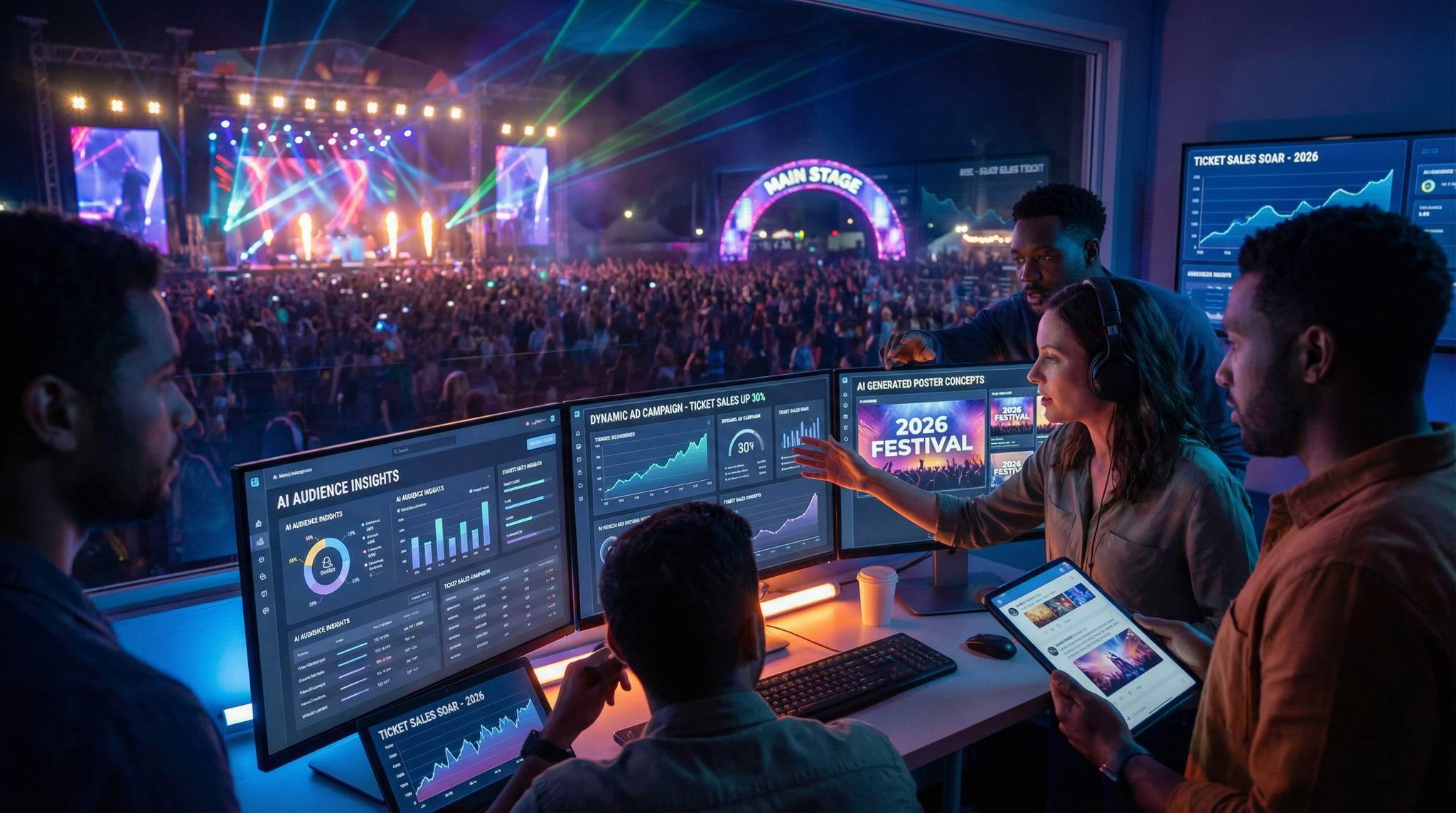
Who you target with your ads is just as critical as how those ads look. AI has revolutionized how event promoters find and segment their ideal audiences. In 2026, the leading ad platforms (Facebook/Meta, Google, TikTok, etc.) all incorporate machine learning to help identify likely ticket-buyers. One core tactic is the use of lookalike audiences, where an AI takes your existing customer data (say, list of past VIP ticket buyers or season pass holders) and analyzes hundreds of traits to find new people who “look” similar in behavior and interests. The days of manually plugging in demographics (25-40 year-olds, interests in “music festivals” and “EDM”) are fading; now you can feed a list of last year’s attendees into an AI model and let it build a highly sophisticated target profile automatically. The result is often a much more precise reach – the AI might discover patterns not obvious to humans (perhaps many of your buyers also follow a certain niche YouTube channel or tend to be frequent travelers, etc.) and use those signals to zero in on untapped potential attendees. Event marketers are also leveraging predictive modeling on their own datasets to segment audiences by purchase propensity. For example, by analyzing past events’ sales, an AI might score your email list or ad audiences on how likely each person is to buy a ticket in the next two weeks. You could then focus your ad spend on the top 20% of scorers for efficiency, or conversely, craft a special offer for the lower-scoring group to entice them. One festival marketing team found that attendees who heavily engaged with certain artists on Spotify were 3× more likely to buy early-bird tickets – insight uncovered by AI analyzing cross-platform data. For instance, knowing how the headliner announcement in January impacts sales allows for data-driven foresight. Armed with that, they specifically targeted ads and early access codes to those music fans first, leading to a faster sell-out of early birds. On the flip side, AI can flag low-engagement segments that might need extra nurturing – for instance, people who attended two years ago but haven’t interacted since might be slipping away, so you can hit them with a “We miss you – comeback for 2026!” campaign. This intelligent segmentation ensures you’re sending the right message to the right people, rather than blasting everyone with the same pitch. The outcome is a more efficient allocation of your marketing budget and often a higher conversion rate, because you’re focusing effort where the likelihood of buying is highest. As AI keeps learning from each campaign, these audience models continuously refine themselves. Many event organizers now see AI-driven targeting as indispensable – it’s like having a powerful data analyst on your team who never sleeps, constantly finding new pockets of potential attendees for you to fill your venue.
Automated Ad Bidding and Budget Allocation
Deciding how to spread your marketing budget across channels and ads used to involve a lot of guesswork and manual tweaking. Now, AI can handle much of the media buying optimization automatically, reacting in real time to performance data. All the major digital ad platforms offer AI-assisted (or fully automated) bidding strategies. For instance, Google Ads’ Smart Bidding and Meta’s Advantage+ campaigns use machine learning to adjust your bids for each ad auction to maximize the outcome you care about – whether it’s ticket purchase conversions, link clicks, or impressions among your target demographic. Instead of you having to monitor and tweak bids every day, the AI learns from each ad impression and conversion, and raises or lowers bids dynamically to get the best results for the lowest cost. If late-night users are more likely to buy tickets, the AI will bid higher for those eyeballs; if a certain audience segment is clicking but not buying, the algorithm will start to show them ads less often or bid lower for them. The result is often a significant reduction in wasted spend and an increase in return on ad spend (ROAS). One real-world example: a concert promoter used an automated campaign on Facebook/Instagram and saw the algorithm allocate more budget to Instagram Stories (after learning those were driving most ticket sales) and cut back on Facebook sidebar ads that were getting few conversions – all without the team having to manually intervene. Budget allocation across channels is also getting the AI treatment. Cross-platform tools can monitor where your sales are coming from – e.g. are Google search ads or TikTok videos producing more buyers this week? – and then suggest shifting more budget to the better-performing channel. Some advanced systems even do this automatically, essentially rebalancing your marketing mix on the fly. This agility is crucial, especially when promoting an event with a short sales cycle; you don’t want to realize too late that 80% of your buyers are coming from YouTube ads and you should have reallocated money there sooner. By entrusting the algorithms to continuously optimize bids and budgets, event marketers can ensure every dollar is working as hard as possible. As one veteran put it, “It’s like having a GPS for our marketing spend – the AI steers money toward the conversions in real time”. That said, humans aren’t completely off the hook – you still set the strategy (the AI needs to know if you value a VIP sale more than a GA sale, for example, or if you have a fixed budget cap). And it’s wise to sanity-check the AI’s choices occasionally; maybe you have inside knowledge (e.g. a particular channel is about to become more important due to a partnership) that the AI can’t predict. But overall, handing over the minute-by-minute bidding wars to machines is yielding fantastic results. Case in point: companies using AI for ad spend optimization have reported significant improvements like 22% higher marketing ROI and 47% better click-through rates, all while campaigns launch 75% faster due to automation, according to XtendedView’s AI in marketing statistics. It’s a classic win-win of doing more with less – more conversions and more free time now that you’re not living in the Ads Manager dashboard 24/7.
Predictive Analytics for Campaign Strategy
Beyond execution, AI is helping event marketers plot smarter overall strategies through predictive analytics. This involves using machine learning to forecast outcomes and guide big-picture decisions – essentially giving you a data-driven crystal ball. Imagine being able to answer questions like: “If we announce the headliner in January, what will that do to weekly ticket sales?” or “Which weeks are likely to be the slowest in our sales cycle so we can plan a promotion?” Predictive models can tackle these kinds of “what if” scenarios by analyzing historical sales patterns, social media trends, economic indicators, and more, assisting in forecasting ticket sales and demand. By 2026, many promoters won’t plan a major campaign without consulting some AI-derived insights. For example, an AI might examine your past events and notice that ticket sales consistently hit a lull about 6 weeks out from the event date – a common mid-campaign slump. Knowing this in advance, you can schedule a well-timed content drop or flash sale at that 6-week mark to maintain momentum. Another huge benefit of predictive analytics is the ability to detect regional differences. In one instance, a festival’s data indicated that interest tended to wane in late July, so the organizers preemptively scheduled a surprise lineup addition and merch giveaway in late July, which successfully kept sales flowing instead of dipping. Predictive analytics also helps with pricing strategy and inventory management. If the AI forecasts that your VIP tickets will sell out a month early (based on current velocity and past trends), you might decide to add more VIP perks or increase that allotment. Conversely, if it predicts the Tier 2 GA tickets are on pace to lag behind, you have time to devise a targeted promotion or value-add to boost those sales. Pricing tickets is as much art as science, and large events and venues have used AI to refine this. Essentially, AI crunches the numbers to tell you where the trajectory is headed, so you can course-correct in advance rather than reacting late. It’s like having a marketing barometer – if pressure is dropping (predicting slower sales ahead), you know to brace with extra marketing, and if it’s rising (sales likely to skyrocket), you can allocate resources to customer service or on-site prep for larger crowds. No model is 100% accurate (unexpected events or viral moments can always throw a curveball), but these forecasts significantly improve planning confidence. Nearly half of companies now use predictive analytics in marketing decisions. It’s like having a crystal ball for sales trends, as seen by early adopters in the event space, underscoring how essential anticipating customer behavior has become. For event organizers, this means fewer nasty surprises (“uh-oh, we’re tracking behind goal with only a month left!”) and more opportunities to proactively drive demand. If an AI model flags that your current campaign is predicted to fall 10% short of a sellout, you can take action early – maybe ramp up ads in a certain region or push a promo code via influencers – and change that outcome before it’s too late. In sum, predictive analytics turns data into actionable foresight, ensuring your marketing strategy is always one step ahead of the curve. (For a deeper dive on data-driven forecasting methods to complement AI, check out our guide on modern ticket sales forecasting techniques and how to leverage pace reports.)
Implementing AI in Your Event Marketing Workflow
Selecting the Right Tools and Platforms
The AI landscape for marketing is vast and continually evolving, so choosing the right tools is a critical first step. Start by identifying your specific pain points or opportunities. Do you struggle with pumping out enough social content? Is your team buried in data without time for analysis? Or maybe your ad budget isn’t yielding the ROI you want. There are AI solutions tailored to each of those issues – copy generators, analytics dashboards, ad optimizers, etc. It’s easy to get overwhelmed by shiny demos, so focus on the tools that directly solve your top challenges. For social and copywriting, popular options include OpenAI’s ChatGPT (accessible via user-friendly interfaces from providers like Jasper or Notion AI) and Copy.ai, which are great for text generation. For design, Midjourney or DALL·E can be integrated into your workflow (some have plugins for design software or even messaging apps to quickly iterate visuals). On the ad side, you largely rely on built-in AI from major platforms – for instance, Meta’s algorithms for targeting and bidding, or Google’s Performance Max campaigns – so take time to learn those platform features you might already be paying for. (Often, your ticketing or CRM platform may also have AI-powered insights baked in – for example, Ticket Fairy’s ticketing system offers predictive sales dashboards and customer scoring as part of its analytics. Many event pros don’t realize they can unlock a lot of AI power from tools they already use.) When evaluating new AI tools, consider integration and usability. Does the email AI tool plug into your email marketing software? Can the social AI connect to your scheduling platform? The goal is to seamlessly slot AI into your existing workflow. The good news is many AI services now offer APIs or integrations, so you can avoid siloed systems. Also, opt for user-friendly solutions especially for your team members who aren’t as tech-savvy – an AI that recommends email send times at the click of a button will see more adoption than one requiring coding knowledge. Don’t hesitate to ask vendors tough questions and request case studies relevant to events. Given how quickly AI products are sprouting up, peer recommendations and case studies can be invaluable to cut through the noise. Talk to fellow event organizers or read industry coverage to see which tools are actually delivering results. And always keep ROI in mind: many AI tools have subscription costs; weigh those against the potential benefit (e.g., if a tool costs $100/month but saves 20 hours of work or boosts ticket sales by 5%, it’s likely worth it). By carefully selecting an AI toolkit aligned with your needs, you set yourself up for smooth implementation and avoid the trap of chasing tech for tech’s sake.
Ensuring Human Oversight and Brand Consistency
Implementing AI doesn’t mean you can go on autopilot – human oversight is essential at every stage to ensure the technology truly serves your event’s goals. One immediate area to watch is content accuracy. Generative AI can sometimes produce incorrect or outdated information as if it were fact. Always have a person review AI-written copy for factual accuracy (dates, venues, artist names, pricing) before it goes out the door. It can be as simple as a marketer spending a few minutes verifying each AI-generated post or email. Similarly, maintain your event’s brand voice and tone. AI will write in a very generic style unless you train or prompt it otherwise. Develop a short brand voice guide (if you don’t have one already) and feed that into your prompts – e.g., “Draft an email in a playful, irreverent tone we use, and never use all-caps or salesy language.” Even with guidance, AI outputs might need tweaking to sound just right. Many experienced marketers use AI for the heavy lifting of generating ideas and rough drafts, then polish the final 10-20% themselves. This helps uncover angles they hadn’t considered while ensuring AI content must be refined by humans. This ensures the content feels human and aligns with the event’s personality. Another reason for oversight is error handling and edge cases. AI scheduling might occasionally propose a weird post time that doesn’t make sense (“3:47 AM? Really?”) due to an anomaly in data – you’d override that. Or an AI-designed image might inadvertently include some odd graphics or text (AI image generators are known to fumble text, often creating gibberish). When using AI for visuals, ensure you balance the creative team and the algorithm. You’ll want a designer to clean those up or decide not to use that particular output. Keep an eye on AI-driven interactions too: if you employ a chatbot to answer attendee questions, periodically review the logs to ensure it’s giving correct, helpful answers and not confusing people. The goal is to catch and correct AI missteps early before they impact your audience’s experience or your brand reputation. A useful approach is to run small tests – for instance, use AI content in a smaller email segment or a limited ad campaign initially, see the results and any feedback, then scale up. By being involved as a human editor and strategist, you can enjoy the massive efficiency and creativity gains of AI while avoiding its pitfalls. Remember, AI is like a super-smart intern: it works incredibly fast and can process tons of data, but it doesn’t have years of experience or common sense to always do the right thing. That’s where you, the event professional, provide the wisdom and final sign-off. This human-in-the-loop model will give you the best of both worlds – AI’s productivity with your seasoned judgment – leading to marketing campaigns that are both high-performing and true to your event’s brand.
Data Privacy, Security, and Ethical Considerations
As you integrate AI into marketing, it’s vital to address data privacy and ethics – both to comply with laws and to maintain attendee trust. Many AI-driven strategies involve personal data (like analyzing attendee behavior for targeting or personalization), which means you must handle that data responsibly. First, ensure that any consumer data you feed into AI tools (purchase history, email engagement, etc.) complies with regulations such as GDPR in Europe or CCPA in California, if applicable. Privacy by design is a good mantra: use data in aggregate and anonymized form where possible. For example, if you’re using an AI to find patterns in ticket buyers, you don’t need to feed it individuals’ names or addresses – you can use user IDs and purchase timestamps. Be especially cautious with AI services that require uploading your data to their servers (e.g., a cloud AI platform analyzing your CRM list). Scrutinize the privacy policy and security measures of any third-party AI tool. Reputable providers will encrypt data and not use your sensitive info to train their public models (you don’t want your attendee list ending up in some AI’s general knowledge). If an AI tool doesn’t clearly state how it handles your data, think twice.
Grow Your Events
Leverage referral marketing, social sharing incentives, and audience insights to sell more tickets.
Another aspect is AI-generated content ethics. Deepfakes and misinformation are hot-button issues; while event marketing use-cases are benign, we still have a responsibility to be transparent and truthful. If you use AI to generate an image or video that looks real, consider disclosing it or ensuring it can’t be misconstrued. For instance, using AI to simulate what a festival might look like is fine if it’s obvious or stated as a visualization – you wouldn’t want fans to think an AI-created crowd photo was a real past event if it wasn’t. Likewise, be careful not to inadvertently plagiarize or violate copyrights with AI outputs. While tools try to generate original content, there have been cases of AI regurgitating chunks of existing text or mimicking art too closely. Always review and, if needed, run AI-generated text through plagiarism checkers, and avoid prompting image AIs in ways that could produce trademarked logos or artwork. On the security front, treat AI accounts and APIs like any other sensitive access – use strong passwords and limit who on your team can invoke certain AI actions (you wouldn’t want an intern accidentally sending an unreviewed AI email to your entire database).
Finally, consider the ethical line between personalization and privacy intrusion. Just because AI can micro-target and personalize deeply doesn’t mean you should use every data point. Attendees might find it creepy if your message gets too specific about their behavior (“We noticed you skipped last year’s event – here’s a special offer to come back”). You can leverage AI insights more subtly, for example by segmenting and tailoring content in meaningful but not overly invasive ways (highlight what aligns with their interests without explicitly saying “we know you did X”). The best practice is to ask: would this marketing approach make our fans feel uncomfortable if they knew how it was done? If yes, dial it back. Being respectful with AI and data builds trust with your audience, which in the long run is crucial for converting first-time attendees into loyal fans. In summary, treat data privacy and ethics as core components of your AI strategy – get proper consent, secure your systems, and use AI in ways that enhance customer experience without crossing the line. This responsible approach not only protects your event from legal issues but also strengthens your brand’s reputation in an era where consumers value their digital privacy more than ever.
Team Training and Change Management
Adopting AI in your marketing workflow isn’t just a technology implementation – it’s a people implementation too. Your team may need training and mindset shifts to get the most out of these new tools. Start by involving your marketing staff early in the AI evaluation process. Show them demos, let them play with trial versions, and solicit their feedback. This helps demystify AI (“it’s here to help, not replace you”) and builds excitement rather than fear. Identify team members who can become AI champions or super-users – perhaps someone on your team is already curious about tools like ChatGPT in their personal life and would love to lead the charge. Give them the opportunity (and time) to become the go-to expert on, say, the AI email generator or the analytics dashboard, and then have them train others in short workshops or one-on-one sessions. Hands-on experience is the best teacher: consider running a low-stakes pilot project to let the team see AI in action. For example, challenge the team to use AI to produce next month’s social calendar or a batch of blog posts, and then review together what worked and what needed tweaking. Early wins will build confidence.
Also, set clear guidelines and roles around AI usage. The concern some staff may have is “Will AI make my job irrelevant?” It’s important to communicate that the goal is to augment their capabilities and free them from drudge work so they can focus on higher-level tasks. Make it explicit: perhaps writers now focus on strategy, story angles, and editing, while AI handles first drafts; designers curate style and brand fit, while AI pumps out variations to choose from. When everyone knows how AI fits into their job description, it feels less threatening and more empowering. Provide training not just on which buttons to click, but on how to craft good AI prompts (prompt engineering). For instance, show the team examples of mediocre AI outputs vs. great ones and discuss how the prompt or input data made the difference. Over time, your marketers will learn how to “speak AI” to get the results they want – this is a new skill worth cultivating. Encourage a culture of learning and experimentation: things are changing fast, and new features roll out frequently (e.g., a platform might suddenly add a new AI targeting option). Allocate time in team meetings to share any new tricks or insights discovered.
Lastly, prepare for change management challenges. Not everything will go perfectly from day one – maybe an AI tool initially produces awkward content, or a software integration hits a snag. Some team members might get frustrated and want to revert to the old way. It’s important to set expectations that there’s a learning curve and that it’s okay to find and fix flaws in the process. Celebrate both the successes (e.g. “AI helped us slash design turnaround time by 50% this month!”) and openly discuss the hiccups (“Our first chatbot attempt was confusing; let’s refine the script and training data and try again.”). By fostering patience and a problem-solving attitude, you’ll help the team gradually trust and rely on AI where it makes sense. One helpful approach is to measure and share impact: show how AI is reducing workload (hours saved) or improving results (higher engagement, more tickets sold). Seeing concrete benefits will turn skeptics into believers. In short, invest in your people as much as the technology – when your team understands, embraces, and feels in control of the AI tools, that’s when the magic truly happens.
Measuring Success and Continuous Improvement
Once you’ve woven AI into your event marketing, don’t just set it and forget it – measure its impact and extract learnings to continuously improve. Start by defining what success looks like for each AI initiative. For example, if you’re using AI for social media copy, you might measure success in terms of content output (did the volume of posts increase?), engagement metrics (did likes/shares/comments improve due to more frequent or better-timed posts?), or efficiency (hours of staff time saved). If implementing predictive analytics, track whether your sales forecasts became more accurate and how that translated into better decisions (e.g., “we avoided overspending on ads in week 4 because the model warned us sales would dip, and indeed they did!”). Establish baseline metrics before AI and then compare after a few cycles. Many teams create an internal dashboard for AI-related KPIs, which can include things like open rate lift from AI-personalized emails vs. prior generic emails, or ad CPA (cost per acquisition) trend since enabling automated bidding. Seeing the numbers will validate the investment – for instance, if your CPA drops by 15% after rolling out AI optimization, that’s a clear win for the budget.
Beyond metrics, conduct qualitative post-event tech audits focusing on your AI tools. For each major event or campaign, evaluate what the AI did well and where it struggled. Perhaps you notice the AI chatbot was great at handling common questions but failed when people asked multi-part or unusual questions – that’s an insight to refine its training before the next event. Or you might find that the AI predictive model overestimated final attendance because it couldn’t anticipate a last-minute viral tweet that boosted sales – a reminder to incorporate real-time social listening into your prediction process. By systematically reviewing performance, you ensure that learnings are captured and acted on rather than lost in the post-event rush. (For a broader template on extracting ROI and learnings from tech deployments, see our guide on conducting post-event tech audits for ROI – the same principles apply to AI projects.) If an AI tool isn’t pulling its weight, don’t be afraid to pivot or try competitors; the field is competitive and rapidly improving, so today’s limitation might be solved by a new feature or alternative product tomorrow.
Continuous improvement also means staying curious and updated. Assign someone to keep an eye on emerging AI trends in event marketing – for example, perhaps AI voice technology becomes useful for creating synthetic voiceovers for videos, or new regulations change what data you can feed AI. Regularly check industry publications (like Event Tech Brief or Event Manager Blog) and attend webinars or conference sessions on AI in marketing. Some of your future gains may come from adopting the next innovation early. However, temper excitement with pragmatism: avoid “shiny object syndrome” where you hop onto the latest AI tool without a clear need. Test your predictive models initially to see which tools actually deliver results. Evaluate new opportunities through the same ROI lens as before.
Finally, celebrate the wins with your team and stakeholders. When AI-driven strategies lead to a sold-out show or a 30% boost in merch sales via personalized recommendations, make sure everyone knows how those results were achieved. This not only gives credit where it’s due (both to the team for learning new tools and to the technology that delivered), but it also builds institutional support for further AI investment. Many marketing departments end up securing higher budgets or resources for AI projects after demonstrating clear success. In an era where, as one report noted, 83% of marketers say AI has increased their productivity. Those who embrace it as an assistant report significant gains, with statistics showing significant ROI improvements, proving its value in your own organization will ensure you can continue to expand and innovate. Measured, informed iteration is the name of the game – use each event as a chance to refine your AI-enhanced approach, and over time you’ll develop a powerful, well-oiled marketing machine that feels almost automatic in its ability to hit goals.
Real-World Success Stories of AI in Event Marketing
Case Study 1: Festival Boosts Ticket Sales with AI-Powered Campaign
A mid-sized music festival in Australia provides a shining example of AI’s ticket-selling power. In 2025, this 15,000-capacity festival integrated AI across its marketing and saw dramatic results. First, the team used an AI content generator to produce a large volume of social media posts and email content around their lineup announcements. What used to require a dedicated copywriter was largely handled by AI – the marketers simply fine-tuned the tone and scheduled the posts. This allowed the festival to increase social posting frequency by 3x (with consistent quality) in the crucial early announcement weeks. Second, they deployed AI-driven ad targeting. Using their past attendee data, they leveraged lookalike modeling on Facebook and identified a new audience segment of fans with similar music tastes who had never attended. AI also optimized their ad spend in real time: when data showed TikTok ads were driving cheaper conversions than Snapchat, the algorithm shifted budget accordingly. During the sales cycle, the festival’s team monitored a predictive sales dashboard (built with an AI analytics tool tied into their ticketing platform). Early warnings showed VIP ticket sales pacing behind previous years, so at the model’s suggestion, they quickly launched a targeted VIP upgrade campaign with personalized offers. By event week, VIP was sold out. Overall, the outcome was astounding – the festival achieved a 22% higher ROI on its ad spend compared to the previous year and sold out 10 days earlier than ever before. The marketing lead attributed this to AI’s efficiency: “We basically gained an extra pair of hands in the office – our output exploded.” Meanwhile, their hard costs didn’t – the AI tools (a combination of a copy generator subscription and using built-in ad platform AI) cost under $500/month, a fraction of what an agency or additional staff would have run. Perhaps most important, attendee surveys after the event showed increased engagement with the marketing content – people mentioned that they “kept seeing cool updates on Instagram” and “loved the personalized touches in emails,” indicating that AI helped the festival not only reach more eyeballs but connect more personally. This case demonstrates how, with a relatively modest investment and a willingness to trust AI guidance, an event grew its audience and revenue substantially. It’s a blueprint other independent festivals are now eager to follow.
Case Study 2: Conference Saves Time and Improves Engagement
Consider a large annual technology conference in the US that draws around 8,000 attendees. By 2026, the organizing team was juggling hundreds of sessions, sponsors, and updates – a marketing communications beast. They turned to AI primarily to tackle email and content personalization challenges. Using an AI writing assistant, the team was able to generate tailored email campaigns for different attendee segments in a snap. For example, they had variation emails for developers, C-suite executives, and investors, each highlighting relevant conference tracks and networking opportunities for those groups. In the past, crafting those segmented emails took their copywriter weeks of work; with AI, it took a couple of days to draft and then a day for the team to review and tweak for accuracy. The resulting open rates jumped about 28% year-over-year, because people were receiving information that felt curated just for them (a direct echo of industry stats on personalized emails’ superior performance). Another win was in their content marketing: the conference ran a blog and LinkedIn page where they’d publish speaker interviews, previews of talks, and daily recaps. They used AI to help generate blog outlines and social captions for this content. One marketer would feed the AI a transcript of a speaker Q&A, and get back a nicely structured blog draft with key insights distilled – something that previously took hours of writing now was done in minutes, requiring just light editing and adding a human touch. This allowed the team to publish more frequently, which in turn drove SEO benefits and kept the event high on Google search results for relevant tech topics. On social media, the conference’s hashtag trended locally each day of the event, partly due to the increased cadence of posts and rapid responses powered by AI-generated copy. Importantly, the conference also implemented an AI chatbot on their website to handle attendee FAQs (schedule queries, ticket transfer questions, COVID policy, etc.). Over the three months leading up to the event, the chatbot handled 7,000+ inquiries, many outside of business hours, and reduced the burden on the small customer service team by roughly 40%. One late-night anecdote: an attendee was on the fence about buying a last-minute ticket and used the site chat at 11 PM to ask about student pricing – the AI bot answered immediately and provided the link to purchase with the student discount applied, securing a sale that might have otherwise been lost waiting until morning. In terms of time savings, post-event the team estimated that AI tools saved at least 60-80 hours of staff time on content creation and query handling. That freed time was reinvested into higher-level strategy, like outreach to community partners and enhancing on-site experience, which further improved the event’s success. This case underlines how combining AI for both marketing content and customer engagement can elevate an event’s professionalism and outreach without requiring a big team or budget increase – it’s like getting an efficiency upgrade across the board.
Case Study 3: Nightclub Series Doubles Online Engagement with AI
AI isn’t just for massive events – even a regional nightlife promoter used it to upscale their marketing. A nightclub event series in Germany – weekly electronic music nights – wanted to grow its attendance and social media following in 2026. They employed a few clever AI-driven tactics to make their two-person marketing team punch well above its weight. First, they leaned heavily on AI-generated visuals to give their branding a consistent but dynamic aesthetic. Using Midjourney, the marketer generated a unique poster design for each week’s event (dozens of them) following a general theme (futuristic neon abstract art) that tied the series together. She would spend maybe 15 minutes tweaking prompts and got high-quality images to use in Facebook events, Instagram posts, and on the club’s website. This was crucial because they couldn’t afford a professional designer for every single event’s art – yet attendees commented that the visuals looked “super cool” and distinctive. Next, they used AI tools to schedule and localize social content. The promoter spoke both German and English audiences, so he used DeepL (an AI translator) to easily create bilingual posts and ads, ensuring the copy in each language felt natural. Engagement from German-speaking fans improved once posts were written natively rather than just in English. Additionally, he used an AI social media assistant which analyzed when their followers were most active (finding, for instance, that the target 18-25 crowd was very late-night active on weekends), and automatically scheduled posts around those peak times. The uplift in engagement was immediate – about 2× the average likes and comments per post compared to a few months prior, as content was both more eye-catching and better timed. The promoter also experimented with an AI-driven email personalization for their weekly newsletter, which highlighted upcoming DJs. The AI segmented subscribers by genre preference (techno vs. house vs. trance) based on their past ticket selections, and tailored the email content accordingly – recommending different opening acts or afterparties to different sub-groups. That nuanced approach led to a 24% increase in email click-throughs, as people were clicking the info that genuinely matched their interests. Over six months, the nightclub series saw attendance grow by roughly 30% on average nights – they started regularly hitting venue capacity. While quality of bookings and word-of-mouth were factors, the promoters credit AI-enhanced marketing for a lot of this growth: “We simply could produce more hype with the same team,” one of them noted. By automating repetitive tasks and amplifying their creative output, they built a vibrant online community around their events. This case highlights how even smaller-scale events can harness AI for very tangible benefits: a stronger brand presence, more engaged fans, and higher turnout – all without hiring extra hands. The bar for professional-looking, data-driven marketing has been effectively lowered (or raised, depending on perspective), enabling independent promoters to compete with larger players when it comes to digital buzz.