Embracing the Future While Honoring the Past
Evolving Expectations for Historic Venues
Modern audiences demand more from live venues in 2026 than ever before. Even century-old theaters and historic music halls are expected to deliver world-class sound, comfort, and technology on par with brand-new arenas. Attendees want crisp acoustics, unobstructed views, climate control, and seamless digital connectivity – all in buildings that might predate World War II. This creates a core challenge: how can a heritage venue meet 21st-century expectations without losing its soul? According to veteran venue managers, today’s fans “won’t tolerate peeling paint or crackling speakers just because a building is old” – beloved status only goes so far if the experience disappoints. At the same time, these historic spaces hold unique charm that modern black-box venues cannot replicate. The goal is to strike a balance where modern upgrades enhance the guest experience while the venue’s character remains intact.
Historic venues also face heightened competition. A post-pandemic reality is that many independent and legacy venues struggle to fill seats and coffers if they don’t adapt. In the UK, one in four late-night venues closed since 2020, underscoring how quickly iconic clubs can disappear. As discussed in strategies for turning your venue into a must-visit destination, fans have more entertainment options (including staying home streaming concerts), so heritage venues must work harder to offer something special. This means leveraging their storied reputations and offering modern conveniences. An Edwardian theater or 1930s jazz club can’t rely on nostalgia alone – it has to deliver an excellent night out by current standards. The message from industry veterans is clear: honour the past, but embrace innovations that secure the future.
Cultural Significance vs. Commercial Pressures
Every heritage venue carries cultural weight – from Art Deco cinemas to famed opera houses, these sites are living history. Communities feel a sense of ownership and pride in them. Shuttering or altering a historic venue can spark public outcry, as it represents loss of cultural heritage. Venue operators are thus stewards of tradition, tasked with preservation as much as presentation. However, they also face commercial realities. Aging buildings are expensive to maintain and often have lower capacities or higher overhead per seat, squeezing profit margins. A 1920s theater might only seat 800 where a modern hall of the same footprint seats 1,200 due to ornate layout and fixed balconies. Smaller capacity means fewer tickets to sell, even as maintenance costs climb. Revenue pressure can tempt shortcuts – like cramming in more standing room or hosting poorly fitting events – that risk damaging the venue’s reputation or fabric.
The key is to leverage the venue’s unique character as a competitive advantage. Heritage venues can brand themselves as destinations with history: the stage where famous legends performed, or an architectural gem that’s an experience in itself. This appeal can justify premium pricing or attract grants and sponsorships aimed at cultural preservation. Still, heritage appeal alone doesn’t pay the bills. Successful operators treat their historic venue like a startup that needs continuous innovation, just with an extra mandate to protect what makes it special. It’s a delicate dance between respecting tradition and staying financially viable. Many have learned that preserving heritage and pursuing profit aren’t mutually exclusive – when done thoughtfully, modernization can enhance the historic appeal (for example, elegant new seating can highlight an auditorium’s grandeur by inviting guests to linger comfortably in it).
Consequences of Falling Behind
Ignoring necessary upgrades isn’t a viable option. Over the past decades, the industry has seen painful examples of once-grand venues fading into disrepair and eventual closure due to deferred maintenance and unwillingness to change. “All the world’s a stage,” wrote Shakespeare, “but once-great stages are showing their age” – and an aging venue must confront either restoration or the wrecking ball. If management hopes that nostalgia will keep the doors open, they risk safety incidents, declining attendance, and mounting losses. A single electrical fire or structural failure in an old building can be catastrophic for human life and for the venue’s future. Even absent a crisis, fans and artists eventually flee venues that feel unsafe or outdated. Experienced operators have seen that deterioration accelerates once weekly crowds thin out – with less revenue for upkeep, problems compound until the venue can’t recover.
On the flip side, timely upgrades can be a lifeline. Venues that invest in modernization often see renewed interest from promoters and audiences. For example, a mid-century concert hall in New York underwent a $100+ million refurbishment and re-opened with a blockbuster season, its best attendance in years. Across the U.S., a number of mid-20th-century theaters have been renovated in the last decade – from Lincoln Center’s David Geffen Hall in NYC to the Alley Theatre in Houston – demonstrating the broad trend of rejuvenating aging venues rather than abandoning them. Simply put, future-proofing is survival. By addressing structural issues, outdated tech, and comfort gaps now, heritage venue operators can extend their lifespan by decades and avoid the fate of those beautiful but empty halls that exist only in archival photographs. In the sections that follow, we’ll explore how to modernize each aspect of a historic venue – step by step, with an experienced eye – so that these past glories continue to thrive well into the future.
Ready to Sell Tickets?
Create professional event pages with built-in payment processing, marketing tools, and real-time analytics.
Upgrading Infrastructure in Heritage Buildings
Modern Systems in Vintage Structures
One of the first challenges in future-proofing an older venue is bringing its core systems up to modern standards. Many historic theaters were built in an era before rock concert sound systems, high-powered stage lighting, or even air conditioning. As a result, their original electrical and mechanical systems are woefully inadequate for 2026 needs. Venue operators must often undertake major electrical overhauls – upgrading old wiring, adding new circuits and distribution panels, and increasing the power capacity to support today’s equipment. This can be daunting in a heritage building with plaster walls, narrow cable shafts, or limited access to run new conduit. The solution is careful planning and creative execution: using existing chases (like old pipe ducts or voids) to hide new cabling, or installing discreet surface conduits painted to blend with decor. In some cases, venues install a completely new electrical backbone separate from the old one, to avoid overloading ancient circuits. The goal is to ensure the venue can handle modern production loads safely, all while keeping the upgrades invisible to patrons’ eyes.
Another critical system is HVAC (heating, ventilation, and air conditioning). Dozens of historic theaters still have little to no air conditioning – something unimaginable for audience comfort today. Retrofitting HVAC into a vintage building requires ingenuity. Large modern air handlers and ductwork can’t just slice through a 19th-century facade. Instead, venues employ solutions like modular chillers on the roof or basement, with ducting run through attics, crawlspaces, or newly built vertical shafts tucked into corners of the structure. For example, when a 1920s movie palace in California was restored, engineers ran slim ductwork behind decorative friezes and used floor vents under seats to distribute air without marring the ornate ceiling. In climates where A/C is less critical, simply upgrading the heating system (often century-old boilers) and adding mechanical ventilation can vastly improve comfort. Additionally, modern control systems (smart thermostats, building management software) help regulate temperature and humidity precisely – extremely important in a heritage venue where uncontrolled humidity could damage delicate wood, plaster, or historical organs. Bringing climate control up to date not only makes guests and artists happier, it also protects the building itself by preventing moisture build-up and material deterioration.
Structural Reinforcement and Safety
Historic venues were constructed to the engineering standards of their time – which might mean unreinforced masonry walls, limited foundations, or roof trusses not engineered for heavy loads. Yet over the years, venues tend to accumulate extra weight: new lighting rigs hung from rafters, additional speakers, maybe a modern steel set piece bolted to an old proscenium arch. Structural stress can quietly build. A top priority for any modernization project is to evaluate the building’s structural capacity and reinforce it where needed. Bringing in a structural engineer experienced with theaters is wise. They might recommend adding steel bracing to support a sagging balcony, or reinforcing roof beams if you plan to suspend a large line-array sound system. Crucially, these interventions must be done with minimal impact on original architecture. Industry engineers note that structural solutions in heritage theaters should be as unobtrusive and reversible as possible, a perspective detailed in guides on keeping theatres performance-ready in 2026. For instance, rather than drilling into an 1880s brick wall to anchor a support (which would permanently damage historic fabric), engineers might design a custom clamp or framing that transfers load to the floor.
Safety upgrades go hand-in-hand with structural work. Many older venues need significant improvements to meet current building codes and life-safety standards. This includes installing or upgrading fire suppression systems (e.g. sprinklers and fire alarms), emergency lighting, and visible exit signage. These elements pose aesthetic challenges – modern exit signs and sprinkler heads can look jarringly new in a vintage interior. The solution is to seek out historically sensitive safety products. Some manufacturers offer decorative covers for sprinkler heads that can be painted to match a ceiling, or LED exit signs in antique brass fixtures that suit a 1920s lobby. The crucial point is not to compromise on safety while integrating it subtly. Remember, as much as we cherish heritage ambiance, nothing is more important than protecting patrons’ lives. Legendary venue operators often say that a well-run theater is one where every safety feature is robust yet “invisible” until needed. In practice, that might mean installing modern fire doors that are masked behind wooden cladding resembling the original doors, or placing emergency strobes in balcony corners out of direct sightlines.
Turn Fans Into Your Marketing Team
Ticket Fairy's built-in referral rewards system incentivizes attendees to share your event, delivering 15-25% sales boosts and 30x ROI vs paid ads.
One instructive case is a 1930s-era auditorium that underwent a major safety retrofit in 2025. Inspectors found the venue’s ancient electrical panel and cloth-insulated wiring posed a fire hazard – it simply could not handle the power draw of contemporary shows. The venue temporarily closed to rewire the entire building, a costly project, but one that likely averted a devastating fire. Today that theater boasts all-new electrics and a clean bill of safety, yet to the average visitor the only hint of change is the faint hum of new HVAC (instead of old clanking radiators). The lesson is clear: defer these upgrades at your peril. It’s far better to schedule structural and safety improvements during a planned dark period than to suffer an incident that forces an indefinite shutdown.
Preserving Character During Renovations
Infrastructure upgrades can require opening up walls, pulling down ceilings, or relocating long-standing fixtures – all of which can alarm preservationists and loyal patrons. The key is planning renovations with preservation principles in mind. Before any hammer swings, venue operators should consult with historical architects or conservation experts. Together, they can identify “no-go” elements that must be preserved untouched, and other areas where intervention is acceptable. Many historic venues create detailed design guidelines for their projects: for example, stipulating that new materials should be distinguishable from original ones (a tenet of many preservation charters), but complementary in appearance. This way, a visitor sees consistency, while future historians can tell what’s original vs. 2020s-era work.
Grow Your Events
Leverage referral marketing, social sharing incentives, and audience insights to sell more tickets.
A common best practice is reversibility – ensuring that any modern additions could be removed in the future without irreparable damage to the building. For instance, if you need to install a new steel support in a 1880s theater, you might bolt it into existing joints or floors rather than epoxy into old masonry, so it could be taken out if needed. In a similar vein, when adding a new tech booth or extending a balcony for better sightlines, use construction methods that minimize permanent change. One venue in Germany built an entire sound control room as a free-standing structure within the lobby, so that it touches the historic walls lightly and could one day be taken out if tastes or needs change.
Communication with the public is also vital. Longtime patrons and community members will be invested in any changes to “their” theater. Savvy operators hold community forums or behind-the-scenes tours before reopening, to explain and demystify the renovation efforts. Showing people, “Here’s how we tucked an air duct behind this stucco molding” can actually build appreciation for the craftsmanship of blending old and new. It also reassures fans that the venue’s soul remains intact. Many theaters document their renovations with photos and stories, effectively adding another chapter to the venue’s history that patrons can feel part of. By treating upgrades not as a loss of authenticity but as the next evolution in the venue’s story, you bring your audience along for the journey. After all, every historic venue was once brand-new and likely cutting-edge for its time – its original builders themselves embraced innovation. Today’s venue managers carry that torch, updating the space so it can continue to inspire for generations to come.
Sustainability Retrofits in Old Venues
In 2026, sustainability isn’t a luxury – it’s a necessity. Historic venues, often energy-guzzling and inefficient, have much to gain from green upgrades. Impressively, even century-old buildings can become eco-friendly without sacrificing character. A prime example is Central Hall Westminster – a historic 2,500-seat London venue – which retrofitted 900 light fixtures with LEDs and converted old gas systems to efficient electric, investing about £80,000. As detailed in reports on practical upgrades to cut carbon and costs, the result was a dramatic drop in power use and energy bills, proving that sustainability measures pay for themselves even in heritage sites. By 2026, many venues are swapping out aging incandescent stage lights for LED rigs that emit less heat (protecting delicate interiors) and consume a fraction of the electricity. Similarly, smart lighting controls can dim or turn off house lights in unused areas, further cutting energy waste.
Other eco-friendly improvements include installing low-flow plumbing fixtures in restrooms to save water, upgrading to high-efficiency boilers or heat pumps for climate control, and adding insulation in concealed spaces (like attics or under roofs) to improve temperature retention. Some historic theaters have even managed to integrate solar panels on rooftops or adjacent structures – carefully placed so they aren’t visible from the street or don’t alter the silhouette of a landmark building. These panels can offset a portion of the venue’s power needs with clean energy. In regions with incentives for carbon reduction, such upgrades open the door to grants and tax credits that help finance the work (more on funding later). An extreme but illuminating case is a 90-year-old university auditorium in Texas that achieved LEED Platinum certification after renovations in 2025, effectively reviving a historic building in a sustainable way. Architects preserved its 1933 exterior while overhauling internal systems for efficiency, replacing decades-old mechanical and electrical equipment. The building went from energy hog to sustainability poster child, all without losing its 1930s charm.
Data-Driven Event Marketing
Track ticket sales, demographics, marketing ROI, and social reach in real time. Exportable reports give you the insights to make smarter decisions.
Beyond technology, sustainability extends to operational practices: implementing recycling and compost programs, eliminating single-use plastics at the bar, or sourcing local food and beverage to reduce transport emissions. While these are “soft” changes, they resonate strongly with modern audiences. Eco-conscious fans actively support venues with green initiatives, and sponsors increasingly favor partnerships with venues that hit ESG (Environmental, Social, Governance) targets. Industry analysis shows that live event audiences in 2026 expect venues to adapt, and failing to reduce your footprint before signing sponsorship deals risks alienating fans and partners. For a heritage venue, playing up sustainability can refresh its image – showing that an old dog can learn new tricks and lead on contemporary values. It’s quite powerful when a building that opened under gaslight in the 1900s is now known for solar panels on the roof or an innovative zero-waste policy. This marriage of heritage and sustainability sends a message that the venue is not stuck in the past, but innovating for the future. And from a cost perspective, every watt or gallon saved is money back in the budget. Especially in Europe and parts of Asia where energy costs are high, cutting consumption through retrofits can significantly improve a venue’s financial stability. In short, greening a historic venue is win-win: good for the planet, good for public relations, and good for the bottom line.
| Challenge in Heritage Venue | Preservation-Minded Solution |
|---|---|
| Outdated electrical capacity (built for 1920s loads, not modern shows) | Upgrade wiring & power distribution using existing shafts or hidden runs. Add new circuits and breakers sized for contemporary sound/lighting, concealing cables behind moldings to maintain aesthetics. |
| No air conditioning or old heating systems | Install modular HVAC units in unobtrusive areas (roof or basement). Run slim ductwork through attics or under seats. Retain facade by using small vents and camouflaged grilles that blend with decor. |
| Poor accessibility (stairs-only access, limited disabled facilities) | Add elevators or lifts in secondary spaces that don’t alter primary architecture (e.g. a discreet side addition for an elevator). Incorporate ramps with complementary design, and retrofit at least one accessible restroom per floor. |
| Subpar acoustics (echoes, dead spots due to original design) | Install acoustic panels and diffusers finished to match interior surfaces. Hang sound reflectors (“acoustic clouds”) high above the stage, styled to blend with the ceiling. Use modern line-array speakers calibrated to fill coverage gaps without altering architectural elements. |
| Fire safety compliance (no sprinklers, old exits) | Integrate sprinkler heads with decorative covers that make them inconspicuous. Mount exit signs in custom housings (wood or brass) fitting the venue’s era. Upgrade emergency lighting with LED fixtures small enough to hide in cornices or behind balcony fronts. |
Integrating Cutting-Edge Technology with Classic Architecture
Audio and Acoustics Upgrades
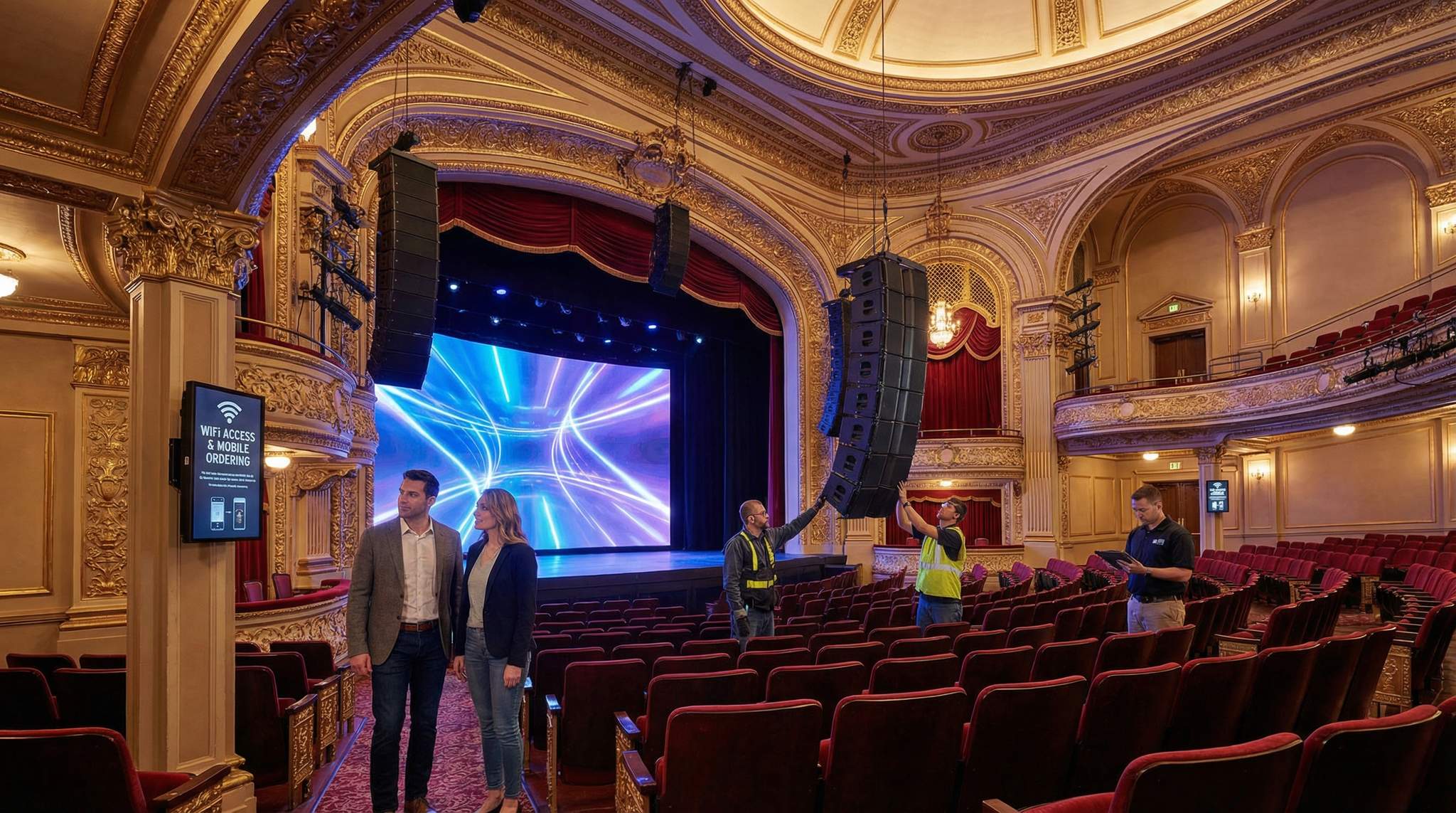
In any entertainment venue, sound is king. But many heritage venues were built before amplified music – their acoustics were designed for unamplified orchestras or early acoustic sound. Some older halls have notorious echo or “dead spots” where sound doesn’t carry well. Modernizing a historic venue means tackling these acoustic challenges head-on, using today’s technology in harmony with yesterday’s design. A common approach is to deploy adaptive sound systems: for example, hanging an array of compact line-array speakers that can be digitally tuned to the room’s acoustics. Unlike the giant speaker stacks of the past, modern line arrays are relatively slim and can be painted or covered to blend into a proscenium arch or flanking walls. Audio engineers can program such systems so that every seat from the stalls to the upper gallery gets balanced sound, compensating for odd corners or overhanging balconies. As one 2026 venues guide notes, achieving great sound in a difficult space often comes down to using advanced calibration tools and strategic use of acoustic treatments. Soft materials like upholstered panels, heavy curtains, and even specially designed wood diffusors can be added in unobtrusive spots to absorb echo and smooth out harsh reflections.
For instance, the famed Sydney Opera House Concert Hall – itself a heritage icon of the 1970s – recently underwent a massive acoustical upgrade. The project installed state-of-the-art acoustic reflectors (visually resembling the original design) and an in-house digital sound system that can adjust output for classical vs. rock performances. The result was dramatically improved clarity for both artists and audiences. Crucially, they achieved this without significant visual change to the hall’s interior, proving that sound enhancements need not clash with heritage aesthetics. In older theaters with historical ceilings, a tried-and-true method is hanging acoustic “clouds” – panels suspended above the audience – carefully color-matched or shaped to complement ceiling artwork. These panels tame echoes and can even add visual interest that looks period-appropriate (some venues commission artists to paint the undersides so they double as art).
Experienced operators also understand that sound upgrades must consider the building’s limits. Pumping thunderous bass into a Victorian theater could rattle plaster off the walls if not managed. That’s why many heritage venues implementing new PA systems also invest in structural damping – for example, reinforcing balcony fronts to prevent vibration. Additionally, noise isolation might be needed; older walls leak sound, and you don’t want to disturb neighbors or other parts of the building. Solutions include installing acoustical door seals, adding secondary glazing to windows, or building a “room within a room” for loud rehearsal spaces. The good news is that modern audio gear is more powerful yet lighter and more compact than older equipment. An array of small digital amplifiers can replace racks of heavy analog amps, reducing weight on floors. By smartly integrating acoustical science and sound technology, heritage venues can offer audio experiences that rival any contemporary venue. In fact, when done right, audiences might simply remark that the band sounded amazing tonight, never realizing how much tech wizardry is hidden in plain sight.
Lighting and Visual Effects in Heritage Spaces
Just as audio has evolved, so have stage lighting and visual production elements – and historic venues must adapt to stay competitive. Modern concerts and shows use dynamic LED lighting, lasers, video walls, and projection mapping to create immersive visual experiences. However, older venues have to deploy these tools carefully. Ceilings may be low or protected by artistic plasterwork, limiting where moving lights can be rigged. Walls may lack mounting points for giant LED screens. Despite these constraints, innovative workarounds abound. Many theaters now use ground-supported lighting towers or portable truss systems that can be set up for a show and removed after, avoiding bolting into heritage ceilings. LED Wall and projection mapping technology is a game changer here – instead of physically altering a building, you can project visuals onto surfaces (even the venue’s own architecture) to transform the space during shows. As seen when the Sydney Opera House reopened its newly renovated Concert Hall, historic facades and interiors have been used as breathtaking projection surfaces, turning pillars and prosceniums into part of the storytelling without a single nail driven.
A major trend is replacing old theatrical lighting (incandescent lekos, PAR cans, etc.) with modern LED stage lights. LED fixtures produce far less heat – crucial for preserving delicate interiors and keeping audience areas cooler – and offer infinite color mixing without the need for gels. In a 1920s heritage theater in Chicago, for example, all 120 of its old stage lights were swapped for LEDs in 2024. The lighting designer noted two benefits: the new system drew 60% less power, and the reduced heat helped protect the ornate ceiling murals that had been deteriorating from decades of high heat and rising hot air. Moreover, LEDs often fit existing light positions and can be controlled by digital consoles that tie into modern show control networks. Venues should invest in a DMX infrastructure (standard for lighting control) if they haven’t already – essentially running data cables or wireless control so that any visiting production can plug into the house system easily. It’s possible to do this unobtrusively, such as running cables along existing conduits or behind crown moldings.
For visual displays, many historic venues opt for portable screens or roll-down projection screens that can be deployed when needed. For instance, a classical concert hall might hide an ultra-short-throw projector in the balcony, only to be used during a multimedia event, then tucked away. If LED video walls are needed (common for conferences or pop shows), they can sometimes be hung from temporary rigs or placed on stage in a free-standing manner. The principle is: introduce transformative tech when needed, but remove it when not, leaving the venue’s classic look undisturbed for other events. Some venues have even started to install floor-based lighting (LED strips along aisles or under steps) to add ambience and assist audience movement without altering historic chandeliers or sconces. These additions can often run on battery or low-voltage systems that don’t require heavy wiring.
Finally, don’t overlook the importance of the house lighting in preserving atmosphere. Dazzling stage effects aside, the moments before a show and during intermission are when the building itself should shine. Upgrading the auditorium house lights – for example, using warm-tone LED bulbs in chandelier replicas or programming slow fades that show off the venue’s architecture – can heighten the audience’s appreciation of the historic space. One London theater cleverly installed programmable LED uplights around its architectural columns; before shows, they subtly change colors to highlight the ornate carvings, basically giving a pre-show light exhibition of the venue itself. It’s a wonderful blend of old and new: 19th-century design enhanced by 21st-century lighting, creating an immersive experience that celebrates the venue.
Digital Connectivity and IT Infrastructure
It’s easy to focus on the stage and forget about what every guest carries in their pocket – a smartphone. Modern audiences expect to be connected at all times, even in thick-walled historic buildings. That means robust Wi-Fi, strong cell signal, and digital conveniences like mobile ticketing need to be supported. However, many heritage venues literally have “old school” infrastructure – perhaps a patchy DSL internet line, no dedicated IT closet, and construction materials (like stone or plaster) that block wireless signals. Upgrading this is a less glamorous but vital part of future-proofing. Venue operators should install a modern IT backbone: high-speed internet (fiber if available), enterprise-grade network switches, and a mesh of Wi-Fi access points covering front-of-house and back-of-house areas. The trick is mounting Wi-Fi antennas discreetly – for instance, inside fake smoke detectors on the ceiling, or blending into light fixtures. In some European opera houses, restorers have hidden wireless APs behind balcony ornamentation, proving you can boost bandwidth without visual clutter.
Why focus so much on connectivity? Because it unlocks a world of digital services and new revenue streams. With solid internet, venues can implement mobile point-of-sale systems at bars (speeding up concessions as noted in modern POS guides for performance readiness), offer event apps for audience engagement, and support live-streaming or interactive elements of shows. Importantly, modern ticketing systems like Ticket Fairy rely on internet connectivity for scanning e-tickets and managing real-time sales data. An outage during a show could mean long entry lines or inability to process credit cards at the bar. Thus, investing in IT resilience – including backup 4G/5G routers for redundancy – is just as critical as maintaining the physical structure. We’ve entered an era where cybersecurity and data protection are also concerns for venues; older operations might have few digital systems, but as you modernize (online ticketing, customer Wi-Fi, IoT devices like smart thermostats and cameras), you must secure them. Many 2026 venue operators are installing network firewalls and segmenting their networks to keep sensitive systems (like payment processing or backend databases) separate from public Wi-Fi, a practice that aligns with elevating venue accessibility and security standards and ensuring guests can enjoy the show fully and safely. This protects customer data and prevents a hacker from, say, hijacking your marquee display through the internet – an admittedly rare but not impossible scenario in today’s connected world.
Another aspect of digital integration is event and building management software. Modern venues increasingly use specialized venue management platforms to handle everything from scheduling and artist contracts to maintenance tickets and staff rostering. A heritage venue can greatly benefit from these tools; for example, using a digital maintenance log to track when that 1940s-era chandelier was last inspected or which seats often break and need replacement. The data-driven insights can optimize operations and flag issues early. AI-powered venue management systems are also emerging that can, for instance, predict when an aging HVAC unit might fail based on sensor data, moving from automation to prediction in event management. Installing IoT sensors on critical equipment (pumps, electrical panels, roof beams for stress) can give early warnings of issues – a smart strategy when working with older infrastructure that might be prone to problems. As discussed in guides to AI in venue operations, these predictive maintenance tools help avoid sudden breakdowns and costly emergencies by addressing technical demands proactively and managing equipment that has become heavier and more dynamic. For an older venue with legacy equipment, that’s a game-changer.
In summary, upgrading a heritage venue’s tech isn’t just about fancy show production; it’s also about behind-the-scenes connectivity and intelligence. By investing in invisible infrastructure like networks, software, and sensors, you empower your classic venue to run as smoothly as any cutting-edge facility. It allows you to deliver modern conveniences – from letting guests Instagram your beautiful architecture in real-time on fast Wi-Fi, to analyzing which acts bring the most bar sales via your new POS. This fusion of old and new ensures the venue remains relevant and efficient in an increasingly digital world.
Smart Venue Management and AI Tools
The year is 2026, and even century-old venues are getting smarter. AI-powered tools and automation are no longer reserved for ultra-modern stadiums; they’re being retrofitted into historic venues to boost efficiency and enhance patron experience. Consider staffing and crowd management: modern software can analyze ticket sales and historical attendance patterns to suggest optimal staffing levels for each event, something that seasoned managers used to do by feel. Now, an AI system might automatically schedule extra ushers on nights when it predicts lots of first-time attendees (who may need more assistance finding seats), or flag that a popular artist’s show is trending towards more walk-up ticket sales and thus needs beefed-up box office staffing. These insights help an under-resourced heritage venue do more with less, cutting costs without cutting service, a key benefit of evaluating event management platforms and ROI. In fact, many forward-thinking venues use AI-driven scheduling and resource management to ensure every dollar of payroll or maintenance counts, effectively juggling hundreds of tasks with AI solutions.
Another area is energy management. Smart building systems can learn the usage patterns of your venue – for instance, that the lobby only needs full lighting an hour before doors and for 30 minutes after show start, or that the upstairs bar fridge can be cycled off on Mondays when the venue is dark. By automating these actions, venues have saved significant amounts on utilities. One historic concert hall installed AI-based climate control that tweaks the HVAC in real-time based on occupancy and even weather forecasts, all while keeping temperature within conservation-safe ranges for the antique wooden stage. The result was not just lower energy bills but also more stable humidity, benefiting both patrons and the building’s preservation. IoT sensors placed around the venue (measuring temperature, foot traffic, equipment performance) feed data to a central system, which uses machine learning to optimize operations. It’s like giving a 100-year-old building a digital brain.
Then there’s the front-of-house experience: AI chatbots and voice assistants are being deployed to handle common guest queries (from show timings to historical facts about the venue), freeing up staff and adding a high-tech touch to visitor engagement. Imagine a patron in a 1890s theater using their smartphone to ask an AI concierge, “Where is the nearest restroom?” or “Tell me about the architect of this theater,” and getting instant answers. These are not far-fetched scenarios; they’re happening now as venues leverage modern customer engagement tech to transform event operations beyond simple chatbots. Importantly, this is done without replacing the human touch that is often integral to a heritage venue’s charm – instead, it augments it, allowing staff to focus on complex tasks while AI handles FAQs.
Security is yet another domain seeing AI integration. Historic venues can maintain a light security presence aesthetically (no one wants airport-style checkpoints in a 18th-century opera house), yet use advanced tech behind the scenes. For example, AI-powered camera systems can monitor crowd density and detect unusual movements or overcrowding, alerting staff to potential issues before they become problems, a crucial aspect of elevating venue accessibility and inclusion. Similarly, facial recognition or RFID scanning can expedite entry for known guests or VIPs, reducing visible queues and crowding at the door. As noted in industry discussions on trends in entertainment venue management, these technologies are replacing traditional metal detectors and manual checks. While any use of such tech should be balanced with privacy considerations and local regulations, the trend is clear: smart systems can keep heritage venues safer and more efficient without needing a visible army of guards or intrusive measures that would detract from the ambiance, ensuring smooth routes from curb to seat.
In essence, smart venue management is the quiet revolution enabling grand old venues to operate at 2026 standards behind the scenes. A Victorian theater might still use the original brass door handles and gaslight-era decor, but now its managers carry a tablet showing real-time data on ticket scans, bar sales, and building systems status. This convergence of AI and automation with the human expertise of venue staff leads to the best of both worlds – the intuition and experience of seasoned operators amplified by the precision and predictive power of technology. Heritage venues that adopt these tools position themselves to compete with slick new venues on efficiency and service, all while retaining the historic allure that sets them apart. As one industry veteran put it, “We use every modern tool to care for this old theater – it deserves no less.”
Enhancing Audience Comfort and Amenities
Seating, Sightlines, and Comfort
Many heritage venues were built in an era when people were, frankly, smaller (and perhaps more patient). Narrow wooden seats, minimal legroom, and pillars blocking views are common complaints in older theaters. To remain viable in 2026, historic venues must address audience comfort head-on. Upgrading seating is usually priority one; it’s a big capital expense but pays off immediately in customer satisfaction. The trick is to install new seats that are more ergonomic and spacious yet suit the venue’s aesthetics. For example, a 1910 theater might replace its threadbare velvet chairs with new replicas that have the same style but use modern cushioning and durable fabric. Often, seat manufacturers can custom-build seats to fit historic requirements, such as matching an original wood armrest design or fitting into curved rows. Some venues take the opportunity to slightly re-rake the seating or adjust row spacing if building codes allow, to gain a bit more legroom and better sightlines. Removing a few seats might be worth it if the remaining seats get a clear view and higher patron approval (plus, you can sometimes increase ticket prices for improved comfort seating). In any case, today’s audiences expect plush, roomy seats and unobstructed views, and even a 200-year-old opera house must deliver that as best it can.
One notable challenge is the infamous sightline-obstructing pillar found in many old theaters and music halls (used back then to support balconies). While you can’t exactly remove a load-bearing column without major reconstruction, venues have found ways to mitigate the issue. Some use clever seating arrangements – for instance, not selling a seat directly behind a pillar, or using that space for decorative elements or lighting instead. Others install high-definition screens in the balcony or upper tiers, so that any view-blocked seats at least have a live video feed of the stage. It’s not as good as direct view, but it’s something. Modern camera equipment and low-latency streaming can make this a seamless extension of the live experience. Meanwhile, balcony fronts that were originally low (causing shorter patrons to lose the view) can sometimes be modified by adding clear glass extensions – preserving the historic balcony appearance but effectively raising the railing transparently.
Comfort extends beyond seating. Audience flow and crowding can be issues in old layouts with narrow corridors and stairwells. Many operators look at their venue from the guest’s perspective: is it easy to find your seat? Are you jostling in an undersized lobby at intermission? Simple fixes can help, like removing or relocating some fixtures to widen paths, adding signage for clarity, and training staff to manage bottlenecks proactively. Some venues have reconfigured their entryways or knocked down a non-historic wall or two to create a more spacious foyer. Any such changes should be planned with an architect well-versed in preservation – the goal is often to “restore” original openness that might have been compromised by later alterations. For example, a theater discovered that a partition wall creating a tiny lobby wasn’t original but added in the 1970s; by removing it, they actually returned the space closer to its 1920 design and got a bigger lobby in the process.
Climate comfort is another facet – if your venue is stuffy or freezing, comfy seats won’t matter. We covered HVAC upgrades earlier; from the audience standpoint, the venue should now maintain a pleasant temperature year-round. Additionally, consider noise comfort: creaky old seats, loud AC blowers, or street noise seeping in due to thin windows can disrupt shows. Many renovations include soundproofing measures like new door seals, double-paned windows, or isolating the auditorium from the lobby with a second set of doors (while maintaining the historic look of the entry). Patrons often won’t notice these improvements consciously, but the show experience will feel smoother and more immersive without those irritations.
Lastly, accessibility seating is a vital component of comfort – not just for those with disabilities, but their companions and indeed everyone who benefits from a more inclusive layout. Older venues might historically have had no wheelchair spaces or only a token spot at the very back. Modern standards and decency require integrating accessible seating in various sections so disabled patrons can enjoy different views and price points. This might mean removing a few seats here and there to create spaces for wheelchairs and companion chairs. Yes, it reduces capacity slightly, but it’s non-negotiable in this era (and often legally mandated by building codes or access laws). By doing so thoughtfully – perhaps disguising the removed seats with a matching carpeted platform when not in use – the venue maintains its look and ensures all guests are comfortable. When a patron using a wheelchair can roll into a gorgeous 100-year-old theater and sit with their friends in an optimal viewing area, it’s a sign that management truly balanced past and future.
Modern Concessions and Facilities
Heritage venues are not usually known for their bathrooms and bars – many still sport cramped 1950s restrooms or a tiny concession stand that was retrofitted into a corner. Upgrading these facilities can massively improve overall guest satisfaction and spending, thus boosting revenue. Start with restrooms: if women are facing 20-minute intermission queues at your historic theater, it’s time to add capacity. Often this means creative use of space – perhaps converting some seldom-used storage room adjacent to existing restrooms into additional stalls, or reconfiguring the layout with modern compact fixtures. Increasing restroom facilities (especially women’s and accessible toilets) is very often a top recommendation in venue improvement plans. Patrons notice when you’ve modernized the loos with touchless faucets, decent lighting, and faster hand dryers, even if it doesn’t have the glam of a chandelier. A pro tip is to maintain a bit of period style in these updates – e.g., incorporate vintage tile patterns or antique-look mirrors – so the restrooms still feel like part of the venue’s charm, just refreshingly functional now.
Moving to concessions: Many older venues underutilize their food and beverage potential, often due to physical constraints. A single small bar might have served 500 patrons back in the day when choices were limited to maybe beer and soda. But in 2026, audiences expect a variety of drinks (including craft cocktails, espresso, non-alcoholic options) and maybe gourmet snacks or merch, all available with minimal wait. If your venue doesn’t have space for a full kitchen or multiple bars, consider pop-up solutions and efficient tech. Mobile bar carts can serve specialty drinks in the lobby or even roam with pre-batched cocktails. POS systems that are modern (like tablet-based registers or self-order kiosks) can speed up transactions, cutting those endless waits in heritage venue bars, a point emphasized in structural engineering perspectives on venue readiness. Accepting mobile payments and even enabling pre-orders via a venue app (so a drink is ready for pick-up at intermission) are strategies some historic venues have adopted to great success. It’s all about making intermissions and pre-show enjoyable rather than a mad dash.
If structural changes are possible, expanding the lobby or bar areas is worth exploring. Some theaters have enclosed an open side porch to create a new indoor bar, or excavated a small basement museum or speakeasy-themed lounge, turning previously unused space into revenue-generating hospitality area. Of course, any construction must tread lightly on historic elements, but often there are nooks and crannies that can be repurposed. Don’t forget merchandise: if artists are playing your stage, they’ll want a place to sell merch. Setting up a designated merch kiosk or wall in the lobby (with good lighting and a power source) can increase per-capita spending. Even better if you integrate it with your point-of-sale so that inventory and sales are tracked, and let fans use contactless payments rather than cash-only. These modern touches show that, while the venue may be old, it’s not stuck in the past when it comes to service.
Lastly, think about amenities like lounges or VIP areas. In the past, a theater might not have had a VIP section, but creating one now (tastefully) could attract premium patrons and rentals. For example, converting an old manager’s office or projection booth into a 20-person VIP room with a private bar can open up new hospitality offerings. In one case, a historic concert hall turned its former organ loft (no longer in use) into a VIP gallery with cocktail tables, giving a unique overhead view of the stage. This kind of repurposing maintains the venue’s legacy (the organ pipes remain as decor) while adding contemporary value. The overarching principle is: meet modern hospitality standards wherever feasible – because a comfortable, well-served patron is more likely to return, whether the venue is 5 years old or 105.
Climate Control and Ventilation
Climate control is such a vital aspect of comfort that it merits its own focus. As touched on earlier, many heritage venues were built without air conditioning (and sometimes with minimal heating). If you’ve ever sat in a packed old theater on a summer evening, you know how unpleasant it can get – the air turns warm and stale, and audience members start fanning themselves with programs. Conversely, in winter, drafty historic halls can be chilly if the heating is uneven. Modernizing climate control is therefore a huge win for audience comfort. We discussed the technical means (installing HVAC systems carefully), but from an audience perspective, the outcome should be that the indoor climate feels just right every time. Achieving this in a finicky old building might involve some trial and error, and smart use of technology like zoned temperature control. Many venues now have digital thermostats and sensors in different sections (stalls, balcony, backstage) to monitor conditions. This addresses a classic problem: heat rises. A balcony can become a sauna while the main floor is just comfortable. By zoning and perhaps installing additional fan systems or dampers to control airflow, you can balance that out.
Ventilation is equally important. Fresh air circulation not only keeps odors at bay (some old theaters unfondly smelled of mildew or decades of cigarette smoke in the upholstery) but is also highlighted by post-COVID health expectations. Audiences want to know a venue has good airflow to reduce stuffiness and germs. If you’ve upgraded HVAC, ensure it includes adequate fresh air intake and that filters are high-grade (and changed often). Patrons likely won’t see your new air handling unit, but they will feel the difference when the room doesn’t have that claustrophobic stuffiness at the end of the night. A well-ventilated auditorium also preserves the building by preventing moisture buildup and rot – a hidden benefit that keeps plaster and woodwork in better shape. Some venues have installed quiet circulation fans in the ceiling or behind architectural grates to keep air moving subtly even during performances, without a loud blower noise. The audience shouldn’t notice these systems, just the comfort they provide.
There’s also the issue of acoustic impact: older HVAC, when retrofitted, sometimes introduced an annoying hum or rumble. Modernizing means choosing low-noise equipment and possibly adding sound dampeners in ducts. During a silent moment in a play, you don’t want the audience to hear the A/C kick on with a clunk. Therefore, part of enhancing comfort is ensuring climate systems are felt, not heard. One trick venue managers use is timing – aggressively cooling or heating the house before audience arrival and during breaks, then running systems at lower, quieter settings during performances. Advanced control systems can automate this, maintaining comfort ranges while minimizing noise.
Finally, communicate these improvements to your patrons subtly. Some venues put a note in the program or an announcement: “Welcome to our newly climate-controlled theater!” This sets expectations and also signals that you’ve invested in their comfort. It can even become a marketing point in heat waves or cold snaps – “Beat the heat in our air-conditioned historic hall!” – which might not have been feasible a few decades ago. When a 1920s venue that was historically sweltering in summer suddenly is a cool oasis, that news spreads by word of mouth. The confluence of historic atmosphere and modern comfort makes for a compelling combination that audiences truly appreciate.
Preserving Ambience in Upgraded Spaces
While we pursue all these comfort upgrades – seats, climate, facilities – there’s an overarching concern: maintaining the special ambience that drew people to the venue in the first place. A heritage venue’s atmosphere is its magic. So every modernization choice should consider: does this preserve or enhance our vibe? The goal is to avoid the “museum effect” or the opposite, a discordant mix of ultra-modern elements in a classic setting. One guiding practice is to retain as many original interior features as possible, even if you’re modernizing around them. For instance, if you are renovating the lobby bar, you might keep the original bar back or mirror and design the new service counter to harmonize with it. In auditorium seating upgrades, perhaps salvage and reinstall the beautiful old aisle end standards (the ornate caps on the row ends) on the new seats. These kinds of touches keep the visible heritage in play, so guests still feel like they’re stepping back in time, even though the seat they’re in is brand new and comfy.
Lighting plays a huge role in ambience. We talked about technical stage and house lighting, but more broadly, one should evaluate the warmth and tone of the venue’s lighting post-upgrade. LED lights tend to be cooler by default, but by choosing warm color temperatures for house lighting and using dimmers, you can mimic the cozy glow of incandescent bulbs that many associate with vintage theaters. Several historic music clubs that installed new LED stage lights actually put vintage-style filament LED bulbs in their chandeliers and sconces so the public areas still have that old-time warmth. Sound is the other factor – modern sound should be clear, but you don’t want it to be clinical. A bit of the natural reverb of an old hall gives it character. Thus, acoustical treatments should be tuned to not deaden the room completely. Acoustic consultants often aim for a balance where speech is intelligible and music is full-bodied, yet the room’s unique reverb tail (maybe a 1-2 second decay in a concert hall) is preserved just enough to remind us we’re in a historic space and not a recording studio.
Sometimes preserving ambience means making tough choices not to install something. For example, many modern venues have jumbotrons or extensive digital signage. In a heritage venue, a plethora of LCD screens in the lobby could feel out of place. You might opt instead for minimal screens or hide them in period-looking frames. One elegant solution seen in a 19th-century opera house was to use projected signage – they projected the program schedule onto a wall with a sepia-toned overlay, so it looked old-fashioned yet was dynamically updateable. It’s all about being creative to keep the visual noise low. Similarly, when implementing security measures like metal detectors or bag checks, think about how to do it without destroying the ambience the moment patrons walk in. Some venues use portable screening devices brought out only during entry and then whisked away, rather than permanent airport-style gates. Others have security staff in formal attire blending with the venue’s style, instead of high-visibility vests that would be jarring in an ornate foyer. These details matter for ambience.
Finally, consider scents and sounds of the venue beyond performances. Old venues sometimes have a distinct smell – some of that can be good (the smell of aged wood seats) and some bad (mustiness). Deep cleaning carpets or adding subtle air freshening (perhaps a signature scent) can ensure there are no unpleasant sensory surprises. Background music in lobbies can also set the tone: maybe some era-appropriate gentle music as people enter, rather than dead silence or a blaring modern playlist. The holistic sensory experience is what creates that irreplaceable ambience. So, as you modernize, walk through your venue in the patrons’ shoes: Does it still feel special? If the answer is yes – the awe of the architecture hits them, coupled with comfort they didn’t expect – then you’ve achieved the balance. You’ve future-proofed the past without losing its essence.
| Aspect | Historic Venue | Modern Purpose-Built Venue |
|---|---|---|
| Acoustics | Rich natural reverberation but may have echo or dead spots; requires retrofits (panels, reflectors) to optimize sound distribution | Designed with acoustics in mind from day one, often needs minimal treatment; predictable sound coverage by design |
| Infrastructure | Original electrical, plumbing, and HVAC often undersized or outdated; upgrades must be woven into existing structure carefully | Equipped with state-of-the-art systems (high-capacity power, advanced HVAC) built into construction; easier to maintain initially |
| Accessibility | Likely built with many stairs and no lifts; requires creative retrofitting (elevators, ramps) to meet modern accessibility standards | Fully accessible by design (elevators, ramps, wide corridors) meeting ADA/equivalent codes from the start |
| Character & Atmosphere | Unique ambiance, architectural beauty, and historical significance that create an emotional connection | Clean slate design offers flexibility, but often lacks the “soul” or heritage feel until a legacy is built over time |
| Operational Costs | Higher ongoing maintenance due to age (restoration, specialized repairs); energy efficiency improves only with retrofits | Lower maintenance in early years (everything new), generally more energy-efficient by default; costs may rise as it ages |
Safety, Security and Compliance in Older Venues
Fire Safety and Emergency Systems
When operating a historic venue, one of the scariest thoughts is a fire breaking out. Many older theaters and clubs were lost to fires in the pre-modern era, and those that remain are often inherently more flammable structures (wooden beams, older wiring, heavy curtains). Modern safety codes are unforgiving, as they should be: even if a building is landmarked, you’ll rarely get a pass on installing up-to-date fire suppression and alarm systems. Retrofitting sprinklers into a heritage venue can be challenging but is usually mandatory for licensure in 2026. It involves running water lines through the building, which sometimes means temporarily removing sections of plaster or flooring. To preserve aesthetics, many venues opt for concealed or recessed sprinkler heads, with cover plates that can be color-matched to surfaces – as noted, you can even get custom decorative covers. The system should be designed to cover all high-risk areas: stage (where hot lights and electronics are), audience areas, backstage workshops, and storage. It’s also key to use fire retardant treatments on scenery, curtains, and set pieces, especially if those elements are in close proximity to antique parts of the building.
Fire alarms and detectors must also be modernized. This means installing smoke and heat detectors throughout, plus manual pull alarms. Historic venues sometimes worry that the alarm strobes and panels will look ugly on fancy walls – but life safety trumps looks. A good installer will work to minimize visual impact (e.g., putting strobes in less obvious spots, while still compliant). Importantly, all staff should be trained on the new systems. In an older venue, evacuation can be tricky (narrow exits, etc.), so you might have additional alarms or even voice evacuation systems to direct people. Conducting routine fire drills with staff and even production crew is wise; everyone should know their role and closest exits, since in an emergency, historic layouts can induce panic if not managed. The International Association of Venue Managers (IAVM) emphasizes that older venues need meticulous emergency planning because they weren’t built with modern crowd sizes and behaviors in mind. That often means staffing extra fire marshals or crowd managers on sold-out nights to gently direct flow and ensure compliance with max capacity limits, a strategy outlined in guides for ensuring safe routes from curb to seat.
Speaking of capacity, overcrowding is a serious safety hazard that some operators of beloved venues have been tempted by (“We can squeeze a few more in”). In 2026, with strict enforcement and social media scrutiny, that’s a risk not worth taking. Adhering to capacity and making sure exits are sufficient are not optional. Some heritage venues have had to reduce their official capacity to meet code – a painful move financially, but one that might save lives and definitely protects against legal liability. If your venue’s exits and stairwells are limited, work with a fire engineer or inspector to see if adding an exit or widening a bottleneck is feasible. There are cases where a new exit was sensitively added (perhaps breaking through an inconspicuous wall into an adjacent alley) and it did not ruin the building’s look, yet greatly improved egress times.
Finally, consider partnering with local fire authorities and letting them do a walkthrough of your unique site. Often, fire departments appreciate early involvement with historic venues because they need to know how they’d fight a fire there (e.g., what parts have fireproofing, where the hydrants/sprinkler connections are, etc.). Some venues install additional fire hose cabinets or extinguishers beyond code minimums, just due to the higher risk profile of older structures. Those should be placed strategically so as not to block or detract, but absolutely accessible and clearly marked. The bottom line is that a historic venue can be made just as safe as a modern one if you invest in the right systems. And the peace of mind that comes from knowing your venue is well-protected is priceless – you can host events confidently, and insurance costs might even drop as a result.
Meeting Building Codes and Inspections
Running a heritage venue means playing by a complex set of rules – building codes, health and safety regulations, and possibly heritage conservation laws. Navigating this regulatory maze is a core part of future-proofing, because compliance issues can literally shut your doors or halt renovations if mishandled . Building codes vary by region, but typically after major renovations, an old venue must at least partially conform to current codes (with some exceptions if officially classified as historic, where equivalent measures might be allowed). For example, today’s codes likely require a minimum number of exits for a given capacity, specific stairway widths, ramp slopes for wheelchair access, seismic reinforcement in earthquake zones, etc. When planning upgrades, it’s crucial to engage code consultants or architects who know both modern code and historic exemptions. Many jurisdictions have a “rehabilitation code” or special provisions for existing buildings that allow some flexibility if strict compliance would destroy historic fabric, but you usually must propose an alternative that achieves the intent of the code.
A practical tip is to schedule regular inspections and audits of everything from electrical panels to elevators to the building structure. Don’t wait for official inspections to find problems – conduct your own preventative checks. Experienced venue operators often perform annual or semi-annual safety walkthroughs and invite experts (structural engineer, electrician, fire safety officer) to point out issues. It’s much better to find out before a big show that, say, an emergency exit light is out or a balcony railing is a bit loose than to have an incident or a failed inspection at the worst time. In older venues, things wear out or break unpredictably (a 75-year-old plumbing joint might finally give way). Having a robust maintenance and inspection regimen is part of compliance too – in some cases, you are required to certify things like rigging systems or boilers each year. Make sure to keep records, both for your own reference and to show authorities or insurers that you are on top of it.
Venue licensing is another angle: many historic venues have been grandfathered into certain licenses (for example, a cabaret license, or permission for late-night hours) that could be jeopardized if you make big changes or if there are complaints. Always check the regulatory implications before doing renovations or changing operations. Something as simple as adding a tasting event could require a different liquor license subclass. Or if you decide to start hosting DJ dance nights in that old concert hall, noise ordinances or zoning might come into play differently. Staying compliant is about not only following the letter of code, but also maintaining good relationships with local councils, preservation boards, and your neighbors. Some veteran operators share that they routinely invite local officials for an annual open house at the venue – showing off improvements, discussing any planned changes – which creates goodwill and tends to make the permitting process smoother. It turns abstract regulators into partners who also want to see the venue thrive safely.
One more point on older structures: hazardous materials like asbestos and lead. Many venues from early-mid 20th century have asbestos insulation or lead paint lurking. Any modernization work must test for and remediate these hazards per regulations. It can be expensive, but skipping it is both illegal and dangerous. So if you’re, say, upgrading the HVAC and need to disturb old pipe lagging that has asbestos – budget for abatement with certified professionals. Again, have all the proper documents; an unexpected stop-work order due to improper materials handling can derail a project timeline and budget severely. To summarize, code compliance in a heritage venue is a continuous effort, not a one-time checkbox. But if you integrate it into your operations culture (with routine checks, staff training on compliance, and open dialogue with authorities), it simply becomes part of how you do business, and prevents nasty surprises that could threaten your venue’s long-term operability.
| Upgrade Category | Approx. Share of Budget |
|---|---|
| Structural & Safety (reinforcement, fire systems, code compliance) | 30% |
| Building Systems (electrical, HVAC, plumbing) | 20% |
| Technical Production (sound, lighting, stage rigging) | 20% |
| Patron Amenities (seating, restrooms, bars) | 15% |
| Accessibility Improvements (elevators, ramps, ADA seating) | 10% |
| Architectural Restoration (decorative plaster, woodwork, etc.) | 5% |
Example breakdown of a heritage venue renovation budget. Significant funds typically go to structural/safety and core systems to meet modern standards, while patron-facing enhancements and cosmetic restoration share the remainder.
Modern Security Measures with Historic Charm
Providing a safe environment goes beyond fire safety – it includes protecting patrons, performers, and the venue from security threats. The challenge in a heritage venue is to implement 21st-century security without it feeling like a fortress that clashes with the charm. A multi-pronged approach is best. Start with the front door: access control for events. Modern ticket scanning (via barcode or RFID) is a must for efficiency and anti-fraud, and it doesn’t detract much visually – ushers can use handheld scanners at the same ornate entry doors guests have always used. Bag checks and metal detectors are more noticeable; however, newer technologies offer subtlety. For instance, some venues use AI-based screening systems that allow guests to walk through at a normal pace without divesting all items, unlike traditional magnetometers, a trend highlighted in recent developments in entertainment venue management. These can often be set up temporarily at entrances and quickly removed after the crowd is inside. If you use older metal detectors, consider disguising them or placing them in secondary doorway arches so that the grand main doors remain a photo-op spot (it’s a shame when the first thing in view is a metal detector rather than a beautiful lobby).
Once inside, surveillance becomes key. Strategically placed security cameras can blend into architectural details – today’s CCTV cameras are small dome or bullet shapes that can be painted or mounted in less obtrusive spots. An advanced surveillance system with AI analytics can help a small security team monitor a large, irregular building effectively, identifying issues like a sudden crowd buildup in a hallway or someone entering a restricted balcony, a key component of elevating venue accessibility and safety. Crucially, the monitoring room can be tucked away (perhaps repurpose an old ticket booth or closet) so visitors don’t see a wall of screens which could spoil the old-world feel. Trained security personnel are still needed, but they can be dressed in venue-appropriate attire (e.g., suit and tie or all-black formal) rather than bright security vests, to keep the atmosphere elegant.
Another aspect is artist and asset protection. Historic venues often have limited backstage space and sometimes no secure loading dock. Modern expectations are that artists and their gear can load in/out privately and safely. Some venues have constructed gated courtyards or enclosed canopies to shield loading areas from crowds (and from weather). If building new structures is impossible, employing smart scheduling and barricades, along with security staff, is how many manage – for example, clearing an alley for 15 minutes when the band arrives, then reopening it. Inside, dressing rooms in old venues might need new locks or access control. Even something like installing an electronic keypad or card reader on dressing room doors and the stage door can elevate security without being seen by the public. This ensures only authorized people access sensitive areas, a concern especially if your venue is hosting high-profile talent.
Crowd management during shows is another security concern. Historic venues may have quirky sightlines or general-admission floors that get crowded, so consider the safety protocols for various event types. For instance, a standing-room rock gig in a 1930s hall may need additional barriers or a pit buffer to prevent surges toward the stage (in decades past, these venues weren’t designed with mosh pits in mind). Work with promoters to set appropriate crowd capacities and barrier setups, using guidance from modern crowd safety research. Also, training your staff in de-escalation and harm reduction can maintain safety while preserving a welcoming vibe. A security team that is proactive but polite – helping someone find an exit or calmly handling an intoxicated patron – will do far more for your venue’s rep than an overly aggressive posture. It’s safety without killing the vibe, a concept central to marketing your venue as a must-visit destination.
In summary, robust security can coexist with heritage charm if done thoughtfully. By leveraging new tech (subtle scanners, smart cameras) and training staff to be both guardians and gracious hosts, you create an environment where guests feel secure but not policed. Many classic venues have managed this balance – you feel the freedom to enjoy the show in a beautiful space, all the while not noticing the quiet layers of protection around you. That’s the sweet spot: when security is pervasive yet practically invisible, blending into the woodwork like another part of the venue’s timeless design.
Crowd Flow and Emergency Egress
Historic venues often have non-intuitive layouts – maybe a maze-like corridor system or a single grand staircase that everyone has to use. Managing crowd flow is thus a top priority for safety and for a pleasant patron experience. A well-modernized heritage venue uses a mix of architectural tweaks, clear signage, and trained staff to guide crowds smoothly. One key step in many renovations is removing bottlenecks. For example, if there was one exit double-door and room to add another next to it without harming the facade, many venues have installed that second door to double throughput. Inside, look at choke points like narrow hallways. In some cases, simply rearranging furniture (or not using a hallway as storage) can widen the path. Where hard constraints exist (like a historic staircase that can’t be widened), operational solutions come in: open additional alternate routes, even if they’re staff hallways or the side stage, to disperse people exiting. Some theaters have opened up their side stage doors to let people exit directly to the street from the orchestra level as well as via the lobby – you might lose a bit of mystique having people go “backstage,” but if you put up drapes to mask sensitive areas, it can greatly relieve post-show crowding.
Clear signage and communication are vital. Modern venues often have digital signs, but in a historic venue, tasteful signage is the way to go. Ensure every exit is clearly marked (using those discrete signs mentioned) and consider additional wayfinding signs that match your decor (e.g., vintage-style arrows or painted lettering) indicating “This way to Stalls” or “Exit to Main Street”. Before and after shows, and during intermission, have staff visibly stationed at key spots to direct people verbally as well – human guidance can compensate for confusing architecture. During an emergency is when this really counts: people will generally head out the way they came in, which might not be fastest. So all events should have staff trained to proactively direct guests to the nearest exit (which might be an unfamiliar door). Some venues have even invested in new technology like intelligent emergency lighting systems that can dynamically illuminate the best exit path depending on the situation, but that’s a complex upgrade. At minimum, practice scenarios with your team: e.g., how to handle evacuation if the main lobby can’t be used, etc. The “legacy” approach of one-size-fits-all egress might not work in a quirky old building, so you need contingency plans.
From a crowd flow perspective, also examine the ingress process (people coming in). If your entry is slow and causes sidewalk backups, not only is that a poor experience, it can be unsafe (people could spill into streets or be targeted in crowded lines). Speed and efficiency at doors are critical; we touched on scanning tech and security screening helping here. Timed entry strategies can work too (if you have pre-show lobby events or staggered door times for different sections), though that’s not always feasible. Some heritage venues entice people to come early by offering lobby entertainment or a pre-show bar special, which naturally spreads out arrival times. The easier it is to get in and find one’s seat, the less crush at any one moment.
A shining example of improved crowd flow is the O2 Arena’s innovative crowd management system in London, where they redesigned entry queues and security to speed up ingress by 40% with clearly marked lanes and plenty of staff – all without diminishing the customer experience. Similarly, historic theaters that added an extra foyer or expanded entrance during renovations often see much smoother movement. If you cannot physically change much, lean on operations: cue lines with stanchions in ways that make sense for your space (avoid winding queues in small lobbies if you can snake them outside under awnings, etc.), and train ushers to act as traffic managers. The goal is for guests to never feel lost or trapped in your venue. When an audience member in the top balcony of a 100-year-old theater can easily find the bar, restroom, and an exit without confusion, you’ve done an excellent job modernizing the flow.
Accessibility and Inclusion in Historic Venues
Meeting and Exceeding Accessibility Standards
One of the most profound changes in venue management over the last few decades is the focus on accessibility and inclusion. Historic venues, unfortunately, were typically built with steep stairs, no elevators, and minimal thought to disabilities. Today, that just doesn’t fly – legally and ethically, venues must be accessible, and the best operators strive to go beyond minimal compliance. Laws like the Americans with Disabilities Act (ADA) in the US or the Equality Act in the UK set baseline requirements (e.g. certain number of wheelchair seats, accessible toilets, ramped entry), but understanding what compliance really means is the floor, not the ceiling. Experienced venue managers emphasize that simply ticking boxes (like adding one token ramp) isn’t enough to truly welcome all guests, a sentiment echoed in guides on elevating venue accessibility and inclusion. To really future-proof a venue, you aim to make the experience equally rich for someone with a mobility impairment, hearing or vision loss, autism, etc., as it is for any other patron.
The first step is physical access. If your venue lacks step-free entry, this becomes project number one. Often the solution is situational: maybe there’s an existing side door that can be converted to an accessible entrance with a short ramp or lift. In some cases, installing a permanent ramp at the front isn’t feasible or would ruin the facade; alternatives include a portable ramp or a wheelchair lift that can be folded away. More ambitiously, some theaters have built exterior lifts tastefully on the side or rear – if done with matching materials or tucked in an alley, they hardly detract from the building. Inside, the big one is adding an elevator if the venue has multiple levels. This can be expensive and tricky in a historic layout, but many venues have successfully added elevators by using small-capacity lifts that require less space, or by routing an elevator shaft through an area that was less historically sensitive (say, through old administrative offices rather than the grand staircase area). The elevator might not go to every level if that’s impractical, but ensuring it goes to all public floors where patrons might need to go (including balcony seating, VIP boxes, etc.) is ideal.
Now, seating for wheelchair users and others with mobility devices: modern code typically dictates a certain number of wheelchair positions per capacity and distribution across seating types. In a classic venue with fixed seating, you achieve this by removing some seats to create wheelchair bays. The key is to distribute them so the option exists to sit in various sections (e.g., not all wheelchair seats stuck in the back row). Additionally, provide companion seating next to them. If your balcony is inaccessible and cannot practically be made so, then focus on making the main floor accommodations excellent and perhaps offer a policy where someone who can’t get to the balcony can buy balcony tickets but sit in an equivalent view area on the main floor. That’s going the extra mile beyond just “not our problem.” The [Ticket Fairy Accessibility Guide for 2026] suggests that true inclusion means thinking from the guest’s perspective – not just can they technically enter, but can they enjoy every aspect of the event? This includes accessible restrooms as a starting point. For example, if your bar is on an upper level with no elevator, you might implement a drink runner service for guests with mobility issues so they can order from an app and have drinks brought to them.
Retrofitting Entrances and Seating for All
Retrofitting an old building for accessibility often requires some noticeable changes – but these can be done in a way that feels like a natural evolution of the space. Take entrances: if you have to alter a stairway to add a ramp, consider styling the ramp with similar materials (stone, metalwork) so it looks like it “belongs.” A famous case is Carnegie Hall in New York, which for years had accessibility issues; they eventually added elevators and more accessible seating in a renovation that retained the venue’s elegant character. Some historic venues use tasteful signage and lighting to highlight the accessible route so it’s not seen as the “back way” but just another grand entrance. One opera house put a beautiful canopy over its side accessible entry and improved the pathway leading to it, so arriving via that door feels just as important as the front steps.
Inside seating areas, one retrofit example: building a small platform over a section of seats to create a wheelchair area with a good sightline. This was done in a London West End theatre – they removed a few rear stalls seats and built up that spot so wheelchair users are raised a bit and can see over the row in front. The platform was covered in the same carpet and wood trim as the rest, so it’s subtle. The same theatre also installed a so-called “easy-access aisle” with handrails at the steps and a bit more room, designed for elderly or others who need a steadier path to seats. These sorts of adjustments show that you’re designing for all patrons, not just the average able-bodied one. In historic venues, even things like the door handles can pose issues (round knobs are tough for those with dexterity issues, so swapping to lever handles might be a minor change that helps). In fact, many accessibility improvements align with general comfort: who wouldn’t prefer a wider aisle or a handrail when descending steep balcony stairs?
One must also retrofit the less visible but crucial areas: backstage and performer areas. If there’s a possibility of disabled performers or crew (which there certainly is), do you have a ramp to the stage or only stairs? Many venues have added a removable ramp or a lifting platform at the stage edge to allow wheelchair access to stage. Dressing rooms and green rooms should also be reachable step-free if possible, or at least have one accessible dressing room on the main level. These upgrades may not be seen by the audience but demonstrate a commitment to inclusion on all fronts. Indeed, an advisory from disability advocacy groups is to involve actual disabled users in planning changes – they will spot things others might miss (like the need for an induction loop at the ticket counter for those with hearing aids, or the benefit of contrasting color edges on steps for the visually impaired).
Assistive Technologies in Heritage Auditoriums
Technology can bridge a lot of accessibility gaps in older venues. A classic example is assistive listening systems. Many historic venues now have either FM, infrared, or induction loop systems that allow patrons with hearing aids or receivers to hear the show’s audio clearly. An induction loop (which transmits sound directly to hearing aids) is great because it’s invisible, just some wiring under the carpet around seating areas, and users simply toggle their device to the ‘T’ setting. There’s guidance that the loop wire shouldn’t interfere with the building’s metal structure (to avoid signal loss), but installers can work around that. If a full loop isn’t feasible, offering RF headsets is next best – just have an ample supply of comfortable, easy-to-use receivers at the front of house. Importantly, advertise these services. Many venues for years had such systems but nobody knew. Now it’s common in pre-show announcements or on screens to say “Assistive listening devices available – ask us if needed.” This ensures those who need them can take advantage.
Captioning and sign interpretation are becoming more expected as well. While you may not implement those for every show, having the capability sets you apart. Some theaters schedule specific captioned or sign-interpreted performances and publicize them to the deaf community. Technology helps here: there are apps that allow a patron to get captions on their own device in real time, or the venue can provide small caption screens. This is easier to manage and less intrusive than trying to fit a surtitles screen in an old venue (except for opera houses which often have surtitle displays by design). For blind or low-vision guests, consider offering audio description on select events – a trained describer narrates the onstage action via a headset. This might not have been imagined when your theater opened in 1890, but it’s a welcome service now and can be done without any physical alteration to the space.
Physical aids like mobility devices charging stations (for power wheelchairs) or simply having a few loaner wheelchairs on site can also be part of your tech solution. Even setting aside a quiet space for those with sensory sensitivities (sometimes called a sensory room) is a newer idea catching on. A small room off the lobby with softer lighting, maybe a live feed of the show, and noise-cancelling headphones available can be a refuge for someone with autism or anxiety who needs a break from the crowd. In a historic venue, you might repurpose an old cloakroom or office for this purpose. It’s about using your space to accommodate different needs.
Crucially, all these technologies and offerings should be clearly communicated on your website, tickets, and at the venue. Patrons with disabilities often plan carefully and will check your info. If they see a heritage venue proudly listing its accessibility features – from ramps and lifts to assistive tech – they’ll be more likely to attend, knowing you have their needs covered. In 2026, that word-of-mouth is gold; the community shares which venues are truly accessible and which are lacking. Strive to be in the former category, and you’ll not only fulfill moral and legal obligations but also tap into an audience segment that deeply appreciates the extra effort.
Inclusive Experience vs. Architectural Constraints
We must acknowledge that not every old building can be made 100% accessible in every way – some constraints are real. But instead of using that as an excuse, the best venue operators focus on maximizing inclusion and being transparent about any limitations. Let’s say your venue is a 200-year-old hall where adding an elevator to the top balcony is structurally impossible. You might keep the balcony for general use but not sell it to those who can’t reach it (having a way during ticket sales for people to indicate if they need accessible seating). You then ensure the main floor experience for accessible patrons is stellar – maybe even provide a small discount or free companion seat to show goodwill. It’s about doing the utmost within your locus of control and acknowledging what you can’t change, while advocating for those who might be excluded.
Sometimes, creative operational solutions can overcome architectural limits. For example, if there’s no way to put a restroom on the balcony level and that’s a hardship for some, perhaps implement an intermission policy allowing those patrons extra time to use other level restrooms and get back to seats, even holding the show a minute if needed (some venues quietly do this, instructing ushers to radio when an elderly or disabled person is still on the way back). Or, staff could offer to bring concessions up to someone in a less accessible area so they don’t have to navigate down and back. These human touches can compensate for bricks-and-mortar shortcomings.
Inclusive experience also means cultural inclusion. Historic venues might have traditions or unspoken dress codes that can alienate some folks. In 2026, inclusivity extends to making everyone feel welcome, regardless of background or familiarity with the arts. So the vibe at your venue should be warm and inviting. Training staff on diversity and sensitivity – understanding invisible disabilities, being ready to assist without patronizing, knowing a bit of sign language for front-line staff or at least being patient with those who have speech differences – all contribute to an inclusive atmosphere. As noted in guides to building diverse audiences, venues benefit when they embrace all demographics. A heritage venue can no longer just cater to the elite or longstanding patrons; it needs new generations, which are the most diverse ever, and that means ensuring comfort and respect for all.
One inspiring example: a small historic theater in Italy began offering “relaxed performances” for certain shows – slightly adjusting lighting and sound, and relaxing house rules (people can make noise, move around) to accommodate those with autism or learning disabilities. This concept, which started in modern venues, was adapted to a charming old-world theater, and families who never could attend before are now loyal patrons. The theater didn’t change its architecture, just its approach, proving inclusion is as much about mindset as physical access. The positive feedback was tremendous, and it didn’t alienate the regular crowd either – they still have formal gala nights and rock concerts, but now with additional programming that widens their community role.
In summary, the architectural constraints are real, but so is human ingenuity and empathy. By pushing for as much physical accessibility as feasible, leveraging technology to fill gaps, and fostering a genuinely inclusive culture, even a very old venue can be remarkably welcoming in 2026. Patrons will notice the effort. In fact, heritage venues that successfully bridge this gap often earn a kind of reverence – they show that even institutions rooted in the past can lead the way in societal progress, which is a powerful statement in itself.
Programming, Community, and Cultural Relevance
Diverse Programming in Heritage Venues
A crucial aspect of sustaining any venue is keeping the programming fresh and relevant. For historic venues, this can be a double-edged sword: on one hand, their legacy might be tied to certain genres (say, a classical music hall or a rock club). On the other, relying on the same acts that defined the venue decades ago can lead to stagnation. Modernizing a heritage venue includes updating its content offerings – while respecting its roots. Many savvy operators are adopting a more diverse and inclusive booking strategy to broaden appeal . For example, an opera house might host film screenings or even a jazz night; a vintage punk rock club might allocate one night a week to emerging hip-hop artists or electronic music. These cross-genre experiments can attract new audiences into the space, some of whom may become regulars. And far from harming the brand, they signal that the venue is alive and evolving. That said, it’s wise to maintain a balance. You don’t want to alienate your core audience who cherish the venue’s traditional identity. The trick is finding synergy – booking acts that complement the venue’s acoustics and vibe even if they’re a bit outside the old norm.
Also, consider the power of collaborations and festival tie-ins. Many historic venues have successfully partnered with city-wide festivals or cultural series to be a stage for special events. This both raises profile and brings in programming that you might not secure on your own. For instance, if there’s a film festival in town, host a classic movie night in your old cinema palace; if a contemporary art biennale is happening, offer your lobby as a gallery space. One global trend is immersive or site-specific shows – producers love using atmospheric venues. We’ve seen immersive theater where actors roam the balconies of an old auditorium, or concert series that pair modern acts with heritage settings for contrast. By being open to such creative programming, you ensure your venue isn’t pigeonholed as “that old place that only does X.” Instead it’s “that unique venue where anything can happen.”
Crucially, listen to your community and industry. Track what types of events are growing in popularity. If your heritage venue has never hosted a podcast taping, eSports tournament, or maybe a wellness/yoga session, could it? Some of these might seem offbeat, but 2026’s entertainment landscape is very diverse. If it can bring people in on off-nights and doesn’t harm the facility, why not? A historic church-turned-venue in England started doing morning yoga classes on stage, leveraging its serene architecture for a totally different use – and it garnered a new daytime revenue stream. Similarly, a venerable concert hall might do a monthly “Club Night” with a DJ and visuals, carefully managed to protect the space (volume limits, crowd control) yet drawing a younger demographic. Innovation in programming is key to staying culturally relevant. As veteran promoter-venue partnerships suggest, keeping a full calendar often means stepping out of your comfort zone and working with a range of content providers, a strategy supported by independent expert analyses and insights.
Community Engagement and Education
Historic venues often have a deep connection to their city or neighborhood. Leveraging that is not just good will – it’s a smart strategy for longevity. Community engagement can take many forms. One staple is offering educational programs: perhaps tours of the historic venue, workshops, or school field trip opportunities. People love behind-the-scenes peeks, especially in famous old theaters or halls. By running daytime tours or history talks, you can generate a bit of income and, more importantly, strengthen the public’s emotional investment in the venue. Some venues have volunteer docent programs where retirees or enthusiasts help give tours, which costs little and builds a cadre of local advocates. During COVID shutdowns, some venues did virtual tours or history webinars to keep interest alive – those could continue as digital engagement tools.
Another avenue is to host community events. If a venue sits idle many weeknights, why not welcome local arts schools for their showcases, or let a community orchestra use the stage for rehearsal at a friendly rate? Not everything has to be a top-dollar commercial booking. By supporting grassroots arts and community gatherings, a heritage venue reinforces its role as a cultural hub. For example, a historic town hall venue might hold the annual high school battle of the bands or a town hall meeting. This kind of usage can sometimes unlock grants or municipal support too, since you’re providing public value. A very tangible example: Music Venue Trust in the UK champions grassroots venues as community assets, and many have diversified into offering daytime youth music workshops or partnering with charities to show their local impact, which in turn has helped them get funding or tax relief.
Don’t shy away from the heritage aspect itself as a community draw. If your venue is officially landmarked or in a heritage precinct, collaborate on heritage festivals or open days. People who might not attend a rock gig might still come for an architecture tour or a heritage open house day, and once they step inside and marvel at the space, they could be converted into event attendees later. Some opera houses have annual free “open days” where the building is the star – thousands come through for backstage demos, costume displays, etc. The goodwill from those translates to ticket sales and a stronger place in the public’s heart. Another engagement tool is oral history – invite locals to share their memories of shows or events at the venue over the decades. This could even be a social media campaign or a wall of memories on site. It reminds everyone that this place has been part of people’s lives for generations and continues to be.
In the end, being culturally relevant isn’t only about big-name artists and tech upgrades; it’s about being embedded in your community’s story. Historic venues have an edge here because they’ve seen so much of that story unfold. Use that! Position the venue as a source of pride. Stay in conversations with community leaders, residents, and cultural groups to ensure the venue’s offerings align with local interests (be it a Diwali celebration in a city with a large Indian community, or hosting the finish line event for a charity run). These things might seem peripheral to core business, but they cement the venue’s status as indispensable. Many a venue has been saved from closure because the community rallied – and they rally for those venues that gave something to the community. In business terms, engaged community = stronger support during tough times, more word-of-mouth promotion, and often a pipeline of talent and staff as well.
Private Events and Alternate Uses
Beyond public concerts and shows, heritage venues can improve financial viability by hosting private events and alternate uses. Many historic theaters double as event rental spaces for weddings, corporate meetings, galas, film shoots, and more. If you haven’t explored this, 2026 is a ripe time – there’s high demand for unique venues. A bride might yearn for a wedding in a century-old ballroom or a tech company might want to launch a product on the same stage Bob Dylan once played. By accommodating these events on off-nights or daytime, you unlock a revenue stream that isn’t reliant on ticket sales. However, you need to modernize some aspects to attract these clients. Corporates will ask: do you have high-speed internet and A/V support for presentations? Wedding planners will ask: can we do catering here? So upgrading your back-of-house facilities (like a catering kitchen or a versatile power setup for A/V) can pay off. Some venues invest in modular staging or flooring that can cover orchestra pits or flattten raked seating areas to create a dance floor for galas.
It’s also wise to clearly define packages and restrictions. For example, because of preservation, you might limit capacity for a dance party or not allow open flames, etc. But many clients will be flexible if they really love the space. Pricing should reflect the added effort (and maybe wear) such events bring, but be competitive with other high-end venues. Historic venues often command a premium if they are visually stunning – people will pay for the wow factor of a gilded proscenium or vaulted hall that no hotel ballroom can match. One caution: schedule carefully to avoid conflicts (don’t book a huge wedding the afternoon before a big concert at night, or your tech crew will be tearing down flower arrangements as the band loads in). Some venues keep a few dates dark for rentals only, or have “flip days” built into the calendar.
Alternate uses beyond events can be more creative. Perhaps during weekdays, a theater can partner with a local university as a lecture hall – earning rental income or shared maintenance cost. Or if the venue is in a busy tourist city, you might operate a daytime cafe or bar in a side space, leveraging the building’s ambiance to draw foot traffic. A notable example is Shakespeare’s Globe in London (though a replica, it’s historic style) which runs tours and has event hires in addition to performances. Also, a number of European historic venues leverage government or foundation funding by partially functioning as museums – displaying their history in exhibits when dark. This again ties into community engagement but also can come with financial support.
Keep an eye on trends: Esports, gaming tournaments, and fan conventions are looking for atmospheric venues as they grow in popularity – a vintage theater might host an esports final for a unique twist, which can be lucrative and gain new audiences. Similarly, consider film and TV shoots; a lot of income can come from allowing production crews to film on location on days you’re closed. It’s a trade-off because of some inconvenience, but fees can be substantial and it’s free marketing when your venue ends up in a movie. Just ensure proper contracts to protect the site from damage.
The overarching strategy is to diversify revenue so that if one sector (say, concerts) dips, others (like private events or tours) buoy you up. This mix of uses has helped many heritage venues survive downturns. Through the streaming revolution, those who only did live concerts struggled, whereas a venue that also did, say, a weekly club night, some rentals, and daytime events had more resilience. The building is your asset – find multiple ways for it to serve and earn, without overextending or compromising its primary identity.
Marketing the Venue’s Unique Story
In the age of social media and constant competition for leisure spending, effectively marketing your venue is essential. Heritage venues have a marketing goldmine: their history and character. It’s important to weave that story into all promotional efforts. Modern marketing for venues isn’t just about upcoming shows; it’s also about selling the venue as a destination itself, a concept explored in real-world examples of venue marketing. Use your venue’s narrative in content – share “on this day 50 years ago Ella Fitzgerald sang on our stage” posts, highlight restoration milestones, or quirky facts (like a resident ghost story, many old theaters have one!). Such content performs well on social platforms because it’s unique; no new venue can replicate it. Additionally, publish high-quality photos of your beautiful interior – the chandeliers, the marquee, the stage from backstage – to entice people. Many might decide to attend an event just to see the venue if it captures their imagination.
Working with influencers or press can also help. Invite local bloggers or travel writers to a tour or show; “historic venue” angles often get coverage in lifestyle magazines or city guides. Emphasize the improvements you’ve made too – the narrative of blending old and new can attract interest. A press release like “100-year-old Theater Unveils Modern Makeover – New Tech Hidden Behind Vintage Facade” could get picked up by press because it’s human-interest and tech-interest combined. And when it comes to listing your events, leverage the fact people search for cool venues: ensure your venue is featured on event discovery platforms, highlighting not just the act but the place . For instance, a listing could note “Venue: The Majestic (1927 restored Art Deco theatre) – an experience in itself!” This piggybacks on the heritage appeal.
Loyalty marketing shouldn’t be neglected either. As a veteran operator knows, the best customers are repeat customers. If someone loves your venue’s vibe, encourage them to join a mailing list or membership program. You can offer perks like priority tickets or a members-only historical lecture once a year. Some venues have “Friends of [Venue]” programs that combine philanthropy and VIP treatment – folks pay an annual donation to support the venue’s preservation and get benefits like early booking or a reception invite. This not only generates funds but builds a community of advocates. In marketing emails and communications, it’s effective to mention improvements (e.g., “We’ve upgraded our sound system – come hear the difference at the next show!”) and to reaffirm the venue’s mission (e.g., “By attending, you support the preservation of this cultural landmark.”). People like to feel their entertainment spend has a higher purpose, and with heritage venues it often does.
Finally, don’t underestimate modern advertising channels. Social media ads can target demographics that historically might not come. For example, target younger music fans with a message that coming to your 1930s jazz club for an indie rock show is the cool, authentic experience. Show them pictures of the cozy brick walls and vintage decor with a young crowd enjoying a band – this can intrigue those bored of cookie-cutter clubs. Similarly, highlight accessibility and inclusivity in promotions, as that signals your venue welcomes everyone, countering any perception of stuffiness. Partnering with promoters and using their reach helps too – if Live Nation or a local indie promoter books your venue, co-market by telling the venue story on their channels as well, leveraging expert insights on venue promotion.
In essence, market your venue not just as a space, but as a legendary character in its own right. It has a personality and legacy that set it apart. By broadcasting that story and simultaneously assuring audiences that it’s equipped for today’s expectations, you motivate both longtime fans and newcomers to walk through those doors. The more people fall in love with the venue, the more they will advocate for it, attend events, and even link to or write about it – organically amplifying your marketing. A well-managed heritage venue in 2026 leverages modern marketing while staying true to its vintage soul, and that’s a combination that can really captivate the public.
Financial Sustainability and Funding Upgrades
Budgeting and Cost Management for Renovations
Modernizing a historic venue is not cheap. Whether it’s a minor retrofit or a top-to-bottom refurb, costs add up quickly. That’s why smart budgeting and cost management are crucial from the outset . A venue operator with decades of experience will tell you: always budget extra for the unexpected in an old building. Once you open up a wall or crawlspace, you may find surprises (like required asbestos removal, or structural issues) that can blow the budget if you didn’t plan contingency. A common practice is to set aside at least 10-15% of the project budget for contingencies. If you don’t end up needing it, great – but if you do, you won’t be scrambling for emergency funds. When planning, prioritize upgrades by critical need and ROI. Compliance and safety (life safety systems, structural fixes) usually top the list because without them the venue might not legally operate. Next might come infrastructure (power, HVAC) that, if failing, could disrupt events. More visible enhancements (like new seats or decorative restoration) are important but can be phased if needed.
Phasing is indeed a key strategy. You might not have the luxury or capital to do everything in one go. Phase the renovations into manageable chunks spread over off-seasons or multiple years. For example, do the electrical and tech upgrades one year, then tackle seating and lobby the next. This allows you to keep operating and earning in between, and possibly adjust plans as you learn from each phase. It also helps in fundraising (easier to raise money for bite-sized projects). Keep in mind, though, that multiple phases can increase total cost due to repeated setup and mobilization of crews. It’s a balance – sometimes doing a larger project all at once is more cost-effective if you have the funding, versus piecemeal which might be easier cash-flow wise. Tools from modern project management can help simulate these scenarios; some venues even build digital twins to simulate renovations impact, as per event planning tech trends.
Cutting costs without cutting corners is an art . Solicit multiple bids for any major work and be upfront that preservation sensitivity is required – sometimes specialists charge a premium, but a general contractor may underbid and then hit you with change orders when they realize the complexities. So, hire contractors and consultants with relevant experience even if their price is higher; it often saves money in the long run. Look for creative solutions: e.g., instead of custom-manufacturing a replica light fixture at huge cost, can you find a salvaged antique or a modern fixture that gives a similar look at fraction of price? Just because it’s a historic venue doesn’t mean every fix must be artisanal. Also, watch the scope creep – while you’re “under the hood” fixing one thing, it’s tempting to add more. Stick to your priorities list unless there’s a compelling efficiency to do extra tasks together.
Finally, treat the renovation like an investment that must yield returns. Calculate or estimate the ROI of major improvements. Upgraded HVAC could reduce energy bills by X% (savings), new seating could allow you to increase ticket prices a bit or draw bigger shows (revenue), improved accessibility might open grants (external funding), etc. Put numbers to these where possible. This not only helps justify the expense but guides where to invest for maximum impact. Often, a combination of cost savings and new revenue can result from modernization – for example, replacing all your old lights with LEDs incurs a cost now but might save you 60-70% on lighting electric costs annually, paying back in a few years and continuing to save after. For historic venues operating on thin margins, those efficiencies matter a lot. As one cost management guide title suggests: you want to cut unnecessary costs, not the quality or integrity of your venue . That means thinking long-term – a cheap fix today that fails in 5 years is worse than a moderately expensive fix that lasts 30 years.
Grants, Subsidies and Public Support
Historic venues often have an advantage when it comes to funding: people generally want them to survive, and that includes governments, foundations, and the public. So, a key part of financial sustainability is tapping into grants, subsidies, and donations earmarked for culture and preservation. Research all levels of grants – local council arts funds, state/provincial grants, national endowments, and even international funds for heritage (UNESCO doesn’t usually give money directly, but being a UNESCO site can attract funding from other sources). In the US, a venue might seek grants from the National Endowment for the Arts (NEA) or state arts councils for specific upgrades or programming. In the UK and EU, there are often heritage lottery funds or cultural preservation grants that can underwrite restoration of historic elements (like your roof, facade, etc.). Writing strong grant applications is vital – emphasize the venue’s cultural significance, your plans for community access, and how the improvements will preserve it for future generations. Data and specifics help: e.g., “this new roof will extend the building’s life by 50 years and save 30% energy, ensuring we can continue serving 100,000 visitors a year.”
Public subsidies can also come in indirect forms like tax relief, as some countries offer for heritage buildings. If your venue is a registered landmark or non-profit, you might get property tax breaks or eligibility for special relief funds (like the UK’s Culture Recovery Fund which helped many venues during COVID). It pays to incorporate as a non-profit or charity if that opens more funding, though that comes with governance requirements. Many independent historic venues have actually created two entities: a non-profit arm that owns or maintains the building and can accept donations/grants, and a for-profit that runs bar and commercial events. This hybrid model can maximize revenue and funding options, albeit requiring careful accounting.
Then there’s community fundraising. Don’t underestimate the willingness of locals or fans to contribute. We live in the era of crowdfunding – numerous beloved venues have raised substantial sums via campaigns when facing closure or in need of renovation. For instance, one small historic jazz club raised over $200k on GoFundMe for accessibility upgrades and survived the pandemic thanks to fan donations. If you go this route, offer tangible recognition: name a seat after big donors, put plaques on renovated sections, or host an exclusive donor appreciation night. It makes contributors feel part of the venue’s story (which they are). Additionally, more formal avenues like capital campaigns with naming rights (e.g., “The So-and-So Foyer” if a donor or sponsor funds it) can work if you have wealthy patrons around – just tread carefully to not overly commercialize a heritage site. But often donors are happy with modest acknowledgement if their money goes to a good cause.
Corporate sponsorship is another piece. While a historic venue might not want to slap branding all over (you probably won’t rename your 1880 Opera House after a soda brand, ideally), sponsors can underwrite series or specific improvements. Maybe a sound company sponsors your new PA system in exchange for discreet recognition in programs. Or a local bank funds your education program for schoolkids, with logo on marketing for that program. These partnerships can ease financial burdens significantly, a strategy supported by independent expert analyses. The key is aligning with sponsors that resonate with your venue’s values and audience, so it feels authentic. Many companies like to be associated with preserving history and supporting arts – it’s a good look for them. Some cities have also seen business improvement districts or tourism boards chip in for theater renovations because it boosts local economy/tourism.
In summary, think of funding as a patchwork quilt: a bit of box office revenue, some bar profit, some rentals, plus grants, plus donations, plus sponsorships. Heritage venues often need this diversified approach. Rarely can one just jack up ticket prices enough to cover a new roof; instead you assemble funding from multiple places. It requires effort – grant writing, donor schmoozing, proposal pitching – but it’s absolutely part of the playbook for a sustainable operation. And once you’ve received such funds, be accountable and share the success. Show the before-and-after of projects to funders, keep them in the loop. That increases the chance of future support since they see their money made a real impact on preserving a cultural treasure.
Partnerships and Innovative Revenue Streams
Sustainability often comes down to not going it alone. Partnerships can provide stability and new revenue avenues for heritage venues. One kind of partnership is with promoters and production companies. If a venue historically has been strictly a rental house (four walls renting to anyone who brings a show), consider forging deeper relationships. For instance, partnering with a respected promoter to become their go-to venue can mean a steady pipeline of events with shared risk/reward. Some venues even enter revenue-sharing deals – e.g., co-promoting a series of concerts where the venue gets a split of profits instead of a flat rent. This aligns incentives to make each show succeed. As noted in guidance on venue–promoter partnerships, these deals, when fair, help fill the calendar and ensure everyone invests in the event’s success, a concept detailed in independent expert analyses of theater preservation. Just be sure to diversify partners; relying on one promoter is risky if they falter.
Another partnership angle is with educational institutions. A music venue could partner with a local college music department to host their recitals or offer internships. A theater might join with a drama school. This can bring in some funding or at least labor (interns eager to help) and again solidifies community roots. There are also examples of cities adopting historic venues in partnership – not fully taking over, but providing annual funding while letting independent operators run them. For that, of course, you need to show social value, which loops back to community engagement.
Now, innovative revenue streams: beyond tickets, obvious ones are bar sales, merch cuts, venue merch (some venues sell their own branded gear – people will wear a shirt of a famous club or hall). But think creatively. Could your venue produce content? With live streaming now common, perhaps stream some shows to online viewers for a fee (with artist permission). This globalizes your audience and maybe brings extra income. Some historic venues have done web series or video tours on YouTube that drew donations or sponsorships. What about memberships or subscription packages? You could sell an annual pass for locals that gives them, say, 10 shows of their choice for a flat fee, paid upfront – helps cash flow and loyalty. Also, consider dynamic pricing strategies carefully: while dynamic ticket pricing (adjusting prices based on demand) is contentious, many venues find subtle ways to maximize revenue, like VIP seating options or tiered pricing . Heritage venues should be cautious here because price gouging can anger a loyal fan base, but offering premium experiences (meet-and-greets in a historic lounge, or a “champagne box” package) can extract higher revenue from those willing, without alienating others.
Cost control is also essentially a revenue stream in the sense that every dollar saved is one you don’t have to earn. We touched on energy efficiency and smart scheduling of staff. Keep exploring those – maybe negotiate better vendor contracts (e.g., for cleaning or concessions). Some venues band together in associations to get group purchasing deals on things like insurance or tech equipment. Leveraging the network of venue managers can yield tips for savings .
Finally, adapt to economic changes and audience behavior. The live events sector can be cyclical. In lean times (like recessions), emphasize affordable programming or rentals to keep afloat, a strategy seen in how major venues like the Royal Albert Hall adapt. During booms, bank profits for a rainy day or invest in upgrades. The ongoing challenge for historic venues is balancing profit with preservation. It might be tempting to over-commercialize when you see dollar signs, but that can backfire if it cheapens the venue’s image or causes wear that’s expensive later. So yes, rent out for a film shoot, but supervise it tightly so they don’t damage your plasterwork. Yes, host that lucrative EDM rave, but ensure decibel limits to not crack the stained glass. It’s always a trade-off.
In essence, financial sustainability comes from diversification and adaptability. The venues that survive centuries are the ones that reinvent how they make money while staying true to their identity. Your beautiful venue is an asset, and assets can work for you in many ways – some yet to be discovered. Keep an entrepreneurial mindset (what new opportunity could our venue seize?) and also a custodial one (will this choice help us be here in 50 years?). With that, you’ll navigate the financial ups and downs and keep the doors open to the next generation.