The Sustainability Imperative in 2026
Fans Demand Eco-Friendly Events
Modern fan convention attendees are more eco-conscious than ever. Surveys show well over half of event-goers factor a convention’s environmental practices into their decision to attend. In fact, 57% of concertgoers consider environmental sustainability important when choosing shows, and implementing eco-friendly artist hospitality strategies can significantly boost image and loyalty with younger demographics. Fan forums reflect similar expectations for comic cons and gaming expos. Especially among Gen Z and millennials, a convention known for going green can become a unique selling point. Forward-thinking organizers now highlight eco-initiatives in marketing – from touting carbon-neutral panels to plastic-free policies – to energize younger fans. Some events even report attendees will favor one con over another if it aligns with their environmental values, proving that green initiatives can drive ticket sales. In short, demonstrating genuine green efforts isn’t just altruism; it’s increasingly key to attracting and retaining a passionate fanbase.
Sponsors and Industry Pressure
It’s not only fans watching – sponsors and partners now expect sustainability as a baseline. Major brands have strict ESG criteria and vet events on recycling programs, energy sources, and carbon footprint before signing on. Organizers who fail to demonstrate genuine green efforts risk alienating both fans and potential partners. Organizers pitching to big sponsors in 2026 often face pointed questions: Do you have a recycling and composting program? Are you working toward renewable energy? How are you minimizing plastic waste? Brands are under pressure to ensure their marketing dollars support responsible events, and adapting your festival’s pitch to brands’ new expectations is essential for securing deals. If those answers aren’t convincing, sponsors may walk, fearing backlash by association with an event that doesn’t walk the talk.
On the flip side, conventions that prove authentic sustainability can unlock new sponsorships. Experienced organizers recommend making eco-initiatives a core part of sponsor proposals – outline your recycling rates, energy savings, or transit incentives as selling points. When aligning a sponsor with your sustainability mission, you create a halo of environmental goodwill that benefits both parties. Some sponsors will even fund green projects directly (like paying for water stations or solar charging areas) as a cause marketing effort. Your team might put out a call for specific sustainability projects beyond standard packages. The message is clear: in 2026, showing off your convention’s green credentials can help secure and satisfy convention sponsors who seek values-aligned partnerships, and establishing from the outset that your festival is data-driven and responsible is crucial.
Regulators and Avoiding “Greenwashing”
Environmental regulations are tightening worldwide, making sustainability not just a nice-to-have but a legal requirement for large events. Many regions – from the EU to cities in Asia – have banned single-use plastics at events, forcing conventions to find alternatives. As environmental regulations tighten worldwide, compliance becomes a critical operational factor. For example, the EU’s Single-Use Plastics Directive prohibits disposable cutlery, straws, and foam containers at large gatherings, and even Hong Kong enacted a 2024 law banning single-use plastic cutlery and Styrofoam at food outlets. Convention venues increasingly must present detailed waste management and energy plans to get permits. Falling short isn’t just a PR risk – it can mean fines or trouble with local authorities.
Smart Promo Codes & Presale Access
Create percentage or flat-rate discount codes with usage limits, date ranges, and ticket type restrictions. Plus unlock codes for private presales.
At the same time, organizers must beware of greenwashing – claiming to be green without real action. Today’s savvy fans will quickly call out insincere “eco-friendly” messaging on social media. Developing solid plans as part of venue sustainability upgrades is essential to avoid this trap. An event that markets itself as green but then sends dumpsters of unsorted trash to the landfill can expect public backlash. To avoid this, transparency is vital. Set specific goals (e.g. “75% waste diversion this year” or “all booth materials recyclable”) and report progress to attendees and partners. If you tout sustainability, be ready to show data to back it up. Cons that move beyond token gestures to truly integrate sustainability build credibility and goodwill, whereas those caught faking it risk lasting damage. Producers in 2026 face a clear reality: merely claiming green status without meeting benchmarks is no longer acceptable. In 2026, authenticity in your environmental efforts is a must – promise only what you can deliver, and deliver what you promise.
A Win-Win: Planet and Profit
There’s a silver lining: sustainable practices often save money or create new value for conventions. Energy efficiency cuts utility bills, waste reduction means lower disposal costs, and a positive green image can boost ticket sales and loyalty. Many eco-upgrades have great ROI – for instance, switching to LED lighting and smart controls can slash electricity use by 70%, paying for itself within a few years via lower bills. Viewing sustainability not as a box to check but as an opportunity is the modern approach. Water refill stations eliminate bulk water purchases and reduce trash hauling fees from thousands of plastic bottles. Going digital with apps and e-tickets saves printing and shipping costs for programs and badges. Even backstage, greening your practices can help: venues that eliminated single-use cups in favor of reusables found it cheaper than constantly buying disposables, proving that reusables can pay off quickly. Plus, government grants or rebates are increasingly available for events adopting renewable energy or sustainable tech. Venues with strong sustainability profiles often amplify the benefit for organizers. The bottom line: what’s good for the planet can also improve your convention’s bottom line. Sustainability is a win-win opportunity when approached strategically, not a budget drain.
Ready to Sell Tickets?
Create professional event pages with built-in payment processing, marketing tools, and real-time analytics.
Convention Practices: Past vs Present
Conventions are evolving rapidly from the wasteful ways of the past toward a greener future. The table below highlights how a traditional fan convention’s operations compare to a sustainable 2026 approach:
| Aspect | Traditional Convention (Past) | Sustainable Convention (2026) |
|---|---|---|
| Venue Energy | Fully grid-powered, lights and A/C blasting 24/7 regardless of need. | Venue uses renewable energy (solar, wind) or carbon offsets. LED lighting and smart HVAC adjust usage based on crowd levels, avoiding energy waste. |
| Badges & Tickets | Thousands of plastic badges and lanyards printed; paper tickets and flyers in abundance. | Digital ticketing and RFID badges reduce plastic. Mobile apps and QR codes replace paper programs and flyers, cutting printing to near-zero. |
| Waste Management | Minimal recycling bins; single-use plastics (bottles, cups, bags) everywhere. Cleaning crew tosses everything in landfill dumpsters. | Comprehensive zero-waste plan: clearly labeled recycle and compost bins at every corner, no single-use plastics allowed. Leftover materials are donated or recycled rather than trashed. |
| Merch & Swag | Freebies and merch often made of cheap plastic and disposable packaging. Thick printed show guides handed out. | Eco-friendly merchandise (e.g. organic cotton tees, sustainably sourced goodies). Default to digital swag bags/codes instead of plastic tchotchkes. Souvenir books printed on recycled paper or offered as PDFs. |
| Food & Beverage | Vendors use disposable plastic cutlery, Styrofoam plates, and single-use condiment packs. Few vegetarian options; excess food tossed. | Food service uses compostable or reusable dishware and cutlery. Water refill stations replace bottled water. Menus include vegetarian/vegan choices to cut carbon. Unserved food is donated to local charities. |
| Travel & Transit | Attendees mostly drive solo or fly without offsets; organizers don’t address transit. Massive parking demand. | Convention partners with public transit – shuttle buses, discounted train tickets – and offers bike parking and EV charging. Attendees incentivized to carpool or offset travel carbon, reducing overall footprint. |
| Community & Culture | Sustainability not part of the event’s identity or programming. Little attendee education on green practices. | Green values are woven into the con’s brand. Attendees are encouraged to participate (bring a bottle, recycle correctly), and programming might include panels on sustainability in fandom. The convention publicly shares its annual sustainability report or results. |
As shown, a sustainable convention touches every aspect of the event – from planning through load-out. Next, we’ll dive into actionable steps and best practices across these areas, so you can transform your convention into an eco-friendly experience.
Setting Clear Sustainability Goals and Plans
Define Measurable Targets
Every journey needs a destination. Start by setting specific sustainability goals for your convention – targets that are ambitious but attainable and easy to communicate. Vague aims like “be greener” won’t cut it. Instead, define concrete benchmarks: for example, “divert 90% of waste from landfill” or “eliminate single-use plastics on site” by 2026. Many events are aligning with industry pledges in this era. Festival organizers, for instance, have widely adopted benchmarks like achieving 90% waste diversion (essentially zero waste) and halving greenhouse emissions by 2030, and festivals that move beyond PR to ground implementation are setting the standard. Conventions can take a similar cue. Choose 3-5 key metrics that matter for your event’s footprint – such as energy usage, waste reduction, water savings, or sourcing local products – and put numbers on them. For example, commit to “reduce printing by 80% compared to last year” or “source 50% of merch from sustainable materials.” These targets give your team clear objectives and signal to attendees and partners that you mean business.
Once goals are set, write them down and share them. Include them in planning documents and staff briefings so everyone is on the same page. Seasoned organizers also recommend announcing major goals to the public – on your website or during opening ceremonies – to create accountability. Knowing the convention has pledged, say, “net zero waste by 2028,” fans and media will be watching. That public pressure can be a motivator to keep the green efforts on track. It also builds trust: attendees appreciate honesty and big-picture vision. Just be realistic; it’s better to under-promise and over-deliver than vice versa. Set interim milestones if needed (e.g. “50% waste diversion this year, 90% by 2026”) so you can celebrate progress along the way. In short: treat sustainability goals like you would attendance or revenue goals – make them specific, measurable, and central to your convention’s strategy.
Data-Driven Event Marketing
Track ticket sales, demographics, marketing ROI, and social reach in real time. Exportable reports give you the insights to make smarter decisions.
Create an Action Plan
A goal without a plan is just wishful thinking. Once your targets are set, map out how to achieve them with a detailed sustainability action plan. Break big goals into tactics across departments: operations, programming, marketing, and beyond. For instance, if one goal is eliminating single-use plastics, your plan might include actions like “order compostable cups and utensils for concession stands,” “require all vendors to use paper or reusable bags,” and “set up water refill stations so attendees don’t need bottled water.” Assign responsibility for each action to specific team members or contractors – who will source those water stations? Who will draft the vendor sustainability guidelines? Deadlines matter too, as many green measures require lead time (e.g. ordering custom recyclable badges or coordinating donation pickups post-event).
It can help to form a “green team” or task force within your staff and volunteer pool to champion these efforts. This team keeps the plan moving, troubleshoots issues, and makes sure sustainability isn’t an afterthought. some conventions even bring on a sustainability coordinator or consultant for expert guidance, especially for larger events. According to organizers who have been through it, integrating the plan into overall event ops is crucial. That means regular check-ins on sustainability tasks during planning meetings – just like you’d review ticket sales or guest bookings. By embedding green initiatives into the core project timeline (venue negotiations, vendor contracts, programming schedule, etc.), you avoid last-minute scrambles. An action plan could be as formal as a spreadsheet outlining objectives, tasks, owners, and status updates. Use whatever project management tools you normally do, but give sustainability initiatives a dedicated section or tracker so nothing falls through the cracks.
Grow Your Events
Leverage referral marketing, social sharing incentives, and audience insights to sell more tickets.
Engage Stakeholders Early
Sustainability isn’t achieved in a vacuum – you’ll need buy-in and help from all stakeholders: venues, vendors, guests, and attendees alike. An effective move is to involve key partners early on when forming your green plan. Talk to your venue about their capabilities and requirements as soon as possible. Many convention centers have a sustainability manager or green meeting handbook – tap into those resources. They can tell you what waste streams they can handle (recycling, compost, etc.), any renewable energy options, and maybe offer equipment like bulk water stations or digital signage. If you’re aiming for a tough goal (like zero plastic), loop in the venue to discuss feasibility and any policy restrictions upfront.
Likewise, coordinate with exhibitors, artists, and vendors well before the event. Include sustainability guidelines in the exhibitor kit or vendor agreements: for example, request that booths minimize one-time-use decorations, prohibit them from handing out plastic bags, and encourage using recyclable packaging for any products sold. Many vendors will be happy to comply if you communicate expectations early – often they just need to know what the rules are. You can even provide tips for greener booths (some conventions share a one-sheet of suggestions like using LED booth lighting and avoiding styrofoam displays). If you plan to have a donation program for leftover materials or merch, alert vendors ahead of time so they can opt in and prepare.
Don’t forget to involve special guests and panelists as stakeholders too. If your celebrity guests have green room or autograph session needs, discuss sustainable options (more on that in later sections). Guests may have their own sustainability preferences – and some can become allies in your efforts if you invite their input. Finally, engage the fans. A growing segment of attendees are eager to contribute to eco-friendly initiatives if given the chance. Consider running a pre-convention survey or social media poll about potential green measures (like “Would you use a free mobile app instead of a printed program book?”). This not only gauges fan support, it also primes them for changes to expect. The earlier you bring everyone into the loop, the smoother your road to a sustainable event.
Transparency and Accountability
As your convention works toward its sustainability goals, transparency is key to maintaining trust and momentum. Share your plans and honestly communicate progress – both the wins and the hurdles. For example, if your goal was 90% waste diversion and you only hit 75% the first year, let attendees know what you achieved and what you learned to improve next time. Post-event sustainability reports or infographics are an excellent tool for this. Many events now publish a brief recap with stats: how much waste was recycled, how many water bottles were avoided, how much carbon was offset, etc. Even if the numbers aren’t perfect, fans and sponsors appreciate that you measured and are striving to do better through venue sustainability and practical upgrades. In fact, measuring and reporting your environmental impact is becoming a standard part of professional event management. Consider aligning your tracking with recognized frameworks – for instance, the global Net Zero Carbon Events pledge encourages measuring carbon emissions and publicly reporting progress yearly. Some conventions even pursue third-party certifications or audits for credibility. While you may not need to hire an auditor in year one, adopting the mindset of “inspect what we expect” is wise.
If you set public goals, provide updates on them regularly. Did you meet the target of 50% renewable energy this year? How close are you to phasing out all single-use plastics? Being transparent about these questions helps avoid any perception of greenwashing. It’s okay to acknowledge where you fell short as long as you outline concrete steps for improvement. For example, “We fell short of our water refill usage goal, likely because of too few stations – so next year we’ll double the refill points and add better signage.” This level of candor actually builds trust and loyalty; attendees see that the convention is genuinely committed and continually adapting. Internally, hold your team accountable too. Do a post-con analysis specifically on sustainability metrics alongside attendance and financials. Celebrate successes – like hitting that waste diversion record or successfully sourcing all recycled merch – as team victories. And for the areas that need work, treat them as action items for the next planning cycle. By fostering a culture of accountability and continuous improvement around sustainability, your convention will make real progress year after year.
Waste Reduction and Resource Management
Reduce First: Shrink the Waste Stream
The greenest waste is the waste you never create. The first principle of sustainable waste management is reduction at the source. Conventions traditionally generate mountains of trash – from discarded promo flyers to packaging, to abandoned props and beyond. Start by analyzing where your event produces the most waste and attack those areas with reduction strategies. One major culprit is paper and printing. Consider switching from bulky printed program books to a mobile event app or PDF schedule. Many large cons have already done this – for example, some comic-cons replaced their multi-page program guides with a downloadable app, saving tens of thousands of sheets of paper (and a lot of printing costs). If completely digital is not feasible, print limited quantities of a slim schedule and encourage sharing or posting copies around the venue instead of handouts. Likewise, reduce paper in other areas: use digital signage for schedules and maps wherever possible, and opt for email or in-app notifications over printed announcements.
Another area to target is swag and giveaways. Exhibit halls and registration bags can be waste generators when full of throwaway trinkets and leaflets. Work with exhibitors on smarter giveaway policies – perhaps encourage quality useful items over lots of cheap freebies that end up in bins. Some conventions have “opt-in” swag bag pickups so only fans who want the goodies take them, rather than automatic distribution to every attendee. Others replaced paper flyer stacks on tables with QR code posters that let fans scan for digital info, drastically cutting paper waste. Be cautious with branded merch too: t-shirts and lanyards are fan favorites, but consider limiting one per attendee or offering an “eco-pack” ticket tier where people forego physical swag for a small discount or a charity donation. Innovative approaches like “digital swag bags” (emailing discount codes or downloadables from sponsors instead of physical inserts) have proven popular and eliminate piles of unwanted brochures.
Reuse and Recycle Initiatives
No matter how much you cut down, some waste is inevitable when thousands of fans gather. The next step is to maximize reuse and recycling for the materials that do come in. Start with big-ticket reusables: If your convention builds a lot of decor or scenic elements, design them for reuse event after event. Invest in sturdy modular booth backdrops or signage that can have the year or specifics swapped out, rather than reprinting entirely each time. For example, print banners without dates so they can be used for multiple editions, or use digital screens that can be updated each year. Some organizers have even upcycled retired vinyl banners into tote bags or wallets for staff and giveaways – extending their life and creating a conversation piece. PCMA turned old conference banners into attendee bags as a clever reuse strategy for embracing sustainability at Convening Leaders. Encourage exhibitors to also bring durable setups they can reuse on their convention tour, instead of single-use booth materials.
When it comes to recycling, make it as easy as possible for everyone on site. Provide ample, well-marked recycling bins for paper, plastic, and metals in all high-traffic areas – and ensure they are alongside every trash can so it’s just as convenient to recycle as to toss garbage. Use clear signage with images (and multiple languages if you have international attendees) to show what goes in each bin. It’s important to also work with your venue or waste hauling service to confirm what materials can be recycled in that city. Tailor your bin labels to those rules (for example, some facilities can recycle #5 plastic cups, others cannot – don’t mislead people). To avoid contamination (non-recyclables mixing in), consider having a “green team” of volunteer monitors at waste stations during peak times. Friendly volunteers can help direct people (“that’s compostable, this goes in recycling”) and dramatically improve your sorting success. Proper planning includes providing clearly labeled bins and identifying common offenders for the next year. Experienced con runners note that attendees often want to recycle but get confused – a little guidance goes a long way.
If your event has any kind of on-site food service, add composting to the mix. Compost bins for food scraps and biodegradable plates/cups will keep heavy organic waste out of landfills. Ensure your catering or venue is using compostable serveware if you provide compost bins, so fans aren’t tossing plastic-lined coffee cups in by mistake. Many large convention centers can arrange for compost pickup if requested. Also, set up lanyard and badge recycling boxes at the exits on the final day – lots of people don’t keep their badges, so collect them for proper recycling (or even reuse lanyards if they are generic). Dragon*Con, for example, has bins where departing attendees drop off badges and lanyards to be recycled or repurposed. Every bit helps.
Waste Management Logistics
Plan the logistics of waste handling with as much detail as any other aspect of the event. Coordinate with your venue’s cleaning staff or an external waste management partner well in advance. Discuss waste hauling schedules, because a multi-day convention can generate huge volumes of recyclables that may need extra pickups. Nothing derails a recycling program faster than overflowing bins with nowhere to empty them. For instance, the San Diego Convention Center (home to SDCC) works with Waste Management to add capacity during Comic-Con – including installing an industrial baler on-site to compact cardboard and shrink-wrap for efficient recycling, as detailed in reports on Waste Management and San Diego Convention Center efforts. Those kinds of behind-the-scenes arrangements can make a big difference. Check if the venue can separate trash after the event (some have sorting facilities), but don’t rely on that solely – it’s always best to have attendees and vendors sorting properly from the start.
Another key is managing exhibitor and artist alley waste. During move-in and teardown, there’s often a lot of cardboard, pallet wrap, and discarded booth materials. Provide large clearly marked dumpsters or collection points in the loading dock area specifically for exhibitor recyclables. Let exhibitors know in advance and during load-out announcements where to put cardboard and other recyclables. Many convention organizers coordinate a post-event donation program: encourage exhibitors to donate usable leftover materials instead of trashing them. Comic-Con International has long offered exhibitors the option to donate unwanted art supplies, decor, or promo items to local nonprofits after the show, a practice supported by resources for donations. Not only does this divert waste, it benefits the community and can save on disposal fees. You’ll want a plan for collection and a charity partner lined up (e.g., arrange a pickup of donated goods on the final evening). It’s a bit of extra effort but can significantly reduce what goes into dumpsters, and it generates goodwill.
Throughout the event, monitor and adjust. Assign staff or volunteers to keep an eye on bin levels and contamination. If you see lots of recyclables ending up in trash cans, you might need better signage or an on-the-fly announcement (“Don’t forget, we have recycling bins for bottles and cans every 50 feet!”). After the event, do a walkthrough with the cleaning crew to see if there were problem areas (maybe the gaming room had no recycling bin and everything got trashed). Use those insights to continually improve placement and procedures each year – it’s an iterative process. By treating waste management with the same importance as guest logistics or panel scheduling, you’ll ensure a smoother, cleaner, and more sustainable convention.
Beyond the venue’s internal operations, your supply chain partners play a massive role in your overall footprint. Organizers frequently ask how logistics companies can showcase green practices at international conventions to align with the event’s broader sustainability goals. Forward-thinking freight and transport partners are now utilizing electric drayage trucks, offering carbon-neutral shipping options for exhibitor freight, and utilizing reusable pallet wraps during load-in. Highlighting these supply chain efforts in your event’s sustainability report not only boosts the logistics provider’s profile but also demonstrates to sponsors and attendees that your commitment to the environment extends all the way to the loading dock.
Success Story: Zero-Waste Comic-Con?
To inspire your waste reduction efforts, look at what some conventions have achieved. San Diego Comic-Con (over 130,000 attendees) partnered with its convention center and waste management experts to dramatically cut waste. By placing over 150 clearly marked recycling containers throughout the venue and encouraging fan participation, they added to an estimated 285,000 tons of materials diverted from landfills since 2011, according to Waste Management and the Convention Center’s joint efforts. They even recycle the enormous exhibit hall carpet after each event, keeping eco-friendly tips in mind and ensuring that natural resources are conserved! On a smaller scale, Anime NYC (an ~50,000 attendee anime convention) implemented a “Leave No Trace” campaign in its Artist Alley, urging artists and attendees to pack out or recycle all waste – resulting in visibly cleaner floors and less post-event cleanup. And at DragonCon in Atlanta, organizers station volunteers at waste bins in cosplay outfits as “Trash Troopers” (a play on Star Wars stormtroopers) to help attendees sort recyclables – turning waste duty into a bit of fan fun. These examples show that with planning, even the biggest cons can make huge strides toward the holy grail* of zero-waste. It’s all about creating a culture where everyone – staff, vendors, and fans – joins the mission to “trash the trash” and keep the con clean.
Greener Venue Choices and Energy Savings
Selecting a Sustainable Venue
One of the most impactful decisions is where you hold your convention. Venues can differ vastly in their environmental performance. Whenever possible, choose convention centers or hotels that have strong sustainability credentials. Look for venues with green certifications (like LEED in the US, BREEAM in Europe, or ISO 20121 for event sustainability). Many modern convention centers highlight their eco-friendly infrastructure – things like solar panels on the roof, energy-efficient climate control, advanced water recycling systems, etc. For example, the Javits Center in New York (home to New York Comic Con) installed one of the largest rooftop solar arrays in Manhattan as part of a 13 MW microgrid, along with a 6.75-acre green roof that insulates the building and even hosts a one-acre farm. This allows organizers to look to the rooftop for the real show and utilize a wildlife habitat in the city. This helped Javits dramatically cut energy use and become a showpiece of green venue design. Hosting your con in such a venue directly reduces your footprint and signals to attendees that sustainability is part of the experience.
Also consider location and transit access as part of venue sustainability. A centrally located, transit-accessible convention venue will automatically lower the event’s carbon footprint compared to a far-flung location that forces everyone to drive. City center venues near public transport hubs (train stations, subway lines, etc.) make it easy for fans to attend via greener modes. If a suburban or rural venue is your only option, see if it provides shuttle buses or has nearby hotels to minimize long commutes. Some venues also offer perks like bike valet or free EV charging for attendees – these can encourage fans to travel in eco-friendly ways. When touring or negotiating with venues, don’t shy away from asking about their sustainability measures. In fact, include environmental requirements in your RFPs. Ask if they have recycling/compost services, whether they use LED lighting, if they source any renewable energy, and so on. A venue that can answer those questions confidently (or is at least willing to support your initiatives) will be a much better partner in pulling off a green convention.
Energy Efficiency on Site
Conventions are electricity guzzlers – between exhibit hall lighting, massive displays, and the ever-present blast of air conditioning, energy use can be immense. Tackling energy efficiency is not only good for the planet but can also save a serious chunk of money on venue costs if you’re paying utilities. One quick win is ensuring the venue uses LED lighting and smart controls. If your venue hasn’t upgraded yet, request it or work together on a plan – many will have done so, as swapping old incandescent or halogen fixtures for LEDs can cut lighting energy by 70% or more. Viewing sustainability as an opportunity rather than a box to check allows you to realize that LEDs consume a fraction of the energy of traditional bulbs. LEDs also run cooler (helping A/C) and last far longer, meaning less maintenance. Some convention centers even let you as the organizer specify lighting levels: do you need the exhibit hall fully lit during setup and teardown, or can they use work lights in specific areas? Optimizing those schedules avoids having every light in the building on all day when not needed.
In tandem, look at HVAC (heating, ventilation, air conditioning) usage. Work with venue engineers to program the climate control to the event’s actual schedule. For example, if certain meeting rooms or halls won’t be used until afternoon, there’s no need to cool them at 8am. Similarly, overnight, the building temperature can be set a bit higher (in summer) or lower (in winter) to save energy when only cleaning crews are around. Modern venues may have smart building management systems that adjust temperature and ventilation dynamically based on occupancy – if yours does, great! If not, request manual scheduling: “Please turn down A/C in Panel Room 1 except during 10am–4pm when sessions run.” It’s a level of detail many organizers never consider, but it can significantly cut waste. As a bonus, attendees won’t be shivering in over-cooled empty rooms or sweating in over-heated spots – comfort can actually improve when you avoid the “one temperature for all spaces” approach.
Where possible, incorporate tech solutions like IoT sensors to optimize power usage. Some events deploy smart plugs or motion sensors in certain areas (like staff lounges, storage rooms, etc.) so that lights and equipment automatically shut off when no one’s there. Effective planning for venue sustainability can treat these spaces as essentially large, smart homes. Even simple reminders help – put signs on panel room doors asking moderators to turn off projectors and mics after their session. If your convention sets up its own AV or stages, choose energy-efficient gear. LED video walls and modern sound systems use less power than older projectors and amps. Many cons now also run main stage rehearsals with minimal lighting and AV to save power until showtime. Every bit adds up in a multi-day event.
Renewable Energy and Carbon Offsets
A truly sustainable 2026 convention will look beyond just using less energy – it will also seek cleaner energy sources. Check if your venue can provide renewable energy for your event. Some facilities have on-site solar or wind generation (e.g., a rooftop solar array) and can attribute a portion of that to your event. Others might offer the option to purchase green power from the grid for the duration of your con (sometimes called renewable energy credits). For instance, the Melbourne Convention Centre in Australia is known for its commitment to buying 100% renewable electricity and could allocate that to events hosted there. If the venue doesn’t already do this, you might negotiate a clause where they purchase a set amount of renewable energy on your behalf, adding a small cost but significantly cutting the event’s carbon footprint.
In cases where you can’t directly control energy sourcing, carbon offsets are a viable tool. Calculating the carbon emissions of your event’s power usage (and even attendee travel) and then purchasing verified offsets can neutralize the impact. Work with reputable offset providers or programs – many event organizers go through companies that invest in projects like wind farms, reforestation, or waste-to-energy, equivalent to the emissions they’re offsetting. Some conventions build an optional add-on into their ticketing where attendees can donate $1–5 to help offset the carbon from their travel. Others simply include offsetting as a line-item in the budget for critical areas (like powering the event venue for four days). Remember, offsets are the last resort – reducing consumption and using clean energy come first – but they’re a helpful way to address emissions that are currently unavoidable.
Also, don’t overlook the potential of on-site renewable demos as part of the fan experience. A few innovative cons have installed small solar charging stations or brought in a couple of portable solar panels and batteries to run a specific activation, both to supply power and to educate attendees. For example, a “solar lounge” where fans can charge their phones on solar power can be a cool attraction (perhaps sponsored by a green tech company). It won’t power your whole con, but it’s a tangible demonstration of renewable energy in action that can spark conversations among fans. At outdoor festivals, we’ve seen bike-powered phone chargers and other gimmicks; an indoor con could similarly have a section showcasing climate tech. This both offsets a tiny bit of grid use and reinforces the event’s sustainability theme.
Water and Resource Conservation
Beyond electricity, conventions use plenty of other resources – notably water and materials. Water conservation may not be top-of-mind for an indoor event, but it’s still worth pursuing. Work with your venue to ensure restrooms have low-flow fixtures (many newer centers do). If you’re responsible for any temporary plumbing (like portable toilets for an overflow or outdoor element), rent modern units that use less water or eco-friendly waste handling. Some venues even have greywater recycling systems (reusing hand-wash water for flushing toilets, for instance) – these might not be visible, but if available, they’re a great plus to mention to attendees curious about behind-the-scenes efforts.
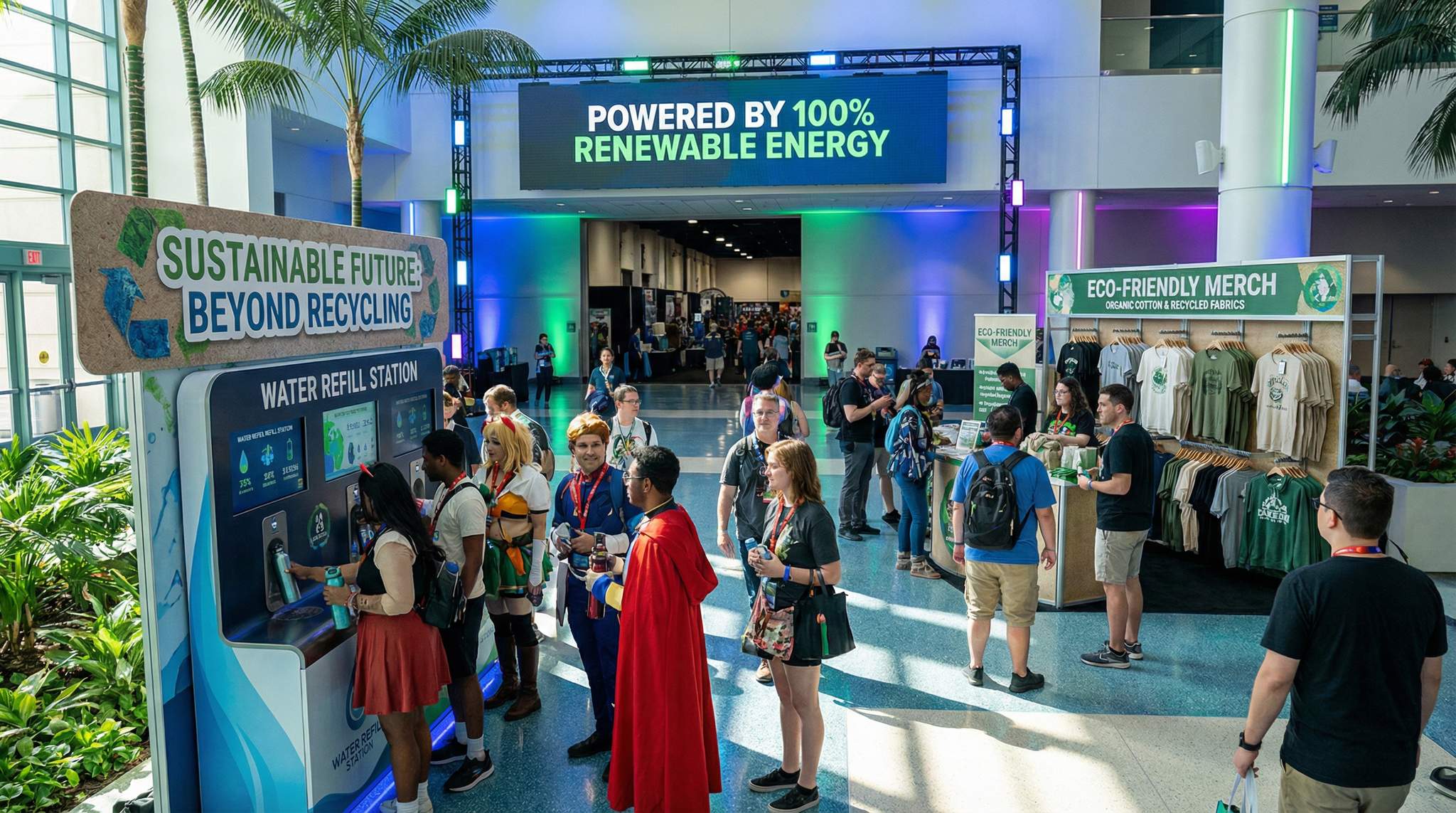
A very visible water initiative is providing water refill stations for attendees. Encouraging fans to bring reusable water bottles (or giving them out as merch) only works if they have places to fill up. Ensure that either the venue’s built-in bottle fountains are plentiful or rent additional refill station units for high-traffic areas. Mark them clearly on the convention map and app. Not only does this reduce the need to buy plastic water bottles, it often keeps attendees healthier and hydrated (bonus: hydrated attendees are happier and have more stamina for those long cosplay days!). If you’re concerned about recouping revenue from beverage sales, consider having a sponsor logo on the water stations or selling a collectible refillable bottle at a slight profit; many events find that the goodwill earned outweighs any loss from bottled water sales.
As for materials, commit to using sustainable materials wherever feasible in your convention operations. This could mean printing badges on recycled PVC or even seed paper (which some conferences have done – attendees can plant their badge after!). Use recycled-content paper for any necessary printing. Choose decor made from fabrics or wood instead of plastics where possible. These choices may seem small, but they reinforce a consistent message. If you print signage or banners, opt for ones without dates so they can be reused (as mentioned), and choose vendors who can print on recyclable materials or take back the prints for recycling. Every piece of the event – from staging to ticket stock – can be evaluated through a sustainability lens. It might not all change at once, but year by year you can phase in greener alternatives. Keep an inventory of what materials you purchase and consume, and set goals to reduce each year. For example, “This year we printed 10,000 wristbands – next year, let’s switch to a biodegradable wristband and try to order 8,000 instead by reusing leftovers.” It’s this mindset of continuous improvement that will make your convention steadily more sustainable.
Sustainable Travel and Transportation
Attendee Transportation Impact
One often overlooked aspect of a convention’s environmental footprint is how people get there. Thousands (or even hundreds of thousands) of attendees traveling – by car, plane, or train – can produce significant emissions. While you as an organizer can’t control where fans come from, you can take steps to influence their transportation choices and mitigate the impact. Start by assessing your venue’s context: Is there robust public transit in the host city? Affordable parking or not? For urban conventions, a large portion of attendees might already use subways, buses, or rideshares if parking is scarce. In more car-dependent locales, nearly everyone might drive. Either way, make transportation a part of your sustainability plan.
Use your event’s communications to encourage the greenest options. On the official website and pre-event emails, prominently feature information about public transit routes to the venue, with links to schedules or a trip planner. Highlight any incentives: for instance, some European cons partner with transit authorities to offer free or discounted transit passes for badge holders (e.g., a German comic con gave attendees free train travel within the city on event days). Even if you can’t arrange that, just letting people know “Hey, the light rail stops two blocks from the con!” will nudge many to leave the car at home. If the city has bike-sharing or scooter rental programs, mention those for local attendees. Providing a secure bike parking area or valet at the venue can also encourage cycling. Fan Expo Vancouver has offered free bike valet services, which were well-received by attendees as an extra perk for cyclists.
For those who do need to drive, promote carpooling. Create an online ride-share board or a dedicated hashtag where attendees can coordinate carpools, especially if they’re coming from the same town or to/from hotels. Many conventions have active Facebook groups or Discord servers – those can be leveraged to match riders. You might even incentivize it: for example, offer priority parking spots close to the entrance for cars with 3 or more people (if you control any parking areas). Some events have gone as far as giving small swag items or raffle entries to carpoolers – an easy way to reward and encourage ride-sharing. If your venue is in a downtown area, also push the message that parking is limited (if true) and alternate transport is less hassle. People often choose convenience over ideals, so frame public transit or carpool as avoiding traffic jams and expensive parking fees – which just happens to also be greener.
Shuttles and Event Transportation
As an organizer, consider providing shuttle services as a strategic move. If your convention is tied to certain hotels or a farther parking lot, arranging shuttle buses can significantly cut down on individual car trips. It’s quite common for large cons to have hotel shuttles – if you do, try to use those motorcoaches to their fullest. Choose charter companies that operate modern energy-efficient or even electric buses if available. A single full coach bus can remove 40-50 separate car trips, which is a huge win for reducing congestion and emissions. Communicate the shuttle schedules clearly and make them convenient so attendees happily opt for the bus. The easier you make it (reliable schedule, frequent service during peak times, comfortable buses), the more people will use it.
If your con includes off-site events or after-parties, shuttles there are also wise – not just for sustainability but for safety (preventing lots of rideshares or inexperienced out-of-towners driving at night). Some conventions invest in wrapping their shuttle buses in event branding, turning them into moving billboards. That adds a marketing benefit to the transportation budget. If budget is a concern, look for sponsorship opportunities – a local transit company or eco-friendly business might sponsor the shuttle service in exchange for branding, since it’s a visibly green initiative.
For special transport needs, like moving VIP guests or staff, plan those with efficiency in mind too. Instead of individual cars for each guest, can you utilize a van to group airport pickups by arrival times? If using golf carts or small vehicles around a large venue campus, consider electric models. All these operational choices contribute to the overall footprint. Some events coordinate with rideshare companies (Uber/Lyft, etc.) to set up designated drop-off points; you could explore if those companies have any sustainability initiatives like offering discounts for using their electric/hybrid drivers. It never hurts to ask – in 2026 many companies are keen to publicize green partnerships.
Offsetting Travel Emissions
Even with the best efforts in promoting greener transit, a big portion of a convention’s footprint can come from travel – especially if attendees or guests fly in. This is where offset programs can play a role. You might encourage attendees to offset their own travel; services exist where an individual can input their flight or driving miles and purchase a small offset to compensate. Provide a link or partnership with such a service on your site. Some cons have set up a system where attendees can voluntarily add, say, $5 during registration checkout that goes into a fund for carbon offsets or environmental projects. Many fans will contribute if it’s a simple checkbox, as it aligns with their reason for attending a “responsible” event.
On the organizer side, consider offsetting guest travel as part of your hospitality. If you’re flying in 10 celebrity guests and 50 staff, you can calculate that carbon and buy offsets for those flights relatively cheaply in the grand scheme. It’s a great thing to mention in your sustainability report: “We offset 100% of talent and staff travel emissions this year.” It shows you’re accounting for unavoidable impacts. Similarly, if you have freight (maybe shipping expo materials or merch by truck), include that in your carbon calculations and offset it.
Beyond offsets, you could invest in some local mitigation to balance out travel impact. Perhaps sponsor a community tree-planting day or donate to an urban gardening program in your host city. While these aren’t as mathematically precise as formal carbon credits, they make a visible positive contribution and engage the local community. Some events look at legacy projects – for example, after a big con weekend, leaving something positive like a donation to the city’s green initiative or a clean-up of a local park by volunteers (a nice “give back” activity for staff or even fans who stick around). These efforts help balance the scales a bit and show that the convention is aware of its broader impact and responsibilities.
Case Study: EasyFairs’ Green Mobility
In Europe, the organizers Easyfairs (who run Comic Con Stockholm and Heroes Dutch Comic Con, among others) provide a great example of prioritizing sustainable travel. For their Stockholm event, they chose a venue with excellent public transport links and actively encouraged attendees to take the metro, offering detailed transit guides on the con website. The venue itself provides bicycle parking and has electric vehicle charging stations on-site, aligning with Comic Con Stockholm’s sustainability goals and Heroes Dutch Comic Con’s green initiatives. Meanwhile, at Dutch Comic Con, Easyfairs promoted a carpool initiative and even selected partner hotels based on sustainability criteria (favoring those close by to reduce travel and those with green practices), as detailed in their travel and accommodation policies and emissions reduction strategies. These cons saw a high uptake of public transport by attendees – in part because driving in Amsterdam or Stockholm is less convenient, but also thanks to the clear messaging that transit was the preferred way to get to the fun. By making sustainable travel an integral part of the event experience (and showing fans you care how they arrive and depart), you can significantly cut traffic and emissions associated with your con.
Eco-Friendly Merchandise and Materials
Greener Merchandising
Fan conventions thrive on merchandise – from official event swag to artist alley prints and vendor goodies. But merch can be a minefield of waste and unsustainable production. As an organizer, you control the official merch and have influence over vendors, so use that power to drive greener merchandising. Start with your own event products: source them responsibly. For example, if you sell convention t-shirts or hoodies, choose sustainable materials like organic cotton or fabric blends made with recycled polyester. These are widely available now and only marginally more expensive than standard shirts. Many fans will actually prefer a shirt that’s labeled eco-friendly – it becomes part of the con’s identity. Ensure your merch printer uses water-based or low-impact inks, and avoid unnecessary plastic packaging on the products. Instead of bagging each shirt in plastic, distribute them as-is or in paper bags. If you do collectible pins, consider wooden or bamboo pins over metal/enamel (there are cool sustainable options now), or at least use recycled metal. Even lanyards can be made from recycled PET (plastic bottles) – a small detail that makes a difference when you’re ordering thousands.
Think also about merch longevity. High-quality items that attendees will use for years (reusable water bottles, sturdy tote bags, enamel pins for their collection) are better than cheap trinkets that get tossed. Consider offering a few premium sustainable items: for instance, a metal convention-branded water bottle or coffee tumbler. Yes, they cost more to produce, but you can price them accordingly, and they actively reduce single-use cup waste during the event and beyond. Some cons have success with branded utensil kits or straws for fans – plugging into the notion that attendees can use them on-site at the food court. Use creative storytelling when marketing these: “Grab the [Con Name] Reusable Kit and join us in cutting down single-use waste – plus, you’ll always remember the year you became a hero for the planet!” It frames purchasing merch as a planet-positive action.
Sustainable Swag and Goodie Bags
Convention swag bags and giveaways are infamous for creating trash. But you can reinvent the swag bag with sustainability in mind. First, decide if you even need a physical bag at all – some events have shifted to a digital swag bag delivered via email or app, containing promo codes, digital comics, or discount links from sponsors instead of physical flyers and samples. If sponsors are on board, this can dramatically reduce paper and junky item waste. However, many sponsors still love tangible swag, so if physical bags remain, make them eco-friendly. Use tote bags made of recycled material or cloth that attendees will actually keep and reuse (those nylon bags that fold into a pouch are popular and reduce plastic bag use later). Clearly mark them as recycled or sustainable material – it educates the fan subtly.
Curate the contents carefully. Work with sponsors to avoid pointless throwaways. Encourage items that are useful or environmentally friendly: e.g., a sponsor might give a mini notebook made of recycled paper or a biodegradable phone case, instead of a plastic keychain. Some cons include a refillable water bottle or bamboo cutlery set as the marquee item in the goody bag, setting the tone that “this is a green event”. If you still have paper flyers or coupons, print them on recycled paper with soy inks, and keep them minimal. One idea is to compile all sponsor offers into a single booklet or fold-out poster rather than dozens of separate inserts – thus only one printed piece per bag. Or better yet, include a QR code handout that directs to an online deals page, skipping multiple prints.
Also, consider making the swag bag optional. Many experienced con-goers would opt out of a bag full of ads if given the choice. You could have a “Swag Station” where only those who want the free loot pick it up. This prevents thousands of unwanted items from being dumped in hotel trash cans later. For example, at some tech expos, organizers moved swag distribution to an opt-in counter; they found only ~60% of attendees took it, meaning 40% reduction in materials needed outright. Leftover swag can often be donated if it’s useful (e.g., stationery to schools). If you end up with boxes of extra sponsor items, try to find a home for them rather than landfilling – charities, children’s hospitals, or shelters might take certain items (toys, toiletries, etc.). But best is to not over-produce by gauging interest ahead of time.
Digital Content Over Print
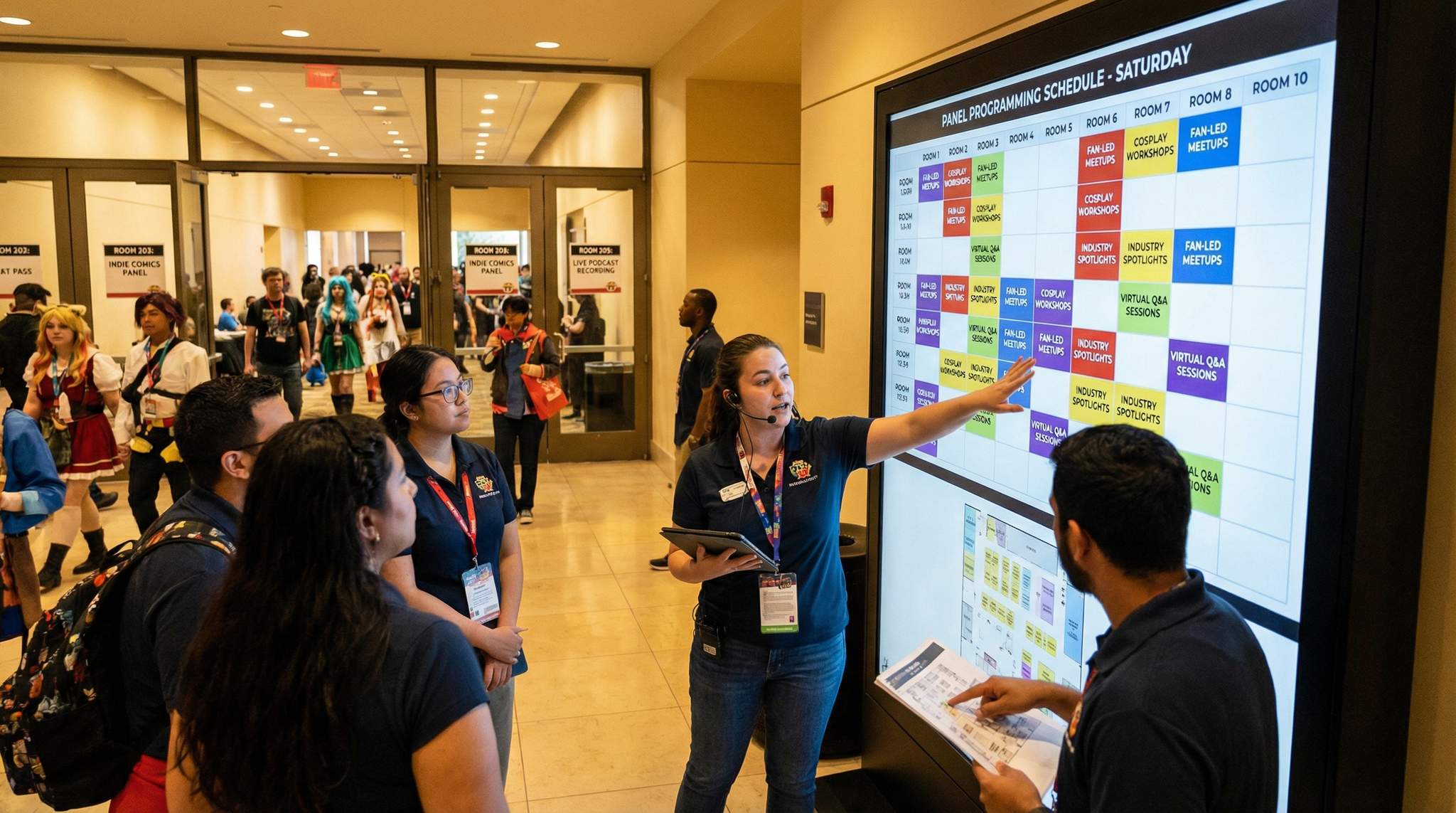
Leverage technology to replace traditionally printed materials. We already discussed mobile event apps for schedules – they’re a must in 2026. Beyond schedules, use the app or website for things like maps, exhibitor directories, and even panel descriptions that used to fill pages. Many conventions have gone fully paperless for attendee information: large digital screens around the venue show the schedule and updates, and the app sends push notifications for line updates or room changes. Not only is this eco-friendly, it’s also more efficient when things inevitably change last-minute (no need to reprint or have outdated info floating around). One caveat: ensure there are charging stations or ample places for attendees to keep devices juiced, since you’re asking them to rely on phones more – which in itself can be a sponsor opportunity (“Charging Lounge brought to you by XYZ”).
Ticketing and registration is another area to eliminate paper. Use an e-ticket or QR code system for admissions instead of mailing physical tickets or printing confirmations. Platforms like Ticket Fairy support fully digital ticketing, letting fans scan in with their phones and receive a digital badge or wristband, which is a key part of venue sustainability in 2026. If you still need a physical badge on site, print on-demand and only what’s needed, rather than pre-printing thousands of generic badges. More cons are also reusing RFID badge holders or renting them to attendees with a refund when returned, so they can be reused year to year (common in music festivals, now catching on for cons). Encourage attendees to recycle or return their badges/lanyards – set up a simple drop box after the turnstiles. That way, even if the badge itself isn’t reusable, the lanyard might be, or at least you keep them out of the regular waste stream to handle separately.
Even for internal operations, go digital: use tablets or laptops for check-in and registration. Have volunteers use an event staff app or Google Sheets on tablets to track things instead of paper forms. If you typically print lots of staff/volunteer handouts or floor plans, consider giving everyone access to those via an online drive or an internal app. Not only does it save trees, it means changes can be communicated instantly. Some conventions have switched to digital signing for autographs (like an autograph QR code system where fans get a digital certificate instead of a COA paper) but admittedly, most fans still want the physical signed item. Focus on where digital truly makes sense and improves the experience. The rule of thumb: if it can be done on a screen instead of paper without detracting from the fan experience, do it. Attendees in 2026 are comfortable with apps and screens – many will appreciate the convenience (and the lighter load of not carrying so many papers around!).
Eco-Conscious Exhibitors and Artists
Your convention’s sustainability can be amplified by the practices of the exhibitors and artists on your show floor. While you can’t control everything vendors do, you can certainly guide and incentivize them toward greener choices. Start by sharing a sustainability guide for exhibitors well in advance (as part of the exhibitor packet). Include practical tips: e.g., “Use LED lighting in your booth to reduce power draw,” “Minimize giveaways that create waste – consider digital downloads or small useful items like pens over pamphlets,” and “Plan your shipments carefully to avoid excess packaging.” If your venue has specific waste streams, let vendors know (e.g., “Please break down and stack cardboard behind your booth for recycling pickup”). Many exhibitors, especially smaller artists, will appreciate these tips as they align with keeping their costs down too (less printing, less shipping costs if they pack smartly).
Enforce a few basic rules through the contract: for example, prohibit vendors from distributing plastic bags to customers (encourage paper or no bag), and require that any food sampling uses compostable containers. You might also ban certain problematic materials on the show floor – some events disallow balloon giveaways or confetti because they’re messy and non-eco. These should be common-sense once explained. To get buy-in, frame it as part of the show’s values: “We ask all our exhibitors to help us reduce waste and keep [Con Name] green and clean.” Many companies have their own CSR goals and will happily comply if they know it’s expected.
During the show, make it easy for exhibitors to be sustainable. Provide convenient recycling for booth refuse. If they have leftover merchandise or display materials, coordinate that donation program as mentioned. A lot of vendors dread the end-of-show teardown when they have to trash what they can’t take – by giving them an alternative (donation or recycling), you reduce waste and earn their gratitude. Some conventions offer a “Green Booth” award or discount for vendors who go above and beyond in sustainable booth design or practices. For instance, you could have staff secretly evaluate booths on criteria (no single-use plastics, sustainable decorations, etc.) and announce a winner who gets a free booth next year or some other perk. It gamifies the process and publicizes the concept. ReedPop (organizers of New York Comic Con and others) in recent years started highlighting vendors with sustainable products in their marketing, essentially giving free shout-outs – which encourages others to consider eco-friendly offerings.
Lastly, artist alley folks might appreciate sustainability help. Many artists have moved to offering digital downloads or on-demand printing for large prints instead of bringing tons of pre-printed inventory that may not sell (which wastes paper/ink). Encourage artists to only print what they need and perhaps offer an on-site printing service partnership (some cons have a print shop in town on standby for artists to print more if they sell out, rather than over-printing initially). This reduces waste from unsold prints. Also, remind artists to bring reusable tablecloths, avoid glitter (microplastic nightmare), and to take advantage of your recycling bins for all those sketch paper scraps. If your con provides an art show or gallery space, use reusable display panels and LED lighting there too. By cultivating a culture where everyone – from big vendors to individual artists – is mindful of materials and waste, you create a convention that’s not just green by organizer efforts, but collectively green by community effort.
Sustainable Food and Beverage Services
Greening the Concession Stands
Food and beverage operations at a convention can create a lot of waste and emissions, but they also offer major opportunities for sustainability wins. If you have control over catering or concession vendors, work closely with them to implement green practices. A top priority is to eliminate single-use plastics in F&B. Require that all concession stands use compostable or biodegradable serveware: cups, plates, forks, straws, etc. Many venues already have switched to these due to regulations or client demand. If your venue’s concessions still serve everything in plastic, push for a change – in 2026 there are ample affordable alternatives (e.g., plant-based PLA cups, paper straws, bamboo or fiber cutlery). You might need to coordinate providing compost bins and hauling, as discussed, to ensure those compostables don’t just end up in trash. Some events implement a “no plastic straw” rule altogether, offering paper straws only on request. Just be mindful to accommodate accessibility: keep some plastic straws available for attendees with disabilities who need them, or offer reusable silicone straws at info booths as an alternative. Inclusivity and sustainability should go hand in hand – for instance, when designing an inclusive convention you consider all attendees’ needs, so ensure your straw policy still allows options for those who truly require plastic straws for medical reasons (while the majority can do without), as seen in social responsibility guidelines.
Another impactful move is introducing a reusable cup program for drinks. Some convention centers now have this down to a science. For example, the Javits Center in NYC launched a reusable cup system for events – attendees pay a small deposit for a sturdy cup for soda/beer, which they can return for a refund or keep as a souvenir; the cups are then washed and reused, eliminating mountains of disposable cups and proving that reusables can pay off quickly. If your venue can facilitate on-site washing (or partner with a service that swaps and washes off-site), this can drastically cut waste. If true reusables aren’t feasible, at least use recyclable aluminum cans or paper cups over plastic. And have clearly marked bins to collect those for recycling.
Work with caterers to incorporate local and sustainably sourced food options. Shipping exotic or out-of-season foods long distances increases the carbon footprint. Instead, where possible, choose menus that celebrate local produce or regional specialties – it can even enhance the attendee experience by giving a “taste of the city.” And consider the menu’s environmental impact: offering more plant-based choices can significantly reduce carbon and water footprint versus a meat-heavy menu. Many cons now ensure there are ample vegan and vegetarian options not just for inclusivity but because plant-based food is eco-friendlier. Some progressive events have even implemented “meatless days” or eliminated red meat from their official catering. Indeed, the organizers of Dutch Comic Con note they do not serve red meat in their on-site restaurants as a sustainability choice, focusing on reducing food waste. If going entirely meatless is too extreme for your crowd, at least emphasize tasty veg options – often they become quite popular, and you can gradually shift the ratio to have more plants, less beef/lamb which have the highest carbon footprint.
Managing Food Waste
Food waste is a double whammy: it means resources were wasted producing food, and if it rots in landfill it emits methane, a potent greenhouse gas. Conventions often have leftover food from green rooms, vendor catering, or unsold concessions. Plan ahead to reduce and repurpose food waste. Coordinate with caterers to prepare reasonable quantities – use pre-registration numbers to estimate demand closely rather than over-cooking “just in case.” For instance, if historically you cater lunch for volunteers and half the sandwiches go uneaten, adjust the order down or switch to a model where people pick meal options in advance so you know exactly how much to make.
No matter how well you plan, there will usually be surplus. Partner with a local food rescue or charity to donate unserved, untouched food. Many cities have organizations that will pick up trays of leftover buffet food or unsold sandwiches and deliver them to shelters or community fridges the same day. Make sure to arrange this before the event; you’ll need to know what kind of food they accept (usually anything that’s been kept at safe temperatures and not plated) and have a pickup time set (often end of each day or end of event). In some places, venues have ongoing donation programs – ask if the convention center already works with a food bank. The San Diego Convention Center, for example, has a long-running donation scheme for events to give leftovers to local nonprofits, supported by resources for donations. Not only does this reduce waste, it’s a feel-good story to tell from your event.
For food that can’t be donated (like half-eaten stuff or expired items), ensure it goes to compost rather than landfill. If you set up compost bins as mentioned earlier, communicate that to food vendors and cleaning staff so that kitchen prep scraps and ditched food from plates end up in the compost stream. Some venues have their own digesters or composting on site, which is ideal. If not, see if a local farm or compost facility can take the waste – some will drop off bins and pick them up for a fee. This might be in the venue’s wheelhouse to arrange, but be proactive in asking.
Lastly, use tech to predict and monitor food needs. If you have an event app, you could have attendees indicate if they plan to buy lunch on-site or not (perhaps a poll each morning: “Will you be eating lunch in the venue today?”) just to give vendors a rough idea. Some events sell meal vouchers in advance as part of packages, which helps gauge numbers. If lines at certain food stalls are short and others long, maybe communicate or signpost to balance the load and avoid waste at the underutilized stall. It’s equal parts an art and a science to match food supply with demand, but every bit of optimization means less waste and likely cost savings too.
When coordinating food service across a large venue, organizers must also consider the complexities of health and safety regulations. Determining the best FSA-compliant multi-vendor waste segregation solutions for event sites is a critical step for international and UK-based conventions. Effective setups typically involve centralized, color-coded disposal hubs that separate organic food scraps from recyclable packaging without risking cross-contamination near food prep areas. By standardizing these segregation stations across all concessionaires, venue managers ensure that food safety standards are strictly maintained while still hitting aggressive waste diversion targets.
Catering to Diverse Diets Sustainably
A sustainable food program also considers the people side of the equation – ensuring everyone is fed and happy while meeting eco goals. Inclusivity in catering means providing options for various dietary needs (vegan, gluten-free, kosher/halal, etc.) and doing so in a sustainable way. Often, the more plant-forward and simple the menu, the easier it is to accommodate many diets. For example, a hearty vegetable curry or a pasta with choice of plant-based sauce covers vegans and avoids common allergens more easily than a complex meat dish would. PCMA’s Convening Leaders 2026 event emphasized that “no matter who’s there, they should feel comfortable that there are options for them”, a principle rooted in food science and inclusivity – they planned menus that were flexible and clearly labeled, which is a great practice cons can emulate. Having clear signage on what each food item contains (and its dietary attributes) not only helps those with restrictions but also can highlight sustainable choices (like a label noting “Local Farm Salad – ingredients sourced within 50 miles” or “Plant-based entrée – low carbon footprint”). It subtly educates attendees that these options are intentional and aligned with the event’s values.
If you cater VIP guests or have hospitality lounges, extend the same principles there. More celebrities and industry VIPs are environmentally conscious now, some traveling with their own eco-riders asking for local organic snacks or no plastic in the green room. Modern touring artists are putting sustainability clauses in their riders, and where once a headliner might have ignored waste, they now consider it a factor in doing business with top talent. Impress your special guests by meeting those requests: use real plates and silverware in green rooms (avoid disposables entirely backstage), stock fridges with drinks in cans or glass instead of plastic bottles, and provide recycling bins specifically for them. Not only will you reduce waste, you’ll earn a reputation as an organizer who “gets it.” Our guide to greening the green room goes deeper into pleasing talent sustainably – a relevant read if you handle a lot of guest stars at your con. It’s not just artists; partners will notice if your values align with theirs. In short, wherever food and drink are served – from the show floor to the VIP lounge – approach it with a sustainability and inclusivity lens. Feed people well, but feed them wisely, and you can satisfy stomachs and consciences at the same time.
Engaging Attendees and Community in Sustainability
Communicate Your Green Vision
One of the most powerful tools for a sustainable convention is your attendee community itself. Fans who understand and buy into the mission will amplify your efforts, not hinder them. So it’s crucial to communicate your green initiatives clearly and positively. Well before the event, let attendees know what sustainability measures you’re taking and what you’re asking of them. For example, if you’ve eliminated plastic bottles and have water stations, blast that message: “Bring your reusable water bottle – our goal is to save 50,000 plastic bottles from waste this year!” Include a blurb on the ticketing page or confirmation email about packing a bottle, using the app instead of printing tickets, maybe even using public transit (with a link to transit info). By framing these as part of the fun (“Be an Eco-Hero at the con by doing X, Y, Z”), you set expectations in a friendly way. San Diego Comic-Con back in 2014 did this effectively with an “Eco Superhero” campaign, inviting Comic-Con attendees to join their quest to save resources and providing earth-friendly tips in the program. Emulate that heroic, inclusive tone – make fans feel they’re part of something important and cool by participating in your green initiatives.
At the event, signage and announcements are key. Use digital signage or posters to remind people of things like recycling (“The recycling symbol is your friend – use the blue bins located around the hall!”) and other onsite programs. If you have a charity donation or offset program running, show progress (“500 lbs of food donated so far – thank you!” or “We’ve offset 30 tons of CO2; contribute at booth 100 to reach 50 tons!”). Celebrate milestones on social media during the con: for instance, tweet that “Day 1, and already 5,000 water bottles refilled at our stations – way to go #GreenCon2026 attendees!” These updates both encourage continued behavior and display transparency.
It also helps to incorporate sustainability into the theme and programming. You might have a panel or two about eco-topics that intersect with fandom – such as “Cosplay and Climate: Crafting with Sustainable Materials” or a Q&A with comic artists who cover environmental themes in their work. Many attendees will attend because it’s genuinely interesting, and it reinforces that the convention’s values include caring for the environment. Some cons create an “Eco Booth” or information table where volunteers or partner organizations share info on local environmental initiatives, and maybe give out a green-themed collectible (like a badge ribbon that says “Eco Warrior” for those who complete a “green quest” around the con). These kinds of interactive elements gamify sustainability, making it part of the convention adventure. For example, you could have a mini scavenger hunt where attendees have to take a selfie recycling or find the booth that has solar panels powering it, etc., to win a small prize. It’s fun and educational rolled into one.
Empower Volunteers and Staff
Your own staff and volunteers are your front line for building a sustainable culture at the con. Recruit a dedicated Green Team of volunteers whose sole focus is to assist and monitor eco-initiatives. As mentioned earlier, they can staff recycling stations, help attendees sort waste, refill water stations, and be on the lookout for any issues like overflowing bins. When building and managing your volunteer team, include questions about sustainability in training – make sure every volunteer, even those not on the Green Team, knows the basics (like location of recycle bins, the why behind any changes like no plastic bags, etc.). If volunteers are enthusiastic about the mission, their energy will spread to attendees. For instance, a volunteer at registration might tell arriving guests, “Don’t forget to download our app for the schedule and turn in your lanyard when leaving to help us reduce waste!” That little mention can prompt many to actually do it.
It’s worthwhile to designate a Sustainability Coordinator on the staff side if you have the bandwidth – someone whose job is to oversee all these efforts during the event, coordinate between teams, and troubleshoot. They can manage the Green Team volunteers and also liaise with venue operations in real-time. For example, if a Green Team member reports that one type of bin is consistently getting trash contamination, the coordinator can decide to quickly swap signage or make an announcement. Or if the water stations run low, they alert facilities to refill. Having that point person ensures sustainability issues are handled promptly, just like you’d address an AV outage on a panel stage.
Another great idea is to provide volunteer incentives tied to sustainability. Many cons already give volunteers perks (free badges, swag, exclusive events). You could integrate something like a special Green Team t-shirt made from organic cotton or an extra hour break if they bring their own reusable kit – something playful that reinforces behaviors. Recognize standout volunteers who championed the eco-cause in your post-event communications or even an award ceremony. People love being part of a meaningful cause, so rallying your team around the sustainability mission can boost morale and retention. Convention veterans often say that a passionate volunteer crew is the secret sauce to success, and leaders highlight volunteering as key to sustainable development – and passion for protecting our common “fandom home” (planet Earth) can be a unifying motivator beyond the event itself.
Community Partnerships and Legacy
Conventions don’t exist in isolation – they are part of a broader community. Engaging the local community in your sustainability efforts can amplify impact and leave a positive legacy. Partner with local environmental organizations or charities. Perhaps a local conservation group can have a booth at your event, offering a workshop on upcycling cosplay materials or advertising a beach cleanup the week after the con. You get expert help in educating attendees, and they get access to new volunteers or donors from your fanbase. Some cons incorporate a charity fundraiser element (like a charity auction of fandom items) – you could direct some of those proceeds to an environmental cause, signaling that the fan community cares about giving back to planet-friendly projects.
Working with the host city can also yield benefits. Cities love to tout big events being green since it reflects well on them too. See if the city’s sustainability office or tourism board has initiatives you can align with. For example, if the city has a recycling challenge or climate action week, tie your con’s activities into it with cross-promotion. A collaborative approach can sometimes open up resources: you might get assistance like extra recycling bins from the city, or publicity for your event as a sustainable tourist attraction. In Melbourne, the city worked closely with their Comic Con to provide water refill stations branded with city logos, highlighting Melbourne’s push to reduce plastic waste – a win-win for both the event and the city’s image.
Finally, think about the legacy of your event. After the convention, besides the memories (and perhaps a dent in local coffee supplies), what do you leave behind? Ideally, nothing harmful – only positive impacts. This could be literal, like ensuring the venue is left spotless with all materials properly recycled. But it could also be the relationships and awareness built. Consider doing a post-event press release highlighting your sustainability results: “Our fans helped recycle 10 tons of waste!” – local media often love that angle, and it might inspire other events to follow suit. If you have sponsor or community debrief meetings, share what went well environmentally and what you aim to do next year, inviting continued support. Each year, as your convention grows greener, it sets a higher benchmark that others in the industry may emulate. This sustainability push isn’t happening in a vacuum; festival alliances are emerging to share knowledge, and sustainability benchmarks are rising. By engaging not just within the event but outward with community and media, you position your convention as a leader – one that doesn’t just entertain fans for a weekend, but also leaves the world a little better in its wake.
Real-World Green Convention Initiatives
North American Pioneers
Several major North American fan conventions have led by example in sustainability. San Diego Comic-Con (SDCC) worked closely with the San Diego Convention Center to launch extensive recycling and waste diversion programs. By 2014, during Comic-Con they had over 150 recycling bins deployed and encouraged attendees to be “Eco Superheroes” by recycling and using transit, a strategy highlighted in Waste Management’s reports on the event. Over the years, their efforts (like recycling all exhibit hall carpets and donating leftover materials) contributed to hundreds of thousands of tons of waste being kept out of landfills, thanks to the partnership between Waste Management and the Convention Center and their focus on conserving natural resources. On the East Coast, New York Comic Con (NYCC) benefits from the sustainability features of the Javits Center. Javits boasts a huge green roof and recently installed 1,400+ solar panels as part of a renewable energy microgrid that is detailed in the Javits Center 2021 Sustainability Report. During NYCC, the venue rolled out a reusable cup program in concession areas, which reportedly “not only slashed waste but saved money over buying thousands of disposables monthly,” proving that reusables can pay off quickly. NYCC’s organizers have also embraced digital solutions (their companion app replaced most printed guides) and crowd messaging to encourage the event’s 200,000+ attendees to take the subway instead of driving to the convention.
Another interesting example is Emerald City Comic Con (ECCC) in Seattle. Seattle is an eco-conscious city, and ECCC partnered with the Washington State Convention Center to achieve a high waste diversion rate. They provide compost bins alongside recycling, reflecting Seattle’s city-wide compost mandate. The con also engaged attendees with a “Scavenger Hunt for Sustainability” – tasks included finding booths with eco-friendly products and spotting the solar panels on the convention center roof, turning sustainability into a game for fans. As a result, many attendees reported learning something new about green practices while having fun, and the event built a reputation as the “forward-thinking comic con.” These North American cases show that whether it’s through industrial-scale initiatives (like Javits’ infrastructure) or creative fan engagement, conventions can successfully go green at scale.
European Innovations
In Europe, fan events have the advantage of often being in countries with strong environmental regulations and culture. Heroes Dutch Comic Con in Utrecht and Comic Con Stockholm in Sweden, both run by Easyfairs, have embedded sustainability into their event DNA. At Dutch Comic Con, the organizers provide gender-neutral cosplay changing rooms and non-binary registration options as part of inclusivity, and they focus heavily on environmental impact, as outlined in their social responsibility guidelines. The venue offers EV charging and bike parking, and the event actively promotes public transport and carpooling to attendees, aiming to reduce travel emissions. They also incorporated sustainability into programming – for instance, panel discussions about eco-innovation in comics, and an area where green startups demo innovations (tying into Easyfairs’ pledge to foster innovation and support communities) as part of their commitment to social responsibility. Both the Dutch and Stockholm Comic Cons have committed to the Net Zero Carbon Events pledge (aiming for net zero emissions by 2050, with a 50% cut by 2030), aligning them with global climate goals as seen in Comic Con Stockholm’s sustainability plan and Dutch Comic Con’s emissions targets. In practical terms, Comic Con Stockholm’s venue only uses 100% green electricity, employs LED lighting throughout, and implements strict energy management so nothing is running needlessly, as detailed in their energy policy. They even use smart badge technology that allows exhibitors to scan attendee badges for info rather than collecting paper brochures, significantly cutting paper use and improving production and waste management.
European cons also often benefit from city initiatives. For example, MCM London Comic Con works with ExCeL London (the venue) which has achieved zero waste to landfill and procures renewable energy for all events. MCM’s team coordinates with ExCeL to ensure that all those cardboard boxes from the massive dealer hall get recycled and that leftover swag gets repurposed. Meanwhile, Paris Manga & Sci-Fi Show in France encourages attendees to use the city’s excellent public transit by offering a discounted Metro pass for convention-goers – and nearly 70% of attendees take advantage, drastically reducing the event’s transportation footprint. In Germany, Gamescom (primarily a gaming expo, but with huge fan attendance) in Cologne introduced a ‘Green Mobile Ticket’ which bundled a public transit ticket with the event pass, and also implemented a deposit system for beverage cups in their outdoor areas. The result was far less litter and almost all cups returned for reuse – an approach learned from German music festivals. These examples highlight Europe’s tendency to integrate conventions into broader sustainability initiatives, showing how government, venue, and organizer cooperation can create very eco-friendly fan events without sacrificing any of the excitement.
Global Movement and Pledges
It’s worth noting that the push for sustainable events is truly global and growing. The Net Zero Carbon Events initiative (launched in late 2021) now has hundreds of signatories worldwide – including major convention organizers and venues – all committed to substantial emissions reduction and sharing best practices. This kind of international cooperation means a convention organizer in, say, Australia can learn from a comic-con in Canada about how to run a greener event, and vice versa. We’re seeing conventions in regions like Asia and the Middle East also start to adopt green practices. For instance, Comic Con Bangalore in India recently announced a partnership with a recycling company to handle all plastics and paper from their events, acknowledging the rising concern about waste in the Indian fan community. In Japan, where large doujinshi (fan comic) markets like Comiket traditionally generate a lot of paper waste, there’s a growing culture of “take your trash home” – and indeed, overseas visitors to Comiket are often amazed at how absolutely clean the venue is despite half a million attendees, thanks to a collective ethos of responsibility.
The convention industry is also drawing inspiration from sustainable practices in related event sectors. The music festival world, for example, has pioneered things like “Drastic on Plastic” pledges and eco-bond ticket schemes (where attendees pay a deposit that they get back if they return a bag of recycling). Some of these ideas could eventually cross over to fan conventions (imagine a badge deposit to encourage badge recycling, or a discount on next year’s ticket if you engage in green volunteering this year). With each passing year, more case studies emerge – the 2026 Festival Sustainability Benchmarks report, for instance, highlighted how even events of 20,000+ capacity hit over 90% waste diversion, demonstrating that achieving 90% diversion is possible with the right guidance on what goes where. Furthermore, these events nearly eliminated single-use plastics by banning single-use items and implementing measures like extra metal recycling. Fan conventions are beginning to aim for those same benchmarks. And as conventions share their successes – through industry conferences, blogs, and social media – a friendly competition arises: who can be the “greenest con” around? Ultimately, all these efforts worldwide feed into each other, creating a momentum where sustainable practices become the norm rather than the exception. The fandom community is global, and so is the mission to ensure the events we love today don’t harm the world we’ll live in tomorrow.
Examples at a Glance
To summarise the range of initiatives, here’s a quick snapshot of notable sustainable moves by fan conventions around the world:
| Event | Green Practices Implemented | Results/Benefits |
|---|---|---|
| San Diego Comic-Con (USA) | Massive recycling program with 150+ bins; partnered with Waste Management for carpet & material recycling; promoted public transit use to attendees. | Achieved high waste diversion – added to ~285,000 tons recycled since 2011 (source); reduced congestion and carbon from attendee travel. |
| New York Comic Con @ Javits (USA) | Venue with 1.4 MW solar array & 7-acre green roof; introduced reusable cups for beverages; digital ticketing and schedules via app. | Cut venue energy demand significantly; minimized single-use cup waste (Javits saw cost savings vs. disposables) (source); virtually eliminated paper guide printing. |
| Comic Con Stockholm (Sweden) | 100% green electricity and LED lighting at venue; Smart Badge tech to reduce paper; strict recycling & no single-use plastics on-site; local/vegetarian food options, no red meat served. | Greatly lowered carbon footprint of event operations; estimated 80%+ reduction in paper waste for exhibitors; aligned with Net Zero 2030/2050 goals (source). |
| Heroes Dutch Comic Con (Netherlands) | Provided EV charging and bike parking; encouraged carpooling & transit; compostable serveware at food stalls; sustainability panels in program; introduced gender-neutral cosplay rooms (social sustainability). | High attendee adoption of transit (a majority came by train); much lower waste from food courts; positioned the con as a progressive, inclusive event (source). |
| Emerald City Comic Con (USA) | Partnered with venue on 100% compost and recycling (including compostable food containers); “Leave No Trace” campaign in cosplay areas; charity donation of leftover merch to local youth orgs. | Diverted an estimated 85% of waste from landfill in 2025; venue reported post-event trash was at a record low; positive community impact through donations. |
These examples show there are many paths to a greener convention – whether through cutting-edge venue tech, fan engagement campaigns, or simply better planning and partnerships. The common thread is leadership and creativity: each of these events tried new approaches to solve old problems. Sustainable conventions are possible in every corner of the globe, and they don’t detract from the fan experience – if anything, they add a new layer of pride and purpose to it.
Balancing Sustainability with Budget and Experience
High Impact, Low Cost Measures
As convention organizers, we’re always balancing the books. One concern when implementing green practices is the perceived cost. The good news is that many sustainable measures are surprisingly affordable – some even save money right away. It’s smart to start with the “low-hanging fruit” that offers a strong impact for little investment. For example, going paperless for tickets and schedules costs very little if you already have an event app or ticketing platform with e-ticket capability. You’ll save on printing and mailing costs of physical tickets or programs, which can be thousands of dollars for a mid-size con. Setting up basic recycling bins around the venue is usually free or low-cost (many venues will provide bins if asked), and it can save on trash disposal fees since you might need fewer dumpster hauls. Encouraging fans to bring their own water bottles and providing water coolers might cost a few hundred dollars to rent coolers, but it slashes the need to buy pallets of bottled water or clean up plastic bottles everywhere. Volunteer-driven initiatives are another bargain – a crew of passionate volunteers directing people at waste stations or collecting lanyards at the door costs you only the price of a T-shirt and maybe some pizza, yet it can significantly improve your waste outcomes.
One trick is to repurpose what you already have. Do you print staff shirts every year? Switch to a color or design that doesn’t include the year, so leftovers can be reused next event, reducing waste and cost next time. If you have old banners, see if they can be turned into table covers or cut into signs for back-of-house areas rather than tossing them. Little hacks like this embody the “reuse” ethos without spending a dime. Also, lean on sponsors for support – if you need funding for a sustainable addition, like installing a temporary water refill station, find a sponsor to cover it in exchange for branding. Many companies would rather sponsor a hydration station with their logo than just have another random ad placement. It’s good PR for them to be associated with something beneficial. For instance, a local utility or beverage company might gladly sponsor your water stations, turning a potential expense into a sponsored feature. Similarly, a recycling company might provide bins and hauling at a discount if they get to put their name on the sustainability efforts in press releases.
Investing for Long-Term Savings
Some green initiatives do require upfront investment – LED lighting, heavy-duty reusable dishware, detailed energy management systems. But these often pay off in the mid to long term through savings or new revenue. It’s useful to frame certain expenses as capital investments in the event’s future. If you run an annual convention, investing in a set of high-quality signage that is undated and durable can cost more up front but saves printing costs for years (and reduces waste). Another example: purchasing an assortment of recycling bins or branded container wraps if the venue doesn’t have enough – an initial outlay, but then you own those and can deploy them every year (or even lend them to other local events for goodwill). A case study from a trade show in Las Vegas found that investing in digital signage screens (instead of yearly printing big signs) had a 3-year payback – by year 4 they were saving tens of thousands of dollars and heaps of paper. Conventions can see similar returns on sustainable tech investments.
Energy efficiency measures tend to recoup costs especially quickly if you’re paying for utilities. If your event covers the power bill (common in many venue rental agreements over a certain usage), then cutting power use saves you directly. Spending a bit on motion sensors for lights in the expo hall at night, or renting more efficient LED wall modules instead of old projectors, might shave a noticeable amount off that bill. Some venues will pass through the utility savings to you in reduced charges or simply lower your flat rate for future events if they see consistent lower consumption. Additionally, consider the avoided costs of not implementing changes. For instance, if new laws fine events for excessive waste or require them to hire extra cleaning services, you’re avoiding those future costs by getting ahead now with waste reduction programs.
One area where investing smartly is crucial is merchandise and materials. Eco-friendly merch can have a higher unit cost (like an organic cotton shirt might be $1 or $2 more than a standard one), but you might be able to price it slightly higher as well – many fans will pay a premium for a limited edition “green” version, or you balance the cost elsewhere. If it’s truly not feasible to absorb the extra cost, consider adjusting quantities. Perhaps order a few hundred fewer shirts in total, citing the sustainable approach of not overproducing, which also saves money to reinvest in the quality of each item. Sometimes sustainability is as much about not buying unnecessary extras as it is about buying new things.
Creative Budgeting and Funding
If certain sustainability projects seem out of reach budget-wise, get creative with funding. We mentioned sponsorships, but there are also grants and subsidies for green initiatives. Check with local government or environmental groups – some cities have grants for events that implement recycling or energy-saving measures. If your convention center is city-owned, the city might have a budget to support events seeking sustainability certification or piloting a new program. For example, the city might provide free consultation from a sustainability expert or cover part of the cost of going zero-waste because it aligns with municipal goals. Don’t be afraid to ask – often these funds are not widely advertised but exist for those who inquire.
Another tactic is to phase in expensive initiatives gradually. Prioritize what gives the best bang for buck now, and put the rest on a wish list for next year’s budget. Perhaps this year you rent a few LED lights to test them on your main stage, and next year you budget to convert the whole stage lighting if it went well. Or you start with compostable straws and cups now, and tackle the costlier transition to compostable food containers later once you see how the waste streams manage. By breaking upgrades into stages, you spread cost over multiple cycles, which is easier to swallow. Track and document any savings or positive feedback from each new measure – this will arm you with justification to allocate more budget to sustainability moving forward. If you can show that the LED lights saved $X on power or that digital guides saved $Y on printing, it’s a clear case to reinvest those savings into the next initiative.
Crowd-funding sustainability can also be surprisingly effective. Some events have added a “Green Donation” option during ticket purchase (even just $1) and found that a large portion of attendees opt in, essentially funding things like carbon offsets or on-site improvements. Since the attendees benefit from and care about the event, many are willing to chip in a tiny bit more to make it sustainable. It also sends a message that the community supports those efforts – powerful data when justifying budget internally. You could also sell a specific piece of merch where proceeds go to funding a green initiative (e.g., a special edition eco tote bag where all profits are earmarked for installing water refill stations or planting trees to offset the con). That way, fans feel they are contributing to the cause and getting something tangible too.
Preserving the Attendee Experience
Amidst all the operational changes, it’s essential to ensure that attendee experience remains stellar. Fans come for fun, for fandom, for community – and none of the sustainability efforts should detract from that. Ideally, they either barely notice the changes (because convenience and comfort are maintained) or they notice and appreciate them. When planning green measures, always do a gut-check: does this make the experience better, worse, or neutral for attendees? For instance, replacing a printed program book with an app – is the app user-friendly and accessible to those who aren’t tech-savvy? Maybe you still print a small quantity of one-page schedules as backup for folks who truly need paper. Removing trash cans in favor of only recycling/compost bins – will attendees get confused where to toss that unrecyclable candy wrapper they have? You might need a solution for that (like clear signs about what to do with landfill waste or a small bin for miscellaneous waste at info booths). The goal is that green measures enhance the event or at least don’t cause annoyance.
One good strategy is to pilot changes on a small scale or off to the side before a full rollout. For example, try a “water bottle free” policy just in one area or day of the con to see how attendees react and if they complain about lack of bottled water. Or introduce one compost bin with clear signage and a volunteer in the food court for a few hours before deciding to place them everywhere unattended. Gathering feedback (formally or informally) helps fine-tune implementation so that by the time you expand it, it’s smooth. Remember, fans get cranky if lines are slow or if they can’t find something they expect – so if you remove something like plastic straws or printed schedules, replace it with a well-communicated, accessible alternative. If you do that, most attendees will embrace the change. Often they’ll even take pride in it – “our con is doing the right thing and we’re part of that.” That’s the vibe you want to cultivate.
In messaging, emphasize that all these efforts are to improve the con and protect the community (and planet) they love. People will tolerate small inconveniences (like taking an extra second to sort recycling) if they understand the purpose and see that the organizers are thoughtful about it. Keep an eye on social media and attendee surveys for gripes related to new policies. If, say, some attendees were upset they couldn’t get a physical program book, maybe next year you offer a print-at-home PDF for those who want paper in hand. Being responsive will show that you are balancing sustainability with customer service, not choosing one over the other. Ultimately, a truly sustainable convention is one that endures – and that means keeping attendees happy so they return year after year. The best news is that surveys increasingly show fans want events to be environmentally responsible, as long as it doesn’t ruin their fun. Many will actually have more fun knowing their good time isn’t coming at the Earth’s expense.
Frequently Asked Questions About Convention Sustainability
What are the best FSA-compliant multi-vendor waste segregation solutions for event sites?
The most effective solutions involve centralized, color-coded waste hubs placed strategically away from direct food preparation zones to prevent cross-contamination. Utilizing standardized, sealed bins for organic waste, recyclables, and general refuse ensures that multiple independent food vendors can dispose of waste safely while strictly adhering to Food Standards Agency (FSA) or local health department guidelines.
How can logistics companies showcase green practices at international conventions?
Logistics and freight partners can demonstrate their environmental commitment by deploying electric or hybrid vehicles for drayage, using reusable pallet wraps instead of single-use shrink wrap, and offering carbon-offset shipping programs for exhibitors. Event organizers can highlight these efforts through co-branded signage at the loading docks and by featuring the logistics provider in the convention’s annual sustainability report.