The 2026 Sustainability Imperative
Fan, Sponsor, and Regulator Pressure for Real Action
Festival producers in 2026 face intense scrutiny to prove their eco-initiatives are more than buzzwords. Today’s fans are eco-savvy and quick to call out insincere “green” claims on social media. In fact, industry surveys show about 70% of festival-goers factor a festival’s environmental practices into their decision to attend, as eco-friendly initiatives drive audience growth. Sponsors and corporate partners, too, have their own sustainability targets and favour events that align with their values. Meanwhile, regulators across the globe are tightening rules – from bans on single-use plastics at events to requirements for detailed waste management plans. The message is clear: merely talking green won’t cut it. Festivals must demonstrate measurable action or risk fan backlash, lost sponsorships, and even permit hurdles from local authorities.
A deeper analysis of the subject reveals exactly why that 70% of festival-goers care so deeply about sustainability. For modern ticket buyers, an event’s environmental footprint is a direct reflection of its cultural authenticity. When promoters ignore eco-friendly logistics, they aren’t just harming the planet; they are actively alienating their core demographic. Venue operators and festival directors must recognize that this demographic shift translates directly to the bottom line, making green operations a fundamental pillar of audience retention rather than a mere marketing afterthought.
Tracking Festival Sustainability Trends in 2026
Staying ahead of festival sustainability trends in 2026 requires promoters to look beyond basic recycling. The most prominent shifts include the transition toward circular economy models for site materials, the integration of mandatory carbon reporting into municipal permit applications, and the rapid adoption of grid-tied renewable power for greenfield sites. Venue operators are also seeing a trend where sustainability metrics are directly tied to sponsorship valuations. By aligning operational strategies with these emerging eco-trends, event producers can future-proof their festivals against tightening regulations while appealing to an increasingly climate-conscious ticket-buying demographic.
From Greenwashing to Genuine Sustainability
Over the past decade, “green” became a buzzword, and some festivals paid lip service with token gestures – like small recycling bins tucked in a corner or a one-time charity donation – without changing core operations. Those days are over. Greenwashing, or making false/exaggerated eco-claims, can seriously damage a festival’s reputation. Seasoned festival organizers recall how quickly word spreads when an “eco-friendly” event still leaves a field of trash or lacks proper waste facilities – credibility evaporates overnight. In contrast, festivals that move beyond PR spin to genuine sustainability are reaping rewards. They set clear sustainability benchmarks (e.g. “Eliminate all single-use plastics by 2026” or “Cut carbon footprint in half by 2030”) and publicly track progress. Importantly, they back up promises with action plans and data. The result? Stronger fan loyalty, positive press, and support from sponsors who can see the results. By 2026, every festival should have a clear roadmap from lofty green goals to on-the-ground implementation.
Free Tool: Size Your Festival Site
Zoned capacity planning for arena, campsite, parking and entry lanes — against UK Purple Guide and NFPA density standards. Finds your bottleneck zone.
Industry Initiatives and Evolving Standards
This sustainability push isn’t happening in a vacuum – it’s now industry-wide. Major festival networks and associations have launched collective initiatives setting the bar for all. For example, the Association of Independent Festivals’ “Drastic on Plastic” pledge united over 60 festivals in the UK to eliminate single-use plastics, many achieving this well before the 2021 target, as reported by Pollstar’s coverage of the initiative. Major promoters like Live Nation rolled out extensive sustainability charters: its Green Nation program aimed to ban single-use plastics at all owned festivals by 2021 and achieve a 50% greenhouse gas reduction by 2030. In practice, that meant flagship events (Download, Reading, Lollapalooza and more) had to overhaul operations or fall behind. Government bodies are also raising the floor – the EU’s single-use plastics directive, for instance, forces all large events in Europe to nix items like disposable cutlery, straws, and polystyrene food containers. International festival alliances are emerging to share best practices and resources, turning sustainability from a competitive edge into a collective movement. All these trends point to 2026 as a tipping point: sustainability is becoming a standard expectation, not a niche option. Festivals that haven’t kept up will stand out – and not in a good way.
Plastic-Free and Zero-Waste Festivals
Banning Single-Use Plastics on Site
By 2026, a plastic-free festival site should be the norm. Single-use plastics – think disposable cups, water bottles, straws, cutlery, and glitter – are among the most visible symbols of event waste, and eliminating them is a highly achievable benchmark. Many festivals proved it’s possible: Glastonbury (UK) stopped selling plastic water bottles in 2019, preventing over a million bottles from going to waste and providing free water stations instead. Dozens of events now require vendors to use only compostable or reusable serveware. Shambala Festival in the UK, a 15,000-capacity event renowned for sustainability, hasn’t had a disposable plastic cup or bottle on site for years – attendees all bring a reusable bottle, and drinks are served in sturdy cups. This transition requires planning: festivals must work with beverage partners to provide branded reusable cups or a deposit cup scheme and install ample water refill points. Communications are key as well – ticket buyers should be told early and often to “bring your bottle” (and perhaps even have the option to buy a branded one in advance). Enforcement means training vendors and bar staff: no sneaky plastic straws or wrappers allowed. It’s also wise to have backup solutions (like extra metal bottles to sell at cost) in case fans forget. When a heatwave hit one plastic-free festival, organizers scrambled to add more water refilling stations, but ultimately the ban held firm and attendees embraced the change. The takeaway: with the right infrastructure and messaging, banning single-use plastics is straightforward – and hugely visible as a sign of sincerity.
Planning a Festival?
Ticket Fairy's festival ticketing platform handles multi-day passes, RFID wristbands, and complex festival operations.
Achieving 90%+ Waste Diversion Rates
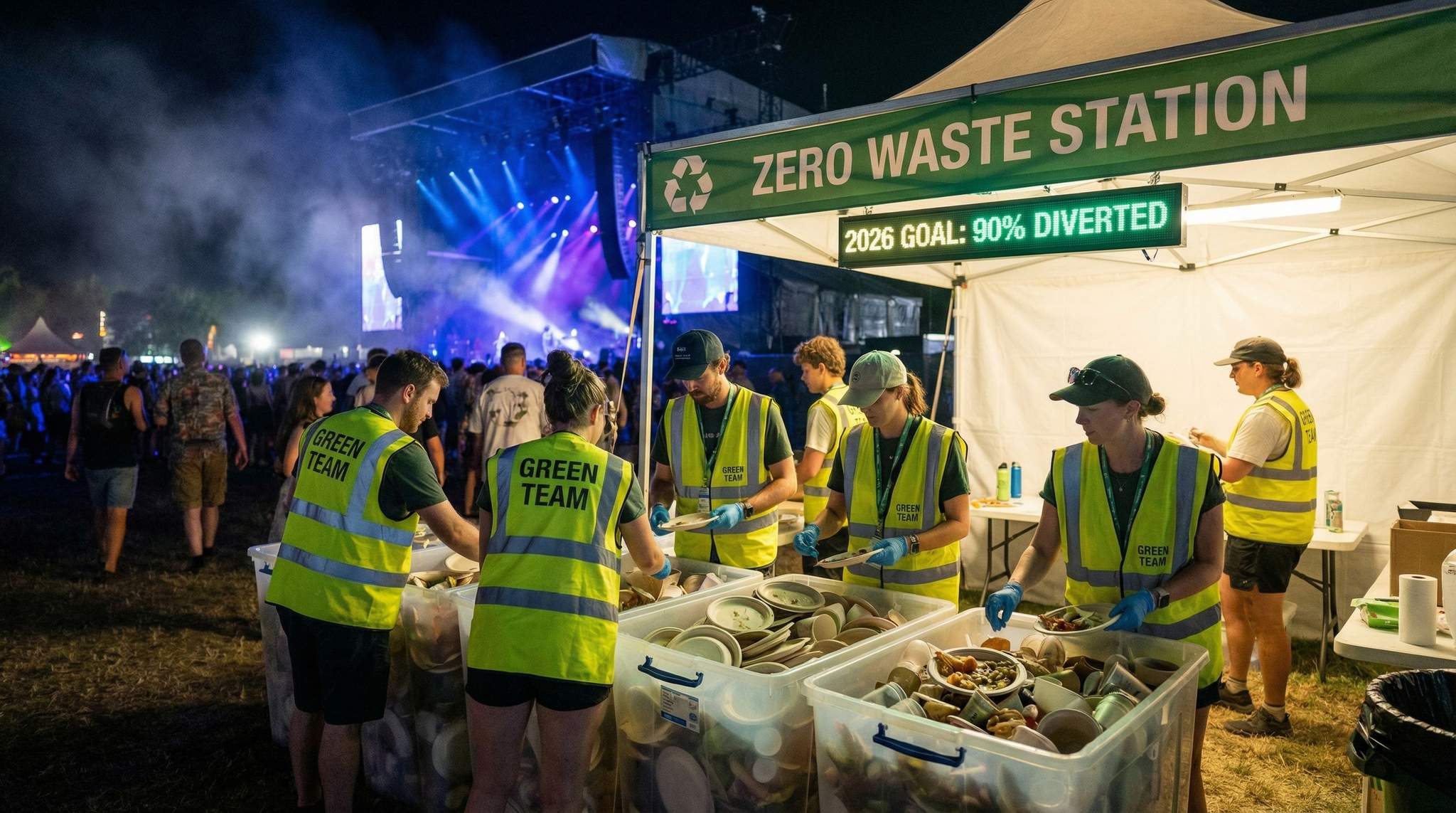
“Zero-waste” might sound like an impossible ideal, but leading festivals are coming impressively close. In industry terms, zero-waste usually means diverting at least 90% of event waste away from landfills (through recycling, composting, or reuse). By 2026, every festival – even smaller community events – should be targeting this 90%+ diversion zone. Achieving it starts with intelligent planning: provide clearly labeled bins for recyclables and food waste everywhere, and minimise what can’t be recycled in the first place. Hiring a dedicated “green team” of staff or volunteers to monitor waste stations during the event greatly boosts proper sorting (attendees often need a friendly nudge or guidance on what goes where). Vendor contracts must stipulate that all packaging and serveware they use is recyclable or compostable. Many seasoned producers perform a “bin audit” after each show – literally inspecting trash to see what slipped through – and use that intel to eliminate the most common offenders the next year.
Real-world examples prove that high diversion is doable. DGTL Festival in Amsterdam implemented a “Resource Street” where every bit of trash is hand-sorted into material streams for recycling or repurposing. They report achieving virtually 100% separation of waste streams, meaning hardly anything ends up as true “rubbish.” Smaller boutique events have been creative too: at a regional 5,000-person festival in New Zealand, organizers partnered with a local composting farm so that all food scraps and compostable plates from the event go directly to become fertilizer for the farm’s fields – a closed-loop solution that diverted tons of waste. The key to 90% diversion is treating “waste” as recoverable resources. This often entails training the cleanup crew to carefully sort out recyclables from the general waste pile after attendees leave. It’s extra effort, but it dramatically shrinks landfill volume. By tracking metrics like “kilograms of landfill waste per attendee,” festivals can quantify improvement. For instance, one U.K. festival proudly saw its waste-to-landfill drop to under 0.8kg per person per day after implementing comprehensive recycling – a huge improvement over typical festivals where that figure can be several kilograms. Hitting the 90% benchmark not only helps the planet but also cuts disposal costs (landfill tipping fees are expensive!). It’s a win-win goal that signals a festival is walking the talk.
Reusable Cups, Plates, and Serveware Programs
Perhaps the biggest game-changer in waste reduction is moving from disposable to reusable cups and dishware on-site. By 2026, single-use beer cups, food bowls, and cutlery should be relics of the past at festivals. The transition has been accelerated by innovative programs that make reusables convenient. A popular approach is the cup deposit system: attendees pay a small deposit (say $1 or £1) for a durable cup at their first drink, which they can refund by returning the cup – or simply keep the cup as a souvenir. Many events go further, rewarding sustainability: at DGTL, festival-goers who collected a stack of used cups and brought them to the bar were given free drink tokens, a sustainable initiative that saves money and keeps grounds clean as people actively picked up any abandoned cups. Other festivals provide a branded reusable cup or water bottle with each ticket, turning it into a collectible item that doubles as an eco-solution.
Reusables aren’t limited to cups. Food vendors can serve meals in sturdy, washable plates or bowls that are returned and sanitized for reuse. This requires setting up dishwashing stations on site (or working with an off-site dishwashing service that swaps dirty for clean dishware periodically). For example, Planet Bluegrass – the organization behind Colorado’s famed Telluride Bluegrass Festival – has long run a system where attendees buy a durable plate for a few dollars which can be reused at all the food stalls; washing stations are available, and at the end guests can either keep the plate or return it for a refund. This eliminated tens of thousands of disposable plates and cutlery pieces each year. The logistics of reusables do require planning: you need enough inventory of cups/plates, an efficient dish return and washing system, and staff to manage it. However, by 2026 the costs have come down and numerous vendors specialize in festival reusable cup programs (some offer full-service models where they deliver cups and handle washing). Experienced festival producers recommend starting with cups first – since drink containers usually make up the largest portion of event waste by volume – then expanding to food ware once that’s running smoothly. Don’t forget to clearly communicate the system: signage and MC announcements should explain how attendees can return items and why it matters. When done right, reusable serveware not only slashes waste but also can become a cool part of the festival’s identity (fans often love the branded cups as merch). Plus, it saves money: consider that washing a cup costs fractions of a penny, whereas buying a disposable cup might be $0.05 each – multiply that by hundreds of thousands of drinks and the savings are real.
Turn Fans Into Your Marketing Team
Ticket Fairy's built-in referral rewards system incentivizes attendees to share your event, delivering 15-25% sales boosts and 30x ROI vs paid ads.
Tackling Tent Waste and Abandoned Gear
One of the most notorious waste problems at multi-day festivals is the sea of abandoned tents, camping gear, and other items left behind by attendees. By 2026, festivals should have strategies to drastically reduce campsite waste – both to avoid landfill and to save the enormous labour (and cost) of post-event cleanup. Some UK festivals have essentially eliminated this issue by fostering a culture of “take your gear home” combined with practical measures. For instance, the boutique Body & Soul Festival in Ireland (5,000 attendees) makes sustainability part of its ethos and directly implores every camper to pack out what they brought; they downsized attendance to focus on the core community that values the site. But beyond culture, there are structural tactics. Roskilde Festival in Denmark (capacity 130,000) attacked tent waste by partnering with a rental program: attendees can rent a sturdy tent and camping gear for a deposit, use it for the weekend, then return it. In 2024, Roskilde saw a 25% jump in campers choosing rentals over buying cheap throwaway tents, effectively turning festival waste into new products, resulting in far fewer leftovers. The deposit model means if people abandon the rented gear, the deposit funds its cleanup or refurbishment – either way, the festival isn’t stuck with the bill.
Another brilliant initiative comes from Tomorrowland (Belgium), one of the world’s largest music festivals. Tomorrowland’s Camp2Camp program collects abandoned camping equipment after the event, refurbishes them, and then offers them for rent to future attendees at a lower cost. Over 4,000 tents have been reused this way, saving many tons of material from the dump, proving that green initiatives can be profitable. Not only does this create a circular loop, it also has spawned an off-site social enterprise employing locals to clean and repair gear. Smaller festivals can collaborate with local charities to similar effect: many events donate left-behind sleeping bags and tents to homeless shelters or refugee organizations. The goal by 2026 is that no usable camping gear ends up in a landfill. Achieving this means heavily publicizing “leave no trace” principles to attendees ahead of time, possibly incentivizing cleanup (like offering a chance at a prize for campers who show a clean campsite, or a small refund for bringing garbage bags of litter to recycling points). It’s also important to have convenient drop-off points at exits for people who want to donate their gear – better that than dumping in a field. Veteran operations managers note a side benefit: a cleaner campsite at end of festival not only feels good ethically, it also speeds up venue teardown and handover, reducing the risk of being fined by landowners for overrunning your site rental due to lengthy cleanup.
To sum up this section, a Plastic-Free, Zero-Waste ethos is entirely attainable with today’s knowledge and tools. Many events are already there. By focusing on eliminating disposables, maximizing recycling, and innovating around tricky waste streams like camping gear, festivals can visibly move beyond greenwashing. The benchmarks are set: zero single-use plastics and 90%+ waste diversion. The next sections will tackle equally critical 2026 benchmarks around carbon footprint, energy, and more.
Cutting Carbon Footprint and Energy Use
Setting Ambitious Carbon Reduction Targets
Climate change has become a central concern for festivals, especially as extreme weather poses direct risks to events (from heatwaves to storms). By 2026, every festival should have a carbon reduction target and roadmap – effectively a climate action plan – in place. A common benchmark many aim for is a 50% reduction in greenhouse gas emissions by 2030 (relative to a baseline like 2019), which aligns with global climate goals. That implies significant progress by 2026, such as a 25–30% reduction achieved already. More forward-thinking festivals are shooting for net zero carbon (balancing any emissions with removal or offset) even sooner. For example, several events in the UK and Netherlands joined initiatives to become carbon neutral by 2025, forcing them to aggressively cut emissions from power, transport, and more immediately. Setting a public target is important – it signals commitment and helps rally the team and stakeholders around making it happen. But targets must be backed by data. Experienced production teams start by measuring their current carbon footprint: accounting for fuel usage, electricity consumption, artist and crew travel, attendee travel, etc. With that baseline, you can identify the biggest sources (often audience travel and diesel generators) and prioritize reductions there. Some festivals use carbon calculators (even simple spreadsheets or tools from organizations like Julie’s Bicycle) to model the impact of changes – for instance, “If we provide more trains or shuttles, can we cut 10% of car travel emissions?” By 2026, it’s expected to at least track year-on-year emissions and have concrete actions each year that bend the curve downward.
Accountability is crucial: don’t hide the numbers. Festivals moving beyond greenwashing publish their carbon footprint and the progress (or setbacks) toward goals. This transparency builds trust and also forces the team to take the targets seriously. A useful framework some adopt is the Science Based Targets initiative (SBTi) adapted for events, ensuring their reductions align with the Paris Agreement’s aims. Even if you’re a small festival, the act of setting a carbon goal (e.g. “reduce diesel usage 30% in two years” or “offset all artist flight emissions in 2026”) demonstrates leadership. One warning: avoid solely relying on carbon offsets as an easy way out – buying offsets for emissions you haven’t actually reduced can appear disingenuous unless you’ve exhausted direct reduction measures. We’ll discuss offsets versus real reductions in a moment. Overall, for 2026, the benchmark is that carbon management is integrated into festival planning: you budget for it, assign someone responsible for sustainability, and regularly review how to cut emissions at every step of the event lifecycle. Proving you have a plan to hit meaningful targets is the antidote to any accusation of greenwashing in the climate arena.
From Diesel Generators to Clean Energy
Traditionally, festivals (especially greenfield outdoor ones) have relied on rows of diesel generators chugging away to power stages, lights, and campgrounds. This is often the single biggest source of on-site carbon emissions, not to mention air and noise pollution. By 2026, the industry is pushing to curtail diesel use dramatically – a benchmark goal is to reduce or replace at least 50% of diesel generator usage with cleaner alternatives. Many festivals are proving this is feasible. A prime example is Tomorrowland in Belgium, which worked with local authorities to expand grid electricity supply into its festival site. By tapping into the mains grid and using battery backups, Tomorrowland cut its diesel generator use by 50% in just one year by replacing generators with portable solar rigs, slashing fuel consumption and emissions accordingly. Similarly, Amsterdam’s DGTL Festival collaborated with the city to run 100% on renewable grid power, eliminating diesel generators entirely. The cost that would have gone to renting generators and buying thousands of liters of fuel instead went to a standard electricity bill – often a cheaper and certainly more stable power source. Festivals in remote areas without grid access are investing in alternatives like solar hybrid generators and biofuel. For instance, several Australian and American festivals have deployed portable solar rigs with large battery storage to run stages during daylight, kicking in a biodiesel generator only when needed at night. As battery technology improves, even multi-day camping festivals can run significant portions of their power on stored solar energy.
For festival producers, transitioning to clean energy requires working closely with power suppliers and potentially the local utility. It may involve upgrading infrastructure (e.g. adding electrical distribution on a farm site, which might require permits and installation of transformers) – so plan this well in advance. However, these investments pay off. One large U.S. festival that added permanent grid hookups calculated that over three years, the cost was repaid by savings on generator rentals and diesel fuel. There are also specialized event power companies now that provide battery-based generators or hydrogen generators on a rental basis, making it easier to try greener tech without huge capital expense. By 2026, festival teams should be well-versed in these options. Even smaller-scale changes help: using LED lighting and efficient sound equipment dramatically lowers power draw, meaning fewer generators (or smaller ones) are required. At a 40,000-capacity festival in 2022, the production team realized that by switching to LED tower lights and smarter scheduling of sound checks, they could eliminate two diesel light towers and one generator – saving hundreds of liters of fuel and simplifying logistics. Every bit counts. The ultimate vision is a festival that one day runs entirely on renewables; until then, the 2026 benchmark is to minimize fossil fuel power on-site as much as possible and document those reductions.
Reducing and Offsetting Carbon Emissions
Even with bold steps in power and waste, festivals inevitably have some carbon footprint – especially from transportation, which we’ll tackle in the next section. To truly move “beyond greenwashing,” producers need to address these emissions head-on and honestly. First, reduce what you can: this might include measures like optimizing schedule logistics so that you’re not running generators or lights when not needed, or choosing local suppliers to shorten delivery distances. Some festivals have even adjusted their operating hours (for example, ending the music an hour earlier each night) to save electricity and give attendees more rest – an eco and attendee-wellbeing twofer. Another area is artist bookings: an experienced talent manager might route an artist’s performance to minimize separate flights – e.g. booking artists who are touring nearby to avoid a special long-haul flight just for one festival date. These kinds of operational tweaks, while invisible to audiences, can chip away at emissions.
Need Festival Funding?
Get the capital you need to book headliners, secure venues, and scale your festival production.
After maximizing reductions, festivals often turn to carbon offsetting to deal with the remainder. Offsetting means investing in projects that reduce or remove emissions elsewhere (like tree planting, renewable energy projects, etc.) equivalent to the festival’s own emissions. By 2026, offsets are considered a supplemental step – useful, but not a free pass to avoid action. If you do offset, be sure to choose reputable, verified offset projects (e.g. Gold Standard or VCS certified projects) and be transparent about what portion of your footprint you offset. Some festivals, such as Boom Festival in Portugal, have gone as far as claiming carbon neutrality by heavily using offsets combined with on-site reductions. However, savvy audiences are increasingly wary of “offset and forget” approaches; they want to see that the festival is genuinely changing its operations, not just writing a check. A good practice is to involve attendees in offsetting: for instance, offer an “opt-in carbon offset” during ticket purchase (a few dollars that go toward a climate project). Many fans will contribute if they know it’s going to, say, a local reforestation effort tied to the festival. This not only subsidizes the cost, but also educates the audience about their travel impact.
This brings up a critical question frequently asked by skeptical fans and industry watchdogs alike: are event venues really offsetting emissions or just buying credits to look good on paper? For veteran producers, the distinction is vital. Purchasing cheap, unverified carbon credits without changing operational habits is the textbook definition of greenwashing. True offsetting requires investing in high-quality, localized, and verifiable environmental projects only after all possible on-site emission reductions—like switching to grid power or optimizing routing—have been exhausted. Promoters must be prepared to show the receipts for both their reduction efforts and their offset investments.
One cautionary tale from a European festival: they loudly advertised being “100% carbon neutral” but failed to explain or substantiate it – under scrutiny, it turned out they were only offsetting a small part of their emissions and hadn’t reduced their diesel at all. The backlash in press and online was harsh, labeling them as greenwashers, and sponsors were not pleased. The lesson is honesty: if you’ve only partially achieved your carbon goals, say so and explain how you’ll improve. By 2026, festivals should ideally be publicly reporting their carbon footprint and mitigation efforts (many do this in a post-event sustainability report). This level of accountability turns sustainability from a fuzzy claim into a credible commitment. In summary, the benchmark is that every festival actively manages its carbon footprint – through reduction first and foremost, and responsibly offsetting what can’t be eliminated – and does so in a transparent way. Even if you’re not at net zero yet, showing year-on-year emission decreases and responsible practices is what separates true climate leadership from empty greenwashing.
Energy Efficiency and Innovative Power Solutions
In tandem with shifting to renewables, 2026 festivals are expected to be far smarter in how they use energy. Energy efficiency may not sound as thrilling as solar panels, but it’s often the easiest, cheapest way to cut both emissions and costs. Festivals can benchmark performance in terms of energy per attendee: for example, how many kilowatt-hours are needed per audience member, and strive to lower that each year. Practical steps include conducting an energy audit of the event – identify which stages or activities are energy hogs and figure out why. Perhaps that art installation with old-school incandescent bulbs can be refitted with LEDs, or the VIP area doesn’t actually need power-hungry air conditioning all day. Some events implement automatic shut-off timers for certain systems (like decorative lighting or non-essential sound systems) after curfew to avoid all-night wastage.
Boost Revenue With Smart Upsells
Sell merchandise, VIP upgrades, parking passes, and add-ons during checkout and via post-purchase emails. Increase average order value by up to 220%.
One area of innovation is smart power monitoring: IoT sensors and software can now give real-time data on energy use by different zones of a festival. Production teams in 2026 increasingly use these tools to spot anomalies (like an idle stage drawing power due to forgotten equipment left on) and to optimize generator loading. Running generators at optimal load is more efficient and can allow one unit to be turned off if others are underutilized. Seasoned production electricians know that an oversized generator running at 20% load is both wasting fuel and risking breakdown – better to redistribute loads and turn off extras. Some festivals employ microgrid setups: rather than each vendor bringing a portable generator, the festival provides a centrally managed grid with distributed energy resources like batteries that charge during low-use times and discharge at peaks. This ensures no generator is idling. An example is a tech-forward festival in California that worked with a startup to deploy a temporary solar microgrid for its food court, which reduced diesel use and ensured vendors had uninterruptible power.
Another creative solution is energy storage-sharing between festivals. Large batteries or power banks purchased by one event can be shared with another if schedules don’t overlap – a model facilitated by networks of events cooperating (much like gear-sharing alliances). This is already happening informally in some regions, and by 2026 we expect more formal collaborations. It saves money and maximizes the use of expensive kit like battery systems. Resource-sharing alliances among festivals not only cut costs but also cut collective footprints, as covered in guides on how festivals band together for efficiency.
In terms of benchmarks, festivals should aim to track key energy metrics (total kWh used, kWh per attendee, fuel liters consumed, etc.) and show reductions. A mid-sized festival might set a goal like “reduce diesel fuel use by 30% in 2026 vs 2024” through a combination of energy-saving measures and switching to solar or grid power. The technology and know-how exist – what’s needed is the commitment to implement them. By focusing on energy efficiency and innovative power approaches, festivals not only cut emissions but also make themselves more resilient (for example, less likely to have a generator failure knock out a stage, since loads are well-managed and backups in place). The bottom line: using less energy to deliver the same festival experience is the unsung hero of sustainability, and by 2026 it’s a benchmark every festival can strive for.
Sustainable Food and Water Practices
Low-Impact Catering and Menus
Food is a big part of the festival experience – and by 2026 it’s also a big part of the sustainability equation. Festivals should be hitting benchmarks in sustainable catering, meaning not just what attendees eat, but how that food is sourced, served, and disposed of. A key goal is to reduce the carbon and ecological footprint of festival food. One effective approach is offering more plant-based menu options or even going entirely vegetarian/vegan. Producing meat (especially beef and lamb) creates significantly higher emissions and resource use than plant-based foods. Forward-thinking festivals have shown leadership here: Shambala (UK) made headlines when it switched to a 100% vegetarian food offering a few years ago, prioritizing delicious veggie cuisines from around the world. They found that not only did this cut their event’s carbon emissions (by an estimated approx. 60 tonnes of CO2 saved from meat avoidance), but many attendees embraced the change and discovered new favourite foods. While not every festival will eliminate meat completely, by 2026 it’s reasonable to expect at least a 50% plant-based share in food vendors and no unsustainably sourced items. For example, festivals should ban vendors from selling endangered seafood or using palm oil from non-certified sources. Some events encourage vendors to source ingredients locally (within say 100 miles) to cut down on transport emissions and support local farmers – a great community angle as well. Creating a “sustainable food charter” for vendors ensures everyone is on the same page about expectations (e.g. use free-range eggs, seasonal produce, fair trade coffee, etc.). Experienced festival food managers suggest working with vendors months in advance, sharing expected sustainability guidelines so they have time to adapt menus or find suppliers. It’s also wise to curate your vendor lineup by prioritizing those with visible eco-credentials – many street food operators now market themselves as eco-friendly, which can enhance your festival’s overall brand.
Another aspect is portioning and pricing strategy to minimize food waste. Oversized portions that end up half-eaten in the bin are a common sight at events. Some festivals collaborate with vendors on right-sizing portions and offering half sizes or sample platters (so attendees can try multiple things without waste). Education plays a role too: festivals increasingly highlight vendors who use compostable plates or edible packaging, making sustainability part of the culinary adventure. All these efforts satisfy a growing demographic of festivalgoers who care about ethical eating. In fact, including a few explicitly eco-conscious food vendors – think solar-powered food trucks or stalls run by environmental social enterprises – can turn your food court into an attraction in itself. By 2026, fans will notice if your event’s food is just the same old greasy fare on styrofoam plates. The benchmark to hit is a food program that is tasty, diverse, and demonstrably sustainable in sourcing and service. Achieving that means planning and vetting vendors systematically, but the payoff is huge: reduced emissions, less waste, and a distinctive experience that aligns with your sustainability story.
Eliminating Single-Use Water Bottles
Water – essential for life and abundant in waste if managed poorly. Many festivals in the past have relied on selling mountains of single-use plastic water bottles, which, aside from the plastic waste, also have a hefty carbon footprint in production and transport. By 2026, a clear benchmark is zero disposable water bottles on-site for both attendees and artists/crew. In practice, this means providing free access to safe drinking water throughout the venue and backstage. Major festivals like Glastonbury, Reading, and Bonnaroo have all installed extensive water refill infrastructure and banned the sale of single-use water bottles. It’s not only the right thing to do environmentally; it’s also a strong statement to attendees that you’re serious about waste reduction. Of course, implementation needs to be meticulous. A festival of 30,000 people on a hot summer day can require tens of thousands of litres of drinking water – you need enough refill points (taps, fountains, water stations) dispersed to prevent huge queues or people resorting to buying other packaged drinks. Many events partner with organizations like WaterAid or local utilities to set up water kiosks and fountains, sometimes even bringing in filtered water trucks. By 2026, the technology for mobile water stations (with filtration and chilling) has improved and become more common.
Data-Driven Event Marketing
Track ticket sales, demographics, marketing ROI, and social reach in real time. Exportable reports give you the insights to make smarter decisions.
One challenge is managing the revenue loss if your festival used to earn money on bottled water sales. However, creative producers have found alternatives: selling reusable branded bottles or canteens can become a new revenue stream. For instance, a festival in California introduced stainless steel water bottles with the festival logo for $20 each – they sold out as popular merch, offsetting the lost profit from water bottles and eliminating tens of thousands of plastic bottles. Some events also sell canned water (infinitely recyclable aluminum) as a transitional measure, but the end goal remains free water refills for all. Backstage and artist hospitality must align too – no more endless cases of individual plastic bottles on riders. Instead, provide water coolers and jugs in dressing rooms and at stages, with artists given reusable bottles or cups. Most artists by now are accustomed to this (many request it!). Communication again is key: make it loud and clear in all attendee info that no plastic bottles will be sold, but water is freely available. Encourage folks to bring empty bottles (often security will allow an empty bottle through, or a sealed full one they can refill after dumping the original water). Also, consider hydration needs in different scenarios – for example, in camping areas you might deploy roving water carts or more taps since people are there 24/7. One lesson learned from a European festival: when they first banned bottled water, a heatwave hit and the initial number of water points was insufficient, causing frustration. They corrected course by rapidly installing temporary tanks and greatly increasing supply – afterward, they committed to a robust contingency plan for extreme weather. The bottom line for 2026: attendees should never have to buy or toss a plastic water bottle at your festival. With planning and investment in infrastructure, achieving a bottle-free festival is entirely realistic, and it’s one of the most visible ways to show you’re beyond greenwashing.
Managing Food Waste and Composting
No matter how well you plan, there will always be some leftover food and organic waste at events – from kitchen prep scraps to half-eaten meals and compostable serviceware. The sustainability benchmark here is 100% diversion of organic waste to compost or bioenergy, rather than landfill. By 2026, festivals should have end-to-end plans for handling food waste responsibly. Start with the source: work with food vendors on inventory management so they don’t grossly overstock perishable items (which often end up trashed). Many festivals now encourage vendors to donate unsold food at the end of each day to local shelters or food banks. Cities like Los Angeles, London, and Sydney have nonprofit organizations that coordinate food rescue from events – plug into those networks. Some festivals set up a collection point and refrigerated storage for surplus food, making it easy for charity partners to pick up. This not only prevents waste but helps feed people in need, boosting the festival’s community impact.
For the unavoidable waste (plate scrapings, fruit peels, coffee grounds, compostable plates/cups), having a commercial composting plan is key. If your venue is in an urban area, you might arrange for an organics recycling company to provide bins and haul it to an industrial compost facility. If you’re on a farm or rural site, perhaps the landowner or local farms can use the waste for their compost heaps – as was done by several festivals like the Greenbelt Festival in the UK. On-site composting is possible for small events but usually not practical for large ones due to volume and time required; better to have a professional service handle it. The critical part is making sure attendees put their leftovers and compostables in the right bins. Clearly marked “food waste” or “compost” bins should be as common as recycling bins, placed near food areas and picnic tables. Green team volunteers can help here too by gently directing people, or even by doing a quick sort of trash can contents after peak meal times (it sounds dirty, but at many eco-minded festivals volunteers line up to help because they passionately want to ensure compost doesn’t get contaminated with plastics!). By tracking how much organic waste is composted, you can share impressive stats – e.g. “5 tons of food scraps were turned into compost for local farms, rather than emitting methane in a landfill.” It’s impactful.
Another angle is cutting food waste at source: some festivals implement participation challenges like urging campers to only bring what they’ll actually eat, and offering communal kitchens or food share stations for excess. A great example is Burning Man’s Burner Express Bus program – riders are given a trash bag and encouraged to deposit any unopened food at the end of the event for donation; this concept can be adopted by music festivals, too. Ultimately, by 2026 the expectation is that festivals treat food waste not as garbage but as a resource. Achieving near-total composting closes the loop, returns nutrients to the earth, and powerfully reinforces a festival’s authenticity in sustainability. It’s hard to accuse an event of greenwashing when you see their on-site compost piles steaming behind the scenes or local farmers picking up barrels of food scraps to enrich their soil. That kind of full-circle thinking is exactly what the future of festival sustainability looks like.
Sustainable Merch and Materials
While less obvious to attendees than solar panels or recycling bins, the merchandise and materials a festival uses can also contribute to sustainability credentials. By 2026, festivals should aim to produce merchandise and printed materials with minimal environmental impact. This means using organic or recycled fabrics for official t-shirts and hoodies, offering eco-friendly products like upcycled tote bags, recycled plastic sunglasses, or bamboo fiber hats in the merch lineup. Some events have even turned retired festival banners and signage into limited-edition merch: for instance, Denmark’s Roskilde Festival has made tote bags and rain ponchos out of old stage banners, effectively turning trash into cash – selling out these one-of-a-kind items to fans and diverting waste in one go. Not only is this a sustainable practice, it creates story-driven products that fans love to buy (and tell their friends about). Merchandise can thus shift from generic fast-fashion tees to conversation pieces with a reuse narrative.
Printed materials like programs, flyers, and tickets should be minimized or switched to digital. Most festivals by 2026 have digital ticketing (using mobile QR codes or RFID) which eliminates paper tickets and plastic laminates. Platforms like Ticket Fairy provide robust mobile ticket solutions, removing the need for printed tickets altogether. If physical programs or schedules are needed, use recycled paper and soy-based inks, and print only what’s truly necessary. Many events have moved to festival mobile apps for schedules, which not only saves paper but also allows live updates – a sustainability win and a better user experience. Decorations and art installations are another area to consider: a lot of staging and decor gets trashed after a festival if not planned carefully. The new benchmark is reusable staging and decor – invest in modular stages that can be re-skinned and used year after year, or share large art pieces between events through initiatives like festival lending libraries. Some festival associations maintain directories of available props and set pieces that others can rent or borrow, fostering a circular economy of festival production materials.
Free Tool: How Many Staff Do You Need?
Get a starting headcount for security, stewards, scanners, bar staff and first aid from your crowd size, event type and risk level.
Even things like staff uniforms and signage can be made greener. For example, instead of single-use vinyl banners with dates (destined for the dumpster post-event), print undated banners that can be reused annually, or use digital screens for signage where possible. Crew t-shirts can be collected at the end of the weekend, washed, and stored for the next edition (this works well if they just say “Crew” without a year). It’s all about avoiding one-and-done uses. These details might seem small individually, but collectively they reduce the resource footprint of the festival considerably. More importantly, they demonstrate an organizer’s pervasive commitment to sustainability – not just the big-ticket items like energy and waste, but all the way down to merch and materials. Fans notice these touches, and sponsors appreciate them too (they may even co-brand on sustainable merch items). The 2026 benchmark is that any aspect of the festival that can be made more sustainable, is. From compostable wristbands to solar-powered phone charging stations for attendees, it’s about weaving eco-conscious thinking into every facet of production. Festivals that embrace this holistic approach will stand out as truly “beyond greenwashing.”
Greener Transportation and Travel
Reducing Audience Travel Emissions
For most festivals, especially destination events, attendee travel is the largest source of carbon emissions in their footprint – often 60-80% of total emissions, according to data from the IEMA. The flights, car trips, and bus rides that bring tens of thousands of people to a site add up to a huge impact. By 2026, festivals need concrete strategies to curb these emissions. One benchmark goal is to significantly increase the percentage of attendees arriving by low-carbon transport (trains, buses, carpooling, cycling) versus single-occupancy cars or flights. Many European festivals are leading the charge because they have strong rail networks: events like Roskilde (DK) and Tomorrowland (BE) partner with national rail services to run special festival trains, and offer combined festival + transport tickets. In Roskilde’s case, a majority of international attendees take the train from Copenhagen direct to the festival grounds, aided by discounted rail passes and energy savings campaigns. Elsewhere, shuttle bus programs from major cities or airports have become standard – Coachella’s “Any Line Shuttle” and regional festivals in Asia providing charter buses have shown that if you make it easy and incentivize it, fans will opt in. By 2026, offering festival shuttles from key hubs isn’t just a nice extra, it’s expected.
To push more people out of cars, some festivals have implemented robust carpool incentive or car disincentive schemes. For example, Shambala (UK) charges a hefty parking fee (e.g. £50) for those driving solo and uses that money to subsidize free shuttle buses from train stations, ensuring the site is clean and sustainable. They also give priority camping spots to cars that arrive full of passengers (a car of 4+ might get a location closer to the entrance). Other events partner with rideshare apps or carpool-matching services so strangers heading from the same city can easily team up. One innovative idea is the “green arrival” reward – attendees who show a train or bus ticket at the gate might get a small merch discount or a chance to win an upgrade. While these perks cost little, they send a strong message and can shift behavior. Especially with Gen Z attendees increasingly climate-conscious, many actually appreciate when festivals nudge them toward sustainable travel options.
For international travelers or those who must fly, some festivals set up carbon offset programs specifically for travel. When buying tickets, fans can opt into an extra fee that funds tree planting or renewable projects to offset their flight’s emissions. There is a debate about relying on offsets, but providing the option at least acknowledges the impact. A few pioneering events have even experimented with virtual attendance for distant fans – streaming parts of the festival in high-quality – to reduce the need for long-haul travel (though this is more of a supplement than a substitute for most). By 2026, festival producers should be collaborating with transport authorities, rideshare companies, and perhaps even airlines (to explore group discounts or offset partnerships for festival-goers) to tackle this challenge. The benchmark outcome would be, for example, “X% of attendees arrived by sustainable transport” and seeing that percentage climb each year. Some UK festivals aimed for 50% non-car travel by mid-decade, a target that more urban festivals have exceeded. The key is data: use postcode surveys or ticket origin data to measure how people come, and be transparent about it. When fans see that, say, 10,000 car trips were avoided thanks to shuttles and carpools, it reinforces that their choices made a difference. In short, 2026 festivals should be actively shaping how their audience travels – making the green option the convenient and affordable one.
Greener Artist and Crew Transportation
While audience travel dominates emissions, the travel logistics for artists, DJs, and production crew are also important to address. By 2026, festivals are expected to have plans to green their artist and staff transportation as part of overall sustainability. This starts with booking and routing: savvy talent buyers try to book artists who are on tour regionally around the festival dates, so that a single long-haul flight is used for multiple shows rather than flying someone in just for one set. Festivals within promoter networks can coordinate to route artists efficiently – for instance, a band might play three European festivals over two weekends rather than flying back and forth from the U.S. three times. These decisions happen behind the scenes but can cut huge amounts of emission (and save money on airfare too). Artist relations teams are also increasingly proactive: some ask artists to travel by train or electric car for closer distances, or provide tour bus options. For example, a festival in France arranged a biofuel-powered bus to pick up several artists from Paris and bring them to the site, rather than multiple separate car journeys.
On the crew side, using local staff and suppliers wherever possible reduces transport needs. If you’re flying in a technical team or trucking gear across long distances, consider whether local vendors or crew hires could do the job – this not only slashes transportation emissions but supports the local economy. Many international festivals now hire local stagehands, runners, and techs instead of bringing an army from home base. When trucking is necessary (for staging, sound equipment, etc.), maximizing the load efficiency is key: no half-empty trucks. Some events consolidate shipments with others in the same region – for example, two festivals a week apart might share one set of staging that is moved and reused, rather than each trucking separate gear. This kind of inter-festival cooperation is on the rise and can be facilitated by production service companies.
Free Tool: Project Your Bar Revenue
Per-head spend benchmarks by event type turned into projected bar and food revenue, with a stock-mix estimate and gross-margin line. Free calculator.
Another element is on-site vehicle use. Festivals employ fleets of buggies, ATVs, and trucks to move people and materials around the site during build, show, and break. By 2026, expect to see more electric or hybrid vehicles in these fleets. Electric golf carts and even electric vans are increasingly available and can often meet the needs for short-range, low-speed site transport. They not only cut emissions but also reduce noise and fumes that crews have to deal with. Some festivals power their production buggies by solar charging stations on-site. There’s also a push to reduce unnecessary driving: smart site layout and radio coordination can avoid dozens of little trips. A simple practice like scheduled shuttle vans for crew (doing loops every 15 minutes around perimeter roads) can replace many individual runs in pickups. Fuel management plans are now common – tracking how much diesel or gasoline is used for site vehicles and aiming to reduce it year on year by using alternatives and better planning.
Lastly, consider the symbolic leadership of how key figures arrive. When artists or VIPs choose greener modes, it sends a message. Case in point: when Coldplay announced an eco-conscious tour, they partnered to have crew and some gear travel by ship instead of air freight, and band members took commercial flights instead of private jets. A festival could highlight if any headliner took a train or if the festival director rides an electric motorcycle on site, etc. These anecdotes humanize the sustainability effort. In summary, by 2026 a festival’s sustainability plan must encompass travel logistics for everyone, not just ticket buyers. The benchmark is having policies or initiatives in place so that artist travel emissions are mitigated and crew transport is optimized. Not every emission can be eliminated – sometimes a band will still need that transatlantic flight – but if you can say “we coordinated schedules to avoid X flights and offset the rest,” you’re far ahead of a festival that hasn’t even considered the issue.
Site Selection and Transportation Access
An often overlooked but crucial aspect of sustainable travel is the location of the festival and its access to transit. By 2026, planners are giving as much weight to transport accessibility as they do to scenic beauty or capacity when choosing venues. A festival site well-served by public transport options (trains, buses) or closer to population centers inherently lowers travel emissions for everyone. Urban and suburban festivals have an advantage here: many city-based events integrate with existing transit (for example, Primavera Sound in Barcelona encourages attendees to take the city’s metro and has stops near the venue). For rural festivals, organizers are working with local authorities to set up temporary transit solutions – like park-and-ride lots on the city outskirts with high-capacity shuttles, so that not every car drives all the way to the remote site. Shuttle bus fleets can be surprisingly efficient: a single coach bus can take 40-50 cars off the road. In the U.S., some festivals team up with bus companies to run cross-state coaches (e.g., from major cities directly to Bonnaroo or Burning Man).
Choosing a site with good road and rail connections also reduces the impact of supplier and artist transport. If semi trucks can access your site easily via highway or if there’s a rail freight spur nearby, you might consolidate deliveries or use cleaner transport modes. Some festivals even coordinate car-free days in the local town during the event to reduce congestion and emissions – working with the community on traffic planning becomes part of sustainability. The benchmark by 2026 is that festival teams do a transportation impact assessment during site selection or design: asking “How will 20,000 people get here, and can we make that greener?” If a beautiful location has zero public transport, one might offset that drawback by providing robust shuttle service from the nearest city or station. Innovative ideas include partnering with bicycle organizations to have guided bike convoys to the festival (with secure bike parking provided on-site). A few European festivals have done this, turning the ride into a fun pre-festival event.
Infrastructure for electric vehicles (EVs) is another modern consideration. As more attendees start to drive electric cars, festivals should facilitate that by providing some EV charging stations at or near the venue. By 2026 it’s plausible that a noticeable fraction of attendees (especially in Europe and North America) will arrive in EVs. Having charging available (ideally using renewable energy) is a nice touch that shows you’re thinking ahead – and it encourages those attendees to choose electric in the first place. Festivals can work with charging companies to set up temporary solar-powered chargers or fast-charge units for the weekend.
In conclusion, aligning your venue choice and transportation plan with sustainability can drastically lower your festival’s carbon footprint. It’s an area that requires coordination with external stakeholders (city transit authorities, coach companies, etc.), but the results are tangible. Fans will also appreciate an easier journey – nobody likes sitting in a 3-hour traffic jam into a festival. By making sustainable transit the path of least resistance, you not only cut emissions but also improve the overall arrival experience. The 2026 benchmark is that transportation is no afterthought: it’s a core part of festival planning, with environment-friendly options baked in from the start. That’s how you truly move beyond empty eco-promises and design the event experience to match.
Community Engagement and Partnerships
Involving Attendees as Sustainability Allies
The most successful sustainable festivals don’t act alone – they turn their attendees into active participants in the mission. By 2026, engaging festival-goers in eco-initiatives is a benchmark for credibility. One effective strategy is implementing an eco-deposit or incentive system for attendees. We saw this with Shambala’s £20 “Recycling Deposit” on tickets, which resulted in reduced cleanup and disposal expenses – every guest paid a deposit that they could reclaim by returning a bag of sorted recycling at the end of the event. This clever tactic virtually guaranteed that attendees took responsibility for their waste; those who didn’t effectively funded the cleanup via their unclaimed deposit. Other festivals use positive rewards: offering merch discounts or even VIP upgrades via random prize draws for people spotted doing green acts (like using the proper bins or bringing a reusable cup). Some have “green scouts” roaming the grounds handing out tokens to environmentally conscientious attendees, which can be exchanged for a free drink or a souvenir. These fun, gamified approaches get people involved in a friendly way.
Another avenue is to create opportunities for fans to directly contribute to sustainability projects on-site. Many festivals now have a “eco-zone” or sustainability center where attendees can learn about the festival’s initiatives, drop off recyclables, participate in workshops (like upcycling crafts or tree-planting tutorials), and even sign up for next year’s volunteer green team. Burning Man is an extreme case where every attendee is responsible for “leave no trace” and is effectively crew, but mainstream festivals can borrow that ethos by clearly communicating that keeping the event green is a shared responsibility. Simple messaging like announcements from stage (“Don’t forget, take your cups to the return points and earn that deposit back – let’s leave this place spotless!”) and signage (“You are in a Zero Waste Zone – every bit of trash has a place. Do your part!”) reinforce the culture.
There are also formal programs like “eco-ambassador” attendees or fan ambassador teams. Some events recruit passionate ticket-holders ahead of time to champion sustainability among their peers – they might lead campground recycling challenges or be the ones answering questions in sustainability info booths. Empowering your audience in this way deepens their loyalty; they feel like stakeholders in the festival’s success, not just consumers. By 2026, the benchmark is that a festival’s sustainability is visibly co-created with its fans. This builds a community vibe that goes beyond the festival weekend – attendees often carry these practices home or to other events, amplifying the impact. And when fans feel proud of a festival’s eco-credentials (especially if they’ve had a hand in it), they become your best ambassadors, countering any cynicism about greenwashing. They’ll brag about how “their festival” is carbon-neutral or waste-free, which is priceless word-of-mouth marketing. In essence, treat your attendees not as potential litterbugs to be managed, but as allies and educators. That shift in mindset is what makes sustainability efforts truly stick.
Partnering with Local Communities and Causes
Festivals don’t exist in a vacuum – they are guests in their local community, whether that’s a city neighbourhood or a rural town. Sustainability and community engagement go hand in hand, and by 2026 festivals are expected to deliver positive impacts to their hosts, not just avoid negative ones. A key benchmark is forming local partnerships that create mutual value and reinforce sustainability goals. For example, many festivals now work closely with local farmers, artisans, and businesses to source goods and services. A festival in Mexico might source all its produce from nearby farms (reducing transport emissions and boosting the local economy). In Australia, some bush festivals invite Indigenous elders from the area to conduct Welcome to Country ceremonies and advise on caring for the land, blending cultural respect with environmental stewardship.
One powerful model is when festivals support local environmental projects. This could mean donating a portion of ticket sales or on-site fundraising to a local tree-planting initiative, park restoration, or wildlife charity. Or it might be a hands-on approach: a day of service where festival staff and volunteers help clean a local river or build a community garden before or after the event. Lightning in a Bottle festival in the US, for example, has worked on local habitat restoration as part of its leave no trace efforts, involving attendees who stay after the festival to help. By 2026, we expect festivals to market themselves not just as entertainment, but as a sort of temporary citizen of their locale that gives back. When the surrounding community sees tangible benefits – cleaner parks, donations to schools, employment opportunities – they become strong allies, which is crucial for long-term success. Community goodwill can even be the factor that gets your permits renewed year after year without hassle.
Additionally, collaborating with local authorities on sustainability can yield results. Some cities offer incentives or grants for events that hit certain green targets (like waste reduction or public transit promotion). A festival in France worked with its regional government to pilot a reusable cup system city-wide, essentially using the festival as a test bed for broader waste reduction programs. The festival gained resources and expertise, while the government gained a high-profile case study. In developing markets or smaller towns, festivals might actually be the first to introduce certain eco-practices, effectively educating the local population by example. It’s important to approach community engagement humbly and genuinely: ask locals what issues matter to them. For instance, if water scarcity is a concern in the area, emphasize water-saving measures at the festival and maybe contribute to local water infrastructure (one festival funded new water wells in their host village as a thank-you).
By integrating sustainability with community partnership, you steer far clear of greenwashing – because the impact is visible and verified by those on the ground. Case in point: after years of engagement and eco-efforts, Glastonbury Festival has become beloved in its region not just for its economic impact but for its environmental advocacy (they’ve campaigned for local river health, for example). In 2026 and beyond, the festivals that thrive will be those seen as a positive force in their community, not just a big party that rolls in and out. The benchmark to aim for is having community leaders and residents who will vouch for your festival’s integrity and benefits. That kind of trust can’t be faked – it’s earned through real action and collaboration.
Aligning Sponsors and Vendors with Sustainability Goals
An often tricky area is ensuring that your sponsors and vendors also walk the sustainability talk. Nothing undermines a festival’s credibility faster than an “eco-friendly” event plastered with logos of companies known for pollution, or vendors handing out plastic freebies at a zero-plastic festival. By 2026, festivals should set benchmarks for sponsor and vendor alignment: essentially a filter or criteria to partner with those who support (or at least don’t contradict) the festival’s green mission. This doesn’t mean you only accept 100% perfect companies – but it does mean having standards. For example, many festivals now refuse sponsorship from fossil fuel companies or big polluters, while actively seeking sponsors in sectors like renewable energy, electric vehicles, sustainable fashion, or plant-based food. The rationale is clear: sponsors increasingly want to be associated with authentic causes, and festivals want sponsors that enhance rather than detract from their message. It’s better to have a solar power company sponsor your energy program (perhaps funding a solar charging station for phones or a shaded cool-down tent) than to take easy money from, say, a single-use plastic bottled drink brand that contradicts your values.
Similarly, food and retail vendors are curated with sustainability in mind by 2026. Festivals often require vendors to adhere to the event’s policies (no plastic packaging, locally sourced ingredients, sustainable merch only, etc.). Some go further and score vendor applications on eco-criteria – giving booth space preference to those who demonstrate green practices. At one festival in Bali, for instance, they give a small discount on vendor fees if the vendor is certified eco-friendly or uses all-natural materials in their products. Encouraging and rewarding vendors this way accelerates change beyond the festival, as these businesses adopt greener operations to qualify.
However, aligning sponsors and vendors can involve tough conversations. You might have a long-time sponsor who isn’t exactly green; it may be worth engaging them on a transition plan (“Can you supply us with compostable packaging for your product samples this year? Can you offset the emissions for the transport of your activation booth?”). Some companies will gladly collaborate on sustainability if you prompt them – others might not, and then you face a choice. Many veteran festival directors emphasize that protecting your brand integrity is paramount; short-term sponsorship money isn’t worth it if it undercuts the trust you’ve built with your audience. Fans do notice these details. If you preach waste reduction but a sponsor’s promo team is handing out thousands of cheap plastic trinkets at the gate, expect social media to buzz with cynicism.
A positive trend is sponsors specifically funding sustainability initiatives. We see tech companies sponsoring festivals’ innovation labs for green solutions, or beverage companies sponsoring water refill stations (with their logo on it, which is fine if they’re providing the service). These partnerships can offset costs for the festival and give sponsors a genuinely positive presence. The key is transparency: as a rule, don’t let any partner “buy” green credentials unless they’re truly contributing. By 2026, festivals should report not just their own efforts but also highlight what sponsors or vendors did to support the sustainability goals. This adds another layer of accountability. A good benchmark to hit: ensure 100% of major sponsors comply with your sustainability ethos, and phase out relationships that don’t evolve. It may take time, but as industry giants are themselves committing to ESG goals now, you might find most sponsors are keen to join your journey. In essence, make your festival a platform where everyone involved – attendees, staff, vendors, sponsors – is part of the sustainability solution. That’s the ultimate antidote to greenwashing: unity of purpose.
Transparent Communication and Storytelling
Community and stakeholder engagement isn’t just about doing the right things – it’s also about telling the story in the right way. Transparency is the watchword. By 2026, festivals should be adept at communicating their sustainability actions, progress, and even setbacks openly to all stakeholders. This means publishing updates for fans (like blog posts or social media updates: “Here’s what we achieved this year in recycling, and here’s where we fell short and will improve next year.”). It also means sharing information with local community and authorities (perhaps a post-event report to the city detailing noise, waste, and social impact metrics). When people see that you’re willing to shine a light on yourself, warts and all, it builds trust. It’s far better to say “We aimed for 90% waste diversion but hit 85%, here’s why and what we’ll do differently” than to either stay silent or brag misleadingly that “we’re eco-friendly” with no data.
Storytelling is a powerful tool here. Turn your sustainability initiatives into narratives that people can relate to and take pride in. For example, frame it like, “Three years ago, our festival was sending 20 dumpsters to landfill. This year, with your help, we reduced that to just 2 dumpsters – saving 18 dumpsters worth of trash from the dump!” Use analogies or visual equivalents (some festivals famously say “that’s equal to the weight of 10 elephants diverted from landfill”). Celebrate milestones: if you finally eliminated all single-use plastic, shout it from the rooftops (and give thanks to everyone – fans, vendors, crew – for making it happen). Humanize the effort by highlighting heroes: maybe a profile of the sustainability coordinator or the volunteer team who worked overnight sorting recycling. People connect with people, not just stats.
In engaging the wider public and media, avoid eco-jargon or self-congratulation. Instead of claiming you’re “the greenest festival ever,” demonstrate it with specifics and acknowledge you’re part of a bigger movement. Press coverage in 2026 tends to be skeptical of greenwashing, so the more concrete and humble you are, the better. Cite third-party verification when possible: “Our emissions were verified by an independent audit,” or “We received an A Greener Festival Award last year, which involved on-site inspection of our practices.” Leveraging such certifications (discussed more in the next section) can bolster trust in your communications. It’s also okay to talk about the journey – maybe you’re not perfect yet, but you have a clear roadmap. Fans and communities usually appreciate honesty and will stick with a festival that shows genuine intent and improvement.
In summary, community engagement and partnerships amplify your sustainability impact and credibility. By treating attendees as allies, the local community as partners, and sponsors/vendors as collaborators in green progress, a festival moves from isolated efforts to a networked approach. This comprehensive engagement is what truly moves an event beyond the realm of possible greenwashing, because so many eyes are on the process and so many hands are involved in making it succeed. It’s no longer just the festival management claiming sustainability – it’s everyone, together, validating it.
Transparency, Standards, and Accountability
Measuring Impact and Reporting Results
By 2026, any festival claiming sustainability credentials should be able to back them up with data. Measurement and reporting are fundamental benchmarks, both to improve performance and to prove you’re not greenwashing. Festival producers should establish clear metrics to track across each sustainability area: waste (total kg, recycling rate), energy (kWh used, % renewable), fuel (liters of diesel, etc.), water (liters provided vs bottled saved), transport (modal split of audience travel, CO2 from artist flights), and so on. Gathering this data can be challenging, but many events now build it into their contracts (e.g. waste contractors provide weights, power suppliers log fuel usage, ticket surveys capture travel modes). There are also carbon footprint tools tailored for events where you plug in all these numbers post-event and get emissions estimates for various categories.
The critical next step is reporting. A best practice is to create a public-facing Sustainability Report or Infographic each year. Some festivals publish a short recap on their website or social media: “Here’s how we did: 92% of waste diverted, 18,000 refill water bottles filled, 28% arrived by public transport, 100% of energy from renewables, total carbon footprint = X tonnes (with Y tonnes offset).” The key is to highlight successes and acknowledge areas to work on. If, say, public transport was only 28%, you might add “(we aim to boost this to 40% next year by increasing shuttle capacity).” By laying out numbers, you leave little room for accusations of vague marketing. In fact, transparency itself becomes a selling point – fans and sponsors see you as trustworthy.
Another aspect of measuring impact is conducting post-event evaluations with stakeholders. For instance, meet with your waste contractor and staff for a debrief: what contamination issues did we have, how can we reduce landfill further? Or survey attendees about whether they noticed improvements (“Did the new recycling system work for you? Any suggestions?”). Incorporating this feedback loop shows that you’re committed to continuous improvement, not just one-off stunts. Some festivals go the extra mile and invite independent observers or local environmental groups to assess the event during show days, then include their observations (good or bad) in the report. This level of openness is rare but very powerful to demonstrate integrity.
In the digital age, radical transparency can even mean sharing live data. We’re seeing experiments where festivals display a “sustainability dashboard” on screens or an app during the event: e.g. how many kilowatt-hours of solar power generated today, how many water refills so far (some water stations have counters). This real-time data both educates and encourages attendees (“Wow, we’ve saved 10,000 bottles already – let’s keep going!”). Regardless of method, by 2026 the norm is that you don’t wait for someone to ask – you proactively share your sustainability outcomes. And if you fall short of benchmarks, you openly explain why and how you’ll address it. That accountability is what distinguishes earnest efforts from greenwashing. Those just greenwashing tend to hide or cherry-pick data; those truly committed will show the full picture.
Certifications and Third-Party Audits
One way to bolster trust in your sustainability claims is to seek independent certifications or awards. Several organizations now evaluate and certify events’ sustainability performance. By 2026, getting certified (or at least audited) by a reputable third party is an excellent benchmark to strive for. The most notable is the A Greener Festival (AGF) Award, which has assessed hundreds of festivals worldwide since 2007. To get an AGF Award, festivals go through a thorough process: submitting a detailed sustainability self-assessment, hosting AGF’s trained auditors on-site during the event, and providing evidence post-event, such as local environmental impact figures. The auditors look at everything – from your use of power and water to how you engage the community – and then provide a rating and feedback. Festivals that meet the standards earn different levels of award (Improver, Commended, Outstanding, etc.). Achieving an AGF Award is a strong signal to all stakeholders that your green efforts hold water. It’s not just you saying you’re green; an independent expert observed and confirmed it.
Another certification is ISO 20121, the international standard for sustainable event management. ISO 20121 is more process-oriented: it requires you to implement a management system that continually monitors and improves sustainability aspects of your event. It’s akin to ISO 9001 for quality, but focused on sustainability in events. Getting ISO 20121 certified involves documentation and an external auditor verifying that you have effective systems in place. Few festivals have gone through the full ISO certification due to the work involved, but those that do (like the London 2012 Olympics events, or some European festivals) demonstrate top-tier commitment to embedding sustainability in their operations through recognized awards and certifications. Even if you don’t get certified, the framework of ISO 20121 is a great guide for structuring your approach – it covers stakeholder engagement, legal requirements, issue identification, setting objectives, and monitoring, which are all best practices.
There are also regional certifications, like Julies Bicycle’s Creative Green rating in the UK or local city “green event” programs (some city councils run their own certification for events held there). Participating in these programs is worthwhile for benchmarking and getting expert advice. They usually give you a score or rating which you can use in marketing – but more importantly, they highlight areas for improvement from an outsider’s perspective. Being open to audits shows confidence in your measures and a willingness to learn.
Finally, awards and recognition can play a role. While awards (like “Green Festival of the Year”) are sometimes just symbolic, they often come with a review process that adds credibility. For instance, the International AIF Awards or local event awards often have a sustainability category judged by professionals. Winning or even being shortlisted means experts reviewed your work against others. Always be cautious to avoid “award-washing”, though – the goal isn’t to collect trophies for PR, but to use these frameworks to genuinely improve and validate your festival’s environmental performance. And if you do achieve certifications, be sure to communicate them properly (e.g., “Our festival earned the AGF Award with a 5-star rating in waste management, thanks to all your help!”). It reassures attendees and partners that an external authority vouches for you, significantly reducing any suspicions of greenwashing.
Avoiding Common Greenwashing Pitfalls
Many festival organizers have good intentions but can inadvertently stumble into greenwashing behaviors. By 2026, it’s critical to be aware of and avoid these pitfalls. One common mistake is overstating or misrepresenting initiatives. For example, saying “100% sustainable power” when in reality you just ran one stage on biodiesel and the rest on regular diesel – that’s misleading and sure to erode trust if discovered. Always phrase claims accurately: if one stage is solar-powered, celebrate that stage but don’t imply the entire festival is. Another pitfall is focusing on superficial changes and ignoring big impacts. Fans and critics are quick to notice if a festival launches a flashy initiative (like a tiny organic veggie garden installation) but hasn’t tackled obvious issues (like overflowing trash bins or parking lot diesel fumes). It can come off as a diversion or marketing ploy.
Avoid “virtue signalling” without substance. Simply adopting green rhetoric in branding – using a lot of green imagery or vague promises – will backfire without concrete action to back it up. Modern audiences are adept at seeing through empty corporate-speak. A better approach is to under-promise and over-deliver: do the work first, then talk about it. Also, be careful with buzzwords. Terms like “eco-friendly”, “green”, “sustainable” get thrown around – make sure you define what they mean in your context. If you say you’re a “sustainable festival”, be prepared to publish exactly what sustainability encompasses for you (waste, energy, community, etc.) and how you meet it. Transparency in definitions prevents criticism.
Engage your communications team or PR folks to vet announcements for accuracy and tone. They should challenge, “Can we verify this claim? Do we have data to support it?” If not, revise the messaging. It’s better to be humble: e.g., “We’re proud to have increased our recycling rate to 85%, and we’re aiming for 90% next year,” rather than “We are one of the greenest festivals around!” – the latter invites someone to prove you wrong, whereas the former is specific and forward-looking. Remember that in the internet age, any claim can be examined. If you tout “plastic-free”, someone at the event will surely tweet a photo of a leftover plastic item if they find one. So aim for authenticity: if you know there’s an area you’re struggling with (maybe you couldn’t find a non-plastic alternative for cable ties or something niche), you don’t have to broadcast that in marketing, but you should be ready to acknowledge challenges if asked.
Another pitfall is neglecting the social side of sustainability. While environment is the focus here, holistic sustainability includes things like accessibility, diversity, fair pay, etc. Some festivals have been called out for championing environmental causes but treating staff poorly or not having an inclusive atmosphere – which then casts doubt on their overall ethics. So, avoid a narrow view; conduct your festival with integrity across the board. It all feeds into your trustworthiness.
Finally, make sure your sustainability initiatives are resilient. There have been cases where festivals announced big green plans and then quietly rolled them back when it got tough (like reinstating bottled water sales because it was easier). This flip-flopping can be worse for reputation than never having tried. If you pilot something and it fails, be honest about it and iterate rather than abandoning it without comment. By 2026, there’s a community of festival professionals sharing what works and what doesn’t in sustainability – tap into that network (via conferences, forums, or articles about sustainable festival best practices that also save money) so you can avoid known pitfalls and not repeat the hard lessons others have already learned. In short: be accurate, be genuine, and be comprehensive. If you do that, you’ll steer well clear of accidental greenwashing and instead set an example for the industry.
Building a Lasting Sustainable Brand
When transparency and accountability are consistently practiced, a festival can build an authentic sustainable brand that strengthens its market position. This goes beyond operations – it becomes part of the event’s identity that fans and sponsors recognize. By 2026, we see festivals where sustainability is not a separate workstream but woven into the DNA of the event experience. For example, the decor might be upcycled art, the messaging on stage might include eco-conscious themes, and even the festival’s narratives or themes year to year might engage with nature or community concepts. This holistic integration ensures that sustainability isn’t viewed as an add-on or a chore – it’s just “how we do things here.” That’s the ultimate goal: fans come to trust that when they attend your festival, they’re part of something that cares about its impact, and they can enjoy themselves guilt-free because measures are in place.
From a business perspective, this reputation can be a powerful draw. Studies have indicated that younger audiences in particular are more likely to attend and support events that align with their values. A sustainable brand drives audience growth and sponsor engagement, as global festival audiences are increasingly eco-conscious, as detailed in industry guides. Sponsors with their own ESG goals will proactively seek out partnerships with credible green festivals to bolster their image (and they may pay a premium to do so). You may even attract new kinds of sponsorships – perhaps an electric vehicle company wants to showcase at your event because of your audience’s eco-minded profile, or a tech company wants to trial a new energy-saving gadget on-site. These opportunities come only if you’ve laid a foundation of trust.
It’s important to maintain that trust by continuing to innovate and improve. Avoid resting on laurels; sustainability is an evolving field. Keep setting new benchmarks even after 2026: if you hit zero-waste, aim for carbon positive (actually removing more CO2 than you emit), or if you’ve engaged your community locally, maybe aim to influence other festivals or take on a leadership role in a festival sustainability working group. Pioneering festivals like Boom (Portugal) or Green Gathering (UK) constantly experiment with new ideas (like permaculture design for festival sites, or self-built composting toilet systems) and share them openly. By contributing knowledge to the wider industry, you further boost your authoritativeness and credibility.
In essence, a lasting sustainable brand is the opposite of greenwashing – it’s not about one-off claims, it’s the accumulated result of consistent, transparent, value-driven actions over years. Fans will stick by such a brand even in tough times (say, if you have to ask them to pay $5 more for a ticket to cover eco upgrades, they’ll understand and many will support it). As one industry veteran put it, “experienced producers know that festivals are ultimately about community and culture – sustainability simply needs to be part of that culture”. Build it genuinely, and you’ll not only meet the benchmarks of 2026, you’ll set the stage for the festivals of 2030 and beyond.
Frequently Asked Questions About Festival Sustainability
How can promoters prove they are genuinely offsetting emissions rather than just buying cheap credits?
To avoid accusations of greenwashing, festival organizers and venue operators must prioritize transparency. Instead of purchasing unverified, low-cost carbon credits, invest in Gold Standard or VCS-certified environmental projects. Furthermore, true climate leadership requires exhausting all on-site emission reductions—such as transitioning to renewable grid power and optimizing routing—before relying on offsets. Publishing a comprehensive post-event sustainability report with receipts for both reduction efforts and offset investments is the best way to demonstrate authenticity to the growing demographic of eco-conscious attendees.
What does a deeper analysis of audience behavior reveal about green event expectations?
A thorough review of modern ticket buyer behavior shows that sustainability is no longer a niche preference but a core driver of brand loyalty. Fans expect measurable action, such as zero-waste initiatives and plastic-free sites, rather than token gestures. Venue managers who fail to implement verifiable eco-initiatives risk alienating their core demographic and losing out on lucrative, values-aligned corporate sponsorships.
Why is the statistic that 70% of festival-goers care about sustainability critical for event producers?
Industry data revealing that 70% of festival-goers factor sustainability into their attendance decisions highlights a major shift in consumer behavior. For promoters and venue operators, this metric proves that eco-friendly operations are no longer just an ethical choice, but a fundamental driver of ticket sales and audience retention. Ignoring these expectations can lead to decreased loyalty, while actively promoting green initiatives can expand your market reach and attract values-aligned sponsors.