Running a venue has never been a simple numbers game, but 2026 raises the stakes. Amid volatile costs and uncertain demand, venue operators must move beyond gut instinct and ground their budgets in real data. This comprehensive guide explores how to build and manage a venue budget using hard facts and scenario planning – turning financial guesswork into a strategic advantage. From forecasting ticket and bar revenues to anticipating expenses and surprises, we’ll look at how data-driven budgeting can be the difference between a thriving venue and a shuttered one. Real-world examples of success (and failure) will illustrate practical steps to keep your venue financially stable and profitable in an unpredictable economy.
The New Financial Reality for Venues in 2026
Rising Costs and Slim Margins
The cost of running a live venue has surged worldwide, squeezing profit margins razor-thin. Inflation and supply chain issues have driven up prices for everything from electricity to artist guarantees. In the UK, grassroots music venues saw expenses jump 40% by 2022, yet attendance remained below pre-pandemic levels – leaving an average profit of just 0.2% of sales (about £1,300 annual profit), a struggle detailed in reports on strategies for smart venue cost management and how small UK music venues struggle to stay open. Across the Atlantic, nightlife operators report operating costs 30–40% higher than in 2020, making cost management a survival skill due to wage hikes, rising taxes, and soaring utility bills. These increases mean many venues are barely breaking even or worse. A small change in any cost factor – an unexpected equipment repair or spike in energy rates – can tip a venue from profit to loss. In short, every dollar (or pound) counts, and old budgeting habits based on rough guesses won’t cut it in 2026’s high-cost environment.
Closures and Financial Instability
Stark evidence of this new reality is seen in venue closures and financial strain across the industry. The UK’s Music Venue Trust reported 127 grassroots venues closed or stopped hosting music within a year due to unsustainable finances forcing venue closures. In the US, a recent industry survey highlighted by Axios found 64% of independent venues consider themselves financially unstable heading into 2026, with independent venues facing financial instability. These are sobering figures – when two-thirds of indie venues aren’t sure they can stay afloat, it’s a clear sign that traditional budgeting (or lack thereof) isn’t working. Venues that lack cash reserves or contingency plans are particularly at risk. Many operators who survived the pandemic did so by the skin of their teeth – often thanks to emergency grants or crowdfunding rather than solid financial planning (for example, The Glad Cafe in Glasgow and The Polar Bear in Hull only survived through community crowdfunding efforts to save venues and historic venues relying on public support when costs spiked). The lesson is obvious: hoping for the best is not a strategy. In 2026, venue managers must actively plan for financial instability – because it’s already here.
From Gut Feel to Data-Driven Planning
In decades past, a venue manager might draft a budget by simply tweaking last year’s numbers or relying on gut feel. Those days are over. Experienced venue operators know that data tells a more honest story than optimism does. For example, one mid-size theater manager learned the hard way that assuming a repeat of last year’s ticket sales almost sank their venue when local competition increased; now they analyze market data and build multiple scenarios instead of a single static forecast. Industry-wide trends back up the need for data: while 2024-25 brought a boom in live events, that growth was uneven. According to Pollstar’s analysis of big issues for small venues, stadiums saw surging attendance but small venues (under 1,500 capacity) were flat or slightly down year-on-year – a reminder that not every venue can count on rising tides. To budget effectively, you need granular data for your venue and market segment, not just general optimism. Embracing data-driven budgeting means scrutinizing every revenue and expense category with real figures, and being ready to adjust your plan on the fly when conditions change. The remainder of this guide details exactly how to do that.
Data-Driven Event Marketing
Track ticket sales, demographics, marketing ROI, and social reach in real time. Exportable reports give you the insights to make smarter decisions.
Forecasting Venue Revenue with Confidence
Accurate revenue forecasts are the bedrock of a data-driven budget. Rather than hoping each show magically sells out, savvy venue managers in 2026 use historical data, market trends, and their upcoming event calendar to project income realistically. Ticket sales may be the largest piece, but it’s not the only one – bar sales, concessions, merchandise cuts, VIP packages, rentals, and sponsorships all contribute to venue revenue. This section shows how to forecast each stream with confidence.
Analyzing Historical Sales Trends
Start by digging into your venue’s past performance. Historical data is a goldmine for spotting patterns in attendance and spending. Break down at least the last 2–3 years of data (adjusting for anomalies like pandemic closures) to identify trends. For example, do you see seasonal spikes (busy summers, slow winters)? Which genres or recurring events draw consistently high crowds? Look at average ticket sales per event, and note outliers – both the sell-out successes and the duds – to see what drove those outcomes. If your ticketing system provides detailed reports, export sales by show and date to analyze. Industry-wide data can add context: for instance, smart booking and programming strategies for 2026 indicate one in three U.S. consumers plans to spend more on live music in 2026, suggesting overall demand is strong. However, fan booking behavior has shifted – many buyers now wait until last minute to purchase tickets, a trend critical to building a thriving venue calendar. Knowing this, you might anticipate slower early sales and avoid panicking if a show isn’t near target a month out. The key is to use real numbers – not wishful thinking – as the starting point for your revenue projections.
Ready to Sell Tickets?
Create professional event pages with built-in payment processing, marketing tools, and real-time analytics.
Factoring in Your Event Calendar
Your upcoming event lineup is a critical input for revenue forecasts. Take a show-by-show approach: look at each confirmed event on your 2026 calendar and estimate its expected revenue based on artist popularity, day of week, historical draw, and ticket price. This is essentially bottom-up forecasting. For example, if you’ve booked a popular indie rock band on a Saturday, you might forecast 90% capacity at $30 a ticket. For a mid-week local showcase, maybe only 40% at $10. Don’t stop at tickets – project per-head spending on other items. If on average each attendee spends $15 at the bar and $5 on merch, a 500-person show could yield $10,000 in F&B and $2,500 in merchandise sales in addition to ticket revenue. Use any data you have from similar past events to refine these estimates. Also incorporate external factors: Are there competing events or festivals that might siphon off your crowd on certain dates? Is a big tour coming through your city that could spike concert interest (or conversely saturate the market)? The more you tailor revenue estimates to the specifics of your calendar and market, the more accurate your budget will be. Overly generic, high-level forecasts (“we’ll average 800 tickets per show all year”) risk misinforming your budget – break it down event by event.
Diversifying and Maximizing Revenue Streams
A data-driven budget accounts for all revenue streams, not just ticket sales. Different venues have different income mixes, so use your data (and industry benchmarks) to understand yours. Here’s an example breakdown of revenue sources for a small club vs. a theater vs. an arena:
| Revenue Source | 250-Capacity Club | 1,500-Cap Theater | 20,000-Seat Arena |
|---|---|---|---|
| Ticket Sales | 55% of revenue | 70% of revenue | 35% of revenue |
| Food & Beverage | 30% (bar sales) | 20% (bar/concession) | 15% (concessions) |
| Merchandise Share | 5% | 3% | 5% |
| VIP Packages / Suites | 0% (none) | 5% (VIP upgrades) | 25% (suites & VIP) |
| Sponsorships & Rentals | 5% (occasional private events) | 2% (local sponsors, rentals) | 15% (corporate sponsors, event rentals) |
| Other (Coat check, etc) | 5% | 0% | 5% |
Every venue’s mix will differ, but the point is to identify all potential revenue streams and budget for them individually. If you run a nightclub, alcohol sales might be nearly as significant as tickets – so your budget should project bar revenue based on attendance and past spend-per-head data. If you operate a large arena, premium offerings like suites and corporate sponsorship deals could dwarf concession income, so give those their own line items in the budget. Use data or trials to find ways to maximize each stream: for example, some venues have boosted F&B revenue by cutting wait times at bars and concessions (resulting in more sales per intermission), a tactic proven to result in no lines and more sales. Others have introduced VIP experiences or tiered ticketing to unlock new income. Importantly, stay realistic with projections – if you plan to introduce a new revenue source (say, VIP meet-and-greets), research what similar venues earn and start conservatively. And keep an eye on industry trends; for instance, many venues in 2026 are rethinking merchandise cuts due to pushback from artists, so don’t over-rely on a 20% merch commission if it conflicts with managing venue costs without cutting corners. A data-informed, diversified revenue forecast will help ensure you’re not overly dependent on one source, and can reveal opportunities to grow income that you might have otherwise overlooked.
Setting Realistic Growth Targets
When building your 2026 revenue budget, it’s tempting to pencil in growth – say, 10% over last year. But data-driven planning means setting targets grounded in reality. Look at broader market forecasts and your own trendline. If last year’s attendance plateaued or industry reports signal a slowdown for venues of your size, assume modest or no growth unless you have a concrete reason for an uptick (such as a major venue renovation or a hot new promoter partnership). It’s here that scenario planning (covered later) is invaluable: you might create a base-case assuming flat revenue and a stretch-case with 5-10% growth if certain initiatives succeed. Use benchmarks as a gut check – for example, if similar venues in your region saw ~5% growth in 2025, that might be a reasonable target for you if economic conditions hold. Also consider pricing strategy: many fans are price-sensitive in 2026 due to economic uncertainty, so simply hiking ticket or drink prices to chase more revenue could backfire with lower volume. Instead, growth might come from driving higher attendance (through better marketing or programming) or adding new events. The bottom line is to justify any growth assumptions with data. A good practice is to write a brief explanation for each line item increase (“Expect +8% bar sales because adding second bar reduced lines, boosting spend, utilizing strategies for no lines and more sales)”), which forces you to ensure every projected dollar has reasoning behind it. If you can’t explain it, you shouldn’t budget it.
No Hidden Fees, Just Honest Pricing
One all-inclusive fee covers the platform, payment processing, support, and every feature. Free events are always free. No setup costs, no surprises.
Projecting Expenses with Precision
If revenue forecasting is about optimism balanced by realism, expense budgeting is about vigilance and control. Costs will eat your lunch if you let them. A true data-driven budget doesn’t just list expenses – it dissects and monitors them in detail. This means analyzing each major cost category using historical data, supplier quotes, and operational plans for the year. It also means anticipating new expenses that 2026 might bring (like rising wages or facility upgrades) rather than being blindsided. In this section, we break down how to project venue expenses accurately and find savings opportunities without compromising quality.
Categorizing Fixed vs. Variable Costs
Start by sorting expenses into fixed and variable buckets. Fixed costs are those you’ll pay regardless of how many events you host – think rent or mortgage, salaried staff, insurance, software subscriptions, and basic utilities. Variable costs scale with activity – examples include event-specific labor (e.g. ushers, security), artist fees, catering stock, merchandise procurement, and credit card processing fees on ticket sales. Laying out costs this way helps you see which expenses are truly tied to revenue and which ones are overhead that must be covered even in slow months. Here’s an illustrative breakdown of typical venue expenses:
Grow Your Events
Leverage referral marketing, social sharing incentives, and audience insights to sell more tickets.
| Expense Category | Typical Share of Budget (Percent) |
|---|---|
| Talent (Artist Fees & Riders) | 25% – 40% (varies by deal) |
| Staff and Labor | 20% – 30% (including full-time & event staff) |
| Rent/Mortgage & Utilities | 10% – 20% |
| Marketing & Promotion | 5% – 10% |
| Insurance, Taxes, Licenses | 5% – 10% |
| Maintenance & Equipment | 5% – 15% (incl. repairs, upgrades) |
| Ticketing Fees & Merchant Costs | 2% – 5% |
| Misc. Overhead (Office, etc.) | 2% – 5% |
| Contingency Reserve (planned) | ~5% (set aside for emergencies) |
These percentages can vary widely – for instance, an arena might have higher facility overhead, while a DIY space might have low rent but higher marketing per show. The goal is to use your past expense data to create a similar table for your venue. If you know last year’s totals, calculate what percent went to each category and ask: Does that make sense for 2026? Perhaps talent fees are rising if you plan bigger bookings, or utilities will surge with increased energy rates. Identify any cost that’s expected to change and adjust the budget accordingly. Fixed costs you generally know in advance (e.g. your landlord already announced a rent increase, or your insurance premium for the year is set). Variable costs you’ll project based on your event calendar and past averages (e.g. average security cost per event × number of events). By categorizing this way, you also see where your money goes – which is the first step to controlling it.
Tackling Labour Costs and Staffing Efficiency
For most venues, staffing is one of the largest expenses, so it warrants a data-focused approach. Break down your labour budget by role and by event vs non-event days. Use timesheets or payroll data from last year as a baseline – how many staff hours did you typically deploy for a sell-out show vs. a smaller weeknight show? Are there patterns of overstaffing or excessive overtime? Armed with this info, you can schedule smarter. Many veteran venue managers use tools and strategies to match staffing levels to event demand, ensuring you have the right people at the right time. For example, if analysis shows the bar staff were idle during early hours, you might stagger start times or reduce number on shift until peak hours. Likewise, examine whether certain functions could be outsourced or kept in-house to save money – maybe contracting an external cleaning crew is cheaper than paying overtime to in-house staff, or vice versa, depending on your wage rates and frequency, considering the high cost of live events in 2026. Consider linking your staffing plan to your event forecast: if you have 10% fewer shows one month, your budgeted variable labor should drop accordingly. It sounds obvious, but too often staffing costs creep up because schedules don’t adjust when business slows. In 2026, also budget for likely wage increases – many regions have raised minimum wages or seen competition for service staff push pay higher. Rather than being surprised, bake a realistic wage rate growth (say 5% if that’s the local trend) into your labor cost projections. Finally, don’t forget staff-related costs like payroll taxes, benefits, and training – these can add 15-30% on top of base wages. Tight control of labour costs, through smart scheduling and strategic staffing decisions, will keep one of your biggest expense lines from busting the budget.
Managing Production and Equipment Expenses
Producing great events comes with significant technical costs – sound, lighting, staging, and artist hospitality can add up fast. To budget these properly, use both historical show reports and vendor quotes. Identify what each type of event typically costs you in production. Perhaps your average club night with house sound/lighting costs very little extra, but a touring rock show requires $5,000 in rented gear and crew. Break it down by line item: audio equipment rental, lighting techs, LED wall, backline instruments, pyrotechnics, etc. For any planned upgrades or equipment purchases, research the price and decide whether to treat it as a capital expenditure (one-time investment) or as part of operational budget. Don’t forget maintenance – if your aging HVAC or sound board might need repairs this year, better to budget a few thousand as a cushion than to be caught off guard. Many venues choose to invest in upgrades that reduce long-term costs, like energy-efficient lighting or modern sound systems that draw less power and need less frequent servicing. Knowing when an upgrade will deliver ROI is key to investing in upgrades that reduce long-term costs – for instance, replacing old incandescent stage lights with LEDs might cost upfront but cut power usage by 70% and pay for itself in two years. If you plan such an investment in 2026, include it in the budget (perhaps under Maintenance/Upgrades) and maybe offset by a projected reduction in utility costs. Speaking of utilities: get data from your providers on expected rate changes. If electricity rates are climbing 5% this year, factor that in. For all production-related costs, detail them out as much as possible in your budget spreadsheet – it will help you later to compare actuals and spot overruns early. A data-driven budget should capture each element of production cost per event type, so you can accurately estimate expenses for the mix of events you have planned.
Overhead, Insurance, and “Hidden” Costs
Some expenses don’t neatly fit into an event or department, but they’re critical to include. These often get lumped as overhead. In 2026, pay special attention to insurance, taxes, and compliance costs – they’ve been rising in many regions. Property insurance premiums for venues jumped in recent years (some insurers reassessed event spaces as higher risk post-pandemic), so get an updated quote and budget that exact amount. Liability insurance, liquor licenses, performance royalties (PRO fees to ASCAP/BMI), and any local entertainment taxes should all be line items. It’s easy to underestimate them if you only budget “Miscellaneous – $5k” and later find your licenses alone cost double that. Regulatory compliance can also carry costs: for example, if new ID scanning requirements mean you need to buy scanning devices or software subscriptions, include it (and note how it may save you in fines or liability) . Another hidden cost is payment processing – your credit card fees on ticket and bar sales. Look at last year’s statements to calculate, say, 2.5% of projected ticket revenue as fees. While each of these may be small relative to the big costs like talent or rent, together they add up. Being data-driven means no cost is simply glossed over. Finally, make sure to allocate something for contingency or emergency funds in your expense plan (more on this in the next section). Treat your contingency like a real expense – money put aside for the unknown. If you’re lucky and don’t need it, great, it drops to your bottom line. But if an unexpected expense hits, you’ll be very glad that reserve was in the plan. Veteran venue operators often set aside around 5% of their budget for contingencies as a buffer against Murphy’s Law.
Building a Flexible Budget with Scenarios
No budget survives contact with reality intact. The most masterful financial plan can be thrown off by an unexpected hit in revenue or surge in costs. That’s why scenario planning is the venue manager’s best friend in 2026. Rather than a single rigid budget, data-driven planners build multiple scenarios – at minimum a base case, best case, and worst case – and decide in advance how they’ll respond to each. This section explores how to construct these scenarios and use contingency funds to weather surprises. It’s essentially stress-testing your venue’s finances so you’re prepared for whatever the year brings.
Base-Case, Best-Case, Worst-Case Budgets
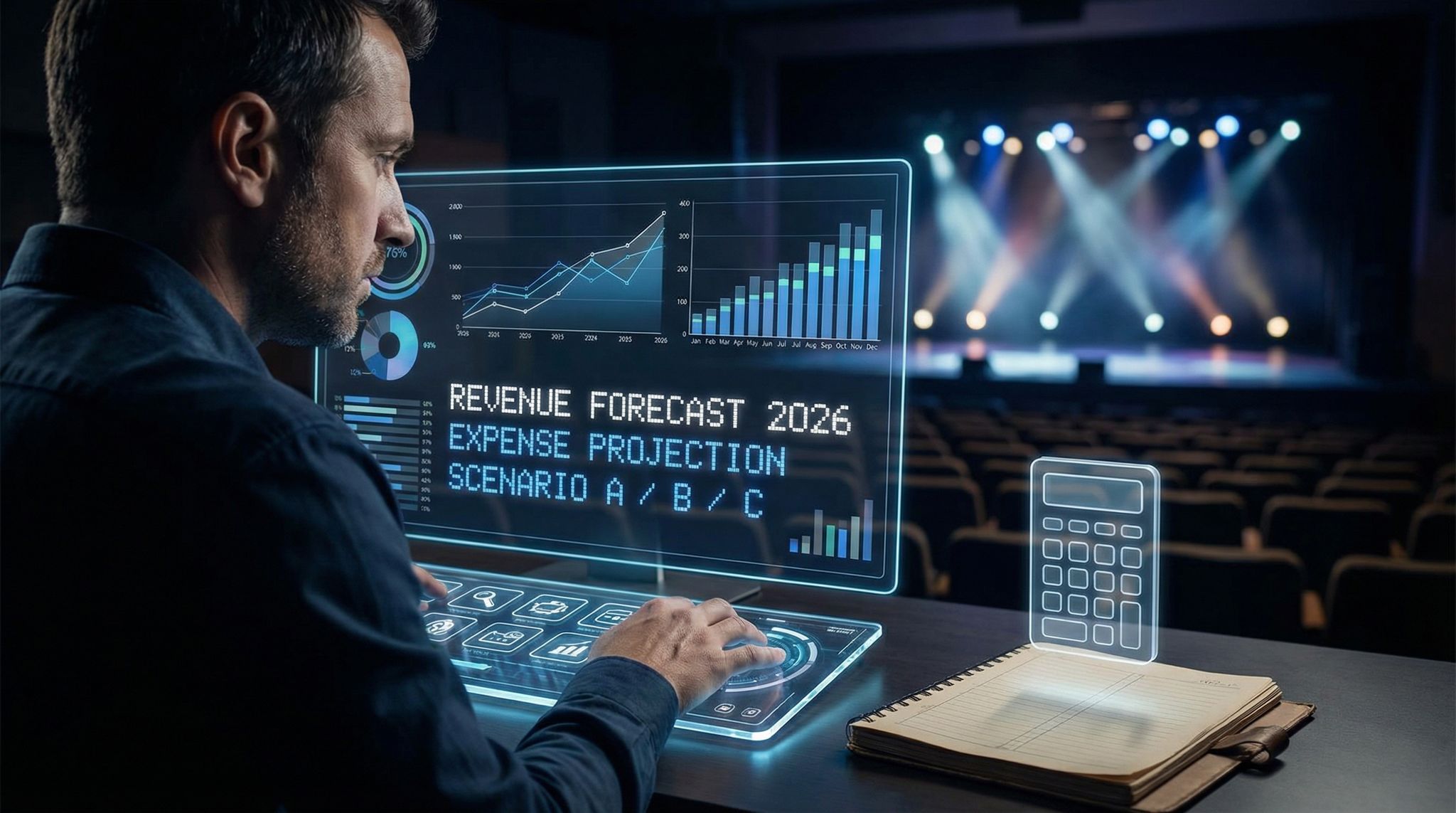
Think of scenario planning as creating three budgets: one for expected performance, one if everything goes better than hoped, and one if things go wrong. Start with your base-case (likely the one you’ve been building so far with “most likely” assumptions on sales and costs). Then imagine ticket sales come in much stronger than expected – perhaps a couple of surprise hit shows and overall higher attendance – what does that do to your revenue? And conversely, what if several events flop or a key tour cancellation hurts your year – how would the numbers look? Laying these out side by side is incredibly insightful. For example, consider a venue’s annual scenario summary:
| Scenario | Events Hosted | Avg. Attendance | Total Revenue | Net Profit/Loss |
|---|---|---|---|---|
| Base Case (forecast) | 150 events | 70% capacity | $5,000,000 | $200,000 (profit) |
| Best Case (20% boost) | 160 events | 85% capacity | $6,000,000 | $600,000 (profit) |
| Worst Case (downturn) | 140 events | 50% capacity | $3,500,000 | -$100,000 (loss) |
In this hypothetical example, the base plan yields a modest profit on 70% average attendance. If demand spikes, profits could triple – nice to know, but more importantly, if a downturn hits and you only fill half your seats, you’d run a six-figure loss. By quantifying this, you can then ask: How would we cope with the worst case? You might identify expense cuts to implement if sales slump, or decide that maintaining a cash reserve to cover a $100k loss is critical. The exercise isn’t about perfectly predicting the future; it’s about being prepared. Many festival organizers do this by creating Plan A and Plan B budgets tied to ticket sales milestones – e.g. a full production plan if 10,000 tickets sell, but a scaled-down version if they only hit 5,000. Venue operators can do likewise: have a more extravagant budget for banner year and a leaner one if signs point to trouble. With data and scenarios, you won’t be caught off guard because you’ve already “seen” what different futures look like on paper.
Sensitivity Analysis: Finding Pressure Points
An important part of scenario planning is sensitivity analysis – figuring out which factors most impact your bottom line. Not all variables are equal. For instance, you might find that a 10% drop in attendance hurts you more than a 10% increase in artist fees would, or vice versa. Test single variables in your budget to see their effect. What if average ticket price is $5 less than expected? What if the cost of beer from your distributor goes up 15% mid-year? By adjusting one input at a time and seeing the output, you identify your pressure points. Experienced operators often know these intuitively (“if we don’t hit at least 60% attendance, we lose money on the night”), but quantifying them with data is powerful. It can inform decisions like insurance and hedging – for example, if you’re heavily dependent on one or two big shows, you might invest in event cancellation insurance to protect that revenue. Or if labor costs are a major swing factor, you might cross-train staff so you can operate with fewer people in a pinch. Sensitivity analysis also helps in communicating with stakeholders; you can plainly show owners or investors, “Here’s what keeps me up at night – if X happens, our profit evaporates. So let’s plan for X.” In short, knowing your budget’s sensitivities allows you to focus risk management where it matters most.
Contingency Funds and Safety Nets
A hallmark of solid financial planning is building in contingencies – essentially, expecting the unexpected. In practice, this means setting aside a slice of your budget as an emergency fund or flexible expense line. A common approach is to allocate a percentage of projected costs (often around 5-10%) as a contingency reserve. This isn’t “extra profit” – consider it already spoken for unless miraculously nothing goes wrong. What kinds of surprises should this cover? Anything from a last-minute show cancellation or postponement (and the resulting revenue loss or refund costs), a common issue discussed regarding big issues for small venues, to a major equipment breakdown, or unplanned regulatory compliance expenses. For example, if an important headliner cancels 48 hours before the show and you have to refund $50,000 in tickets, your contingency fund might be what saves you from a huge loss on that event. Another safety net is insurance and contract clauses. Ensure you have appropriate insurance (event cancellation, liability, business interruption coverage) and understand what it covers – it can reimburse some losses in extreme cases, effectively serving as a financial backstop. Also, negotiating contracts with flexibility (like force majeure clauses, or revenue-share deals with artists instead of fixed guarantees) can shift or reduce certain costs in worst-case scenarios, a key part of safeguarding your festival finances. The key is to acknowledge that something will always go unplanned and to bake that into your financial plan. Venues that survived crises often did so because they had rainy-day funds or quickly slashed discretionary spending; those that didn’t often had no cushion. By treating your contingency fund as untouchable except for true emergencies, you give your venue a fighting chance to weather storms ahead.
Adapting to Real-Time Market Shifts
Scenario plans shouldn’t sit in a drawer – they need to trigger real adjustments when warning signs appear. Decide in advance what indicators will prompt you to pivot budget strategies. For example, you might say “If by mid-year our ticket sales are 15% below target, we enact the cost-cutting measures from our worst-case plan.” Those measures could include freezing new hires, reducing marketing spend for a while, or negotiating payment plans with vendors to manage cash flow. Conversely, if you hit a best-case streak (say a few big sellouts), you might allocate additional funds to improvements that were on hold, or beef up your contingency reserve in case the pendulum swings back. The point is to be agile and intentional. 2026’s economy could bring surprises – a recession would shrink discretionary spending on concerts, or a post-pandemic euphoria could keep live entertainment booming beyond expectations. By monitoring ticket sales trends, economic indicators, and even industry news (like if major touring artists start scaling back, it might signal softening demand), you can judge which scenario is unfolding and adjust your budget execution accordingly. This agile approach is the opposite of “set it and forget it” budgeting. Instead, you are continuously aligning your spending with reality. Venue managers who do this treat their budget as a living document – when market conditions change, the budget is revised, not ignored. Next, we’ll discuss how to put this into practice through active monitoring and mid-course corrections.
Monitoring Cash Flow and Adjusting on the Fly
A budget isn’t a one-and-done exercise – it’s a tool you should use throughout the year. Data-driven venue operators constantly compare their projections to actual performance and course-correct as needed. This section covers how to monitor your cash flow, use technology and team input to stay on track, and make adjustments to your budget (and operations) in real time. Think of it as steering the ship: you have to check the compass and sea conditions regularly, not just plot a course and hope.
Tracking Budget vs. Actuals Rigorously
Once your budget is set and the year kicks off, the real work begins: tracking every month how you’re doing relative to plan. Set up a simple dashboard or spreadsheet that lists each major revenue and expense category with two columns: Budget vs. Actual. Update it monthly (or for very busy venues, even weekly for key metrics like ticket sales and cash flow). For example, by the end of Q1 you should be able to say: “We budgeted $1 million in ticket revenue by March, but only brought in $850k – that’s 15% under, largely because two shows underperformed. On the expense side, we’re fortunately $50k below budget thanks to lower marketing spend.” This kind of analysis lets you pinpoint variances. Investigate significant variances immediately – was an expense higher because of a one-time issue, or is it likely to continue all year (meaning your budget assumption was too low)? If bar sales are exceeding expectations every night, you might raise your forecast (and ensure you have enough inventory and staff to capitalize on it). If utility bills are coming in much higher than last year’s averages, perhaps energy prices rose or your usage spiked – either way, you might need to allocate more funds there, or find ways to conserve energy. By catching trends by spring or summer, you still have time to adjust events, pricing, or cost measures in fall to hit your annual targets. Many veteran venue managers conduct post-event debriefs that include financial review of each show to cut costs not corners – comparing projected vs actual costs and revenue – and use those insights to refine future budgets and operations. The main principle is: don’t wait until year-end to see if you hit budget. Treat your financial plan as a dynamic guide and check your progress frequently.
Using Tools and Technology for Transparency
Gone are the days of paper ledgers and manual calculations (at least, they should be!). To effectively monitor finances in 2026, take advantage of modern tools. Most ticketing and point-of-sale systems can export detailed reports on sales – use them. There are affordable accounting and budgeting software options that allow you to set budgets and track actual income/expenses, even sending alerts when you’re over-budget on a line item. Consider implementing a dashboard that pulls key metrics into one view: tickets sold to date vs. plan, monthly revenue vs. expense chart, etc. If you’re using an integrated event management platform like Ticket Fairy, leverage its analytics to understand ticket sales pacing, marketing ROI, and customer trends in real time. For example, Ticket Fairy’s event ticketing system provides rich data on sales and audience demographics that can feed into your financial planning. The goal with tech is real-time visibility – you want to spot issues or opportunities quickly. Additionally, encourage a data culture among your team: department heads (like bar manager, marketing manager, technical director) should have access to relevant numbers and be trained to interpret them. When everyone from the venue operator to the bar supervisor is watching the same KPIs, it’s easier to coordinate adjustments. For instance, if merchandise sales are lagging behind budget, your team can proactively brainstorm promotions or adjust pricing mid-quarter rather than realizing in December that you fell short. In summary, use technology to automate tracking and to keep your finger on the financial pulse of your venue at all times.
Engaging Your Team in Budget Accountability
Financial planning shouldn’t happen in a vacuum. Some of the best-run venues treat budgeting as a team sport, where each department or manager takes ownership of their piece. From the start, communicate the budget targets and assumptions to your core team – key staff should know the revenue goals and cost limits that pertain to their work. For example, the production manager should be aware of the budget for stage crew labor and equipment rentals for the year; the bar manager should know the targeted cost of goods sold percentage for beverages. By giving them these data-driven targets, you empower them to make decisions that align with the budget. Check in regularly with each department on their financial metrics. If security costs per event are creeping up, sit down with your operations lead to find out why – maybe crowd demographics changed requiring more guards, in which case the budget might need revising, or maybe scheduling inefficiency is to blame, which training or tools can fix to ensure no lines and more sales. Create a culture where meeting or beating budget is recognized, and overages are analyzed without blame but for solutions. It can even help to tie small incentives or recognition to staying on budget (e.g. if the bar team hits their sales target at a big show while controlling costs, celebrate that win). Also, loop the team into scenario plans – they should know what the “rainy day” plan is too. If everyone understands that, say, a certain level of revenue shortfall will mean tightening overtime or cutting back on non-essentials, they’ll be more conscious to avoid waste and maybe suggest cost-saving ideas. Some venues hold quarterly budget review meetings with all department heads, turning it into a problem-solving session. The takeaway: make budgeting a shared mission, not just a report card from the finance office. When staff at all levels are financially literate about the venue’s operations, the whole organization becomes more agile and responsible.
Adjusting and Reforecasting as Needed
A data-driven plan is only as good as your willingness to revise it when needed. By mid-year 2026, you will likely have new information that wasn’t available when you made the budget – maybe a major tour got announced (or canceled), your city approved a grant for venues, or the economic outlook shifted. Don’t hesitate to reforecast your budget for the remaining months based on these developments. This isn’t “cheating” or failing – it’s a smart response to reality. For instance, if you see that by June your revenues are trailing, you might trim down expected income for the second half and correspondingly reduce discretionary expenses to still hit a profit by year-end. Conversely, if you land a surprise high-grossing event for the holiday season, factor in the extra revenue and consider allocating some towards upgrades or into your reserve fund. Reforecasting can be as simple as updating your spreadsheet with Year-to-Date actuals plus revised estimates for future months, essentially creating a new projection. Many venues do this on a rolling quarterly basis – after each quarter, adjust the rest-of-year figures rather than sticking stubbornly to the original annual plan. Communicate major changes to stakeholders (owners, investors, or even staff, as appropriate) so everyone stays aligned. And carry the insights forward: if certain costs were way off mark, note why. Maybe you underestimated marketing spend needed to hit ticket sales – that lesson should inform your next budget cycle. Agile financial management is an ongoing loop of plan, execute, measure, adjust. By continuously refining your budget with actual data, you ensure that your financial roadmap remains accurate and useful, rather than a document gathering dust while the venue sails into a storm.
Maximizing Profitability and Financial Health
Beyond just making the numbers add up, a venue operator’s ultimate goal is to ensure the business is financially healthy and profitable in the long run. Budgeting with data helps achieve this, but there are additional strategies to strengthen your venue’s financial foundation. In this section, we look at ways to boost profit margins and build resilience: from finding new revenue opportunities, to wise cost-benefit investments and maintaining a cushion against tough times. The idea is to move beyond break-even into a position of stability and growth, even as the economy and industry evolve.
Identifying Profit Drivers (and Drains)
Not all events or services contribute equally to your bottom line. A data-driven approach zeroes in on which parts of your operation actually drive profit. Analyze the profitability of different event types you host – you might discover that those monthly comedy nights, while modest in revenue, have very low costs and healthy margins, whereas some big concerts generate tons of revenue but also eat up almost as much in fees and staffing. If you haven’t already, calculate the net profit per event (or per event category) for last year. Include all allocated costs. This can reveal, for example, that corporate rental events or weddings hosted on off-nights brought in an outsized share of profit due to minimal production needs. Or that your VIP packages have high margins that offset thinner profits from general admission tickets. Likewise, identify drains – maybe you’re spending a fortune on afterparties or niche events that barely break even. With this insight, you can adjust your strategy: emphasize the high-profit elements and tweak or drop the underperformers. Many successful venue operators diversify their event portfolio, mixing marquee concerts (even if margins are thin on those due to big artist fees) with other events like conferences, film screenings, or community events that fill the calendar and contribute steady income. Also look at ancillary services: is your merch booth or parking operation actually profitable after labor? If not, could it be improved or is it more of a goodwill service? By focusing on profit drivers, you ensure your time and budget are invested where they yield the best returns. This doesn’t mean cutting all “unprofitable” events – some might have strategic value (loss leaders that bring new audiences or please the community). But knowing the numbers means you do that knowingly and can seek to balance it elsewhere. Use data to double down on what works financially.
Smart Investments and ROI Considerations
Even in a tight economy, you shouldn’t shy away from all spending – the key is to invest wisely for long-term gain. ROI (Return on Investment) should be a guiding concept in your budget planning. When considering a major expense, ask: what return will this generate, in revenue growth or cost savings? For example, upgrading to a new sound system might be costly now, but if it allows you to attract bigger tours (revenue up) and reduces maintenance and energy costs (expenses down), the ROI could be very positive given the high cost of live events in 2026. Laying out these justifications in your budget documentation is crucial. Another example: investing in staff training might cost a few thousand, but if it improves operational efficiency or safety, it could save money by preventing mistakes or claims in the future. In 2026, many venues are exploring technology investments – from analytics software to contactless payment systems – that have upfront costs but can boost sales or reduce friction. Always project the impact: if a new online marketing tool costs $5k a year but could increase ticket sales by 5%, and 5% equals $50k, it’s a no-brainer. On the flip side, scrutinize “vanity” expenditures that don’t clearly contribute to the bottom line. That fancy new marquee sign might look great, but will it sell more tickets or is it better to delay until profits allow? One practice is to maintain a “wish list” of capital improvements and only greenlight them when you’ve met certain financial milestones (e.g., only purchase the $20k new lighting rig after hitting $X profit for the year, ensuring you’re using surplus, not digging into essential funds). Also leverage data from other venues: industry reports or case studies can show what ROI others experienced when struggling with rising venue expenses. If you’re unsure, pilot the idea cheaply – perhaps rent a piece of gear for a couple of shows to see if it truly makes a difference in ticket sales or reviews, before buying your own. In short, spend money where it makes money (or saves money), and use data to back up those decisions to any skeptics holding the purse strings.
Building Cash Reserves and Financial Resilience
One of the most un-glamorous but critical aspects of venue financial health is having adequate cash reserves. This was highlighted painfully during the COVID-19 shutdown: venues with even a few months of operating cash on hand fared far better than those living week-to-week. As you budget for 2026, aim to allocate a portion of profit (if generated) to a reserve fund. Many finance experts suggest a business keep at least 3-6 months of core operating expenses in reserve. That’s tough for venues with historically slim margins, but it’s a worthy goal to build toward gradually. Even adding, say, $2,000 each month into a savings account builds a safety net over time. These reserves can cover emergency repairs or bridge a temporary revenue gap without throwing you into debt. It also gives you breathing room for strategic decisions – for instance, if an amazing booking opportunity comes up that requires a big deposit, having cash ready lets you seize it. In addition to saving cash, reducing debt is part of resilience. If your venue is carrying loans, plan out debt service in the budget and consider using surplus to pay down high-interest debt faster. That frees up future cash flow. Also, cultivate good relationships with lenders and investors during good times – it’s easier to negotiate support or credit lines if they trust your data-driven approach and see that you run a tight ship. Another aspect: maintain transparency and goodwill with stakeholders like landlords, suppliers, and artists. If a crisis hits, having a reputation for honesty and reliability can buy you leniency (for example, a landlord might extend a break or a supplier might allow a payment plan if they know you’re usually solid). All these moves contribute to an anti-fragile financial position – one where your venue can take a punch and get back up. Budgeting beyond guesswork means not just planning for one scenario, but steadily fortifying your venue’s finances against whatever the future throws at it.
Leveraging Community and Support Networks
Financial planning doesn’t happen in isolation of the broader community and industry. Venues that thrive often tap into external support and partnerships to bolster their finances. In budgeting, consider where you can offset costs or generate funds through collaborations. For example, maybe a local brewery is willing to sponsor your venue or a series of shows – providing cash or in-kind contributions (like discounted kegs) that reduce your F&B costs in exchange for promotion. Community fundraising and grants are another avenue: keep an eye on arts funding opportunities or city initiatives that support live music and factor those potential contributions into your projections once they’re secured. During the toughest times, many venues have survived through benefit shows or crowdfunding – it’s essentially raising revenue outside of normal operations. While you shouldn’t plan on GoFundMe as a line item, knowing that your community has your back can influence how you plan for worst-case scenarios. Maintaining good relationships with neighbors and the local council can also have financial benefits, such as smoother permit processes for special events (sparing legal costs) or support letters for grants, as seen when music venues close under extreme financial pressures. Additionally, participating in venue associations or networks (like a local venue alliance or national bodies such as NIVA in the U.S. or the Music Venue Trust in the UK) can provide early info on policy changes, collective bargaining power to lower costs (some associations negotiate group rates for insurance or equipment), and shared data. For instance, if you learn through an association that nearly all venues are seeing utility costs jump 20%, you can adjust your budget preemptively. The takeaway is that budgeting isn’t just an internal exercise – align your financial planning with the broader ecosystem and don’t hesitate to seek support. It’s much easier to stay profitable when you’re leveraging every advantage, internal and external, available to your venue.
Lessons from Budgeting Successes and Failures
Real-world stories often drive home the principles of data-driven budgeting better than any theory. In this section, we’ll highlight a few examples of venues that navigated choppy financial waters through savvy planning – and contrast them with cautionary tales where poor budgeting led to trouble. While we won’t call anyone out unfairly, these composite cases (drawn from industry reports and insider anecdotes) illustrate the do’s and don’ts of venue financial management. As you read them, consider how the lessons might apply to your own operation.
Thriving Through Strategic Planning: Case Study
A mid-sized independent concert hall (approximately 1,200 capacity) in California faced a challenging 2024, with skyrocketing talent fees and inconsistent attendance. In response, the venue’s management embraced a data-driven overhaul of their budgeting and emerged profitable in 2025. They started by analyzing two years of show data and discovered that certain niche genre nights were consistently money-losers, so they cut those and filled the calendar with slightly fewer but higher-demand events, even negotiating co-promotes to share risk on unproven acts. They also noticed bar revenue per head was below industry benchmarks – it turned out long bar lines at peak times were limiting sales. Acting on this, they invested in an express beer station and a mobile ordering system. The result? Bar spend per attendee rose by 20%, which was immediately factored into their 2025 revenue forecasts. On the expense side, they found overtime pay was eating into margins, so they adopted smarter staff scheduling software and cross-trained crew to reduce overtime hours by 15%. They also renegotiated vendor contracts – getting a modest break on annual sound equipment rental costs by showing loyalty and committing to longer-term agreements. Come mid-2025, when a minor recession hit their region and ticket sales dipped, this venue was prepared with a contingency plan: they quickly pivoted to hosting a few more community events and leaner one-man shows (cheaper talent) to keep cash coming in. Those had lower ticket prices but also low costs, which kept the venue’s cash flow positive. By year’s end, while some similar venues reported losses, this hall actually exceeded its modest profit target. The operators credit proactive data analysis and scenario planning for their success – as one of them put it, “We stopped budgeting by wishful thinking. We knew our break-even point for each show and our Plan B if sales softened. That made all the difference.” This case underscores how using real numbers to guide decisions (and reacting fast to changes) can turn a struggling venue into a sustainable business.
The Cost of Poor Planning: Cautionary Tale
Contrast the above with the story of a once-popular 400-capacity club in the UK that sadly shut its doors in 2023. What went wrong? In short, a perfect storm of unrealistic budgeting and zero contingency. Coming out of the pandemic, the owners assumed crowds would return in full force and budgeted accordingly – expecting 100% of 2019’s ticket revenues despite signs that their audience’s habits had changed. They also kept their cost structures the same (and in some cases higher, as they gave overdue raises to staff and paid top dollar to book a few big acts, thinking it would guarantee full houses). When attendance lagged well below expectations in the first half of 2023, they found themselves upside-down financially – revenue was falling short, but their expenses were locked in. To cover the gap, they started relying on short-term credit (high-interest loans and piling up payables). By the time they realized the new normal was perhaps 70% of pre-pandemic sales, they were in a hole. A major blow came when a high-profile New Year’s Eve event they banked on was cancelled last-minute due to the artist’s injury; the venue had no insurance and no rainy-day fund, so not only did they lose the ticket income, they had to refund deposits for VIP packages and still pay staff and vendors for preparations. This one event wiped out the remainder of their cash. With mounting debts, they appealed to the community for help, but the economy was in a dip and the crowdfunding fell short. Finally, the landlord refused to negotiate further on rent arrears, and the venue closed, adding to the grim statistic of closures that year, echoing reports that 127 grassroots venues closed. Post-mortem discussions with the operators revealed the key mistake: their budget was built on hope, not data. They admitted they hadn’t done a serious scenario analysis or considered what would happen if revenue was even 20% below target. They also confessed that they “figured things would work out” and put off difficult decisions like reducing operating hours or trimming staff until it was too late. The cautionary tale of this club is a sobering reminder: unrealistic budgeting and ignoring the warning signs can sink even a beloved venue. It reinforces why data-driven planning and prudent reserves are not just financial best practices – they’re survival essentials.
Balancing Innovation with Caution: Example
On a more positive note, consider a large arena in Asia (around 15,000 capacity) that managed to innovate its way to higher profits, but did so in a controlled, data-backed manner. In 2026, this arena’s management decided to experiment with a dynamic pricing model for tickets and parking – a potentially lucrative move but one that can upset fans if done recklessly. Instead of diving in across the board, they trialed it on a few events, closely monitoring sales data and customer feedback. Their finance team created a mini “budget within a budget” for the experiment: they projected various outcomes (best case: +10% revenue from dynamic pricing, worst case: fan backlash reduces sales by 5%). Because they had those scenarios, they had mitigation plans ready (like offering added perks for higher-priced tickets to ease fan concerns). The result was an incremental revenue bump with minimal pushback. They rolled out the strategy more widely only after seeing the data from trials. Simultaneously, that year the arena invested in solar panels for its roof – a hefty upfront expense that they justified through an energy cost analysis showing it would cut utility bills by 25% over five years. By budgeting for this capital expense and timing it after a particularly profitable quarter, they ensured it didn’t strain their cash flow. This arena illustrates the balance of ambition and caution: they embraced new revenue approaches and tech upgrades to stay ahead, but always based decisions on data and pilot results rather than hype. As a result, their financial reports showed not only higher revenues but also stable or improved profit margins, reinforcing trust from their stakeholders. The take-home point is that innovation in venue operations can pay off, but it should be approached as part of a data-driven plan – try things small-scale, measure the outcomes, and scale up what truly works (while budgeting for the possibility that some experiments might not pan out).
Frequently Asked Questions
Why is data-driven budgeting critical for venues in 2026?
Data-driven budgeting is essential because venue operating costs have risen 30–40% since 2020, squeezing profit margins to as low as 0.2%. Relying on gut instinct fails in this high-cost environment, whereas using historical data helps operators anticipate expenses, manage cash flow, and avoid financial instability caused by inflation and supply chain issues.
How can venues accurately forecast revenue for upcoming events?
Venues should use bottom-up forecasting by analyzing historical sales trends, market data, and specific event details like artist popularity. Instead of generic averages, operators must estimate ticket sales, bar spend, and merchandise revenue for each individual show on the calendar to create realistic financial projections that account for seasonal spikes or slow periods.
What are the best strategies for managing venue labor costs?
Managing labor costs requires analyzing past payroll data to match staffing levels with specific event demand. Operators can reduce expenses by staggering shift start times, cross-training crew to minimize overtime, and budgeting for wage increases. Effective scheduling ensures the right number of staff are present only when needed, preventing waste during slow hours.
How does scenario planning help venue financial stability?
Scenario planning protects financial stability by creating base-case, best-case, and worst-case budgets to prepare for unpredictable market shifts. By quantifying potential outcomes—such as a 20% drop in attendance—managers can identify necessary cost-cutting measures or contingency plans in advance, ensuring the venue survives revenue downturns or unexpected expenses without collapsing.
Why is a contingency fund important for venue budgets?
A contingency fund acts as a financial safety net, typically requiring venues to set aside approximately 5% of their total budget for emergencies. This reserve covers unexpected costs like equipment breakdowns, sudden regulatory compliance fees, or show cancellations, preventing these surprises from driving the venue into debt or operational failure.
How should venue managers monitor budget performance throughout the year?
Venue managers must track budget versus actual performance on a monthly basis to identify variances immediately. By comparing projected figures against real-time data for revenue and expenses, operators can spot trends early and reforecast the remaining months, adjusting spending or strategies to ensure annual financial targets are met.