Why Social Listening Matters in 2026
The Always-On Fan Conversation
Social media never sleeps, and neither do your event’s fans. Every day, attendees and prospective ticket-buyers are chatting online about artists, venues, past experiences, and expectations for upcoming shows. This always-on fan conversation is a goldmine of insights and a potential minefield. On one hand, it offers unfiltered feedback and authentic excitement you can harness. On the other, a single viral complaint or rumor can spiral if ignored. In 2026’s hyper-connected landscape, social listening isn’t a “nice-to-have” – it’s mission-critical for event marketers who want to stay ahead of the story.
Opportunities: Engagement and Trust
Actively monitoring fan chatter creates twin opportunities: boosting engagement and building trust. When you tune in and respond, fans feel heard and valued. A well-timed reply or a slight change based on feedback can turn casual attendees into loyal advocates. For example, if you notice many fans tweeting confusion about door times or bag policies, a quick clarification post (or direct responses) shows that you care – preventing frustration and encouraging more people to attend. Listening also uncovers positive moments to amplify. If an attendee raves about an amazing set or posts an incredible crowd photo, you can reshare it or shout them out, spreading their enthusiasm to thousands more. These interactions humanize your brand and create a community feeling around your event. Experienced event promoters know that engaged, appreciated fans are far more likely to buy tickets again and spread the word.
Just as importantly, social listening is a pillar of brand trust and protection. Fans talk candidly online; by paying attention, you catch small issues before they become big problems. Responding quickly and transparently to concerns – whether it’s addressing a gripe about long lines or correcting misinformation – proves to your audience that you’re accountable. In an era where consumer trust can make or break ticket sales, actively listening (and showing you’re listening) earns goodwill. Conversely, ignoring the conversation can be costly. We’ve all seen events dragged on social media because organizers appeared silent or indifferent to attendee complaints. By tuning in and engaging, you build a reservoir of trust that can safeguard your reputation when challenges arise.
New Platforms, New Expectations
Social media in 2026 looks different than it did just a few years ago. Fan conversations now span established platforms like Twitter (X), Instagram, and Facebook, newer juggernauts like TikTok, and niche communities on Reddit, Discord, and beyond. With algorithms constantly in flux and organic reach declining, understanding key event marketing trends for 2026 is essential because you can’t assume your official posts reach everyone. Instead, fans rely on each other – and on influencers – for real-time information and recommendations. This shift means event marketers must meet their audience where conversations are happening, rather than expecting all engagement on official pages. It also means monitoring a broader range of channels, from tweet threads to TikTok comment sections.
Turn Fans Into Your Marketing Team
Ticket Fairy's built-in referral rewards system incentivizes attendees to share your event, delivering 15-25% sales boosts and 30x ROI vs paid ads.
Audience expectations have never been higher. Response times that were acceptable in the past may now be seen as too slow. In fact, 42% of consumers who complain on social media expect a brand response within just one hour, according to research on social media response time expectations. Fans have grown accustomed to immediate information and candid interaction. If a potential attendee asks a question on your Instagram post or voices a concern in a Facebook group, they anticipate a timely, helpful answer – or they’ll find it from another fan or not at all. The bottom line: event marketers need to be listening actively and responding promptly across platforms. The reward is a more engaged, informed audience and a stronger brand-community bond, while the risk of not listening is being blindsided by issues that could have been addressed early.
Building a Social Listening Strategy
Setting Clear Goals & KPIs
Like any aspect of marketing, social listening works best with a plan. Start by defining what you want to achieve through listening. Are you aiming to boost attendee engagement on social media? Gather feedback to improve the event experience? Prevent PR crises by catching complaints early? All of the above? Setting clear objectives will inform what you monitor and how you act on the insights. For instance, if your goal is to increase fan engagement, you might track the number of fan interactions you respond to each week. If it’s to protect brand reputation, you might set a key performance indicator (KPI) around reducing negative sentiment or resolving a certain percentage of public complaints within 24 hours.
Ready to Sell Tickets?
Create professional event pages with built-in payment processing, marketing tools, and real-time analytics.
Common KPIs for social listening include sentiment score (the ratio of positive to negative mentions about your event), response time (how fast you reply to inquiries or issues), and engagement uplift (changes in likes, shares, comments when you engage versus when you don’t). You might also track things like the number of insights gathered (e.g. new ideas for marketing content or event improvements sourced from fan comments) or the volume of issues resolved. The key is to make these goals measurable. Experienced event marketers often bake listening metrics into their overall campaign KPIs – for example, treating “X% increase in positive social sentiment” as important as, say, email open rates or ad click-through rates. By defining success up front, you give your team targets to aim for and a way to demonstrate the impact of social listening to stakeholders (like showing how quick responses led to higher attendee satisfaction or more ticket referrals).
Deciding What to Monitor
A successful listening strategy starts with knowing which conversations to tune into. The social web is vast, so you’ll want to focus on the most relevant signals. Start by brainstorming all the keywords, phrases, and touchpoints related to your event:
- Event name and hashtags: Track your official event name (and common abbreviations or misspellings) as well as any event hashtags you’re using. Fans might use different variants – for example, “Ultra2026” vs. “Ultra 2026”. Cast a wide net.
- Artist, speaker or lineup names: Keep tabs on mentions of headliners, performers, speakers, or special guests at your event. These often spike as fans discuss who they’re excited (or disappointed) to see.
- Venue and location: Monitor the venue name and city, especially combined with event context (e.g., “London O2 Festival complaints”). Local residents or attendees might sound off about venue logistics, parking, or city regulations that affect the event.
- Keywords for common issues: Think of terms like “tickets”, “sold out”, “line” (queue), “cancelled”, “delay”, “sound”, etc., paired with your event or artist names. These can tip you off to pain points. For example, a rush of tweets about “XYZ Festival line” could indicate entrance bottlenecks.
- Competitor and industry chatter: It’s wise to keep an ear on similar events or the wider scene. If a rival festival in your genre is trending (good or bad), those discussions might spill over to your audience. You can learn from their missteps or successes.
- Your brand and key staff: Don’t forget to monitor your organization’s name, your promoters or DJs (if they have public profiles associated with the event), and even sponsor or partner mentions. Sometimes a complaint about an event actually tags the promoter or a sponsor – you don’t want to miss it.
By defining these core topics, you create a listening blueprint. Many social platforms and tools let you set up keyword tracking streams (for example, Twitter’s advanced search or social media management dashboards). If you’re using a platform like Ticket Fairy’s, you’ll have full access to your event and ticketing data, which can be combined with social listening insights for a richer understanding of your audience. Savvy event marketers treat social listening as part of a broader data puzzle – alongside surveys, ticket purchase data, and other research – to get a 360° view of fan sentiment. In fact, incorporating social listening into your data-driven audience research can reveal motivations and pain points that traditional surveys might miss.
Integrating Listening into Your Campaign Plan
Once you know your goals and what you’ll monitor, the next step is baking social listening into your day-to-day workflow. This isn’t a one-time task; it’s an ongoing practice that spans before, during, and after your event. Assign clear roles – for example, one team member might be responsible for a “daily check” of all mentions each morning, while another handles real-time monitoring during event days or major announcements. If your team is small, you might automate some of this (for instance, setting up email alerts for spikes in mentions or negative sentiment). The key is to treat listening with the same importance as creating content or placing ads. It helps to formalize it on your marketing calendar.
Grow Your Social Following With Every Sale
Require social media follows, shares, or playlist adds to unlock presale access or special pricing. Turn every ticket purchase into audience growth.
Consider creating a simple social listening timeline as part of your campaign plan. What should you be listening for at different stages of your event cycle? Here’s an example:
| Campaign Phase | Listening Focus | Actions |
|---|---|---|
| Pre-event (Months Out) | Monitor initial fan reactions to lineup announcements; track early buzz and common questions. | Adjust marketing messaging based on fan excitement or concerns. For example, if many ask about age limits or VIP upgrades, update your FAQ and make that info more prominent in promos. |
| Run-up (Weeks Before) | Watch ticket-buyer comments and chatter about logistics (parking, doors open time, etc.); gauge sentiment as event approaches. | Respond to FAQs on social (e.g., “Yes, gates open at 5 PM”); push out reminders addressing any prevalent concerns (like posting a parking map if people are worried). Build hype by amplifying positive posts (“Can’t wait for this show!”). |
| During Event (Live) | Real-time monitoring of attendee posts about the experience (#EventHashtag); look for any issues (long lines, sound problems, weather updates). | Respond immediately to on-site issues (via official channels and direct replies). Alert on-site staff to fix problems fans flag (e.g., water station empty). Retweet and highlight fans having a great time to boost the collective mood and FOMO. |
| Post-event | Listen to attendee feedback and reviews; check social for highlights, criticisms, or suggestions after the event. | Thank attendees for coming (and mean it!). Acknowledge any hiccups and explain plans to improve next time. Share and celebrate positive recaps (fan photos, blog reviews) to reinforce the good memories and encourage reattendance. |
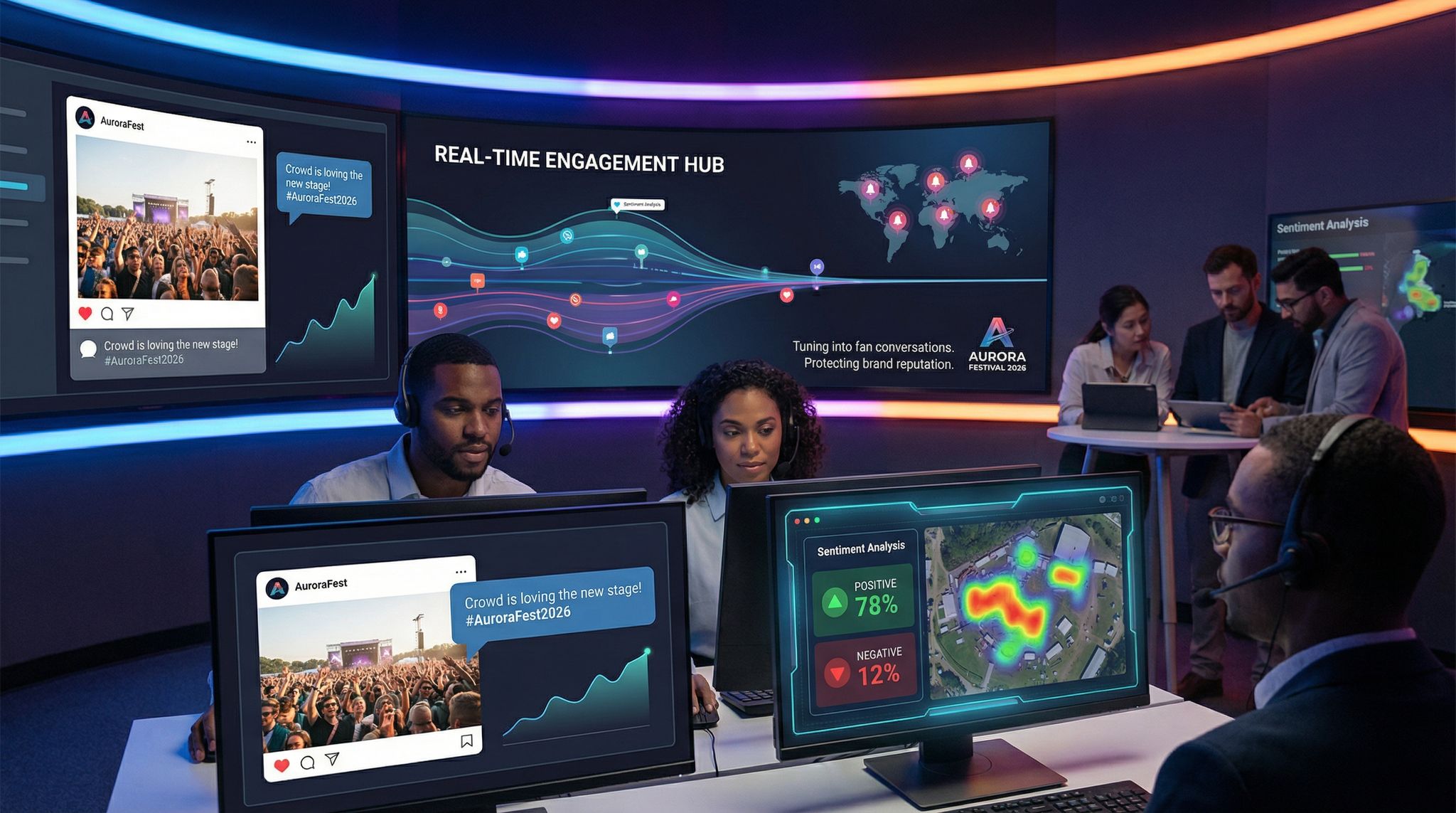
In practice, integrating listening into your plan might mean having a “social listening war room” during a major festival (more on that later), or simply setting aside 15 minutes every morning to scan mentions for a smaller event. The scale will differ, but the principle is the same: make listening a continuous loop in your marketing. Take what you hear and feed it back into action. For example, if pre-sale chatter reveals confusion about a ticket tier, adjust your website or comms that very day. If live tweets show an issue, jump on it in real time. And after the event, compile those learnings – what did fans love, what did they hate – and let it inform your next event’s planning. By systematically looping social insights into decisions, you ensure your marketing (and event experience) is always aligned with audience sentiment.
Grow Your Events
Leverage referral marketing, social sharing incentives, and audience insights to sell more tickets.
Essential Tools and Platforms for Listening
Free and Native Tools for Quick Wins
You don’t need an expensive setup to start social listening. There are plenty of free or built-in tools that can cover the basics:
- Native platform search & alerts: Utilize the search functions on Twitter (X), Instagram, TikTok, and Facebook to look up your keywords and hashtags. For example, Twitter’s advanced search can filter by date, location (useful if you only want tweets from your city), or even sentiment. Set up Google Alerts for your event name and key phrases – you’ll get email notifications when they appear in news or web posts.
- Social media dashboards (freemium): Tools like TweetDeck (now part of X Pro) let you create custom columns monitoring specific terms or accounts in real time. You can have one column showing every mention of your festival hashtag, another for any tweet to your official account, etc. Similarly, Hootsuite’s free plan allows a few streams where you might track mentions. These can be great for one-stop monitoring without constantly searching manually.
- Community and forum monitoring: Don’t forget to check channels like Reddit (search for your event or related subreddits) or Discord if you have an official server. Even a quick manual scan of the top Reddit threads about your event can reveal common discussion points. Setting aside time weekly to browse fan forums or Facebook groups can uncover deeper qualitative insights.
- Ticketing & email data: While not “social media,” your ticketing platform can be a listening tool too. Customer support emails and inquiries via your ticketing page often highlight what information people can’t find or concerns they have. For instance, multiple emails about “Will tickets be available at the door?” might prompt you to broadcast that info on social. Using a platform like Ticket Fairy gives you full access to customer data and questions, which you can combine with social comments for a full picture.
The advantage of native and free tools is obviously cost – anyone can start monitoring Twitter or set Google Alerts at no charge. However, these methods can become labor-intensive as your event grows. That’s when more advanced tools can help automate and deepen your listening capabilities.
Advanced Listening Platforms & AI Tools
For larger events or organizers who want deeper insights, investing in a social listening software can be a game-changer. Platforms like Brandwatch, Meltwater, Talkwalker, Sprout Social, and Hootsuite (enterprise tier) go beyond basic keyword tracking. They use AI-driven analysis to gauge sentiment (is the tone of conversation happy, angry, neutral?), identify trending topics in the chatter, and even pinpoint influential voices in your fan community. For example, a tool might alert you that “parking” has surged as a negative topic in the past hour on social – giving you a heads-up to investigate an on-site issue. Many tools also aggregate data from across the internet, so you’ll catch mentions in news articles, blogs, or forums that Google Alerts might miss.
Another big benefit of advanced platforms is workflow integration. You can often set them up to ping your team’s Slack channel when a critical keyword is mentioned (“security issue”, “scalpers”, “refund”, etc.), or to flag spikes in activity. By 2026, many listening tools also incorporate AI chatbots or assistants that can auto-tag posts by category (e.g., “ticketing issue” vs “positive feedback”). Some even attempt auto-responses for simple FAQs. While we advise caution with autopilot replies (authenticity is key), these features can save time by triaging the firehose of social content.
Of course, these capabilities come at a cost. It’s worth weighing the investment based on your event scale and budget. To illustrate some options:
| Monitoring Approach | Examples | Pros | Cons |
|---|---|---|---|
| Free DIY Monitoring | Google Alerts, Twitter/X search, basic native app tools | $0 cost, easy to start; direct access to raw fan posts. | Can be labor-intensive to check multiple platforms; risk of missing things when volume is high. |
| Social Media Suites (SMB) | Hootsuite (standard), Sprout Social, Buffer, etc. | Unified dashboard for multi-platform tracking; scheduling + listening in one place; some analytics. | Monthly fees can range $50–$150+; may have limits on mentions tracked; not as in-depth sentiment analysis. |
| Enterprise Listening | Brandwatch, Talkwalker, Meltwater, Sprinklr | Comprehensive coverage (social, news, blogs); AI sentiment, trend detection, influencer ID; customizable reports. | High cost (often $1,000+/month); steep learning curve to fully utilize features; usually overkill for small events. |
For many mid-sized event promoters, a combination approach works well: use free tools for everyday monitoring and add a paid tool during critical periods. For instance, you might subscribe to a listening service just for the 2 months around your major festival if budget is a concern. Also, remember that technology is evolving. In 2026, we’re seeing newer AI-powered tools that can summarize the day’s social media sentiment in a few bullet points, or highlight the single most viral fan post for you – great for daily check-ins without wading through every mention. Keep an eye on emerging tools (and perhaps check out the 2026 event marketer’s toolbox of must-have tools for ideas on what technology can boost your efficiency).
Setting Up Alerts and Dashboards
No matter which tools you use, the key is to set up a system that runs in the background and brings important conversations to your attention. Start by configuring alerts for critical keywords. For example, set up instant notifications for your event name + “scam” or “tickets” (to catch scam reports or urgent ticket issues), or your festival name + “cancelled” (in case rumors start). Many social platforms and third-party apps let you define these triggers. It’s better to get a few false alarms than to miss a real crisis.
Next, build a dashboard or listening hub. This could be in an app (like a Hootsuite board with columns for each keyword) or even a simple Google Sheet where you log daily notable comments. The goal is to see at a glance what the public sentiment is and what topics are trending. A good practice is to have separate streams for different needs: one for general positive/neutral mentions (to find great UGC to share), one for questions/customer service (so you can respond quickly), and one for complaints/negative sentiment (your early warning system). If you have an international audience, consider setting up language-specific searches – e.g. monitor posts in Spanish or German if a significant chunk of your attendees speak those languages, a strategy often used in a social media war room for festivals.
Finally, make sure the whole team knows how to use these tools and sees the insights. Involve your customer support, PR, and operations folks if you can. Social listening shouldn’t live in a silo – a gripe about ticket refunds might be handled by your billing department, while confusion about gate times is one for operations. Some event teams even create a dedicated Slack channel piped full of social listening alerts, so everyone from marketing to on-site management stays informed in real time. In short: set up your tech and teamwork so that when the social posts start flying, nothing important slips through the cracks.
Monitoring Conversations Across Platforms
Matching Platforms to Your Audience
Not every event audience uses social media in the same way. A crucial step in smart social listening is knowing where your fans hang out online. Demographics play a huge role here. For example, if you’re marketing an EDM festival to Gen Z and young Millennials, you’ll likely see most chatter on Twitter (X), TikTok, Instagram, and maybe Snapchat. In contrast, an event targeting Baby Boomers or seniors (say, a nostalgia music cruise or an AARP conference) will have more conversation on Facebook groups or even in email threads. It’s important to prioritize the platforms that align with your ticket buyers’ demographics and behaviors – you don’t want to waste effort monitoring a silent channel while missing the real discussions elsewhere. (For more on tailoring marketing to different age groups, see our guide on winning over Baby Boomer and senior audiences.)
Start by identifying your primary channels. If you’ve run events before, look at where most of your engagement came from. Did your hashtag trend on Twitter? Did you get a ton of Instagram tags? Or maybe your attendees are professionals who raved about your B2B conference on LinkedIn. Wherever the fans are, make that your listening priority. Next, consider secondary channels: niche forums or local community pages can sometimes light up with event talk (for instance, a local subreddit discussing the upcoming county fair, or a fan forum for a genre of music where your festival lineup is being debated). These might have smaller audiences, but they can be highly influential within a core community.
Also, don’t underestimate offline cues that lead to online talk. A poster on the street or a radio mention might drive people to discuss your event on social media without tagging you. For instance, if you plaster the city with flyers for a club night, check neighborhood Facebook pages or Nextdoor in the following days – residents might be buzzing (“Anyone going to that show at Club X?”) or complaining (“Noise alert for this Friday”). Connecting those dots ensures you’re truly covering all bases.
In summary, match your listening strategy to your audience. A one-size-fits-all approach (“we’ll just watch Twitter and Instagram and call it a day”) could leave you deaf to the conversations that matter. Instead, create a platform-by-platform game plan based on where your attendees live online. And remember, those preferences can change – 18-year-olds might be all about TikTok today, but by 2026 perhaps a new platform or community is on the rise. Stay attuned to shifts in social media habits in your target demo, and be ready to adapt your listening focus accordingly.
Twitter/X: The Real-Time Pulse
Twitter (rebranded as X) remains one of the fastest-moving channels for real-time event talk. It’s often the first place people go to share excitement and frustrations in the moment. Fans live-tweet set lists, post pictures, vent about queues, and more – making Twitter a critical platform to monitor especially during live events. To get the most out of it:
Set up streams for your event hashtag and key terms (as discussed). Use TweetDeck or another dashboard to watch mentions in real time. During major announcements or the event itself, keep a dedicated team member (or yourself, if you’re a one-person show) on Twitter duty. The goal is to catch things within minutes, not hours. For example, if multiple tweets at 8pm say “Beer taps empty in section B” at your festival, you want to catch that and alert operations by 8:05pm.
Also pay attention to trending topics and local trends. If your event name starts trending, congratulations – but click it and see why. Is it mostly positive buzz? Or is it people complaining about something? Trending hashtags can amplify the narrative beyond your attendee pool, attracting media attention too. By listening in, you can influence the tone: jump in with helpful info, or your side of the story, if needed.
Engaging on Twitter in real time can turn the tide of sentiment. Simple acts like retweeting a fan’s excited post, or replying with a solution to someone’s issue, are visible to the wider audience. It shows anyone else watching that “hey, the organizers are on top of this.” It’s also an opportunity to humanize the brand voice – a bit of wit or warmth in responses (while staying professional) can earn you a lot of goodwill. Some events even set up a Twitter Q&A hour on the day of lineup drops or ticket releases, inviting fans to fire questions – which the organizers answer live. This can preemptively address confusion and drive more engagement to your announcement post.
One caution: Twitter’s volume can be overwhelming. It’s okay to prioritize. Focus on direct mentions, replies to your account, and high-engagement posts about your event first. Not every single tweet requires a response. Look for patterns – if dozens of people are asking the same question, respond publicly with a post that reaches everyone (“FYI, parking lots open at 3pm – plan ahead!”). Twitter is your event pulse check and public address system rolled into one. Treat it as such, and it will be your early-warning radar and fan goodwill generator.
Instagram & TikTok: The Visual Buzz
In 2026, Instagram and TikTok are where your event’s visuals and viral moments will live. Fans might not always use these platforms to directly complain (though comments can certainly contain feedback), but they will post stories, photos, and videos that speak volumes about their experience. From a listening perspective, these channels are about catching the visual fan buzz and related commentary.
On Instagram, make liberal use of the search and explore functions. Track your event hashtag – not just in feed posts, but in Stories too (you can follow hashtags, so stories using them appear in your feed). Many attendees tag event accounts in their Instagram Stories; re-share the best ones (with permission or via a mention) to your own story. This both flatters the fan and shows your broader audience real people having a blast, creating powerful FOMO. Also monitor comments on your official posts. Often, questions or issues pop up in comment threads (“Is there re-entry allowed?” on your latest promo post, for example). Reply to those promptly – even if it’s answered elsewhere, a public answer helps everyone who might be wondering the same thing.
Don’t forget to check Instagram DMs and mentions. Some attendees will message your official account directly with issues or praise. It’s worth having someone assigned to keep an eye on your inbox, especially during on-sale and event days. Quick, helpful responses in DMs can convert an uncertain fan into a ticket buyer (a direct parallel to how pre-sale customer support turns questions into sales). Instagram is also a place where influencers operate – if a local food blogger posts “Can’t wait to try the eats at #YourFestival”, drop them a friendly comment or like. Those small engagements can lead to bigger partnerships.
On TikTok, the content is video and the vibe is very candid. Search for your event name and related keywords on TikTok regularly – especially after any news or during the event. You might find a TikTok of someone showing off the festival grounds, or unfortunately, a clip of a problem (like crowding at a gate). TikTok’s algorithm can spread a video far beyond the original poster’s followers, so one attendee’s TikTok rant about your merch lines could suddenly get 100,000 views. By listening on TikTok, you gain the chance to respond or correct course even if the conversation isn’t initially on your turf. Some brands are now dueting or stitching TikToks from fans – for instance, if a fan posts “Getting ready for the concert tonight! Outfit check”, the organizer might stitch with a fun “See you soon!” video. This kind of playful engagement can delight fans and rack up views. Even if you don’t go that far, simply being aware of the TikTok chatter is crucial in 2026.
Lastly, keep an eye on sentiment in comments on TikTok and Instagram. Sometimes the video/photo is positive, but the comments reveal simmering issues (“This looks fun, but did they fix the sound from last year?”). Treat those comments as early clues – jump in to reply, or incorporate that feedback into your planning and messaging. Visual platforms showcase the heart of fan experiences; by listening closely, you’ll know what’s striking a chord visually and emotionally with your audience.
Facebook, Reddit & Community Forums
While newer networks steal the spotlight, Facebook remains a key hub for many event communities – especially for older demographics and local audiences. Facebook Events, groups, and pages will often host extensive discussions. If your event has an official Facebook Event page, monitor the posts and discussion there like a hawk. People treat that space as a customer service channel (“Where do I pick up tickets?” “Is there ADA seating?” etc.), so prompt answers are a must. Even on your regular Facebook page posts, don’t neglect comments – Facebook may not be as “cool” as TikTok in 2026, but it might be where a core (paying!) segment of your attendees are most active. A thoughtful answer on Facebook can easily be seen by hundreds of others who had the same question but never asked.
Reddit is another beast altogether – an entirely user-driven forum where candid opinions flow. See if a subreddit exists for your event or genre. For instance, r/Festivals might have a thread about “Lineup predictions for X Festival 2026” or post-event reviews. Use Reddit’s search to find mentions of your event or related keywords. The tone on Reddit is often blunt and unfiltered; you might discover critical feedback there that people wouldn’t tweet at you directly. Take it as free advice. Many savvy event marketers lurk on Reddit to gauge true sentiment. If you see misconceptions or burning questions on a Reddit thread, it can be wise to address them outside of Reddit (like in an official FAQ or social post) rather than jumping in as a brand new Reddit user (Redditors can be skeptical of corporate accounts appearing out of nowhere). However, there are cases where organizers do participate genuinely on Reddit – for example, an organizer doing an “Ask Me Anything” or providing a quick clarification in a thread. If you do, be transparent about who you are and keep a helpful tone.
Other forums and communities can matter depending on your event niche. Gaming convention? Check Discord servers or game forums. Music festival? There are likely Facebook or WhatsApp group chats among fan communities, though those are harder to monitor unless you’re invited. Some events create official Discord servers or Telegram channels – which can double as listening outposts. If you run one, you’ll naturally see the chatter there. If not, you might partner with a fan-run community group to stay plugged in. For example, a comic-con might have an unofficial fan forum where attendees plan meetups and air concerns; being present or getting intel from community leaders can give you a heads-up about the fan pulse.
The thread running through all these channels is community. These spaces often foster peer-to-peer help (“I went last year, here’s a tip…”) and fan bonding. By respectfully monitoring and occasionally joining these conversations, you not only catch feedback – you also show the most dedicated fans that you’re part of the community, not an outsider selling tickets. That recognition can go a long way in strengthening loyalty. Just remember to listen more than you talk in organic communities. Use what you hear to improve the event and communications, and engage only when you can add real value or authenticity.
Turning Fan Feedback into Marketing Insights
Identifying Sentiment & Trends
One of the richest benefits of social listening is the ability to gauge sentiment in real time. Instead of waiting for post-event surveys or media reviews, you can tell immediately if fans are loving or loathing something. Look for patterns in the chatter. Are the majority of comments about your event positive (“Best lineup ever!”, “Totally worth the price”)? Or do negative themes keep emerging (complaints about an artist clash, or lots of “wish tickets were cheaper” remarks)? Quantify it if you can: some social listening tools will actually give you a sentiment score or percentage of positive vs. negative mentions, utilizing metrics for tracking social listening success. But even a manual scan each day can reveal the trend. Veteran marketers often create a simple tally: today, X positive posts, Y negative posts, main topics… If the ratio starts dipping toward the negative, that’s a signal to dig into why.
Beyond general mood, zero in on recurring themes. This is where the gold lies for marketing insight. Perhaps you notice a lot of excitement around one particular artist on your lineup – that’s a cue to feature them more in your content, since they’re a clear draw. Or maybe attendees can’t stop talking about the unique venue (“Everyone’s posting photos of the sunset view from the amphitheater”). That tells you to lean into that unique selling point in your promotions. On the flip side, if a particular issue keeps popping up, treat it as constructive criticism. Do people keep mentioning long lines for merch last year? That should already be on your radar to address operationally, but it’s also something marketing can proactively communicate about (e.g., “We’ve doubled merch booths for 2026 – no more long waits!” in a prep email or post). By identifying these sentiment trends early, you can pivot your strategy while it still matters.
Sometimes, fan feedback will even surprise you with insights you hadn’t considered. For instance, maybe international fans are commenting that your event website lacks information in other languages, or families are asking on social if there are any kid-friendly activities at a festival you assumed was adults only. These nuggets can inform both marketing and programming. They might indicate an untapped audience segment (maybe you should highlight family options if demand is there) or simply prompt a communications fix (add a language selector or an FAQ answer). Smart social listening isn’t just about putting out fires – it’s about discovering opportunities hidden in plain sight within fan conversations.
Spotlighting What Fans Love (and What They Don’t)
Think of social media as a giant, open-ended post-event survey that’s running constantly. Fans will loudly broadcast what they love about your event – and what they can’t stand. By actively listening, you can create a running list of positives to amplify and negatives to address. This practice is essentially harvesting social proof and pain points in real time.
On the positive side, identify the elements earning praise and excitement. Did a certain announcement (like a surprise guest or a new stage) send your mentions skyrocketing with heart-eye emojis? That’s a cue to double down on promoting that feature. Perhaps attendees are raving about the vibe or community of your event (“Everyone was so friendly!”). That sentiment can be woven into your marketing messaging – it’s authentic proof that your event offers more than just entertainment, it offers belonging. Top-tier promoters will even take direct quotes from social media (with permission if needed) and use them as testimonials in ads or on websites. Nothing sells tickets like real fans hyping the event for you. By leveraging these testimonials and fan buzz as social proof, you not only boost credibility but also make those fans feel heard and appreciated.
Conversely, be brutally honest with what fans don’t like. It might sting to see criticism, but it’s better to know and react than to plug your ears. If multiple people say the sound quality at your last concert was poor, take that insight straight to your production team and see what can be improved – and let your marketing team know to highlight any improvements (“New state-of-the-art sound system coming in!”). If there’s grumbling about value (“Tickets are pricey for what you get”), you might need to adjust your marketing to better communicate what’s included or any payment plans available. Sometimes the issue isn’t something you can fully fix (you can’t magically make a festival less crowded if it’s sold out), but you can address it through communication: acknowledge the concern and explain what you’re doing to mitigate it (“We know last year felt crowded, so we’ve reduced capacity by 10% for a more comfortable experience”). By tackling negatives head-on, you show transparency and a commitment to improvement, which can turn skeptics into supporters.
A great example of using fan feedback occurred when a major UK festival noticed on social media that attendees loved the eco-friendly water stations but hated the lack of shade. The next year, they sponsored more shade tents and then actively promoted this upgrade – turning a past complaint into a selling point. The lesson is clear: double down on what fans love, fix (and communicate about) what they don’t. Social listening provides the receipts for both.
Adapting Campaigns in Real Time
Traditional marketing campaigns often follow a set plan – but event marketing is a living, breathing effort that can and should adapt on the fly. Social listening is your early-warning and opportunity-detection system that informs those tweaks. If you’re listening closely, you can capitalize on positive buzz or course-correct messaging within hours or days, rather than waiting weeks for post-mortems.
For instance, imagine you launch an artist lineup announcement and then monitor the social chatter. If you see an unexpected artist is trending in the conversation (maybe a smaller font band is all the rage among a niche community), you might quickly rework your content calendar to spotlight that artist more, riding the wave of enthusiasm. On the flip side, if your announcement’s reception is lukewarm or people seem more excited about a competing event, you can adjust by pumping up the unique aspects of your festival that set it apart. This could be the time to release a hype video, add an incentive (like a limited-time merch bundle for ticket buyers), or deploy influencers to boost excitement – moves you might not have realized you needed without the social feedback.
During an event campaign, pay attention to questions that keep arising. Those are signals your marketing might not be addressing certain info clearly enough. A surge in “What time do doors open?” on Facebook or “Is VIP 18+ or all ages?” on Twitter indicates you should post an update or an easy-to-read graphic covering those FAQs. You can even turn these into content opportunities – a quick “Know Before You Go” video or story series addressing all common queries not only informs your audience but shows you’re proactive and listening.
Adapting in real time also extends to crisis aversion, which we’ll cover more in the next section. If listening detects a lot of negativity or a specific complaint gaining traction, consider pausing your scheduled promotional posts and addressing the concern first. For example, say there’s confusion and anger about a postponed on-sale date – pivot your plan to post a clear explanation/apology rather than sticking to the pre-planned countdown graphic. The agility to adjust your marketing communications based on listening keeps you aligned with audience sentiment. Fans will notice that you’re responding to them, not just pushing messages at them. In 2026, that responsiveness can spell the difference between an engaged audience that converts into ticket sales versus a frustrated one that tunes you out.
Continuous Improvement Loop
The smartest event promoters treat social listening as a continuous improvement loop feeding into every event they do. It’s not just about the immediate campaign; it’s about learning for the future. After each major marketing push or the event itself, take time to compile and analyze the social feedback. What were the top five things fans were happy about? The top five complaints? Document them and discuss with your team in debrief meetings. These insights should directly shape your next event’s planning – from operational tweaks to marketing messages.
For example, if fans on social media kept mentioning that they loved the new silent disco area at your festival, you might plan to expand that feature next year and promote it even more. If there were lots of social posts frustrated with how long ticket lines were at the door, you could implement more entry lanes or better scanning tech – and make sure to advertise improved entry wait times next go-round to rebuild confidence. In this way, listening data becomes as important as ticket sales data in guiding decisions.
Share the voice of the customer widely. Some event organizers create an internal report with anonymized quotes from social media – both positive (“This was the best con ever, already bought tickets for next year!”) and negative (“Sound bleed between stages was a big issue”). Seeing actual attendee words can be powerful for rallying your team or convincing stakeholders where to invest. It grounds discussions in real user experience, not just gut feel. According to marketers who’ve sold out major events consistently, this practice of closing the loop – listen, learn, adjust – is key to staying relevant and keeping fan loyalty year after year.
In short, never let the valuable feedback that fans freely offer go to waste. By continuously feeding it into your strategy, you create a virtuous cycle: each event’s listening insights make the next event better, which in turn generates more positive buzz and fewer issues to manage. That’s the long-term payoff of mastering social listening – not just one sold-out show, but a sustainable reputation for putting fans first.
Engaging in Real Time: Responding & Amplifying
Best Practices for Timely Responses
Monitoring the conversation is only half the equation – the other half is jumping in and engaging with fans in a timely, effective manner. The tone and speed of your responses can dramatically influence public perception. Here are some do’s and don’ts veteran event marketers follow when responding to fans online:
- DO respond quickly. A fast reply can turn a potential meltdown into a pat on the back. Aim to acknowledge complaints or urgent questions as soon as possible – ideally within an hour or two on major channels (during waking hours). Remember, nearly half of consumers expect an answer within 60 minutes on social media, based on consumer complaint response data. Even if you don’t have a full answer yet, a quick “We hear you and we’re checking on this” buys goodwill and time.
- DO respond with empathy. Always lead by showing you understand the fan’s perspective. Use a friendly, human tone – not robotic corporate-speak. For example, “Hi Jane – I’m so sorry the entry line was such a headache for you. That’s not the experience we want anyone to have.” This kind of personal touch (
Hi [Name], a genuine apology if warranted, and a warm tone) can defuse a lot of tension. - DO provide facts and solutions. Answer the question or issue with any helpful info you can. If someone asks, “What happens if it rains?”, don’t just say “We have a plan” – briefly outline it (“We have large tents and free ponchos if needed; the show will go on unless safety is at risk”). If there’s an ongoing issue, explain what you’re doing about it (“We’ve alerted the venue to add more staff at Gate 4 now”). Fans appreciate transparency and action.
- DON’T use canned boilerplate. Nothing aggravates an upset attendee more than feeling blown off by a copy-paste reply. Avoid generic lines like “Your feedback is important to us” as a standalone. It’s fine to have internal templates for common questions, but always personalize and tailor them to the specific situation. An insincere response can be as bad as no response at all, as noted in guides on managing real-time festival communications – it tells people you’re not really listening.
- DON’T get defensive or argue. It can be tempting to correct a fan who you think is wrong or exaggerating, but fight that urge in public forums. If someone tweets “Worst organization ever!”, respond with an apology and an offer to talk/resolve – not “Actually, most people had no issue.” The broader audience is watching, and a defensive tone will hurt your brand more. Stay professional and understanding, even if the customer’s tone is heated.
- DON’T disappear once you’ve answered. If a conversation warrants it, follow up. For example, if you told someone with a complaint to DM you for help, make sure you actually solve their issue in DM and then consider circling back publicly (“@User Glad we could get that sorted out for you – thanks for the heads up!”). This shows others that problems were resolved.
In practice, being responsive and helpful can turn social media into a customer service win. According to social media crisis experts, a prompt, heartfelt reply can often stop a rant from spreading by making the person feel heard and satisfied, effectively validating how your audience feels. There’s also a ripple effect: not only do you potentially save that one attendee’s relationship with your brand, but everyone else witnessing the interaction sees that you care and act. That builds trust with the silent majority.
Many event teams in 2026 have adopted a “social media help desk” mentality – they treat Twitter, Facebook, and Instagram queries with the same seriousness as a customer support hotline. During high-volume times (like on-sale day or festival weekend), you might even have a small dedicated response team or rotate staff in shifts to ensure coverage. The investment pays off in goodwill and often in dollars: fans who get their questions answered are more likely to hit “purchase” on those tickets. As one marketing veteran quipped, “Engagement is the new sales – if you engage them, the sales will follow.” While that’s not literally always true, there’s no doubt that responsive brands earn more loyalty, referrals, and repeat business than silent ones.
Amplifying Positive Fan Content
Social listening isn’t only about finding problems – it’s also about finding the awesome stuff your fans are saying and doing, and then shining a spotlight on it. User-generated content (UGC) and fan testimonials are marketing gold because they’re authentic and relatable. By amplifying positive fan content, you not only flatter the fans who created it but also provide credible social proof to everyone else that people love your event.
There are several ways to amplify the good:
- Share or repost fan content on your official channels. If an attendee creates a great TikTok recap of your conference, ask for permission to repost it on your official TikTok or Instagram. Many will be thrilled to be featured (some might even do it hoping you’ll see and share). When you do share, credit them – tag their handle and maybe add a short comment like “We ?? seeing your highlights!” This encourages even more fans to post their own content for a chance to be featured.
- Create fan highlight reels or galleries. Collect the best photos, tweets, and quotes from attendees and compile them. For example, a week after your festival, you could publish an Instagram carousel or a Facebook album titled “Fan Perspectives on [Event] 2026” showcasing amazing attendee-taken photos and captions. Or during a multi-day event, daily “social roundup” videos on Twitter can show off fan posts from the day (many big festivals do this). It shows you value fan contributions and makes those who are featured feel like rockstars.
- Engage with influencers and super-fans. If certain individuals are generating a lot of positive buzz – maybe a micro-influencer raving about your event – engage strategically. Retweet them, drop a comment thanking them, or send a direct message offering a small token of appreciation (like an upgrade or merch). These folks often have outsized reach. By turning them into allies, their positivity can ripple out further. Coachella, for instance, famously works with influencers, but even at a smaller scale, treating a local blogger or enthusiastic fan kindly can lead to them championing your brand even more.
- Leverage testimonials in promotions. We touched on this earlier – take those great one-liners from fans and incorporate them in your marketing materials. A real quote like “I’ve been to many concerts, but this was next level – amazing energy from start to finish!” can be the centerpiece of an email or ad. It’s more convincing than anything you craft yourself. Just be sure to get permission if you’re using someone’s exact words in a broad marketing campaign, especially if you attribute their name. Often a quick DM like “Your comment made our day – can we quote you in our promo?” will do, and most fans are happy to oblige.
By amplifying fan voices, you essentially turn your attendees into advocates. This is social media word-of-mouth at its finest. People are more likely to trust content from peers than from official ads. So when they see your feed filled not just with self-promotion but with fan-created excitement, it builds credibility that “hey, this event is actually awesome, look how much these real people enjoyed it.” It also creates a virtuous cycle – the more you share fan content, the more other fans will post, hoping for their 15 seconds of fame on your page. That boosts overall engagement and reach, which ultimately can drive more ticket sales.
One pro tip: if you’re using Ticket Fairy’s platform, take advantage of its referral marketing features to supercharge this advocacy loop. When you identify super-fans who are posting glowing content, consider inviting them into a formal ambassador program (even unofficially) – give them a referral link or code. Ticket Fairy’s built-in referral system makes it easy to track this, and these engaged fans can directly drive 15–25% more sales by sharing with friends (all while you keep listening and supporting them)!
Fostering Community & Loyalty
At its heart, engaging through social listening is about building a community. When fans feel a genuine back-and-forth connection with an event brand, their loyalty skyrockets. They stop being just customers and start feeling like members of something – insiders, even. This sense of community can be a formidable asset: it turns your attendees into repeat buyers and word-of-mouth promoters.
So how do you foster that community vibe through listening and engagement? First, acknowledge and appreciate your fans publicly. Simple shout-outs can go a long way. For example, “@DJDave Thanks for the love – we can’t wait to have you at the festival!” or retweeting a fan’s comment with “This made us smile ear-to-ear, thank you for sharing.” When fans see an event giving credit and attention to individuals in the crowd, it humanizes your brand. It says, “we see you, we’re one of you.”
Another tactic is to involve the community in decision-making or content creation – a concept related to audience co-creation. Social listening can inform what you ask. Let’s say you’ve noticed a lot of debate among fans about which songs an artist should play as an encore. You could run a quick poll (“We see a lot of you discussing Song A vs Song B for the encore – vote on which you must hear live!”). This not only gives you engagement juice, but also signals to fans that their opinions matter in shaping the experience. On a larger scale, you might take an insight (“fans wish for more chill-out spaces”) and pose it as a question: “If we added a new lounge area, what theme would you love most?” Don’t be surprised when fans enthusiastically chime in – people love to be heard and to see their suggestions implemented. (And if you do implement something, be sure to circle back and thank the community for the idea!) Our piece on audience co-creation campaigns offers more examples of turning listeners into collaborators.
Building loyalty also comes from showing that you’re not just there to profit off tickets, but to genuinely improve the fan experience. This is where closing the feedback loop publicly matters. When you make a change based on feedback, let people know. For instance: “You spoke, we listened: more water refill stations are coming to avoid last year’s lines. Stay hydrated and keep the feedback coming!” Posts like this demonstrate that feedback isn’t disappearing into a void – it’s valued and acted upon. Fans who see a brand correct course due to fan input develop a deeper trust. It’s the kind of thing that will make them stick with you even if something goes wrong, because they believe you’ll make it right.
Finally, encourage fans to engage with each other, not just with you. You might spark conversation by asking questions (“Tell us your favorite memory from last year’s event”) or by highlighting fan meetups and interactions (“Love seeing our community make friends at the show!”). Some events highlight fan-created Facebook groups or subreddit threads for attendees to connect. By doing so, you’re facilitating connections between fans, which strengthens the overall community feeling. And a strong community is self-reinforcing: they will often self-police misinformation, defend the event against unfair criticism, and generally amplify positive vibes.
In essence, real-time engagement through listening is about nurturing a tribe of supporters. It’s not a one-off campaign, but an ongoing relationship. Invest in that relationship sincerely, and you’ll have an army of fans who’ve got your back and can’t wait to return for the next event (often bringing friends along).
Protecting Your Brand: Social Listening as Early Warning
Catching Issues Before They Explode
One of the most powerful aspects of social listening is its ability to function as an early warning system for potential crises. Think of it as your digital smoke alarm: if there’s a whiff of trouble in the air, you want to catch it when it’s just a wisp, not a five-alarm fire. By closely watching spikes in complaints or negative keywords, you can often detect issues that on-site staff or traditional channels haven’t yet reported.
For example, if you suddenly see a cluster of tweets about “water outage at Stage 2” or an uptick in Instagram comments about “no shuttle buses in Lot C”, that’s your cue to act immediately – even before official reports reach you. In 2026, many large event ops teams have a direct line from the social media monitors to the control room for exactly this reason. The social team might say, “Hey, we’re seeing a lot of chatter about bathrooms by the east gate being unusable,” prompting operations to verify and fix the issue on the double. In some cases, attendees on social will spot and share hazards or incidents faster than any staff can (like a minor scuffle, or a broken fence) – if you’re listening, you can respond minutes sooner than if you waited for the on-ground radio call.
Social listening also helps to triage the seriousness of an issue. If one person on Facebook complains that a merchandise stall ran out of T-shirts, it’s something to note. But if 50 people in 10 minutes are up in arms about it, you know it’s a flashpoint that needs addressing right away (restocking merch and posting that more shirts are en route, etc.). Volume and velocity of mentions are key indicators: a sudden spike means an issue is potentially going viral. Better you catch it at spike level than let it become a top trending topic that news outlets latch onto.
Large-scale festivals sometimes formalize this into a “social media war room” during live events – a dedicated crew solely focused on scanning and alerting. For instance, Coachella and Tomorrowland have teams monitoring everything from Twitter to local news to fan Discords. They have predefined triggers (e.g., if more than 5 posts in 5 minutes mention “safety” or “passed out”, escalate immediately). Setting those thresholds for your event (scaled to your size) is smart. As detailed in our guide on running a social media war room for festivals, having listeners who focus on facts, not emotions, and who flag issues to decision-makers can mean the difference between a hiccup and a full-blown PR crisis.
In short, by listening keenly you can stay one step ahead of trouble. It’s far better to be saying “we’re aware of the issue and here’s our action plan” than to be caught off-guard with “wait, what happened?” The earlier you know, the faster (and more calmly) you can respond, limiting damage and often preventing a cascade of complaints. Your brand gets credit not just for fixing problems, but for being on top of them swiftly.
Transparent Communication to Defuse Crises
Even with great listening and preparation, things can and will go wrong – that’s the nature of live events. How you respond publicly in those moments is what defines your brand in the eyes of attendees and the wider community. Social listening gives you the intel; transparent communication is how you put out the fires.
When a crisis (big or small) hits, acknowledge it quickly and honestly on the channels where the noise is loudest. If you see dozens of posts about a long entry delay due to security checks, don’t stay silent until later – hop on social right away with a statement. It can be as simple as: “We’re aware that entry is slower than expected due to enhanced checks – our team is adding more staff to speed this up. We truly appreciate your patience and promise we’ll get everyone in as fast as we safely can.” This kind of message does two key things: it shows you’re listening and care, and it provides factual context and a solution. Fans may still be annoyed at waiting, but they’ll be far less upset knowing why and seeing an apology plus action. As one social media handbook notes, no response or a non-answer in a crisis will kill trust fastest, highlighting the need for transparent real-time listening and response.
Transparency also means owning up when you make a mistake. If an artist is running late or a stage is temporarily closed for tech issues, be straight about it on social media and at the event. It’s tempting to sugarcoat or hide bad news, but today’s fans appreciate candor. Many times, they already know something’s up (they’re talking about it online after all). By being the first to tell the full story, you become the trusted source. Use your official accounts to correct rumors with facts. For example, during a weather incident at a festival, crazy rumors can fly (we’ve seen instances like a simple rainstorm sparking false tweets about the event being cancelled or other wild theories). Jump in as soon as you have verified info: “Yes, we are pausing the show due to weather. No, the event is NOT cancelled – we’re just waiting for the storm to pass. Please stay tuned for updates and stay safe.” Fans will recall that you kept them accurately informed, not leaving them to the mercy of hearsay.
A textbook case of transparency came from an Asia-based music festival in 2023: a headliner’s flight got cancelled due to weather, meaning he couldn’t perform. Social media was erupting with disappointment and demands for refunds. The organizers quickly put out a detailed explanation and apology on all channels during the event, offered partial refunds and even free drink vouchers to attendees as an olive branch, a move detailed in reports on how organizers reengage confused consumers. The result? Many fans, initially angry, posted that they appreciated the prompt honesty and fair compensation. The narrative shifted from outrage to understanding and even praise for how it was handled. The moral: when in doubt, communicate. Even if you don’t have all answers yet, say what you know and promise to update. Being visible and vocal in tough times shows leadership and empathy, which can actually strengthen your brand image in the long run.
Finally, always follow through. If you’ve stated you’re investigating an issue or will provide an update by a certain time, do it. Silence after a promise can reignite the very frustration you tried to quell. And once the dust settles, consider doing a post-mortem post: “Thank you for bearing with us – here’s what happened and how we’ll improve next time.” It closes the loop and signals accountability. In the age of social media, transparency and accountability are the new PR, and they are best demonstrated directly through your own channels, in your authentic voice, speaking with your audience.
Lessons from Real Events
It’s worth looking at real-world examples, both to learn cautionary tales and to emulate success stories. Social listening has been the hero – or could have been the hero – in many event scenarios:
- The Misinformation Wildfire: In 2023, the Burning Man festival in Nevada faced an unusual challenge when heavy rains stranded attendees. While people were stuck in the mud on-site, outrageous rumors spread on social media – including a completely false claim of an Ebola outbreak at the festival. Organizers who were actively listening saw these unfounded reports start to gain traction online. By quickly putting out official statements debunking the rumors (“No, there’s no Ebola, we’re just dealing with weather – everyone is OK”) and urging people to stick to trusted channels, they helped douse the misinformation fire, proving that correcting misinformation stops panic. This incident showed how vital it is to monitor not just what attendees are saying, but what the broader internet is saying about your event, and to squash dangerous misinformation with facts before it causes panic.
- Headliner Crisis Managed Right: The S2O Songkran Music Festival in Hong Kong (2023) had a big headliner, DJ Alesso, who suddenly couldn’t attend due to flight cancellations from severe weather. Fans took to social media expressing disappointment and asking if they’d get refunds. Because the organizers were tuned in, they immediately addressed the situation on Facebook and Instagram with full transparency – explaining why Alesso couldn’t make it, and crucially, offering solutions (refund processes and even free drink vouchers for those who still came to the show), as seen when music festivals face operational crises. Their speedy, empathetic response “won praise from netizens” and industry observers, turning what could have been a PR disaster into a moment of community understanding, emphasizing that communication is key during a crisis. The takeaway: listening allowed them to feel the fan disappointment and respond in a way that prioritized fan trust over trying to save face.
- The Silent Backlash: On the other hand, there have been events that failed to listen or respond, to their detriment. One notorious example was a major festival that in 2017 experienced extreme food and accommodation issues (hints: an infamous “gourmet” cheese sandwich went viral). Attendees’ furious social posts went unanswered for hours as the situation on the ground got worse – the organizers either weren’t listening or were in over their heads. The resulting backlash on social media, which went unchecked and unaddressed in real time, essentially destroyed the festival’s reputation (and it never ran again). This underscores the point: had social listening been effectively in place, at least some damage control messaging could have occurred. Ignoring a problem won’t make it go away – in fact, it pours fuel on the social media fire.
The common thread from real events is clear: listen intently, and act on what you hear. Whether it’s dispelling a wild rumor or responding to a genuine operational failure, the events that come out with reputation intact (or even enhanced) are those that engage quickly, honestly, and with solutions or restitution. In the heat of the moment, you might only have minutes to shape the narrative. That’s why all the preparation – the streams, alerts, team roles, and crisis protocols – pays off. It positions you to catch the issue and respond in the same medium (social) where it’s unfolding. Fans ultimately understand that things can go wrong; what they won’t forgive is being kept in the dark or treated poorly. By learning from those who’ve handled crises well, you can ensure your event’s story in a tough time is one of decisive, caring communication – the kind that can actually build loyalty, as counterintuitive as that may seem.
Measuring the Impact on Engagement & Sales
Key Metrics to Track
After investing time and resources into social listening and engagement, it’s important to measure its impact. While some benefits (like crisis avoidance) are hard to quantify in dollars, there are plenty of metrics that can demonstrate the value of your efforts and inform your strategy. Here are some key ones to consider:
- Volume of Mentions: Simply put, how many times are people talking about your event? Track this over time. A growing volume (especially a growth in positive mentions) can indicate rising buzz and interest. A sudden drop might show waning hype, or successful resolution of an issue if it was tied to a specific incident. Volume gives you a general sense of awareness levels.
- Sentiment Score: If you have tools to quantify sentiment, use them. If not, do a manual sentiment analysis periodically – e.g., what % of recent mentions are positive, neutral, negative. This is crucial during and after campaigns or major announcements. For instance, an announcement might spike volume, but what if 40% of those mentions are negative (maybe fans upset about ticket prices)? That’s a red flag. You want to see sentiment improving as you address concerns. Over the long term, track sentiment averages for before vs. after you ramped up listening and engagement efforts. A rise in positive sentiment can often be tied to those efforts paying off.
- Engagement Metrics: Look at how your own social posts perform when you incorporate social listening insights. Do posts that address fan questions or share fan content get higher likes/comments/shares than your more generic promotional posts? Often they will, because they resonate more. Measure things like average comment sentiment on your posts, or the response rate – how many comments you reply to, and whether the conversation sentiment improves after replies. Also, if you started doing things like Twitter Q&As or Instagram story polls based on listening, track participation numbers in those. High engagement in these interactive initiatives is a sign you’re hitting the right notes.
- Response Time & Resolution Rate: If part of your goal is customer support, keep tabs on how fast you’re responding and how many issues you successfully resolve. Some teams use a simple tally: “We responded to 95% of inquiries within 1 hour, and resolved 90% of issues on first contact.” If those numbers improve over time, that’s a concrete win to report. Fans often notice and even comment positively when a brand is super responsive (“Wow, thanks for the quick help!”), which in turn boosts your public image.
- Share of Voice: This is a more advanced metric, but insightful if you have competitors or other events in the same time frame. It measures what portion of the overall conversation in your event’s category is about your event versus others. For example, if two music festivals happened the same weekend, and you track both names on social, did your festival account for 70% of the mentions (good, you dominated attention) or only 30% (meaning another stole the spotlight)? Increasing your share of voice over competitors can often be achieved by an active social presence that engages fans (because their conversations count towards your share). It’s a way to link listening/engagement to competitive advantage.
Let’s summarize a few of these in a quick-reference table for clarity:
| Metric | What It Measures | Why It Matters |
|---|---|---|
| Volume of Mentions | Total count of online mentions of your event (over a given period). | Gauges overall awareness and buzz. Spikes indicate news or issues; tracking volume helps you time marketing pushes and monitor issue reach. |
| Sentiment (Positive/Negative) | Attitude of mentions/posts (can be scored or % positive vs negative). | Measures public perception. A rising positive sentiment means your engagement and improvements are working; negative spikes signal areas to address promptly. |
| Engagement per Post | How much fans interact (likes, comments, shares) with your social content. | Reflects content resonance. High engagement on posts addressing fan topics suggests your listening-based content strategy is effective. |
| Response Time | How quickly you reply to inquiries or issues on social. | Fast response is linked to higher customer satisfaction, given that 42 percent of consumers expect quick replies. Tracking this ensures you meet audience expectations and can be a bragging point if you’re outperforming industry norms. |
| Share of Voice | Your portion of total conversation in your niche or against competitors. | Indicates your event’s mindshare. If your share of voice grows, it likely means your campaign (including social engagement) is outperforming others in capturing attention. |
By monitoring a blend of these metrics, you can paint a picture of how your social listening efforts translate into tangible outcomes. Often, improvements in sentiment and engagement will precede (and lead to) improvements in ticket sales and retention, even if it’s hard to draw a straight line. But some metrics can be tied more directly to sales, which brings us to the next point.
Linking Listening to Ticket Sales
Ultimately, you want to know if social listening is helping sell tickets (and keeping customers). Though it’s not as cut-and-dry as, say, an ad click conversion, there are ways to attribute sales impact:
- Promotional Uplifts: Look at periods when you actively engaged versus when you didn’t. Did ticket sales rise after a particularly well-received social campaign or quick customer service responses? For example, maybe during the week you ran daily Twitter Q&As and resolved lots of individual questions, you notice a bump in ticket purchases – those answered questions likely removed barriers to purchase for many fans. If you have a referral program or trackable links (Ticket Fairy’s platform, for instance, can track referral sales), you might see that users who engaged with your social content or got a direct answer went on to buy via provided links.
- Reduced Churn / Refunds: In cases of potential refunds or cancellations, good social listening can save sales. For instance, someone publicly fretting “I’m thinking of refunding my ticket because XYZ”, you engage, solve their issue, and they keep the ticket. These are anecdotal but valuable to note – keep a log of “saves” like this as success stories. If you have data on refund requests or cancellation rates, see if they’re lower in cycles where you were highly responsive to concerns.
- Correlation with Engagement: Areas with high social engagement often correlate with strong sales. If one city’s community is very active on your socials (lots of comments from City X), you might see ticket sales strong in that region – indicating your local listening and targeting worked. Similarly, content themes that blew up online (like fans going crazy for a particular artist) might correlate to spikes in sales during that timeframe (people got hyped and converted). Use tracking tools like UTM links for when you share fan content or address FAQs – see if those lead to clicks on your ticketing page.
- Surveys and Feedback: Another approach – ask attendees how they heard about the event or what influenced them to attend. You might find responses like “Saw folks talking about it on Twitter” or “The brand’s responsiveness on Facebook gave me confidence to go.” These qualitative links underscore the sales-driving effect of listening and engagement. Include a question in post-event surveys about social interactions (e.g., “Did our social media engagement (content, responsiveness) affect your decision to attend? Yes/No”). It’s a soft metric, but if a good chunk say yes, that’s evidence of ROI.
There’s also the concept of lifetime value and repeat attendance. A fan who has a great experience interacting with you on social is more likely to come back next time (and bring friends). While you won’t see that immediately, over 2-3 event cycles you may notice retention rates improving. Track how many people are repeat buyers year over year; if you’ve ramped up community engagement, that number should rise, indicating that you’re not just gaining one-off attendees but building long-term loyalty (which in turn is hugely valuable financially).
A telling example: one festival promoter noted that after implementing a robust social listening and response strategy, their customer service email inquiries dropped by 30% (because questions were being answered on social proactively) and their ticket purchase conversion rate from social traffic increased significantly. People clicking through from social media were “warmer” leads because they’d likely seen positive UGC or had interactions already. That’s an example of listening indirectly boosting sales funnel efficiency – fans had fewer doubts or unanswered questions blocking the sale.
In essence, while social listening’s impact on sales might not always be linear, it undeniably oils the gears. It reduces friction (answering questions, resolving issues), increases positive buzz (which drives word-of-mouth and FOMO), and strengthens loyalty (repeat business). Those are the ingredients of revenue growth. Keep telling that story with the data you do have – it will help justify continued or increased investment into social engagement efforts for your events.
Demonstrating ROI and Refining Strategy
To win support from your team or sponsors for social listening initiatives, you’ll want to demonstrate ROI (return on investment) as clearly as possible. This means translating the metrics and anecdotes into business outcomes. Here are some ways to do that, and simultaneously refine your strategy:
- Showcase Cost Savings: Sometimes the ROI of social listening is in preventing losses. For instance, by catching a brewing PR crisis early and addressing it, you potentially saved your event from lost ticket sales or refunds that could have resulted if it blew up. If you can tie a listening action to averting a known cost (e.g., “We managed to reassure X number of worried attendees about the new entry policy, avoiding an estimated Y% refund rate”), that’s huge. Similarly, being responsive on free social channels might reduce the load on paid customer service staff or call centers, which is a cost saving. You can estimate: “Each support email costs us $Z to handle; by resolving 100 inquiries on Twitter, we saved $100Z this season.”
- Highlight Revenue Attribution: Use any direct data points to attribute revenue. For example, “Our referral promo code shared with asking fans on Instagram DMs was used by 50 people, generating $5,000 in ticket sales.” Or “We tracked $20,000 in sales from links in our Twitter responses to fan questions.” These attributions might require some setup (unique URLs or codes), but they make the contribution very tangible. Even citing that increase in social-to-site conversion rate or web traffic during periods of high engagement, as mentioned earlier, strengthens the case.
- Correlate Social Wins to Sales Milestones: Did you notice that right after that viral fan video you reposted, your daily ticket sales jumped? Plot your social engagement metrics and ticket sales on the same timeline to find correlations. They won’t prove causation, but they often line up, and it’s persuasive to say, “On days we had major positive social interactions, we also saw above-average sales.” It implies a connection that your savvy stakeholders will appreciate (and it matches common sense – buzz drives sales).
- Refining Strategy with Data: Use what you measure to fine-tune your approach. If you see that sentiment still dipped at certain points (maybe around a contentious topic like pricing or lineup schedule conflicts), focus extra listening and comms effort there next time. Or if one platform isn’t showing much engagement despite effort, maybe you reallocate resources to where your audience is more active. Measuring ROI isn’t just about patting yourself on the back, it’s about learning where to double down. Perhaps you find that 80% of meaningful fan interactions (and subsequent sales) came from Twitter and Instagram, whereas TikTok listening yielded less actionable input – that could justify focusing on the former two for your next campaign, or coming up with a new approach for TikTok if you still see potential there.
- Qualitative Proof: Don’t underestimate the power of a good story. Share some of the best before-and-after snapshots: a skeptical commenter on Facebook who, after a helpful exchange, posted “Thanks, I’m grabbing my ticket now”; or the attendee who tweeted anger about an issue, you intervened, and later they tweeted praising the event and how you handled things. These narratives, backed by screenshots, can be shared internally (or even externally as testimonials) to prove the concept that engaged listening directly leads to happier customers and saved sales. It puts a human face on the ROI, which can be as convincing as numbers.
When you bring all this together – the metrics, correlations, cost avoidance, revenue attribution, and human stories – you paint a full picture of why social listening is a smart investment. It’s not just “feel good” community management; it’s a strategy that drives tangible business results in ticket sales and brand value. And with each event cycle, as you refine your approach based on what the data tells you, that ROI should grow.
In refining your strategy year over year, also keep an eye on broader industry benchmarks. If the average event responds to social queries in 2 hours and you’re doing it in 30 minutes, shout about that competitive edge. If the industry average positive sentiment is, say, 70% and you’ve nurtured yours to 85%, that’s a differentiator in marketplace reputation. The better you get, the more you can market not just your events, but your brand’s excellence in fan engagement – which in turn attracts more fans. It’s a virtuous cycle, all rooted in savvy listening.
Future Trends in Social Listening
AI-Powered Sentiment & Automation
As we look towards the late 2020s, artificial intelligence and automation are set to play an even bigger role in social listening for event marketers. By 2026, we’re already seeing glimpses of this. Advanced AI can sift through millions of social posts at lightning speed, picking out not only keywords but contextual sentiment and even urgency. For example, sentiment analysis tools (powered by machine learning) are getting better at understanding sarcasm or slang in posts – so they can tell the difference between “This festival is sick” (good) and “People getting sick at this festival” (bad). The next step is AI that can summarize the overall mood in a simple dashboard – imagine logging in and seeing “Overall Sentiment: 82% positive, Key Emotions: Excitement and Anticipation” before you even read a single comment. This helps overwhelmed marketers quickly grasp the vibe.
AI is also enabling predictive insights. By analyzing historical data and real-time chatter, algorithms might predict potential flare-ups (“We’ve seen a pattern where discussions about parking hit negative sentiment two days before the event – you might want to post a reminder about parking plans today”). Such predictive listening could allow you to pre-empt issues before they fully manifest, almost like weather forecasting for PR storms.
On the engagement side, automation is stepping in for simpler interactions. Chatbots, for instance, can handle first-line responses to common queries on social or your website chat (“What time do gates open?” “Are kids allowed?”). In 2026, these bots are more sophisticated – they can pull answers from your FAQ database instantly and even scan recent social posts to provide relevant updates (“Looks like you’re asking about weather – as of now, the show is on and we’re monitoring forecasts, per our latest post”). This can take a huge load off your human team, freeing them to address the more nuanced or critical conversations. However, a word of caution: automation should augment, not replace, the human touch. Fans can tell when they’re talking to a bot, and while they appreciate speedy info, they still want a human to step in for anything emotional or complex.
We might also see more AI-driven content creation from social listening insights. If an AI notices fans are universally excited about a particular moment (say, a specific song from a DJ’s set went viral on TikTok), it could auto-generate a short highlight reel of that moment for you to post while it’s hot. Some experimental tools already create draft social media posts or replies based on the sentiment they detect – e.g., suggesting you tweet an apology in a polite tone if negative sentiment spikes. Of course, such drafts would need human review to ensure they’re on point and sincere. But as a brainstorming aid or time-saver, AI could be clutch.
In summary, the future is one where AI helps filter the noise from the signal. Event marketers who embrace these tools will be able to listen smarter – catching the important stuff without drowning in data – and perhaps respond faster with a cyborg-like combo of machine efficiency and human empathy. The key will be maintaining authenticity: use AI for what it’s good at (speed, pattern recognition, automation of routine tasks) while humans continue to do what they do best – understanding context, showing empathy, and making creative decisions.
Privacy and Ethical Listening
As social listening technology advances, privacy and ethics become even more paramount. By 2026, consumers are highly aware of data privacy (think of all the GDPR-like regulations around the world, Apple’s app tracking transparency, etc.). As an event marketer, you need to balance gathering insights with respecting individuals’ privacy and the rules of each platform.
One important practice is to stick to publicly available information. Monitoring public posts, hashtags, and comments is fair game (that’s information people chose to share openly). But sliding into private spheres – like trying to access closed Facebook groups unethically, or scraping data that isn’t meant to be public – is a no-go. Not only can it violate platform policies and laws, it can backfire big time if fans feel you’re spying on them. Transparency is key: some brands openly say, “We’re listening to your comments because we want to improve your experience.” This kind of messaging (for example, a tweet like “We hear you – keep the feedback coming, we’re taking notes!”) actually frames your listening as a positive, collaborative effort, not a creepy surveillance.
Also, consider anonymity and aggregation when reporting internally. If you’re sharing social listening findings, you usually don’t need to expose individual users’ identities to make your point. You can say “Many attendees expressed concern about X” rather than “JohnDoe123 on Twitter said X, JaneDoe on Twitter said Y.” Save direct references or quotes for when you’ve obtained permission or when publicly responding. This is especially true if you decide to use any social posts in marketing materials as testimonials – always ask the user’s permission. Most will happily agree, but assuming so can breach trust.
Another ethical aspect is how you handle sensitive information. Suppose someone tags your event saying they got hurt or fell ill, or they witnessed something concerning (like harassment). These are not just brand issues, they’re human issues. Listening ethically means using that info responsibly: activate your safety or medical teams if needed, reach out with support, and of course protect that person’s privacy in how you handle it (don’t blast their story without consent). In the Ticket Fairy article on marketing event safety to build trust, one theme is transparency and care – if you show you take safety and concerns seriously online, it builds immense trust, but it must be done with respect for those involved.
Regulations may also shape how we listen. Some countries may introduce rules about monitoring online conversations, archiving communications, etc., especially if you’re considered a larger event or entity. It’s good to stay informed on digital compliance. For instance, if you run contests or get testimonials via social, have clear terms so participants know how their content might be used. In general, treat the community’s data and sentiment with the same care you treat their physical safety at an event. Ethical listening isn’t just the right thing to do – it also preserves the goodwill of your audience. People have to know that when they tweet or post about your event, you might see it, but you’ll handle that knowledge considerately.
24/7 Community Expectations
As we head further into the 2020s, audience expectations for responsiveness will only heighten. Already we live in a culture of instant gratification – on-demand info, streaming, same-day delivery. It’s no surprise that fans will expect event organizers to be “always on” too. For event marketers, this means gearing up for near 24/7 listening and engagement, especially during peak times.
Now, realistically, you might not have a round-the-clock social team (nor is it healthy to try to personally monitor feeds 24 hours a day). This is where planning and perhaps global team distribution come in. If you have an international audience, consider having team members or agency support in different time zones who can tag in. Alternatively, some events designate overnight on-call staff during critical periods (like the week of a festival) just in case something major breaks at 3 AM. Community doesn’t sleep, particularly if your fans span the globe – when it’s night in Los Angeles, it might be prime time in London and people are chatting about your upcoming tour date there.
Fans also expect listening between events, not just when you’re selling something. The concept of year-round engagement springs from continuous listening. Maybe your festival is annual – in the off-season, superfans might still be active on forums discussing last year’s highlights or speculating about next year. If you drop into those convos occasionally (or at least lurk to gather intel), you maintain presence. It’s akin to community gardening: tending a little throughout the year prevents having to regrow interest from scratch when your promo cycle starts again, a core concept of cultivating fan communities year-round. If someone posts mid-year, “I miss XYZ Fest, hope they upgrade the campgrounds next time,” a playful official reply like “Noted! ? We’ve got some improvements brewing… stay tuned!” can delight people and keep them eager. It shows you’re not only listening when it’s ticket-selling time.
By 2026, many events are nurturing online communities (Facebook Groups, Discord servers, subreddit, etc.) year-round. Social listening extends there too. And the community may self-organize gatherings, create fan content, or celebrate milestones (“100 days until the event!” countdowns initiated by fans). Recognize and encourage these organic movements; they are the heartbeat of your most loyal audience. For example, repost fan countdown art or applaud a group meetup. By validating these, you encourage more such community-driven promotion. Our article on year-round attendee engagement delves into tactics for keeping the flame alive between event dates – a big part of which is simply being present and responsive consistently, not just disappearing after the show is over.
The takeaway on expectations: As the line between online and offline community blurs, fans see your event not as a one-off product but as an ongoing experience they are part of. They’ll tag you in their throwback posts, message you when inspiration strikes, and jump into discussions whenever. If you can meet them there – even if it’s a quick like or occasional comment during quieter months – you demonstrate that the community isn’t just a marketing vehicle for you, but something you genuinely value. In return, that community will be there for you when you launch the next event, almost like an extended part of your team, amplifying your hype and having your back if hiccups happen. And that is the future vision: an event brand and its attendees in constant, mutually beneficial dialogue, powered by always-on listening and authentic engagement.
Frequently Asked Questions
Why is social listening important for event marketing in 2026?
Social listening allows event marketers to harness unfiltered fan feedback for engagement and catch issues before they spiral. It builds trust by making fans feel heard, helps identify positive moments to amplify, and protects brand reputation by enabling quick responses to complaints or misinformation in a hyper-connected landscape.
What keywords should event marketers monitor for social listening?
Effective social listening requires tracking the official event name, hashtags, and artist or speaker names. Marketers should also monitor venue and city names for logistical context, keywords for common issues like “tickets” or “lines,” and competitor chatter to gauge industry trends and audience sentiment.
What tools are recommended for social listening in event marketing?
Event marketers can utilize free native search tools on Twitter and Instagram or dashboards like TweetDeck for basic monitoring. For advanced needs, AI-driven platforms like Brandwatch and Sprout Social offer sentiment analysis, while ticketing platforms like Ticket Fairy integrate customer data to provide a comprehensive view of fan sentiment.
How does social listening help prevent PR crises at events?
Social listening acts as an early warning system by detecting spikes in negative keywords or complaints, such as “long lines” or “safety issues,” before they escalate. This allows organizers to investigate immediately, fix on-site problems, and communicate transparently to defuse tension and correct misinformation quickly.
What metrics should be tracked to measure social listening success?
Key metrics include volume of mentions to gauge awareness, sentiment scores to track public perception, and response times to ensure audience expectations are met. Marketers should also monitor engagement rates on posts and link specific social interactions to ticket sales or reduced refund requests to demonstrate financial impact.
What are the best practices for responding to fan complaints on social media?
Brands should respond quickly, ideally within one hour, using an empathetic and human tone rather than robotic scripts. Providing factual information and solutions is crucial to resolving issues. Publicly addressing concerns transparently shows accountability, while following up to ensure resolution builds long-term trust and loyalty among attendees.