Managing music events and festivals means handling countless details – from coordinating vendors and staff to keeping attendees informed. It’s a demanding job, but technology has transformed modern event management, making planning more seamless and communication more efficient. In fact, only about 2% of organizers don’t use any event tech today, according to recent event marketing statistics from Bizzabo), showing how essential digital tools have become. By embracing new platforms, even complex festivals can be run with a precision that was impossible a decade ago. Ultimately, better planning tech on the inside leads to better experiences for everyone on the outside – from smoother entry lines to more engaging shows.
New innovations in event management technology are changing the way event planners work. Tasks that once took hours of manual effort can now be automated or handled collaboratively in real time. For example, cloud-based planning apps let your whole team update schedules and share documents instantly, instead of juggling endless email threads. This level of integration not only boosts productivity (using specialized software can cut planning time by up to 30%, as noted in Moldstud’s analysis of event management software)) but also reduces errors. One study found switching to an all-in-one platform decreased miscommunications by over 25%, since everyone is literally on the same page. Especially for large festivals, using the right tech tools early in the planning stages – and all the way through show day – is a game-changer for efficiency and clarity.
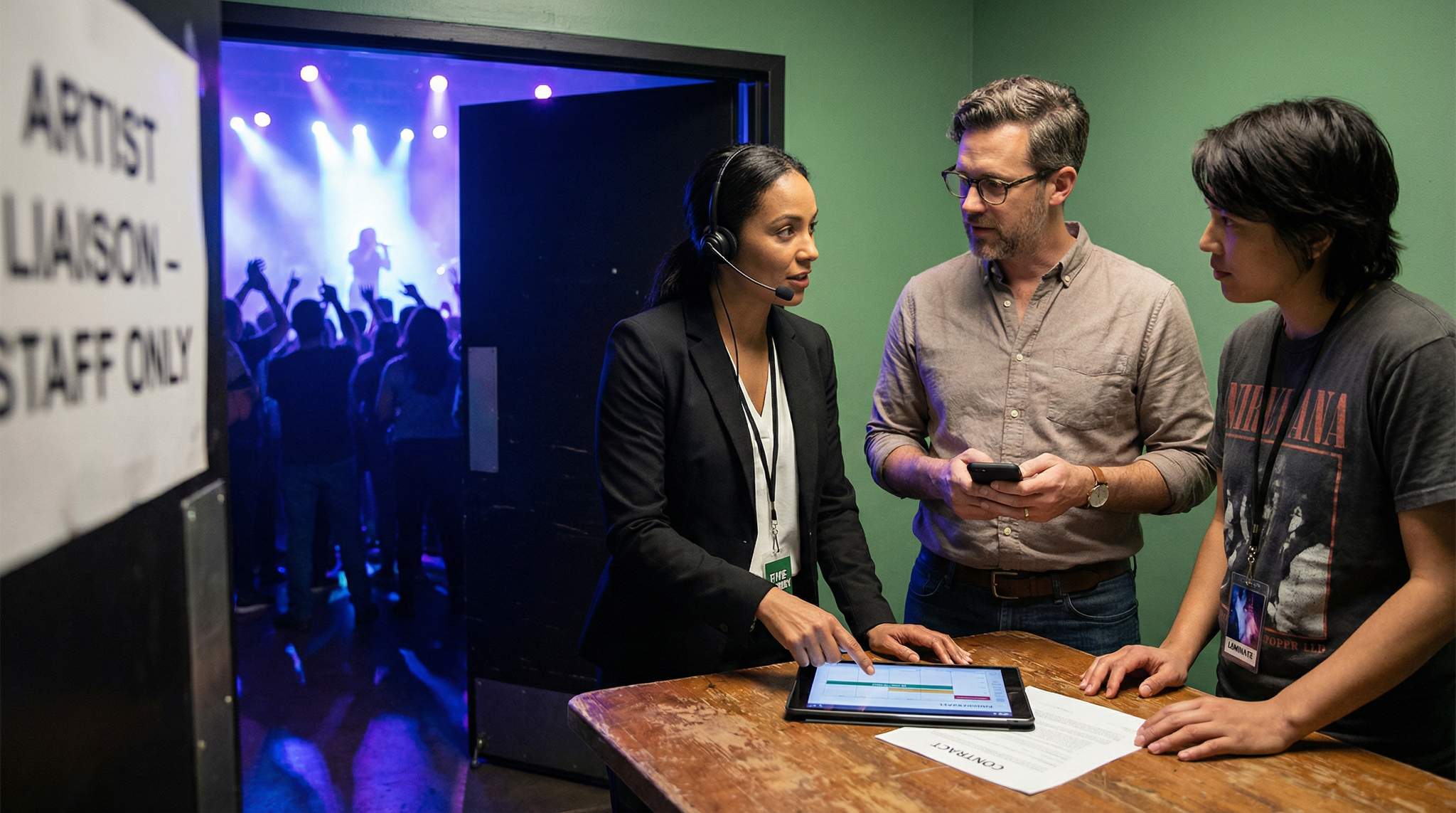
Event teams now often gather around shared screens, using collaborative software to plan timelines and creative details. Modern event management tools allow in-person and remote team members to work on the same interactive schedules, documents, and checklists in real time. This keeps everyone aligned and eliminates version control issues. As an experienced producer might recall, it wasn’t long ago that final schedules lived in static spreadsheets, leading to confusion when changes inevitably happened. Now, if the stage timetable shifts or a vendor update comes in, your whole team sees it immediately via the app or platform. Fewer frantic phone calls – and fewer mistakes – result.
What are some examples of event management technology?
It can be overwhelming to sift through all the event management tools out there, especially when you’re diving in for the first time and figuring out what to use when planning a music event and festival. The good news is that whatever you imagine you might need, it probably exists! Here are a few major categories of tech that event planners use, and how each one helps create better events:
Go Cashless With RFID Technology
Enable contactless payments, faster entry, and real-time spending analytics with RFID wristbands and NFC-enabled ticketing for your events.
| Tool Category | How It’s Used | Benefit to Events |
|---|---|---|
| Email marketing platforms | Send targeted email campaigns and updates to attendees (newsletters, offers, reminders) | Personalizes communication and boosts engagement; helps drive ticket sales and reduce no-shows by keeping your audience informed. |
| Social media tools | Schedule posts, manage event pages, and track analytics across platforms like Instagram, X (Twitter), TikTok, etc. | Expands outreach globally and builds community; generates buzz through shares and user-generated content well before the event. |
| Live streaming services | Broadcast live event feeds or performances to online viewers; enable virtual attendance via streaming or VR platforms | Extends your audience beyond the venue; fans worldwide can join virtually, increasing reach and revenue while providing an option for those who can’t attend in person. |
| Event management apps | Centralize planning with features for scheduling, task assignment, vendor management, and team chat (often via mobile and web) | Synchronizes the whole team on one system; reduces confusion with real-time updates, and keeps planning documents organized and accessible anywhere. |
| Registration & ticketing software | Facilitate online ticket sales, RSVPs, and check-ins; collect attendee data (demographics, preferences) in one dashboard | Streamlines the attendee journey from sign-up to entry, cutting wait times and errors. Also provides valuable data for marketing and on-site planning (like knowing how many VIP vs. GA guests to expect). |
The list of event tech tools is growing every year, and more planners are adopting them as an industry standard. Using technology isn’t just about making the organizer’s job easier – it directly leads to smoother, smarter experiences for attendees, too. Think about online registration: a decade ago, people printed tickets and stood in long lines; today, a scannable QR code or RFID wristband gets them through the gate in seconds. Or consider event apps that send push notifications about schedule changes or special offers on-site – attendees get the info they need instantly, no confusion. In short, tech is transforming not only how music events and festivals are organized, but also how fans experience them, from the moment they buy a ticket to the encore at the end of the night.
When evaluating your overall festival technology stack, it is crucial to look beyond standalone apps and consider how different systems communicate. A comprehensive tech ecosystem integrates ticketing, access control, point-of-sale, and staff management into a single data flow. For producers, investing in cohesive festival technology means less time troubleshooting API connections and more time focusing on site design and talent buying. Whether you are organizing a boutique electronic music gathering or a massive multi-day outdoor event, the right technological infrastructure scales seamlessly with your operational needs.
Ready to Sell Tickets?
Create professional event pages with built-in payment processing, marketing tools, and real-time analytics.
A major driver of this cohesive ecosystem is the rise of innovative event ticketing startups in 2025. Unlike legacy platforms that often silo attendee data, these emerging companies focus on giving promoters full ownership of their customer insights. By leveraging advanced API integrations, dynamic pricing models, and secure ticket transfers, these new partners help organizers mitigate scalping while maximizing revenue. For independent producers, collaborating with a forward-thinking ticketing provider means gaining access to enterprise-level analytics and marketing automation without the prohibitive costs. This shift represents a core piece of modern festival innovation, allowing teams to build highly customized, data-driven attendee journeys from the moment a ticket is purchased.
When producers ask which ticketing platforms are the most innovative for festivals and live events, the answer usually points to systems that offer white-label branding, robust API access, and built-in audience segmentation. The most forward-thinking providers go beyond simple transaction processing; they act as comprehensive growth partners. By utilizing these advanced systems, organizers can seamlessly integrate their box office data with marketing tools, ensuring that every promotional dollar is spent efficiently.
Beyond basic transaction processing, evaluating these advanced ticketing partners requires looking at how they handle the entire attendee lifecycle. The standout solutions in the market today offer built-in promotional tools, such as automated peer-to-peer ambassador programs and dynamic pricing algorithms that adjust to real-time demand. For a festival producer, choosing a cutting-edge registration system means securing a platform that actively helps sell out the event while providing the backend stability required to handle massive traffic spikes during on-sale days.
Looking ahead, the most prominent event ticketing software trends in 2025 revolve around hyper-personalization and decentralized data ownership. Promoters are moving away from rigid, one-size-fits-all box office solutions in favor of modular platforms that allow for custom checkout flows and integrated Web3 loyalty programs. Another major shift is the adoption of predictive analytics, where the software not only processes sales but actively forecasts demand curves based on historical data and social sentiment. For organizers, staying ahead of these registration technology shifts means you can optimize pricing strategies weeks before a lineup is even announced.
Data-Driven Event Marketing
Track ticket sales, demographics, marketing ROI, and social reach in real time. Exportable reports give you the insights to make smarter decisions.
Pro Tip: As you integrate new tools into your event, make sure they can “talk” to each other. An event app that syncs with your ticketing platform and CRM will prevent data silos and give you a 360° view of operations. For example, linking your ticket sales data with your email marketing tool lets you automatically send personalized reminders or upsell offers to ticket buyers. This kind of integration saves time and ensures no attendee falls through the cracks.
There are many reasons why technology is shaping the future of event planning. Below, we look at five key ways these innovations are improving events as of 2025:
Grow Your Events
Leverage referral marketing, social sharing incentives, and audience insights to sell more tickets.
1. Communication is seamless
Effective communication is the backbone of any successful event plan. Modern event management technology makes team communication clear, centralized, and instantaneous. Instead of long email threads or scattered WhatsApp messages, planners can use dedicated platforms where every team member – from stage managers to security leads – stays updated in real time. This ensures your whole team is on the same page (literally, often viewing the same dashboard or app screen). When using an all-in-one planning app, the operations crew, vendors, and volunteers can all access the latest schedules, site maps, and task lists. If someone makes a change or update, everyone sees it immediately.
Imagine it’s the day of a big festival and a sudden thunderstorm forces a change in the schedule. In the old days, that scenario could mean chaos: frantic radio calls, runners physically delivering new timetables, and inevitable confusion among staff and attendees. Today, with the right communication tech, you can adjust the schedule in your event app and ping the update to everyone at once. Crew members receive an instant notification in their app, and attendees could even get a push alert about the adjusted show times. Crisis averted in minutes. This level of responsiveness simply wasn’t possible before – and it highlights how seamless communication tech adds a layer of agility that improves both the working experience for staff and the event experience for fans.
The benefits are tangible: fewer mistakes, faster responses, and a less stressed team. Surveys back this up – organizers say real-time collaboration tools have significantly cut down on errors and last-minute scrambles, facilitating data-driven strategies. When every department can coordinate through one channel, there’s little room for crossed wires. Veteran stage manager insight: “In the past, I’d often play telephone between the sound crew and the artist manager. Now, using our event Slack channel, they sort details out directly and instantly – I just oversee.” In short, when communication flows smoothly through tech, your event can run like a well-choreographed dance instead of a relay of isolated runners.
2. Planning is more synchronized and organized
Building on improved communication, technology also makes project management for events far more synchronized and organized. Rather than juggling dozens of separate spreadsheets, documents, and calendars, you can consolidate all planning elements into one system. Many event professionals adopt project management software (some tailored specifically to events) to map out everything from production timelines to vendor contracts. This means your team can upload information easily, track progress on tasks, and see updates in one place. Automatic reminders and notifications keep everyone on schedule – the app itself becomes your virtual production assistant.
No Hidden Fees, Just Honest Pricing
One all-inclusive fee covers the platform, payment processing, support, and every feature. Free events are always free. No setup costs, no surprises.
Organization comes naturally when using these tools. Every piece of the plan – site layouts, catering orders, artist travel itineraries – gets filed in an accessible way. Need to find the stage power requirements? Just search within your event app instead of digging through email archives. And because everything is stored centrally, meetings become more productive: everyone has the latest info beforehand, so time isn’t wasted catching up. The result is a more synchronized team that can anticipate issues and stay proactive.
Planners who have transitioned to digital workflows often report big improvements. We already noted the time savings – up to 30% less planning time thanks to streamlined workflows and advanced tools – which means you can dedicate more energy to creative enhancements rather than administrative drudgery. There’s also a consistency that technology enforces. Checklists ensure no step is overlooked; templates from previous events can be reused and tweaked, carrying forward best practices. If you’re managing multiple events or festivals in one season, these tools become even more crucial. Many top promoters running several festivals at once rely on centralized dashboards to oversee each event’s status without getting overwhelmed, similar to how 2026 festivals use automation. In essence, tech acts like the conductor of an orchestra – aligning all the moving parts so the entire production stays in harmony.
Pro Tip: Facing staff shortages or a small team? Automation can be your secret weapon. Consider using self-service solutions like automated check-in kiosks, cashless payment systems, or chatbot assistants for attendee FAQs. Many events in 2025 are turning to automation to fill labor gaps, allowing a lean crew to manage large crowds efficiently. For instance, a self-serve ticket scan at the gate frees up staff to handle exceptions or customer service issues, rather than manually checking every ticket. Embrace tech as an extra “team member” that works 24/7 without breaks.
3. Marketing tools make promotion easier and more targeted
Selling tickets and building buzz is a huge part of event planning – and technology has completely upgraded how planners approach marketing. Today’s event marketing tools include everything from email automation platforms to sophisticated social media ad targeting and analytics dashboards. These tools make it infinitely easier to reach your ideal audience with the right message at the right time.
Take email marketing as an example: Modern email platforms enable you to segment your audience and personalize each message. If you know that one segment of your list prefers electronic music and another loves art installations, you can send tailored content highlighting the aspects of the event each group will appreciate most. Personalization is key to grabbing your audience’s attention – and it pays off. According to industry data, 94% of event teams consider pre-event email campaigns their most important marketing channel, according to Bizzabo’s 2024 event statistics), precisely because targeted emails drive engagement and conversion better than generic blasts. A well-crafted email with a personalized greeting and content relevant to the recipient is far more likely to turn a prospect into an attendee.
Social media is the other cornerstone. With scheduling and analytics tools, you can plan out posts across platforms and then use real-time data to see what’s hitting the mark. For instance, you might discover via analytics that Instagram is generating more ticket clicks than Facebook, leading you to adjust your budget or content strategy accordingly. Social marketing tech also helps with community building – you can monitor mentions and hashtags to engage directly with fans, turning your followers into an active promotional street team. A viral TikTok or an Instagram reel of a past event highlight can explode your reach overnight with zero advertising cost, simply because the tools helped you harness user-generated content.
Smooth Entry With Mobile Check-In
Scan tickets and manage entry with our mobile check-in app. Supports photo ID verification, real-time capacity tracking, and multi-gate coordination.
Crucially, all these marketing technologies give you data to refine your strategy. You’ll know open rates, click-through percentages, engagement metrics, and conversion rates in real time. This means you can experiment (A/B test that subject line or try two versions of an ad) and quickly optimize based on what the numbers show. Event organizers in 2025 are far more data-driven in their marketing decisions than ever before – and it’s yielding results. Some reports show that firms using advanced marketing tech see nearly a 50% boost in audience engagement, which often translates to higher ticket sales and sold-out shows.
Finally, marketing tech helps with maintaining relationships even after your event. You can easily send a post-event thank you, a survey for feedback, or an early bird discount for your next festival to all attendees with a few clicks. This keeps your audience warm and eager for the next experience. As explored in our guide on audience targeting and experience design, focusing on the right audience and crafting messages for them is what most festivals get wrong about audience targeting. The new wave of marketing tools is exactly what enables that level of focus, without needing an army of marketing staff. In sum, technology has made event marketing more efficient, more precise, and often more budget-friendly (since you waste less effort on people who aren’t likely to convert). The result? Better turnout and a more engaged crowd when the doors open.
Beyond traditional social media, technology innovations in event discovery platforms are changing how new audiences find your shows. Modern discovery apps now use machine learning algorithms to recommend upcoming festivals based on a user’s streaming habits or past ticket purchases. By ensuring your event is listed and optimized on these networks, you tap into a highly qualified pool of potential buyers who are actively looking for their next live music experience.
Furthermore, these advanced discovery networks integrate seamlessly with modern ticketing ecosystems. When a fan searches for niche genres, the platform’s algorithm doesn’t just show them a flyer; it provides a frictionless, one-click path to purchase. For promoters, leveraging these tech-driven discovery channels means lower customer acquisition costs and higher conversion rates compared to traditional broad-stroke advertising.
To fully capitalize on these networks, producers must also consider the technology infrastructure scaling event discovery platforms. As your festival grows from a regional favorite to a nationally recognized brand, the underlying architecture of your ticketing and marketing stack must be able to handle sudden surges in traffic generated by these discovery algorithms. Utilizing cloud-native registration systems ensures that when a major discovery app pushes a notification about your event to thousands of local users simultaneously, your checkout process remains fast and stable, preventing abandoned carts and lost revenue.
4. Your outreach can expand globally (and build a community)
One of the most powerful impacts of technology is how it blows past geographical boundaries for events. With social media, live streaming, and online communities, your local event can attract a global following. This means your outreach isn’t limited to people in the same city or those who happen to catch an ad – you can actively cultivate an international audience of fans.
Free Tool: Model Promoter Payouts
Flat-percentage, flat-per-ticket, or tiered-bonus commission structures — get per-promoter payouts and total commission as % of gross. Free calculator.
Social media, in particular, has become the megaphone that can project even a small event onto the world stage. By creating engaging content and encouraging attendees to share their experiences, you turn your event into a trending topic that friends-of-friends (and their friends) hear about across the country or across the ocean. We’ve seen indie festivals in one country gain ticket buyers from another continent simply because a performance clip went viral on TikTok or a striking photo made rounds on Instagram Explore pages. Your event’s brand can live online year-round, attracting followers worldwide who may travel to attend, or at least spread the word to others.
Technology also enables targeted advertising to specific communities that might have interest in your event. For example, say you’re hosting a Japanese indie rock night in Los Angeles – through social media ad targeting you could reach Japanese expat community groups in California, anime convention followers, or fans of similar bands anywhere. This precision means you can expand your reach to niche audiences that traditional local marketing would never find. And because tools provide insights on who’s clicking or engaging, you can refine these targets over time to maximize the impact.
Another component of expanding outreach is the rise of online communities and fan engagement platforms. Many event organizers create Facebook Groups, Discord servers, or subreddit communities where fans can gather virtually. This not only builds hype before the event, but also fosters a sense of belonging that can turn one-time attendees into a loyal community. When people feel connected to your event brand virtually, they’re more likely to show up physically. A global fan forum can make international attendees feel just as much part of the community as locals – so when they do travel to your festival, they already have friends to meet and plans to connect (some festivals even organize meetup points for members of their online fan groups!).
All of this global reach used to be possible only for mega events with huge marketing budgets. Now, even a smaller festival or a regional concert series can punch above its weight by smartly using technology for outreach. The key is consistency and authenticity: engage with your followers, respond to comments, share behind-the-scenes looks – essentially, keep the conversation going. Over time, your online presence becomes a magnet, pulling in new audience members far and wide. We live in an age where someone in London or Sydney might proudly wear a T-shirt of a festival that takes place in Brazil or the US, simply because they encountered its vibe online and plan to attend someday. That’s the power of tech-enabled global outreach – it turns your event into an idea without borders, not just a one-off happening in a single location.
5. Technology can transform the attendee experience on-site and online
Beyond planning and marketing, some of the most exciting innovations appear in the live experience itself. Technology has opened up new ways for attendees to enjoy events – sometimes in person, sometimes virtually, and often a blend of both. A prime example is the rise of hybrid events and enhanced live streaming. After the global disruptions in 2020–2021, many people grew accustomed to remote event options. As of 2025, that trend isn’t going away: roughly 40% of attendees say a hybrid format (with in-person and online options) is their favorite way to experience events, based on recent attendee preference data). By streaming your live music festival or conference to an online audience, you can satisfy fans who can’t be there physically and tap into a second source of engagement and revenue. Major festivals have embraced this – for instance, Coachella’s free YouTube live stream has attracted tens of millions of viewers (the 2019 stream drew a record 82 million live views on YouTube), massively extending the festival’s reach beyond the polo fields.
Additionally, tech can enhance the on-site experience in ways that make the event more immersive and convenient. Mobile event apps are increasingly common at large events, giving attendees an interactive guide in the palm of their hand. Through an app, fans can build their own schedule, get real-time updates on performances, explore festival maps, and even network with each other. It’s become such a staple that 68% of attendees now consider it vital for events to offer a mobile app, according to Bizzabo’s research) – no one wants to carry a paper schedule or miss a surprise pop-up show because they didn’t get the alert. Some apps even use GPS to send location-specific notifications (like “The line at the merch booth in Zone B is short now”) or AR features to view information or art through your phone camera at the venue. All these touches add convenience and delight, reducing friction so attendees can focus on having fun.
Built-In Email Marketing for Events
Send targeted campaigns, automated purchase confirmations, and post-event follow-ups directly from your ticketing dashboard.
For producers, the true power of these platforms lies in seamless mobile app integration for concerts. When your custom application connects directly via API to your ticketing provider, cashless point-of-sale systems, and access control hardware, it creates a unified digital ecosystem. This connectivity allows organizers to push real-time schedule changes, trigger location-based sponsor messages, and monitor crowd flow analytics from a central dashboard. Instead of operating in silos, a fully synced concert app ensures that box office data instantly updates VIP access lists, while food and beverage vendors receive accurate demand forecasting based on attendee movement.
Technology is also enabling interactive and personalized experiences that were never before possible. Think of silent disco headphones that let each attendee choose their own music channel, or augmented reality installations where fans can point their phone at a stage and see holographic effects through the screen. At some concerts, fans can even influence aspects of the show via live polls or apps (imagine voting on the next song or controlling the color of LED wristbands worn by the crowd). Speaking of LED wristbands – a recent example stands out: at Coldplay’s 2024 stadium shows, every audience member received a wireless LED wristband, which lit up in sync with the music and visuals. This wearable tech transformed the concert into a multisensory journey, ensuring each person became part of a collective, magical light show. Attendees raved that it made them feel like active participants in the spectacle, not just spectators.
When planning the infrastructure for these activations, producers must consider exactly how live events interact with interactive technologies on a technical level. Deploying augmented reality, real-time crowd polling, or synchronized wearables requires robust on-site networks. High-density Wi-Fi, low-latency 5G setups, and seamless API integrations between your event app and the venue’s hardware are non-negotiable. As an organizer, you aren’t just booking a cool visual effect; you are building a temporary smart-city ecosystem where attendee inputs—like a tap of an RFID wristband or a vote cast on a smartphone—trigger immediate, synchronized environmental responses across the festival grounds.
Fans at a music festival share the moment with thousands of phone lights in the air. From interactive light-up wristbands to everyone filming their favorite song on a smartphone, technology is now woven into the live atmosphere. We’ve reached a point where many attendees are embracing these tech-driven enhancements as part of the fun. Even formerly “old-school” traditions are going high-tech: instead of lighters swaying in the dark, it’s phone flashlights; instead of signing a paper guestbook at a conference, attendees drop virtual business cards via an app. As event producers, we need to harness these trends to elevate the experience. That could mean investing in better audio-visual tech for breathtaking stage visuals, deploying fast Wi-Fi and charging stations so people can stay connected, or creating virtual photo booths and AR filters attendees use to share branded content on social media during the show.
However, it’s crucial to implement technology thoughtfully. The goal is to enhance the experience, not distract or complicate it. For example, if you roll out a festival-wide cashless payment system, ensure it’s reliable and have a backup plan (like accepting cash if needed) so that a tech glitch won’t leave people unable to buy food or drinks. In fact, many veteran organizers stress balance: use tech to add value, but keep the human touch. As one industry guide puts it, festivals can innovate without losing their soul – meaning the sense of community, authenticity, and spontaneity that make live events special must remain front and center. A great example: many festivals have introduced automated ID-scanning entry gates to speed up lines, but they still station friendly staff nearby to welcome attendees and assist anyone who runs into trouble with the scanner. Technology should never replace good hospitality; rather, it should free up your people to deliver it.
When producers ask how technology can be integrated into festival programming to captivate attendees, the answer lies in blending the physical and digital worlds seamlessly. If you are looking for ways to innovate a live band concert experience to make it more moving and special, consider interactive stage designs that react to crowd noise, or spatial audio systems that provide studio-quality sound regardless of where a fan is standing. True festival innovation isn’t just about flashy gadgets; it’s about using tools to deepen the emotional connection between the artist and the audience.
For producers operating outside of major global hubs, adapting these strategies to local environments is essential. When considering how technology can be integrated into festival programming to captivate attendees in specific regions—such as when your location is Canada—the focus must shift toward resilient infrastructure and localized engagement. Canadian festivals, for instance, often deal with remote outdoor venues where cellular service is spotty. In these scenarios, deploying localized mesh networks allows interactive programming—like offline-capable scavenger hunts via the event app or localized Bluetooth beacons triggering site-specific audio—to function flawlessly without relying on a broader internet connection. This ensures that the immersive experience remains uninterrupted, regardless of geographic constraints.
Warning: Don’t rely solely on technology with no contingency plan. Veteran producers recount cautionary tales of tech hiccups – like a cashless payment system outage that forced vendors at one festival to give away food on the honor system, a scenario discussed in our guide on balancing high-tech with the human touch. The events that handle these setbacks best have human backups in place. If you introduce an all-app attendee ticket, keep a manual check-in option ready. If your event app crashes, have loudspeaker announcements or info booths as a fallback. Technology amplifies your capabilities, but trustworthiness with your audience means you’re prepared even if the Wi-Fi goes down or a system misfires.
Technology is creating a wave in the event planning industry. From planning and marketing through to the live show, embracing the right innovations can dramatically improve both operational efficiency and attendee satisfaction. Importantly, tech also generates a wealth of data that you can use to continually refine and improve your events. It’s wise to use a ticketing platform that gives you vital information about your audience – demographics, interests, purchasing behavior – in detailed reports updated in real time. All this data can be easily accessed when you set up your event on Ticket Fairy’s large event ticketing platform. These insights not only help with immediate logistics, but also enable you to look for potential sponsorship opportunities by presenting solid attendee profiles to brands, or to curate on-site experiences (like choosing food vendors or activities) that match your ticket buyers’ preferences. In the end, while great events are built on creative vision and hard work, leveraging technology and data is what truly empowers you to elevate those events into exceptional experiences for everyone involved.
Frequently Asked Questions
How does event management software improve planning productivity?
Event management software significantly boosts productivity by automating manual tasks and centralizing communication, capable of cutting planning time by up to 30%. Switching to all-in-one platforms decreases miscommunications by over 25% because teams access real-time schedules and documents. This integration ensures efficiency and clarity from early planning stages through show day.
Why are mobile apps considered vital for modern music festivals?
Mobile event apps are essential tools that 68% of attendees now consider vital for navigating festivals. These apps provide interactive schedules, real-time push notifications for lineup changes, and GPS-enabled maps. They streamline the attendee experience by delivering instant information and reducing friction, ensuring fans never miss performances or important updates.
How does email marketing technology benefit event promotion?
Email marketing platforms allow organizers to segment audiences and send personalized messages, which 94% of event teams consider their most important marketing channel. By tailoring content to specific music or art preferences, planners drive higher engagement and ticket sales. Integrating these tools with CRM systems ensures automated, relevant communication throughout the attendee journey.
What is the advantage of hosting hybrid events with live streaming?
Hybrid events extend an organizer’s reach beyond the physical venue by broadcasting live feeds to global online audiences. With roughly 40% of attendees preferring this format, live streaming generates additional revenue and engagement. Major festivals like Coachella have utilized this technology to attract tens of millions of virtual viewers worldwide.
How can automation solve staffing shortages at large festivals?
Automation fills critical labor gaps by handling repetitive tasks through self-service solutions like check-in kiosks and cashless payment systems. These tools allow lean crews to manage large crowds efficiently while working 24/7 without breaks. By automating entry and FAQs via chatbots, staff are freed up to handle complex customer service issues.
How do interactive technologies like LED wristbands enhance concert experiences?
Interactive technologies like wireless LED wristbands transform concerts into multisensory journeys by syncing light effects with the music. Used effectively at stadium shows, these wearables turn the audience into an active part of the visual spectacle. This immersive tech fosters a sense of collective participation, making attendees feel connected to the performance.
What role do innovative event ticketing startups play in 2025?
Innovative event ticketing startups in 2025 are pushing the boundaries of data ownership, dynamic pricing, and seamless entry. By leveraging advanced API integrations and secure transfer protocols, these emerging platforms give organizers deeper insights into buyer behavior while mitigating scalping, ultimately driving true festival innovation from the point of purchase.
What are some ways to innovate a live band concert experience to make it more moving and special?
To deeply captivate attendees, organizers can integrate several technology innovations into festival programming. Consider these 10 approaches: 1) Spatial audio systems for immersive sound, 2) Interactive LED wristbands synced to the beat, 3) Augmented reality (AR) filters for stage visuals, 4) Real-time crowd-controlled lighting, 5) Holographic artist projections, 6) Haptic feedback flooring for bass-heavy shows, 7) Drone light shows replacing traditional fireworks, 8) AI-generated generative art backdrops, 9) Silent disco hybrid zones, and 10) Multi-camera live streaming for VIP virtual access. These festival innovations deepen the emotional connection between the artist and the audience.
How can technology be integrated into festival programming to captivate attendees in specific regional markets?
Whether you are operating a large-scale event in Canada or a boutique gathering elsewhere, integrating technology into festival programming requires adapting to local infrastructure. For example, organizers evaluating event management and hospitality platforms (such as Bizzabo) for regional events—like wine country food and music festivals—often prioritize robust offline capabilities, VIP hospitality tracking, and localized discovery platform integrations. This ensures that even in remote or specialized venues, the tech stack reliably elevates the attendee experience.
How do live events interact with interactive technologies on a technical level?
For live events to successfully interact with interactive technologies, organizers must deploy robust on-site infrastructure. This includes high-density Wi-Fi, low-latency 5G networks, and seamless API integrations between mobile event apps and venue hardware. This technical foundation allows attendee actions—such as scanning an RFID wristband or participating in a live smartphone poll—to trigger immediate, synchronized audio-visual responses, creating a deeply immersive environment.
What are the core components of a modern festival technology stack?
A robust festival technology ecosystem typically includes centralized event management software, RFID or QR-based access control, cashless point-of-sale systems, and dynamic ticketing platforms. For organizers, integrating these tools ensures real-time data syncing across departments, reducing operational bottlenecks and providing actionable insights into attendee behavior and on-site spending.
Which ticketing platforms are the most innovative for festivals and live events?
The most innovative ticketing platforms for festivals and live events are those that offer white-label customization, deep API integrations, and advanced data ownership. Rather than just processing transactions, these modern systems act as comprehensive growth engines, allowing promoters to leverage dynamic pricing, built-in marketing automation, and real-time audience analytics to maximize revenue and streamline operations.
How should organizers evaluate ticketing platforms for large-scale live events?
When assessing modern box office solutions, producers should prioritize systems that offer robust data ownership, seamless API integrations with existing marketing tools, and advanced features like predictive demand analytics. An innovative platform acts as a growth partner, providing the infrastructure needed to scale operations, manage dynamic pricing, and execute targeted promotional campaigns effectively.
How does mobile app integration for concerts improve operational efficiency?
Integrating a custom mobile app with your core event systems—such as ticketing, access control, and cashless payments—creates a unified digital ecosystem. For concert organizers, this connectivity means real-time data syncing across departments. It allows teams to monitor crowd flow, push instant schedule updates, and manage VIP access dynamically, ultimately reducing bottlenecks and enhancing the overall attendee experience.
What are the leading event ticketing software trends in 2025?
The top event ticketing software trends for 2025 focus on predictive analytics, decentralized data ownership, and hyper-personalized checkout experiences. Promoters are increasingly adopting modular platforms that forecast demand curves and integrate seamlessly with Web3 loyalty programs, allowing organizers to optimize dynamic pricing and maximize revenue long before the event date.