Introduction
Cosplay contests (often dubbed masquerades) have become the crown jewel of fan conventions – from small local anime cons to massive comic expos. Figuring out how to run a cosplay contest that dazzles attendees while keeping everyone safe is both an art and a science. On one hand, you’re staging a spectacular showcase of fan creativity; on the other, you’re responsible for fair judging and strict safety measures (like cosplay prop weapons policies) to protect participants and the public. The stakes are high: at events like Dragon Con in Atlanta – which drew 70,000 attendees in 2023 – the cosplay parade and contest are headline attractions, while even intimate 500-person conventions rely on a fun masquerade to engage their community. This guide draws on decades of convention experience to help organisers create cosplay competitions that celebrate fans’ creative passion and enforce sensible prop weapon rules. We’ll cover everything from designing fair contest guidelines and recruiting judges to conducting prop checks and “peace-bonding” weapons. The goal: ensure your cosplay showcase is a safe, inclusive highlight of the con, not a logistical headache or safety risk.
Tip: Success lies in planning beyond the masquerade itself. That means establishing clear rules well in advance, communicating them to attendees, and coordinating every detail – from pre-registering contestants to placing security at the doors. With smart preparation, your cosplay contest can run smoothly, wow the crowd, and become a beloved tradition fans talk about for years.
How to Run a Cosplay Contest in 2026: Planning the Basics
Running a great cosplay contest starts long before the convention weekend. Organisers should lay a strong foundation of rules, categories, and registrations that set cosplayers up for success. A well-planned contest is fair, inclusive, and transparent, so both first-time cosplayers and veteran costumers feel excited to participate. Equally important, a thorough plan heads off common problems – like hurt feelings over judging, or chaos lining up contestants – before they happen. In this section, we’ll look at crafting convention cosplay contest guidelines that cover who can enter, how winners are picked, and what cosplayers need to know upfront.
Clear Contest Rules and Categories for All Skill Levels
Every successful masquerade begins with clear, written rules that are shared with attendees early. These rules ensure a level playing field and help cosplayers understand exactly what to expect. Key areas to cover include:
Smooth Entry With Mobile Check-In
Scan tickets and manage entry with our mobile check-in app. Supports photo ID verification, real-time capacity tracking, and multi-gate coordination.
- Eligibility and Skill Divisions: Decide whether to split contestants by experience level. Many conventions use skill categories like Novice, Journeyman, and Master so beginners aren’t directly competing against seasoned cosplay veterans. For example, an entrant who has won major awards would be required to compete as a Master, while first-timers or those without wins start as Novices. Some cons also offer a separate Youth division for children. Skill-based categories encourage newcomers by giving them a fair shot, rather than pitting them against professional-grade creators. Experienced con runners recommend setting clear criteria (e.g. “Less than 1 year of cosplay or no prior awards qualifies as Novice”) so contestants self-select into the right tier. This prevents the frustration of an expert costumer “sandbagging” in a beginner tier just to snag an easy win.
- Original Work vs. Store-Bought: Decide how to handle costume craftsmanship. Typically, masquerades are intended to showcase costumes made or heavily handcrafted by the cosplayers themselves. Many competitions explicitly state that commissioned or purchased costumes are not eligible for awards. For instance, San Diego Comic-Con’s official rules require that costumes be “of original construction or show significant modification” – you can’t just buy a costume online and win Best in Show. If your contest will include workmanship judging, communicate a guideline (some cons use a threshold like “at least 60-70% of your cosplay must be made or altered by you”). This sets expectations that it’s a contest of skill and effort, not wallet size. However, you may allow some exceptions or separate categories: for example, a Performance-Only category where stage presentation is judged regardless of who made the outfit. Just be upfront so everyone knows the ground rules.
- Content and Conduct Guidelines: Cosplay spans every fandom genre, so lay out any content restrictions. Most conventions require skits and costumes to be PG-13 appropriate at most (no overt nudity, extreme gore, or hateful imagery), given that audiences often include families. Also clarify what type of performances are allowed: Is dancing or singing permitted? Any ban on risky stunts? For example, Animazement convention’s masquerade rules specify “no full flips or hard stage jumps” due to safety on their platform stage. A common rule is “no live steel or real weapons on stage,” so nobody accidentally swings an actual blade during a skit. Additionally, emphasise respectful behaviour: your guidelines might echo the fan community mantra “cosplay is not consent,” reminding everyone that harassment of contestants or unwelcome touching of costumes will not be tolerated. A clear cosplay policy that celebrates creativity while keeping things safe sets the tone for an inclusive, fun contest. Publish these rules on your website and con program well ahead of time, so entrants and attendees alike are on the same page.
- Time Limits and Technical Specs: To keep the show flowing, establish limits on performance length. Commonly, a solo cosplay skit might get 1 minute to 1.5 minutes, while a group of several people might be allowed up to 2.5 minutes. Define these clearly (e.g. “individual entries have 90 seconds; groups up to 3 people have 2 minutes”). Also specify how audio should be provided (most contests require contestants to submit a music track or audio file in advance, rather than handling live mics). If certain tech effects are off-limits or need pre-approval – perhaps strobe lights, smoke machines, or confetti – put that in writing. One convention might allow flash paper effects only with prior staff approval, while another might ban confetti outright (since venues dislike the mess). For fairness, the rules should apply equally: if fog machines aren’t allowed for one, no one should sneak one in. By detailing these production aspects early, you avoid night-of disputes like a cosplayer wanting to redo their act because their audio wasn’t cued properly.
In crafting your contest guidelines, aim to be thorough but not discouraging. Invite participation by explaining the contest’s spirit (“a fun showcase for all fans”) even as you lay down rules. Many conventions post a FAQ with their masquerade rules, anticipating questions like “Can my friend help on stage as a stage ninja?” or “Are original characters allowed, or only existing characters?” Cover those common queries in your materials. Transparency is key – when everyone understands the rules and feels they apply equally to all, your contest avoids the all-too-common complaints of bias or confusion.
Common Cosplay Contest Skill Divisions
| Division | Who Belongs Here? | Typical Criteria (Examples) |
|---|---|---|
| Novice (Beginner) | First-time contestants or those with no prior cosplay awards. Ideal for newcomers to gain experience. | 0–1 years cosplay experience; no significant competition wins. Handmade costume not required but encouraged. |
| Journeyman (Intermediate) | Cosplayers with some experience or minor awards, but not yet at master level. | Some costume construction skill; perhaps 1–2 minor awards. Stepping up craftsmanship difficulty. |
| Master (Advanced) | Veteran cosplayers and past winners competing at the highest level. The “pros” of fan costuming. | Multiple years experience; significant craftsmanship awards or professional costume work. Expected to produce elaborate, self-made costumes. |
| Youth | Children (often under 12 or under 14) in costume, sometimes judged separately or given participation awards. | Age-based category; parents may accompany on stage. Focus on fun rather than technical skill. |
Not every convention will use all these categories – smaller cons might combine Journeymen and Masters, for instance – but consider at least separating novices from experts. This way, a 14-year-old in their first handmade costume isn’t directly up against a cosplayer who’s been perfecting armor builds for 10 years. Some events also create special categories like Best Group (for group skits) or Best Craftsmanship (awarded purely on costume construction regardless of performance). The structure can be tailored to your event’s size and goals, but the guiding principle is the same: keep the contest fair and fun by grouping like with like.
Ready to Sell Tickets?
Create professional event pages with built-in payment processing, marketing tools, and real-time analytics.
Streamlined Registration and Pre-Con Sign-Ups
One of the most practical cosplay contest management tips is to handle as much admin as possible before the convention begins. Allowing cosplayers to register for the contest in advance – often via an online form – greatly reduces chaos on the day of the event. Many conventions open masquerade sign-ups weeks or months prior and cap the number of entries for a manageable show (e.g. “First 30 qualified entries will be accepted”). This lets you review entries, ask follow-up questions, and even vet for any rules issues (like an oversize prop or a risky performance idea) ahead of time.
If pre-registration isn’t feasible, at least announce a clear sign-up window (say, Friday 2–6pm at the cosplay desk) where contestants can register at the con. Emphasise that no entries will be taken after the deadline so your team has time to organise the lineup. Last-minute sign-ups or show-night surprises (“Can I join in? I just finished my costume!”) should be strongly discouraged, as they can throw off timing and judging plans.
Expert tip: Use technology to your advantage. Integrating contest sign-ups into your convention’s online ticketing or registration platform can streamline the process. Some event management systems let you add a cosplay contest application as part of badge purchase or as an add-on, so you gather all necessary info digitally. At minimum, create a Google Form or web form for contestants to fill out. Collect details like: stage name, character/series, a short performance description, audio file upload, category (Novice/Journeyman/Master), and any stage needs (e.g. assistance with large props). Having this data in a spreadsheet well before the event helps you plan the show order and prepare the MC’s script. It also reduces on-site paperwork – your staff won’t be deciphering messy handwriting on sign-up sheets or scrambling to download music files at the last minute.
Behind the scenes, once registrations are in, build a schedule around the contest. Account for a briefing or rehearsal: many veteran organisers schedule a contestants’ meeting a few hours before showtime or early on contest day. During this meeting, entrants confirm their music with the AV team, walk through the stage area to get familiar, and learn the run-of-show. It’s also a chance to do a costume workmanship pre-judging if you offer a craftsmanship award – judges can use a side room to inspect costumes up close and ask the makers questions without the pressure of the stage. Pre-judging each entry for 3–5 minutes can significantly improve fairness in craftsmanship awards, but it does require time and coordination (often earlier in the day or immediately before the main show). Make sure to communicate to contestants if pre-judging is required, and hold it on schedule. Organising these elements ahead of time, with clear communications, ensures that when it’s showtime, your cosplayers feel prepared and taken care of.
Grow Your Social Following With Every Sale
Require social media follows, shares, or playlist adds to unlock presale access or special pricing. Turn every ticket purchase into audience growth.
Judges and Judging Criteria: Ensuring Fairness
The difference between a frustrating contest and a fantastic one often comes down to judging. Cosplayers put their heart into their creations – if the contest feels rigged or the feedback is lacking, it can sour their whole experience. That’s why selecting the right judges and using a transparent scoring system is crucial. In this section, we’ll explore how to recruit judges who command respect, and how to establish judging criteria that make the evaluation process as fair and objective as possible. Remember, the goal is to celebrate fan creativity, not to create unnecessary competition drama, so the judging process should feel professional and unbiased to all involved.
Recruiting Knowledgeable, Respected Judges
Who should judge your cosplay contest? Ideally, individuals with a solid understanding of costuming, performance, or (preferably) both. Common choices include:
Grow Your Events
Leverage referral marketing, social sharing incentives, and audience insights to sell more tickets.
- Experienced Cosplayers: Many cons invite well-known cosplayers (sometimes guest cosplayers brought in by the event) to be judges. These folks have typically participated in or won contests themselves, so they understand the effort and nerves involved. They also tend to have credibility in the community – contestants appreciate being evaluated by someone whose own craftsmanship or cosplay resume they admire. If you have a cosplay guest of honour at your con, asking them to judge the masquerade is a natural fit.
- Costume or Fashion Professionals: Some contests include professional costume designers, seamstresses, makeup artists, or prop builders as judges. For example, a local theatrical costumer or a special effects artist can offer expert eyes. They might not be famous to attendees, but their technical insight can be invaluable, especially for craftsmanship awards. Just ensure they also understand the fan community aspect – a professional who has never been to an anime con might need a crash course in what the characters are and why accuracy matters to fans.
- Organisers or Emcees: Convention staff members sometimes serve as judges, especially if they have cosplay experience. However, be cautious about any perceived biases – if a staff judge is best friends with a contestant, that’s a conflict. Some events avoid having core staff judge for this reason, bringing in external judges to maintain neutrality.
Aim for 3 to 5 judges on your panel. An odd number (3 or 5) is useful to break any ties and provide a range of opinions. It’s also wise to have a mix of strengths – for instance, one judge might be a master armor maker, another is great with sewing and fabric, and a third is a performer who values stage presence. This way, contestants are evaluated from multiple angles. Brief your judges on the rules and criteria beforehand. Make sure they know the categories (so they don’t accidentally compare a Novice too harshly against a Master) and the scoring system you’ll use. Also discuss etiquette: judges should remain respectful in their critiques. Many contests allow (or even encourage) judges to provide private feedback to contestants after the show – if so, remind judges to be constructive and kind in their notes. The cosplay community is tightly-knit, and a judge who belittles an entrant’s hard work can quickly get a bad reputation (and by extension, so can your event). Pick judges who are approachable and positive, not just technically skilled.
Establishing Judging Criteria and Scoring
To demystify the judging process, decide on a scoring rubric and share it publicly. A transparent judging system builds trust: contestants know why the winners won. Common judging criteria include:
- Craftsmanship (Construction Quality): How well-made is the costume? This looks at durability, skill in techniques, detailing, and overall faithfulness to the source design. If a costume was largely self-made, judges examine seams, armor construction, wig styling, prop build quality, etc. You might assign, say, 40% of the score to craftsmanship for those in craftsmanship-focused categories.
- Accuracy or Presentation of Design: For character cosplays, how closely does the costume (and props) resemble the character’s look? Judges consider faithfulness to reference images. However, note that “accuracy” can be tricky if original designs or creative interpretations are allowed; some contests instead use “visual impact” or “accuracy/creativity” combined. Essentially, does the cosplay look impressive and recognizable as what it’s portraying?
- Performance (Stage Presence): How well did the entrant present themselves on stage? This includes confidence, charisma, posing, and entertainment value of any skit. For entries doing a skit or choreographed act, performance could be a large part of the score (e.g. another 30%). Even for simple walk-ons, judges can note stage presence – did the cosplayer strike a strong pose, engage the audience, hold character?
- Originality/Creativity: This can cover creative approach to the costume or skit. Did the contestant tackle an ambitious design or use clever techniques? Is the skit script or dance unique and memorable? This category is a bit subjective, but it gives judges room to reward special “wow” factors that don’t fall under pure accuracy or craftsmanship (for example, a mecha costume with functioning animatronic parts might score high in creativity for engineering).
- Overall Impression: Some rubrics include a smaller section for overall impression or judge’s discretion – basically a catch-all to acknowledge the entry that just blew the judges away, even if minor flaws existed elsewhere. This can help break close scores.
It helps to decide if you will use numeric scoring (e.g. each judge gives a numeric score for each criterion, such as 1–10 for craftsmanship, 1–5 for performance, etc., which are then tallied) or a more comparative ranking system (judges collectively agree on placements). Numeric scoring with a rubric tends to feel more objective and is easier to audit. Provide judges with scoring sheets that list each criterion; if possible, have a staff member or head judge calculate totals at the end to identify winners. Many contests create separate awards for “Best Craftsmanship” and “Best Performance” in addition to an overall “Best in Show.” That way, an entry that had phenomenal costume build but maybe a modest walk-on can still be recognised for their workmanship, while an entry that brought the house down with a hilarious skit can win a performance trophy, even if their costume wasn’t the most elaborate.
After judging, ensure the results are handled professionally. Have a planned deliberation period – often contests schedule a break (or some on-stage entertainment) after all entries have gone on, giving judges 10-15 minutes to finalize decisions. Worst-case scenario, if deliberation takes longer, communicate to the audience (“The judges are finishing up – almost there!”) and keep the crowd engaged (this is where a good emcee might run a quick trivia contest or play hype videos). When announcing winners, bring all contestants on stage if possible to show appreciation, then announce awards from smaller ones up to Best in Show. Make sure any prizes (trophies, certificates, sponsor gifts) are prepared and labelled so there’s no fumbling. This ceremony moment should feel celebratory – it’s the culmination of everyone’s hard work.
Free Tool: Size Your Festival Site
Zoned capacity planning for arena, campsite, parking and entry lanes — against UK Purple Guide and NFPA density standards. Finds your bottleneck zone.
Finally, consider providing feedback to contestants who want it. Some contests have judges available after the show for a few minutes to talk to entrants one-on-one – this can be incredibly valuable for cosplayers to improve. Others offer written comment sheets. If your judges are willing, setting up a feedback loop demonstrates that the contest is about learning and community, not just winning. It reinforces trust: even those who didn’t win feel heard and can understand what stood out or what could be better next time, rather than leaving in the dark. In the long run, a fair and transparent judging process will enhance your convention’s reputation. Attendees will know your event as “the con where the masquerade is really well-run and fair,” attracting even more and better cosplay participation in future years.
Sample Cosplay Contest Judging Rubric (for reference)
| Criteria | What Judges Look For | Points (example) |
|---|---|---|
| Craftsmanship | Quality of costume construction, complexity of techniques used, level of detail, finishes. Were materials used effectively and is the costume sturdy? | 40 points |
| Accuracy | How closely the costume (and prop) matches the character’s design. Includes details, colours, and faithfulness to source reference (if applicable). | 20 points |
| Performance | Stage presence, confidence, entertainment value of the presentation. Did the contestant showcase their costume well or perform an engaging skit? | 20 points |
| Originality | Creativity in costume or performance approach. Unique features, innovative engineering, or novel interpretation that stands out. | 10 points |
| Overall Impact | General wow-factor and audience impact. How memorable was the entry as a whole? (This can serve as a tie-breaker category.) | 10 points |
Total: 100 points. (Judges can score each entry, and the highest totals determine winners in each category.)
This rubric is just an example – your event might weigh things differently. For instance, if your masquerade is primarily a craftsmanship competition, you might allocate 60% or more to costume workmanship and minimal points to performance for walk-ons. Conversely, a contest focused on skit performances might flip those weights. What’s important is that you decide in advance and stick to it consistently for all contestants. Sharing this rubric (even in a simplified form) with entrants ahead of time is a good practice; it educates them on what areas to focus on. As one organizer noted, “efficient registration queue management prevents attendee frustration” – the same logic applies here: an efficient, well-communicated judging system prevents participant frustration.
Smooth Masquerade Logistics: From Check-In to Showtime
A cosplay contest is essentially a mini stage production within your convention, and like any show, logistics can make or break it. Even with great costumes and judges, a contest can derail if the audience can’t see the stage, contestants line up in the wrong order, or the event runs hours behind schedule. This section focuses on the practical side of executing the contest on-site: managing contestant check-in, backstage coordination, audio/visual needs, and keeping the audience engaged from the first entry to the final awards. With smart planning, your masquerade will not only be spectacular on stage but also smooth in operation.
Contestant Check-In and Green Room Setup
On the day of the contest, set up a check-in process to verify all registered cosplayers are present and prepared. This usually takes place in a designated room or area (often a “Green Room” or cosplay staging area) a couple of hours before showtime. Have a staff member or two handle check-in against your registration list: confirm the contestant’s presence, the pronunciation of their name and character (for the MC’s sake), and that you have their audio file queued. If any last-minute changes are needed (e.g. a different music track on a USB drive, or a note that they need an extra few seconds to set a prop on stage), now is the time to catch them.
It’s wise to assign entry numbers or an order during check-in if not already set. This is the sequence they will go on stage. Provide each contestant or group a large number badge or card that corresponds to their turn order – they can stick it on their badge or costume discreetly. This helps marshals line them up correctly later and helps judges keep track of who’s who (judges’ scoring sheets can list entries by number). If possible, give contestants a rough schedule: for example, “Green Room opens at 6:00 PM, all contestants must be checked in by 7:00 PM; contest starts at 8:00 PM. Entry #1 through #10 will line up first, and so on.” Keeping everyone informed reduces anxiety and confusion.
Free Tool: When Should You Announce?
Pick your event date and genre — the free planner outputs a recommended announce, presale, on-sale and reminder schedule anchored to how your audience actually buys.
Green Room amenities: Make the backstage as comfortable as you can. Remember, some cosplayers are in bulky, hot costumes or are battling nerves. Provide water for contestants (hydrated, happy contestants put on better shows). If budget and space allow, have a few fan units or a cooling area, especially at summer events – many large cons now provide a fan or cooling station backstage after learning that several heavily armored cosplayers nearly fainted under stage lights. Also consider a “repair table” equipped with some emergency cosplay supplies like safety pins, tape, or glue for last-minute fixes – you might partner with a cosplay repair booth in your con’s exhibitors hall to staff it. These small touches show you care about the participants’ well-being.
Lastly, ensure any special assistance is ready. If an entrant has a very large costume that impairs mobility or vision (think a giant creature suit, wings, etc.), assign a couple of volunteer stagehands (often called “stage ninjas”) to be on standby. Stage ninjas dressed in black can help contestants climb on stage steps, place or remove props, or adjust microphones. Plan for this in advance by asking on the registration form if a cosplayer will require assistance or has large props. By contest time, your stage crew should know, for example, “Entry 12 has a big dragon costume, two helpers needed to escort them and carry their tail.” This avoids fumbling on stage and potential damage to elaborate props.
Stage Management and Show Flow
Once showtime arrives, it’s all about coordination and timing. A stage manager (this could be you or a designated staffer) should be communicating with tech crew, MC, and the contestant lineup simultaneously. Here are some best practices for a smooth show flow:
- Audio/Visual Checks: Before the doors open to the audience, conduct a quick tech run if possible. Test that each audio file is correctly cued in order (many contests use a single laptop playlist or soundboard deck with tracks labeled by entry number). Check microphones if any will be used. Ensure lighting knows if any entry requested a special lighting cue (most don’t, but occasionally a skit might ask “can you dim the lights at the end” – if you agreed to it, make sure it’s relayed to the A/V team). If you have video projection, test any videos. Technical hiccups are the bane of cosplay contests – nothing kills momentum like an audio track not playing – so double-check everything.
- MC Working the Room: A charismatic Master of Ceremonies is worth their weight in gold. They will introduce each act and entertain the crowd during transitions. Provide the MC a script or cue cards with the entry numbers, names, characters, and any fun bio info the contestants gave. Encourage the MC to keep the energy up and be respectful – light humour is great, but never make fun of the contestants; the goal is to make every cosplayer feel like a star stepping on stage. Between entries, if there’s any delay, the MC should have quick fillers (trivia questions, witty banter, interacting with the crowd) to prevent dead air. A well-prepared MC turns what could be awkward pauses into part of the entertainment.
- Lineup and Flow Backstage: Backstage, have contestants line up in order, ideally a few entries ahead of time. A staff member (deputy stage manager) should cue each entry to be ready and lead them to the stage entrance on deck. As entry #1 goes on, you’ve already brought #2 to wait in the wings. When #1 exits, #2 is immediately sent on, and #3 is moved up to the wing, etc. This relay keeps the show moving quickly without long gaps. If a contestant has a big prop or cleanup (say they drop rose petals on stage), stage ninjas should swiftly clear debris in the few seconds of transition while the MC is talking. Plan extra time for complex entries by inserting a brief MC bit or video right after them if needed.
- Timing and Pacing: Try to keep the overall show within a reasonable length – around 90 minutes is a good maximum for audience engagement, though giant cons sometimes go 2 hours with the sheer number of entries. If you have, for instance, 30 entries each averaging 2 minutes including intro/exit, that’s ~60 minutes of entries, plus judging deliberation and awards. It’s doable in 1.5 hours total. If you find you have many entries, consider a pre-judging cut (only the top X go on stage) or split the contest (e.g. craftsmanship judging separate from a runway showcase) to avoid an overlong main show. Audiences will get restless if it drags on, so quality over quantity – better 20 great acts than 50 where the last 30 have an empty room. House management is important too: if your contest is popular, manage the seating or line to get in. For major conventions, cosplay contests pack rooms to fire-code capacity. You might need ticketed seating or at least staff at doors doing crowd control (some cons hand out free line tickets or wristbands in the morning to manage demand for limited seats, much like how Hall H queue systems are handled for big panels). Make sure these logistics are thought through to avoid disgruntled attendees.
During the show, expect the unexpected. Have an on-the-fly contingency: if an entry no-shows without telling anyone, don’t publicly fret – the MC can simply skip that number in the introductions (“Entry 5, unfortunately, had to withdraw – so moving on to Entry 6…”). If a prop breaks on stage or a costume malfunctions, your stage ninjas can assist and the MC should handle it with positivity (“Let’s give them a round of applause – that takes guts to get up here!”). In rare cases, you might have to pause the show for a tech fix; if so, communicate openly (“We’re fixing a sound issue, bear with us one minute”) and the MC can engage the audience with a quick ad-lib or a backup plan (maybe bring up a known cosplayer from the crowd for a quick impromptu Q&A – anything to keep energy up). Veteran convention producers know that running any show is about managing the energy in the room. Keep things moving, keep people informed, and most issues will smooth over without souring the experience.
Keeping the Audience Engaged (Deliberation & Awards)
So the last contestant has strutted off stage – congrats, the hard part is over! But the show isn’t done yet: you have an audience eagerly awaiting results and dozens of cosplayers anxious to hear winners. Judging deliberation can take some time, especially if scores need tallying or judges debate the top awards. Plan for this interlude so the crowd stays excited instead of bored or rowdy.
Many contests schedule a form of halftime entertainment or intermission. This could be anything from a geeky musical performance, a short fan film screening, a dance group, or even inviting all audience members in cosplay up for an impromptu fashion parade. Some cons play highlight reels of past masquerades or run a cosplay music video on the screens. Others have the MC conduct fun activities like a quick trivia contest or give out a few small prizes (sponsored swag or candy) to keep people in their seats. The key is to make sure the audience isn’t just sitting idle for 15 minutes with nothing happening.
Behind the scenes, use this time efficiently. The judges should be sequestered (away from chatty contestants) and focused on sorting winners. A staffer or Head Judge can do the math on scores if using numeric sheets. If there’s a tie or a tough call, an odd-number judging panel helps, or the Head Judge can have tie-breaking authority. In the meantime, line up the awards and prizes. Know exactly how many awards you’re giving (Best in Show, 1st/2nd/3rd in each division, Judge’s Choice awards, etc.) and have them labeled. Double-check you have the trophies or certificates ready on stage or podium. Nothing’s more awkward than announcing an award and then scrambling because the trophy went missing. If you have sponsors donating prizes (gift cards, costumes, etc.), have those items ready to hand winners or to tell them how to redeem later.
When the judges finalize their decisions, quickly coordinate with the MC or presenter. Some contests bring the judges on stage to announce winners; others have the MC announce while judges stand by to congratulate. Choose whatever fits your event’s style – but do give the judges their moment to applaud the winners too, since it shows that peer recognition element. Bring all contestants on stage if possible, or at least have them come back out from the wings, so they all get one more big round of applause. Then announce the awards one by one. A best practice is to start with any fun or minor awards (like “Judge’s Choice” or funny superlatives if you have them), then division awards (Novice category winners, etc.), and save your grand “Best in Show” for last as the climax.
Ensure photographers (if you have official event photogs) are ready to snap the winners. Some events also immediately invite all cosplayers for a group photo at the end. Finally, close the show by thanking everyone – contestants, judges, crew, and the audience – for making it a success. The MC can invite the crowd to cheer one more time for all the amazing creativity on display. This positivity sends people off on a high note. In the aftermath, if you promised feedback from judges, manage that (perhaps announce “Contestants can meet the judges by the stage side now for feedback”). And don’t forget to get those prize details to winners – if someone won a sewing machine or cash prize that they’ll collect later, make sure staff obtains their contact info or gives them the voucher.
When run well, a cosplay contest’s award ceremony is pure joy – you see tears of happiness, group hugs, and shocked smiles. It’s the payoff for all the hard work by the cosplayers and your convention team. The audience leaves having witnessed not just a competition, but a community celebration. And a convention that delivers that kind of memorable, smooth, feel-good masquerade will earn a strong reputation in fandom circles, leading to even bigger turnouts next year.
Prop Weapons Policies: Keeping Cosplay Safe and Secure
In the age of ultra-realistic prop guns and massive replica swords, every convention needs a robust cosplay prop weapons policy. While cosplay weapons – from foam fantasy blades to sci-fi blasters – are often integral to costumes, they can pose safety hazards if not controlled. Attendees might be alarmed by a realistic firearm prop, heavy props can accidentally injure bystanders, and of course there’s the rare but real risk of someone bringing a dangerous item. Striking the right balance is key: you want to allow fan creativity and awesome prop craftsmanship, but you must ensure all weapons props are harmless and handled responsibly. In this section, we’ll cover how to craft and enforce a prop policy that keeps everyone safe without dampening the fun. This includes the concept of peace-bonding props, working with venue security, and learning from past incidents that highlighted the importance of vigilance.
Crafting a Clear Weapons Policy (and Communicating It)
Start by developing a comprehensive weapons policy in consultation with your venue and local laws. Generally, convention weapon policies specify what is not allowed at all and what is allowed under certain conditions. Common points include:
- No Real Weapons: This may sound obvious, but spell it out. No real guns, no real knives or swords (often phrased as “no live steel”), no functional bows or projectile weapons. Even if an attendee has a legal permit to carry a firearm, your private event can prohibit it inside. Realistic replicas often fall under this too (for example, airsoft guns which look real even if disabled). If it can shoot, stab, or seriously hurt someone, it’s not coming in – period.
- Prop Firearms: Most cons either ban realistic gun replicas outright or allow them only if they cannot fire and have an orange tip as per law. For safety, many events require that any gun-shaped prop be inspected and “peace-bonded” (more on that soon). Some go further: right after a 2017 incident, Phoenix Comicon banned all costume prop weapons entirely for the remainder of that event. That was an extreme step due to a security scare, but it underscores that prop guns are treated very seriously. A common compromise policy is: prop guns are allowed only if they are obviously fake (brightly coloured or clearly toys) or have an orange safety tip and are incapable of firing. No metal pellet guns, no airsoft with working actions, etc. Attendees should never brandish them threateningly.
- Bladed Weapons: “No live steel” is the typical rule – meaning no metal blades, sharp or blunt. Swords, knives, throwing stars, axes, etc., should be made of foam, plastic, or other safe material. Some conventions allow metal hilt-only if the blade is peace-bonded into a sheath and not removable, but this can be risky. It’s simpler to ban metal altogether because even a dull metal sword can injure or be swung dangerously. (Metal props also tend to be heavy – a cosplayer accidentally whacking someone with a metal sword, even unsharpened, can do damage.) Examples of banned items often listed: real swords, daggers, kunai, metal arrows or darts, functional brass knuckles, etc. If your venue or local law has specific definitions (some places define any blade over 3 inches as a weapon), include those.
- Projectile Toys: Nerf guns or water guns pose an interesting challenge – they’re toys, but they do shoot projectiles (foam darts, water). Policies vary, but many cons allow Nerf guns conditionally: they must be unloaded, and zip-tied to prevent loading, with any loose ammo surrendered at weapons check. Water guns should be empty (and maybe also peace-bonded). Bows and crossbows are typically allowed only if unstrung or strung loosely so they cannot shoot. Arrows must have no tips or be secured in a quiver not removable. Essentially, anything that can launch a projectile should be rendered inert.
- Prop Construction and Usage: Include a catch-all about “items that are too large, unwieldy, or unsafe in crowds” can be disallowed at staff discretion. This covers those crazy huge props (ten-foot wings, for instance) that might hit people in dealer hall aisles. Sometimes it’s not a weapon per se but still a hazard. Your policy might state a size limit (e.g. props over 2 meters long may not be allowed on the show floor during peak hours) or simply reserve the right to restrict items that pose a danger. Attendees can be advised to be mindful of their space – e.g. “if your costume includes sharp spikes or long parts, be careful moving through crowds.” Reinforce that functional props are not allowed: no actively sparking tasers, no real chain saws (yes, people have tried – with the fuel removed, but still not okay!). Even blasting confetti or silly string might need permission if indoors, as it affects cleanup and others.
Once your policy is written, publicise it everywhere. Put it on the convention website, include it in the registration packet or email, post signs at the venue entrances, and have it in the program guide. The goal is to ensure every cosplayer knows the rules before they arrive with that replica weapon. You’ll still have some who don’t get the memo, but widespread communication helps. Some cons use social media with examples – e.g. posting images of allowed vs. not allowed props. Being transparent and even-handed is part of building trust; fans may grumble about restrictions, but if they understand the safety rationale and see it’s uniformly enforced, they’re more likely to comply without drama.
Weapons Check and Peace-Bonding Station
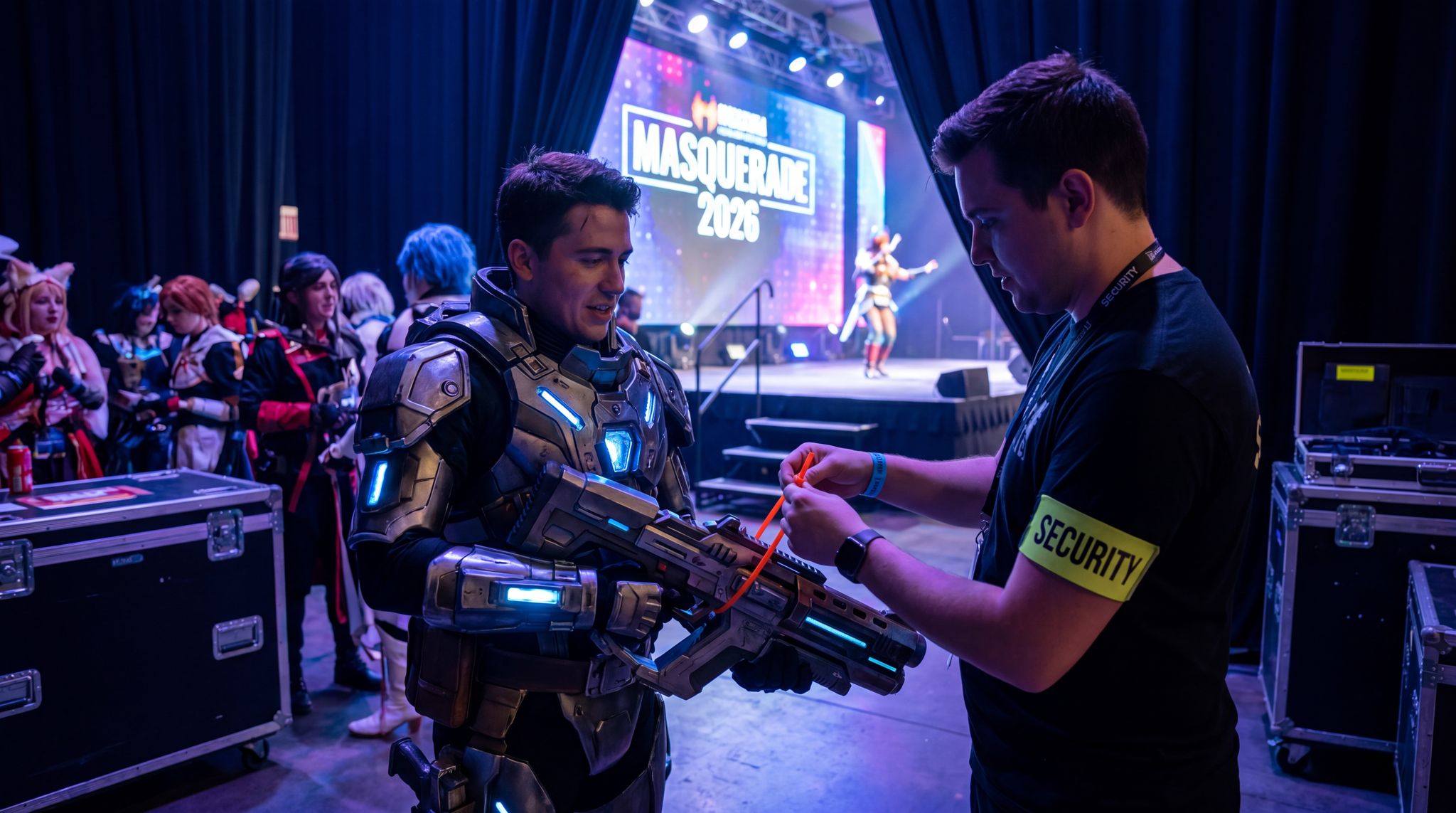
The cornerstone of prop policy enforcement is the Weapons Check station, sometimes called the Peace-Bonding table. This is where every prop weapon must be brought for inspection upon entering the convention. You’ll want to locate it prominently – often near the main entrance or registration area – so that as attendees arrive with costumes, security or staff can funnel those with props to the table. At large cons, weapons check might be integrated with bag check at entry, using security staff or off-duty police to inspect. At smaller events, a dedicated cosplay staff team can handle it.
Here’s how a typical weapons check works:
- Inspection: A staff member examines the prop to determine if it adheres to the policy. They might tap a sword to confirm it’s foam, not metal; test that a gun prop can’t fire (chamber empty, no movable trigger, or even glued-in parts); measure something if size limits apply. They’ll ask the attendee if there are any functional parts. If an item fails the policy – say someone brought a steel katana – the attendee will be given options per your policy (e.g. immediately remove it from the premises, or have it stored by con security until they leave). Many events offer a “prop check tag” system like coat check for disallowed items, so the attendee can reclaim the item when they are departing (ensuring they don’t just wander back in with it).
- Peace-Bonding: If the item is allowed, it gets peace-bonded – typically by affixing a brightly colored zip-tie or tag to the prop in a visible spot. This zip-tie acts as a universal signal that “this prop has been checked and approved.” Often for guns, the zip-tie goes around the trigger or through the trigger guard, rendering it impossible to squeeze the trigger. For swords, a zip-tie might secure the sword to its sheath, so it cannot be drawn (or around part of the hilt for display-only weapons). The tie is usually a neon colour (fluorescent orange or green is common) so security staff can see at a glance that a prop was checked. It’s not the prettiest accessory on a cosplay prop, but it’s an accepted norm at conventions worldwide. Some cons use a small sticker or wrap instead, but zip-ties tend to be tamper-evident and sturdier. Important: Official policy should state that removal or tampering of the peace-bond is grounds for ejection from the con – if someone cuts off the zip-tie to swing their sword around, they violate the agreement and should be dealt with.
- Rule Reminder: After peace-bonding, staff briefly reminds the cosplayer of any handling rules: e.g. “Do not brandish or point this at anyone. Do not engage in mock fights. It must remain peace-bonded at all times on con property.” Some cons hand out a small card listing the rules when you peace-bond an item, as a written reminder. This step is about ensuring the attendee understands they still must use common sense. Even a foam sword can hurt if you jab someone, so emphasise polite cosplay etiquette: no swinging weapons around in crowded halls, no aiming a gun prop at someone’s face, etc.
The weapons check table should be staffed all convention long during open hours. Prop enforcement isn’t a one-and-done thing; people might arrive at different times or on different days with props. Also, if your con has multiple entrance points or a large footprint, you might need multiple check stations (or roving prop-check staff) to cover all ingress routes. At anime conventions in hotels, for example, sometimes late-night cosplayers come through side entrances – ensure security knows to catch those and direct them to get peace-bonded.
Coordination with venue security and local law enforcement is important too. Inform them of your policies and that you’ll be doing prop inspections. Large convention centers sometimes require their own security or police to be involved in any weapons policy enforcement. Make sure the cops on duty know that there will be fake weapons around so they are not caught off guard. Nothing is scarier (or more dangerous) than a police officer mistaking a cosplay prop for a real threat. Clear communication can prevent that. It’s wise to have a liaison from your team who can explain to any curious security personnel that an attendee carrying a giant rifle is actually holding a painted Nerf gun with an orange tip and a zip-tie, i.e. it’s been screened and deemed safe.
Another aspect some cons implement is re-checking props each day. If someone got peace-bonded on Friday and they leave, the bond should be checked again on Saturday (especially if it’s a different coloured tag per day) so they don’t remove it overnight and walk in unvetted. Some cons use a different colour tie each day of the event to ensure daily checks. That might be overkill for smaller events, but for multi-day cons above, say, 20,000 attendees, it’s a consideration.
Enforcing Rules Diplomatically and Consistently
Even with a great policy and check system, enforcement ultimately comes down to your staff on the floor. All event staff, volunteers, and security personnel should be briefed on the prop rules so they can politely enforce them. Key points for staff training:
- Be Vigilant, Yet Fan-Friendly: Instruct staff to kindly approach any attendee carrying a weapon prop that does not have an obvious peace-bond. The interaction can be as simple as, “Hi there! That prop looks awesome. I notice it doesn’t have one of our safety tags yet – may I escort you to our weapons check table to get that taken care of?” Most cosplayers will comply without issue if approached respectfully. Avoid an accusatory tone (“Hey you, stop, that’s not allowed!”) which could put someone on the defensive. Frame it as a standard procedure that they might have just missed.
- Consistent Application: Ensure no one gets a “free pass” because they’re in a rush or particularly popular. If your rules say no exceptions, then truly enforce it with everyone – even that VIP cosplayer or the group doing a stage demo. Letting one person wave around a metal sword for a photoshoot, for example, will cause confusion and resentment among others who were told to peace-bond theirs. Consistency also means, conversely, not over-policing beyond the written rules – don’t suddenly add new requirements on the fly. If something unexpected comes up (like a prop that doesn’t neatly fit rules), have a chain of command: staff can escalate to the Security Chief or con leadership to make a call, rather than differing staff giving different answers.
- Tactful Problem Handling: There may be times you have to confiscate or eject an item. Do so discreetly if possible. For instance, if someone is found to have snuck in a knife, you should take them aside, involve security, and follow your policy (likely expulsion from the event for bringing a real weapon). In less severe cases (like someone removed their peace-bond to pose for a photo with their sword drawn), a warning might suffice: re-affix the tie and explain firmly that if it’s removed again, they’ll face removal. Document incidents if needed (some cons have incident report forms) so repeat offenders can be tracked. During all this, remain professional. You’re not trying to ruin their fun – you’re upholding the safety rules that they agreed to as attendees. Most fans ultimately understand this when it’s explained calmly.
Finally, learn from each event and iterate. After your convention, review how the prop policy played out. Did certain props cause unexpected issues? (Maybe you had a rash of overly heavy props knocking over displays – next year clarify weight limits.) Did the peace-bond station get backed up at peak times? (Perhaps add more staff or a second station.) Solicit feedback from attendees too. If many cosplayers said “I wasn’t sure if my XYZ prop was allowed – it wasn’t clear,” then tweak your public guidelines for clarity. The best practices on safety evolve: for example, after an infamous incident at Phoenix Comicon where an armed individual infiltrated with real weapons, many cons stepped up screening and even banned all gun-like props temporarily. Those events learned to coordinate closely with police and communicate clearly to attendees about changes. One lesson learned was to avoid knee-jerk blanket bans if possible by having strong preventive measures from the start – fans had been “frustrated and upset over the sudden ban” in Phoenix, feeling it was unclear and punitive to those who had safe props. So, it’s far better to have steady rules in place than to impose new bans mid-event.
In summary, a well-run prop weapons policy is about safety, communication, and consistency. It’s another area where conventions must balance fan experience with risk management. By being proactive – establishing rules, checking all props, and training staff – you greatly reduce the chance of any accident or alarm. And cosplayers, though they might grumble about a zip-tie spoiling the look of their weapon, ultimately appreciate knowing the convention takes safety seriously. It creates an environment where families, guests, and venue officials all feel comfortable, and it ensures that the only battles happening are the pretend kind at your cosplay contest, not real disputes over dangerous items.