Introduction
A Multi-Generational Festival Workforce: Modern festival teams often span ages from eager 20-something newcomers to seasoned 60-year-old veterans. This diversity can be a huge asset – if managed well. In planning meetings you might see a Gen Z social media coordinator pitching TikTok campaigns alongside a Baby Boomer site manager warning about electrical load limits. Each brings unique strengths: the fresh perspective and tech-savvy of youth, and the hard-won practical knowledge of experience. Yet without conscious effort, generational differences can also breed miscommunication or conflict. Surveys show roughly 60% of workplaces report intergenerational conflict, with over 70% of older employees admitting they doubt younger workers’ abilities, and nearly half of younger staff similarly dismissing their senior colleagues’ skills, according to research on sustainable intergenerational leadership. In the high-stakes environment of festival production – where split-second decisions on safety, logistics, and show execution matter – bridging this gap isn’t just nice to have, it’s essential.
Why It Matters: Festivals thrive on innovation and reliability. Veteran crew members carry decades of know-how on what can go wrong and how to prevent it. They’ve weathered headliner cancellations, electrical outages, and freak storms. (For instance, when a sudden windstorm hit a 50,000-capacity festival in 2019, it was the grey-haired production chief who quickly recalled the 15-minute storm pause protocol from a similar squall in ’05, likely preventing chaos at the gates.) On the other hand, younger team members bring new energy, contemporary skills, and the ability to connect with modern audiences and technology. Many are digital natives fluent in festival apps, cashless payment systems, and the latest social media – areas that increasingly determine an event’s success. The challenge for festival organizers is creating a cohesive team where these generations collaborate effectively, rather than clash.
This guide will explore how to harmonize a multi-generational festival crew. We’ll dig into the differences in work style and communication that accompany age diversity and how to turn those differences into strengths. From formal mentorship programs and reverse mentoring, to adjusting communication styles and embracing new training methods, the strategies here are grounded in real-world festival experience. You’ll see examples of festivals that successfully blended generations on their staff – and cautionary tales where ignoring veteran wisdom or stifling new ideas led to problems. By the end, you’ll have concrete tactics to ensure critical knowledge is transferred to the next generation, that fresh talent is empowered (not just tolerated), and that your festival crew operates as one united force. Bridging the generation gap isn’t about favoring one age over another – it’s about leveraging the full spectrum of talent to produce safer, smarter, and more spectacular festivals.
Understanding Generational Differences on Festival Teams
Effective multi-generational management starts with recognizing how crew members’ perspectives can differ based on their generational background. While every individual is unique, certain trends emerge in how older vs. younger staff approach work. Being aware of these differences – and openly acknowledging them – helps prevent misinterpretations and frustration on both sides.
Free Tool: Size Your Festival Site
Zoned capacity planning for arena, campsite, parking and entry lanes — against UK Purple Guide and NFPA density standards. Finds your bottleneck zone.
Work Styles, Values, and Strengths
Older festival crew (often Generation X and Baby Boomers) tend to be shaped by decades in the live events world. They often value structure, chain-of-command, and “paying dues” through hands-on experience. Many veteran crew members have a “get it done no matter what” work ethic – long hours on-site and a preference for face-to-face problem solving, a trait often noted in analyses of Baby Boomer work ethics and generational leadership styles. They may approach new ideas cautiously, drawing on a memory bank of what’s succeeded or failed in the past. Notably, seasoned team members usually excel under pressure; having lived through past crises, they’ve developed patience, resilience, and a realistic sense of risk management (for example, an experienced production manager might insist on triple-checking a stage’s wind ratings, having “seen it all before”). They also often carry deep institutional knowledge – things like long-standing vendor relationships and local permitting quirks – that can’t be Googled or learned in school.
By contrast, the younger generation of crew (Millennials and Gen Z entering the workforce) often places high value on innovation, collaboration, and purpose. They’re typically comfortable multitasking and adapting on the fly. Growing up in the smartphone era means they expect technology-driven solutions and efficiency. For instance, a 22-year-old site assistant might quickly set up a shared Google Sheet to coordinate stage schedules in real time, whereas older colleagues might rely on printed run-of-show binders. Younger staff often crave feedback and mentorship; they want to learn fast and feel their work has meaning. They may question old assumptions – not out of disrespect, but a desire to improve things (e.g. asking “Why do we always use diesel generators? Can we use solar/battery packs instead?”). Crucially, they bring creative new ideas about attendee experience, diversity and inclusion, and sustainability that help keep festivals relevant in changing times.
Planning a Festival?
Ticket Fairy's festival ticketing platform handles multi-day passes, RFID wristbands, and complex festival operations.
It’s clear that each generation contributes in different ways. Rather than viewing one approach as “better,” successful festival teams recognise the complementary value. The table below highlights some strengths typically associated with veteran vs. newcomer crew members:
| Veteran Crew Strengths | Newcomer Crew Strengths |
|---|---|
| Deep well of practical experience – they’ve seen past festivals’ successes and failures, giving them strong instincts for what can go wrong and how to prevent it. | Digital natives – highly tech-savvy and quick to adopt new event technology (festival apps, RFID cashless systems, social media) to streamline operations and fan engagement. |
| Established industry networks – long-term relationships with vendors, local authorities, and artists’ teams that can be leveraged to solve problems faster. | Fresh perspective and ideas – question “the way it’s always been” and introduce creative concepts for programming, marketing, and problem-solving that drive innovation. |
| Calm under pressure – having managed crises like storms, medical emergencies, or power outages before, they tend to stay composed and make decisions based on seasoned judgment. | High energy and enthusiasm – willing to put in extra effort, learn new skills, and tackle challenges with optimism. Their passion can motivate the whole team and keep morale high. |
| Loyal and mission-focused – many see the festival as part of their legacy and take pride in mentoring others and upholding event traditions and safety standards. | Collaborative and inclusive – comfortable in diverse teams, often champions of inclusion and new social values. They may excel at team communication and ensuring every voice is heard. |
Understanding these differing mindsets is important. For example, if a veteran supervisor seems resistant to a new idea, it might be from genuine concern over a known hazard, not stubbornness. Likewise, if a young coordinator pushes for a new process, it isn’t necessarily impatience – it could be a solution the veterans hadn’t considered. Recognizing the intent behind behaviors prevents misjudging colleagues based on age. A key insight is that diversity in age, like other forms of diversity, can strengthen decision-making and problem-solving. Research confirms that inclusive teams with varied perspectives make better decisions nearly 90% of the time, as highlighted in guides on cross-cultural crew management. A festival crew blending long-term wisdom with fresh outlooks is more likely to foresee blind spots and devise creative fixes that neither group could alone.
Communication Styles and Expectations
One of the biggest friction points between generations is communication. Festival workplaces range from noisy on-site radio chatter to email chains to WhatsApp groups – so finding a communication style that works for all is crucial. Generational preferences often differ in tone, medium, and frequency of communication:
- Formality vs. Informality: Older crew members may lean toward more formal communication – e.g. face-to-face discussions, scheduled meetings, or detailed emails – reflecting the professional norms they came up with. Younger staff, having grown up texting and using memes, often communicate in a more informal, rapid-fire style. They might shoot a late-night Slack message with a new idea or use emojis in crew group chats. This difference can cause misunderstandings; a veteran security chief might misread a brief Slack reply from a young staffer as disrespectful or lacking detail, when in fact that’s just the norm for brevity. Likewise, a Gen Z coordinator might find a Boomer manager’s lengthy email daunting or unusually stiff. Establishing a middle ground is important.
- Preferred Channels: Baby Boomers and Gen X tend to be comfortable with phone calls and emails, and many are perfectly tech-savvy, but they didn’t grow up constantly on instant messaging, a distinction often found in generational communication style breakdowns. Millennials and Gen Z crew are accustomed to constant connectivity via chat apps, texts, and collaborative platforms. A younger logistics volunteer might wonder, “Why didn’t my supervisor respond to my WhatsApp message from last night?”, not realizing that person rarely checks messaging apps after work hours and expected a phone call for urgent issues. Teams should clarify which channels to use for what purposes (e.g. urgent production issues = phone/radio call, daily updates = email or Slack). Some festivals literally create a communication charter in their training manual so everyone knows, for instance, that critical alerts must be phoned in and also logged in the project management app.
- Feedback and Language: Seasoned crew might be more direct or terse in their feedback, a style honed on high-stress event sites. Younger workers, educated in an era emphasizing emotional intelligence, might expect more coaching-style feedback and positivity. What one sees as “constructive criticism,” the other may perceive as “getting yelled at.” Tone awareness is key. Festivals that succeed in mixing generations encourage mutual adaptation: veterans try to be patient mentors rather than drill sergeants, while newcomers learn to not take curt on-site instructions personally during crunch time. Everyone benefits from assuming good intent. Open conversations about feedback preferences can help – e.g., a junior staffer can tell a senior, “I absorb feedback well, I’d just appreciate a quick note if I did something right too, not only what went wrong,” and vice versa, a veteran can explain, “If I give a one-word reply on radio, it’s just because I’m swamped – it’s not annoyance.”
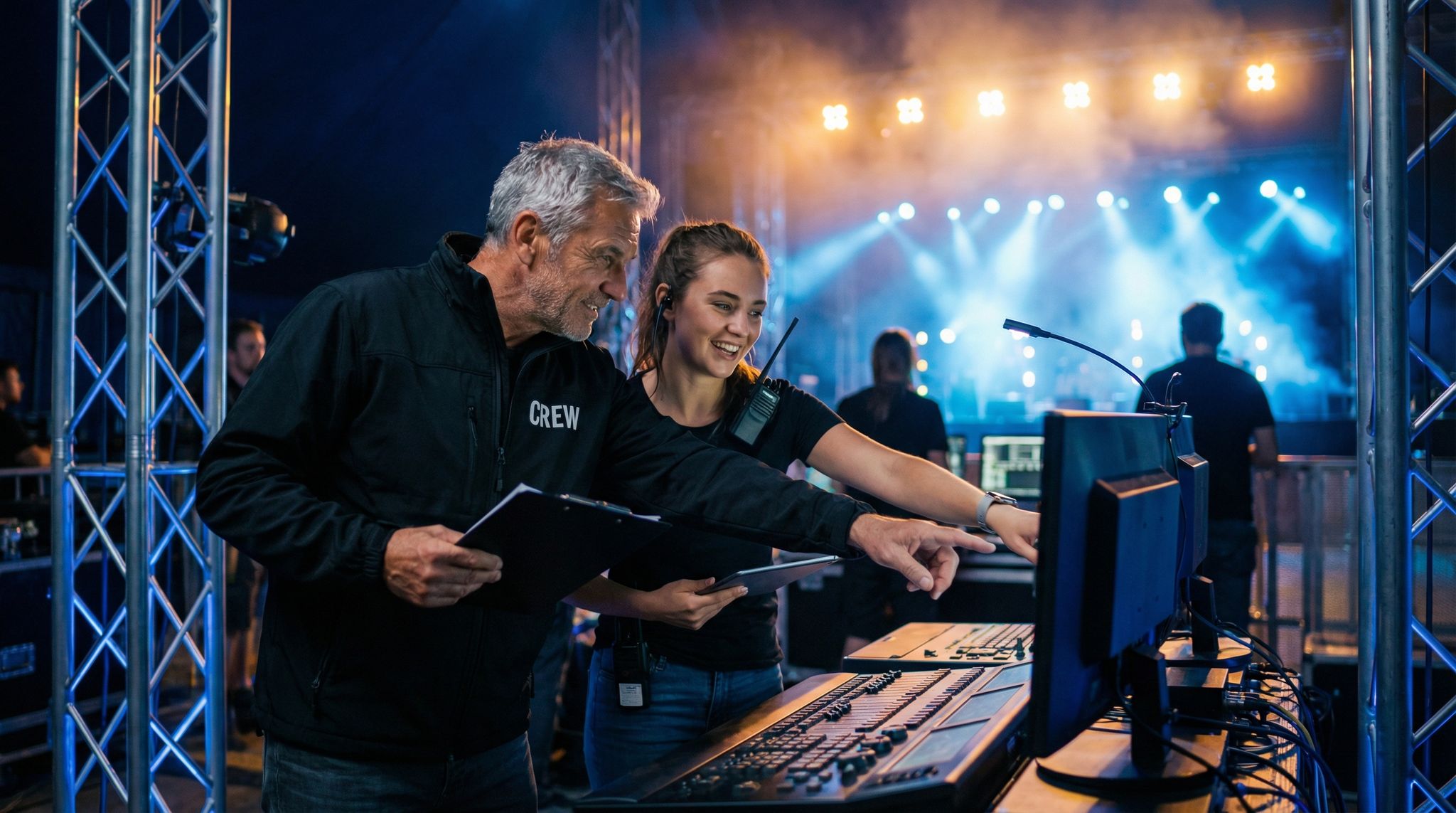
It’s worth noting that communication style isn’t just an internal issue – it also affects how your team engages with fans and vendors. A mix of ages can actually improve external communications. For instance, a Gen Z staffer might run your festival’s TikTok or Discord channels to engage young attendees, while a Gen X publicist handles press releases and city council briefings. Each can learn from the other: the publicist can mentor the Gen Z social manager on crisis PR wording, while picking up tips on authentic social media tone in return. In practice, many festivals have found success by pairing employees of different ages on key tasks so they naturally learn each other’s modes. One festival in California deliberately teams up a veteran stage manager with a 20-something assistant stage manager on every stage. The veteran manages overall production and calls the show, while the younger partner handles communication tech like updating the festival app with set times or texting updates to artist liaisons. The result is a stage crew that’s both reliable and responsive – the two generations cover each other’s blind spots.
Indeed, studies on festival audiences echo these differences: younger generations favor informal, interactive, meme-infused communication, whereas older generations are more comfortable with a mix of traditional and digital channels and don’t mind longer-form information, a concept central to designing festivals for digital natives. These preferences mirror how they operate as team members. By acknowledging this, you can set team norms that respect everyone. For example, Tomorrowland’s production team in Belgium introduced a simple rule: any critical instruction given over radio must be confirmed with a brief repeat by the receiver, to ensure clarity (a practice borrowed from older stage managers), and conversely they adopted WhatsApp groups for non-critical daily updates (an idea pushed by younger staff to streamline communication). The takeaway is that clear, inclusive communication protocols prevent generational style differences from becoming operational gaps.
Building a Cohesive Multi-Generational Crew Culture
Bridging the generation gap isn’t something that happens by accident – it requires an intentional team culture and leadership approach. Festival organizers should foster an environment of respect, continuous learning, and teamwork that explicitly values contributions from both veteran and newbie crew members. Here are strategies to blend ages into a harmonious unit:
Need Festival Funding?
Get the capital you need to book headliners, secure venues, and scale your festival production.
Inclusive Recruitment and Role Design
A multi-generational team starts with hiring. Avoid age bias in either direction. Some festivals inadvertently skew young in recruitment – for example, only recruiting college students for internships and entry-level roles – which can sideline older workers who might want to break into events or continue working past retirement. On the flip side, some established events only trust a core group of veteran contractors and don’t open doors for new talent, which can lead to stagnation and burnout. Strive for balance by recruiting crew of varied ages. This could mean:
- Apprenticeships / Internships: Bring in young people through formal trainee programs each year, but pair them with older mentors (more on mentorship soon). For instance, Glastonbury Festival in the UK has long offered crew internships in departments like production and artist liaison, many of which turn into full-time jobs. They make a point to embed interns in teams led by veterans – it’s common to see a 22-year-old apprentice working under a production manager with 30 years’ experience on that farm. The intern gains skills; the veteran gains an extra hand and often a fresh perspective.
- Welcoming Experienced Newcomers: Don’t assume an industry veteran is only interested in top director jobs. Some retirees or mid-career professionals might be happy to take on part-time event roles (security, guest services, volunteer coordination) for the love of it. Tap into that by advertising roles in places beyond your usual channels – community boards, retiree networks, etc. A food & wine festival in California successfully recruited senior volunteers by pitching the roles as fun community involvement; these folks, many former professionals in unrelated fields, brought superb work ethic and reliability to festival operations. They mentored younger volunteers in customer service, and in turn said they enjoyed the youthful energy on the team.
- Age-Diverse Interview Panels: When hiring, involve a mix of interviewers if possible. A panel that includes both a veteran staffer and a younger team member sends a signal that your festival values all ages. It also helps evaluate candidates from multiple perspectives, reducing bias. For example, a tech-savvy young manager might appreciate a candidate’s digital skills that an older interviewer might underrate, while the older manager might catch experience nuances the younger one misses.
Importantly, design roles and schedules with various life stages in mind. Older crew might appreciate options for shorter shifts or roles that aren’t as physically taxing (like an operations advisor instead of crew lead doing 18-hour days in the sun). Younger crew might be hungry for growth, so build in advancement paths or rotating assignments where they can learn new skills rather than pigeonholing them into the same task all season. A truly inclusive crew plan treats age diversity as another facet of team diversity. As strategies like inclusive festival crew recruitment point out, festivals like Roskilde actively recruit a broad mix – their 30,000 volunteers include teenagers, seniors, locals, internationals, people of varying abilities – and this diversity creates a virtuous cycle of positive culture and high return rates, as seen in Roskilde’s diverse volunteer army. The lesson is: be intentional in assembling a crew that’s diverse in age, and set everyone up for success in roles that play to their strengths.
Setting the Tone: Respect, Inclusion, and Team Bonding
Crew culture flows from the top. Festival leadership and department heads must model respect across generations. Simple behaviors go a long way: veteran directors should avoid dismissive “back in my day” comments that invalidate younger staff ideas, and conversely, younger managers should solicit input from the old guard rather than assuming new is always better. Emphasize that everyone is a student and teacher on your team. For instance, at pre-festival all-staff meetings, make a point to celebrate both kinds of contributions (“Shout out to our seasoned veterans for guiding our site build so efficiently, and to the new team members who introduced some great sustainability ideas this year!”). When mutual respect is the norm, age becomes much less of a divider.
It also helps to create opportunities for crew of different ages to socialize and bond as people, not just work colleagues. In the frenzy of festival prep, people can start to stereotype: “the old guys in ops,” “the kids in the social media team.” Breaking down those silos with cross-generational bonding builds empathy. Some effective approaches:
Go Cashless With RFID Technology
Enable contactless payments, faster entry, and real-time spending analytics with RFID wristbands and NFC-enabled ticketing for your events.
- Mentor Meet-and-Greets: If you are implementing a mentorship program (detailed in the next section), kick it off with a casual mixer or introductory lunch where mentors and mentees meet face-to-face. Perhaps have veteran staff each share a 2-minute story of their wildest festival moment, and younger staff share what dream outcome they hope to achieve working on the festival. Mixing personal stories with work aspirations helps humanize both groups.
- Team meals and downtime: Provide a crew catering tent or common area where all staff – from the site build crew to the marketing interns – eat together. It’s amazing how much camaraderie forms over midnight pizza during a stage build or coffee at 7am. Consider organising an all-crew dinner at the start or end of the festival, including volunteers, where age groups mingle at tables. Some festivals do a “family dinner” after the final night teardown, giving heartfelt toasts to the whole multigenerational team.
- Inclusive team-building activities: Be mindful of activities that might unintentionally exclude by age. A nightly post-work pub crawl might be great for 22-year-olds but not for a 55-year-old with a family at home (or a 19-year-old crew intern who can’t go to a bar). Instead, opt for occasional group activities that everyone can join: a welcome picnic, an on-site yoga session during setup week, or even a friendly competition like a trivia quiz that can mix ages in teams. One European festival held a “field day Olympics” during build week with goofy games (tug-of-war, relay races) explicitly mixing younger and older crew on each team – the photos and laughs from that day became legendary, and it set a tone of one big family.
Critically, lead by example. If an older technician consistently talks over a younger colleague in meetings, management should address it just as they would any disrespect – not as “oh that’s just the way he is.” Likewise, if younger staff are showing lack of courtesy (maybe casually playing music on their phone in the crew van while older folks are trying to talk), it’s worth a conversation about being considerate. By nipping age-related friction in the bud through clear expectations of professionalism and kindness, you prevent small irritations from growing into toxic resentments. As highlighted in an internal guide on leading international festival teams, many of the same principles apply to cross-generational crew management: awareness, patience, and finding common ground are key to uniting people around the festival’s mission.
Empower Every Voice: Another element of inclusive culture is making sure both the old hands and the new hires have a voice in decision-making appropriate to their role. Hierarchy can be flatter than it used to be – and that’s often a good thing. Encourage a culture where questions and ideas are welcome from everyone, regardless of age or title. Perhaps implement a weekly 15-minute crew forum or stand-up meeting where anyone can suggest improvements or flag concerns. A veteran might point out a safety issue others overlooked, while a newcomer might propose a brilliant idea for fan engagement – you want both inputs. It’s on leaders to create a safe space for that. Explicitly invite quieter or junior staff to contribute in meetings (“Any fresh eyes have a take on this?”). According to event industry veterans, great festivals foster an environment where a stagehand or volunteer feels comfortable bringing up a potential issue without fear – and where senior staff actively listen. This approach is echoed in advice to solicit feedback from junior crew members and make space for all perspectives by inviting quieter voices to share. At the end of the day, good ideas don’t mind who they come from – and a culture that genuinely respects that will naturally bridge a lot of generational divides.
Knowledge Transfer: Mentorship and Reverse Mentoring
One of the most valuable aspects of combining veteran and new team members is the opportunity for knowledge transfer. Festivals are complex operations with many tribal knowledge elements – the undocumented tricks and lessons that live in veterans’ heads. If that know-how isn’t passed on, a festival can suffer when key people leave. Meanwhile, younger crew have their own knowledge (especially around tech and current trends) that can benefit older colleagues who didn’t come up with those tools. Setting up formal and informal mentorship opportunities accelerates the sharing of wisdom in both directions.
Classic Mentorship Programs (Veterans to Rookies)
Many festivals implement mentorship pairings where an experienced staffer is matched with a less-experienced team member for a season. The goal is to give the newcomer guidance, build their skills faster, and also lighten the load on the veteran by delegating some tasks under supervision. For example, the production department might pair a veteran production manager with an assistant production coordinator in a mentor-mentee relationship. The mentor brings the mentee to high-level production meetings, walks them through how they do advance planning, and explains decision-making during on-site build. The mentee in turn takes on smaller duties (like advancing a minor stage or running a vendor check-in) with the mentor providing feedback. Over the course of one festival cycle, the mentee might progress from a passive observer to actively running parts of the show, thanks to the mentor’s coaching.
Best Practices for Festival Mentorship:
– Structured Goals: At the season start, have the mentor and mentee set a few specific goals. For instance, the mentee might aim to learn how to draft an evacuation plan, or how to advance an artist hospitality rider. The mentor can then focus on those teaching moments. A clear goal prevents the mentorship from becoming too ad-hoc or only about menial help.
– Regular Check-Ins: Encourage a scheduled check-in (say 30 minutes) each week or key milestone, where the mentee can ask questions and the mentor can share not just what to do but why. These chats are where a lot of institutional memory gets passed on via war stories and “when X happened, here’s how we solved it” anecdotes.
– Shadow Critical Tasks: Have the mentee shadow the mentor during at least one critical process or live operation. If the mentor is the one who, for example, walks the fire marshal through the site inspection, bring the mentee along to observe that interaction. Seeing a veteran handle high-pressure moments or tricky stakeholder meetings is invaluable learning by osmosis.
– Empower Responsibility: By mid-project, identify an area where the mentee can take lead (with mentor in background). Perhaps the mentee runs one morning’s all-hands briefing or leads the load-out plan for the smallest stage, allowing them to apply what they’ve learned. The mentor’s presence as a safety net builds the younger crew member’s confidence to step up.
– Feedback Loop: Mentors should give constructive feedback but also solicit feedback from the mentee about the process. Maybe the mentee shares that they wished to get hands-on with budgeting but didn’t get the chance – that can prompt the mentor to involve them in the final budget reconciliation, for example. This two-way openness makes the mentorship stronger.
– Recognition: Publicly recognize effective mentor-mentee pairs. Some festivals give an award or shout-out to great mentors at the crew after-party. It reinforces that teaching is as valued as doing.
Festivals like Bonnaroo have successfully used mentorship to groom the next generation of production leaders. Many of Bonnaroo’s current department heads started as assistants a decade ago under older mentors who have since retired. By overlapping the generations through mentorship, they ensured a brain trust transfer rather than a brain drain. This matters because festivals often run on very specific knowledge (the quirks of that farm’s geography, that one supplier who always needs a nudge, the historical context of community relations). Mentorship is how you keep those insights in the team even as faces change. According to industry veterans, setting up a formal mentorship program for new festival producers is one of the best investments an organization can make – it’s basically succession planning for your event’s future.
Data-Driven Event Marketing
Track ticket sales, demographics, marketing ROI, and social reach in real time. Exportable reports give you the insights to make smarter decisions.
Reverse Mentoring: Tapping Fresh Talent to Teach Too
Mentorship in the traditional sense usually flows one way (older to younger), but reverse mentoring flips the script – and it’s extremely powerful in bridging generational gaps. Reverse mentoring pairs a younger staffer as the mentor to an older mentee, typically centered on areas where the junior person has more updated knowledge. This concept, first popularized by GE’s Jack Welch in 1999 to teach executives about the internet age, has since been embraced in industries from tech to hospitality, where reverse mentoring bridges digital skill gaps and fosters connection. In a festival context, reverse mentoring might involve a young digital marketing coordinator “mentoring” a veteran sponsorship manager on the nuances of TikTok and Instagram, or a recent grad in the ticketing department guiding the festival director through new analytics dashboards and cashless payment tech.
The goal is not to undermine the elder crew’s authority, but to encourage cross-pollination of skills. It recognizes that learning is lifelong – even a production guru with 35 years’ experience can benefit from the knowledge of a 25-year-old who intuitively understands, say, the latest event software or youth culture trends. Reverse mentoring also empowers younger staff, making them feel their expertise is valued from day one rather than having to “wait their turn” to contribute ideas.
To implement reverse mentoring, identify areas where your festival is trying something new or modernizing. Perhaps you’re launching a festival app or a new CRM system for ticketing, or trying to improve your outreach to Gen Z audiences. Pair a savvy young staffer or intern leading that initiative with a willing veteran who wants to learn. Maybe your head of operations is an old-school genius at logistics but doesn’t use social media – pair them with the new marketing assistant for a few sessions to share knowledge. The younger mentor can walk the older mentee through setting up an Instagram Live Q&A, for example, or explain how newer fans interact online. In exchange, you’ll often find this becomes a two-way street; the conversations inevitably lead to the veteran sharing context and strategic thinking that helps the young employee grasp bigger-picture knowledge. Frequent exchange of ideas between generations supports connection and talent growth on both sides, a key benefit of reverse mentoring programs.
Many companies have found reverse mentoring improves not just skills but also inter-personal respect: older employees gain appreciation for the challenges youth face (and bust any negative stereotypes about work ethic or aptitude), while younger employees gain a deeper respect for the complexity of leadership and legacy knowledge. In a festival crew, this can translate to tighter teamwork. For example, after a reverse mentoring program at a large music festival in Australia, the seasoned technical production crew and the 20-something IT volunteers ended up collaborating much more closely on show days – the veterans consulted the IT kids when setting up networks (instead of doing it “their usual way”), and the young crew proactively helped troubleshoot radios and lighting consoles (applying tech smarts beyond just their IT role). Each had learned the other’s language to an extent. Connecting people as mentor-mentees across ages breaks down walls that might otherwise limit communication to one’s immediate peer group.
The reverse mentoring idea might feel novel in the rough-and-tumble festival world, but it’s essentially an extension of the festival ethos of community and shared knowledge. Look at Burning Man – not a traditional festival, but its culture of peer learning across generations is well known. In fact, Burning Man’s “Rising Sparks” initiative was created specifically to foster intergenerational collaboration and mentorship within its community. They bring together newcomers and veteran “Burners” to ensure the event’s culture and know-how pass on, and to help new leaders emerge. That same principle can be applied to any festival: intentionally create situations for younger staff to teach or lead something that older staff can learn from. It keeps your team dynamic and adaptable. As one hospitality study noted, reverse mentoring was developed as a direct response to the generational gap, aiming to bridge it by flipping traditional mentoring roles. In practice, it can be as simple as asking your most junior team member to brief the whole crew on a topic they’re expert in (e.g., “Leah’s going to show us how the new drone camera works and what we should know about it”). That moment of spotlight builds confidence and signals that every team member, no matter how young or old, is both a learner and a teacher in your festival organization.
Documenting and Preserving Knowledge
In addition to person-to-person mentoring, consider creating resources that capture veteran knowledge for posterity. Busy festivals often skip this, but even a simple internal wiki or shared Google Drive of “Festival How-Tos” can accumulate golden nuggets over the years. Task some of your experienced team members with writing short playbooks or checklists on their area of expertise. For example, your 20-year stage manager could draft a one-pager on “Daily Soundcheck Procedure – top 10 things to never forget,” or your head of security could record a short video explaining the crowd density monitoring protocol they use. Pair them with a younger staffer or intern who can help write or film these resources in an organized, accessible way. This not only makes the veterans feel valued (they are literally authoring the institutional wisdom), but also gives younger staff immediate access to that knowledge without having to ask in the heat of the moment.
Free Tool: Project Your Bar Revenue
Per-head spend benchmarks by event type turned into projected bar and food revenue, with a stock-mix estimate and gross-margin line. Free calculator.
Some festivals formalize this into a training curriculum for new crew. For instance, the Association of Independent Festivals (AIF) in the UK has shared best practices where member festivals host annual training days – veterans teach sessions on topics like stage safety, site layout, or contract negotiation, essentially compressing decades of lessons into digestible classes for newcomers. If your festival has the scale, you could run a mini internal conference at the start of the season: a “Festival University” half-day where senior team members present on key operations. Invite questions and discussion – you might be surprised that even the old-timers learn a thing or two from each other in the process.
Finally, encourage a mindset of continuous knowledge sharing on-site. A lot of learning in festivals is on the job. So pair diverse ages on shifts (don’t put all the over-50 folks on the day shift and all the 20-year-olds overnight; mix them so they work together). Encourage veterans to explain their thought process when time allows (“Here’s why I’m routing this cable this way…”). And encourage juniors to ask “why” whenever they’re curious. If psychological safety is present, you’ll get organic mentorship happening every day. Consider the approach of one Midwest U.S. festival: they implemented a policy that every manager had to spend at least one hour per week teaching something to someone on their team. It could be as simple as demonstrating how to operate a particular piece of equipment or reviewing an incident report together to glean lessons. That policy led managers (mostly older) to proactively seek out juniors to coach, and it became a badge of honor to be known as a great teacher. Result: far less turnover and a pipeline of talent ready to step up into bigger roles, because skills weren’t siloed.
Collaboration in Action: Multi-Generational Success Stories and Pitfalls
To truly understand how integrating veteran wisdom with new energy plays out, let’s look at some real festival team experiences – the good, the bad, and the instructive. These cases show the tangible benefits of bridging the generation gap, as well as what can go wrong if you fail to do so.
Success Story: Roskilde Festival’s “Young Volunteers, Elder Advisors” Model
Roskilde Festival in Denmark is often cited for its powerful volunteer culture. With a volunteer army tens of thousands strong, Roskilde has everyone from local high schoolers to retirees working side by side. The festival’s organizers actively cultivate this mix by providing both fun entry-level roles and more specialized volunteer jobs that appeal to older community members. Critically, Roskilde backs it up with support structures: they have on-site services like volunteer wellness areas and even social workers to ensure everyone (young or old) feels cared for, thanks to measures like volunteer wellness areas. Veterans in the crew serve as team leaders and informal mentors for each volunteer group. Anecdotally, older volunteers at Roskilde love sharing stories of the festival’s history with the newbies, giving them a sense of tradition and pride, while the younger volunteers keep the atmosphere lively and introduce new cultural references each year. The result? As noted earlier, people of all ages feel valued and keep coming back – Roskilde’s diverse crew “from teenagers to seniors…consistently return and recommend the experience,” creating a virtuous cycle where a positive culture attracts talent. By weaving generational inclusion into their crew ethos, Roskilde benefits from high retention, a vast skills pool, and an audience that sees the festival’s values reflected in the staff.
Another interesting practice at Roskilde: they established a formal Youth Council that works alongside festival management to give input on new ideas (like sustainability initiatives and emerging music trends). Many Youth Council members are under 25 and are paired with mentors from the main festival board. This gives the festival leadership direct insight into the youth perspective and incubates young leaders for the future – some Council members have gone on to join the festival steering committees in later years. It’s a great example of integrating new energy into governance with guidance from veterans.
Success Story: Glastonbury’s Generational Hand-off and Collaboration
The UK’s Glastonbury Festival illustrates generational integration at the leadership level. The festival was founded in 1970 by Michael Eavis, who ran it for decades. In the 2000s his daughter Emily Eavis gradually took over booking the lineup and now co-organizes the festival. This father-daughter team (and by extension, their staff) blends old and new approaches. Michael, in his 80s, brings the traditional ethos of the festival and deep ties to the local community; Emily, in her 40s, has pushed Glastonbury to evolve – improving gender balance on stage, embracing new genres, and implementing initiatives like live streaming and a stronger social media presence. Rather than clash, they’ve created a festival that appeals “across ages and backgrounds” by combining traditional ethos with new approaches. For example, when Emily championed booking younger pop and grime artists to keep the lineup fresh, some skeptics protested, but Michael’s support of her vision helped win over the old guard. Now, Glastonbury’s stages host both legacy acts and cutting-edge youth artists, and its crew similarly has veterans working under younger department heads that Emily appointed. The lesson from Glastonbury is the importance of intentional succession planning and collaboration: the elder Eavis didn’t simply retire and vanish – he stayed on as a mentor figure, endorsing new ideas while imparting the values that make Glastonbury unique (like its charity focus and “family” atmosphere). In turn, the younger leadership didn’t push out the old guard – they leveraged that knowledge to avoid past mistakes and maintain continuity. Festivals that plan for a transfer of institutional knowledge – not just power – handle generational change far more smoothly.
Smooth Entry With Mobile Check-In
Scan tickets and manage entry with our mobile check-in app. Supports photo ID verification, real-time capacity tracking, and multi-gate coordination.
Glastonbury also demonstrates that bridging generations can enhance community relations. The festival’s long history in Somerset meant Michael Eavis knew every farmer and council member in the area, relationships built over 50 years. As younger staff took over logistics and local coordination, Michael introduced them personally to these stakeholders, essentially transferring the trust he had earned. This prevented the common problem of community pushback when “the old familiar face” steps down. Instead, locals saw both generations working together, signaling stability. For festival organizers, this is a clue: if you have veteran staff who are the face of your festival to certain external partners (authorities, sponsors, media), involve younger team members in those dealings before the veteran leaves, so the trust is passed on, not lost.
Success Story: Tech Training Bridging the Gap at a Major U.S. Festival
One large North American music festival (anonymized for candidness) realized a few years ago that while they had a top-notch veteran operations team, the crew struggled with new tech that the organizers were implementing – things like RFID wristband systems, digital ticket scanners, and a new event management software. The older crew members were frustrated with glitchy devices and missed the “old way” of paper lists and analog radios. Meanwhile, the younger crew were getting impatient because they saw the tech’s potential and felt the veterans weren’t trying hard enough to learn it. This had “generation gap conflict” written all over it. The festival’s solution was two-fold: they appointed some of the tech-savvy younger staff as peer trainers to the whole team but scheduled the training in multiple formats to suit different learning styles. They ran hands-on practice sessions in small groups, mixing ages so folks could help each other, and made sure to communicate the “why” behind each tech tool (e.g. explaining to a skeptical older staffer that the new scanner wasn’t just change for change’s sake, but would cut entry wait times by 30%, improving fan experience). They also set up a “troubleshooting squad” of younger crew during the festival that roamed around specifically to assist anyone having tech issues on the job without judgment – kind of like roving IT support for scanners and apps.
The effect was significant. By event time, more of the veteran crew felt comfortable with the tech and even appreciated its benefits, while younger staff gained empathy for the complexity of operations beyond the screen. Implementing smart change management techniques for event tech adoption (like tailored training, hands-on practice, and peer champions) ensured the whole team mastered the new tools together. One senior security manager in his 50s later admitted he was initially resistant to the new digital incident reporting app, but after a patient 20-something teammate walked him through it and they used it during an actual show stop, he was sold. He then became an advocate, encouraging his contemporaries to embrace it. This story underlines that investing in thorough staff training on new technology can unite generations around a shared goal, rather than letting tech be a wedge between “old-school” and “new-school” crew. The festival avoided a potential meltdown (imagine if half the crew refused or failed to use the ticket scanners on show day!) and instead had a relatively glitch-free operation with everyone on board. The takeaway: learning together is a powerful unifier.
Pitfall to Avoid: Dismissing Veteran Warnings – The Fyre Festival Fiasco
No discussion of festival failures is complete without Fyre Festival (2017) – an infamous catastrophe triggered by inexperience and hubris. One major post-mortem finding was the lack of seasoned festival producers in leadership, as noted in analyses of the Fyre Festival collapse. The young organizers, led by a twenty-something entrepreneur, had sky-high vision and marketing savvy but ignored the counsel of industry veterans who tried to warn them. As experts later noted, “there wasn’t an experienced event leadership team at the helm… anyone with the right experience who spoke sense either walked away or was ignored,” according to event industry post-mortems. In other words, the festival’s youthful team brushed off the wisdom of older, more experienced voices that could have saved them from logistical nightmares. Basic festival fundamentals – adequate infrastructure, realistic timelines, emergency planning – were neglected in favor of flashy ideas. Some veteran contractors did get involved but left when it was clear their advice was falling on deaf ears. We all know how that turned out: stranded attendees, half-built tents, supply shortages – a masterclass in what not to do.
For this article’s context, Fyre Festival starkly illustrates a generational pitfall: when youthful enthusiasm is not tempered by veteran guidance. New producers sometimes don’t know what they don’t know, and if they don’t seek or respect advice from those with battle scars, they risk repeating old mistakes. Conversely, it shows that experienced folks must be integrated and listened to, not just present as token advisors. If Fyre’s core team had brought even a couple of seasoned festival operations managers into their planning early – and truly empowered them to influence decisions – many red flags (like the impossibility of building proper accommodations on a remote island in weeks) would have been raised and potentially heeded. Instead, Fyre’s leadership remained in an echo chamber of youthful can-do hype until it was too late. The lesson for any festival team is clear: blend visionary youth with grounded experience in your decision-making process. When a veteran on your crew cautions “this site plan might cause a bottleneck” or “you need at least 8 months to get that permit,” listen – they are trying to help you avoid disaster, not kill your vibe. As one expert quipped about Fyre, the organizers had plenty of hustle, but what they desperately needed was one grizzled production manager to say “No, this is not feasible” and to rework the plan entirely. In a well-balanced generational team, that voice is in the room and is respected.
Pitfall to Avoid: Failing to Keep Knowledge When Veterans Depart
On the opposite end, consider a hypothetical (and common) pitfall: a long-running festival relies for years on a few key older managers who “know everything.” The event succeeds, but little effort is made to document their processes or train successors. When those individuals retire or leave (which is inevitable), the festival finds itself with enormous knowledge gaps. Suddenly the new team doesn’t know the history behind certain city permit conditions, or how to operate a specialized piece of equipment, or which vendor can be counted on to deliver last-minute. This scenario has played out in real life at some events – the first edition after a veteran core team’s exit often struggles. One U.S. city’s annual music festival stumbled when its founding technical director (with 30 years of experience) stepped back. The young replacement team, though talented, had to essentially reinvent the wheel on many production aspects, and they hit costly snags (from power outages to neighborhood noise complaints) in their first solo year. Attendee feedback dropped, and only then did the organizers realize they needed that veteran as a consultant to guide them for a bit longer. They brought him back the next year in a part-time “technical advisor” role, and he eagerly helped formalize all the knowledge he’d carried in his head.
Grow Your Social Following With Every Sale
Require social media follows, shares, or playlist adds to unlock presale access or special pricing. Turn every ticket purchase into audience growth.
The moral: don’t let legacy knowledge walk out the door uncaptured. If you know some of your key seniors are nearing retirement or likely to leave soon, plan for a transitional period. Have them train one or two proteges and create manuals for critical tasks. Perhaps invite them to stay involved as consultants or board members, so their brain can be picked when needed. Many festivals establish advisory boards of former organizers for this reason – you retain the wisdom in an accessible way. And for multi-decade events, consider that your history itself can guide new generations; maintain archives of past site maps, schedules, incident reports, and contracts that new staff can review to learn how and why things evolved. Instituting these practices is part of strong festival planning and project management discipline. Experienced producers often stress that being behind schedule or understaffed can be fixed with effort, but losing key knowledge is harder to repair, as recovering from planning delays is often easier than recovering lost wisdom. By proactively bridging the generation gap before veterans leave, you ensure the festival’s core competencies persist.
Pitfall to Avoid: “Young vs Old” Toxic Culture
Finally, a softer pitfall to guard against is the emergence of an “us vs. them” mentality. If younger staff perceive older colleagues as stuck in their ways, or older staff see the younger ones as entitled or careless, a rift can grow. Cliques may form – the older crew hang out together and grumble that “these kids don’t know what hard work means,” while the younger crew make snide jokes that “the boomers won’t let us use any new ideas.” This toxic culture can simmer under the surface and erode teamwork. Attendees might even feel it – ever been to a festival where some staff seemed disgruntled? Often that’s an internal culture issue reflecting outward.
Preventing this requires active management and zero tolerance for age-based discrimination or ridicule in either direction. Jokes are fine, but if you hear “OK boomer” or “Millennials are all clueless” in a derogatory way among your team, nip it in the bud. Reinforce that professional respect is mandatory. Focus everyone on the shared mission: delivering a great festival experience. It helps to intentionally mix ages within sub-teams rather than, say, assigning all older staff to one department and all younger to another. The more they work side by side, the more they appreciate each other as individuals, not stereotypes. Lead facilitators can also watch out for any signs of exclusion – e.g., if younger volunteers aren’t listening to an older supervisor because they assume he’s out of touch, step in and correct that behavior; or if a veteran coordinator keeps bypassing a young manager and taking issues to someone older, remind them to follow the chain of command and give the young leader due authority.
In summary, the way to avoid an age-divided crew is the same as building any strong, unified team: clear values, fair treatment, open communication, and alignment on goals. When everyone is pulling together and feels heard and appreciated, generational friction evaporates. If you do sense a divide forming, acknowledge it and address it openly. Sometimes a frank team discussion – “Let’s talk about what frustrations we might have across our different age groups and how we can help each other” – can clear the air. Often, mutual complaints boil down to misunderstandings or lack of communication, which are fixable once identified. Do not let problems fester in silence, because that’s when resentment hardens. With proactive effort, you can turn a potential culture clash into an opportunity for bonding – “look how far we’ve come as a team.” As a KPMG workplace report put it, bridging any gap at work comes down to connection, creating an environment of learning and trust. That’s as true for age differences as it is for any other aspect of diversity.
Frequently Asked Questions
Why is a multi-generational crew important for festivals?
A multi-generational crew combines veteran reliability and crisis management skills with the fresh energy and tech-savviness of younger staff. This diversity improves decision-making by nearly 90% and ensures comprehensive problem-solving. Veterans handle logistics and safety, while younger members drive digital engagement and innovation.
How can festival organizers bridge the generation gap in their teams?
Organizers can bridge the gap by implementing formal mentorship and reverse mentoring programs where skills are exchanged. Creating mixed-age teams for specific tasks, establishing clear communication protocols that respect different styles, and fostering a culture of mutual respect are essential strategies for harmonizing veteran wisdom with new talent.
What are the main communication differences between generations on festival sites?
Older crew members typically prefer formal channels like phone calls, radios, and detailed emails, valuing structure and face-to-face interaction. Conversely, younger staff often favor rapid, informal communication via instant messaging apps like WhatsApp or Slack. Bridging this requires establishing clear protocols on which channels to use for urgent versus non-critical updates.
What is reverse mentoring in the context of festival management?
Reverse mentoring pairs younger, tech-savvy staff members with experienced senior leaders to teach modern skills. In festivals, this often involves junior crew guiding veterans on social media trends, new event software, or digital engagement. This approach empowers younger employees while updating the technical skill sets of seasoned professionals.
How do you train older festival crew on new technology?
Training older crew involves using hands-on practice sessions and peer-to-peer learning rather than just digital manuals. Pairing tech-reluctant veterans with patient, younger “tech champions” helps ease adoption. Explaining the practical benefits of the technology, such as improved efficiency or safety, helps overcome resistance and ensures smoother operations.
What are the benefits of mixed-age volunteer teams at festivals?
Mixed-age volunteer teams create a virtuous cycle where veterans provide stability and mentorship while younger volunteers bring energy and cultural relevance. This blend leads to higher retention rates and better attendee service. Festivals like Roskilde use this model to foster a supportive community where knowledge is passed down and innovation is encouraged.
How does age diversity improve festival safety and logistics?
Age diversity enhances safety because veteran crew members possess deep institutional memory regarding past crises, weather patterns, and crowd control. When combined with younger staff’s proficiency in real-time communication apps and digital monitoring tools, the team can predict risks faster and execute emergency protocols more effectively than a homogenous group.
What happens when festival organizers ignore veteran advice?
Ignoring veteran advice can lead to operational failures, logistical nightmares, and safety risks, as seen in cases like Fyre Festival. Without the grounded experience of seasoned professionals to identify feasibility issues or permitting requirements, enthusiastic but inexperienced teams often overlook critical infrastructure needs, resulting in chaotic events and reputational damage.