The 2026 Event Marketing Team Dilemma
New Challenges Demand the Right Expertise
By 2026, event marketing has become more complex than ever. Digital ad platforms constantly evolve, privacy laws tighten, and audience expectations skyrocket. Marketers face rapidly shifting social algorithms, new channels like TikTok, and global data regulations that complicate targeting. As the marketing industry is ever-evolving, and every budget line needs to prove impact, having the right expertise on your team isn’t a luxury – it’s essential for selling out events. With competition fierce (every venue and festival is vying for attendee attention), understanding how to outsmart rival events through savvy marketing strategies is key. This involves featuring niche content in marketing campaigns and bringing fans along as evangelists rather than detractors. Many organizers are asking the million-dollar question: do we build our marketing muscle in-house or bring in external pros?
High Stakes for Sellouts in 2026
The pressure to sell tickets is intense. Budgets are under scrutiny – marketing spend often hovers around 7-8% of company revenue for events, meaning event budgets are under strict scrutiny – so every dollar must drive ROI. Sellouts aren’t guaranteed; they’re earned through smart promotion. A misstep in strategy (like poorly targeted ads or weak engagement) can mean empty seats and lost revenue. Having the right team structure can make the difference between a buzz-worthy sold-out show and one that struggles to break even. Successful promoters in 2026 know that matching the team’s capabilities to the campaign’s demands is crucial. Experienced event marketers emphasize that you should “put the right people on the right tasks” – whether those people sit internally or at an agency – to ensure nothing falls through the cracks.
The Rise of Hybrid Marketing Teams
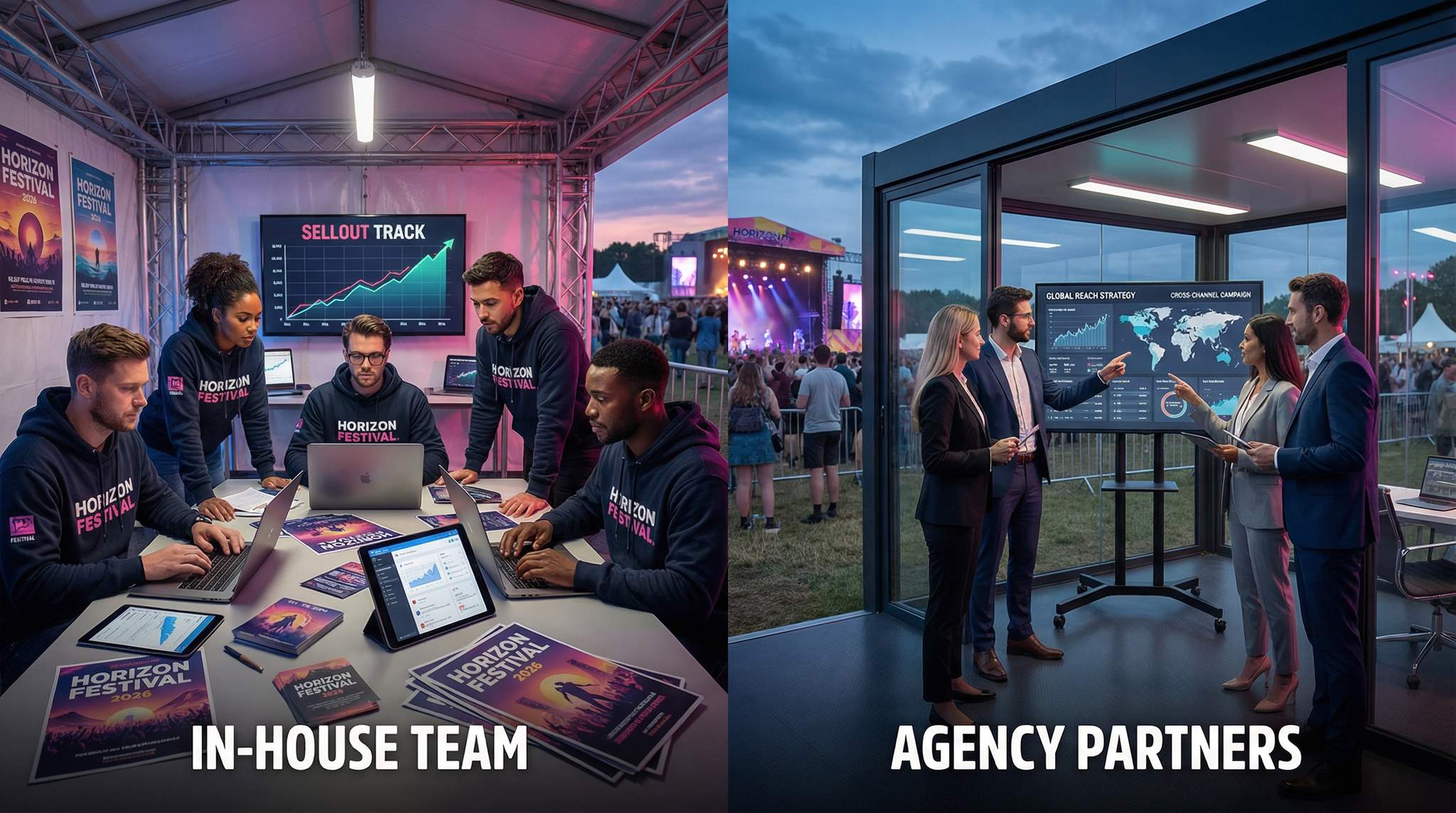
Increasingly, organizations are blending internal staff with external experts. In fact, roughly one-third of companies already use a hybrid approach (mixing in-house and outsourced marketing), and statistics show that companies outsourcing their marketing find it effective. It’s common to keep core marketing strategy and branding in-house while outsourcing specialized tasks like performance ad buying, PR outreach, or video production. This hybrid trend is growing: over 25% of businesses plan to outsource more digital marketing in 2026 as new tech (AI, analytics) makes campaigns more complex, leading many to explore outsourcing for business growth. Event promoters are following suit – maintaining an internal team for day-to-day fan engagement and institutional knowledge, while pulling in agencies or freelancers for boosts of expertise and capacity. The goal is simple: have the best of both worlds and ensure every campaign has the right skills on deck to drive ticket sales.
Reality Check: There’s no one-size-fits-all answer. The ideal mix of in-house vs external talent depends on your event’s size, budget, audience, and goals. Let’s break down how to evaluate your situation and build the optimal marketing team for 2026’s challenges.
Evaluating Your In-House Team’s Capacity
Auditing Skills and Gaps
Start by taking stock of your current team. What skills do your in-house marketers bring to the table? List out key marketing functions – social media, content creation, SEO, email marketing, paid ads (Meta, Google, TikTok), PR, design, analytics, etc. Identify which boxes you tick confidently with internal talent, and which areas are weak or nonexistent. For example, maybe your team excels at organic social media and community building, but no one has expertise in advanced PPC advertising or retargeting campaigns, which require careful coordination in event production. Or you have great creative content creators, but lack someone who can parse Google Analytics or Ticket Fairy’s dashboard for insights. An honest skills audit reveals where you might need outside help.
It’s also worth assessing each member’s experience level. Do you have senior strategists who have run multi-channel campaigns, or mostly juniors learning as they go? High-stakes events (like 10,000+ attendee festivals or global conferences) often demand senior experience – if your in-house team hasn’t tackled something that big, consider bridging the gap with external experts who have. As veteran promoters advise, know what you don’t know. It’s okay if your tight-knit team isn’t up to speed on, say, the latest privacy-compliant retargeting techniques for 2026 – that’s a cue to either train up or bring in someone who is.
Ready to Sell Tickets?
Create professional event pages with built-in payment processing, marketing tools, and real-time analytics.
Bandwidth and Workload Reality Check
Capacity isn’t just about skill – it’s also about bandwidth. How much can your team realistically handle? Event marketing often runs in intense cycles: teaser campaigns, on-sale pushes, daily social content, last-minute promos, and on-site engagement during the event. If you have a small in-house crew, they might be wearing multiple hats. One day they’re analyzing audience survey data, the next they’re designing Instagram graphics and answering attendee questions online. This can lead to overload, mistakes, and burnout. Examine past campaigns: Were there signs of the team struggling to keep up (missed posting schedules, rushed ads with typos, PR opportunities lost because no one had time)? Those are red flags that you’re stretched thin.
Be realistic about upcoming needs. For instance, if you’re planning to double your event lineup next year (more shows or bigger venues), can your current team scale up output accordingly? If not, you’ll need to either hire additional staff or outsource some functions. Another consideration is the timing of tasks. Often, critical marketing activities cluster in the weeks leading up to an event – if your internal team can’t dedicate full focus during that crunch, important promo efforts (like competitive analysis to outsmart rival events) might slip. Don’t wait until things are on fire; proactively gauge if your team size matches the marketing ambitions.
Growth Goals vs. Internal Resources
Align your team’s abilities with your growth objectives. Suppose your goal is to expand a local music festival into a regional destination event attracting travelers – that likely means scaling up marketing significantly (bigger ad spend, broader outreach, perhaps multilingual promotion). Can your in-house staff handle the leap? If you only have a marketing manager and an assistant, expecting them to suddenly manage a national campaign with high production content, influencer activations, and international PR might be unrealistic. On the other hand, if you plan to keep things roughly the same size or do one event at a time, your team might be perfectly sufficient as is, with maybe a little specialized support.
Consider not just current skills, but the capacity to learn and adapt. Some internal teams are hungry to develop new expertise – for example, an in-house marketer might be eager to become your TikTok ads specialist if given training and time. Growing talent from within can be a fantastic long-term strategy for building an internal powerhouse. But it takes an investment in training and experimentation (plus patience). If your timeline for results is short (e.g. you need a boost in ticket sales now), bringing in external specialists could shortcut the learning curve. Successful promoters weigh the trade-off: build versus buy talent. If you have runway to cultivate skills internally, that can pay off in institutional knowledge. If not, outsourcing to hit immediate targets might be the smarter play.
Data-Driven Event Marketing
Track ticket sales, demographics, marketing ROI, and social reach in real time. Exportable reports give you the insights to make smarter decisions.
Tools and Tech: DIY or Outsource?
Modern event marketing relies on a stack of tools – CRM systems, email automation, ad platforms, analytics dashboards, design software, and more. Evaluate whether your team has the know-how to maximize these tools. For instance, you might have access to an email marketing platform, but are you fully utilizing features like segmentation, A/B testing, and automated drip campaigns? If not, is it due to lack of time or expertise? Sometimes, hiring a freelancer who’s a whiz at, say, Google Ads or SEO tools can quickly unlock more potential than your team juggling it on their own. Also, consider if you’re using the tools provided by your ticketing platform. Many event organizers under-utilize their ticketing partner’s marketing features – for example, referral tracking and affiliate links built into Ticket Fairy’s platform can amplify word-of-mouth. An in-house team armed with the right tools (and training) might achieve great results without an agency, whereas a team not leveraging these tools might struggle. In fact, seeing which tickets came directly from your fans allows you to reward top promoters.
The Case for an In-House Marketing Team
Deep Brand Intimacy and Authentic Voice
One of the strongest arguments for keeping event marketing in-house is brand intimacy. Your internal team lives and breathes your event’s ethos every day. They understand the history, the values, the tone of voice that resonates with your audience. This becomes incredibly important for authenticity. Fans can tell when messaging feels off. In-house marketers are more likely to nail that authentic voice, inside jokes of the community, or the specific vibe that makes your event unique. For example, a comic-con’s in-house social media manager who is a genuine fan of the content will engage in a much more heartfelt way with attendees than an external agency rep just learning the lingo. In-house teams can craft content that hits the right notes because they are part of the culture of the event.
Case in point: veteran convention organizers often maintain year-round fan engagement directly with their community, something that’s hard to outsource. They run insider teaser campaigns, do spontaneous giveaways, and actively banter with fans on forums – all building trust and hype. This authentic touch is credited with turning casual followers into super-fans who return year after year. Moving from teasers to sold-out convention marketing requires this consistent touch. When your marketing relies on authenticity (as it often does for niche festivals, fan conventions, or nonprofit events), having an in-house voice can be a major strength.
Building an In-House Content Marketing Team
For many organizers, the first step away from full outsourcing is building an in-house content marketing team. Because content—such as behind-the-scenes TikToks, artist interviews, and community blog posts—relies so heavily on authentic brand voice, it is often the most logical function to internalize. Constructing this dedicated content unit usually starts with a versatile content manager who can shoot video, write copy, and understand social algorithms, eventually scaling to include specialized videographers or copywriters as the event portfolio grows. This internal content engine ensures a steady, cost-effective stream of promotional material that external firms struggle to replicate without heavy retainer fees.
Real-Time Alignment and Agility
Events are live and dynamic – things change fast, and marketing needs to react in real time. In-house teams excel at agility. Since they’re embedded within the organization, they hear news firsthand and can pivot quickly. Think about scenarios like a last-minute change in venue, a surprise artist announcement, or an urgent PR crisis. An internal marketer can walk over to the event director’s desk (or hop on Slack) and decide on messaging within minutes. They can publish an official update or tweak an ad campaign on the fly. With external agencies, there’s often a communication lag – you have to call the account manager, explain the issue, wait for them to relay to their team, etc. In fast-moving situations, that delay can be costly.
Similarly, internal teams tend to have tighter alignment with other departments. Marketing can coordinate with operations, ticketing, and customer service seamlessly because they’re all under one roof. Daily stand-ups or quick syncs ensure everyone’s on the same page. For instance, if sales data shows VIP tickets are lagging, an in-house marketer can instantly coordinate a push (email blast, social post, homepage banner) to give VIP sales a boost. This nimbleness and integrated communication loop are big pluses for in-house setups. In essence, you maintain full control – over brand messaging, over spend, and over timing – without needing external approval for every little change. For events that require rapid iteration and constant fine-tuning of the campaign, an in-house team is often the fastest and most responsive option.
Turn Fans Into Your Marketing Team
Ticket Fairy's built-in referral rewards system incentivizes attendees to share your event, delivering 15-25% sales boosts and 30x ROI vs paid ads.
This speed becomes a massive competitive advantage when capitalizing on viral trends or sudden PR opportunities. With a capable internal crew and modern self-serve ticketing platforms, you can literally launch in minutes: go live faster than you can brief an agency. Instead of drafting a creative brief, waiting for account managers to review it, and enduring rounds of revisions, your internal staff can conceptualize a flash sale, build the ticketing page, and push the social media assets live almost instantly.
Cost Efficiency for Ongoing Needs
At first glance, agencies might seem expensive while your salaried staff is “already paid for.” In-house marketing can indeed be cost-efficient for ongoing, year-round needs. If you run events continuously or have a packed annual calendar, keeping a dedicated team on payroll often costs less than paying agency fees for each campaign. Agencies typically charge markups, retainers, or project fees that include their overhead and profit margin. Over a full year, those costs can outweigh one or two full-time salaries. That’s why many promoters opt to invest in a couple of key hires and build internal capability for core marketing functions.
Grow Your Events
Leverage referral marketing, social sharing incentives, and audience insights to sell more tickets.
Moreover, in-house team members can wear multiple hats when needed. Your marketing coordinator might handle social media most of the year and then temporarily shift to help with sponsorship decks or on-site signage when the crunch comes – something an agency would bill extra for if it’s outside scope. There’s also transparency: with in-house, you see exactly where the hours go and can shift priorities on the fly without renegotiating contracts. And any content or creative produced in-house becomes your asset with no questions on ownership or usage rights (sometimes agencies retain rights to creative until fully paid, etc.). Over time, as your team gains experience, the ROI of each internal hire often improves – they become more effective the more they understand your audience and what marketing tactics drive your ticket sales. This compounding value is a big incentive to nurture in-house talent.
Building Long-Term Marketing Assets
When you invest in an in-house team, you’re also investing in institutional knowledge and relationships that grow over time. An agency might launch a campaign and move on, but an internal marketer carries forward all the lessons learned to the next campaign. They remember that email subject line A beat subject line B in last year’s festival invite, or that college students responded really well to the TikTok teaser but not the FB ads. This historical insight means each new promotion can be smarter than the last. Agencies can document learnings too, but no one will ever be as steeped in your event’s journey as your own team.
In-house staff also build relationships that matter: with loyal attendees (knowing VIPs or superfans by name), with local media reporters, with influencers who repeatedly work with your event, and with sponsors in your community. These relationships can be cultivated in a genuine way over years, leading to things like a grassroots street team of volunteers or an informal network of promoters who help spread the word – advantages that money can’t easily buy. Experienced promoters often say their in-house marketers become brand ambassadors as much as staff – talking up the event everywhere they go, bringing passion that fuels word-of-mouth. This kind of organic advocacy and deep familiarity is hard to replicate externally. So, if your strategy is to build a long-term brand (and it likely is), an in-house team can accumulate valuable goodwill and insights that drive sustained success.
The Case for Agencies and Freelancers
Specialized Skills on Tap
Marketing today is highly specialized. There’s SEO, SEM, social ads, analytics, conversion rate optimization, copywriting, graphic design, video editing, influencer management – the list goes on. It’s unrealistic for a small in-house team to master every niche skill. This is where agencies and freelancers shine. By hiring an external expert, you get immediate access to specialized talent that might take years to develop internally. For example, if you want to launch a complex influencer-driven campaign to promote your event, you could engage an agency that has dedicated influencer strategists and established creator relationships. They’ll know how to vet influencers, negotiate deals, and run the campaign efficiently because they do it day in, day out. Similarly, a freelancer who’s a Google Ads wizard can likely optimize your search and display campaigns faster and better than a generalist marketer figuring it out as they go – yielding a higher ROAS (Return on Ad Spend) and more ticket sales for the same budget.
Built-In Email Marketing for Events
Send targeted campaigns, automated purchase confirmations, and post-event follow-ups directly from your ticketing dashboard.
Agencies also invest in cutting-edge tools and training for their specialties. A digital marketing agency might have expensive analytics software or AI ad optimization tools that your team doesn’t. When you hire them, you indirectly get the benefit of those tools without having to purchase them yourself. The same goes for staying current: good agencies keep up with platform changes (like that latest algorithm shift killing your organic reach) and emerging trends (e.g. new ad formats on TikTok) across all their clients, so they can quickly apply that knowledge to your campaigns. In short, outsourcing specific tasks can infuse your marketing with top-tier expertise and technology on demand.
Rapid Scaling and Flexibility
Another advantage of external help is the ability to scale your marketing efforts up or down quickly. Let’s say you have a one-off mega event – perhaps a stadium concert or a festival doubling in size for its anniversary. Rather than hiring multiple full-time staff whom you might not need after the event, you can bring in an agency team for the surge. They can deploy additional designers, ad buyers, and PR reps as needed to handle the larger scope. After the event, you simply wrap up the contract instead of carrying ongoing payroll. This flexibility is ideal for promoters who have seasonal or irregular events. You can effectively “rent” a larger team during peak marketing periods.
Freelancers offer flexibility too – you might hire a content writer for three months to populate your blog with SEO-rich articles leading up to the event, then pause. If next year you need them again, you re-engage. No long-term commitments if you don’t want them. Agencies also provide the benefit of built-in backup: if your account manager goes on vacation, someone else at the agency steps in. With a tiny in-house team, if one person is out sick during a critical week, you’re stuck. An agency has more redundancy. Essentially, external partners give you a more elastic marketing workforce that can expand or contract with your needs, which is cost-effective and convenient for many event organizers.
Fresh Perspectives and Creative Boost
Bringing in outsiders can spark fresh ideas and creative strategies that an internal team, accustomed to doing things a certain way, might overlook. Agencies work with multiple clients and see a broad view of what’s working in the market. They might introduce a promotional tactic you hadn’t thought of – like a viral TikTok challenge, an interactive AR experience, or a novel partnership approach – because they’ve seen it succeed elsewhere. This cross-pollination of ideas is valuable. For example, if you’re promoting a music festival, an agency that also handled a sports event might suggest a fan engagement idea from sports that translates brilliantly to concerts.
External experts can also conduct an objective assessment of your marketing. Sometimes internal teams develop tunnel vision or get too close to the event to spot flaws in the strategy. A fresh pair of eyes, like a marketing consultant or agency strategist, can audit your campaign plan and point out, say, that your messaging isn’t differentiated from competitors or that you’re underutilizing email re-marketing. They can benchmark against industry best practices and give candid feedback without internal politics. Many successful promoters worldwide have credited an outside perspective for turning around a stalled campaign – e.g., a freelance copywriter revamped their landing page and boosted ticket conversions by 15%, or an agency’s creative team produced a promo video that went viral, doing more in 2 weeks than months of standard ads.
There’s also the motivational aspect: external partners want to prove their value. Agencies often bring very polished deliverables (slick graphics, well-researched media plans) that can raise the overall quality of your marketing output. Their creatives and planners brainstorm big ideas to impress you and justify their fee – which can inject a lot of energy into your event’s promotional effort. In short, outsourcing can be a way to turbocharge innovation and get out of a marketing rut with new thinking.
Automated Waiting Lists for Sold-Out Events
Capture demand when tickets sell out and automatically notify waitlisted buyers when tickets become available through cancellations or resale.
Efficiency and Proven Processes
Experienced marketing agencies come with battle-tested processes. They have launch checklists, campaign calendars, templates, and optimization playbooks refined over dozens of similar projects. This means they can often execute faster and more efficiently than an in-house team inventing the wheel from scratch. For example, a seasoned event marketing agency knows exactly how to structure a 12-week concert promotion timeline, when to drop early-bird tickets, how to stagger social media content, when to switch messaging to “last chance” urgency – all based on what’s worked before. By tapping into that accumulated experience, you avoid a lot of trial-and-error.
In-house teams, especially newer ones, might spend a lot of time figuring out these rhythms or making mistakes that an agency would sidestep. There’s also efficiency in media buying and PR outreach – agencies likely have bulk ad buying power or existing media contacts. They might get you better advertising rates or easier press coverage because of those relationships. For instance, an agency that regularly books radio ads or billboard space could negotiate a better package deal than you’d get as a one-time buyer. Or they might have a press list ready for your event genre, so your news gets to the right journalists without your team painstakingly compiling contacts. These efficiencies can translate to cost savings and better results. In fact, 93% of companies that outsource marketing say it’s effective, often due to agencies avoiding pitfalls and driving higher ROI.
Finally, external specialists reduce the risk of important things falling through the cracks. Their job is on the line if they underperform, so good agencies are very methodical about tracking KPIs, providing reports, and making adjustments. This level of rigor can ensure no opportunity is missed – every retargeting ad is A/B tested, every influencer post is monitored, every email performance is analyzed – freeing you to focus on the big picture while they handle the execution details.
Weighing the Drawbacks of Each Approach
Every approach has its flipside. It’s crucial to understand the potential pitfalls of staying in-house versus outsourcing so you can address them.
In-House Pitfalls: Gaps and Burnout
For all the control and culture fit benefits of in-house teams, they can run into problems, especially if they’re small. One issue is skill gaps – your team might simply not have expertise in a critical area. In 2026, for example, if none of your staff truly understands privacy-first ad strategies and data compliance, you could end up wasting ad spend or (worse) violating regulations unknowingly. Similarly, an in-house team might lack cutting-edge design capabilities, resulting in less polished creative that doesn’t capture attention. Training and learning on the fly can cover some gaps, but it takes time that you may not have during a campaign push.
Another big concern is workload burnout. Small internal teams can be overwhelmed by the sheer volume of marketing tasks for an event. We’ve seen event coordinators who double as social media managers and press liaisons – juggling 10+ duties and working 60-hour weeks as an event approaches. This is a recipe for mistakes and fatigue. When people are spread too thin, important details slip (like forgetting to follow up with that journalist or missing a scheduled ad placement). Burnout can also lead to staff turnover, which is a setback in itself. If your star marketing manager quits mid-season due to overwork, you lose momentum and institutional knowledge. That risk is on you as the organizer when everything is kept in-house.
Grow Your Social Following With Every Sale
Require social media follows, shares, or playlist adds to unlock presale access or special pricing. Turn every ticket purchase into audience growth.
Moreover, an inward-focused team might become insular over time. They might rely on the same playbook every year (“we always poster the same shops, run the same Facebook ads”). Without external input, they could miss shifts in the market or fresher ideas competitors are using. Essentially, the weaknesses of in-house boil down to limited capacity and perspective if not proactively managed. The good news is, you can mitigate these by carefully planning workload, investing in training, and perhaps supplementing with occasional external consulting. But you need to be aware of the dangers to take action.
Agency Pitfalls: Cost and Control
While agencies bring expertise and manpower, they come at a premium price. A full-service marketing agency might charge a retainer or percentage of ad spend that adds up fast. For instance, a $10,000/month retainer over 6 months is $60k – that could be another full-time skilled employee you could have hired. If your ticket revenue is tight, those fees cut into profit. Beyond fees, agencies might also mark up third-party costs (like ad buys or printing) as part of their service. You pay for their project management and overhead, not just the work output. This doesn’t mean agencies aren’t worth it – many are – but you have to ensure the ROI justifies the expense. Keep an eye on hidden costs too: sometimes scope creep leads to extra charges for work outside the original contract, or long-term agency contracts have cancellation penalties. Always read the fine print.
Another challenge is losing some control over the day-to-day marketing execution. When you hand over tasks to an agency, you’re trusting them to represent your brand. They might not get it perfect initially – maybe the tone of that first social post isn’t quite right, or they choose an ad image that doesn’t align with your event’s aesthetic. You’ll need to spend time onboarding the agency about your brand guidelines, reviewing their work at first, and giving feedback. That’s additional effort that some organizers underestimate. If the agency is juggling multiple clients (which they usually are), you might also worry that you’re not their top priority. Response times might be slower than hoped on occasion, or you get a more junior team than promised once the deal is signed (a common complaint known as “bait-and-switch” where senior people pitch you but juniors do the work).
There’s also the risk of misaligned vision. If the agency’s creative direction doesn’t match what you envision, it can lead to friction and back-and-forth revisions. In the worst case, a poorly chosen agency might produce campaigns that actually hurt your brand – like tone-deaf ads or inaccurate information – which you then have to scramble to correct. While such cases are rarer with reputable firms, it underscores the need to choose your external partners carefully and keep communication very clear. In summary, with agencies you trade some direct control for added expertise, and you pay a premium for it. Managing that relationship smartly (with clear goals, check-ins, and accountability) is key to avoiding these pitfalls.
Freelancers: Independence vs. Reliability
Freelancers and contractors can be a great middle ground – you get specialized help without big agency fees. However, working with freelancers has its own considerations. One is consistency and reliability. A freelancer might be juggling other gigs, so you’re one of several priorities. If a higher-paying project comes along, they might deprioritize your work (hopefully not, but it happens). And unlike an agency, there’s usually no backup if a freelancer is sick or unavailable. If your go-to graphic designer is suddenly unresponsive the week your poster needs finalizing, you’re in a bind. To mitigate this, always have clear deadlines and maybe even a backup freelancer for emergencies, especially for critical deliverables.
Another aspect is that freelancers, by nature, work independently. They won’t have the broader team brainstorming that an agency offers. You manage them directly, which means you need to provide direction and oversight. If you’re not prepared to effectively brief and coordinate freelancers, you might not get the results you want. Some freelancers may need a fair bit of guidance to nail your brand voice or style initially. Essentially, you become the project manager – which is fine if you have the time and skills, but can be a challenge if you were hoping to offload that burden.
Full Pixel & Analytics Integration
Install Meta Pixel with Conversions API, Google Analytics, TikTok Pixel, Reddit Pixel, and Spotify Pixel on your event pages. Server-side tracking for accurate attribution.
Quality can also vary widely. There are superstar freelancers who’ll deliver agency-quality work, and there are less experienced ones who may need multiple revisions. Vetting is crucial – check portfolios and consider doing a small paid test project to ensure a fit. And since freelancers aren’t embedded in your team, ensure they understand the bigger picture of your campaign. A common pitfall is a freelancer doing exactly what was asked, but not thinking about the context. For example, they design a beautiful ad creative, but it doesn’t include the event date because you forgot to mention it and they didn’t know the event timeline. In an in-house team, that context is obvious; with a freelancer, you must explicitly share it.
In short, freelancers offer flexibility and often great value, but you need to manage and integrate them proactively. With good communication, they can be a powerful extension of your team – just remember they aren’t mind readers and they aren’t on-call 24/7 unless agreed (don’t expect a freelancer to respond at midnight unless you’ve set that understanding and compensation!). Treat them professionally, and most will reciprocate with dedication to your project.
Brand Consistency and Knowledge Transfer
One often overlooked challenge when bringing in external partners (agencies or freelancers) is maintaining brand consistency. Your event has a personality – its logo, voice, values, and story. In-house teams usually have this baked into everything they do. When outsiders produce content, there’s a chance of inconsistency – maybe a different tone in a press release, or an off-brand color scheme in an ad. To prevent this, you need to equip them with brand guidelines, past examples, and clear review processes. It takes effort up front to educate external folks so they become brand stewards rather than rogues. The first few weeks with an agency might involve a lot of back-and-forth to calibrate tone and style. Don’t skip this step; otherwise you may end up with confusing messaging that dilutes your brand impact.
Another factor is knowledge transfer. After the event, if a freelancer or agency moves on, what happens to the knowledge of what they did? Ideally, they’ll deliver reports and assets, but they won’t internalize lessons learned for next time – because they might not be there next time. This is where some organizations hit a stumbling block: they outsource a big chunk of marketing and see good results, but the internal team didn’t follow closely enough to learn the “how” behind those results. Next year, you either pay the external partner again or struggle to replicate success without them. To solve this, smart promoters integrate external experts in a way that shares knowledge. For example, have your in-house team shadow the agency’s work, join in their strategy sessions, and debrief after campaigns to absorb insights. If a freelancer ran your email marketing and got 40% open rates, deconstruct the tactics with your team – was it the subject lines, the send time, list segmentation? Document these takeaways. The goal is to gradually level up your internal capabilities even when using outside help. This way, you’re not wholly dependent on them in the future.
Lastly, consider internal morale. If you bring in an agency and sideline your in-house marketers, they might feel demoralized or fearful for their jobs. It’s important to frame external help as supportive, not a replacement. Involve your team in selecting and working with agencies so it feels like augmentation, not usurpation. Many organizations find that bringing in specialists actually energizes their staff – it offloads grunt work or fills gaps, allowing in-house folks to focus on their strengths (and maybe learn new tricks from the pros). Just handle it thoughtfully to keep everyone rowing in the same direction.
In-House vs Agency vs Freelancer: A Quick Comparison
To visualize the differences, below is a quick comparison of key factors for in-house teams, agencies, and freelancers. Each approach has strengths and weaknesses that make it better suited for certain needs:
| Factor | In-House Team | Agency | Freelancer |
|---|---|---|---|
| Expertise Breadth | Generalists with broad event knowledge; may lack niche skills in some channels. | Deep bench of specialists in various marketing fields (e.g. SEO, PPC, PR). | Highly skilled in one specific area (e.g. graphic design, copywriting). |
| Brand Knowledge | Intimate understanding of the event brand and audience; authentic voice. | Learns brand through onboarding; may need time to fully grasp voice. | Varies – can learn brand for their task, but not as immersed as staff. |
| Cost Structure | Fixed salaries (plus benefits); lower incremental cost for additional work. | Project or retainer fees (higher upfront cost); may mark up third-party expenses. | Pay per project or hourly; flexible cost but can add up if used extensively. |
| Control & Agility | Total control; can pivot quickly and coordinate internally with ease. | Some control lost; changes require communication and may have lead time. | Moderate control; direct communication, but not present for impromptu needs. |
| Scalability | Limited to team size; hiring new staff takes time. Great for steady, ongoing needs. | Highly scalable; can deploy large teams for big campaigns, then scale down. | Scales by hiring multiple freelancers, but coordination becomes complex if many. |
| Accountability | Team is invested in event’s long-term success; accountability is internal. | Typically contract-bound deliverables; will work to meet defined KPIs (reputation at stake). | Accountable to task outcomes; reliability varies, must vet and manage. |
| Innovation & Ideas | Knows what’s been tried; can be incremental. Innovation must be sought out. | Brings fresh ideas from industry experience; may push creative boundaries. | Offers outside perspective within their niche; might suggest new approaches in their domain. |
| Continuity | Retains knowledge year over year (low turnover ideal); learns from each event. | New campaigns may repeat onboarding; knowledge can be lost if you switch agencies. | Short-term involvement; knowledge often leaves when contract ends. |
Your goal isn’t to “pick one” forever, but to mix and match these strengths to suit your event. Some organizers keep most factors in-house but outsource one or two areas where agencies clearly shine, for example. Others start in-house and outsource more as they scale. The comparison above can guide you based on what you value most.
When to Keep Marketing In-House
There are scenarios where doubling down on your internal team makes the most sense. Here are common situations where an in-house approach tends to excel:
Smaller Events with Tight Budgets
If you’re running modest events (say a 300-person local concert or a niche workshop series) on a shoestring budget, in-house marketing is often the only viable route. Every dollar counts, and paying agency fees could blow your budget entirely. Fortunately, smaller scale events usually mean marketing is manageable with a lean team – maybe it’s just you and one colleague doing everything from flyering to Facebook posts. In these cases, grassroots tactics and personal connections often matter more than big-budget polish. Many nonprofit events, for example, rely on passionate internal teams and volunteers rather than agencies. Deciding when in-house management is most valuable often comes down to budget and community connection. They trade cash for creativity – leveraging community partnerships, free social media, and email outreach to drive attendance. If your event’s value proposition is strong and the community is tight-knit, an in-house marketer who genuinely engages with attendees can achieve a lot without fancy ad campaigns. Keeping it in-house also means you can redirect funds into the event experience itself (better venue, nicer decor, etc.), which in turn helps word-of-mouth marketing. In summary, for smaller or financially constrained events, scrappy in-house marketing keeps costs down and can be highly effective with the right personal touch.
Niche or Community-Centric Events
Events that serve a very specific audience or have a strong existing community often benefit from in-house marketing because it requires an authentic, nuanced approach. Take a genre-specific music festival (like an underground techno rave) or a cultural event (like a local Pride parade or a religious festival) – the messaging and channels need to resonate deeply with that tribe. In-house teams (especially if the team members are part of the community themselves) have an edge in credibility. They know the tone to use, the forums or groups where the audience hangs out, and the influencers or community leaders people trust.
For example, an anime fan convention might keep marketing internal so they can post in fan subreddit threads and niche Discord servers without coming off as “corporate spam.” The fans running the marketing can reference insider jokes from last year’s con, or highlight guests in a way that only true fans appreciate. This authenticity is gold – it builds trust. External marketers, no matter how skilled, might inadvertently use language that feels off, and then the community tunes out. Long-running events with loyal followings (think a 10-year running local festival) also often have an in-house team because those folks have built one-to-one relationships with attendees over the years. They might even greet known attendees by name via email campaigns (“Hey Alex, we saw you grabbed tickets again – can’t wait to see you!”). That level of personalization is hard to replicate externally.
In short, when your event’s success relies on a passionate core audience who values authenticity – whether it’s a fan convention, a faith-based gathering, or any mission-driven event – staying in-house helps you speak their language and maintain trust. You might still get external advice or creative support, but the voice should remain close to home.
Ongoing Fan Engagement and Content
Do you maintain a vibrant online community or continuous content stream between events? If your marketing isn’t just a one-and-done campaign but an ongoing conversation (like year-round social media engagement, monthly content drops, fan meetups, etc.), an in-house team is often best positioned to handle that. Continuous engagement requires day-to-day attention and genuine interaction. Your internal social media or community manager can respond to comments in minutes, post behind-the-scenes staff photos from the office, and moderate fan discussions with an authoritative yet friendly presence. It’s harder (and more expensive) to have an agency manage this kind of always-on community nurturing at the micro-level.
A great example is how some comic-cons or esports events operate: they basically run like media outlets, with daily content to keep fans hyped year-round. Being ready to sell out conventions relies on keeping that momentum alive. They tease next year’s theme right after the current event, drop sneak peeks of guest announcements, and highlight fan art or throwback photos each week. This steady drumbeat keeps the community engaged and grows it in the off-season. Trying to outsource that could end up feeling formulaic. In-house teams, on the other hand, can riff off real attendee interactions, adjust tone as the community mood shifts, and even recognize super-fans (e.g., giving a shoutout to a fan’s cosplay post). This organic rapport strengthens loyalty – those fans are far more likely to buy tickets the moment they go on sale.
So if your strategy involves content marketing and fan engagement as a continuous effort, lean on your in-house talent. They can deliver authenticity and timeliness that’s hard for an outside firm to match long-term. Use agencies for burst campaigns or specialty content if needed, but the day-to-day heartbeat of fan communication usually belongs in-house.
When You Already Have Rock-Star Marketers
Sometimes, the simplest reason to keep marketing in-house is that you’ve got a stellar team in place. If you’re lucky enough to have experienced event marketers on staff who consistently hit goals, understand multiple channels, and bring creative ideas – then you should absolutely leverage them. Empower them with budget and tools, and let them run. Agencies might not add much value if your internal team is firing on all cylinders. In fact, top in-house marketers often outperform agencies because they have the context and dedication agencies lack.
For instance, say your marketing director has 10 years of festival marketing under her belt and a network of contacts, or your digital marketer came from a big promoter and is an absolute wiz at ad targeting and email segmentation. These folks can coach junior team members, steadily improving your internal capacity. Over time, you might expand the team, hiring another coordinator or analyst as your events grow, essentially building your own mini-agency internally. Many large event companies (think Live Nation or major convention organizers) operate this way – they have sizable in-house marketing departments and only occasionally tap outside firms for very specialized needs or overflow work. The benefit is consistency and deep expertise that stays within the company.
If results are good and capacity is sufficient, sticking with an internal approach also means clearer attribution and feedback loops. Your team sees direct how their strategies correlate to ticket sales on your dashboard, and they can adjust in near real-time. When you have “rock stars” internally, you can also save money in the long run (agencies might charge a premium to provide the same caliber of talent). Just be sure to keep those star players happy – invest in their growth, pay them well, and make sure they aren’t stretched too thin. The last thing you want is to lose them to burnout or to another company because you under-utilized them in favor of an agency.
Control and Confidentiality Concerns
Certain events or organizations have reasons to keep things close to the vest. If your marketing strategy involves sensitive information – perhaps a surprise lineup reveal, a high-profile guest appearance under embargo, or proprietary marketing tactics you consider a competitive edge – then limiting outside exposure might be wise. In-house teams are easier to bind with strict NDAs and are inherently part of the inner circle, whereas agencies work with multiple clients and there’s a (usually small) risk of leaks or crossover of ideas.
Also, some brands are very protective of their image and tone, to the point where every tweet must be vetted for brand compliance. If you fall into this category, you may feel more comfortable with an internal person you trust hitting “send” on communications rather than an agency employee you’ve never met personally. Political organizations, high-security events, or those with controversial elements often opt to do most marketing internally just to maintain control over messaging. For example, a summit dealing with sensitive geopolitics might keep PR in-house to ensure absolutely nothing is miscommunicated.
While reputable agencies are professional about confidentiality and aligning to guidelines, the peace of mind that comes from having your own staff manage delicate marketing matters can tilt the decision towards in-house. If control is non-negotiable for you, then structure your team accordingly and maybe use external folks only in low-risk areas (like purely technical ad setup or generic design work where they don’t need insider info).
When to Leverage External Agencies or Freelancers
On the flip side, there are clear scenarios where bringing in outside help can elevate your marketing and ticket sales. Consider seeking external expertise in situations like these:
Major Events or Rapid Expansion
If you’re stepping up to a larger stage – literally or figuratively – external support can be game-changing. Launching a new festival that’s much bigger than anything you’ve done, taking a regional event national, or organizing a one-time mega-concert tour are instances where the marketing complexity jumps dramatically. To promote an 80,000-seat stadium show, for example, you might need multi-city ad buys, nationwide PR outreach, broadcast media spots, and high-production creative. That’s a far cry from marketing a 500-person club gig. Agencies that specialize in big events have experience scaling campaigns** to massive audiences and coordinating across channels. They know how to generate nationwide buzz and have the staff to execute quickly.
Rapid growth can also strain a previously sufficient team. Maybe your festival sold out 5,000 tickets last year, and this year you’re aiming for 15,000. That might involve targeting new demographics, significantly upping content output, and handling triple the customer inquiries. If you don’t have time to hire and train multiple people in-house, an agency with a ready-to-go team can be a lifesaver. They can plug in and run a heavy-duty campaign immediately. Think of it like bringing in an experienced pit crew when you enter a faster racing circuit. Speed and scale are their forte. Many festivals that scaled up fast – say expanding to multiple cities or countries – leveraged agencies for things like national media buying or influencer campaigns in each local market, because trying to do that centrally with a tiny team would be Herculean. Use agencies to amplify your reach to match your big ambitions.
Specialized Campaign Needs
Every so often, you might have a specific marketing initiative that falls outside your team’s comfort zone. Perhaps you want to run a sophisticated retargeting campaign that adheres to new privacy guidelines to re-engage people who visited your ticket page but didn’t purchase. If your team hasn’t kept up with the latest cookie-less retargeting tech or CRM-based remarketing, an agency can step in with that know-how. Or imagine you decide to overhaul your event website for better SEO and conversion – you might hire an SEO expert freelancer and a UX designer to revamp it, rather than expecting your social media manager to magically morph into a web optimization guru.
PR is another specialized area often best left to pros: if you need to get media coverage in high-profile outlets, a PR agency that already has those journalist contacts will likely be far more effective than your in-house staff cold-pitching reporters. The same goes for video production – if you want a stunning aftermovie to promote next year’s festival, contracting a production house or freelance videographer with event experience will ensure high quality, whereas DIY might look amateurish. Essentially, whenever the task requires deep expertise or technical ability that you either lack or don’t have time to fully develop internally, it’s wise to call for external specialists. You can do this surgically – hire for that task, get the deliverable, maybe even have them train your team a bit, and then continue with your regular team handling the rest.
Entering Unfamiliar Markets (Geographic or Demographic)
Expanding your event to a new location or targeting a new audience segment can be tricky to navigate without local or domain knowledge. Let’s say you’re an Australian festival organizer taking your event to Asia for the first time – the social platforms, influencer culture, and media landscape might be completely different there. Partnering with a local marketing agency or promoter in that region can make a huge difference. They’ll avoid cultural missteps, know which channels actually reach people (maybe WhatsApp or WeChat instead of email, for example), and may even speak the language natively. The same logic applies to demographics: if your core team has always marketed to college-aged EDM fans, and now you’re launching a family-friendly food festival, you might not instinctively know how to pitch to parents. An agency with experience in family events or a freelancer who’s a whiz at mommy-blogger outreach, for instance, could help bridge that gap.
In emerging markets or areas with lower internet usage, a local partner is often crucial. Promoting events in emerging markets sometimes means using channels like SMS broadcasts, community radio, or on-the-ground street teams that your in-house digital-savvy team might not even consider. Leveraging festival partnership marketing and cross-promotions can open doors to new audiences. Local agencies understand these nuances and have networks in place (e.g., contacts at local radio, or knowledge of which neighborhoods respond to postering). Moreover, using a local voice can prevent your marketing from feeling “foreign.” Research has shown that adapting your promotion with local nuances significantly improves effectiveness – one approach is to engage a local promoter or influencer agency who knows the scene and can speak to that audience authentically. In summary, when venturing into new territory (literally or figuratively), an external expert who’s native to that space can save you from costly trial-and-error and help you connect with the audience much faster.
Peak Season or Crisis Bandwidth
Sometimes the issue isn’t skill, but sheer manpower during crunch times. Most events have a peak marketing period – the weeks leading up to the event (or around on-sale dates) where workload explodes. You may need to double down on content, run support for ticket buyer questions, launch last-minute ads, and coordinate final press releases all at once. If your internal team is small, those few weeks can be overwhelming. This is an ideal scenario to bring in temporary external help. For instance, hire a freelance copywriter for the month before the event to pump out extra blogs, schedule a short-term contract with an agency to manage your Google Ads during the final push, or get a PR freelancer to handle all the press follow-ups right before showtime. They can focus on those tasks, freeing your core team to handle everything else without losing sanity.
Crisis moments are another time to lean on external assistance. Imagine a situation where ticket sales are slower than expected two weeks out – you might engage a marketing agency to do an emergency blitz campaign (perhaps a flash sale promo, influencer shoutouts, etc.) to boost last-minute sales. Their team can dedicate full attention to that critical save, whereas your team might be busy with operational prep by then. Similarly, if a PR crisis hits (maybe an artist cancellation or a controversy), a specialized PR firm could be brought on short notice to manage messaging and media inquiries professionally, allowing your team to focus on attendee communication and logistics.
The idea is: don’t let pride or rigidity stop you from getting extra hands when you truly need them. Even the best in-house team can be overloaded by peaks or blindsided by crises. Having a roster of go-to freelancers or agencies for such occasions is like having fire extinguishers – hopefully you won’t need them, but if you do, you’ll be glad they’re there. Many event organizers develop relationships with a few freelancers (designers, writers, ad specialists) who are on standby and can take on work during those super intense periods when the internal team is maxed out.
Objective Audits and Strategy Overhauls
Another smart time to use outside experts: when you feel your marketing strategy has plateaued or needs a fresh set of eyes. If your event growth has stagnated or past campaigns aren’t delivering like they used to, an external marketing consultant or agency can perform an audit and identify issues. They come without internal bias, so they might spot things your team overlooks. Perhaps they find that your messaging isn’t differentiated or that your ticketing funnel has too much friction. For example, an agency could do a quick audit and discover your checkout process on mobile is clunky – something costing 5% of conversions, which internal teams hadn’t noticed because “that’s how it’s always been.” Or maybe your ad frequency is too high causing audience fatigue – an external media planner might see that immediately from metrics.
Bringing in an agency to plan a new strategy doesn’t mean you must keep them forever. Some promoters use agencies essentially as jump-starters: collaborate to craft a new marketing plan or creative rebrand, then have the in-house team execute and maintain it. The agency’s strategic expertise sets the course, and internal folks take the wheel from there. This can work well if you feel you’re in a rut or facing new competition where the old tactics aren’t enough. An objective outsider can also mediate internal debates – maybe your team is split on whether to focus on Instagram or YouTube next year. A third-party analysis with data can guide that decision more impartially.
In short, when in doubt, call in a consultant. It could be as informal as a one-day workshop or as formal as a contracted analysis, but getting an external perspective can validate your strengths and pinpoint weaknesses. Just be ready to hear some critique – it’s valuable if it helps you sell more tickets next time around. And you can always blend their recommendations with your own insights for a plan that feels right.
Building a Hybrid Team: Best of Both Worlds
Increasingly, the answer to in-house vs agency isn’t one or the other – it’s a well-crafted combination. A hybrid approach lets you capitalize on internal strengths and external expertise together. However, making this work requires intention. Here’s how to seamlessly integrate outside help with your team:
Define Roles and Responsibilities Up Front
Clarity is king. From the outset of any engagement with an agency or freelancer, nail down who is responsible for what. This avoids both duplication and gaps. For example, if you hire an agency to run your digital ads, specify that your in-house team will still handle organic social media and email marketing. The agency’s scope might be “manage Meta and Google Ads from creative to optimization, and provide weekly reports,” while your team’s scope is “provide brand-approved visuals/copy to agency, manage community comments, and run all non-paid social content.” Document these divisions in writing and share with all parties. If you’re in a meeting where something needs doing (say, updating the event website homepage), it should be clear whether that’s on the internal web designer or the agency’s content team. Over-communicate responsibilities at the start.
Also clarify decision-making power. Does the agency have freedom to adjust budgets or messaging on the fly, or must they get approval? Many promoters give agencies some autonomy within guidelines (e.g., they can swap out underperforming ad creatives or raise a budget by 10% if CPA is good, but any major messaging changes need sign-off). At the same time, define internal roles like who is the point person liaising with the agency. Often an internal marketing lead will act as the coordinator to funnel requests and feedback so the agency isn’t bombarded by ad-hoc inputs from five different internal stakeholders. When everyone knows their lane, the partnership runs much smoother.
Foster Collaboration and Knowledge Sharing
Treat external partners as extensions of your team, not outsiders. Invite them (virtually) to key team meetings. For instance, have your PR agency join your weekly marketing call to update everyone on press outreach status and hear about any event developments that could yield stories. Or if you have a freelancer designing graphics, include them in your Slack channel for the marketing team so day-to-day communication is fluid. The goal is to break the silo mentality. When agencies and in-house staff collaborate closely, it prevents duplication of work and ensures consistent messaging.
Encourage knowledge sharing both ways. Your team can learn from the agency’s expertise – maybe ask them to do a mini-training session on reading Facebook Ad analytics for your staff. Conversely, your in-house folks have a trove of knowledge about your audience and past campaigns; make sure they brief external people thoroughly and share relevant historical data. For example, share that last year’s campaign saw email outperform Instagram, or that certain messaging angles did not work well. This helps the external marketers ramp up faster and avoid known pitfalls.
Culturally, little gestures help too. Introduce external partners on internal emails like “meet our extended team member who’s helping with XYZ.” Celebrate wins together – if your event sells out early, send a thank-you note or small gift to the agency team as well as treating your internal team. These things build goodwill and make external folks more invested in your success, rather than just seeing you as another client. Remember, we’re all on the same mission: a sold-out event and a happy audience.
Align Goals, KPIs and Reporting
To ensure everyone is rowing in the same direction, align on goals and metrics from day one. Your internal team and any agency/freelancers should all know the primary KPI (e.g., number of tickets sold, revenue target, ROI on ad spend, etc.) and key interim metrics (such as weekly ticket sales, conversion rates, social engagement figures). Share your targets and how you’ll measure success. Then, set up a reporting cadence where progress is transparent.
For example, you might require a weekly report from the agency on ad performance – and you combine that with your internal report on organic channels and ticket sales to have a full picture. Or use a shared dashboard (many ticketing platforms, including Ticket Fairy, have analytics that multiple users can view). The idea is, data is visible to all so it’s clear what’s working and what’s not. If the PR agency knows that web traffic is high but conversions are low, they might adjust their messaging to drive more qualified traffic; if your internal team sees the agency’s ads are delivering great results in one region, they might shift more budget or focus there. It’s a synchronized dance.
Also, agree on what happens if things are off track. Perhaps you stipulate that if ticket sales are 20% behind by a certain date, you’ll huddle with the agency for a strategy pivot (maybe launch a promo or additional channel). Having this pre-planned avoids finger-pointing and ensures a quick course correction. When everyone is accountable to common goals, you avoid the “us vs them” scenario. It shouldn’t be internal vs agency – it should be all of us vs the goal line (sell those tickets!).
Keep Branding and Message Unified
One risk of a hybrid approach is fragmented messaging – multiple cooks in the kitchen each adding their own spice. To prevent brand dilution, establish a single source of truth for brand guidelines and campaign messaging. Often, the in-house team’s first task when onboarding external help is to share the brand book: logos, color codes, font files, and examples of tone of voice in copy. If you have key slogans or taglines for the event, make sure everyone is aware and using them appropriately. Some organizers even create a shared content calendar that covers both in-house and agency postings, so nothing clashes or repeats.
For instance, if your internal social team plans a big announcement post on Wednesday, ensure the agency isn’t coincidentally running a conflicting message ad on the same day. Coordination is key. A unified calendar or at least weekly planning calls can synchronize efforts. Consistency is important: an attendee should feel like all touchpoints – whether a tweet, an email, or a billboard designed by an agency – “feel like” the same event. It’s jarring if one has a cheeky playful tone and another is very formal, unless you’ve intentionally segmented messaging by audience.
Also, decide on approval workflows for content. Perhaps your internal marketing director must approve all ad creatives the agency makes before they go live, to ensure brand consistency. Or vice versa, maybe the agency’s copywriter can review your in-house emails to polish tone. Collaborate on major pieces of content. Some of the best hybrid campaigns involve co-creation, like your team drafting a story-driven press release and the PR agency refining it and distributing it widely. Each uses their strength but the end product is cohesive. Don’t be afraid to insist on creativity that matches your brand – good agencies appreciate clear direction there. Over time, as trust builds, you might loosen the reins, but early on it’s better to check and align frequently.
Evaluate and Evolve Continuously
Building the “right” event marketing team is not a one-time project – it’s an evolving strategy. After each event or big campaign, evaluate how the hybrid approach worked. What were the successes? Did the agency deliver on expectations and ROI? How was communication? Did any responsibilities blur lines or fall through cracks? Also evaluate your in-house performance: were there tasks they could have handled that you outsourced (or vice versa)? Use post-mortems to refine roles for next time.
You might find that over time, your internal team learned a lot from the agency – maybe to the point they can take some tasks in-house next year, saving money. Or perhaps you realize an area where you still lack depth and decide to extend the contract or bring in an additional specialist. For example, if your freelancer delivered great social content, but you see an unmet need in data analysis, next time you might contract an analyst for the campaign period. Keep the arrangement fluid and pragmatic. The ultimate goal is to optimize ticket sales and growth, not to rigidly stick to an arbitrary in/out division. If something’s not working out with an external partner, don’t hesitate to change providers or bring it in-house if you believe you can do it better internally. Conversely, if an internal effort flopped, consider outsourcing that piece next round.
Many seasoned promoters treat each year’s marketing structure as a test that informs the next. You could even A/B test on a larger scale – e.g., one year use an agency for email marketing, the next year try doing it in-house with new software, and compare results. The idea is continuous improvement. By 2026’s end, you might have an entirely different team makeup than at the start, and that’s okay if it’s driven by learning and adapting. Always ask: Given what we know now, what’s the best way to staff our next campaign? Then adjust accordingly.
Real-World Examples of Blended Teams
Sometimes it helps to see how others are balancing in-house and external marketing to inspire your own approach. Here are a few examples (with anonymized or generalized details) illustrating different strategies:
Boutique Festival Grows with Minimal Outsourcing
A 5,000-capacity indie music festival in New Zealand managed to sell out three years in a row with a tiny in-house team and very limited agency help. They had a full-time marketing manager and a part-time assistant. Their strategy: focus on authentic storytelling and community engagement internally, and outsource only technical ad buying. The marketing manager ran the social media accounts year-round, interacting with fans daily, sharing behind-the-scenes looks at planning, and spotlighting local artists on the lineup. This built a loyal community that basically became a street team sharing festival posts. For expertise, they hired a freelance digital marketer for two months leading up to the festival to manage Facebook and Google Ads with a small budget. That specialist optimized the campaigns to a 5X ROAS (return on ad spend) – turning a $5,000 ad spend into a much larger chunk of ticket revenue – while the in-house team focused on content and email blasts. By keeping most operations in-house, they spent very little on marketing (around 8% of their total budget) yet achieved sellouts and even had a waitlist. The key was identifying that their own team could handle community and content (their strengths), and delegating the more technical ads work to an expert rather than trying to learn it themselves under time pressure.
Conference Integrates Agency Expertise for Big Launch
A tech conference in Germany, originally regional, decided to go international and target attendees across Europe. Their internal team of four had done well on local marketing (mostly in German), but now they needed to reach the UK, France, Netherlands and more. They brought in an agency with pan-European marketing experience for the launch year. The arrangement was hybrid: the in-house team continued creating content (blogs, webinars, speaker announcements) and handled German-language promotion and their existing email list. The agency was tasked with multi-language digital advertising, international PR, and sourcing local influencers in key countries. The internal marketing lead coordinated daily with the agency PM. The result: the first international edition of the conference achieved 40% attendance from outside Germany, with notable spikes in countries where agency efforts were heaviest. Importantly, the in-house team sat in on the agency’s strategy meetings and learned the nuances of each market. By year two, they felt confident taking back some tasks (they hired a bilingual staff member to handle French and Spanish outreach internally) and reduced the agency scope to just PR and a bit of ad consulting. This example shows a phased approach: use an agency to accelerate expansion, then internalize what you learned to build permanent capacity for sustaining that growth.
Large Festival’s Hybrid Powerhouse
Consider a major US festival attracting 50,000+ attendees annually. They operate with a robust in-house core and multiple specialized agencies – truly getting the best of both worlds. In-house, they have a marketing director, social media team, email marketing manager, and designer – about 6 people year-round. This team crafts the overall campaign theme, handles daily fan engagement, runs the website and email campaigns, and manages community relations. They ensure the brand’s voice is consistent and engage directly with fans. Now enter the agencies: they contract a PR agency to secure national press and manage artist interview opportunities; a digital ad agency to execute large-scale ad buys across YouTube, Instagram, and TikTok (with a seven-figure ad budget, they want experts maximizing it); and an influencer marketing agency to coordinate dozens of influencers who attend and post from the event. All agencies work under the guidance of the in-house director, who shares the campaign goals and brand guidelines.
This festival has found that agencies deliver reach and expertise at scale that their lean internal team couldn’t alone. The PR firm, for example, consistently lands them coverage in Rolling Stone and Billboard – boosting credibility and FOMO. The influencer agency brought in popular creators whose posts reached millions, tapping audiences the festival’s own channels might never hit. Meanwhile, the internal team focuses on engaging the core fanbase: they run a loyalty program, moderate the official attendee Facebook group, and host polls to involve fans in decisions (like merch designs). The outcome: a sell-out months in advance and trending status on social media every year. Revenue is maximized, and importantly, the internal team isn’t overloaded; they work smart alongside their external partners. The cost is significant (agencies aren’t cheap), but the ROI is there in multi-millions of ticket revenue and sponsorship uplifts due to the extended reach. This scenario shows that for big events, a well-managed hybrid model can cover all bases – the intimacy of in-house plus the megaphone of agencies.
Panel Discussion: Internal vs External Insights
To further illustrate, imagine a panel of veteran event promoters discussing their approaches:
– Promoter A (Nightclub Series): “We keep things 90% in-house. Our events are bi-weekly at a 800-cap venue. We know our local crowd personally. I have one marketing manager who basically is the voice of our brand online – he posts memes, talks to fans, and it works. We only outsource design occasionally for special posters and maybe some Google Ads help if we have a big artist coming and want to draw folks from out of town. That’s it. In our experience, authenticity is everything, so we prefer to do most ourselves.”
– Promoter B (Mid-size Touring Festival): “We run a traveling festival that hits 5 cities. We use a hybrid model. Our internal team (3 people) coordinates overall strategy and social media, but we hire local PR agencies in each city to push local press and partnerships. We also have a central advertising agency for digital ads across all regions – our in-house just doesn’t have the bandwidth to handle thousands of ad variants. This combo has been great: local expertise plus unified ad strategy plus our own branding oversight. Wouldn’t have achieved consistent sell-outs without it.”
– Promoter C (Large Convention): “For our 60,000-attendee convention, we practically have an army. We actually have an internal marketing department of 10 – covering everything from email to video content – and we hire agencies for very specific projects like our TV commercials and a major YouTube influencer campaign. We find agencies produce high-production-value materials that we then integrate into overall campaigns run by our team. It’s expensive but our audience growth justifies it. One thing I’ll add: we treat agencies like partners. They attend our event, we have end-of-year debriefs with them. It’s a long-term relationship, not a one-off.”
These varied perspectives underline that context matters – scale, frequency, audience – and the right solution can range from DIY to a complex hybrid network. The common thread is these promoters each found a balance that plays to their strengths and resources.
Example Scenarios and Team Approaches
To help apply these insights to your situation, here’s a table of example scenarios pairing event types with a suggested marketing team approach in 2026:
| Event Scenario | Suggested Team Strategy | Rationale |
|---|---|---|
| Local indie band tour (small venues) | Primarily In-House: 1-2 person team, occasional freelancer for design | Intimate knowledge of local music scene is key; budget is limited, in-house can engage fans authentically. |
| Regional tech conference (1,000 attendees) | Hybrid: In-house lead + freelance PR + digital ad specialist on contract | Internal lead knows industry niche; PR freelancer secures trade media coverage; ad specialist targets LinkedIn/Google Ads to reach professionals. |
| Major music festival (50,000 attendees) | Hybrid+: In-house core team + multiple agencies (PR, digital, influencer) | Scale demands many hands. In-house maintains brand and fan community; agencies amplify reach nationally and handle specialized high-volume tasks. |
| Nonprofit charity run (5,000 runners) | In-House/Community: small internal team + volunteers for social & local outreach | Emphasis on community and cause. Volunteers and internal staff can rally local support and word-of-mouth, keeping costs low. |
| International esports championship (arena) | Agency-heavy Hybrid: in-house strategy + global agency for production and multi-country promotion | Need global consistency and high-end production; an agency coordinates across markets, internal team ensures gaming community messaging stays on-point. |
| Niche hobby convention (2,000 attendees) | In-House: dedicated internal fan-marketer + part-time freelancer for ads | Audience is niche and spread on specific forums; an internal fan knows where to engage. Minimal paid ads needed, so a freelancer can handle with small budget. |
| Multi-city concert tour (arena level) | Hybrid: Tour promoter’s internal marketing + local agencies in key tour stops | Internal team handles artist branding and overall campaign; local agencies plug in for each city to localize media buys and promotions, leveraging local contacts. |
| New Year’s Eve one-off mega party (10k cap) | Agency support: In-house events company team + short-term agency contract for final push | One-time event with huge capacity – internal team plans initial campaign, but agency hired 2 months out to saturate advertising and PR for sell-out, then disband. |
These examples are illustrative, but they mirror real approaches used by event professionals. Notice how hybrid solutions dominate as events grow larger or more complex. Smaller or more community-driven events lean in-house, whereas bigger, broader events mix in agencies to extend their reach. You can use similar reasoning to map out your own strategy.
Frequently Asked Questions
What is the hybrid approach to event marketing teams in 2026?
The hybrid approach blends internal staff with external experts to maximize efficiency and skill coverage. Roughly one-third of companies use this model, keeping core strategy and brand voice in-house while outsourcing specialized tasks like performance ad buying, PR outreach, or video production to agencies to handle complex campaigns effectively.
Why should event organizers keep marketing teams in-house?
In-house teams provide deep brand intimacy and an authentic voice, which is crucial for engaging niche communities and building trust. They offer the agility to pivot strategies in real-time during live events and are cost-efficient for year-round engagement, allowing organizations to build long-term institutional knowledge and relationships with attendees.
When is it best to hire an external event marketing agency?
Hiring an external agency is ideal when events require rapid scaling, such as expanding to new international markets or launching massive stadium tours. Agencies provide specialized expertise in areas like privacy-compliant retargeting and influencer campaigns that internal teams may lack, offering a flexible workforce that can expand during peak promotional cycles.
How can organizers evaluate if their in-house marketing team needs external help?
Conduct an honest skills audit to identify gaps in critical areas like advanced PPC, SEO, or analytics. Assess bandwidth by checking if staff are overwhelmed by wearing multiple hats or missing deadlines. If the team lacks the capacity to scale for growth goals or utilize complex tools effectively, outsourcing specific functions is recommended.
How do you successfully manage a hybrid event marketing team?
Successfully managing a hybrid team requires defining clear roles upfront to avoid overlap, such as assigning organic social to internal staff and paid ads to agencies. Organizers must align on KPIs and reporting dashboards from the start. Fostering collaboration through shared brand guidelines and regular meetings ensures a unified message across all channels.
What percentage of revenue is typically spent on event marketing?
Marketing spend generally hovers around 7-8% of company revenue for events. Because budgets are under strict scrutiny to prove impact, organizers must ensure every dollar drives ROI. This financial pressure often leads companies to adopt hybrid models, balancing fixed in-house salaries with flexible agency fees to optimize ticket sales and return on ad spend.
What is the meaning of high-ticket sales in event marketing?
In the event industry, high-ticket sales refers to the marketing and selling of premium, high-priced inventory—such as VIP festival packages, luxury corporate retreat passes, or exclusive backstage experiences. Understanding what high-ticket sales entails is crucial because these premium conversions require a different strategy than general admission tickets. They often rely on personalized outreach, dedicated account management, and highly targeted retargeting campaigns to convince buyers to make a larger financial commitment.