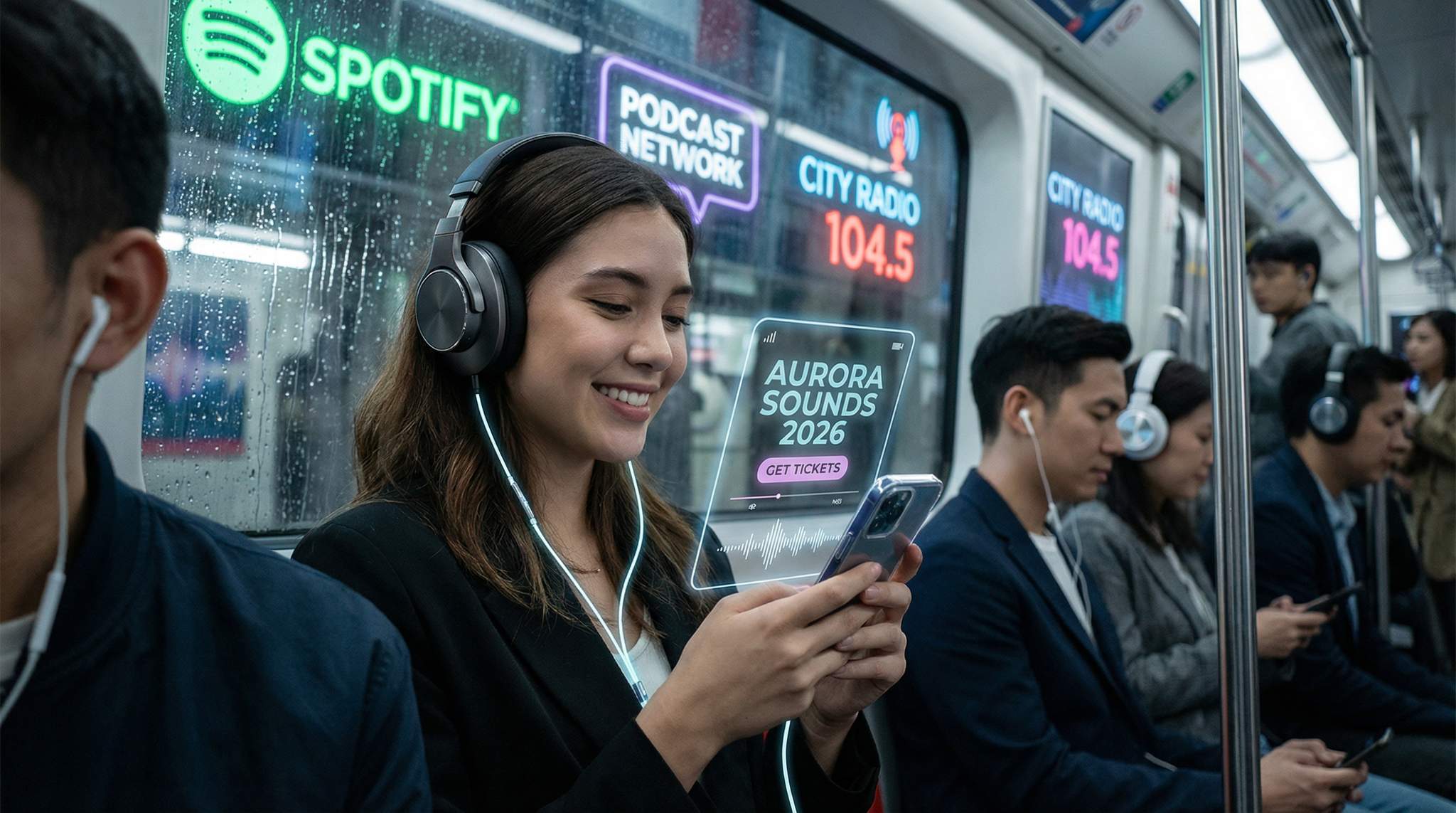
By 2026, fans are increasingly tuning out traditional visual ads. Social feeds are saturated with promotions, banners are often ignored, and video commercials get skipped at the first chance. Yet while eyes may glaze over ads, ears remain open. People are spending nearly four hours each day listening to audio content, and about 64% of that time is with ad-supported music, radio, or podcasts, according to Oxagile’s analysis of audio advertising trends). Audio advertising can cut through the visual noise – in fact, 43% of consumers say audio ads feel less intrusive than the display ads bombarding them on screens, as noted in Marketing LTB’s audio advertising statistics.
Event marketers worldwide are discovering that a well-crafted audio spot can engage potential attendees in moments where other channels can’t reach them. Whether it’s a 30-second Spotify ad between songs, a host-read mention on a hit podcast, or a prime-time radio spot on a local station, audio ads reach listeners in a uniquely personal space. Seasoned promoters who have sold out everything from small club shows to massive stadium tours know that audio is often the secret sauce that sparks excitement in audiences. This guide will share practical tactics, real examples, and hard-won insights on using platforms like Spotify, podcasts, and radio to boost ticket sales. From scripting an attention-grabbing ad to fine-tuning your targeting by location and genre to tracking which listeners convert to buyers – here’s how to master audio ads for event promotion in 2026.
The Power of Audio Advertising in 2026
Audio Consumption Trends in 2026
Audio consumption is booming. Globally, digital audio draws hundreds of millions of listeners, and usage keeps climbing. Spotify alone now boasts over 678 million users worldwide who collectively stream about 2 hours of audio per day on average, a figure highlighted in Accenture’s case study on the Spotify advertising revolution. Podcasts have exploded too – 66% of 12–34-year-olds in the U.S. listen to podcasts monthly, based on podcast statistics from BloggersIdeas – and even traditional radio holds strong across demographics. The global audio advertising market is estimated around $38+ billion in 2025 and growing ~10% year-over-year, according to general audio advertising market data, as advertisers catch on to these engaged audiences. In short, fans in 2026 are immersed in audio, and events that join that conversation stand to gain significant reach.
At its core, what is audio advertising for event professionals? It is the strategic placement of promotional audio messages within digital streaming services, podcasts, and traditional radio broadcasts to drive ticket sales and brand awareness. As we look at emerging digital audio advertising trends, programmatic buying and dynamic creative optimization are taking center stage. Promoters can now automate their ad placements across multiple networks simultaneously, adjusting the voiceover or background track in real-time based on the listener’s weather, location, or time of day. Staying ahead of these audio advertising trends allows festival producers to maximize their return on ad spend by delivering hyper-personalized messages at scale.
Data-Driven Event Marketing
Track ticket sales, demographics, marketing ROI, and social reach in real time. Exportable reports give you the insights to make smarter decisions.
Overcoming Visual Ad Fatigue with Audio
In a world of banner blindness and skippable video ads, audio offers a fresh way to engage jaded audiences. Listeners tend to accept ads as part of the experience – for example, Spotify’s own research found users are about 15% happier while streaming audio than when scrolling social feeds, as reported by Accenture’s research on Spotify engagement, suggesting they’re in a more receptive mindset. Audio ads are also an uncrowded channel: only around 1.5% of digital ad spend currently goes toward digital audio, despite digital audio driving significant engagement, meaning far fewer brands are competing for airtime compared to the saturated realms of social or display advertising. And unlike a banner that can be ignored, an audio spot usually gets heard in full. Free streaming listeners can’t skip the ad break, and radio audiences expect to hear ads between segments. Not surprisingly, 68% of weekly podcast listeners say they don’t mind the ads and see them as a fair trade for free content, with Oxagile noting that 68% of listeners accept ads). All this means your event message has a higher chance to actually land with listeners, rather than getting lost in the visual clutter.
Why Audio Channels Engage Event Audiences
Audio ads let you speak directly to fans in an intimate, immersive way. Hearing a voice convey excitement about your event – or a short clip of a headliner’s song in the background – can spark emotion and FOMO in a way static text or images often can’t. Sound creates theater of the mind, painting a picture of the experience. According to industry surveys, 72% of marketers say audio ads improve brand recall for campaigns, according to year-over-year audio advertising statistics. For an event promoter, that means a listener is more likely to remember your festival’s name or tour dates after hearing them in a catchy audio spot. Audio also inherently targets by context. If someone is listening to an EDM playlist, a promo for an upcoming EDM festival will feel highly relevant; a local radio ad for a food festival reaching people driving around town can catch them right when they’re thinking of weekend plans. In short, audio channels combine targeting and storytelling to engage potential attendees on a personal level. Experienced event marketers often remark how an audio ad can “put the listener in the front row” well before they buy a ticket.
Ready to Sell Tickets?
Create professional event pages with built-in payment processing, marketing tools, and real-time analytics.
Key Audio Ad Channels for Event Promotion
Evaluating the Top Audio Advertising Platforms in 2026
When planning your media mix, selecting the best audio advertising platforms in 2026 depends heavily on your event’s scale and target demographic. For promoters organizing multi-city tours or large-scale destination festivals, utilizing networks that support national campaigns with real-time analytics and audience insights is essential. Spotify remains a dominant force, especially for targeting young listeners under 35, but comparing Spotify versus other networks like Pandora, iHeartRadio, or programmatic audio exchanges is crucial for a well-rounded strategy. While Spotify excels in granular music-taste targeting, programmatic platforms often provide broader reach across various mobile ecosystems, making them highly effective for mobile app install campaigns (such as pushing a custom festival app to attendees) and widespread brand awareness.
Music Streaming Platforms (Spotify & More)
Music streaming services are a prime channel for event ads. Spotify is the heavyweight, along with others like Pandora, Amazon Music (free tier), and Deezer. These platforms offer access to gigantic user bases – Spotify alone spans 184 markets with both free (ad-supported) and premium users. As an event marketer, streaming ads let you play an audio message to listeners based on specific targeting filters. For example, you can run a 30-second ad on Spotify’s free tier targeted to people aged 18–34 in your city who often listen to the genre of music your event features. When your ad plays between songs, a clickable banner or call-to-action button can appear on the listener’s screen, driving traffic to your ticket page. Streaming ad campaigns can start small – Spotify Ad Studio requires only about a $250 minimum spend (roughly £200), which yields ~10,000+ impressions at typical $15–$25 CPM rates, as detailed in Influence Marketing Hub’s guide to Spotify ad costs. This means even independent promoters can afford to test the waters. These platforms also provide analytics on plays and clicks, making it easier to track results. In short, streaming audio ads offer a flexible, precision tool to reach music fans during their daily listening.
When budgeting for these campaigns, event organizers must understand the baseline costs across different regions. Looking at average CPM audience data across major markets like the UK, USA, and Australia in 2026, promoters can generally expect digital audio CPMs to range between $15 and $30, depending on targeting granularity. These figures typically reflect the cost of reaching the audience directly, excluding premium media inventory markups or specialized programmatic fees. By benchmarking these average costs, festival producers can accurately forecast their return on ad spend and allocate budgets efficiently across international tour dates.
Podcast Advertising Opportunities
Podcast ads are another powerful audio avenue, letting you reach devoted niche audiences. Podcasts exist for virtually every interest – from EDM and true crime to regional food culture – so there’s likely a show perfectly aligned with your event’s theme or target attendees. Ads on podcasts typically come in two flavors: host-read sponsorships (the host personally endorses or explains your event in their own words) or pre-produced spots (a recorded ad you supply, similar to a radio commercial). Many podcast ads are 30 to 60 seconds and appear at the beginning (pre-roll), middle (mid-roll), or end (post-roll) of episodes. The big advantage of podcasts is audience trust and engagement; listeners often feel a personal connection to the host and pay attention to their recommendations. It shows in the numbers – roughly 55% of podcast ad revenue comes from host-read ads, a trend highlighted in podcast advertising revenue statistics because that personal touch works. In surveys, 46%–69% of podcast listeners say they’ve purchased something after hearing it advertised, and a whopping 88% have taken some action (like searching online or discussing the product) because of a podcast ad, according to consumer behavior data from BloggersIdeas. For event marketers, this means a well-placed podcast plug can genuinely drive ticket sales and buzz. You can choose to advertise on big national podcasts or smaller local/regional shows depending on your event. For example, a comic convention might sponsor a popular comics podcast for national reach, while a local food festival might buy spots on a regional foodie show. The key is to pick podcasts whose listeners match your event’s profile – the more naturally your event fits the content, the better the response.
Smart Promo Codes & Presale Access
Create percentage or flat-rate discount codes with usage limits, date ranges, and ticket type restrictions. Plus unlock codes for private presales.
Traditional Radio in the Modern Mix
AM/FM radio may be old-school, but it remains a major marketing channel in 2026 – and one event promoters shouldn’t overlook. Radio’s reach is massive: it still touches about 92% of US adults each week, as reported in Nielsen’s analysis of radio reach and ROI, and similar reach figures hold in many other countries. In fact, radio accounts for roughly 60%–65% of all ad-supported audio listening time even today, according to Oxagile’s audio consumption trends), far outstripping streaming music and podcasts in total ear-hours. Why? Many people spend significant time commuting or at work with radio on. For events targeting a local or regional audience (concerts, fairs, club nights, etc.), local radio ads can effectively blanket your target market with awareness. You typically have options to run 30-second or 60-second spots on stations whose listener demographics fit your event – for example, an alternative rock festival might advertise on the local alternative rock station, while a family carnival might be better on a pop hits or community radio station. Radio lacks the granular individual targeting of digital channels, but you can target by choosing station format (genre) and specific show times. A well-placed morning drive-time ad on a popular station could reach tens of thousands of people in your city in one shot. And beyond paid spots, savvy promoters also leverage radio promotions (like on-air ticket giveaways or artist interviews) for extra exposure at no added cost – more on those later. The bottom line: radio is a broadcast megaphone that can generate broad awareness and excitement, especially for citywide events or those aiming at audiences that might not be as active online.
Beyond traditional AM/FM broadcasts, digital radio advertising (such as DAB+ networks) is rapidly expanding the reach of local campaigns. In regions with high adoption rates, like the digital audio advertising market in Australia and parts of Europe, DAB+ offers the broad reach of traditional radio combined with clearer signals and digital display text on car dashboards. Event promoters can leverage these digital radio networks to run highly targeted audio ads that display the festival name and ticket URL directly on the listener’s screen, bridging the gap between offline listening and online conversion.
Grow Your Events
Leverage referral marketing, social sharing incentives, and audience insights to sell more tickets.
Below is a quick comparison of these audio ad channels and how they stack up for event promotion:
| Channel | Audience & Reach | Targeting Capabilities | Best Uses for Events |
|---|---|---|---|
| Music Streaming (Spotify, etc.) | Hundreds of millions of mostly under-40 listeners globally. High mobile app usage during commutes, workouts, etc. | Precise targeting by location, age, gender, music genre, and even fans of specific artists. Companion display banner allows click-through to ticket page. | Broad awareness among genre-specific fans. Great for reaching younger audiences and promoting multi-city tours or festivals where digital-savvy music fans are plentiful. |
| Podcasts | Highly engaged niche audiences worldwide. Listeners often trust their podcast hosts. | Contextual targeting by show topic (choose podcasts related to your event’s theme). Some networks offer geo-targeted ad insertion, but targeting is mainly by content category. Ads can be host-read or pre-recorded. | Reaching special interest groups with strong affinity (e.g. advertising a tech conference on a coding podcast). Building credibility through host endorsements. Works for both local events (via local podcasts) and global/destination events. |
| AM/FM Radio | Massive local reach (e.g. radio reaches ~92% of US adults monthly, per Radio Ink’s coverage of Nielsen data; similar figures elsewhere). Broad cross-demographic audience, with a skew toward older listeners and drivers. | Target by station format (genre) and broadcast region. Can schedule ads by time of day (e.g. rush hour), but cannot personalize to individuals. No direct click-through – response is via listeners remembering your message. | Generating broad regional awareness (e.g. citywide concerts, fairs). Reaching commuters and listeners not active on streaming platforms. Best when paired with on-air promotions (ticket giveaways, DJ mentions) to amplify word-of-mouth. |
Crafting Audio Ads that Drive Ticket Sales
Writing Attention-Grabbing Scripts
Audio ads give you only a few seconds to hook a listener, so your script needs to get to the point – fast. Lead with the most exciting or relevant detail about your event in the first line. For example, instead of a bland intro, start with something like ‘This Saturday, get ready to rock at London’s legendary O2 Arena!’ – this immediately signals what and why listeners should care. Keep the language punchy and vivid – paint a mental picture of the experience (‘an unforgettable night of drum & bass under the stars’). Experienced event marketers recommend focusing on one core message or theme in a 30-second ad, rather than cramming in too many details. Use the event name and date early, and repeat them toward the end for retention. It’s also crucial to write in a conversational tone that matches your audience; an ad for a tech conference might use a professional but enthusiastic style, whereas a festival promo can be more hype and slang. Avoid excess jargon or generic superlatives that don’t mean anything – every word should either build excitement or convey an important fact. Once you have a draft, read it aloud and time it; trim any fluff so it fits the 30s (or 60s) comfortably without rushing. Applying these event copywriting best practices will ensure your audio script is clear, compelling, and tailored to turn listeners into buyers.
Choosing the Right Voice, Tone, and Music
The voice and tone of your audio ad are as important as the words. Choose a voice that resonates with your target audience and reflects your event’s vibe. If you’re promoting an underground techno night, you might opt for a youthful, energetic voice with a slight edge; for a luxury wine-tasting event, a warmer, mature voice could convey sophistication. Some promoters even use the event’s MC or a performing artist’s voice for familiarity. Emotion is key – the delivery should match the feeling you want to evoke (excitement, inspiration, curiosity). Coach your voiceover talent to convey genuine enthusiasm and smile while speaking (you can hear a smile in someone’s voice). Also consider adding a music bed or sound effects to set the scene. A subtle background track can reinforce the mood – for instance, a few seconds of a headliner’s hit song (if you have rights) can instantly grab fans’ attention. Likewise, ambient sound can immerse listeners (e.g. crowd cheering to simulate the live excitement). Just be careful that any music or effects don’t drown out the narration – they should sit low in the mix. Finally, ensure all essential info (event name, date/time, venue, ticket link) is spoken clearly. Many listeners are passive (like driving or working), so clarity is crucial. A strong, clear voice with the right tone, complemented by on-brand audio elements, will make your ad memorable.
When using music and sound effects in Spotify ads, event organizers must ensure they have the proper licensing for any copyrighted tracks, even if the artist is on your festival lineup. Alternatively, leveraging royalty-free soundscapes or platform-provided audio tools can keep your Spotify audio ads compliant while still delivering a high-energy punch.
Grow Your Social Following With Every Sale
Require social media follows, shares, or playlist adds to unlock presale access or special pricing. Turn every ticket purchase into audience growth.
Calls-to-Action and Incentives that Work
Every audio ad needs a clear and compelling call-to-action (CTA) – essentially, tell listeners what to do next. Do you want them to visit your website, use a promo code, or buy tickets by a certain date? Be explicit: for example, Get your tickets now at TicketFairy.com – use code SOUND10 for 10% off through Friday! Keep the action simple and immediately achievable. Because listeners can’t click a radio or podcast ad, use easy-to-remember instructions: a short web URL (or a unique URL like YourEvent.com/podcast) or a simple discount code mentioned once or twice. Avoid long or hard-to-spell web addresses – one trick is to create a memorable vanity URL or redirect. Mention any incentive or urgency to spur action, but keep it truthful. Limited-time early bird pricing, “last few tickets remaining,” or a special bonus for the first 100 buyers can all create urgency. For example, Book by this Sunday for early bird pricing – tickets are moving fast! gives listeners a nudge to act now rather than later. In a 30-second ad, it’s wise to repeat the core CTA at the end so it sticks – something like “Don’t miss out – head to TicketFairy.com and secure your spot for DanceFest this August 5th.” The final words should ideally be the website or way to buy, giving interested listeners a clear direction. If possible, coordinate your voiceover with the timing of on-screen displays (in streaming ads) so that the call-to-action aligns with any clickable button or text shown. A strong CTA turns an engaging ad into tangible ticket sales.
When developing your script, utilizing proven CTA frameworks can significantly elevate your campaign’s performance. Some highly effective call-to-action examples for Spotify podcast ads and streaming spots include:
- The Scarcity Push: “Only 50 VIP passes left—click the banner to claim yours before they sell out.” This approach works exceptionally well for high-demand club nights or boutique festivals where inventory is genuinely limited.
- The Exclusive Listener Perk: “Use promo code PODCAST20 at checkout for early access to the lineup.” Offering a tangible reward incentivizes immediate action and helps organizers track the exact source of the sale.
- The Curiosity Gap: “Tap the link in the show notes to reveal which surprise headliner just got added to the Saturday roster.” This tactic drives high click-through rates by teasing valuable event information that fans want to discover.
Optimizing Ad Length and Format
Audio ads for events typically come in either 15-second, 30-second, or 60-second spots. Choosing the right length and format can impact effectiveness. 30 seconds tends to be the sweet spot for many platforms (it’s the standard for Spotify and radio ads) – it gives enough time to deliver your message and emotion without losing listener attention. 15-second ads can work for very simple messages or as teasers (e.g. a quick reminder about a show happening this weekend), and they cost less, but they might not convey enough info for a complex event. On the other hand, 60-second spots (common in podcasts and talk radio) allow more storytelling – you can include an artist lineup, a brief testimonial from a fan, or a bit more context. However, you must keep longer ads engaging throughout; a rambling minute will lose people. It’s often wise to script multiple versions of your ad – say, a 30s and a 15s cut – and test which performs better or use them at different stages (a longer ad early on to tell the full story, then shorter reminders as the event nears). Always adhere to platform guidelines: for example, some radio stations might require a 29s length to avoid overlapping programming, or podcast hosts might limit pre-recorded ads to 60s. In any format, conciseness and pacing are critical. Don’t try to list every performer and every sponsor – focus on the top hook that will sell the event. A common rule among veteran promoters is “one ad, one message.” If you need to communicate multiple distinct points, consider separate spots or channels for each. By optimizing length to the channel and crafting a tight message, you’ll keep listeners engaged from the first second to the last.
When specifically looking at broadcast channels, determining the most effective length for radio spots in 2026 comes down to balancing budget with message complexity. Industry data suggests that the 30-second radio spot remains the gold standard for event advertising, offering enough time to establish the hook, mention the headliner, and deliver a clear call-to-action without losing the listener’s attention. However, 15-second spots are increasingly popular for high-frequency retargeting in the final week before a festival, acting as rapid-fire reminders. Conversely, 60-second advertisements are best reserved for complex announcements, such as a multi-day festival lineup drop, where the extra time is necessary to build the narrative and list multiple artists.
When drafting copy specifically for streaming platforms, adhering to strict Spotify audio ad script length recommendations is essential for pacing. A standard 30-second spot should contain no more than 55 to 70 words. Pushing beyond this word count forces the voiceover artist to rush, which diminishes clarity and emotional impact. Promoters should focus on a single, punchy message—such as a final ticket warning or a major headliner reveal—ensuring the delivery feels natural and leaves breathing room for background music or sound effects.
Targeting the Right Listeners with Audio Ads
Geotargeting and Location-Based Reach
For events, geography is everything – and many audio ad platforms let you aim your message at listeners in specific locations. Streaming services like Spotify and Pandora allow geotargeting by country, state, city, or even postal code in some cases. This means a promoter in Melbourne can choose to have their audio ads heard only by Spotify users in Greater Melbourne, rather than wasting impressions on Sydney or overseas. Location filters ensure your budget is spent on ears that could actually travel to your event. On broadcast radio, geotargeting is inherent – a local station’s signal covers a defined region, so choosing the right station effectively targets that area’s population. You can also time your ads around when out-of-town visitors might be present (for example, running spots on a regional radio station in a neighboring city the week before a big festival, to catch people who might travel in). Advanced digital tactics like geofencing and hyper-local targeting campaigns can even trigger mobile audio ads based on real-time location – for instance, targeting attendees at a competing concert with an ad for your upcoming show. The key is to map out where your potential attendees are and concentrate your audio spend there. If you’re promoting a multi-city tour, set up separate localized campaigns for each tour stop. If it’s a one-city event but draws regionally, consider reaching a 50–100 km radius. By zeroing in on location, you’ll improve relevance and avoid paying to advertise to people who live nowhere near your venue.
Turn Fans Into Your Marketing Team
Ticket Fairy's built-in referral rewards system incentivizes attendees to share your event, delivering 15-25% sales boosts and 30x ROI vs paid ads.
Demographic and Interest Targeting
Beyond location, the best audio campaigns home in on the right people and passions. On Spotify and other streaming platforms, you can filter your audience by demographic traits like age and gender. If you’re promoting an 18+ nightlife event, you might target ages 18–35 and exclude older listeners; for a family-friendly fair, you may include a broader age range but craft a message that appeals to parents. Streaming services and programmatic audio networks also offer interest data – often based on listening habits. For example, you could target users who frequently stream hip-hop or indie rock if those genres match your festival lineup. You can even target fans of specific artists – Spotify’s Ad Studio has a feature to reach listeners who follow or have recently played a certain artist, which helps meet specific campaign objectives (perfect if that artist is headlining your event). With podcasts, you inherently target by interest when you choose relevant shows (advertising a business conference on a tech podcast ensures the listeners are professional and tech-savvy, for instance). For radio, choosing the station format achieves a similar purpose – an electronic music event will naturally advertise on an EDM station, not the local classical station. It’s also important to consider cultural and linguistic targeting. If your city has multiple language communities, you might run ads on a Spanish-language radio station or an English podcast with a large South Asian audience, depending on who you want to reach. Make sure your messaging is inclusive and culturally tuned in – using references that resonate with the audience and avoiding any slang or language that doesn’t fit (see our guide on adapting your marketing to be inclusive and accessible for more tips on reaching diverse audiences). Ultimately, refining your audio ad targeting to demographic and interest sweet spots will boost relevance – and relevant ads are what drive higher conversion rates.
Contextual Targeting by Genre & Mood
One of audio advertising’s superpowers is the ability to target the context in which listeners are tuning in. Music streaming, in particular, gives options to target by genre, playlist type, or even listening mood. For example, Spotify allows targeting by playlist category – you could have your ad play specifically during workout playlists or chill vibes playlists, depending on what aligns with your event. Campaign data shows that aligning your message with the listening context can pay off – Spotify reports that ad campaigns which include playlist targeting drive about 2.1× higher intent from listeners than those without that contextual alignment, according to Spotify ad performance data. Essentially, someone jamming to a pop hits playlist will be more receptive to an ad for a pop concert than, say, a listener tuned into a jazz session would. The same principle applies across audio channels. On podcasts, an ad read on a show about true crime will naturally work best if your event somehow relates (perhaps a murder mystery theater experience?). And on radio, choosing the right format (rock, hip-hop, talk, etc.) means your ad speaks to an audience already interested in that content. Contextual targeting can extend to mood and time of day as well – if you have a late-night event, running ads during evening listening hours or on “party” playlists hits people when they’re in a going-out mindset. Many experienced promoters essentially “tune in” to how their target audience consumes audio: if you know indie music fans often listen on Sunday mornings to discover new tracks, that could be an ideal slot for your indie festival ad. By matching your ad to the musical tastes and moments that fit your event, you make it feel like a natural part of the listener’s day rather than an interruption.
Timing and Frequency Strategies
Timing is a critical and often under-appreciated aspect of audio ad targeting. This covers both when in time you deliver your ads and how often the same listener hears them. First, consider the daily and weekly cycles of your audience. Radio advertisers have long optimized dayparts – for instance, hitting morning and afternoon rush hours to catch commuters. If you’re running streaming or radio ads for a show, you might focus on late afternoons and evenings when people are making plans (and not at 3 AM when most are asleep). Think about the lead time before your event as well: starting too early can waste budget if people aren’t ready to decide, but starting too late means you’ll miss those who plan ahead. Many event marketers begin audio ads about 6–8 weeks before a major event, then ramp up intensity in the final 2–3 weeks as urgency grows. Frequency is the other piece – a listener often needs to hear an ad multiple times for it to sink in, but too much repetition can annoy. Digital platforms often allow frequency capping (e.g. no more than 3 impressions per user per day). It’s a balancing act: someone hearing your podcast ad twice a week in the month leading up to your festival can be perfect, whereas hearing the same radio spot 5 times a day might cause burnout. Monitor how ticket sales respond and adjust if needed – if you see a spike whenever your ad runs during a certain radio show, you could invest more in that slot, whereas if people start complaining about hearing your ad “everywhere,” it might be on too heavy a rotation.
For a rough example, here’s how you might schedule audio advertising in the months and weeks leading up to an event:
| Campaign Phase (Timing) | Audio Advertising Actions | Purpose/Goals |
|---|---|---|
| Announcement & Early Buzz (3+ months out) | – Tease the event on relevant podcasts (sponsor episodes or brief host mentions). – Secure media partners like a local radio station to plan ticket giveaway promotions closer to the event. – Start building a remarketing list (if applicable) of early listeners who showed interest (e.g. clicked your streaming ad). |
Generate initial awareness among core fans without heavy spend. Plant the seed about the event in niche communities and press to build buzz. |
| Early Sales Launch (8–6 weeks out) | – Launch Spotify/streaming audio ads targeting your key demographics and music genres. – Run the first wave of radio ads on stations aligned with your event’s genre (light rotation). – Continue podcast ads on high-impact episodes (e.g. an industry podcast dropping when tickets go on sale). |
Drive ticket purchases as soon as they’re available. Reach active fans during the critical on-sale period. Start momentum while inventory is plentiful. |
| Mid-Campaign Build (4–2 weeks out) | – Increase frequency of streaming ads (retarget listeners who heard earlier ads with a fresh message). – Expand radio ads to more stations or time slots, including popular commute times. – Introduce a new angle in audio creative (e.g. “VIP almost sold out!”) to spur undecided listeners. |
Sustain excitement and reach new audiences as the event draws nearer. Capture fence-sitters with repeated exposure. Keep the event top-of-mind during decision-making time. |
| Final Push (Last 1–2 weeks) | – Hit peak frequency: daily radio spots during drive-time and midday. – Emphasize urgency in all audio ads (“Only a few days left to secure tickets!”). – Leverage live opportunities – e.g. have a DJ mention the event on-air or run a last-minute ticket giveaway on air. – Retarget via streaming ads one more time focusing on the event date imminent. |
Convert last-minute buyers and drive a sell-out. Create the sense that “everyone’s talking about this event” through ubiquitous audio presence. Overcome procrastination by instilling FOMO and urgency. |
Understanding the baseline Spotify free tier ad frequency in 2026 is also vital for campaign planning. On average, listeners on the ad-supported tier hear a commercial break every 15 to 30 minutes of active streaming. Because this ad frequency on the free tier remains relatively high in 2025 and 2026, event marketers must utilize frequency capping within Spotify Ad Studio. Setting a cap of three to five impressions per user per week ensures your festival’s message stays top-of-mind without causing listener fatigue or brand annoyance.
Maximizing Music Streaming Ads (Spotify & More)
Setting Up Campaigns on Spotify Ad Studio
Advertising on Spotify and similar streaming platforms is designed to be accessible – even if you’re a one-person marketing team. On Spotify Ad Studio (available in major markets like the US, UK, Australia, parts of Europe, etc.), you can create a campaign in minutes with a few steps. First, choose your campaign objective – Spotify even has a specific option “Promote a concert or artist” that helps auto-target fans of that artist, as explained in Influence Marketing Hub’s tutorial on campaign objectives. Next, define your audience: pick location, age, gender, platforms (perhaps you only want mobile listeners), and music interests or genres. Spotify will estimate your reach as you adjust targeting. The platform also offers a very useful creative tool: you can upload a script and request a free voiceover from Spotify, a feature detailed in guides on uploading audio creative if you don’t have an audio ad produced. Within about 24–48 hours, they’ll provide a professionally voiced recording for you – a huge help for promoters on a budget. You’ll also upload a companion image (choose a vibrant event photo or flyer graphic) and a clickable link (to your Ticket Fairy ticket page, for example). Set your budget and schedule (e.g. $500 total to run ads over the next 4 weeks) – Spotify operates on a bidding model with a CPM you can cap. Once live, your ad will start playing to the selected listeners between songs. Other streaming platforms have similar self-serve or managed ad systems: Pandora, for instance, allows targeting by station/genre and has listeners predominantly in North America (skewing a bit older than Spotify’s base). And increasingly, you can buy streaming audio ads via programmatic advertising platforms to expand your reach that place your spots across multiple services (Spotify, iHeart, TuneIn, etc.) automatically. However you set it up, be sure to double-check your audio ad’s specs (format, length) and listen back to how it sounds on a phone. Once you launch, these platforms provide dashboards where you can monitor impressions, clicks, and listen-through rates, so you can gauge performance.
Full Pixel & Analytics Integration
Install Meta Pixel with Conversions API, Google Analytics, TikTok Pixel, Reddit Pixel, and Spotify Pixel on your event pages. Server-side tracking for accurate attribution.
Understanding the baseline Spotify free tier ad frequency in 2026 is also vital for campaign planning. On average, listeners on the ad-supported tier hear a commercial break every 15 to 30 minutes of active streaming. Because this ad frequency on the free tier remains relatively high in 2025 and 2026, event marketers must utilize frequency capping within Spotify Ad Studio. Setting a cap of three to five impressions per user per week ensures your festival’s message stays top-of-mind without causing listener fatigue or brand annoyance.
Maximizing Music Streaming Ads (Spotify & More)
Setting Up Campaigns on Spotify Ad Studio
Advertising on Spotify and similar streaming platforms is designed to be accessible – even if you’re a one-person marketing team. On Spotify Ad Studio (available in major markets like the US, UK, Australia, parts of Europe, etc.), you can create a campaign in minutes with a few steps. First, choose your campaign objective – Spotify even has a specific option “Promote a concert or artist” that helps auto-target fans of that artist, as explained in Influence Marketing Hub’s tutorial on campaign objectives. Next, define your audience: pick location, age, gender, platforms (perhaps you only want mobile listeners), and music interests or genres. Spotify will estimate your reach as you adjust targeting. The platform also offers a very useful creative tool: you can upload a script and request a free voiceover from Spotify, a feature detailed in guides on uploading audio creative if you don’t have an audio ad produced. Within about 24–48 hours, they’ll provide a professionally voiced recording for you – a huge help for promoters seeking event funding. You’ll also upload a companion image (choose a vibrant event photo or flyer graphic) and a clickable link (to your Ticket Fairy ticket page, for example). Set your budget and schedule (e.g. $500 total to run ads over the next 4 weeks) – Spotify operates on a bidding model with a CPM you can cap. Once live, your ad will start playing to the selected listeners between songs. Other streaming platforms have similar self-serve or managed ad systems: Pandora, for instance, allows targeting by station/genre and has listeners predominantly in North America (skewing a bit older than Spotify’s base). And increasingly, you can buy streaming audio ads via programmatic advertising platforms to expand your reach that place your spots across multiple services (Spotify, iHeart, TuneIn, etc.) automatically. However you set it up, be sure to double-check your audio ad’s specs (format, length) and listen back to how it sounds on a phone. Once you launch, these platforms provide dashboards where you can monitor impressions, clicks, and listen-through rates, so you can gauge performance.
For larger festival brands or promoters managing their own ticketing applications, finding the best all-in-one digital audio advertising tool can streamline operations significantly. These comprehensive platforms allow organizers to buy, manage, and track digital audio ads across multiple streaming services and podcast networks from a single dashboard. By consolidating your digital audio advertising efforts, you can more easily shift budgets in real-time toward the channels driving the highest return on ad spend.
Understanding Spotify ads pricing is crucial for independent promoters scaling their marketing budgets. While the self-serve platform allows campaigns to launch for as little as $250, the actual cost per listen fluctuates based on audience demand and targeting parameters. Promoters can optimize their spend by testing different ad formats, balancing standard Spotify audio ads with targeted Spotify podcast ads to reach listeners across both music and spoken-word content.
When forecasting these budgets, organizers frequently ask about the typical CPM for Spotify advertising. In 2026, the average CPM for Spotify ads generally falls between $15 and $25 for standard audio placements. However, this baseline cost per thousand impressions can shift depending on how narrowly you define your audience. For example, targeting a highly specific subgenre in a competitive major market might push your Spotify CPM closer to $30, whereas broader regional awareness campaigns often secure rates at the lower end of the spectrum. Monitoring these typical costs ensures your festival marketing dollars are deployed efficiently.
For major festival announcements or high-stakes on-sale days, organizers should also explore premium inventory like cost-per-day sponsorships on Spotify. Unlike standard CPM bidding, a cost-per-day (CPD) model allows promoters to essentially “take over” specific high-traffic playlists or homepage placements for a full 24 hours. This strategy guarantees massive, concentrated exposure, making it an ideal tactic for national campaigns where immediate ticket velocity is the primary goal.
Free Tool: When Should You Announce?
Pick your event date and genre — the free planner outputs a recommended announce, presale, on-sale and reminder schedule anchored to how your audience actually buys.
When evaluating these cost-per-day sponsorships on Spotify, event marketers must weigh the higher upfront investment against the potential for rapid ticket movement. A 24-hour homepage takeover or a sponsored session on a flagship genre playlist can deliver millions of impressions in a single day. To maximize the ROI of a CPD campaign, promoters should align the takeover exactly with their general on-sale launch or a major headliner reveal, ensuring that the massive surge in visibility translates directly into immediate purchases.
Targeting Fans by Artists and Playlists
A unique strength of Spotify and streaming ads is the ability to target extremely granularly – including reaching the fanbases of specific artists and the followers of certain playlists. If your event features a well-known act, you can target people who recently listened to that act’s music on Spotify (this is exactly what the “promote a concert” objective helps with). Many event marketers use this tactic: for an upcoming tour by DJ Example, they’ll serve ads to users Spotify identifies as DJ Example listeners, essentially directly hitting known fans. You can also target by broad genre or subgenre, and even by playlist themes. For example, if you’re throwing a 90s throwback party, you might target listeners of 90s hits playlists or “All Out 90s” style channels – catching people already in a nostalgic mood. As mentioned, Spotify’s data indicates that campaigns with playlist targeting yielded over 2× higher intent, per Influence Marketing Hub’s insights, so it’s worth aligning with listening context. Additionally, consider using Spotify’s interest targeting when available (e.g. reaching users in “Concerts” or “Live Events” affinity segments) and device targeting (maybe you prioritize mobile listeners if you suspect they’re more likely to attend local shows). Keep an eye on the size of your target: if you layer too many filters (e.g. age + small city + multiple interests), your audience might become so narrow that ads barely deliver and costs rise. A rule of thumb is to ensure you still have an audience of at least many tens of thousands of listeners for a local event (more for bigger events) to let Spotify’s algorithm optimize effectively. Test different combinations – one campaign might target people who like Artist A and Artist B, another targets a genre in your city – and see which drives more engagement.
Running dedicated Spotify playlist ads allows promoters to capture the exact mood of their target demographic, whether it’s a high-BPM workout mix or a relaxed acoustic session. Furthermore, utilizing Spotify ads for artists—specifically targeting the followers of acts booked for your event—ensures your marketing dollars are spent on high-intent fans who are already primed to buy tickets.
Leveraging Companion Banners and CTAs
In streaming audio, the visuals that accompany your ad are small but important. When your audio spot plays on platforms like Spotify, users often see a companion banner or display unit on their screen. This typically includes an image, your event name, and a call-to-action like “Buy Tickets” that they can tap. Make sure to design this visual to complement your audio message. Use a high-quality image – for example, a striking photo from last year’s event or a promo graphic with the headliner’s picture – and include key text like the event name/date if possible (keeping it readable even on a phone screen). Many listeners who hear your ad will only glance at the app briefly, so the image should quickly convey what kind of event it is, and the CTA button text should be clear (Spotify lets you choose labels like “Buy Tickets” or “Learn More”). Track the clicks on these companion banners closely. It’s common to see click-through rates (CTR) on streaming audio banners of only around 0.3%–0.5%, which sounds low, but those who do click are very interested. Use UTM tracking on the URL so you know in your analytics that these visitors came from Spotify Ads. If one creative’s banner is getting more clicks than another’s, analyze why – perhaps the image or wording is more compelling – and apply that insight to future campaigns. Also note that even those who don’t click might still take action later (searching for your event), so strong verbal CTAs combined with the visual are ideal. Finally, ensure your landing page is mobile-optimized and loads fast – streaming ad clicks almost always come from smartphones. You don’t want an interested fan to tap your banner and bail because the ticket page was slow or hard to navigate on their phone. In short, treat the companion banner as an extension of your audio ad’s voice: both should work together to drive the listener toward a ticket purchase.
If you are wondering what’s the best way to run display ads across music streaming apps, the secret lies in visual simplicity and immediate actionability. Because these visual banners are secondary to the audio experience, your display creative must feature high-contrast text, a dominant “Buy Tickets” button, and minimal clutter. The most successful event marketers synchronize their display banners to appear exactly when the audio voiceover mentions the ticket link, creating a seamless multi-sensory prompt that maximizes click-through rates.
To maximize the impact of these visual elements, organizers should treat Spotify banner ads as a direct extension of their ticketing page. Effective Spotify display ads utilize bold typography and high-contrast festival branding to ensure the call-to-action stands out, even when the user only briefly glances at their mobile screen.
Beyond visual elements, optimizing Spotify ads for higher conversion rates requires aligning the audio script’s urgency with the clickable banner. For example, using effective call-to-action examples for Spotify podcast ads—such as “Tap the banner to reveal your exclusive presale code” or “Click now to secure the last remaining VIP passes”—creates a direct, frictionless path to purchase. By explicitly telling the listener exactly what will happen when they interact with the companion display, promoters significantly reduce drop-off and drive higher ticketing ROI.
Example: Streaming Ad Success Story
To illustrate, consider a real-world scenario: an independent promoter in Los Angeles ran a Spotify ad campaign for a Latin music concert. They aimed the 30-second audio spot at Spotify users aged 18–45 in Southern California who had recently streamed popular Latin pop playlists. The campaign spent about $300 (roughly 15,000 impressions at a $20 CPM) and the promoter saw around a 0.4% click-through rate on the companion banner – about 60 people clicked through to the ticket page. More importantly, over the following week, the promoter tracked 25 ticket sales that they could attribute to listeners who heard the Spotify ad (some via the promo code mentioned in the ad, others by matching upticks in web traffic when the ad ran). Those 25 sales more than covered the ad spend in revenue. This small campaign also built new awareness; the promoter noticed an uptick in Spotify follows for the event’s headline artist as well. The takeaway: even with a modest budget, a targeted streaming audio ad can deliver a solid boost in ticket sales and reach new fans who might not have seen your social media posts or flyers. By scaling up a similar approach, promoters have sold hundreds of tickets via Spotify ads – especially when combining compelling creative with precise targeting.
Leveraging Podcast Ads for Event Promotion
Host-Read vs Pre-Recorded Podcast Spots
Podcast advertising often presents a choice: host-read vs pre-recorded ads. A host-read ad is when the podcast’s host(s) talk about your event in their own voice and style, usually delivered as part of the show (“…and this episode is brought to you by Your Event”). A pre-recorded ad is one you produce (or have produced) that gets inserted into the show like a typical commercial. Host-read ads tend to feel more organic and trustworthy – the host might even ad-lib, making it sound like a personal recommendation. This can be golden for events, because it’s more like an endorsement from a friend than an advertisement. Pre-recorded ads, meanwhile, ensure you control the exact message and branding – they might include music, sound effects, or a specific call-to-action in a polished format (similar to a radio commercial). Which to choose? If you have a close alignment with the podcast and the budget allows, host-reads often drive higher engagement (reflecting why they make up the majority of podcast ad spending). However, not all hosts will do the level of hype you might want, and some big podcasts only accept provided spots. Consider a hybrid approach: provide key points or even a sample script to the host, but let them put it in their own words. Also note placement – a pre-roll (right at the episode start) might catch more listeners, but a mid-roll (during a natural break in the middle) often allows a longer, more narrative ad where the host can riff a bit. Make sure to specify any must-say details like your event name and where to get tickets, and ensure the host has those correct (spell out the website if it’s not obvious). In either format, consistency matters: if you sponsor multiple episodes in the run-up to your event, try to keep at least the core message (event name, date, why it’s awesome) the same each time (for memorability), while maybe varying a secondary detail to keep it fresh.
Beyond direct sponsorships, event marketers are increasingly turning to podcast programmatic advertising to efficiently scale their reach. Platforms like the Spotify Audience Network allow promoters to run Spotify podcast advertising campaigns that dynamically insert pre-recorded audio spots across thousands of participating shows. This programmatic approach lets you target listeners by demographic, location, or interest—such as live music fans or tech enthusiasts—regardless of which specific episode they are streaming. Evaluating ad services from companies that offer dynamic insertion ensures your festival’s message reaches the right ears at the right time, bypassing the manual effort of negotiating individual show sponsorships.
When utilizing these programmatic networks, maintaining a conversational tone in Spotify podcast advertising is critical for engagement. Because listeners are accustomed to intimate, host-driven narratives, a pre-recorded spot that sounds too much like a traditional, high-pressure radio commercial can disrupt the listening experience. Event marketers should script these dynamic insertions to sound like a natural recommendation from a peer. Using relaxed pacing, direct address, and authentic enthusiasm helps the ad blend seamlessly into the spoken-word environment, ultimately driving higher click-through rates for your festival or conference.
Choosing the Right Podcasts for Your Event
Podcast selection can make or break your campaign – you want shows whose listeners match your prospective ticket buyers. Start by brainstorming topics related to your event. If you’re promoting a jazz festival, look for jazz music podcasts or even local radio shows released as podcasts. For a tech startup conference, target entrepreneurship or coding podcasts. Pay attention to listenership and geography: some podcasts have tens of thousands of listeners but spread globally, while others might have a smaller audience that’s mostly in your city or region (e.g. a local culture podcast). Both can be valuable – large national shows are great for online events or destination festivals, whereas local shows might be better for a community event. When evaluating a podcast, consider the audience demographics (many podcast media kits will tell you if they skew by age or gender), typical episode downloads, and how engaged the community is (do listeners respond to calls-to-action?). If possible, listen to an episode or two – ensure the tone fits your brand and that you’d be happy having that host speak for your event. Also, inquire about pricing early on, as it can vary widely: a niche podcast might charge $100 for an ad, whereas a top-50 podcast could charge thousands for a single slot. Don’t overlook up-and-coming podcasts – if they have, say, 5,000 very loyal listeners deeply into your event’s niche, an ad there could outperform one on a super-popular podcast that isn’t as targeted. It can help to test on a couple of smaller podcasts first before diving into a big spend. Many promoters also tap podcast networks or brokers that bundle ads across multiple related shows, which can simplify buying and expand reach – but ensure the shows in the bundle truly align with your audience. The goal is to speak to potential attendees in a context that makes them say, “Whoa, that sounds right up my alley!” If you achieve that, the listeners will be far more likely to convert into ticket buyers.
When evaluating the broader podcast advertising market, event organizers must factor in current pricing models to ensure a strong return on investment. In 2026, standard podcast advertising CPM rates typically range from $18 to $30 for pre-roll placements, while premium mid-roll host-read spots can command $25 to $50 per thousand listens. Understanding these baseline podcast advertising costs helps promoters allocate their marketing budgets effectively. For instance, a highly targeted niche show might have a higher CPM but yield a significantly better conversion rate for a specialized industry conference than a massive, generalized comedy broadcast.
Using Promo Codes and Unique Links in Podcasts
Tracking response from podcasts can be tricky because there’s usually no direct click. That’s where promo codes and unique URLs come in. Give podcast listeners a special incentive and a way to identify themselves. For example: “Use code JAZZ10 at checkout for 10% off your festival pass.” Not only can a discount spur action, but you’ll know that any orders with that code came from the podcast ad. Alternatively, use a vanity URL: YourFest.com/podcast could redirect to your ticket page and allow you to count those visitors separately. Make the code or URL easy to remember and say – short and ideally related to the podcast name or event name. Also consider time-limiting the offer to create urgency (“valid this month only”). Beyond direct sales, you might set up a tracking phone number or simple RSVP link if appropriate, but usually codes are simplest. Some podcasts will also help track performance – for instance, by surveying their audience (“How did you hear about us?”) or using an embedded link in the episode notes – but your own measures will be the primary way to gauge results. Check your ticketing platform for support; Ticket Fairy’s system, for example, lets you create custom promo codes and then track their usage in your dashboard, so you can see exactly how many tickets were sold with the “JAZZ10” code. Share results with the podcast host too; if the campaign is doing well, they might give an extra enthusiastic plug next time, and if it’s underperforming, you can discuss tweaks mid-flight. The principle is: give listeners a little something special (and trackable) for hearing your ad, and you’ll both encourage more conversions and have data to prove it.
Measuring Podcast Ad Impact
Measuring the ROI of podcast ads requires piecing together several indicators. With no instant click-through data (unless it’s a digital insertion with analytics), you have to rely on indirect metrics:
– Promo code redemptions – Track how many times your podcast-specific code was used for purchases. This is your clearest link between the ad and ticket sales.
– Web traffic spikes – Monitor your website analytics for traffic surges after the podcast episode drops. Be sure to configure GA4 to track ticket purchase conversions so you can attribute any spike to the timeframe of the ad. For example, if your ad was read on Tuesday’s show, do you see a bump in direct or search traffic on Tuesday/Wednesday?
– Surveys or polls – If possible, ask ticket buyers how they heard about the event (via a checkout survey or a follow-up email). Many won’t answer, but those who do can reveal podcast impact.
– Social chatter – Anecdotally, keep an eye on social media or community forums for mentions like “Heard about this on X Podcast!” These qualitative signals can reinforce what the numbers tell you.
Keep in mind podcast ads often have a halo effect – a listener might not buy the instant they hear the ad, but the seed is planted. They might purchase weeks later, or tell a friend. So if you spent $500 and only see $300 directly attributed through codes, consider overall sales trends in that audience segment or region. Often, you’ll notice an uplift that correlates with the podcast campaign even if the code usage is modest. Over multiple campaigns, track which podcasts deliver not just clicks or codes but actual attendees who show up (and perhaps come back next time). And remember, one of the best features of audio is the trust it builds – even if ROI isn’t immediate, you may have won new fans.
Pro Tip: Advertising isn’t the only way to tap podcasts. Consider pitching yourself or your artists as guests on relevant shows, or even launching an official podcast for your event’s community. These content-driven approaches complement paid ads by building deeper engagement. (For more ideas on growing your audience through audio content, see our guide on podcast marketing for events beyond traditional ads.)
Embracing Traditional Radio for Local Impact
Selecting the Right Stations and Shows
To make the most of radio advertising, it’s crucial to pick the right stations and programs for your event. Start with your target demographic and music genre: what do they likely listen to on the radio? If you’re throwing a hip-hop concert, the local urban/hip-hop station is an obvious choice. Promoting a classical music recital? Perhaps the classical or public radio station. For a broad-appeal event like a state fair or multi-genre festival, you might spread ads across multiple stations (e.g. pop hits, rock, and news/talk) to cover different segments of the community. Research station listener profiles – many stations publish media kits with audience age breakdowns and interests, or you can get this info from their ad reps. Also consider the station’s coverage area: a regional rock station that spans your whole province might be better than a low-power community station that only covers one city district, if you want to draw attendees from afar. Pay attention to specific shows too: advertising during a popular morning show or drive-time program will cost more but reach a larger, engaged audience. If your event caters to a certain community or language group, look for stations serving them (for instance, the local Spanish-language station for a Latin music event). And don’t forget smaller community and college stations, especially for niche scenes – they often charge very low rates or will trade ad spots for event passes. For example, an EDM promoter might partner with a college radio show and get mentions on-air in exchange for some free tickets. These kinds of grassroots efforts through community radio shows and even record shops frequently reach the superfans that big generic campaigns miss, and have shown conversion rates roughly 3× higher than broader advertising, as seen in Ticket Fairy’s case studies on grassroots marketing). The more overlap between a station’s listeners and your target attendees, the higher your ROI will be.
Crafting a Compelling Radio Spot
Radio ads may lack visual support, but they have the advantage of a captive listener who’s already in an audio-focused mode. To craft an effective radio spot, localize and humanize it. Mention the city or area to grab attention (“Birmingham’s biggest New Year’s party is coming…”). Highlight what’s special about your event in relatable terms – for a local audience, referencing known landmarks or community points can resonate (“…right next to the Queen’s Park fountain”). Use a friendly, conversational tone unless a more authoritative voice fits your event’s style. The script should be simple: identify the event, give the hook (artist, theme, why it’s exciting), provide the when/where, and a quick how to get tickets. You often have either 30 or 60 seconds, so choose the format based on how much detail you truly need. A 60-second radio ad allows a bit more storytelling – you could include a mini attendee testimonial or describe a couple of lineup highlights – but if you fill it with too much info, listeners won’t retain it. Sometimes 30 seconds with one strong hook (like the headliner’s name and a catchy tagline) repeated is more effective. Sound design can also set your radio ad apart. Background audio of what attendees might hear (a snippet of a live song, crowd noise, or a DJ drop) can instantly capture attention – but ensure it’s balanced under the narration. Always end with a clear call-to-action: usually the station won’t allow a long URL to be read multiple times, so use something punchy: e.g. “Tickets at TicketFairy dot com.” Speak clearly when saying the URL or event name – you might even spell it if it’s an uncommon name. And consider the voice talent: a touch of local accent or dialect can sometimes make the message feel more for the community. On radio, authenticity and clarity beat hype. One well-delivered line like “See you there, Birmingham!” at the end in a genuine, enthusiastic tone can leave a strong final impression that motivates listeners to find out more.
Integrating Radio Ads with Promotions and Partnerships
Radio offers more than just paid spots – you can amplify your reach by working with stations as promotional partners. Many stations love to get involved with local events because it gives them content and perks for their listeners. Here are a few ideas:
– Ticket giveaways: Arrange with a station to give away free tickets on-air leading up to the event. For example, ‘Keep listening for your chance to win a pair of tickets to DanceFest!’ These contest promos provide frequent, enthusiastic mentions of your event at no extra cost (aside from a handful of tickets). The station benefits by rewarding listeners, and you benefit from the hype.
– On-air interviews or features: Offer a popular show or DJ an interview with your headlining artist or festival organizer. A 5-minute morning show call-in or studio visit can generate excitement and credibility – it’s framed as music/cultural news rather than an ad. Listeners get a story, and your event gets a spotlight.
– Live broadcasts: For major events, consider inviting a radio station to broadcast live from the venue. Some stations will set up a booth and do live segments during your event. Their audience hears the real-time excitement (“We’re here live at XYZ Festival and it’s electric!”), which can entice last-minute attendees and build your event’s brand for next time too.
– Media sponsorships: Make a local station an “official media partner.” In exchange for some perks (VIP access, logo placement), they’ll plug your event in PSAs or community event segments routinely. It turns the station into an invested ally who will often hype your event like it’s their own.
When pursuing these partnerships, start discussions early – stations plan their promo calendars in advance. Be ready to provide a batch of free tickets or exclusive access for giveaways. Work out clear terms: e.g. the station will mention your event 3x daily in the week prior, or the morning host will do one interview and two live mentions. Provide them with accurate talking points (date, website, a few exciting details) but let their personalities shine in delivery. Many veteran promoters know that partnering with local radio stations for interviews, broadcasts and contests turns the station into a stakeholder in your event’s success – they’ll often promote it with genuine enthusiasm. The result is listeners hearing about your event in many different, engaging ways, building trust and excitement that a standard ad buy alone can’t achieve.
Case Study: Radio Promotion in Action
One example of radio’s impact comes from the renowned Telluride Bluegrass Festival in Colorado. Each year, the festival partners with local station KOTO-FM, which broadcasts live from the festival – airing artist interviews and performances throughout the weekend. This essentially turns the radio into an extension of the event experience, and it has been incredibly effective at converting listeners into attendees, a strategy discussed in Ticket Fairy’s analysis of community radio partnerships. Fans tuning in hear the excitement and feel almost like they’re there, which often convinces them to be there in person the next day or the next year. While not every event can get a live broadcast, the lesson is to leverage radio’s ability to convey your event’s atmosphere. Even a simple recorded teaser – say, a montage of performer soundbites or a “man on the street” inviting folks out – played during peak hours can ignite FOMO.
Another case: a regional theater tour noticed slow sales in one city, so they executed an aggressive final-week radio push. They bought spots during the top two morning shows and had the show’s actors do quick call-in interviews on those stations. They also sponsored a daily giveaway of a ticket 4-pack on the afternoon drive show. The week of on-air promotion led to a clear spike – the show went from about 50% sold to almost completely sold out in those last few days. The station managers reported their phone lines lit up during the ticket giveaways, and the theater’s website saw a surge in direct traffic. This demonstrated how traditional radio, when activated with engaging content and contests, can directly move the sales needle. The bottom line: a well-coordinated radio promotion – combining ads with authentic on-air stories and listener rewards – can deliver both widespread awareness and a tangible jump in ticket buyers. Radio might not provide digital click metrics, but when you see your ticket graph jump after a flurry of radio activity, the results are loud and clear.
Tracking and Optimizing Audio Ad Performance
Using Unique Tracking Links and Codes
To truly understand if your audio ads are selling tickets, you need to track them. The challenge: audio is often absorbed offline (a person hears it in the car or while jogging). So we use trackable proxies:
– Custom URLs – Create a vanity URL or specific landing page for each audio channel or campaign. For instance, YourFestival.com/Spotify or YourFestival.com/WXYZ (if WXYZ is a radio station) as the URL you mention. When visitors go to that link, you’ll know they came from that ad. The landing page can simply redirect to your main site or ticket page while still counting the click.
– Promo Codes – Provide unique discount or referral codes in your audio ads (even if it’s just 5% off). For example, “Use code RADIO10 for 10% off.” Even if people don’t redeem the discount, those who do are a direct measure of response. Issue different codes for Spotify vs radio vs podcast to compare which audience redeems most.
– Dedicated Phone Numbers – This is old-school, but if you take phone bookings or info calls, you can rent a unique phone number for a campaign (services allow call forwarding and tracking). For example, advertise 1-800-123-ROCK on your radio ad, which forwards to your main line – then count calls that came via that number.
Then, ensure your ticketing/analytics systems capture these. Ticket Fairy’s platform, for instance, makes it easy to generate custom promo codes and track their usage in your dashboard, so you can directly see how many tickets “RADIO10” or “SPOTIFY10” brought in. In Google Analytics, set up UTM parameters for any URLs used so you can see visits and conversions from those links. By watching these metrics, you’ll quickly spot what’s working. You might find 50 ticket sales came from your podcast code but only 5 from the radio code – a sign that podcast was more effective (or that the radio station choice might need rethinking). Also monitor overall sales while audio ads are running: some listeners will hear your ad but just Google your event rather than using the code. If you see a general lift in sales or site traffic during the campaign period, factor that in as well. The more granular data you collect, the better you can optimize future campaigns.
Attribution and Analytics for Audio Ads
Audio often plays as part of a multi-touch journey – someone hears your ad, then later sees a social post, then finally Googles your event to buy. That can make attribution tricky. However, with smart analytics you can still derive insights:
– Web Analytics & Timing – Use tools like Google Analytics to observe traffic patterns during your audio campaigns. If your radio ads run during morning rush hour, check GA for spikes around 9–10 AM in direct traffic. Often you’ll see correlations that strongly suggest cause and effect.
– Tag Your Links – Always use UTM tags on streaming ad URLs or any digital audio placements. For example, tagging utm_source=spotify&utm_medium=audio_ad on your link will let you filter conversions in GA from that source. It’s a simple step that yields clear attribution data for digital audio.
– Multi-Touch & View-Through – Recognize that many audio ad conversions will be “view-through” (the person didn’t click an ad, but later converted). Some advanced ad platforms can track this if the user was logged in (Spotify Ad Analytics, for instance, is rolling out ways to see actions taken after hearing an ad). Even if you don’t have that, you can approximate by looking at regions where you ran radio ads or times you ran them and seeing if those correlate to higher sales.
– Surveys and Ask – Continue to ask attendees how they heard about the event in post-event surveys or on entry forms. If a sizable portion say radio or podcast, that bolsters your attribution case when combined with sales data.
Modern attribution models (e.g. data-driven attribution in GA4) can incorporate some of these indirect signals, but even with basic methods you can paint a picture. The goal is to compare Return on Ad Spend (ROAS) between channels. If you spent $1,000 on Spotify ads and can attribute $3,000 in ticket sales to them, that’s a 3× ROAS (excellent). Many marketers find audio ads deliver ROAS in the 2×–3× range on average, according to Marketing LTB’s ad performance ROI stats, which often rivals or beats social media ads. If a channel isn’t performing, dive into why – is the targeting off, or is the creative not resonating? Use the data to make adjustments. Over time, you’ll get more confident about how many dollars an audio campaign will bring back, which helps hugely in budgeting. (For a deeper dive into proving and improving marketing ROI, see our guide on metrics to measure event marketing ROI.)
A/B Testing and Optimizing Campaigns
Continuous improvement is the name of the game. Just as you might A/B test on Facebook or email, you can experiment with your audio ads to optimize performance. Here are some tests to consider:
– Creative variations – Produce two versions of your ad with distinct approaches. For instance, one spot has an energetic female voiceover, another uses a male voice; or one version opens with your headliner’s name while another opens with an attendee testimonial. Run them in equal rotation (Spotify Ad Studio and some radio buys allow this) and see which drives more clicks or code redemptions. Learn from the winner for future campaigns.
– Different offers or CTAs – Test the impact of including a promotion. You might run one podcast ad that mentions a 10% discount code and another that just pitches the event straight. If the one with the code yields significantly more sales (even after factoring the discount), that tells you incentives matter for that audience. Alternatively, test different phrasing: “Buy Tickets Now” vs “Learn More” as the call-to-action – which drives more engagement?
– Timing & flighting – You can also A/B test when and how frequently ads run. For example, in one city you concentrate radio ads heavily over one weekend, in another city you spread the same number of ads over two weeks. Observe which city saw a bigger relative uptick in sales. This might reveal whether a blitz or a steady drumbeat works better for your event.
– Channel mix – If budget allows, experiment with the mix of audio channels. Perhaps for Event A you put 70% of your audio budget into Spotify and 30% into local radio; for Event B, flip that ratio or try a heavier podcast focus. Comparing results (especially if the events are similar in size/audience) can guide your future allocations toward the most responsive channel.
Whenever you run these tests, keep as many variables constant as possible and collect data for a meaningful period. And don’t forget to define what “success” looks like (e.g. higher conversion rate, lower cost per sale, greater reach). By applying a structured A/B testing approach to your audio marketing, you’ll turn intuition into evidence. Over multiple events, these evidence-based tweaks add up to significantly better performance – more tickets sold for the same spend. The beauty of digital audio is that it provides faster feedback than old-fashioned media, so take advantage of that agility. Test, learn, and iterate to keep improving your audio ad ROI.
When specifically focused on optimizing Spotify ads for higher conversion rates, event marketers should also look beyond creative elements and analyze campaign delivery data. By reviewing which dayparts, geographic zones, or specific music genres yield the lowest cost-per-acquisition, promoters can reallocate their budget toward the highest-performing segments. Shifting spend away from underperforming audiences and doubling down on the exact listener profiles that are actively buying tickets ensures your ad dollars work harder as the event date approaches.
Implementing data-driven optimization for Spotify audio ads is what separates a baseline campaign from a highly profitable one. By integrating tracking pixels directly on your ticketing page, you can monitor exactly which listener segments are converting into buyers. This level of granular analytics allows festival organizers to move beyond basic A/B testing and dynamically adjust bids, refine audience targeting, and swap out creative assets based on real-time performance metrics. Ultimately, leveraging these insights ensures your marketing budget is continuously funneled toward the most engaged listener profiles.
Frequently Asked Questions About Event Audio Advertising
What is the most effective length for radio spots when advertising an event in 2026?
For most event promotions, the 30-second radio spot is the most effective length in 2026. It provides the perfect balance, allowing enough time to highlight the event name, date, and a strong call-to-action without causing listener fatigue. Shorter 15-second spots are ideal for high-frequency reminders just days before the event, while 60-second spots should be reserved for detailed festival lineup announcements.
How do average audio CPMs compare across the US, UK, and Australia?
Based on average CPM audience data for 2026, event marketers can expect digital audio costs to hover between $15 and $30 per thousand impressions across the USA, UK, and Australia. These baseline figures help promoters forecast budgets accurately, though highly specific targeting (like reaching fans of a niche artist) can push CPMs toward the higher end of that spectrum.
What is the best way to run display ads across music streaming apps?
The best approach is to treat the display ad as a direct companion to your audio script. Use high-contrast, simple visuals with a clear, clickable “Buy Tickets” button. Ensure the banner appears simultaneously with the audio call-to-action, and always use UTM-tagged links to track which streaming platform is driving the most ticket sales.
What are some effective podcast advertising examples for event promotion?
Successful podcast advertising examples for events often blend authentic host endorsements with exclusive listener incentives. For instance, a regional food festival might sponsor a popular culinary podcast, providing the host with talking points about specific chef appearances and a unique promo code for ticket discounts. Another strong approach involves a tech conference utilizing programmatic dynamic ad insertion across a network of business podcasts, delivering a concise, pre-recorded 30-second spot that highlights keynote speakers and directs listeners to a dedicated landing page.
What are the most important digital audio advertising trends for event promoters to watch?
Key digital audio advertising trends include the rise of programmatic audio buying, which allows organizers to automate ad placements across various streaming platforms and podcasts simultaneously. Additionally, dynamic creative optimization is becoming standard, enabling campaigns to automatically swap out script elements—like mentioning a specific city or weather condition—to make the ad feel hyper-local and relevant to the listener.
What is the future of digital audio advertising for event promoters?
The future of digital audio advertising lies in hyper-personalization and programmatic buying. Event organizers will increasingly rely on AI-driven dynamic creative optimization to automatically tailor ad scripts based on the listener’s real-time context, such as local weather or time of day. Additionally, the integration of interactive voice ads—where listeners can simply say “buy tickets” to initiate a purchase—will transform passive listening into immediate conversions.
How does Spotify ads pricing work for independent event promoters?
Spotify ads pricing operates on an auction-based CPM (cost per mille) model. Independent event promoters can launch self-serve campaigns via Spotify Ad Studio with a minimum budget of around $250. The final cost depends on the granularity of your targeting, such as specific geographic regions, listener demographics, or whether you are running standard Spotify audio ads versus premium Spotify podcast ads.
What is the average CPM for Spotify advertising in 2026?
For event promoters utilizing the self-serve Ad Studio in 2026, the typical CPM for Spotify ads ranges from $15 to $25. This average cost per thousand impressions fluctuates based on targeting criteria, market competition, and the specific ad format chosen, with highly granular audience filters generally commanding a higher premium.
What are the recommended script lengths for Spotify audio ads?
The standard Spotify audio ad script length recommendation for a 30-second spot is between 55 and 70 words. Keeping the word count within this range ensures the voiceover is delivered at a natural, conversational pace without rushing, allowing listeners to clearly understand the event details and call-to-action.
How often do ads play on Spotify’s free tier in 2026?
In 2026, the Spotify free tier ad frequency typically results in a commercial break every 15 to 30 minutes of active listening. Event promoters should use frequency capping tools to limit their specific campaign’s exposure to 3-5 times per week per user, preventing ad fatigue while maintaining strong brand recall.
What are the best strategies for optimizing Spotify ads for higher conversion rates?
To maximize ticketing ROI, event organizers should continuously test their audio creative and companion banners. Optimizing Spotify ads for higher conversion rates requires analyzing campaign data to identify top-performing listener demographics, dayparts, and music genres, then reallocating the budget to those high-intent segments while refining the call-to-action for maximum urgency.
What are some effective call-to-action examples for Spotify podcast ads?
For event promoters, strong CTAs on streaming platforms should blend urgency with exclusivity. Proven examples include: “Tap the banner to unlock your listener-only presale code,” “Click the link in the episode description to secure the final tier-one tickets before prices increase,” or “Use promo code FEST26 at checkout for a VIP upgrade.” These prompts work best when they offer a clear, immediate benefit to the fan and directly reference the platform’s clickable interface.
Why is a conversational tone important in Spotify podcast advertising?
Using a conversational tone in Spotify podcast advertising helps pre-recorded event promos blend naturally into the intimate, spoken-word environment of a show. Because listeners expect authentic, host-driven content, a relaxed and friendly delivery feels more like a personal recommendation than a disruptive commercial, which significantly improves listener retention and ticket conversion rates.
What are the best audio advertising platforms for targeting young listeners in 2026?
For reaching Gen Z and millennial audiences, Spotify and programmatic podcast networks are widely considered the top audio advertising platforms in 2026. These networks offer unparalleled access to younger demographics through genre-specific music streams, gaming podcasts, and pop-culture shows, backed by real-time analytics that help promoters optimize their ad spend on the fly.
Are cost-per-day sponsorships on Spotify worth the investment for event promoters?
Yes, cost-per-day sponsorships on Spotify can be highly effective for large-scale event promoters, particularly during critical sales windows like a festival lineup drop or general ticket on-sale. While CPD campaigns require a larger upfront budget than standard CPM bidding, they provide guaranteed, massive share-of-voice by allowing organizers to take over high-traffic playlists or homepage placements for a full 24 hours, driving immediate and concentrated ticket velocity.
How can promoters use data-driven optimization for Spotify audio ads?
Event organizers can implement data-driven optimization for Spotify audio ads by utilizing the platform’s pixel tracking and analytics dashboard. By monitoring real-time metrics such as listen-through rates and cost-per-acquisition across different audience segments, promoters can dynamically adjust their targeting, shift budgets toward high-converting demographics, and refine their audio creative to maximize ticket sales.