Introduction
What Is Dark Social?
For event professionals, understanding exactly what dark social is forms the foundation of modern ticketing strategies. Originally coined to describe hidden web traffic, the term refers to the invisible sharing of content that occurs outside of trackable public platforms. When a fan copies your festival’s ticketing link and pastes it into a private WhatsApp chat, an email thread, or a native SMS message, the referral tags are stripped away. Consequently, this high-intent, peer-to-peer traffic appears in your analytics dashboard as direct visits, masking the true origin of the word-of-mouth referral.
The Invisible Word-of-Mouth Networks
Private conversations have become the new powerhouse of event marketing in 2026. Rather than broadcasting everything on public feeds, fans increasingly share event news through “dark social” channels – direct messaging apps, group texts, private forums – that are largely invisible to marketers. A decade ago, public social media sharing got all the attention; today, an estimated 69% of all content shares globally happen via dark social (private links, DMs, emails), according to global content sharing statistics from Statista. In regions like Europe and the UK, that number soars above 75% in specific European markets. These hidden shares represent genuine peer-to-peer enthusiasm – a friend texting friends about a festival, a group chat buzzing over a tour announcement – and they carry immense influence over ticket buying decisions.
Why Dark Social is Dominant in 2026
Several trends have converged to make dark social the dominant force in word-of-mouth. Audiences are seeking more private, curated spaces for discussion, partly due to “feed fatigue” and privacy concerns. Younger consumers especially favor closed groups and messaging threads over public posts; for example, WhatsApp and Telegram groups are hugely popular for everything from parent communities to music fan clubs, as noted in strategies for solving analytics attribution problems. Gen Z users often prefer interacting in interest-based private chats rather than blasting opinions on public timelines, a shift highlighted in dark social marketing analysis. Additionally, ever-changing social media algorithms have reduced organic reach for brands to a trickle, as low as ~1-3% on major platforms, necessitating real-time audience connections via SMS messaging. Savvy fans know their friends will likely miss a Facebook post, so they share event links directly via chat apps to guarantee it’s seen. In short, enthusiasts are taking promotion into their own hands, circulating links and excitement in channels where they have full control of who sees it (and when).
A Blind Spot in Analytics and Attribution
For event marketers, dark social presents a double-edged sword. On one hand, it’s driving real ticket sales through trusted peer referrals. On the other, it’s largely untrackable by traditional analytics, creating a huge blind spot in your data. If someone copies an event link and pastes it in a WhatsApp message, the friend who clicks it will usually appear as “Direct” traffic in Google Analytics, with no indication they came from a friend’s share. Studies have found that platforms like TikTok, Slack, Discord, and WhatsApp fail to pass referral data nearly 100% of the time, based on research on dark social traffic attribution. Even Facebook Messenger clicks come through “dark” ~75% of the time according to SparkToro data. The result? Your reporting underestimates the impact of social sharing and word-of-mouth. Marketing teams might see a surge of direct traffic or unexplained sales spikes and not realize it was triggered by a flurry of private shares. This can lead to misallocating budget away from channels that are actually driving interest, leading to strategy shifts based on incomplete data. In 2026, ignoring dark social is like flying blind – you risk mis-reading which efforts truly sparked your audience, because the buzz is happening off the radar.
As a result, many event organizers are noticing distinct referral traffic, SMS traffic, and email traffic fluctuations and trends in 2026. You might launch a major campaign and see your standard referral traffic remain flat, while direct visits skyrocket. This happens because fans are copying your links and pasting them into native text apps or private email threads, which strips the tracking data. Understanding these traffic fluctuations is critical; a sudden drop in measurable email or SMS referrals doesn’t necessarily mean your audience stopped sharing. Instead, it indicates a behavioral shift toward untrackable dark social environments, skewing your traditional social ticket data.
(Table 1 below illustrates how much of online sharing happens via dark social channels versus public social networks, highlighting the scale of this hidden phenomenon.)
Ready to Sell Tickets?
Create professional event pages with built-in payment processing, marketing tools, and real-time analytics.
| Share of Content Sharing via Dark Social | Percentage |
|---|---|
| Global (average) | 69% (Statista global sharing data) |
| Europe (average) | 77% (Statista European sharing data) |
| United Kingdom | 75% (Statista UK sharing data) |
| North America | 59% (Statista North American data) |
Table 1: Dark social’s share of total content shares, globally and by region. The majority of link sharing now happens in private channels, especially in Europe and the UK, making it harder for marketers to track.
The Hidden Power of Dark Social for Ticket Sales
Trust and Personal Recommendations
Dark social isn’t just another channel – it’s the digital equivalent of old-fashioned word-of-mouth, which has always been gold for event promotion. Personal recommendations carry far more weight than any ad or algorithmic post. In fact, studies show over 90% of consumers trust recommendations from people they know over traditional advertisements. This aligns with strategies for turning attendees into ambassadors. When a friend excitedly DMs you a concert link and says “We have to go to this!”, it’s infinitely more convincing than seeing a banner ad for the same show. This trust translates directly into ticket sales. An engaged attendee telling friends about an upcoming festival effectively becomes a micro-influencer for your event. Their endorsement feels genuine because it is – it’s motivated by authentic enthusiasm, not by marketing dollars. Seasoned event promoters recognize that dark social is essentially word-of-mouth on steroids: one fan can instantly reach dozens of close contacts, who are far more likely to take action because the info comes from a trusted source.
FOMO: Private Hype Driving Public Rush
These private shares don’t just inform people about events – they energize them. Often, dark social chatter creates a sense of insider knowledge and urgency that fuels FOMO (Fear of Missing Out). For example, imagine a group chat of college friends where one drops a link to a rave, adding “There are only 100 tickets left – who’s in?” That simple message can spur a cascade of ticket purchases as the friends rally to not miss a great night out. Because the conversation is private, it feels exclusive – we know about this event, and we better act fast. Promoters often see this effect when early ticket-buyers start buzzing in private Facebook Groups or WhatsApp threads. One excited ticket holder can ignite five more sales just by sharing their hype. This kind of peer-driven FOMO is incredibly powerful: people hate feeling left out when someone they know is raving about an upcoming experience. This pre-event attendee engagement reduces no-shows and drives urgency. By the time that hype manifests publicly – like last-minute “Can’t wait for tonight!” posts on Twitter – the initial wave of sales from dark social is already done. The key is that invisible buzz in DMs and private groups can lead to very visible outcomes, like sudden spikes in ticketing “direct” traffic and sold-out signs appearing faster than expected.
Case in Point: When Sharing Goes Dark
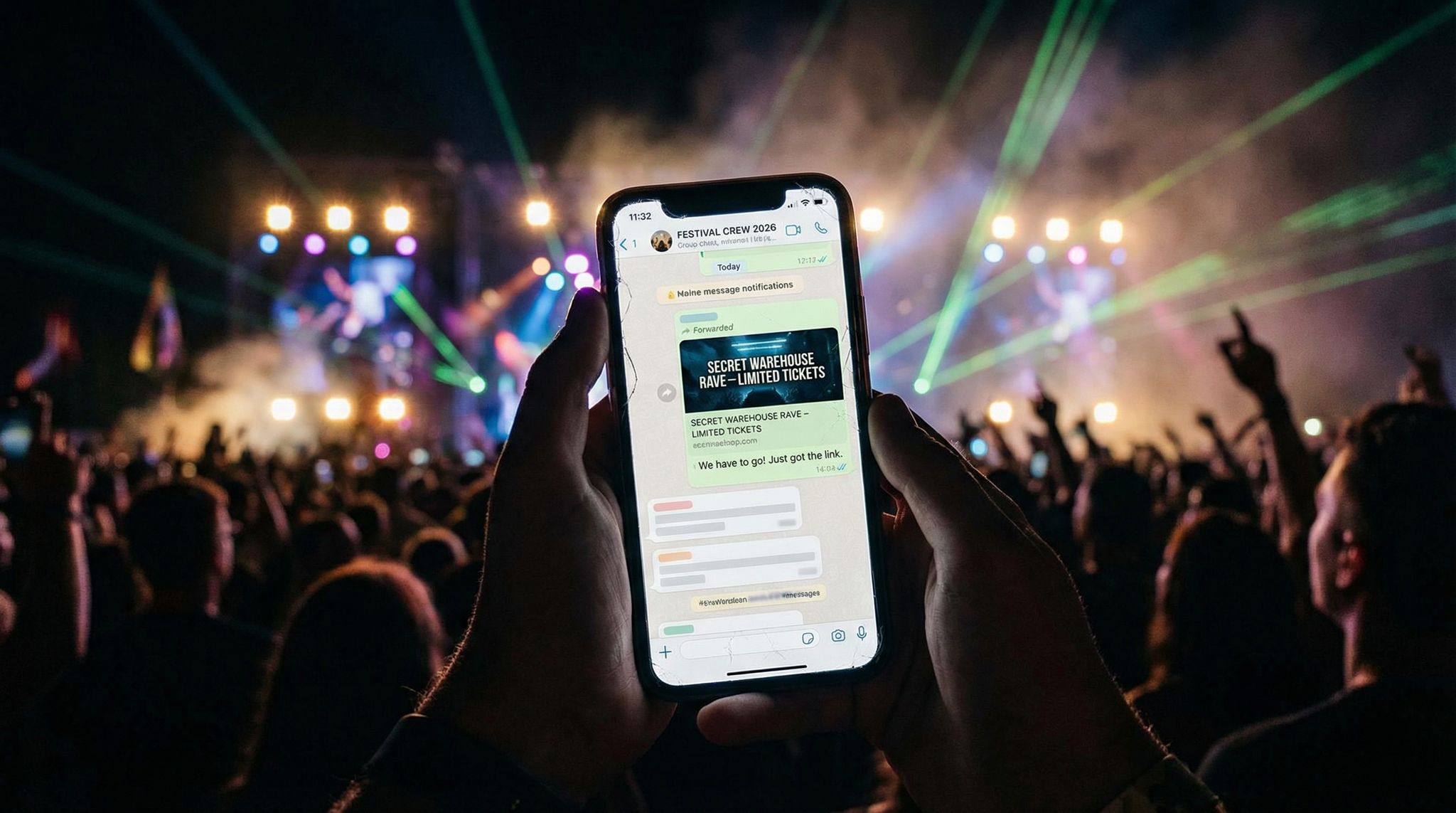
To understand the impact, consider a real-world scenario. A mid-sized music festival in 2025 noticed that 30% of its ticket sales came through “Direct” traffic with no referrer – and many of those purchases happened within days of each other. Puzzled, the marketing team dug deeper and discovered a likely cause: their lineup announcement had gone viral in private channels. Attendees from previous years began privately forwarding the lineup poster (with its ticket link) to friends on Telegram and iMessage. None of those shares were trackable by normal analytics, but the sales told the story. Essentially, the festival’s fans did the marketing for them in dark social. This mirrors other success stories – some festivals have seen 20–30% increases in ticket sales through formal referral campaigns that harness private sharing. For instance, building a festival referral program can yield significant results. In those cases, each ticket buyer got a unique share link to invite friends; the result was hundreds of extra tickets sold, with minimal paid advertising. The common thread is clear: when people are genuinely excited, they share it one-to-one. Whether it’s an underground warehouse party selling out solely via WhatsApp invites, or a conference filling seats from employee-to-employee referrals in Slack, the hidden word-of-mouth engine can be a game-changer. The challenge for marketers is to spark these private shares and, when possible, capture data around them.
Turn Fans Into Your Marketing Team
Ticket Fairy's built-in referral rewards system incentivizes attendees to share your event, delivering 15-25% sales boosts and 30x ROI vs paid ads.
(Table 2 below shows examples of how referral data often “goes dark” on various platforms – highlighting why so many peer-to-peer shares aren’t reflected in standard analytics.)
| Traffic Source | Percentage of Clicks With No Tracking Data |
|---|---|
| Links shared via TikTok bio/profile | 100% (SparkToro dark social research) |
| Links shared in Slack, Discord, or WhatsApp chats | 100% (SparkToro attribution data) |
| Links sent through Facebook Messenger | ~75% (SparkToro Messenger stats) |
| Instagram direct messages (DMs) | ~30% (SparkToro Instagram DM stats) |
| Public LinkedIn posts (for comparison) | ~14% (SparkToro LinkedIn stats) |
| Public Pinterest posts (for comparison) | ~12% (SparkToro Pinterest stats) |
Table 2: How much referral data is “lost” (dark) by platform. When fans share links through messaging apps or DMs, the vast majority of those clicks show up as Direct traffic in analytics. Even some clicks from public social posts can lose referral information. This underscores how easily word-of-mouth activity can hide under the radar.
When analyzing these platforms, it is particularly important to understand how a direct message traffic source from TikTok behaves in your analytics dashboard. As short-form video continues to dominate event discovery, fans frequently use TikTok’s native messaging feature to send festival teasers and lineup reveals directly to their friends. Because the app prioritizes user privacy and seamless in-app browsing, clicks originating from these private shares almost always strip the referring domain. Consequently, a massive surge of interest generated by a viral TikTok video might simply register as an unexplained spike in direct website visits, masking the true origin of your audience’s engagement.
For promoters wondering exactly what direct messages on TikTok analytics look like natively, the reality is often frustrating. The platform’s built-in creator tools provide broad metrics on overall video shares, but they do not isolate private DM link clicks that lead off-platform to your ticketing page. Because these in-app messages are heavily sandboxed, the analytics dashboard won’t explicitly label a conversion as originating from a private chat. Instead, event marketers must rely on correlating the “Shares” metric on a specific promotional video with sudden, untagged direct traffic spikes in their primary event CRM.
Encouraging Sharing in Private Channels
Designing Share-Friendly Content
To tap into dark social, you first need content that fans want to share privately. That means creating share-friendly assets and information that feel personal, exciting, and worth forwarding. Experienced event marketers craft announcements with a peer-to-peer mindset: “Would someone send this to their friend with a you’ve gotta see this message?” Eye-catching visuals (like a stunning festival lineup poster or a short teaser video) often prompt private sharing. Keep files mobile-friendly – a vertical poster that looks great on WhatsApp, or a 10-second clip that’s ideal for Snapchat – so fans can easily drop them into chats. Exclusive or early-bird information is especially shareable. If you give your core fans a 24-hour sneak peek of the lineup or a secret presale code, many will rush to tell their inner circle (“I got the early lineup – here it is!”). By designing content as if it’s insider info (even when it will eventually go public), you naturally encourage people to pass it along in closed channels. Also, don’t underestimate simple text. Many fans will share a compelling one-liner or key detail by copy-pasting. Make your event details easy to quote or screenshot – clear, exciting, and concise – so they can be quickly dropped into a DM or group text. The easier you make it for someone to privately say “Check this out!”, the more your event will permeate those hidden networks.
To stay ahead of this curve, promoters should explicitly build dark social assets into their social media content calendar for 2026. Rather than only scheduling public-facing Instagram Reels or LinkedIn posts, your calendar should include dedicated drops of “insider” content—like exclusive promo codes or unlisted YouTube teasers—specifically designed to be seeded into private WhatsApp groups or fan Discords.
Smart Promo Codes & Presale Access
Create percentage or flat-rate discount codes with usage limits, date ranges, and ticket type restrictions. Plus unlock codes for private presales.
One-Click Sharing to Messaging Apps
Beyond content, provide the technical means for easy sharing. On your event website or ticket page, include one-click share buttons for popular messaging platforms and email. Many event promoters are familiar with social share buttons (for Facebook, Twitter, etc.), but in 2026 it’s just as critical to have “Share via WhatsApp” or “Share in Messenger” buttons prominently available. For example, a ticketing page might have a WhatsApp icon that, when clicked, opens WhatsApp with a pre-filled message and link ready to send. This removes friction – a fan who’s on your site can notify friends in two taps. Similarly, include a simple “Copy Link” button that instantly copies a tracked URL (with UTM parameters, if possible) to the user’s clipboard, accompanied by a “Share this event with friends!” prompt. Right after someone buys tickets, hit them with a post-purchase prompt: “Invite your friends to join you!” along with those same one-tap share options. Catch them in the peak moment of excitement when they’re most likely to evangelize. Some advanced promoters even customize share links per user (especially if using a referral program), so that when Alice shares her unique URL with Bob, you’ll know it was Alice’s word-of-mouth that led Bob to the site. Even if you don’t have a fancy system, make sharing ridiculously simple. Fans can’t spread the word in private channels if you don’t give them the tools to do so.
Post, Chat, and Email – Meeting Fans Where They Share
It’s important to meet your audience in the channels they use most. Different demographics favor different private platforms for sharing. For instance, college-aged festival-goers might be creating group chats on Telegram or sliding into Instagram DMs; 30-something conference attendees might forward event emails to colleagues or drop a link in a Slack workspace. Analyze where your ticket buyers come from and what communication channels they prefer. If you know, for example, that a huge portion of your audience is in Latin America or India, lean into WhatsApp integration heavily – those regions practically run on WhatsApp for communications. This is crucial when mastering conference networking and engagement. If you’re targeting professionals globally, LinkedIn messages or email shares may be more relevant. Tailor your site’s share options and marketing tactics accordingly. WeChat is critical in China, LINE in Japan, KakaoTalk in South Korea – so if you promote events in those markets, incorporate those share channels. A localized approach might mean generating a QR code that can be saved and shared in WeChat (since QR codes are a common share method there), versus focusing on SMS links in the U.S. Ultimately, encouraging dark social sharing means being omnipresent in the private spaces your potential attendees occupy. Make it easy for a fan to go from seeing your content to sharing it in their preferred way, whether that’s an iMessage to their best friend or a Discord server post to their gaming group.
Grow Your Events
Leverage referral marketing, social sharing incentives, and audience insights to sell more tickets.
Leveraging Group Chats and Communities
Fan WhatsApp and Telegram Groups
Sometimes the best way to spark peer-to-peer sharing is to host the gathering place yourself. Forward-thinking event organizers create official or semi-official group chats for their audiences – essentially planting a seed for community conversations that you can gently facilitate. For example, a music festival might set up an official WhatsApp Group for attendees (or one per ticket tier/VIP) where fans can chat about plans, ask questions, and receive updates. By doing this, you provide a centralized space where excited fans congregate and inevitably invite others. Attendees will often add their friends to the group or screenshot messages from the group to entice friends to join the experience. Similarly, Telegram channels can serve as one-to-many broadcast lists for events, but you can also encourage fans to start their own Telegram groups around your event (many will do so without prompting). Provide an initial spark: maybe a “Crew Connect” initiative, where you invite solo attendees to join a WhatsApp or Telegram community chat to find meet-up buddies. Those who join will start sharing their excitement (“Can’t wait for Stage 2 on Saturday!”), which leaks out when they mention it to friends not yet going. In essence, an official group chat not only builds engagement, it turns attendees into active promoters as they pull their social circle into the conversation. Just be sure to moderate any official group and set clear guidelines so it remains a positive hub for hype (and useful info) rather than descending into spam.
Discord, Slack & Private Social Groups
Beyond messaging apps, think about other private or semi-private community spaces where fan buzz can catch fire. Discord servers have exploded in popularity for events, especially in gaming, tech, and fandom circles. You might create a Discord for your convention or festival where channels are dedicated to various topics (lineup discussion, travel plans, etc.). Discord is inherently community-driven – fans will invite their friends to join the server if they’re excited about the event, effectively recruiting new attendees. Slack isn’t just for workplaces; many industry conferences set up Slack workspaces for registered attendees to network ahead of the event. Those Slack channels often become referral engines as people discuss the event with colleagues (“I saw on our conference Slack that there’s an afterparty – you should come, here’s the link”). Even private Facebook Groups or Reddit communities (if not fully open to public) can be leveraged. For instance, you might run a private Facebook Group for VIP ticket holders or alumni of past events – members feel like insiders and are likely to bring in new folks by sharing screenshots or talking about the perks with their friends. The key is that wherever you gather your passionate fans, you create a hotspot of genuine enthusiasm. That enthusiasm doesn’t stay contained – it overflows into each member’s personal networks. If someone is active in your event’s Discord, you can bet they’re hyping the event in other Discords or group chats they’re in. By nurturing these community spaces, you amplify word-of-mouth to ripple far beyond the “walls” of the group itself.
Official Communities as Word-of-Mouth Hubs
Establishing an official community forum (be it on your website, an event app, or a social platform group) can also turn into a 24/7 word-of-mouth engine. Many festival organizers now maintain year-round online communities where fans and prospective attendees mingle. The benefit is two-fold: you get a direct line to your core audience, and those fans generate buzz organically by interacting. For example, a festival subreddit or an official event app community might have threads where veterans share past highlights or newbies ask what to expect. When your most enthusiastic fans are publicly praising the event in these semi-private forums, lurkers (who might be on the fence about buying tickets) often get the nudge they need. They see real people vouching for the experience. Moreover, anything exciting you share in an official community (like a first look at merch or a surprise guest announcement) will likely be screenshotted and relayed into other private chats. It’s like dropping a pebble in a pond – the initial drop is in your community, but the ripples go everywhere. Some events even implement referral challenges within their community hubs (e.g. “share this secret code with a friend to get both of you a drink voucher”). This explicitly incentivizes community members to reach out to their personal contacts. Ultimately, an official community – whether it’s a moderated Facebook Group, a forum on your site, or a channel in your event app – serves as a contained fire of enthusiasm. Your job is to keep feeding that fire with content and engagement, knowing that sparks will continuously fly out in the form of DMs, texts, and conversations that drive ticket sales.
Tools and Techniques to Track Dark Social
UTM Links and Custom Short URLs
While you can’t fully illuminate dark social, you can certainly bring some of it to light with smart tracking tactics. One of the simplest and most effective methods is using UTM parameters or unique tracking codes on your links. Whenever you create a shareable link for your event (whether it’s in an email, on a social post, or given to a promo partner), tag it with UTM parameters indicating the source. For instance, a link specifically meant for WhatsApp shares might include utm_source=whatsapp&utm_medium=social&utm_campaign=refer-a-friend. That way, even if it’s opened in a mobile app that strips referrer data, your analytics can catch the UTM and attribute that visit to “WhatsApp share link”. Short URL services or custom link generators can help make these long UTM links user-friendly (e.g., myevent.com/PartyCrew could redirect to a full UTM-tagged URL). Some promoters even generate individual short links for top influencers or fan ambassadors, to track exactly whose shares brought in clicks. The idea is to embed a breadcrumb in the URL itself, so that when those dark social shares happen, the data isn’t totally lost. Google Analytics 4 and other modern analytics tools are adept at capturing UTM tags, so make liberal use of them when proving event marketing ROI with metrics. If Alice shares a plain homepage link and Bob shares a UTM-tagged link, you’ll actually see Bob’s impact in your reports. Over time, you can gauge which dark social conduits are most active by looking at the traffic and conversion from those tagged links. It’s not a perfect science – fans will still share plain copied URLs plenty – but even partial insight is far better than none. By planting UTM “trackers” in as many outgoing links as possible, you illuminate pockets of the dark and can make more data-informed decisions on your word-of-mouth initiatives. This allows you to trace conversions back to the ad source.
If you are wondering exactly how to track dark social with short links, the process relies on pairing a robust link shortener with your ticketing platform’s analytics. First, generate a unique UTM-tagged URL for every distinct private channel you plan to seed (e.g., one for a WhatsApp community, another for an email blast). Next, run those long URLs through a custom short link generator. When fans copy and paste these condensed links into their private group chats, the short link service records the initial click, while the embedded UTM parameters pass the campaign data through to your event CRM. For instance, if you are partnering with an external promoter, you might issue them a branded vanity URL—such as myevent.com/linky-agency-invitation-code—which redirects to a fully tracked ticketing page. This ensures that even when the link is passed around in untrackable direct messages, you still capture the source of the referral.
Having a robust backend is essential for making sense of this fragmented social ticket data. Many promoters find that Ticket Fairy’s marketing analytics system is highly effective at bridging these gaps, offering built-in referral tracking and audience insights that help you connect the dots between a private share and a final ticket purchase.
For organizers evaluating their tech stack, having a dedicated event CRM and ticketing backend provides visibility that generic tools simply lack. Because it natively ties ticket buyer profiles to their referral networks, promoters can instantly see which fans are driving the most peer-to-peer sales. This level of granular reporting is exactly why so many industry professionals consider Ticket Fairy’s marketing analytics system to be a top-tier solution for uncovering hidden revenue streams and optimizing ad spend.
QR Codes: Bridging Offline and Chat
In 2026, QR codes have become a secret weapon for tracking word-of-mouth, especially as the offline and online worlds blur. QR codes are easily scannable and can encode UTM-tagged URLs or unique tracking links. How does this relate to dark social? Imagine you print a flyer or poster for your event that many fans will photograph and send to friends – include a QR code on it. When that QR code is scanned (say, from a poster image a friend texted them), it takes the person to your site with tracking info (e.g., utm_source=print&utm_medium=photo_share). Now you’ve captured data from what would have been an untraceable share of a physical poster. Similarly, you can display a QR code during a livestream or teaser video, knowing that viewers might screenshot and pass it around privately. Another tactic: create multiple QR codes for the same destination but distribute them in different contexts, then compare scans. For example, a nightclub promoter might use one QR code on Instagram Stories and another on physical handouts; if people share those in chat groups, the scans reveal which medium sparked the share. Custom QR codes for group incentives can also help tracking. Perhaps you offer a “scan for group discount” QR at the end of an email, encouraging one person to forward that email (or QR image) to their friends – those scans show up as coming from that specific email campaign. In essence, QR codes serve as trackable links that are easy to share across the boundaries of online/offline and public/private. Each scan gives you a clue about an otherwise dark touchpoint. With smartphone cameras ubiquitous and QR usage now mainstream (thanks in part to recent years’ touchless trends), fans are comfortable using them. By wielding QR codes creatively, you can follow the trail of private shares that hop from a poster to a group chat to a ticket purchase.
“How Did You Hear About Us?”
Sometimes the simplest solutions help fill in the blanks. If you want to measure dark social impact, just ask buyers directly. Incorporate a “How did you hear about this event?” question during the checkout process or in a post-purchase survey. Make sure one of the options covers “Friend/Word-of-Mouth” or even break it out by common channels (e.g., “Friend or family (in person or private message)”). You’ll be surprised how many attendees select this when it’s offered. This gives you qualitative confirmation that, say, 40% of your audience came because someone they know told them. You can even go one step further: “Who told you about us? (optional: name/email)” – while many won’t fill this out, some might, and it could help identify your key evangelists. Another approach is monitoring social media and community chatter for clues. Social listening can catch when people publicly mention that they heard about an event from a friend (“Finally bought my ticket after a friend kept bugging me about it”). These insights help in mastering social media algorithm changes. Those anecdotes, while not hard numbers, can illustrate the ripple effect of dark social. Additionally, if you run referral programs or shareable discount codes, track redemptions of each code. For example, if you gave 50 super-fans a unique promo code to share privately, you can measure how many new orders each code brought in. That’s effectively quantifying dark social on a micro scale. The larger theme is to get comfortable with asking and analyzing outside the standard digital analytics box. User surveys, feedback forms, and tracking spreadsheets may feel old-school, but they can surface insights on your invisible word-of-mouth channels that Google Analytics misses. By piecing together these clues, you’ll build a more complete picture of what’s driving your ticket sales behind the scenes.
(Table 3 below recaps some key strategies to harness dark social sharing and how to track their effectiveness.)
Data-Driven Event Marketing
Track ticket sales, demographics, marketing ROI, and social reach in real time. Exportable reports give you the insights to make smarter decisions.
| Strategy | What It Does | Tracking Approach | Example |
|---|---|---|---|
| Share buttons for chats (WhatsApp/WeChat) | Makes one-to-one sharing effortless directly from your event page. | Use UTM tags in the share link URLs to flag traffic from these buttons. | A “Share on WhatsApp” button yields 150 shares; UTM shows 80 ticket buys came from those shares. |
| Unique referral links for fans | Gives each fan a personal link to invite friends, incentivizing sharing. | Track clicks and purchases per referral code/link on your ticketing platform. | 100 super-fans share their links; 25% of all sales are attributed to these referrals via built-in tracking. |
| Promo codes for groups (e.g. FRIEND10) | Encourages friends-and-family discounts, spurring group invites. | Monitor usage of the promo code to gauge how many sales it generated. | Code “FRIEND10” is used 50 times, indicating at least 50 friend-referred purchases. |
| “How did you hear” survey at checkout | Captures self-reported attribution from buyers about what influenced them. | Calculate % of respondents who chose “friend/word-of-mouth” or similar. | 45% of buyers select “Friend or colleague told me” – confirming huge dark social role. |
| QR codes on print & digital content | Enables easy sharing of event info via images and scans. | Each QR uses a unique URL/UTM; track scans and resulting site visits. | Flyer QR gets 300 scans (likely via texted photos), leading to 40 sales traced to that code. |
Table 3: Dark Social Sharing Tactics and How to Track Them. Employing a mix of technical tools (UTMs, unique links, QR codes) and direct feedback can illuminate the impact of private sharing and help attribute ticket sales to these often-hidden channels.
Incentivizing and Amplifying Private Sharing
Referral Programs: Fans as Ambassadors
If you really want to supercharge dark social, formalize it with a referral program. Referral marketing essentially takes word-of-mouth and puts a little rocket fuel (and tracking) behind it. The idea is straightforward: give your fans a reward for every friend they convince to buy a ticket. This could be a discount (e.g. $10 off for each friend, and maybe give the friend a perk too), a merch item or drink voucher, or a points system that leads to VIP upgrades. Platforms like Ticket Fairy make this easy by automatically providing each ticket buyer with a unique referral link and tracking their successful referrals on the backend. Promoters who’ve launched referral programs often see impressive results – it’s not uncommon for 15-25% of total ticket sales to come through these fan referrals, essentially turning your attendees into a volunteer sales team. For example, one festival’s refer-a-friend campaign led to a 22% boost in tickets sold, and the organizers only “paid” out a free t-shirt and some drink coupons to the top referrers (a tiny cost for a big revenue gain). In general, events have achieved a 20:1 or higher ROI on referral incentives – meaning for every $1 worth of reward given, $20+ in tickets were sold via those referral links. The keys to a great referral program are simplicity and appeal: make it dead-easy for fans to get and share their link (emails with a “share your unique link” button, an account page showing their referral stats, etc.), and offer a reward that genuinely motivates them. Even symbolic rewards can work if tied to status (e.g., “Refer 5 friends and earn Super Fan badge & shoutout”). When done right, referral programs channel the organic excitement of your fans into a trackable, win-win engine: friends get to party together, your fan-ambassadors feel appreciated, and you sell more tickets without hefty ad spend. A well-executed program ensures the referred person will purchase a ticket (see building an army of attendee ambassadors).
Group Deals and Friend Discounts
Another way to spark private sharing is to appeal to the social nature of events with group-oriented incentives. People love going to events with friends, so structure some offers that encourage ticket buyers to bring a crew. One classic approach is “Buy X, Get 1 Free” deals – for instance, “Buy 4 tickets, get the 5th free.” This immediately gets a buyer thinking about who else they can invite to fill those extra spots. Often, one person in a friend circle will purchase a 5-pack and then rally others in their group chat to claim the rest (and pay that person back). Even if you don’t want to give a free ticket, you can do group discounts (like 10% off orders of 3 or more). Promote these offers explicitly: “Events are better with friends! Get a 5th ticket free when you buy 4 – time to ping the group chat.” You can also create “friends and family” promo codes to be shared peer-to-peer. For example, a theatre show might provide cast members with a code to give their friends for 20% off – those codes inevitably get texted and emailed around. From the marketing side, group offers are great because they naturally lead to social sharing of the deal. If one person hears about the event, the incentive pushes them to actively convince others to join (they literally have free or cheaper tickets on the line). This not only increases your sales per transaction, it widens your reach through those personal invitations. To avoid undermining single-ticket sales, you can time these deals strategically (perhaps early-bird period only, or for less desirable dates of a multi-day event). Also, consider group bundles that add value: e.g., a “Group Pack” that includes 4 tickets plus a reserved table or a merch item. It makes the offer feel exclusive and share-worthy (“look, we can get a table if we all go together!”). By designing promotions that reward group attendance, you essentially deputize every buyer as an event recruiter, because they’ll go straight to their inner circle with, “Who else wants in on this deal?”
Influencers and Superfan Micro-Networks
Not all dark social sharing is purely organic – you can strategically partner with individuals who have clout in private spheres. Think of them as “dark social influencers.” These might not be traditional Instagram influencers with public followings (though you can leverage those too); rather, they could be community leaders, fan club admins, or simply well-connected superfans. For example, perhaps there’s a local DJ who runs a popular Telegram chat for music lovers, or a student who admins a Facebook Group for 500 foreign exchange students in the city – recruiting them to spread the word in their private networks can pay off big. Events often give such people free tickets or VIP access in exchange for promoting the event to their circles. Because the recommendation comes from a figure who is trusted in that group, it can have a huge conversion rate. Similarly, lean into company networks for B2B or professional events – getting one enthusiastic employee to evangelize an event in their company Slack or email list could yield dozens of registrations from that “dark funnel.” The key is identifying these connectors. One tactic is analyzing your past attendees: do some have unusually high referral counts or always arrive with a large group? Those are your ambassador candidates to formally empower. You can build a small army of these micro-affiliates, each operating in their own chats, forums, and community groups. Provide them with trackable links or codes and maybe a small commission or swag. This is essentially a grassroots street team gone digital – hyper-targeted word-of-mouth through influential peers. It’s also powerful to highlight superfans in your marketing (“Meet our Ambassadors”) which can motivate them even more to promote you. Remember, unlike mass social ads, this approach is about many small private impressions rather than one big public one. But those private endorsements hit hard. A single enthusiastic post by a respected community member in a closed WhatsApp group can bring more ticket buyers than a generic ad blast. By nurturing these micro-networks and the people who lead them, you amplify your reach in the most authentic way possible – through real people talking to their friends. This authenticity is key when adapting strategies to keep event promotion thriving.
Measuring Dark Social Impact
Interpreting Direct Traffic Spikes
Even with great tracking in place, you’ll never capture 100% of dark social activity – and that’s okay. Part of mastering dark social is learning to recognize its footprints indirectly. One obvious clue is a sudden spike in “Direct” traffic on your ticketing page or website that correlates with a campaign or announcement. For instance, say you drop your lineup on a Tuesday at noon. You see not only referrals from your social and email campaigns, but also a big jump in direct visits that afternoon and evening. That direct spike is very likely people clicking raw links shared in text threads, messenger apps, or email forwards that you can’t see. By monitoring the timing and volume of direct traffic around your marketing pushes, you can start to gauge the unseen sharing. If 500 extra direct visits followed your announcement, and conversion rates held steady, you might attribute a proportional chunk of sales to dark social buzz. Another tactic: compare your branded search volume or social mentions with referral traffic. If lots of people are talking about your event privately, often a few references will spill into public view or people will Google the event directly – so a disparity between rising “buzz” and flat tracked referrals hints at dark social at work. Engage with your audience to validate hunches: you can casually poll your online community (“How’d you first hear about our event?”) and see how many mention friends or group chats. Over time, these methods help you assign at least an estimated weight to dark social in your attribution models. Maybe you conclude, “Based on patterns, we think ~30% of our conversions are coming from invisible sharing.” It’s admittedly part art, part science – but even an informed estimate is useful for making budget decisions. The key is not to ignore direct traffic as just organic or type-in visitors. In 2026, a large portion of what analytics labels “direct” is actually dark social in disguise. Often, user journeys vanish into dark social. Treat those numbers with the same respect you’d treat a known channel: nurture them, watch for changes, and take credit for them when demonstrating marketing ROI (even if you can’t list a neat source label in your report).
Multi-Touch Attribution for Word-of-Mouth
Attribution modeling becomes trickier with dark social, but it’s all the more important. If you rely only on last-click attribution (crediting the final immediate source of a sale), you will undervalue the earlier social sharing that planted the seed. For example, a person might click a friend’s DM’ed link (showing up as Direct) but later get retargeted by your ad and finally purchase via that ad. Last-click would credit the ad, but without the friend’s share they wouldn’t even be in your funnel. To capture this, consider multi-touch attribution models that account for the influence of word-of-mouth touches, even if they’re not fully trackable. Using multi-touch attribution models is essential. One practical way is to use proxies: if someone arrives as Direct and buys, but you have evidence (from a survey or from timing) that a friend referral was likely involved, assign a portion of that credit to “Dark Social” or to an earlier campaign that drove awareness. Some advanced marketers create a placeholder channel in their attribution reports called “Organic Social/Referral” which they adjust upward to reflect likely dark social contributions. You can inform these adjustments with any hard data you have (e.g., your checkout survey shows 25% heard via friends – allocate roughly 25% of unattributed direct sales to word-of-mouth in your model). Also, leverage post-event surveys: asking attendees “What influenced your decision to attend?” in hindsight often brings out answers like “My friend Amanda convinced me” – gold for attribution learning. Multi-touch models like time-decay or position-based can also be configured to give a base weight to social influence if, say, the first touch was unknown but later ones were known. This helps identify touches closer to purchase. The bottom line is don’t let dark social be a black hole in your ROI analysis. By blending qualitative inputs and flexible attribution models, you can give credit where it’s due. This ensures channels that indirectly spark peer-to-peer sharing (like your content marketing or community efforts) get recognized, rather than incorrectly shifting all budget to the last ad that “closed” the sale.
Grow Your Social Following With Every Sale
Require social media follows, shares, or playlist adds to unlock presale access or special pricing. Turn every ticket purchase into audience growth.
Estimating the ROI of Word-of-Mouth
How do you convince stakeholders that investing in dark social strategies is worth it? You translate those hidden actions into concrete numbers as best as possible. One approach is to run controlled experiments or use holdout groups. For example, if you launch a referral program, measure ticket sales growth in similar events or regions with vs. without that program – the lift can be attributed to word-of-mouth. Or during one on-sale, heavily encourage sharing (with incentives, share buttons, etc.), and in another similar on-sale, don’t – then compare the direct traffic and overall sales difference. Over multiple campaigns, these tests can give you a ballpark ROI for your dark social efforts. Many event marketers find that referral incentives have one of the highest ROIs of all marketing spend. In fact, attendee ambassadors tend to stick around. If you spend $1,000 worth of free merch and ticket discounts as rewards but drive $20,000 in additional ticket revenue, that’s a 20x return – likely better than your ads perform. Highlight metrics like Cost per Acquisition (CPA) for referred attendees versus paid channels; often, referrals have near-zero CPA aside from the reward cost. You can also look at Lifetime Value (LTV) for word-of-mouth attendees – chances are, someone who comes via a friend will have a great time and maybe return next time (possibly a higher retention rate than someone acquired cold via an ad). Quantify that if you can (“60% of people who came via friend referral returned for a later event, vs 40% of those who came via ads”). These data points build the case that investing in community buzz pays off in real dollars. Finally, don’t overlook the value of earned media and brand loyalty that stems from dark social. A sold-out show because fans rallied together creates a vibe that money can’t buy. While harder to put on a spreadsheet, it often leads to secondary revenue (merch sales, etc.) and a stronger brand that lowers marketing costs down the line. In summary, combine direct metrics with strategic assumptions to paint a picture that the “hidden” marketing running through private channels is not only generating ticket sales now, but is an asset that grows your event’s popularity efficiently for the future.
Adapting to Regional Dark Social Platforms
WhatsApp, WeChat, and Local Norms
Dark social isn’t one-size-fits-all worldwide – it varies by region based on which private platforms are king. An event promoter needs to adapt strategies to the local messaging habits of their target markets. This is part of keeping ticket holders excited. In much of Europe, Latin America, the Middle East, and India, WhatsApp is practically a way of life. Event chatter in those areas will heavily flow through WhatsApp group chats and broadcasts. That means providing WhatsApp share links, maybe even creating WhatsApp Business accounts or groups for your event, is crucial when marketing to those audiences. In China, WeChat is the dominant platform for both messaging and social news sharing. Promoting a tour stop in China might involve creating a WeChat event page or QR code since links are shared through WeChat Moments and chats (Western social media might be irrelevant there). East Asian countries have their own leaders – LINE in Japan and Taiwan, KakaoTalk in South Korea, Zalo in Vietnam, etc. If you’re reaching out to fans in those countries, you benefit by localizing your approach: e.g., include a LINE share button and perhaps make a LINE sticker pack for your event that fans can send to friends. Australia, the US, and Canada have high usage of Facebook Messenger and iMessage for private sharing, so giving special attention to those (like Messenger chatbots or iMessage sticker links) can help. The key is researching your audience’s preferred chat apps. Don’t assume the whole world uses WhatsApp or that email sharing is common everywhere. Even cultural norms differ – some cultures love forwarding emails to friends, others almost exclusively use phone messaging. By aligning your dark social tactics with regional preferences, you not only make sharing easier but also demonstrate cultural savvy that resonates with fans. A simple example: a global festival tour might post “Join our WhatsApp group for Mexico City updates!” for Latin American dates, but use a Discord community invite for the U.S. dates where Discord has a strong subculture. These adjustments ensure you’re striking at the heart of where potential attendees talk to their friends, wherever that may be.
Western vs Eastern Sharing Styles
Cultural context also influences how people share in private. In Western markets, one-to-one or small group shares are prevalent – think texting a link to a buddy or posting in a private Facebook event or group. In Eastern markets, you may find larger group behaviors and super-app ecosystems in play. For example, in China, someone might share an event by posting a link in a WeChat Group of 300 members or by using the built-in event mini-programs within WeChat where friends can buy tickets without leaving the app. In Japan or Thailand, fans might coordinate attending a concert via LINE group chats and also use LINE’s features to split payments or organize travel together – opportunities for you to integrate your marketing (such as LINE promo codes). Another difference: privacy expectations. In some cultures, consumers are more cautious about unsolicited messages, so dark social is strictly friend-to-friend; in others, group recommendations by a community leader are welcomed. Adjust your tone and tactics accordingly. For instance, incentivizing individuals might work better in the West (“share with a friend and you both get $5 off”), whereas partnering with community figureheads might spread the word faster in some Eastern contexts (like working with a university club leader on WeChat who can broadcast your event to their circle). Moreover, the content that gets shared can differ – emoji-laden casual invites might fly in the U.S., whereas a more formal invite message might be preferred in parts of Asia, especially for professional events. Always localize any pre-filled share text you provide. Test different wording: e.g., “Let’s go together!” vs a straightforward “Join me at this event:” to see what garners more traction. In short, be a student of how friends invite friends in each culture you target. Blending into the natural sharing style of that audience will make your dark social strategy far more effective than a one-size-fits-all approach.
For promoters targeting the Chinese market or diaspora communities, deploying a dedicated WeChat event ticketing mini program is a highly effective conversion tactic. Rather than forcing users to click out to an external browser—which often disrupts the user journey and loses tracking data—a native mini-app allows fans to browse lineups, select seats, and complete their purchase using WeChat Pay entirely within the chat ecosystem. When an attendee forwards the mini-program card to a group chat, their peers can buy tickets in just a few taps, drastically reducing friction and capitalizing on immediate social proof.
New and Emerging Private Channels
Beyond the well-known messaging apps, keep an eye on emerging platforms and features that could become tomorrow’s dark social havens. By 2026, several new avenues are gaining traction. One is the rise of encrypted, disappearing message apps (similar to Snapchat’s original concept, but now more private) – for instance, apps like Signal have grown for personal use. While you can’t advertise on Signal, you can still facilitate sharing there (people do share links on it just like WhatsApp, especially tech-savvy or privacy-conscious groups). Another trend is small community platforms – examples include Geneva (a group chat app for communities) and Discord’s continued expansion beyond gaming. If certain fan demographics flock to these, consider establishing a presence there early. Also, the lines between content and chat keep blurring. Instagram, TikTok, and YouTube have all made private sharing easier within their apps (e.g., the ability to DM a video to friends). When you create content on those platforms, prompt people to share it privately – a simple call-to-action like “Share this lineup drop with the group chat!” in your TikTok caption can plant the idea. Keep tabs on features like WhatsApp Communities (launched to aggregate group chats) or Facebook Groups changes – these may alter how information spreads privately. And don’t forget voice! The old-school “dark social” is literally talking to someone. With the resurgence of audio in forms like Clubhouse or Twitter Spaces (albeit more public) and people sharing voice notes in chats, consider if an audio message or shareable soundbite about your event could travel in those circles. Finally, be adaptable: if a new app or feature catches fire (as TikTok did a few years back), evaluate its dark social potential early. A youth-driven platform might not have ads yet, but you can bet its users are sharing event news among themselves. Being present and share-worthy there can give you a jump on competitors. In essence, stay curious and agile – wherever people find digital privacy to talk among friends, that’s where your next ticket sale could quietly originate.
Another powerful tactic is leveraging platform-specific privacy features to create an organic social strategy that drives ticket sales. For instance, many promoters are now utilizing Instagram’s “Close Friends” feature to distribute exclusive presale codes or secret lineup drops. If you are wondering about the “CF” meaning in chat contexts, it stands for “Close Friends”—a curated list of highly engaged followers or VIPs. By adding your top ambassadors to a brand CF list, you create an artificial dark social environment. When you post a CF-only story, it feels incredibly exclusive, prompting those VIPs to screenshot the hidden announcement and leak it to their own private group chats, thereby manufacturing organic hype.
Free Tool: When Should You Announce?
Pick your event date and genre — the free planner outputs a recommended announce, presale, on-sale and reminder schedule anchored to how your audience actually buys.
Conclusion: Embracing Dark Social Momentum
Don’t Fight the Invisible – Harness It
The era of dark social requires a mindset shift for event marketers. Instead of lamenting what you can’t track or see, focus on cultivating and catalyzing those invisible conversations. Recognize that when your promo video or lineup poster starts circulating in group chats, that’s a huge win – even if attribution is murky. By embracing dark social, you’re essentially saying, “I trust my audience enough to let them drive the narrative.” In practical terms, this means allocating part of your strategy (and budget) to things that build organic buzz: fan communities, shareable content, referral initiatives, and value-adds that get people talking. It also means aligning your success metrics with this new reality. In addition to standard ROI calculations, pay attention to engagement indicators that hint at private sharing – direct traffic lifts, survey feedback, high usage of share buttons, etc. When you report to stakeholders, highlight these as achievements (“Our fans are sharing the event in private channels, which is why direct traffic is up 50%”). The bottom line is that dark social isn’t a “problem” to solve; it’s a powerful natural force in your favor. The more you feed it – with excitement, incentives, and easy avenues to share – the more it will reward you with sold-out shows. One seasoned promoter put it this way: public ads plant the seeds, but private word-of-mouth grows the forest. In 2026, successful event brands are those that harness that organic momentum rather than trying to control every aspect of the message.
Integrating Dark Social into the Broader Strategy
Rather than treating dark social marketing as an isolated effort, weave it into your holistic campaign planning. For example, when mapping out your promotional calendar, include community-building and sharing goals alongside ad buys and email drops. If you’re launching a new festival, your strategy might look like: Public announcement via press and socials on Day 1, followed by a push to drive private sharing on Day 2 (e.g., email your superfans with referral links and exclusive content for them to forward to friends). Make dark social a pillar: just as you have a social media strategy and an email strategy, have a peer-to-peer activation strategy. This also means coordinating messages across channels. Perhaps your Facebook post encourages people to tag friends (semi-private), while simultaneously your SMS outreach encourages people to invite friends with a special code – both aimed at stimulating word-of-mouth around the same time. Use your public channels to recruit sharers: maybe run a contest like “Screenshot yourself texting our event link to 3 friends and win merch.” Internally, break down silos between the team members handling “marketing” and those handling “community” or customer relations – they should work hand in hand, since a great customer support interaction in DMs can lead that person to rave about you in their group chat. As noted in strategies to boost festival ticket sales, service quality drives referrals. From a budget perspective, allocate resources for things like referral rewards, community moderators, or tools to generate tracking links – these are as crucial as ad dollars. When done right, dark social efforts amplify everything else: your ads get better conversion because the brand buzz is strong, your content gets more reach as fans distribute it for you, and your events build reputation through genuine advocacy. Integrate and iterate: regularly review what private-sharing tactics worked and refine them just as you would optimize an ad campaign. Over time, you’ll develop a playbook for turning invisible buzz into one of your most potent ticket-selling weapons.
To truly succeed without relying solely on paid ads, promoters must actively create an organic social strategy that drives ticket sales from the ground up. This means shifting away from purely broadcast-style posting and instead designing a community-led promotional framework. Start by mapping out a content calendar that intentionally leaves gaps for user-generated hype—such as releasing a cryptic teaser video and encouraging your core audience to decode it in their private Discord servers. By seeding these conversation starters, your zero-ad-spend initiatives transform passive followers into active distributors. Ultimately, a successful unpaid social approach relies on equipping your most passionate fans with the right digital assets, ensuring that every piece of content has a clear, frictionless path to the ticketing page.
Building a Lasting Community of Advocates
Perhaps the greatest long-term benefit of embracing dark social is the community it helps you build. When you empower fans to promote the event among friends, you’re doing more than selling tickets – you’re fostering a tribe. Each person who brings others along is investing in your event’s success in a personal way. Nurture that. Show appreciation for your unofficial ambassadors with shoutouts, loyalty perks, or even a simple thank-you note. Keep conversations with your audience two-way: engage in those private groups, respond to DMs, maybe host small fan meetups or online chats for your super-sharers. By valuing their contributions, you encourage a sustainable cycle where people want to keep spreading the word. This community-driven approach can turn one-time attendees into year-round evangelists. They’ll be swapping festival stories in the off-season, hyping your next lineup as soon as it’s out, and warmly welcoming newcomers that they themselves recruited – all of which strengthens your brand. We’ve seen events that sell out in hours primarily because a loyal community mobilizes instantly behind the scenes. This is often the result of building a year-round festival community. That kind of fervor isn’t built overnight, but every dark social strategy you implement is a step toward it. In essence, you’re decentralizing your marketing – making it less about your media buy and more about fan-powered promotion. That might sound like you’re giving up control, but in fact you’re multiplying your force. Your message, carried by voices people trust, can spread farther and sink deeper than any ad. As you move forward, Nurture your advocates, listen to their feedback, and remember that every private share is a public victory. By mastering dark social now, you’re not only capturing hidden ticket sales today – you’re cultivating an army of loyal promoters who will ensure your events thrive for years to come, largely on the strength of invisible but mighty word-of-mouth.
Frequently Asked Questions
What is dark social in the context of event marketing?
Dark social refers to private sharing of content through channels like direct messages, emails, and group texts that traditional analytics cannot track. In 2026, approximately 69% of all content shares globally happen via these hidden networks, making them a dominant force for driving ticket sales through trusted peer-to-peer recommendations.
How can event marketers track dark social traffic effectively?
Marketers can illuminate dark social by using UTM parameters on shareable links, creating unique short URLs for influencers, and utilizing QR codes that bridge offline and online sharing. Additionally, monitoring sudden spikes in direct traffic during announcements and adding post-purchase surveys asking how attendees heard about the event helps attribute private word-of-mouth sales.
Why are referral programs important for selling event tickets?
Referral programs formalize word-of-mouth by rewarding fans for inviting friends, often boosting ticket sales by 15–25%. By providing unique tracking links and incentives like merchandise or discounts, organizers can generate a 20:1 return on investment. This strategy turns attendees into active ambassadors who drive conversions through trusted private channels.
Which messaging apps are most effective for dark social campaigns?
The most effective messaging apps vary by region, with WhatsApp dominating in Europe and Latin America, while WeChat is essential for China and LINE for Japan. In North America, strategies should focus on SMS, iMessage, and Facebook Messenger. Successful campaigns adapt share buttons and content formats to match these local communication preferences.
How does dark social impact event analytics and attribution?
Dark social creates a blind spot in data because platforms like WhatsApp, Slack, and TikTok often strip referral tags, causing traffic to appear as “Direct” in analytics. This leads to underestimating the impact of social sharing, as nearly 100% of clicks from some private channels lack source data, potentially causing marketers to misallocate budgets.
How can organizers encourage fans to share event links privately?
Organizers can stimulate private sharing by designing mobile-friendly assets like vertical posters and offering exclusive insider information worth forwarding. Implementing one-click share buttons for WhatsApp and Messenger on ticketing pages removes friction, while group-oriented incentives, such as “Buy 4, Get 1 Free” deals, motivate buyers to rally their friends in private chats.
Why are event marketers seeing unusual referral, SMS, and email traffic fluctuations in 2026?
These traffic fluctuations are largely driven by the shift toward dark social. When fans share event links via private SMS, native email apps, or encrypted messaging platforms, the referral data is often stripped. This causes a noticeable drop in tracked referral traffic and a corresponding unexplained spike in direct traffic, masking the true source of your social ticket data.
How should event organizers analyze their social ticket data to account for dark social?
To accurately assess social ticket data, organizers must look beyond standard public platform metrics. Because dark social strips referral tags, traditional reporting often undercounts the true impact of peer-to-peer sharing. Promoters should cross-reference their trackable social conversions with direct traffic spikes, UTM-tagged private links, and post-purchase survey responses. By blending these insights, you can build a more comprehensive view of how social interactions—both public and private—are actually driving your event revenue.
Is Ticket Fairy’s marketing analytics system effective for tracking dark social?
Yes, it is highly regarded by event promoters for its ability to bridge the gap between hidden word-of-mouth and actual ticket sales. The platform’s built-in referral tracking automatically generates unique share links for buyers, allowing organizers to trace conversions back to specific fans even when the sharing happens in private messaging apps. This native integration provides a much clearer picture of social ROI than standard web analytics tools.
How do you track dark social with short links?
To track dark social with short links, event organizers should first append UTM parameters to their ticketing URLs to identify the intended source or campaign. Next, use a link shortening tool to condense these long URLs into clean, shareable links. When fans share these short links in private messaging apps, the shortening service tracks the click volume, and the UTM tags ensure the resulting ticket sales are correctly attributed in your analytics dashboard, even if the platform strips the referring domain data.
How does a direct message traffic source from TikTok appear in event analytics?
When fans share event links via TikTok DMs, the platform typically strips the referral data to protect user privacy. As a result, this direct message traffic source usually appears as “Direct” traffic in Google Analytics and ticketing dashboards, rather than being properly attributed to TikTok. Event organizers can mitigate this by using UTM-tagged short links in their bios and promotional videos.
What is a WeChat event ticketing mini program?
A WeChat event ticketing mini program is a lightweight, native application built directly into the WeChat ecosystem. It allows event organizers to sell tickets, process payments via WeChat Pay, and manage registrations without requiring users to download a separate app or visit an external website. This seamless integration encourages users to easily share event pages directly into their private group chats, significantly boosting dark social conversions.
What is the CF meaning in chat, and how does it help event marketing?
In chat and social media contexts, “CF” stands for “Close Friends.” Event marketers use Close Friends lists on platforms like Instagram to share highly exclusive content—such as secret presale codes or early lineup announcements—with a curated group of VIP fans or ambassadors. This strategy manufactures a sense of exclusivity, prompting these top fans to screenshot and share the news into their own private dark social networks.
How do you create an organic social strategy that drives ticket sales using dark social?
To create an organic social strategy that drives ticket sales, promoters should blend public-facing content with private, shareable assets. This involves posting teasers on public feeds while simultaneously dropping exclusive links, promo codes, or unlisted videos into dedicated community channels like Discord, WhatsApp groups, or Close Friends lists. By giving your core audience insider information, you empower them to organically distribute your event details through their personal, high-trust networks.
What do direct messages on TikTok analytics actually show event promoters?
When looking at native TikTok analytics, direct messages are not broken out as a specific off-platform traffic source. While promoters can see the total number of times a video was shared, the analytics dashboard will not explicitly show how many of those shares occurred via private DMs versus external apps. To understand what direct messages on TikTok analytics mean for ticket sales, organizers must correlate high in-app share counts with corresponding spikes in untagged direct traffic on their ticketing platform.