The Offline Advantage in a Digital Era
Consider this your comprehensive direct mail advertising guide 2026 for the live events industry. As digital acquisition costs soar and privacy regulations tighten, savvy promoters are rediscovering that physical mailboxes offer an uncluttered pathway to their most valuable attendees.
Cutting Through Digital Noise
In 2026’s digital-first era, consumers are bombarded with endless online ads, emails, and social posts. Event promoters find that offline marketing channels like direct mail and print ads can cut through the clutter of notifications and pop-ups. A physical postcard in someone’s mailbox doesn’t have to compete with dozens of browser tabs – it gets a moment of genuine focus. In fact, industry data shows direct mail garners an average response rate of 2.7–4.4%, vastly higher than the roughly 0.1% response rate of email or social media ads, as noted in Postie’s analysis of direct mail marketing trends. That means recipients are far more likely to notice and act on a well-crafted mailer than a fleeting digital ad. Unlike an Instagram post that’s scrolled past in a split-second, a tangible flyer or poster can’t be swiped away – it demands attention, a benefit highlighted in Ticket Fairy’s guide to festival advertising campaigns.
Keeping up with direct mail marketing news in 2026 reveals a growing trend: as digital privacy regulations tighten and third-party cookies disappear, event organizers are pivoting back to physical addresses as a reliable, privacy-compliant way to reach their core audience.
Channel Response Rate Comparison (Average)
Channel Avg. Response Rate Avg. Conversion Rate Direct Mail 2.7–4.4% ~14% (Postie’s data on marketing effectiveness) ~0.12% ~1.9% (Postie’s comparison of channel metrics) Social Ads ~0.08% ~1.3% (Postie’s social media performance stats) Direct mail significantly outperforms typical digital channels in response and conversion rates.
Beyond digital channels, traditional broadcast mediums face similar engagement hurdles. For instance, while audio campaigns build broad brand awareness, the direct radio response rate often hovers around 0.1% for immediate ticket conversions. This stark contrast makes the robust yield of physical mailers even more attractive for performance-focused event organizers.
Ready to Sell Tickets?
Create professional event pages with built-in payment processing, marketing tools, and real-time analytics.
Tangibility Builds Trust and Recall
There’s a psychological solidity to print. Holding a well-designed event postcard or seeing a poster on your city’s main street creates a sense of tangibility and trust that pixels on a screen sometimes lack. Research consistently finds that consumers trust traditional print ads (in newspapers, magazines, or mail) more than many digital ads that pop up online. The physical presence of a mailed invitation or a glossy flyer lends credibility – it signals that the event is real, established, and worth considering. This trust translates into action: recipients often keep postcards or brochures on their desk or fridge as a visual reminder, meaning your event stays top-of-mind far longer than a one-time email open. According to recent studies, an overwhelming 85% of Millennials and Gen Z consumers will engage with direct mail they receive, and 67% take action (such as purchasing tickets or visiting a website) after getting a mailer, according to DataMasters’ insights on Gen Z direct mail strategy. Even hyper-digital young audiences respond to the novelty and authenticity of physical mail!
Engaging Audiences Beyond the Screen
Old-school outreach isn’t just for older demographics. Tech-weary professionals, inundated with spam and social ads, appreciate a creative mailer or well-placed print ad that offers a refreshing change of pace. Younger audiences, too, are often delighted by retro marketing touches – for example, college students might share a cool event poster on their dorm wall or TikTok, effectively amplifying your reach. Experienced event promoters know different segments consume media differently: that’s why a multi-channel approach wins. By reaching attendees beyond the screen, you’re covering touchpoints others might neglect. A mailed invite can engage someone who ignores Facebook ads, while a striking poster might catch the eye of a casual passerby who wasn’t actively searching for events. This expanded reach is why veteran festival producers still incorporate radio spots, billboards, posters, and print ads to build local buzz and credibility alongside digital campaigns, as detailed in strategies for festival advertising. Furthermore, strategic placement of posters helps saturate an area with the festival’s branding. In short, combining online and offline efforts ensures you’re connecting with your audience wherever their attention is – and in 2026, that means not being only online.
Old-School Tactics, New-Tech Twist
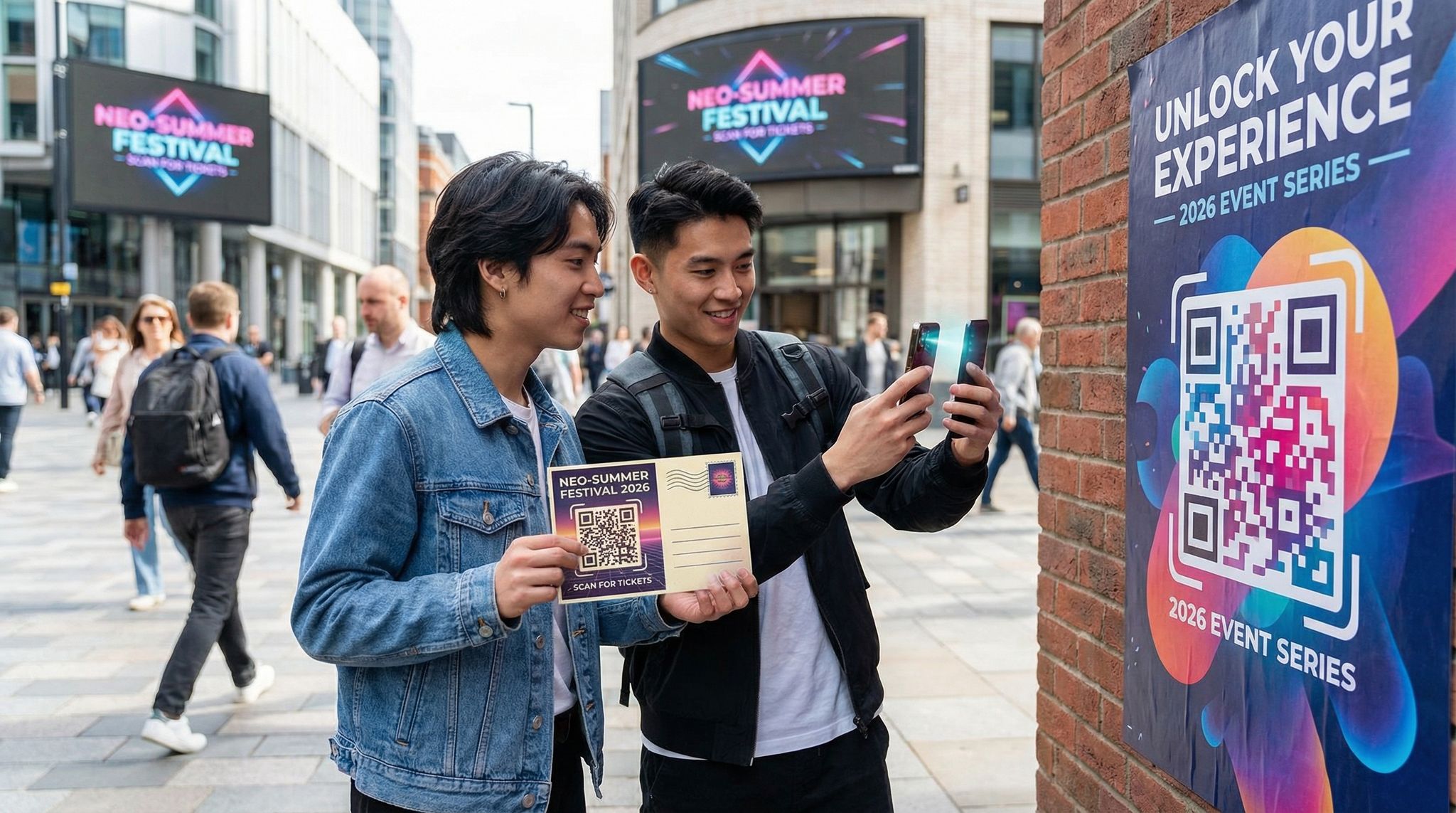
The beauty of promoting events in 2026 is that you can give old-school tactics a high-tech upgrade. Direct mail now often features QR codes and personalized URLs that seamlessly bridge recipients from a physical postcard to an online ticket page in one scan. Print ads can incorporate AR (augmented reality) markers or special hashtags that encourage viewers to go online and share. This merging of offline and online means you get the best of both worlds: the stopping power of tangible media plus the easy conversion of digital. Savvy promoters use these tools to make offline outreach fully trackable and interactive, as we’ll explore further below. The result is an integrated experience where a mailer or poster sparks an online journey – exactly what you want for boosting ticket sales in a measurable way.
Crafting Irresistible Mailers and Print Pieces
Postcards, Flyers, or Letters: Picking the Format
Choosing the right print format is the first step to a successful campaign. Postcards are a popular choice for event promotion – they’re cost-effective, require no envelope (so the message is immediately visible), and are perfect for bold visuals. A6 or A5-sized postcards can be eye-catching without being overwhelming. For more upscale events (galas, VIP experiences, B2B conferences), a letter in an envelope or even a creative dimensional mailer (like a small box with a themed item) can convey exclusivity and personal touch. Flyers (one-page leaflets) are great for hand-outs and street marketing, but when sent via mail, postcards generally hold up better in postal handling. The key is to match the format to your audience and message: a techno music festival might use a neon-colored oversized postcard to scream excitement, whereas a business conference might send a sleek tri-fold brochure detailing the agenda. Always consider practical constraints too – postcards and self-mailers save on postage, while oddly shaped or heavier mailers may cost more but could earn a higher impact if they feel like a “gift” in the mailbox.
Smart Promo Codes & Presale Access
Create percentage or flat-rate discount codes with usage limits, date ranges, and ticket type restrictions. Plus unlock codes for private presales.
Eye-Catching Design That Stands Out
In a stack of mail or on a community bulletin board, your design needs to pop. Successful event mailers and posters share some common design principles:
- Bold, Relevant Imagery: Use high-quality images or graphics that reflect the event’s theme. This could be a striking photo of last year’s crowd, the headline artist’s picture, or thematic artwork. Colorful, high-contrast visuals grab attention from first glance.
- Clear Event Details: Make sure the essential info – event name, date, venue, and a concise tagline – is immediately visible. Don’t bury the lead. A recipient should grasp what, when, and where within a second. For posters viewed from a distance, big readable text is crucial.
- Hierarchy of Text: Just like a webpage, a print piece benefits from a visual hierarchy. A powerful headline or event title at the top, a subheading or tagline next, and finer details (like URL, ticket info, sponsors) in smaller text. This guides the reader’s eye.
- On-Brand Style: Align with your event’s branding (colors, fonts, vibe) to reinforce recognition. A punk-rock show’s flyer might feature edgy fonts and gritty textures, whereas a luxury wine festival’s mailer would use elegant typography and rich colors. Consistency builds trust.
- Use of White Space: Cramming too much information can overwhelm. Counterintuitively, less can be more – leaving some blank space can actually draw attention to the key elements and make your piece look professional.
For example, experienced promoters often design postcards with the event’s most exciting element on the front (artist lineup, a stunning photo, or artwork) and details plus the call-to-action on the back. This way the visual hook draws the recipient in, then they flip it over for the info. In designing print ads for magazines or newspapers, eye-tracking studies show that images of people (especially faces looking at the reader or an image conveying motion) can increase engagement, as can bold headlines. The bottom line: make it impossible to ignore. If someone pins your postcard to their corkboard because it looks cool, it’s doing its job!
Grow Your Events
Leverage referral marketing, social sharing incentives, and audience insights to sell more tickets.
Ultimately, successful promotion designs are often the result of rigorous testing and a deep understanding of your target demographic’s visual language. A flyer that looks chaotic to a corporate crowd might be exactly what resonates with an underground rave audience. Always design with the end-user’s preferences in mind, rather than just following generic aesthetic trends.
Persuasive Copy and Call-to-Action
A picture may grab attention, but the words will close the deal. Writing copy for direct mail and print ads requires a balance of informative and enticing. Keep the text concise – you have limited space, and attention spans are short. Lead with a powerful value proposition or hook. For instance:
“London’s Biggest 90s Throwback Party – One Night Only!”
This headline on a flyer instantly tells the reader what they’re getting. Follow up with a few punchy details or benefits that matter to your audience:
Turn Fans Into Your Marketing Team
Ticket Fairy's built-in referral rewards system incentivizes attendees to share your event, delivering 15-25% sales boosts and 30x ROI vs paid ads.
- “Featuring 5 chart-topping bands of the 90s”
- “Join 2,000 fans under the stars – relive the magic!”
- “Early-bird tickets 50% sold out – don’t miss out.”
Seasonal events offer a prime opportunity to get creative with your hooks. For instance, effective Halloween business mailer taglines might include playful yet urgent phrasing like, “Don’t get ghosted at the door – secure your VIP pass before they vanish!” or “A killer lineup awaits: grab your early-bird tickets to the city’s most exclusive haunted warehouse party.” Tailoring your copy to the holiday or theme instantly makes the mailer feel timely and relevant.
Notice the use of urgency and excitement. Phrases like “one night only” or highlighting that tickets are already selling fast create a gentle FOMO, encouraging immediate action. (This taps into the same psychology as waitlist marketing strategies that harness pre-sale hype and FOMO – by implying scarcity, you spur readers to act sooner rather than later.) It’s important to be honest and ethical with urgency (if you claim “limited tickets,” it should be true), but transparent scarcity can really motivate.
Always include a clear Call-to-Action (CTA) that tells the reader exactly what to do next. Whether it’s “Scan the QR code to book now,” “Visit TicketFairy.com to secure your spot,” or “Use code MAIL5 for 5% off tickets,” make it explicit. On a printed piece, the CTA should be prominently placed (often near the bottom or on the back of a postcard) and possibly repeated in two places if space allows. Using a short, memorable URL (or custom URL) specific to the campaign is wise – e.g., TicketFairy.com/PartyNYE rather than a long generic link. This not only looks cleaner but helps track responses from that print piece.
Finally, tone matters. Write in a style that resonates with your target audience. A family-friendly community festival might use warm, inviting language: “Join us for a fun-filled day in the park – games, live music, and memories to last a lifetime.” A tech conference might take a more professional tone: “Discover the future of AI – network with industry leaders at Tech Innovate 2026.” In all cases, focus on the reader’s benefits (what they will experience or gain) more than just facts about the event.
QR Codes and Interactive Elements
Every direct mail piece or poster in 2026 should serve as a seamless gateway to your online world. QR codes have become commonplace and audiences know what to do with them. Designing an eye-catching postcard? Add a QR code that instantly opens your event page or ticket purchase link when scanned. You can even customize QR codes with your event logo or colors in the center to make them more integrated with the design. Be sure to test that the code is easily scannable (adequate size and contrast) – generally 1 x 1 inch on print is a safe minimum, bigger if viewed from a poster afar.
Why use QR codes? They make it effortless for someone to go from interest to action. Instead of manually typing a URL, a scan does it in seconds – reducing friction increases conversion. It’s also trackable: by using unique UTM parameters or a URL shortener for each print campaign’s QR code, you can later see how many visitors and ticket buyers came directly from that scan. For example, you might create a distinct QR code for the postcard versus the poster, to compare which brought more traffic.
Grow Your Social Following With Every Sale
Require social media follows, shares, or playlist adds to unlock presale access or special pricing. Turn every ticket purchase into audience growth.
Aside from QR codes, consider other interactive print elements:
- Personalized URLs (PURLs): These are unique web addresses printed for each recipient (e.g., TicketFairy.com/JohnSmith) which lead to a personalized landing page. This can significantly boost response rates by making the recipient feel the invite is just for them. Modern digital printing allows you to easily vary text, URLs, or even images per piece (variable data printing) if you have data on your recipients.
- Augmented Reality (AR): Some events leverage AR via print. For instance, a poster might say “Scan with our app to see the lineup in AR” – using a smartphone, the user sees a 3D animation or video come to life on the poster. It’s a novelty, but when used well (e.g., a festival poster animates with past stage footage), it can create a buzz and is highly shareable on social media.
- Coupons or Promo Codes: Including a special discount code on a mailer (“Use code MAILVIP for 10% off”) can both entice action and help track effectiveness. If a significant number of buyers redeem that code, you know your mail campaign worked. (Bonus: it makes the recipient feel they have an exclusive deal.)
By making print interactive, you’re effectively blending it with digital. People engage with the mailer physically, then immediately transition to an online interaction to learn more or purchase. It creates a smooth online-to-offline funnel that didn’t exist back in the purely analog days. Every savvy event marketer in 2026 should view print pieces as not standalone, but as integral parts of an omni-channel journey for the attendee.
Personalization and VIP Touches
In the age of data-driven marketing, personalization isn’t limited to emails – you can bring it into direct mail and print too. Experienced event marketers often segment their audience and tailor print materials accordingly. For example:
- A music festival might send a different postcard design to different genres of fans – electronic music fans see DJ imagery and copy highlighting the EDM stage, while rock fans receive a version showcasing the rock headliners. Both promote the same festival but emphasize what each group cares about.
- A conference could include the recipient’s name and company in the mailer: “Hey Sarah, join 500 marketers at MarketingWorld 2026” printed right on the flyer. Seeing one’s name in print can grab attention in a powerful way (just be sure your data is accurate to avoid embarrassing mistakes!).
- For VIPs or past attendees, you might reference their history: “As a valued past guest of our 2019 event, you’re invited to an exclusive pre-sale…” – this makes the direct mail feel less like a generic ad and more like a personal invitation.
Personalization can extend to small touches like using a real (or real-looking) signature from the event founder on a letter, or even hand-writing the address or a note on a few postcards for top influencers/partners. These human elements increase the likelihood they piece gets noticed and appreciated. One pro tip some promoters use: hand-stamp the postcards or use a colorful envelope so it doesn’t look like junk mail. A brightly colored envelope with a fun sticker can almost guarantee the recipient’s curiosity to open it.
Remember, the goal is to make the recipient feel special – that this isn’t just another mass mailing, but something meant for them. When done right, personalization can significantly lift response rates and ultimately ticket sales. In direct marketing circles, it’s often said that relevance is king; a well-targeted, well-personalized mail piece to 1,000 ideal recipients will outsell 10,000 generic mailed flyers sent blindly into the world.
Targeting the Right Audience (and Mailbox)
Building a High-Quality Mailing List
Any direct mail campaign is only as good as its mailing list. The first step is identifying who you want to reach with your print pieces. Start with the low-hanging fruit: your own database. Do you have past attendees’ mailing addresses from ticket purchases or sign-ups? Many event ticketing platforms (including Ticket Fairy) collect attendee info – if you have mailing consent or the physical address provided, these are warm leads who already know your brand. Sending a “We’d love to see you again!” postcard to last year’s attendees can be incredibly effective.
Built-In Email Marketing for Events
Send targeted campaigns, automated purchase confirmations, and post-event follow-ups directly from your ticketing dashboard.
If you’re starting without an in-house list, consider ways to build one:
- Online Sign-ups: Add an option on your event website or registration page for people to provide their mailing address to receive special offers or an event welcome kit. You’d be surprised – some superfans want the physical perks (e.g., a free sticker pack by mail) and will give info for it.
- At-event Collection: When running events, have a fishbowl for business cards or a sign-up sheet for people to join the mailing list, perhaps with a chance to win a prize. Over time, you’ll grow a list of engaged locals.
- Partnerships: Team up with local businesses or organizations related to your event. For example, a fitness expo might collaborate with a gym that agrees to share a mailing list of members (ensuring compliance with privacy rules). Or a music festival could work with a sponsors’ customer list by doing a coordinated mailer to their VIP clients.
- List Rentals/Purchases: In some cases, you can rent or buy targeted mailing lists from brokers – for instance, a list of 10,000 known jazz music enthusiasts in your region. Be cautious here: make sure the list is reputable and people on it have agreed to be contacted. Direct mail has an advantage that unsolicited mail is generally legal (unlike unsolicited emails), but you still want the recipients to be relevant, not random. Always scrub against do-not-mail lists or any exclusions for privacy.
Quality matters more than quantity. A lean list of 5,000 primed, interested contacts will yield far better ROI than 50,000 random addresses of people unlikely to attend your event. Also, maintain your list: keep it updated, remove duplicates or people who’ve moved (national postal databases can help with change-of-address updates), and honor any requests to opt out. Some countries have Mail Preference Services or similar – adhere to those to maintain trust and avoid wasting money mailing those who don’t want to be contacted.
Demographic & Geographic Targeting
Smart event marketers use data to zero in on the most promising neighborhoods and demographics for print campaigns. If your event is tied to a location – say a festival, concert, or community event – geography is a huge factor. You’ll likely want to focus your direct mail efforts within a certain radius of the venue (e.g., 30 miles around) or in specific cities from which you typically draw attendees. One approach is to analyze the ZIP/postal codes of past ticket buyers: if you see clusters (e.g., a lot of fans came from a particular suburb or town), those areas are prime targets for a new postcard campaign.
Many postal services offer tools for geographic targeting. In the US, for instance, USPS’s Every Door Direct Mail (EDDM) program lets you send mail to every household in a chosen carrier route or ZIP code, without needing individual addresses. It’s great for local events – you could blanket the closest neighborhoods with a flyer about your upcoming street fair or concert in the park. Other countries have similar unaddressed mail services (like Canada Post’s Neighbourhood Mail, or Royal Mail door drop in the UK). These are cost-effective for broad local outreach since you pay a bulk rate and don’t need a list of names.
Demographics are equally important. If you’re promoting a 18+ nightlife event, you might target postal routes in hip urban districts or near university campuses, rather than retirement communities. Conversely, for a daytime family festival, you’d aim for residential areas with young families. Many list brokers or marketing services can filter address lists by demographic criteria (age, income, interests inferred from data). Even without buying data, you can infer a lot from neighborhood profiles – urban planners often publish the demographic stats of city districts, which can guide where to distribute posters or mailers.
For niche or premium events, a focused list beats a mass blast. Example: a luxury wine-tasting event might mail only to high-income ZIP codes or to members of local wine clubs. A comic convention might target known comic book store customers or subscribers of a sci-fi magazine (some publishers will do list exchanges). Always ask, “Who is most likely to attend?” and concentrate your print budget there. This targeted approach echoes the importance of precision in marketing spend – as highlighted in Postie’s analysis of marketing ROI by channel, it’s not just about the medium but aiming it at the right people.
Free Tool: When Should You Announce?
Pick your event date and genre — the free planner outputs a recommended announce, presale, on-sale and reminder schedule anchored to how your audience actually buys.
Finally, consider international targeting if your event draws a global crowd. Postage costs can rise for overseas, so maybe reserve mailings for past international attendees or those who’ve opted in. Alternatively, use digital lookalikes for far-flung audiences and save print for domestic. The integration of online and offline targeting (like running Facebook ads in the same area you just sent physical flyers) can also reinforce the message, which leads nicely into our integration topic later.
Timing Your Mail Drops
When it comes to direct mail for events, timing is everything. You want your postcards or invitations to land in mailboxes at just the right moment – not so early that people forget about the event, but not so late that they’ve already made other plans. A proven timeline for many events is to mail the first wave 4–6 weeks before your event date, a timeline suggested by Mailpro’s event promotion guidelines. For a big festival or conference with tickets on sale far in advance, you might even do an initial mailer several months out to announce the event and then a reminder postcard closer to the date.
Here’s a typical direct mail schedule that veteran promoters use:
- Save the Date / Announcement Mailing: (Optional) If your event is annual or highly anticipated, sending a teaser or “save the date” card 3+ months out can prime the pump. This is often used for weddings, but festivals have done it too, especially milestone anniversaries, often utilizing billboards and posters to excel at awareness. It’s not a hard sell, just a “mark your calendar, big news coming soon.”
- Main Invitation or Promo Mailing: ~6 weeks out from the event. This is the primary mailer with all the details and a strong call-to-action to buy tickets. If you have early bird pricing, align the mail so it arrives with at least a week or two left in the early bird window – you can explicitly say “Early pricing ends Sept 1!” to push urgency.
- Follow-Up / Reminder Mailing: ~2 weeks out. This could be a smaller batch targeted to those who haven’t purchased yet (if you can track that, say for past attendees or VIPs), or a general “last chance” postcard to the same list as a reminder. It might include updated info like “95% sold out” if true – a final nudge. Be mindful of mail delivery times; you don’t want this arriving after the event! Domestic mail usually takes 3-5 days, but it can vary.
- Thank You / Post-event mailing: While not for promotion per se, some organizers send postcards to ticket buyers afterwards as a thank-you (and sneakily, to promote next year’s pre-sale or social media follows). This can boost loyalty and set the stage for next time.
Also, consider the day of week your mail hits. Data suggests mid-week deliveries (Tue–Thu) often perform best, according to Mailpro’s mailing optimization tips – people are home to check mail and not away for weekend trips. If you’re using a mailing house or postal service scheduling, you might be able to time it. It’s not an exact science, but avoid holiday periods or major national events when mail might sit or get ignored.
Coordinate timing with your digital marketing too. For instance, if you know postcards will land this week, you can simultaneously run a geo-targeted social media ad campaign in those same areas saying “Tickets on sale now!” This one-two punch can significantly lift response, as people might see the mailer and then later see an online ad reinforcing it (or vice versa). We’ll dive more into such integration shortly.
Testing and Iteration
One of the hallmarks of an expert marketer is testing. With direct mail and print, testing is a bit slower and costlier than digital A/B tests, but it’s still extremely valuable. Here are tactics to consider:
Free Tool: Split Tickets for Max Gross
Given capacity and a target price, the optimizer proposes Early Bird / GA / VIP allocations and prices — with projected gross at 100%, 80% and 60% sell-through.
- A/B Test Creative: If budget allows, print two versions of your mailer (vary one element, like the headline or image) and split your list. See which version yields more ticket sales or website visits. For example, Version A’s postcard might feature the headline artist’s photo, Version B might feature a montage of the experience (crowd, venue, etc.). Track responses via separate QR codes or promo codes to judge the winner.
- Track by Segment: Use different promo codes or URLs for different audience segments or neighborhoods. Maybe code ROCK5 was on postcards mailed to rock fans, and EDM5 to electronic fans. Or simply code by region (NYC vs. LA). Monitoring which code gets redeemed more can tell you which segment is more responsive or which offer drove more sales.
- Small-Scale Pilots: If you’re uncertain about direct mail ROI for your event, do a small test mailing first. Send 500 letters to a highly likely group (say, past attendees or a targeted demographic) and measure results. If you sell a healthy number of tickets from that, it justifies scaling up. If not, you can adjust the creative or list for the next round before investing in 10,000 pieces that might flop.
- Survey and Ask: Include a question in your ticket purchase flow or a post-purchase survey: “How did you hear about this event?” Often, you’ll find some people say “Got a flyer in the mail” or “Saw a poster in a cafe.” This qualitative data, while not perfectly precise, gives a fuller picture of what’s working. It’s also a way to validate if your sense of the campaign impact matches reality.
The key is to treat offline marketing with the same analytical mindset as digital. Track what you can, look at the numbers, and iterate. Over time, you’ll refine your approach: maybe you discover that mailing to certain suburbs yields an ROI twice as high as others – so next time you double down there. Or you learn that a postcard with a testimonial quote (social proof) generates more scans than one without. Take those lessons into your next design, refining how billboards and posters drive engagement. Continuous improvement is how you turn direct mail and print from a guessing game into a reliable, data-informed ticket-selling machine.
Sample Direct Mail Campaign ROI Calculation
Campaign Metric Example Value Postcards mailed 5,000 Cost per postcard (print+post) $0.50 Total campaign cost $2,500 Response rate (scanned/visited) 4% (200 people) Conversion rate (purchased) 50% of responders (100 sales) Tickets sold via postcards 100 tickets Average ticket price $50 Revenue from campaign $5,000 Return on Investment (ROI) 200% (2 : 1) This hypothetical example shows how a targeted mailing can double the money invested. Actual results vary, but with strong lists and creative, direct mail often delivers positive ROI.
Posters & Street Marketing: Grassroots Tactics
Posters: High-Visibility, High-Impact
Posters might be one of the oldest event marketing methods, but in 2026 they remain highly effective for building grassroots buzz. A well-placed poster in a busy area is seen by thousands of people and can’t be “ad-blocked” or skipped. Posters and other out-of-home displays also lend a sense of legitimacy and hype to events – if someone sees your event poster everywhere around town, it instantly feels like the place to be. As noted in one festival marketing guide, billboards and posters create a physical presence that makes a festival “the talk of the town,” especially when combined with other channels, as highlighted in Ticket Fairy’s overview of festival advertising.
The goal of poster campaigns is often to saturate the local scene. For a city music festival, that might mean plastering popular nightlife districts, around universities, and near music stores with eye-catching posters of your lineup. For a smaller club night, putting up posters at the venue entrance weeks in advance and in neighboring bars can capture the exact audience you want. Repetition is key: seeing a poster once might not spur action, but seeing it 3-4 times around town builds recognition and curiosity. Essentially, posters are great for awareness – ensuring that your target community knows the event exists and when it’s happening.
Importantly, poster marketing often works best when you have a concentrated geographic audience. If your potential attendees are all over the country, traditional posters won’t reach them (though digital “posters” on social media would). But if you have a strong local base or you’re trying to grow one, don’t underestimate the value of dominating the streetscape with your event branding.
Designing Posters that Pop (and Inform)
Design principles for posters overlap with those for mailers, but there are some differences given the format:
- Bold Title & Date: Your event name and date should be huge and high-contrast. Many passersby will only glance briefly, so they should immediately catch “Battle of the Bands – July 9, Central Park” or whatever the core info is, from several feet away.
- Striking Visuals: Use one arresting image or graphic. It could be the headline performer’s photo, the event logo, or artwork that conveys the vibe. The visual should be intriguing enough to make someone walking past actually stop to look closer.
- Legibility: Choose fonts and colors for any text such that they’re readable at a distance. Avoid overly elaborate fonts for critical info. If your poster has a background image, ensure text is on a solid or contrasting area. Test by printing a smaller version and seeing if you can read it from across a room.
- Essential Details Only: On posters, less is more. People rarely read paragraphs on a wall. Include the what, when, where, and a short tagline or list of key attractions (e.g., “Carnival rides, Food trucks, Live DJs”). You can include a QR code or URL for more info, rather than trying to print every detail. If you do include a QR or small text details (like ticket prices or social handles), accept that those are for the few who come up close – the primary info should stand on its own.
- Branding & Sponsors: Don’t forget to include your event branding (logo, if you have one) and any key partner logos if required. Many events have sponsor obligations to put logos on print materials. Place these at the bottom usually, smaller than main content, so they don’t clutter the message but are visible to those who look for them.
- Call to Action: It’s wise to include a call to action here too – often “Tickets: www.YourEventSite.com” or a QR code with “Scan for tickets”. Some might just list ticket outlets (like a local record shop or the venue’s box office) if that’s part of your sales strategy. Make sure it’s clear how and where to get tickets from seeing the poster.
A trick from seasoned poster designers: design in layers so that the most important info can be grasped at a glance (big title/date), and secondary info reveals on closer inspection. This way you engage both the quick passerby and the interested reader. Also, consider creating a few format variations of your poster – for instance, a large 24”x36” version for prime spots and a half-size version for tighter spaces or community boards. The layout might be adjusted to each, but keep visual consistency so they all reinforce each other.
Strategic Distribution: Street Teams and Local Spots
Designing a great poster or flyer is only half the battle – you need to get them out into the world effectively. This is where street team strategy comes in. Many event promoters empower brand ambassadors or superfans to spread the word in their own circles and communities. For instance, you might recruit a few passionate supporters (often in exchange for a free ticket or merch) to champion the event at their university, workplace, or among friend groups. They can hand out flyers, wear event merch, or host a small pre-event meetup, creating a buzz through word of mouth. This person-to-person advocacy is a form of social proof and can dramatically increase trust — people are more likely to pay attention when someone they know says, “Hey, you’d love this event, here’s a flyer.”
The strategy should include:
- High-Traffic Placements: Identify where your target audience frequents. For an indie music gig, it might be record stores, music venues, trendy cafes, college campus bulletin boards, and popular street corners in artsy neighborhoods. For a foodie festival, you’d hit restaurants, culinary schools, farmers markets, and lifestyle shops. Get the posters up where the eyeballs are.
- Permission & Partnerships: Always seek permission before posting. Many cities have community boards or allow posters on certain pillars or kiosks. But for private businesses (cafes, shops, gyms), politely ask if you can hang a poster or leave some flyers by the counter. It often helps to offer something in return – e.g., “We’d love to put up a poster here; we can list your café as a community partner” or give them a couple of free event tickets as thanks. Partnering with local businesses is a win-win: you get promotion space, they get to offer something cool to customers, a tactic that can go a long way in grassroots marketing. A tip from festival promoters: hit up music stores or clothing boutiques popular with your crowd – they often support local events and will display posters willingly, sometimes even proactively.
- Street Team Etiquette: If you have folks handing out flyers in person (say outside a concert that has a similar audience, or in busy nightlife areas on weekends), train them on the do’s and don’ts. They should be friendly, not pushy, targeting people who seem interested. Often a simple “Hey, live music fan? Check out this festival coming up!” as they hand a flyer can spark conversations. Enthusiasm is infectious – a passionate street rep can persuade someone to give your event a look.
- Timing and Frequency: Don’t put posters up too early or they might get covered or weather-worn by event time. 2–3 weeks before the event is a sweet spot for postering a city. Some promoters do two rounds: an initial wave of posters, and a second wave a week out to replace ones that got torn or to add “Sold Out” stickers if applicable (which ironically can drive more buzz). Keep an eye on local events calendar – if some huge festival is happening, avoid flyering that weekend when everyone’s busy with that, unless you’re specifically flyering at that festival to poach audience.
- Comply with Laws: Some cities fine for unauthorized wheat-pasting posters or littering cars with flyers. Use legal posting boards and don’t vandalize. In many areas, there are professional poster services that for a fee will distribute your posters in approved spots all over town (ensuring coverage and compliance). This can save time if budget permits.
One often overlooked channel: community institutions. Libraries, community centers, universities, and churches often have bulletin boards or newsletters that will include local event info for free. If your event is community-oriented or non-profit, definitely leverage those networks – they add credibility and reach folks beyond the hip social media crowd.
By saturating the right locations, you create an inescapable presence. Someone might see your poster at their coffee shop, then a flyer at a friend’s house, then again outside a club – by the third time, they’ll think, “This thing is everywhere, I’ve got to check it out!” That recall is exactly what you want from grassroots marketing.
From Handbills to Handshakes: Personal Outreach
Grassroots marketing often blurs into personal outreach. The flyer in someone’s hand can be the start of a conversation, which is often far more persuasive than any ad. Many event promoters empower brand ambassadors or superfans to spread the word in their own circles and communities. For instance, you might recruit a few passionate supporters (often in exchange for a free ticket or merch) to champion the event at their university, workplace, or among friend groups. They can hand out flyers, wear event merch, or host a small pre-event meetup, creating a buzz through word of mouth. This person-to-person advocacy is a form of social proof and can dramatically increase trust — people are more likely to pay attention when someone they know says, “Hey, you’d love this event, here’s a flyer.”
Another effective tactic is organizing mini-events or street stunts to promote the main event. For example, a month before a festival, you could have a pop-up street performance or DJ set in a public square – with banners or posters around, of course – and hand out flyers to onlookers. Or a promotional booth at a local market handing out free stickers and postcards. These grassroots activations create memorable experiences and often local media or bloggers might mention them, multiplying reach.
The common thread: whether it’s through posters, flyers, or face-to-face promotion, the aim is to tap into community energy. Especially for events that pride themselves on community building and engagement, these offline interactions are gold. They give a human touch to your marketing that no online ad can match. By fostering real connections and excitement on the ground, you’re not just selling a ticket, you’re inviting people into an experience – and that invitation feels all the more genuine when it comes with a handshake, a personal invite, or a colorful flyer handed over with a smile.
Print Advertising in Publications
Picking the Right Print Publications
Print advertising doesn’t only mean putting up your own posters – it also includes buying ad space in newspapers, magazines, brochures, and other publications that your target audience reads. In 2026, print media has seen consolidation, but niche magazines and local newspapers still command loyal readerships. The key is to choose publications that align with your event’s audience demographics and interests for maximum impact.
Start local: if you’re promoting a community event or local concert series, the city’s main daily newspaper or weekly arts/culture paper is an obvious choice. Many cities have an “alt-weekly” or entertainment magazine that locals read to find out what’s happening – getting your event listed or advertised there is vital. Often these publications offer event listing sections where you can submit basic info for free, and then you can pay for a display ad for extra visibility. For larger events, consider regional or national magazines that fit the theme (for example, a jazz festival might advertise in a jazz enthusiast magazine; a tech conference might target a tech business journal). Industry trade publications are key for B2B events – e.g., a hospitality expo might advertise in a hotel management magazine.
Also think outside the box of traditional media: community newsletters, college newspapers (for youth-oriented events), or even program booklets of related events. For instance, if you’re running a renaissance fair, see if you can place an ad in the program of a nearby medieval festival a month prior. If you have relationships with venues, maybe the local theater’s season playbill can include your festival ad. These might be smaller circulation, but extremely targeted and often cheaper.
Evaluate a publication’s reach and readership profile. Ask for a media kit – it will tell you their circulation (print and maybe online if combo packages) and audience demographics. Compare that to your event’s target demo. If there’s a strong match, it’s worth considering. Don’t waste budget on a glossy mag just because it’s prestigious if its readers aren’t likely to attend your show.
Lastly, consider lead times. Magazines often have long lead times (you might need to submit an ad two months before publication). Newspapers are more flexible, but usually you need to book the space at least a couple of weeks ahead. Plan accordingly relative to your event date.
Designing Effective Print Ads
Designing a great print ad for a publication has its own challenges and opportunities. Here you’re usually working with smaller real estate (maybe a quarter-page in a newspaper, or a banner in a magazine) and you’re placed alongside other content and ads, so you must compete for attention.
Key tips for print ads:
- Bold Headline or Visual: Just like posters, you need something to draw the eye. It could be a short, bold headline (“Summer Fest Returns!”) or a striking image (like your event logo or a photo from last year’s event). Because print ads often appear amidst text or other ads, using a splash of color or a high-contrast design can help it stand out on the page.
- Keep Copy Short: You might only have one or two sentences or bullet points to get your message across. Focus on the unique selling point of your event. For example: “Join 5,000 foodies at Taste of Melbourne – Aug 12. 50+ gourmet stalls, live music, family fun. Early bird tickets at TicketFairy.com.” That packs in the what, when, a bit of why, and the call to action in a tight space.
- Include Core Details: At minimum, the ad should mention the event name, date(s), location (at least city or venue), and a way to get tickets or more info (website or QR code). If space allows, highlight one or two star attractions (a headliner band, a keynote speaker, a unique feature). Don’t try to list every performer or schedule detail – that’s what the website is for.
- Visual Identity: Use your event branding elements consistently – colors, fonts, logo. This way, if someone has seen your posters or digital ads, the print ad reinforces the recognition, and vice versa. Consistency is a form of frequency in advertising that helps drive recall.
- Quality and Format: Adhere to the publication’s specifications for resolution, color profile, and dimensions. A blurry or improperly sized ad can hurt how readers perceive your event’s quality. High-resolution images (300 dpi for print) and clear text are a must. Double-check proofs, especially if they convert your ad to grayscale for a newspaper – ensure contrast holds up.
- Option: Advertorial Style: Some publications offer “sponsored content” or advertorials – essentially, an article-style ad. This might be an option if you want more space to tell a story about your event (like an interview with the organizer or a behind-the-scenes look). These often cost more and should be clearly marked as advertising to be ethical. But when done well, they can engage readers who might skip obvious ads. Only consider this if the outlet’s readership is very valuable to you and you have a compelling story to share, not just an announcement.
One advanced tactic: if using a QR code in a print ad (yes, people do scan from magazines!), make sure it’s not too small. People might be reading on the go, so also include a short URL as backup. And if it’s a digital publication or e-magazine, ensure any links are clickable in the PDF or online version.
Finally, remember context. A print ad in a music zine can be a bit edgy or humorous, whereas in a business journal it should be sleek and professional. Match your tone to the publication’s style and the mindset the reader is in when they encounter it.
Maximizing Value from Print Media Buys
Print advertising often isn’t cheap, so you want to squeeze as much value as possible. Here are some insider tips to maximize ROI:
- Negotiate Packages: Many publishers will do a bundle deal if you ask. For example, if you’re buying an eighth-page ad in the paper, see if they’ll throw in a digital banner on their website or an inclusion in their email newsletter. Or negotiate multiple insertions (say, an ad in the paper for 4 weeks leading up to the event) at a discounted rate. It never hurts to ask – the worst they say is no, but often they have unsold space they’re willing to fill.
- Leverage PR/Editorial: When you advertise, you slightly increase your chance of getting editorial coverage (though any good publication won’t make it explicitly pay-to-play). It’s fair to politely mention to the editor or reporter that the event is coming up, especially if you have a newsworthy angle, since you’re also supporting their publication. Even a small event listing or a brief mention can complement your paid ad. Just ensure you provide a compelling story or local angle – media will cover what interests their readers. Some local outlets have sections like “Top 10 Things to Do This Weekend” – getting listed there is gold.
- Measure Results: We touched on this before, but apply it to print specifically. Use unique URLs or codes in each publication’s ad if you can. Or simply monitor your ticket sales and web traffic during the time the ad runs – do you see a spike after the newspaper hits newsstands each week? These clues help determine if that spend was worth it. Sometimes, even without direct clicks, print ads can drive a halo effect (people see the ad, then later search online). So check if search volumes or direct traffic to your site increased when the ads were out.
- Know the Audience: Use the insights from the publication. For example, if you advertise in a tourist magazine, maybe offer a special deal for tourists (like a promo code in the ad for out-of-towners). Or if it’s a student newspaper, emphasize student discounts or free entry for under 18, etc. Tailoring the message to the readers increases the likelihood they’ll convert, giving you more bang for your buck.
- One and Done?: Frequency often matters in advertising. A common mistake is to place one ad one time and expect miracles. People may need to see the message multiple times. If budget permits, a smaller ad repeated weekly might outperform a one-time full-page splash. Consistency builds recognition. It’s similar to how you’d run multiple flightings of digital ads – do the same in print if you can, spaced out leading to the event.
At the end of the day, treat print ads as part of your broader marketing mix, not an isolated spend. The real payoff often comes when someone sees your event mentioned across multiple channels – perhaps they see a poster downtown, then a mention in the local paper, then a friend sends them the Facebook event link. Each touchpoint reinforces the other. Print ads add credibility (it signals your event is legitimate enough to be “in the paper”) and can reach segments that might not be on your email list or social feed. By carefully choosing where to advertise and crafting a compelling ad, you’ll get those readers one step closer to becoming attendees.
Integrating Offline and Online Campaigns
Creating a Unified Campaign Strategy
The most successful 2026 event promotions don’t treat offline and online marketing as separate silos – they blend them into one cohesive campaign. As an event marketer, you want all channels “singing from the same song sheet” in terms of messaging, timing, and branding. This means your direct mail, posters, print ads, emails, and social media should look and feel connected. A reader should almost subconsciously tie that postcard they got in the mail to the Facebook ad they saw later that day.
Start with a central campaign theme or slogan that appears everywhere. If your event has a tagline or a specific branding (say the event is billed as “Winter Wonderland 2026: New Year’s Music Festival”), use that consistently. The colors and imagery in your print poster should match your website and digital ads. Consistency breeds familiarity – and familiarity reduces decision friction. When someone has seen your event mentioned in multiple places, it builds trust that “this is a real thing and people are talking about it.” Think of how major festivals or tours create a logo or poster design, then adapt it to flyers, web banners, merch, etc., creating an identity for that event.
Coordinate your campaign timeline so that channels amplify each other. For example, when your direct mail postcards land in homes this week, ensure your online ads in that geographic area are active with the same visuals. The week you put up posters around town, maybe that’s when you also launch an event hashtag challenge on Instagram – locals see the poster then might notice the hashtag trending online. This kind of synchronization can significantly boost overall impact; in advertising, it’s known that multi-channel exposure can yield a higher conversion lift than the sum of individual channels.
A unified strategy also helps you adapt to unpredictable changes, like social media algorithm shifts impacting your event promotion reach. If suddenly your Facebook posts get less visibility, your posters and mailers are there to pick up slack; conversely, if a print run gets delayed, your email newsletter can fill in. Having multiple touchpoints is a hedge against putting all your eggs in one basket – a lesson many event marketers learned when platform algorithms change or outages occur.
For those wondering exactly how to coordinate digital advertising and direct mail for events, the secret lies in data synchronization. Start by exporting your direct mail recipient list and uploading it as a custom audience in your digital ad platforms (like Meta or Google Ads). Schedule your online campaigns to launch 48 hours before the physical mailers are expected to hit mailboxes. This ensures that when a potential attendee pulls your postcard from their mailbox, they’ve already been primed by a digital impression, dramatically increasing the likelihood of conversion.
Bridging Offline to Online (QRs, Hashtags, and More)
We’ve discussed QR codes as a practical bridge from physical to digital. Beyond QR codes, short URLs and event-specific hashtags also play a role. For instance, a poster might have “#WinterWonderlandFest” on it – encouraging people who see it to check that hashtag on Twitter or Instagram, where you’re running contests or posting teaser videos. In recent years, some events even create Snapchat or Instagram filters unlocked at certain locations (like near a poster or billboard) as a clever integration of location-based marketing. The idea is to make engaging with the event online easy and enticing the moment someone encounters an offline promo.
For direct mail, personalized URLs as mentioned are great because when John Doe types YourFest.com/JohnD from his postcard, he’s taken to a page that might greet him by name and perhaps offer a tailored suggestion (e.g., “John, grab your VIP pass by Dec 1 for a bonus”). This level of integration can significantly boost conversion by making the journey feel smooth.
Another strategy: use offline to drive online engagement. For example, you could include on your flyer: “Post a selfie with this poster and tag us for a chance to win free tickets!” Suddenly your physical marketing has spurred user-generated content online – expanding reach to all the friends of anyone who does it. Or the classic “Bring this flyer to our pop-up event for a free shirt” which then often gets shared on social media when people attend the pop-up. These tactics are basically about making offline promotions interactive and shareable, fueling your digital word-of-mouth.
Don’t forget retargeting and custom audiences. If you collect any data from your offline touches – like those who scanned a QR code, or people who RSVP via a mail-in card (some older-school folks still might mail back an RSVP or call a number – track those too) – you can feed that into digital advertising. For example, create a Facebook Custom Audience of everyone who visited your site via the postcard QR, and then serve them follow-up ads (“Still time to buy your tickets!”). This kind of sequential messaging can gently push them down the funnel. Similarly, you can geo-fence digital ads around areas you flyered. If you hit a certain zip code with door hanger flyers, serve an added dose of YouTube or Spotify ads in that zip code. People almost feel like the event is everywhere around them – physically and on their phones – which makes it hard to ignore.
The integration should also extend to analytics. Use your digital analytics to see if there are spikes when an offline effort happens. Did web traffic jump the days after the newspaper ad ran? Did your direct traffic or search queries increase in regions where you sent mail? These hints inform if your offline-to-online bridge is working. If not, refine the message or the bridge (maybe the offer wasn’t compelling enough to make them go online, or the QR code got overlooked – could you make the call-to-action bigger or more enticing?).
Ultimately, the offline and online components of your marketing should be in a feedback loop. Offline drives people online to learn more or buy; online buzz (like social proof, trending hashtags) makes the offline feel more credible and exciting, which drives more people to engage when they see that poster or mailer. When you achieve this synergy, you create a surround-sound effect: no matter how someone encounters your event, they’re seamlessly guided to the next step, and they consistently hear the same core message. That’s the formula for turning casual interest into ticket purchases.
Case Study of an Integrated Approach
To see integration in action, let’s consider a hypothetical (but very realistic) example of how an event can blend offline and online promotion into a single campaign timeline:
Campaign Timeline: Online + Offline Integration
Weeks Out Offline Marketing Actions Online/Digital Actions 8 weeks Design and print postcards; put up save-the-date posters in key spots. Launch event website & ticket page; announce on social with event teaser video. 6 weeks Mail out postcards to past attendees and target ZIP codes. Run geo-targeted Facebook/Instagram ads in areas receiving postcards (matching imagery). 4 weeks Distribute flyers at related local events and cafes. Send announcement email to mailing list; publish blog post about what’s new at this year’s event. 3 weeks Refresh posters around city with main promo poster (lineup, etc.). Post on social media showcasing the poster (digital version), encourage fans to spot & share them with hashtag. 2 weeks Execute a second mailer (smaller batch) to high-value prospects (e.g., VIPs, or different area). Launch retargeting ads for anyone who visited site but hasn’t bought; promote a “last chance” offer online. 1 week Host a small on-site street promo (e.g., a flash mob or busker wearing event branding handing out flyers downtown). Go live on Instagram from the street promo; final pre-event email push with urgency (“90% sold out!”). Event week Visible signage goes up at venue and around town (“This Friday!” banners). Continue social content countdown; paid ads switch to “happening tomorrow – don’t miss out!” messages. This integrated timeline ensures every offline action is echoed or supported by an online action, creating multiple touchpoints with a unified message.
In this scenario, by the time the event arrives, your target person in the city might have received a postcard, seen a poster in their local coffee shop, scrolled by a Facebook ad, and maybe even caught a tweet or email about it. Each interaction reinforces the others. When they walk by that street-team rep handing out flyers, they think “Oh yeah, I’ve heard of this!” and that familiarity could be the final push to buy a ticket.
Anecdotally, experienced marketers have observed phenomena like a direct mail drop yielding a noticeable bump in web traffic that very day – even before the recipients go online to use the link, some might just Google the event name they saw on the mail. Similarly, after a heavy postering weekend, you might see more social mentions as people snap pics of cool posters. These are signs that your integration is creating buzz.
The big picture: offline and online are not enemies, they’re allies. By letting them play off each other’s strengths – offline’s attention and credibility, online’s convenience and scale – you maximize your chances of selling out your event. In 2026, the promoters rediscovering print and mail are those who’ve learned that a truly holistic strategy beats any single channel approach, as discussed in Ticket Fairy’s analysis of festival advertising channels.
Real-World Examples of Offline Promotion Boosting Ticket Sales
Festivals & Concerts: Old-School Hype, Modern Results
Around the world, music festival and concert promoters are blending old-school outreach with modern tech to pack their events. A shining example is how some independent festival organizers have returned to postal mailers to reach dedicated fans. In 2024, a boutique electronic music festival in California mailed 20,000 glossy postcards to previous attendees and targeted zip codes known for high music fan populations. Each postcard included a QR code for an early-bird ticket discount. The result? Within two weeks of the mail drop, the festival saw an 18% jump in early-bird sales, many using the postcard’s promo code. This direct mail effort cut through the digital ad noise (especially useful after noticing their social ads were getting less traction due to algorithm changes) and reactivated lapsed attendees who hadn’t engaged with recent emails.
Major concert tours are also leveraging print creatively. One rock band’s 2025 tour did a guerrilla poster campaign: ahead of the official announcement, mysterious posters with just the band’s logo and a date appeared in cities on the tour routing. Fans speculated on social media, sharing photos of the posters – effectively the posters themselves went viral online. When the tour was confirmed, there was already massive buzz, and several shows sold out in minutes. This shows how a grassroots poster stunt, combined with fans’ online activity, can create hype that directly translates to ticket demand.
Even household-name festivals haven’t abandoned grassroots marketing. Glastonbury Festival in the UK famously has long waitlists for tickets, yet each year they still print and distribute local posters and flyers in the surrounding Somerset area and music hubs like London. It’s partly tradition and partly recognition that not everyone is glued to social media. Promoters report that local ticket outlets often see increased walk-in inquiries when the posters go up. For the festival, it’s as much about community goodwill as sales – posters in local shops and pubs make neighbors feel involved and aware, which helps maintain the festival’s positive local reputation (crucial for its longevity).
Closer to home, many club promoters can attest to the power of street teams. A Los Angeles EDM promoter in 2026 shared that after relying solely on Facebook events for a while (with mixed results), he reintroduced physical flyer handouts at related shows. By targeting fans exiting similar genre events with a friendly street team handing out rave-themed flyers (with a scannable code for a ticket discount), he saw a noticeable bump in attendance. At one 500-capacity event, roughly 70 attendees (14%) entered using the street team’s flyer discount code – proving the tangible outreach translated into bodies on the dancefloor. These kinds of anecdotal successes are fueling a renaissance of offline tactics in music promotion.
Conferences & Trade Shows: Personal Touch for Professionals
In the corporate and B2B event world, direct mail never truly went away – but it’s evolving. A case in point: a 2026 marketing industry conference aiming to attract high-level executives (the kind who might ignore mass emails). The organizers created a personalized VIP mailer: a box containing a printed invitation on quality cardstock, a small branded gift (a leather notebook), and a QR code linking to a personalized registration page. This was sent to 500 top prospects. The response was impressive – about 15% of recipients registered for the conference, many commenting on how the invite “stood out” among generic email invites, reinforcing Gen Z direct mail engagement statistics. The cost per invite was higher than email, but each new attendee was worth thousands in ticket revenue, so the ROI was excellent. This illustrates how, for high-value audiences, a tangible personal touch can break through where digital solicitations are ignored.
Another example comes from a trade show in Australia. The show’s marketing team partnered with industry associations to get their mailers directly into the hands of businesses likely to exhibit. They sent out a professional-looking brochure that doubled as a “why exhibit” guide, including testimonials from past exhibitors and an ROI calculator. One testimonial read, “We found out about this expo from a flyer and it turned out to be our best show of the year.” This kind of social proof in print mirrored what savvy marketers do online to leverage testimonials – it just happened to be on paper. The result: the trade show saw a significant uptick in early exhibitor sign-ups. They attributed at least 30% of new exhibitor leads to the print campaign, as tracked by unique response URLs. It shows that even in trade events, print materials can convince in ways a cold email might not, by conveying a sense of substance and importance.
There’s also the scenario of hybrid events and how print can help. A large tech summit in Germany, which had both in-person and virtual attendance, used direct mail to boost physical turnout (since virtual is always just a click away, they needed to give people reasons to show up in person). They mailed a fun “conference survival kit” to all confirmed attendees in advance, which included a printed schedule, a city map with recommended restaurants, and some branded swag. This not only got people excited (many shared pics on LinkedIn, essentially promoting the event to their networks for free), but it also reduced no-show rates – people felt more committed to attend since they had the materials in hand. Sponsors loved it too, as their logos in that kit had guaranteed impressions. It’s a reminder that direct mail isn’t only for selling tickets; it can also be used to engage attendees pre-event and amplify word-of-mouth.
Local & Community Events: Reaching the Unreachable
Not every potential attendee is online 24/7. Community and grassroots events have long known this, and in 2026 they continue to use print to effectively reach neighbors and niche groups. Take the example of a community theater in Toronto: they struggled to get the senior population to come back post-pandemic via Facebook ads, so they went back to basics – printing a simple season schedule postcard and mailing it to all past members and local postal codes around the venue. That physical reminder on the fridge led to a flood of phone inquiries and in-person box office sales, many from people who said, “I’m so glad to get this in the mail – I don’t use the internet much, and I didn’t know shows had resumed!” The theatre saw season subscription renewals climb by 20%, largely thanks to direct mail reaching those left behind by digital.
Another story: a charity 5K run in a small New Zealand town managed to double its participation by deploying volunteers to drop flyers in every mailbox in the area and put up posters in every café and community notice board. The organizer noted that while their online sign-ups were steady, the offline blitz brought in a wave of older participants and families who registered via the paper form on the back of the flyer (which they allowed as an option) or went to the community center to sign up. By providing both online and offline paths to registration, they made the event more inclusive and saw record attendance. The lesson: if your event targets a broad public, don’t exclude those who aren’t hyper-digital – sometimes a paper form or a phone number on a flyer can convert folks that a web URL alone wouldn’t.
Lastly, in the nightlife scene, a London club promoter shared a “failure turned success” tale: they hosted a niche 80s themed dance night and initially only promoted via Instagram and TikTok. Ticket sales were lukewarm. A week out, they decided to print some retro-styled flyers and hit the streets – specifically targeting vintage clothing shops, record stores, and college dorms with the flyers (tapping into those likely to love 80s music). They also mailed a mini flyer (in an envelope with a fun sticker) to a list of local vinyl collectors. The personal touch and physical nostalgia factor struck a chord – the event ended up selling out on the day, with many attendees bringing the flyer to the door (some literally dressed in 80s outfits they wouldn’t have known to wear except the flyer inspired them!). The promoter admitted the pivot to print saved the night. It’s a perfect example of how old-school outreach can energize an event’s core fans when digital alone falls short.
These examples underscore a common theme: integrating print and direct mail isn’t about ditching digital, but about complementing it. Across different countries and event types – from California festivals to German conferences, from New Zealand charity runs to UK club nights – offline tactics have proven to engage audiences in ways that translate to real ticket sales. The strategic use of these channels provides coverage where digital might miss and creates a multi-sensory brand experience that sticks with people. In each case, the promoters measured impact (via codes, surveys, or sales analysis) and found the extra effort in physical marketing paid off significantly. As we move forward, expect more events to share similar success stories as they master this blend of old and new.
Frequently Asked Questions
Why is direct mail effective for event promotion in 2026?
Direct mail cuts through digital clutter with physical tangibility, garnering an average response rate of 2.7–4.4%, significantly higher than the 0.1% seen with email or social ads. This offline channel builds trust and recall, with 85% of Millennials and Gen Z engaging with mail they receive.
How can event promoters track the effectiveness of print advertising?
Promoters track print campaigns by incorporating QR codes, personalized URLs (PURLs), and unique promo codes into designs. These interactive elements bridge offline media to online actions, allowing organizers to attribute specific website visits and ticket purchases directly to a postcard, poster, or flyer campaign.
When is the best time to send direct mail for event promotion?
The optimal timeline for mailing main event invitations is 4–6 weeks before the event date. For major festivals, organizers often send “save the date” cards 3+ months in advance, followed by a final reminder or “last chance” postcard approximately two weeks prior to the event to drive urgency.
What are the key design elements of successful event posters?
Effective event posters utilize a visual hierarchy featuring a bold headline and high-contrast imagery to grab attention from a distance. Essential details like date and venue must be immediately legible, while interactive elements like QR codes facilitate instant ticket purchases, ensuring the design is both eye-catching and actionable.
How does geographic targeting work for event direct mail campaigns?
Geographic targeting focuses print efforts on specific neighborhoods or radii around a venue using tools like USPS Every Door Direct Mail (EDDM). Organizers analyze past ticket buyer data to identify high-density attendee clusters, ensuring marketing budget is spent on postal routes and demographics most likely to convert.
What is the role of street teams in grassroots event marketing?
Street teams amplify reach by distributing flyers and posters in high-traffic areas relevant to the target audience, such as cafes or music venues. These brand ambassadors provide social proof through face-to-face advocacy, creating genuine community buzz and driving ticket sales through personal recommendations and hand-to-hand distribution.
How do you coordinate digital advertising and direct mail for events?
To effectively coordinate digital advertising and direct mail for events, synchronize your audience data by uploading your mailing list as a custom audience on platforms like Meta or Google Ads. Time your digital campaigns to launch slightly before or exactly when the physical mailers arrive, creating a multi-touchpoint surround-sound effect that boosts overall ticket conversions.
How does the radio response rate compare to direct mail for event marketing?
While broadcast media is excellent for top-of-funnel awareness, the average radio response rate for direct ticket sales typically hovers around 0.1%. In contrast, highly targeted direct mail campaigns can achieve response rates between 2.7% and 4.4%, making physical mailers significantly more effective for driving immediate conversions.
How to coordinate timing between digital advertising and direct mail for events?
To perfectly synchronize these channels, launch your digital ad campaigns approximately 48 hours before your physical mailers are scheduled to arrive in mailboxes. This sequencing ensures that potential attendees receive a digital impression first, priming them to recognize and act upon the tangible postcard or brochure when they retrieve their mail.