Introduction: Asia’s Booming Live Event Scene in 2026
The World’s Largest Audience Goes Live
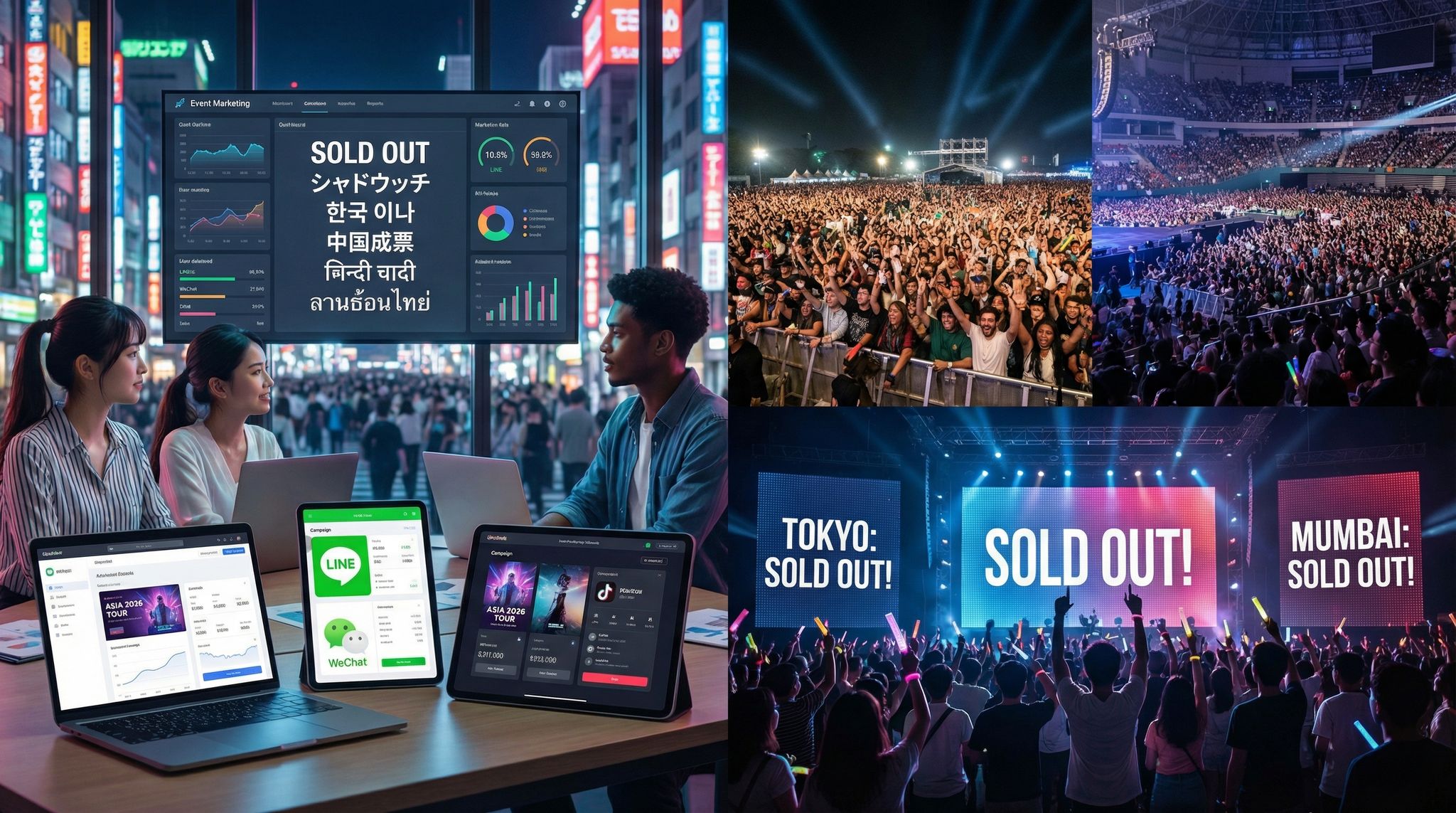
Asia is home to over half the world’s population – and by 2026, it’s driving a massive boom in live events. From mega music festivals to niche fan conventions, demand is surging across the continent. In fact, Asia-Pacific now accounts for roughly 60% of global social media users, reflecting the region’s huge connected audience and marketing potential as highlighted in recent data on Asian e-commerce and social trends. For event promoters, this means an unprecedented opportunity to reach vast crowds – if you can navigate Asia’s unique digital landscape and diverse cultures. Successful campaigns in Asia have led to sold-out stadium tours in India, multi-city festival expansions in China, and record-breaking concert attendance in Japan. The key? Embrace a think global, market local mindset, adapting every aspect of your strategy to resonate with local fans by adapting your event marketing for different markets.
Diversity from India to Japan: One Size Won’t Fit All
Asia is anything but a monolith. The region spans dozens of countries and hundreds of languages and dialects, each with distinct cultural norms and media habits. For example, India alone has 22 official languages and countless dialects, meaning a single English ad will miss vast swaths of potential fans, a challenge often cited in guides on local language marketing in India. Likewise, what works to engage rock fans in Tokyo might fall flat for EDM lovers in Jakarta. Experienced event marketers know that localized content is crucial – audiences respond best to messaging in their own language, with references to their values and lifestyle. A flashy campaign that sells out a show in Los Angeles won’t automatically translate to Seoul or Mumbai without tailoring. The lesson: to win over Asian event-goers, you must deeply understand each target market’s language, platforms, and cultural quirks. As one veteran promoter puts it, “global vision must be executed with local precision” to avoid neglecting local customs and preferences.
Opportunities and Challenges in Asia’s Digital Landscape
Introduction: Asia’s Booming Live Event Scene in 2026
The World’s Largest Audience Goes Live
Asia is home to over half the world’s population – and by 2026, it’s driving a massive boom in live events. From mega music festivals to niche fan conventions, demand is surging across the continent. In fact, Asia-Pacific now accounts for roughly 60% of global social media users, reflecting the region’s huge connected audience and marketing potential as highlighted in recent data on Asian e-commerce and social trends. For event promoters, this means an unprecedented opportunity to reach vast crowds – if you can navigate Asia’s unique digital landscape and diverse cultures. Successful campaigns in Asia have led to sold-out stadium tours in India, multi-city festival expansions in China, and record-breaking concert attendance in Japan. The key? Embrace a think global, market local mindset, adapting every aspect of your strategy to resonate with local fans by adapting your event marketing for different markets.
Diversity from India to Japan: One Size Won’t Fit All
Asia is anything but a monolith. The region spans dozens of countries and hundreds of languages and dialects, each with distinct cultural norms and media habits. For example, India alone has 22 official languages and countless dialects, meaning a single English ad will miss vast swaths of potential fans, a challenge often cited in guides on local language marketing in India. Likewise, what works to engage rock fans in Tokyo might fall flat for EDM lovers in Jakarta. Experienced event marketers know that localized content is crucial – audiences respond best to messaging in their own language, with references to their values and lifestyle. A flashy campaign that sells out a show in Los Angeles won’t automatically translate to Seoul or Mumbai without tailoring. The lesson: to win over Asian event-goers, you must deeply understand each target market’s language, platforms, and cultural quirks. As one veteran promoter puts it, “global vision must be executed with local precision” to avoid neglecting local customs and preferences.
Opportunities and Challenges in Asia’s Digital Landscape
What makes 2026 a breakout year for events in Asia? On one hand, rising incomes and youth populations mean millions of new potential ticket buyers entering the market. Major international tours and festivals are finally coming to countries like India, Vietnam, and the Philippines – often for the first time – feeding a huge pent-up appetite for live experiences. On the other hand, marketers face challenges from fragmented media ecosystems and local regulations. China’s strict internet controls, for instance, require navigating a “walled garden” of domestic apps instead of the global social networks most Western promoters know, as detailed in strategies for adapting event marketing globally. In Southeast Asia, connectivity can vary between urban and rural areas, making offline tactics still relevant when promoting events in emerging markets. Moreover, cultural expectations differ – from how consumers view promotional hype to the timing of buying tickets (many Asian audiences skew toward last-minute purchases, as we’ll discuss later). In short, Asia offers massive rewards for event marketers, but only if you do your homework for each locale. The rest of this guide will arm you with strategies – from leveraging region-specific platforms like WeChat and LINE to respecting cultural holidays – to help sell out events across Asia’s diverse markets.
Localizing Language and Content for Asian Audiences
Navigating Asia’s Language Diversity
One of the first rules of marketing in Asia is simple: speak your audience’s language – literally. With hundreds of languages across the continent, translating and localizing your content is non-negotiable. Savvy promoters create separate campaigns for each major market, ensuring ads, emails, and websites are in the local language (or at least subtitled). For example, a pan-Asia tour announcement might have an English version for Singapore, a Hindi version for India, a Mandarin version for China, and a Japanese version for Japan. It’s not just about words, but context: use local idioms, honorifics, and cultural references that make fans feel “this event is for people like me.” When targeting India’s 1.4 billion people, remember that more than 22 official languages are in use according to insights on Indian media operations – Hindi might cover North India, but reaching South Indian fans could require Tamil, Telugu, or Kannada content. Similarly, a U.S. or U.K. festival expanding to Asia must avoid a one-size English campaign as noted in best practices for international event adaptation; even if some younger fans speak English, using Japanese for Tokyo or Bahasa Indonesia in Jakarta shows respect and dramatically boosts engagement. Prioritize professional translation and local copywriters – an automated translate tool can miss nuances or, worse, produce embarrassing gaffes.
Cultural Nuance in Messaging and Imagery
Effective localization goes beyond language. Cultural norms, symbols, and humor vary widely and can make or break your campaign. Something as simple as a color or number can carry deep meaning – for instance, in China the color red signifies luck (great for a festive event theme), while white is associated with mourning (not ideal for your promotional materials), a nuance discussed in cultural considerations for event marketing. Likewise, the number 4 is avoided in many East Asian countries because it sounds like the word for “death” in Chinese and Japanese. Smart event marketers adjust creative assets accordingly: they might design alternate artwork for an Asia tour leg, swapping out visuals or phrases that might be misinterpreted. Imagery should also reflect local faces and fashion where possible, so audiences identify with it. Even tone matters – a sarcastic or edgy tagline that works in New York might offend more conservative sensibilities in parts of Asia. Case in point: an international DJ festival learned this the hard way when their generic promo slogan was awkwardly translated for an Asian market, coming off as bizarre and mistranslated, which required review by native speakers to correct. The fix was to hire a native speaker to rewrite the copy with a local pop-culture reference, which immediately clicked with fans. The bottom line: invest time in understanding local culture – consult native staff or partners, do small focus groups if needed, and double-check all messaging with cultural insiders. Avoiding missteps here builds credibility and trust with your audience from the start.
Balancing English vs. Local Languages
While localization is key, there are scenarios where a blend of English and local language can be effective. In cosmopolitan cities like Singapore, Hong Kong, or Dubai, for example, marketing materials often mix English with local languages because of bilingual populations. Know when to use English terms for clarity or brand consistency, and when to lean fully into the native language. A music festival in Tokyo might keep artist names and certain global terms (like “VIP” or “Backstage Pass”) in English, since those are widely recognized, but still run the bulk of ads and announcements in Japanese. In India, English is common among urban youth, but if you’re promoting a show in smaller cities or targeting older demographics, adding Hindi (or relevant regional languages) will drastically increase reach. Many Indian event promoters create bilingual content – an Instagram caption might have a catchy English line and a Hindi tagline, for instance. Another tactic is using transliteration, writing an English phrase in local script to make it more visually familiar. For cross-border events or destination festivals aiming to attract travelers from multiple Asian countries, consider maintaining separate social media pages per language to help in breaking language barriers for international audiences. For example, an international EDM festival might run one Facebook page in English and another in Thai to engage local Thai fans. The key is to avoid assuming everyone will adapt to you – show that you’ve made the effort to communicate in the audience’s preferred way. Not only does this boost marketing performance, it also demonstrates respect, which goes a long way in building goodwill in Asian markets.
Dominating Asia’s Unique Social & Messaging Platforms
India & Southeast Asia: Facebook, Instagram & WhatsApp Reign
Outside of China, much of Asia actively uses the global social media giants – but with local twists. In India, for example, Facebook, Instagram, and YouTube are hugely popular (with hundreds of millions of users), making them core channels for event marketing as noted in reports on Asian social media trends. Instagram Reels and YouTube Shorts effectively fill the void left by TikTok’s ban – marketers targeting India lean heavily on these for short-form video content to reach audiences via Instagram Reels. (India banned TikTok in 2020, cutting off what was then over 200 million users, so reaching Gen Z now requires alternatives like Reels, a shift documented in analysis of India’s TikTok ban impact.) Facebook remains important for broad reach and community building in India, especially via event pages and local interest groups. WhatsApp is the other juggernaut – with an estimated 500+ million Indian users, it’s used not just for chat but as a content-sharing network. A viral event flyer or ticket link on WhatsApp can spread like wildfire through friend groups and family circles. Across Southeast Asia, a similar pattern holds: Meta platforms dominate, but local adoption is uniquely high. Countries like the Philippines and Indonesia rank among the most active Facebook and Instagram user bases in the world. TikTok usage is exploding in Southeast Asia too – Thailand, Vietnam, and Indonesia all see massive engagement on TikTok for music and event content, according to emerging festival market data. One recent survey even showed Thailand leads the world in TikTok engagement for users under 25. However, messaging apps often beat traditional social feeds for reach: WhatsApp is king in most of Southeast Asia (Indonesia, Malaysia, Singapore, etc.), while Thailand stands out with LINE as a top app. Effective marketers tailor their channel mix per country – for a Southeast Asia tour, you might run Facebook Ads in English for Singapore, buy TikTok ads in Bahasa for Indonesian cities, and launch a LINE Official Account to engage Thai fans with direct messages. Meeting fans on their preferred platforms is non-negotiable, often requiring you to combine YouTube artist interviews with other local channels – if you stick only to Western networks, you’ll simply miss huge swaths of the conversation.
Japan (& Korea): LINE, Twitter & Local Networks
Japan’s social media landscape is famously unique. While younger audiences do use Instagram, YouTube, and TikTok, the country’s most ubiquitous digital platform is LINE – a messaging-first “super-app” used by around 95 million people in Japan (over 75% of the entire population) according to regional social media platform insights. LINE isn’t just chat; it offers news, shopping, payment, and social timeline features, making it akin to Japan’s version of WeChat. For event marketers, this means two things: (1) You need a presence on LINE (e.g. an Official Account for your event or brand) to push out updates, ticket releases, and promotions directly to fans’ chat feeds. And (2) Advertising on LINE’s platform can be very effective – LINE offers targeted ad placements in users’ timeline and even special sponsored stickers, which event campaigns have used creatively (imagine a sticker pack of a festival’s mascot that fans share). Another quirk of Japan is the outsized role of Twitter. Twitter (recently rebranded as X) is far more popular in Japan than in many other countries – Japan is actually Twitter’s second-largest market by revenue. Concerts and festivals in Japan often trend on Twitter, and Japanese fans use it as a real-time news source and discussion forum. A well-placed hashtag campaign or artist Q&A on Twitter can generate major buzz among Japanese audiences. South Korea shares some similarities – KakaoTalk is the dominant messenger there (used by 90%+ of Koreans), and it has its own ecosystem including KakaoStory (social feed) and KakaoTV. Key takeaway: East Asian markets like Japan and Korea require tapping into their homegrown networks. It’s telling that in Japan, Facebook reaches only about 26 million users compared to LINE’s 95 million, a disparity highlighted in analysis of LINE’s market dominance; a promoter who ignores LINE in favor of Facebook would be handicapping their reach. Successful events in Tokyo and Seoul routinely combine global platforms with local ones – for example, a campaign might use YouTube for posting artist announcement videos (since YouTube is widely viewed in Japan), but drive traffic to those videos via LINE and Twitter posts in Japanese. By blending into the daily digital life of Japanese and Korean fans, you drastically increase your marketing touchpoints.
When executing these localized strategies, understanding what constitutes a successful metric is vital. Typical conversion events used in Japan-focused campaigns often look different from Western standards. Instead of optimizing solely for immediate direct-to-consumer ticket purchases, savvy promoters track intermediate milestones. These include acquiring new subscribers on a LINE Official Account, securing entries into a pre-sale ticket lottery (known locally as chusen), or logging ticket reservations that will be paid later in cash at a convenience store. By focusing on these specific micro-conversions, event marketers can build robust, highly engaged retargeting audiences well before the general on-sale begins.
China: The WeChat Universe & Douyin Buzz
Mainland China presents a completely self-contained digital world. With global social media like Facebook, Instagram, and WhatsApp all banned in China, event promoters must master the native platforms. At the center is WeChat (Weixin), China’s do-everything app with over 1.38 billion monthly active users as of late 2024, as reported in statistics on WeChat’s user base. WeChat is not just a messenger; it’s effectively a social network, payment service, ticketing portal, and web browser combined. Promoting an event in China in 2026 means establishing an official WeChat presence – typically by creating a WeChat Official Account (similar to a Facebook Page) to publish content and updates. You can geo-target posts to followers in a certain city, use WeChat’s mini-programs to sell tickets directly inside the app, and even set up group chats or communities for your event. Many Western festivals expanding to China partner with local agencies who specialize in WeChat marketing to navigate the subtleties (such as content censorship rules and optimal posting times). Beyond WeChat, China has a constellation of other influential platforms: Weibo (a microblogging site akin to Twitter) is key for public visibility and trending hashtags; Douyin (the original Chinese version of TikTok) is huge for short video content and challenges; Xiaohongshu (RED) is popular for lifestyle content and reviews (imagine a hybrid of Instagram and Pinterest where users share finds – useful for events via attendee testimonials and fashion posts); and Bilibili is a favorite for live streaming and youth subcultures (especially for anime, gaming, and music events). Each platform serves a niche – for instance, Weibo might be where you announce the festival lineup to get media buzz, Douyin is where you run creative video teasers or influencer takeovers to go viral, and RED could be where you encourage attendees to post aftermovies or tips (turning them into micro-influencers). The golden rule for China is to dedicate separate content and campaigns tailored specifically for these domestic channels, avoiding a one-size-fits-all approach to Chinese platforms. You’ll likely need Mandarin-language community managers to engage fans – responding to comments on Weibo, answering questions in WeChat, etc. The effort is significant but necessary: an event that ignores China’s digital ecosystem will remain invisible to Chinese consumers. Those who invest, however, can tap into a massive market of experience-hungry young people. A great example is how some global EDM brands succeeded in China by working with local KOLs on Douyin and streaming parts of their festival on Bilibili, pulling in millions of views and driving ticket demand for the next edition by relying on influencers’ recommendations. In summary, to crack China you must “go native” on platforms – the payoff is accessing one of the world’s largest pools of fans through channels they implicitly trust and use daily.
Ready to Sell Tickets?
Create professional event pages with built-in payment processing, marketing tools, and real-time analytics.
For organizers, utilizing a WeChat mini program for ticketing events is a game-changer when it comes to conversion rates. Because these lightweight applications live entirely within the messaging ecosystem, fans never have to open an external browser or create new accounts to secure their passes. A well-designed native applet allows promoters to customize the seat selection interface, push real-time schedule updates, and seamlessly process transactions via WeChat Pay. Furthermore, operating your own embedded box office gives you direct access to invaluable attendee data and analytics, enabling highly targeted retargeting campaigns for future tours or festivals in the region.
Beyond direct ticketing, organizers can leverage broader ecosystem insights to gauge regional demand for niche subcultures. For instance, analyzing recent Meituan travel data reveals the massive economic impact of anime conventions across Chinese host cities. When a major ACG (Anime, Comic, and Games) event is announced, platforms like Meituan often record a sharp, immediate spike in local hotel bookings, high-speed rail reservations, and nearby restaurant traffic. Savvy promoters use these tourism metrics to negotiate lucrative sponsorship deals with local hospitality brands and to bundle event passes with travel packages, maximizing revenue from out-of-town attendees.
Messaging Apps and “Dark Social”: Word-of-Mouth Engine
Group Chats, Communities & “Dark Social” Buzz
Across Asia, messaging apps are often the real powerhouses behind event buzz. Whether it’s WeChat in China, WhatsApp in India, LINE in Japan, or Telegram in various countries, people increasingly share event news peer-to-peer, which marketers call “dark social” because it’s hard to track. These private or closed channels – group chats, DMs, community forums – are where enthusiastic fans become your unofficial marketers by spreading the word among friends, creating FOMO among their followers. Tapping into this requires a strategy beyond public posts. For one, create shareable content that fans will want to forward: think bite-sized posters or flyers formatted for mobile, quirky GIFs or stickers, and short announcement videos compressed for easy sending. A great tactic is to launch a WhatsApp or Telegram broadcast list for your event, where people can opt-in to receive announcements, then periodically drop exciting news (lineup reveals, contest alerts) that subscribers will forward to their friend groups. In China, WeChat groups are a major force – savvy promoters seed dedicated WeChat groups for specific attendee communities (e.g. VIP ticket holders, or fans from the same city traveling to a festival) to cultivate FOMO and encourage them to invite others. Real-world example: A music promoter in Southeast Asia gave local fan club admins special early info and custom referral links, and those fan group chats drove over 30% of ticket sales for a show via peer-sharing, demonstrating the impact of dark social referrals. The lesson is clear: the personal recommendation in a chat is more persuasive than any ad. Make it easy – give superfans exclusive content or discount codes to share privately, and watch the ripple effect.
Broadcasting on Super-Apps: Reaching Fans Directly
Unlike open social media, messaging apps allow direct, subscription-like communication with your audience – with astounding engagement rates. For instance, messages on WhatsApp often see open rates north of 95%, far higher than email or Facebook posts, according to marketing software statistics. This is a huge opportunity to ensure your key updates are seen. Many promoters are now using WhatsApp Business or Telegram channels to blast out ticket on-sale reminders, “last chance” alerts, and even personalized invite videos from artists. Because users have to opt in, they tend to be highly interested fans – the people mostly likely to convert to ticket buyers. Similarly, WeChat Official Accounts work like a direct news feed in China. When fans follow your Official Account, you can send them article-like posts or short messages that appear in their app – essentially doing content marketing within WeChat. The smart approach on these super-apps is to mix information with engagement: don’t just push sales, also offer value like tips (“5 Ways to Get Ready for the Festival”), behind-the-scenes peeks, or interactive polls (“Which song should our headliner play first?”) via messaging. Remember to respect frequency and privacy – spammy over-messaging will cause fans to unsubscribe or mute you. But used thoughtfully, direct messaging is a goldmine for guiding the fan journey from awareness to purchase. For example, you might send a broadcast: “?? Tickets 80% sold out – get yours before Friday!” with the ticket link, leveraging that near-100% open rate to drive urgency. Or post a LINE Today news snippet (in Japan/Thailand) highlighting a cool festival attraction, which feels more like content than an ad. With messaging, you’re effectively running a concierge or insider news service for your event – which not only sells tickets but also builds a loyal community around your brand.
Turn Fans Into Your Marketing Team
Ticket Fairy's built-in referral rewards system incentivizes attendees to share your event, delivering 15-25% sales boosts and 30x ROI vs paid ads.
Converting Chat Engagement into Ticket Sales
The final step is turning all that chat activity into actual attendance. One best practice is to integrate your ticketing process seamlessly with chat apps. For instance, in China you would enable in-app ticket purchases via a WeChat mini-program or QR code link so that when someone hears about your event in a group chat, booking is just one tap away. In other markets, consider adding a WhatsApp “Chat with us” widget on your ticket page so interested buyers can easily ask questions – this is crucial in cultures where personal reassurance is valued before purchase. As an example, an Indonesian concert saw a significant boost in conversions by staffing agents on WhatsApp to handle queries about the event and payment options; answering a simple question like “Are kids allowed entry?” in real-time can be the difference between a sale or an abandoned cart. Pre-sale customer support via messaging – whether through a human or a chatbot – can alleviate doubts and nudge fence-sitters toward buying, often utilizing WhatsApp for headliner announcements or flash sales. Another proven tactic is to drop limited-time promo codes or flash sale links into your owned channels (like a Telegram group for subscribers) to reward those engaged fans with a deal, instantly driving a surge in sales from your most eager audience segment. Always include clear calls-to-action in your chat communications: if you announce new tickets released or a venue upgrade, attach that purchase link or a big “Buy Now” button sticker. Track what you can – use UTM tagged URLs for each channel to see where final sales are coming from. While dark social makes 100% attribution tricky, regular surveys or post-event data can reveal, for example, that “X% of attendees heard about the event through WhatsApp or WeChat,” validating the effort you put into those channels. The overarching point is that messaging apps are not just for marketing pushes, but for facilitating the entire customer journey. By meeting fans in chat with engaging content and helpful support, you remove friction and build excitement – translating digital word-of-mouth into sold-out shows.
Influencers and KOLs: Harnessing Community Voices
Collaborating with Local Influencers & Celebrities
In Asian markets, leveraging influencers – both mega-celebrities and micro-creators – is often the catalyst that elevates an event’s profile. The influencer ecosystems are quite developed; for instance, China has Key Opinion Leaders (KOLs) who command enormous followings on WeChat, Douyin, or Xiaohongshu and can single-handedly sway trends. When marketing an event, partner with influencers whose audience aligns with your target attendees. In India, that might mean engaging a popular YouTuber or Instagram comedian to create hype skits about your comedy festival. In Japan, it could involve a well-known TV tarento or TikTok dance creator posting about your music event in Japanese. Authenticity is crucial – Asian audiences are very attuned to tone, and influencers who genuinely enjoy or fit the event (versus doing a forced promo) will drive better results, functioning almost like extended friends within the culture. A great strategy is to give influencers creative freedom to localize your message: for instance, an Indonesian influencer might bilingualize their posts in English and Bahasa and add local humor when talking about your event, making it more relatable. Also consider platform-specific influencer tactics: a Chinese food vlogger on RED could vlog the food offerings at your festival, or a Thai celebrity might do a LINE live stream Q&A about the concert. Negotiating these partnerships can take time – be prepared to offer influencer perks like VIP tickets, meet-and-greets, or commission via affiliate ticket links. A case study: When the ultra-popular Korean band Blackpink toured Asia, promoters in each country worked with homegrown influencers (from Malaysian pop stars to Japanese fashion bloggers) who attended and posted live content from the shows, resulting in huge organic reach and faster ticket sell-outs. The key is aligning on a narrative – make sure influencers highlight what will appeal most locally, whether that’s “the first time this DJ is playing in Manila!” or “a festival experience celebrating local art in Seoul.” By amplifying your campaign through voices that local fans already trust and follow, you essentially tap into built-in communities instead of having to build your own from scratch.
Grow Your Events
Leverage referral marketing, social sharing incentives, and audience insights to sell more tickets.
Building Trust Through Authentic Community Engagement
In many Asian cultures, trust and word-of-mouth carry even more weight than in the West. Slick ads alone won’t fill venues – you need authentic voices vouching for your event. This is where community engagement and micro-influencers shine. Rather than only chasing celebrity endorsements, identify passionate local community leaders and niche influencers: the Tokyo anime artist with 30k loyal followers who’d love your comic-con, or the Bangkok fitness coach whose bootcamp group might attend your wellness retreat. These folks may not be traditional “influencers,” but in their circles they have tremendous credibility. Engaging them could be as simple as offering a group discount or inviting them to host a small session during your event (e.g. a local DJ gets a side-stage slot at your festival). Such gestures turn influential fans into event ambassadors, and their genuine enthusiasm can persuade many peers to join. It’s also important to interact directly with your audience on social platforms to build trust. For instance, respond to comments in local language, repost user-generated content from fans, and show behind-the-scenes human touches (like a video of your team doing a local food tasting while on a promo trip – signaling you appreciate the culture). Transparency and reliability are part of authenticity too. Ensure your promotion promises align with the actual event experience – under-delivering is a fast way to lose trust, and Asian consumers quickly share negative experiences through networks. One common pitfall is overlooking customer service tone: a canned response might be fine in one country, but in others a more polite, formal reply is expected. Ultimately, if your marketing feels like a conversation within the community rather than a corporate broadcast, fans will welcome you. Many seasoned promoters note that in Asia, once you win a core fanbase’s trust, they become your strongest marketers, evangelizing your event to friends and family as seen in strategies for community-based marketing. That kind of community word-of-mouth is priceless – and it’s earned through authenticity every step of the way.
Fan Ambassador & Referral Programs
Sometimes the most powerful “influencers” are regular fans with a passion for your event. Turning enthusiastic attendees into official ambassadors can supercharge your marketing in Asia, where personal networks are tightly knit. Referral programs are a proven way to do this: you give selected fans a unique referral link or code, and reward them (with merch, free tickets, VIP upgrades, etc.) for each sale they drive. In practice, it creates an army of micro-promoters who promote the event out of genuine excitement and a desire to unlock rewards, a tactic detailed in guides on fan ambassador programs. According to Ticket Fairy’s platform data, robust ambassador programs typically generate 15–25% of total ticket sales for events, with ROI often over 20:1 since fans essentially do the marketing for free aside from small rewards, proving that personal recommendations are more persuasive than any ad. This strategy has worked wonders in Asia. For example, a 2025 festival in Singapore recruited student ambassadors at local universities; they shared a steady drip of event content and ticket links into campus group chats and Instagram stories, contributing to a significant chunk of early ticket sales. In India, where family and friend groups are especially influential in decision-making, referrals can tap into the dynamic of “if my friend goes, I’ll go.” We’ve seen New Year’s parties in Mumbai sell out solely through WhatsApp referrals by offering top referrers free table packages – a tactic noted in guides on capturing hidden word-of-mouth marketing. To succeed, carefully plan and support your ambassadors: provide them with a toolkit (branded images, suggested captions in the local language, maybe even physical flyers), create a sense of exclusivity (e.g. a private group or kickoff meeting for ambassadors), and keep them motivated with shout-outs or progress updates on how their efforts are contributing. Monitor the program closely – a spike in referral traffic can help you identify which ambassadors or communities are most effective. By empowering passionate fans, you not only boost ticket sales but also deepen these fans’ loyalty (they feel like part of the team). It’s a perfect example of community co-creation – the audience isn’t just passively consuming your marketing, they’re actively shaping the event’s success alongside you.
To maximize the impact of these referral networks, some forward-thinking promoters go a step further by hosting a localized social media platform conference or digital bootcamp prior to the main event. By inviting aspiring event marketers, local micro-influencers, and university students to learn advanced promotional tactics, organizers effectively train a dedicated street team. This B2B community-building approach ensures that ambassadors are fully equipped to leverage regional apps and drive maximum ticket conversions.
Blending Online and Offline Marketing Tactics
Local Media and PR: Getting Covered in the Press
While digital channels dominate in 2026, traditional media and PR still play a role in Asia, especially for establishing credibility. A well-placed feature on a local news site, radio show, or in a city lifestyle magazine can expose your event to new audiences who might not see your ads. Each country has its own media culture: for example, Japan and Korea have a very formal press environment – major events often hold press conferences or issue comprehensive press kits in the local language, and media outlets expect a certain level of protocol and exclusivity, meaning if the media isn’t covering it, it must not matter. If you’re bringing a big festival to Japan, investing in a polished Japanese press release and perhaps partnering with a local PR firm can pay off with coverage in newspapers or TV that lend your event legitimacy. In contrast, markets like Indonesia or the Philippines have a thriving blog and vlogger scene; inviting influential bloggers or YouTube reviewers to a pre-event media day (where they can interview artists or tour the venue setup) can result in a flood of content that reaches millions. Don’t overlook radio either – in many Asian cities, radio remains popular during commutes, and a fun on-air ticket giveaway or artist interview on a top station (like Hardwell dropping by a dance station in Kuala Lumpur) can spark interest. When doing PR, always angle your story to what’s newsworthy locally: it could be an economic impact angle (“this festival is expected to bring tourism revenue to Goa”), a cultural milestone (“first time a female DJ headlines a major show in this city”), or a tie-in with a community cause. Also, adapt your PR etiquette to the country. In some places, a cheeky publicity stunt might get tabloids talking, whereas in others, a respectful approach wins the day as seen in case studies of localization wins and missteps. For instance, a flashy flash mob promotion might be great in Malaysia (and go viral on social media), but in Japan a more formal partnership with a respected brand or institution could have a bigger impact. The goal is to secure coverage or buzz from voices that locals trust – hearing about an upcoming event on the evening news or a popular podcast can strongly validate it in the eyes of potential attendees.
Smart Promo Codes & Presale Access
Create percentage or flat-rate discount codes with usage limits, date ranges, and ticket type restrictions. Plus unlock codes for private presales.
For organizers looking ahead, successful public relations event ideas in Japan for 2026 often revolve around exclusive, high-touch experiences. Rather than generic blasts, tailored PR activations—such as invite-only media previews in upscale Tokyo venues or collaborative pop-ups with local fashion brands—generate significant traction. Staying current with event marketing Japan news is crucial here; recent trends show that Japanese media outlets heavily favor campaigns that blend international prestige with local craftsmanship. By monitoring Japan event industry news for 2026, promoters can time their press conferences to coincide with emerging cultural trends, ensuring their public relations efforts feel timely and highly relevant to local journalists.
To continuously refine these strategies, international promoters must keep a close pulse on the broader market. Subscribing to specialized trade publications and monitoring Japan event industry news throughout 2026 provides critical intelligence on shifting consumer behaviors, new venue openings, and evolving sponsorship regulations. For instance, recent event marketing updates in Japan highlight a growing preference for hybrid digital-physical activations, such as AR-enhanced pop-up shops in Shibuya. By staying informed on these regional industry developments, organizers can pivot their public relations event ideas to match the exact expectations of both local media and ticket buyers.
For those focusing on the capital’s hyper-competitive landscape, tracking Tokyo event marketing news is particularly vital. The city’s distinct ward-level demographics—from Shibuya’s youth-driven pop-ups to Roppongi’s premium nightlife—mean that a successful activation requires hyper-local intelligence. Promoters should follow regional B2B newsletters and local agency blogs to catch early signals on venue regulations, emerging digital platforms, and shifting consumer preferences specific to the Tokyo metropolitan area.
Street Teams, Posters and On-Ground Buzz
On the streets of Asia’s cities, old-school marketing still grabs attention. Walk around areas like Hongdae in Seoul, Shibuya in Tokyo, or Bandra in Mumbai, and you’ll notice posters for shows plastered on walls, flyers handed out at related events, and even trucks driving by with event billboards. These grassroots tactics are alive and well because they complement digital outreach by making the event feel ubiquitous. If a young professional hears about a concert online and then also sees a flyer at their favorite cafe and a billboard on their commute, it reinforces that “this is a big deal.” Coordinating a street team isn’t as archaic as it sounds – in 2026, many promoters use data to target flyering at just the right places. For example, if you’re promoting a Korean indie band’s gig in Bangkok, you might deploy street team members to hand out flyers in areas where Thai K-pop and indie fans hang out (like Siam Square), perhaps on weekends when foot traffic is high. In markets like Latin America and parts of Asia, we’ve seen how blending digital and physical marketing yields great results – the same applies here. Consider postering in local language: a poster in Mandarin or Thai will stand out and connect more than an English one in those countries. Also think beyond posters – branded activations can double as promotion. For instance, a festival in Malaysia once set up a pop-up DJ booth in a busy mall where local DJs played mini-sets; they drew crowds and distributed promo cards with a discount QR code. Even at aligned events (say you are promoting a comic con, you send costumed street team members to a superhero movie premiere night to tease it), these stunts not only spread awareness but also show your engagement with the community. And don’t forget campus marketing if your event appeals to students: in many Asian countries, universities allow limited postering or club presentations. A quick talk or flyer drop at college music clubs in Jakarta or Delhi can ignite word-of-mouth among younger fans who are very active on social media, effectively turning physical outreach into digital chatter. The key is integration – every flyer, poster, or sticker should include your event website or a QR code to follow for more info, seamlessly connecting offline curiosity to online conversion.
Immersive Activations and Experiential Marketing in Southeast Asia
For promoters operating in regions like Thailand, Vietnam, and Indonesia, Southeast Asia experiential marketing has become a critical differentiator. Rather than relying solely on traditional digital ads, organizers are creating immersive, interactive pop-ups that allow fans to physically engage with the event brand before buying a ticket. For example, a major music festival in Jakarta might host a pre-event VR booth in a high-traffic shopping mall, letting passersby experience a 360-degree view of the previous year’s main stage. These tactile brand activations not only generate immediate social media sharing but also build a deeper emotional connection with potential attendees, driving higher conversion rates in highly competitive markets.
Brand Partnerships and Sponsorship Activations
Partnering with local brands, organizations, or even government tourism boards can significantly amplify your reach in Asia. A well-chosen sponsorship or co-promotion not only provides extra marketing muscle (and budget) but also lends local credibility to your event. For example, if you’re organizing an EDM festival in India, teaming up with a giant like Jio or Pepsi could land you on millions of soda bottles or telecom app ads, instantly boosting exposure. Likewise, a collaboration with Tourism Authority of Thailand for a festival in Phuket could get your event featured in official travel campaigns and airport billboards. The trick is to align with partners that share a target demographic. In Japan, we often see music festivals pair with trendy beverage or fashion brands – beyond just logos on flyers, they create joint content like limited-edition products or social media contests (“Post a pic with the new ‘Festival Latte’ and win VIP tickets!”). These integrations localize the event’s presence by tapping into an existing customer base. Another angle is partnering with venues and local promoters. If you’re touring an international theater production through Asia, connecting with a well-known local promoter or venue chain in each country can massively help – they’ll bring their own mailing lists, media contacts, and on-ground know-how. This collaborative approach is essentially plugging into local networks rather than going it alone. Even media partnerships (e.g. official radio partner, official streaming partner) should be explored: a top streaming platform in China might agree to broadcast parts of your event, or a leading lifestyle magazine in Malaysia might run a cover story on your headliner in exchange for presenting sponsorship. These deals require coordination to fulfill both parties’ goals (brand visibility for them, promotion for you) – make sure to deliver value to the partner, whether it’s on-site activations, exclusive content, or hospitality. When done right, collaborative event marketing creates a win-win synergy where you gain local clout and extra channels, and partners benefit from associating with a cool experience that engages their audience, often leveraging popular local DJs and graphics. Just be mindful to choose partners whose image aligns with yours and avoid over-commercializing the fan experience – the integration should feel additive (enhancing the event with fun extras) rather than distracting or inauthentic.
Free Tool: Split Tickets for Max Gross
Given capacity and a target price, the optimizer proposes Early Bird / GA / VIP allocations and prices — with projected gross at 100%, 80% and 60% sell-through.
Timing and Cultural Calendars: When to Promote and Host
Navigating Holidays and Festival Seasons
Asia’s calendar is packed with cultural and religious holidays that can dramatically impact your event marketing timeline. Ignoring these dates is a recipe for disaster, but leveraging them can be a boon. Always research the major holidays in your target markets: Chinese New Year, Diwali, Eid al-Fitr, Songkran (Thai New Year), Obon, Golden Week, and many more. During these periods, typical consumer behavior shifts – people may travel to their hometowns, spend time with family, or simply be less focused on entertainment. For example, launching ticket sales for a Malaysian concert during the week of Chinese New Year would be unwise, as many potential buyers are offline or away. Either avoid scheduling events on or very near major holidays (unless your event is tied to that celebration), or if you do, incorporate the holiday in your theme to make it part of the appeal. Some events successfully turn holidays into selling points, like a New Year’s Eve music festival in Bali targeting international travelers, or a Diwali-themed comedy night that embraces the season’s spirit. Just be cautious: in multi-ethnic societies like Singapore or India, there’s a major festival every few weeks across different communities – you won’t avoid everything, but do sidestep the biggest clashes and show cultural respect in marketing when a country is in holiday mode. Timing your promotional push around local seasons is also smart. Summers and winters flip across hemispheres: an Australian tour might need heavy promotion in their spring (Sep/Oct) for summer shows in Jan, whereas in Japan the prime concert season is summer so you’d build hype in spring. Also note school exam seasons if you target youth – e.g. avoid marketing a college event in India during April’s exam period or in June for the Chinese Gaokao exams, when students drop extracurricular plans. By syncing with the rhythms of local life, you can schedule announcements, on-sales, and media events for moments when fans are most receptive and free to engage.
Weather, Seasons and Local Climate Factors
Asia’s climate varies from tropical monsoons to arid desert heat, and it should influence your event plans and marketing. A practical consideration: don’t plan outdoor concerts in the monsoon season for regions like India, Southeast Asia, or parts of China. Heavy rains and storms often hit between June and September in these areas. Fans know this and might avoid buying tickets for an event in, say, coastal India in July due to fear of a washout. As a marketer, you either schedule around these or heavily emphasize contingency plans (covered areas, rain or shine policies) if you must hold an event then. Monsoon weather can make or break attendance – trying to sell a festival during peak rains is notoriously tough. Similarly, consider extreme heat or cold: an outdoor festival in Dubai or Mumbai in peak summer (40°C+ temperatures) will be a hard sell unless it’s night-time or you highlight cooling measures. In Japan, many events avoid the mid-August Obon week not just for holidays but also because it’s swelteringly hot and humid – late August or early September fares better. Seasonality also affects when people are in ‘event-going’ mindset. For instance, spring and autumn are prime festival seasons in many parts of Asia, with milder weather and multiple public holidays (Golden Week in East Asia around April/May; fall harvest festivals in September/October). On the flip side, Ramadan is a holy month observed by many in Indonesia, Malaysia, parts of India, etc., where many people fast during the day and cut back on nightlife – scheduling a loud music event during Ramadan could be seen as insensitive and likely won’t draw crowds (though events after the fasting period, for the Eid celebrations, can be huge). Understanding these patterns lets you time your promotions wisely. If you know a rainy season lull is coming, you might start early bird sales before it and then re-engage fans with deals once the skies clear. Or if there’s a big holiday period when people travel (like Chinese New Year or Songkran), consider pausing major ad spend during those weeks and saving your budget for when everyone’s back and looking for things to do. Local climate knowledge isn’t just an operations issue – it’s a marketing necessity to ensure you’re not shouting into the void when audiences are hibernating from heat, humidity, or storms.
Adapting to these cultural calendars also requires specialized promotional assets. For example, as organizers plan for the upcoming year, many are developing specific Ramadan discount code templates for 2026 to use across Southeast Asia, including niche markets like Vietnam. By offering tailored promotional codes that activate during evening Iftar hours, promoters can respectfully drive ticket sales without disrupting daytime fasting observances, demonstrating both cultural awareness and strategic timing.
Ticket Buying Habits: Early Birds vs. Last-Minute Bookers
One of the trickiest aspects of event marketing is predicting when people will actually buy, and in Asia those patterns can differ from Western norms. In some Asian markets, attendees are notorious for last-minute ticket purchases – which can panic an inexperienced promoter who expects a steady build-up. For instance, countries like India, Indonesia, and even Japan to an extent often see a huge proportion of tickets sold in the final few weeks or even days before an event. There are cultural and practical reasons: some fans wait to see if an event will be successful or if friends are going, others may be paid monthly and buy after payday, and there’s a general habit in certain places of deciding plans closer to the date. In fact, data shows that in parts of Asia, a majority of ticket sales can come in the last 2-4 weeks, especially for newer events or concerts, a trend noted in analysis of Asian ticket buying habits. To adapt, marketers should create a sense of urgency ethically and continually, not just at the on-sale. Use tactics like tiered pricing (early bird discounts that expire), limited VIP packages, or bonus perks for early buyers (e.g. “first 1000 buyers get a merch voucher”). These incentivize earlier commitment. However, also be prepared to sustain marketing efforts longer than you might in the West; it’s common in Asia to do a big final blitz in the last 2 weeks – ramping up social ads, releasing extra content, and using retargeting ads to hit all those people who visited the ticket page but didn’t buy. You basically have to train the audience over time to buy earlier by rewarding early birds, while still catering to the reality of latecomers by keeping the hype rolling. Another insight: trust and event track record influence buying habits. When a famous global festival launches in a new Asian country, locals might be cautious and wait to see reviews of day 1 before buying day 2 tickets (yes, they’ll literally line up at the door if they sense FOMO after it starts!). This happened when a major EDM brand first came to India – a chunk of attendees decided on the event day after seeing social media posts from friends on-site. To mitigate no-shows, you could implement waitlists and late-release tickets, or emphasize “selling fast” messaging (truthfully) as the event nears. For beloved annual events, you may gradually see earlier sell-outs once fans trust it’ll be great each year. Key tip: Analyze past events in that region – did similar concerts see a late surge? Use that to plan your marketing calendar, saving some budget and energy for the end. And importantly, don’t panic if three weeks out you’re at 50% sold – that might be perfectly normal for that market. Instead, double-down on tactics to convert fence-sitters: flash sales, artist shout-out videos (“Can’t wait to see you – only a few days left!”), press releases about “limited tickets remaining” to drive media buzz, etc. Managing the cadence with local buying habits in mind ensures you peak at just the right time – with a full house when doors open.
Streamlining Ticketing & Payments for Asian Audiences
Offering Local Payment Methods and Currencies
Imagine this: a fan in Tokyo is excited to buy a ticket from your website, but at checkout they only see foreign payment options and prices in USD – their enthusiasm could quickly turn into cart abandonment. To succeed in Asia, make buying tickets as easy and familiar as possible for local customers. This means accepting the payment methods they know and trust, and displaying prices in local currency. In China, that’s essentially mandatory – you’ll need Alipay and WeChat Pay integration since credit card usage is relatively low and many consumers don’t even have international cards. In India, UPI (Unified Payments Interface) and popular wallets like PayTM or PhonePe are widely used for quick digital payments; savvy event organizers ensure these options (and Indian rupee pricing) are available. Ticket Fairy, for example, integrates with local processors such as Razorpay in India and Xendit in Southeast Asia so that attendees can pay via domestic banks, e-wallets, or even cash vouchers seamlessly. In Japan, a significant chunk of people still prefer convenience store payments for tickets – systems like Lawson Ticket or Pay-easy allow a customer to reserve a ticket online then pay in cash at a local store. While that might sound old-school, accommodating it can boost your conversion rate among traditionalists. The same goes for installment plans or “Buy Now, Pay Later” services which are gaining traction across Asia (especially for higher-priced festival passes or VIP packages). Offering an installment option – whether via credit card EMI in India or a BNPL partner in Southeast Asia – can open the door for younger audiences on a budget to commit early. The underlying principle: remove financial friction. Even minor barriers like foreign transaction fees or unfamiliar gateways can deter buyers because they introduce uncertainty or mistrust. By contrast, presenting a localized checkout – “Pay ?5000 with Google Pay or credit card” for an Indian event, or “Pay S$200 via PayLah or Visa” for Singapore – instills confidence that this event is for people like me. Also, taking payment in local currency avoids nasty surprises from exchange rates or bank charges, which builds goodwill.
Understanding the historical context of these financial habits can also guide future strategies. For instance, analyzing ticketing data from Seoul’s vibrant entertainment districts, such as Hongdae, reveals that credit card usage for live music events saw a massive adoption spike between 2014 and 2016. This rapid shift laid the groundwork for the seamless mobile wallet integrations seen today. By studying these localized payment evolutions, promoters can better anticipate the next wave of financial technology adoption across emerging Asian markets.
Free Tool: When Should You Announce?
Pick your event date and genre — the free planner outputs a recommended announce, presale, on-sale and reminder schedule anchored to how your audience actually buys.
Transparency, Trust and Customer Experience
Beyond payment options, building trust through the ticketing experience is paramount in Asia. Many markets here have been burned by scams or opaque fees in the past, so consumers scrutinize the buying process. Be upfront about all costs – list the final price with fees clearly before checkout. Hidden “junk fees” that get added at the last step can trigger high abandonment and hurt your brand’s reputation. Fans talk, and if word spreads on Weibo or Reddit that “this ticketing site adds 20% in fees at the end,” you’ll face backlash and slower sales. Some forward-thinking venues and promoters have adopted transparent pricing policies (no surprise fees) to earn fan trust and differentiate from giants that use dynamic pricing surges. A great strategy is to highlight “no hidden fees” or “pay exactly what you see” in your marketing – it resonates strongly, as evidenced by venues that saw improved fan sentiment by embracing transparent prices in 2026. Similarly, assure buyers about ticket authenticity and security. Asia has its scalping issues like anywhere; implementing features like secure digital tickets (possibly tied to ID or phone number), and offering a legitimate resale platform for fans (to discourage black-market sales) can set attendees at ease. For example, Ticket Fairy’s system includes anti-scalping resale where fans can only resell at face value, which can be a selling point if you mention “official resale available – no need to risk buying invalid tickets elsewhere.” Another trust factor is customer support: provide local-language support or at least an FAQ in local language on your ticketing page. If someone has an issue processing a payment, a quick resolution (or offering an alternate method) can save the sale. Consider common local concerns – for instance, will call pickup instructions in the local script, or a cash-on-delivery option for certain situations, etc. Finally, optimize for mobile completely. In Asia, a huge portion of buyers will complete transactions on smartphones. Your ticketing page must load fast, be mobile-responsive, and integrate with mobile wallets in one or two taps. If the checkout is clunky on a phone or requires too many form fields, expect drop-offs. In markets like China where everything is mobile-app driven, some international events even listed tickets on local super-app platforms or marketplaces (like TaoBao’s Damai or Meituan in China) just to be where users are comfortable. In summary, frictionless and trustworthy ticketing isn’t an afterthought – it’s a core part of your marketing success. You may convince someone to attend through great advertising, but the sale happens when the buying experience confirms that your event is reputable, fan-friendly, and tailored to their needs.
Leveraging No-Code Ticketing Solutions in Emerging Markets
As live events expand into rapidly growing regions, organizers are increasingly seeking out popular no-code event ticketing platforms in Bangladesh or South Asia. These intuitive, plug-and-play systems allow promoters to launch fully branded box offices without needing a dedicated web development team. For instance, a festival producer in Dhaka or Colombo can use a no-code solution to instantly generate mobile-optimized checkout pages, integrate local mobile money gateways like bKash, and automate digital ticket delivery. By removing technical barriers, these accessible platforms empower independent venues and regional promoters to professionalize their operations and capture digital sales efficiently.
Case Studies: Localization Wins (and Lessons) from Asian Events
Ultra Japan – Global EDM Brand, Localized to Perfection
When Ultra Music Festival (the Miami-born EDM powerhouse) expanded into Asia, not every attempt succeeded – but Ultra Japan stands out as a massive win. Launched in Tokyo in 2014, Ultra Japan grew to draw over 100,000 attendees annually, becoming a staple of the Japanese live music calendar, a success story often cited in case studies of global festival expansion. The secret? Embracing Japanese culture and media from day one. Ultra’s organizers partnered with a local promotions company and respected figures in Japan’s dance music scene to co-produce the festival. This ensured everything from navigating event permitting to understanding what Japanese fans value was handled with local expertise. Marketing was fully localized: the official website, tickets page, social media – all in Japanese. Ultra Japan focused on the channels that Japanese EDM fans use – Twitter and LINE – posting frequently in Japanese, interacting with fans, and even creating LINE sticker packs featuring the festival’s logo and mascot (hugely popular among users). They also smartly used local EDM artists as ambassadors, a strategy that leveraged popular Japanese EDM DJs. Several popular Japanese DJs were included on the lineup each year alongside the global superstar DJs, helping draw domestic fans. These DJs would go on TV and radio shows ahead of the festival, hyping it up in Japanese and essentially acting as influencers. Ultra’s global reputation provided a baseline excitement (the brand guaranteed top international acts and high-end production), but on the ground they operated Ultra Japan like a homegrown event. They adapted the festival experience with details appreciated in Japan: for example, offering ample amenities and an orderly event layout to suit Japanese expectations for comfort and organization. They even wove in touches of Japanese pop culture, such as anime-style graphics in marketing materials and on stage visuals, which resonated with the local audience’s aesthetic. The result was a cultural phenomenon – Ultra Japan sold out year after year, boosted tourism (with regional attendees flying in), and enjoyed positive press as a model of global event localization. It shows that even a huge international brand must speak the local language (literally and figuratively) to win fans’ hearts. By treating Japan not as just another market but as a unique audience with its own tastes and standards, Ultra built lasting success.
Ultra India – A Cautionary Tale in Minimal Localization
Contrast Ultra Japan with Ultra’s attempt in India. In September 2017, Ultra held a one-day “Road to Ultra” concert in New Delhi – marking the brand’s first foray into the Indian market. India has a massive EDM fanbase and a youth-heavy population, so expectations were high. But the event did not meet attendance goals and was not repeated, offering a valuable lesson in what happens when localization falls short. What went wrong? In hindsight, Ultra India’s rollout felt like a “plug and play” of the global template with too few adjustments for India. The promotion relied heavily on Ultra’s own international social media and a couple of local EDM promoters’ channels – but there was no strong local partner deeply invested in outreach. Unlike Japan, Ultra didn’t bring on an established Indian event company at the outset to navigate things like venue selection, permitting challenges, or connections with Indian artists. Marketing materials were mostly in English and mirrored the style of Ultra’s other events, without tailoring to Indian cultural elements or languages. While the headliners were big international DJs (a draw for hardcore fans), the lineup lacked Indian talent that could have broadened appeal. Importantly, the event faced logistical and timing issues: some fans reported it felt rushed in planning, and with Delhi’s complex venue regulations and a competitive festival scene (the popular Sunburn and VH1 Supersonic festivals were already in the market), Ultra didn’t differentiate itself or build grassroots excitement. Attendance was estimated around 10–15,000 – not terrible, but far below a typical Ultra turnout as noted in reviews of the event’s performance. More telling was the social media sentiment: Indian attendees felt the experience was a watered-down version of Ultra (the production was smaller scale since it was a “Road to Ultra” show) with high ticket prices, and they didn’t sense a commitment to India beyond that one-off night. Essentially, Ultra’s team under-indexed on localization – they may have assumed the global brand name was enough to guarantee success in an untapped market. The fallout: Ultra did not return for a full festival in India in subsequent years, ceding the space to homegrown and other international competitors. The lesson for event marketers is stark: a huge brand alone won’t ensure success if you don’t adapt to local expectations. India required the same kind of localized strategy (or more) that Ultra applied in Japan – including partnerships, language localization, and integrating into the local music scene – but those efforts were insufficient. Global promoters expanding into Asia should treat this as a cautionary tale: do your local homework and invest in the market’s culture, or your event might be seen as an opportunistic drop-in. The silver lining is that other events learned from this – when Don’t Let Daddy Know (another EDM fest) came to India later, they collaborated closely with Indian organizers and incorporated Bollywood influencers in promos, seeing much better results. In summary, Ultra’s India misstep underscores that local buy-in and cultural resonance are make-or-break – even in a country eager for new experiences, fans need to feel the event was made for them.
Frequently Asked Questions
Which social media platforms are best for event marketing in Asia?
Platform choice depends heavily on the specific region within Asia. India and Southeast Asia rely on Meta platforms like Facebook, Instagram, and WhatsApp, while Japan favors LINE and Twitter. China requires a unique strategy using domestic apps like WeChat, Douyin, and Weibo, as global social networks are largely banned there.
How do I market an event in China given internet restrictions?
Marketing in China requires establishing an official presence on WeChat, the country’s dominant super-app, to publish content and sell tickets via mini-programs. You must also leverage local platforms like Douyin for video and Weibo for trending topics. Partnering with local agencies is often necessary to navigate censorship rules and the unique digital ecosystem.
Why is content localization important for Asian markets?
Localization ensures marketing resonates with diverse cultural norms and languages, as Asia is not a monolith. Translating content into local languages, such as Hindi, Japanese, or Thai, dramatically boosts engagement. Furthermore, adapting imagery and avoiding cultural taboos, like unlucky colors or numbers, builds necessary trust and credibility with local audiences.
How far in advance do Asian audiences buy event tickets?
Asian audiences frequently skew toward last-minute purchases, with a majority of sales often occurring in the final two to four weeks before an event. Marketers should counter this by offering early-bird tiered pricing to incentivize early commitment while simultaneously planning for a heavy marketing blitz and retargeting campaign closer to the event date.
What is the role of dark social in promoting events?
Dark social refers to private sharing through messaging apps like WhatsApp, Telegram, and WeChat, which drives significant word-of-mouth sales. Promoters can leverage this by creating broadcast lists or community groups to share exclusive updates. These direct messages often achieve open rates above 95%, making them far more effective than public social media posts.
How effective are fan referral programs in Asia?
Referral programs are highly effective in Asia, often generating 15–25% of total ticket sales by tapping into tight-knit personal networks. By rewarding fans with perks for selling tickets to friends, organizers utilize trusted peer-to-peer recommendations. This strategy works exceptionally well in collectivist cultures where friend groups often attend events together.
Which payment methods are essential for Asian event ticketing?
Ticketing platforms must accept local currencies and specific regional payment methods to ensure high conversion rates. Essential options include Alipay and WeChat Pay in China, UPI and digital wallets like PayTM in India, and convenience store payment systems in Japan. Offering these familiar methods removes friction and prevents cart abandonment.
How do weather and holidays affect event planning in Asia?
Seasonal factors like the monsoon season in India and Southeast Asia can disrupt outdoor events between June and September. Additionally, major cultural holidays such as Chinese New Year, Diwali, and Ramadan significantly impact consumer behavior. Marketers should avoid scheduling conflicts with these dates or adapt their themes to align with the festive spirit.
What are common mistakes to avoid when marketing events in Asia?
A major mistake is using a “one-size-fits-all” global strategy without adapting to local cultures or platforms. Failing to partner with local promoters, neglecting local language translation, or ignoring regional buying habits can lead to poor attendance. The failure of Ultra India compared to the success of Ultra Japan highlights the necessity of deep localization.
What are typical conversion events used in Japan-focused campaigns?
In Japan-focused event marketing campaigns, typical conversion events differ slightly from Western markets. While direct ticket purchases are standard, intermediate conversion goals are highly effective. These include acquiring a new follower on a LINE Official Account, securing an entry into a pre-sale ticket lottery (known as “chusen”), or completing a ticket reservation for later cash payment at a convenience store like Lawson or 7-Eleven. Tracking these specific micro-conversions helps promoters gauge true intent and build a reliable retargeting audience before the final general on-sale.
How do WeChat mini-programs work for event ticketing in China?
For event organizers, WeChat mini-programs function as lightweight, native applications built directly inside the platform’s ecosystem. Instead of directing fans to an external website—which often causes high drop-off rates—promoters use these embedded applets to host their entire box office experience. Attendees can browse lineups, select VIP packages, and complete purchases using WeChat Pay without ever leaving their chat interface. This seamless integration not only maximizes conversion rates for live experiences but also allows organizers to retain valuable first-party customer data for future marketing efforts.
How can promoters stay updated on event marketing trends and industry news in Japan?
To remain competitive, organizers should regularly monitor Japan event industry news through regional B2B trade publications, local marketing agency reports, and specialized live entertainment newsletters. Staying abreast of event marketing developments in Japan helps promoters anticipate shifts in consumer behavior, discover innovative public relations event ideas, and adapt their 2026 campaigns to align with the latest technological integrations, such as LINE app updates or new AR ticketing features.
Why is tracking Tokyo event marketing news critical for international promoters?
Staying updated with Tokyo event marketing news allows international promoters to navigate the capital’s fast-paced, hyper-local entertainment landscape. Because consumer trends, venue regulations, and digital platform preferences can shift rapidly between districts like Shibuya and Shinjuku, relying on generalized national data isn’t enough. Monitoring city-specific B2B updates helps organizers tailor their campaigns, secure the right local partnerships, and time their announcements perfectly for the Tokyo market.
How does experiential marketing drive ticket sales in Southeast Asia?
In Southeast Asia, experiential marketing drives ticket sales by bridging the gap between digital hype and physical engagement. Promoters use immersive pop-ups, interactive mall activations, and VR experiences to let fans sample the event atmosphere before purchasing. This tactile approach is highly effective in markets like Indonesia and Thailand, where consumers value shared, highly visual moments, ultimately accelerating word-of-mouth and boosting conversion rates.
How does Meituan travel data reflect the impact of anime conventions in China?
Meituan travel data highlights the significant economic impact of anime conventions by tracking spikes in local hotel bookings, transit reservations, and restaurant traffic around host cities. Event organizers use these tourism metrics to validate demand, negotiate sponsorships with hospitality brands, and create bundled travel-and-ticket packages for out-of-town attendees.
What are the benefits of using no-code event ticketing platforms in South Asia?
For organizers in emerging markets like Bangladesh or Sri Lanka, no-code ticketing solutions eliminate the need for technical expertise or custom web development. These platforms allow promoters to quickly deploy branded, mobile-optimized checkout pages that integrate seamlessly with local payment gateways. This plug-and-play approach empowers independent organizers to professionalize their box office operations and capture digital sales with minimal overhead.