The New Role of Pre-Sale Customer Support in 2026
From Cost Center to Sales Driver
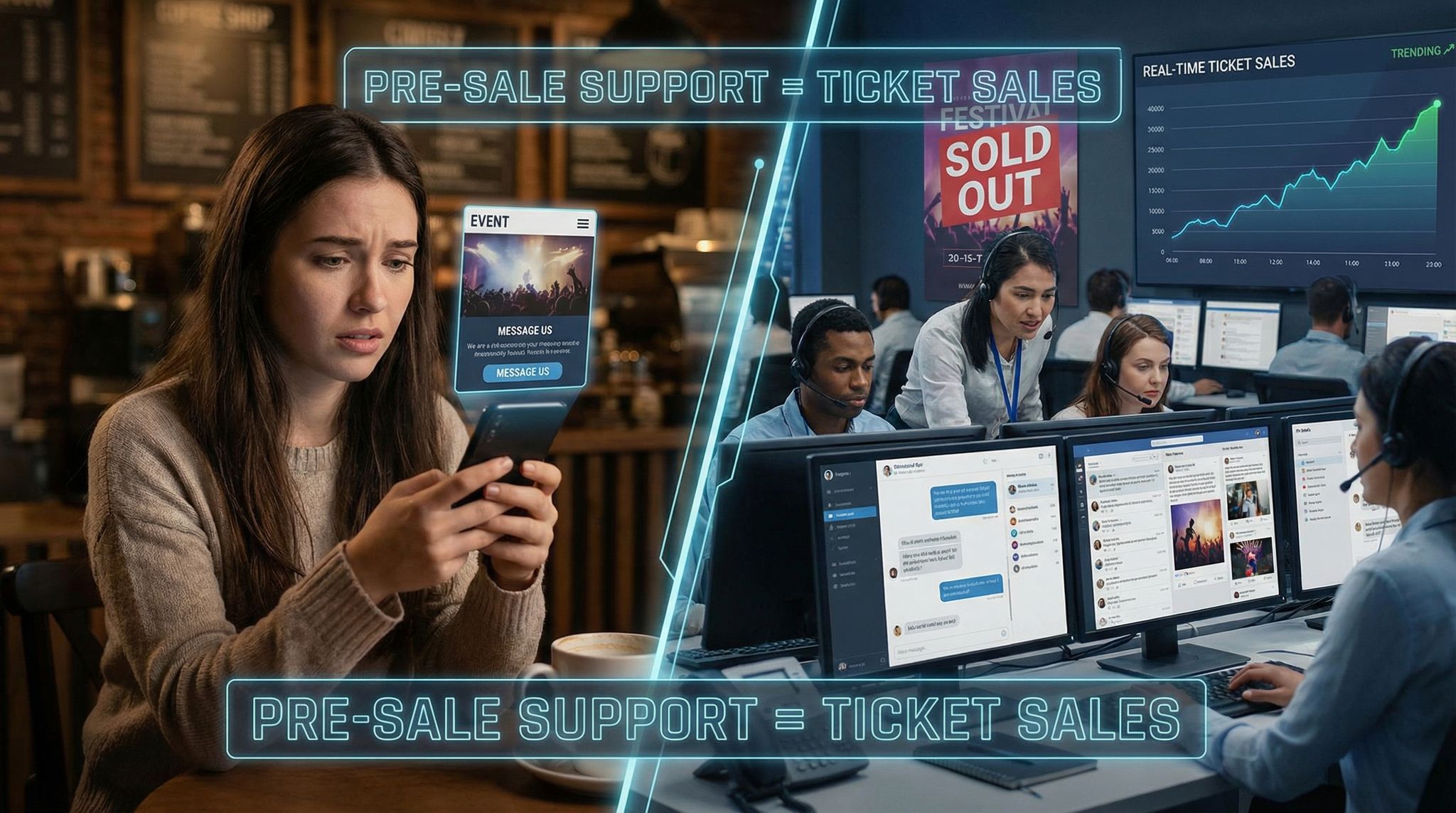
Customer support used to be seen as a cost of doing business – answering questions and resolving issues after a purchase. In 2026, savvy event promoters recognise that pre-sale customer support is also a powerful marketing channel that can directly drive ticket revenue. Every fan inquiry is a chance to build a relationship and address concerns that might be blocking a purchase. Experienced event marketers know that when handled strategically, customer service interactions can convert “maybe” into “yes” and even spark positive word-of-mouth. For example, one veteran promoter recalls a campaign where personally responding to every fan DM for a 200-capacity club night led to a sold-out show, with attendees citing those friendly answers as the reason they felt confident buying tickets.
Customer Expectations in 2026
Today’s fans expect instant, helpful responses at any hour. The always-connected audience has been trained by e-commerce and on-demand services to expect information right now. Speed is paramount – over half of consumers say fast responses are a must when choosing where to spend their money, according to Nextiva’s customer service statistics. In fact, 55% will walk away from a brand if they wait too long for an answer, based on data on consumer response expectations. Whether someone is asking about a festival’s age limit or a conference’s dress code, they want clarity immediately. If you’re slow to reply, you risk losing that potential attendee to another plan. Responsiveness has become part of the product. A quick, informative reply in 2026 isn’t just good service – it’s a direct factor in a fan’s decision to purchase.
Building Trust Before Purchase
Addressing fan questions promptly and transparently builds trust before any money changes hands. Imagine a first-time attendee interested in your event but unsure about safety, refund policies, or what the experience will be like. A proactive, friendly answer from your team can assure them that your event is legitimate, safe, and worth their time. On the flip side, silence or a curt reply can sow doubt. Trust is the currency of conversion: fans need to feel confident in your event and your organisation. For instance, if a potential ticket-buyer asks, “Is this festival wheelchair accessible?” and your team responds quickly with details (access points, viewing platforms, how to get assistance on-site), it shows you care about their experience. That trust makes them far more likely to hit “Buy”. According to a Salesforce customer service report, 88% of consumers say quality customer support makes them more likely to purchase and even spreads positive word-of-mouth, a trend highlighted in a Salesforce report on customer service impact. By winning trust through helpful pre-sale support, you’re not just answering one person’s question – you’re laying groundwork for loyalty and future sales.
Integrating Support into the Marketing Funnel
Leading promoters now integrate pre-sale support touchpoints into their marketing strategy. They map the attendee journey from the first spark of interest all the way to purchase, and identify where questions tend to arise. Perhaps after seeing an ad, a fan might DM your Instagram asking about ticket release dates or pricing tiers. Maybe midway through your email campaign, potential attendees click “Reply” to ask about the venue location or COVID protocols. These are make-or-break moments. As a comprehensive event attendee journey guide points out, many buyers have one critical question that will tip them into buying – if you answer it well (and quickly), you remove the final hurdle to conversion. In practice, this means marketing and customer service teams must work hand-in-hand. Pre-sale inquiries aren’t just “support tickets”; they are high-intent sales leads. Treat them with the urgency and importance you would any hot lead. Some events even set up AI chatbots on their ticketing pages to instantly field common queries and capture interested leads, ensuring no curious prospect falls through the cracks. The bottom line: pre-sale support isn’t a back-office task, it’s front-line marketing that can directly boost your bottom line.
To fully capitalize on this shift, modern organizers are restructuring their teams to provide dedicated ticket sales support. Rather than treating ticketing inquiries as a secondary duty for the general info desk, promoters are training specialized agents who understand both customer service and conversion tactics. Effective support for ticket sales involves equipping your staff with deep knowledge of pricing tiers, group discounts, and VIP upgrade paths. When a fan reaches out with a purchasing hurdle, a well-trained ticketing assistance team doesn’t just troubleshoot the technical issue—they actively guide the buyer through the checkout process, ensuring the transaction is completed smoothly.
Meeting Fans Where They Ask Questions
Social Media Comments and DMs
Fans in 2026 will fire off questions wherever they spend time – often that means social media. Twitter (now X), Facebook, Instagram, TikTok, YouTube comments – your event’s posts and DMs on these platforms are the new customer service desk. Event marketers must actively monitor and respond on social channels because that’s where many fans will first reach out. Don’t just post and ghost; check your mentions, comments, and message requests daily (if not hourly during campaigns). A fan might comment on your event flyer post, “Does this show allow under-18s with an adult?” Answering publicly not only helps that person, but also all the others silently wondering the same thing. It’s a chance to broadcast helpful info and encourage ticket sales. Make sure your tone on social Q&As is warm, on-brand, and human – these replies are public and form part of your marketing. For instance, responding with “Absolutely! This event is all-ages. We’ll see you and your youngster there ?” is far more engaging than a dry “Yes, under-18 allowed per policy.” Even negative comments (“Why are tickets so expensive?!”) are opportunities – a polite, informative reply about everything included in the ticket (great lineup, amenities, etc.) can shift perception for countless onlookers. Top promoters often have a dedicated social support person or team during on-sale periods to ensure no comment goes unanswered. In fact, major festivals have even run social media “war rooms” for real-time monitoring and response because they know a swift, empathic reply can halt rumors and build goodwill. While your event might not need a full war room, the lesson is clear: meet fans’ questions on social media with the same attentiveness as you would a phone call – the whole world is listening.
Ready to Sell Tickets?
Create professional event pages with built-in payment processing, marketing tools, and real-time analytics.
Email and Contact Forms
Email remains a workhorse channel for fan inquiries, especially for more formal questions or longer-form queries. Many potential attendees will use the “Contact Us” form on your website or shoot an email to your [email protected] address when they have detailed questions (“Can my company buy a block of VIP tickets?” or “Do you offer group discounts for 10+ people?”). Treat inbound emails like priority leads. Set up a system to acknowledge receipt immediately (an auto-reply that says “Thanks for reaching out – our team will get back to you within X hours”) and then follow through with a thorough answer as quickly as possible. Unlike the fast-and-furious nature of social media, email inquiries often expect a reply within a few hours or by the next business day – but faster is always better. Aim to respond the same day, or within 24 hours at most, even on weekends if you can manage it during a hot ticket launch. If you have an international audience, consider different time zones – an email from a fan in London to your New York-based team might come in at 3 AM your time. Having a global support plan (or team members in different regions) ensures no one waits too long.
In your email responses, personalise the greeting and content. Use the person’s name if provided (“Hi Alex,”), and reference their specific questions to show it’s a human reply. It can be effective to create a library of template answers for common questions (so your team can respond faster), but always customise them a bit each time – no one likes getting a canned response that doesn’t quite fit their situation. If someone asks multiple questions in one email, answer every single one clearly – perhaps even use bullet points or numbered lists in your reply so nothing is missed. And always end with a friendly note and a clear call-to-action, like “Let us know if you have any other questions – we’re here to help. If everything sounds good, you can grab your tickets here: [Ticket Link]. We’d love to see you there!” By providing a timely, informative response and guiding them to the next step, you turn email support into an extension of your sales funnel.
Messaging Apps and SMS
Beyond traditional social media and email, many fans now reach out via messaging apps. WhatsApp, Facebook Messenger, Telegram, WeChat (for Chinese audiences), even SMS texts – these are increasingly common avenues for customer inquiries. In some regions, messaging apps are the primary way people communicate with businesses. For example, a fan might find a WhatsApp number on your event page and send a quick question, or use the “Message” button on your Facebook event to shoot over an inquiry. If you advertise a customer support number or chat, be prepared to answer on those platforms promptly as well. It’s a good practice to enable business features on messaging apps, such as WhatsApp Business, which lets you set quick replies and show your “online” hours. You might set up an automatic greeting that says “Hey there! Got a question about the event? We usually reply within a few minutes.” This at least lets the fan know their message was received and sets expectations for a reply.
SMS (text messaging) can play a role too, especially for last-minute questions like “What time do doors open?” Many ticketing platforms (including Ticket Fairy) allow you to send out info via SMS broadcasts, and some even let fans reply with questions. If you provide a text contact, monitor it closely – SMS users often expect even faster answers (it feels as immediate as chatting with a friend). One pro tip: if you find yourself answering the same question frequently on a messaging channel, save a keyboard shortcut or template if the app allows it. For instance, on WhatsApp Business you can save preset replies triggered by a slash command (like typing “/directions” could paste a pre-written answer with the venue address and parking instructions). Just be very careful that any templated answer is updated and accurate – always double-check before sending, and personalize it if needed (add a “Hi John,” or a specific detail matching their question). Ultimately, extending your support to these apps shows fans you’re available on their terms, which can set you apart from less responsive competitors.
Smart Promo Codes & Presale Access
Create percentage or flat-rate discount codes with usage limits, date ranges, and ticket type restrictions. Plus unlock codes for private presales.
Fan Communities & Forums
In addition to one-to-one channels, don’t overlook the power of fan communities and forums. Enthusiastic audiences often create or congregate in online groups to discuss events – think subreddits for music festivals, Facebook or LinkedIn groups for industry conferences, Discord servers for gaming conventions, or fan-run forums on niche websites. These spaces are where would-be attendees swap information, recommendations, and yes, plenty of questions. Smart event marketers join the conversation (authentically) in these communities to provide accurate info and build rapport. For example, if there’s a Reddit thread asking “Has anyone been to XYZ Festival before? Is it worth it?”, an official reply from the festival’s account or promoter (with transparency about who you are) providing insight – “Hi! I’m one of the organizers – happy to answer. We put a ton of effort into making the experience amazing (free water, upgraded stages, camping options, etc.). Check out our attendee testimonials on our site. And feel free to DM me any specific questions!” – can make a huge impact. It shows lurkers that the event team is listening and cares.
Also, consider hosting Q&A sessions in community spaces. Many conferences now do AMA (Ask Me Anything) threads on their forums or LinkedIn groups with the event director answering questions live for an hour. Festivals might do an Instagram Live or a Facebook Live Q&A where fans can send questions in real time. These aren’t just support interactions; they’re marketing content – they generate excitement and public trust. When fans see their questions answered openly, it reduces skepticism. It’s also wise to empower your passionate attendees to help each other. If you have an official forum or Facebook group, appoint community moderators or ambassadors who can answer common questions (often superfans know almost as much about the event as you do!). This peer-to-peer support can scale your efforts and create an authentic buzz. You’re essentially building a year-round fan community where fans feel heard and informed, which in turn drives stronger loyalty and repeat attendance.
Furthermore, these engaged communities are the perfect launchpad for driving ticket sales through fans. By identifying your most helpful and enthusiastic community members, you can invite them into an official ambassador or peer-to-peer rewards program. When you empower these super-fans with unique referral links or discount codes to share within their own networks, they effectively become an extension of your marketing team. Generating ticket sales through your existing fan base not only lowers your customer acquisition cost but also brings in new attendees who already have a built-in level of trust because they were invited by a friend.
Multi-Lingual & 24/7 Support
Events in 2026 often draw global audiences, either traveling in for a festival or tuning into a hybrid/virtual conference from abroad. That means your pre-sale support should be prepared to handle multiple languages and time zones whenever relevant. If you’re selling tickets worldwide, consider providing answers in the languages your attendees speak. This could be as simple as having a bilingual team member or two, or using a translation tool integration in your chat. Many savvy organisers post FAQs in multiple languages on their website and social media. If a fan from Mexico messages in Spanish asking about ticket prices in their currency, being able to reply en español (even if via a well-checked translation) shows immense respect and dramatically increases the chance of conversion. Major festivals like Tomorrowland cater to an international fanbase by offering support in English, French, Dutch, and more. You might not have the resources for a full multilingual call center, but even covering one or two additional key languages for your audience can go a long way.
Time coverage is the other side of the coin. With fans browsing and buying at all hours, a question that comes in at 2:00 AM your time needs an answer before that window of interest closes. Obviously, round-the-clock human staff isn’t feasible for every organiser. This is where a mix of automation and smart scheduling helps (which we’ll cover in a later section). At minimum, set clear expectations: list your support hours on your contact page (“Our team is online 9am–9pm GMT, Mon-Sun”). If someone messages at 11pm, they should receive an automatic “We’re away but will respond first thing in the morning” note – and then actually get a prompt reply in the morning. For critical sales periods (like the day tickets go on sale), it’s wise to extend support hours or have team members on-call late into the night. Many big on-sales for international events will schedule staff in shifts so that any fan question, no matter when it comes, gets a near-immediate response. One success story came from a UK music festival that staggered their support team across time zones during their global ticket sale – a fan in Japan who asked a question at what was 3 AM UK time got an instant reply from a team member in New Zealand. She bought her ticket five minutes later, amazed at the service. That’s the kind of impression that not only secures a sale but turns a customer into a life-long fan.
Pre-Sale Support Channels at a Glance: Here’s a quick overview of the key channels for pre-sale questions and what to remember about each:
Turn Fans Into Your Marketing Team
Ticket Fairy's built-in referral rewards system incentivizes attendees to share your event, delivering 15-25% sales boosts and 30x ROI vs paid ads.
| Support Channel | Common Uses | Expected Response Time | Tips for Success |
|---|---|---|---|
| Social Media (comments, DMs) | Quick questions on lineup, age limits, pricing; public feedback | Within hours (faster for public posts) | Respond publicly when possible (others have the same Q). Keep tone friendly & on-brand. Monitor mentions and keywords. |
| Email & Website Forms | Detailed inquiries, group sales, special requests | 12–24 hours (same-day ideally) | Personalize replies, answer all points clearly. Use auto-acknowledgement so they know you’ll reply. Include a call-to-action (ticket link, etc.). |
| Messaging Apps (WhatsApp, SMS) | Last-minute or on-the-go questions; private chat | Minutes to an hour (very fast) | Use quick reply templates for FAQs. Set online/offline auto-replies. Great for urgent queries like directions on event day. |
| Fan Communities/Forums | Broad discussions, peer advice, “Is it worth it?” questions | 24 hours (since asynchronous) | Participate genuinely, don’t just advertise. Host AMAs or Q&As. Let super-fans help answer but chime in with official info. |
| Chatbots/AI Assistants (more on these later) | Instant answers to common FAQs on ticket page or Facebook Messenger | Seconds (instant 24/7) | Train bots with up-to-date info. Ensure smooth handoff to human for complex questions. Use bot to capture emails for follow-up. |
By engaging on all these channels, you ensure no fan’s question goes unanswered, no matter where or how they ask it. Being omnipresent and responsive in the lead-up to your event creates a seamless experience that gives fans confidence to click “Purchase”.
Speed: The Golden Rule of Pre-Sale Support
First Response Time Matters
When it comes to converting curious onlookers into ticket buyers, speed is often the make-or-break factor. The longer a potential attendee waits for an answer, the colder their interest can get. Industry data and common sense align on this: prompt responses significantly boost conversion likelihood. One analysis found that brands implementing live chat or instant answers on their sales pages saw conversion rate lifts between 15% and 40% by eliminating wait times, based on conversion optimization tactics for customer service. That’s a huge jump in ticket sales simply from being faster to help. In the pre-sale context, consider a fan who’s just one click away from buying but pauses because they have a question – say, “Are there any VIP tickets left, and what do they include?” If you can respond while that spark of interest is hot (within a minute or two via chat or a quick DM), you’re likely to close the sale right then and there. If you take hours, that fan might wander off, get distracted, or second-guess their decision.
Grow Your Events
Leverage referral marketing, social sharing incentives, and audience insights to sell more tickets.
Experienced promoters sometimes even “race” to be the first to reply to a fan. There’s a saying in sales: the first to respond often wins the customer. In fact, some studies in broader retail have found that a vast majority of buyers will go with the first company that answers their inquiry. While events might have less direct competition (your event is unique, after all), you are still competing with inertia and other ways that fan could spend their money and time. A fast reply keeps their momentum going toward a purchase. One event marketing veteran shared a telling experiment: for a multi-date tour, they tested replying to Facebook comments within 5 minutes vs. after a few hours. The enquiries that got lightning-fast replies led to purchases about 3 times more often than those with slower answers. Why? Urgency works both ways – fans feel more urgency (and excitement) to buy when their questions are resolved quickly.
Real-Time Engagement via Live Chat
Perhaps the single most game-changing tool for speed is live chat. In 2026, audiences are very comfortable with chat interfaces – they use WhatsApp, Facebook Messenger, iMessage daily – so chatting with an event’s support on the website feels natural. By embedding a live chat widget on your ticketing or event info page, you can catch questions the moment they arise. For example, a visitor is looking at tickets on your site and thinks, “Hmm, is there parking at the venue?” Instead of leaving to find that info (or giving up), they see a little chat bubble: “Questions? Chat with us!” They ask about parking, and a support agent (or AI assistant) answers within seconds: “Yes, there’s a parking lot on 5th Street we’ve reserved, $10 per car, and you can pre-book a spot here. Anything else I can help with?” The fan says “Great, thanks!” and proceeds to order tickets with peace of mind. That is a saved sale that might have been lost if the question went unanswered.
Proactive chat can even nudge indecisive visitors. You can program your website chat to pop up after, say, 90 seconds on the ticket page: “Hi, let us know if you have any questions about the event!” This gentle prompt can catch hesitant buyers. Perhaps they were wondering about the refund policy or if the event is kid-friendly. Seeing the chat, they realize they can ask right away. Providing the answer immediately can overcome their last bit of doubt. Data backs this up: customers who engage with live chat often convert at a higher rate and tend to spend more on average, as shown in analysis of live chat conversion rates. In practice, event organizers have reported similar trends – enabling live chat during an on-sale leads to a flurry of questions like “Is there a payment plan for VIP tickets?” or “What does the backstage experience include?” and once answered, many of those chatters go on to buy the tickets they were on the fence about.
If you don’t have staff to man a chat 24/7, consider at least using a chatbot or automated responder to handle common queries instantly (we’ll dive more into bots soon). The key is that something or someone is there to immediately acknowledge a question and ideally answer it. Even a note saying “Got your question about camping options – connecting you with an agent now!” is better than silence. A golden rule is emerging among event marketers: Aim to have a first response within 5 minutes or less for live channels (chat, social, SMS) during peak periods. Under 1 minute is even better. For email, under an hour is excellent. These aren’t always achievable, but setting aggressive targets for response time can dramatically improve your ticket conversion rates. Remember, the faster you answer, the less time there is for doubt, rival events, or everyday distractions to creep in and steal that fan’s attention (and money).
Free Tool: Split Tickets for Max Gross
Given capacity and a target price, the optimizer proposes Early Bird / GA / VIP allocations and prices — with projected gross at 100%, 80% and 60% sell-through.
Active Social Listening for Quick Reactions
Speed isn’t just for one-on-one chats – it’s crucial in the fast-paced world of social media too. An unanswered question on a public forum can quickly turn into a missed opportunity or even a viral complaint if the person feels ignored. That’s why active social listening is so important. Use tools or manual monitoring to catch every mention of your event in real time. Set up alerts for your event name, hashtags, and common misspellings on Twitter/X. Monitor comments on your TikTok videos and Instagram Reels; often fans ask questions in comments that can lead to sales if you answer. And keep an eye on those indirect conversations – for example, someone might not tag you, but tweet “Thinking about going to
Social media moves in real time, so aim to respond in real time. A good practice is to treat social DMs like a live chat – keep the conversation thread open and reply back-and-forth rapidly when possible. On public posts, many brands have found that replying within minutes can surprise and delight fans (“Whoa, they responded so fast!”), whereas replying days later can make you seem unengaged or worse, can escalate a customer’s frustration. If someone posts a complaint or concern, a fast public response can prevent misinformation from spreading. But even for neutral questions, speed shows professionalism. One pro tip: if you need a bit more time to get an answer (say a fan asks something technical like “Will my RFID wristband work if I bought a resale ticket?” and you’re not 100% sure), it’s still good to acknowledge quickly (“Thanks for asking! Checking on that for you now.”) and then follow up with the full answer as soon as you can gather it. This two-step approach (quick acknowledgement, followed by detailed answer) reassures the fan that you’re on it, rather than leaving them in the dark.
Also, consider the phenomenon of viral speed. If a question or complaint goes viral and you’re slow to respond, it can snowball. Conversely, a quick, witty, or particularly helpful response can itself go viral in a positive way, giving you free promotion. We’ve seen instances of event teams turning around a tough situation with a speedy, transparent reply that fans share (“Look how well
As inquiry volumes spike during an on-sale, knowing how to prioritize social media customer service tickets in 2026 becomes essential. Not all comments carry the same urgency. Train your team to triage incoming messages by intent: a fan asking “Are there any VIP tables left for tonight?” is a high-intent sales lead that requires an immediate response, whereas a general comment like “Can’t wait for this!” can be liked or replied to later. Using social listening tools to tag and filter messages based on keywords (e.g., “buy,” “sold out,” “upgrade,” “broken link”) ensures your staff tackles revenue-blocking issues first before clearing the rest of the inbox.
When evaluating how to prioritize social media customer service tickets across the 2025 and 2026 event seasons, leading promoters are implementing automated tagging rules. For instance, integrating your social inbox with a CRM allows you to automatically flag messages containing phrases like “payment failed” or “upgrade my pass” as critical. This tiered triage system ensures that even during a chaotic on-sale day, your human agents are directed to the highest-value interactions first, maximizing conversion rates while bots handle the lower-priority logistical queries.
Avoiding the “Black Hole” of Silence
Have you ever sent a question to a company and heard nothing back for days? It’s frustrating, and it almost certainly sends you looking for alternatives. For event customers, an unanswered inquiry can feel like a black hole – and it’s one of the fastest ways to lose a potential sale (and earn a poor reputation). Avoid silence at all costs. Even if you don’t have an immediate answer or the news isn’t what they want to hear, any response is better than none. If a fan emails, “Can I get a refund if my plans change?” and your policy is no refunds, reply promptly and kindly: “Hi, thanks for reaching out. We don’t offer refunds except in case of event cancellation, but we do support ticket transfers if you can no longer attend (you can safely resell your ticket to another fan). Let me know if you need help with that.” This answer may not be exactly what they hoped, but getting it quickly is more likely to keep them as a customer (or encourage them to buy knowing they can resell if needed) than being ignored. Many customers interpret silence as a sign of untrustworthiness – is this event even legit if nobody responds? You never want that doubt.
Free Tool: When Should You Announce?
Pick your event date and genre — the free planner outputs a recommended announce, presale, on-sale and reminder schedule anchored to how your audience actually buys.
For that reason, it’s critical to set up systems that ensure every inquiry is caught and answered. Use a ticketing or CRM system to track emails so none slip through. On social media, consider assigning team members specific platforms or shifts to watch. During a busy on-sale, you can even pin a post: “Questions about the event? We’re standing by – comment here or DM us for fast answers!” to funnel people to channels you are monitoring closely. Furthermore, if you notice a pattern of a certain question popping up, address it publicly – update your FAQ, make a quick social post (“FYI, lots of folks asking about parking – yes, plenty of parking on site for $10, first-come first-served!”). Proactively broadcasting answers can prevent the silence in the first place.
At times, you might encounter questions or requests that you can’t fulfill or don’t have an immediate answer for. It’s still important to respond and set expectations. For instance, “I’m not sure about that yet, but I’ve forwarded your question to our tech team and will get back to you by tomorrow.” Then make sure you do follow up. Over the years, seasoned event support managers have learned the hard way that failing to follow up is as bad as not responding at all. One shared a story of losing a high-value client because an inquiry about VIP tables went unanswered for 48 hours – by the time they replied, the client had booked a corporate box at a different event. That painful lesson led them to implement a strict “no question left behind” policy with daily checklists of open inquiries. It’s a good practice to borrow: keep a visible log of all pending questions and regularly review it to ensure responses have been sent. In short, treat fan questions with the same importance as ticket orders – they are precursors to ticket orders. Responding swiftly and thoroughly is one of the simplest marketing wins you can achieve.
Being Proactive and Helpful: Turning Questions into Opportunities
Anticipate FAQs Before They’re Asked
The best offense is a good defense – and in pre-sale support, that means answering questions before fans even have to ask. By anticipating common questions and providing information proactively, you reduce hesitation and build confidence. Start by compiling a list of frequently asked questions from past events or similar events. Typical pre-sale FAQs might include: “What items are allowed/not allowed?”, “Is there re-entry during the event?”, “Are kids allowed and is there a kid ticket price?”, “What’s the refund or resale policy?”, “What’s included with VIP?”, “Will there be food and drink for purchase?”, “Is parking available or shuttle service offered?”, and so on. Once you know the top 10–20 questions, weave the answers into your marketing materials and make them highly visible. This could be a dedicated FAQ section on your website (clearly linked on the ticket purchase page), a series of social media posts addressing each (“#5 – Yes, you can leave and come back in until 8 PM, just make sure to get your wristband scanned on exit.”), or even a highlight on Instagram stories (“FAQ” highlight with slides answering common queries).
Many event organizers use content marketing as proactive customer support. For example, writing a blog post like “Top 10 Questions First-Timers Ask About Our Festival (Answered!)” and sharing it widely can preempt dozens of individual inquiries. Not only does this save your team time, but it also functions as persuasive marketing copy – you can frame each answer in a positive, excited tone that sells the event. If done well, fans will read the FAQs and feel more eager to attend (“Wow, they really have everything covered, this sounds amazing!”). A practical tip: in 2026, short-form videos are incredibly popular for this purpose. Consider a quick video series featuring a staff member or even an artist from your lineup answering FAQs (“Hi, I’m DJ XYZ – the number one question I hear is what should I wear? Don’t worry, wear whatever you can dance in! We also have lockers and a coat check if you need it. Can’t wait to see your outfits on the dance floor!”). This adds a personal touch and high shareability to your proactive support.
Another way to anticipate questions is to see what fans are asking about similar events. Join forums or Facebook groups of comparable festivals or conferences and observe the common concerns. If, say, you notice lots of people asking “Is the water free at Big Festival X?”, you might proactively highlight on your channels, “We’ll have free water stations throughout the venue – bring an empty bottle to refill and stay hydrated!” even if no one has directly asked you yet. By answering unasked questions, you not only eliminate potential doubts but also come across as thoughtful and fan-focused. Fans think, “They’ve really thought of everything!” which is exactly the sentiment that closes ticket sales.
Encourage Questions and Invite Engagement
While being proactive is key, you also want to encourage fans to come forward with their unique questions. Some people won’t speak up unless invited – and they might quietly decide not to buy a ticket because they weren’t 100% sure about something. You can prevent that by actively inviting questions in your marketing. Include a line in your emails like “Got questions? Just hit reply and we’ll respond ASAP.” In social posts, say “Ask us anything in the comments!” or run polls/Q&As (Instagram has great Story stickers for this) where fans can submit questions. Showing that you welcome questions sets a friendly tone and surfaces concerns that you might not have anticipated. It’s far better they ask you than silently hold a misgiving and bail on buying.
Grow Your Social Following With Every Sale
Require social media follows, shares, or playlist adds to unlock presale access or special pricing. Turn every ticket purchase into audience growth.
When you do invitation-style posts or Q&As, be prepared to answer quickly and publicly. A Facebook post captioned “Questions about the event? We’re here to help – ask away!” might get dozens of comments. Jump in and reply to each, tagging the person’s name so they get notified. This public forum approach has a bonus: each answer essentially becomes content that other potential attendees will see. It’s like creating a living FAQ that markets the event. For example, a fan asks “Do I need to print my ticket or can it be scanned on my phone?” You reply, “No need to print – we’re a 100% digital ticket event (save the trees ?!). Just have your QR code ready on your phone at entry.” Not only is that helpful info, it also subtly highlights a positive aspect of your event (eco-friendly digital tickets). Another fan asks, “Will there be more artists added to the lineup?” You answer, “Yes! We actually have 2 surprise guest acts we’ll announce a week before the show. Trust us, you’ll be excited ?. Stay tuned!” Now you’ve turned a simple question into a hype-building moment.
Don’t shy away from difficult questions in these public formats either. If someone asks, “Why is your VIP ticket so expensive compared to last year?”, view it as an opportunity to justify value: “Great question – this year VIP includes an all-day open bar and a meet-and-greet with the headliner, which is a new addition. We’ve also capped VIP tickets to keep the area comfortable (no crowding) and added a dedicated VIP entrance. We think you’ll love the upgraded experience.” This kind of transparent, detailed answer can convince not only the asker but anyone else reading who had the same concern. In fact, giving thorough answers to tough questions can build credibility – you’re showing that you have nothing to hide and care about attendee satisfaction.
Consider implementing a live Q&A session as part of your pre-sale campaign. For instance, do an Instagram Live or YouTube live stream titled “Ask the Organizers – Live Q&A about
For highly anticipated niche events, specific search queries often dominate your inbox. If you are running a pop-culture convention, fans might flood your channels asking about Comic Con 2026 tickets, VIP meet-and-greet upgrades, or cosplay weapon policies. By setting up dedicated auto-responses or chatbot flows for these exact high-volume phrases, you can instantly satisfy the most eager buyers while freeing up your human staff to handle complex accessibility or group sales requests.
Personalized Recommendations and Guidance
Sometimes a fan’s question is an opportunity to not just give info, but to personalize your pitch and guide them to the best purchase for them. This is a more consultative approach – think of it as “personal shopper” mode. For example, if someone asks, “I’ve never been to this convention. Is the VIP ticket worth it or should I just get General Admission?”, you have a chance to ask a couple of questions and tailor a recommendation: “Thanks for asking! It really depends on what experience you’re looking for. VIP gets you front-row seating at keynotes and a private lounge with snacks (great if you want a quieter space to network). If you’re the type who loves meeting speakers and enjoying some perks, VIP is awesome. If you’re mainly there for the sessions and don’t mind the crowds, GA will still be great. Let me know what you’re hoping to get out of the event, and I can advise more!” By engaging in a short dialogue, you make the fan feel valued and seen. You might even glean information that helps you upsell them: maybe they say “I really want to meet people and make connections.” Now you can highlight VIP networking benefits and likely convince them the higher-tier ticket is worth it. You’ve turned a simple question into a tailored sales interaction.
This approach works for all kinds of events. A concert attendee DMs, “Is balcony seating good or should I go for floor tickets?” You can reply, “The balcony at our venue actually has a fantastic view of the stage and a dedicated bar, so it’s a comfortable experience. If you love being close to the action and don’t mind standing/dancing, floor is super fun and you’ll be in the thick of the energy. We’ve seen fans enjoy both for different reasons – what matters most to you, view or vibe?” Again, you’re conversing, not just answering. It’s exactly how a salesperson in a store would help a customer choose a product, and it works just as well for ticket sales. People appreciate feeling like you’re not just shoving the most expensive option at them, but genuinely helping them get the experience they want.
Boost Revenue With Smart Upsells
Sell merchandise, VIP upgrades, parking passes, and add-ons during checkout and via post-purchase emails. Increase average order value by up to 220%.
This tailored approach is especially critical when providing white glove service for high ticket customers. Buyers interested in premium VIP cabanas, corporate suites, or all-inclusive destination packages expect a level of care commensurate with their investment. For these high-value inquiries, bypass standard auto-replies and assign a dedicated concierge or senior sales rep to handle the conversation. Offering a quick phone call, a personalized video walkthrough of the VIP area, or custom invoicing options demonstrates premium hospitality before the event even begins. This white-glove attention not only secures the immediate high-ticket sale but often establishes a lucrative, multi-year relationship with corporate clients and big spenders.
Another form of personalized guidance is offering planning tips when asked (or even unprompted in your FAQ content). If someone asks, “What’s the best way to get there from the city?” don’t just say “There’s a train.” Take the opportunity to help plan: “There’s a train from Central Station that drops you 10 minutes from the venue – take the Green Line toward Oakwood. We’ll also have shuttles running from two downtown locations (tickets for those shuttles are $5, here’s the link). Many attendees also carpool – we actually have a Facebook group for ride-sharing to the event, if you’re interested I can send you an invite!” This level of help not only answers the question but also demonstrates that you care about their whole experience. A fan who maybe was nervous about logistics now feels more at ease – and more excited to attend. In many cases, fans have admitted that having an organiser go above-and-beyond in answering questions sealed their decision to go to an event they were on the fence about. It’s the cumulative effect of feeling valued, informed, and welcomed even before buying a ticket.
Capturing Leads from Inquiries
Every question is not just a potential sale – it’s also a lead that you can nurture. Don’t let interested fans fall off the radar after you answer them. Make sure you have a way to follow up or stay in touch, especially if they’re not ready to purchase right now. For inbound emails, this is straightforward: reply to their question and then, if they don’t buy immediately, consider sending a polite follow-up a few days later: “Hey Jack, just wanted to check that you got all the info you needed about the VIP tickets. We’re here if you have any more questions! We still have a few VIP passes left, and early bird pricing ends Friday. Let us know if we can help you secure one. – Team AwesomeFest.” This follow-up can gently nudge them toward the sale, or at least keep them warm. Many email marketing systems let you tag these inbound inquiries and automate a follow-up sequence – just ensure it still feels personal, not like they got thrown onto a generic email blast. It should reference their specific inquiry.
On social or chat, it’s a bit trickier since you might not have their contact info beyond the platform. But you can still encourage future engagement. For instance, if someone DMs a question, after answering, you might say, “By the way, we’re about to announce more artists next week. If you’d like, I can add you to our announcement list so you don’t miss it – just let me know your email and I’ll make sure you get the news (and maybe a little discount code ?).” With an invitation like that, you can convert a one-time question into an ongoing email subscriber or at least make them feel part of the insider group. Similarly, in public threads, you can invite people to join your community or waitlist. If a person comments, “I can’t go unless there’s a Saturday ticket because of work,” you can respond, “Totally understand! If you join our waitlist for next year’s event, we’ll notify you early (and often with a discount code) so you can plan ahead for a date that works. We’d love to have you with us when the timing lines up.” Now you’ve taken someone who wasn’t a sale this time and kept them in the pipeline for the future.
Another effective tactic is the exclusive pre-sale invite conversion. Let’s say someone messages, “I missed out on early bird – are there any discounts left?” You can respond: “Early birds did sell out, but since you reached out, I’d love to offer you our ‘friends and family’ rate for the next 48 hours. Here’s a special link just for you to get 10% off standard tickets: [link]. Hope it helps and really hope to see you at the event!” This kind of personalised incentive as a thank-you for engaging can tip an undecided person into buying now, because you’ve made them feel special and given a time-bound reason to act. It’s essentially a friendly lead conversion technique. Just use it judiciously (you don’t want everyone waiting to ask a question just to get a discount) and frame it as a one-to-one gesture. It can be incredibly effective – promoters have quietly done this in DMs and reported that many of those who got a personal small discount code ended up sharing how great the customer service was, which in turn boosted the event’s reputation.
The overarching principle: never let a warm lead go cold. If they’ve taken the trouble to ask you something, they’re interested. Your answer should be the beginning of a relationship, not the end. Whether through a follow-up message, adding them to a mailing list (with permission!), or simply making sure they see future announcements, treat every inquisitive fan as someone who is this close to buying a ticket – and needs just a bit more nurturing. This mindset will push you to be more proactive and creative in how you engage them, ultimately turning a lot more question-askers into satisfied ticket holders.
Human Tone and Empathy in Responses
Authentic Brand Voice in Support
It’s not just what you say, but how you say it. Every pre-sale support interaction is an extension of your event’s brand voice. If your festival brand is all about fun and inclusivity, your answers to fans should reflect that personality. If your conference brand is about innovation and professionalism, your tone might be more expert and concise, but still friendly. The key is to sound like a human, not a corporate robot. Use a conversational tone and natural language in replies – especially on social media and chat. For example, instead of a stiff “YOUR REQUEST HAS BEEN RECEIVED AND IS BEING PROCESSED,” an authentic voice would say, “Got it! We’re on it and will get back to you ASAP ?.” The latter feels like it’s coming from a real person who cares, which is exactly the vibe you want.
Consistency matters too. If multiple team members are answering inquiries, establish some voice guidelines. Decide on things like: Do we use emojis? (Maybe yes for a music festival, maybe no or very sparingly for a serious business conference.) Do we address people by first name? (Generally yes, it’s warmer.) Are there any words or phrases on-brand or off-brand? For instance, a punk-rock concert series might lean into edgy humor in responses, while a wellness retreat would use calming, positive language. One trick is to have your social media manager or copywriter craft sample Q&A responses in the brand voice, and share those with everyone on support duty. That way, whether John on email or Priya on Facebook replies, they both echo the same friendly vibe and key messaging. This consistency builds a cohesive impression for fans – they’ll feel like they’re talking to the same “voice” of the event everywhere.
Also, don’t be afraid to inject enthusiasm and positivity into your answers. If a fan says “The lineup looks awesome but I’m not sure if I can make it,” respond with genuine excitement: “We’re super proud of this lineup – it’s going to be an unforgettable night! If you can make it, we’d hate for you to miss out. Let me know if there’s anything we can do to help you be there.” People can sense passion, even through text. Your excitement can be contagious and reassure them that the event will live up to the hype. Just remember to balance enthusiasm with helpfulness – do answer their actual question or concern in the process, not just cheerlead. The goal is to humanize the interaction. Fans should come away feeling like, “Wow, the team behind this event is really cool and they treated me like a friend.” When they feel that personal connection, buying a ticket becomes an emotional decision (in a good way) – they want to be part of what you’re building.
Empathy and Reassurance
“Empathy” is the buzzword, but here it truly counts: put yourself in the fan’s shoes for each inquiry and respond with understanding. If someone expresses a worry or confusion, acknowledge their feelings before jumping to the factual answer. For example, if a prospective attendee says, “I’m a bit nervous about attending because I’ll be coming alone,” start your reply with empathy: “Totally understand – going solo can feel daunting.” Then you could reassure them: “The good news is our community is super welcoming, and we even have a meet-up for solo attendees at the start so you can say hi to a few friendly faces. We’ve got you covered!” This not only answers the question (perhaps they were implicitly asking if it’s okay to come alone), but shows you care about their experience and comfort.
If a fan’s question has a hint of frustration or complaint (“Why are drinks so pricey at your venue?!”), it’s especially important to respond with empathy first. You might say, “I hear you – nobody likes overpaying for drinks.” This simple validation can defuse defensiveness. Then proceed with helpful info: “We’ve actually worked with the venue to offer a range of options, including some discounted drink specials early in the night. And water is free all night because we want everyone to stay hydrated and safe!” You’re not ignoring their gripe; you’re addressing it head-on in a human way and offering solutions.
Being reassuring is key for questions that reveal hesitation. Some fans will outright say things like, “I’m kinda on the fence – I had a bad experience at a festival last year.” This is your chance to rescue that customer. Empathize: “Sorry to hear last year’s fest wasn’t great – that’s always a bummer.” Then reassure with what’s different: “We take pride in doing things differently. For example, we cap our attendance at 5,000 to avoid overcrowding, and we doubled the number of restrooms and water stations compared to similar events. We’ve read all the horror stories and designed ours to be a fantastic experience front to back.” You’re essentially saying, “We get it, and you can trust us.” Even if fans don’t explicitly state their worry, read between the lines. A question like “How strict is security going to be?” might be coming from someone concerned about safety. Don’t just say “Very strict” – elaborate in a reassuring way: “Our security team is professional and there to keep everyone safe. Expect bag checks and friendly pat-downs at entry – it goes quickly and we’ll have plenty of staff to minimize wait times. Your safety is our top priority, and we also train our crew to be respectful and courteous. You’ll be in good hands.” This level of detail can ease their mind and make them more inclined to attend, because they feel their wellbeing matters to you – which it does!
In summary, make empathy your first response, always. No boilerplate apology lines like “We apologize for any inconvenience” (that feels cold and insincere). Instead, use first-person and direct language: “I’m really sorry that happened,” or “I totally understand why you’d feel that way,” or “Thanks for bringing this up – I would wonder the same thing in your position.” These phrases make the person feel heard. As festival social media teams emphasise, prompt sincerity can turn situations around. An empathic approach in pre-sale means even if you have to deliver an answer they might not love (no, you can’t bring outside food; no, we don’t have refunds), you cushion it with understanding and perhaps an alternative solution. That leaves them thinking, “Well, at least they care and tried to help,” which is worlds better than a flat “No, that’s our policy, sorry.” Empathy is free – use it generously.
Specific and Accurate Information
While friendliness and empathy set the tone, accuracy and specificity seal the deal. A surefire way to lose a fan’s trust (and their ticket purchase) is to give them incorrect or vague information. In 2026, details matter: fans often ask very specific things because those are their make-or-break factors. If they ask, “What time will the headliner go on stage? I can only come late,” replying with “Probably around 10-ish” won’t instill confidence. Instead, give specifics if you have them: “The headliner is scheduled for 10:30 PM and typically plays about a 90-minute set, so you should be fine arriving by 10. We’ll post the full schedule on our site this week. Safe travels and hope you enjoy the show!” If you don’t know an exact detail yet (maybe set times aren’t final), be honest but still helpful: “We’re finalising the schedule now, but the headliner will definitely be on after 10 PM. We’ll release exact set times two days before the event – keep an eye on our website or sign up here and we’ll email it to you as soon as it’s out.” This way they know what to expect and that you’re not just guessing.
Being specific also means tailoring your answer to exactly what was asked. Fans get frustrated if they feel their question was half-answered. For instance, a potential attendee emails, “I’m flying in for the festival. Is there a shuttle from the airport or should I just take a taxi? And can I bring a carry-on bag into the venue?” In your excitement to answer the shuttle part, don’t forget the second question about the bag. It’s a good practice to mirror back the questions and answer each clearly: “Thanks for reaching out! We have no official airport shuttle, but the airport is only 15 miles from our venue. A taxi or rideshare will be quickest (about $30). There’s also a public bus (Route 10) that goes downtown, but it takes about an hour. As for bags: You can bring backpacks or carry-on sized bags, but they will be searched at entry. We actually have lockers on-site if you need to store your luggage during the show. Many travelers drop bags at their hotel first if possible, but if not, we’ve got you covered with the locker option.” See how each aspect is answered thoroughly? This level of detail not only helps the person asking, it shows you’re competent and reliable – traits that make someone comfortable buying a ticket.
Accuracy is paramount. Double-check any facts or figures you provide. If you’re unsure whether re-entry is allowed, don’t wing it – find out for sure from the operations team or reference your own FAQ. Giving the wrong info (“Yes, you can leave and come back” when in fact there’s no re-entry) could ruin someone’s experience and your reputation. It’s better to say, “Let me confirm that for you,” and take a little extra time, than to accidentally mislead. Many top event customer support teams keep a “fact sheet” or knowledge base at their fingertips – a living document with all the key details (dates, times, policies, facilities, you name it) that anyone answering questions can quickly search. This ensures consistency and accuracy. If you update a policy (say, you decide to allow small bags when initially you weren’t going to), update the fact sheet and inform the team so every channel gives out the new info from that moment on.
Specificity also applies to any promises or instructions you give. If you tell a fan, “I’ve put your name on the guest list,” be very clear about what name and what they need to do (“You can pick up your guest pass at Will Call under the name Jane Doe – just show your ID”). Vague assurances can cause confusion. Likewise, if you offer to follow up later, be precise: “I will email you by Friday with that answer.” This holds you accountable and the fan knows when to expect a reply, which keeps them from getting impatient. The overarching tip: sweat the details on behalf of your fans. When they see that you’re detail-oriented and accurate, they feel confident that the event itself will run like clockwork (or at least that issues will be handled). That confidence directly translates to ticket sales – people buy when they believe in you.
No Boilerplate: Keep It Personal
In the age of AI and automated replies, a human, personal touch stands out more than ever. Fans can tell when they get a canned response or a generic copy-paste that doesn’t quite fit their question. Such replies can come off as tone-deaf or make the person feel like a number. Avoid boilerplate templates that haven’t been tailored. Yes, you should have reference templates to save time, but always edit them to truly answer the individual’s question and address them personally. Use their name if possible (“Hi Sam,”), reference what they said (“You mentioned you’d be coming straight from the airport, so here’s what I suggest…”), and employ a natural tone. One trick: read your response draft out loud – does it sound like something you’d say to the fan face-to-face? If not, loosen it up. It’s okay to be a bit informal, use first person (“I” and “we”) and even contractions (“we’re”, “you’ll”) to sound conversational.
Also steer clear of corporate jargon or overly formal language. Phrases like “Thank you for your esteemed query, we value your interest in our event” have no place in pre-sale support. Instead: “Thanks for reaching out! We’re excited you’re interested and I’m happy to help answer that.” See the difference? One is stiff and distant, the other is approachable. Being specific and personal can even apply to apologies or negative news. If someone had an issue with the ticketing website and writes in about it, don’t send a sterile “Your feedback is being forwarded to the technical team.” Try: “I’m really sorry you had that glitch during checkout – I’d be frustrated too. I’ve asked our tech team to look into it ASAP, and I’ll update you as soon as I hear back. In the meantime, if you want, I can assist you with the purchase directly or hold a ticket for you so you don’t miss out. Let me know what works best for you, and thanks for your patience!” That response is loaded with humanity – empathy, taking ownership, offering solutions. It’s the opposite of boilerplate, and you can bet it leaves the customer feeling taken care of.
Another thing: never copy-paste policy text or web content verbatim as your answer. At best, it’s lazy; at worst, it can be incomprehensible. For example, if someone asks “What’s your refund policy?”, don’t just paste a chunk from your terms and conditions (“Section 5.2: Tickets are non-refundable except as required by law…etc.”). Instead, explain it in plain language: “Our tickets are generally non-refundable – like most concerts and festivals, all sales are final. The only exception is if the event were cancelled or postponed, in which case we’d offer refunds. One thing we do offer: if you can’t make it, you’re allowed to transfer or resell your ticket through our official platform, so you won’t be out of pocket. Let me know if that helps or if you have more questions on this!” This feels like a real person translating the policy for them (which it is). It’s helpful and much more likely to keep them as a customer even if they weren’t thrilled to hear “no refunds.”
Fans appreciate when you craft your response just for them, even if the core information is commonly used. A good example is how you address the person. Compare “Dear Customer, your request has been received” to “Hi Jamie – got your question!” The latter wins every time in terms of connection. Even in a quick chat reply, adding a “?” or a friendly exclamation like “Great question!” or “Happy to help,” can make a difference in tone. Lastly, avoid answering like a detached FAQ bot. If someone asks two or three questions in one go, don’t just rattle off answers in a dry list. You might instead weave the answers into a narrative. E.g., “So, here’s what your day could look like: Arrive by 2 PM and you can park on-site (parking is $15, plenty of space). Feel free to bring a sealed water bottle – we have free water refills. And yes, you can leave and re-enter until 8 PM as long as you get your wristband scanned on exit. That way you can pop out to your car or hotel if needed. Hope that paints a clear picture! Anything else you’re curious about? ?” This is far from boilerplate – it’s engaging and personalized. The extra effort you put into writing responses in a human way directly correlates with fans feeling valued and excited to attend your event.
Tools and Technology: AI Chatbots, Automation, and More
24/7 FAQ Bots for Instant Answers
In 2026, one of your best allies in pre-sale support is artificial intelligence – specifically, AI-powered chatbots that can handle frequently asked questions around the clock. These aren’t the clunky robots of years past; modern event chatbots (often built on advanced natural language processing) can resolve a large chunk of common inquiries in seconds, any time of day. Setting up a chatbot on your website or Facebook page to answer questions like “When do doors open?”, “Is there an age restriction?”, or “What’s the venue address?” can give fans immediate answers even at 3 AM when your human team is asleep. This instant gratification keeps potential attendees engaged. As noted earlier, fast answers boost conversion – and you literally can’t get faster than an AI replying in under a second.
To implement this, start by logging all the common questions you get (from past events or during this campaign so far). Most bots come with a knowledge base or Q&A list you can feed in. For example: Question: “What time does the event end?”, Answer: “The event ends around 11:00 PM with a fireworks finale, but the after-party goes till 1:00 AM for VIPs.” You’ll want to create friendly, concise answer scripts for each known question. Many platforms allow a bit of personality too – you might configure your bot to say “Hey there! ? I’m the EventBot. How can I help you today?” and to answer in a tone consistent with your brand voice. Always test the chatbot thoroughly. Ask it questions in natural language (the way a fan would) to ensure it responds correctly. For instance, a fan might phrase the parking question in many ways: “Is there parking?”, “Where do I park?”, “Parking available at the venue?” – make sure the bot recognises all those variations. Most AI bots learn and improve with time, especially if they come with machine learning features. You can usually see logs of what people asked that the bot couldn’t answer, and then update the knowledge base accordingly.
A huge benefit of chatbots is not just answering FAQs, but also capturing leads and handing off when needed. You can program the bot with triggers: if someone asks something complex or types things like “talk to a person” or if the AI confidence level is low (meaning it’s not sure how to answer), it can say, “Let me get a human to help with that!” and either collect their contact info or ping your on-call support. This hybrid approach ensures that fans don’t hit a dead-end. For example, if someone asks a very specific question about VIP catering that isn’t in the bot’s database, the bot might respond, “I’ll need to check on that. Could you leave your email or phone number? Our team will get back to you quickly with the details on VIP catering. So sorry I don’t have the info instantly – but we’ll ensure you get it!” This is a polite handoff that still feels responsive.
Another nifty use of bots: interactive guides. Instead of waiting for the fan to ask, the bot can be proactive. It might pop up and say “Hi! Do you want help finding the best ticket for you?” If they click yes, it could ask a series of questions like “Do you prefer GA or VIP?” or “Are you coming with a group?” and then recommend a ticket option or bundle, and even provide the direct purchase link. This kind of guided selling via chatbot can increase average order value and ensure people don’t drop off because they’re unsure what to choose. It essentially mimics a sales assistant in a store, but online. And it can do this simultaneously for hundreds of website visitors.
One real-world example: A large New Year’s music festival integrated a chatbot on their ticket checkout page to answer questions, and they found that not only did it handle 80% of inquiries without human help, but it also gathered thousands of email addresses through interactions (“Can I send you the info on that? Enter your email…”). Those contacts were then followed up with targeted offers. The bot even had some fun personality – if someone asked, “Who’s playing at midnight?”, it would reply with a bit of flair, “Our secret headliner will take the stage at 11:45 PM – we can’t spill the beans here, but let’s just say you won’t be disappointed ?! (It’s someone who had a huge hit this year…).” Fans loved these little touches. The takeaway: a well-trained chatbot can be a tireless, polite, and on-brand team member that works 24/7 turning curious visitors into ticket buyers.
Intelligent Routing: Bot to Human Handoff
While AI is fantastic for speed and volume, it’s not a complete replacement for human support – especially when it comes to more nuanced or high-stakes questions. That’s where intelligent routing comes in. You want your system to seamlessly transition people from the bot (or any automated channel) to a real human at the right moment. The worst scenario is when a bot frustrates a user with irrelevant answers or dead-ends when an agent should have stepped in. To avoid that, set clear rules for escalation. For instance, if a potential VIP customer asks, “Can I customize a sponsorship package for the event?” that’s a big opportunity – the bot should immediately flag that to a VIP sales rep or human team, rather than trying to answer something out of scope.
Many chatbot platforms allow triggers like certain keywords or phrases that automatically notify a human. You might define triggers such as “refund”, “sponsor”, “media request”, or even sentiment-based ones like if the user sounds upset (“disappointed”, “angry”) – those get bumped to a human quickly. When a human takes over, it’s ideal if they can see the chat transcript so far, so the customer doesn’t have to repeat themselves. A smooth handoff might look like this: Bot says, “I’m transferring you to one of our team members who can assist further.” Then a human agent joins, perhaps with their name: “Hi, this is Alex. I see you have some specific questions about sponsorship packages – I’m happy to help with that. What do you have in mind?” The user feels heard and gets expert attention for their complex query.
For email inquiries, intelligent routing might mean directing certain web form submissions to specific staff. For example, your contact form can have a dropdown like “What is your question about?” – if they choose “Group Sales/Corporate”, that email goes straight to the person managing group bookings. If they choose “Accessibility Accommodations”, it might go to your operations manager. Routing by topic ensures the most qualified person responds first, reducing back-and-forth. For social media, while most DMs will just be handled by whoever is on duty, you can still internally flag certain accounts or individuals (for instance, if a well-known influencer or a VIP attendee is asking something, route that to a senior team member for a white-glove response).
The “intelligence” part can also involve tracking the user’s journey. Say someone interacts with your chatbot and it captures their email because they asked about hotels. If they then email you later, a smart CRM could link that and show the history – then your team knows, “Oh, this is the same person who asked the bot about hotels. They might be concerned about lodging.” That context can help the human agent personalize their answer further (“Following up on your earlier question about hotels, by the way, our partner hotel is offering a discount for attendees; I’ve attached those details in case you need it.”). That level of attentiveness delights customers.
One more tech tool: co-browsing or screen sharing. Some live chat systems let your support agent see what’s on the user’s screen (with permission) or even highlight where to click. If someone is clearly stuck on the checkout page, the agent can guide them visually. This isn’t common for every event, but for high-end sales (like someone buying a large package or a festival where ticket packages are complex), this can be extremely helpful to close a sale.
In summary, use AI to cover the basics and volume, but always have an easy off-ramp to a human for anything the bot can’t handle perfectly. Fans should never feel trapped in an endless loop with a digital assistant. The combination of bot efficiency and human touch – each used at the right time – gives you the best of both worlds: scale and personalization.
Automated Responses on Social and Email
To bolster your support responsiveness, leverage automation for initial responses on key channels. On social media, for instance, Facebook pages and Instagram business accounts allow an instant auto-reply to new messages. You might set it up to say, “Thanks for messaging GlowFest 2026! We’ve received your question and one of our team members will respond within 2 hours. In the meantime, you can check our FAQ here [link]– it might have the answer you need. ?” This kind of auto-response achieves two things: it lets the fan know you got their message (preventing frustration and multiple pings), and it manages their expectation on when you’ll properly reply. The FAQ link might even solve their question immediately, which is a bonus. Just be sure to actually follow up within the promised time – the auto-reply buys you a bit of grace, but you still need to deliver.
For email, you can do something similar. An auto-confirmation email after someone submits a contact form can say, “Hey there! Just wanted to let you know we got your question about CampoutFest tickets. Our small team is working hard to respond quickly – you can expect to hear from us within 24 hours (usually sooner!). Your question is important to us, and we can’t wait to help you. – Team CampoutFest.” This reassurance keeps them from wondering if their email went into a void. It also sets a friendly tone right off the bat. Make sure the auto-reply is personalized if possible (many systems can dynamically insert their name and the category of their inquiry). That extra touch shows it’s not just a random form letter, even though it is automated.
Another useful automation is quick-reply buttons or suggested replies in messaging apps. For example, on Facebook Messenger you can have predetermined buttons like “View Ticket Options” or “Event Schedule” that pop up in the chat window. If a user clicks those, the bot (or instant answer feature) provides that specific info. This can reduce the friction of them having to type the question and it ensures they get a precise answer. Twitter DM also allows a welcome message with quick options. So you might have, “Welcome to MegaCon Support! How can we help?” with buttons: “Ticket Prices”, “Venue Info”, “Schedule”, “Other Question”. The first three give an immediate answer if that’s what they wanted, and “Other Question” could prompt them to type or route to a human.
However, a caution: don’t over-automate at the expense of the personal touch. The goal is to handle simple, repetitive queries automatically and to not leave people hanging initially. But once a human conversation has begun, avoid templated responses that sound mechanical. Always personalize as described earlier. Use automation to augment, not replace, the human interaction beyond the first contact. It can also help behind the scenes – for example, automatically tagging or prioritising inquiries in your inbox (“urgent”, “VIP”, “sales lead”) using AI text analysis. Some CRM systems can read an email and mark it as potential high value (maybe it contains words like “corporate booking” or “large group”) so you can tackle those first. That’s a smart use of AI that fans won’t see directly but will feel in terms of the quality of service they get.
Integrating Support Data with Marketing
One often overlooked benefit of leveraging technology in your support process is the data and insights it generates, which can supercharge your marketing. Every question a fan asks is a clue about what information might be missing or what concerns are common. By tracking and analyzing your pre-sale support logs, you can find trends that inform your broader campaign. For instance, if dozens of people are asking “Is there a payment plan for tickets?”, that might indicate you should make your payment plan option more prominent in your marketing – perhaps a dedicated post or a note on the ticket page. Or it could be an idea to introduce a payment plan if you haven’t (clearly there’s demand!). If many ask about the dress code for a themed party, maybe you publish a fun style guide as part of your content strategy. This is turning support inquiries into marketing actions.
Integration between support and marketing tools is key here. Use a CRM that notes when a person has inquired before or what they asked. Then tailor your marketing emails accordingly. For example, if John asked about family-friendly features, when you send your newsletter, you might highlight the “Kids under 12 enter free” in his version of the email. Modern CRM and email systems allow tagging contacts and sending dynamic content based on those tags. It’s an advanced move, but it can boost conversion by speaking directly to their known interests or concerns.
Another integration: feed your support Q&A content into your SEO and content marketing. If lots of fans ask, “What time does X band play?”, you can create a blog post or update your event page with a schedule section that search engines will pick up. Some events even turn their FAQ into a public knowledge base that is indexed by Google, so that people might find answers via search without even contacting support. That not only helps them (fast self-service) but also can bring new eyeballs to your site. Imagine someone searches “
Ticket Fairy’s platform, for instance, provides promoters with marketing dashboards – if you can, connect those with your support system to see if support interactions correlate with purchase behavior. You might discover that users who engaged with support have a higher conversion rate (which is a great KPI to show the value of your support efforts). Or you might find certain questions correlate with whether they end up buying VIP vs GA. You could then proactively mention VIP benefits when people ask those key questions. For example, if those who ask about parking often buy VIP when told VIP includes premium parking, then always mention that in the answer.
Finally, consider making support a two-way street for gathering testimonials or user-generated content. If someone is super happy with the answer they got or excited about the event now, politely ask, “Glad I could help! If you’re as excited as we are, feel free to share on social – we love seeing posts from future attendees.” Some will do it, essentially promoting your event. Or after the event, follow up with those who had inquiries (since you have their contacts) and ask how it went for them. Their positive feedback can become testimonials for future marketing. This closes the loop – marketing leads to inquiries, which lead to sales, which lead to experiences, which you then feed back into marketing via reviews and social proof. In essence, customer support and marketing become a seamless continuum rather than separate silos. The technology you use – CRM, chat logs, analytics – is what helps glue this together by capturing data and enabling personalised outreach. Embrace it, and you’ll continuously refine how you turn questions into ticket sales.
Overcoming Common Pre-Sale Hesitations
Addressing Safety & Security Concerns
In a post-2020 world, many fans have heightened concerns about safety, health, and security at events. Whether it’s COVID-19 policies, general crowd safety, or specific issues like terrorism or harassment, these can be significant hurdles in an attendee’s mind. Don’t shy away from safety questions – tackle them head-on with clear and reassuring information. If a potential attendee asks, “What COVID measures will be in place?” or “How are you handling safety with such large crowds?”, this is your chance to market your event’s safety as a feature. Explain in detail: “We’re committed to everyone’s well-being. We’ll have hand sanitisation stations throughout the venue, enhanced cleaning protocols, and if any guidelines require masks or proof of vaccination by event time, we will enforce those (we’ll keep ticket buyers updated as things evolve). We also have a full medical team on site for any health issues and a security staff of 50 professionals for crowd control.” By being specific, you show you’ve done the work. In fact, highlighting safety measures can be a selling point – it builds trust that you’re a responsible organiser. Our guide on marketing event safety to build attendee trust delves into this: the more proactively you communicate safety, the more comfortable people feel clicking “Buy”.
Sometimes fans will ask bluntly, “What if something goes wrong? Is it safe to attend?” Apart from describing measures, express empathy and confidence: “Your safety is our top priority – as event professionals, we’ve designed everything with that in mind. For instance, we’ve doubled the number of water stations and shaded areas to prevent heat issues we saw at some festivals in the past, and we have clear emergency procedures (you’ll see exits marked everywhere and staff ready to guide people if needed). We want you to not just have fun, but do it safely.” If the event is indoors, talk about ventilation upgrades or controlled entry. If it’s outdoors, discuss weather plans. Being transparent about these plans can tip someone from worry to assurance.
Security concerns also come up often – e.g., “Is the neighborhood around the venue safe at night?” or “Will there be security screening at entry?” Answer thoroughly: “The venue is in a busy area, and we work closely with local police for event nights. You’ll see officers and our security team around the perimeter. We do bag checks and use metal detectors at entry, so allow a little extra time for that – it’s to ensure everyone inside is safe and can enjoy the show. After the event, we have lighting and staff guiding people to parking lots and rideshares. We’ve run this event for 5 years with an excellent safety record.” A potential attendee hears that and can breathe easier. They know you’ve thought it through. Every aspect you clarify removes a reason not to buy a ticket.
A special note on health policies: If your event requires vaccinations, tests, or masks, be upfront and helpful about it. Provide resources like where to get a test or how the verification will work. Conversely, if you don’t require anything, still mention what you do encourage (like “masks are optional but welcome, and we’ll have free masks available at the info booth for anyone who wants one”). In pre-sale support, you may even talk to people who have health conditions or disabilities – be ready to discuss accommodations (this overlaps with accessibility too). For those nervous about large gatherings after pandemic times, you might highlight outdoor spaces or the ability to distance. Show that you’re listening to their concerns and have solutions.
In essence, when it comes to safety, be proactive and proud to talk about it. You can even weave safety messaging into your general marketing (“Safe & Sound: Our commitment to your well-being at RaveFest 2026” could be a blog post or section in an email). When fans inevitably ask support questions around safety, you’ll have that material ready to share. Not only will you answer their question, you might convince them that your event is one of the better ones to attend because you clearly prioritize attendee welfare. In a very real sense, addressing safety is not just risk management – it’s a conversion strategy. A fan who feels safe is a fan who buys.
Transparency on Pricing & Policies
Questions about money are always top-of-mind: pricing, fees, and refund policies can be sticking points that your support interactions need to smooth over. If a fan asks, “Why are there extra fees on my ticket?”, don’t get defensive. This is a golden chance to be transparent and build credibility. You can explain exactly what those fees are (service fee, tax, etc.) and how they’re used, e.g., “The service fee covers the secure ticketing platform (Ticket Fairy) and credit card processing; we strive to keep fees as low as possible and there are no hidden charges beyond what you see.” Fans appreciate candor. In fact, the industry has faced backlash for hidden “junk fees”, so making it clear that you’re embracing transparent ticket pricing can set you apart. You might add, “We know surprise fees are frustrating – we agree! That’s why we make sure all fees are disclosed up front before you pay. The price you see is the price you pay.” Such openness builds trust and can turn a skeptic into a buyer.
Refunds and rainchecks are another biggie. If someone asks, “What if I buy a ticket and then I can’t go? Can I get a refund or transfer it?”, you should clearly outline your policy and any alternatives. If your policy is no refunds, don’t just say “No, all sales final.” Instead: “Tickets are non-refundable (as is standard for most concerts). However, we’ve got you covered – if you can’t make it, you’re free to give or sell your ticket to someone else. We use Ticket Fairy’s secure fan-to-fan resale platform, which lets you transfer your ticket easily and safely to another person . This way, you get your money back and another fan gets to attend. We think it’s a good solution to help out if plans change!” Now you’ve not only answered the question, you pitched a feature. (Assuming your event platform supports it; Ticket Fairy does enable secure resales). If your event does something like a ticket insurance or a refund plan, definitely mention that too.
For events with multiple ticket tiers or packages, fans often have pricing questions like, “What’s the difference between the $50 and $85 tickets?” This is a chance not just to list features, but to sell the value: “Great question! The $50 General Admission gets you entry and access to all general areas. The $85 VIP includes everything GA does, plus fast-track entry (skip the lines), access to the VIP lounge with seating and a private bar, and premium viewing area near the stage. It also comes with 2 free drink coupons. So VIP is a more upscale experience if you want the extras, while GA still gives you the core event fun. A lot of people love the VIP lounge to relax between sets – and we cap VIP capacity to keep it comfy. Totally up to what experience you’re after!” Notice how that answer is transparent about what extra money buys and uses a bit of FOMO (“capped capacity for VIP”) to entice.
Sometimes price questions are really value questions in disguise. If someone says, “Tickets are kind of expensive… what do I really get for that price?”, don’t recoil – lean in and justify the value. “We hear you – attending an event is an investment. We’ve packed the day with value: not only 10 amazing bands over 8 hours, but also free attractions like our art installations and gaming area, plus a free merch item for the first 500 entrants. Compared to a single concert, you’re actually getting way more entertainment per dollar. We also ensure quality with top-notch sound and lighting (it’ll blow you away) and ample facilities so you’re not stuck in lines. Our goal is that by the end of the night, you’ll feel it was worth every penny – and from fan feedback in past years, most say it absolutely is!” This kind of response helps the fan rationalize the cost and feel good about it.
Lastly, be open about any other policies that involve money: merchandise, food and drink prices (“Expect beers around $8-9, and lots of food truck options – we try to keep it fair for everyone.”), parking fees, etc. Surprises in costs can sour an experience, so addressing them beforehand in questions turns a potential negative into a demonstration of honesty. Customers may or may not love the price, but they will respect that you didn’t try to hide anything. Transparency builds trust, and trust leads to sales. One of the quickest ways to lose a sale is if a fan feels something wasn’t disclosed or was misleading. On the flip side, some event organizers have found that by openly breaking down where the ticket money goes (venue rental, artist fees, production, staff, etc.), many fans actually become more understanding and supportive of the price. You might not go that deep in a one-on-one answer unless asked, but it shows the power of transparency. It turns a potential confrontation into a collaboration – you and the fan on the same side, wanting the event to be awesome and fair.
Beyond pricing, promoters must also address evolving online ticket purchase customer concerns in 2026. With the rise of sophisticated ticketing scams and secondary market scalping, fans are increasingly anxious about ticket authenticity and data security. Reassure buyers by explicitly stating that your checkout process uses bank-level encryption and that tickets are securely tied to their digital identity or mobile device. If a fan asks, “How do I know these tickets are real?”, guide them exclusively to your official primary ticketing partner (like Ticket Fairy) and warn them against buying screenshots on social media. Alleviating these digital security fears is a crucial step in removing friction from the modern checkout experience.
Showcasing Social Proof & Past Attendee Buzz
Often, potential attendees are seeking assurance that your event is as good as it sounds. They may ask questions like, “Has this event happened before? What do people say about it?” or “Do you have any videos or photos from last year?” These are cues for you to break out the social proof. Social proof means using the enthusiasm of others to validate the experience – and it’s incredibly persuasive. When these queries come, be ready to share testimonials, reviews, or user-generated content from past attendees. For instance: “Yes! We’ve been running for 5 years and our attendees had a blast. Here’s what one of our guests said after last year: ‘Best festival of my life! The vibe was amazing and every detail was on point.’ ? We also have tons of fan photos and comments on our Instagram highlight reel – check it out to see the excitement. We’re so grateful to have a 4.8? rating on Ticket Fairy from attendees, so we’re confident you’ll love it too.” By quoting real people (even paraphrased) and pointing them to testimonials and fan-generated buzz, you help the undecided fan imagine themselves having that great experience.
If you have any media coverage or influencer endorsements, mention those as well. “Our event was actually featured in EDM Magazine’s Top 10 Must-Attend Raves of 2025, which we’re really proud of. And popular DJ Jane Doe called it ‘an insane crowd with unbelievable energy’ when she played last year.” These kinds of external validations answer the question behind the question: “Is this worth my time and money?” If others – especially credible sources or peers – say yes, that carries weight. Psychologically, people tend to follow the crowd; if they sense a fandom around your event, they want to join in rather than miss out.
Another angle: use your engaged community as proof that the event will be fun. For example, if someone is hesitant about attending solo or not knowing anyone there, you might respond, “We have a wonderful community of attendees – you’ll see that in our Facebook event group where people are already hyping up and even arranging meetups. You won’t be alone at all, it’s a friendly bunch! In fact, many people come solo and leave with new friends. One attendee said in a review, ‘I went not knowing anyone and left feeling like I had 50 new friends.’ ? That’s the atmosphere we foster.” This not only answers the question, but sells the community experience. It’s way more convincing than any marketing copy you as an organizer could write, because it’s coming from real attendees.
Visual proof is powerful too. Have links handy to aftermovies, photo galleries, or social media posts from past editions of your event. If a fan asks what the stage setups are like, you can drop a YouTube link: “Check out last year’s recap video – skip to 2:10 for a look at our main stage pyrotechnics. It was wild ?.” Seeing is believing; a hype video can sometimes do the job of ten support answers. If your ticketing or event page has reviews, guide them there. Platforms like Ticket Fairy allow verified attendee reviews; you can say, “We have some reviews on our ticket page, like from Alex who attended in 2024 and said it was ‘worth every penny’. Feel free to read those for an unbiased take!” This kind of transparency with feedback (even if there’s a critical comment among them) can actually increase trust– you’re showing you aren’t afraid of what people have to say.
One caution: ensure any testimonial or content you share is genuine and recent enough to be relevant. Overhyping with possibly fake-sounding quotes will backfire – authenticity is crucial. Luckily, if your event is established, you probably have plenty of real fan quotes (from post-event surveys, social comments, etc.). Use them in support replies liberally. It doesn’t feel like bragging when you’re just relaying what others have experienced. It feels like proof. And proof obliterates doubts. Many times, a hesitant customer just needs to know that someone like them attended and loved it. Once they have that, they can picture themselves there and the fear of the unknown drops away. At that point, clicking “Buy Ticket” feels a lot safer and more exciting.
Removing Other Barriers (Logistics & Accessibility)
Some pre-sale questions reveal practical barriers that might be holding someone back. It’s crucial to identify these and offer solutions to remove those obstacles. Common logistical hesitations include things like transportation (“I don’t have a car, can I still get there easily?”), timing (“I work until 7, will I miss a lot if I come late?”), or accommodations (“Are there hotels nearby? Coming from out of town.”). When you get these, become a problem-solver on their behalf. For instance, for the no-car issue: “No wheels, no problem! The venue is actually very transit-accessible – there’s a subway stop just 5 minutes’ walk away (Station Name on the Green line). We also partnered with Lyft for a promo code: use MEGASHOW for 15% off your ride that night. And plenty of attendees carpool; we have a rideshare thread in our Facebook event where you might snag a ride with fellow fans. We’ll do everything to help you get there!” See how many options were packed in there? You’ve virtually guaranteed they can find a way.
For timing concerns: reassure and recap what they can expect even if coming late. “Doors open at 6 PM, but if you arrive around 7:30, you’ll still catch all the main acts. The first opener is on at 6:30 and our headliner doesn’t start until 9:45. So you’ll be totally fine – you might miss some of the early DJ sets, but the big shows happen later. We often have people coming after work; we designed the schedule with that in mind.” This not only alleviates their worry but also shows you’re considerate of working folks, making them feel understood.
For those traveling from out of town: provide resources. “Yes! There are several hotels within 2 miles of the venue. On our website’s FAQ we list a few (Hotel A, Hotel B) that many attendees use – and we’ve arranged a 10% discount at Hotel B, just mention MegaCon when booking. There’s also a campsite option if you’re into that (info here). And if cost is a concern, some attendees coordinate house-shares via our community group. Don’t hesitate to ask there; our community is really welcoming to travelers.” This answer not only removes the barrier of “I don’t know where to stay,” it also gently pushes them closer to purchase by solving one of the hardest parts of attending an event in another city.
Don’t forget accessibility needs – these can be unspoken barriers for some potential attendees. If someone asks, “Is the venue accessible for wheelchairs?” or “Do you have ADA seating?”, respond with enthusiasm and detail: “Absolutely. We are committed to making our event accessible. The venue has step-free entrances and wheelchair-accessible restrooms. We also have a designated ADA viewing area near the stage with a good sightline. Just shoot us an email at [email protected] after you get your ticket, and we’ll arrange for our staff to assist as needed on the day. We also allow early entry for those who might need a bit more time getting in and settled. Anything we can do to accommodate, we will – just let us know.” Many people might not ask but are wondering about such accommodations, so sometimes volunteering that info in related questions is useful (e.g., if someone asks about seating in general, you might add “and yes, we have ADA-compliant seating available too”). A year-round engagement community could even help answer these questions from personal experience, but as the organizer, your authoritative answer will carry weight.
Think of other potential hurdles: maybe someone is concerned they don’t have anyone to go with (we touched on encouraging solo attendees via community). Or maybe it’s a parent asking if the event is suitable for kids. That one you answer with both information and reassurance: “Kids are welcome (under 12 are free!). It’s a family-friendly event until 8 PM; after that it gets a bit louder and more crowded, but still safe. We even have a small kids’ zone with activities from 4-7 PM. Many parents bring their kids during the day portion. You know your child best, but we do everything to make it enjoyable for all ages!” You’ve given them confidence that bringing their kid isn’t just allowed, but will be a good experience.
In all cases, pivot from answering the question to guiding them to action. Once you’ve addressed the worry, remind them of next steps or reasons to move forward. “So if you’re coming after 7, you won’t miss the headliner – go ahead and grab that ticket, and we’ll see you there whenever you can make it! The energy will only be ramping up by then.” Or, “Hotel’s sorted – now you just need the ticket! Let us know if you need any other tips as you plan your trip.” By doing this, you not only solve their problem but also drive the conversation toward closing the sale. Ultimately, overcoming barriers is about being in the customer’s corner – show that you’re invested in getting them to the event comfortably, and they’ll be far more inclined to commit.
Common Fan Pre-Sale Questions & How to Answer Them: Here are some typical hesitations fans express, and effective ways to respond that build trust and motivate the sale:
| Fan Concern | Example Question | How to Respond to Win the Sale |
|---|---|---|
| Safety & Security | “Is it safe to attend with the large crowd?” | Acknowledge concern, highlight safety measures: “Your safety is our priority – we have 50 trained security staff, medical tents, and strict entry checks. Last year’s attendees praised how safe they felt. You’ll be in good hands to just enjoy the music!” |
| Pricing & Fees | “Why are there extra fees on my ticket?” | Be transparent, justify value: “The fees cover the secure ticketing platform and taxes – no hidden charges. We prefer upfront pricing so you know exactly what you pay. This supports better service at the event (like free water & amenities for everyone).” |
| Value/Experience | “Not sure if it’s worth $100…” | Emphasize what they get: “That $100 includes 8 hours of entertainment, 3 stages, 20 artists, plus free carnival rides and a firework show finale. We strive to give you an unforgettable day – most fans say they got more than their money’s worth!” |
| Logistics (Travel) | “I live 2 hours away. Is there transport?” | Provide options: “Many fans come from out of town! We offer a shuttle bus from your city for $20 (reserve on our site). Or there’s a carpool group you can join. Also, the last train back runs at 1 AM, so you can absolutely make a day-trip of it.” |
| Refunds/If Plans Change | “What if I buy a ticket and can’t go?” | Reassure flexibility: “Tickets are non-refundable, but you won’t lose your money – we have an official resale option through Ticket Fairy, so you can easily sell your ticket to another fan if something comes up. It’s safe and fair, and many use it.” |
| Crowd & Comfort | “Will it be overcrowded? I hate huge crowds.” | Balance honesty with solutions: “It will be lively (about 5,000 people), but we cap attendance to keep it comfortable. We also have chill-out zones if you need a break from the crowd. Past attendees loved that they could always find a spot to breathe and sit. We’ve got space for everyone to have fun.” |
| Weather Contingencies | “What if it rains during the festival?” | Show preparedness: “We’re rain-or-shine, but we have plans for weather. We’ll have tents and indoor areas open if it rains heavily, free ponchos for everyone, and safety protocols to pause the show if needed. You won’t be left in the storm – we promise to keep it safe and fun!” |
| Accessibility | “Is the venue wheelchair accessible?” | Enthusiastically assure: “Yes! Fully accessible. Ramps at all entrances, ADA viewing areas at each stage, and accessible restrooms. If you need any assistance on-site, our team is there to help – just let us know and we’ll make sure you have a great experience. Everyone is welcome!” |
By tailoring your answers to address the heart of the fan’s concern, you remove the barriers that might be holding them back. Each well-handled question is one step closer to seeing that fan at your event, ticket in hand and excitement in their eyes.
Converting Inquiries into Ticket Sales
Providing Clear Calls-to-Action in Responses
Every interaction with a potential attendee should nudge them closer to securing that ticket. After you’ve answered a fan’s question, don’t leave them hanging – guide them on what to do next with a clear call-to-action (CTA). This doesn’t mean being overly pushy or “salesy” in a support conversation, but rather making it easy and natural for the person to move from inquiry to purchase. For example, if someone asks about ticket availability (“Are early birds still available?”) and you confirm they are, you can smoothly add, “They are available – in fact, about 30% are left as of today. I’d recommend grabbing yours soon before they’re gone. Here’s the direct link to our ticket page to save you time.” This way, you not only answered their question, you literally handed them the means to act on it. You’d be surprised how an included link or button can significantly increase follow-through – people value convenience.
On social DMs or chat, if the platform allows, use quick actions: send a “Buy Now” button or a shortened URL. Many messaging apps can open a webview for checkout right inside the chat. When providing a link, consider using UTM parameters or a referral code (some ticketing platforms like Ticket Fairy allow referral tracking) – this can help you later attribute that sale to the support interaction. It’s great for measuring ROI of your support efforts (e.g., “Support Team converted 50 inquiries into sales this week, worth $X revenue.”). But attribution aside, the immediate goal is to strike while the iron is hot. The person is engaged, they got their info, now show them the door into the event (figuratively speaking). Something like, “Here’s where you can book your ticket: [link]. Let me know if you run into any issues in the checkout – I’m here to help ?” is both helpful and subtly encouraging action.
Another angle: tailor the CTA to what you learned about them. If during conversation they mentioned they love VIP experiences, you might say, “I’m excited for you to join us – I think you’d really enjoy the VIP option from what you mentioned. If you decide to go VIP, you can use this VIP ticket link to select that tier. Either way, can’t wait to see you there!” It feels personal, not canned, and it steers them toward a higher tier (if appropriate) while still leaving the choice open. If they were on the fence about attending at all and you’ve reassured them, end with an upbeat CTA: “We’d love to have you there. Tickets are available here when you’re ready: [link]. Jump in – it’s going to be a blast ?.” People often just need that final encouragement.
In email replies, the CTA might be a hyperlink or even a button (if you’re using a helpdesk that supports rich text or HTML email). Make it stand out – for example: “Ready to Secure Your Spot? Get Your Ticket Now” as a centered line after your answer. Also consider adding urgency if it’s genuine (more on urgency next). If you know a price increase or deadline is coming, mention it: “Early bird prices end this Friday, so if you want to lock in the lower price, I’d recommend purchasing in the next day or two. You can do that here: [Early Bird Ticket Page].” Urgency + a direct link is a powerful combo.
Finally, always invite further questions after the CTA, in case they have any lingering hesitation. Like: “If there’s anything else you’re curious about, ask away – but otherwise, the ticket page above has you covered. ?” This leaves the door open so they don’t feel abandoned once you pivot to the sale. But truthfully, a lot of the time, if you’ve answered everything and provided the means to buy, the next time you’ll “hear” from them is the notification of a completed order. By bridging the gap from question to purchase with a clear action step, you reduce the chances of them drifting away or procrastinating. You’d be amazed how many sales are lost not because the person said “no,” but because they said “later” and then forgot or got distracted. A CTA in the moment capitalizes on the interest and momentum you’ve just built.
Creating (Ethical) Urgency and Scarcity
One of the oldest tricks in the marketing book is leveraging urgency and scarcity – but it must be done ethically and accurately in customer support interactions. If something is truly in limited supply or a deadline is approaching, reminding the fan of that can nudge them to act now rather than later. You have to walk a fine line: you’re being helpful by informing them, not manipulating them with false alarms. If a fan asks, “Will tickets be available at the door?” and you are nearly sold out, it’s fair to emphasize scarcity: “We only have about 100 tickets left out of 5,000 – and the last two years we sold out before the event day. I’d strongly recommend buying in advance because there’s a good chance no tickets will be left by door time. I’d hate for you to come out and not get in! Grabbing them online now guarantees your spot.” This answer uses facts (only X left), history (past sellouts), and concern for the fan (don’t waste a trip) to create urgency. It’s not just “hard sell”, it’s genuinely looking out for them while also encouraging immediate purchase.
Countdowns and deadlines are also effective to mention. If someone is taking their time deciding and maybe asks, “When do early bird sales end?” you can use that to create a push: “Early bird ends this Sunday at midnight. After that, the price jumps from $60 to $75. So you’ve got a couple days to snag the discount – I’d say go for it soon so you save some cash. ? Let me know if you need any help with the purchase!” People often need that deadline to prioritize the purchase amid life’s many distractions. By highlighting it, you’re doing them a favor (saving them money) and helping yourself (getting a sale locked in).
If your event has tiers that might sell out, mention those too. “Our VIP tickets are actually almost sold out (only ~10 left), so if you were eyeing VIP, now’s the time. GA tickets should be available for a while longer, but they will go up in price next week.” This conveys both scarcity (VIP nearly gone) and mild urgency (GA price increase coming). Notice the tone remains helpful, not like a pushy salesperson. It’s more like insider info – you’re giving them a heads up so they don’t miss out. Fans appreciate feeling like they got timely information. In fact, turning your support response into a sort of “alert” can make them feel special, as if they have an advantage by talking to you. It aligns you with them (we both want you to get the best ticket at the best price) rather than feeling adversarial.
Ensure any urgency claims are true. Never lie about “only X left” if that’s not accurate, or make up a fake deadline. Not only is that unethical, it can backfire if customers sense dishonesty (and it likely violates consumer protection laws in many places). Stick to real, verifiable scarcity: limited capacity, upcoming price hike, a known high-demand situation, or simply the calendar (time until event). Even something like, “This is our final event of the year – next chance won’t be until next summer” can impart a sense of now-or-never for enthusiasts.
One more technique: FOMO (Fear of Missing Out) by using excitement of those who already committed. In answering questions, sprinkle in lines like “Tickets have been flying – thousands of fans are already locked in and hyped for this! We’d hate for you to miss out because it’s shaping up to be an incredible crowd.” It subtly tells them, others are buying (social proof) and if you wait too long, you might be left out. It’s not a direct “Buy now or cry later!” – it’s a friendly nudge that “hey, don’t wait until it’s too late.” If you’ve got any cool stats (“90% of our VIP tables were booked within 48 hours – just one left if you’re considering that experience.”) or milestones (“Early birds sold out in record time, now onto Phase 2 pricing.”), those can be worked into answers if relevant to the query.
Urgency is powerful because it drives action. Your support role isn’t just to give info and solve issues; it can actively stimulate the customer to stop procrastinating and make the purchase. By doing it ethically, you maintain trust and actually provide value (nobody complains that you warned them before prices went up). Many an event marketer can tell stories where a simple, timely “only a few spots left!” message in a chat turned a long-time fence-sitter into a confirmed attendee instantly. Use this tool wisely in your support arsenal, and you’ll see more of those inquiries convert into ticket confirmations.
Offering Incentives and Upsells When Appropriate
Sometimes a little extra perk or suggestion can tip the scales for a potential attendee. While support’s primary aim is to answer questions, you can also strategically offer incentives or upsells as part of the conversation – as long as they feel relevant and helpful. For instance, if someone is wavering on buying, perhaps because of cost, you might have a promo code in your back pocket for such cases. “You know, since you reached out to us, I’d love to extend a small courtesy – here’s a promo code for 10% off your ticket: SUPPORT10. If you use that by tomorrow, it’ll knock a few dollars off as our way of saying thanks for chatting with us. ?” This kind of personal incentive (especially if it feels exclusive to them) can be highly motivating. They feel valued and “special,” and who doesn’t like saving money? Make sure to clear such promotions with your team or have guidelines (e.g., only use for genuinely hesitant folks, not just everyone, to preserve value). This tactic can close deals, particularly for more price-sensitive fans or group sales (“Bring a friend and use code 2TOGO for 2 tickets at 15% off!” if they mentioned friends).
Upselling is another opportunity. If someone already seems sold on attending, you can enhance their experience (and your revenue) by suggesting upgrades or add-ons in a helpful way. Imagine a fan asks about what VIP includes, and after you explain, they seem keen. You could upsell: “If you do go VIP, you might also consider our Backstage Tour add-on – it’s a $30 add-on where our staff takes a small group backstage before the show for a quick behind-the-scenes peek and a group photo on stage. A lot of our VIP guests loved that last time! Not many people know about it, but since you’re clearly a big fan, I think you’d find it awesome.” Here, you’re not hard selling, you’re matching an upsell to their profile (a big fan). And you’ve created a bit of exclusivity around it (“not many know about it”), increasing its appeal. The fan feels like they got insider info and might very well add that to their purchase.
Another scenario: group deals. If someone says, “My friends might come too, but they’re not sure,” this is a chance to incentivize group sales: “We actually have a group package – if you buy 4 or more tickets in one go, there’s a 10% discount automatically applied. If your friends are on the fence, maybe let them know they’d save a bit by committing together. We’d love to have your whole squad there!” This not only encourages the person to rally their friends (thus more tickets), it frames it as doing their friends a favor (saving money). You’ve armed them with a selling point to convince others.
Ensure any incentive you offer is genuine and financially sensible for your event. Don’t give away the farm to everyone who asks a tough question, but do have a few tactical perks ready. These could be small – like a free drink voucher included if they buy now, a merch discount code, an upgraded lanyard – or monetary as in the examples above. For high-end or VIP customers, sometimes a personal touch like, “If you and your business partners end up coming VIP, let me know – I’ll arrange a complimentary bottle of champagne at your table to welcome you,” can seal a lucrative deal. That level of bespoke incentive makes them feel like a VIP before they’ve even purchased.
It’s worth noting, incentives should be framed as thank-yous or special opportunities, not desperation moves. Language matters: “As a thank-you for reaching out…” or “just for you…” or “since you’re interested in VIP…”. Also, don’t contradict your general marketing. If publicly you’ve said “no discounts,” then a support agent handing out codes left and right could cause annoyance if word spreads. Keep it controlled and targeted. Some events do official “save $5 if you chat with our bot” promotions or similar – that’s another approach, actually driving people to support channels for a reward, which then opens a conversation to upsell or build rapport.
In summary, be on the lookout for moments when an extra carrot can drive the sale home. Combine it with urgency: “I can give you this code that’s good till midnight tomorrow” – ooh, exclusive and urgent. Or combine with group logic: “each of your 5 friends saves $5, that’s $25 saved – basically one free ticket’s worth!” If done considerately, incentives and upsells turn your support from reactive Q&A into a proactive sales engine, all while making fans feel like they got a fantastic deal or experience. It’s a win-win – they’re happier, and you’ve sold more tickets or higher-value packages.
Following Up with Hesitant Prospects
Not everyone will buy immediately after one interaction. Some people need a little more time or a gentle nudge. That’s where follow-up comes into play. If you have a fan who showed strong interest or had multiple questions but still hasn’t pulled the trigger, a well-timed follow-up message can convert them. Many businesses miss this step, but event promoters who go the extra mile here often secure additional sales and also impress the customer with their attentiveness.
Depending on how you communicated, choose the appropriate follow-up channel. If it was email, sending a brief follow-up email a couple of days later works. If it was a social DM and they seemed open, you can follow up in the same thread. The tone should be friendly and not pushy. For example: “Hi Alex! Just checking back – did you need any more information about the festival? We’ve got a few GA tickets left at the early price, and I wanted to make sure all your questions were answered. I’m here if you need anything. ? Hope to see you there!” This kind of follow-up does a few things: it shows you remember and care (they’re not just a number), it gently reminds them of the looming decision (few tickets left, early price), and it reopens the door for dialogue if they have lingering doubts.
Personalization is key. Reference their context or questions. “Hey Maria, last we chatted you were confirming if your friends from college could come – any update? We’d love to have your group! Let me know if I can assist or if you want me to walk you through the group booking process.” This makes the follow-up feel like a continuation of help, not an unsolicited sales pitch. It shows you listened and recall details (which will flatter them a bit as well). People often intend to buy but procrastinate – your ping can be the friendly tap on the shoulder that gets them to finally do it.
In cases where you answered a question and they seemed satisfied but still no purchase, it’s possible something else is holding them back. A follow-up can invite them to voice any new concerns: “Hi! I was thinking – sometimes folks have questions about parking or schedule after we talk. Anything else on your mind I can help with? We really don’t want you to miss this show if you’re interested. I’m happy to help with whatever might be giving you pause.” The phrase “don’t want you to miss this” is subtle FOMO reinforcement. Also, by explicitly asking if anything else is a concern, you give them permission to bring up something they maybe felt shy to ask earlier (like money issues, or uncertainty about going alone, etc.). Then you can address that and hopefully close the deal.
Timing of follow-ups matters. Don’t wait too long – within 24-72 hours is usually best, while the memory of your helpfulness is fresh and before their excitement cools off. But also consider the event timeline: if early bird is ending in a week, a follow-up just before that could be effective (“Only a couple days left to snag early pricing!”). If they inquired far in advance and the event is now approaching, you could hit them up like, “We’re only a month out from Conference X! I remember you were interested. Tickets are 80% sold now – if you haven’t gotten yours, I wanted to reach out in case you needed any help. We’d love to see you join the attendee list!” That plays on both urgency (80% sold) and a bit of social proof (implying lots of others have joined, making it a must-attend).
Be mindful to not spam or come across as stalking. Limit follow-ups to one, maybe two at most, unless they respond. If someone doesn’t respond to a follow-up, it’s usually best to leave them be. You’ve done what you could. On the flip side, if they do respond with “Thanks, I’ve decided not to go,” respond gracefully: “No worries at all – maybe we’ll catch you next time! If you have any feedback or if circumstances change, let us know. We appreciate your interest.” Keeping goodwill leaves the door open for future events without resentment.
One more tactic: if you have their email and they’ve engaged, consider retargeting in ads or including them in a “did you forget to buy?” email segment, if you do that kind of marketing. Some promoters send reminder emails to people who clicked on links or started purchasing but didn’t complete (if you have that data). Your personal follow-up could be in addition or part of that strategy. But the personal touch often stands out more than any mass reminder.
In the end, following up turns your support from reactive Q&A into a proactive sales concierge service. It’s the digital equivalent of a box office agent calling someone back who inquired about tickets. It shows professionalism and care. Many fans will actually thank you for the reminder, and it can tip those last few dominoes that result in a sold-out event. And nothing feels better to a support/marketing team than knowing your extra effort directly led to more happy attendees and better sales.
Frequently Asked Questions
How does pre-sale customer support drive ticket sales?
Pre-sale customer support functions as a direct marketing channel by building trust and resolving doubts before a purchase occurs. Answering inquiries promptly converts hesitant fans into buyers, with 88% of consumers stating that quality support increases their likelihood of purchasing. Strategic interactions turn service touchpoints into high-intent sales opportunities.
Why is response speed critical for event marketing?
Speed is often the deciding factor in converting interest into sales, as immediate responses maintain a buyer’s momentum. Implementing live chat or instant answers can lift conversion rates between 15% and 40% by eliminating wait times. Fast engagement prevents potential attendees from getting distracted or choosing alternative entertainment options.
What are the best channels for handling pre-sale event inquiries?
Effective pre-sale support requires monitoring channels where fans naturally congregate, including social media comments, DMs, email, and messaging apps like WhatsApp. Publicly answering questions on platforms like Instagram or Facebook allows organizers to address concerns for multiple potential buyers simultaneously, while live chat on ticketing pages captures high-intent leads.
How can AI chatbots improve event customer service?
AI-powered chatbots provide instant, 24/7 responses to frequent queries like door times or age limits, ensuring fans receive immediate answers even during off-hours. These tools handle high volumes of FAQs efficiently while intelligently routing complex or high-value inquiries to human staff, ensuring a seamless balance between speed and personalization.
How should event organizers address safety concerns to boost sales?
Organizers must tackle safety and security questions head-on by providing specific details about medical teams, crowd control, and entry protocols. Proactively communicating these measures builds trust and positions safety as a valuable feature, helping hesitant attendees feel confident enough to commit to a ticket purchase in the current event landscape.
What strategies convert fan inquiries into completed ticket orders?
Converting inquiries requires including clear calls-to-action, such as direct purchase links, immediately after resolving a fan’s question. Leveraging ethical urgency by mentioning limited inventory or upcoming price increases motivates procrastination-prone buyers to act. Additionally, sending personalized follow-up messages to hesitant prospects keeps leads warm and often secures the final sale.
How should event teams prioritize social media customer service tickets?
To effectively prioritize social media customer service tickets in 2026, organizers should triage inquiries by intent. High-intent messages regarding ticket purchases, VIP upgrades, or checkout issues should be flagged for immediate response, while general excitement or broad questions can be addressed subsequently. Using social listening tools to filter keywords helps ensure revenue-blocking concerns are resolved first.
What is the best way to handle inquiries from high-ticket customers?
Providing white glove service for high ticket customers involves bypassing standard automated replies in favor of personalized, dedicated attention. Assigning a senior sales representative or VIP concierge to offer custom walkthroughs, tailored packages, and direct communication channels ensures these premium buyers feel valued, which is essential for closing large corporate or luxury sales.
What are the primary online ticket purchase customer concerns in 2026?
In 2026, the leading online ticket purchase customer concerns revolve around digital security, data privacy, and the authenticity of passes. With the proliferation of sophisticated scams on secondary markets, fans are highly anxious about buying fake admissions. Event organizers must proactively address these fears by directing all inquiries to official, secure primary ticketing platforms, highlighting bank-level encryption, and educating buyers on how to verify their digital tickets.
What is the ROI of dedicated ticket sales support?
Investing in dedicated ticket sales support yields a high return on investment by directly reducing cart abandonment and upselling premium experiences. When specialized agents assist buyers through checkout hurdles, organizers capture revenue that would otherwise be lost to frustration or technical confusion.