The Stakes: Why Timing is Everything
Avoiding Costly Fines and Penalties
Live music runs on passion and energy – but also on permits and regulations. In 2026, nearly every city and town has noise ordinances or event permits that dictate when the sound must stop. Missing a mandated curfew by even a few minutes can lead to hefty fines or even jeopardize your venue’s license. For example, rock legend Bruce Springsteen faced up to €50,000 in fines for overrunning the curfew at his Dublin shows. In London, a high-profile concert was infamously cut off mid-encore when it hit the strict 10:30 PM cutoff, sparking public backlash and forcing authorities to rethink strict curfew rules. These incidents highlight the hard truth: if you don’t enforce the stop time, someone else (like the city or police) will – and it won’t be gentle.
Beyond fines, there are also labor penalties to consider. Many unionized venues trigger overtime pay if events run late – a few extra minutes could mean all crew costs jump to time-and-a-half or double time. Seasoned venue operators know how quickly those fees add up. At large arenas in New York or Los Angeles, running 30 minutes past schedule might rack up tens of thousands of dollars in union overtime. In short, sticking to the schedule isn’t just polite – it’s financially critical to your bottom line.
Maintaining Community Goodwill
An off-schedule show doesn’t only anger regulators; it can also create enemies in your neighborhood. Noise complaints from irate neighbors are one of the top reasons venues face license restrictions or even shutdowns. Late-night noise – whether it’s booming bass after midnight or rowdy crowds pouring into the streets past curfew – can turn a community against a venue. Experienced venue managers emphasize that being a considerate neighbor is non-negotiable for long-term survival. One proven tactic is proactively sharing your event schedule and curfew times with local residents and offering them a channel for feedback or even occasional free tickets. Venues that do this find they dramatically reduce noise complaints and conflicts. If neighbors see that your venue makes earnest efforts to respect quiet hours, they are far less likely to call authorities at the first sound of an encore running late.
On the flip side, if you consistently break curfew or disrespect community noise norms, expect pushback. Local councils can impose even stricter rules or deny permits for future events. In one city-owned venue case, a hard rock festival drew a flurry of noise complaints and an angry council meeting. The venue manager narrowly avoided lasting penalties by showing they had followed all permit rules and by demonstrating the event’s positive impact (over $2 million to local businesses) while promising new noise-control measures next time, a strategy often seen in successful municipal venue management. The lesson: transparency and goodwill can buy you patience and support. Protect your venue’s standing by treating your neighbors as stakeholders in your success.
Free Tool: Size Your Festival Site
Zoned capacity planning for arena, campsite, parking and entry lanes — against UK Purple Guide and NFPA density standards. Finds your bottleneck zone.
Protecting Your Reputation and Fan Trust
Running chronically late doesn’t just upset officials and neighbors – it erodes trust with the people who matter most: your audience. Today’s fans are savvy and vocal. If doors consistently open late or headliners take the stage an hour past the advertised time, word will get around fast (especially via social media and review sites). The last thing you want is a reputation for “always running behind” or for cutting artists’ sets short due to poor timing. In the ultra-competitive 2026 live music scene, fans will simply choose a better-organized venue next time, as noted in guides on standing out amidst rising venue competition. Delivering shows on schedule is part of the promise you make when selling a ticket – it shows respect for your customers’ time and money.
Punctual performances also keep the experience enjoyable. Long, unexpected delays can deflate a crowd’s excitement. Think about a time you attended a gig that ran an hour late with no updates – frustration builds, bars overfill, and by the time the artist comes on, some fans are more annoyed than excited. Venue operators with decades of experience stress that momentum is key: a smoothly run show, with reasonable intervals between acts and no excessive waiting, keeps energy high and fans engaged. That translates into better reviews, more repeat attendance, and higher overall satisfaction. In an era when fans crave unforgettable experiences, punctuality is a fundamental (and often overlooked) ingredient of great customer experience.
Ready to Sell Tickets?
Create professional event pages with built-in payment processing, marketing tools, and real-time analytics.
Finally, your professional reputation within the industry is at stake. Agents and tour managers notice when a venue can’t run on time. If your delays force a headliner to drop songs from their set or breach a contractually obligated end time, you can bet the artist’s team will think twice about booking your venue again. Industry veterans recommend treating schedule reliability as a core part of your venue’s brand. It signals that you run a tight ship. Over years, that reputation for reliability attracts top talent and bigger shows, because promoters know you’ll deliver as promised.
Revenue Impact of Timing (Time is Money)
Every minute counts in venue operations – literally. An event that starts on time and ends right at curfew maximizes your revenue opportunities (full allotted performance time, full crowd stay for concessions) without incurring extra costs. Conversely, delays and overruns shrink profits in multiple ways:
- Shortened sets = unhappy fans who may request refunds or skip the encore (lost bar sales in that final 15 minutes).
- Overtime pay for staff and crew kicks in, driving up your expenses for the night.
- If you miss the curfew and face a fine, that’s money straight out of your earnings for the event.
- Encore curtailment or abrupt endings due to curfew leave a bad taste, reducing repeat business and merchandise sales after the show.
Efficient scheduling can also unlock more revenue by enabling additional events. Venues that master tight turnarounds can book back-to-back shows (e.g. an early show and late show in one evening at a club, or a sports event followed by a concert). As one Ticket Fairy analysis noted, venues that schedule tightly and execute efficiently see substantially higher annual gross revenue than those with long idle gaps. In 2026’s fast-paced live events economy, every hour your venue sits empty is an hour you’re not monetizing. By treating time as a precious resource – budgeting it wisely and using every minute productively – you boost the venue’s financial health. The bottom line: staying on schedule means staying in business.
(Table: Consequences of Missing Curfew – see how schedule slip-ups directly hit your bottom line and operations)
Smooth Entry With Mobile Check-In
Scan tickets and manage entry with our mobile check-in app. Supports photo ID verification, real-time capacity tracking, and multi-gate coordination.
| Consequence of Overrun | Potential Impact | Real-World Example |
|---|---|---|
| Noise ordinance fine | $500–$5,000+ per minute of curfew violation | Springsteen risked €50k fine for minutes over curfew |
| License or permit violation | Warning, license points, or event shutdown next time | London council nearly pulled rock shows after repeated complaints |
| Union crew overtime pay | 1.5x or 2x labor rates (hundreds per staff per hour) | NYC arena paid ~$10k extra when a show ran 30 min past 11 PM (union rules) |
| Extra venue rental fees | Venue or city charges by the hour after contracted time | Many city-owned venues charge ~$1,000+ for every hour overrun |
| Neighborhood backlash | Increased complaints; pressure for stricter curfews | Residents petitioned against a venue after a midnight overrun |
| Reputation damage | Fans angered; negative reviews; agents avoid venue | Local blog dubbed a club “Always Late Live” after repeated tardy shows |
In summary: missing a hard stop time can cost dearly – financially and in goodwill. It’s cheaper to prevent delays than to pay for them later.
Crafting a Bulletproof Show Schedule
Backward Planning from the Curfew
Expert venue managers often plan a show backwards from the end time. Start with the non-negotiable: the curfew or “hard stop.” For instance, if your city’s noise curfew is 11:00 PM, that is your latest moment for all sound to stop. From there, work in reverse: if the headliner needs a 90-minute set, they must be on stage by 9:30 PM at the latest. If you promised them a 5-minute encore buffer, maybe plan for them to finish by 10:50 PM, giving a small cushion. This backward mapping continues through the evening: the set change before the headliner might be 30 minutes (meaning the support act ends by 9:00 PM). If the support played for 45 minutes, they started at 8:15 PM. Keep moving backwards: perhaps two local openers did 30-minute sets each, plus changeovers, etc. By the time you reach the start of the event (doors open at, say, 7:00 PM), you’ll have a fully allotted schedule that fits snugly between door time and curfew.
Backward planning is powerful because it reveals where you have no slack. If mapping backwards shows that an extra 15-minute delay anywhere would push the headliner past 11:00 PM, you know your schedule is at maximum tightness. At that point, a wise operator will decide to adjust – maybe shorten an opener’s set or open doors 15 minutes earlier – before the show day arrives. In 2026, tools like scheduling spreadsheets or dedicated event planning software can assist with this backward timeline mapping. Some advanced platforms even alert you if the planned durations don’t math out correctly against the curfew. The goal is to finalize a timetable where every act’s start and end time are defined and the final note will ring out with minutes to spare. As a best practice, always aim to beat the curfew by at least 5–10 minutes as a buffer (more on buffers soon). Ending a show at 10:50 PM for an 11 PM curfew ensures you’re clear even if an encore runs long or the singer chats a bit too much between songs.
Regional tip: Regulations differ widely. In some countries (e.g. Germany or the UK), curfews for outdoor shows can be extremely strict (10 PM or 10:30 PM common in residential areas), whereas in parts of the U.S., indoor venues may not have a set legal curfew but still face practical limits (public transit schedules, landlord agreements, or simply courtesy). Always confirm the exact curfew time for every show – don’t assume it’s the same as your last event, especially if it’s determined by individual show permits or local bylaws.
Setting Realistic Set Lengths and Changeovers
Building a bulletproof schedule means being realistic about how long each component truly takes. Veteran venue operators recommend timing everything under ideal and less-than-ideal conditions. For example, if a band’s set is advertised as 60 minutes, consider whether they tend to stretch to 70 with encores or onstage banter. If you give them 60 on the schedule, but their typical show naturally runs 10 minutes long, you’ve set yourself up for a crunch. Instead, clarify with the artist’s team in advance what the absolute maximum set time is, and plan for that.
The same goes for set changeovers (the breaks between acts to reset the stage). An intimate acoustic duo might only need 10 minutes to clear their gear, but a five-piece rock band with drum kit swap and extensive miking could need 30 minutes or more. Always consult your production crew and advancing notes: how complex is the stage setup? Are there heavy risers to strike, special graphics to load on video walls, or monitor mixes to swap? Schedule ample changeover time so the crew isn’t racing against the clock. A common mistake is underestimating changeover and then watching 5 minutes behind schedule become 15, then 30 as the night wears on.
Boost Revenue With Smart Upsells
Sell merchandise, VIP upgrades, parking passes, and add-ons during checkout and via post-purchase emails. Increase average order value by up to 220%.
One trick used in festivals and multi-act bills is having a dedicated changeover coordinator or stage manager who owns that timeline. They will signal the opening acts when they have, say, “5 minutes left” in their set and “last song” to help wrap on time. Then they quarterback the stage turnover process with military precision. Even for single-show nights, treating the interval before the headliner with the same importance as a scheduled set helps avoid slippage. If you planned 8:30–9:00 PM for changeover, at 9:00 PM sharp the headliner should be stepping on stage – not still waiting for a line check to finish.
It’s also crucial to stagger activities where possible to save time. Can the next band quietly set up some gear in the wings during the previous act’s final song? Can you lower a backdrop in advance or pre-position the drum kit off to the side on a riser that rolls in? Small efficiencies like these, multiplied, can shave minutes off each transition. World-class venues in 2026 pride themselves on modular stage setups and well-rehearsed crew routines to minimize downtime, ensuring they maximize calendar availability. They know that an extra 10 minutes of bar sales during a shorter changeover is meaningful revenue, and a prompt start keeps fans happy.
Grow Your Events
Leverage referral marketing, social sharing incentives, and audience insights to sell more tickets.
Building Buffers and Contingencies
“Expect the best, plan for the worst” is a mantra every production manager lives by. No matter how tightly you schedule, live events have variables you can’t fully control – a guitar amp might blow, an artist might decide to tell a 5-minute story, or an unexpected encore chant might push things longer. That’s why smart scheduling builds in buffers. A buffer is essentially planned slack time – a few minutes here and there that can absorb minor delays. You might insert a 10-minute buffer before the headliner’s set (e.g. plan the headliner at 9:20 PM instead of 9:30, even though you expect to need until 9:30 to be ready). If everything is on time, the headliner simply starts at 9:20 and maybe gets to play an extra song or the show ends early (no attendee ever complains about a show ending a few minutes ahead, as opposed to late). If minor delays occurred earlier, that 10-minute cushion disappears and you’re still on track for a 9:30 start.
Some venues even schedule an “emergency” encore buffer right before curfew – say 5 minutes – which they intend not to use unless truly needed. Think of it as a spare battery. It’s there if the headliner absolutely needs those extra 5 minutes to finish their final song safely without a hard cutoff. Otherwise, the show ends a few minutes before curfew and everyone has a more relaxed exit. Importantly, do not advertise these buffers to the public or artists as free time. They’re your insurance policy.
Another crucial contingency is a plan B for common disruptions. What if the opener is late arriving due to traffic? Your buffer might cover some of it, but you should also have a plan: perhaps the house DJ or MC is ready to extend their intro set by 15 minutes to entertain the crowd. What if a thunderstorm pauses an outdoor concert? Who communicates the adjusted times and how will you recover the schedule? Professional scheduling isn’t just a timeline on paper – it’s a set of if/then scenarios worked out in advance. As the comprehensive rapid changeover guide suggests, always ask “what if?” during scheduling. For every critical timeline element, imagine it runs late, and decide how you’d compensate. This mindset ensures that when real delays happen, you’re not scrambling blindly – you’re executing a contingency you already prepared.
Finally, consider staff shifts and breaks in your schedule planning. If your show is running longer than usual or you have back-to-back events, have you built in a break for crew to grab water or swap out? Fatigued staff can inadvertently slow down a show if, say, key technicians aren’t at their posts on time after an intermission. Stagger staff breaks and ensure coverage so that critical roles (like spotlight operators or stagehands) are always manned according to the timeline. In some jurisdictions, labor laws or union rules might mandate breaks – missing those could be as damaging as missing a curfew. Modern venues increasingly use staff scheduling software (even AI-driven) that auto-checks compliance and optimizes shift times, ensuring you’re never left understaffed at a crucial moment through AI-powered venue operations. The takeaway: pad your schedule smartly and plan for Plan B (and C). It’s much easier to relax a bit because you’re ahead of schedule than to catch up when you’re behind.
Free Tool: When Should You Announce?
Pick your event date and genre — the free planner outputs a recommended announce, presale, on-sale and reminder schedule anchored to how your audience actually buys.
Adapting to Venue and Event Type
Not all venues and events are created equal, and your scheduling approach should adapt accordingly. A classical concert in a symphony hall has a very different flow (and audience expectation) than a multi-DJ EDM night at a nightclub. Understanding your venue type and show format is key to crafting the right schedule.
For example, large arenas and amphitheaters often have hard outs tied to transportation or city agreements. These venues might have a curfew like 11 PM explicitly to allow 20,000 people to catch last trains or clear the neighborhood. They also may have complex changeovers (e.g. converting an ice hockey rink to a concert stage) that require meticulous planning. When scheduling in these environments, you’ll lean heavily on backward planning and may even coordinate with city officials on event timing. In contrast, a small club with 200 capacity might have more flexibility; there’s no official curfew if soundproofing is good, but you might impose your own voluntary curfew (say 2 AM) out of respect for neighbors or staff. A club’s challenge is often keeping a show on schedule when artists might be more casual or when multiple bands share backline – communicating timing expectations becomes the big focus in these intimate settings.
Different genres also have different norms. Comedy nights, for instance, thrive on tight timing – comics typically do precise 10, 15, or 20-minute sets and audiences expect a prompt start and a defined end (especially on weeknights) so they can catch trains home. If you’re a music venue adding a comedy night, you may need to adjust your usually looser concert timing to a more regimented schedule for building a thriving venue calendar. On the other hand, DJ-centric events or raves might have a more fluid timeline (a DJ can extend or shorten their set on the fly to adjust to an overall schedule, since there’s no “dead air” between artists). In those cases, your schedule might be a series of blocks that can flex, but you still have to hit the ultimate end time by venue or permit rules.
Outdoor festivals and multi-stage events are a world of their own. They require synchronizing multiple schedules (each stage has its timeline) and also factoring in crowd movement time. If the same audience is expected to move from a main stage at 9 PM to a side stage by 9:15 PM for another act, you have to account for travel time and avoid programming too tightly across distances. Festivals also must comply with often strict local day-by-day curfews (e.g. music off by 10 PM on Sunday per city law). Top festival organizers communicate set times and any updates in real-time via apps and screens, utilizing staged festival announcements to keep things on track and avoid mass confusion if delays occur.
One more nuance: Municipal and performing arts venues (like city-owned theaters) might have community events with fixed intermissions, etc. Here, starting right on time is critical because the audience could include dignitaries or the events might be broadcast, and running late isn’t an option. These venues often schedule pre-show warnings (bells or announcements 15 minutes and 5 minutes before showtime) to herd patrons to seats so the curtain rises exactly as planned.
In summary, know your context. Don’t impose a one-size-fits-all schedule template on every event. The best venue operators tweak their scheduling approach to the nature of the show, the audience’s expectations, and the venue’s constraints. But at the core of all of them is respect for the promised timing and the hard limits that can’t be breached.
Turn Fans Into Your Marketing Team
Ticket Fairy's built-in referral rewards system incentivizes attendees to share your event, delivering 15-25% sales boosts and 30x ROI vs paid ads.
(Table: Sample Show Schedule Timeline – illustrating backward planning for an 11 PM curfew event)
| Time | Scheduled Event | Notes |
|---|---|---|
| 5:30 PM | Staff & crew call time | Crew load-in, sound check, doors setup |
| 7:00 PM | Doors open to public | Security & ticket scanning at full staff |
| 7:30 PM | Opening act (Local Band) – 30 min | 7:30–8:00 set; no extension past 8:00 |
| 8:00 PM | Changeover – 15 min | Clear opener’s gear, quick line-check |
| 8:15 PM | Support Act – 45 min | 8:15–9:00 set; hard stop at 9:00 |
| 9:00 PM | Changeover – 30 min | Major changeover for headliner setup |
| 9:30 PM | Headliner on stage (90 min set planned) | Scheduled 9:30 start (buffer built-in) |
| 11:00 PM | Curfew: All sound off | Hard noise curfew enforced by city |
| 11:00–11:30 PM | Audience exit & venue empty | House lights up, security guides patrons |
| 11:30 PM | Load-out complete (target) | Crew wraps up gear, venue goes silent |
This timeline works backward from the 11 PM noise curfew, ensuring the headliner finishes by 11 PM. Note the buffer: Headliner actually takes stage at 9:30 for a 90-min set, theoretically ending 11:00 sharp – if any delays happen earlier, they could start by 9:40 and still finish by curfew.
Artist & Crew Coordination for Punctuality
Clear Advance Communication & Contracts
Keeping a show on schedule starts weeks or months before the doors open. It begins in the advance – the period when the venue and the tour/artist communicate about all aspects of the show. One of the most important items to clarify in advance is the schedule: specifically, the expected set times, load-in, soundcheck, doors, and curfew. Make sure all these details are laid out in the artist’s contract or rider and the advance documents. Many artists include the local curfew time in their contracts (or the promoter does), sometimes with penalties if they play past it (e.g. the artist may bear the cost of fines if they choose to ignore a curfew). As a venue operator, ensure this is addressed so everyone is on the same page that “the music must end by X time.” When artists know in advance that a strict cutoff exists – and that it’s enforced – they are more likely to plan their set accordingly (perhaps skipping that second encore or trimming stage banter).
It’s equally critical to communicate all timing to the artist’s tour manager and production manager ahead of show day. These professionals are your allies – they want a smooth show too. Provide a minute-by-minute show schedule as part of the advance pack: e.g., “Support act: 8:15–9:00 PM, Headliner: 9:30–11:00 PM (11 PM hard curfew).” Highlight the curfew in bold. Discuss it on advance calls: “Just to confirm, we have a strict 11 PM noise curfew at our venue.” By looping the artist’s team in on these conditions early, you prevent surprises. In some cases, if a big artist normally does a 2-hour show but your local rules only allow 90 minutes, you might even seek an extended curfew permit in advance to accommodate them. (According to one guide for attracting major artists, if you need a waiver for a midnight end time, you should start the application well ahead and inform the artist’s team of any special conditions, a key strategy for attracting major artists to your venue.) Being proactive shows professionalism and prevents last-minute scrambling.
Additionally, communicate the schedule to any third-party contractors like lighting or sound companies, and ensure backline providers or rental gear deliveries are timed to fit the schedule (no point having a piano arrive at 7 PM if the opener is supposed to start at 7:30 and the piano needs setup). The entire ecosystem should be aware of the day’s timeline. Many seasoned venue managers use a detailed day-of-show schedule document broken down into 15-minute increments, distributed to all departments (and often to touring crew). This includes everything: crew meal breaks, soundcheck slots, bus parking times, etc., in addition to show times. The more clarity beforehand, the less chance of misalignment when the show is live.
Day-of Briefings and Enforcement
On the show day, one of the smartest moves is holding a brief production meeting or at least a huddle with key players (venue stage manager, promoter rep, tour manager, security head, audio/lighting lead) a few hours before doors. In this quick meeting, re-confirm all timing: “Doors at 7, opener at 7:30 for 30 minutes, headliner 8:15, hard curfew 10:00 – copy?” This ensures that if anything has changed or wasn’t clearly understood, it’s addressed while there’s still time to adjust. It’s also the time to assign who will be giving time cues to the artists. Usually the venue stage manager or show caller will be responsible for communicating “5 minutes left” or “time to wrap up” to performers, either through side-stage hand signals, a digital clock, or via the monitor engineer’s talkback.
Data-Driven Event Marketing
Track ticket sales, demographics, marketing ROI, and social reach in real time. Exportable reports give you the insights to make smarter decisions.
During the show, constant communication is key. Equip your stage managers and crew chiefs with reliable communication tools – radios, in-ear comms, or at least a clear line of sight – so they can give and receive timing updates. For example, if the opener runs 5 minutes over their allotted set (perhaps they lost track of time), the stage manager should instantly inform the rest of the crew: “Opener ran over, we’re 5 late hitting changeover.” This allows everyone to adjust – maybe the changeover can be tightened to 25 minutes instead of 30 to recoup that time. Communication also extends to front-of-house (FOH) operations: the box office should alert if there’s still a huge entry line at showtime, a task made easier with effective box office management software, as this might warrant holding the start a few minutes (better to delay slightly than have a half-empty house for the first song – but this decision must be communicated to all stakeholders rapidly). Many venues now use group messaging apps or integrated event management systems to keep all departments in sync in real time.
Enforcing the schedule with artists can be delicate, but it’s necessary. Some artists, especially emerging ones, may be inclined to play an extra song if the crowd is loving it. As the venue operator, you must balance that live-music magic with your strict timeline. Tactful yet firm stage management is the solution. If an opener is at risk of going over their slot, a stage manager might move into their line of sight and tap a watch or hold up a sign with “1 MIN” on it. For headliners, often the tour manager side-stage will handle cutting the set if need be – but you should communicate with them: e.g., whisper at 10:45 PM “two songs left, please,” if curfew is 11. It’s always better to let the artist’s team be the bad cop to the artist, if possible, but if you must, be prepared to pull the plug (literally, in extreme cases). No one wants to cut power on a singer mid-song, and this is exceedingly rare – but knowing you would if absolutely required can stiffen your resolve in enforcing the end time.
Don’t forget crew coordination in all this. Your own staff needs to be punctually executing their tasks to support the schedule. Set expectations with your team that call times and set times are sacred. Simple example: if lights are supposed to go down at 8:15 PM to start the show, the lighting operator needs to be at the console, ready, not out back taking a break. Train your crew on the night’s show flow and make specific assignments (who is cueing the house lights, who starts the intro music, etc.). By having everyone internally aligned, you create a united front that keeps the show clipping along on time.
Managing Artist Expectations (and Egos)
Let’s face it – now and then you’ll work with an artist who isn’t very concerned about schedules. Perhaps they’re a superstar used to taking the stage when they feel like it, or an enthusiastic band who wants to give fans “their money’s worth” with extra encores. Handling this requires diplomacy and foresight. In the advance and contract stage, as mentioned, it helps to set the ground rules clearly. But on the day of show, you may need a personal conversation. Often the tour manager or promoter rep can handle it: a gentle reminder to the artist like, “This venue has a strict curfew, we’d love to let you play longer but we simply can’t go past it.” Emphasize that it’s out of the venue’s hands – it’s a legal or logistical matter (blame the city, blame the union, etc., not your stinginess) so it doesn’t become personal.
Enforcing the schedule with artists can be delicate, but it’s necessary. Some artists, especially emerging ones, may be inclined to play an extra song if the crowd is loving it. As the venue operator, you must balance that live-music magic with your strict timeline. Tactful yet firm stage management is the solution. If an opener is at risk of going over their slot, a stage manager might move into their line of sight and tap a watch or hold up a sign with “1 MIN” on it. For headliners, often the tour manager side-stage will handle cutting the set if need be – but you should communicate with them: e.g., whisper at 10:45 PM “two songs left, please,” if curfew is 11. It’s always better to let the artist’s team be the bad cop to the artist, if possible, but if you must, be prepared to pull the plug (literally, in extreme cases). No one wants to cut power on a singer mid-song, and this is exceedingly rare – but knowing you would if absolutely required can stiffen your resolve in enforcing the end time.
Don’t forget crew coordination in all this. Your own staff needs to be punctually executing their tasks to support the schedule. Set expectations with your team that call times and set times are sacred. Simple example: if lights are supposed to go down at 8:15 PM to start the show, the lighting operator needs to be at the console, ready, not out back taking a break. Train your crew on the night’s show flow and make specific assignments (who is cueing the house lights, who starts the intro music, etc.). By having everyone internally aligned, you create a united front that keeps the show clipping along on time.
Managing Artist Expectations (and Egos)
Let’s face it – now and then you’ll work with an artist who isn’t very concerned about schedules. Perhaps they’re a superstar used to taking the stage when they feel like it, or an enthusiastic band who wants to give fans “their money’s worth” with extra encores. Handling this requires diplomacy and foresight. In the advance and contract stage, as mentioned, it helps to set the ground rules clearly. But on the day of show, you may need a personal conversation. Often the tour manager or promoter rep can handle it: a gentle reminder to the artist like, “This venue has a strict curfew, we’d love to let you play longer but we simply can’t go past it.” Emphasize that it’s out of the venue’s hands – it’s a legal or logistical matter (blame the city, blame the union, etc., not your stinginess) so it doesn’t become personal.
Be ready with solutions rather than just no’s. If a headliner is determined to do a second encore but you only have 5 minutes left, maybe suggest: “How about an acoustic encore off-mic in the middle of the crowd?” (if it’s a small venue) – that way it’s quiet enough not to break noise rules but still special for fans. Or, “We can extend the house curfew by 10 minutes, but we’ll have to kill the subs (subwoofers) at 11 PM to comply with dB limits – the neighbors mostly complain about bass.” Sometimes artists will agree to a compromise like doing the last song with house lights on (signaling to fans and artist alike it’s truly time to wrap it up). The key is communicating that you’re on their side to deliver a great show within the constraints. When artists understand the venue could get fined or a staff crew could lose overtime pay out of their own pocket if it goes late, they are usually respectful – especially if you’ve built a rapport.
Another aspect of managing expectations is educating less experienced artists. Club-level acts, for instance, might not grasp why it’s a big deal if they start 15 minutes late (“the crowd’s having drinks, what’s the harm?”). Take time to politely explain: the cascading effect of that delay – the headliner will go on late, risk curfew issues, the venue could be fined or have to cut the sound. When framed as a collective effort (“we all want the fans to have a full show without being cut off”), artists are more likely to cooperate. Still, have a firm hand on the wheel. If start time is 9:30 and the band is lollygagging backstage at 9:35, a confident stage manager or promoter rep should be knocking on the green room door: “We need you on now, guys.” In the live events world, assertiveness backed by the schedule saves the day more often than not.
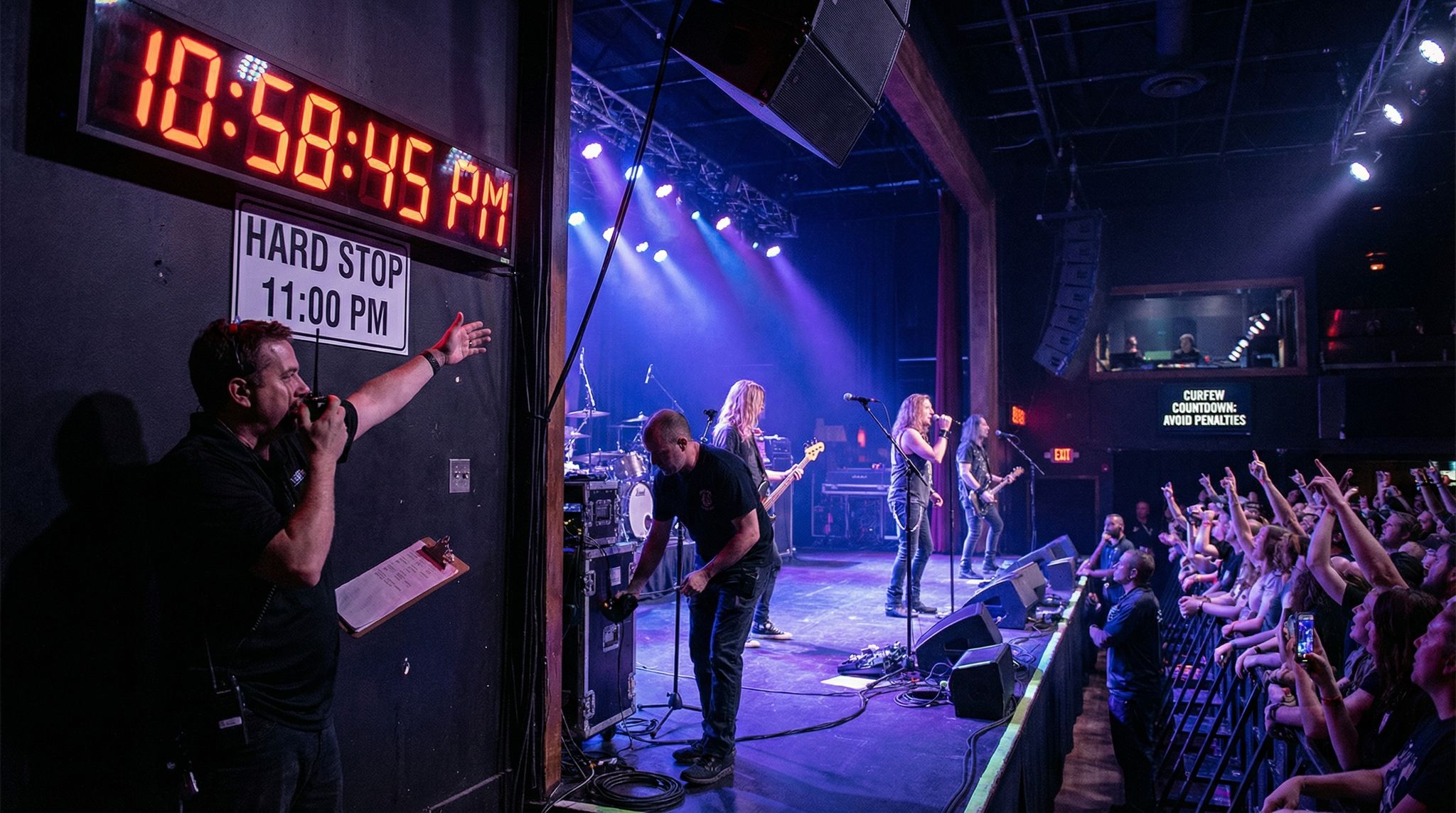
One more tip: use your Stage Clock to your advantage. Many venues have a digital countdown clock visible to performers from the stage or from the wings. Set it to count down minutes left in the set or up to the curfew time. It’s a clear, non-confrontational way to keep artists aware of time. A glance at a clock reading “5:00” (meaning 5 minutes left) can spur an artist to wrap up without anyone saying a word. And when it hits “0:00” – well, the visual says it all. In 2026, such production tools are affordable and common in professional venues, and artists have come to expect them.
Coordinating Venue Staff and Touring Crew
The relationship between a venue’s local crew and an artist’s touring crew is a critical partnership for staying on schedule. Both sides have valuable knowledge – the local team knows the house and the rules (like where the power tie-ins are, or how strict the curfew is enforced by local cops), and the tour crew knows the artist’s needs and the show’s intricacies. Fostering a cooperative atmosphere ensures that things happen efficiently. Encourage your stage hands to introduce themselves to the tour’s production folks early in the day and to discuss the run of show. For instance, the tour’s drum tech might say “I need 20 minutes to swap drum kits after the opener” – now your team can help streamline that.
Where possible, integrate the crews for key tasks. Have a venue audio tech stationed with the touring monitor engineer for swift troubleshooting, or a house lighting tech assisting the LD (lighting director) with any house-board quirks. These little collaborations prevent delays when cueing up the next act. A common cause of on-stage delays is miscommunication (e.g., the band is ready but the house isn’t dimming lights because someone didn’t radio FOH). By keeping an open comm channel between tour and venue teams – say a comm headset or a WhatsApp group for show cues – everyone can signal “ready” or flag issues in real time.
Another coordination point is load-out timing. As the curfew approaches, you might have venue crew prepping to strike certain gear even as the last notes are playing. This is often the case for tight turnarounds: you might quietly bring cases to stage side at the final song, or have loaders standing by at side exits. Make sure the touring crew is comfortable with this and that it’s choreographed in advance (so it doesn’t distract the artist or audience). Many experienced tour managers appreciate when a venue has a plan to get them out on time – it means the tour can hit the road sooner and your staff can clock off without overtime. Everyone wins.
Finally, always have a quick post-show debrief with your team and any touring reps before everyone departs. Discuss if any schedule hiccups occurred: “We started 10 min late because opening act was still eating dinner at start time – next time we need to fetch them earlier,” or “Guitar change took longer, maybe we can preset spares on stand next time.” These little notes, when recorded and learned from, make future shows even smoother. Building a culture of punctuality and continuous improvement among your staff spreads to how they interact with visiting artists and crew. It creates a virtuous cycle where everyone – venue and tour – is motivated to run a tight, professional show.
Technology and Tools to Stay on Track
Digital Scheduling & Alert Systems
Technology in 2026 has become a venue operator’s best friend for managing schedules. Many venues have adopted digital event scheduling systems (from simple shared Google Sheets to specialized software like Master Tour, Eventbrite Organizer, or bespoke tools) where all set times and tasks are logged. These systems often come with automated alerts: for example, a text message to key staff 10 minutes before the headliner is due on stage, or a push notification to the production team’s phones when doors are opening. By using digital alarms and reminders, you reduce the reliance on one person’s watch and ensure the whole team is aware of upcoming cues. If your stage manager gets distracted solving a power issue, a backup alarm can remind everyone “Headliner in 5 minutes!” so someone else can step in to alert the band.
Beyond scheduling software, consider using collaboration apps (like Slack or Microsoft Teams channels dedicated to show ops) where minute-by-minute updates can be posted. For instance, the moment the opener goes on stage, a quick message “Opener live at 7:32 (2 min late)” in the channel timestamps the progress. All managers see it and know the schedule is now 2 min behind, so they might shave a bit off intermission. If something goes wrong – say a lighting console reboot – the tech lead can instantly ping “Technical hold, approx 5 min delay” so front-of-house and bar staff also know fans will be waiting longer. This real-time transparency keeps everyone aligned and lets different departments adjust their pace. Just be sure not to overload staff with too many apps – pick a system that integrates well into their workflow. The key is centralized communication where timing updates are accessible to all who need them.
Many venues are also implementing automated show control systems. These can be simple or advanced: on the simpler side, a programmatic bell or announcement that plays exactly at a certain time (e.g., a pre-recorded voice: “Ladies and gentlemen, the show will begin in 5 minutes” over PA), or a buzzer in dressing rooms at 5-minute call. On the high-tech side, some integrated systems can trigger multiple actions on a schedule – for example, automatically lowering house lights, killing house music, and pinging the stage manager’s smartwatch all at 8:15 PM when the show should start. While full automation is a nice-to-have (you still need humans to confirm it’s safe to begin), these tools act as safety nets against forgetfulness or chaos.
Crucially, technology also aids in audience communication regarding schedule, which indirectly helps you stay on track. If fans know exactly when the headliner will start, they’re more likely to arrive on time, meaning you’re not stuck with a half-empty floor at downbeat. Many venues use their mobile apps or texting systems to send ticketholders push notifications like “Doors now open” or “Headliner on in 20 minutes.” For instance, an official festival app might broadcast updated set times if there’s a delay, ensuring effective set time communications. A modern ticketing platform like Ticket Fairy provides built-in messaging tools so you can notify all attendees of important updates (e.g., “Set times moved up 15 min due to weather – don’t be late!”). By leveraging these tech tools, venue managers keep both staff and fans in the loop, reducing friction and keeping the event moving as planned.
Entry Management Tech for Quick Ingress
One of the easiest places for a show schedule to unravel is right at the beginning: slow entry lines causing a delayed start. A venue could plan everything perfectly, but if half the audience is still outside at showtime, you face a tough choice – delay the show (upsetting those inside) or start on time (upsetting those stuck outside and possibly creating a dangerous rush). That’s why investing in efficient entry technology is so important. In 2026, scanning tickets via mobile QR codes or RFID is standard, but not all systems are equal. High-capacity venues opt for fast, reliable scanners and even biometric check-ins to speed up the door. Some are using turnstiles with integrated ticket readers that can process 20 people per minute.
The goal is to eliminate bottlenecks. Virtual queue systems are an emerging tech that let attendees secure a place in line digitally and arrive when it’s their turn, which prevents massive physical queues. As noted in an industry analysis, an overloaded entry line can directly delay show start times, and long bar lines at intermission can push back the next set. Venues that adopted smart line management – from more entry lanes and “lobby” smartphone queues to real-time wait time displays – have seen doors close on schedule and intermissions end promptly. By cutting wait times, you avoid those “hold the show, people are still coming in” situations.
Another tech solution is contactless payments and ID checks at the door to speed up entry. If age verification (ID checks for 18+ shows) slows your line, look into digital ID scanning devices. If searching bags causes delays, consider new tech like AI-based weapon detection scanners that allow guests to walk through without emptying pockets. The time saved can be significant. Leading venues have shaved several minutes per guest off entry with these tools, which for thousands of attendees means starting on time instead of 30 minutes late.
Ticketing platforms can help too – for example, Ticket Fairy’s system integrates with Stripe Terminal and scanning apps to ensure door operations are swift and smooth, even handling last-minute door sales within seconds. The platform’s reliability (no outage causing a backup at the gate) and speed directly support on-time show starts. In short, the best show schedule on paper means nothing if you can’t get fans in the door efficiently. Use technology to make your front gate as advanced as your stage, and you’ll remove one of the biggest wildcards in event timing.
Stage Timekeeping and Cue Systems
We touched on this earlier: having visible countdown clocks or timers for the stage is a game-changer. It’s 2026 – there’s no reason to rely on hand signals and guesswork alone. Professional timekeeping systems, like those used on TV and award shows, are increasingly adopted by venues and festivals. A digital clock facing the performers can count down the minutes remaining in their set or count up to a designated end time (e.g., “00:00” at 11 PM). Some even change color – green for plenty of time, yellow for 10 minutes left, red for “wrap it up now.” Performers appreciate this clear communication; it allows them to pace their show responsibly. It’s far better for an artist to self-adjust (“We’ve got time for two more songs”) than to have a stage manager step in to cut them off.
In addition to clocks, cue lights and systems are common in theater and increasingly in concerts. A side-stage cue light (often just a colored light bulb or LED) can indicate “go” or “stop” cues. For example, a blinking light near the FOH soundboard could be a signal agreed upon: blinking = you’re over time or last song. Or a specific mover light pattern might have been communicated to the band as the sign to take a bow. These methods sound old-school, but they work without drawing audience attention.
There are also full show control software solutions that some tours carry, which automate set sequences (especially for productions with time-coded lighting or video). If a tour is using timecode, they are definitely clock-aware – work with them to ensure the timecode aligns with curfew. Some venues plug into this by having a link to the timecode or at least the stage manager follows the timecoded setlist on a screen, so they know exactly how many minutes of content remain.
One often overlooked tool is a Decibel Monitor tied to the clock. Cities like Denver or LA not only care about when you stop but how loud you are up to that point. Having a real-time dB meter display visible to audio engineers can prevent accidental violation of noise limits (for instance, keeping it under 85 dBA after 10 PM as required by local ordinance). Some modern soundboards and venue monitoring systems will flash an alert if you approach the dB limit or curfew time – giving a visual cue that it’s time to lower volume or end the set.
Finally, automation in stage transitions is a tech assist: motorized turntables that rotate to swap bands, pre-programmed line-check sequences, and even robots (yes, some venues use simple robotics to move heavy gear quickly). These may not be common at every venue level, but the principle is the same – leverage machinery and pre-programming to save time where humans would be slower or at risk of error.
Keep in mind, though, that all the tech in the world won’t save you if it’s too complicated or fails at a critical moment. Always have a manual backup plan. If your fancy show control app glitches, your crew should know how to revert to analog clocks and radios on the fly. Technology is there to augment the human effort, not replace the need for attentive stage management. Used smartly, it becomes an invisible hand that keeps everything running like clockwork – which is exactly what you want fans to feel: that the show flowed seamlessly without them ever noticing the clock was a factor at all.
Data and Analytics for Continuous Improvement
One advanced aspect of using technology is collecting data on your schedules to improve them over time. By 2026, forward-thinking venues analyze past event logs to spot patterns. Maybe you find that on average, Band X’s genre takes 7 minutes longer to change over because of drum kit swaps, or that events where you scheduled only a 10-minute intermission always ran late compared to those with 15 minutes (maybe restroom lines needed that extra 5). Using analytics, you can adjust future planning. Some ticketing and venue management systems track when show segments actually occurred vs. scheduled. By reviewing these, operators create a feedback loop to refine their time allocations.
Data can also help convince stakeholders to cooperate with your schedule. For example, if an artist’s agent pushes back on an early start time, you might share anonymized data: “Over the past year, shows here that started 30 minutes earlier saw 20% less neighbor noise complaints and zero curfew fines, whereas later starts correlate with issues. We recommend sticking to the earlier time for everyone’s benefit.” When you back scheduling decisions with numbers (attendance trends, bar sales by hour, noise readings by time of night), it adds weight and objectivity.
Another data point: fan feedback. Through post-event surveys or social listening, you might find attendees commenting on timing – “Loved the band, but waiting 40 minutes between sets was a buzzkill” or “Great show, and I appreciated that it ended right on time so I caught my train.” These insights tell you how schedule impacts fan experience. Many fans quietly tolerate minor delays, but if it’s consistently an issue, it will come out in feedback. By monitoring this, you can address pain points proactively (e.g., if long changeovers are noted, double down on improving that aspect or provide entertainment during the wait to make it feel shorter).
Lastly, consider sharing some data transparently with your community and artists. Being able to say to city officials, “We’ve had 98% compliance with our curfew over the last year, here’s the log to prove it” gives you credibility, helping in engaging your community to support your venue. Similarly, telling a support band, “We run on time – in 50 shows we’ve never started more than 5 minutes late,” sets the tone that you expect the same professionalism from them. In essence, use technology not only to manage the present, but to learn and improve for the future. The best venues treat schedule management as an evolving science – one that blends tech, human skill, and data-driven tweaks to achieve that perfect show where everything runs like a Swiss watch and feels effortless to everyone watching.
Front-of-House & Backstage Synchronization
Efficient Doors and Seating Processes
Front-of-house (FOH) operations – notably ticket scanning, security screening, and seating – have a huge influence on whether a show kicks off on schedule. As mentioned earlier, long entry lines can force a late start if half your audience is still outside or in the lobby at showtime. To synchronize FOH with the show schedule, you should plan the doors open time strategically and ensure FOH is fully staffed and equipped. For most concerts, opening doors 60 to 90 minutes before the first act is standard. Larger venues or those with heavy security checks may even do 2 hours. The idea is to give ample time for the majority of the audience to get in, hit the restrooms or concession stands, and find their spots before lights dim.
A few tactics to expedite this: First, staggered entry – if you have multiple sections (e.g., VIP early entry, or separate entrances by ticket tier), use that to your advantage to spread out the surge. Some venues allow fan club or premium ticket holders in 15 minutes early as a perk; this also has the benefit of reducing the crunch for general admission entry. Second, ensure your FOH staff is trained to hustle without compromising safety. Bag checks and pat-downs should be thorough but efficient – have a clear checklist of disqualifying items so staff don’t waste time debating what to do with an oversized bag, for example. Metal detectors should be tested and set to an appropriate sensitivity to minimize false alarms that slow the line. It’s wise to run drills or at least a quick briefing each night: “We expect ~1,000 people at doors in the first 15 minutes, let’s be ready.” Aligning FOH mindset with the show schedule means they know they’re working against a countdown to showtime as well.
Another piece of FOH synchronization is coordinating seating or floor access. If you have a general admission pit that often fills first-come-first-served, you’ll want to open those doors on time and possibly even a few minutes early to avoid a last-second rush that delays start. If you have reserved seating, make sure ushers are sufficient in number and well-distributed to help people find seats quickly – you don’t want clusters of confused ticket holders still looking for their row when the lights go down. Some theaters use chimes or announcements (“Please take your seats, the performance will begin in 2 minutes”) to great effect. Even in rock venues, blinking the lights or a friendly MC announcement like “Grab that drink and head to the stage – we’re starting in 5!” can herd stragglers in.
Crucially, FOH and backstage must have a line of communication. If FOH anticipates a delay – for instance, a security issue is causing a backup or a VIP’s arrival is holding things up – they need to inform the stage manager immediately. Conversely, if the band decides to start 5 minutes late (maybe to allow more crowd in), FOH should be told so they can inform the crowd that’s waiting and not cause confusion at scanners (e.g., avoid a situation where lights go off and there’s a pile of people at security who panic or try to rush). A well-coordinated FOH and backstage team can dynamically adjust: hold doors if needed for production reasons, or slightly hold the show if FOH needs a minute more to seat a large group that arrived late (though ideally you avoid that).
Finally, consider the customer service aspect – FOH is where you can set expectations about schedule to the audience. Posting set times clearly at the entrance or on screens, and having staff verbally let people know (“Opener at 8, headliner at 9”) helps fans manage their time (and not all crowd the bar right when the opener is starting, for instance). It subtly encourages them to be in the room when they should. Some venues hand out small flyers or have digital displays with the evening’s timeline. A well-informed audience cooperates better with your schedule.
Stage Management & Show Calling
In the theater world, the Stage Manager or “show caller” is the absolute authority on timing – calling cues and moving the show along. Concert venues and clubs benefit greatly from adopting some of this show-calling discipline. The stage manager (or whoever fills this role, sometimes a production manager or head stagehand in smaller venues) should have the master schedule in hand and be actively managing it throughout the night. They are the point person side-stage keeping track of set lengths, cueing artists to start or wrap up, and coordinating with all departments when each segment begins and ends.
A strong stage manager operates like an air traffic controller. They use headsets or radios to communicate with sound, lighting, video, and FOH: “Standby, we’re about to go dark for the opener… Lights go, sound go.” When the opener’s last song starts, they alert the changeover crew: “Opener finishing in 3 minutes – be ready to strike.” During changeovers, they might be on the mic communicating progress: “Drums off, guitar rig rolling out – 10 minutes to headliner.” This continuous flow of information keeps everyone alert and synced. If something goes awry (say an amp isn’t working during line check), the stage manager is the one who decides how to adjust: hold doors longer, cut a song from the opener, etc., and relays that to all teams. In essence, they own the clock for the show.
Not all venues have a dedicated professional stage manager, but even if you’re a small venue operator wearing multiple hats, someone needs to perform this function during the event. That means not getting so bogged down in other tasks that no one’s tracking the schedule. If you’re the GM and also acting as stage manager, you might delegate door issues or bar questions to others once the show is underway, so you can focus on calling the show’s timing.
One useful practice from the stage management playbook is having a “show report” for timing. That’s a log of actual start/end times of each act and any notable delays or holds. You can scribble this on paper or use an app. It serves two purposes: (1) Real-time reference in case you need to adjust – if opener ran 5 long, you see it in writing and ensure you cut 5 elsewhere. (2) Post-show record for future planning (as discussed, data collection). Over time, these show reports highlight if a certain band always plays long or if your changeovers are consistently overshooting the planned duration.
In training your stage management team (or yourself), emphasize decisiveness and consistency. When it’s time to start, start (assuming the situation allows). This trains the entire ecosystem – crew, bands, even audience – that your venue runs on time. If you routinely delay starts for “just a few more people” or because one band member wasn’t ready, you create a culture of laxness that will bite you later. Of course, you use judgment (safety or major technical issues are valid reasons to hold), but those should be rare exceptions. A well-called show also adds to the perception of professionalism: the transitions feel smooth, and fans don’t even realize a stage manager might have averted a potential 10-minute lull by hustling an indecisive guitarist on stage promptly.
Quick Set Changeovers and Multitasking
An earlier section detailed planning for set changeovers. Here we’ll focus on executing them swiftly on the night. Quick changeovers are an art form that combine preparation, crew choreography, and sometimes innovative equipment. Veteran venues often have pre-labeled stage plots and even color-coded gear setups for each act to facilitate rapid festival changeovers and even production schedules for changeover day. For example, all mics and cables for the opener might be tagged in red, and for the headliner in blue – so when striking the opener, crew quickly pulls all red tags offstage, without accidentally removing something needed for the next act. This prevents confusion and saves time unraveling whose cable is whose.
Good crew division of labor is vital. Assign specific tasks: who’s handling drums, who’s on guitar amps, who’s wrapping cables. This way, nothing is forgotten and things happen in parallel. If you have enough hands, overlap tasks: one crew member can start removing the opener’s drums while another simultaneously starts setting up the headliner’s keyboards on the other side. It’s like a pit-stop in racing – multiple people working at once, each on a different component. Investing in rolling risers or spare stands can speed this up (roll the opener’s drums off on a riser, roll the headliner’s preset drums on). Some clubs with tiny stages even set up part of the next act’s gear behind the current one with drapes, then do a quick swap during changeover.
Time your changeovers during rehearsals or low-pressure shows to establish benchmarks. If it’s consistently taking 25 minutes but you scheduled 15, analyze why. Perhaps the guitarists are chatting instead of clearing gear – in which case, politely but firmly instruct bands in advance on the expectation: “Please clear your equipment from the stage within 10 minutes of finishing, our crew will assist.” Often local openers don’t realize they need to move fast; a gentle education helps. In some cases, offering a small incentive works – e.g., “If we break the record and change over in under 15, pizzas on me after the show.” That boosts crew morale and makes it a fun challenge rather than a chore.
For multi-use venues hosting radically different events back-to-back (say a comedy show at 7 PM, concert at 9 PM), changeovers might involve swapping out seating layouts or audio configs entirely. This is where pre-planning and modular setups pay off. If you know you have to pull out tables after the comedy set to create a dance floor, have the storage racks staged nearby and extra hands ready. The article on rapid event changeovers discusses strategies like modular stage panels and lighting presets to flip venues swiftly. Even if you’re not flipping from hockey rink to arena concert overnight, the principle stands: design your venue and equipment in a way that it can be reconfigured with minimal fuss.
Lastly, have a contingency crew or plan for when changeovers don’t go as planned. A classic example: a guitar amp won’t power up during line check – now you’re running late. Do you have a spare amp ready to go? Is there a house amp that can be rolled out in 1 minute? Another: the opener went long and didn’t clear the stage quickly – can you as the venue employ extra hands (maybe grab a couple of able-bodied security guys for a minute) to speed the gear off? Veteran operators often keep an “emergency kit” – gaffer tape, extra cables, spare DI boxes, even spare snare drum or cymbal – handy on the side of the stage so solving a tech issue doesn’t require running to the storage room. The quicker you solve problems, the sooner the next act can start.
In sum, tight changeovers are a dance: it looks hectic to the outsider, but to those in the know, it’s a well-rehearsed ballet. When your tech crew can pull off a swap in record time, not only do you stay on schedule, you impress the artists and fans. There’s nothing like that moment when the headliner kicks in right on time and the crowd roars, barely aware that 20 minutes ago the stage had a completely different band on it. That’s operational excellence.
Coordinating All Departments (Sound, Lights, Bar, etc.)
Synchronization isn’t just between stage and FOH – it’s across every department in the venue. Think of a show night as an orchestra: stage crew, sound engineers, lighting operators, bartenders, security, merch sellers, even custodial staff – all have parts to play in the timing and flow. If one section falls out of sync, it can cause a ripple effect.
Take the bar for instance: If bartenders aren’t warned that an intermission is ending in 2 minutes, they might still be taking complex orders when the lights dim, leading to frustrated customers or people missing the first song of the next act. A venue that’s masterful at timing will have protocols like “last call before show resume” – maybe flash lights at the bars or have bar managers announce “Show starting, please head in” when needed. In smaller venues, the sound person might play a specific song or audio cue over PA as a signal that intermission is wrapping up.
Security and crowd control also tie in. If your security team knows the set times, they can anticipate when to be at certain posts: for example, more guards at the stage front during a headliner, or extra staff at exits right when the show ends to manage the outgoing crowd. If a show is running 10 minutes late, the head of security should be informed so they can adjust their team’s positions or break schedules accordingly. Coordination prevents a scenario where, say, the band ends early and half the security were on break because they expected a later end – leaving the exits understaffed and chaotic.
Merchandise sales benefit from timing awareness too. A lot of merch sales happen after the show or during intermissions. If the show is going to end 5 minutes earlier than expected due to a short set, giving the merch crew a heads-up lets them get into position and be ready for the flood of fans coming out. Conversely, if there’s a delay, they might use that extra 10 minutes to do another sales push during the lull.
One department often forgotten in timing is transportation/parking management. If your venue coordinates with nearby parking or runs shuttles, they need to know if the show is ending later so they can adjust pickup times. Similarly, public transit info could be relayed to fans (“last train at 11:30 – we’ll be done by 11:00, you can make it”). Professional venues in urban centers sometimes even coordinate with transit authorities; for instance, if a gig might run right up to the usual last train, they might arrange an extra train or advise fans accordingly.
An excellent practice is a short all-staff meeting or radio call before doors where the night’s timeline is reviewed: “Alright team, key times: doors at 7, opener 8–8:45, headliner 9:15–11. Curfew 11 hard. Let’s remember to give last call at the bar at 10:45, lights up right at 11. Security, be ready at exits by 10:50…” This ensures no one can say they weren’t informed.
During the event, department heads should keep in touch. If any department is facing an issue that could affect timing (e.g., bar ran out of change, causing slow lines; or the box office has a will-call crunch delaying people’s entry), they should communicate that quickly so adjustments can be made or help provided. Multi-tasking is a hallmark of venue operations, but aligning those tasks under the umbrella of the show schedule is what separates great venues from mediocre ones. When every staff member, from the spotlight operator to the janitor, understands where they are in the night’s timeline and what’s coming next, the whole machine runs smoother. Fans will notice the cohesion: “Everything just clicked – no awkward waits, seamless transitions” – that’s the result of behind-the-scenes synchronization.
Dealing with Delays and On-the-Fly Adjustments
Common Causes of Schedule Slip-Ups
No matter how precise your planning, things can and will go wrong – often at the worst times. Knowing the usual suspects behind delays helps you preempt and respond. Some common culprits include:
- Artist-related delays: The band is late arriving (transportation issues, traffic), a band member goes missing when they’re due on stage, or the artist insists on holding the start for personal reasons. For example, perhaps the singer’s voice is strained and they want an extra 15 minutes of vocal rest – suddenly your start time is pushed.
- Technical difficulties: A power outage on stage, a mixing console rebooting, a piece of gear failing. Live sound and lighting are high-tech in 2026, but technology can glitch. A blown amp fuse or a software crash on the DJ’s laptop can eat up unplanned minutes.
- Weather: For outdoor events, rain or lightning can cause temporary stops. Even light rain might require wiping down the stage for safety, halting the show for 10–20 minutes. High winds could delay aerial effects or pyrotechnics.
- Crowd issues: If there’s unexpectedly slow ingress (due to extra security measures or a spike of late arrivals), you might hold the start. Or if there’s a medical emergency in the crowd right as a set is supposed to start, you choose to pause until it’s handled, for safety.
- Show logistics: Perhaps an opener ran longer than scheduled (despite your warnings), or a guest performer showed up unplanned and you allowed an extra song, etc. Sometimes positive surprises (encores, guest jams) can still cause schedule overruns if not managed.
Experienced venue managers mentally run through these scenarios and often have checklists or protocols for each. For instance, if an artist is late arriving, the protocol might be: communicate with the crowd (to manage expectations), possibly have a DJ or MC keep them entertained, and coordinate with local officials if curfew extension might be needed. If a major technical failure happens, you may have a “pause show” announcement ready to go and an estimated time to fix.
Live Adjustment Strategies
The moment you realize a delay is happening, act quickly and decisively. Don’t fall into denial – 5 minutes become 15 very fast if you hesitate. There are a few go-to strategies to get a lagging schedule back on track:
- Cutting content: The most direct way is to trim something. This could mean asking the opening act to shorten their set (e.g., “one more song” even if they planned two). Or later in the night, discreetly asking the headliner to skip the planned encore if things are running late. Many artists will cooperate if it’s explained as necessary to avoid an abrupt cut. Another tactic is cutting or shortening an intermission. For example, if you advertised a 20-min intermission but are 10 minutes behind, you might quietly make it 10 (announce “Please return to your seats, the show resumes in 10 minutes” even if people expected 20). Most won’t mind, or even realize why, and you just clawed back time.
- Parallel processing: Recover time by doing two things at once. If a tech issue is holding up the stage, can you start a different element of the show in parallel? For instance, if the curtain won’t open at a theater show, perhaps have the MC come out in front of curtain to kill time with the audience while crew works behind. In concerts, if one guitar amp is dead, maybe start the set acoustically or with other instruments while a tech swaps the amp quietly. Think creatively – the show might be slightly re-arranged on the fly to avoid a full-stop delay.
- Leveraging openers/support: If the headliner’s delayed arriving, and you have an opener who already finished, consider sending that opener (or a local DJ) back out for an impromptu extra 15-minute bonus set. This keeps fans engaged and less upset about the wait. Many indie artists would jump at extra stage time. Just be sure to communicate clearly (“Folks, we’ve got a special short bonus set for you while [Headliner] gets ready!”) so the crowd knows what’s up and it doesn’t feel disorganized.
- Communication & transparency: One of your strongest tools in a delay is honest communication with the audience. Fans are far more patient when they know what’s going on and that it’s being handled. If you’re facing a 30-minute technical delay due to, say, a power outage, announce it (or have someone address the crowd): “We’re experiencing a technical issue with the sound system. We expect to be back online in about 15-20 minutes. Thank you for your understanding – grab a drink, we’ll extend the show to make sure you don’t miss a thing.” Even if you can’t extend due to curfew, acknowledging the situation is better than silence. This prevents restless crowds and potential anger. It also stops rumor-mill panic (imagine if people think the show might be canceled vs just postponed a few minutes).
- Engage the crowd creatively: In some cases, the performers themselves can help diffuse a delay. There have been instances of artists coming out off stage to chat or do an acoustic sing-along with fans when power went out, etc. If you have a cooperative artist and a safe way to do something like that, it can turn a delay into a memorable fan experience. However, that’s situational. At minimum, ensure house music or a video display keeps running to give people something to focus on.
When making on-the-fly cuts or adjustments, consider the domino effect. If you shave 5 minutes off an opener’s set, check that the opener’s crew still has enough time to break down safely without rushing unsafely. If you shorten intermission, maybe send a runner to quickly notify restroom attendants or bar managers so they know a wave of people might be heading back in sooner. Essentially, every adjustment should be accompanied by a quick mental checklist of “who else needs to know or adapt to this?” This is where your earlier internal comms planning pays off. A quick radio call: “Heads up, intermission now 10 min not 20, lights going down at 9:10” to all departments can sync everyone to the new plan.
Keeping Calm Under Pressure
Attitude matters during crises. Stay calm, project confidence, and your staff and audience will usually remain calm too. As the person in charge, you set the tone. If you panic or shout, chaos can spread. If you stay composed and solution-oriented, your team will follow suit and the crowd often won’t sense any danger. Reassure your crew (“We’ve got this, Plan B is in action”) and ensure someone is keeping an eye on safety during any unplanned hold (e.g., if crowd gets restless, security should be alert to potential issues like pushing or people leaving).
Part of being calm is being prepared. We discussed having contingencies – knowing those in advance reduces panic. Many experienced managers have mental rehearse their emergency steps much like pilots drill for engine failure. When the real thing hits, muscle memory (procedural memory) takes over and you execute the plan rather than freak out at the newness of it.
Also, learn from every incident. If you had a delay but managed to recover, debrief with your team: What caused it? How did we solve it? What could we do next time to prevent it in the first place? Maybe you realize that the guitar pedal board always fails because of a power issue at that stage pocket – time to fix that during an off-day. Or that you should arrange a police escort for artists from the airport when traffic is known to be bad on Fridays (some venues do this for tight timelines!). Each challenge is a lesson in disguise, making you more resilient for the next one.
Extreme Scenarios: Last-Minute Cancellations or Postponements
The nightmare scenario for timing is when the show can’t go on at all as planned – for instance, a headliner cancels minutes before they’re due on, or a severe incident forces the show to stop entirely. This goes beyond a simple delay and into crisis management. While this isn’t common, 30+ years in the industry inevitably exposes you to something like it eventually. The key is to have a crisis response plan ready, as detailed in guides for last-minute cancellations. Act fast and decisively: assemble your core team the moment you get wind of a potential show-stopper (“Band’s stuck on highway in an accident and won’t make it”, or “Police are shutting us down due to an incident”). In that huddle, decide the course: Are we postponing to later that night, delaying a few hours, or full-out canceling? Who will inform the crowd and how?
Transparent, empathetic communication to fans is paramount if you have to deliver bad news to maintain the event’s reputation. Explain the situation honestly (“Due to a sudden medical emergency, the performance cannot continue tonight” or whatever it may be), and crucially, tell them what’s next (rescheduled date, refund process, etc.). If you handle this gracefully, you can salvage some goodwill. If you go radio silent or hide, you’ll have a riot of angry patrons.
From a schedule perspective, even a cancellation or big delay is about managing the timeline: maybe you decide to delay the start by 90 minutes because the artist’s plane is late – now you need to fill that 90 minutes. Maybe entertain the crowd with DJs, offer free soft drinks, and keep them updated every 15 minutes so they don’t give up and leave. Some veteran promoters have saved shows by literally stalling for an hour or more with creative filler until the artist arrived. It’s risky, but when the alternative is a cancel, it might be worth a try.
One more scenario: a partial show due to curfew. Imagine the headliner arrives so late that even with delays, they can only play a short set before curfew. Rather than just let it happen and disappoint fans, address it head-on. Perhaps negotiate a special arrangement: maybe the venue can go past curfew by 15 minutes just this once (sometimes authorities will allow it if you ask preemptively in an emergency), or commit on the spot to a make-up show at a later date for free. Having a plan to make it up to fans can turn a disaster into something manageable. The worst outcome is doing nothing and letting the schedule bust, the show cut short, and everyone go home upset without any gesture from your side.
In all cases of major unexpected issues, loop in stakeholders like venue owners, police or fire marshal (if relevant), and certainly the artist’s management. It should be a coordinated decision with everyone aware. Your calm leadership and quick action in these moments can literally save not just the show but your venue’s reputation and legal standing. Many crisis-handling best practices – like those for headliner cancellations – emphasize speed, honest communication, and trying to deliver an alternative experience if possible, as outlined in crisis marketing strategies to maintain the event’s standing even when your headliner cancels. If you manage that, you’ll find even on the worst nights, fans and artists will remember how well you handled a bad situation, rather than just the bad situation itself.
Mastering Curfews and Noise Ordinances
Knowing the Law: Curfews, dB Limits, and Permits
Every venue operator must become a student of their local laws and ordinances regarding events. Curfew management starts with knowing precisely what rules you’re dealing with. Is the curfew a hard cutoff for all amplified sound or just music? Does it apply every day or only weekdays? (For example, some cities allow a later curfew on weekends.) Are there decibel limits that gradually lower at night before the final cutoff? In 2026, many places have sophisticated noise regulations: e.g., a city might allow 85 dB until 10 PM, then 55 dB after – effectively meaning a rock show must end by 10, similar to Denver’s noise program regulations. Denver’s updated ordinance allows festivals 85 dB but still requires them to conclude by 10 PM. These details hugely impact how you schedule.
For operators and promoters, it is vital to distinguish between a hard venue closure and a stage curfew. When industry professionals ask what a curfew is at a concert, they are usually referring to the stage curfew—the exact minute the artist must stop performing and all amplified stage sound must cease. This is distinct from the building curfew, which dictates when the property must be entirely clear of patrons. Defining what curfew means at a concert in your artist contracts prevents the classic “one more song” scenario from bleeding into your egress time, ensuring you have the necessary buffer to clear the house legally.
Consult multiple sources: your venue’s operating license will spell out some conditions, local council or city websites often publish noise ordinances, and park venues have park district rules. Don’t rely on word of mouth. If you’re new to a venue, physically go to city hall or the local authority and get it in writing. Also clarify enforcement: sometimes “curfew” might mean when music must stop, but you could still have people on premises (soft music, patrons finishing drinks) for a while after. Other times it might mean everyone out by that time. Understand if there are grace periods or if fines are per minute, per 15 minutes, etc.
Another aspect is event permits. Special one-off events might have exceptions or stricter rules. For example, a city could grant you a permit for a New Year’s Eve show until 1 AM even if normally it’s 11 PM. Or conversely, a permit for an outdoor event might impose an earlier end than your usual indoor curfew. Always review each event’s permit or agreement.
Be aware of the “agent of change” principle in some regions (like parts of the UK and Australia): if new residents move in near an existing venue, technically they should accommodate the venue’s pre-existing noise levels – but in practice, you may still get complaints and need to address them. Knowing these frameworks helps in discussions with officials. In fact, proactively reaching out to the local noise control officer or environmental health department can establish goodwill. If they see you’re knowledgeable and proactive, they might be more lenient or helpful.
Lastly, know the penalties and processes. Is there an immediate fine for going 5 minutes over, or do you get a warning first? Can the police show up and literally pull the plug (it’s rare, but it has happened)? Or is it more that you’ll get a nasty letter the next day threatening action if repeated? Some locales impose steep fines or even can suspend your license for repeated breaches. This knowledge isn’t to encourage skirting the rules (“Oh, we can go 10 over, they’ll just warn us”) but to fully understand risk. The best practice is to assume a zero-tolerance approach – treat curfew as sacrosanct – but also have Plan B if an unavoidable run-over occurs (like maybe you pre-arrange to pay overtime for city inspectors if you run late – yes, in some cities that’s a thing; they send a sound inspector and if you go past, you pay their overtime but avoid a fine). It all depends on the locale.
Working with Authorities (Not Against Them)
Venue managers who succeed long-term often develop a good rapport with local authorities – police, city officials, noise enforcement officers, etc. Instead of viewing them as adversaries trying to shut you down, see them as partners in keeping the peace. Communication is key: if you know a particular show might be challenging (say a hugely popular artist where crowd noise will be high even after curfew, or the artist has a history of playing long), you could notify the authorities in advance: “We have XYZ playing, we are committed to the 11 PM cutoff, but just letting you know we’ll manage egress and monitor sound diligently.” Sometimes this heads-up makes them trust you more and they won’t be itching to pounce.
In cases where you anticipate a needed exception to the rules, apply early and document thoroughly. For example, if your festival wants to run 30 minutes late on a Saturday night, submit for a temporary noise variance permit well in advance. Show why it’s important (perhaps the artist can only play after dark so it’s a daylight issue), and outline what you’ll do to minimize disturbance (like notifying neighbors, providing earplugs as goodwill – a tactic used by some venues to turn potential conflicts into cooperation). Invite officials to visit the venue beforehand to see your setup. Demonstrating professionalism and a problem-solving attitude can sometimes win a favorable decision. As noted in the “Small Market, Big Acts” guide, getting a curfew waiver is possible if you loop the artist’s team in and show officials you’re taking extraordinary measures, a key part of strategies for attracting major artists.
During events, if law enforcement or inspectors are on site (some cities require an officer present at large shows), keep them in the loop. If a show is running say 5 minutes late, inform the on-site officer: “We’re on track to wrap at 11:05, apologies – minor delay due to tech issue – we’re doing our best.” Often, they appreciate the courtesy and may use discretion if they see you’re making effort and keeping them informed. It’s certainly better than them having to ask “Why are you running late?” with no heads-up.
Another tip: include local officials in your planning of large-scale events or new initiatives. If you’re planning to host a marathon concert or try a new noise mitigation technology, tell them. If you show you’re proactively addressing potential problems (like investing in an L-Acoustics directional sound system that keeps sound focused on the audience, effectively upgrading sound to keep peace), it impresses upon officials that you’re a responsible operator. They might then give you the benefit of the doubt when a complaint comes in (“That venue usually keeps noise under control, maybe it was a one-time fluke”).
Remember, the authorities’ main concerns are public peace and safety. If you align your operations to those aims – and make it clear that you do – they generally won’t have a reason to battle you. And if you do slip up (it can happen to the best of us), owning it and showing a plan to fix it goes a long way. For example, after a noise complaint incident, meeting with the city council or neighborhood group to outline new noise control measures, as seen in successful municipal venue management cases, helped one municipal venue maintain permission for rock concerts. That kind of responsiveness can turn a potential ban into just a “minor adjustment.”
Sound Mitigation and Late-Night Volume Control
Sometimes, the issue isn’t just when you stop the show, but how loud it is as it approaches curfew. Many venues employ sound mitigation strategies to comply with ordinances without necessarily cutting a performance short. For instance, if you’re allowed to play until 11 PM but the dB limit drops after 10 PM, you might work with the headliner’s sound engineer to gradually lower volume through the last few songs. Or perhaps you cut subwoofers at a certain time (low frequencies travel further and often are the main culprit in disturbing neighbors). Some artists will cooperate by doing a quieter song at the end of the set to help – it can even be a special acoustic finale that feels intimate.
There are also physical and technical investments to reduce sound bleed. Soundproofing the venue – adding acoustic paneling, bass traps, heavier doors – can let you push a bit more sound later without violating outside noise levels. It’s a cost, but as the Music Venue Trust and others have noted, investing in sound control is essential to being a good neighbor and engaging your community. Enclosures for outdoor stages, directional speaker arrays (like the one employed by Forest Hills Stadium in NY that “keeps concert sound laser-focused on seats,” ensuring sound is where it needs to be), and strict monitoring can drastically cut down complaints.
If your venue has the ability, monitor sound at the property line in real time. There are apps and devices now that can send an alert when you’re approaching a dB threshold off-site. Having someone tasked to walk the perimeter during the show, armed with a decibel meter, is an old but effective practice. If they report “bass is booming in the parking lot at 10:50 PM,” you might decide to pull the bass down a bit for the final minutes.
Another strategy is scheduling certain genres or particularly loud acts earlier in the evening. If you have a multi-band bill, maybe put the loudest band on before the quieter one, so as you get later, the overall sound energy is lower. And if you know an act is extremely loud (hello metal and EDM), you might even schedule them on nights when later curfew extensions are possible (e.g., a Saturday vs. a strict Sunday).
Finally, consider beyond-the-venue tactics: working with neighbors to mitigate impacts. For example, some venues provide local residents with hotline numbers to call if noise is too loud, promising a quick response (instead of them calling police first). Others, as we touched on, offer small gestures like free tickets or even earplugs delivered to homes for a particularly loud event – these gestures can turn potential complaints into understanding. Showing you care may not directly lower the volume, but it lowers the tension. Satisfied neighbors might tolerate a bit more noise a bit later if they feel respected and included.
In summary, noise mitigation is about playing smart. Abide by the letter of the law – absolutely – but also go beyond it as a sign of goodwill through operational control and sound provision. If allowed until 11 PM at 85 dB, maybe you end at 10:50 at 80 dB. The neighbors notice that kind of courtesy. Over time, that builds a reservoir of goodwill that can save you when you really need it (like asking for that one-off midnight NYE show).
Curfew Extension Tactics and Limitations
Sometimes you’ll face a situation where you really need more time than the curfew allows – an artist’s full production doesn’t fit in the window, or a sports game went into overtime and pushed the concert late. How can you get a curfew extended? As mentioned, advanced approval is key. Some tactics include:
- Petitioning local officials: Present a case that the event is of significant cultural/economic value, and outline how you’ll minimize impact (maybe only one-time, you’ll do extra security to manage exit noise, etc.). We saw earlier that small cities might extend curfew for a superstar; for instance, Foxborough extended by 15 minutes for Springsteen one night, as reported when a town extended curfew just for Springsteen. These tend to be the exception for special occasions, not routine.
- Pay for it: In certain jurisdictions, you can pay for a permit for extra hours. Example: some U.S. cities allow buying a “late event” permit at a cost that might go toward community funds. It’s expensive but can be worth it for a major event. Make sure to budget for this if you plan to go that route.
- Artist cooperation: If an artist knows they have a long set, they might share in responsibilities, like starting earlier than usual or trimming non-essential parts of their show (maybe do a shorter opening video montage, etc.). Encourage them to adapt to venue constraints – most will if asked professionally.
But, be mindful of limitations. Even if you get an extra 15 minutes, that’s not a license to blow past that new time. It often comes with scrutiny. Also, if you go to the well too often (keep asking for extensions), authorities will lose patience. Use the curfew extension option sparingly and for truly important needs.
Never assume you can just quietly break curfew because “just this once, it’ll be fine.” It has a way of backfiring – that one neighbor was recording the whole time, or someone posts on social media about the late noise and next thing you know officials have evidence. It’s not worth risking your operating license or angering the community for one show. Long-term venue survival trumps short-term wins. That said, if an artist does go over despite everything (it happens – perhaps they just wouldn’t leave the stage and played on), be prepared to apologize and remediate. That means talk to your city officers the next day, explain it was unplanned, and offer a plan to prevent a reoccurrence. Maybe you decide to set the stage power on a timer as a joke solution (or not so joke) – e.g., “we will literally cut power next time, and we’ve told artist agents this.” It shows you take it seriously.
Community Relations and Curfew
We covered neighbor relations earlier, but it’s worth re-emphasizing from the curfew perspective. A venue that has a positive relationship with its community will navigate curfew issues much more smoothly. Engage your neighbors in dialogue about noise and timing, especially for venues in densely populated areas. Some venues hold annual meetings or send newsletters to residents listing major events, curfew times, and contact info. Transparency disarms a lot of conflict. If people know “there’s a show Saturday that will end at 10 PM with fireworks,” they’re less likely to freak out when it happens.
Encourage a culture of respect among your patrons as well. Many venues make a pre-show or post-show announcement like, “Thank you for coming – as you exit, please respect our neighbors and keep noise to a minimum”. It’s a simple reminder that can significantly reduce the late-night yelling and car honking that often infuriates people nearby, as neighbors just need the prompt. Even signage at exits saying “Quiet Zone – Residential Area” helps. Fans who love your venue often will self-police once you’ve primed them with this message.
Another aspect is showing you’re part of the community fabric. If neighbors feel your venue is a community asset, they’ll be more forgiving. This goes beyond just noise – it’s about being a good citizen (charity events, local partnerships). But it loops back: a neighbor who’s attended your shows or benefitted from your venue is “in your corner” and less likely to rally against you for a minor curfew run-over, creating neighbors who love your venue. Some venues even invite neighbors to certain shows free as goodwill, or at least give them earplugs and a heads-up for loud ones – these gestures can turn complainers into ambassadors.
Lastly, document your efforts. Keep a log of noise levels, complaints, and responses. If you can show that in the past year you had only 3 complaints and each was handled within 20 minutes, demonstrating how you handle the neighbor relationship, you build a case as a responsible operator. Then if a single neighbor tries to make a case against you, you have data to defend yourself (“We have 300 nearby households, only one regularly complains; we respond to them each time and our readings are within limits”). Combine that with letters of support from other neighbors or local businesses (“the venue draws customers to our cafe but always ends on time”) and you create a strong narrative if curfew debates come up at licensing hearings or community boards, leading to fewer regulatory conflicts and stronger community support.
In short, curfew management isn’t merely an internal scheduling matter – it’s deeply entwined with public relations and community trust. By mastering the technical aspects and the human aspects, you ensure your venue can keep the music playing for years to come.
Smooth Event Wrap-Up: Post-Show Time Management
Controlled Endings and Exits
When the last note has rung out and the curfew is met, your job isn’t quite done – how you handle the immediate post-show period is crucial for safety, neighbor relations, and even maximizing a bit more revenue. A controlled, efficient exit process avoids undoing all the good will you built by running a punctual show. If fans leave in a chaotic fashion or linger making noise, you could still get complaints or incur extra costs (like staff overtime or city penalties for disturbance).
First, the end-of-show cue: typically, house lights come up and the music (either outro music or simply the absence of performance) signals that it’s time to go. Don’t delay on this – lingering in darkness with no music after a set can confuse people or prompt them to start chanting for more even if the curfew forbids it. As soon as the band’s final bow is done, bring up lights to a moderate level to indicate closure. Some venues play a specific closing song over PA (it becomes a tradition, like how arenas often play a particular track when the game ends). This creates an auditory signal that the event is over.
It’s wise to have the MC or a recorded announcement say a quick thank-you and goodnight that also gently reminds patrons to exit calmly and respect the surroundings, as neighbors just need the prompt. For example: “Thank you for coming! Please make your way to the exits and have a safe journey home. We kindly ask that you keep noise down outside as it’s late.” This sets expectation and most law-abiding folks will comply.
Executing this transition smoothly relies heavily on up-to-date crowd management safety protocols in 2026. Modern egress strategies require operators to anticipate crowd behavior the moment the stage curfew hits. This means pre-positioning trained security personnel at strategic choke points, ensuring dynamic digital signage switches to exit routing, and maintaining adequate lighting levels to prevent trips and falls. By integrating these advanced safety protocols into your post-show timeline, you mitigate the risk of crowd crushes and ensure that the mass movement of fans out of the venue is as orderly as their arrival.
Now, ensure all possible exits are utilized. Don’t force everyone through one door if you have multiple – open the side gates, the secondary doors, etc., to let people disperse quickly and avoid bottlenecks. Trained security or ushers should gently direct people – “This way out folks” – and prevent crowd jams. An orderly exit not only is safer (no crowd surges or frustration), it also empties the venue faster which can reduce how long you’re paying staff and how long neighbors hear departing noise. In large venues, coordinate with local traffic control if needed (sometimes police help direct cars after big shows – if so, timeline that with them beforehand based on expected end time). If you ran late at all, expedite everything: every minute counts in clearing out before you trigger overtime charges or neighbor ire.
Last-Call Sales vs. Curfew Compliance
Many venues face a small conflict of interest at show’s end: you could potentially sell more drinks or merch if people hang out longer, but you also need them out by a certain time. Generally, once the main act is done at curfew, you shouldn’t continue ancillary sales that prolong people’s stay (in some places it’s illegal to serve alcohol after event end or past a certain hour anyway). So plan last calls smartly. Typically, you might stop alcohol service 10-15 minutes before the event ends to allow people to finish drinks and then leave. Announce or display “Last Call” so attendees know. That way, by the time lights are up, they’re not clutching full beers wondering if they can stay and drink.
Merchandise booths often get swamped right after a show. One tactic is to reposition merch closer to exits towards the end of the night, if possible. Some venues have merch stands outside the main hall in the lobby or even outdoors under a tent that people naturally pass by on the way out. This allows those who want to buy to do so without blocking others from leaving. It also draws the crowd out of the main space. However, be cautious: if outside, still control the line so it doesn’t become a loud congregation under someone’s window at 11:30 PM.
From a schedule viewpoint, consider allocating a short window for merch buying in your internal timeline. For example, if the show ends at 10:50, maybe you keep venue open till 11:15 for merch and gradual exit, but with strict noise control. Some venues play softer, calming music in the lobby at this point to encourage a quiet, mellow departure rather than rowdiness. You might also use announcements: “Merch is available by the main doors. Venue will close in 15 minutes.” This subtly tells people they can’t just linger indefinitely.
Staff Wrap-Up and Overtime Prevention
Your crew’s work isn’t done at show end either. Strike and clean-up needs to happen, and it needs to be organized so you’re not paying an extra hour of wages just because folks were slow to start folding chairs. Have a post-show checklist and team assignments ready: who picks up trash in the audience area, who loads out the band’s gear (and are loaders in position to help the tour if needed), who resets the stage or secures equipment? The faster this gets done, the sooner everyone clocks out or transitions to the next task (like overnight changeover for next event, if applicable). A well-rehearsed teardown can be done amazingly fast – think of some festivals where as soon as the concert ends, a small army appears cleaning and dismantling. Borrow that mentality.
Be mindful of labor rules here too – if crew have been working since morning, ensure you’re not pushing them into double overtime by dragging feet now. Sometimes giving everyone a quick 5-minute breather after an intense show before teardown can actually speed things up, because they catch a second wind and then work more efficiently. Judge your team’s stamina and the urgency. In union houses, you might have a fixed window before a meal penalty or curfew penalty hits for crew, so that’s extra incentive to finish on time.
Another strategy: “all lights on” as soon as audience is out, to facilitate cleaning and packing. A brightly lit venue keeps workers alert and signals that the fun part is over, now it’s work mode. You might play some upbeat but not loud music just for staff mood while cleaning (though careful after curfew – keep it very low or just on internal monitors if cleaning late at night; the public facing sound should be off).
For venues in residential areas, consider a “quiet load-out” plan. If you have to load trucks on the street at 11:30 PM, try using quieter rubber-wheeled dollies, avoid shouting commands, maybe wait to dump glass bottles from the bar until daytime (that clattering can wake the dead). These small efforts can prevent neighbors from getting disturbed just when they thought it was all over, effectively minimizing noise and disruption. Some venues have even coordinated with garbage pickup so that their post-show trash removal doesn’t happen at 2 AM.
Post-Event Debriefs and Continuous Improvement
Once the night’s work is truly done and everyone catches a breath, it’s extremely valuable to have a brief debrief with your core team (perhaps the next morning when people are fresh). Go over the timeline: Did we hit all our marks? Where were we ahead or behind? This doesn’t have to be a long meeting – even a 10-minute rundown: “Doors were smooth, opener started 5 late because we held for more entry – consider opening doors 15 min earlier next time. Headliner ended exactly on time, great job everyone. Load-out took 45 min, a bit longer than goal; maybe next time stagehands needed more clear plan.” By reviewing these while fresh, you capture tribal knowledge that improves future shows.
Keep a log of these notes. Over months and years, patterns emerge (perhaps “every December shows run late because of holiday train schedules affecting arrival times” or “XYZ tour always has long changeovers”). Use that intel to refine rider language, staffing levels, or infrastructure. Maybe you realize your new line-array speaker system is actually cutting 5 min of changeover because it’s easier to move, great! Or that you lost time every night switching a DJ booth in and out – so invest in a second DJ setup to save 10 minutes.
A post-show debrief isn’t only operational; it’s also a chance to praise and reinforce. Thank the team for sticking to the schedule, call out the security lead for efficiently clearing the floor, credit the stage manager for quick thinking on a delay. This boosts morale and gets everyone to buy into the importance of punctuality and teamwork. When staff feel that buzz of a show well-executed, they’ll aim to replicate it every time.
And don’t forget to loop in the artist/promoter side if appropriate – a quick email to the tour manager: “Thanks for helping us wrap by curfew, great show!” can go a long way. They’ll remember your venue as one that runs things professionally and still delivers a great experience.
Lastly, if there were any incidents or near-misses, use them as learning tools. For example, if a few overly rowdy fans lingered shouting outside and a neighbor complained, maybe your debrief decides “next time, have security gently disperse any loud groups immediately post-show.” Or if the artist wanted to do a signing after the show which you hadn’t planned for, and it ran late, you decide “We must include any post-show activations in the schedule in the future.” Continuous improvement is the name of the game – even after 30 years in the business, there are always new lessons because live events are wonderfully unpredictable.
By mastering the post-show phase, you essentially complete the circle of schedule management – from planning well before the event to wrapping it efficiently at the end. Each phase feeds into the next, and excellence in all of them is what makes a venue truly world-class.
Frequently Asked Questions
How do venue managers plan show schedules around curfews?
Venue managers utilize backward planning, starting with the non-negotiable hard curfew time and working in reverse to schedule headliners, support acts, and changeovers. This method reveals potential timing conflicts early, allowing operators to build in necessary buffers and ensure the final note rings out before fines or penalties occur.
What are the penalties for breaking venue noise curfews?
Violating noise curfews can result in fines ranging from hundreds of dollars to over €50,000 for major infractions. Beyond financial penalties, venues risk license suspension, expensive union overtime costs for crew, and long-term reputational damage with local authorities and neighborhood associations.
How can venues speed up stage changeovers between bands?
Venues accelerate changeovers by using rolling risers, pre-labeled color-coded gear, and modular stage setups. Assigning a dedicated changeover coordinator to manage the timeline and utilizing parallel processing—where crew members simultaneously strike old gear and set up new equipment—can significantly reduce downtime between acts.
What technology is used for event time management in 2026?
Modern venues utilize digital scheduling software with automated alerts to sync staff, alongside visible stage countdown clocks that signal remaining set time to artists. Advanced systems also integrate real-time decibel monitors and automated show control features that can trigger house lights or cut sound if strict limits are breached.
How do stage managers communicate time limits to artists?
Stage managers communicate timing through visible digital countdown clocks facing the performers, color-coded cue lights, and hand signals from the wings. In critical situations, they coordinate with tour managers via headsets to verbally instruct artists to wrap up, ensuring the set ends before the hard curfew.
What strategies help venues recover time when a show runs late?
Venues recover lost time by shortening support act sets, trimming intermissions, or cutting planned encores. Operational teams may also employ parallel processing, such as starting a set acoustically while fixing technical issues, or using efficient entry technology to speed up audience ingress if door delays are the cause.
How does entry management impact show start times?
Inefficient entry creates bottlenecks that leave audiences outside at showtime, forcing venues to delay the start. Implementing fast scanning technology, biometric check-ins, and staggered entry times ensures the crowd is on the floor before the first act, allowing the show to begin exactly as scheduled.
Why is building buffer time into event schedules important?
Buffer time acts as a planned contingency to absorb unexpected delays like technical glitches or weather holds without pushing the event past curfew. Scheduling a 5-to-10-minute cushion before the headliner or curfew ensures that minor slip-ups don’t result in fines or abrupt power cuts.
How can music venues reduce noise complaints from neighbors?
Venues reduce complaints by proactively sharing event schedules and curfew times with residents and offering feedback channels. Implementing sound mitigation strategies, such as directional speaker systems and lowering decibel levels as the night progresses, demonstrates respect for community norms and helps avoid regulatory backlash.
How do union rules impact venue curfew management?
Union contracts often trigger expensive overtime pay, such as time-and-a-half or double time, if an event runs even a few minutes past the scheduled end. Venue operators must strictly enforce stop times to avoid these escalating labor costs, which can amount to tens of thousands of dollars for large crews.
What are best practices for post-show crowd management?
Effective post-show management involves raising house lights immediately, playing distinct closing music, and utilizing all available exits to disperse crowds quickly. Venues should coordinate last call times for alcohol sales to prevent lingering and ensure security staff actively guide patrons out to minimize neighborhood noise disturbance.
Is it possible to get a curfew extension for a live event?
Venues can sometimes secure curfew extensions by applying for special permits well in advance, particularly for events with significant economic or cultural value. However, this often requires demonstrating noise mitigation plans, paying additional fees, or gaining approval from local councils and is generally reserved for special occasions.
Why is the “advance” process critical for show punctuality?
The advance process establishes the run of show, load-in times, and strict curfew rules in contracts before the artist arrives. Communicating these details to tour managers early ensures all parties are aligned on the timeline, preventing day-of-show negotiations and reducing the risk of schedule overruns.
What sound mitigation strategies help venues comply with curfews?
Operators comply with strict late-night rules by utilizing directional sound systems that focus audio on the audience, installing acoustic paneling, and cutting subwoofers at specific times. Real-time monitoring at the property line allows engineers to adjust volume levels dynamically to stay within legal decibel limits.
How do noise ordinances affect concert scheduling?
Local ordinances dictate hard stop times and often impose stricter decibel limits later in the evening. Venue operators must schedule headliners to finish before these cutoffs and may need to program quieter acts or lower volumes towards the end of the night to avoid violations.
What does a stage curfew mean at a concert?
For venue operators and promoters, a stage curfew is the strict, contractually defined time when an artist must stop performing and all amplified stage sound must be turned off. This differs from a venue curfew, which is the time by which the entire building or grounds must be completely cleared of attendees and staff.
How do crowd management safety protocols integrate with curfews in 2026?
In 2026, crowd management safety protocols require venues to synchronize their security and egress strategies directly with the stage curfew. This involves pre-positioning staff, activating dynamic exit signage, and managing lighting the moment the performance ends to ensure a safe, orderly, and timely evacuation of the crowd before the hard building curfew.