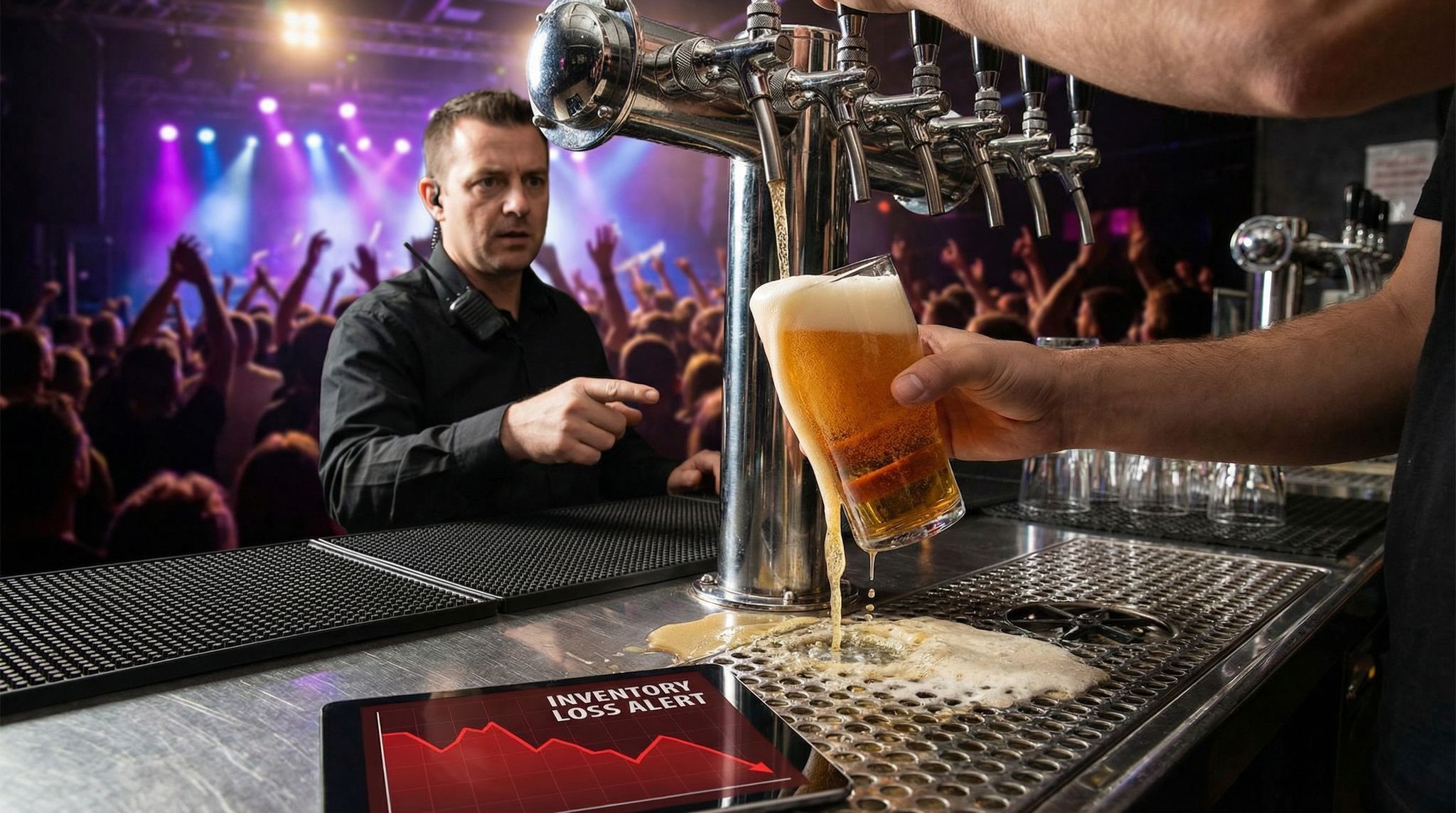
Venue operators often focus on selling more tickets and drawing bigger crowds – but if you’re literally pouring profits down the drain through poor inventory control, those extra sales won’t translate to a healthier bottom line. In 2026’s tight-margin venue business, every drop of beer, every burger patty, and every band T-shirt counts. Studies show that bars and restaurants lose roughly 20% of their revenue to inventory shrinkage on average, according to data on food inventory and bar shrinkage. That means wasted drinks, spoiled food, or unaccounted merchandise could be siphoning away one-fifth of your potential profits. The good news: by tightening up inventory management, venues worldwide are saving thousands annually and boosting profit margins without raising prices or cutting the fan experience. This comprehensive guide will show you how to do the same, with practical tactics and real examples from venues that mastered their stock.
We’ll dive into strategies for preventing bar spillage and over-pouring, reducing food spoilage, leveraging real-time stock tracking tools, optimizing orders and supplier deals, training staff on portion control, and using data forecasts to anticipate demand. Whether you run a 200-cap club or a 20,000-seat arena, these inventory control methods will help ensure every drop and every dollar are accounted for. It’s time to stop the silent profit drain and turn inventory management into one of your venue’s biggest competitive advantages.
The Hidden Cost of Wasted Inventory
Shrinking Margins in a Post-Pandemic World
Live entertainment may be booming again, but venue profit margins remain razor-thin. Rising costs for supplies, utilities, and labour mean venues can’t afford to bleed money through avoidable waste. In the UK, grassroots music venues saw operating costs surge 40% by 2022, leaving an average profit margin of just 0.2% (about £1,300 annual profit), as noted in strategies for smart venue cost management – virtually break-even. Across the U.S., over 60% of small independent venues weren’t profitable in 2024, highlighting the challenges of rising venue competition. In this climate, any inventory mismanagement – from overstocking expensive liquor that ends up expired to under-portioning that disappoints customers – directly threatens a venue’s survival. Cutting waste isn’t just eco-friendly; it’s becoming essential for staying in business.
How Spillage and Spoilage Erode Profits
Every ounce of beer that spills, every bottle over-poured, every case of soda that expires on the shelf, and every unsold T-shirt sitting in storage represents money lost. Industry analyses estimate that unchecked inventory shrinkage (from spills, spoilage, and theft) can eat up as much as 25% of a venue’s bottom line, based on industry analysis of inventory shrinkage. Think about it: if your concert hall pulls in $50,000 a month in bar revenue, you could be losing $10,000 of that to waste and shrinkage without proper controls. Common culprits include:
Data-Driven Event Marketing
Track ticket sales, demographics, marketing ROI, and social reach in real time. Exportable reports give you the insights to make smarter decisions.
- Over-Pouring at the Bar: A bartender free-pouring a generous “heavy” shot or mis-measuring a cocktail might seem like great hospitality, but it adds up to gallons of lost product over time.
- Drink Spillage & Breakage: Foam overflow from draft beers, dropped glasses, or improperly sealed keg lines can result in liquid gold literally down the drain.
- Food Spoilage: Perishable stock (fruits, dairy, bread, etc.) that isn’t used before its use-by date, unsold catering trays from shows, or ingredients forgotten at the back of the freezer all contribute to waste.
- Theft and Unrecorded Comps: Unfortunately, a few staff giving out free drinks to friends or failing to ring in items can quietly drain stock. Even well-intentioned comped drinks or meals that aren’t tracked count as shrinkage.
- Excess Merch Inventory: Boxes of unsold merchandise (shirts, hats, posters) after an event tie up cash and often get discounted heavily or never sold at all.
Each of these problems is controllable with the right strategies and tools. Before we dive into solutions, let’s put real numbers to the problem and see how much smart inventory management can save.
Real-World Examples: Thousands Saved by Controlling Inventory
It’s hard to grasp the scale of inventory losses until you see the before-and-after. Consider Pint House, a bustling bar in Columbus, Ohio. A few years ago, they discovered their beer and liquor shrinkage – the gap between product sold and product used – was a whopping 21%. By implementing a meticulous weekly inventory auditing system, they slashed shrinkage to just 3% and boosted profits by $9,445 per week, a case study on bar and restaurant cost reduction reveals. That’s nearly half a million dollars recouped per year, simply by not giving away so much stock for free. Another group of venues, the Vaughan Hospitality Group in Chicago, adopted a similar beverage inventory system across six bar-restaurants. The result? A 15% improvement in inventory variance and roughly $1,200 extra profit per week, per venue, demonstrating the benefits of beverage inventory systems. These are game-changing figures achieved without selling a single extra ticket – purely by managing existing stock better.
Ready to Sell Tickets?
Create professional event pages with built-in payment processing, marketing tools, and real-time analytics.
To see where venues commonly lose money and how to fix it, let’s break down typical loss areas and their solutions:
| Common Inventory Loss Source | How It Hurts Profits | Prevention Tactics |
|---|---|---|
| Over-pouring drinks | Shrinks each sale’s margin (extra liquor per pour). A 0.25 oz over-pour on every drink can cost hundreds per week, according to common errors that drain beverage profits. | Train strict pour counts; use jiggers or measured pour spouts; install pour control devices. |
| Spillage & breakage | Wasted product from dropped glasses, foamy kegs, etc. Direct cost of goods down the drain. | Emphasise careful handling; use spill mats; maintain tap systems; log all spills to identify patterns. |
| Expired or spoiled stock | Money spent on stock that never gets sold (expired beer, wilted produce). | First-In, First-Out (FIFO) rotation; track expiry dates; adjust order sizes and frequency to demand. |
| Theft & unrecorded comps | Missing inventory from theft or giving away product free eats into revenue; often 5-10% loss in some bars. | Implement inventory counts and variance reports; restrict comping authority; use cameras or mystery shoppers if needed. |
| Merch overstock | Capital tied up in unsold shirts/posters that may be discounted or trashed (lost potential sales). | Use pre-event surveys and pre-orders to gauge demand; order conservatively with re-order options; have post-event online sales for leftovers. |
As these examples and figures show, stronger inventory controls can transform your venue’s finances. Now, let’s explore how to implement these controls – from the bar and kitchen to the stockroom and supplier negotiations – so you keep more of each hard-earned dollar in 2026.
Plugging the Leaks Behind the Bar
The venue bar is often both a top revenue source and a top source of product loss. Eliminating waste here can significantly boost profits. Let’s look at how veteran venue managers clamp down on over-pouring, spills, and drink shrinkage without sacrificing service quality.
Over-Pouring: The Silent Profit Killer
Generous pours might please patrons in the moment, but habitually over-pouring is devastating to your profit margins. For example, using the wrong speed pour spout on liquor bottles can cause subtle leakage that loses up to 0.25 ounces every pour, a major factor in beverage profit drainage. Across hundreds of drinks a night, that’s like giving away dozens of extra cocktails for free. Similarly, bartenders who free-pour often have inconsistent portions – one bartender’s “whiskey on the rocks” might be 2 oz, another’s 1.5 oz. That variance adds up. Solution: Standardize and measure everything. Many experienced venue operators enforce a strict rule: all spirits in mixed drinks are measured with a jigger or an electronic pour gun, not eyeballed. Even for straight pours, specifying a standard (e.g. 1.5 oz for a single) and using precision pour spouts ensures consistency. Not only does this control cost, it also improves consistency for the customer – they get the same drink every time. Regular staff tasting and calibration sessions can help too (e.g. show bartenders what a proper 5-ounce wine pour looks like in your glassware). The goal is to eliminate the “heavy hand” and make every drop count.
Tools and Techniques to Control Pours
Modern bar technology offers ways to monitor and reduce liquid loss without hovering over your staff. Smart pour spouts with built-in measures will cut off flow after the exact ounce is dispensed, preventing that extra splash. Some venues install flow meters on beer tap lines – these devices measure each ounce dispensed and can flag if more beer is pouring than being rung into the register. If 150 pints were sold but 170 pints worth of beer left the keg, you know there’s a problem in need of investigation. Bars at major arenas and stadiums in 2026 are increasingly using automated self-serve beer taps (with RFID cards or bracelets for customers) that dispense a preset volume; these virtually eliminate over-pour and spillage, though they require upfront investment and are best for high-volume environments. For most venues, simply integrating your POS with inventory software can work wonders – every drink ordered deducts that amount of liquor or beer from your digital inventory, so you can spot discrepancies on the fly. Even low-tech solutions help: use glassware with pour lines (subtle markings) to guide bartenders on ounces, or provide dedicated pour training with timed counting methods for free-pour (e.g. a 4-count = 1 ounce with a standard speed pourer). The right tools, training, and tech together will tighten up your pours and boost your beverage cost percentage back to healthy levels.
Monitoring and Accountability for Bar Stock
To truly plug the leaks, you need to monitor bar inventory in real time and hold staff accountable. Many veteran bar managers institute end-of-shift or nightly inventory spot-checks – counting high-value bottles (like top-shelf spirits) to ensure the volume used roughly matches the sales recorded. If 3 liters of vodka were poured but only 2 liters’ worth of sales rung up, it’s addressed immediately. Some venues use an approach of “portion variance” reports: measure how many drinks each bottle should yield versus actual sales. For example, a 750ml bottle at 1.5 oz per drink gives ~16 pours; if a bartender only got 12 drinks out of it, that’s a red flag. Discuss these reports with your bar team; often just knowing that management is tracking pour cost creates a culture of diligence. Preventing theft also factors in – sadly, whether due to deliberate stealing or the temptation to give generous freebies to friends, you must have controls. Use a comp tab or button in the POS for any free drinks (and review it), limit free drink policies to managers, and consider installing a camera over the bar or a mystery shopper program if losses persist. The goal isn’t to create a paranoid atmosphere, but to build a culture where every staff member treats each bottle like it’s money – because it is. When bartenders understand that controlling pour costs can be the difference between the venue making a profit or not (and thus keeping their jobs secure and wages paid), they’re more likely to get on board. Combine training, the right tools, and consistent monitoring, and your bar can go from a profit drain to a profit driver.
Grow Your Events
Leverage referral marketing, social sharing incentives, and audience insights to sell more tickets.
Looking ahead, preventing theft and inventory shrinkage in restaurants and venues relies heavily on updated best practices for 2025 and 2026. Modern operators are moving beyond simple lock-and-key methods, integrating AI-driven camera systems that sync directly with POS timestamps to flag suspicious voids or unauthorized comps automatically. Establishing a zero-tolerance policy combined with transparent, tech-enabled auditing ensures that staff know inventory is actively monitored, drastically reducing opportunistic shrinkage while protecting your bottom line.
Slashing Food Spoilage and Waste
In venue operations, the kitchen or concessions stand can be just as much a source of profit leak as the bar. Spoiled inventory, inefficient ordering, and inconsistent portioning in food service all contribute to lost profits. Here’s how top venues tighten up their food operations to reduce waste.
First In, First Out – and Other Kitchen Basics
One of the simplest yet most effective practices to cut food waste is FIFO: First In, First Out. This means organizing storage so that older stock (the first in) is at the front of shelves to be used first, and newly received stock (last in) goes to the back. Venues that implement FIFO with discipline see dramatic drops in the amount of food that expires or spoils unseen in the stockroom. Make sure every delivery is dated, and train your kitchen or concession staff to always pull from the oldest stock. Labelling and transparency are key – use clearly marked bins or shelves by date. Additionally, keep a daily prep and waste log in the kitchen. Staff should record any ingredient that goes bad or gets tossed, whether it’s “5 lbs of lettuce spoiled” or “threw out 20 hotdogs after low attendance Tuesday.” This log highlights patterns (maybe you don’t need to prep so many hotdogs on Tuesdays) and holds everyone accountable to minimize waste. Other basics include proper food storage techniques – for instance, ensure refrigerators are at the correct temperature, dry goods are in airtight containers, and raw items are not mixed with cooked ones, as improper storage can accelerate spoilage. These may sound like Kitchen 101, but many venues – especially smaller clubs without a dedicated kitchen manager – struggle here, and tightening these fundamentals can yield immediate savings by extending the usable life of your inventory.
Menu Planning to Minimize Waste
Your menu and product selection have a big impact on inventory efficiency. The more items you offer, the more ingredients you must stock – and the greater the risk that some will not sell. Successful venue kitchens in 2026 are trimming menus and designing them smarter to use inventory more efficiently. Analyze your sales: if your theater cafe sells tons of fries and pizzas but very few of the artisanal cheese plates, you might be tossing expensive brie and charcuterie regularly. It could be wise to cut low-selling, perishable items from the menu (or only offer them for special pre-sale orders or VIP packages). Also, design menu items to cross-utilize ingredients. For example, if your club’s menu has 10 items that all use a common set of 15 ingredients, you’ll have far less waste than a similarly sized menu that requires 30 unique ingredients. A single vegetable or sauce should ideally be used in multiple dishes. Daily or weekly specials can be a great outlet to use up surplus ingredients that are near expiry – turning potential waste into revenue. Another tip: scale your batch prep according to expected attendance. If you have a light ticket pre-sale for an event, don’t prep the kitchen as if it’s a sold-out night. Adjust the amount of fresh garnishes, the number of burger patties thawed, etc., to match the likely crowd. In the festival world, the food vendor line-up is often curated so each vendor specializes rather than all offering everything – a lesson venues can use by focusing internally on a few winners rather than an over-ambitious menu that leads to half-used ingredients.
Free Tool: Project Your Bar Revenue
Per-head spend benchmarks by event type turned into projected bar and food revenue, with a stock-mix estimate and gross-margin line. Free calculator.
Portion Control on the Plate
Just as over-pouring drinks costs money, over-portioning food does too. If your servings are consistently larger than necessary, you’re effectively giving away product and training customers to expect an unsustainable size. Now, no venue wants to skimp so much that they anger guests – it’s a fine balance. The solution is to establish standard portion sizes for each item and train your kitchen team to stick to them. Use the right tools: portion scoops for fries (e.g. a 8 oz scoop per basket), ladles for sauces, pre-weighed burger patties, etc. For instance, if a basket of wings is meant to be 1 pound of wings, ensure the kitchen has a simple weigh scale and actually weighs that out, rather than eyeballing “a pile of wings” that could be 1.3 or 1.5 lbs. Those extra ounces multiply into shrinking margins. One case study revealed a venue that reduced its weekly food costs by 8% simply by switching from freehand scooping of fries to using a standardized scoop – customers didn’t notice a difference in satisfaction, but the venue saved on every portion. Another aspect is plate waste: observe what comes back on plates or gets tossed by customers. If you notice consistently that side salads are half uneaten, you might be over-portioning them or they might not be desired – either reduce the portion or consider making it optional. Training staff (both kitchen and front-of-house) to be mindful of waste can even extend to asking “Do you want a garnish or sauce?” rather than automatically giving every sandwich a pickle if half of them go uneaten and end up trashed. Often, small tweaks in portion and presentation can maintain perceived value for the customer while significantly reducing product use – a win-win for margins.
Keeping a Clean, Organized Kitchen
An often underappreciated factor in food inventory management is organization and cleanliness. A disorganized stockroom or walk-in cooler leads to things going bad simply because they were forgotten or not found in time. Implement a clear organization system: group items by type (produce in one area, dairy in another, meats separate to avoid cross-contamination) and by date. Do a quick walk-in inspection weekly with a checklist – are all items covered and sealed? Are labels and dates visible? Is anything starting to wilt or smell off? Catching a problem early (like a fridge that’s a few degrees too warm or a leaking container spoiling nearby items) can prevent big losses. Likewise, ensure proper cleaning schedules for equipment – a fridge or freezer that fails due to lack of maintenance can result in a nightmare of spoiled stock overnight. And don’t forget pest control; nothing will force you to toss thousands in food inventory faster than a rodent or insect infestation. Many venues partner with food rescue organizations or local charities to donate safe, unsold prepared food (for example, concession stands at sports arenas coordinating with shelters). While donation doesn’t directly recoup the cost, it can save on disposal fees, provide tax deductions in some regions, and generate goodwill. The ultimate goal, however, is to buy, prepare, and serve the right amount of food such that little is left over – which is achieved through smart forecasting, menu discipline, and vigilant kitchen management.
For smaller venues or secondary concession stands, operators often start with a basic snack bar inventory spreadsheet to track candy, chips, and bottled beverages. While a manual template is better than no tracking at all, relying on static spreadsheets makes it difficult to spot real-time shrinkage or calculate accurate par levels during a busy event. As your operations scale, upgrading from a simple concession log to an integrated digital system ensures that every bag of popcorn and soda cup is accounted for, bridging the gap between front-of-house sales and back-of-house supply.
Scaling Up: Professional Venue Concession Management
As your operation grows, basic food tracking must evolve into comprehensive venue concession management. This discipline goes beyond simply counting boxes of burger patties; it encompasses menu engineering, speed-of-service optimization, and strategic vendor placement. Veteran operators know that a well-managed concession stand maximizes throughput during the critical 15-minute intermission or set break. To further optimize labor costs and capture passive revenue, many modern facilities are deploying automated F&B solutions. For example, strategically placed smart dispensers or high-end automated kiosks can yield an exceptional vending machine profit margin, often exceeding 50% to 70%, because they completely eliminate the hourly labor costs associated with traditional service counters. By blending high-speed human service with automated snack and beverage options, you create a frictionless environment that captures every possible dollar before the crowd heads back to the stage.
Leveraging Real-Time Tracking and Tech Tools
Here’s where 2026 technology becomes a venue operator’s best friend. Modern inventory management systems and smart devices can give you live visibility into your stock levels and usage, helping prevent both oversupply and running dry at the worst moment. Let’s explore how real-time tracking tools and integration of systems can tighten inventory control.
Inventory Management Software & POS Integration
If you’re still managing inventory with pen-and-paper counts or a basic spreadsheet, it’s time to upgrade. A dedicated inventory management system tailored for bars/restaurants or venues can automate much of the process. These systems connect with your Point-of-Sale (POS) so that every time an item is sold, the corresponding ingredients or units are deducted from inventory. For example, when a bartender sells a pint of IPA, the keg’s remaining volume is automatically adjusted in the system; when a merch table sells a T-shirt, one unit comes out of the apparel inventory. This real-time decrement means you can check at any moment to see stock levels and get alerts (e.g. “only 2 kegs of lager left”). Systems like these also allow you to set par levels (minimum acceptable stock) and will notify or even auto-order when stock drops to a threshold. Many venues choose an all-in-one venue management platform or integrate multiple tools – the key is ensuring your tech stack is cohesive. It’s crucial that your sales data flows seamlessly into inventory data, so you’re not reconciling two separate records at week’s end. (For tips on connecting different tech systems effectively, see our guide on ensuring seamless collaboration between multiple event tech vendors.) The benefit of these integrations is huge: you get accurate, up-to-the-minute inventory counts and can make informed decisions, like slowing down a happy hour promotion if a certain beer is selling faster than anticipated, or knowing exactly how many hotdogs are left at the 4th quarter of a stadium game to decide if you need to prep more.
Go Cashless With RFID Technology
Enable contactless payments, faster entry, and real-time spending analytics with RFID wristbands and NFC-enabled ticketing for your events.
To get the most out of these systems, venue operators should prioritize platforms that offer robust product features like reporting dashboards, deep analytics insights, and clear data visualization. Instead of staring at raw spreadsheet numbers, a visual dashboard can instantly highlight shrinkage trends, peak consumption times, and supplier cost fluctuations. These advanced data visualization tools empower management to make rapid, informed decisions without needing a degree in data science.
When evaluating specialized vendors—whether comparing mainstream POS providers or niche platforms like Loopfront—product features such as reporting dashboards, analytics insights, and data visualization should be non-negotiable requirements for your tech stack. These capabilities allow operators to drill down into granular performance metrics across all service points, ensuring no drop of inventory goes unaccounted for.
Beyond comprehensive desktop dashboards, the adoption of dedicated stocktaking apps for bars and clubs has revolutionized how weekly counts are performed. Instead of managers carrying clipboards into dimly lit cellars, staff can now use mobile inventory applications on their smartphones or venue-provided tablets. These mobile stocktaking tools allow multiple team members to count simultaneously, scanning barcodes and using visual sliders to estimate partial bottle volumes with high precision. By syncing directly with your main inventory management software, these apps eliminate manual data entry errors and cut the time spent on physical stock checks in half, freeing up your team to focus on front-of-house operations.
Smart Sensors and IoT for Inventory
Choosing the Best Inventory Management Systems for Mid-Market Hospitality in 2026
For operators running 500- to 2,500-capacity rooms or multi-space complexes, finding the right software is a balancing act. The best inventory management systems for mid-market hospitality in 2026 are those that bridge the gap between basic spreadsheet templates and overly complex enterprise ERPs. Mid-sized venues need platforms that offer seamless POS integrations, automated par level alerts, and mobile stocktaking capabilities without requiring a dedicated IT department to run them. When evaluating options this year, prioritize solutions that deliver robust reporting dashboards and predictive analytics tailored specifically to live event fluctuations, ensuring your tech stack scales smoothly as your event calendar grows.
Real-Time Data = Quick Adjustments
One of the biggest advantages of real-time inventory tracking is the ability to respond to issues before they become disasters. For instance, at large multi-bar events, savvy organizers set up a central “bar command center” that watches live sales and stock data from all bar points. If one beer tent is blowing through tequila at twice the expected rate, runners can be sent with extra tequila from a slower station to balance the load, before the first bar runs dry. This dynamic redistributing was famously used at Serbia’s Exit Festival, where a central team monitored each bar’s inventory and dispatched stock runners proactively to avoid any bar having to stop sales, a strategy for maintaining festival beverage throughput. Even in a single-venue scenario, say a 500-capacity nightclub, real-time data lets you react: if the POS shows that cocktail X is unusually popular tonight and you’re 80% through your mint leaves by 10pm, you can send someone to a local store or adjust the menu special before you outright 86 an item. Contrast this with old-school once-a-night inventory checks where by the time you realize something, the opportunity (or damage) is done. Live tracking also helps on the customer experience side – no one likes ordering a drink or snack only to be told it’s out of stock. In fact, some venues integrate inventory with digital menu boards or apps that only display items that are in stock, updating throughout the event. To leverage real-time data best, ensure your staff is empowered to act on it: have clear communication (radios or group chats for your bar managers, for example) and perhaps designate a duty manager whose job is to monitor these dashboards during events. An ounce of prevention is worth a pint of cure in this case – catching a shortfall early or spotting an anomaly in usage (like a spike that could indicate spillage or theft) can save you a lot more by night’s end. As technology and event data systems advance, even smaller venues can afford to implement some level of real-time inventory oversight and reap the benefits in reduced waste and higher sales.
Boost Revenue With Smart Upsells
Sell merchandise, VIP upgrades, parking passes, and add-ons during checkout and via post-purchase emails. Increase average order value by up to 220%.
Integrating Ticketing, Payments, and Inventory Data
A holistic approach connects the dots between what’s happening at the door, at the bar, and in the books. Modern venues use comprehensive platforms that tie together event ticketing, cashless payments, and inventory management. For example, if your venue uses a cashless RFID wristband system for attendees to buy food and drinks, those purchases are tracked instantly. Leading event management platforms (like Ticket Fairy’s all-in-one system) integrate such payment data into your analytics – so you could see in real time how concession spend per head correlates with inventory depletion. This unified data is powerful: you might discover that certain event types or audience demographics drink far more of one product, leading you to stock differently for those shows. Or integrate weather data – a hot summer evening might see a surge in cold drink sales, which your system can flag versus a baseline. By linking your ticketing and entry data with sales data, you can even calculate metrics like “average drinks sold per attendee by 8pm” and forecast if you need to slow down or ramp up service. Consider investing in a platform or a combination of tools that provide a single source of truth dashboard. For instance, the Ticket Fairy event management platform offers robust integrations (with POS systems, RFID cashless solutions, etc.) to give venue operators a real-time overview of ticket scans, F&B sales, and merch transactions in one place. When you see the full picture live, you’re better equipped to make decisions on the fly – whether that’s moving stock, calling in extra staff to the bar, or pushing a quick promotion to move a surplus of snacks before they go bad. The future of venue inventory management lies in data-driven decision making, and that data flows from connecting all the tech pieces of your operation.
Furthermore, mastering ticket inventory management is a crucial precursor to optimizing your physical stock. By closely monitoring ticket inventory performance reports, promoters and venue managers can track exactly which ticket tiers (such as VIP vs. General Admission) are selling fastest. If VIP ticket inventory is moving quicker than anticipated, you can proactively adjust your premium liquor and high-end food orders, ensuring your F&B supply perfectly matches the specific demographic profile of your incoming attendees.
Smarter Ordering and Demand Planning
No matter how well you control pouring and portioning, if you regularly order too much (or the wrong items), you’ll end up with waste. The flip side, under-ordering, can mean losing sales when you run out of a high-margin product. The sweet spot comes from optimized ordering – getting the quantity and timing just right. Here’s how venues in 2026 use data and planning to dial in their ordering schedules.
Establishing Par Levels and Reorder Points
Successful inventory management starts with knowing your par levels – the ideal amount of each product you should have on hand to meet demand without overstocking. Par levels will differ by venue and by item. For example, a 1,000-capacity club might set a par of 20 kegs of beer in stock, while a 200-cap bar may only need 4-5 kegs on hand. To calculate a par level, factor in average usage per week plus safety buffer, and consider supplier lead times. If you go through 8 bottles of vodka in a week at peak and delivery takes 3 days, you might set a par of perhaps 10-12 bottles (ensuring a buffer of a few extra). Once you have pars, define reorder points – the stock level at which you trigger a new order. For instance, when vodka inventory hits 5 bottles, that’s the reorder trigger to get back up to 10. Using your sales and usage data, preferably over several months or a year to account for seasonality, will help set these numbers realistically. It’s a dynamic process: revisit par levels every quarter or after major events to adjust for trends. The goal is to never have so much stock that it’s sitting idle (tying up cash and risking spoilage), but never so little that you run out mid-show. Modern inventory apps can calculate and even suggest par levels for you based on historical data – but even a manual approach with spreadsheets can work if you consistently update it. Clearly communicate par levels to whoever does the ordering, and maintain a pars checklist so staff can quickly see if something is below par and needs reordering.
Furthermore, mastering ticket inventory management is a crucial precursor to optimizing your physical stock. By closely monitoring ticket inventory performance reports, promoters and venue managers can track exactly which ticket tiers (such as VIP vs. General Admission) are selling fastest. If VIP ticket inventory is moving quicker than anticipated, you can proactively adjust your premium liquor and high-end food orders, ensuring your F&B supply perfectly matches the specific demographic profile of your incoming attendees.
Smarter Ordering and Demand Planning
No matter how well you control pouring and portioning, if you regularly order too much (or the wrong items), you’ll end up with waste. The flip side, under-ordering, can mean losing sales when you run out of a high-margin product. The sweet spot comes from optimized ordering – getting the quantity and timing just right. Here’s how venues in 2026 use data and planning to dial in their ordering schedules.
Smart Promo Codes & Presale Access
Create percentage or flat-rate discount codes with usage limits, date ranges, and ticket type restrictions. Plus unlock codes for private presales.
Establishing Par Levels and Reorder Points
Successful inventory management starts with knowing your par levels – the ideal amount of each product you should have on hand to meet demand without overstocking. Par levels will differ by venue and by item. For example, a 1,000-capacity club might set a par of 20 kegs of beer in stock, while a 200-cap bar may only need 4-5 kegs on hand. To calculate a par level, factor in average usage per week plus safety buffer, and consider supplier lead times. If you go through 8 bottles of vodka in a week at peak and delivery takes 3 days, you might set a par of perhaps 10-12 bottles (ensuring a buffer of a few extra). Once you have pars, define reorder points – the stock level at which you trigger a new order. For instance, when vodka inventory hits 5 bottles, that’s the reorder trigger to get back up to 10. Using your sales and usage data, preferably over several months or a year to account for seasonality, will help set these numbers realistically. It’s a dynamic process: revisit par levels every quarter or after major events to adjust for trends. The goal is to never have so much stock that it’s sitting idle (tying up cash and risking spoilage), but never so little that you run out mid-show. Modern inventory apps can calculate and even suggest par levels for you based on historical data – but even a manual approach with spreadsheets can work if you consistently update it. Clearly communicate par levels to whoever does the ordering, and maintain a pars checklist so staff can quickly see if something is below par and needs reordering.
A Modern Par Level Setting Guide for Perishable Inventory
When dealing with fresh food and short-shelf-life ingredients, standard calculations aren’t enough. A post-2020 par level setting guide for perishable inventory in any restaurant or venue kitchen must account for volatile supply chains and fluctuating walk-up crowds. To establish these dynamic baselines, start by isolating your highly perishable items—like fresh produce, dairy, and raw proteins. Instead of relying on a static monthly average, calculate a rolling seven-day usage rate. Multiply this daily average by your supplier’s lead time, then add a strict 10% to 15% safety buffer (rather than the traditional 20%, which often leads to spoilage). Modern operators also cross-reference these figures with upcoming event ticket sales; if a weekend festival skews heavily toward VIP attendees who historically consume more premium fresh garnishes and dairy-based cocktails, you adjust the perishable par level upward specifically for those 48 hours. This agile approach ensures your kitchen remains fully stocked for peak rushes without leaving expensive, spoiled ingredients in the walk-in cooler by Monday morning.
Aligning Orders with the Events Calendar
Blanket weekly or monthly ordering without regard to your event schedule is a recipe for mismatch. Instead, calibrate your orders to your upcoming events. A veteran venue manager will look at the calendar and see, for example, that a holiday weekend with back-to-back sold-out shows is coming – so they’ll order extra beer and spirits anticipating a spike (and maybe extra champagne if there’s a New Year’s Eve gala). Conversely, in a quiet week or when the venue is dark for a stretch, they’ll scale back orders to avoid stock sitting. It sounds obvious, but many venues fall into a routine of “we always get 10 cases of wine a month” without factoring that maybe 3 of those cases are being poured down the drain or, alternatively, that during a festival week you needed 15 and lost sales after running out. Use your ticket sales as one guide: if a show is sold out or if a particular demographic is coming (say, a band whose fans famously love beer merch or a crowd likely to drink more cocktails), factor that in. Also consider the nature of events: a heavy metal concert might sell more beer; a theatre performance might have higher wine and coffee consumption. Some advanced forecasting tools can even predict F&B demand from ticket demographics and past comparable events – but you can also develop this intuition from experience and data review. The key is to break away from one-size-fits-all ordering. Implement an event-specific ordering plan: for each major event or week, make a short plan (even just notes) if you expect deviations from normal sales patterns, and adjust the order accordingly. This ensures you’re stocked for peaks and not overstocking in lulls.
Using Data Forecasts to Order Smart
Historically, ordering was often a bit of guesswork plus gut feeling. In 2026, venues have access to much better forecasting data – so use it. Look at your past sales data for similar events or time periods. If last year’s summer season saw a 20% bump in beverage sales, plan for a similar bump this summer (adjust for any growth in audience). Many independent venues, for instance, track per capita spending: e.g. $15 per attendee on F&B on average. If you know next Friday you have 500 tickets sold, you can predict roughly $7,500 in F&B sales and order stock accordingly (with a little buffer). If you have one of the new wave of data-driven inventory systems, it might alert you that “Based on trends, you will run out of Item X in 4 days – order now.” But even without that, you can perform simpler analyses. Calculate your inventory turnover – how quickly you go through key items. If you buy 10 cases of water and they last 2 weeks, your turnover is 5 cases/week. That means if you see a big event coming, you know ordering an extra case per 100 attendees above your usual might be wise. Also, factor external data: weather forecasts (a hot day can spike cold drink sales, a cold day might dip them but increase coffee/hot chocolate), local events (a citywide festival might mean more foot traffic or could mean competition drawing some crowd away). Some venues even use social media and buzz – if an upcoming show is trending and getting unusual attention, it might attract a larger walk-up crowd and heavier bar usage, so be prepared. The main principle is to become proactive rather than reactive with ordering. By forecasting demand as accurately as possible, you’ll reduce the “just in case” over-ordering that leads to waste, and avoid the emergency restocks that often come at higher cost or too late.
Advanced Inventory Management and Demand Planning
When you look past the generic advice, true mastery of inventory management and demand planning requires strategies often missing from standard top 100 industry lists. Veteran operators know that basic forecasting isn’t enough for complex, multi-day events or highly volatile seasonal shifts. Instead of relying solely on historical averages, advanced demand planning integrates real-time external variables—such as hyper-local weather shifts, competing local events, and even dynamic ticket-tier sales velocity—into your purchasing models. By adopting these nuanced forecasting techniques, venues can anticipate sudden spikes in premium beverage consumption or unexpected drops in food demand, ensuring stock levels remain perfectly calibrated even when crowd behavior deviates from the norm.
Avoiding Overstock and Stockouts: The Goldilocks Zone
Overstocking is tying up money in inventory that isn’t earning revenue and may spoil; stockouts are missed sales and disappointed customers. The goal is the Goldilocks zone of inventory – just right. How to get there? One tactic is Just-in-Time (JIT) ordering for perishables and fast-turn items: order as close as possible to the time you need to use the stock, in smaller, more frequent deliveries. This keeps inventory lean and fresh. Many fresh-food venues receive produce deliveries multiple times a week instead of one big drop. If you have a good local supplier or distributor who can accommodate it, you might arrange beer deliveries twice a week so kegs are always fresh and you don’t have to store so many at once. However, JIT can backfire if supply is unreliable; it also might cost more in delivery fees or miss out on bulk discounts. On the flip side, bulk buying can save cost per unit (and we’ll discuss supplier deals in the next section), but it can lead to waste if you can’t use it all or if conditions to store it properly aren’t ideal. The compromise often is: bulk buy non-perishables you are certain to use (cleaning supplies, spirits with infinite shelf life, durable merch like T-shirts in timeless designs) to get discounts, but go lean on perishables (dairy, fresh foods) and trendy merch (dated or seasonal designs). Use a simple order review checklist each time: ask “Based on current stock levels and next 2 weeks of events, is this order quantity truly needed?” If you’re ordering more out of habit than data, recalibrate. Also, maintain a small safety stock of critical items – the things that if you run out of, you can’t operate (e.g., toilet paper, CO2 for taps, etc.). Safety stock covers unforeseen spikes or delayed shipments, but keep it reasonable (like a week’s worth). Striking the right balance is an iterative process; track your success by an important metric: inventory turnover ratio (COGS / average inventory value). A higher turnover means you’re not overstocking. Most bars and venues aim for a healthy turnover so that inventory is “turning” frequently and not stagnating. With diligent planning and continuous tweaking, you’ll find that Goldilocks point where waste is minimal and you always have just what you need.
Free Tool: Split Tickets for Max Gross
Given capacity and a target price, the optimizer proposes Early Bird / GA / VIP allocations and prices — with projected gross at 100%, 80% and 60% sell-through.
Bulk Ordering vs. Frequent Ordering: Pros & Cons
Sometimes it’s difficult to decide whether to place one big bulk order or multiple smaller ones over time. Here’s a quick comparison:
| Strategy | Pros | Cons |
|---|---|---|
| Bulk Orders (Infrequent, Large) | – Lower unit costs via volume discounts. – Less frequent ordering/admin work. – Ample stock on hand for sudden demand spikes. |
– Higher risk of spoilage or expiry if demand is overestimated. – Requires more storage space (which costs money). – Ties up cash in inventory that isn’t immediately used. |
| Frequent Orders (JIT) | – Fresher stock, less waste from spoilage. – Lower storage needs and carrying costs. – More flexibility to adjust orders if demand changes. |
– Possibly higher unit costs (smaller lots often cost more). – Risk of stockouts if a delivery is late or supplier has issues. – More time spent on ordering and receiving regularly. |
Many venues use a hybrid approach: bulk-order stable items or those with long shelf life (saving money), but order fresh goods and fickle-demand items in a JIT manner to stay flexible. Know your products – a pallet of bottled water might be fine to buy in bulk (it will sell eventually and not spoil), whereas bulk-buying an exotic beer that only a niche crowd drinks could leave you with expired kegs.
Supplier Partnerships and Purchasing Power
Getting the best deal from suppliers can directly boost your margins. In 2026, venues are banding together and negotiating hard to cut their cost of goods. Inventory management isn’t only about internal control – it’s also about managing your supply chain smartly. Here’s how to strengthen your purchasing power and supplier terms.
Negotiating for Better Pricing
Most vendors – whether alcohol distributors, food purveyors, or merchandise printers – have some flexibility in pricing, especially if they value your recurring business. Don’t be shy about negotiating. Approach your suppliers and ask about bulk discounts or price breaks at higher order quantities. If you’re increasing volume as your venue grows, make sure you’re not still paying the smaller volume price. Also, consider timing: some venues negotiate discounts by agreeing to take delivery on a supplier’s schedule (e.g. they’ll deliver to you on a certain day of week when they’re in the area, in exchange for lower delivery fees or a discount). If you have multiple suppliers for similar goods, periodically get quotes or price compare to ensure you’re getting a competitive rate. For instance, if two breweries offer a similar IPA, see which gives a better deal per keg or better support (like free branded glassware or marketing). One tactic is leveraging trial periods – if you threaten (politely) to switch to a competitor for better pricing, your current supplier might match it to keep your business. Remember, everything is negotiable: payment terms (Net 30 vs Net 60 can affect your cash flow), delivery fees, even buy-back agreements for unsold seasonal items. Ensure you’re looking at the whole package – maybe Supplier A’s unit price is higher, but they offer free delivery and pick-up of kegs, whereas Supplier B charges for delivery which nullifies the savings. The key is to treat suppliers as partners but also realize you have leverage – your venue’s spend might be significant, and in 2026 many suppliers are eager to retain reliable clients. Do your homework, then ask for a better deal.
Bulk Buying Alliances and Co-Ops
If your venue alone isn’t big enough to get hefty volume discounts, consider teaming up with others. In some cities, independent venues form buying alliances – essentially cooperatives that pool their orders to negotiate as if they were a bigger entity. For example, a network of five small venues might collectively approach a beverage distributor and say “we will purchase 100 kegs a month combined, give us the same rate you’d give a larger theater that buys that volume,” a tactic for smart venue cost management. This strategy has been endorsed by independent venue associations (like NIVA in the U.S. or Music Venue Trust in the U.K.) as a way to help small venues gain parity with corporate chains, often through sharing resources between venues. If formal alliances don’t exist in your area, you can create informal ones – even just syncing up with another club owner friend to place orders together from a supplier. Another angle: if you have multiple venue properties under common ownership, consolidate your purchasing across them. Large venue management companies already do this to great effect, but it works at smaller scale too – e.g. one owner of three clubs orders all cleaning supplies in bulk for all venues at once to get a lower unit price. Keep an eye on industry news or reach out to local venue networks to see if group buys are happening. Some regions have online procurement platforms for hospitality that aggregate lots of independent buyers to negotiate with wholesalers. The bottom line: there is power in numbers. By pooling orders, even indie venues can band together to unlock volume deals that none of them could achieve alone, leveraging external partnerships and venue coalitions. It’s a creative way to cut the cost of inventory without cutting quality.
Improving Supplier Terms (Beyond Price)
Money is one thing, but also look at the fine print and terms your suppliers offer. For instance, can your beer supplier provide coolers or draft equipment at little or no cost? Many will, if you commit to their product. What about consignment or sale-or-return agreements? Some vendors (especially for merchandise and sometimes for alcohol on a case-by-case basis) might allow you to return unopened product or unsold items for credit. If you’re running a one-off event, you might negotiate “we’ll take 10 cases, but pay only for what we sell and return the rest.” Not all will agree, but if you don’t ask, you don’t get. Similarly, ask about breakage allowances – distributors often have a policy to credit you for a certain amount of product that might be delivered damaged or go bad (say, a couple of bottles per case). Ensure you’re utilizing those and reporting any issues for credit. Payment terms are another key area: securing an extra 15 or 30 days to pay invoices can greatly help venue cash flow, especially when you have upfront event costs. If you’ve been a reliable client, ask if they can extend net terms or offer an early-payment discount (like 2% off if paid in 10 days). And don’t overlook support and service: a food supplier that provides a weekly sales report or a tasting session for new menu ideas, or a beverage company that trains your staff on product knowledge, adds value that can indirectly improve your operations (and thus reduce waste by smarter usage). In essence, build a relationship where your suppliers have a stake in your success: if you grow, they grow. Let them know you’re aiming to be more efficient and ask how they can help you do that. You may find them surprisingly willing to accommodate with better terms or perks to keep your business thriving.
Local Sourcing and Shorter Supply Chains
Another trend in 2026 is venues sourcing more from local producers – not just as a marketing angle, but for practical inventory benefits. Local breweries, distilleries, farms, and merch printers can often deliver on shorter notice and even in smaller quantities because of proximity. That means you might be able to order “just in time” knowing a local bakery can restock your buns daily, or a local microbrewery can drop off a fresh keg with a quick call mid-week. Local vendors might also work with you on consignment since they have the ability to pick up unused product quickly and resell elsewhere. For example, a local craft brewery might lend you a specialty keg or two for a weekend with the agreement that if they don’t sell, they’ll take them back (since they can pour it at their taproom). Beyond flexibility, local sourcing can reduce freight and delivery costs – an increasingly big factor as fuel prices rise. Of course, you must balance this with cost (local can sometimes be pricier) and volume needs (a small farm might not meet a big venue’s demand reliably). But forging a partnership with local suppliers often yields intangible benefits: they might promote your venue (drawing their fans to your events), and they might give you exclusive small-batch items that become a unique selling point (and unique often sells out rather than languishes). One caution: ensure any local or small supplier is up to the task – you don’t want to under-order assuming they can resupply in a snap, only to find they ran out. Always have a backup plan. Used smartly, local sourcing can tighten your inventory turns (since you can refresh stock more frequently) and embed your venue in the community, both of which are good for business.
Training Staff and Fostering Accountability
Even the best inventory plan will falter if your staff aren’t on board. The day-to-day people pouring drinks, cooking food, and managing stock need to practice good habits and understand why it matters. By training your team on portion control, waste tracking, and accountability, you create a culture that guards your profits as vigilantly as you do.
Educating and Incentivizing Your Team
Start by making sure every staff member – from bartenders to barbacks to kitchen preps – understands the impact of inventory control. Share some eye-opening stats (for example, that “we lose about 20% of potential revenue to waste on average, according to bar shrinkage statistics, which is money that could go to better equipment, staff bonuses, or pay raises”). When staff realize that reducing waste can benefit them too, they pay attention. Incorporate inventory management into training programs: new bartenders should be trained on standard pours and how to handle kegs; new chefs should learn the expected portion sizes and the cost of each plate. Many venues hold periodic “refresher” meetings or even friendly competitions – e.g., a pour accuracy contest among bartenders, or a challenge to the kitchen team to come up with a creative daily special that uses up surplus ingredients (with a prize for the best idea). Consider implementing incentives for low wastage: for instance, if your bar staff consistently keep beverage cost percentage under a certain threshold, perhaps a portion of the savings is shared as a bonus or used for a staff party. Some restaurants do tip-pooling and include cost-saving bonuses in the pool distribution. The idea is to reward the behavior you want to see. However, be careful not to push so hard that staff feel they can’t comp a drink to save an upset customer or that they have to serve tiny portions – balance is key. The aim is to cultivate pride in running a “tight ship.” When a bartender manages to get exactly the expected 20 pours from a new liquor bottle, congratulate them. When the kitchen uses all the broccoli without any going yellow and tossed, acknowledge that. Build it into performance reviews even – inventory management can be a line item to discuss. In short, turn it from a management mandate into a team ethic: “We as a venue don’t waste because we respect our resources and love being efficient.” It can even be made fun, like an internal game of spotting areas to save.
Implementing Checks and Audits with Staff Involvement
Rather than management doing all the monitoring and then “catching” staff mistakes, involve your team directly in inventory checks and waste audits. For example, assign bartenders rotating duties to do the weekly liquor count alongside a bar manager. When bartenders count bottles themselves, they see the usage vs. sales numbers first-hand and it often clicks that “oh, we went through 3 bottles of whiskey but only rang 2 – that’s a problem.” In the kitchen, have cooks weigh the trim waste or track what gets thrown out during their shift. This involvement not only distributes the workload, it builds ownership – it’s no longer just the boss’s problem, it’s everyone’s. Create simple waste log sheets where staff jot down any notable waste events (spilled a pitcher, dropped a tray of burgers, etc.) as they happen. Review these in your team meetings without blame – use them as learning moments or brainstorming: “We spilled 4 pitchers last Saturday – what can we do to improve? Maybe easier pitcher lids or pouring mats?” When employees help come up with the solution, they’re more invested in making it work. Some venues use a “waste board” in the back-of-house – tracking the cost of wasted items each week to visualize it. Be sure to separate unavoidable waste (some spillage is inevitable) from avoidable – focus criticisms on the latter. Conduct periodic surprise audits as well – like a random spot inventory of a spirit or a surprise till count mid-shift – but frame it as keeping everyone accountable together, not mistrust. If issues are found, address them constructively (unless it’s clear theft, which is another matter). Many times, just knowing that counts happen regularly will keep staff conscientious. When you implement checks in a collaborative way, staff see it as part of the routine and even a point of pride to “pass” with minimal variances.
Enforcing Policies on Comps and Waste
It’s important to have clear policies on things that often lead to inventory loss: complimentary items, spillage, and mistakes. For instance, decide how your venue handles a mis-pour or wrong order – does it become a freebie for staff or must it be recorded and dumped out? Some venues allow bartenders one free drink at shift end but only from designated low-cost stock; others strictly forbid consuming any “mistake” drinks to avoid encouraging careless over-pouring. There’s no one right policy, but whatever it is, communicate it clearly and stick to it. For comps (giving free drinks/food to VIPs, friends, or as goodwill to resolve an issue), set a limit per manager on duty or require that all comps be logged on the POS with a reason code. Review the comp log; if one staffer has far more than others, have a chat. Patrons will ask for freebies – train staff on how to handle those requests professionally without caving often. A culture of liberal freebies can wreak havoc on your inventory. Similarly, have rules for staff meals or drinks (if you offer them). If staff are allowed a shift drink or meal, that needs to be factored into costs and accounted for (like ringing it as $0 sale or using a staff meal button, so it’s not just vanishing stock). Whenever a bottle is opened for a special promo or a mistake, mark it – e.g. if you open a top-shelf whiskey for a tasting promotion and the rest is to be given as small samples over time, keep it separate so it doesn’t mysteriously disappear. It might sound strict, but venues that get lax here often see generous intentions abused (intentionally or not). However, pair enforcement with trust and respect: explain to the team that these rules protect the venue’s viability. Most staff will understand that if giving away too much product continues, it’s their hours or even jobs that could be in jeopardy when finances get tight. When policies are consistently enforced, people adapt and it becomes just “how we do things here.”
Continuous Training and Communication
Inventory best practices aren’t a one-and-done topic – they should be part of ongoing training. Emphasize it during onboarding of new hires: show them how you track liquor, how to rotate stock, etc., from day one so they know it’s a priority. Periodically, maybe each quarter, do a brief refresher training or workshop, especially if you introduce a new system (for instance, you start using a new inventory app – take time to train staff on using it properly, entering data, or reading reports). Encourage an open feedback loop: front-line staff often have great insights on where waste is happening and how to fix it. Perhaps bartenders notice a certain cocktail garnish rarely gets eaten – they could suggest using less or switching to a cheaper garnish, saving money. Or a merch seller might tell you that people keep dropping the display shirts on the floor, getting them dirty (leading to unsellable stock) – maybe a small barrier or sign could prevent that. Create an environment where staff aren’t afraid to point out waste or issues. Praise publicly when someone brings a clever cost-saving idea or when a team hits a waste reduction target. Keep everyone updated on progress: “Last month, we reduced our overall cost of goods sold by 3% – awesome work team, that’s an extra $X for the venue!” This keeps momentum and buy-in. As new trends or challenges emerge (e.g. a new cocktail that’s super popular but labor-intensive – maybe it leads to more spillage), address them in real time with the team. Lastly, lead by example: if management is seen being careless (like pouring themselves drinks after hours or letting stock sit out), it sends the wrong message. But if they pitch in with counting, follow the same rules, and show they care about every dollar of inventory, the staff will mirror that attitude. In essence, make inventory mindfulness part of your venue’s DNA.
Mastering Merchandise Inventory
Food and drink aren’t the only inventory a venue handles – merchandise like T-shirts, hats, posters, or even vinyl can be significant revenue streams, but only if managed well. Unsold merch is just as much a profit drain as spoiled food. Here’s how to forecast, stock, and sell merch in a way that maximizes revenue and minimizes leftover boxes gathering dust.
Forecasting Merch Demand with Data
Ordering merchandise for your venue or events can be tricky – order too little and you miss sales, order too much and you’re stuck with excess. The solution is to approach merch with the same data-driven mindset as F&B. Start with historical sales: what’s your attach rate (percentage of attendees who buy merch)? If at past shows of similar genre you sold merch to 10% of attendees, use that as a baseline. Let’s say you have a festival of 5,000 people and expect a 20% attach rate; that’s roughly 1,000 merch items to plan for. Dive into your product mix: typically, certain items (like T-shirts) dominate sales – one study found 70% of merch revenue often comes from staple items like tees and hoodies, based on optimizing festival merch inventory. So prioritize those in your order quantities. Use industry benchmarks and comparable events: if you’re hosting a metal concert, maybe look up what percentage of the crowd at similar metal shows buys merch (artists or tour managers sometimes share this data, or you might find clues in forums). Also, consider pre-event insights – a huge tactic in 2026 is using your audience to predict what to stock. For instance, many festivals and venues engage fans with pre-event merch surveys or pre-orders to avoid leftovers and lost sales. You can post designs on social media and ask “Which shirt would you buy?” or even allow superfans to reserve a limited item in advance. If hundreds of people pre-order a hoodie online before the event, that’s a strong sign to print plenty of hoodies (and those pre-sales guarantee you won’t overprint too badly). Some venues tie merch to ticket purchase – offering an add-on. Not only does that bring in cash early, it gauges interest. All this data should feed your merch order forecasts. It’s still an educated guess, but with each show or season, track what sold and what didn’t, broken down by item and even size. That way your future forecasts get sharper. Smart venue merch managers treat each order like a mini-science: they’ll say, “Last time 30% of attendees bought something, mostly T-shirts, and mediums sold out first while XXL lingered. This time, with 20% more attendance expected, I’ll increase the T-shirt order by 25%, and skew more towards M and L sizes.” That level of detail is how you avoid both sell-outs (lost sales) and overstock.
Optimizing Product Mix and Quantities
It’s tempting to produce a wide variety of merch – multiple shirt designs, various trinkets, etc. But a broad product lineup can spread your inventory dollars too thin and leave you with leftovers of the less popular items. Often, less is more. Focus on a product mix that balances proven sellers with a few unique items. A good approach is to have your “core” items (for venues this is usually a T-shirt with your venue logo or the event name/date, and perhaps another apparel piece like a hoodie or cap) which you order in larger quantities. Then, add maybe one or two novelty or premium items – these could be limited-edition posters, a tote bag, or even non-traditional merch like a branded hot sauce or a USB drive with the artist’s set recording. Keep these limited in number; they create buzz and will either sell out or, if not, at least you didn’t over-order. Also, consider timeless vs. event-specific designs. Timeless designs (like your venue’s classic logo tee) can be sold year-round, even after a specific show, so any extras aren’t truly wasted – they go into your general merch stock. Event-specific ones (like a shirt with the festival year or a tour date) expire in relevance quickly after the event. It’s wise to produce a lean quantity of event-dated items to drive urgency (fans will rush to buy because they can’t get it later), but rely on your timeless stock as the backbone that you can continue selling. When deciding quantities, use ratios: for shirts, estimate your size breakdown (e.g., S 15%, M 30%, L 30%, XL 15%, XXL 10% as a starting point, using past data to predict size breakdowns, then adjust if your crowd skews differently). It’s painful to run out of a common size while sitting on a pile of XS and XXL nobody needs. For other items, watch trends – e.g., if you sell posters, note if mostly one design moves. Don’t print equal numbers of three designs if one style historically outsells others 2:1. Another trick: you can split orders or do small second runs. Instead of printing 1000 shirts upfront, maybe print 700 and have the ability to rush print another 300 overnight if you see Day 1 of the festival that they’re hot (some local print shops or on-site printing vendors can do this). It mitigates risk, though it might cost a bit more per unit. Optimizing merch is really about being as precise as possible in matching supply to demand, and that precision comes from good planning and a dose of restraint on how many different SKUs you roll out.
Maximizing Sell-Through During and After Events
The best way to avoid leftover inventory is to sell as much as possible at the event – which may seem obvious, but it calls for strategic thinking in merch sales tactics. First, merchandising display and promotion matters: make the merch booth attractive and easy to find, showcase the most desirable items prominently, and create that “get it before it’s gone!” urgency (for example, if something is limited, put up a sign like “Limited Edition – Only 50 Available”). Train merch sellers to upsell (“That poster is $10 on its own, but only $5 if you get a T-shirt too”). Bundling is great for moving inventory – e.g., sell a T-shirt + hat combo at a slight discount to encourage multi-item purchases. One real example: a festival bundle of a tee + hoodie + hat at 15% off cleared out stock evenly and boosted multi-item sales, a strategy for moving items that might otherwise linger. Keep an eye on sales through the event – if one item is lagging, maybe put it on a flash sale the last day or have roving staff model it to drum up interest. Also, actively monitor sizes: if you’re low on certain sizes, consider a quick reallocation (e.g., if you have multiple booths, move inventory around so each booth still has a full size range as long as possible). Now, no matter what, you’ll likely end with some leftovers. Post-event strategy is crucial. Don’t shove unsold merch in a closet and forget it – turn it into cash. Right after the event, list items on your website or online store while the excitement is fresh. Often fans who missed the show or didn’t have cash then might buy after. Market it on social media (“Missed the merch table? Remaining stock now online – first come, first served!”). If you have a significant amount left, consider a clearance sale or mystery box – for instance, a discounted bundle of random past event merch. Some venues hold an annual “garage sale” where they invite fans to come buy older merch at deep discounts – moving inventory and engaging the community. Another creative approach is repurposing leftover merch: outdated T-shirts can be donated (for a charity write-off) or even upcycled (one venue turned unsold shirts into tote bags with a local seamstress). For high-value items like posters or vinyl, you could auction some off later as collector’s items if they didn’t all sell initially. The key takeaway is to have a plan for leftover merch before you place your order. Set an internal goal, like “we aim to sell 85% of merch by event end” to maximize profit and know how you’ll handle the 15% left. By being proactive, you ensure merchandise contributes to your profit, not to your storage woes.
Tracking Merchandise Like F&B Inventory
Many venues fall into the trap of managing merch more loosely than their bar stock – but those shirts are dollars just as much as bottles of beer are. Apply the same rigor to merch inventory. This means doing counts at the beginning and end of each event day or shift at the merch booth: know exactly how many of each item and size were sold vs. starting stock. This will immediately highlight if something is off (e.g., if cash in the till doesn’t line up with inventory sold – which could indicate theft or miscounting). Use your POS for merch if possible to track each SKU sold in real time. If you have multiple sales points, keep them coordinated (a central inventory or a system that deducts sales from one pool, or if separate, then redistribute stock between points during the event to avoid one booth running out while another has plenty). Security is also important; merch can “grow legs” just like a bottle of liquor. Keep higher value items out of easy reach, and have a process for storing and locking up merch when unattended. Post-event, reconcile your sales and remaining stock, and feed that data back into your forecasting for next time: which items had zero inventory left (suggesting you underestimated demand), and which had a lot remaining (you overestimated, or maybe placement/promotion was poor)? Over time, this continuous improvement cycle will make your merch ordering sharper. Finally, if you tour or do multiple event days, treat each stop/day’s inventory as its own and do daily resets – don’t just assume you know how much is left by memory. The venues that treat merch with the same seriousness as bar inventory often find a nice bump in overall profits – merchandise typically has high margin, so every extra piece sold (or every cost saved by not over-printing) has a big impact. And as bonus, fans get more opportunity to buy cool stuff when you manage it well, which boosts their experience too.
Going Beyond the Basics: Advanced Inventory Control Best Practices
While many operators are familiar with standard advice, true venue mastery requires digging deeper. If you look at comprehensive industry guides, you will find that the most impactful inventory control best practices are often the advanced tactics—sometimes the crucial operational nuances not found in a generic top 100 list. These include integrating predictive weather modeling into your F&B ordering, utilizing AI-driven reporting dashboards for granular analytics insights, and employing dynamic data visualization to spot micro-trends in shrinkage before they escalate. By adopting these next-level methods, veteran operators can secure margins that standard counting simply cannot achieve.
Frequently Asked Questions
How much revenue do bars lose to inventory shrinkage?
Bars and restaurants lose roughly 20% of their revenue to inventory shrinkage on average due to waste, theft, and administrative errors. This loss includes over-poured drinks, spoiled food, and unaccounted merchandise. Implementing strict inventory controls and audits can help venues recoup these lost funds and significantly boost profit margins.
How can venues prevent bartenders from over-pouring drinks?
Venues prevent over-pouring by enforcing strict pour counts using jiggers, electronic pour guns, or smart pour spouts that measure exact ounces. Training staff on standard recipes and using glassware with pour lines also ensures consistency. Installing flow meters on tap lines helps monitor variance between poured volume and actual sales data.
What is the FIFO method in food inventory management?
The First-In, First-Out (FIFO) method organizes storage so older stock is used before newer deliveries to prevent spoilage. Staff place new items at the back of shelves and pull ingredients from the front. This rotation strategy significantly reduces food waste by ensuring perishable items are used before their expiration dates.
Why is real-time inventory tracking important for venues?
Real-time inventory tracking integrates POS data with stock levels to identify shortages or theft immediately rather than at month-end. This visibility allows managers to adjust orders dynamically, spot spillage trends as they happen, and prevent stockouts during high-volume events. It transforms reactive counting into proactive profit protection.
How do you calculate par levels for bar inventory?
Calculate par levels by analyzing average weekly usage per item and adding a safety buffer for unexpected demand or delivery delays. Factor in supplier lead times to determine the reorder point. Regularly review sales data and upcoming event calendars to adjust these minimum stock thresholds for seasonality and specific crowd demographics.
How can venues reduce unsold merchandise inventory?
Venues reduce unsold merchandise by using pre-event surveys and pre-orders to forecast demand accurately before printing. Analyzing historical sales data helps optimize size breakdowns and product mix. Strategies like bundling items, running flash sales during events, and listing leftovers online immediately post-event also maximize sell-through rates.
How do you train staff to reduce inventory waste?
Train staff by educating them on the financial impact of waste and involving them directly in inventory audits. Implement standard portion controls, use waste logs to track spills, and create a culture of accountability where efficient pouring is rewarded. Regular feedback loops and clear policies on complimentary items help maintain high standards.
How can venues negotiate better deals with suppliers?
Venues negotiate better deals by leveraging bulk purchasing power or forming buying alliances with other local operators. Requesting volume discounts, extended payment terms, or consignment agreements for seasonal items can lower costs. Comparing quotes regularly and offering suppliers consistent, recurring business often secures more favorable pricing and support.
What causes high beverage costs in bars?
High beverage costs primarily result from over-pouring, spillage, theft, and unrecorded complimentary drinks. Even a 0.25-ounce over-pour per drink accumulates into significant revenue loss over time. Inefficient ordering that leads to expired stock and lack of real-time variance tracking also contribute to shrinking profit margins.
How does event forecasting improve inventory management?
Event forecasting uses historical sales data and ticket demographics to predict specific consumption patterns for upcoming shows. This allows operators to adjust orders based on expected crowd size and preferences, preventing both overstocking of perishables and stockouts of high-demand items. It aligns purchasing directly with revenue potential.
What are the core principles of beverage cost control for venues?
Effective beverage cost control relies on several proven truths. First, proper portion control directly helps reduce waste and maintains consistent drink quality. Second, monitoring beverage inventory in real-time is essential to prevent stock-outs during busy events. Third, pricing accuracy ensures you remain competitive while protecting margins. Conversely, it is a dangerous myth that overpouring helps increase profit margins; in reality, overpouring is a primary driver of inventory shrinkage and lost revenue.
What features should venue operators look for in stocktaking apps for bars and clubs?
When evaluating stocktaking apps for bars and clubs, operators should prioritize mobile compatibility, offline functionality (for cellars with poor Wi-Fi), and multi-user support so several staff members can count inventory simultaneously. Look for applications that offer barcode scanning, visual bottle sliders for accurate partial-pour measurements, and seamless integration with your existing POS and main inventory management software to eliminate manual data entry.
How can venues effectively transition away from a manual snack bar inventory spreadsheet?
While a basic snack bar inventory spreadsheet is a common starting point for tracking concession items like candy, chips, and bottled drinks, it lacks real-time visibility. Venues can transition effectively by adopting cloud-based inventory apps that integrate directly with their POS systems. This shift automates stock deductions as items are sold, eliminating manual data entry errors and providing instant alerts when high-margin snacks run low during an event.
What are some advanced inventory control best practices for venues?
Beyond standard counting and FIFO, advanced inventory control best practices include integrating predictive analytics with your POS, using automated reporting dashboards for real-time data visualization, and implementing dynamic par levels that adjust based on ticket sales and weather forecasts. These sophisticated methods often provide the critical margin improvements that basic tips miss.
What are some advanced strategies for inventory management and demand planning?
Advanced inventory management and demand planning go beyond basic historical averages. Strategies often excluded from standard top 100 tips include integrating real-time external data—like hyper-local weather patterns and competing city events—directly into your purchasing models. Additionally, tracking the sales velocity of specific ticket tiers allows operators to dynamically adjust premium food and beverage orders before the event begins, ensuring supply perfectly matches the incoming crowd’s specific demographic profile.
What are the key components of effective venue concession management?
Effective venue concession management involves optimizing menu design for rapid service, tracking real-time ingredient depletion, and strategically placing service points to maximize throughput during peak rush times. It bridges the gap between back-of-house supply logistics and front-of-house customer experience, ensuring high-margin items are always available when demand spikes.
How can automated solutions impact a venue’s vending machine profit margin?
Automated F&B solutions, such as smart kiosks and modern snack dispensers, can significantly boost a venue’s overall profitability. Because these systems operate without dedicated hourly staff, the vending machine profit margin is exceptionally high—often capturing passive revenue from attendees who want a quick refreshment without waiting in a traditional concession line.
What features define the best inventory management systems for mid-market hospitality in 2026?
The top platforms for mid-sized venues prioritize seamless POS integration, mobile stocktaking apps, and automated par level alerts. In 2026, the best inventory management systems for mid-market hospitality also feature predictive analytics and dynamic reporting dashboards that adjust to live event schedules, allowing operators to scale their tech stack without needing enterprise-level IT resources.
What is the best way to set par levels for perishable inventory?
A modern par level setting guide for perishable inventory in a restaurant or venue emphasizes dynamic, short-term forecasting over static monthly averages. To set accurate levels, calculate your daily usage rate for fresh items based on the last 7 to 14 days, multiply that by your vendor’s delivery lead time, and add a minimal safety buffer of 10% to 15%. Always adjust these baseline numbers against your upcoming event calendar and specific ticket demographics to prevent costly spoilage.