Many festival organizers eventually face a crossroads: keep renting temporary venues each year or invest in buying and developing a permanent festival site. It’s a high-stakes decision that can redefine a festival’s future. On one hand, renting different sites offers flexibility and lower upfront costs. On the other, owning your own land promises creative control and long-term savings – but with significant financial and operational responsibilities attached. This guide explores every angle of the rent-vs-own dilemma, from crunching the long-term costs to envisioning the year-round possibilities (and pitfalls) of a permanent home for your festival. Real-world examples – from Glastonbury’s famous Worthy Farm to traveling festivals that pop up in a new city each year – will illustrate the trade-offs. By the end, you’ll have a clear framework to determine if, when, and how investing in a permanent location can pay off for your event.
Crunching the Numbers: Financial Considerations
Upfront Land Costs vs. Annual Venue Rentals
Buying land for a festival is akin to buying a house – a major upfront investment in exchange for potential long-term savings. Land acquisition costs vary wildly by location: a remote 100-acre farm might cost a few hundred thousand dollars, whereas a large site near a major city could run into the millions. Festival promoters must weigh this lump sum (often requiring financing or investors) against the ongoing expense of renting venues each year. For example, Bonnaroo’s organizers paid $8.7 million for a 530-acre farm in Tennessee to secure their festival’s home, a strategic move detailed by Future Music. That purchase eliminated their annual venue rental fee but came with a mortgage and property taxes instead. To put it simply: if your festival currently spends, say, $200,000 each year renting fairgrounds or parks, buying land for $2 million (plus development costs) means betting that ownership will be cheaper over a span of perhaps 10–15 years. Every festival’s math will differ, but the principle is the same – compare the multi-year rental outlay to the total cost of land purchase (including interest if you take a loan) and see at roughly what year an owned site “pays for itself.”
When promoters ask how much it costs to run a music festival, the answer heavily depends on this real estate strategy. A mid-sized independent festival might require a total operating budget of $1 million to $3 million annually, with venue and site infrastructure consuming 15% to 30% of that total. Securing a permanent home shifts these figures from sunk rental expenses into long-term festival investment. Instead of burning cash on temporary fencing, portable power, and land use fees every year, organizers can build equity. However, this requires significant upfront capital, meaning your overall financial model must transition from event promotion to real estate development.
To illustrate, here’s a hypothetical 5-year cost comparison between sticking with rentals and purchasing a site:
Free Tool: Size Your Festival Site
Zoned capacity planning for arena, campsite, parking and entry lanes — against UK Purple Guide and NFPA density standards. Finds your bottleneck zone.
| Year | Cumulative Cost – Renting (example) | Cumulative Cost – Owning (example) |
|---|---|---|
| 1 | $300,000 (one-year venue hire, temp facilities) | $3,000,000 (land purchase + infrastructure) |
| 2 | $600,000 | $3,100,000 (plus property tax, maintenance) |
| 3 | $900,000 | $3,200,000 |
| 4 | $1,200,000 | $3,300,000 |
| 5 | $1,500,000 | $3,400,000 |
Example: In this scenario, renting costs $300k per year (venue, temporary setup, etc.), while owning requires $3M upfront and about $100k per year in upkeep. By year 5, renting has spent half as much as owning. The break-even would occur much later (well beyond year 10 in this simplistic model). Your festival’s actual break-even horizon will depend on land cost, interest rates, and how much you can save annually by not renting. The key is to forecast over a long term, not just year 1 or 2. Industry veterans recommend doing a 5-, 10-, and even 20-year projection of costs. If the festival is likely to continue for decades, ownership can become financially attractive despite the steep initial price, especially when planning for permanent festival infrastructure and considering long-term site power distribution needs. However, if the event’s future is uncertain or short-term, an expensive land purchase could be an over-commitment that never pays off.
Infrastructure Investment and On-Site Development
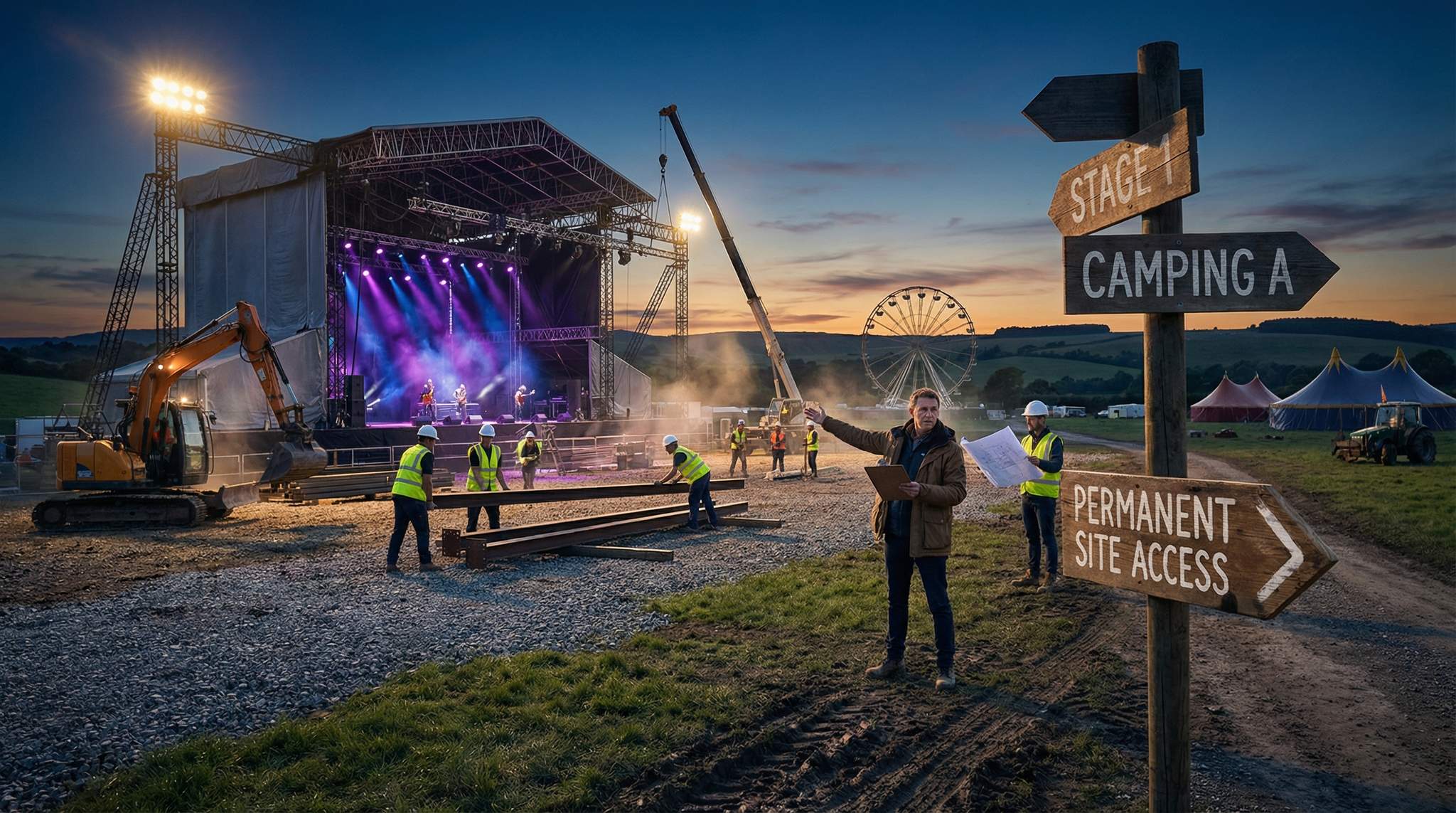
Buying land is just the beginning. A raw plot usually needs significant infrastructure investment to become festival-ready. Site development costs can include building access roads, installing permanent utilities (power, water, wastewater systems), constructing stages or other structures, and grading the terrain for crowds. These capital expenditures can rival or exceed the land cost itself. For instance, hooking a large festival site into the electrical grid and adding basic plumbing might run into hundreds of thousands of dollars upfront for quieter and greener energy solutions. Festivals often phase these investments over several years. In practice, many events start with a bare-bones site and gradually add infrastructure as budgets allow and the festival proves its longevity, evaluating key questions before big investments and carefully calculating total infrastructure costs.
Planning a Festival?
Ticket Fairy's festival ticketing platform handles multi-day passes, RFID wristbands, and complex festival operations.
One way to evaluate infrastructure spending is to compare it to the cost of continually renting that equipment or service. If you spend $50,000 every year on generator rentals and fuel, an $200,000 one-time spend to bring permanent power to the site could break even in 4 years through efficient grid-tie power distribution. The same logic can apply to water supply (vs. trucking water in), fencing (vs. hiring temporary fencing annually), or stages. As events grow, renting massive staging and lighting rigs each year becomes very costly and labor-intensive. A permanent main stage structure is a multi-million-dollar project at the top-tier festival level, but it can drastically cut annual production load-in time and rental bills. Additionally, a purpose-built stage can be tailored to the site’s geography and the festival’s aesthetic, giving your event a unique signature. (Think of the Pyramid Stage at Glastonbury – a permanent skeleton structure on Worthy Farm that’s instantly recognizable and ready to go each year.) The Built to Last principle for infrastructure is that if you’re going to use something every year and you have long-term rights to the site, owning it is ultimately cheaper than renting repeatedly, as it becomes part of the site’s infrastructure and ensures the festival can reliably continue annually. However, these are big capital projects, and festival producers must budget conservatively and ensure they have the cash flow to support building projects that might not deliver ROI for several years by conducting a thorough cost-benefit analysis and avoiding the risk of financial over-commitment. It’s wise to maintain a financial Plan B – for example, have scaled-back festival budget versions in case ticket sales dip or sponsors pull out, so that costly site investments don’t sink the event, a lesson learned from analyzing past festival disasters like Fyre where organizers relied on wishful thinking instead of logistical reality.
Recurring Expenses: Taxes, Insurance, and Maintenance
Owning a festival site turns you into a year-round property owner, with all the ongoing expenses that entails. These costs may be “invisible” when you’re just renting annually, but they add up when you have your own land:
- Property taxes: Once you purchase land, you’ll owe local property taxes each year. The rate can vary; farmland or rural property taxes are often low, but if your land is reclassified as commercial event space, taxes could be substantial. Be sure to research the tax implications in that jurisdiction. Some festival owners negotiate with local authorities for favorable terms (especially if the event brings tourism revenue), but you can’t assume tax bills will be trivial.
- Insurance: You’ll need insurance coverage year-round, not just event insurance. This includes liability insurance for any accidents on-site even in the off-season, property insurance for any structures you build (e.g., stages, buildings) against fire, weather, vandalism, etc. Insurance premiums for a large outdoor venue can run tens of thousands per year (or more if in a disaster-prone area). It’s a new line item that pure renters typically don’t carry year-round.
- Maintenance and security: A permanent site requires upkeep: mowing fields, maintaining roads, cleaning and winterizing plumbing, pest control, and possibly paying staff or a caretaker to watch the property. For example, a 100-acre site may need tractors or mowers and fuel, and if you have permanent bathrooms or buildings, they’ll need periodic maintenance and repairs. Many festivals also invest in on-site storage (like shipping containers or warehouses) to keep equipment between events, which provides efficiency but also requires keeping those storage units secure, often using shipping containers as secure storage. Storing infrastructure securely year-round provides efficiency but budget for off-season security personnel or camera systems – you don’t want trespassers or thieves damaging your investment when no event is happening.
- Financing costs: If you took out a loan or mortgage to buy the land or fund construction, the interest payments are another recurring cost. This debt servicing can be significant and must be factored into your multi-year budget. During years like 2020 (when COVID-19 shut down festivals globally), an organizer with a hefty mortgage but no ticket sales could be in a perilous position. (Many risk management experts now stress planning for worst-case scenarios, like pandemics or weather cancellations, to ensure you can cover fixed costs like land loans even if a festival gets called off, avoiding common causes of festival failures such as inadequate infrastructure and safety planning.)
In sum, owning a site shifts some costs from variable (pay-as-you-go each event) to fixed (you pay them regardless of whether the festival occurs or is profitable). This isn’t necessarily a bad thing – fixed investments can save money over time – but it does raise the stakes. You need confidence in the festival’s future and good financial management to carry those year-round expenses. Consider setting aside a reserve fund from good years to cover these costs in lean years or emergencies, essentially self-insuring your venue.
Year-Round Revenue Opportunities
One big allure of owning a festival site is the chance to generate income beyond your flagship event. An idle venue is a missed opportunity; many smart festival promoters turn their sites into year-round revenue engines. Owning property opens up possibilities such as:
Free Tool: Will the Money Be There in Time?
Map your deposits and balances against when ticket money reaches you. See your lowest balance and how much you need to find before it arrives.
- Hosting other events: You can rent your site to other promoters when you’re not using it. For instance, Goldenvoice (organizers of Coachella) purchased 280 acres adjacent to their Coachella festival grounds, not only to expand parking and camping but also to host 3–4 additional events year-round on their own terms, as reported regarding the El Dorado purchase which allows them to host major acts like Metallica and Slayer. A permanent site can double as a concert venue, fairgrounds, or sports event site on off-weekends. Each extra event (whether run by you or an outside organizer paying rent) brings in revenue that helps offset the land’s carrying costs.
- Camping or glamping business: If your festival site includes attractive nature or open land, you might operate a seasonal campground or glamping retreat. Some festivals open their grounds to visitors in the summer before or after the main event, or on weekends through the year. For example, a site with a lake or forest could draw campers even when the stages are gone. This not only earns income but keeps local communities and businesses benefiting continuously, building goodwill.
- Permanent attractions: Festivals like Tomorrowland have installed permanent art installations and landmarks (e.g. the One World Bridge and scenic “Stairway to Unity” in De Schorre Park) that remain accessible year-round, secured by a long-term contract at De Schorre Park which facilitates major investments like the Stairway to Unity. An owned site can be developed almost like a theme park – perhaps you create a small museum showcasing festival history, a year-round festival-themed cafe, or maintain stages that can be toured. While these may not become huge profit centers, they enhance the brand and could bring a trickle of tourism. In rural areas, a festival’s site itself can become a minor attraction for hardcore fans.
- Equipment rental and storage services: If you’ve invested in stages, tents, lighting, etc., those assets don’t have to sit idle. Some festivals rent out their stages and gear to other events in the off-season. Similarly, if you have extra space, you could offer storage for touring companies or other festivals’ equipment (for a fee). Essentially, you become a bit of a production company or landlord during the off-season, monetizing festival assets year-round.
- Content creation and digital revenue: Owning a site gives you freedom to use it whenever – perhaps to film performances, host exclusive small fan events, or create an “on-site studio.” Top festivals have leveraged their brands for year-round digital content – streaming series, documentary filming on their grounds, etc., creating revenue streams beyond the main event. While this strays from pure site rental, it shows how a permanent space under your control can spark new business ideas (podcasts from the festival site, wellness retreats, holiday markets – the sky’s the limit if the demand exists).
Of course, these opportunities come with their own costs and operational needs (you might need a dedicated team to market and run off-season events), but they can significantly improve the Return on Investment (ROI) for a permanent site. If done well, the venue transforms from a once-a-year expense into a year-round asset. Some festival sites have even become cornerstones of local concert tourism, drawing travelers from afar for multiple events. For instance, a remote festival that develops a strong brand and a permanent venue can entice fans to fly in (music tourism is booming – over 30 million people worldwide now travel each year primarily to attend festivals, according to global festival travel statistics). Those travelers spend on local hotels, food, and transport, boosting the host region’s economy. This fact can be used to your advantage: you might secure sponsorships or local government support for site development by highlighting the tourism impact of a permanent festival location. Many regions are eager to have a renowned festival rooted in their area, as it puts them on the map and brings in revenue.
Operational Impact and Creative Control
Tailoring the Layout and Facilities to Your Event
When renting a venue, festival planners often have to adapt to the site’s constraints – fixed entrance points, existing buildings, limited wiring, etc. In contrast, owning your festival grounds means you can design the layout exactly as you envision. This is a game-changer for creative control. You can widen or relocate entrances to avoid bottlenecks, sculpt fields for better sightlines, plant trees or build shade structures for comfort, and place stages optimally without a venue owner’s restrictions. Veteran producers stress how much easier it is to implement the perfect site plan when you literally own the ground, avoiding issues with temporary metal trackways and enabling permanent road and pathway construction. Mistakes in layout (like poor crowd flow or insufficient facilities) can be corrected by investing in improvements, whereas on a rented site you might be stuck with suboptimal conditions.
Need Festival Funding?
Get the capital you need to book headliners, secure venues, and scale your festival production.
For example, if attendees consistently complain about congestion near Stage Two, an owner-operator can respond by expanding that area, adding an exit path, or even relocating that stage for next year. If you’ve built permanent roads and pathways, you likely have better ingress/egress and emergency access than a makeshift setup. Owning the site also enables installation of permanent signage or wayfinding systems (even high-tech solutions like digital signage or AR markers) to guide attendees, since you don’t have to strip everything down post-event. Moreover, permanent structures like decorative arches, art pieces, or thematic facades can stay in place, so the festival gains a sense of place – attendees feel like they’re returning to a known world each year, not a blank canvas. This can deepen fan loyalty, as the venue itself becomes part of the festival’s identity. (Think of iconic festival locations: the Glastonbury farm, the Tomorrowland grounds, the Black Rock Desert for Burning Man – each is integral to those events’ character.) It’s no surprise that some festivals design their site layout to become part of the storytelling, with areas and stages that have their own lore and permanent names.
From an operations perspective, having a fixed layout that you refine annually also leads to efficiency gains. Crew and vendors become intimately familiar with the site, reducing setup time and mistakes. If last year’s map is 90% the same, everyone knows where power drops are, where the ground tends to get muddy, how traffic flows, etc. Compare this to a festival that changes location frequently – each new site can feel like reinventing the wheel, with unknown quirks that could cause delays or safety issues. An often-cited industry lesson is to avoid “site hopping” once you’ve found a location that works, favoring long-term investment strategies like Tomorrowland’s. Committing to one site (via ownership or a very long lease) lets you fine-tune operations and infrastructure year over year, which improves the attendee experience and reduces on-site headaches.
On-Site Storage, Offices and Year-Round Presence
Owning a site allows you to maintain a continuous presence that simply isn’t possible when you rent temporarily. One benefit is on-site storage and offices. Rather than hauling everything in and out for each event, you can keep equipment, materials, and records right at the venue in secure storage units or permanent buildings. Many festivals that operate in remote areas use shipping containers as year-round storage lockers on the grounds, reducing transport logistics significantly. This saves a fortune in trucking costs and warehouse rentals. It also means you can start set-up earlier and tear down more leisurely – if you own the land, there’s no rush to clear out by a certain date because another event is coming in. Your team can even have a base of operations on-site: imagine a small office or workshop that stays year-round, where local staff handle maintenance and planning. During the festival, that doubles as HQ for operations. During the off-season, it’s a hub for site projects and security.
Some established festivals take this further by opening the site on select days for community use or tours, effectively integrating the venue into the local community’s life rather than it being a gated-off private land. For example, a festival that owns its site might let local charities host a 5K run or a farmers’ market on the grounds during the off-season. This was much harder to do when you were just a one-week tenant at someone else’s venue. By having a permanent site and facilities, you’re effectively operating a venue – which can be a community asset if managed well. (The article Local Love: Engaging Your Community to Support Your Venue shares many examples of venues doing open-house events and local programming to build goodwill, similar to Goldenvoice’s community engagement efforts.) The benefit to operations is twofold: you strengthen community relationships (which can be crucial for permits and neighbor support) and you keep the site active, which helps in spotting maintenance issues and preventing the “ghost town” problem (vacant properties can deteriorate or attract trouble).
Free Tool: Price Your Venue Like a Pro
Capacity, city tier, day of week and amenity mix produce a suggested rate band and a full day-by-day rate card for your space. Free estimator.
Additionally, the ability to store infrastructure on-site means you can invest in higher-quality gear without worrying about transportation logistics. If you know you can lock up hundreds of crowd barriers, lighting rigs, or even golf carts securely on your land, you might purchase them instead of renting annually. This again can save money after a few years. Festivals that have gone this route often remark that not only do they save on rentals, but their show quality improves – they’re using the same equipment which they maintain to their standards (no surprises from subpar rented gear). However, maintaining gear is its own task – once you own 500 tents or dozens of AV equipment pieces, you need staff to clean, repair and catalog them. It’s all doable if you budget the time and money, but it’s a shift from a pure-play festival producer to a hybrid festival + venue operator role.
Scheduling Freedom and Rehearsal Time
Another operational perk of owning your venue is flexibility in scheduling. With a rented site, you often have a tight window: load-in starts on X date and you must be off-site by Y date, because the venue has other clients or the city permit is strictly limited. With your own land, you can set your timeline. Want to start building stages a month out? No problem, you’re not competing for venue calendar slots. Need to postpone the festival by a week due to an extreme weather forecast? If permits allow, an owned site makes that much easier since there’s no landlord to negotiate with or other event conflicts to navigate. This proved invaluable in some cases during the pandemic and in volatile weather situations. For instance, when storms threatened an event, festivals with their own sites found it easier to adjust plans or even delay entry by a day, compared to events in rented stadiums or city streets that had immovable schedules.
Artists and performers also appreciate when they can access the stage early for soundchecks or rehearsals on a permanent site. It’s not unusual for major festivals on their own land to let headliners arrive a day early to run through technical rehearsals, something that’s often impossible at a municipal park that the city only closed on show day. More generous scheduling can lead to better show production value and fewer technical glitches, because you’re not as time-crunched. Additionally, your operations team can build gradually and carefully. For example, you might start setting up campgrounds two weeks out, hang lighting truss a week out, and do full dress rehearsals of your emergency evacuation plan with staff a few days before gates open – all without paying extra venue rental fees. This reduces stress and last-minute scrambles. (No wonder many major festivals lobby for longer-term leases or ownership; it buys them more breathing room to get everything right.)
There’s also a subtle creative benefit: you can experiment on your site in the off-season. Want to test a new stage placement or sound system orientation? You could set it up during a quiet month and see how it performs, without thousands of fans watching. This R&D work is nearly impossible if you don’t control the venue year-round. Over time, this freedom helps you innovate and refine the festival experience in ways that transient events cannot.
Risks and Challenges of Owning a Site
Capital Risk and Cash Flow Strain
For all its potential upsides, buying a permanent site is a major risk if the finances don’t pan out. The initial capital outlay for land and infrastructure can put enormous strain on a festival’s finances. If ticket sales underperform or a couple of bad years hit early on, you could be stuck with debt and a piece of land you can’t fully utilize. Many independent festival promoters operate on thin margins, and diverting millions into real estate means less cushion to handle other surprises. Opportunity cost is a huge consideration: the money tied up in land is money not spent on talent, marketing, new experiences, or simply kept as reserve. So, a festival that stretches to buy a site might have to scale back other investments for a while. That could ironically hurt the event’s quality or growth trajectory in the short term – for example, you might book fewer headliner-level artists or reduce marketing spend in a critical year because of mortgage payments, and that could slow ticket sales. It’s a delicate balance and a key reason why some very successful festivals have chosen to keep renting even when they could afford to buy. They prefer to keep their capital free for talent or expansion rather than sunk into land. As one industry insider put it, “Owning a venue is a different business than running a festival – you have to be ready for that financial commitment long-term.”
There’s also market risk: land values can go down as well as up. If you overpaid for a site and the festival doesn’t work out, you might not recoup your costs by selling the land. Festivals have gone bust by making big bets – for example, if you invest in a remote site expecting 50,000 attendees but only 20,000 show up consistently, the revenues might never catch up to the investment. It’s crucial to run realistic scenarios (best case, moderate case, worst case) for festival attendance and income before committing to a purchase. Seasoned producers recommend erring on the side of caution: assume it will take longer than expected to hit your growth targets and that costs will run over budget – and see if ownership still makes sense under those conditions. If it only pencils out in a perfect scenario, that’s a red flag.
Free Tool: How Many Tickets to Break Even?
Enter your venue, artist, production and marketing costs with your ticket price. See how many tickets cover your costs and how many you still need to sell.
Added Responsibilities and Operational Burdens
Owning a site doesn’t just add expenses; it adds workload and complexity. As hinted earlier, you effectively become a venue operator, which is a year-round occupation quite different from focusing solely on one event. This can stretch a festival team that is used to seasonal cycles. You may need to hire additional staff or contractors for venue management, facilities maintenance, landscaping, etc. There’s also a learning curve with regulatory compliance for property owners. Suddenly you’re dealing with permits for permanent structures, navigating zoning laws and building codes, and working with local authorities and landowners. For instance, constructing a permanent stage might require structural engineering approvals and periodic inspections. Installing wells or septic systems brings environmental regulations into play. If a festival just rents a fairground, many of those infrastructure compliance issues are the venue owner’s headache – but if you are the owner, they become yours.
Maintenance surprises can pop up and demand urgent attention (and money). A few years of heavy festivals can tear up fields, requiring re-seeding or even re-grading the land. Storms might damage your site in the off-season – e.g., flooding could wash out an access road or high winds could topple light poles. You’ll need an emergency maintenance budget for such situations. Pest control is another often overlooked issue; a large empty site could become a habitat for critters (or even an illegal dumping ground for other people’s trash, in worst-case scenarios) if not actively managed. All of this requires vigilance that doesn’t stop when the last fan leaves the festival.
Security and liability management also ramp up. When you rent, venue security (outside of festival hours) is largely on the venue owner. When you own, you must secure the site year-round. Trespassers might try to sneak in for illicit parties or vandals could target your structures. If someone gets injured on the site in the off-season (even if they’re trespassing), you could face legal action or at least an insurance claim. For example, if locals use your open field as an unofficial dog park and someone falls into a ditch, it can become your problem. Thus, owning means proactively securing and perhaps fencing off the land, posting proper warning signage, and regularly inspecting for hazards. It’s not insurmountable, but it’s continuous work that promoters didn’t worry about when they were just temporary tenants.
Finally, staffing patterns will need to shift. Your core team might need to be on payroll year-round to manage the property (rather than the common model of a small year-round staff and big seasonal hiring just for the event). This can increase HR costs but might also build a more stable operation with less turnover. Many festival companies that move to owning a venue find they resemble a venue management company in the off-season, booking events and maintaining facilities to keep revenue flowing. If that’s not appealing or within the team’s expertise, it can lead to burnout or mismanagement. It’s important to assess whether your team (or you as the festival director) wants to be in the venue business, not just the festival business.
Community and Regulatory Risks
A permanent festival site inevitably becomes part of the local community, for better or worse. When you rent different sites, you can fly under the radar to some degree or move if a region becomes unfriendly. But when you plant roots, you need a solid plan for community relations and regulatory diplomacy. Neighbors who tolerated a festival once a year might be more resistant if they know the festival owner is planning to make this a permanent fixture – they may fear increased traffic, noise, or environmental damage year after year. It’s not uncommon for residents to organize against festival site proposals in local council meetings. Even after purchase, local authorities could impose new restrictions that hamper your plans (e.g., stricter sound curfews, lower capacity limits, or even denial of event permits if political winds shift). Owning land doesn’t automatically guarantee you can hold a festival there – you still must obtain the necessary event permits and licenses each time, and those can be revoked or not renewed if the community sours on you. In a worst-case scenario, you could end up owning land that you are not allowed to use for the intended purpose (at least not at the scale you want).
There are instructive examples: Ultra Music Festival in Miami is a case where a festival on city property faced community backlash over noise and disruption; it had to relocate in 2019, and even though Ultra didn’t own the venue, the lesson was clear – community sentiment can make or break an event. Now imagine if you did own the site but the community wanted you gone – you’d be stuck in a very difficult spot. Festivals like Glastonbury and Wacken Open Air have navigated this by deeply engaging with their communities: investing in local infrastructure, capping attendance to manageable levels, providing economic benefits, and being responsive to concerns. In fact, Wacken Open Air’s organizers have built such goodwill that the festival is embraced as part of the town’s identity (they even installed a beer pipeline and improved roads, which serve locals too), creating new stage and sound infrastructure and innovative logistics solutions. This came from years of trust-building. Similarly, Michael Eavis of Glastonbury famously curates good relations with his neighbors and the local council, and the festival contributes to local charities and services as a thank-you.
Free Tool: Project Your Bar Revenue
Per-head spend benchmarks by event type turned into projected bar and food revenue, with a stock-mix estimate and gross-margin line. Free calculator.
The regulatory risk extends beyond community happiness. Zoning laws might limit permanent structures or year-round usage. Environmental regulations could affect where you can build (you might discover part of your land is protected wetlands or home to endangered species, limiting development). And remember: when you own the land, you become liable for all code compliance. If your temporary festival setup on rented land didn’t have perfect ADA accessibility or had some safety shortcomings, authorities might let it slide as a one-off. But a permanent venue will be held to higher standards. Fire codes may require you to install things like permanent exit lighting, marked fire lanes, and certain structural safety features. These are good for safety, of course, but they add costs and reduce flexibility. You can’t just throw up any stage anywhere – you’ll need permits for those structures and they may be subject to inspection each year. Failing to maintain compliance can lead to fines or event shutdowns. In extreme cases, a tragedy or major issue at a permanent site could even result in the venue being shut by authorities pending investigations (as seen with some nightclubs or venues after accidents). Festival promoters who own sites must adopt a mindset of continuous compliance and risk management. Partnering with experienced venue ops managers or consultants (for safety, noise control, traffic, etc.) is a wise move; don’t assume your usual festival Ops can handle it all without guidance. Organizations like the Event Safety Alliance and local fire marshals can help audit your site plans to ensure you’re meeting all requirements – a step that should be budgeted and scheduled annually.
Loss of Flexibility
Committing to a single location inherently means giving up some flexibility. Trends change, markets shift. If the majority of your audience suddenly clusters in a different region or you find a better opportunity elsewhere, moving a festival that’s tied to owned land is difficult. Contrast this with a festival brand that doesn’t own a site – they could potentially pick up and move cities or countries if needed (granted, that’s a complex move too, but it’s at least feasible). For example, when Warped Tour was running, it could tour various cities each year and follow where the fans were, because it had no fixed venue. A destination festival with its own site is basically betting that this location is the right one for the long haul. If five years in you realize the location has drawbacks (maybe the weather is increasingly problematic, or local lodging can’t keep up with attendance, etc.), you face a sunk-cost dilemma: stick it out because you invested here, or try to relocate and eat the losses on your site.
Even year to year, flexibility is somewhat reduced. Imagine a scenario where a great opportunity arises to partner with another event or brand, but it would require a different venue or a city setting – you might be less inclined to diverge from your home base because you’re so invested there. In addition, if serious problems arise (say, a natural disaster damages your venue right before the event), you may have fewer fallback options. A festival that rents could perhaps find an alternate venue last-minute (anecdotally, some festivals have relocated on short notice to alternate sites in emergencies). But if your own site is out of commission, you might not have relationships to easily rent somewhere else because all your eggs were in the ownership basket. In other words, owning can increase operational rigidity; you’ll put so much work into optimizing that one site that the idea of moving is nearly impossible. Owners should have contingency plans – for example, if a flood or wildfire hits your land, is there a backup location you could use, or would you have to cancel? And does insurance cover your financial losses in that scenario? These tough questions come with the territory of planting roots.
Finally, being tied to a location means you’re also tied to its local economy and infrastructure situation. If that area experiences economic downturns, travel boycotts, new competing events, or other changes, your festival will feel it more than if you were mobile. For instance, a rural festival that bought land might suffer if a new highway project gets canceled (making travel for fans harder), or if a local airport closes. These external factors are out of your control yet directly impact the venue’s viability. Thus, diversification – a common business risk mitigation – is not really possible when you’ve invested in a single site. The flip side, of course, is if the area booms, you ride that wave too (e.g., a new hotel opens nearby making it easier for attendees to stay, or the region becomes “hip”). But prudent organizers will consider the downside scenarios carefully.
Real-World Examples: Permanent Sites vs. Rented Venues
Festivals That Secured Their Own Sites
Many of the world’s most iconic festivals are synonymous with their locations, often because they’ve taken steps to secure those sites for the long term.
- Glastonbury (UK) – Worthy Farm, the now-legendary site of Glastonbury Festival, is actually co-owned by the festival’s founders (the Eavis family) and has been in continuous use since 1970. By staging the event on private farmland that Michael Eavis controlled, Glastonbury gained tremendous freedom to grow. Over the years they’ve invested heavily in the land: implementing drainage systems to combat the infamous mud, building the Pyramid Stage’s permanent base, and even installing a 200 kW solar array on a barn roof that powers the farm and feeds the grid, utilizing solar panels and small wind turbines to support sustainable year-round operations. These improvements would be hard to justify on a rented site. Glastonbury does occasionally skip years (for “fallow years” to let the land recover, and it was canceled in 2020–21 for COVID), but because they own the site, there’s no risk of losing it during a break. The festival’s permanence at Worthy Farm has allowed it to become a cultural institution and anchor for the local economy – an economic impact report found the 2023 festival cost £62 million to stage and pumped tens of millions more into the region, as Glastonbury’s costs were revealed in an economic report. However, even Glastonbury has to work closely with local councils and residents (noise limits and crowd safety rules still apply). Their long-term presence is generally seen as positive locally due to careful management and the charitable contributions the festival makes in Pilton village each year.
- Bonnaroo (USA) – This major U.S. festival began in 2002 on a rented 530-acre farm in Manchester, Tennessee. Just five years later, Bonnaroo’s promoters took a bold step: they purchased the entire farm outright for about $8.7 million, a landmark deal for the 530-acre farm. This move, while costly, secured what they now call “The Farm” as a permanent home known officially as Great Stage Park. Ownership has enabled Bonnaroo to build permanent infrastructure like wells for water supply, an electrical grid hookup, permanent venue offices, and durable roads to handle the annual influx of 80,000+ attendees. The festival site is also used for other events; for instance, Bonnaroo has hosted country music campouts and destival-style concerts outside of the main Bonnaroo weekend. By owning Great Stage Park, the organizers have been able to shape the land – planting trees for shade, carving out distinct camping plazas, and erecting permanent art (like the famous Bonnaroo arch) that stays year-round. They’ve also integrated with the local community: local groups are hired for trash cleanup and parking each year (fundraising for those groups), and the festival has a community advisory board to maintain open dialogue. The payoff for Bonnaroo has been branding a unique destination (“See you on The Farm!” is part of their identity) and operational self-reliance. During the COVID-19 pandemic hiatus, they had the freedom to use the site for socially distanced drive-in shows and were under less pressure than festivals that might lose a venue slot; however, owning the site meant they still had to cover maintenance with no festival revenue in 2020. Bonnaroo’s bet on land ownership is often cited in the U.S. industry as a visionary move that locked in their status – no one else can swoop in and book over them on that weekend or evict them for development. They essentially made themselves invaluable to Coffee County, TN, by becoming landowners and economic contributors.
- Tomorrowland (Belgium) – One of the world’s largest electronic music festivals, Tomorrowland, provides a great example of a hybrid approach. The festival has been held at De Schorre Park in Boom, Belgium since 2005. Recognizing the value of committing to that site, Tomorrowland’s organizers recently signed a 66-year lease agreement to continue using De Schorre Park through 2090, securing the site for decades. While they didn’t buy the public park (it remains government-owned), this ultra-long contract gives Tomorrowland practically the same stability as ownership. It also explicitly allows them to make substantial investments in the park’s infrastructure and aesthetics. Over the years, Tomorrowland has indeed built permanent bridges, art installations, and landscaping across De Schorre, to the point where the park is permanently modified in Tomorrowland’s enchanting style, providing legal security for future investments and encompassing projects like the One World Bridge. They’ve installed features like the One World Bridge and reflective ponds that enhance the festival and remain for locals to enjoy year-round. By doing this, Tomorrowland essentially subsidized park improvements in exchange for guaranteed access. It’s a win-win: the festival gets greater creative control and a unique venue, and the community gets a nicer park. The long-term deal also justified Tomorrowland installing more practical infrastructure, such as fiber-optic internet lines and stable power and water hookups that are used each festival (avoiding some generator usage). Tomorrowland’s case shows that you don’t always have to outright buy land to act like an owner – a secure multi-decade land agreement can provide the confidence to invest. However, it took years of trust-building with local authorities to get to that point. Now, with the lease in hand, Tomorrowland can plan decades ahead, knowing the site is theirs every summer. The festival park has become a tourist attraction in its own right; Boom, Belgium sees visitors who come to walk the grounds even when the festival is not happening, illustrating how a festival’s permanent site can elevate an entire area’s profile.
- Wacken Open Air (Germany) – This legendary heavy metal festival, held in the tiny village of Wacken, doesn’t officially own all its land but works in very close partnership with local landowners (mostly farmers). Over 30+ years, Wacken Open Air has transformed from a small field party to a 75,000-capacity behemoth and, in the process, effectively turned parts of the village into a permanent festival zone. They negotiated long-term use of several large fields and invested in serious infrastructure: there are now permanent underground pipelines at Wacken that provide fresh water and even deliver beer to the main stages, utilizing new stage, sound, and beer pipeline technology that improves logistics and reduces waste, plus improved sewage systems to handle waste. The promoters worked with the town to pave certain paths and reinforce grounds that were prone to becoming mud pits. After some especially rainy years, they improved drainage across the site to ensure the show could go on. Wacken demonstrates how even without owning the ground outright, a festival can create a semi-permanent home through infrastructure and community integration. The village benefits economically from tens of thousands of metalheads coming every summer (locals rent out their yards for camping, etc.), so they have mutual interest in keeping Wacken there. Festival organizers have built a Wacken Foundation supporting local and global music initiatives, ingratiating themselves further with the community. The trust is so high that farmers adjust crop cycles to accommodate the festival schedule, and some land parcels have essentially become year-round event grounds (used for other events like a smaller winter festival). Wacken’s approach might be called “community ownership” – the whole town feels ownership of the festival. The lesson is that buying land isn’t the only path; securing buy-in from those who own it can likewise give a festival a stable, upgradeable site for the long term.
- Shambhala Music Festival (Canada) – On a smaller but instructive scale, Shambhala shows the power of owning your location. This boutique electronic music festival in British Columbia is held on the Salmo River Ranch, which is actually the farm owned by the family who founded the festival. Because it’s on private family land, Shambhala has been able to develop truly unique permanent stage structures and features – attendees often note that Shambhala’s stages feel more like fantastical villages than temporary setups. They’ve built elaborate treehouse-style DJ booths and integrated the stages into the forest environment in ways that would be infeasible in a rented public venue. The festival also doesn’t allow corporate sponsorship and keeps a very independent ethos, something made easier by not relying on third-party venues or cities. The drawback is that all responsibility lies with them: when wildfires threatened the area one year, they had to institute extensive safety measures and nearly cancel – there was no venue authority to defer to. But thanks to proactive planning and owning on-site resources like water pumps and irrigation (for fire suppression), they managed. Shambhala’s longevity (over 20 years) is intimately tied to its land – a self-reliant homestead-turned-festival playground. They’ve effectively homesteaded a festival, with all the pros and cons that implies.
Festivals Thriving with Rented or Rotating Venues
On the other side, many successful festivals have opted to keep renting venues or even change locations periodically, finding that model better suited to their goals.
- Lollapalooza (USA & Global) – Lollapalooza’s flagship event takes place in Chicago’s Grant Park, a public lakefront park, every year under a rental/permit agreement with the city. C3 Presents (the organizers) do not own the park, nor could they realistically, but they’ve forged a multi-year arrangement with Chicago to host the festival each summer. The benefits of this are evident: Grant Park offers an iconic skyline backdrop and central city location without Lolla having to purchase any land. The festival works closely with city agencies and each year they fine-tune the setup (location of stages, entry gates, etc.) to minimize impact on the park and neighbors. After the festival, they are required to restore the park (reseeding grass, repairing any damage), which adds to costs, but that’s part of the rental deal. Lollapalooza’s model shows that if you have a strong partnership with a city, you can enjoy a stable venue without ownership – Chicago is very keen to keep Lolla for its economic boost (over $300 million impact some years) and cultural cachet. Lolla has expanded to other countries (Berlin, São Paulo, etc.) using the same approach: leveraging existing venues (often public parks or stadium grounds) with local government support. The ability to plug the brand into multiple locations globally is actually a strength; it would be far harder if Lolla was tied to a proprietary venue in one place. They’ve proven that renting can scale. The trade-off is that in any given city, Lolla must abide by official rules – for example, strict sound curfews at 10 pm in Grant Park, and capacity limits because of park layout and evacuation routes. They can’t, for instance, suddenly build permanent new stages or dig up the park to install plumbing. In 2020, when the festival was canceled, there was no owned real estate draining resources – they could go dormant with minimal overhead. That flexibility and agility has allowed Lollapalooza to thrive as a multi-headed brand. However, this model relies on maintaining good relations: any major fallout with the city (imagine severe site damage or a safety incident) could jeopardize their venue access. In fact, some local residents occasionally voice concerns about the park’s prolonged closure and wear-and-tear, so Lolla must continuously prove its value and responsibility to keep its lease renewed.
- Traveling or Multi-City Festivals – A number of festival brands take the show on the road, holding events in different cities annually or even touring like a concert series. The defunct Vans Warped Tour was a prime example, visiting dozens of cities each summer at rented outdoor venues (like amphitheater parking lots or fairgrounds). While not a single “festival” in one location, it shows the extreme of renting: no ownership anywhere, just short-term venue deals everywhere. This gave Warped Tour unparalleled flexibility to reach fans nationwide and adjust its stops each year. The downside was a heavy operational lift – building and tearing down a festival setup daily in a new city is exhausting and complex. Another example is Electric Daisy Carnival (EDC) which initially moved from Los Angeles to Las Vegas when faced with regulatory issues, and now it rents the Las Vegas Motor Speedway annually. EDC’s promoter Insomniac does not own the speedway, but their long-term rental relationship has allowed them to treat it almost like home – they’ve added some semi-permanent improvements (perhaps with the speedway’s blessing) like additional grass turf in areas and more permanent power drops. Still, each year EDC ships in a massive amount of staging and lighting which is removed after the weekend. Large-scale traveling festivals clearly show renting’s advantage: go where the demand is. If one city becomes unviable (due to ordinances or waning interest), you can move. The new Rolling Loud hip-hop festival has exemplified this by popping up in various stadiums/parks from Miami to New York to Los Angeles, chasing fan bases and date availability. However, these events must start planning from scratch with local officials each time – new security plans, new traffic plans, different local vendors – which can lead to inconsistencies and hiccups. For instance, Rolling Loud’s switch of venues in Southern California caused some logistical issues and fan complaints until they worked out the kinks. In short, rotating festivals trade consistency for reach.
- Urban Festivals & Block Parties – Some festivals integrate directly into the urban fabric instead of carving out private enclaves. Take SXSW in Austin or Notting Hill Carnival in London – while not ticketed music festivals in a field, they illustrate an alternative to owning a site: using existing city venues and streets. These events succeed by going where the people already are. The logistics are very different (permitting dozens of bars or closing city blocks), but it’s an example of building a festival without any dedicated site at all. No single land to rent or buy – instead, it leverages public space. The “venues” in this model are the city itself. Organizers become maestros of coordination rather than owners or renters. This can keep costs down (no huge land purchase), but requires strong public-private coordination and has limited control (city authorities ultimately hold power). It works best for culturally ingrained events that community and government actively support.
- Stadium and Arena Rentals – For promoters looking at massive scale without the burden of land ownership, renting existing mega-venues is a common strategy. If you are wondering how much it costs to rent a stadium for a concert or a multi-day festival, the figures are substantial. Top-tier NFL or soccer stadiums can command base rental fees ranging from $100,000 to over $500,000 per day, plus a percentage of ticketing, food, and beverage revenues. Similarly, securing an iconic indoor arena—like renting Madison Square Garden for a concert—often involves complex deals where the base rent (frequently exceeding $400,000 per night) is just the starting point, with union labor, security, and production load-in adding hundreds of thousands more. While these costs are staggering, they provide turnkey infrastructure, built-in transit access, and weather protection, allowing promoters to focus entirely on talent buying and marketing rather than building a city from scratch in a field.
- Burning Man (USA) – A unique case worth mentioning: Burning Man takes place on the Black Rock Desert playa in Nevada, which is federal land (Bureau of Land Management property). Each year the Burning Man organization obtains a permit to build Black Rock City, a temporary metropolis for ~80,000 participants, and then they dismantle it completely leaving “no trace.” Burning Man doesn’t own the desert – and indeed they legally couldn’t, since it’s public land – and this is by design to preserve transience. The entire ethos is to exist temporarily and vanish. This model requires incredible effort: literally bringing in everything (water, fuel, structures) and taking it out, and subjecting plans to federal environmental reviews annually. The cost of their BLM permit and associated requirements is substantial (millions of dollars). Why do this? It allows an event in a pristine, otherworldly environment that no private owner could provide. Burning Man accepts the trade-off of zero permanent infrastructure in exchange for absolute freedom in creative city-building each year from scratch. Interestingly, the Burning Man organization did purchase a nearby ranch (Fly Ranch) in recent years, but not to move the event there – rather to have a year-round space for art and potentially an experimental year-round community. The main event is expected to remain on the rented desert, as the landscape’s unique qualities are central to the experience. Burning Man demonstrates that renting (or permitting) can work for even huge events if the experience calls for it – but it’s a very strenuous form of renting, feasible only with an army of volunteers and a culture committed to making it work. It also shows a scenario where owning wouldn’t easily replicate the magic (you can’t buy the 100-square-mile prehistoric lakebed needed for the event). So sometimes, sticking with a non-owned site is not just financially wise but core to the event’s identity.
Each of these examples – both the owners and the renters – highlights that success is possible on either path. The choice comes down to the festival’s nature, scale, and strategy. Owning tends to benefit events that value a consistent location, deep customization, and long-term development, and that have the stability and funding to support it. Renting/rotating tends to benefit events that prioritize flexibility, near-term affordability, and reaching different markets, or those that leverage existing urban settings. Neither path guarantees success – poor management or unforeseen events can derail both owned and rented festivals. However, the considerations we’ve discussed will influence which path is less risky and more rewarding for your particular festival.
Key Criteria to Guide Your Decision
How can you determine which route – rent or own – is right for your festival? Consider these key factors and questions as a litmus test:
Longevity and Commitment to Location
Perhaps the first question: Do you envision your festival at the same location for many years (even decades) to come? If your festival is tied to a specific locale culturally or by attendee expectation, investing in that place makes more sense. Festivals with a strong sense of place (like a desert gathering that wouldn’t be the same elsewhere, or a hometown event that the community identifies with) lean toward the permanent site option. On the other hand, if your festival concept could roam – for instance, it’s more about a genre or theme than the location, and you might want to visit different cities or countries – then owning land could actually box you in creatively.
Also reflect on the festival’s track record and future outlook. Is it still experimental and finding its footing, or has it been steadily growing for 5+ editions at the same spot? A festival that’s still relatively new or volatile in attendance might be better served by maintaining flexibility (renting) until it stabilizes. Conversely, if you’ve run, say, 10 years at the same rented venue and every year you sell out and have the routine down, that’s a sign you’ve essentially outgrown the need to rent. You’re a prime candidate to put down roots, because you have proof the location works and audience demand is consistent. Some industry experts suggest a rule of thumb: wait until you have at least 3–5 successful editions in the same place and a clear upward trajectory before even considering land ownership. This tracks with the idea of a “tipping point” for infrastructure investment, recognizing growing pains and signs it is time to upgrade and moving beyond short-term infrastructure solutions – once you hit certain size/stability, the balance shifts toward making permanent commitments.
Financial Health and Access to Capital
The financial dimension can’t be overstated. Can your festival realistically afford to buy and develop a site without jeopardizing its core operations? Take a hard look at your balance sheets, profits (if any), and funding sources. If you operate on razor-thin margins or debt already, taking on a large new expense could be very risky. However, if the festival has been profitable and you have cash reserves or investors lined up for expansion, a capital project like land purchase could be feasible. In some cases, festival organizers bring on new partners or sponsors specifically to support a venue acquisition – essentially raising a round of investment as a venue development fund. Are there investors out there who’d be interested in a stake of the land or a long-term revenue share in exchange for fronting the purchase? If you have a strong brand, you might find backers, but remember they will expect returns (so include those in your financial planning).
Consider the opportunity for grants or public funding as well. Some governments offer support for cultural infrastructure. For example, regional development grants might help a festival site that will promote tourism and jobs. Or there could be land trusts and donors willing to help secure land for an arts event. Research if any such avenues exist in your locale – it could reduce the financial burden on your organization. Even without grants, approach your budget with a conservative lens: model out the worst-case attendance or revenue scenario and ensure you could still service a loan or cover ownership costs in that scenario. And don’t forget the hidden costs – legal fees for land purchase, surveying costs, permitting fees for construction, interest on loans, etc. These can add 10–15% on top of the raw land and build costs. The decision may come down to: is your festival at a point where it can transform from a scrappy event to a brick-and-mortar business?
Free Tool: How Many Staff Do You Need?
Get a starting headcount for security, stewards, scanners, bar staff and first aid from your crowd size, event type and risk level.
Securing external festival investment is increasingly common for independent promoters looking to make the leap from renting to owning. Institutional backers, real estate partners, and private equity firms are recognizing the value of live event properties. When pitching a permanent site acquisition to potential investors, your business plan must clearly delineate the event’s operational profitability from the real estate asset’s long-term appreciation. A well-structured capital injection not only funds the initial land purchase but can also underwrite the multi-year infrastructure build-out required to make the venue fully operational.
If the numbers don’t quite work today, it might be smart to wait and focus on growing your festival’s financial base first. There’s no shame in choosing to rent for a few more years and building up capital; many events only moved to permanent sites after a decade or more of steady success. In the meantime, you can still invest in semi-permanent improvements even on rented sites (with permission) to smooth the transition later by working closely with local authorities and focusing on community engagement and benefit sharing – like perhaps paying to install a power drop on a rented field in exchange for a multi-year discount or agreement. Which brings us to the next point: maybe an intermediate step is possible.
Alternatives to Buying Outright (Long Leases, Partnerships)
The binary of rent vs own has shades of gray. One alternative is negotiating a long-term lease or exclusive use agreement for a site. This could be 5, 10, even 20 years. It’s not as iron-clad as owning, but it offers more security than year-to-year rental and often grants you rights to make improvements. For example, a 10-year lease on private land might stipulate that you can build temporary structures or even some permanent ones (with clauses about who retains ownership of those if the lease ends). Usually, if you invest in infrastructure on someone else’s land, you’d want a long lease to recoup the investment – Tomorrowland’s 66-year deal is an extreme example giving them confidence to build extensively, as seen in Tomorrowland’s 66-year contract which justifies investing in long-term infrastructure. Short of that, even a 5-year recurring permit at a city venue can help a festival plan better and justify certain upgrades (like buying custom fencing or permanent lighting rigs that city allows you to leave in place). When negotiating any extended use, get detailed agreements on what you can alter, and maybe include first right of refusal to purchase if the owner ever decides to sell the land.
Another hybrid option is partnering with others. Is there a chance to co-own a site with another event or organization? Perhaps two festivals at different times of year go in on a property together, splitting costs and usage (one uses it in summer, another in winter, for instance). This is uncommon but not unheard of – it requires two entities with great trust and complementary schedules. Alternatively, a local municipality might be willing to purchase or co-develop an event site that your festival anchors. In Australia, for example, some local councils have invested in showgrounds or parks specifically to host recurring festivals and sports events, effectively acting as landlord while the festival is resident. If your festival has proven economic benefit, you could pitch to local authorities the idea of creating a permanent festival park, with shared investment. This way, the festival might not have to foot the whole bill, and the community gets a venue that could serve multiple purposes (fairs, concerts, etc.). One must be cautious in these partnerships – ensure clarity on who controls the schedule, how improvements are funded and who owns them, and what happens if one party pulls out. But they can be win-win if structured well.
Site Suitability and Potential
Not all land is created equal. A key question: Have you found a site that is truly a gem worth holding onto? Sometimes the decision is driven by the specific land opportunity. If an absolutely ideal piece of property comes up for sale – the right size, location, scenic beauty, with supportive neighbors – that can tip the scales toward buying. Conversely, if your current rented venue has significant drawbacks (drainage problems, noise complaints, limited expansion room) and you haven’t found better land to buy, then rushing to purchase could backfire (you don’t want to own a headache). Evaluate the future potential of any site you consider owning. Is there room to expand capacity if your audience grows? Can infrastructure be added easily (is there access to roads, power lines, water sources)? What’s the environment like – any floodplains, extreme weather patterns, or environmental sensitivities to consider? Ideally, a permanent festival site should be resilient and adaptable. Scrutinize historical weather data: for instance, if climate change is making summers hotter and drier, owning a forested site could bring fire risks (some festivals in fire-prone regions have had to invest heavily in mitigation, like fire breaks and early detection systems). Or if a site is low-lying, flood risk may worsen over time – can you engineer around that with drainage? These factors might be tolerable for a one-off rental (“we got unlucky with mud this year, oh well”), but not for a permanent base where every troublesome characteristic will haunt you annually.
Also weigh the location relative to your audience. Are you considering buying in the same area you’ve been hosting (because it’s proven) or moving elsewhere? If moving, do audience surveys or studies to ensure your fans would travel there. There’s a cautionary tale in the festival world about moving too far: an event in one city that bought land 200 miles away may lose some of its core attendees who aren’t willing to make the trek. Even a top lineup might not overcome inconvenience or additional travel costs for fans. On the positive side, a great site can draw new audiences if it offers a better experience. For example, many festival-goers are willing to travel a bit farther for a site that offers camping under the stars, beautiful scenery, and no sound curfew, versus a more convenient but less inspired city venue. It’s a balance of convenience vs experience. Some successful permanent-site festivals basically created a tiny “destination” that people now love to pilgrimage to (like the Gorge Amphitheatre in Washington – not a festival, but a venue in the middle of nowhere that people flock to for its beauty). If your festival can become the destination event at a dream location, owning that dream location might pay off in stronger demand and premium pricing. Use data: analyze where your ticket buyers come from. If 80% are local and you’re contemplating a site two states away, that’s risky. If your fan base is dispersed or already traveling, then they may be more agnostic to location as long as it’s worth it.
Operational Capacity and Team Readiness
Finally, reflect on your team’s capacity and appetite for owning a venue. This is more of a qualitative criterion but an important one. Does your core team include people with venue management or construction project experience? If not, are you prepared to bring in new expertise (hire a venue operations manager, consult with architects, etc.)? Owning and developing a site is a project that can span years – from land negotiations and purchase paperwork, through design and construction phases, to ongoing venue administration. It’s almost like launching a sibling business to the festival. If your staff is already stretched thin delivering the festival itself, piling property development on them could lead to burnout or critical oversight. Make sure you have (or plan to acquire) the right skill sets: project managers, site managers, maybe civil engineers or event infrastructure specialists who have built permanent stages or utilities before. Tapping into industry networks can help; many festival producers talk to peers who have made the jump to get candid advice. In some cases, festival companies partner with established venue companies or hire contractors for the heavy lifting during development, then transition to self-managing once things are built.
Team mindset matters too. Some festival organizers love the idea of designing their own “festival campus” and will pour their passion into it. Others actually prefer the simplicity of focusing on booking artists and marketing the show, and dread dealing with bulldozers and building permits. Be honest about which camp you fall into. If you aren’t excited by the notion of managing a piece of land, you either need to find someone who is (to lead that charge) or reconsider if owning will make you happy. Remember, success in live events is not just measured in profit, but in sustainability of the organization – an overstressed team can crumble, which would put both the festival and the venue at risk. If your festival is volunteer-driven or run on a shoestring manpower-wise, owning a site may simply be beyond scope right now because it demands a more formal, staffed operation.
One more consideration: timing. Is there a strategic time to pull the trigger on owning? Perhaps right after a particularly successful year (cash on hand), or when a land opportunity arises, or conversely wait until after a challenging period is overcome (e.g., many festivals wouldn’t have wanted to buy land in 2021 when uncertainty was high). Plan the move for when you can devote maximum focus to it – not while you’re simultaneously launching a new stage or massive expansion that could distract resources. Some festivals even take a year off from the event to focus on building a site (rare, since it’s lost income, but it’s been done in cases where the move is big). At the very least, if you decide to go for it, consider phasing the project so that the first festival on your new/owned site isn’t 100% complete with everything – it could be a transitional edition with some temporary elements while permanent ones are still in progress, to avoid overloading the timeline.
From Decision to Action: Making Ownership Work
If after careful evaluation you conclude that investing in a permanent site is the right path, the real work begins. Here’s how to proceed strategically to maximize your chances of success:
Conduct Thorough Due Diligence
Before you sign any deed or lease, investigate the land thoroughly. This means obtaining surveys, environmental reports, and understanding any legal encumbrances. Check zoning: is the land currently zoned for events or at least for gatherings (e.g., agricultural and recreational use)? If not, what’s the procedure and likelihood of rezoning or getting a special use permit? Investigate noise ordinances, water rights (especially if it has a well or river – who owns those rights?), and any protected species or historical sites on the property that could limit development. Do a title search to ensure there are no unexpected liens or easements. Essentially, know exactly what you’re buying; surprises later can be costly (imagine finding out you can’t actually get permission to have 10,000 campers overnight on the site due to a county code – better to know upfront!).
Engage professionals for this phase: land use attorneys, environmental consultants, and veteran festival site managers who can walk the land with you to spot potential issues (like “Where will the drainage go? Is there enough space for parking vs camping? Is the soil stable for heavy stages?”). Also, talk to the neighbors and local officials quietly to gauge support before committing. If you sense fierce opposition even at the idea stage, you may need to do more community work before purchasing (or reconsider location). A clever move some organizers do is to get an option to buy the land, contingent on receiving necessary permits. For instance, you sign a contract that gives you 6–12 months to get your event permits and zoning sorted; if you succeed, you complete the purchase, if you fail, you can walk away (perhaps losing a smaller option fee, but not millions on land you can’t use). Not every seller will agree to that, but in some cases – especially if the land isn’t in high demand – it could be negotiated.
Secure Financing and Budget Wisely
Treat this like a major capital project (because it is). Create a detailed project budget for the land acquisition and all planned development work for at least the first phase of making it festival-ready. Include a healthy contingency (20% or more) because costs often run over. If you’re financing via a loan or investors, work those repayment plans into your festival’s multi-year operating budget to ensure you can meet them. One common approach is to separate the land venture into its own entity – e.g., create an LLC that owns the land and maybe leases it to the festival LLC. This can help separate finances and attract investors who want to be involved in the venue but not the festival’s other business, or vice versa. It also might protect the festival business if something goes wrong with the land venture (and again vice versa). Consult with a financial advisor or accountant experienced in events or real estate for the best structure and tax considerations (there could be tax benefits, like writing off infrastructure depreciation, once you own assets).
Look into specialized event financing programs too. Some staging or production companies offer financing if you buy their gear for permanent install – effectively a loan tied to the equipment. Similarly, some local banks might give favorable loan terms if you can demonstrate the festival’s economic impact (community banks sometimes take pride in supporting local developments). And don’t forget sponsorship: if you’re building a venue, perhaps naming rights or sponsorship of certain areas could offset costs. For instance, a telecom might sponsor installing high-speed internet on site in exchange for branding, saving you that expense. It’s very common in sports venues to finance builds via long-term sponsorship deals; festivals haven’t done it as much, but it’s worth exploring (just be mindful of maintaining your festival’s image if you go this route – too much commercialization of the site could draw backlash if your audience values independence or nature, etc.).
Once financing is in place, stick to your budget as much as possible and keep the festival’s cash flow needs in mind. It might take a few years for the “own vs rent” to tilt in your favor financially, so ensure you can bridge that period. This might mean running some leaner operations for a while or doing targeted ticket price increases to fund “infrastructure improvements.” Many fans are surprisingly supportive if they know higher ticket prices are going into making the festival better (e.g., real bathrooms or better camping facilities) – just communicate transparently. In fact, some festivals add a small fee or opt-in donation on ticket sales as a “festival development fund” where passionate attendees can directly contribute to improvements (this works best for community-driven events with loyal attendees, who feel invested in the festival’s success).
Phase the Development
Rome wasn’t built in a day, and neither should your festival site be. Phasing the construction and upgrades is usually the smartest strategy, balancing immediate needs with resource constraints to ensure attendee satisfaction and permanent benefits while transitioning from largely temporary setups to improved flow. In the first year on the new site (or if you’re improving an existing owned site gradually), identify the essentials that must be in place for the event to run safely and smoothly. This might include basics like entrance roads, adequate fencing or perimeter security, a bare minimum of power/water supply (or still using rentals until permanent is done), and maybe one signature element like a main stage area prepared. Nice-to-haves like permanent artist lounges, paved paths, fancy lighting, etc., can come in later phases. Many festivals start by installing key underground infrastructure (pipes, drainage, electrical conduits) early – things that are easier to do before other stuff is built or before a big crowd comes. Temporary solutions can complement them in Year 1. Then in Year 2 or 3, you tackle more visible structures like permanent stages or buildings, once you’re certain the site works and you have one festival’s revenue from it under your belt to reinvest.
Define your Phase 1, Phase 2, Phase 3 in a master plan. For example:
- Phase 1: Install the basics (entrance gate, gravel access road, one well and pump or bring in water tanks, basic power distro maybe still via generators but with on-site fuel storage, etc.), plus temporary infrastructure for everything else. Get through the first festival and gather feedback.
- Phase 2: Based on what Phase 1 showed, invest in major improvements that will have the biggest impact. Perhaps build a permanent main stage and roof to save future rental costs, lay proper drainage in problem areas, connect to the electrical grid or build a solar farm if that suits you. Address any pain points noticed in Phase 1 (e.g., if traffic was an issue, maybe create additional gates or a longer entry road for queuing, which might involve buying an easement or adjacent strip of land; if sanitation was an issue, prioritize building permanent toilet/shower blocks if allowed).
- Phase 3: Expand and refine. This could be building secondary stages or more amenities like permanent food court structures, shading pavilions, permanent medical center, etc., and adding capacity if needed (more campgrounds, parking lots). Also consider at this stage any revenue-generating add-ons – like could part of the site double as an RV campground open all summer? If yes, Phase 3 might include adding hookups that make that possible.
- Phase 4: Long-term dreams and continuous improvement. Maybe years down the line you’ll add on-site renewable energy, artist retreat cabins, or other ambitious projects once the basics are well-handled and the festival is thriving on the site.
Having a phased roadmap keeps you from overspending at the start and allows adjustments as you learn how the site actually behaves with a full festival on it. It’s very valuable to document everything after the first event on the land: where did crowds naturally gravitate, where did mud build up, did any neighbors complain about specific sound bleed, etc. Use that info to tweak your development plan. Flexibility is key – you might realize a permanent stage would actually be better slightly further north than you thought, or that you need more drainage in camping than anticipated. It’s much easier to pivot early on if you haven’t already poured concrete everywhere.
Additionally, maintain some temporary infrastructure in backup even as you build permanents. For instance, if you install permanent bathrooms, you might still keep some portables on call for higher-than-expected attendance or if something fails. Think of it like having a safety net – don’t throw away all your temporary solutions until you’re absolutely sure the permanent ones handle peak load. Several festivals that installed permanent utilities learned that they still needed generators or water trucks on standby in case the grid or well had issues that first year. Over-engineer for reliability: for example, if connecting to the local power grid, consider also having a generator backup grid or battery system so a regional blackout doesn’t stop the show, because hooking into the grid requires heavy upfront capacity or utilizing solar panels and small wind turbines.
Community Engagement and Transparency
As soon as you make moves to own or permanently use a site, community engagement moves to the forefront of your agenda. It’s wise to start this process even before the deal is inked (as noted in due diligence), but it becomes even more critical once you’re committed. Open lines of communication with local residents, businesses, and officials. This can take many forms:
- Public meetings or forums: Host an informational session about your festival’s plans for the site. Allow locals to voice concerns and ask questions. Be prepared to address issues like noise, traffic, environmental impact, and what’s in it for them (jobs, tourism, etc.). Showing that you want to be a good neighbor goes a long way to easing skepticism. Bring data or examples – e.g., noise mitigation plans, economic impact figures from previous editions, and testimonials from community members around other festivals you’ve done.
- Community advisory board: Consider forming a small committee of local stakeholders (maybe a couple of neighbors, a local official, a business owner) who meet with you periodically. They can provide grass-roots feedback and you can float ideas by them. Giving locals a seat at the table can turn them into allies. For instance, involve them in designing the traffic management plan (“Which roads get most congested usually? How can we minimize disruption?”) or in scheduling (maybe avoid certain sensitive dates). This also helps you identify the community’s priorities – they might say, for instance, that litter after the festival is a big concern, so you can respond proactively with clean-up crews and even invite local volunteers to help for a charity donation.
- Benefit-sharing: It’s much easier to gain acceptance if the community tangibly benefits. This could be direct, like hiring locals for event staff, contracting local services (buses, catering, equipment rental) as much as possible, or allowing local vendors and artisans space at the festival. Or it could be more indirect: donating a portion of ticket sales to community projects, or, as some festivals do, setting up a fund to improve local infrastructure (if you’re using rural roads heavily, maybe you contribute to their maintenance). Some U.K. festivals in countryside locations have provided new community centers or sports facilities as a goodwill gesture. These costs should be considered part of the investment – essentially social infrastructure around your site. And it’s not just altruism; it builds a protective layer of goodwill. When people see the festival as a positive for the area, they are more likely to support it in council votes or defend it against any naysayers.
- Transparency and responsiveness: Once you own the site and plan to operate yearly, be very transparent with locals about the schedule and any changes. For example, send out a community letter well ahead of the event each year with key info (“We’ll have road X closed on these dates, sound checks at these times, here’s a hotline to call if you have an issue during the event”). Then, importantly, if someone calls that hotline about, say, a too-loud speaker at 2 AM on the outskirts, have a team ready to respond and adjust if feasible. After the event, engage again – maybe a thank-you event for neighbors or a feedback survey for them. Demonstrating that you listen and adjust will turn around many initial skeptics.
Remember, when you owned nothing, you could leave a town if things went sour; when you own the site, you’re essentially marrying the community. It’s worth investing time and money to make that marriage harmonious. Many veteran festival organizers say that community relations become as important as talent booking once you have a permanent site. If you neglect it, you could face permit denials or hostile locals that make operations miserable. On the flip side, if you become a beloved part of the community, they might fight for you when it counts – like renewing your licenses or allowing expansions and additional event days.
Professional Venue Management and Policies
As operations gear up on your new site, treat it like a professional venue from day one. Develop standard operating procedures (SOPs) for the site, even for off-season. This might include security patrol schedules, maintenance checklists (e.g., inspect fences monthly, test backup generators, treat fields for fire ants quarterly – whatever is relevant to your locale), and emergency protocols (for example, if an off-season fire breaks out, who is called? If an alarm goes off, who responds?). You may have had emergency plans for the festival event itself; now you need a broader safety plan for the venue year-round to avoid disasters like Fyre Festival and ensure you can logistically support the site reality. Work with local emergency services to integrate your site into their response maps – invite them to drive through the site and note access points, best routes, etc., in case they’re ever called there.
Establish clear policies for external use if you intend to rent the site to others. Decide what kinds of events are allowed (you might restrict it to avoid conflicting events or ones that could damage the site). Create a template venue rental contract, covering liability, allowed attendee numbers, noise limits, cleanup expectations, etc. This is similar to what venues did for you when you were a renter. Now you get to set the rules. Being on the other side of that equation, think about what clauses protected the venue and what was fair – incorporate those. One notable policy is about noise and curfews: even if you, as the owner, might push the dB limits for your festival (with special permission), you might require any third-party renter to stick to stricter limits to keep peace with neighbors. Also, set rules for how outside events must treat the site (for instance, no digging holes or nothing can be stapled to trees – protect your asset!).
Another area is ticketing and crowd management. If previously you left a lot of ticketing or entry logistics to the venue, now it’s all on you (although if you’ve been organizing a festival, you likely handled your own entry system anyway). Owning the site means you can potentially upgrade these systems more easily – for instance, install permanent RFID gate readers or more robust entry checkpoints that stay year-round. Platforms like Ticket Fairy can provide an integrated solution for ticket sales, access control, and even on-site cashless payments which you can optimize for your fixed venue, turning your venue into a must-visit destination. Use data from each event to refine crowd flow: heat maps of where people go, how long they wait at bathrooms, etc. Over time, owning a site allows you to deeply understand patron behavior in that environment, leading to continuous improvements that are hard to replicate at a one-off venue.
Lastly, future-proofing deserves attention. Technology and audience expectations evolve. Since you plan to be here a while, design your site so it can accommodate new tech like expanded 5G coverage, augmented reality experiences, or whatever the next big thing is. For example, some newer venues are putting in extra fiber optic lines anticipating greater data needs for live streaming or on-site digital engagement. Also consider environmental sustainability in all your builds – not just for goodwill, but regulations are likely to get stricter on events (for waste, energy, etc.). Having solar power, recycling systems, etc., not only is responsible but could one day save you from compliance headaches. Build your dream, but build it smart and sturdy, with an eye on the horizon of live events innovation.
Conclusion
Deciding whether to rent venues or invest in a permanent site is one of the most consequential choices a festival organisation will ever make. It’s a decision that intertwines financial calculus, creative vision, operational readiness, and even philosophy about what your festival is and wants to become. There are compelling arguments on both sides. Renting keeps your festival agile, adaptive, and lower-risk in uncertain times – a path many successful events continue to follow diligently. Owning opens the door to creating a legacy, a place that can grow with your ambitions and unlock new dimensions of experience and revenue – but it requires confidence, capital, and a long-term commitment that not every festival can sustain.
For some festivals, the right answer might actually be both: continue to rent for now while laying groundwork for eventual ownership, or secure a middle-ground solution like a long-term lease that grants many of the benefits of ownership. The landscape is not one-size-fits-all. A small boutique art festival might flourish precisely because it doesn’t tie itself down, popping up in creative new spaces each year. Meanwhile, a massive multi-genre festival might need a permanent base to deliver the scale and consistency fans expect. And there are many cases in between.
What’s crucial is that festival organizers approach this decision with eyes wide open and a strategic mindset. Do the homework – run the numbers over the long term, visit other permanent festival sites to learn from them, engage your stakeholders in honest discussion about the festival’s future. When industry veterans share war stories, you hear about festivals that failed because they overreached on a site purchase, and others that withered because they never invested in a solid home. Use those lessons to avoid either fate.
Ultimately, the goal is to provide amazing experiences to your audience in a sustainable way. Whether renting or owning, put the attendee experience and safety first, maintain fiscal prudence, and honor the community and environment that host you. If you do that, your festival will thrive in whichever soil it’s planted.
Below are key takeaways summarizing the critical points to remember as you weigh rent vs own for your festival:
Frequently Asked Questions
What are the financial benefits of buying a festival site?
Buying a festival site transforms variable annual rental fees into fixed assets, potentially saving money over a 10–15 year horizon. Ownership eliminates venue hire costs and allows for investment in permanent infrastructure, such as grid power and water, which is cheaper than renting generators and temporary facilities annually. Long-term savings depend on overcoming high upfront land acquisition costs.
How can festivals generate revenue from a permanent site year-round?
Festival owners can monetize their land in the off-season by hosting third-party concerts, sports events, or weddings. Sites with natural appeal can operate as campgrounds or glamping retreats, while secure facilities allow for equipment storage rentals. Some festivals, like Tomorrowland, create permanent art installations or landmarks that attract tourists even when the event is not taking place.
What are the main risks of owning a festival venue?
Owning a venue introduces significant capital risk, tying up cash that might be needed for talent or marketing. It creates year-round operational burdens, including property taxes, insurance, security, and maintenance costs. Additionally, ownership reduces flexibility to relocate if market trends shift and requires strict adherence to zoning laws and community relations to avoid permit revocations.
When should a festival organizer consider buying land?
Organizers should consider purchasing land only after hosting 3–5 successful editions with consistent attendance growth. The festival must have a stable financial base to handle down payments and development costs without jeopardizing operations. It is also crucial that the event has a strong cultural tie to the specific location and a team prepared for year-round venue management.
How does owning a site improve festival infrastructure and operations?
Ownership grants creative control to optimize site layout, widen access roads, and install permanent stages, reducing annual setup and teardown times. It allows for the construction of durable utilities like underground water pipes and fiber optics, improving reliability compared to temporary rentals. Permanent sites also enable secure on-site storage, eliminating the logistics and cost of transporting equipment.
Can festivals secure long-term sites without buying land?
Festivals can achieve stability through long-term lease agreements, such as Tomorrowland’s 66-year contract for De Schorre Park. These extended leases allow organizers to invest in permanent infrastructure and landscaping without the full financial burden of purchasing land. Other alternatives include co-owning properties with other events or partnering with local municipalities to develop shared festival parks.
How much does it cost to run a music festival?
The total cost to run a music festival varies drastically by scale, location, and infrastructure needs. A boutique 3,000-person event might cost between $300,000 and $750,000 to produce, while a major 50,000-capacity mega-festival can require an operating budget of $15 million to $30 million or more. Major expenses include talent buying (often 30-40% of the budget), site infrastructure, marketing, staffing, and insurance.
How much does it cost to rent a stadium or major arena for a concert?
Renting a major stadium or iconic arena for a large-scale concert or festival event involves significant capital. Base rental fees for top-tier stadiums or venues like Madison Square Garden typically range from $100,000 to over $500,000 per day. However, total costs are much higher once union labor, security, production load-in, and revenue-sharing agreements (such as food, beverage, and merchandise cuts) are factored in, often pushing the true venue cost well past the $1 million mark for a multi-day event.
How do promoters secure festival investment for permanent sites?
Promoters typically secure capital for permanent sites by partnering with real estate investors, private equity firms, or institutional lenders who understand the live events sector. A successful pitch separates the operational business of the event from the underlying real estate asset, demonstrating how year-round venue monetization and long-term property appreciation will deliver a strong return on the initial capital injection.