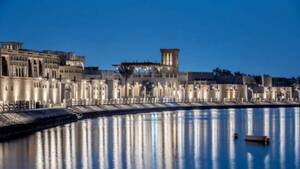
About Al Shindagha Museum
Al Shindagha Museum is the UAE’s largest heritage museum: an open-air cultural district formed from 22 themed pavilions across more than 80 restored and reconstructed heritage houses beside Dubai Creek. Rather than placing one collection inside a conventional building, it turns the lanes, courtyards and former family homes of Al Shindagha into part of the experience. The wider heritage area covers approximately 310,000 square metres.
The exhibitions cover Dubai’s development from the mid-19th century to the 1970s, alongside older archaeology and enduring Emirati traditions. Important pavilions include Dubai Creek: Birth of a City, Al Maktoum Residence, Perfume House, Culture of the Sea, Traditional Crafts, Traditional Jewellery, Beauty and Adornment, Traditional Healthcare, Poetry House, Life on Land, Traditional Food House, People and Faith, Emerging City, the Children’s Pavilion and Saruq Al Hadid.
This is primarily a museum, not a traditional concert hall or theatre. There is no single published public capacity, permanent arena-style seating plan, VIP section or general-admission floor. Performances are normally presented temporarily in courtyards, public spaces, community rooms or festival stages, while everyday visits involve walking between separate air-conditioned houses.
History and Development
Al Shindagha occupies a strategic peninsula at the entrance to Dubai Creek. The district became associated with Dubai’s ruling family and leading merchants, and expanded after Sheikh Saeed Al Maktoum settled there. Al Maktoum Residence, constructed in 1896, served as the ruling family’s home until 1958. Traditional houses used coral stone and gypsum, with palm-frond and timber roof structures, courtyards and barjeel wind towers providing natural ventilation.
Planning for a district-wide living heritage museum began in earnest in 2015. The first major exhibitions, Perfume House and the original Story of the Creek experience, had a soft opening in February 2019. Museums temporarily closed during the COVID-19 restrictions in March 2020 and Al Shindagha reopened on 1 June 2020 with reduced capacity. It recorded 18,909 visitors during 2021 while development and maintenance continued.
Additional houses opened in phases before the renovated and expanded museum was formally inaugurated on 6 March 2023. The completed concept grouped 80 houses into 22 pavilions, supported by rare objects, archival photographs, films, oral histories and contributions from more than 100 collectors, families, researchers and community members. Former residents helped preserve memories of everyday life, giving the museum a strong community-authored character.
Events and Programming
Programming centres on heritage workshops, family trails, storytelling, craft demonstrations, school visits, summer and winter camps, poetry, food culture and seasonal celebrations. It does not book touring pop concerts in the manner of an arena. Live music, theatre and large temporary installations appear mainly during district-wide festivals, particularly Sikka Art & Design Festival.
Documented highlights since 2021 show a consistent educational focus. A 2021 winter camp gave children early access to the Traditional Crafts and Al Maktoum houses. The 2022 Little Explorers summer programme explored artisans, leadership, merchants, engineering and navigation, followed by a winter camp involving pearl-diving stories, perfume and other heritage activities.
Following the full 2023 inauguration, the museum hosted Eid craft workshops, Emirati food experiences and Al Harbiya performances. Its recurring Family Weekend programme introduced monthly themes such as coastal life, maritime occupations and traditional crafts. Children’s summer camps examined pearl diving, marine ecology, camels, falconry and the relationship between desert and coastal communities.
In 2024, the surrounding neighbourhood hosted Sikka, presenting visual art, installations, murals, performances and hundreds of workshops. The festival attracted more than 162,000 visits and included a performance by the Fontane di Roma Youth Orchestra. Ramadan Nights brought Suhoor gatherings, traditional games, perfume, candle, weaving and jewellery workshops, a creative market and the Bu Tebaila heritage walk. Summer and winter camps covered wind-tower architecture, museum guiding and archaeology.
Sikka returned in 2025 with more than 350 artworks and installations across 19 houses, accompanied by live performances, talks and hands-on activities. Regular museum programming has included window-puzzle trails, gypsum decoration, traditional boat building, henna, jewellery, weaving, storytelling and perfume-related workshops. Ramadan programming continued with palm-frond crafts, dukhoon, prayer-rug making and multicultural heritage activities.
The 2026 Sikka programme used 16 houses for approximately 250 artworks by more than 450 creatives. Its wider schedule included more than 500 workshops, around 55 live music shows and ten orchestral, choral and other musical performances on the creekside main stage. Ramadan Nights added poetry, storytelling, craft demonstrations and an Emirati iftar majlis, while the summer camp introduced children to hospitality and Dubai’s early trading economy.
For 2027, organisers have announced that Sikka’s 15th edition will take place during January across Al Shindagha and Al Fahidi historic neighbourhoods. The theme, “The Return”, focuses on roots, traditions, identity and cultural memory. Detailed performance schedules and ticket arrangements had not been published as of 15 August 2026.
Tickets and Booking
Regular admission is AED 50 for an adult. Full-time students aged five to 24 pay AED 20, while groups of at least five people pay AED 40 per person. Children under five, senior UAE citizens, eligible people with disabilities and one accompanying escort, and valid ICOM cardholders receive free admission. These prices were formally approved in November 2024.
Tickets are available through the museum’s official advance-booking service and at ticket desks in the Visitor Centre, Culture of the Sea Pavilion and Poetry House. One admission provides access to the operational museum houses. Ordinary museum entry is not sold in seating tiers, and there is no standard VIP or presale system. Camps and limited-capacity workshops are announced and booked separately, so early registration is sensible.
Layout, Capacity and Event Spaces
The official venue-booking directory has listed capacities of 250 people for the Visitor Centre, 150 for Community Hall, 100 for Emerging City, 50 for Dar Al Maktoum, 25 for Life on Land, 44 for the Dubai Creek cinema and 15 for the Perfume House workshop. These are individual event-space limits, not the museum’s overall daily capacity. Seating configurations depend on the programme, and published information does not provide stage dimensions, rigging loads or backstage specifications.
Published architectural areas include approximately 483 square metres for the Welcome Pavilion, 1,137 square metres for Story of the Creek and 1,371 square metres for Perfume House. Four other exhibition groups developed across 17 houses cover a combined 7,980 square metres. No complete room-by-room measurements are publicly available.
For an ordinary visit, begin with Dubai Creek: Birth of a City for geographical and historical context. Perfume House is especially strong for sensory interpretation, Culture of the Sea for maritime life and virtual reality, and Al Maktoum Residence for political history. The 44-seat cinema provides the closest equivalent to conventional fixed seating; elsewhere, the experience is standing and walking based.
Architecture and Technical Capabilities
The conservation approach balances traditional fabric with contemporary exhibition design. Coral and gypsum walls, palm-covered ceilings and shaded courtyards remain visible, while the modern Welcome Pavilion uses a teak roof referencing the wooden dhows that supported Dubai’s maritime economy. Movable walls allow its sheltered plaza to open towards the surrounding district.
The permanent audiovisual system was designed for numerous independent sound zones, exhibit soundscapes, public announcements and the call to prayer. More than 800 networked loudspeakers are distributed across indoor and outdoor areas, with corrosion-resistant components suitable for the creekside environment. Central touch controls, integrated media playback and Dante networking allow different audio streams to operate simultaneously.
Exhibitions use high-definition projection, video mapping, LCD touchscreens, RFID readers, joysticks, interactive films, virtual reality and synchronised audio. Perfume House includes triggered projections and a digital smoke-effect installation. Lighting is conservation-aware, balancing daylight and theatrical emphasis while protecting sensitive textiles and artefacts. Detailed permanent fixture schedules are not published. For Sikka 2026, a separate temporary festival system reportedly used more than 1,000 lighting fixtures, including approximately 200 weather-resistant moving lights.
Getting There and Parking
The museum is on Al Khaleej Street in Al Shindagha Historic District, Bur Dubai, beside the mouth of Dubai Creek. Al Ghubaiba Metro Station on the Green Line is the most convenient stop and is only a short walk from the Visitor Centre. Al Ghubaiba Bus Station and Al Ghubaiba Marine Transport Station are also nearby, making the museum unusually well connected by metro, bus, ferry and abra.
Public paid parking is available along Al Khaleej Street, but spaces can be scarce during festivals. Al Ghubaiba multistorey car park is approximately an eight-minute walk away. Its recently published tariff was AED 5.25 per hour or AED 42 per day, including VAT, although parking prices can change. During Sikka and other major events, public transport is normally the easier option.
Taxis and app-based rides can use the museum’s designated drop-off points. Marine services from Al Ghubaiba may connect with Dubai Canal, the Marina, Bluewaters and Sharjah Aquarium, but routes and departure times vary. Visitors approaching from Deira can also incorporate an abra crossing into an Old Dubai itinerary.
Inside the Museum
Entry is generally managed from the Visitor Centre, where tickets are exchanged or issued with an access wristband. Expect short outdoor walks followed by air-conditioned galleries. The official map identifies toilets, accessible toilets, baby-changing facilities, a prayer room, cloakroom, café, shop, parking and drop-off points. Mobility buggies help visitors cover the large district.
Small bags and backpacks may be taken into galleries, but larger backpacks must be left at the entrance or cloakroom. Bags may be inspected. Eating, drinking, smoking and vaping are prohibited inside exhibition spaces. Pens, crayons, markers and wet art materials are not permitted; visitors wishing to sketch or take notes should use pencils and erasers.
Food options inside the permanent museum are limited compared with a shopping centre. Seasonal festivals add food courts, markets and independent vendors. There is no conventional merchandise concourse, although the museum shop and temporary creative markets sell heritage-inspired items. Photography instructions can vary by pavilion or temporary exhibition, so follow the signs displayed in each house.
Nearby Amenities
Al Ghubaiba has cafés, casual restaurants and a nearby shopping centre for quick meals. For a more atmospheric meal, continue along the creek towards Al Fahidi or Al Seef, where restaurants occupy courtyards and waterfront terraces. Bur Dubai and Al Seef contain the nearest substantial hotel clusters, ranging from simple city hotels to heritage-style accommodation. Deira’s spice and gold souqs are accessible by abra.
Allow at least 30 minutes after the museum closes before committing to a dinner reservation. The district is attractive around sunset, but the route between houses can be tiring in summer. Metro, buses and taxis provide late-evening options, although marine transport normally has a more limited timetable.
What Makes Al Shindagha Museum Special
The museum’s defining achievement is that it tells Dubai’s history in the place where much of that history unfolded. Visitors stand beside the creek that generated trade, wealth, fishing, pearling and migration, then enter houses connected with rulers, merchants, craftspeople and families. Objects belonging to Dubai’s leaders sit alongside oral testimony, jewellery, perfume recipes, domestic tools and maritime equipment.
Its economic impact has not been published as a single audited jobs or visitor-spending figure. Its wider contribution is nevertheless visible in the opportunities it creates for artists, craftspeople, educators, food businesses and creative retailers. Sikka’s 162,000 visits in 2024 demonstrated the district’s ability to draw large audiences while giving local and regional creatives access to historic houses and public space.
Recent visitors commonly praise the clean galleries, English-and-Arabic interpretation, knowledgeable guides, interactive technology and lack of heavy crowding outside major festivals. The most frequent warning is scale: several visitors spent four or five hours and still did not finish. Outdoor heat between pavilions and limited interpretation in languages other than Arabic and English are the principal recurring concerns.
Visitor Tips and Information
The museum operates regular hours of 10am to 8pm daily, with final ticket sales or entry at 7pm. Special-event and Ramadan schedules may differ. Arrive before mid-afternoon for a comprehensive visit, or shortly before sunset if atmosphere and creekside photography matter more than seeing every house.
Wear comfortable shoes and lightweight, respectful clothing. Bring water for the journey, but keep it outside the galleries. A light extra layer can be useful because the indoor air conditioning contrasts sharply with outdoor temperatures. Collect a map immediately, choose priority pavilions and use the available buggy service if walking long distances is difficult.
The museum is not certified under the American ADA system, which does not govern venues in the UAE. Official information says most houses have step-free access, while accessible toilets, complimentary wheelchairs and mobility buggies are available. Because some buildings retain heritage constraints, visitors with specific access requirements should speak to staff at the Visitor Centre before starting their route.
Frequently Asked Questions
What are Al Shindagha Museum’s normal opening hours?
Regular opening hours are 10am to 8pm every day, with the final ticket sale or admission at approximately 7pm. Ramadan, public holidays and major events such as Sikka may bring extended or altered hours. Arriving by 3pm gives most visitors enough time to explore several important pavilions without rushing.
How much does admission cost?
Standard adult admission is AED 50. Full-time students aged five to 24 pay AED 20, while groups of five or more receive a rate of AED 40 per person. Children under five enter free. People with disabilities and one escort, senior UAE citizens and valid ICOM cardholders are also exempt from admission charges.
How long should I spend at Al Shindagha Museum?
Allow three to five hours for a useful overview. Two hours is sufficient only if you select three or four priority pavilions. Visitors who read every display, watch the films and try the interactive experiences can spend most of the day here. Recent reviews regularly mention four- and five-hour visits without completing every house.
Does one ticket include every pavilion?
A regular admission ticket covers the operational houses within Al Shindagha Museum. Temporary workshops, holiday camps, private programmes and certain special activities may require separate registration or payment. Occasionally, individual houses close for maintenance or event preparation, so the precise number available can vary even though the standard ticket is designed for the full museum complex.
Is Al Shindagha Museum suitable for young children?
Yes. The Children’s Pavilion, traditional games, craft workshops, projection effects, touchscreen activities and maritime virtual reality make the museum more engaging than a conventional object-only collection. Seasonal camps are designed for different age groups. Children aged 12 and under should remain with an adult, and families should account for outdoor walking between the houses.
Is the museum wheelchair accessible?
Most museum houses are described as having step-free access, and the grounds include accessible toilets. Wheelchairs and mobility buggies are available without charge, subject to availability. Some restored heritage structures may present individual constraints, so ask staff to mark the most accessible route. Eligible visitors with disabilities and one accompanying escort receive free admission.
Where should drivers park?
Paid public spaces are available along Al Khaleej Street, but they fill quickly during evening festivals and weekends. The more dependable option is Al Ghubaiba multistorey car park, around eight minutes away on foot. Its published rate has been AED 5.25 per hour or AED 42 daily, although visitors should expect tariffs to change over time.
Which Metro station is closest?
Use Al Ghubaiba Metro Station on the Green Line. The museum’s Visitor Centre is only a short, generally straightforward walk from the station. Al Ghubaiba is also a major bus and marine transport interchange, making it convenient for visitors combining the museum with Al Fahidi, Deira’s souqs, an abra crossing or other Old Dubai attractions.
Is Al Shindagha Museum indoors or outdoors?
It is both. The exhibitions are housed inside separate, air-conditioned heritage buildings, but visitors walk outdoors through lanes and courtyards to move between them. This distributed arrangement is why it is called an open-air museum. Summer visits remain manageable inside the galleries, although the connecting walks can be hot and humid during the middle of the day.
What is the best time to visit during hot weather?
Begin at 10am to avoid the day’s highest temperatures, or arrive after 4pm and stay into the cooler evening. A morning visit is best for completing numerous houses; late afternoon is better for creek views and outdoor atmosphere. Use the museum buggy when available and alternate nearby pavilions rather than repeatedly crossing the entire district.
Can I bring a backpack into the galleries?
Small backpacks and handbags are normally permitted, although staff may inspect them. Large backpacks must be left at the entrance or cloakroom. Avoid bringing bulky luggage, particularly if arriving during an airport stopover. Pens, markers, crayons and wet art materials are prohibited in the galleries, but pencils and erasers may be used for notes or sketching.
Can visitors take photographs?
Casual photography is generally part of the visitor experience, particularly around the architecture and waterfront, but individual galleries or borrowed artefacts may have restrictions. Flash, tripods and commercial equipment may receive different treatment from handheld personal photography. Check the signs at each pavilion and follow instructions from gallery staff rather than assuming one rule applies throughout the district.
Are food and drinks available inside?
The permanent visitor facilities include a café, but the museum is not a major dining destination. Eating and drinking are prohibited inside exhibition galleries. Large festivals introduce food courts, local vendors and creative markets, considerably expanding the choice. For a full meal outside event periods, walk towards Al Ghubaiba, Al Fahidi or Al Seef after completing the museum.
Which pavilions should I choose if I have only 90 minutes?
Start with Dubai Creek: Birth of a City, which explains how geography, trade and leadership shaped Dubai. Choose Perfume House next for its sensory displays, then either Al Maktoum Residence for ruling-family history or Culture of the Sea for pearling, dhow building and maritime life. Ninety minutes is not enough for all four without moving quickly.
Does the museum have regular concerts or theatre performances?
There is no permanent commercial concert season. Most days focus on exhibitions, guided interpretation and workshops. Live music, traditional performance, theatre, poetry and temporary stages appear during Sikka, Ramadan celebrations, Eid and other cultural programmes. For example, Sikka 2026’s creekside stage supported dozens of music shows plus orchestral and choral performances.
Can Al Shindagha Museum be hired for private events?
Several spaces have been offered for meetings, workshops and cultural events. Published capacity limits range from 15 in the Perfume House workshop to 250 in the Visitor Centre, with Community Hall accommodating 150 and Emerging City 100. Applications have historically required advance approval and an event proposal; capacities, fees and production conditions should be confirmed before planning.