About Burj Lake
Burj Lake is not a conventional concert venue with an auditorium, fixed seats or an advertised capacity. It is the artificial lake and public waterfront at the centre of Downtown Dubai, bordered by Burj Khalifa, Dubai Mall, Souk Al Bahar, Burj Park and the Opera District. Its resident attraction is the Dubai Fountain, which remains open and operating under that name in 2026. The operator’s current description places the fountain on a 23.81-acre lake, while other Emaar materials describe the wider Burj Khalifa Lake as more than 120,000 square metres, or roughly 30 acres.
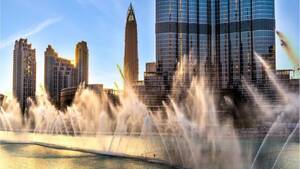
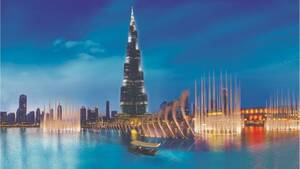
The fountain is approximately 275 metres long and arranged around five circles of different sizes and two arcs. Its original system included 344 underwater robots, 1,137 water shooters, more than 6,600 lights and 25 colour projectors. Around 83,000 litres—approximately 22,000 gallons—can be airborne at once, with the tallest jets reaching about 140 to 150 metres. Robotic Oarsmen, Fan Oarsmen and high-pressure Shooters create the sweeping, spinning and sudden vertical movements associated with the show.
The project was commissioned from California-based WET, the company behind the Bellagio fountains in Las Vegas. Its public name was chosen through a competition announced in October 2008. Testing began in early 2009, and Sheikh Mohammed bin Rashid Al Maktoum formally unveiled the Dubai Fountain on 8 May 2009 during Dubai Mall’s grand inauguration. The fountain was completed in about 18 months, unusually quickly for a water feature of this complexity.
After Burj Khalifa opened in January 2010, the lake became part of Downtown Dubai’s annual New Year’s Eve spectacle. Later additions included traditional abra lake rides and a 272-metre floating boardwalk extending to within nine metres of the jets. These experiences changed Burj Lake from a landmark viewed only from shore into an attraction visitors could enter and cross.
The most significant renovation occurred in 2025. The fountain closed on 19 April and reopened on 1 October after five months of work. Phase One addressed the concrete base, waterproofing, insulation, tiling and paint, with blue tiles added beneath the water. Mechanical, lighting and sound improvements were also reported. Emaar scheduled a second phase of creative and technological additions for the second quarter of 2026, although the public information available in August 2026 does not provide a detailed final inventory of those additions.
Events and Programming
Burj Lake’s core programme is the Dubai Fountain rather than touring concerts. Current afternoon performances are scheduled at 1pm and 1.30pm from Saturday to Thursday, and at 2pm and 2.30pm on Friday. Evening shows run daily every 30 minutes from 6pm until 11pm. The repertoire rotates among Emirati and wider Arabic music, orchestral and classical pieces, film music and international pop, so consecutive performances may use different tracks.
Recent programming demonstrates how the lake is used for festivals and civic occasions. In 2021, Eid Al Fitr brought a new fountain sequence choreographed to Emirati composition Esmaha Dubai , while Eid Al Adha featured more frequent shows. The New Year celebration welcoming 2022 synchronised the fountain with Burj Khalifa’s fireworks, lights and a new laser element.
Ramadan and Eid in 2022 brought additional themed and extended performances, including a nightly Ramadan water display and a new Eid show linked to the tower’s LED production. The lake’s regular international repertoire continued through 2023, culminating in a technically elaborate New Year production welcoming 2024. That show used more than 1,000 MiniShooters, dozens of high-pressure shooters, hundreds of moving water nozzles, 127 strobe strings and thousands of fog nozzles.
The 2024–25 “Beyond Dreams” New Year production combined original music, lasers, lighting and more than 15,600 pyrotechnic elements, with live musicians, dancers, drummers and roaming performers positioned around Downtown Dubai. After the 2025 renovation, reopening performances drew large crowds and included Emirati, classical crossover and Mandarin pop selections.
The most ambitious use of Burj Lake to date welcomed 2026. Producers transformed the water into a temporary performance stage for more than 280 artists from 31 countries. The 20-minute production included live music, water choreography, aerial performance, a tightrope crossing, three 30-metre water screens, a ring of fire, drones, pyrotechnics and thousands of controlled lighting fixtures. The wider celebration continued in modified form until 7 January 2026.
No conventional concert season or confirmed long-range 2027 programme has been published for Burj Lake. Visitors should expect daily fountain shows, Ramadan and Eid variations, national celebrations and a major New Year production rather than regular ticketed artist concerts.
Tickets and Booking
Watching from the public promenade is free and requires no reservation. The paid Boardwalk costs around AED25, while the Lake Ride is approximately AED75; prices and operating periods can change. Timed tickets are sold through the attraction’s authorised booking channel and can also be arranged at its visitor counter. Popular evening slots are worth reserving ahead during winter, school holidays and major celebrations.
Boardwalk and Lake Ride tickets apply only to the selected date and time. Guests collecting attraction tickets are advised to reach the main visitor counter on Dubai Mall’s Lower Ground level at least 30 minutes before their slot. Late arrival or a temporary weather closure may affect the experience, so avoid booking an inflexible onward activity immediately afterwards.
Seating and Layout
There is no permanent seating plan or official public capacity. Ordinary viewing is standing-room along several kilometres of waterfront, while private restaurants provide reserved tables. Temporary New Year stages, controlled viewing zones and Burj Park hospitality areas use event-specific layouts that do not apply to normal fountain nights.
The Dubai Mall Waterfront Promenade offers the most direct free view but attracts the densest crowds. Across the water, Souk Al Bahar gives the classic composition of fountains rising in front of Burj Khalifa. Burj Park and the Opera District side provide wider angles and can feel less compressed, although parts may close for private events or production work.
The Boardwalk is best for physical proximity and the sound and spray of the jets. The abra ride provides a moving, unobstructed perspective but not a fixed camera angle. Elevated restaurant terraces are comfortable for repeated shows, although glass, railings, landscaping or other diners may interrupt sightlines and the soundtrack can sound quieter than it does at water level.
Getting There and Parking
Burj Lake is at the foot of Burj Khalifa, beside Dubai Mall in Downtown Dubai. The nearest Metro stop is Burj Khalifa/Dubai Mall station on the Red Line. A covered, air-conditioned Metro Link Bridge leads into Level 2 of the mall near Fashion Catwalk. From there, follow signs to the Lower Ground floor, the fountain, waterfront promenade or Souk Al Bahar. The station name can be misleading: the link and walk through the mall are substantial, so allow additional time.
Dubai Mall’s current taxi location is at P3 Zabeel Parking. Ride-hailing collection points include Lower Ground near du, P3 Cinema Parking, Fashion P4 and P3 Zabeel. The F13 feeder bus also serves stops around Dubai Mall, Dubai Fountain Street and the Palace hotel area. Public transport is usually preferable on busy weekend evenings.
Grand, Cinema and Fashion parking use ticketless Salik charging. Parking is free for up to four hours Monday to Thursday and six hours Friday to Sunday. The next weekday slab begins at AED20; longer stays rise sharply. Zabeel and Fountain Views parking are currently exempt from these charges. Eligible People of Determination are also exempt in the applicable zones.
Inside the Venue
Burj Lake has no enclosed foyer, permanent box office, dedicated cloakroom or merchandise hall. Public promenade access normally involves walking straight from Dubai Mall, Souk Al Bahar or surrounding boulevards to the waterfront. Security barriers and controlled entry appear during major celebrations, particularly New Year’s Eve.
Restrooms, prayer rooms, cafés and family facilities are available inside Dubai Mall and Souk Al Bahar rather than on the open shoreline. Dubai Mall has prayer rooms on every level. Food ranges from quick-service counters to formal fountain-view restaurants; outside food and drink are not permitted on the paid Boardwalk or Lake Ride.
The Boardwalk rules prohibit running, jumping, smoking and littering. Large bags and strollers may need to be left at the designated counter. There is no formal dress code for the free promenade, but modest clothing appropriate to a Dubai shopping and family district is expected. Public alcohol consumption is prohibited; drinks containing alcohol should remain within licensed premises.
Nearby Amenities
Dubai Mall and Souk Al Bahar surround visitors with dining choices. Social House and several Fashion Avenue restaurants offer broad lake views, while Abd El Wahab, Karma Kafé and Maison de Curry are among the established Souk Al Bahar options. Thiptara at Palace Downtown is particularly close to the water. Request an outdoor, fountain-facing table explicitly; a general terrace reservation does not guarantee an unobstructed view.
Licensed dining and drinks are available at selected Souk Al Bahar venues and nearby hotels. Close accommodation includes Armani Hotel Dubai inside Burj Khalifa, Palace Downtown, Address Downtown and Address Dubai Mall. Staying within Downtown is especially useful for New Year’s Eve, when road closures and pedestrian controls make late-night travel complicated.
For a normal evening, arrive at the waterfront 20 to 30 minutes before the desired performance. In cooler months, at weekends or during holidays, arrive earlier. Between May and September, the air-conditioned mall offers relief from heat and humidity until shortly before showtime.
What Makes Burj Lake Special
Burj Lake succeeds because water, architecture and public space operate as one composition. The fountain’s arcs echo across the lake while Burj Khalifa supplies a vertical backdrop and enormous LED canvas. Reflections from the tower, restaurants and blue-tiled lake floor expand the perceived scale after dark.
Its cultural role is broader than a tourist photo stop. Fountain selections move between Emirati music, wider Arab popular culture, classical works and songs from Asia, Europe, Africa and the Americas. That multilingual programming reflects Dubai’s international population, while Eid, Ramadan, UAE celebrations and New Year productions give the lake a civic function.
No audited figure isolates Burj Lake’s individual economic contribution. Its importance is nevertheless visible within the wider Downtown cluster: Dubai Mall recorded 111 million visits in 2024, and the fountain’s 2025 closure prompted temporary digital waterfront installations and commercial support for affected terrace businesses. The lake helps convert shopping visits into evening dining, hotel stays and longer Downtown itineraries.
Visitor Tips and Accessibility
Dubai uses the term “People of Determination” rather than ADA terminology, and US ADA law does not govern the venue. Dubai Metro stations provide lifts, tactile guidance, wheelchair gates, accessible ticket counters and designated carriage spaces. The mall and main waterfront promenade offer the most dependable step-free route to a fountain view.
The operator does not publish a detailed current accessibility specification for the floating Boardwalk or traditional abra. Older visitor information reports that the Boardwalk may not accommodate wheelchairs, so travellers requiring step-free access should use the promenade unless suitability has been confirmed before purchase. The abra also requires checking for transfer and boarding requirements.
Bring comfortable footwear, a charged phone and a light layer during cooler winter evenings. Avoid stopping on bridges, escalator exits or narrow passages to film. Protect cameras from possible spray on the Boardwalk, supervise children beside the water and respect other visitors’ privacy when photographing crowded areas.
Frequently Asked Questions
Is Burj Lake a concert venue?
Not in the usual sense. Burj Lake is an outdoor artificial lake and public waterfront whose permanent attraction is the Dubai Fountain. It occasionally becomes a temporary performance stage for New Year productions, civic celebrations, aerial acts and special effects, but it has no permanent concert seating, published audience capacity, backstage complex or regular touring-artist calendar.
Is the Dubai Fountain operating in 2026?
Yes. The fountain reopened on 1 October 2025 after a five-month renovation and its current operator information lists normal afternoon and evening performances. Emaar had scheduled additional Phase Two features for the second quarter of 2026, but no detailed public completion report or revised technical specification was available by 14 August 2026.
How much does it cost to watch the fountain?
The waterfront promenade is free. The floating Boardwalk generally costs around AED25, while the traditional abra Lake Ride is approximately AED75. These are attraction prices rather than admission to Burj Lake itself and may change by date or operating policy. Fountain-view restaurants charge their normal food and beverage prices, often with minimum spends on major occasions.
How long does each fountain show last?
A show normally follows one musical selection and lasts several minutes rather than the full half-hour interval. The exact duration depends on the choreography and track. The published schedule indicates when performances begin, not how long they run. Visitors wanting to see different music should remain for two or three consecutive half-hour slots.
Where is the best free viewing position?
Souk Al Bahar’s waterfront gives the most recognisable view, with the fountain in front of Burj Khalifa. Dubai Mall’s promenade places you closer to the strongest jets but is usually busier. Burj Park offers a broader skyline angle. Arrive between performances so you can move towards the railing as the previous crowd disperses.
Do I need to reserve a free promenade space?
No. Normal promenade viewing is first-come, first-served. Reservations apply only to paid attractions, restaurants, hospitality areas and special events. Space immediately beside the railing fills quickly after sunset, especially on Friday and Saturday evenings. New Year’s Eve is entirely different, with closures, access controls and exceptionally early crowd arrival.
Which is better: the Boardwalk or Lake Ride?
Choose the Boardwalk for the closest stationary view, stronger sound and dramatic spray. Choose the Lake Ride for photographs across the water and a calmer experience away from the main promenade. The boat moves, so its angle changes during the performance. Neither is essential: the free views remain excellent and show more of the overall choreography.
Are children allowed on the paid experiences?
Children under 16 must be accompanied by a guardian. Children under three are admitted free on the Lake Ride, but children under three are not permitted on the Boardwalk under the current published terms. Child tickets cannot be purchased independently. Families should also consider whether a young child will be comfortable with loud music, spray and a floating platform.
Can I bring a stroller onto the Boardwalk?
Large bags and strollers may need to be deposited at the designated counter before entering the Boardwalk or Lake Ride. For families who need continuous stroller access, the public promenade is simpler. It offers level routes from the mall, room to step back from dense crowds and quick access to indoor restrooms, cafés and cooling.
Is Burj Lake wheelchair accessible?
The main Dubai Mall promenade is the most practical wheelchair viewing area, reached by lifts and step-free mall routes. Dubai Metro is designed for wheelchair users. The floating Boardwalk and abra do not have sufficiently detailed current accessibility information for assured independent access, so visitors with transfer or mobility requirements should not assume that paid experiences are suitable.
Can I take photographs and video?
Personal photography is normal around the lake, and mobile phones are widely used during performances. Avoid tripods or equipment that blocks walkways, do not lean over barriers and obtain permission before focusing on identifiable strangers. Commercial productions require appropriate authorisation. Spray can reach the closest Boardwalk areas, so protect equipment that is not water resistant.
What happens if weather affects the show?
Outdoor operations may be altered or suspended because of storms, wind, poor visibility or other safety concerns. The operator’s terms do not accept responsibility for weather affecting visibility. Dubai’s weather is usually stable, but wind can carry spray towards spectators. Paid guests should retain their booking details and follow instructions from attraction staff.
What is the least crowded time to visit?
Afternoon performances are generally easier than the period immediately after sunset, though daylight reduces the impact of the lighting. For an evening visit, choose an earlier weekday show or remain for a later performance after families begin leaving. Winter weekends, public holidays and school breaks are busiest. New Year’s Eve should never be treated as a normal visit.
How far is Burj Lake from the Metro?
Burj Khalifa/Dubai Mall is the correct station, but the platform is not beside the water. Visitors cross a long, climate-controlled link bridge, enter Dubai Mall and continue to the Lower Ground waterfront. Allow generous time for this route, particularly with children or reduced mobility. Do not plan to leave the train only a few minutes before a show.
How does Dubai Mall parking payment work?
Fashion, Grand and Cinema parking use automatic Salik identification. The first four hours are free Monday to Thursday and the first six hours Friday to Sunday, after which flat time-based charges apply. Zabeel and Fountain Views parking are currently exempt. Drivers need an active, adequately funded Salik account for chargeable parking.
Are toilets available beside the lake?
There is no standalone Burj Lake restroom building intended as part of a concert venue. Use facilities inside Dubai Mall, Souk Al Bahar or a restaurant. The mall also provides prayer rooms on every level. Visit facilities before taking a timed Boardwalk or boat slot, as returning through the evening crowd may take longer than expected.
Can I drink alcohol while watching the fountain?
Alcohol cannot be consumed on the public promenade, Boardwalk or abra. Selected licensed restaurants and lounges in nearby hotels and parts of Souk Al Bahar serve alcoholic drinks for consumption within their premises. Dubai Mall itself should not be treated as a bar destination. Never carry an open alcoholic drink into the public waterfront area.
What should visitors know about New Year’s Eve?
New Year’s Eve brings road closures, pedestrian checkpoints, restaurant passes, controlled areas and crowds far beyond those of a normal fountain evening. Public areas may remain free but can close when capacity is reached. Burj Park has recently operated as a separate ticketed viewing zone. Visitors should arrive exceptionally early and expect a lengthy journey out after midnight.