About Pew Pew Miami
Pew Pew Miami is not currently operating as a permanent nightclub or venue. It was a branded pop-up created by the New York-based Pew Pew art collective, principally associated with a month-long residency at The Oasis in Miami’s Little Haiti neighborhood. Research found no announced Pew Pew Miami events for 2026 or beyond as of August 23, 2026. The underlying event property remains marketed under The Oasis name at 363 NE 61st Street.
The collective originated in a Lower East Side loft, where its founders sought an alternative to conventional club nights. Their events combined electronic music, interactive art, immersive acting and spontaneous theatrical encounters, making guests participants rather than passive spectators. Before arriving in Miami, Pew Pew had staged New York venue takeovers and an event on a private island in Bermuda.
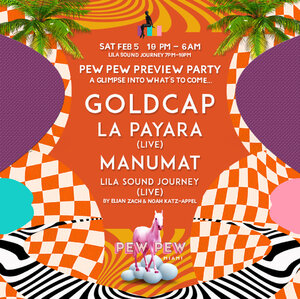
Pew Pew introduced its Miami concept with a preview on February 5, 2022. The evening began with a limited-capacity sound journey led by Elian Zach and Noah Katz-Appel, followed by an overnight party featuring Goldcap, La Payara and Manumat. Contemporary coverage reported more than 900 guests at the preview, which included secret-room performances, unconventional figure drawing and Frick Frack Blackjack, a game in which participants wagered objects rather than money. ticketfairy.com
The main residency ran from April 7 through May 1, 2022, generally from Thursday through Sunday. Pew Pew retrofitted approximately 6,000 square feet of The Oasis as a “retro-surrealist” playground. Its own later account says more than 7,100 people attended across four weekends. Fourteen local artists received funding to construct site-specific installations, giving the residency a stronger visual-art component than a standard touring dance party.
Events and Programming
Pew Pew Miami programmed house, techno, disco, live electronic music, wellness sessions, pool parties, drag, burlesque, circus performance, workshops and installation art. The advertised schedule divided some days into daytime wellness programming, early-evening art and connection activities, and late-night performance and dancing. More than 50 DJs were promoted across the residency.
The opening weekend illustrates the concept’s range. An April 7 launch involving BitBasel featured Oscar G and Charlie from Soul Clap. The following night brought Dark Heart, Zookëper and Sephyr, while the April 9 Pride collaboration featured Louie Vega, Eli Escobar, Inbal and Djembe across two dance floors. A Sunday disco pool party followed with Max Baum, Madden and T. Dade.
Later documented bookings included Goldfish, Sheik ’n’ Beik, Tâches, Nick Monaco, Dude Skywalker, Alan Amorozzo, Kike Roldan, Tostao, Dennis Ferrer and Gordo. A Secret Garden collaboration featured Detroit techno figure Stacey Pullen with Tony Guerra and Miami-area supporting DJs. The April 30 closing party paired Patrice Bäumel and Frankey & Sandrino with an extended lineup of regional artists.
The recurring Pew Pew Spectacular format added silk aerialists, fire eaters, roller-skating painters, drag performers, burlesque, neon art and roaming characters to the DJ program. Installations included Lindsey Fielding’s “Voyeur Vulnerable,” a recording and listening booth designed like an emotional confessional. Other promoted features included projection mapping, murals, light art, sculptures, rotary phones playing seductive secrets, a pop-up roller rink, a playful “butt-kissing booth” and a hidden motel environment.
Pew Pew returned to the same address during Miami Art Week on December 3, 2022, as a co-producer of Teleport City rather than another Pew Pew Miami residency. That one-night project involved more than 55 artists, actors, performers and designers, with 14 installations spread through an approximately 18,000-square-foot activation. No verified Pew Pew Miami programming was found for 2021 or from 2023 through August 2026.
Tickets and Booking
There are no current Pew Pew Miami tickets because no active residency or future dates have been announced. During 2022, each event was ticketed separately and sold digitally in ascending price tiers. Door availability could not be assumed, particularly for major collaborations and the preview, which sold through several advance tiers. ticketfairy.com
Historic pricing varied substantially by format. Daytime disco pool events were advertised from roughly $10 to $40, while many full nighttime parties fell around $33 to $77. The February preview reached approximately $99 for later general-admission tiers and $200 for a VIP package with a private lounge and limited open bar. These figures describe 2022 events, not current pricing.
For any future Pew Pew production, look for a clearly identified organizer, date, location and refund policy before purchasing. The collective creates temporary environments, so a future Miami event would not necessarily use The Oasis or repeat the 2022 layout, admission rules or ticket structure.
Seating, Capacity and Layout
Pew Pew Miami was primarily a standing, general-admission experience rather than a seated theater. Guests circulated between dance floors, installations, performance areas, secret rooms and the pool terrace. Seating, when provided, was in temporary lounge or VIP arrangements rather than numbered rows. The open format rewarded exploration; there was no single “best seat.”
The host property is officially described as a 6,800-square-foot venue containing Studio 1, Studio 2 and a Cottage opening through French doors onto the pool terrace. The studios include preparation kitchens and changing areas, while the Cottage has elevated ceilings. Pew Pew advertised about 6,000 square feet for its activated environment, apparently reflecting the portion configured for the residency.
Capacity figures require caution. The venue’s current information lists 250 for the indoor studios and Cottage and 700 for the pool terrace, with full-property capacity dependent on event type. An older brochure listed a much higher 1,800-person full-venue capacity and 1,200 on the terrace. Those historical numbers should not be treated as a current concert limit; permitted attendance depends on the specific floor plan, exits, staging and production footprint.
No verified room dimensions, stage measurements or permanently installed seating chart have been published. For a dance event, positions near the primary DJ platform offered the most direct view, while moving between rooms was essential for discovering theatrical encounters. Anyone needing a chair or clear viewing position would have needed event-specific assistance because the floor was designed for standing and movement.
Architecture, Design and Production
The Oasis supplied a bright, contemporary blank canvas rather than a historic auditorium. White studio interiors, high ceilings, French doors and a tropical pool terrace allowed Pew Pew to create contrasting environments indoors and outside. The transformation was temporary: installations, projection surfaces, lounges, stages and theatrical rooms were constructed for the residency rather than added as permanent renovations.
Documented production elements included multiple performance areas, projection mapping, light projection, strobe effects, murals, sculptures, immersive audio and rigging for aerial and circus performance. However, no reliable inventory identifies the PA brand, speaker configuration, mixing console, lighting fixtures, projector models, power distribution or stage dimensions. These systems should be understood as event-specific production, not guaranteed house equipment.
Because performances happened among the audience, sightlines and sound changed as guests moved through the property. The design placed equal importance on intimate discoveries and headline DJ sets. Visitors could encounter a performer in a small room, watch an aerial act, examine an installation and then return to a busy dance floor within the same night.
Getting There and Parking
The 2022 residency was held at 363 NE 61st Street, Miami, Florida 33137 , within the Magic City Innovation District campus in Little Haiti. It is north of the Miami Design District and Wynwood, west of Biscayne Boulevard and close to NE 2nd Avenue. This address remains associated with The Oasis, not an active Pew Pew Miami club.
Metrobus routes 9 and 9A travel along NE 2nd Avenue and serve Little Haiti, placing their corridor close to the property. The free Little Haiti Trolley also has a stop around NE 61st Street and NE 2nd Avenue, but its published service generally finishes around 8 p.m. Consequently, it is useful for daytime programs but not a dependable way home from an overnight event.
There is no Metrorail or Metromover station within a convenient short walk. Visitors coming from Downtown can connect to a northbound bus, while those arriving after dark commonly use a rideshare or taxi. Arrange the return trip before leaving an event, especially after midnight when transit frequency falls and demand-based fares may rise.
A fixed parking capacity or standard public parking fee has not been published. Parking arrangements can change with each rental, and nearby curb space is limited. Do not assume that admission includes parking. If driving to another event at The Oasis, follow that event’s stated parking instructions and avoid blocking neighboring driveways, loading areas or residential access.
Inside the Venue
At the Pew Pew residency, guests entered an art-driven club environment rather than a conventional lobby-and-auditorium arrangement. A valid photo ID and scannable ticket were required for advertised 21-and-over nights. The Pride event specifically prohibited re-entry, used strobe lighting and applied a consent-focused safer-spaces policy with zero tolerance for harassment, discrimination and unwanted touching. Policies varied by production rather than forming a permanent venue rulebook.
Bars and an “elixir” wellness lounge formed part of the experience, but menus and service points changed between events. The pool was a major visual and social feature; its presence did not automatically mean swimming was permitted. Temporary VIP lounges, table service and open-bar periods appeared on selected tickets. No consistent coat-check, merchandise, public Wi-Fi or food-service policy can be verified for the full run. ticketfairy.com
The April 9 event identified all restrooms as gender-neutral and the entrance as ADA accessible. Comprehensive details about accessible restrooms, pool-area routes, viewing platforms, hearing assistance or sensory accommodations were not published. Guests with specific mobility or sensory needs should therefore treat accessibility as event-specific rather than assuming that every temporary installation preserves the same routes.
Nearby Amenities
Little Haiti offers stronger pre-event dining than late-night bar hopping. Current neighborhood options include Clive’s Cafe for Jamaican cooking, Chef Creole for Haitian, Creole and Bahamian dishes, Piman Bouk for Haitian favorites, Fiorito for Argentine food and Lakou for contemporary Haitian-inspired plates. Hours vary, so eating before a late event is safer than expecting a full meal afterward.
There is no hotel attached to the property. The closest substantial hotel cluster is farther south around the Design District, Midtown and Wynwood, including the AC Hotel Miami Wynwood, Hampton Inn & Suites Miami Wynwood Design District and The Hotel at The Moore. These are generally more practical by car or rideshare than on foot, particularly late at night.
What Made Pew Pew Miami Special
Pew Pew’s defining idea was that nightlife could operate as participatory art. Guests did not merely watch a stage: they received keys to hidden rooms, spoke into installations, encountered roaming actors and found performances embedded throughout the crowd. That structure blurred distinctions between nightclub, gallery, circus and immersive theater.
Its measurable cultural contribution included funding 14 local artists and presenting Miami talent beside internationally known dance-music artists. More than 7,100 visits over four weekends demonstrated demand for experimental programming outside Miami Beach’s traditional club corridor. No independent study quantified the residency’s direct spending, employment or wider economic impact, so broader financial claims would be speculative.
The location also requires context. The surrounding Magic City development has committed money to a Little Haiti community trust, but the wider project has faced sustained criticism over displacement, scale and gentrification. Those debates concern the development rather than Pew Pew alone, yet they matter when describing cultural events placed within a historically Haitian neighborhood.
Visitor Tips and Information
Do not travel to the address expecting an active Pew Pew club. Confirm the event name and organizer first.For a similar temporary production, arrive early enough to explore installations before the dance floors become crowded.
Bring government-issued photo identification and a charged phone containing the ticket.
Wear comfortable shoes; the experience was designed around standing, dancing and movement between rooms.
Carry hearing protection. Electronic music, strobe lighting and sudden spectacle effects were central to the format.
Never assume the pool is open for swimming, that re-entry is allowed or that bags and professional cameras will be accepted.
Use the Little Haiti Trolley only for daytime or early-evening arrival; plan a different late-night return.
Creative clothing suited the atmosphere, but historical event language emphasized self-expression rather than a rigid dress code.
Frequently Asked Questions
Is Pew Pew Miami still open?
No. Pew Pew Miami was a temporary immersive nightlife residency, not a permanent Miami club. Its main public run ended on May 1, 2022. The property at 363 NE 61st Street continues to be presented as The Oasis, a rentable event and production venue, but no new Pew Pew Miami season has been announced for 2026.
Is Pew Pew Miami the same place as The Oasis?
Not exactly. The Oasis is the physical indoor-outdoor venue that hosted the residency. Pew Pew Miami was the temporary artistic identity installed within it, including custom stages, projection art, hidden rooms and performances. A later event at the same address may have a completely different organizer, layout, audience capacity and admission policy.
What was Pew Pew Miami’s capacity?
No single verified capacity applied to every Pew Pew event. The host venue currently lists 250 for its indoor studios and Cottage and 700 for the pool terrace, while full capacity depends on configuration. Older material advertised higher totals. Stages, installations and safety routes would have reduced the usable audience area during the residency.
Was Pew Pew Miami indoors or outdoors?
It used both. Two indoor studios and the Cottage accommodated dancing, installations and smaller experiences, while French doors connected the Cottage to an outdoor pool terrace. Weather could therefore affect the outdoor portion, although indoor areas provided shelter. The exact balance between inside and outside changed with each event’s temporary production plan.
Did Pew Pew Miami have assigned seating?
No. The experience was predominantly general admission and standing-room, with guests circulating among dance floors and installations. Selected VIP packages offered access to a private lounge, but that was not equivalent to a reserved theater seat. Anyone unable to stand for long periods would have needed to request event-specific accommodation before attending.
Was the venue wheelchair accessible?
The April 2022 Pride event specifically described its entrance as ADA accessible. However, detailed information about accessible restroom stalls, uninterrupted routes around installations, pool-terrace access and dedicated viewing space was not published for every event. Temporary scenery can alter circulation, so accessibility should be reconfirmed for any future production at the property.
What was the minimum age?
The documented preview and major nightlife events were restricted to guests aged 21 and older, with photo identification required. That reflected their late-night alcohol service and club format. It should not be interpreted as a permanent age policy for The Oasis, which also hosts private celebrations, productions and other functions with rules established by each renter. ticketfairy.com
Was there a dress code?
There was no conventional upscale-club dress code in the surviving event information. Instead, guests were encouraged to “dress to express,” with colorful, retro and surreal outfits matching the theatrical environment. Comfortable footwear remained important because nights involved extensive standing and dancing. Any future production could establish different costume themes or practical restrictions.
Were strobe lights and intense effects used?
Yes. Strobe lighting was expressly disclosed for the Pride party, and the wider residency used projection mapping, bright light art, loud amplified music, surprise performances and roaming actors. Visitors sensitive to flashing light, high volume, crowds or unexpected interaction would have benefited from hearing protection and advance confirmation of available quieter spaces.
Could guests swim in the pool?
The pool was a prominent part of The Oasis terrace and Sunday programming included pool parties. Nevertheless, a poolside event does not automatically grant permission to swim. Access would have depended on staffing, weather, dress requirements and the individual organizer’s rules. Guests should never arrive in swimwear unless the current event description clearly identifies swimming as part of the program.
How much did Pew Pew Miami tickets cost?
Historic prices ranged from approximately $10 to $40 for some daytime pool events and about $33 to $77 for several nighttime parties. The one-off February preview reached roughly $99 for later general admission, with a $200 VIP option. Those 2022 prices are useful background only and do not predict the cost of a future production.
Could tickets be purchased at the door?
Advance digital purchase was the safest approach during the residency. Several preview tiers sold out, and the later Teleport City project at the same address reached capacity before the event. Door tickets were therefore never guaranteed. For any temporary event, confirm that the ticket states the correct date, organizer and address before traveling. ticketfairy.com
Is parking available at 363 NE 61st Street?
The property may provide or designate parking for individual rentals, but no dependable public capacity or standard rate has been published. Street availability is limited and can be affected by neighboring events. Drivers should use only the lot or route identified in their event instructions and should not assume that parking is included with admission.
What is the best public transportation option?
Routes 9 and 9A along NE 2nd Avenue provide the most useful regular bus corridor near the address. The free Little Haiti Trolley also stops around NE 61st Street and NE 2nd Avenue, but usually ends service around 8 p.m. It is unsuitable as the sole return plan for an overnight party.
Were bags and cameras allowed?
No comprehensive residency-wide bag or photography policy survives. A sensible approach would have been to carry only a small bag and leave professional cameras, tripods, outside drinks and bulky props at home unless expressly approved. Phone photography suited the visual environment, but consent remained important when photographing performers or other guests during intimate interactive scenes.
Did Pew Pew Miami serve food and alcohol?
Bars, cocktails, mocktails and a wellness-oriented elixir area were promoted, while selected VIP tickets included limited open-bar service. Full meals were not a consistent defining amenity, although experiential dinners and culinary activities appeared in the broader program. Visitors planning a long night were better served by eating in Little Haiti before arrival. ticketfairy.com
Are any Pew Pew Miami events announced for 2026 or later?
No verified Pew Pew Miami dates have been announced for the remainder of 2026 or beyond. The collective remains associated with immersive art projects in other cities, but its current portfolio treats the Miami residency as a completed project. Do not confuse unrelated events at The Oasis with a revival unless Pew Pew is clearly identified as a producer.
Why do old listings still call it a Miami venue?
Archived event directories often preserve the venue name assigned when tickets were originally issued. That can make Pew Pew Miami appear to be a continuing nightclub even though the branded residency ended in 2022. The address remains active as an event property, but its current functions and temporary renters should not be presented as Pew Pew programming.