About RC Cola Plant
RC Cola Plant is an active indoor-outdoor event venue at 550 NW 24th Street in Miami’s Wynwood Arts District. It is also promoted as RC Cola at Mana Wynwood or Mana Wynwood @ RC Cola, forming part of the wider Mana Wynwood campus. The venue does not keep regular attraction hours: entry is generally limited to ticketed events, private functions, productions, and occasional public programs. As of August 23, 2026, it remains open under the RC Cola Plant name and has hosted events throughout 2026.
The industrial property dates to approximately 1935. Royal Crown Cola used it as a Miami manufacturing and bottling facility, with later additions made during the 1960s and 1970s. Bottling operations reportedly ended in 1993, leaving an expansive concrete-and-steel shell that local graffiti writers gradually reclaimed. Public property information records a 1935 construction date and approximately 47,263 square feet of surviving building area.
During the 2000s, the abandoned plant became one of Wynwood’s most consequential graffiti sites. Primary Flight and associated artists began organizing legal mural activity there around Miami Art Week, turning walls previously painted informally into a recognized open-air exhibition. Mana-related ownership acquired the property for approximately $2.1 million in 2010. The first major music event widely documented at the plant was Steve Angello’s #Decade party in March 2014.
What distinguishes RC Cola Plant from a conventional arena is its deliberately unfinished character. Graffiti covers concrete walls, structural columns, loading areas, and portions of the warehouse shell. The flat yards, large openings, exposed framework, and sightline from nearby I-95 give events a sense of scale without disguising the site’s industrial past. It has also been used for film production, including work associated with 2 Fast 2 Furious .
Events and Programming
Electronic music remains the plant’s strongest programming identity. Promoters typically transform the blank site with temporary stages, line-array sound, LED screens, lasers, video installations, bars, and VIP platforms. House, techno, bass music, trance, and harder electronic styles are common, especially during Miami Music Week and the annual III Points festival. The site also accommodates Pride celebrations, automotive shows, brand activations, fashion events, public art, wellness programming, and private parties.
Recent programming demonstrates that range. III Points activated the RC Cola areas in 2021 with sets by Eric Prydz, Peggy Gou, Jamie xx, Keinemusik, and others. In 2022, the plant hosted Wynwood Pride, a Stone Island Art Week installation, Circoloco with artists including Adriatique, Michael Bibi, Mochakk, Rampa, and VTSS, and further III Points programming.
III Points continued using the plant footprint in 2023 and 2024. The RC Cola stage leaned toward house and club music in 2023, with performers including Cloonee, Lane 8, Gorgon City, and Bedouin. The renamed RC95 presentation in 2024 included artists such as horsegiirL, Disco Lines, and Of The Trees. Visitor accounts consistently identify this as one of the festival’s most atmospheric dance areas, although peak sets can create crowded entry and exit points.
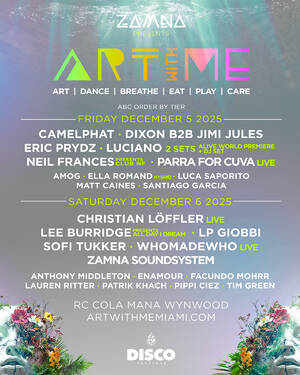
In 2025, III Points turned a large portion of the plant into an immersive graffiti gallery developed by dozens of artists and crews. December’s Art With Me combined electronic performances by Eric Prydz, Sofi Tukker, CamelPhat, WhoMadeWho, Luciano, and others with sculpture, fire performance, wellness sessions, food, and family-oriented daytime activities.
Miami Music Week 2026 brought a concentrated run of events: a daytime Bassrush program featuring Liquid Stranger, Jessica Audiffred, LAYZ, Sippy, and others; a hard-techno Teletech night; and late-night programs led by GORDO and Holy Priest. The plant also hosted the community-focused Horsepower for Heroes car show in April. As of August 23, 2026, the announced calendar included a September Andrew Music Club weekend, starting at $15, while III Points’ October accessibility plan again referenced an RC Cola stage. No confirmed 2027 RC Cola Plant program had been publicly posted.
General-admission prices vary widely. Recent examples have ranged from approximately $15 for smaller community-oriented programming to $58–$70 or more for Miami Music Week nights and roughly $100–$130 for a two-day immersive festival. VIP access, express entry, tables, and hospitality packages can cost considerably more. The plant is event-driven, so there is no standard admission price.
Tickets and Booking
Tickets are normally released by the event promoter rather than through a permanent RC Cola Plant box office. Buy through the official listing associated with the event, confirm that the location still says RC Cola Plant, and save the mobile ticket before arriving. Venue changes have occurred in the past, so rechecking the address, door time, age limit, and entry instructions shortly before departure is important.
Popular Miami Music Week, III Points, and Art Week programs often use escalating pricing tiers. Buying during the first release usually offers the lowest price, while final-release and door admission can be substantially higher or unavailable. Presales may precede general sales, and VIP areas are created differently for each production. Unless a listing expressly promises assigned seating, assume that a concert ticket provides standing-room access.
Seating, Capacity, and Layout
RC Cola Plant has no permanent auditorium seating or standard seating chart. Published specifications describe a total event footprint of approximately 137,977 square feet, including an 89,721-square-foot open yard and courtyard with a reported 7,000-person standing configuration, plus roughly 44,767 square feet of indoor industrial space with a 28-foot ceiling and a reported 5,000-person standing configuration. Full-site rental listings market configurations of up to approximately 12,000 standing or 11,000 seated. Actual permitted capacity depends on staging, exits, bars, art, and production equipment.
Most music events are general admission on flat concrete or paved ground. Temporary seating may appear at galas, private functions, daytime programs, and accessible viewing platforms, but concertgoers should expect to stand. VIP sections are commonly placed on raised decks or within controlled areas near a stage or bar, although their position changes with each organizer.
For a close, high-energy experience, arrive early and move toward the front before the headline crowd forms. The center-rear area generally provides a better view of full lighting and video production, more room to dance, and easier access to exits. At busy festival sets, avoid stopping in doorways and narrow transitions between the plant and adjoining Mana spaces; visitors have specifically reported crowd-flow pressure at these points.
Architecture and Technical Production
The plant is best understood as a production canvas rather than a fully equipped theater. Its architecture supplies the atmosphere—industrial walls, open roof sections, concrete floors, broad yards, graffiti, columns, and loading access—while promoters install the working stage, sound, lights, video, power distribution, barriers, furnishings, and concessions. No reliable current specification for a permanent RC Cola Plant house PA, lighting inventory, or installed rigging package has been published.
The structure has nevertheless supported major touring-grade systems. Steve Angello’s inaugural 2014 event used a 38-by-20-foot LED video wall. An Above & Beyond production used rotating RGBW LED battens, high-output fixtures, haze, video content, and outdoor truss positions. Earlier art and music programs have deployed line-array loudspeakers with supplementary downfills. These examples demonstrate the plant’s production potential, not equipment guaranteed at every event.
Getting There and Parking
The commonly published venue address is 550 NW 24th Street, Miami, FL 33127, near NW Fifth Avenue. The wider Mana Wynwood campus uses 318 NW 23rd Street. Entry gates can move between NW 23rd Street, NW 24th Street, NW Fifth Avenue, and other controlled festival approaches, so follow the gate printed on the event instructions rather than assuming the main campus entrance will be open.
Mana describes an adjacent private lot holding approximately 240 vehicles, while its broader event-parking information advertises more than 400 available spaces across campus configurations. Published daily charges generally range from $10 to $50, depending on the event and day. VIP and valet parking may be offered for selected functions. Parking is first come, first served unless the organizer sells a reserved option.
The free City of Miami Wynwood trolley runs Monday through Saturday, generally from 6:30 a.m. to 11 p.m., with no regular Sunday service. Its route travels through the Wynwood district, including NW Second Avenue. Metrobus Route 2 also serves NW Second Avenue, a few blocks east of the plant, connecting Wynwood with Downtown Miami. Late-night events frequently continue after trolley service ends, making rideshare, taxi, or a prearranged pickup necessary.
Culmer Metrorail station is the nearest commonly suggested rail connection, although it is not immediately beside the venue. MiamiCentral, served by intercity and regional trains, is roughly two miles south. From either station, a bus, short rideshare trip, or substantial walk completes the journey. Miami International Airport is approximately 7.1 miles from the Mana campus, but travel time can expand sharply during rush hour and major festival road closures.
Inside the Venue
Expect temporary security lanes, ticket scanning, ID checks, and bag inspection. Bars, food trucks, water points, merchandise stands, restrooms, first aid, and phone-charging services depend on the promoter’s site plan. The plant itself should not be assumed to have a permanent public restaurant, coat check, locker bank, or daily visitor facilities.
Miami heat and humidity remain noticeable after dark, while sudden rain can affect open sections. Wear supportive closed-toe shoes suitable for long periods on concrete, bring hearing protection, and keep possessions in a compact secure bag. Cellular service usually works, but data can slow when thousands of attendees are concentrated in the plant.
Accessibility and Venue Policies
The Mana campus provides ADA-compliant parking spaces, and major festivals build event-specific accessible entrances, service hubs, restrooms, and viewing platforms. III Points’ 2026 plan included an ADA entry lane, an accessibility services desk, seated viewing at the RC Cola stage, companion credentials, first aid, and admission for task-trained service animals. Because these facilities are installed by the organizer, their locations and procedures can differ at standalone events.
There is no universal plant-wide bag, camera, reentry, smoking, age, or weather policy. Recent electronic events have commonly been restricted to ages 18 or 21 and older, while Pride, art, wellness, and community programs may be all-ages. Large backpacks, weapons, outside alcohol, professional camera equipment, drones, and illegal substances are commonly prohibited. Bring government-issued photo identification whenever an event has an age restriction.
Nearby Amenities
Wynwood has abundant pre-event dining within a short walk. Doya, an Aegean restaurant and bar, is on NW 24th Street approximately two blocks east. Coyo Taco, Uchi, Pastis, Le Chick, and numerous breweries, coffee shops, cocktail bars, and counter-service restaurants are spread through the surrounding district. Reservations are sensible during Miami Music Week, Art Week, and III Points because neighborhood demand rises sharply.
Nearby lodging includes Sentral Wynwood and Arlo Wynwood, both approximately half a mile from the plant, with additional hotels in Midtown, Downtown, the Design District, and the medical district. Staying in Wynwood can eliminate post-show rideshare delays, although visitors should use well-traveled streets, remain aware of traffic, and confirm that their accommodation is genuinely within comfortable walking distance.
What Makes RC Cola Plant Special
Few Miami venues preserve the relationship between industrial abandonment, unauthorized graffiti, recognized public art, and large-scale nightlife as visibly as RC Cola Plant. Its murals were not simply added as decoration to a new building; they grew from the years when the empty factory served as an informal canvas. That history gives concerts and exhibitions a rawness that purpose-built event halls cannot easily reproduce.
The plant also reflects Wynwood’s complicated transformation. Graffiti and independent art helped attract visitors and investment, but commercialization, controlled access, rising property values, and development have generated concern about displacement and the loss of authentic creative space. RC Cola Plant embodies both sides: it protects a monumental collection of urban art while turning a once-unregulated location into a gated commercial venue.
No independent economic-impact figure isolates the plant from the wider campus. However, III Points alone brings approximately 50,000 people to Mana Wynwood over two days, generating substantial neighborhood foot traffic for hospitality, transport, vendors, artists, technicians, and security workers. The site’s cultural contribution is equally important: in 2025, its temporary graffiti gallery placed Miami artists and crews inside one of the city’s largest annual music gatherings.
Visitor Tips and Information
Arrive 45 to 90 minutes before the performance you most want to see, especially when parking or collecting credentials. Screenshot your ticket, agree on a meeting point, and inspect the event map before entering. Eat beforehand if food options have not been announced, carry only essential items, and never assume that an old online policy applies to a new promoter.
Visitors frequently praise the murals, immense scale, event crews, and unconventional atmosphere. Recurring complaints concern traffic, expensive parking, crowded transition areas, heat, and the fact that the plant is inaccessible when no public event is underway. Treat it as an operating venue rather than a walk-in museum: outside event hours, closed gates are normal.
Frequently Asked Questions
Is RC Cola Plant still open?
Yes. As of August 23, 2026, RC Cola Plant remains an active Mana Wynwood event venue. It hosted Miami Music Week and community programming earlier in 2026 and had additional fall programming announced. It is not a daily nightclub, museum, or tourist attraction, however. The gates may remain closed unless a ticketed event, private rental, production, or public activation is taking place.
What is the capacity of RC Cola Plant?
Capacity depends on the portion being used. Published specifications list approximately 7,000 standing in the open yard and 5,000 in the indoor industrial area. Full-footprint rental configurations are marketed for up to approximately 12,000 standing or 11,000 seated. The fire-permitted attendance may be lower after stages, exits, bars, installations, and production compounds are installed.
Is RC Cola Plant indoors or outdoors?
It is an indoor-outdoor industrial venue. Events can use open paved yards, courtyards, roofless or partially exposed areas, and the surviving warehouse structure. The exact balance changes with each production. Do not assume complete air conditioning or weather protection simply because an event is described as being “inside” the plant; some areas retain an open-air warehouse character.
Can I visit the murals without attending an event?
Usually not from inside the property. RC Cola Plant is privately controlled and normally secured when no event is operating. Some exterior art can be viewed from surrounding public streets, but entering through a closed gate or attempting to explore the warehouse is not permitted. Public festivals, exhibitions, mural programs, and art-focused events offer the best opportunities to experience the interior legally.
Does RC Cola Plant have assigned seats?
No permanent seats are installed. Most concerts and dance events use general-admission standing areas on flat concrete. Organizers may add temporary chairs, bleachers, tables, lounges, accessible viewing platforms, or raised VIP decks. If a ticket does not identify a numbered section and seat, expect standing room and arrive early if being close to the stage is important.
Where is the best place to stand for a concert?
The center-rear area often offers the clearest view of complete video and lighting production, more dancing space, and quicker access to concessions and exits. The front provides the most intense experience but becomes congested during headline sets. Avoid standing inside doorways or transition corridors, particularly when RC Cola forms one stage within a larger multi-venue festival.
How much do tickets usually cost?
Recent general-admission examples have ranged from about $15 for smaller programming to $58–$70 or more for major electronic nights. Two-day immersive festivals have started around $100–$130. Prices rise by release tier, while VIP, table, and hospitality packages can cost substantially more. RC Cola Plant does not have one standard ticket price because independent organizers set admission for each event.
Can tickets be purchased at the door?
Door sales are possible only when an organizer announces them and the event has not reached capacity. Popular Miami Music Week, Art Week, and III Points-related programs can sell out or enter expensive final tiers. Advance purchase is safer. If door tickets are offered, bring an accepted payment method, photo identification, and the exact event name because several Mana spaces may operate simultaneously.
How early should I arrive?
For a normal concert, arriving 45 to 60 minutes before the desired set allows time for traffic, parking, security, and walking across the site. Allow 60 to 90 minutes for sold-out festivals, Miami Music Week, or Art Week. Entry can take longer when age checks, wristband collection, bag searches, or multiple ticket categories create separate lines.
Is parking available at RC Cola Plant?
Yes, but supply depends on how much campus space the event itself occupies. Mana describes a 240-vehicle adjacent lot and more than 400 spaces across wider event configurations. Typical published rates range from approximately $10 to $50. Large festivals may use parking areas for stages or production, so early arrival, reserved parking when offered, or rideshare may be preferable.
What public transportation goes near the venue?
Metrobus Route 2 runs along NW Second Avenue, several blocks east. The free Wynwood trolley also circulates through the neighborhood Monday through Saturday, generally between 6:30 a.m. and 11 p.m. Culmer Metrorail station and MiamiCentral provide rail connections farther away, followed by a bus, rideshare trip, or walk. Sunday and late-night trolley coverage is limited.
Where should a rideshare driver drop me off?
Use the entrance stated in the event instructions. Depending on street closures, drivers may be directed toward NW 23rd Street, NW 24th Street, NW Fifth Avenue, or a designated festival zone. After large events, walking several blocks beyond the immediate crowd before requesting pickup can reduce delays. Stay on illuminated, active streets and never wait inside a traffic lane.
Is RC Cola Plant wheelchair accessible?
The venue is largely ground-level, and the Mana campus provides accessible parking. Major festivals add ADA entry lanes, accessible viewing areas, restrooms, service desks, and companion procedures. Because temporary stages, barriers, and routes differ, accessibility should be confirmed for the specific event. Concrete is generally easier than grass, although crowds and long travel distances across the footprint may require additional planning.
Are children allowed?
Age rules depend entirely on the event. Many Miami Music Week and late-night electronic programs are restricted to guests 18 or 21 and older. Art, Pride, automotive, wellness, and daytime community events may admit children or operate as all-ages programs. Check the ticket’s age statement before purchasing and bring government-issued identification whenever an age minimum applies.
What is the bag policy?
RC Cola Plant does not publish one permanent bag rule for every organizer. Small clear bags, compact clutches, and medically necessary bags are generally the safest choices. Large backpacks and oversized purses are commonly restricted. All bags may be searched. Do not rely on a policy from a previous festival, because size limits and permitted items can change between events.
Can I bring a professional camera?
Small personal cameras and phones may be allowed, but detachable lenses, tripods, monopods, large video rigs, drones, and commercial photography equipment normally require credentials or prior authorization. Art and brand events may apply different rules from concerts. Flash can interfere with performances and installations, so follow security and production instructions even when basic photography is permitted.
Are food and drinks sold inside?
Large public events usually install bars, water stations, food trucks, snack counters, or vendor villages, but the plant has no guaranteed daily concession operation. Selection, payment method, and dietary options vary by promoter. Outside alcohol is normally prohibited, and outside food may be restricted. Eat beforehand when concessions have not been announced, particularly before a long late-night program.
What should I wear to RC Cola Plant?
There is generally no formal dress code unless a private event specifies one. For concerts, prioritize closed-toe shoes, lightweight clothing, and items suitable for heat, humidity, concrete floors, and possible rain. Bring hearing protection and avoid clothing or footwear that is difficult to manage in dense crowds. Some electronic events continue for six hours or longer.
What happens if it rains?
Policies depend on the production and severity of the weather. Light rain may not stop an event because significant portions of RC Cola Plant are open-air or semi-covered. Lightning, strong winds, flooding, or unsafe production conditions can cause delays, evacuation, relocation, or cancellation. Ponchos are more practical than umbrellas, which are often restricted in crowded concert areas.