Important clarification: Hutt Park is not a conventional indoor concert venue. It is a large public sports and recreation reserve in Moera and Seaview, Lower Hutt, with grass fields, clubs, an indoor sports complex, a sports administration building, a golf course, walking areas and a holiday park. Large festivals can temporarily turn part of the reserve into a ticketed event site, but Hutt Park has no permanent auditorium, fixed concert seating or year-round entertainment calendar.
The information below reflects the venue and event activity confirmed up to 27 August 2026 . Hutt Park itself remains open and listed as an operating sportsground.
Events and Programming
Regular programming at Hutt Park is primarily sporting rather than theatrical. The reserve hosts football, junior and senior touch rugby, Australian rules football, cricket-related activity, rugby league, community training and school competitions. The regional sports-fields report identifies four senior football fields, two junior football fields, training areas, one Australian rules field, eight touch fields and four junior touch fields across the Hutt Park grounds.
Stop Out Sports Club is the best-known resident football organisation. Its home fixtures, junior tournaments and club events provide much of the park’s recurring activity. The annual Wynton Rufer Tournament is a notable example: the 2021 edition used Hutt Park for under-7 and under-8 football, while the 2025 tournament marked its 30th year and included mixed-age and girls-only divisions.
Hutt Park also hosts national and regional competitions. The 2026 New Zealand Gaelic Games Championships brought teams from around the country to the reserve over the weekend of 21–22 March. Junior touch competitions are scheduled for Hutt Park during the 2026 school-term calendar, including Friday-night schools-based matches in Term 4. These events show the site’s strongest present-day identity: a flexible outdoor competition ground rather than a programmed performing-arts venue.
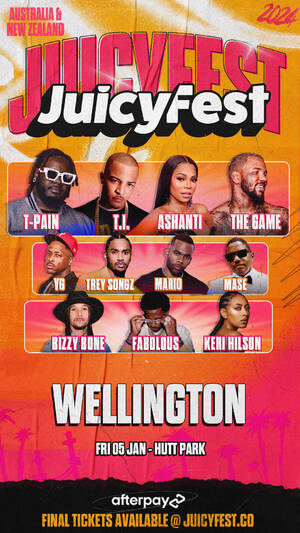
The most significant recent music booking was Juicy Fest Wellington on 5 January 2024. The open-air R&B and hip-hop festival featured artists including T-Pain, T.I., Ashanti, The Game, Trey Songz, Fabolous, Bone Thugs-N-Harmony, Keri Hilson, Mase and Mario. Organiser and media reports put attendance at roughly 15,000, making it considerably larger than the normal sports crowds Hutt Park accommodates.
A Wellington edition of Juicy Fest was planned for 10 January 2025, with a proposed noon-to-11pm event period and alcohol service under a special licence. The New Zealand leg was cancelled in December 2024, so the 2025 Hutt Park event did not proceed. No confirmed large-scale concert or festival at Hutt Park beyond 2026 was identified in the available public event information.
There is no evidence of a regular Hutt Park concert series, resident touring theatre programme or permanent dance calendar. For live entertainment, the site is most likely to be used for occasional one-day outdoor festivals, cultural gatherings or special community events that can operate on temporary infrastructure.
Tickets and Booking
There are no general admission tickets for entering Hutt Park as a public reserve. Walking, picnicking and watching ordinary community sport are generally separate from ticketed event operations. Tickets are issued only when an individual organiser creates a paid event, such as a festival, tournament or private attraction within the wider Hutt Park complex.
For a ticketed event, buy through the organiser’s official event information and ticketing channel. Hutt Park does not operate a permanent box office, and the council is not the ticket seller for privately promoted festivals. Sports tournaments may instead require team registration, club entry or sideline admission arrangements.
Pricing varies sharply by event. As examples, the 2021 Wynton Rufer Tournament listed a team entry fee of NZ$120, while the final-release general-admission price advertised for Juicy Fest 2024 was NZ$239 excluding fees. Those figures are not a Hutt Park tariff and should not be used to predict future event prices.
For popular outdoor festivals, early purchase is sensible because temporary events may sell several ticket classes, including general admission, VIP and higher-tier hospitality access. Check the event’s age rule, re-entry policy, alcohol conditions, weather arrangements and transport plan before paying. Those conditions belong to the promoter, not to Hutt Park as a reserve.
About Hutt Park
Hutt Park is a 34-hectare reserve precinct between the southern industrial area of Lower Hutt and Moera. It sits beside the Waiwhetū Stream, the Gracefield Branch railway line and Randwick Road. The council lists sports fields, a nine-hole public golf course, walking tracks, picnic areas, toilets, changing rooms, free parking, Stop Out Sports Club, Pelorus Trust Sports House, Hutt Indoor Sports and a holiday park among its facilities.
The site has no single published venue capacity because it is a collection of fields and buildings rather than one enclosed facility. Hutt Park 1 is commonly listed by football databases at approximately 1,000 spectators, but this is best treated as a ground-level sports estimate, not a certified concert capacity. The council has not published a single maximum capacity for the whole reserve or for a festival configuration.
Pelorus Trust Sports House is the principal purpose-built building in the precinct. It is a 1,440-square-metre sports administration and training facility designed to bring sporting organisations together. Its tenants have included national, regional and community sports bodies, making Hutt Park an important administrative hub as well as a playing venue.
Seating and Layout
Normal Hutt Park activity is played on open grass fields with no permanent grandstand seating. Spectators usually stand or sit on the perimeter, bring their own low chairs or use clubroom areas where available. The main football ground is the most likely place to find an organised spectator zone, but match-day layouts vary.
Large festivals use temporary fencing, stages, front-of-stage zones, food areas, bars, portable toilets, security lanes and production compounds. General admission, VIP and VVIP areas are created by the promoter for that particular event. They are not permanent Hutt Park features. Juicy Fest’s 2024 setup used a single main stage, with different ticket classes providing access to different parts of the temporary event footprint.
The reserve is relatively open and level compared with many Wellington outdoor sites, but grass can become soft after rain. For sport, the best viewing position is usually along the halfway line or near the clubroom side of the principal field. For a festival, sightlines, sound coverage and sheltered areas depend entirely on the temporary site plan. There are no permanent acoustic zones or fixed “best seats”.
People seeking quiet viewing should avoid standing immediately beside loudspeaker arrays, generator compounds, entry queues or bar areas. Families and visitors with mobility needs should check the event-specific site map because temporary fencing and vehicles can change the most direct route across the grass.
Architecture, Design and Technical Facilities
Hutt Park’s character comes from its landscape and layered use rather than from a single landmark building. The reserve combines broad playing fields, mature planting, the Waiwhetū Stream, sports club facilities, a golf course and an industrial-edge setting. The absence of a permanent arena is part of the site’s appeal for occasional large outdoor events, but it also means that nearly every concert facility must be brought in temporarily.
Pelorus Trust Sports House was designed by Nigel Dong of Designgroup Stapleton Architecture. Its design uses glass, profiled steel and rendered plaster, with a central reception, café, meeting and multipurpose area separating open-plan office zones. The architecture was intended to act as an anchor for the former raceway site and to encourage shared resources among sporting organisations.
The Sports House has two meeting rooms measuring approximately 5.5 by 8 metres each, a combined meeting area of about 92 square metres, a boardroom of approximately 19 square metres and a café or breakout area of roughly 145 square metres. A commercial kitchen is available for approved building hires. The building is not a concert hall, and its listed equipment is oriented towards meetings, presentations and community functions rather than touring productions.
No permanent concert sound system, theatrical lighting rig, fly tower, stage, orchestra pit or installed festival infrastructure has been published for Hutt Park. Temporary productions supply their own PA, monitors, lighting, staging, generators, barriers and communications systems. Production information for Juicy Fest confirms separate front-of-house and monitor audio roles, but does not establish a permanent Hutt Park technical specification.
History and Cultural Significance
Hutt Park has no simple “opening day” because it began as a historic landscape and racecourse area before becoming the modern sports reserve. Racing in the Wellington district took place at Hutt Park by the 1840s, and the area was proclaimed a racecourse reserve in 1854. A major two-day meeting was held there in 1867, a Wellington Cup meeting in 1868 and a gathering attended by about 5,000 people in 1873.
The site remained associated with racing into the twentieth century. Transport difficulties contributed to the establishment of Trentham as the Wellington Racing Club’s principal course in the early 1900s. Hutt Park nevertheless continued to be used for trotting and other racing activity, including Wellington-area harness meetings. Special race trains once served the course, linking the venue with Wellington and the Hutt Valley railway network.
During the Second World War, Hutt Park was used by the military and race meetings were transferred elsewhere between 1942 and 1946. Later historic moments included a Royal meeting attended by Queen Elizabeth II and Prince Philip on 11 February 1963, and a celebrated Cardigan Bay time trial at Hutt Park later that year.
The raceway’s final years are described slightly differently in available sources. One racing history records the Wellington Trotting Club’s final Hutt Park meeting on 3 February 2000, while redevelopment accounts describe the harness-racing raceway as having folded in 2002. The practical outcome is clear: the racecourse closed around the turn of the millennium and the land was progressively converted into a modern sports precinct.
Hutt Park also carries Māori cultural significance. Hutt City Council identifies the area around the Sports House as the historic battleground of Pū-harakeke-tapu. That history is increasingly relevant to how the surrounding Moera and Hutt Park area is interpreted and developed.
Getting There and Parking
Hutt Park’s main sportsground access is listed from Seaview Road, Seaview, Lower Hutt. Different facilities within the precinct use Hutt Park Road addresses, including Sports House, the indoor attractions and the holiday park. If an event ticket gives a specific gate or entrance, follow that instruction rather than relying only on “Hutt Park” in a navigation app.
Free parking is available within the wider Hutt Park complex, although ordinary spaces can fill quickly during weekend sport and major events. For large festivals, parking may be managed separately, moved to temporary areas or restricted by traffic plans. Juicy Fest traffic arrangements included closures or restrictions affecting Seaview Road, Parkside Road, Hutt Park Road and Gracefield Road, with delays reported as crowds left.
The nearest useful bus stop is Hutt Park–Seaview Road. Current route information shows services including routes 81, 83 and 84 serving the stop, with other local services operating nearby. These connect the Seaview and Gracefield area with Petone, Lower Hutt and Wellington. Timetables and stop patterns can change, particularly for evening events.
There is no current passenger railway station inside the park. Rail passengers normally change at Petone, Ava or another suitable Hutt Valley station and continue by bus, taxi or rideshare. Walking from a station is possible for confident pedestrians but is not the most convenient option when carrying equipment, travelling at night or attending a crowded festival.
Rideshare and taxi drop-off arrangements are event-specific. During a major festival, do not assume a driver can reach the normal sports-club entrance. Temporary road closures may create a designated drop-off zone away from the gates, and post-event pick-ups can be delayed by pedestrian controls.
Inside the Venue
There is no single indoor arrival experience. A normal football or touch match may involve an open gate, clubroom facilities and field-side viewing. A large festival may involve bag checks, security screening, ticket scanning, temporary fencing, portable toilets, food trucks, bars, merchandise stalls and a no-re-entry rule.
The council lists toilets and changing rooms within the park, but the quantity and location available to the public depend on the activity taking place. Festival organisers generally add portable facilities when attendance exceeds normal sportsground use. Do not rely on every permanent sports facility being open during a separately promoted event.
Food and drink vary by booking. Indoor attractions in the precinct have café facilities, sports clubs may operate a bar or kiosk during matches, and festivals can bring in food vendors and licensed bars. Alcohol cannot simply be sold at an unlicensed public event; a special licence may be required, and the licence conditions apply to ticket holders and service areas.
There is no publicly advertised sitewide coat check, merchandise service, permanent concert Wi-Fi or permanent festival charging area. Bring only what the event rules permit, keep valuables to a minimum and download or save essential ticket information before arrival.
Nearby Amenities
The immediate surroundings are a mix of sports, light industrial and visitor-accommodation uses rather than a dense restaurant district. The Hutt Park holiday park provides cabins, powered and non-powered camping sites, communal kitchens, BBQ areas, showers, laundry facilities and family recreation areas. It is the most convenient overnight option within the precinct, subject to availability.
For a proper pre-event meal, visitors generally have more choice in Petone, Seaview and Lower Hutt’s central areas than immediately beside the fields. Allow extra time for the return journey because evening sport and major festivals can make the access roads busy. A nearby sports club, café or hotel may be convenient for a quick drink, but opening hours should be checked on the day.
For a festival finishing late, pre-arrange a ride or confirm the last suitable bus. Public transport is more useful before and during ordinary daytime activity than immediately after a large concert, when demand can exceed available services.
Accessibility and Inclusive Facilities
Pelorus Trust Sports House is described as wheelchair accessible and has fully accessible toilet facilities. The wider park has toilets, changing rooms and free parking, but no comprehensive public accessibility audit covering every field, pathway, temporary event entrance or viewing area has been published.
Because Hutt Park is mainly grass, accessibility can change with weather and event construction. Temporary stages, cable ramps, fencing and vehicle movements may create uneven surfaces. Visitors who need step-free access, accessible parking, a mobility viewing area or an accessible toilet should confirm those arrangements with the individual event organiser before attending.
New Zealand does not use the United States ADA framework as its standard venue label. The practical question is whether the particular event provides an accessible route, suitable toilets, seating or standing space, companion access and an appropriate drop-off point. Those details are not automatically guaranteed by the park’s general public access.
Venue Policies and Visitor Tips
Hutt City Council states that Lower Hutt parks and reserves are smoke-free, including vaping restrictions. Alcohol controls also apply across designated public areas in Seaview, Gracefield and Moera. Selling or supplying alcohol at a public festival normally requires a special licence, and event organisers must follow its conditions.
Park or sportsground bookings should be requested at least four weeks before a casual one-off event and at least eight weeks before a seasonal booking. Larger events may also require resource consent, temporary traffic management, road-closure approval, food licensing, building approval for temporary structures and event-specific safety plans.
There is no universal Hutt Park bag policy, dress code, photography rule or age restriction. Those rules belong to the match organiser, club, indoor attraction or festival promoter. For outdoor events, wear weather-appropriate layers and footwear that can handle grass. Do not assume umbrellas, large chairs, outside food, alcohol, professional cameras or re-entry will be allowed.
Arrive early for any event advertised as a large festival. The park is spacious, but access roads are not designed for every visitor arriving at once. Build in time for parking, walking from the vehicle, security screening and finding the correct temporary entrance.
What Makes Hutt Park Special
Hutt Park’s distinction is its transformation from an historic racecourse into a broad community sports landscape. It combines local club sport, national competition, sporting administration, family recreation, accommodation and occasional high-capacity outdoor entertainment in one precinct.
For athletes, its value lies in the number of fields and the ability to host multi-team tournaments. For promoters, the open reserve offers the space needed for a temporary stage and large crowd. For visitors, the experience is less polished than a purpose-built arena but more spacious, informal and connected to Lower Hutt’s sporting identity.
The site’s limitations are equally important. There is no fixed concert seating, no permanent production system, no standard event capacity and no dependable all-weather festival infrastructure. Hutt Park works best when visitors understand that they are attending an event temporarily built inside a working public reserve.
Economic and Cultural Impact
Hutt City Council views investment in Hutt Park and other sportsgrounds as a way to support participation, attract national tournaments and generate spending for local retailers, accommodation providers and hospitality businesses. In March 2026, the council reported that completed field upgrades at Hutt Park formed part of a wider sports-field investment intended to improve drainage, reduce weather closures and support larger events.
Large festivals can bring significant visitor numbers but also place pressure on traffic, toilets, policing, waste management and nearby businesses. The 2024 Juicy Fest demonstrated both sides: a substantial crowd and major international programme, alongside reports of disorder outside the venue and congestion after the event. That experience contributed to tighter attention on licensing, transport and event management for the proposed 2025 edition.
No independently verified public figure was found for Hutt Park’s annual economic contribution, total event spend or local employment impact. The clearest cultural contribution is the reserve’s role as an accessible base for club sport, multicultural participation, youth tournaments and national competitions.
Frequently Asked Questions
Is Hutt Park an indoor concert venue?
No. Hutt Park is primarily a public sports and recreation reserve. It has grass fields, clubrooms, an indoor sports complex and Sports House facilities, but no permanent concert auditorium. Large music festivals can be staged there using temporary fencing, stages, sound systems, lighting, bars and portable toilets. Treat each concert as a temporary event rather than a standard venue booking.
What events are held at Hutt Park?
Most activity is football, touch rugby, school sport, Australian rules football, cricket-related use, training and tournaments. The Wynton Rufer junior football tournament is a recurring fixture, and Hutt Park hosted the 2026 New Zealand Gaelic Games Championships. The most prominent recent concert-style booking was Juicy Fest Wellington in January 2024.
Are there any confirmed Hutt Park concerts for 2026?
No major 2026 concert or music festival at Hutt Park was confirmed in the public information reviewed through 27 August 2026. The confirmed 2026 programme is predominantly sporting, including Gaelic championships and touch competitions. Event listings can change, so a future promoter could announce a temporary festival later, but no confirmed 2027 or beyond headline music booking was identified.
Did Juicy Fest 2025 happen at Hutt Park?
No. Juicy Fest Wellington was planned for 10 January 2025 and council documents recorded proposed event and alcohol-licence arrangements. However, the organiser cancelled the New Zealand leg in December 2024. The cancellation applied to the New Zealand events, so there was no 2025 Hutt Park performance under that plan.
What was the biggest recent concert at Hutt Park?
Juicy Fest Wellington on 5 January 2024 was the largest clearly documented recent concert-style event. It presented a full day of international R&B and hip-hop artists and attracted a reported crowd of about 15,000. That scale was unusual for Hutt Park, which normally operates as a sports reserve with much smaller match-day audiences.
Does Hutt Park have fixed seating?
No. Ordinary visitors watch from field edges, clubroom areas or temporary spectator zones. Major festivals may create general-admission standing areas, VIP platforms or temporary hospitality sections, but those are installed for the individual event. A ticket marked VIP does not refer to a permanent Hutt Park seating section; it refers to that promoter’s temporary layout.
What is the capacity of Hutt Park?
There is no single official capacity for the entire 34-hectare reserve. A football database lists Hutt Park 1 at approximately 1,000 spectators, but that is not a certified festival figure. Concert capacity depends on the fenced footprint, stage position, emergency exits, traffic plan, licences and temporary facilities approved for that specific event.
What is the address of Hutt Park?
The main sportsground entrance is identified from Seaview Road in Seaview, Lower Hutt. Facilities within the precinct use different Hutt Park Road addresses, including Sports House, indoor recreation businesses, the golf course and the holiday park. Use the exact gate or facility address printed on your event information because “Hutt Park” covers a broad area.
Is parking free at Hutt Park?
Yes, the council lists free parking as one of Hutt Park’s facilities. Spaces are shared by sports clubs, indoor attractions, golfers, holiday-park guests and visitors, so availability can be tight during weekend tournaments. Major festivals may introduce temporary parking controls, traffic marshals or road closures. Never assume normal parking arrangements will operate during a high-attendance event.
Which bus goes to Hutt Park?
The Hutt Park–Seaview Road stop is the most useful public-transport stop for the precinct. Current route information shows services including routes 81, 83 and 84, with additional local services nearby. The best route depends on your starting point and event time. Check the live timetable before travelling, especially for late-night returns or temporary festival detours.
Can I take the train directly to Hutt Park?
No current passenger railway station is located inside the reserve. Rail users generally connect through Petone, Ava or another suitable Hutt Valley station, then continue by bus, taxi or rideshare. Walking from the station may be practical in daylight for some visitors, but it is less convenient after a long outdoor event or when temporary road closures affect the route.
Does Hutt Park have food and drinks?
Food and drink depend on the facility or event. The wider precinct includes indoor-activity cafés, sports-club facilities and a holiday park with communal cooking areas. Major festivals may add food vendors and licensed bars. There is no permanent Hutt Park-wide hospitality operation, so bring payment options and check whether outside food, refillable bottles or alcohol are allowed for your particular booking.
Are there toilets at Hutt Park?
Yes. The council lists toilets and changing rooms among the reserve facilities. Their availability and location vary by field, club and event. Large festivals normally supplement permanent facilities with portable toilets, accessible units and hand-washing stations. If you need an accessible toilet or a nearby facility, confirm the event map rather than assuming every park building will be open.
Is Hutt Park wheelchair accessible?
Pelorus Trust Sports House is described as wheelchair accessible and has fully accessible toilets. The wider reserve is mostly grass, and the council has not published a complete access audit for every field or temporary festival layout. Wet weather, temporary fencing and cables can affect movement. Ask the event organiser about accessible parking, drop-off, routes, viewing areas and toilets.
Can I bring a chair to Hutt Park?
For ordinary sport, a small low chair may be useful because fixed spectator seating is limited. For concerts and festivals, chair rules are promoter-specific. Some events prohibit chairs in standing zones or allow only small folding seats in designated areas. Check the conditions before arrival, and remember that a chair may be difficult to carry across wet grass or through security.
Does Hutt Park have a permanent sound system?
No permanent concert sound system has been published. Normal sports use may involve club microphones or small speakers, while festivals bring in their own front-of-house audio, monitor systems, speakers, lighting, staging and power. Sound coverage therefore depends on the temporary production design. For quieter listening, avoid standing directly beside speaker arrays or generator compounds.
What should I wear to an outdoor event at Hutt Park?
Wear layers and shoes suitable for grass. Wellington weather can change quickly, and the reserve offers limited permanent shelter for large crowds. Waterproof footwear is sensible after rain, while sun protection is important during summer festivals. Avoid assuming a city-night-out dress code will be comfortable: outdoor queues, uneven ground and wind can make practical clothing a better choice.
Can I smoke or vape at Hutt Park?
No. Hutt City Council states that Lower Hutt parks and reserves are completely smoke-free, including vaping. Event organisers may also create additional no-smoking areas around stages, queues, children’s zones, food service and temporary structures. Visitors should not rely on a smoking section unless the event specifically provides one under its approved management plan.
Can I buy alcohol at Hutt Park events?
Only when the event has the required licence and the organiser provides a licensed service area. Alcohol cannot automatically be sold because an event is ticketed or held in a public reserve. Age checks, intoxication controls, service cut-off times and restricted areas may apply. Bringing your own alcohol is also subject to public-place rules and the individual event’s entry conditions.
How early should I arrive at Hutt Park?
For ordinary sport, arriving 20 to 30 minutes early is usually enough to park and find the field. For a major festival, allow at least one to two hours before the first act if you need parking, ticket scanning, security screening or accessibility assistance. Leave extra time for traffic near Seaview Road and for a potentially long walk from temporary parking.