Introduction
Food festival success relies not only on great cuisine and big crowds, but also on strong partnerships with vendors. When dozens or even hundreds of food stalls, trucks, and caterers come together, clear agreements are the backbone of smooth operations. A well-crafted vendor agreement sets expectations for service speed, operating hours, and compliance with rules. It provides legal safeguards (like indemnities and insurance requirements) and defines remedies if things go wrong. Perhaps most importantly, it helps festival organizers maintain high standards without souring relationships with the very vendors who make the event possible. Real-world experience shows why this matters: nobody wants an “all-you-can-eat” festival that runs out of food or chaotic booths closing early. In this guide, an expert festival producer shares how to craft vendor agreements and SLA clauses that keep your food festival running like a well-oiled machine while keeping vendors happy to return year after year.
Why Vendor Agreements Are Essential for Food Festivals
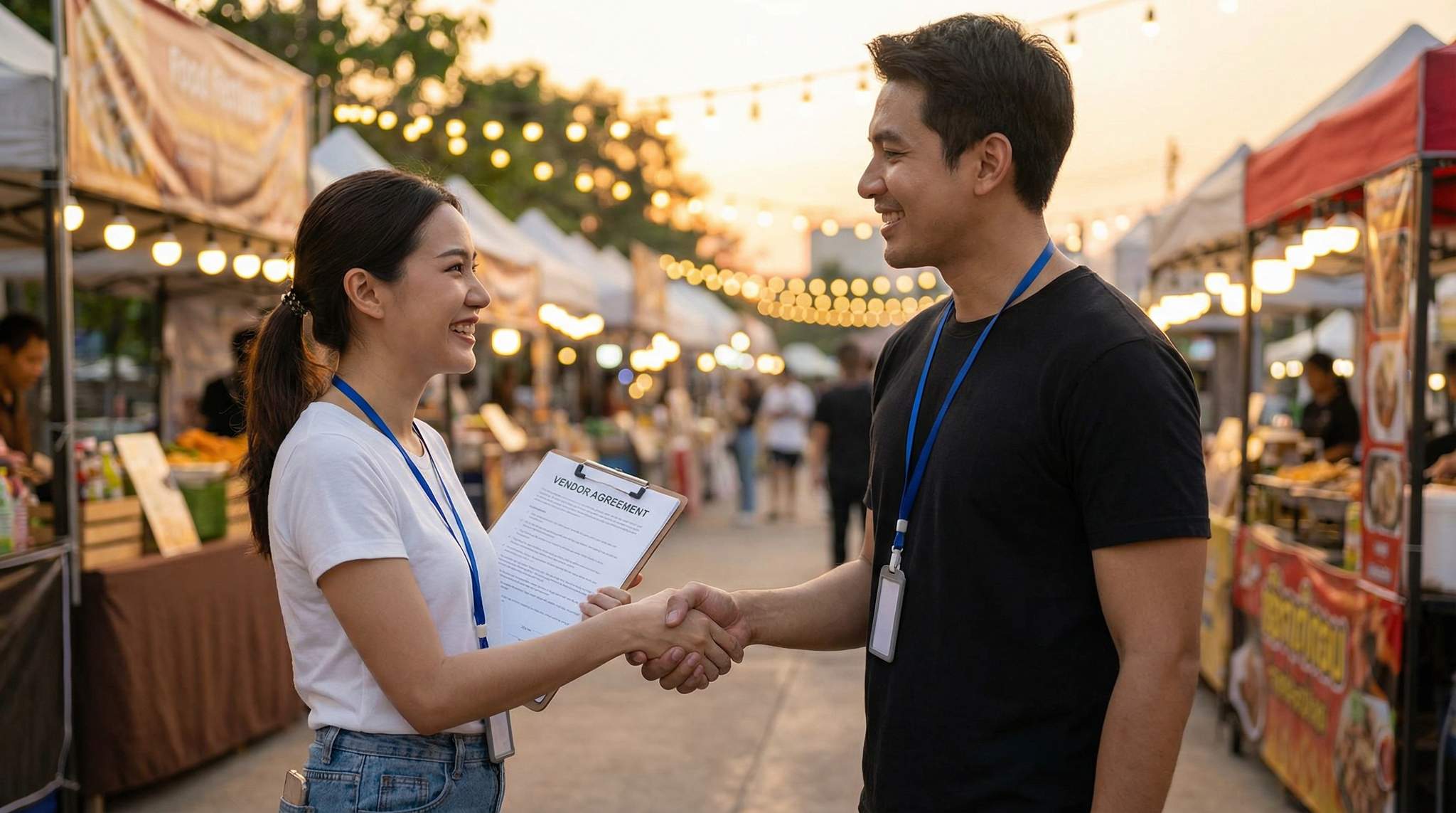
A festival vendor agreement is more than paperwork – it’s a mutual understanding that protects both the event and the vendor. For the festival, a written contract ensures every vendor knows their responsibilities, from serving guests promptly to following health regulations. For vendors, it clarifies what support or provisions the organizer will provide (like power, water, or an exclusive selling zone) and how and when they’ll get paid or be charged fees. Without clear terms, misunderstandings can easily arise – and at a festival, small issues can snowball fast.
Consider the cautionary tales of events that lacked adequate vendor oversight. In one notorious case, a pizza festival in London promised unlimited slices but failed to deliver when a key oven broke down and vendors ran out of stock, leaving throngs of hungry ticket-holders furious, as detailed in this report on food festival disasters. At another event, organizers expected 2,000 servings but got swarmed by 7,000 attendees, overwhelming vendors who hadn’t been prepared for that scale, highlighting the risks of poor planning. These debacles underline the importance of setting realistic expectations and having terms in place for capacity, backup plans, and remedies if vendors can’t keep up. A solid vendor agreement can specify those expectations, so each food stall is ready to serve the crowd and knows what happens if they fall short.
On the flip side, when agreements are done right, festivals thrive. Many veteran food festivals (from regional street fairs in India and Mexico to large international events in Singapore or Australia) have honed their vendor contracts over the years. They include clauses that anticipate common issues – and because vendors understand the rules, everyone works in unison. The result is shorter lines, happier attendees, and return invitations for vendors. In short, vendor agreements are the playbook that keeps your event fair, safe, and enjoyable for all.
Turn Fans Into Your Marketing Team
Ticket Fairy's built-in referral rewards system incentivizes attendees to share your event, delivering 15-25% sales boosts and 30x ROI vs paid ads.
To streamline this entire process, organizers should utilize standardized vendor forms for events right from the application stage. Collecting accurate details early—such as power requirements, menu specifics, and spatial footprints—makes drafting the final agreement much easier. This is particularly crucial when putting together a food truck contract for an event. Unlike standard pop-up tent setups, mobile kitchens require specific logistical clauses covering vehicle arrival windows, exhaust ventilation, and precise parking dimensions to ensure they fit safely within the festival layout.
Beyond the initial application, a complete suite of vendor paperwork should include specialized intake documents. Standardizing these templates—such as electrical request sheets, fire safety checklists, and health permit upload portals—ensures no logistical detail slips through the cracks. When festival producers digitize this intake process, it creates a seamless transition from the first inquiry to the final, legally binding agreement, saving countless hours of administrative back-and-forth.
Planning a Festival?
Ticket Fairy's festival ticketing platform handles multi-day passes, RFID wristbands, and complex festival operations.
Setting Clear Expectations: Service Speed, Hours, and Compliance
Service speed, operating hours, and rule compliance are three critical areas to nail down with vendors. Start by defining the basics in your contracts and vendor handbook:
- Operating Hours: Lock in the hours during which vendors must operate. For a food festival, consistency is key – attendees expect all stalls to be open during advertised festival hours (whether it’s a weekend market from 10 AM to 7 PM, or an evening foodie bazaar). State clearly that vendors must be ready to serve at opening time and not shut down before closing time. Many festivals include a “no early takedown” rule: for instance, “All vendors are required to remain open and staffed until the festival closes each day; early closure without permission may result in a penalty or forfeiture of fees.” This ensures a full experience for attendees. It’s wise to build in a small cushion (e.g., vendors should arrive for setup well in advance and have last call slightly before official closing) to ensure smooth opening/closing transitions.
- Service Speed & Quality: While you can’t micromanage exactly how fast a vendor serves each meal, you can set expectations for adequate staffing and preparedness. Encourage or require vendors to have enough staff during peak times to keep lines moving. In the agreement or vendor guidelines, you might note expected service standards such as “Vendors should be capable of serving approximately X customers per hour” (based on your crowd estimates) or “prepare portions in advance during off-peak times to avoid excessive queues.” Emphasize that long, stagnant lines reflect poorly on the festival, so vendors should strive for efficient service. Some festivals even implement an informal Service Level Agreement (SLA): for example, if a booth’s wait time consistently exceeds, say, 15-20 minutes, the festival may step in to assist (by providing volunteer runners, additional temporary staff, or operational advice) – this cooperative approach keeps the focus on customer experience rather than punishment.
- Menu and Inventory Expectations: To prevent disappointments, require vendors to plan sufficient inventory for the event’s duration. The contract can stipulate that vendors must notify organizers immediately if they are running dangerously low on product or facing an equipment breakdown. This gives the festival a chance to react – perhaps by redistributing supplies between vendors, having a standby vendor ready, or informing attendees proactively. It’s also common to approve each vendor’s menu in advance (often as part of the application) to avoid unnecessary duplication and ensure variety. Once approved, the agreement should limit changes: “Only the menu items submitted and approved may be sold, and any substitutions require organizer permission.” This way, a vendor can’t suddenly switch to a different product that might undermine another vendor or violate sponsorship exclusivities (e.g., selling a soda if the festival has a deal with a particular beverage brand).
- Compliance with Health & Safety: Food festivals are subject to strict health regulations, and every vendor must comply – not only for legal reasons but to protect attendees. Vendor agreements should outline that vendors are responsible for meeting all local health department requirements: possessing valid food handling permits, using proper temperature control, maintaining a clean prep area, and so on. In many jurisdictions, organizers are expected to verify vendor compliance. For example, festivals in the United States and Canada typically require vendors to have a current health certificate or food permit displayed. In the UK, vendors might need a food hygiene rating and gas/electrical safety certificates if applicable. Make it clear that vendors must pass any on-site inspections; the agreement can state “Any vendor found in violation of health codes or festival safety rules may be temporarily shut down until issues are resolved, and repeated or egregious violations can result in expulsion from the event.” Importantly, set these rules in a collaborative tone: remind vendors that these standards protect everyone. Consider providing a checklist of common health/safety requirements along with the contract so vendors can self-audit before arriving (e.g., sanitizer availability, proper food storage, fire extinguisher on hand if using open flame, etc.).
- Other Festival Rules: Every festival has its own additional policies – whether it’s sustainability (e.g., use of biodegradable serving ware), noise control, or uniform booth appearance. Include these in the agreement so vendors acknowledge them. For instance: if your food festival in New Zealand has a zero-waste goal, require vendors to only use compostable containers and participate in recycling programs. If an event in Singapore mandates no single-use plastics by government directive, ensure that’s written in. These compliance clauses keep all vendors on the same page and uphold the festival’s brand values and legal obligations.
By spelling out hours, service, and compliance expectations in writing, you set a professional tone from the start. Vendors know what’s required to participate, and you have the groundwork to enforce standards fairly across the board. Clarity here prevents resentment later – a vendor can’t claim they “didn’t know” they weren’t supposed to shut their booth during a lull or that they needed a certain permit. Everything is agreed upon upfront, which is better for everyone.
Incorporating SLA Clauses to Maintain Service Levels
In corporate settings, a Service Level Agreement (SLA) defines specific performance metrics and remedies. For festivals, you can borrow this concept to ensure vendors maintain a high level of service. While you might not set extremely granular metrics (like exact transaction times), your vendor contract can include measurable commitments and procedures for lapses. Here’s how to integrate SLA-like clauses:
- Define Key Service Metrics: Identify what service aspects most impact attendee experience. Common ones include wait times, food availability, and operating uptime. For example, you might state: “Vendor agrees to have their food service operational for 100% of the festival’s public hours (aside from short breaks as permitted for safety/hygiene) and to avoid stockouts of main menu items before [specified time].” If a vendor knows they must stay open the whole time and not run out of food by 2pm, they’ll plan inventory accordingly (or inform you in advance so you can manage expectations). You can also address speed indirectly: “Vendor will have a minimum of 2 staff serving at all times” or “food will be prepared to order in a timely manner to keep queues moving.” The goal is to document the festival’s expectation of good service.
- Set Communication & Response Protocols: An SLA clause can require vendors to communicate issues promptly. For instance: “Vendor shall immediately notify the festival management if they experience any disruption (equipment failure, supply shortage, staff issues) that could impact service for more than 10 minutes.” In turn, outline what the festival will do: “The festival will endeavor to assist in resolving the issue or reassigning the vendor’s customers, as appropriate.” By having this two-way commitment, you encourage transparency. A vendor who’s oven just went down shouldn’t hide it – they should tell you so maybe you can move a spare oven into place or shift some crowd to other vendors with a quick announcement. Quick communication prevents a small problem from becoming a headline-making disaster.
- Remedies for Service Failures: This is where alignment with “remedies and holdbacks” comes in. While you want to avoid adversarial penalties, you do need consequences if a vendor seriously underperforms or breaks rules. The contract might include a sliding scale of remedies: for minor breaches, a warning and chance to rectify; for major breaches, financial penalties or ejection. For example: “If a vendor fails to open on time or suspends service during festival hours without approval, the festival may deduct [$X] from the vendor’s fee or retain [Y]% of the security deposit as liquidated damages.” Another remedy could be losing a spot in next year’s event (this isn’t financial, but the prospect of not being invited back can be powerful). Importantly, tie any penalties to specific failures so it feels fair – e.g., leaving early = forfeit deposit, not meeting hygiene standards = immediate closure by authorities (no refund), no-show on event day = no refund of booth fee and maybe an additional charge if you had to scramble for a replacement. Always include a clause reserving the right to remove a vendor in severe cases (like if they become a health hazard or violate safety rules) – this is a last resort, but you need that authority in writing.
- Grace Periods & Cure Clauses: To keep relationships intact, consider “cure” clauses for fixable issues. Just like some contracts give a party time to remedy a breach, your vendor agreement can say: “If a vendor is found in violation of a festival rule (e.g., unsafe food temps, improper trash handling), they will be given a notice and a reasonable opportunity (e.g., 1 hour) to correct the issue before further action is taken.” This approach, often used by experienced festival organizers, shows good faith. It turns enforcement into collaboration: the vendor has a chance to fix the problem (thus meeting the SLA after all), and you avoid having to pull the plug unless absolutely necessary. Only when problems persist or are not corrected do stronger remedies kick in. Vendors appreciate this flexibility because it treats them like partners rather than adversaries.
- Environmental and Regulatory Compliance Warranties: A robust service level agreement doesn’t just ensure attendees get fed; it shields the organizer’s business entity. You might wonder, can a vendor SLA protect my bank from regulatory fines? Yes, by explicitly transferring liability. When evaluating SLA options, include strict cooking oil compliance and waste disposal mandates where vendors warrant they will follow local environmental laws. If a caterer illegally dumps grease into a storm drain, a well-drafted SLA and indemnity clause ensures the resulting municipal fines fall on the responsible party, protecting your festival’s financial accounts and bottom line.
By weaving these SLA-style elements into your agreements, you create a structured way to maintain quality. It’s clear what “success” looks like for vendor performance, and there’s a game plan if standards slip. Just be sure any metrics you set are realistic – consult with veteran vendors about what they can deliver, especially if you’re a new festival. An overly strict SLA that no small business can meet will either scare off vendors or set everyone up for failure. Find the balance that ensures great service but is attainable with proper effort.
Data-Driven Event Marketing
Track ticket sales, demographics, marketing ROI, and social reach in real time. Exportable reports give you the insights to make smarter decisions.
Indemnities and Insurance: Protecting Your Festival (and Vendors)
No festival organizer wants to think about worst-case scenarios, but part of being a responsible producer is planning for them. Indemnity clauses and insurance requirements in vendor agreements are critical for risk management. They ensure that if something goes awry — an attendee gets food poisoning, a propane tank at a vendor’s booth causes a fire, or a customer slips in front of a stall — the financial and legal fallout doesn’t all land on the festival’s shoulders (or at the very least, that the responsible party is held accountable).
Indemnity Clauses: An indemnity (or hold-harmless) clause is the vendor’s promise to indemnify and defend the festival against certain claims. In plain terms, the vendor agrees to reimburse and shield the festival for any lawsuits, damages, or losses that result from the vendor’s own actions or products. For example, if a visitor gets sick from a vendor’s food and sues the festival, a good indemnity clause forces the vendor to cover the festival’s costs (like legal fees or settlements) arising from that situation. These clauses may sound tough, but they are standard. They typically exclude the festival’s own negligence (so a vendor isn’t covering the festival’s mistakes, only their own). The contract might say something like: “Vendor shall indemnify, defend, and hold harmless the Organizer, its officers, employees, and agents from any claims, liabilities, damages, or expenses arising out of Vendor’s participation in the festival, except to the extent caused by Organizer’s sole negligence.” This wording means if the vendor is at fault (directly or indirectly), they’ll protect the organizer. It’s a crucial shield that every large festival from the USA to Europe insists on.
Need Festival Funding?
Get the capital you need to book headliners, secure venues, and scale your festival production.
Vendors may not love this clause — after all, it’s a serious responsibility — but it goes hand-in-hand with the requirement that they carry insurance. Insurance Requirements transfer much of that risk to an insurance company. Your vendor agreement should require each vendor to have a General Liability insurance policy (and more specialized policies in certain cases) with sufficient coverage limits. A common requirement in places like the United States, Canada, or Australia is at least $1 million per occurrence in liability coverage (sometimes $2 million or more for bigger events). In fact, some festivals in Canada mandate proof of a CAD $2,000,000 liability policy from every food vendor, as seen in standard festival regulations. The agreement should also ask that the festival/event organizer be named as an Additional Insured on the vendor’s policy for the dates of the event. This gives the festival direct rights under that policy if a claim occurs, providing an extra layer of protection. Don’t forget to set a deadline for proof of insurance (certificates should be submitted before the event, often 1-2 weeks in advance) and to verify the documents.
Other insurance aspects to consider:
* If alcohol is being served by vendors (e.g., craft beer tents or wine sellers at a food & wine festival), require Liquor Liability coverage or ensure their general liability covers it. Also check that they have the proper liquor licenses – and note in the contract that vendors are solely responsible for following alcohol service laws (like checking IDs for age, not overserving, etc.) to further protect the festival from legal trouble.
* If the festival is providing any equipment for vendors (tents, generators, etc.), clarify who is responsible for any damage. Often, vendor insurance can cover damage they cause to rented equipment. Conversely, if a vendor brings heavy equipment (like a food truck or trailer), ensure they carry insurance for their property and any accidents involving it (auto liability if it’s a vehicle, for instance). The vendor agreement can specify that the vendor bears all risk for their own property and must secure it; the festival isn’t liable for theft or damage.
* Workers’ compensation: If required by law (varies by country), vendors should have workers’ comp or employer’s liability insurance for their staff. While the festival might not police this, a clause in your agreement can state that vendors are responsible for their own employees and will hold the festival harmless from any worker injury claims.
When dealing with mobile kitchens, a comprehensive food truck event vendor agreement must include specific liability waivers and insurance requirements tailored to vehicular operations. Unlike standard pop-up tents, food trucks introduce unique risks such as onboard propane storage, generator usage, and the physical movement of heavy vehicles through pedestrian-heavy festival grounds. Organizers should mandate commercial auto liability coverage in addition to standard general liability. Furthermore, the contract should feature a robust liability waiver where the mobile vendor assumes all risk for vehicular damage, towing fees in case of a breakdown on site, and any injuries resulting from their specific mobile setup.
In summary, indemnities and insurance clauses work hand-in-hand. The indemnity is the promise, and insurance is the mechanism to back up that promise financially. These clauses might never be invoked if all goes well – and hopefully they won’t – but if disaster strikes, you’ll be immensely grateful they’re there. They can make the difference between a vendor’s mishap being a manageable blip versus a festival-ending financial crisis. Always have a legal professional review these sections to comply with local law (for example, some jurisdictions have limits on indemnity or specific wording requirements). And communicate clearly with vendors about them: explain that “these requirements are standard for any professional event” and even provide resources or referrals to event insurance programs if needed. Helping vendors navigate getting insured shows you’re a supportive partner, not just a bureaucrat, which again builds goodwill.
Payment Terms, Fees, and Holdbacks in Vendor Agreements
Money matters can be sensitive, so it’s vital to outline payment structures transparently in the vendor agreement. Different festivals use different models: some charge a flat vendor fee (e.g., $500 for a booth), others take a percentage of sales, and some hybrid models do both (a smaller fee plus, say, 10% of gross sales). Whichever approach, make sure the contract spells it out in detail, including any payment schedule, deposit, or refundable components.
Upfront Fees and Schedules: Clearly state how much the vendor must pay to participate, and by when. For instance: “Vendor shall pay a booth fee of $400, due in full by June 1” or “50% deposit due on acceptance, balance due 2 weeks before event.” If you offer early bird discounts or have tiered pricing for different booth sizes/locations, include those specifics in an attached fee schedule. Ensure the agreement covers what happens if payments are late or missed (usually, failure to pay results in forfeiting their spot). Many festivals also have an application fee or an initial deposit to secure the spot – if so, clarify whether that’s refundable or not if the vendor cancels or if the festival has to cancel.
Revenue Sharing and Cashless Systems: If your festival takes a cut of sales, detail how sales will be tracked and settled. In some food festivals (especially large ones or those using a cashless payment system like festival wristbands or tokens), the organizer might be the one processing all sales and then remitting the vendor’s portion afterward. If using a system like Ticket Fairy or another integrated payment platform for on-site transactions, highlight the advantages to the vendors (fast payments, transparent reporting). Then specify: “Festival will remit 90% of gross sales to vendor within X days post-event, retaining 10% as commission” (adjust percentages and timing accordingly). Also mention any audits or reconciliations – for example, “vendors will receive an itemized sales report and must raise any discrepancies within 5 days.” Transparency here prevents disputes. Both big and small vendors appreciate knowing when and how they’ll get their hard-earned money.
Refunds and Cancellation Policies: Address what happens if the festival is canceled or if a vendor has to withdraw. A fair approach (and commonly used) is that if the festival cancels due to force majeure (weather, government orders, etc.), vendors get a refund of fees minus any non-recoverable costs. Some agreements prorate the refund based on expenses already incurred by the organizer, which is mentioned to set expectations. For example, “In the event the festival is canceled due to circumstances beyond the organizer’s control, the organizer will refund vendor fees after deducting a pro-rata share of event setup costs not recoverable, if any.” Conversely, if a vendor cancels last-minute, usually their fee is non-refundable (because it’s hard to fill their spot and the festival may suffer reputationally if a food stall is empty). State those timelines: “Vendor cancelations after [date]will result in forfeiture of any fees paid.” This encourages commitment. In cases of an emergency (like a vendor’s equipment breakdown or personal crisis), some festivals choose to be flexible especially with longtime vendors – but keep that at your discretion; don’t promise refunds unless you intend to.
Security Deposits and Holdbacks: Now, the concept of holdbacks comes into play as a great tool to enforce standards. Many food festivals charge a separate security or cleanup deposit (e.g., $200) due before the event, which is returned after the festival if the vendor abided by all rules. This deposit can be used to cover any damages or extra cleanup costs the vendor caused, or other breaches. For example, if a vendor leaves a huge mess that requires extra cleaning crew hours, you can deduct the cost from their deposit. Outline clearly: “Vendor will pay a $X security deposit, to be refunded within Y days after the event minus any deductions for damages, excessive cleanup, or contract violations (with an itemized explanation of any deductions).” Knowing they have money on the line gives vendors an incentive to follow through on promises like disposing of oil properly, taking down their booth on time, and so on.
If your festival doesn’t do a separate deposit, you can still “hold back” a portion of payments or fees. For instance, if you’re paying a stipend to certain invited food vendors (sometimes festivals will guarantee a minimum sales amount or pay celebrity chefs to appear), you might hold the final 10% of their payment until after the event and after they’ve fulfilled all obligations. That holdback could be forfeited if, say, they no-show or leave early. In cases where the vendor is paying you (which is more typical for food fests), the leverage is slightly different – often it’s the threat of not being invited back, or charging an additional penalty fee if rules were broken. But deposits work well here; they’re simple and understood in many industries (similar to how venues might take a damage deposit).
Aligning Remedies with Relationships: The key with financial holdbacks and penalties is to align them with standards enforcement in a way that feels fair, not vindictive. You want the vendor to see that “if I do my job well, I get all my money (or deposit) – if not, I lose something.” That creates accountability. However, avoid overly punitive measures that could unnecessarily alienate vendors. For instance, a minor infraction like staying open 10 minutes past teardown time (when it doesn’t really harm anyone) probably isn’t worth a $500 fine – a friendly warning would suffice. Reserve monetary penalties for things that genuinely impact the event or incur costs: not following health protocols (which could risk fines from authorities), causing damage, creating major disturbances, or failing to adhere to critical operational times. By calibrating the remedy to the seriousness of the issue, you maintain credibility with vendors. They might grumble about losing a deposit due to a serious mistake, but if it’s clearly stated and they did break the rule, they’ll typically accept it and retain respect for the festival. If penalties come out of nowhere or feel random, you’ll burn bridges.
To further soften the impact on relationships, communicate about these policies in advance and remind vendors during pre-event briefings: “We do have to enforce standards to ensure a great event for everyone – for example, there’s a $100 fine if a vendor leaves before closing time. We really don’t want to charge that, and we’ve rarely had to, because nearly everyone understands the importance of staying till the end. In case it ever comes up, just know it’s nothing personal – we all have to uphold the festival’s reputation.” This kind of messaging helps vendors see the festival as a team effort, with rules applied evenly. When they know everyone is being held to the same standards, it feels fairer.
Enforcing Standards Without Souring Relationships
A festival producer’s long-term success comes from positive, long-lasting vendor relationships. You want your top food vendors to feel excited about coming back next year. So how do you enforce the rules and standards we’ve discussed without creating animosity? It boils down to communication, fairness, and a bit of diplomacy.
- Communicate Early and Often: Don’t wait until a vendor breaks a rule to talk about it. Set the tone from the beginning – provide all expectations in writing well before the event, and consider hosting a vendor orientation meeting (in person or via video call) a week or two prior. In that meeting, walk through key points of the agreement in a friendly way: highlight the festival’s goals (e.g., “We’re aiming for zero waste, so here’s why we ask you to use compostable plates”) and the benefits to vendors (“If everyone sticks to these hours and standards, the attendees stay happy and spend more, which means more sales for you.”). Encourage questions. When vendors feel informed, they’re less likely to accidentally violate rules or feel ambushed by enforcement.
- Be Present and Responsive During the Festival: As the event unfolds, have a dedicated vendor coordinator or team who checks on vendors regularly. This serves two purposes: you can spot issues early (like a stall that’s getting backed up or a grill that looks like it might be setting off smoke alarms), and vendors know who to reach out to if they need help. Establishing that rapport makes vendors comfortable alerting you to problems (rather than hiding them). If a vendor communicates a concern – e.g., their supply of propane is low – respond quickly. Even if the contract says “vendor is responsible for all their equipment,” lending a hand in a pinch (maybe you have an extra propane tank or can arrange a quick delivery) will be remembered as a goodwill gesture. Solving problems together builds a partner mentality rather than us-vs-them.
- Use a Light Touch on Enforcement (When Possible): When a minor infraction occurs, approach it with understanding first. For example, if a vendor’s line is getting unmanageably long (hurting customer experience), you might gently advise them during the event: “You’re getting quite a crowd! Do you have additional staff you can call in? If it helps, I can ask one of our volunteers to assist with taking orders or managing the queue.” This is a subtle way of enforcing the service speed expectation – you’re addressing it, but also offering support. Similarly, if you notice a vendor edging towards a violation (say, they’re considering closing early because they’re low on product), step in to discuss options: maybe you can work out a reduced menu so they can stay open with what they have, or combine forces with a neighboring vendor. By intervening constructively before jumping to penalties, you often prevent the violation altogether.
- Fair and Consistent Rule Application: Vendors talk to each other. If one stall gets away with something that another was punished for, you can bet it’ll breed resentment. So ensure that your standards are applied evenly. If you had a rule “no loud generators” and one vendor’s generator is annoyingly loud – don’t ignore it because they’re selling the most popular burgers. Politely ask them to correct it (maybe relocate it or add a sound baffle) just as you would with any other vendor. Consistency builds trust. In cases where you do have to levy a penalty or retain a deposit, do it across the board. For instance, if two vendors left a mess, don’t only charge one of them for cleaning. Treating everyone equally is the best way to avoid accusations of favoritism or unfairness that sour relationships.
- Post-Event Feedback and Respect: After the festival, take time to thank your vendors and also gather feedback. You might send a survey or have a debrief session. This is your chance to close the loop: if you had to enforce any rules or if any vendors had issues, discuss them professionally. For example, if you kept a vendor’s $200 deposit because they dumped grease on the ground (violating clear instructions), explain in writing: “Unfortunately, we had to allocate extra cleaning for the grease left at your spot, which goes against our agreement. As such, we’ll be retaining $150 of your deposit to cover those costs, per the contract terms. We value your participation and, aside from that issue, loved your contribution to the festival. We hope you understand the need for this policy.” Pairing the enforcement with genuine appreciation can soften the sting. Also, give vendors a chance to explain if there were mitigating circumstances – sometimes you might overturn a penalty if they had a very good reason, which shows flexibility. Taking a case-by-case compassionate approach (while still adhering to your rules generally) demonstrates that you care about the relationship.
- Build a Reputation as a Vendor-Friendly Festival: Over time, strive to be known as an organizer who is firm but fair. Vendors will accept strict rules if they know the festival is well-run, lucrative for them, and that the organizers treat them with respect. Little gestures can help: provide amenities like a vendor lounge with water and snacks, or runners who can give vendors short breaks (since many food vendors can’t easily leave their stall). Such support makes vendors feel valued, and in turn they will be more willing to comply with requests and rules. Also, acknowledge star vendors publicly if appropriate (e.g., an award for best stall or a shout-out on social media for those who kept things exceptionally clean or had great service). Positive reinforcement can be as powerful as penalties in encouraging compliance.
In essence, enforcing standards without souring relationships is about pairing your written rules with a human touch. The contract lays out the non-negotiables, but how you execute it day-to-day determines whether vendors feel like partners or prisoners. Strive for mutual respect – after all, a festival organizer and a food vendor ultimately have the same goal: a successful event with happy attendees. When vendors feel that the organizer is on their side (even while holding them to high standards), they’ll often go above and beyond to meet those standards. That’s the ideal outcome where everyone wins.
Adapting to Festival Scale, Type, and Local Context
Not all food festivals are created equal – an intimate local street food fair is a different beast than a massive international food expo. As a festival producer, you should tailor your vendor agreements and approaches to fit the scale and context of your event. Here are some considerations:
- Small vs. Large Festivals: Smaller community festivals (say 10-20 vendors) might get by with a simpler agreement, but don’t skip the essentials. Even if you know all the vendors personally (perhaps they’re local restaurants or food trucks you invited), put the key expectations in writing. You might not need a 10-page legal document; a 1-2 page outline of duties, fees, hours, and a basic indemnification could suffice. Smaller events often have more of a family vibe, and you may give a little more leeway in enforcement (you might forego deposits and handle issues conversationally). However, as your festival grows, scaling up the rigor of contracts and procedures is important. A large festival with 100+ vendors and audiences flying in from across the country or world demands more structure – comprehensive contracts, formal check-in/check-out processes for vendors, and possibly even vendor training sessions. The larger the event, the higher the stakes (financial, safety, reputational), so the agreements should leave no stone unturned. Big festivals in countries like the USA, UK, or Germany often involve lawyers in drafting vendor terms to ensure all legal bases (from ADA compliance to GDPR if collecting vendor data) are covered. Smaller festivals might not have that luxury, but can often adapt templates from others and then scale up over time.
- Different Festival Themes and Audiences: A food festival’s theme and target demographic can influence vendor expectations. For example, a Wine & Food Classic aimed at high-end culinary experiences (like those in Melbourne or California) might have clauses about minimum food quality, portion sizes, or even dress code for vendor staff to fit the upscale atmosphere. Their agreements might also include exclusivity – e.g., only one vendor can serve sushi, one serves gelato, etc., to ensure each vendor has a unique offering (and they often curate vendors meticulously for quality). Contrast that with a night market style festival geared towards a young, budget-conscious crowd: here the focus may be on affordability and speed, so agreements might emphasize price caps (to ensure dishes remain reasonably priced) and quick service. Family-oriented festivals might require vendors to offer kid-friendly portions or clearly mark allergens on menus, aligning with the needs of the audience. Always think about what your attendees expect and ensure your vendor rules support delivering that. For instance, at a health-food festival, you might require vendors to list ingredients and adhere to certain dietary standards (vegan, gluten-free options, etc.). At a multicultural food fair, you might encourage authentic presentation but also require signage in the common festival language for clarity. These details can be worked into vendor guidelines or addendums to the main contract.
- Cultural and Regional Differences: When operating in different countries (or inviting international vendors), be mindful that business practices and legal norms vary. In some regions, the concept of signing a detailed contract for a weekend festival might be uncommon – vendors may be used to informal arrangements. In such cases, you might need to spend more effort educating vendors on why the agreement is important (and perhaps simplify language to avoid jargon). Translation might be necessary if there’s a language barrier – always ensure the vendor actually understands the contract they sign. From a legal standpoint, consider local laws: for example, in parts of Europe, you cannot enforce certain indemnity or penalty clauses as strictly as in the US due to consumer protection laws – craft clauses that are enforceable in that jurisdiction. In many countries, government permits or inspections are the main compliance focus (e.g., in India, vendors might need FSSAI registration—a process often tracked alongside comprehensive event registration platform data—and festival organizers must obtain local municipal permission for a food event; in Indonesia, authorities may require onsite health checks of all food stalls). Your vendor agreement should reinforce any local legal requirements, but also coordinate with authorities so that vendors aren’t caught off guard by an inspector. Culturally, respect practices – for instance, if you have vendors from different cultural backgrounds, be aware of holidays or prayer times that might affect operations, and see if you can accommodate (while still maintaining overall service coverage). Being culturally sensitive can forge stronger bonds; vendors see that you’re not just a rule enforcer, but also an empathetic partner.
- Case in Point – Global Examples: A food festival in Auckland, New Zealand might emphasize strict earthquake-safe setups (requiring vendors to securely anchor equipment) due to local regulations – their vendor agreements include those safety specifics. In Singapore, a food festival’s contract could highlight the requirement for each vendor to have someone with a Food Safety Course Level 1 certification present, aligning with national standards. Meanwhile, a state fair in the USA (though not exactly a boutique festival) might require all vendors to abide by state fire marshal rules, including having a fire extinguisher readily available – with random checks. These examples show that while the core principles of vendor agreements are consistent (hours, fees, compliance, etc.), the fine print can be customized to fit the locale and nature of the event. As a festival organizer, do your homework on both industry best practices and local requirements, and merge them into a coherent set of vendor terms.
The ability to adapt and be detail-oriented in vendor agreements often distinguishes sustainable festivals from one-hit wonders. By tailoring your agreements to your festival’s size and context, you avoid using a sledgehammer where a scalpel is needed (and vice versa). Vendors will notice when an agreement is thoughtfully put together versus a generic one – and a thoughtful agreement suggests a well-run event, which attracts quality vendors. It’s all interlinked in the festival ecosystem.
Learning from Successes and Failures
Experience is the best teacher. As you produce more festivals, you’ll undoubtedly encounter unexpected vendor situations – and each one is an opportunity to refine your agreements and approach. To accelerate that learning, let’s highlight a few scenarios drawn from real festivals, examining what went wrong or right and what lessons a festival producer can take away.
Failure to Meet Demand – Lesson: Plan Capacity and Require Backup Plans. We touched on the pizza festival fiasco earlier: huge demand, not enough supply. Similarly, there have been food festivals where a famous vendor’s stall drew an outsize crowd that overwhelmed the event (imagine a celebrity chef’s taco stand with a 2-hour line while other vendors stood idle). Lesson: When selecting vendors and planning, consider each vendor’s capacity. In your agreement or follow-up discussions, ask vendors realistically how many portions they can serve per hour and per day, and how they’ll handle a rush. If you’re advertising a particular vendor as a headline draw, work with them to prepare for the onslaught – maybe encourage them to bring an extra food cart or pre-cook some items. In contracts, you might not specify numbers, but you can insert a clause requiring vendors to “come prepared with adequate product and staffing based on the attendance estimates provided by the organizer.” Meanwhile, have contingencies: perhaps arrange a standby vendor (someone local who can set up quickly if another vendor sells out completely) or have an on-site kitchen to cook additional food if needed. One successful example is a big chili festival in Texas that noticed certain vendors sold out early in its first year; by its second year, the organizers implemented a “central pantry” concept – they kept extra ingredients (beans, spices, etc.) on hand, and a clause in vendor agreements allowed those who ran low to buy emergency supplies at cost from the organizer’s pantry. This saved several stalls from closing early and kept attendees fed.
Vendor No-Show or Early Exit – Lesson: Use Deposits and Build a Vendor Bench. There have been instances where a vendor simply doesn’t show up on event day – leaving an ugly gap in your festival map – or they pack up midday due to some issue or low sales. This is frustrating, but a prepared festival producer can mitigate it. Your vendor agreement should clearly state that no-shows or unauthorized early exits will lead to consequences (loss of fees, and disqualification from future events). The fear of losing, say, a $1000 booth fee is usually enough to dissuade casual no-shows. Still, emergencies happen (a truck breakdown, a family emergency). The best practice is to maintain a “backup list” of vendors. Perhaps you had to turn a few away during applications – keep their contacts handy. If a vendor spot is unexpectedly empty, you might quickly offer it to a local vendor who can pop in for the day. Some festivals even have standby vendors on site (maybe smaller operations with a cart) who can step into an empty space. Include in your contract that “Organizer reserves the right to fill vacant booth spaces with other vendors if the contracted Vendor is not present by the setup deadline,” so you have flexibility to react. That way, the show goes on. Cultivating a friendly relationship with more vendors than you need (via community networks or past events) creates a safety net.
Safety Incident at a Vendor Booth – Lesson: Enforce Safety Rules and Verify Setup. Imagine a scenario: at a night market, a vendor’s gas-powered generator catches fire because it was refueling improperly – it’s extinguished quickly, but causes a scare and minor property damage. Investigations find the vendor didn’t have a fire extinguisher handy and had placed the generator too close to a tent. This could have been far worse. The takeaway is to proactively enforce safety requirements. Your vendor agreements should enumerate these: “All vendors using cooking equipment or generators must have a 5lb ABC fire extinguisher readily available”, “No open flame or heat source within 10 feet of a tent canopy,” etc., based on fire code. But don’t stop at paper: on event day, have an inspection routine. It could be your staff or the fire marshal, but someone should do a walkthrough before opening to check each booth for compliance (politely, but firmly). If any vendor is not up to standard, require them to fix it immediately (this goes back to cure periods – give them the chance if time permits). In serious cases, don’t open their booth until it’s safe. One success story comes from a large outdoor food fair in California where the organizers worked closely with the fire department to create a detailed vendor safety checklist; they shared this checklist with vendors weeks in advance so everyone knew what was expected. As a result, vendors came prepared, and the event had zero safety incidents. The organizer’s proactive stance (even though it meant extra work checking every propane connection and electrical cord) paid off by preventing accidents that can ruin relationships and reputations.
Outstanding Vendor Performance – Lesson: Reward and Reinvite. Not all learning is from failure; when things go really well, learn from that too. Maybe you noticed that one of your vendors not only followed every rule, but also went above and beyond – say, they stayed open an extra half-hour when they saw attendees still lining up, or they kept their area immaculately clean, or jumped in to help a neighboring vendor in need. These are the vendors you want back, and their behavior sets a bar for others. It’s a great idea to formally acknowledge such excellence. In post-event communications, highlight any vendors who did exceptionally well (“Shout out to Mama Mia Pizzeria for serving 500 people and staying open until every last guest got a slice!”). Consider giving those vendors priority rebooking for next year, maybe even at a slight discount or first pick of booth location. This creates healthy competition and motivation among the vendor community. It says that while you do enforce rules, you also recognize and appreciate those who really contribute to the festival’s success. Over time, this can build a culture where vendors take pride in meeting the festival’s standards – not just to avoid penalties, but to earn praise and preferred status. Many top festivals worldwide have a core group of vendors that return every year; they form the event’s backbone, and the mutual trust is so high that things run almost on autopilot. That’s the endgame of nurturing relationships through fair agreements and respect.
Each festival will come with its own surprises, but with robust vendor agreements and a willingness to learn and adapt, you’ll handle them with aplomb. Document what you learn – after each event, review your vendor contract and see if any clause needs tweaking or any new clause needs to be added based on what happened. This continuous improvement loop keeps your festival growing stronger and your vendors more successful.
Conclusion
Bringing together a diverse group of food vendors to delight your attendees is one of the most rewarding parts of producing a food festival. When the smells of global cuisines waft through the air and happy crowds roam from stall to stall, it’s easy to forget the tremendous behind-the-scenes coordination that makes it all possible. Vendor agreements, indemnities, and SLA clauses might not be glamorous, but they form the invisible scaffolding supporting that vibrant scene. By investing the time to craft detailed, fair, and thoughtful vendor contracts – and by enforcing them with a mix of firmness and friendliness – you set the stage for a festival where everyone wins: guests get great service and selection, vendors do brisk business under safe and organized conditions, and you as the organizer protect your event’s reputation and viability.
Remember that at the heart of all these contracts and clauses, we’re dealing with human relationships. Treat vendors as valued partners – professionals who want to succeed just as much as you want your event to succeed. Provide them the guidance, resources, and communication they need to meet your standards. In return, most will rise to the occasion and might even exceed your expectations. And if some don’t, you have your agreements and contingency plans to back you up.
Whether you’re running a cozy rural food fair in France, a bustling street food carnival in India, or a gourmet extravaganza in Los Angeles, the principles remain the same. Be clear. Be fair. Plan for the worst, but work for the best. Over the years, you’ll build not just a rolodex of vendor contacts, but a community – a team that comes together each festival season, united by a shared goal of giving people an unforgettable experience. And it all starts with that piece of paper (or digital contract) that outlines how you’ll work together.
As you continue your journey in festival production, keep refining those vendor agreements and learning from each event. The next generation of festival organizers will stand on the shoulders of this hard-earned knowledge – and perhaps you’ll be the mentor passing on the torch. Here’s to many successful, delicious, and well-organized festivals ahead!
Frequently Asked Questions
Why are vendor agreements essential for food festivals?
Vendor agreements are essential because they define responsibilities, service standards, and legal protections for both organizers and vendors. They prevent operational failures, such as food shortages or early closures, by setting clear expectations for hours, inventory, and health compliance, ensuring a smooth experience for attendees and protecting the festival’s reputation.
How do Service Level Agreement (SLA) clauses improve food festival operations?
SLA clauses improve operations by defining measurable performance metrics like wait times, food availability, and operating uptime. They establish clear protocols for communication during disruptions and outline remedies for failures, such as financial penalties or warnings. This structure ensures vendors maintain high service standards and allows organizers to address issues proactively.
What is the purpose of an indemnity clause in a festival vendor agreement?
An indemnity clause protects festival organizers by requiring vendors to reimburse and defend the event against claims resulting from the vendor’s actions, such as food poisoning or accidents. It shifts financial liability for specific risks away from the festival, ensuring that the responsible party covers legal fees, damages, or settlements.
How do security deposits and holdbacks enforce festival vendor standards?
Security deposits and payment holdbacks create financial incentives for vendors to adhere to festival rules. Organizers retain a specific amount, such as a cleanup deposit or a percentage of sales, which is refunded only if the vendor meets all obligations. This ensures compliance with requirements like proper waste disposal and operating hours.
What insurance requirements should be included in a food festival vendor agreement?
Vendor agreements should require General Liability insurance with sufficient coverage limits, typically around $1 million per occurrence. Vendors must also name the festival organizer as an Additional Insured for the event duration. Depending on the setup, additional policies for liquor liability, auto liability, or workers’ compensation may also be necessary.
How can festival organizers enforce vendor rules without damaging relationships?
Organizers can enforce rules effectively by communicating expectations early through written agreements and orientations. During the event, using a “light touch” with warnings or “cure clauses” allows vendors to fix minor issues before penalties apply. Consistent, fair application of rules and offering operational support helps maintain a partnership mentality rather than an adversarial one.
What should be included in a food truck contract for an event?
A food truck contract for an event should include all standard vendor terms, plus specific logistical clauses. These include precise vehicle dimensions, designated load-in and drive-out times, exhaust and generator placement rules, and auto liability insurance requirements to ensure safe integration into the festival footprint.
Can a vendor SLA protect my event business from regulatory fines?
Yes, a well-structured vendor SLA and indemnity clause can protect your event’s bank account and bottom line from regulatory fines. By requiring vendors to warrant their compliance with environmental and health codes—such as strict cooking oil disposal rules—any fines incurred from their violations are legally shifted back to them.
What are the essential vendor forms for events?
Essential vendor paperwork includes the initial application, electrical and spatial request sheets, health and safety compliance checklists, proof of insurance uploads, and the final legally binding vendor agreement. Standardizing these documents streamlines the intake process and ensures all logistical and legal requirements are met before load-in.
What liability waivers and insurance requirements are needed in a food truck event vendor agreement?
A food truck event vendor agreement must include specific liability waivers and insurance requirements that address the unique risks of mobile kitchens. Organizers should mandate commercial auto liability alongside standard general liability, and require waivers where the vendor assumes all risk for vehicular damage, towing, and incidents related to onboard propane or generators.