Designing a multi-stage festival campus that truly flows is both an art and a science. It’s about orchestrating space, sound, and crowds so that every corner of the festival feels accessible and enjoyable. The goal is to eliminate bottlenecks, minimize conflicts (like sound or foot traffic jams), and ensure safety even under changing conditions. Whether it’s a music festival, food carnival, or cultural fest spanning numerous stages, a smart masterplan makes the difference between a chaotic experience and a seamless one.
Below, we break down the key elements of festival site masterplanning – from stage zoning and genre “bridges” to walkway design, amenities placement, and all-weather contingencies. These insights draw on decades of real-world festival production across different countries and venues, distilling what helps a multi-stage event site function like a well-oiled machine.
Strategic Stage Placement to Manage Noise
One of the first challenges in laying out multiple stages is controlling sound bleed and managing noise impact on surrounding communities. Loud stages (think main stages blasting rock or EDM) should be positioned with local geography and wind in mind. Ideally, orient the loudest stages so that their speaker arrays point away from nearby neighborhoods or noise-sensitive areas. If prevailing winds typically blow in a certain direction, place major sound sources such that the wind carries noise away from town rather than into it. In other words, zone loud stages “downwind” of residential zones – if the breeze is blowing from the homes toward the festival, that wind will help muffle the sound leaving your site.
Real-world example: At an urban festival in San Francisco, an electronic music stage unintentionally sent deep bass across the bay due to wind and placement, generating nearly 200 noise complaints, an incident detailed by SFGATE regarding the Portola Festival. The organizers learned to re-aim speakers and add monitoring after that incident. Urban events in densely populated cities – from Mexico City to Singapore – face particularly strict noise regulations, making stage orientation and volume control even more critical in those environments. By contrast, festivals on open fields (like those in Australia or the UK countryside) often still face strict noise curfews – Glastonbury Festival in England, for instance, carefully positions stages and uses directed speaker technology to keep sound levels acceptable in nearby villages. Always work with an acoustical engineer or experienced sound designer when planning stage locations; they can map expected decibel drop-off at various distances and adjust stage orientation accordingly.
Boost Revenue With Smart Upsells
Sell merchandise, VIP upgrades, parking passes, and add-ons during checkout and via post-purchase emails. Increase average order value by up to 220%.
Also consider using natural features as noise buffers. Clumps of trees, hills, or even purpose-built barriers can dampen sound escaping the site. For multi-genre festivals, try grouping stages by general volume level: e.g., all the heavy bass stages on one side, quieter acoustic or family stages on another. This prevents a mellow folk act from being drowned out by a thundering rock set next door. Whenever possible, schedule the loudest headliners earlier in the evening (before community noise restrictions get tighter later at night) and inform local residents in advance of the festival schedule. A proactive approach to noise management – both in the physical masterplan and in community relations – goes a long way to maintaining your festival’s license to operate year after year.
Quiet Fringe Zones for Families and Seating
Not every festival-goer wants to be in the thick of the mosh pit. Successful multi-stage festivals cater to a variety of audiences, including families with children, older attendees, or anyone looking to relax. A smart campus layout places family zones, chill-out areas, and seated sections around the quieter fringes of the festival grounds. By putting these calmer spaces at the edges, you naturally shield them from the highest volume levels and densest crowds near center-stage.
Planning a Festival?
Ticket Fairy's festival ticketing platform handles multi-day passes, RFID wristbands, and complex festival operations.
For example, many large festivals in Europe and North America designate a “family area” far from the main speaker stacks – sometimes near an entrance or at the back of a main field – where the sound is softer. This might include a kids’ tent with children’s entertainment, face painting, and seating for parents. At Australia’s Byron Bay Bluesfest and the UK’s Victorious Festival, festival organizers ensure there are family-friendly zones on site, allowing parents to enjoy music from a safe distance with little ones in tow. The fringe location also means easier access to exits (handy for early bedtimes or quick getaways if kids get tired).
Similarly, consider seated zones or picnic areas on the outskirts of stage audiences. Many festivals mark an area where attendees can set up folding chairs or blankets without obstructing others. Keeping these seating sections toward the back or side of a stage lawn ensures sightlines remain clear for standing viewers up front, while giving those seated a comfortable buffered space. It also naturally groups those who prefer a lower-key experience together. During planning, clearly map out these quiet zones and provide signage so that people who need a break from the noise and crowds know where to go. Inclusivity is key – think of designing spaces for all ages and energy levels, from a breastfeeding mother seeking a calm spot, to an elderly fan who’d love a chair and shade while enjoying the show.
“Bridge” Stages to Connect Genres and Audiences
In a multi-genre festival, you might have a reggae stage in one corner and an EDM tent in another, or metal and folk happening on different ends of the grounds. To maintain a cohesive flow (both in terms of sound and audience movement), it helps to place “bridge” stages or attractions between distinct genre areas. A bridge stage is typically a mid-size stage or programming area that features acts with crossover appeal or a neutral genre, acting as a buffer and transition zone between two very different musical realms.
Why do this? For one, it prevents an abrupt sonic clash. Instead of death metal and acoustic singer-songwriters bleeding directly into each other, a bridge area could host, say, an indie rock or world-fusion act that sonically sits in between. This way, the genres segue more gradually as people walk the site, and there’s less jarring contrast. Sound bleed is also easier to manage because the intermediate stage can be oriented or timed to not directly compete with its louder neighbors.
Secondly, bridge stages encourage audience exploration. Festival-goers strolling from one big stage to another will have something to discover along the way, rather than a long silent walk. For example, Bonnaroo (USA) arranges its stages in a loop connected by pathways lined with smaller stages and art installations. As fans wander from the main stage to another big tent, they pass intermediate performance spots, DJs, or buskers that keep energy high and people engaged. Similarly, at Glastonbury (UK), the sprawling grounds are divided into thematic zones (rock, dance, world music, theatre/circus, etc.), but between major areas you’ll often encounter medium stages or attractions that blend elements of both neighboring zones – effectively bridging the gap. A folk-rock hybrid stage might sit between the pure folk tent and the rock arena, enticing those fans to cross over for a bit.
When planning your site, identify where genres with potentially different audiences meet. Those junctions are ideal places for attractions that draw both crowds. It could be a crossover artist stage, a food court with mixed street performances, or even interactive art. The goal is to avoid any dead zones and to foster a flow of people circulating rather than segregating into isolated pockets. Bridge stages can also help with crowd distribution: rather than everyone flooding from Stage A straight to Stage B at once, some might linger at the in-between stage, smoothing out surges.
Need Festival Funding?
Get the capital you need to book headliners, secure venues, and scale your festival production.
Promenades Built for Peak Crowd Flow and Egress
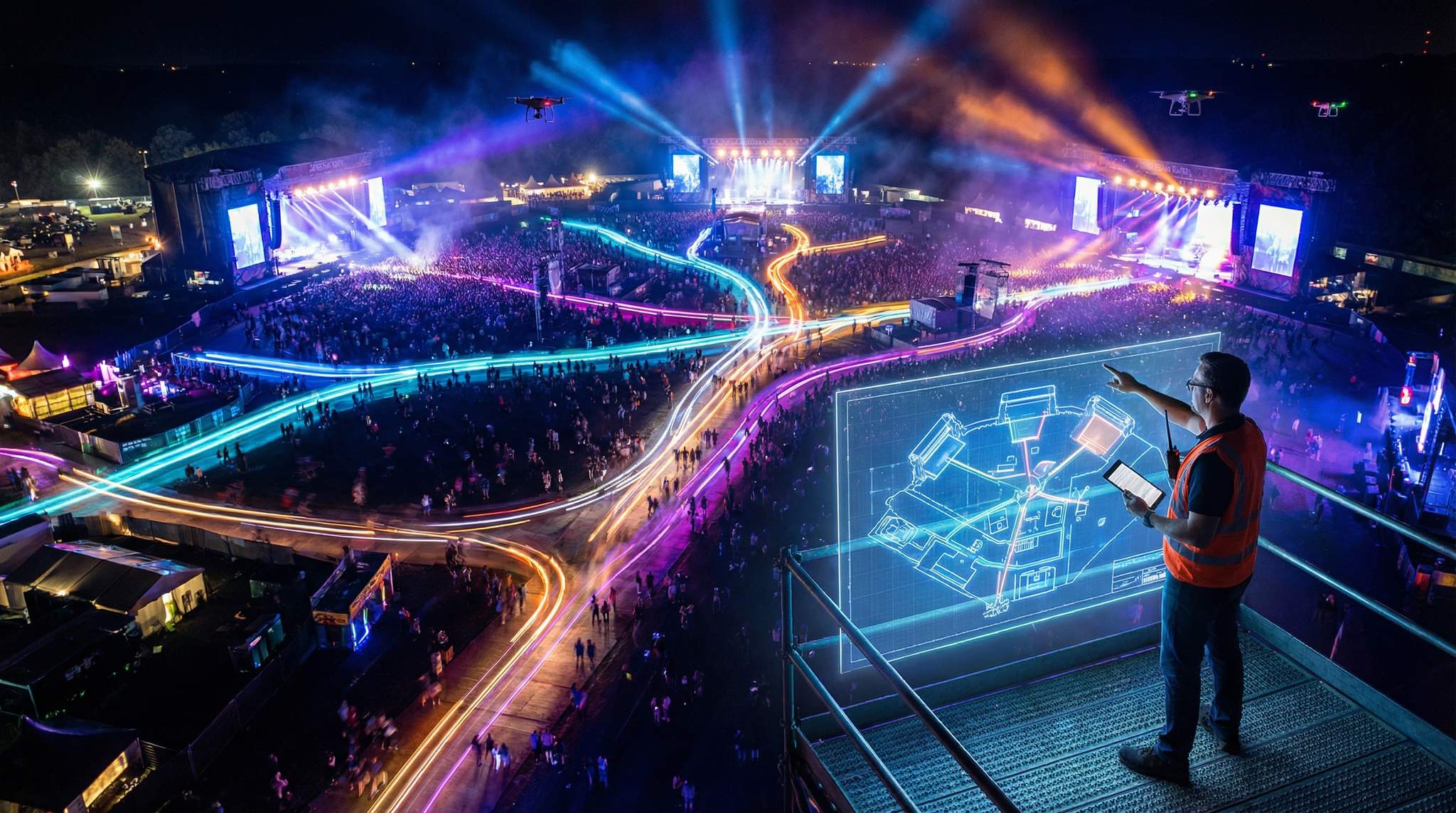
A festival site is like a small city, and its streets (the pedestrian promenades and paths) are crucial infrastructure. When designing these pathways, always plan for peak bi-directional flow and emergency needs – not just average daily traffic. In practice, this means making main walkways wide enough to handle the biggest rush of the weekend, which often occurs when a headliner act ends and tens of thousands of people move at once. Crowds might be going in two directions (some heading to another stage, others to toilets or exits), so your paths must accommodate flow both ways simultaneously at that peak volume.
Don’t underestimate how much space moving bodies require. It’s far better to have a generously wide boulevard that looks a little empty during off-peak times than a narrow choke point that becomes dangerously packed at night. Over the years, experienced festival organizers have learned from unfortunate incidents that tight exits or pathways can lead to crowd crushes. For instance, a famous tragedy at the Love Parade in Germany (2010) occurred when an overly narrow tunnel exit led to a fatal crowd crush, a tragedy documented by BBC News. The lesson for festivals: provide multiple broad exit routes and open corridors so people can disperse quickly and safely. Many countries’ event safety regulations (like the UK’s Purple Guide or local fire codes) even specify a minimum width per thousand attendees for exits and pathways – it’s wise to exceed those minimums if you can.
When mapping your site, identify the “highways” that connect stages, key attractions, and gates. Design those routes to handle the maximum expected traffic plus a margin for safety. Think about scenarios like a sudden evacuation due to weather – can your main avenues and gate areas handle everyone leaving in a hurry? One rule of thumb is to ensure any point in the main arena has at least two clear routes to exit, each wide enough for a heavy flow. If you expect 50,000 people at your biggest stage, the egress paths from that area should handle that load within minutes.
Also account for emergency vehicle access on these promenades. Often, a festival’s medical teams or security may need to get a cart or ambulance through a crowd. By designing a wide, sturdy pathway (e.g., laying down trackway or gravel on grass) that doubles as a service road, you ensure that even during peak times there’s a lane for emergency response. In India and Southeast Asia, some large festivals use dedicated center lanes with rope barriers that staff can open for vehicles or VIP movement – attendees learn to keep those lanes clear. Whether through signage, barriers, or security staff training, keep critical paths unobstructed.
Finally, don’t forget ground surface and signage on these paths. Mark the major routes clearly on the site map and with on-site signposts (consider multiple languages or universal icons for international audiences). Light the pathways at night (more on lighting below) so people feel safe walking them after dark. Smooth, well-lit, and spacious promenades make navigating a multi-stage campus a far more pleasant experience and reduce the risk of accidents during frantic crowd moments.
Beyond physical space, organizers must consider how to help guests navigate multi-stage music festival sites effectively. Clear, high-visibility wayfinding signage placed above eye level at major intersections is essential. Pairing these physical markers with a digital site map on the event’s mobile app ensures attendees can easily orient themselves, reducing confusion and preventing bottlenecks caused by lost patrons stopping in the middle of busy thoroughfares.
To further optimize how attendees move through sprawling event grounds, crowd management teams should implement dynamic directional signage. Using digital VMS (Variable Message Signs) allows operations control to update routing in real-time. If a specific bridge stage or promenade becomes oversaturated, these boards can instantly redirect foot traffic to alternative paths, ensuring the campus continues to flow smoothly even during unexpected surges.
Amenities on the Perimeter, Not Blocking Paths
Every festival needs ample water stations, toilets, food stalls, and bars, but how you place them can make or break traffic flow. A golden rule of site planning is to keep these amenities on the “pull” side of movement and never as obstacles in the middle of a main egress route. In simpler terms, position your service areas just off to the side of high-traffic pathways, in alcoves or convenient nooks, so that when a thirsty crowd rushes out, they can peel off toward the bar or water refill without stopping in the flow’s direct line.
Imagine a broad promenade leading away from a stage – you want water refill points and beer tents set back a little along the edges of that promenade. This way, people who line up won’t spill into the center of the walkway and block others. Never place a concession or restroom queue across a choke point. It sounds obvious, but on a tight site it’s easy to accidentally create a fiasco where, say, the line for merchandise snakes across the only exit path from a stage. To avoid this, give each amenity area its own space where people can congregate without impeding others. Creating small plazas for food courts or banks of restrooms works well: attendees step into the plaza to use the facilities, then rejoin the flow on the main path after.
Another tactic is to align amenities with natural “pull” factors of crowd movement. For example, people tend to head toward certain attractions or move in particular directions at certain times (like towards the exit at night). You can place coffee and snack vendors along the route people take when leaving late, encouraging a smoother, staggered egress as some folks stop for a bite instead of all rushing out in one mass. Just ensure those vendors are off to the side, not in the middle of the gateway.
Keep accessibility in mind too – water and toilets should be evenly distributed so that any given area of the festival has these essentials nearby (nobody should have to trek 20 minutes from one stage to find the next bathroom). But distribution should never sacrifice safety: better to have fewer, slightly larger service hubs in smart locations than a bunch of tiny stalls that inadvertently clog every corridor. Festival sites in places like Singapore or New York, where space is limited, often achieve this by clustering food and beverage in designated corners or along one side of a field rather than sprinkled randomly. The result is a tidier flow of foot traffic. And operationally, these clusters make it easier to restock and manage vendors from backstage service roads without driving through crowds.
In summary, let the necessities attract people out of main thoroughfares. An attendee should always step out of the traffic stream to get their drink or use the restroom, and then merge back in, just like cars using a rest stop off a highway. If you design with that analogy in mind, you’ll prevent countless frustrations (and dangerous crowding) on site.
For events heavily focused on culinary experiences, applying layout principles from a comprehensive food festival guide—such as those shared by event management platforms like Social Tables—can further optimize vendor arrangements. Grouping food stalls into distinct “neighborhoods” or culinary zones with centralized, shaded seating encourages attendees to linger comfortably while keeping the main pedestrian arteries clear for transit.
All-Weather and Nighttime Planning
A masterplan isn’t complete until you’ve stress-tested it under different conditions, especially after dark and in bad weather. Festivals span long hours, and a site that feels safe and navigable by day can turn confusing at night if lighting and sign visibility are inadequate. Likewise, a sudden downpour can transform a perfectly planned field into a mud pit if you haven’t prepared a rain layout. Wise festival organizers draft overlay plans for night and for rain (or other inclement weather) to ensure sightlines and safety measures hold up no matter what.
Lighting the night: Once the sun sets, two main things change: visibility and crowd behavior. Make sure all major pathways, exits, and gathering areas are equipped with floodlights or towers of light. Emergency exit signs and route markers should be illuminated (preferably with battery or generator backup power) so they remain visible even if the grid power fails, a safety standard emphasized in Social Tables’ festival layout guides. Pay special attention to tricky areas like uneven ground, steps, or edges of trenches – these need ground lighting or glow-in-the-dark tape to prevent trips. Also, consider how stage lighting can blind or dazzle people; avoid shining powerful lights out into the crowd’s eyes or the paths. In terms of crowd behavior, people may be more tired or inebriated at night, so they rely even more on clear visual cues and helpful staff to guide them. Position staff or volunteers with flashlights or glow sticks at key junctions to direct traffic after headline sets, for example. The campus should feel like a gently lit grid of safe routes guiding attendees back to camp, parking, or public transit when the show’s over.
Weather overlays: Whether it’s rain, extreme heat, or even high winds, have a plan. For rain, identify the low-lying areas on your site map – these can become waterlogged or muddy quickly. It’s prudent to lay down straw, wood chips, or portable flooring in these spots before the weather hits (many European festival planners pre-lay metal trackway in critical lanes, precisely because they expect rain). If a particular stage area is prone to becoming a swamp, be ready to relocate certain activities or close off that zone and redistribute the crowd to other stages for safety. Communication is crucial: announce alternate routes if the usual path floods, and ensure your crew can deploy temporary bridges or mats to keep people out of deep mud.
Some festivals known for rainy climates, like those in the UK, have learned to reinforce their sites extensively. Glastonbury, for instance, invested heavily in drainage and fortifications after infamous mud years – including installing new flood defenses and adding more covered venues, improvements highlighted by the Irish Examiner. This meant that even when heavy rains hit, the show could mostly go on without turning into a complete quagmire. On the flip side, consider the TomorrowWorld 2015 incident in the USA: torrential rain turned the Georgia festival site into such a mud bath that roads became impassable, and thousands of attendees were stranded overnight when shuttles couldn’t reach them, leaving thousands stranded as reported by Atlanta Magazine. The lack of a robust rain contingency and exit plan there became a cautionary tale in the industry. The takeaway is clear – plan for the worst weather even if you hope not to need those plans.
High winds can also wreak havoc: ensure stages and structures have proper ballast or stakes (large stages will have engineers sign off on wind tolerances). Identify zones to evacuate if wind exceeds safe levels (for instance, a tall ferris wheel or flimsy vendor tents area might need clearing in a storm). For heat, create shaded rest areas and misting stations; for cold, maybe provide warming tents.
The masterplan should be flexible. Create versions (overlays) of your site plan for different scenarios – a “rainy day” map that might reroute entry lanes around a flooded parking lot, or a “reduced capacity” plan if one arena must be closed. Share these plans with your security, medical, and operations teams well in advance, and if possible, run a drill or at least a tabletop simulation of an evacuation or weather emergency. By gamifying the “what-ifs,” you’ll discover if, say, additional exit gates are needed or if signage is lacking for the alternative routes.
At the end of the day, your festival layout should never be a fair-weather design only. The best festival producers anticipate the variables of night and weather, so that when conditions change, the festival’s heart still beats smoothly and every patron stays safe and informed.
Scaling Temporary Event Infrastructure
Before placing a single food vendor or bridge stage, organizers must map out the foundational event infrastructure that supports the entire campus. This physical backbone includes high-capacity power distribution grids, temporary fencing, heavy-duty trackway for heavy machinery, and comprehensive sanitation frameworks. Without a robust structural baseline, even the most creatively designed festival layout will struggle under the operational demands of thousands of attendees.
When scaling up to a multi-stage format, producers need to treat temporary structures and utility routing as critical path items. For instance, running miles of cabling for lighting and sound requires secure cable ramps and trenched pathways that do not intersect with primary pedestrian promenades. Similarly, deploying modular staging and crowd-control barricades must be engineered to withstand dynamic crowd pressure and local weather variables. By prioritizing these core infrastructural elements early in the masterplanning phase, venue operators ensure a resilient, safe environment that allows the creative aspects of the festival to shine.
Best Practices for Mapping Out a Multi-Day Festival
When expanding from a single-day event to a weekend-long experience, the masterplan must account for operational resets and sustained attendee comfort. One of the core best practices for mapping out a multi-day festival is separating the day-visitor footprint from overnight camping zones. Organizers need to design secure, well-lit corridors connecting the main arena to campgrounds, ensuring these paths can handle continuous foot traffic after the main stages close. Additionally, a multi-day site plan must include dedicated service roads that allow waste management and sanitation crews to empty bins and service toilets during early morning hours without crossing paths with early-rising attendees. Planning for these daily operational cycles is what keeps a prolonged event running smoothly from Friday afternoon through Sunday night.
Another crucial element when determining the best way to map out a multi-day festival is establishing dedicated welfare and recovery spaces. Unlike single-day shows where attendees arrive and leave within hours, a weekend-long event requires infrastructure that supports prolonged habitation. Strategically placing shower blocks, mobile charging stations, and shaded communal lounges near the campgrounds—but safely buffered from late-night stages—prevents daytime congestion in the main arena. Furthermore, mapping out clear, secondary perimeter routes allows vendors to restock food and beverage supplies seamlessly while patrons sleep, ensuring the site is fully refreshed for the next day’s programming.
Given the sheer complexity of orchestrating camping zones, 24-hour pedestrian corridors, and daily vendor resets, many organizers turn to professional multi-day festival mapping services. Engaging specialized spatial planners or utilizing advanced CAD-based site design agencies ensures that every square foot of the venue is optimized for both safety and revenue. These experts bring invaluable experience in crowd flow simulation, emergency egress modeling, and local compliance, transforming a rough site sketch into a highly functional, scalable blueprint that supports the unique logistical demands of a weekend-long event.
Frequently Asked Questions
How do festivals manage sound bleed between stages and local communities?
Loud stages should be oriented so speaker arrays point away from residential areas, ideally positioning them downwind of homes to utilize wind direction. Using natural features like hills or trees as buffers helps, as does grouping stages by volume level to prevent louder rock or EDM acts from drowning out quieter acoustic performances.
What is the purpose of a bridge stage at a music festival?
Bridge stages act as transition zones between distinct genre areas, featuring crossover acts to prevent abrupt sonic clashes. They encourage audience exploration and smooth crowd distribution by offering intermediate entertainment, ensuring attendees do not face jarring contrasts when moving between areas like a heavy metal stage and a folk tent.
How should festival organizers design walkways for peak crowd flow?
Main promenades must be wide enough to handle bi-directional traffic during peak moments, such as when headliners finish. Organizers should design routes that accommodate emergency vehicle access and ensure every area has at least two clear exit paths, preventing dangerous choke points and crowd crushes during mass egress.
Where is the best place to position amenities like toilets and food stalls at a festival?
Amenities should be located on the pull side of movement in alcoves or nooks off main pathways, rather than directly in the flow. This placement ensures queues for water, restrooms, or bars do not block egress routes, allowing attendees to step out of the traffic stream safely to use facilities.
Why do multi-stage festivals include quiet fringe zones?
Quiet fringe zones cater to families, older attendees, and those needing a break from high volume levels. Placing these areas at the edges of the festival grounds shields them from main stage noise and provides easier access to exits, creating a safer, more inclusive environment for attendees of all ages.
How should festival masterplans account for rain and nighttime conditions?
Effective masterplans include overlays for night and bad weather, ensuring pathways have adequate lighting and backup power for exit signs. For rain, organizers identify low-lying areas to reinforce with trackway or wood chips and prepare alternate routes to prevent main thoroughfares from becoming impassable mud pits during storms.
What’s the best way to map out a multi-day festival?
The most effective approach involves zoning the site to separate active performance arenas from camping and rest areas. Organizers should prioritize dedicated service routes for daily sanitation resets, establish secure 24-hour pedestrian corridors, and ensure amenities are scaled to support sustained usage without creating bottlenecks.
When should organizers hire professional multi-day festival mapping services?
Organizers should consider engaging professional mapping services when scaling an event to include overnight camping, complex 24-hour operational resets, or multiple high-capacity stages. Specialized spatial planners use advanced CAD software and crowd flow simulations to optimize site layouts, ensuring compliance with local safety regulations while maximizing vendor revenue and attendee experience.
What are the core components of festival event infrastructure?
The foundational elements include power distribution grids, temporary fencing, heavy-duty trackway for vehicle access, staging structures, and sanitation frameworks. Proper planning of this physical backbone ensures that all other operational and aesthetic aspects of the festival function safely and efficiently.