Wind Management for Festivals: Anemometers and Action Tables
Wind can be a festival’s invisible threat. Seasoned festival producers know that a clear sky can turn dangerous in minutes when strong gusts or storms roll in, a reality emphasized by Stageline’s analysis of stage weather preparedness. Temporary stages, tents, and structures become vulnerable when winds pick up, as seen in several high-profile festival incidents around the world. In the wake of tragedies like the 2011 Pukkelpop storm in Belgium and the Indiana State Fair stage collapse in the U.S., safety standards have tightened and weather monitoring is no longer optional, as detailed in Crodeon’s guide to measuring wind at festival sites and The A.V. Club’s report on how bad weather impacts music festivals. Modern large-scale festivals invest in robust wind management plans – because when it comes to crowd safety, data beats instincts every time.
Why Wind Management Matters at Large Festivals
Outdoor festivals often involve tall stages, towering lighting rigs, big-top tents, and expansive signage, all of which can turn into sails in high winds, a danger highlighted by Stageline’s safety protocols for temporary structures and their specifications for wind resistance with backdrops. History has taught hard lessons about underestimating wind:
- Pukkelpop 2011 (Belgium): A sudden thunderstorm with near-hurricane winds collapsed tents and a stage, causing five deaths, an event covered by The Guardian regarding the Belgian festival storm tragedy. This disaster prompted mandatory on-site wind monitoring at Belgian and Dutch festivals, a shift noted in Crodeon’s weather monitoring industry overview.
- Indiana State Fair 2011 (USA): A gust-front ahead of a storm toppled a concert stage, killing seven people. The tragedy spurred the U.S. live events industry to develop better weather safety protocols, as explored in The A.V. Club’s investigation into weather evacuations.
- Medusa Festival 2022 (Spain): High winds tore loose heavy stage decor, resulting in one fatality and multiple injuries, reinforcing the need to properly distribute weight on festival structures.
- Brazil 2012: A strong wind gust led to a stage collapse at a music festival in Brazil, causing multiple injuries and highlighting that wind risks are truly global, a point emphasized in Modu-Loc’s guide to wind management plans.
These incidents underscore that wind is a non-negotiable risk factor. Even “minor” structures are affected – for example, standard 6-foot (1.8 m) festival fencing can fail in ~62 km/h gusts (about 39 mph), according to Modu-Loc’s data on temporary fence stability. Many cities see winds that high multiple times a year, as stated in Modu-Loc’s assessment of wind frequency. A single unexpected gust can send unsecured tents, banners, or truss pieces airborne. Whether it’s a 5,000-person community event or a 100,000-strong mega-festival, having a wind management plan is critical to protect attendees, staff, and performers.
Installing Height-Appropriate Anemometers on All Major Structures
Accurate wind data is the cornerstone of wind management. This means using anemometers (wind speed sensors) at the right locations and heights across your festival site. Don’t rely on a single ground-weather station miles away – wind conditions can vary significantly on-site and change with height. Modu-Loc advises monitoring weather at established warning levels to account for these variations.
Free Tool: Size Your Festival Site
Zoned capacity planning for arena, campsite, parking and entry lanes — against UK Purple Guide and NFPA density standards. Finds your bottleneck zone.
Place anemometers at every tall or wind-sensitive structure, especially:
- Stage roofs and PA towers: The wind at a stage’s roof (which might be 30–50 feet high) can be far stronger than at ground level. For example, a stage facing an open plain will catch higher winds at the top than what people feel on the ground in front, creating a situation where structures can be blown away like a sail or balloon. Mount sensors at the top of main stages and secondary stages to capture what the structure itself is experiencing.
- Large tents and canopies: If you have big top tents, circus tents, or temporary domes, put a sensor near the highest point or on a secure pole at that height. Wind load on fabric structures is a major hazard – knowing the exact wind hitting a tent’s roof can inform timely decisions to evacuate or secure it.
- Tall signage or art installations: Any free-standing tower, art piece, or big LED screen structure that could become unstable in wind should have a nearby sensor. For instance, festival organizers often recall how vendor tents or even portable toilets can flip in high winds, a hazard noted in Modu-Loc’s wind safety tips – sensors can give early warning before that happens.
- Multiple locations if possible: At Lokerse Feesten in Belgium, the festival’s organizers deploy multiple wind meters around the site, including units 6–7 km west and south of the grounds, to detect incoming storm fronts a few minutes early. This strategy of measuring wind west and south of the grounds is crucial for lead time. This shows how having more than one sensor (both on-site and upwind off-site) can buy precious lead time to act.
Height-appropriate placement is key. Anemometer needs to be roughly at the height of the structure or element you’re concerned about – wind speeds increase with elevation due to less ground friction. A sensor on the roof truss will tell you if that roof is nearing its design limit, whereas a waist-height sensor at the mixing desk might lull you into complacency. Some festivals use wireless anemometers on stages, feeding data live to a central system, such as Interface’s wireless telemetry solutions for festivals. Whatever technology you use, ensure each sensor is calibrated, protected from tampering, and has backup power or a battery so it stays active during a storm.
Planning a Festival?
Ticket Fairy's festival ticketing platform handles multi-day passes, RFID wristbands, and complex festival operations.
When selecting equipment, understanding the best anemometer types for concert stage safety is critical. Traditional mechanical cup anemometers are cost-effective and widely used, but they have moving parts that can freeze or foul in severe weather. For high-stakes festival environments, ultrasonic anemometers are increasingly preferred by rigging professionals. These solid-state sensors use sound waves to measure wind velocity and direction, offering extreme accuracy with zero moving parts to maintain. Whether you choose a robust mechanical unit or an advanced ultrasonic model, ensure it integrates seamlessly with your site-wide telemetry system.
When scaling up to massive event footprints, deploying the best wireless wind monitoring systems for multi-stage festivals becomes a logistical necessity. Running hardlines across a 500-acre site is impossible. Instead, modern productions rely on long-range RF (radio frequency) or cellular mesh networks to transmit real-time stage wind data back to event control. These advanced setups allow producers to monitor the main stage, dance tents, and VIP grandstands simultaneously on a single unified dashboard, ensuring no localized microburst goes unnoticed.
Defining Wind Speed Thresholds: Trim, Pause, and Evacuate
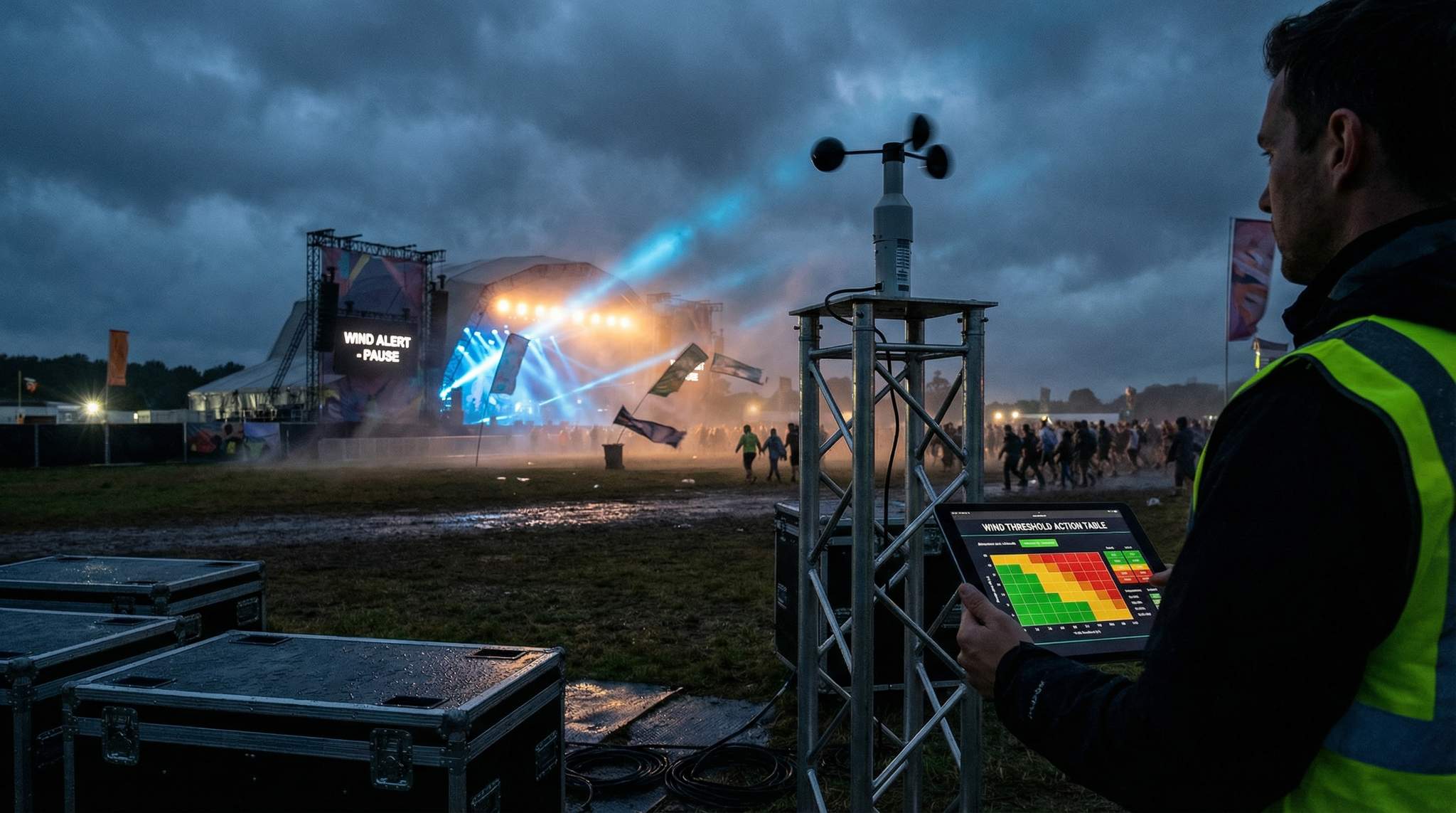
Collecting wind data is only half the battle – the other half is knowing when and how to act on that data. Every festival’s wind management plan should include a clear action threshold table that spells out what to do as winds rise. A common approach is to establish at least three escalating levels of response:
- Trim (Preventative Actions) – moderate high winds: This is the first alert level. When winds reach a certain “caution” speed (for example, 25–30 mph sustained, or whatever is ~75% of your structure’s safe limit, a benchmark suggested by Modu-Loc’s structural safety guidelines), start trimming the proverbial sails. Actions: Secure loose items and decor, roll up or remove stage scrims and banners, lower or angle down lighting trusses, and double-check that all ballast, stakes, and straps on tents or towers are tight, potentially evacuating the area if conditions worsen. Essentially, reduce the wind profile of structures – much like a ship reefing sails – to lessen wind stress. At this stage, all crew should be put on alert that further action may be required if winds continue to increase.
- Pause (Show Stop) – high winds: The second threshold might be triggered at roughly 75–90% of the maximum safe wind speed of your critical structures, often based on the Institution of Structural Engineers’ gust ratings. At this level – say winds steady above ~35–40 mph, or gusts crossing a dangerous threshold – it’s time to pause performances and potentially clear non-essential people from stage areas. Actions: Immediately stop the music or show; instruct artists and stage crew to exit the stage for their safety; ensure the crowd steps further back from large structures (e.g. keep at least 30 m / 100 ft away from stages) and remove backdrops as much as possible. This might involve temporarily suspending the event program while monitoring conditions. By pausing at high winds, you avoid putting performers and attendees in harm’s way if, for example, speakers were to fall or a canopy were to tear loose.
- Evacuate (Emergency Stop) – extreme winds: This is the last resort, when winds reach or exceed the engineered limits of structures or when storm conditions make the site untenable. Often this means sustained winds above ~40–50 mph or severe gusts that pose an immediate threat of collapse. Stageline advises clearing everyone from the stage area entirely. Actions: Shut down all stages and audio-visual systems; make emergency announcements for attendees to evacuate to predefined safe areas or shelters; clear everyone (including crew) away from large structures entirely. In practice, this could mean moving the crowd to parking lots or buses (if safer), or if time permits, to sturdy buildings or shelters until the wind subsides. It may also mean cancelling the remainder of the event day. No performance or ticket refund is worth lives – safety comes first.
These thresholds should be determined in advance with input from structural engineers and equipment providers. Identify the wind ratings for each temporary stage, tent, and tower in your inventory, utilizing wind load test results for each structure; many suppliers can provide documentation on what their structure can withstand. Use those figures to customize your action levels. For example, if your main stage roof is rated for 60 mph (97 km/h) winds with all wind walls on, ensuring preparedness for high winds at all times, you might set your “pause” trigger around 40–45 mph and “evacuate” trigger at 55 mph, to stay on the safe side. Conversely, a smaller mobile stage might only handle 45 mph – so adjust your thresholds lower for that stage. The Institution of Structural Engineers recommends setting a first warning at about 75% of a structure’s limit, and a full action trigger at 90% of the limit, a standard referenced in Modu-Loc’s overview of structural engineering recommendations. Following this guideline adds a buffer so that you’re not waiting until things are at the breaking point to react.
Free Tool: Project Your Bar Revenue
Per-head spend benchmarks by event type turned into projected bar and food revenue, with a stock-mix estimate and gross-margin line. Free calculator.
When defining actions, consider all phases of the festival:
- During build (load-in): If dangerously high winds hit while you’re constructing stages or big tents, the plan might mandate a work stoppage and for crew to stand down until winds ease, adhering to Level 1 warning protocols for crew safety. Erecting structures in high wind is risky – no one should be on a roof or lifting heavy truss in those conditions.
- During the event: Focus on crowd safety and show-stop procedures as described (pause/evacuation). Ensure you have a method to quickly communicate to the audience if they need to move or leave — such as a public address system message or screens displaying instructions.
- During teardown: Don’t forget the breakdown phase. After the crowds leave, crews often rush to dismantle staging and tents. If a gale picks up during teardown, you may need to delay and secure equipment rather than pressing on and risking an accident.
Everything in your wind action table should be specific and assign responsibilities. For example: “If sustained wind exceeds 30 mph, Stage Manager X will immediately instruct the sound engineer to mute audio and bring down all scrims, while Security Lead Y clears the front-of-house area.” Clarity saves precious seconds when a squall line is bearing down on your festival.
Need Festival Funding?
Get the capital you need to book headliners, secure venues, and scale your festival production.
Real-Time Monitoring and Communication in the EOC
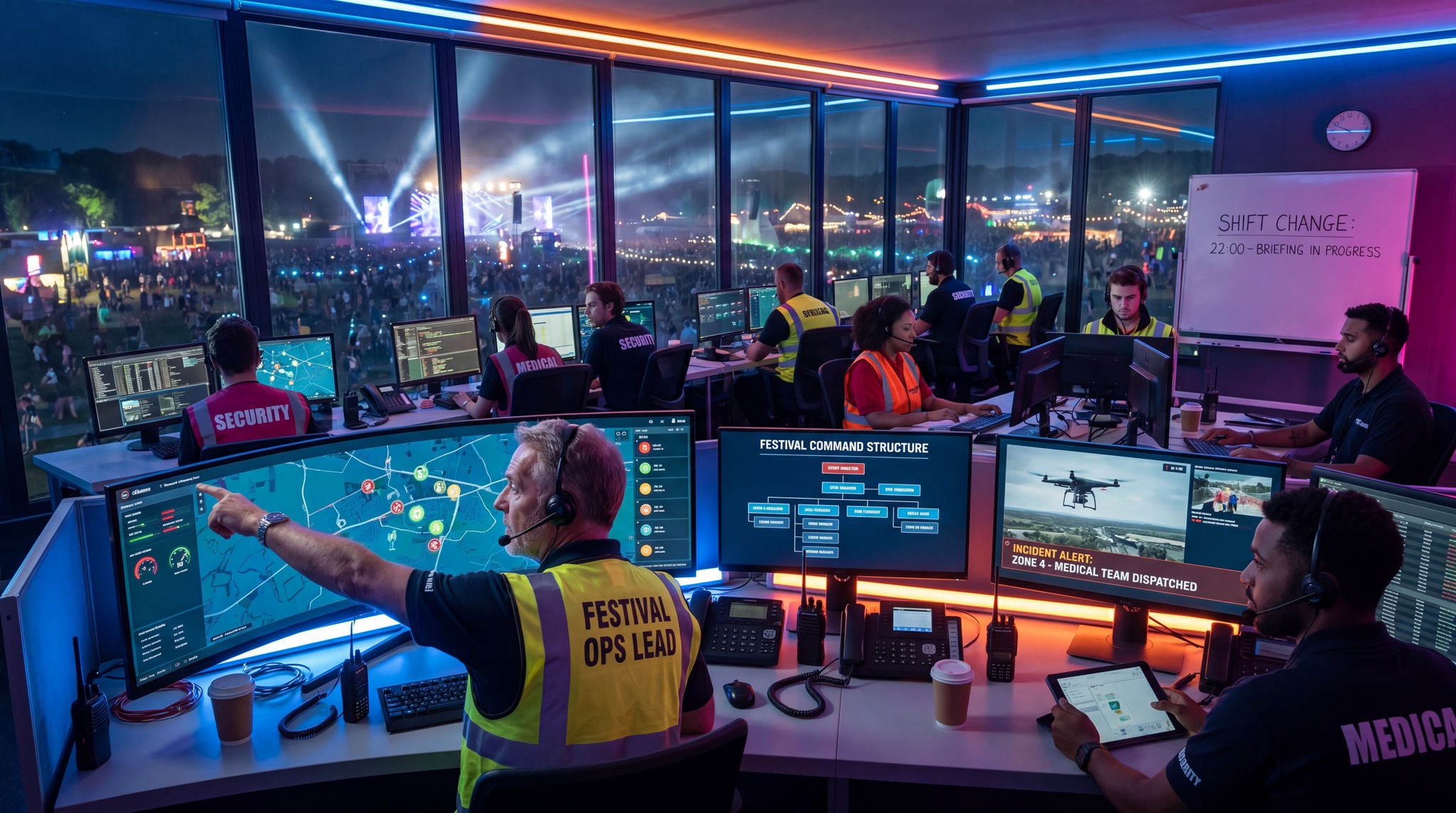
Having the best sensors and action plan means little if the information doesn’t reach the right people in time. That’s why it’s essential to integrate wind monitoring into your Event Operations Centre (EOC) or festival control room. The EOC (sometimes just called Event Control) is the nerve center where key staff like the festival director, safety officer, security, medical, and weather monitoring teams converge. Make sure wind data flows into this hub in real time.
How to share readings effectively:
- Central Display: Set up monitors in the EOC showing live readings from all anemometers on site. Interface recommends installing WTS wireless sensors for this purpose. For instance, one screen could show the Main Stage roof wind speed, another the Second Stage, another the big top tent area, etc. Modern wireless systems can transmit data to a laptop or base station, where it can be graphed with Log100 software. If budget allows, use visualization software to graph wind trends over the past minutes and hours, so you can spot sudden spikes.
- Radio Updates: Ensure that your communications plan includes regular wind updates to those in the field. The safety officer or a designated “weather scout” in the EOC should radio the stage managers and site managers whenever winds approach an action threshold. It could be as simple as: “Weather Update: Sustained winds now 25 mph at Main Stage – level 1 actions implemented, be prepared for possible show pause.” By keeping stage leads in the loop, they won’t be caught off-guard if you call for a stop.
- Alarms and Alerts: Consider setting automated alarms when wind speeds hit certain numbers. Some anemometer systems or weather apps can trigger sirens, strobe lights, or text alerts to key personnel when thresholds are breached, a critical component of Modu-Loc’s wind management considerations. At minimum, have someone in the EOC watching the readings like a hawk when winds are on the rise.
- Weather Forecast Integration: In addition to on-site sensors, follow professional weather forecasts closely in the EOC. Many large festivals partner with meteorologists or subscribe to specialized weather services (like WeatherOps or Met Office briefings) to prepare for every conceivable weather scenario. These experts can warn you of incoming storm fronts, wind shifts, or microbursts down to the hour. Share forecast info with stage teams too – e.g., “Radar shows a storm cell 10 miles out, ETA 20 minutes, likely gusts over 40 mph.” This gives everyone a heads-up about what’s coming, not just what’s happening now.
Communication also means coordination. In a fast-developing weather situation, the EOC should convene decision-makers (festival producer, head of security, etc.) to decide on pauses or evacuations quickly, based on the live data. It’s wise to include local emergency services in these communications if they are on site or on standby. For example, when Boardmasters Festival (UK) faced an approaching storm in 2019, festival organizers, local authorities, meteorologists, and emergency services collectively decided to cancel and evacuate before gates even opened. BBC News reported on the decision by organizers and Cornwall Council to prioritize safety due to predicted high winds. They shared weather data and agreed the site would be “very dangerous” in the forecast winds, so they put safety first. Your EOC should function with that same unity of purpose – everyone hearing the same info and ready to act in concert.
Lastly, after any weather event or near-miss, debrief and refine your communications. Maybe the radios were too chaotic, or a key person didn’t get the alert to drop a backdrop. Learn and improve for next time.
Data-Driven Event Marketing
Track ticket sales, demographics, marketing ROI, and social reach in real time. Exportable reports give you the insights to make smarter decisions.
Empowering Festival Leadership to Stop the Show
When dangerous wind conditions materialize, decisions must be made in seconds. The authority to postpone or cancel a performance for safety should be clearly defined and never in question at the moment of crisis. Every festival should designate one or two senior officials (for example, the Festival Director and the Safety Officer) who have full authority to stop the show at any stage, any time, if conditions become unsafe. Equally important, all artists, stage crews, and contractors need to be informed that if a stop is called, it is non-negotiable and immediate.
Some key practices:
- Establish a Chain of Command: Your wind action plan should list who can call for a show pause or evacuation. Typically, it might read: “On the recommendation of the Safety Officer (or Weather Manager), the Festival Director (or their deputy) will order an immediate show stop.” This prevents confusion where everyone is looking at each other when a critical call is needed.
- Fast Decision Triggers: The moment a wind speed red-flag is hit (or a structure shows signs of distress), the empowered leader should not hesitate. It’s better to overreact and restart the music later than to wait too long. Remember, stages can collapse in seconds – a delay of even a minute can be catastrophic. There have been events where warnings were ignored or delayed, with deadly results. For instance, in a 2024 event in Mexico, multiple warnings about high winds went unheeded by the event’s organizers, and the stage collapsed killing nine people. AP News reported that organizers had very little time to react to the sudden onset. No one wants that outcome. By contrast, many U.S. festivals since 2011 have adopted a “when in doubt, shut it down” policy – it’s painful to evacuate tens of thousands of guests, but that proactive approach has undoubtedly saved lives and prevented injuries, a trend discussed in The A.V. Club’s article on weather evacuations.
- Artist and Audience Management: Stopping a headline act mid-song or evacuating a venue is a big deal, so plan for it. Communicate your weather hold/stop protocols with artists and their tour managers in advance. Most will understand that safety comes first. Have a polite but firm script for MCs or DJs to announce to the crowd that the show is pausing due to weather and instruct them on what to do. Emphasize that this is for everyone’s safety. It helps to rehearse this process, so security and staff know how to usher people calmly and where to direct them.
- Maintain Authority Under Pressure: Young or inexperienced festival organizers might feel pressure to “push through” bad weather – from excited fans, from an artist eager to play, or from concerns about refunds. The veteran festival producer’s voice in your head should remind you: one tragedy will overshadow a hundred great festival days. Do not let external pressure override safety judgment. If your instruments and plan say it’s time to stop, stop. Attendees might boo in the moment, but they will ultimately appreciate that you kept them safe. It’s far better to deal with some disappointed customers (and possibly offer make-goods like partial refunds or rescheduled sets) than to deal with injuries or worse.
Stopping a show quickly and safely is a hallmark of a responsible festival organization. It requires confidence, clear authority, and practice. In an emergency, seconds count, so empower your team leaders to act without fear.
Trust Data Over Gut Feel – Every Time
Human instincts are valuable, but when it comes to fast-changing weather, objective data should lead the way. A calm-looking sky can belie a wind storm approaching at 50 mph a few miles away. A light breeze on the ground can translate to dangerous gusts at the top of a stage roof. It’s easy to get a false sense of security or hope that “maybe it’ll pass.” But countless case studies show that acting on solid data saves events from disaster:
- Festival teams that closely monitor radar and anemometer readings have evacuated sites minutes before a storm hit, avoiding chaos. Data gave them the confidence to act. For example, the team at a coastal festival might see winds steadily rising and choose to delay a headline act as a precaution, only for a sudden gale to blow through 10 minutes later. Thanks to their instruments, they were ready.
- Conversely, when event organizers have relied on gut feel or optimistic assumptions, the results have been poor. Remember that weather in one spot can be wildly different from another. During the Newport Folk Festival, as Newport Folk Festival’s producer Jay Sweet recalls, there could be blue skies overhead while lightning and wind are raging just beyond the horizon. Newport Folk Festival producer Jay Sweet described this phenomenon to The A.V. Club. Without instruments and expertise, you’d be flying blind in such a scenario.
- Modern weather tech is incredibly advanced – use it. High-resolution forecasts, mobile alerts, and onsite sensors are tools the previous generation of festival producers didn’t have as readily. Today there’s no excuse for being surprised by a line of storms or a wind advisory. Embrace these tools: subscribe to weather alert services, invest in quality sensors, and educate your team on interpreting the data. Make “check the weather data” as routine as checking the stage schedule.
In the end, trusting data over instincts doesn’t mean ignoring experience – it means informing your experience with evidence. Experienced festival producers certainly develop a feel for weather, but the best marry that intuition with real-time measurements. Use your instincts to guide contingency plans (like knowing when a crowd might panic or when an artist can do an acoustic set if power is lost), but use hard data to trigger safety decisions. As the saying goes in event safety, “Plan with your head, not your heart.” The numbers on your anemometer aren’t biased or emotional – they simply tell you what the wind is doing. Listen to them.
Conclusion
Wind management at festivals is both an art and a science. It requires vigilance, technology, teamwork, and the courage to put safety first every single time. By installing the right sensors, planning clear action thresholds, communicating constantly, and empowering decisive leadership, festival organizers can weather the storm – literally – and keep their audiences safe. Remember that every marquee, stage, or tent you raise is a responsibility. When the wind kicks up, let data, not hope, dictate your actions. The next generation of festival producers will stand on the shoulders of hard-earned lessons, ensuring that great show experiences are never marred by preventable weather disasters. Stay safe, stay smart, and always respect the power of nature at your events.
Free Tool: When Should You Announce?
Pick your event date and genre — the free planner outputs a recommended announce, presale, on-sale and reminder schedule anchored to how your audience actually buys.
Frequently Asked Questions
Why is wind management critical for outdoor festivals?
Wind management is essential because temporary structures like stages, lighting rigs, and tents act as sails and can collapse during high winds. Historical tragedies, such as the Pukkelpop and Indiana State Fair incidents, demonstrate that unmonitored wind gusts pose a lethal threat to attendees, making data-driven safety plans a non-negotiable requirement for production.
Where should anemometers be placed on a festival site?
Anemometers must be installed at height-appropriate locations on all major structures, including the tops of stage roofs, PA towers, and large tents. Placing sensors at the highest points is vital because wind speeds increase with elevation and are often significantly stronger at the top of a truss than at ground level.
At what wind speed should a festival stage be evacuated?
Evacuation protocols are typically triggered when sustained winds reach 40–50 mph or exceed the specific engineered limits of the structure. Industry guidelines suggest initiating a ‘pause’ or show stop earlier, often around 35–40 mph (roughly 75–90% of the maximum safe rating), to ensure performers and crowds are cleared before critical failure points are reached.
What are the three levels of wind response for live events?
The three standard response levels are Trim, Pause, and Evacuate. ‘Trim’ involves securing loose items and lowering banners during moderate winds; ‘Pause’ requires stopping performances and clearing stages when high winds threaten safety; and ‘Evacuate’ mandates a total site shutdown and movement to safe shelters when winds reach extreme or structural design limits.
How strong does wind need to be to knock over festival fencing?
Standard 6-foot (1.8 m) temporary festival fencing can fail in wind gusts as low as 62 km/h (approximately 39 mph). Since these perimeter structures are often less secured than main stages, they pose a significant hazard during sudden squalls, requiring organizers to monitor wind speeds even for minor infrastructure.
How do festival organizers create a wind action table?
Organizers create a wind action table by consulting structural engineers to identify the wind load ratings for every stage and tent. They then map these ratings to specific triggers—Trim, Pause, and Evacuate—ensuring that staff have clear, pre-assigned responsibilities to secure equipment or stop the show when anemometers detect wind speeds hitting those defined thresholds.
What is the role of the Event Operations Centre (EOC) in weather safety?
The Event Operations Centre (EOC) serves as the central hub where real-time wind data from on-site anemometers and professional forecasts are monitored. Key decision-makers in the EOC use this data to coordinate communications, issue radio alerts to stage managers regarding rising wind levels, and authorize emergency actions like show stops or evacuations.
Who has the authority to stop a festival performance due to weather?
A designated senior official, such as the Festival Director or Safety Officer, must have the absolute authority to stop a performance immediately. This chain of command is established in advance to ensure that decisions to pause or evacuate are made instantly based on safety data, without negotiation from artists or delays caused by seeking consensus.
What are the best anemometer types for concert stage safety?
For concert stage safety, the two primary options are mechanical cup anemometers and ultrasonic anemometers. Ultrasonic models are widely considered the optimal choice for large-scale festivals because they feature no moving parts, making them highly reliable in freezing rain or dusty conditions. However, high-quality mechanical cup sensors remain a viable, cost-effective standard for many temporary structures, provided they are regularly calibrated and properly maintained.
What are the best wireless wind monitoring systems for multi-stage festivals?
The most effective wireless setups utilize long-range RF or cellular mesh networks to transmit real-time telemetry from multiple anemometers across a large site. These systems centralize data from the main stage, secondary tents, and perimeter structures into a single Event Operations Centre dashboard, eliminating the need for vulnerable hardwired connections.
What is the standard man basket wind speed limit during festival load-in?
While specific limits depend on the Mobile Elevating Work Platform (MEWP) manufacturer, the standard man basket wind speed limit for safe operation is typically between 20 and 28 mph (32 to 45 km/h). Rigging crews must cease aerial work and lower boom lifts when gusts approach these thresholds, long before the stage structure itself requires evacuation.