Introduction
The festival industry is entering a new era of organized labor. Across 2026’s events landscape, festival crews and contractors are increasingly pushing for better working conditions and even unionizing. From stagehands and lighting techs to security teams, workers who once toiled long hours without complaint are now banding together to demand fair treatment. High-profile labor actions in entertainment – from Broadway stagehand strikes to film industry walkouts – have sent ripples into live events, signaling that festivals must be ready to collaborate with unions and collective bargaining efforts. Seasoned festival producers understand that adapting to this shift isn’t just a legal necessity; it’s also key to preventing disruptions, fostering a loyal workforce, and ensuring events run safely and smoothly.
In this comprehensive guide, readers will learn practical strategies for navigating union negotiations and labor movements in the festival world. We’ll explore why crew members are unionizing now, common grievances driving these movements, and what legal obligations festival organizers have when labor unions come into play. Importantly, we’ll discuss how proactive improvements to working conditions before conflicts arise can go a long way – potentially heading off disputes or at least demonstrating good faith. From adjusting budgets and schedules to meet fair labor practices to working hand-in-hand with union representatives as partners rather than opponents and establishing a good working relationship with stewards, today’s festival producers can embrace this new era constructively. Real-world examples – like a successful collective agreement that boosted festival staff conditions, and a major event averted from crisis through open negotiation – will illustrate win-win outcomes. By preparing for the rise of organized labor, festival organizers can build a safer, happier crew and keep the show on the road, even as the industry’s labor rules evolve.
The Rise of Organized Labor in Festivals
Crew Grievances Fueling Unionization
It’s no secret that festival work can be grueling. In recent years, crew members have become more vocal about “brutal” conditions behind the scenes. A 2025 survey by the UK’s Bectu performing arts union revealed festival staff working 18-hour days, sleeping on floors, and even lacking access to drinking water. About half of the 100 workers surveyed felt unsafe at work, and a third had faced direct risks to their physical safety. The head of Bectu, Philippa Childs, described some festivals as the “wild west” of labor practices – with certain organizers using the industry’s “fun and fast” reputation as an excuse to shirk basic standards. These findings echo grievances heard across the global festival circuit: excessive hours with no overtime pay, inadequate rest or meal breaks, on-site accommodations that are unsanitary, and a lack of respect for the skill and safety of crew jobs.
The urgency of these issues reached a boiling point recently when Bectu called for immediate action on the lack of rest breaks, as their research shows a huge health and safety risk to crew members. Specifically, the union highlighted the dangers of a “broken turnaround” in 2025, where festival crews are forced back to work without the legally or biologically necessary sleep between shifts. For festival organizers, this data underscores that ignoring mandatory rest periods isn’t just a minor scheduling oversight—it is a critical liability that directly endangers the physical well-being of the workforce and the overall safety of the event site.
Turn Fans Into Your Marketing Team
Ticket Fairy's built-in referral rewards system incentivizes attendees to share your event, delivering 15-25% sales boosts and 30x ROI vs paid ads.
To address these specific warnings, forward-thinking festival producers are auditing their production schedules to eliminate the dreaded broken turnaround. When industry bodies demand urgent intervention regarding inadequate downtime, it serves as a crucial wake-up call. The data clearly demonstrates that denying workers proper recovery time introduces severe physical hazards, particularly for technicians operating heavy machinery or rigging stages. By proactively restructuring shift patterns to guarantee a minimum 11-hour rest period between calls, organizers not only comply with emerging labor standards but also drastically reduce the liability of fatigue-related accidents among festival crews.
Behind these complaints lies a fundamental tension. Festivals often run on razor-thin margins, and historically some organizers cut costs by relying on passion and adrenaline to carry crews through marathon builds and show days. However, as the live events sector has rebounded post-pandemic, workers have more leverage and are less willing to tolerate unhealthy conditions. Labour activists point out that many crew are freelance or seasonal, lacking job security and benefits despite years of service. In response, more crew members are considering unionizing to gain a collective voice. Unions can negotiate for fair wages, reasonable working hours, proper breaks, and safety measures on behalf of the crew – things that may not consistently happen if every worker fends for themselves. The goal isn’t to undermine festivals’ success; it’s to ensure those success stories aren’t built on burnout and risk. As one veteran production manager put it, “Our events are only as good as the team running them – if that team is exhausted and frustrated, eventually something gives.” It’s a lesson many experienced festival producers have learned the hard way after incidents caused by fatigue or understaffing.
Planning a Festival?
Ticket Fairy's festival ticketing platform handles multi-day passes, RFID wristbands, and complex festival operations.
Industry Trends and Labor Activism in 2026
The push for better crew conditions isn’t happening in isolation. A broader wave of labor activism is sweeping many industries in the 2020s, and live events are no exception. Unions remain a powerful force in entertainment: stagehands, riggers, and even some front-of-house staff at large venues often operate under collective bargaining agreements. The resurgence of concerts and festivals after the pandemic coincided with union victories and strikes making headlines. For example, the International Alliance of Theatrical Stage Employees (IATSE), which represents many film and theater technicians, nearly went on strike in 2021 to demand safer hours – a fight that resonated with live event crews who also endure all-night shifts and tight turnarounds. This momentum has emboldened festival crews to organize for their own rights.
Geography plays a role as well. In traditional union strongholds like New York, Chicago, Los Angeles, London, or Paris, it’s long been common to work with unionized stage crews for major events. Festival organizers in these regions may already be familiar with union rules through local stagehand unions or trade unions for electricians and technicians. By contrast, in some “right-to-work” areas or countries with less union presence, festival producers might be encountering collective action for the first time. But even in historically non-union markets, change is under way. Young workers in particular are bringing fresh energy to labor movements, coordinating via social media and industry networks. They’ve seen peers at companies like Amazon or Starbucks unionize, and they’re asking: Why not us in the festival crew?
Crucially, ignoring this trend can carry steep consequences. In recent years, strikes and labor disputes have disrupted high-profile events – from theater productions to municipal festivals – underscoring that organizers cannot afford to be complacent. For instance, in July 2025, Philadelphia’s city workers went on strike just as the huge Wawa Welcome America Festival was gearing up for Independence Day celebrations. In solidarity, headliners LL Cool J and Jazmine Sullivan pulled out of the concert rather than cross a picket line, sending organizers scrambling as the artists supported the union members. The message was clear: artists and audiences increasingly side with workers’ calls for fairness. A festival unwittingly caught in a labor conflict can face bad press, last-minute talent cancellations, or even an event shutdown if crew walk off the job. No organizer wants to face thousands of angry fans because the stage crew is on strike.
The new era of organized labor in festivals is about partnership as much as protest. Producers who stay ahead of the curve are talking with their teams now, not just when a strike threat looms. They understand why crew are demanding change and recognize that many of these demands – like safer conditions and realistic work hours – align with producing a better festival. As we move forward, the goal is to channel this labor energy into positive outcomes: festivals where crew are respected, which in turn leads to smoother operations and a stronger team culture. In the next sections, we’ll delve into how organizers can navigate this landscape by understanding their legal responsibilities and by taking proactive steps to improve crew welfare before conflicts erupt.
Accept Payments Across 13 Countries
Local currency processing via Stripe, Razorpay, Xendit, Paystack, and OXXO across 13 countries with region-specific payment methods.
Legal Obligations & Rights: What Festival Producers Need to Know
Understanding Labor Laws and Union Rights
When crew members decide to unionize, festival organizers must tread carefully – both ethically and legally. Labor laws in most countries protect workers’ rights to organize and bargain collectively, and festival producers need to be well-versed in these regulations. For example, in the United States the National Labor Relations Act (NLRA) guarantees employees the right to form or join a union and prohibits employers from retaliating against union organizers. That means if your stage technicians or security staff start discussing a union, it’s illegal (and counter-productive) to fire or punish them for it. Likewise, in the UK, employees have rights to join trade unions like Bectu or Unite, and there are processes for union recognition if a majority want it. Many European countries have strong labor protections encoded in law – including limits on working hours, mandated breaks, and overtime pay – so failing to meet basic standards isn’t just a morale issue, it could be a legal violation. In fact, even without a union in place, regulators can penalize events that breach labor laws. Imagine an inspector discovering your crew worked 18 hours straight without breaks; fines or shutdown orders could follow.
Festival organizers, especially those accustomed to informal gig labor, often face a learning curve here. One key concept is good-faith bargaining. If a union is formed or an existing union (like IATSE Local XYZ in a city) claims jurisdiction over your event crew, you as the employer are typically obligated to recognize the union (depending on local law) and negotiate with them in good faith. Good faith means coming to the table with an open mind, providing relevant information when requested (for instance, disclosing safety records or financial constraints if claiming you can’t afford certain demands), and genuinely trying to reach an agreement. Simply pretending to negotiate while stonewalling or delaying can lead to charges of unfair labor practices. This can be tricky territory – which is why many industry veterans recommend consulting a labor attorney early on, as soon as union talk bubbles up. Knowing your legal footing – what you can and cannot do – will help you avoid missteps that could escalate the conflict or even result in lawsuits.
It’s equally important to understand the scope of union labor rules that might apply to your festival. In unionized event environments, collective bargaining agreements (CBAs) will spell out specific work rules: everything from minimum crew sizes and job classifications to call times, overtime rates, and required rest periods. For example, a CBA might mandate that after 8 hours, crew must receive time-and-a-half pay, or that a licensed union electrician is required on-site whenever generators are running. If your festival is in a major market, there may already be union jurisdictions – think of how certain city-owned venues require union stagehands by law or policy. Similarly, large festivals using city parks or public land might be subject to agreements with local unions for stage setup, security, or sanitation. Surprises in this arena are costly, so do your homework: research local labor laws and any union contracts in venues you plan to use, and reach out to local labor councils or union reps well in advance. Veteran festival organizers always map out the labor landscape during the early planning phase – better to know upfront if hiring a crew in Los Angeles means union wages and terms, so you can budget accordingly, rather than finding out on the eve of load-in.
When mapping out these agreements, organizers should pay close attention to established industry benchmarks, such as standard IATSE turnaround rules. These regulations typically mandate a minimum rest period—often 8 to 10 hours—between the end of one shift and the beginning of the next. If a production schedule forces a crew member to return before this rest period concludes, it triggers a “forced call,” which usually requires premium penalty pay until a full rest window is provided. By understanding and integrating these turnaround guidelines into early planning, festival producers can build safer, more compliant schedules that protect both their workforce and their budget.
Employee vs Contractor: Classification Matters
One legal gray area in festivals is the widespread use of independent contractors. Many festivals hire crew as freelancers on short-term contracts, which can blur the lines between an “employee” (protected by most labor laws and able to unionize) and an “independent contractor” (who generally is not covered by collective bargaining rights or certain labor protections). Some less-experienced producers mistakenly think they can dodge labor rules by labeling all crew as contractors – a dangerous misconception. If you exert significant control over how, when, and where a person works, then legally that crew member is likely an employee, regardless of what your paperwork calls them. Misclassifying true employees as contractors can lead to serious penalties and back-pay obligations for misclassification, as well as complicating any union efforts (unions can challenge misclassification so that those workers are included in bargaining units). For instance, if you tell a lighting tech exactly how to do their job, schedule their hours, and provide their gear, they’re effectively your employee for the event – and entitled to things like overtime pay and workers’ compensation coverage.
Savvy festival producers get ahead of this by classifying staff correctly and ethically from the start. This might mean putting your core crew on payroll (even if just for the duration of the festival project) so that you comply with tax laws and can offer legal overtime. It also means that if those workers unionize, you won’t be caught in a dispute over who is even eligible to be in the union. Yes, handling payroll and benefits for short-term staff is an added administrative step, but it builds trust and keeps you on the right side of the law. Additionally, clear classification enables clear contracts – you can then craft agreements or job offers that outline working conditions, pay rates, and expectations transparently. That transparency itself can reduce grievances; people tend to organize when they feel kept in the dark or taken advantage of. In summary, understanding and following labor laws isn’t just bureaucratic box-ticking – it’s laying the groundwork for a fair relationship with your crew, whether or not a union is formally involved. By recognizing crews’ rights early and often, festival organizers demonstrate integrity and reduce the risk of conflicts escalating into full-blown labor disputes.
Proactively Improving Crew Conditions (Before Conflict)
A common piece of advice from experienced festival producers is to “fix the roof while the sun is shining.” In the labor context, that means addressing crew concerns before they coalesce into strikes or union showdowns. The reality is that most crew don’t unionize on a whim – they do it as a last resort when they feel their voices and welfare are consistently ignored. Thus, one of the best ways to navigate the new era of organized labor is to cultivate a work environment where grievances are minimized and mutual respect is the norm. Not only can this prevent unionization altogether (if workers feel truly valued, they may see less need for a union), it also means that if a union does form, the negotiations are likely to be far more amicable because the baseline conditions are already decent.
Fair Wages, Reasonable Hours, and Safe Working Conditions
The top crew complaints are unsurprising: low pay, excessive hours, and safety risks. Tackling these head-on is critical. Start with compensation – festival crews often include very skilled tradespeople (electricians, riggers, sound engineers) whose labor is just as critical as the headline artist on stage. If you’re paying bare minimum rates or expecting people to work “for the love of it,” you’re sowing seeds of discontent. Research the standard rates in your region (union wage scales are actually a helpful benchmark even for non-union events). Strive to pay a living wage or better, and be transparent about how pay is determined. If you can’t offer higher base pay due to budget limits, consider other forms of compensation: stipends for meals, travel or housing allowances for out-of-town crew, and end-of-festival bonuses for those who went above and beyond. Another option is providing access to healthcare or wellness resources during the event – for example, engaging a medic not just for attendees but for crew check-ins, or arranging discount gym passes during the run-up. These gestures show you see the crew as people, not disposable labor units.
Need Festival Funding?
Get the capital you need to book headliners, secure venues, and scale your festival production.
Next, address working hours and rest. Festivals often involve intense build and break schedules, but chronic 16-18 hour days are a recipe for disaster (and increasingly illegal in many locales). Aim to structure shifts so that no one works beyond about 10-12 hours without relief, and nobody should do multiple ultra-long days in a row. In fact, many veteran producers now cap individual shifts at 8–10 hours and then cycle in a second shift if work must continue around the clock. It might cost more in the short term to hire extra crew to support, but it’s far cheaper than a serious accident caused by fatigue – or a mass crew walkout because people are fed up. Building a realistic schedule with built-in overtime and relief crew is key. As one guide advises, plan for overtime and limits: don’t regularly exceed 8–12 hours per person per day, and budget for overtime pay if longer shifts are truly unavoidable to prevent dangerous fatigue failures. Crucially, enforce meaningful breaks. Provide at least a 30-60 minute meal break every 5-6 hours, and a few shorter rest breaks in between. Even if the crew says “we’re fine, let’s push through,” insist on breaks – this not only averts exhaustion, it’s often required by law or union rules (some contracts impose financial penalties if breaks are missed). Also ensure adequate rest periods between days: a good rule of thumb (and law in some regions) is a minimum of 10-11 hours off between shift end and the next shift. If a stage build goes until 2 AM, don’t have those same folks back at 7 AM for soundcheck.
Safety goes hand-in-hand with hours. A fatigued crew is an unsafe crew. To proactively improve safety conditions, invest in proper training and equipment for your team. This could mean providing personal protective equipment (PPE) like high-visibility vests, gloves, hard hats, particularly during load-in and teardown when heavy machinery and tools are in use. It also means conducting safety briefings and toolbox talks at the start of each day – five minutes to review hazards and encourage crew to speak up if they see a problem. Festivals that empower their teams with authority to pause performances for safety create a culture where safety trumps haste. For instance, if a lighting tower seems unstable or weather conditions turn dangerous, any crew member should feel they can call time-out to address it. Encouraging this level of ownership and trust can actually prevent tragedies and builds crew morale. Many unions explicitly champion safety, so showing that you take safety seriously can reduce one major motivation for unionization (nobody wants to unionize just to get basic safety – that’s an expectation).
Below is a brief summary of common crew grievances and steps festival organizers can take before conflicts arise:
| Crew Grievance / Need | Risks if Ignored | Proactive Organizer Actions |
|---|---|---|
| Excessive work hours | Fatigue-related mistakes, accidents; crew burnout; potential legal overtime claims. | Set shift length limits (e.g. 8–10 hours max), rotate crews for long tasks, budget for overtime pay to fairly compensate extra hours. Ensure mandatory daily rest periods and breaks. |
| Low pay or no benefits | Low morale and high turnover; difficulty retaining talent; public criticism if word spreads. | Pay competitive wages (benchmark against union scales). Offer perks: quality meals on-site, lodging or travel stipends, end-of-event bonuses. If possible, provide access to basic healthcare or wellness resources during the event. |
| Unsafe conditions | Accidents/injuries (and liability for organizers); negative reputation; crew may refuse dangerous work or involve regulators. | Provide proper safety gear (PPE) and training. Enforce safety protocols (equipment checks, weather monitoring). Empower crew to pause work if unsafe. Schedule work to avoid extreme heat or overnight hazards whenever possible. |
| Lack of breaks/rest | Crew exhaustion, increased errors; potential labor law violations or union grievances (e.g., meal break penalties). | Schedule regular breaks (meal and rest) into every shift. Set up a relief system so critical operations can continue while individuals take breaks. Ensure water, shade, and rest areas are available on site. |
| No voice in decisions | Resentment; “us vs. them” mentality; greater desire for union representation to be heard. | Hold crew briefings and feedback sessions. Involve department leads in planning discussions (e.g. scheduling, workflow). Establish a clear, respectful channel for crew to raise concerns (an open-door policy or anonymous suggestion box). Respond to issues promptly so crew see results. |
The table above highlights that many crew issues are preventable if organizers take a thoughtful, human-centered approach. As one festival operations director put it, “We started treating our crew as partners in the event, not just hired hands. Simple changes – like better catering, hot coffee on overnight shifts, and actually listening to complaints – saved us money in the long run because our crew came back year after year.” Indeed, a loyal returning crew is like gold: they know the event, they work efficiently, and they feel personally invested in making it a success. Achieving that loyalty means showing the crew you’re invested in them.
Communication and Early Issue Resolution
Open communication is the cornerstone of good labor relations. Festival teams are often a mix of different departments and contracted vendors, which can lead to confusion about who to talk to when a problem arises. Smart organizers create a clear chain of command for crew issues and communicate it to everyone. For example, crew might be told: “If you have a concern on-site, report it to your area supervisor or the production manager immediately – we will address it.” If a union is present or forming, there will typically be an elected union steward among the crew who represents their interests. Embrace that structure: let the steward know your door (or phone line) is always open, and that you’re willing to discuss and resolve minor disputes on the spot. Many conflicts can be defused early through quick, sincere responses – whether it’s replacing a malfunctioning piece of safety gear that a crew member pointed out, or clarifying a miscommunication about call times.
Another tactic is to hold regular crew meetings or “town halls” during the production process. For instance, in the months leading up to the festival, you might host a Zoom call or in-person meet for all crew leads to update them on plans and invite questions. During the event build and show days, brief daily huddles help keep everyone informed and signal that management is approachable. The benefit of these forums is twofold: crew get to voice their thoughts, and organizers can convey the rationale behind decisions directly. If you have to ask crews for a tough effort – say, an overnight rebuild due to storm damage – doing it face-to-face with appreciation and explanation goes a long way. Crew who feel respected and “in the loop” are less likely to resort to adversarial means to get attention. As a bonus, these meetings reinforce a one-team mentality, bridging divides between subgroups. Festivals often employ a mix of veterans and newbies, locals and internationals, some who might be union members and others not. Fostering mutual respect and camaraderie in this diverse team can prevent the “us vs. them” dynamic that sometimes plagues labor relations between union and non-union crew. Simple steps like joint training sessions, mixed assignment teams, or even shared break areas for all staff (no segregating the “production” folks from the “volunteers”) build unity.
The proactive improvements and communication strategies outlined here are essentially applying good crew management. They overlap heavily with standard crew & team management best practices, which is no coincidence – treating people well is universal advice. By implementing these measures, festival producers not only reduce the drive for unionization, they also create a more productive and positive work environment. And if a union presence does come into play, you’ll be starting negotiations from a much better place than if your crew were exhausted, underpaid, and angry. As we turn to collaborating with unions, remember that many of the solutions to labor disputes start long before the bargaining table – in the everyday choices organizers make about how to treat their team.
Collaborating with Unions in Good Faith
So what happens when your crew takes steps to unionize, or when you need to bring in union labor for a festival? The short answer: work with them, not against them. Organizers who approach unions as adversaries often find themselves mired in costly disputes or disruptive strikes. In contrast, those who embrace unions as partners can negotiate agreements that satisfy crew needs and keep the festival on track. Here’s how festival producers can navigate union negotiations and ongoing relationships in good faith.
Embrace a Partnership Mindset
First, adjust your mindset: a union is not a nuisance or an enemy, it’s the collective voice of the people who make your event possible. Veteran producers know that showing respect to union representatives and members sets the tone for everything that follows. Start by opening lines of communication early. If you catch wind that a union drive is happening among your staff, you don’t need to interfere with their decision (and legally shouldn’t), but you can express that you’ll respect whatever choice they make and will work with their representatives. If your festival is hiring unionized crew (for example, through a union hiring hall or a production company that employs union staff), reach out to the union steward or business agent well in advance. Introduce yourself, explain the festival’s vision, and express enthusiasm about having skilled union professionals on the team. This kind of cordial outreach can dispel any preconceived tension.
Transparency and honesty are crucial in building trust. If crew are organizing due to certain grievances, acknowledge those issues openly rather than denying or hiding them. For example, if you know that past events had crew working 18-hour days and that was unsustainable, admit it: “Last year was tough – we recognize the hours were too long and we’re committed to changing that.” Owning up to problems makes it easier to collaborate on solutions. Many labor negotiators say that when management acknowledges workers’ experiences, bargaining becomes about problem-solving together instead of finger-pointing. Also, be transparent about the festival’s business realities. Share what you reasonably can about budgets, constraints, and goals. If everyone sees the same puzzle pieces, it’s easier to assemble a solution. Some festival organizers even invite union input on operational plans – a strategy that flips the dynamic from confrontational to cooperative. For instance, involving a union crew leader in drafting the production schedule or safety plan not only leverages their expertise, it gives them shared ownership in making it work.
Making union crews feel like a true part of the festival’s mission can go a long way. Consider the example of a major city festival that holds a kickoff meeting each season with all crew (union and non-union) where leadership shares the event vision: “We’re aiming for a record year, here’s our theme and what success looks like, and we can’t do it without you.” They might hand out festival-branded t-shirts or hats to regular crew members, symbolically bringing them onto the “team” at the start of a big event. Little gestures aside, the core idea is psychological: if crew feel like stakeholders, not outsiders, they have more incentive to collaborate rather than clash. This doesn’t mean the union stops advocating for its members – but it does create a baseline of goodwill.
Negotiating the Collective Bargaining Agreement (CBA)
When it comes time to negotiate with a union (whether it’s a first contract for a newly unionized crew or a renewal of an existing agreement), preparation and professionalism are key. Do your homework before you sit at the bargaining table. That means understanding the union’s structure, the typical provisions of their contracts in similar events, and the specific requests your crew is making. If there’s an industry standard (say, IATSE contracts for music tours often include certain overtime rules or per diem rates), expect those topics to come up. Work with your finance team to calculate the true costs of various scenarios so you know what you can afford. It may help to prioritize which issues you can be flexible on and which are make-or-break. For example, maybe you can agree to higher hourly wages in exchange for more flexibility on crew call times, or vice versa.
Engage in good-faith bargaining by listening and asking questions. If a union proposal doesn’t make sense to you, ask for clarification or the reasoning behind it. Perhaps the crew is asking for a second meal break not to slack off, but because past events ran 16 hours and they literally couldn’t function on one meal. Understanding the “why” helps in finding creative alternatives if needed. Sometimes, you might not be able to meet a request fully but can offer a compromise that addresses the core concern. For instance, if the budget truly can’t stretch to the exact pay raise demanded, could you phase increases over two years or offer a bonus structure based on the festival’s ticket sales? This shows you take their demand seriously and are looking for solutions. Seasoned negotiators focus on common goals, like keeping the event safe and successful. Emphasize that everyone stands to gain from a fair deal: the crew get better conditions, and the festival benefits from a motivated, efficient team and avoids costly disruptions.
It’s wise to involve other leaders on your side of the table too – production managers, department heads, even sometimes an artist liaison or someone from marketing – not to gang up, but to ensure all operational aspects are considered. A tech department head, for example, can provide insight into why certain turnaround times are needed on stage, which might influence a discussion on shift lengths. Also, consider bringing in a neutral mediator if talks become strained. Professional mediators can help bridge gaps and keep discussions productive. This isn’t always necessary, but the option exists, and some unions appreciate the willingness to use an impartial facilitator to reach a win-win outcome.
Throughout negotiations, maintain a respectful and calm demeanor. Avoid any hint of union-busting – threats, intimidation, or pleas to individuals to abandon the effort are not only unlawful in many places but also destroy trust. Instead, signal your commitment to reaching an agreement. Celebrate small wins along the way (e.g., “I’m glad we agreed on the new safety protocol language, that’s a great step for all of us”) to build positive momentum. If talks hit a serious impasse on a critical issue, don’t panic or walk away; call for a recess, revisit your assumptions, and see if there are outside-the-box solutions. Sometimes reframing the problem helps – like if overtime costs are the sticking point, you might work out a creative scheduling plan that minimizes overtime while still giving crew needed rest, thus reducing how much overtime pay is at stake.
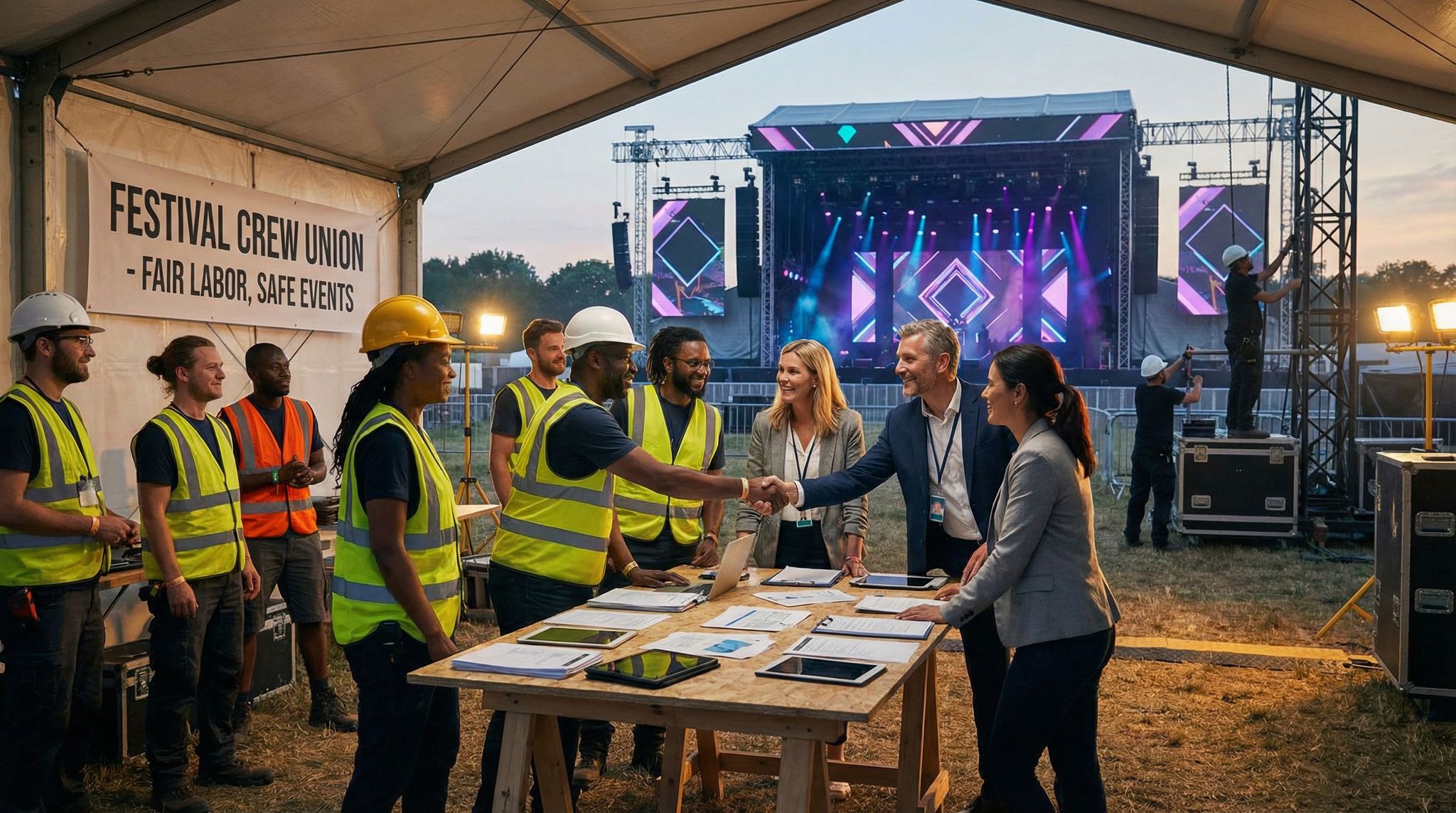
One practical outcome of good-faith talks is setting up a joint labor-management committee post-contract. Many successful festival labor agreements include a clause creating a committee of crew representatives (including union stewards) and festival management that meets periodically to troubleshoot issues during the year. For example, before the next festival edition, this committee might review the schedule or a new stage plan together to preempt any concerns about staffing or safety. This continuous collaboration means fewer surprises and disputes when you’re on-site and the pressure is high. As noted in a venue context, some organizations even involve union crew in planning meetings for technical upgrades – the same principle can apply to festivals making operational changes.
Above all, follow through on what you agree to. The fastest way to sour a labor relationship is to renege on promises. If your negotiated agreement says crew get a 1-hour meal break, then even if the headliner is running late, you honor that break or work with the union steward on an alternative plan that the crew consents to. By executing the contract faithfully and addressing any breaches immediately (stuff happens – maybe a miscommunication causes someone to miss a break; the key is to rectify it and if needed, pay the penalty or overtime as agreed), you build a reputation as a trustworthy partner. This pays dividends long-term: when crew know you keep your word, they are far more likely to go the extra mile when the festival really needs it.
Blending Union and Non-Union Teams Smoothly
It’s worth noting that not every festival will have an all-union crew. You may end up with a mix – perhaps certain departments unionized and others not, or union labor from one city joining forces with your regular non-union crew. In these cases, thoughtful management is required to avoid friction. Clear role definitions are essential: plan out which tasks are designated for union personnel versus non-union staff. This avoids accidental conflicts like a well-meaning volunteer doing a job that a union member should be assigned (which could trigger a grievance). For example, if your agreement says only union riggers handle truss climbing, don’t ask your non-union stagehands to do that – even if they’re capable – because it undercuts the agreement.
Foster a unified team culture despite the different employment statuses. Make sure all crew attend the same briefings and get the same information, rather than separating the “union crew” aside – integration helps dissipate any us-versus-them sentiment. Encourage collaboration and mutual respect in mixed teams performing union and non-union roles. Often union members bring seasoned expertise, while younger non-union staff bring fresh energy; pairing them up can be beneficial. One festival in California implemented a “buddy system” where each non-union volunteer was paired with a union pro in a similar role during load-in – knowledge was exchanged both ways, and it broke down barriers. Also, educate your non-union team about working alongside union colleagues: let them know it’s not about special treatment, but about everyone doing their assigned role safely and effectively. If non-union staff perceive union rules as constraints, explain that those rules improve fairness and safety (for instance, “We’re taking a lunch break now because that’s a union requirement and it’s important for everyone’s well-being”). Setting this tone helps ensure your entire crew functions as one unit.
Mixed crew situations can sometimes lead to jealousies or misunderstandings – like a non-union worker might wonder why a union member gets overtime after 8 hours while they don’t. The best approach here is transparency and fairness wherever you can. If possible, offer similar rest breaks and amenities to everyone, not just what the union contract mandates for union members. Many festivals choose to voluntarily mirror union conditions for all staff. For example, if union crew stop for a 1-hour lunch with catered food, give your volunteers and non-union staff the same meal period and food. This avoids a two-tier work environment that could breed resentment. Yes, there might still be differences in pay or benefits (that’s often why people unionize in the first place), but you can uphold a general principle that everyone on-site deserves respect, decent working conditions, and to be heard if they have an issue. By modeling equitable treatment, you also subtly show non-union crew the benefits of fair labor practices – which, if they ever consider unionizing, means you’ve already proven that you’re not an antagonist.
In summary, collaborating with unions in good faith boils down to respect, communication, and a willingness to meet in the middle. Festival organizers who have navigated these waters successfully often speak of the pride and professionalism that a stable, union-integrated crew brings. Rather than viewing it as ceding control, they see it as sharing control – and responsibility – with people equally invested in the festival’s success. As one long-time festival director said after negotiating a landmark crew agreement, “I realized we all wanted the same thing – an incredible event. Once we got on the same page, the union became not a hurdle, but a pillar holding the event up.”
Adjusting Budgets and Schedules to Meet Fair Labor Practices
One of the most challenging aspects of embracing better labor practices (union or otherwise) is the impact on budgets and timelines. There’s no sugar-coating it: treating crew more fairly – paying overtime, hiring extra hands to allow shift rotations, providing better facilities – does cost more and can complicate scheduling. However, these costs are an investment in your festival’s sustainability and reputation. Let’s break down how festival producers can adjust budgets and schedules to align with fair labor practices, turning what may seem like hurdles into manageable plan elements.
Budgeting for a Fair Workforce
Labor will likely take up a larger share of your festival budget in the era of organized crews. Instead of ignoring that, build it in from day one. During budget planning, allocate funds for the following labor-related items:
– Higher Wages & Benefits: If union agreements or conscious improvements raise wages by, say, 15-20%, that needs to be reflected in your budget. Similarly, account for payroll taxes, workers’ comp insurance, health contributions, or other benefits if those come into play.
– Overtime Pay: Plan for a certain percentage of crew hours to incur overtime. For example, if historically your stage crew worked 60 hours during the week of show, then at least 20 of those hours are overtime by standard definitions. Budget for overtime at time-and-a-half (or whatever rate applicable) so it’s not a nasty surprise later. Seasoned accountants often create a separate line item for overtime in each department’s budget, which helps track and control it.
– Additional Crew/Shift Coverage: To avoid overtime or burnout, you may choose to hire more people for shorter shifts. This means paying more individuals for overlapping roles. Budget for extra positions or backup staff. For instance, instead of 10 security guards doing 16-hour shifts, you might hire 15 guards doing ~10-hour shifts. Yes, that’s 50% more people, but each at fewer hours. A practical tip is to use historical data: if your total crew hours needed for a task were 500, you could budget for 600 hours spread across more staff to allow breathing room and legal compliance.
– Training and Safety Measures: Dedicate some funds for crew training, safety drills, or equipment (like harnesses, first aid kits, hydration stations). These costs pay off by preventing accidents and demonstrating your commitment to crew welfare.
– Contingency for Labor Disputes: It might seem pessimistic, but setting aside a small contingency (even 1-2% of budget) for labor issues is wise. This could cover things like bringing in an extra rigger last-minute if one goes off sick (healthier working conditions actually reduce that risk) or, in worst case, covering expenses if a delay or renegotiation leads to extra costs.
Many festival producers find that these labor investments can be offset with creative financial strategies. For example, securing a new sponsorship specifically earmarked for “crew wellness” or “safety initiatives” can turn a cost into a marketing positive (imagine a brand sponsoring your crew catering or rest lounge). Additionally, some ticketing platforms provide financial tools that help with cash flow for higher upfront costs – advance funding programs (like Ticket Fairy’s Event Fund for production expenses) can front production expenses including staff payroll, so you’re not strained paying overtime before ticket revenues come in. If fair labor practices add £50,000 to your budget, think of it this way: that might be the equivalent of 200 additional VIP tickets or a slightly higher sponsor ask. Communicate to stakeholders that this is an investment in quality and safety. After all, a festival that avoids a shutdown or bad press from a labor dispute is protecting its revenue and brand in the long run.
To illustrate how certain union or fair labor requirements can impact budget and planning, consider the following comparison of key labor rules:
| Labor Aspect | Old Approach (Typical Non-Union Practice) | New Approach (Fair/Union Standard) |
|---|---|---|
| Work Hours per Day | 10–16 hours common, often at a flat day rate. Crew might work until a task is done, regardless of fatigue. | ~8 hours base with overtime after that (or shift change). Plan multiple shifts for builds that go beyond 8-10 hours. No more marathon 18h days without relief or shift limits. |
| Overtime Compensation | May not be paid at premium (some gigs paid a lump sum regardless of hours). | Time-and-a-half or more for hours beyond standard (exact threshold per law/contract). Budget example: a crew paid $20/hour costs $30/hour in OT, increasing labor cost for extra hours ~50%. |
| Crew Size and Roles | “Do more with less” mentality; minimal crew counts, one person doing multiple jobs to save money. | Minimum staffing levels enforced for certain tasks (e.g. 4 stagehands to load heavy gear). Dedicated roles – you can’t ask the audio tech to also climb truss if that’s a rigger’s job. Possibly hire additional personnel to meet these needs. |
| Meal/Rest Breaks | Often informal, skipped or taken on the fly; no additional cost (crew expected to eat quickly on their own time). | Guaranteed meal breaks (e.g. 1 hour after 5 hours work) – if not provided, financial penalties apply. May need to extend timelines slightly to accommodate breaks, or stagger crews so work continues while others take required breaks. Budget for catered meals or stipends to ensure breaks are effective. |
| Safety and Training | Ad-hoc, learn as you go; safety training not a line item in budget. PPE sometimes personal responsibility. | Mandatory safety training/orientations on the clock. Time for training is paid. PPE often provided by organizer. Minor cost increase upfront that prevents big costs later (accidents, fines). |
This table highlights that adopting union standards can change how you allocate resources. For example, if previously one technical team worked 14 hours straight to finish overnight load-in, now you might split that into two teams of 7 hours each – labor cost might increase, but the work gets done more safely and you avoid paying heavy overtime or risking errors. Savvy producers also find efficiencies in other areas to balance the labor increases. Perhaps you spend slightly less on non-essentials or use technology to automate a process (for instance, using an all-in-one event management platform to reduce on-site admin workload). The key is to approach budgeting as a dynamic puzzle: if labor pieces get bigger, some other pieces might need to adjust.
Reworking Schedules and Timelines
Time is money in festivals, and fair labor practices often require adjusting your production timeline. Two major factors come into play: providing breaks/rest, and potentially dealing with work rule constraints (like curfews or limited overnight shifts). The solution is better planning and possibly starting earlier. If you know setup will take 5 days with round-the-clock shifts, build that into the schedule from the start rather than hoping to cram it into 3 days with exhausted crews. Many large-scale festivals have already shifted to longer build schedules for this reason – it’s not unusual now for a mega-festival to begin site build 6-8 weeks out instead of 4, spreading work more evenly.
One practical tip is to create a detailed crew scheduling matrix for the event. Lay out each day’s tasks and map who is assigned, in what shift blocks. Identify any points where under old habits someone would have had to work an unsafe length – then plug in a second person or team to take over at that juncture. For example, if you traditionally have the same lighting crew handle both a late-night focus and the early-morning power-on, that’s a red flag. Split those into separate crews or give a reasonable break in between. Communicate these schedules clearly to the crew well ahead of time, so they know what to expect. Crew appreciate knowing, “Okay, I’ll be on a 8am-6pm shift, and someone else picks up 6pm-midnight” rather than the dreaded “work until it’s done” ambiguity.
Keep in mind that union agreements might also dictate schedule elements like turnaround time (minimum hours between shifts) or maximum consecutive days before a day off. If your festival runs over two weekends with a break in between, union crew might insist on a rest day after so many days. You’ll need to accommodate that in hiring (maybe rotate two sets of crews across weekends). Scheduling must account for human limits – whether by law, contract, or common sense. In practice, many producers find that once they embrace this, efficiency actually improves. A crew that works 10 focused hours and then hands off to a fresh team can sometimes get more done collectively in 20 hours than a single crew pushing through 16 fatigued hours. As one operations manager said, “We were stunned to see the night shift finished almost as much as the old single shift used to, and with zero incidents. Day crew came back recharged. It was smoother.” Planning for overlap, such as a short meeting when shifts change to brief the incoming team, ensures continuity.
Don’t forget contingency time. Festivals know to plan buffers for weather, permitting delays, etc., and now you should also buffer for labor realities. Have a little slack in the schedule so that if, say, a critical crew member falls ill or if negotiations with a union cause a slight delay in starting work, you’re not immediately in panic mode. For instance, schedule main stage completion one day before absolutely necessary, in case crew rotations slow it down a bit. If all goes well, you end up ahead of schedule (and could even give crews a bit of time off as a reward).
Finally, coordinate with the union (or crew leads if non-union) on the schedule to ensure it’s realistic. Invite their input on the draft timeline and working relationship – they might spot issues you missed or suggest efficiencies. Perhaps they know that by adding one more person in a team, a job can be done in 6 hours instead of 8, saving overtime. Or they might recommend different sequencing of tasks to give people natural breaks. Collaborating on the plan minimizes surprises like a crew saying “we can’t possibly turn this around in 4 hours with safe practices.” When they co-create the schedule, there’s shared accountability to meet it.
In summary, adjusting budgets and schedules for fair labor is absolutely doable with careful planning. Yes, you may trim some expenses elsewhere or push your timeline out slightly, but the upside is huge. You reduce the risk of burnout-fueled mistakes that cause show delays or injuries, you improve team morale, and you significantly lower the chance of a labor dispute derailing the event at the worst moment. Many festivals that have gone through this transition report that the show quality improved – crews were sharp, setups were more robust, and the general atmosphere was positive backstage, which often carries through to the attendee experience. Think of fair labor costs as insurance: you’re investing in the smooth running of your festival. Plus, as more events adopt these practices, fans and sponsors will come to expect festivals to treat their people right. Being ahead of that curve can even be a selling point, as fans increasingly care about the ethics behind the events they support.
Real-World Lessons: Win-Win Labor Agreements in Action
The idea of union negotiations might still sound daunting, but real festivals have navigated these waters and come out stronger. Let’s look at a couple of examples and lessons learned from events that successfully reached win-win outcomes with organized crews.
Case Study 1: Festivals Malta’s Collective Agreement
In mid-2025, Festivals Malta – the government-backed organization running major cultural events in Malta – signed a groundbreaking collective agreement with its employees. This agreement was negotiated with a union (U?M – Union ?addiema Mag?qudin) and achieved salary increases, new allowances, and clear working condition guidelines for the staff according to Minister Bonnici. The process was notably collaborative: the culture minister and festival leadership publicly praised the staff’s dedication and openly acknowledged that these festival employees often work long hours, weekends, and holidays to make events happen highlighted by Chairman Aaron Zahra. By recognizing the sacrifice and commitment of the crew, management set a positive tone. The union, for its part, thanked the organizers for their professionalism during negotiations on behalf of the U?M union. The resulting five-year agreement was hailed as a “major milestone” that raised compensation and set positive standards for working conditions going forward.
Lesson: Festivals Malta’s experience shows the value of acknowledging crew contributions and negotiating proactively before a crisis forces it. They didn’t wait for a strike – they sat down, involved even government stakeholders, and came to a mutually beneficial deal. Festival producers can take note that involving high-level support (like a city or state cultural office, if your event is of public interest) can lend weight and resources to improving labor conditions. And by locking in a multi-year agreement, they ensured labor stability for future events, which is priceless when planning big festivals year after year.
Case Study 2: Preventing a Stagehand Strike at a Major U.S. Festival
A few years ago, a large music festival in the U.S. Midwest faced a brewing labor issue: the local stagehand union was unhappy with the long hours and meager per diems their members experienced at the previous year’s festival. Rumblings of a possible strike or picket emerged just months before the next edition, which could have been devastating for the event’s schedule. The festival organizers took a two-pronged approach to defuse the situation. First, they opened direct dialogues with the union business agent as soon as they heard about the concerns. Rather than dismissing the complaints, the production director acknowledged that improvements were needed. They worked out an interim solution for that year’s festival: guaranteed meal breaks catered by the festival (addressing the meager per diem issue) and a cap of 12 hours max on shifts with shuttles to take crew back to their hotel after long shifts (addressing the extreme hours). These changes were communicated in writing to the union and crew in advance. Second, the festival quietly budgeted extra funds to bring in a few additional local crew to split shifts and authorized overtime pay where needed – a departure from their previous flat-rate labor deal.
Come festival time, the atmosphere among crew was much improved. The union members saw tangible changes: they got hot meals and didn’t have to pull back-to-back double shifts. In response, the stagehand union informally agreed not to disrupt the festival – no last-minute demands or walkouts. After the event, the organizers sat down with the union to formalize some of these practices into a written agreement or MOU (memorandum of understanding) for future years, essentially codifying the meal policy and shift lengths. The compromise ended up barely increasing the labor cost relative to the overall budget (the event’s ticket sales and reputation could easily have taken a bigger hit if a strike occurred). In the end, the festival ran smoothly and both sides felt heard – crew felt their issues were addressed, and management avoided a costly showdown.
Lesson: Early engagement and tangible good-faith measures can avert a labor crisis. This festival’s story highlights that you don’t always need a fully negotiated contract on paper before making improvements. If time is short, demonstrate good faith by voluntarily implementing some of the changes the crew seek. It builds trust and buys you time to then negotiate a more formal agreement later. Also, by involving the union in crafting solutions (in this case, discussing what meal break setup would satisfy them), the organizers found relatively simple fixes that enhanced goodwill immensely.
Case Study 3: Turning a Union Mandate into a Festival Asset
Not all union interactions start with conflict. Sometimes, using union labor from the outset can be a strategic advantage if managed well. Consider a large international festival in Australia that decided to expand to a new city where unions have a strong presence. They knew from day one that local regulations would require union crew for many roles (audio, staging, electricians). So, the festival’s production team met with the union months in advance, essentially saying, “Help us make this event great – what do you need from us, and here’s what we need from you.” They even included union leaders in early site visits. The union, seeing a chance to secure work for its members, was eager to collaborate. They assigned some of their most experienced crew to the event and worked with the organizers to schedule shifts that balanced the festival’s tight timeline with the union’s work-hour limits.
During the festival, whenever a minor issue arose (like a question about whether a certain task was within a certain crew’s scope), the festival managers and the on-site union steward addressed it together on the spot with the union steward and management. The attitude was problem-solving, not blaming. Post-event, the festival publicly thanked the union crew in press releases, highlighting their craftsmanship in bringing the event to life. This public appreciation reflected well on the union, showing its members as integral to the success. The result: when the festival returned the next year, they had zero trouble staffing it – union crew were eager to sign on, and there was a solid understanding in place, meaning negotiations for the crew terms took maybe an hour instead of days. The production manager also noted that having a skilled, stable union crew actually saved time and money – there was less rework, and safety incidents were nil, which avoided any delays.
Lesson: Proactively integrating union requirements into your planning can transform a would-be constraint into a benefit. By aligning interests (the union wants steady, safe jobs; the festival wants reliable, skilled labor), both can win. The transparency and cooperation in this case show that union relationships aren’t just about avoiding negatives; they can produce positives like higher quality production and an easier annual planning cycle.
These scenarios reinforce that the rise of organized labor in festivals doesn’t have to be a nightmare for producers. Yes, it introduces new complexities, but with the right approach, those can be managed and even turned to advantage. Festivals thrive on community and collective energy – and that applies to the crew as much as the audience. When crew form a union or band together, they are essentially asking to be treated as a valued part of the festival community, with a voice in their working conditions. Forward-thinking producers meet that request with open arms, not clenched fists.
Frequently Asked Questions
Why are festival crews unionizing in 2026?
Festival crews are unionizing primarily to address grievances regarding excessive working hours, low pay, and unsafe conditions. Recent surveys reveal staff often endure 18-hour days and lack basic amenities like drinking water. Unionization provides a collective voice to negotiate for fair wages, overtime pay, and safer working environments.
What legal obligations do festival organizers have regarding unions?
Organizers are legally required to recognize valid unions and engage in good-faith bargaining under laws like the National Labor Relations Act. Employers cannot retaliate against workers for organizing and must adhere to collective bargaining agreements. Failure to comply with mandated wage scales, break times, and safety rules can result in significant legal penalties.
Can independent contractors unionize in the festival industry?
Independent contractors generally lack the federal protections to unionize that employees possess, but misclassification poses a major risk. If a festival exerts significant control over a worker’s schedule and duties, regulators may reclassify them as employees eligible for union rights. Correct classification is essential to avoid legal disputes and back-pay obligations.
How can festival producers improve crew working conditions proactively?
Producers can improve conditions by enforcing reasonable shift limits, such as 10-12 hours maximum, and scheduling mandatory meal breaks. Investing in safety training, providing proper PPE, and offering fair compensation comparable to union rates demonstrates respect. Establishing open communication channels for grievances can also prevent issues from escalating into labor disputes.
How should festival organizers negotiate with labor unions?
Organizers should approach negotiations as a partnership, engaging in transparency and good-faith bargaining with union representatives. Effective strategies include listening to specific crew concerns, sharing relevant budget constraints, and focusing on shared goals like event safety. Involving department heads and potentially using neutral mediators can help reach mutually beneficial collective bargaining agreements.
How does union labor affect festival budgets?
Union labor typically requires higher budget allocations for standardized wages, overtime pay, and benefits. Organizers must also account for costs associated with minimum staffing levels and penalties for missed breaks. However, these expenses are often offset by the increased efficiency, reliability, and reduced liability risks that come with a professional, well-rested crew.
What are best practices for scheduling festival crews to avoid burnout?
Best practices include capping daily work hours at 8-10 hours and implementing rotating shifts for round-the-clock operations. Schedules should include guaranteed rest periods of at least 10 hours between shifts and mandatory meal breaks. Building buffer time into the production timeline allows for these breaks without compromising the event setup.
Can festivals use both union and non-union crew members?
Festivals can successfully employ mixed teams by clearly defining roles to ensure union members handle jurisdiction-specific tasks. Management should foster a unified culture by providing equitable treatment and amenities to all staff, regardless of status. Clear communication about job responsibilities helps prevent friction and ensures compliance with union contracts.
What are the benefits of hiring unionized festival staff?
Hiring unionized staff provides access to a highly skilled and safety-trained workforce, which often leads to greater operational efficiency. Union agreements offer labor stability, significantly reducing the risk of strikes or last-minute walkouts. Additionally, a professional union crew can enhance the event’s reputation and minimize costly accidents or technical errors.
What is a unionized environment in festival production?
A unionized environment refers to a workplace where festival crews and staff are represented by a recognized labor union that negotiates their terms of employment. In this setting, organizers and venue managers must adhere to a collective bargaining agreement (CBA) that dictates work hours, mandatory rest breaks, safety protocols, and wage scales, rather than negotiating these terms individually with each contractor or employee.
What is a “broken turnaround” and why is it a major safety risk for festival crews?
A broken turnaround occurs when festival crews are required to return to work without receiving the legally or biologically necessary rest period between shifts (typically 10 to 11 hours). As highlighted by recent union research—such as Bectu’s urgent calls for action on the lack of rest breaks—this practice poses a huge health and safety risk. Operating heavy equipment, rigging, and managing crowds while severely fatigued drastically increases the likelihood of on-site accidents. For organizers, eliminating broken turnarounds is essential for minimizing liability and ensuring a safe, compliant working environment.
What are standard IATSE turnaround rules, and how do they impact festival scheduling?
IATSE turnaround rules dictate the minimum required rest period between the end of a crew member’s shift and the start of their next call. Typically, these guidelines mandate an 8 to 10-hour rest window to prevent dangerous fatigue. For festival organizers, adhering to these turnaround standards—even for non-union crews—is a crucial best practice for ensuring site safety, maintaining high morale, and avoiding costly financial penalties associated with forced calls or broken turnarounds.