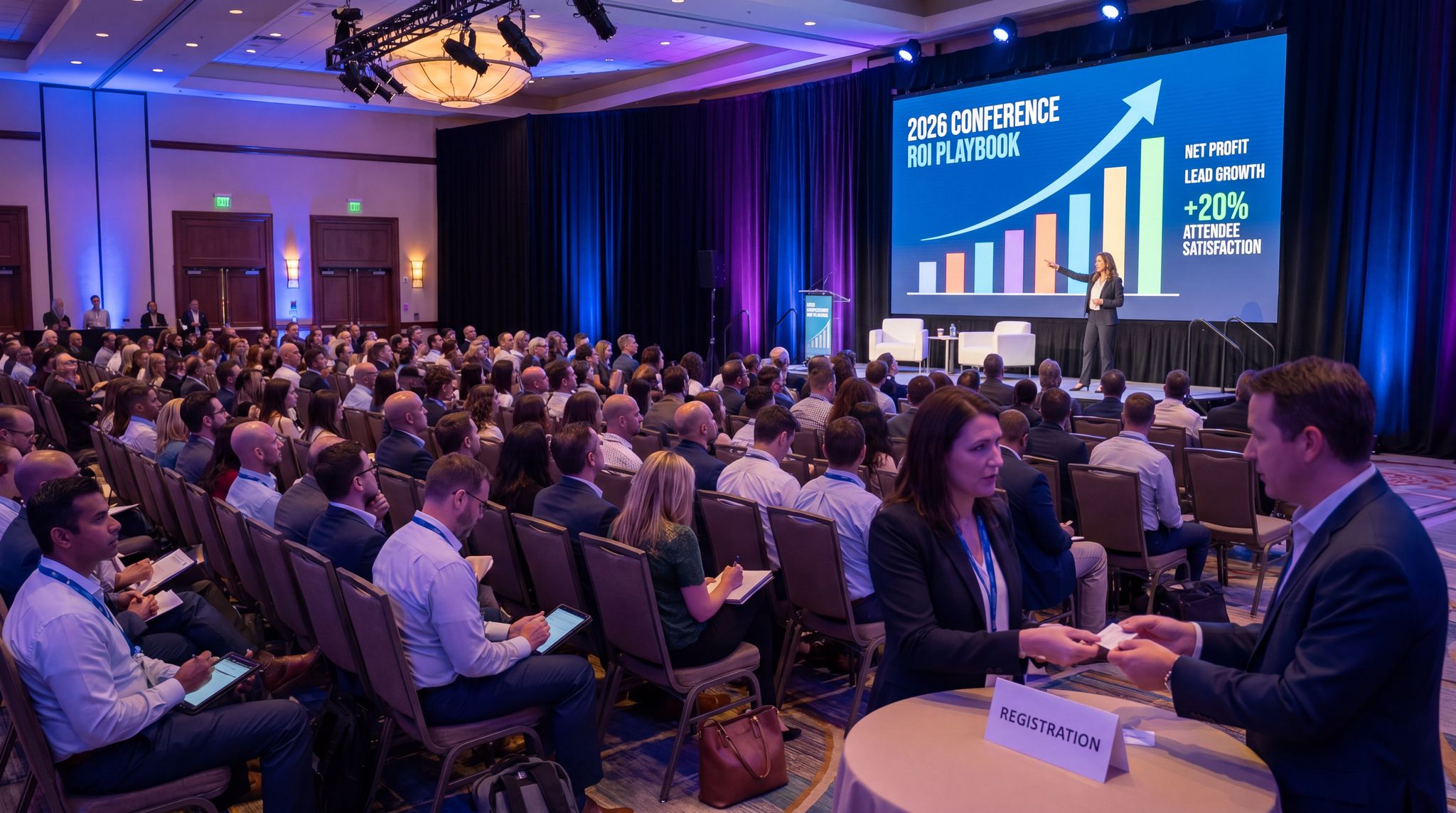
Every conference organiser in 2026 faces a pointed question once the lights dim and the last delegates head home: Was it worth it? With budgets under scrutiny and stakeholders demanding proof, measuring return on investment (ROI) for conferences has become mission-critical. In fact, nearly half of event marketers struggled to quantify ROI in recent years – a gap this playbook aims to close. By setting clear objectives, tracking meaningful conference ROI metrics, and translating data into compelling evidence, organisers can demonstrate real value. This guide breaks down a practical framework to define success, measure it rigorously, and prove to sponsors, attendees, and executives alike that your event delivered results.
Setting Clear Objectives for ROI
Define Success in Specific Terms
A conference’s ROI measurement begins long before the first attendee checks in. It starts with clear, specific objectives that define success. Avoid vague goals like “host a great event” – instead, pinpoint what “great” means in measurable terms. For a corporate user conference, success might mean generating $5 million in sales pipeline or achieving 95% customer satisfaction. An academic symposium might aim for 100 research papers presented or 200 citations within a year. Experienced planners align each objective to a metric: e.g., “increase qualified leads by 20%” is tied to the number of sales leads captured. By articulating goals concretely, you set the stage for meaningful ROI evaluation later.
Objectives should reflect the priorities of your stakeholders. Financial targets (like reaching break-even or better) are common, but they’re not the only aim. Many organisers also set goals for attendee experience, learning outcomes, and community impact. For example, a sustainable energy conference might prioritise knowledge exchange and set an objective to have 90% of attendees report learning something new – a metric captured via post-event survey. A trade association’s goal could be member retention, measured by renewal rates after the conference. The key is to define 3–5 core objectives covering both tangible outcomes (revenue, leads, attendance) and intangible benefits (satisfaction, knowledge gained). As industry veterans say, “if it matters, measure it” – and if you can’t measure it, reconsider if it truly matters as a conference goal.
Align Metrics with Goals
Once objectives are set, determine the metrics that align with each. This is essentially translating goals into numbers. If your objective is profit, metrics include total revenue, total costs, and net profit margin. If it’s attendee satisfaction, metrics might be survey ratings, Net Promoter Score (NPS), and repeat attendance rate. Make sure each goal has at least one quantifiable metric attached. Experienced conference organisers often use the SMART framework (Specific, Measurable, Achievable, Relevant, Time-bound) to refine objectives and ensure metrics are well-defined and time-limited (e.g., “achieve 85%+ satisfaction this year” rather than “improve satisfaction someday”). By aligning metrics to goals upfront, you create a roadmap for data collection and avoid the common pitfall of drowning in irrelevant stats later.
Data-Driven Event Marketing
Track ticket sales, demographics, marketing ROI, and social reach in real time. Exportable reports give you the insights to make smarter decisions.
Crucially, include both ROI metrics and ROE (Return on Event) metrics. Industry research is expanding beyond pure financials – PCMA’s “Beyond ROI to ROE” initiative urges organisers to capture the full impact of meetings, including the intangible “magic” that happens when people gather. This means that alongside cost and revenue, you might track things like audience engagement, brand sentiment, or knowledge transfer. For instance, if one goal is enhancing your brand’s thought leadership, a metric could be media mentions or social media share of voice during the conference. By embracing a broader view of value (ROI and ROE), you acknowledge not just the countable metrics but also qualitative outcomes that stakeholders appreciate.
Pro tip: Involve stakeholders in setting objectives early. Ask sponsors what outcomes matter to them (e.g. number of leads, demo sign-ups), and ask internal executives what success looks like in their eyes. This collaborative goal-setting builds buy-in for later when you report back on those very metrics.
Identifying Key Conference ROI Metrics
Once objectives and broad metrics are defined, it’s time to nail down the specific conference ROI metrics you’ll measure. These metrics fall into two buckets: tangible financial/business metrics and intangible experience metrics. Below we break down the most important types in each category and how they demonstrate conference success.
Tangible Metrics: Finance, Marketing & Growth
Financial ROI metrics are at the core of evaluating any event’s success. Start with the basics: total revenue (from tickets, sponsorships, exhibits, etc.) and total cost (venue, A/V, marketing, etc.). From these, calculate net profit (or loss) and the ROI percentage. ROI% is typically (Revenue - Cost) / Cost * 100. For example, if you spent $1,000,000 on a conference and earned $1,200,000 in revenue, your ROI is ($1.2M-$1.0M)/$1.0M = 20%. Many professional conferences target a healthy profit margin in the 10–20% range, though for non-profit or first-year events the goal might simply be to break even or build long-term goodwill. Table 1 below summarizes several core financial metrics and how to calculate them:
| ROI Metric | How to Calculate | Example |
|---|---|---|
| Net ROI (%) | (Total Revenue – Total Cost) / Total Cost * 100 | ($1.2M – $1.0M) / $1.0M = 20% |
| Cost per Attendee | Total Cost / Number of Attendees | $500,000 / 1,000 = $500 |
| Cost per Lead | Total Cost / Number of Leads Generated | $100,000 / 500 leads = $200/lead |
| Net Promoter Score | % Promoters – % Detractors (from post-event survey) | 70% – 10% = NPS of 60 |
| Learning Gain | Post-event Quiz Score – Pre-event Quiz Score | 85% post vs 70% pre = +15 points |
Beyond profit, consider marketing ROI metrics that tie the conference to business growth. If one aim of the event is lead generation or sales, track metrics like number of qualified leads, cost per lead, and pipeline created. For instance, a B2B conference may generate 500 sales-qualified leads – if you spent $100,000 on the event, that’s $200 per lead (as in Table 1). You can further estimate pipeline value by having sales or sponsors project the potential revenue from those leads. Another key metric is customer acquisition cost (CAC) for any deals closed from the event: divide the event cost by the number of new customers acquired because of the conference. Repeat attendance rate (how many attendees return year over year) is another tangible metric indicating loyalty and community growth, which in turn drives future revenue.
Sponsor ROI metrics also fall in the tangible bucket. Sponsors invest in your conference expecting a return, often in the form of exposure and leads. Metrics here include number of leads captured per sponsor, booth traffic counts, demo sign-ups, and social media impressions for sponsor-branded content. Many expos and trade shows use lead retrieval tech to track exactly how many leads each exhibitor collects. It’s wise to calculate cost per lead for sponsors (their sponsorship fee divided by leads obtained) to benchmark value. For example, if a sponsor paid $10,000 and scanned 200 leads, they paid $50 per lead – compare that to their cost per lead at other marketing channels or events. Also measure sponsor retention or upsell: a high re-booking rate for next year’s sponsors is a strong indicator of ROI delivered. Keep in mind that ROI can vary wildly by how sponsors activate their presence – one case study noted a company spending $85,000 on a platinum sponsorship yielded fewer sales leads than a competitor’s bronze package. The lesson is clear: without tracking these metrics, neither you nor your sponsors can judge whether a sponsorship package was truly worthwhile.
Turn Fans Into Your Marketing Team
Ticket Fairy's built-in referral rewards system incentivizes attendees to share your event, delivering 15-25% sales boosts and 30x ROI vs paid ads.
Intangible Metrics: Satisfaction, Learning & Engagement
Not all conference benefits show up on a balance sheet. Attendee satisfaction and engagement metrics capture the success of the event experience itself. The go-to metric here is Attendee Satisfaction Score, usually measured via post-event surveys. You might ask attendees to rate overall satisfaction on a 1–5 scale; an average of 4.5, for example, equates to 90% satisfaction. Another popular measure is the Net Promoter Score (NPS) – “How likely are you to recommend this event to a colleague?” – which gauges loyalty and word-of-mouth potential. High satisfaction and NPS correlate with positive ROI in subtle ways: happy attendees are more likely to return (driving future revenue) and to spread positive buzz that attracts others. Set a target for these scores (e.g., NPS of 50+ which is considered excellent in the events industry) and track it annually.
Learning outcomes are crucial for conferences with educational missions – think academic conferences, medical congresses, or professional training seminars. Metrics could include the number of Continuing Education credits issued, quiz or test results (if you administer learning assessments), or self-reported knowledge gain. For example, you might survey attendees on key knowledge areas before and after the conference to quantify learning improvements (Table 1 shows a hypothetical +15 point knowledge gain). If 85% of attendees say they learned something that will improve their work, that’s a compelling ROI story for a content-driven event. Academic conferences might track citations of papers presented or the number of collaborative projects initiated as a result of the event – these demonstrate research impact, a form of ROI for scholars.
Engagement metrics show how deeply attendees interacted with your conference. These include session attendance rates (what percentage of attendees actually showed up for each session), audience engagement in sessions (measured by Q&A questions asked, live poll responses, or session feedback ratings), and networking metrics like number of meeting requests sent through your event app. Some conferences measure the average number of new contacts made per attendee (e.g., through badge scanning or business card exchanges). If your event app or platform supports it, you might also look at social engagement – e.g., how many attendees posted on the event’s social feed or participated in discussion forums. High engagement often predicts higher satisfaction and future attendance: an attendee who made meaningful connections and stayed active throughout the schedule is likely to perceive the event as valuable.
Finally, consider community and brand metrics as part of ROI. These can include social media mentions and hashtag usage, media coverage volume, and sentiment analysis of those mentions. For large public-facing conferences, the media exposure (often quantified as an Advertising Value Equivalency in PR terms) can be huge – for example, SXSW 2023 generated hundreds of millions of social impressions and over $300M in local economic impact, reinforcing the event’s brand value. While not every conference operates at that scale, even a niche industry summit can track how its brand awareness grew (e.g., spikes in web traffic or social followers during event week). These stats help demonstrate ROI to marketing and executive stakeholders who care about long-term brand building more than immediate revenue.
Key metric tip: Don’t measure for the sake of measuring. Focus on metrics that tie back to your core objectives and stakeholder interests. It’s better to have a concise dashboard of truly relevant metrics than a sprawling report of dozens of stats no one will act on. As one event CEO put it, “We’d rather have five numbers we really understand than fifty that just look impressive.”
Collecting and Analyzing Data
Capturing the right data – and making sense of it – is the engine behind event ROI measurement. This phase is about turning the metrics you’ve identified into real numbers. It spans everything from the tools you use (e.g. registration platforms, apps, surveys) to the analysis techniques that connect the dots. Done well, data collection and analysis not only prove ROI after the fact but can also help optimize ROI in real time during the conference.
Collect Any Attendee Data at Checkout
Add custom registration fields to your checkout — dietary needs, t-shirt sizes, company names, and more. Conditional logic and per-ticket-type fields.
Data Collection Tools & Techniques
Build measurement into the conference design. Before the event, map out how you will collect each metric. For instance, if lead generation is a metric, ensure you have a lead capture system in place for exhibitors (QR code scanners, NFC badges, or lead collection apps). If session attendance is important, consider using badge scanning or a conference app check-in for sessions to count participation. Many modern conference registration systems can integrate these functions, so choose your tech platforms with data in mind. An all-in-one conference ticketing software with built-in analytics makes this easier by consolidating registration, attendance tracking, and feedback in one place. In 2026, organisers favour data-friendly platforms that give full access to attendee information and real-time stats, rather than siloed systems.
Key data sources include:
– Registration systems – the foundation of attendee data (who registered, ticket types, demographics, how they heard about the event). Ensure your registration platform can export data easily or, better, provides an analytics dashboard. For example, the Ticket Fairy platform includes real-time dashboards for ticket sales, demographics, and even referral tracking, so organisers can monitor ROI-related metrics as registrations roll in. Owning your registration data is vital – platforms that let you see which marketing campaigns drove sign-ups or the drop-off rate between ticket page views and actual purchases help calculate marketing ROI and optimize your funnel.
– Event apps and engagement platforms – these can log user actions like session check-ins, meeting requests, poll responses, and social posts. If increasing attendee engagement is a goal, an event app will provide the numbers to measure it (e.g., “5,000 messages sent between attendees” or “75% of attendees created a profile in the networking app”). Ensure you choose an app that gives you the data afterward – some platforms include detailed engagement reports.
– Lead capture systems – for sponsor ROI, deploy robust lead tech. Rather than relying on fishbowl business card drops, use digital solutions. Lead retrieval apps or smart badges allow exhibitors to scan attendee info with a tap, automatically logging each lead’s data. These tools often integrate directly with CRM systems. In fact, 81% of exhibitors now integrate lead capture with their CRM for instant follow-up. This means the data on leads (name, contact, interests) flows straight into pipelines, and you can track if those leads convert to revenue later. Be sure to communicate to sponsors how leads will be captured and reported – that transparency is part of proving value.
– Surveys and feedback forms – the primary way to measure satisfaction, learning, and other qualitative outcomes. Plan to conduct an attendee post-event survey within 24–48 hours of the conference (when impressions are fresh). Keep surveys concise to boost response rates, but cover your key ROI questions: overall satisfaction, NPS, content relevance, networking quality, and any specific learning or outcome questions. If you need deeper insight, consider pre-event and post-event surveys to gauge changes (for instance, a good practice for measuring learning outcomes or shifts in perception).
– Social media and web analytics – set up social listening for your event hashtag and track mentions, reach, and sentiment. Twitter/X, LinkedIn, and industry forums are gold mines for qualitative feedback and brand impact metrics. Also check website analytics for traffic spikes during the campaign and event – an increase in hits on your conference pages or content downloads can be an ROI indicator for marketing exposure.
– On-site observation & technology – don’t overlook physical metrics. Tools like RFID badges or heatmap sensors can track foot traffic in expo halls. Even without high-tech solutions, staff can do manual counts (e.g., count how many people are in seats for each keynote to calculate attendance rate vs. registrations for that session). If a goal is engagement in a particular feature (say a “demo zone” or sponsored lounge), assign someone to track usage (entries, dwell time) or use any available tech to do so. These data points can be very persuasive for sponsors and for improving layouts next time.
Everything you measure should map back to a metric and objective. Create a simple “measurement matrix” before the event that lists each metric, the tool or method to capture it, and who is responsible. For example: Lead scans – captured via ExpoApp scanners at booths – onsite tech team to compile daily. This ensures no important data is missed amidst the conference bustle.
Making Sense of the Numbers
Collecting data is only half the battle – now you must analyze and interpret it to derive insights. Start by consolidating all data sources into one place. Post-event, you might have a spreadsheet or dashboard combining registration data, survey results, lead counts, etc. Clean the data for accuracy (remove duplicates, correct any obvious errors like badge scans logged wrong). Then, calculate your key metrics: sum up total revenue, count the leads, average the survey scores, and so on.
Compare outcomes to targets. Remember those objectives and targets set at the beginning? Now is the time of reckoning. How did you perform against each? For instance, if your goal was 1,000 attendees but you registered 950, that’s 95% of target – worth discussing in your ROI report. If you aimed for $500k in sponsorship and achieved $550k, you’re at 110% of goal, which is a clear win. Create a simple table of Goal vs. Actual vs. % Achieved for all primary metrics. This straightforward view highlights success areas and gaps, making it easy for stakeholders to see where the event delivered and where it fell short.
Next, analyze the data for insights and context. Numbers on their own don’t tell the whole story. Interpret why certain outcomes happened. For example, if attendee satisfaction came in lower than expected, delve into the survey responses – did multiple people complain about the Wi-Fi or crowded rooms? If so, that’s a lesson to address for future ROI improvement. If one sponsor generated an unusually high number of leads, investigate what they did (perhaps a particularly engaging booth activation) and consider featuring that as a best practice for other sponsors next time. Segmenting data can be very illuminating: try breaking down attendee feedback by ticket type or demographic to see if certain groups had a better or worse experience. Perhaps VIP ticket holders rated the event 4.8 out of 5 while general attendees averaged 4.2 – that suggests your VIP perks paid off, or conversely that general attendees saw room for improvement.
Grow Your Social Following With Every Sale
Require social media follows, shares, or playlist adds to unlock presale access or special pricing. Turn every ticket purchase into audience growth.
Another powerful technique is benchmarking. Compare this event’s metrics to past events or industry benchmarks. If last year’s conference had an NPS of 50 and this year is 60, that’s a positive trend to trumpet. Or compare cost per lead at your conference to typical trade show benchmarks – if your $200/lead is below the industry average of (say) $300/lead, you’ve delivered efficient value. Where do you find benchmarks? Industry associations (PCMA, MPI, IAEE) and research firms often publish studies; for instance, CEIR provides benchmarks for exhibitor lead metrics, and some surveys share average attendee satisfaction scores. Also use internal benchmarks: your own historical data is often the best comparison, as it controls for event size and audience specifics.
Importantly, identify the stories in the data. Stakeholders remember narratives: “Our investment in a conference mobile app paid off – 85% of attendees used it, and those who did had 10% higher satisfaction scores.” Or, “Real-time data insights allowed us to fix an issue on Day 1, leading to a 30% boost in traffic to the underused demo zone on Day 2.” These specific insights are gold for your ROI report because they connect actions to outcomes. Perhaps you see that early-bird registrants (who got a discount) had a higher show-up rate and satisfaction than last-minute signups – a sign that early engagement improves ROI in terms of attendee quality. Highlighting such cause-and-effect with data not only proves this event’s value but can guide improvements for the next one.
Finally, leverage real-time analytics if available. In 2026, many organisers use live dashboards during the event to monitor key metrics as they unfold. This lets you course-correct on the fly and ultimately maximize ROI. For example, if you see on Day 1 that only 50% of attendees have checked into a new networking lounge, you could send a push notification via the event app to draw more people in, boosting engagement metrics. As Ticket Fairy’s own analytics experts note, instant data can translate into immediate ROI improvements by averting problems like long lines or empty sessions. One conference reported that switching to a data-driven crowd management tool cut registration wait times by half, resulting in higher first-day satisfaction (and fewer attendees skipping morning sessions). Incorporate any such mid-event adjustments into your analysis – it shows stakeholders that you actively managed ROI throughout, not just measured it after the fact.
With all metrics computed and insights gleaned, you’re ready for the final step: reporting the results in a compelling way that resonates with each audience.
Proving ROI to Stakeholders
Collecting great data is useless if you can’t communicate the value of your conference to those who matter. Different stakeholders care about different metrics, so your ROI report (or presentations) should be tailored accordingly. Typically, conference ROI needs to be proved to three groups: sponsors, attendees, and internal executives. Let’s look at how to demonstrate value to each in turn.
Demonstrating Value to Sponsors
Sponsors underwrite your conference with cash or in-kind contributions, and they expect a return in line with their investment. To prove ROI to sponsors, provide a post-event sponsor report that highlights outcomes in the metrics they care about. This often includes:
– Lead generation results: Provide detailed stats on leads captured. For example, “You scanned 350 attendee badges at your booth, of which 200 opted in for follow-up. This is a 17% capture rate from the 1,200 attendees on the expo floor.” If possible, break down lead quality – e.g., how many were classified as hot prospects on the spot. If you used digital lead capture, you can also share data like average dwell time at their booth or which content downloads were most popular.
– Brand exposure: Summarise how the sponsor’s brand was amplified. For instance, “Your logo was displayed on-screen to 800 in-person attendees and ~2,000 virtual viewers during the keynote live stream.” If you tracked social media, report “Your company was mentioned 120+ times in event-related posts, reaching an estimated 45,000 users.” Media coverage can be noted too: e.g., if a sponsor’s product launch at the conference got press pickups.
– Engagement activities: If the sponsor hosted a special event (like a sponsored breakfast or workshop), report the attendance and feedback for that. “Your sponsored workshop had 150 participants (75% of room capacity) with an average session rating of 4.3/5.” Any interactive activation results (e.g., 500 people visited the photo booth at their lounge) should be included.
– Comparative benchmarks: Sponsors, especially seasoned ones, will appreciate context. If you know average performance, show how they fared. “The average exhibitor captured 200 leads; you captured 350, placing you in the top 10%.” If available, provide industry benchmarks: “Tech conferences of similar size report an average cost per lead of $100 – your cost per lead was roughly $60, indicating strong ROI.”
– Next-year incentive: Use the data to encourage renewal. If ROI looks good, you might say, “We’d love to help you build on this success next year. Perhaps a bigger booth or a speaking slot could yield even more engagement – based on this year’s figures, we project you could capture 500+ leads with that increased presence.” Even if some metrics fell short, showing that you care about their results and have ideas to improve goes a long way.
Free Tool: Will the Room Actually Be Full?
Forecasts expected attendance from ticket type, event type and day of week. Calculates safe over-book count for free-RSVP events. Free estimator.
It’s often effective to present sponsor ROI data in a visually engaging format – think charts and infographics – rather than just text. For example, a bar chart of leads captured by each sponsor (with the sponsor’s bar highlighted) taps into their competitive spirit and shows value relative to peers. A heatmap of the expo floor foot traffic can vividly demonstrate that their booth’s location delivered strong exposure. Narrative is key: tie the numbers to outcomes. Instead of only “350 leads,” say “350 leads – which is 75% of your target – with follow-up info already in your inbox for immediate action.” If you have any testimonial or qualitative feedback (“Several attendees specifically praised your demo in our survey”), include that to humanize the impact.
Lastly, don’t shy away from calculating ROI for the sponsor if you have data to do so. If the sponsor is willing to share what those leads are worth or any sales closed, you can demonstrate, for example, “Your $10k sponsorship has so far resulted in $50k of confirmed sales – a 5:1 ROI – with more pipeline still in discussion.” Not all sponsors will share that info, but even a generic estimate (e.g., “if even 10% of your 350 leads convert at an average $5k sale, that’s $175k in revenue, a substantial return”) can underline the point that their investment paid off.
Ready to Sell Tickets?
Create professional event pages with built-in payment processing, marketing tools, and real-time analytics.
Demonstrating Value to Attendees
While attendees aren’t usually presented with a formal “ROI report,” proving value to them is crucial for loyalty and word-of-mouth. Essentially, you need to convince attendees (and often their bosses who approve the trip) that time and money spent at the conference yielded benefits. Here’s how:
– Communicate outcomes back to attendees. Consider sending a post-event “Thank You & Highlights” email that not only thanks them, but also recaps key achievements of the event: “Over two days, you and 1,000 peers attended 40 sessions, participated in 500+ hours of learning, and facilitated over 2,300 new connections through our networking tools.” This subtly signals the richness of the experience they were part of, reinforcing its value.
– Provide personal analytics or certificates. Some events now give attendees a personalised summary – e.g., “You attended 8 sessions, earned 12 Professional Development credits, and connected with 15 new contacts.” This kind of personal report, if you can pull it off with your data, makes the value tangible to each individual. At minimum, offering certificates of attendance or credit transcripts can help attendees justify the ROI to their employers (many will include these in trip reports at work to show it was worth the expense).
– Share content and continued learning. Prove that the value didn’t end when the conference did. Provide access to session recordings, slides, or an online knowledge library and highlight this as an added ROI element: “By attending, you now have on-demand access to 30 hours of insights – extending the learning far beyond the conference.” If your post-event survey shows strong satisfaction, share a stat like “95% of attendees found the conference valuable” – people like to know they were part of a worthwhile event. It affirms their choice to attend and makes them more likely to return.
– Highlight success stories. If certain attendees achieved something notable – e.g., a startup met an investor at the networking mixer and secured funding, or a jobseeker found a new role through contacts at the event – with their permission, share that story on your blog or next year’s brochure. It exemplifies attendee ROI in action. While these stories may be outliers, they are powerful testimonials of the event’s impact on individual careers and projects.
– Ask attendees to self-report ROI. In your surveys, consider including a question like “Do you feel attending this conference was worth your investment (time/money)?” or even a numeric estimate “What do you estimate is the value gained from attending (e.g., in dollars or hours saved thanks to what you learned)?” These data points, while subjective, can be striking. For example, if 88% of attendees say the conference was a good investment, that’s a headline for your marketing. Or if on average attendees say it was “worth about $5,000 to their business,” that’s an interesting way to quantify value from the attendee perspective.
The goal with attendees is to make them walk away feeling “I’m glad I came – it was absolutely worth it.” If you achieve that, they’ll likely come back next time (bringing colleagues along, perhaps). Monitoring metrics like repeat attendance rate and referral rate (how many new attendees came via word-of-mouth) in subsequent years can actually quantify this. For instance, if 40% of this year’s attendees are returning participants and 20% are friend referrals, those are strong indicators that attendees themselves are convinced of the ROI. To encourage this, some conferences explicitly package the ROI argument for attendees to take back to their managers – providing a one-page summary of benefits and learnings that justifies the expense. Doing so not only helps current attendees articulate the value they got, but also positions your event as a must-have when budget planning for next year.
Demonstrating Value to Executive Teams
Internally, you’ll likely need to justify the conference’s performance to your executive team, board, or clients (if you’re an agency producing an event). This is where you pull everything together into a comprehensive ROI report and/or presentation. For executive stakeholders, focus on the big picture and tie results back to organisational goals:
– Start with the bottom line. Early in the report, clearly state the net financial outcome: “The conference generated $1.2M in revenue against $1.05M in expenses, yielding a net profit of $150k (14% margin).” If the event was not designed for profit (e.g., a user conference aimed at retention or an academic event), state whether it met its budget (on budget, under, or the extent of any subsidy required) and why that investment was deemed worthwhile (e.g., in customer goodwill or research impact).
– Show core goal achievement. For each primary objective set, report the outcome. If your goal was to create sales pipeline, report “$5.4M in potential deals are now in the pipeline attributable to interactions at the conference.” If it was to increase membership, “We signed 50 new members on-site, a 8% increase in association membership directly tied to the event.” Use visuals like a checklist or goal vs. actual table to make it easy to see which goals were hit. Executives appreciate efficiency – they want to know, did the event do what it was supposed to do?
– Highlight key metrics and KPIs. Present the high-level metrics that matter most to the organisation. This might include attendance numbers, attendee demographics (e.g., 30% C-level execs attending if the goal was to attract decision-makers), sponsor count and revenue, media reach, and satisfaction scores. A popular approach is a one-page “dashboard” of KPIs with concise commentary. For example:
| Stakeholder | ROI Focus | Key Results from Conference |
|---|---|---|
| Attendees | Learning & Networking Value | 92% satisfaction; Average attendee made 5 new contacts; 300 training certificates issued. |
| Sponsors | Lead Gen & Brand Exposure | 45 sponsors (10% increase); 6,200 total leads captured across expo; Sponsor NPS 8.5/10. |
| Organisation | Revenue, Brand & Strategic Goals | $1.2M revenue (14% profit); 3 new product demos launched; 20+ media mentions in industry press. |
- Table 2: Example snapshot of ROI results by stakeholder group.
The above approach (as illustrated in Table 2) ensures each stakeholder’s interests are addressed: attendees got value, sponsors got leads/exposure, and the organisation furthered its mission and financial goals.
Smooth Entry With Mobile Check-In
Scan tickets and manage entry with our mobile check-in app. Supports photo ID verification, real-time capacity tracking, and multi-gate coordination.
- Tell the story behind the numbers. Executives will want to understand why things happened, not just what happened. Be ready to explain context: “Attendance was 950, short of our 1,000 goal, largely due to a new visa requirement impacting international guests – however, we overachieved on sponsorship which offset ticket revenue loss.” Or “Attendee satisfaction jumped to 92% from 85% last year after we implemented a new networking app – a relatively small $10k investment that clearly paid off.” Connect the dots between decisions made and outcomes achieved; this demonstrates strategic thinking and learning, which execs respect.
- Address shortcomings candidly. If some metrics disappointed, acknowledge them and provide a corrective plan. For instance, “Exhibitor ROI scores were modest: 70% struggled to quantify ROI. We discovered many leads weren’t followed up promptly by exhibitors. To improve this, we plan to integrate a lead follow-up tool and educate exhibitors on best practices next year. This should increase exhibitor satisfaction and measurable ROI.” Showing that you’re not only measuring ROI but actively tackling areas to improve it turns a negative into a forward-looking positive. It builds trust that you’re not hiding failures – you’re learning from them.
- Calculate broader impact if relevant. Some executive teams might value seeing the conference’s impact beyond direct dollars. For example, economic impact on a host city (use local tourism multipliers to estimate hotel nights, etc.), or employee engagement if internal staff attended (maybe employee attendees showed a post-event productivity bump or increased product knowledge). While these are secondary to the main ROI, they paint a fuller picture of the event’s value.
- Include testimonials or quotes. A powerful quote from a top client or industry leader (“This was the best conference in our field I’ve attended in years…”) included in an executive report can underscore the qualitative success that numbers may not fully capture. It reminds decision-makers that the event influenced perceptions and relationships – which often translate into long-term ROI via loyalty or brand strength.
Wrapping up the executive report, end with clear recommendations or next steps. If the ROI was strong, recommend doubling down: “Given the 20:1 ROI on our referral marketing campaign (over $100k in ticket sales from a $5k incentive spend), we will expand this tactic next year with a higher budget.” If something underperformed, outline your plan to fix or cut it. Treat the ROI analysis as a cycle that informs the next conference’s strategy – this demonstrates that every insight will be used to drive even better returns moving forward.
Conclusion: Turning Insight into Action
Measuring and proving conference ROI is both art and science. It requires the quantitative rigor of capturing data and calculating metrics, and the qualitative finesse of weaving those metrics into a story that resonates with each stakeholder. In 2026’s climate of accountability, this skill isn’t just nice to have – it’s essential. Organisers who can show the value of every dollar and every hour spent on their events will win the confidence of sponsors, loyalty of attendees, and backing of executives for years to come.
Grow Your Events
Leverage referral marketing, social sharing incentives, and audience insights to sell more tickets.
Remember, ROI analysis isn’t merely a report card – it’s a roadmap. The insights you gain from defining metrics and analyzing outcomes should directly inform how you plan your next conference. If the data says attendees craved more networking, build that in; if sponsors saw ROI in lead quantity but not quality, perhaps curate a better audience or provide scoring tools. Use ROI findings to continuously refine and future-proof your conference strategy.
As you implement this ROI playbook, you’ll find that measurement becomes second nature and even small wins become clear. Rather than relying on gut feel, you’ll have evidence of what’s working and what’s not. That empowers you to make bold improvements, secure bigger budgets, and confidently state the ultimate ROI truth: great conferences aren’t expenses – they’re investments that pay dividends.
Key Takeaways:
– Set Specific Goals: Define clear conference objectives (financial targets, lead counts, satisfaction levels, etc.) at the outset so you know what ROI markers to hit. Tie each goal to one or more concrete metrics for measurement.
– Track a Mix of Metrics: Combine financial metrics (revenue, profit, cost per attendee) with engagement metrics (survey scores, NPS, leads generated). This holistic view captures both the dollars-and-cents ROI and the intangible value (learning, networking, brand impact).
– Use Data Wisely: Collect data via registration systems, event apps, lead capture tools, and surveys. Analyze it against your targets and look for insights and trends. Leverage real-time analytics during the event to boost ROI (fix issues or seize opportunities on the fly).
– Tailor ROI Stories to Stakeholders: Prove value in the language each stakeholder values. Show sponsors their leads and exposure, demonstrate to attendees the knowledge and connections gained, and deliver to executives a clear summary of how the event met business goals and justified its costs.
– Continuous Improvement: Treat ROI measurement as a feedback loop. Use what worked (and what didn’t) to make data-driven changes for your next conference. Over time, this will increase ROI and also make it easier to secure support by pointing to a track record of proven results.
Frequently Asked Questions
What is a good ROI for a conference?
A good return on investment for professional conferences typically targets a healthy profit margin in the 10% to 20% range. However, non-profit or first-year events often aim simply to break even while building long-term goodwill, community growth, and brand awareness for future profitability.
What is Return on Event (ROE) in the meetings industry?
Return on Event (ROE) measures the full, holistic impact of a meeting beyond pure financial profit. It captures intangible qualitative outcomes such as audience engagement levels, brand sentiment, knowledge transfer, and the networking magic that occurs when professionals gather in person.
How do you calculate conference ROI?
Calculate conference ROI by subtracting the total event cost from the total revenue, dividing that number by the total cost, and multiplying by 100. For example, a conference that costs $1,000,000 to produce and generates $1,200,000 in revenue yields a 20% net ROI.
How can event organizers prove ROI to conference sponsors?
Organizers prove sponsor ROI by providing post-event reports detailing tangible business outcomes. These reports should highlight the exact number of leads captured, the calculated cost per lead, booth traffic counts, and brand exposure metrics like social media impressions and keynote live stream viewership.
What are the most important conference ROI metrics to track?
The most critical conference ROI metrics include tangible financial figures like net profit margin, cost per attendee, and cost per lead. Organizers must also track intangible experience metrics, including Net Promoter Score (NPS), attendee satisfaction ratings, session attendance rates, and measurable learning gains.
How do you collect attendee data at a conference?
Collect attendee data by integrating technology directly into the conference design. Utilize modern registration platforms for demographic data, event apps for session check-ins and poll responses, digital lead retrieval systems for exhibitor scanning, and post-event surveys deployed within 48 hours to capture satisfaction scores.
Why are real-time event analytics important for conferences?
Real-time event analytics allow organizers to monitor key metrics through live dashboards and course-correct immediately during the conference. Using instant data helps avert problems like long registration lines or empty sessions, ultimately maximizing attendee satisfaction and improving overall event ROI on the fly.
How do you measure attendee satisfaction at an event?
Measure attendee satisfaction primarily through post-event surveys distributed within 24 to 48 hours while impressions remain fresh. Ask attendees to rate their overall experience on a 1-to-5 scale and calculate the Net Promoter Score (NPS) to gauge loyalty and likelihood to recommend the event.