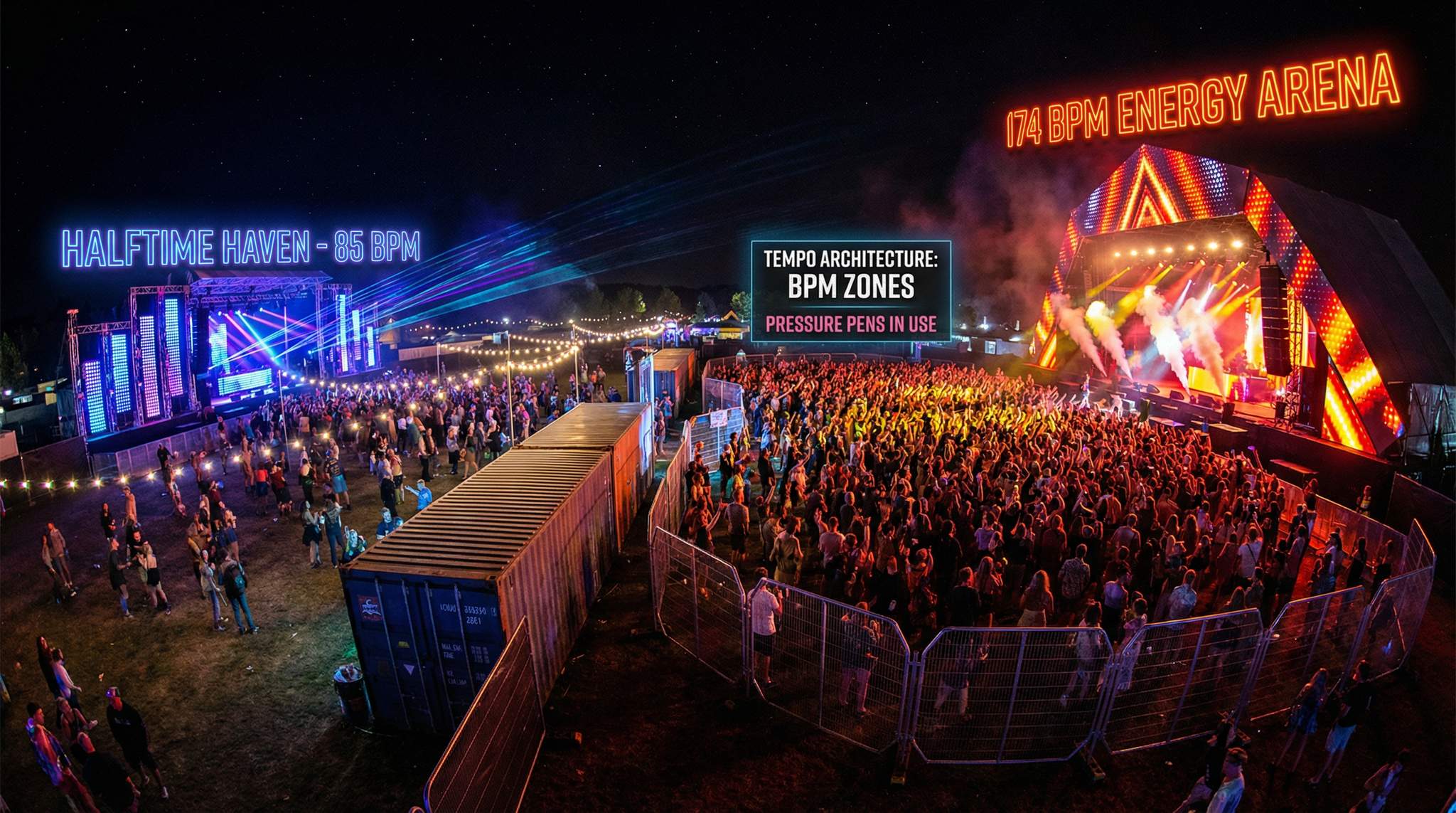
Tempo Architecture is a game-changing concept for bass music festivals that goes beyond lineup curation – it’s about designing your festival space by BPM and vibe. The idea is to dedicate separate areas to different tempos (for example, a halftime room, a deep 140 BPM zone, and a 174+ BPM high-energy arena) in a way that each can thrive without bleeding into one another.
By building your festival this way, you protect each musical “pocket” so that the deep, subby bass of a dubstep stage doesn’t get overrun by the rapid-fire breaks of a drum & bass stage next door. This article draws on decades of festival production experience across the globe – from the UK to New Zealand – to show how to implement tempo-based stage design effectively. We’ll cover practical tips on choosing the right venues, using acoustic buffers and clever scheduling, keeping crowds safe in wild “pressure pen” mosh pits, labeling your map by vibes, and even deploying a roaming “vibe marshal” to fine-tune the energy in real time. This article now dives into the architecture of tempo to explore how to create festival experiences where every beat has its own space to shine.
Separate Spaces for Varied Tempos (No Sound Bleed)
One key to a successful drum & bass or dubstep festival is designing your venue like a tempo-based map. Each distinct tempo range or subgenre – be it halftime (around 85 BPM feel), deep 140 BPM dubstep, or high-velocity 174+ BPM drum & bass – deserves its own dedicated space. By giving each style a separate stage or room, you prevent sonic bleed and preserve the integrity of each vibe. For example, Outlook Festival in Croatia famously nestled its stages in different nooks of an abandoned fort, so each zone delivered powerful bass without interfering with the others, a strategy highlighted in reviews of the festival’s distinct stage layout. Attendees could move between a chilled dub groove and a frenetic drum & bass arena without the two sounds clashing.
For small-scale events (like multi-room club nights or boutique indoor festivals), this might mean assigning separate rooms or floors to different tempos. In larger outdoor festivals, it means spacing stages far apart or orienting them back-to-back to minimize overlap. Natural barriers (hills, buildings, trees) can act as buffers between stages. The goal is to create self-contained musical pockets: when fans enter the “halftime room” they should be fully immersed in that slower, head-nodding bass, and when they step into the “174 BPM arena,” it’s an entirely different high-octane world.
Free Tool: Size Your Festival Site
Zoned capacity planning for arena, campsite, parking and entry lanes — against UK Purple Guide and NFPA density standards. Finds your bottleneck zone.
Acoustic Buffers and Notch Scheduling to Protect Each Pocket
Physical layout alone isn’t enough – smart scheduling and acoustic engineering are crucial to avoid any audio bleed between stages. Acoustic buffers can be anything that dampens sound between areas. For instance, you can position food courts, chill-out zones, or art installations as sound buffers separating loud stages. Some festivals even use speaker orientation and noise-canceling techniques so that each stage’s sound is directed inward toward its crowd and away from other stages. Sound insulation materials or strategically placed barricades and tents can also absorb excess noise.
Equally important is “notch scheduling.” This means scheduling sets with awareness of what’s happening on adjacent stages. If two stages are close by, avoid putting two peak-energy acts on at the same time. Stagger start times or set intentional quiet periods. A real-world example: at Lollapalooza, two neighboring stages (Tito’s and Bud Light) had completely non-overlapping set times, precisely because they were so close. This strategy is often cited as one of the best examples of festival scheduling to solve proximity issues. One stage took a break while the other roared, then they’d switch – ensuring fans enjoyed each performance without a battle of beats. As a festival producer, coordinate your lineup so that a deep 140 set isn’t drowned out by a simultaneous 174 BPM banger next door. It might mean giving one stage a 15-minute head start or having a downtempo interlude on one stage while the other hits a climax. These scheduling notches act like audio stopgaps, preserving each pocket’s atmosphere.
Planning a Festival?
Ticket Fairy's festival ticketing platform handles multi-day passes, RFID wristbands, and complex festival operations.
Designing Safe “Pressure Pens” for High-Energy Crowds
Fast 174+ BPM drum & bass sets often bring explosive energy – and dense crowds. Managing crowd safety in these high-octane areas is absolutely critical. Enter the concept of “pressure pens”: segmented crowd areas designed to handle intense pressure. Using sturdy front-of-stage barriers to divide the crowd into sections prevents dangerous surges. Think of these barriers as wave-breakers in an ocean of people – they disperse the force, effectively acting as barriers subdividing festival seating areas to mitigate crush risks. This way, if everyone rushes forward during an anthemic drop, the crowd is compartmentalized rather than becoming one uncontrollable mass.
When engineering these pens, provide ample water and easy exits. High-energy dancing in a packed 174 BPM arena causes dehydration fast – so set up water stations or have staff hand out water to the front rows. Ensure there are clearly marked exit paths from each pen section; attendees should be able to leave the crowd from the front or middle if they need air or help. Many major festivals (from the US to Germany) learned this the hard way after past incidents – the 2021 Astroworld tragedy in Texas, for example, highlighted how lethal an unbroken, overcrowded crowd can become without proper barriers and oversight. Modern drum & bass festivals in the UK, Europe, and beyond now routinely place secondary barriers a few meters from the stage, creating a front pit that’s monitored by security and medics, and a second section behind it. This not only reduces risk but also makes the experience more comfortable – fans in the front pen can enjoy the chaos knowing they have space and water, while those who want to dance with a bit more elbow room stay in the second section.
Safety must be engineered into the design: double-check barrier stability, train your security on pulling people out of a crush, and never exceed safe density. A well-designed “energy pen” lets the music hit hard while keeping the crowd safe.
Implementing these specialized zones is a cornerstone of modern concert crowd control. When you anticipate the physical impact of a heavy drum and bass drop, your event management strategy shifts from reactive policing to proactive environmental design. Effective crowd management at this scale means utilizing directional signage, strategically placed barricades, and trained pit teams to guide audience flow naturally. By aligning your site layout with the expected energy levels of the performers, you drastically reduce the risk of bottlenecks and localized crushing, ensuring a safer environment for both attendees and staff.
Free Tool: Project Your Bar Revenue
Per-head spend benchmarks by event type turned into projected bar and food revenue, with a stock-mix estimate and gross-margin line. Free calculator.
Scaling Infrastructure for High-BPM Genres
When mapping out your overall festival tempo strategy, it is vital to recognize that higher BPMs demand more robust physical infrastructure. Booking heavy drum and bass acts isn’t just a programming decision; it is an operational stress test. The rapid, sustained physical movement associated with 174+ BPM crowds accelerates wear and tear on flooring, increases the ambient temperature in enclosed tents, and drastically spikes water consumption at nearby bars. As a producer, you must scale your HVAC systems, reinforce temporary flooring, and increase medical roaming teams specifically in these high-velocity zones. Treating tempo as a core metric for site engineering ensures that your infrastructure can handle the kinetic energy generated by the music.
Publishing Vibe-Focused Festival Maps
Don’t just give your attendees a generic map with stage names – tell them the vibes. Label each area in a way that communicates its musical identity at a glance. At a bass music festival, stage names might be creative or cryptic, but adding a short descriptor can guide people to the experience they’re seeking. For instance, instead of simply “Stage 2” or “Nebula Stage” on the map, call it “Nebula Stage – Deep 140 Dubstep” or “Jungle Arena – 174 BPM+”. By publishing maps and schedules that highlight the vibe/tempo of each stage, you help festival-goers plan their journey. First-timers might not know what “halftime” means, but if they see a “Halftime Haven – slow & heavy bass” on the map, they’ll instantly grasp what’s in store.
Need Festival Funding?
Get the capital you need to book headliners, secure venues, and scale your festival production.
Consider color-coding or iconography as well: maybe blue areas for chill or halftime zones, and red for high-energy zones. Some festivals in Australia and New Zealand have experimented with interactive maps in their apps that filter stages by genre/tempo, so people can find “Drum & Bass,” “Dubstep/140,” or “Chillout” areas easily. The more clearly you communicate the vibe profile of each space, the less likely attendees will stumble into the wrong crowd or miss the experience they came for. It also spreads the crowd more evenly – those needing a breather will naturally gravitate to the low-key zone when they see it highlighted, easing pressure on the main stage. In short, market your map by mood, not just by names and sponsors.
Roaming “Vibe Marshal” to Adjust Density Live
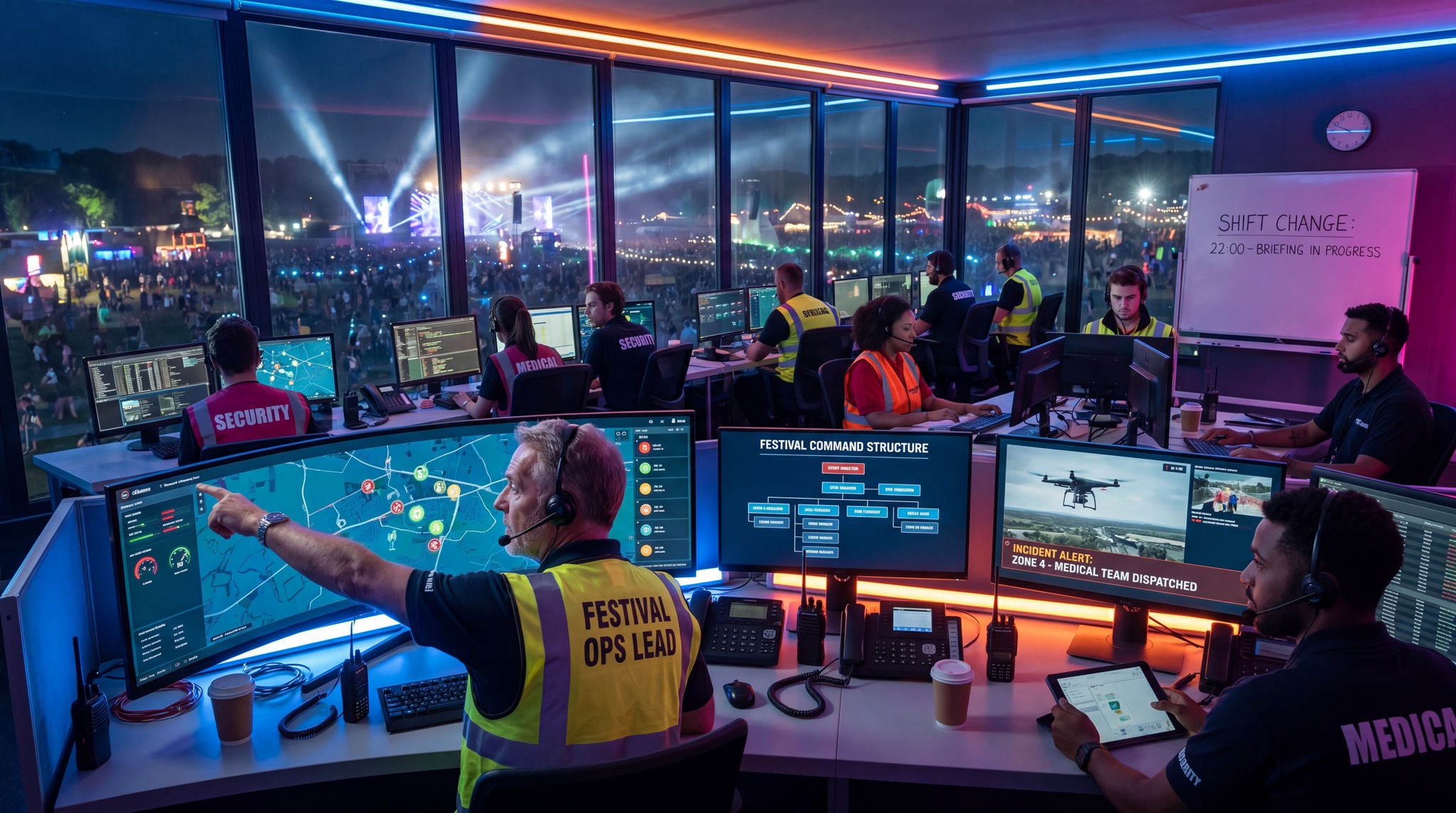
Even with perfect planning, the on-ground reality can shift. Crowds are dynamic – maybe a surprise B2B set draws an unexpected overflow to the 140 BPM tent, or a headliner on the main stage causes the halftime room to empty out. Having a roaming “vibe marshal” on your team is like having a festival air-traffic controller for crowds and energy. This should be an experienced staff member (or team) equipped with communication tools, real-time crowd counts, and the authority to make micro-adjustments on the fly.
What can a vibe marshal do? Monitor and respond. They’ll continuously walk the grounds, feeling out each area’s energy and density. If one zone is getting dangerously packed, they can coordinate with security to temporarily pause entry to that area, or signal to open an extra gate. They might ask the sound engineer to slightly lower volume or lighting in an overhyped tent (to subtly calm the vibe), while maybe boosting excitement at a quieter stage to draw some crowd over. A vibe marshal can also update the festival’s social media or app live: e.g., sending a push notification like “Deep 140 room is nice and roomy right now for XYZ’s set if you need space to dance.” On the flip side, if an area is too empty and another is jammed, the marshal might orchestrate a solution – perhaps a special announcement of a surprise set in the empty area, luring people over and balancing the load.
This role requires a big-picture mindset: the marshal isn’t tied to one stage, but looks at the festival as an ecosystem of vibes. Festivals in the UK and Europe have long employed crowd managers for safety; think of the vibe marshal as that, plus an artistic touch. They’re not there to boss people around – they’re there to ensure everyone is safe and having the best possible time, wherever they are. Consider it the human element of tempo architecture: reading the room (or field) and fine-tuning the experience in real time.
Pitching the Concept: How to Explain Tempo Architecture in a Presentation
When securing funding, venue permits, or stakeholder buy-in for a new event, you may need to clearly articulate why you are designing the site this way. If you need to explain tempo architecture for a presentation to local councils or investors, frame it as a proactive crowd management and audio-engineering strategy. Rather than just pitching a “tempo music festival,” explain that grouping stages by BPM (beats per minute) is a deliberate safety and acoustic choice. Emphasize that this layout naturally disperses crowd density, reduces noise complaints through targeted acoustic buffering, and minimizes the need for aggressive policing by aligning environmental design with audience behavior. Visualizing this on your pitch deck with a color-coded heat map of energy zones will instantly demonstrate your operational maturity to stakeholders.
Frequently Asked Questions
What is Tempo Architecture in music festivals?
Tempo Architecture is a festival design concept that organizes venue spaces by BPM and vibe rather than just lineup curation. It involves dedicating separate areas to specific tempos, such as halftime, deep 140 BPM, or 174+ BPM, ensuring each musical style thrives without sonic bleed or interference from adjacent stages.
How can festivals prevent sound bleed between stages?
Festivals prevent sound bleed by creating physical acoustic buffers using food courts, chill zones, or art installations between stages. Additionally, organizers use natural barriers like hills and orient speakers inward to create self-contained musical pockets, ensuring the deep bass of one stage doesn’t clash with the rapid breaks of another.
What are pressure pens used for at music festivals?
Pressure pens are segmented crowd areas created using sturdy barriers to manage high-energy audiences, particularly at 174+ BPM drum & bass stages. These barriers act like wave-breakers to disperse crowd force, preventing dangerous surges and allowing easier access to water and exits to mitigate crush risks during intense performances.
How does notch scheduling work for festival stages?
Notch scheduling involves coordinating set times on adjacent stages to avoid simultaneous peak-energy performances. By staggering start times or scheduling quiet interludes on one stage while another climaxes, festivals create audio stopgaps that prevent louder genres from drowning out quieter sets, preserving the atmosphere of each musical pocket.
Why should festival maps be labeled by vibe or tempo?
Labeling maps by vibe or tempo, such as “Deep 140 Dubstep” or “High-Energy 174 DnB,” helps attendees instantly understand a stage’s musical identity. This strategy guides crowds to the experience they seek, manages expectations, and naturally distributes people across the venue based on their desired energy level rather than just stage names.
What is the role of a festival vibe marshal?
A vibe marshal monitors real-time crowd density and energy across festival grounds to ensure safety and enjoyment. This staff member coordinates with security to manage entry flow, adjusts volume levels to calm overhyped areas, and directs attendees to under-used zones, acting as an air-traffic controller for festival atmosphere.
How do you explain tempo architecture in a presentation to stakeholders?
When you need to explain tempo architecture for a presentation to investors or city councils, frame it as a strategic approach to crowd safety and noise management. Highlight that designing a tempo music festival by BPM zones naturally controls crowd flow, reduces acoustic bleed, and creates safer, self-contained environments for different energy levels.
How does tempo architecture improve concert crowd control?
By grouping stages by BPM and energy levels, tempo architecture naturally disperses attendees across the venue based on their desired vibe. This proactive approach to concert crowd control prevents dangerous bottlenecks, reduces localized crushing during high-energy drum and bass sets, and allows security teams to allocate resources more effectively.
How does festival tempo impact site infrastructure?
The overall festival tempo directly dictates the physical demands placed on your site. High-BPM genres like drum and bass generate intense crowd movement, requiring reinforced flooring, enhanced ventilation in enclosed stages, and increased water station capacity to safely support the audience’s kinetic energy.