International festivals are thrilling melting pots of talent, but behind the scenes lies a complex puzzle: getting artists, staff, and crew from around the world to the right place at the right time. Efficient travel logistics can make the difference between a smoothly run festival and a chaotic scramble. This guide offers seasoned advice on managing travel for international artists and crew, covering everything from visas and flights to luggage and contingency planning.
Planning Visas and Work Permits Early
One of the first priorities for international festival travel is securing visas and work permits. Each country has its own immigration requirements, and approvals can take months. Organizers must research the specific visa types needed (such as work or performance visas) and start the application process well in advance. For example, in the United States, processing times for artist visas have ballooned – some petitions that once took a few weeks can now take up to eight months, a significant increase noted in reports on US visa processing delays.
Not planning far enough ahead could jeopardize an artist’s appearance; in one case, a Canadian arts festival had to cancel a performance entirely because an overseas artist’s visa wasn’t approved in time, a situation highlighted by the PuSh Festival’s cancellation announcement. To avoid such heartbreak, begin visa paperwork as soon as artists are confirmed. It’s wise to work closely with immigration specialists or agencies if possible, and to stay updated on any changes in visa fees or procedures (which can change frequently). Additionally, ensure all passports are valid well beyond the festival dates – many countries require at least six months’ validity on passports for entry.
When handling visa logistics for international tours or multi-country festival runs, the complexity multiplies. Promoters organizing travel for international music festival roadshows must ensure that work permits align not just for a single entry, but across consecutive dates in different jurisdictions. A delay in one country’s processing can create a domino effect, derailing an entire regional tour. Establishing a centralized tracking system for all passport expirations, consulate appointments, and approval statuses is a critical best practice for these multi-stop events.
Free Tool: Size Your Festival Site
Zoned capacity planning for arena, campsite, parking and entry lanes — against UK Purple Guide and NFPA density standards. Finds your bottleneck zone.
How Logistics Impact Programming and Lineup Curation
Beyond simply getting people from point A to point B, travel constraints fundamentally shape how talent buyers and producers build their lineups. When evaluating what logistical considerations affect festival programming decisions, organizers must weigh routing feasibility, border processing times, and freight costs before making an offer. For instance, booking an international headliner for a single isolated date is often cost-prohibitive unless they are already routing through the region. Consequently, programming teams frequently collaborate with other regional events to share travel burdens, creating a more sustainable touring corridor.
Regional border policies also play a massive role in these curation choices. For example, promoters operating in Canada must factor in the specific processing timelines of Labour Market Impact Assessment (LMIA) exemptions or international mobility programs when booking overseas acts. If an artist’s routing requires multiple border crossings between the US and Canada within a tight window, the heightened risk of customs delays might force organizers to schedule that act on a later day of the festival, ensuring a wider buffer for transit. Ultimately, a lineup isn’t just a wish list of talent; it is a carefully calculated matrix of operational realities.
Planning a Festival?
Ticket Fairy's festival ticketing platform handles multi-day passes, RFID wristbands, and complex festival operations.
Coordinating Flights Across the Globe
Booking flights for artists and crew is not as simple as clicking “purchase”. It requires careful coordination and attention to detail. Festival organizers should aim to book flights early, especially during peak travel seasons, to secure better rates and seat availability. Group bookings can be useful when multiple people are traveling from the same city or region, as airlines may offer group rates and it simplifies coordination. Always double-check that each ticket matches the passport name exactly to avoid airport issues, and keep records of all booking references and e-tickets in one place.
Timing is critical: build the schedule so that artists and crew arrive with a comfortable buffer before their work at the festival. Seasoned producers often avoid same-day arrivals for performers – jet lag and unexpected delays can wreak havoc if an artist is supposed to hit the stage just hours after landing. A good practice is to have key talent arrive at least a day (or more) prior to their performance, giving time to rest and adjust. Similarly, if crew members (like sound or lighting engineers) are coming from abroad, ensure they arrive in time to set up equipment and run checks without rushing.
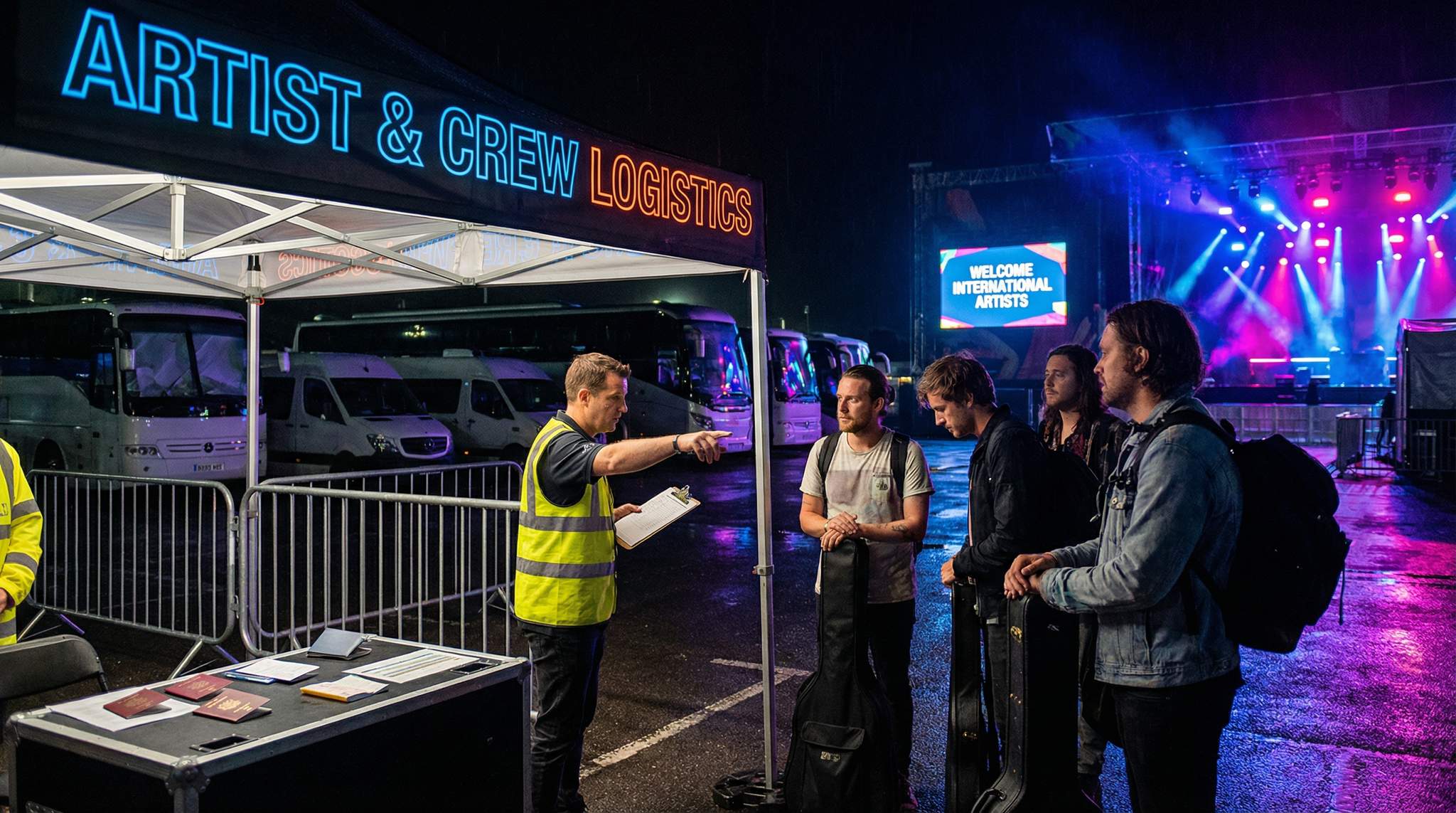
Don’t forget to plan for airport transfers as part of flight logistics. Coordinate pick-ups from the airport to the hotel or festival site so that arriving guests aren’t stranded. For large festivals, arranging a welcome desk or a transport coordinator at the airport can help herd everyone in the right direction. At smaller events, a simple car service or van pickup schedule might suffice. Communication is key – everyone should know who is meeting them and have an emergency contact number in case plans change.
When executing multi-city festival tours, the transportation strategy often shifts from commercial airline bookings to chartered travel. Moving an entire production—including multiple headliners, supporting acts, and technical staff—between consecutive regional dates requires synchronized ground and air transport. Promoters managing these cross-border roadshows frequently utilize dedicated tour buses or chartered flights to maintain strict schedules, ensuring that talent and essential crew arrive together without relying on unpredictable commercial flight connections.
Accept Payments Across 13 Countries
Local currency processing via Stripe, Razorpay, Xendit, Paystack, and OXXO across 13 countries with region-specific payment methods.
Accommodations for a Traveling Team
Housing artists and crew from different parts of the world presents another challenge. The goal is to provide comfortable accommodation that meets the needs of the talent but also fits the festival’s budget and logistics. Start by assessing how many people are traveling and any special requirements they might have. International artists might come with entourage members, and crew teams can be sizeable, so account for total headcount when booking.
Reserve accommodations well in advance. If your festival coincides with a busy season or local events (for example, a major conference or sports event in the same city), hotels can fill up quickly. Festival organizers often negotiate block bookings at hotels near the venue to ensure availability and possibly secure a better rate. Proximity is important – closer lodgings mean easier transportation logistics each day. If the festival is rural or camping-focused, you may need to provide on-site lodging like trailers or premium tents, but ensure these are arranged and comfortable for international travelers who might not be accustomed to rustic conditions.
Need Festival Funding?
Get the capital you need to book headliners, secure venues, and scale your festival production.
Another consideration is matching accommodation quality to expectations. A rising indie band might be fine with standard hotel rooms, while a legendary headliner might expect a five-star property or a boutique hotel experience. Know the artist riders and preferences in advance. It’s often part of the artist advance to confirm accommodation details. That said, balance hospitality with practicality: sometimes putting all artists in the same reputable hotel makes security and transport easier. Lastly, always plan for some flexibility – have a couple of spare rooms on hold if possible, in case travel party numbers change last-minute (for example, an artist bringing an extra tour manager or a crew member’s spouse deciding to join).
Navigating Luggage and Equipment Rules
When artists and crew travel, they don’t just bring suitcases – they often carry instruments, costumes, merchandise, and specialized equipment. Every airline has its own luggage policies, and these can get complicated when dealing with music gear. Communicate with artists well ahead of time about what equipment they absolutely need to bring versus what can be sourced locally. Many festivals provide backline equipment (like drum kits, amplifiers, etc.) to minimize what must be flown in. If your festival can arrange certain heavy or bulky gear on site, it will save everyone a lot of hassle and cost.
For the items that must travel with the team, carefully check airline baggage rules. Common challenges include oversized instruments (guitars, cellos, DJ gear) and excess baggage from crew carrying tools or technical kit. Some airlines allow musicians to purchase a separate seat for a large instrument, but not all carriers offer this option, as noted in The Recording Academy’s touring tips for musicians. It’s crucial to confirm each airline’s policies: if an artist is bringing a guitar or violin, find out if it can go in the cabin or if they need to check it in a hard case. In some cases, you may need to arrange cargo freight for extremely large or heavy equipment, especially if it’s too risky or expensive to check as luggage.
Luggage allowances vary widely: an intercontinental flight might permit two checked bags of 23 kg each, while a budget intra-European flight might only allow 20 kg total. When artists and crew have connecting flights on different airlines, plan for the most restrictive baggage limit to avoid unpleasant surprises. It may be worth purchasing extra baggage allowance in advance or shipping items separately. Also consider customs regulations – for professional gear crossing borders, an ATA Carnet (an international customs document for temporary imports) might be needed to smoothly bring equipment in and out without paying duties.
Free Tool: Project Your Bar Revenue
Per-head spend benchmarks by event type turned into projected bar and food revenue, with a stock-mix estimate and gross-margin line. Free calculator.
Integrating these heavy freight deliveries into your broader event logistics plan is critical. Site managers must coordinate forklift availability, secure lockups, and loading dock schedules to receive oversized cargo before the main production build begins. When travel coordinators and site operations teams share a unified logistics dashboard, it prevents bottlenecks at the venue gates and ensures that international backline arrives exactly when the stage crew is ready for it.
Encourage travelers to pack smart and label everything. Crew gear boxes should have clear labels and contacts. Musicians should have sturdy flight cases for instruments (and ideally, travel insurance for those instruments). Remind everyone to carry essential items (like performance-critical items or medication) in carry-on luggage in case checked bags are delayed. By anticipating these baggage issues and setting guidelines early, you’ll prevent last-minute airport dramas.
To streamline the airport experience, proactive promoters compile comprehensive pre-departure packets containing essential logistics tips for musicians and their touring crews. These guides should outline venue-specific backline provisions, local customs regulations for merchandise, and exact airline baggage allowances for the booked carriers. By setting clear expectations before anyone leaves home, organizers minimize frantic calls from the check-in counter and ensure talent arrives focused on the performance rather than missing gear.
Beyond static pre-departure packets, modern production teams often deploy dedicated mobile apps or digital portals to distribute these essential travel guidelines. Providing a centralized hub where artists can instantly access backline specifications, hotel routing, and real-time flight updates ensures that critical touring information is always at their fingertips. This digital approach not only reduces frantic email chains but also allows coordinators to push instant notifications if baggage policies or gate assignments change mid-transit.
Contingency Plans for Travel Disruptions
Even with the best-laid plans, travel can go awry. Flights get delayed or canceled, visas get denied, and luggage can get lost. A resilient festival organizer always has contingency plans for these scenarios. One fundamental strategy is to build slack into the schedule: as mentioned, have key people arrive a day or two early whenever feasible. That buffer means that if a flight is postponed, there’s still time to make it before showtime. If a critical flight connection is missed, having knowledge of alternate routes or earlier flights the next day can be a lifesaver.
Consider purchasing travel insurance or refundable tickets for major travel itineraries, especially for high-value artists. The extra cost can pay off if plans change unexpectedly. Some festivals also partner with airlines or travel agencies that can assist quickly in rebooking in emergencies. It’s also wise to keep some budget earmarked for last-minute travel changes – like buying a new flight on the spot if necessary.
Free Tool: Will the Room Actually Be Full?
Forecasts expected attendance from ticket type, event type and day of week. Calculates safe over-book count for free-RSVP events. Free estimator.
What if an artist or crew member simply cannot get there in time? This is where Plan B comes in. Have a protocol for artist no-shows or delays. For artists, you might have a local performer on standby who can fill a slot, or be ready to extend another artist’s set. For crew, identify local backup technicians or stagehands who can substitute if a key crew member is stuck in transit. Communication is vital: if someone is delayed, they should inform the travel coordinator or production team immediately so adjustments can be made (e.g., swapping set times or finding temporary replacements). In the case of widespread disruption – imagine a sudden storm or an air traffic control strike grounding many flights – you may even need to rearrange the festival schedule itself. Assign a team to scenario-plan these “what if” situations in advance so you’re not improvising under stress.
The Value of a Dedicated Travel Logistics Coordinator
With artists and staff coming from all corners of the globe, having a dedicated travel logistics coordinator is not a luxury – it’s essential. This role (or even a small team for very large festivals) is the command center for all travel-related matters. A travel logistics coordinator keeps track of every individual’s itinerary, ensures that visas and tickets are in order, and acts as the point of contact for travel updates or emergencies.
In practice, the coordinator’s day-to-day involves sending out detailed itineraries to each artist and crew group, arranging airport pickups, and checking that everyone has arrived as planned. They will often have copies of all passports, visas, and flight tickets on file. When something goes wrong – say, a flight is canceled last-minute – the coordinator is the one who jumps on the phone to book a new flight or liaise with an airline agent to reroute the traveler. This frees the rest of the festival production team to focus on on-site issues while the travel expert handles the off-site crisis.
Having such a specialist not only improves efficiency but also gives peace of mind to the artists and crew. Touring artists are accustomed to having tour managers or agents sort out travel; providing a similar level of care for your festival builds trust and professionalism. It shows that the festival is organized and values the time and comfort of its participants. Moreover, a travel coordinator can identify cost-saving opportunities (like consolidating airport runs or spotting cheaper group fares) and prevent costly mistakes (such as forgotten visas or booking flights for the wrong dates). In short, this role is the glue that holds the complex travel puzzle together.
Beyond booking flights and hotels, this dedicated role serves as the crucial link between artist advancing and broader music festival logistics. A skilled coordinator ensures that off-site travel schedules align perfectly with on-site operational realities, such as loading dock availability, soundcheck windows, and credential pickup. By synchronizing passenger arrivals with the event’s master production timeline, promoters can prevent backstage bottlenecks and maintain a seamless flow of talent from the airport directly to the stage.
Frequently Asked Questions
When should festival organizers start applying for international artist visas?
Organizers must begin visa paperwork as soon as artists are confirmed because approvals can take months. For instance, processing times for United States artist visas have increased to up to eight months. Failing to plan ahead risks performance cancellations, so early application and ensuring passports have six months’ validity are crucial.
Why should festival producers avoid booking same-day flights for artists?
Booking same-day arrivals risks performance cancellations due to jet lag, unexpected delays, or missed connections. Seasoned producers schedule key talent to arrive at least one day prior to their set to allow time for rest and adjustment. This buffer ensures artists and crew are ready to perform without rushing.
How can festivals manage travel logistics for large musical instruments?
Festivals should communicate early to determine what gear must travel versus what can be sourced locally as backline. For traveling gear, organizers must verify specific airline baggage policies for oversized items or arrange cargo freight. Using an ATA Carnet helps professional equipment cross borders smoothly without paying duties.
What are the benefits of hiring a dedicated travel logistics coordinator for festivals?
A dedicated travel logistics coordinator centralizes all itineraries, visa tracking, and emergency responses, freeing the production team to focus on on-site issues. This role improves efficiency, identifies cost-saving opportunities like group fares, and prevents costly mistakes such as booking errors, while providing peace of mind to traveling artists.
How should festival organizers handle accommodation for international crew?
Organizers should reserve accommodations well in advance, often negotiating block bookings at hotels near the venue to ensure availability and better rates. It is important to match lodging quality to artist riders and expectations while maintaining flexibility with spare rooms to account for last-minute changes in travel party numbers.
What contingency plans help manage festival travel disruptions?
Effective contingency planning involves building slack into schedules so delays don’t result in missed shows. Organizers should purchase travel insurance or refundable tickets for high-value artists and establish protocols for no-shows, such as having local performers on standby or backup technicians ready to fill in if crew members are delayed.
How do promoters manage visa logistics for multi-stop international tours?
Handling visa logistics for international tours requires coordinating work permits across multiple jurisdictions simultaneously. Promoters should use centralized tracking for consulate appointments and approval statuses, ensuring that entry dates align perfectly for back-to-back festival roadshows to prevent a single delay from disrupting the entire routing.
How does travel coordination differ for multi-city festival roadshows compared to single-weekend events?
Coordinating a multi-city touring festival requires synchronizing continuous movement for the entire lineup and crew across consecutive dates. Unlike single-weekend events where talent arrives and departs independently, roadshows often rely on chartered flights, dedicated tour buses, and rolling visa approvals to move the entire production as a single unit, minimizing the risk of commercial transit delays.
How does artist transportation integrate with broader music festival logistics?
Artist transportation must be tightly synchronized with overall music festival logistics to prevent backstage bottlenecks. This involves aligning flight arrivals and ground transport schedules with on-site operational milestones, such as credentialing, soundcheck windows, and loading dock availability. A unified approach ensures that talent and their gear move seamlessly from the airport to the stage without disrupting other site operations.
How does artist travel impact overall event logistics?
Artist travel is a foundational element of overall event logistics. Delays in flights or customs can disrupt soundcheck schedules, stage changeovers, and even gate opening times. Successful festival producers integrate travel itineraries directly into their master production schedules, ensuring that ground transport, credentialing, and backline delivery are perfectly synchronized with site operations.
What logistical considerations affect festival programming decisions?
Travel logistics directly influence lineup curation by dictating which artists are financially and operationally viable to book. Organizers must consider regional routing, visa processing timelines, and freight costs before making offers. For example, cross-border transit risks—such as moving a tour between the US and Canada—often force producers to schedule international acts on later festival days to provide a sufficient travel buffer.