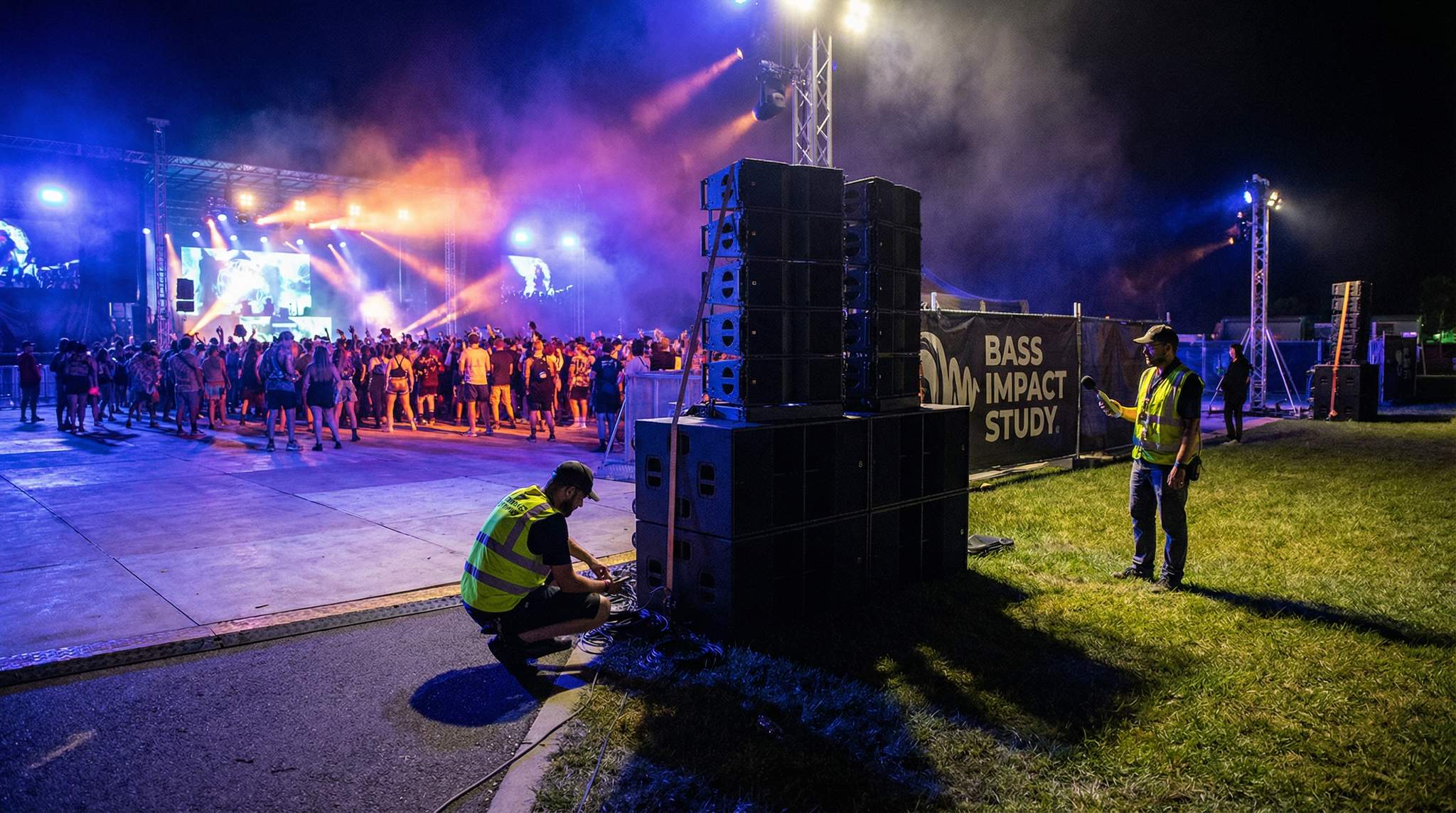
Category: Drum ‘n’ Bass, Dubstep and Bass Music Festivals
Introduction
For bass music festivals – from drum ‘n’ bass raves to dubstep extravaganzas – the ground beneath your feet plays a surprisingly important role in how the music feels. Seasoned festival producers understand that grass, asphalt, and concrete each interact differently with earth-shaking bass. The floor underfoot can literally change how those massive drops land, affecting both the sonic impact and the audience experience. This guide dives deep into how various surfaces absorb or reflect bass energy, and how festival organisers can adjust subwoofer placement, protect venues, and optimise the bass feel for every crowd. It’s packed with real-world examples and actionable advice drawn from festivals around the globe – ensuring that every bass drop hits just right.
Grass Fields: The Soft Ground with a Sonic Twist
Outdoor festivals often take place on grass fields or park lawns – think of massive events like Glastonbury (UK) or boutique gatherings like Shambhala (Canada). Grass and soil are considered “acoustically soft” ground, meaning they absorb more sound and alter the phase of reflections – causing significant attenuation of sound except at the very lowest frequencies, according to Federal Highway Administration noise barrier design guidelines. In practical terms, some low and mid frequencies get soaked up by the earth, reducing noise bounce. The deepest bass notes, however, tend to plough through (low frequencies aren’t easily stopped by a bit of turf!). Still, the lack of hard reflection can mellow the perceived impact of bass in a field.
Bass Feel on Grass: Audiences dancing on grass might notice the bass feeling a bit “softer” or less sharp compared to a hard floor. There’s less natural vibration coming through the ground into the body. For example, at Shambhala’s Village Stage, known for its chest-rattling PK Sound system, the crew mitigates the soft-ground effect by carefully tuning the system – they add a slight bass boost and use plenty of subwoofers to ensure every drop hits hard despite the grassy dancefloor. Festival-goers love the warmth of the bass there, and many attribute it to Shambhala’s sound team mastering the field’s environment.
Free Tool: Size Your Festival Site
Zoned capacity planning for arena, campsite, parking and entry lanes — against UK Purple Guide and NFPA density standards. Finds your bottleneck zone.
Stability and Turf Protection: Grass can turn to mud with thousands of stomping feet, especially if rain joins the party. A muddy ground can literally “suck the life out of your sound,” as one live sound engineer warned – meaning your low-end might vanish and gear could literally sink or tilt on a muddy surface, a danger highlighted in discussions on playing bass gigs on grass. To combat this, prudent festival organisers deploy ground protection mats or flooring in high-traffic areas. For instance, Tomorrowland (Belgium) lines its main stage front with heavy-duty interlocking mats to prevent the beautiful Boom area grass from becoming a mud pit under the jumping crowd. These mats keep speakers and truss structures stable, preserve the turf, and give fans firmer footing for dancing. At Lost Lands (USA) in Legend Valley – a bass-heavy festival in a grassy bowl – the first year saw patches of mud near stage front due to enthusiastic headbangers. By the next edition, the production team laid down reinforced floor panels in those zones, vastly improving ground stability. When a downpour made the grounds muddy in 2021, the crew’s quick deployment of straw and track mats kept the event going safely, as noted in reviews of Lost Lands 2021 production quality, earning praise from attendees for both sound consistency and comfort.
Case in Point – Glastonbury’s Fields: At the iconic Glastonbury Festival, the stages sit on a working farm’s grasslands. The organisers have learned to be gentle on the land – even scheduling “fallow years” where the festival skips a year to let the ground recover, a practice highlighted in reports on the festival’s environmental impact. They use protective flooring for stages and delay towers, and implement robust drainage. The result? Even with notoriously rainy UK weather, stages like Glastonbury’s Sonic Stage (which hosts dance music and big bass acts) manage to deliver powerful bass without sinking into the mud. The community around Worthy Farm appreciates these efforts, as the land is left in good condition post-festival, demonstrating great community engagement by respecting the turf and local environment.
Planning a Festival?
Ticket Fairy's festival ticketing platform handles multi-day passes, RFID wristbands, and complex festival operations.
Asphalt Jungle: Bass on City Streets and Lots
Many urban bass music festivals take place on asphalt – from pop-up stages on city streets to massive events in parking lots (think Electric Daisy Carnival’s stages on the Las Vegas Motor Speedway’s infield, or Outlook Festival’s gatherings on fort roadways). Asphalt is a “hard ground” surface, meaning it’s highly reflective of sound (almost as much as concrete), as described in technical noise barrier design documentation. Acoustically, an asphalt lot will bounce bass waves back upward more than grass would. One study on highway noise found that hard ground like asphalt or concrete can actually increase sound levels by about 1–2 dB for listeners near the source, based on highway noise reflection studies – not huge, but enough to notice a bit more thump. In other words, bass drops may hit a tad harder on asphalt because less energy is lost into the ground.
Bass Feel on Asphalt: Audiences often describe shows on asphalt as having a sharper, more resonant bass feel. The surface itself doesn’t shake much (as it’s solid and heavy), but it reflects the bass energy effectively. At a drum & bass block party in Bristol (UK) – a city famous for its bass culture – organisers noted the kicks and sub-bass felt “tighter and more in-your-face” on the closed-off asphalt street compared to a grass field event. Similarly, EDC Mexico (held at a racetrack in Mexico City) benefits from wide tarmac pads that allow for uniform speaker placement and reflection – the bass at the circuit’s stages feels powerful and uniform, with less muddiness even far back in the crowd. However, along with that extra punch comes the challenge of controlling where the bass goes. Hard surfaces can let low frequencies propagate further, potentially causing off-site noise issues if not managed.
Mitigating Reflections and Spill: On asphalt, festival producers should plan subwoofer setups to harness reflections constructively on the dancefloor but limit unwanted spread. One solution is using cardioid subwoofer arrays – arranging subwoofers in clusters that cancel out bass toward the back and sides. For example, at Rampage (Belgium) – one of the biggest dubstep & D’n’B parties which sometimes uses an indoor parking structure – the sound engineers configure cardioid sub stacks so that bass energy is focused into the crowd area and not reverberating excessively off the asphalt and concrete around. Another tip is angling or elevating speakers slightly. Interestingly, acoustic simulations have shown that a speaker elevated a few feet above the ground can project bass further than one directly on the ground, because the ground reflection then acts like a second source amplifying the waves at a distance, a phenomenon explained in Bassboss guides on outdoor festival sound. That can be useful for reaching the back of a large lot venue – but if neighbours are a concern, keeping subs ground-stacked might actually help contain some of that energy close to the ground. Festivals in city environments, like Ultra Music Festival in downtown Miami (set partly on pavement), often work with acousticians (such as Ultra’s long-time audio designer, Terry McNeil) to model the site’s acoustics in advance and adjust sub placements. This ensures that attendees get a full blast of bass on the tarmac dancefloor, while nearby residential buildings feel minimal thump.
Audience Comfort on Asphalt: While asphalt provides a solid, flat base for staging (no muddy surprises here), it can be tough on festival-goers physically. Hours of dancing on a hard, unforgiving surface lead to sore feet and joints. Some festivals lay down rubberised mats or portable dancefloor panels on top of asphalt in front of stages – not to change the sound, but to give a slight cushion and prevent foot fatigue (and also to mark the dance area). Bass music fans are known for non-stop headbanging and shuffle dancing, so a little extra flooring support goes a long way. Plus, those mats can reduce the risk of slips if the asphalt gets slick (from spilled drinks or dew). As a bonus, they can protect the asphalt itself from scuffs or the weight of heavy equipment if the venue is, say, a rented car park that needs to be handed back in good condition.
Free Tool: Project Your Bar Revenue
Per-head spend benchmarks by event type turned into projected bar and food revenue, with a stock-mix estimate and gross-margin line. Free calculator.
Concrete Floors and Stadiums: The Hardest Bass
Concrete is about as solid as it gets for a festival floor, featured in venues from warehouse arenas to stadium plazas. Many indoor bass festivals (and some open-air ones in city squares) have concrete underfoot – for example, Rampage in Antwerp is held in a concrete-floored arena, and Movement Festival in Detroit pumps techno and bass on the concrete expanse of Hart Plaza. Acoustically, concrete is a textbook “hard ground” surface, reflecting bass energy with very little absorption, consistent with hard ground acoustic characteristics. In fact, concrete surfaces preserve the phase of bass waves upon reflection, allowing reflected waves to reinforce direct sound, meaning those reflected waves can reinforce the direct sound. The result is often a booming, immersive bass experience: you not only hear the drop, you feel it reverberating off the ground and structures.
Bass Feel on Concrete: A well-known example of concrete’s impact is at Detroit’s Movement Festival – when the subwoofers drop a heavy kick, you can feel a thud in your chest and a tremor in your shoes. The rigid floor carries vibrations locally, giving festival-goers that “floor shaking” sensation. In indoor settings like the Sportpaleis (Belgium) for Rampage or the concrete hangars used for Outlook Festival’s tunnel parties in Croatia, attendees often note how the bass “rattles the building.” That’s partly the concrete floors and walls resonating or reflecting the sound. While this adds excitement and physicality, sound engineers must be cautious: unchecked reflections on concrete can also cause boomy hotspots or muddiness if frequencies overlap. The key is strategic system tuning and delays. For instance, at Rampage, the production team uses extensive acoustic treatment (like hanging baffles and precisely timed arrays) to counter the echoey nature of concrete, ensuring the bass stays punchy and not just loud.
Need Festival Funding?
Get the capital you need to book headliners, secure venues, and scale your festival production.
Sub Placement and Coupling: On concrete, placing subs directly on the floor usually yields the maximum bass output due to strong ground coupling – essentially, the concrete surface acts as an extension of the subwoofer, helping project sound outward. This half-space loading effect can give roughly +3 dB more bass output compared to suspending the sub in mid-air. (No wonder most festival systems keep subs firmly on the ground or stage platform.) However, concrete’s reflectivity means you might get interference patterns – e.g., if subs are spread far apart across a stage, their sound can converge and interact with reflections, creating peaks or nulls in the audience area. A pro tip from veteran sound designers: cluster subwoofers when possible to create a unified wavefront and reduce weird phase cancellations. This was applied at Outlook Festival one year when a stage in a concrete courtyard sounded uneven; the next night, the crew regrouped the subs in a tight block and immediately the bass felt more even and powerful across the dancefloor. Also, because concrete can easily carry bass into adjacent areas, festivals in concrete-heavy sites employ techniques like end-fire arrays (lining subs one after another with slight delays) or cardioid setups to aim bass energy away from sensitive boundaries. These approaches were crucial at Ultra Music Festival when it took place in Miami’s hard-surfaced Bayfront Park – multiple sub array techniques were used to focus bass toward the park and away from downtown hotels.
Protecting Ears and Structures: With great bass power comes great responsibility. High decibels on concrete can push the limits of safety – the clarity and reinforcement might tempt one to crank it up. Smart festival producers set clear SPL limits and provide ample chill-out zones or earplug stations, especially at bass-heavy stages on concrete where the intensity is highest. Additionally, consider the infrastructure: if your stage is on a concrete slab or within a building, ensure nothing loose can rattle off due to vibration. (There are tales of minor cracks in plaster or dislodged decor in venues subjected to relentless bass – not something you want in your safety report!) Regular inspections and securing fixtures is a must. The bottom line is to let the bass be felt but under control.
Adapting to Each Venue: Practical Tips
Every festival site is unique, and part of a producer’s mastery is adapting the plan to the ground conditions at hand. Here are some actionable strategies for different surface scenarios:
- Conduct a Site Sound Test: If possible, do a small-scale sound test at the venue beforehand. Even a single subwoofer run during a site visit can reveal things – how the bass carries, any unexpected rattle from the ground, etc. Bring your audio team and walk the grounds listening for differences. For example, the team behind Bass Coast Festival (Canada) did early soundchecks at their new venue to gauge how bass travelled over the grassy, uneven terrain versus their old location. This informed how they spaced their speakers for the real event.
- Model the Acoustics: Leverage prediction software to simulate bass propagation on different surfaces. Tools like Meyer Sound MAPP XT or EASE allow inputting ground conditions. An environmental noise model can show, for instance, that a concrete pad will reflect more energy towards a nearby neighbourhood than a field would. Having these models helps in stage orientation too – maybe you’ll rotate the stage a few degrees or add a noise barrier to mitigate reflections. The audio engineers at larger festivals like Tomorrowland routinely model each stage area (which includes grass lawns, asphalt paths, even a small lake) to fine-tune speaker setups and avoid unpleasant surprises.
- Adjust Subwoofer Setup: Tune the subwoofer configuration to the ground. On soft ground (grass), consider using a bit more sub power or clustering subs tightly to compensate for absorption. Keep subs directly on the ground for maximum coupling (avoid putting them on wobbling risers in a field). On hard ground (asphalt/concrete), watch out for reflective buildup – you might space subs wider or use electronic delays to shape the bass dispersion. If low-end complaints off-site are a risk, favour cardioid or end-fire arrays which inherently use destructive interference to cancel bass in unwanted directions. Remember that with hard floors, an elevated sub (on a stage) will interact with the floor reflection as a mirror source – sometimes causing a dip right in front if the path difference creates a phase cancellation. A bit of experimentation with height and angle can solve this.
- Use Flooring to Your Advantage: Don’t hesitate to invest in temporary flooring. Portable outdoor flooring systems (like aluminium panels, plastic hexagonal tiles, or plywood sheets) can be lifesavers on grass or dirt. They protect the ground and also give a more solid platform for sound. A flat, firm surface under the crowd means more uniform acoustics; you won’t have patches of audience standing in a squelchy bog where bass literally sinks. Additionally, these floors can reduce dust in dry conditions or mud in wet conditions, improving overall audio clarity (less dust on gear) and audience comfort. Many festivals in Australia – such as Rainbow Serpent on its dry plains – use water trucks and lay down carpet-like flooring near stages to minimise dust which can otherwise dampen high-end clarity and even coat subwoofers.
- Mind the Environment & Community: Ground conditions affect more than sound – they tie into community relations and environmental stewardship. A festival on concrete or asphalt in a city might face noise ordinances; working with acousticians to adjust for reflective ground can prevent upsetting the neighbours. Conversely, a festival on a lakeside grass field might worry about wildlife or soil damage; using mats to protect root systems or limiting low-frequency output late at night can show respect for the locale. Some forward-thinking producers even involve the community in post-festival site restoration – for example, a local volunteer crew at Boomtown Fair (UK) helps aerate and re-seed the trampled grass after the festival, turning a production challenge into a community bonding exercise. Giving back in this way earns goodwill and ensures the festival can return next year without resistance.
Documenting Findings for Next Time
One hallmark of a veteran festival organiser is constant learning. After each event, take time to document how the venue’s ground surface impacted the audio and logistics. Was the bass response on the grassy main stage as powerful as expected, or did you notice certain “dead spots” in the crowd area? Did the concrete floor in the drum & bass arena cause any excessive reverberation that had to be EQ’d out? Gather input from your audio engineers and production crews: they might note, for example, that they had to raise the subwoofer level 3 dB on the beach stage to get the same punch, or that the asphalt stage’s sound carried further than anticipated at night. Also collect feedback from the audience if possible – bass-heads are usually happy to tell you if the drop shook them to the core or if something felt lacking.
Free Tool: How Many Tickets to Break Even?
Enter your venue, artist, production and marketing costs with your ticket price. See how many tickets cover your costs and how many you still need to sell.
Use these insights when scouting your next site or planning next year’s festival at the same location. Over time, you’ll build a knowledge base: e.g., “Venue A (grass) requires extra subs and a backup rain plan for ground, Venue B (concrete) needs more acoustic absorption on stage to avoid echo,” and so on. Sharing these findings with your peers is invaluable too. The next generation of festival producers can learn from these case studies – much like how you’re now benefiting from decades of experience boiled down into this article. By treating each festival as a field experiment in sound and ground, you’ll refine your craft continually. And when you finally find that dream site with just the right ground (maybe a firm turf that provides both comfort and a bit of bounce), you’ll know exactly how to make the most of it.
Conclusion
Whether it’s a lush green meadow in New Zealand or a concrete jungle in Berlin, ground conditions fundamentally shape the bass experience at festivals. Great festival organisers don’t leave this to chance – they model it, adapt to it, and even embrace it. Adjusting subwoofer placement and coupling for the venue can mean the difference between a bassline that merely sounds loud versus one that feels transcendental. Likewise, looking after the ground with mats or mindful volume control isn’t just about avoiding a mud pit or a noise complaint; it’s about crafting an environment where fans can safely lose themselves in the music. The wisdom here is simple but profound: pay attention to the floor underfoot, because it truly changes how the drops land. From community goodwill to sonic perfection, ground matters. Now go forth and make those bass drops hit as if the earth itself is dancing with the crowd.
Frequently Asked Questions
How does grass affect bass sound at outdoor festivals?
Grass is an acoustically soft surface that absorbs sound and alters reflection phases, causing attenuation of low and mid frequencies. While deep bass notes penetrate the ground, the overall feel is softer and less sharp compared to hard surfaces. Sound engineers often boost bass frequencies and use specific subwoofer arrays to compensate for this absorption.
Why does bass feel stronger on concrete floors?
Concrete is a hard ground surface that reflects bass energy rather than absorbing it, preserving the phase of sound waves. This reflection reinforces the direct sound, potentially increasing levels by roughly 3 dB through ground coupling. This creates a sharper, more resonant physical sensation often described as floor shaking or in-your-face by festival attendees.
How do festival organizers prevent mud from ruining sound quality?
Muddy ground can absorb low-end frequencies and destabilize equipment, so festivals deploy ground protection mats or portable flooring in high-traffic areas. Events like Tomorrowland use heavy-duty interlocking mats to stabilize speakers and truss structures. This preserves the turf, ensures consistent acoustics, and prevents equipment from sinking or tilting on soft, wet soil.
What is the advantage of placing subwoofers on the ground?
Placing subwoofers directly on the ground, known as ground coupling, utilizes the floor as an extension of the speaker to increase bass output by approximately 3 dB. This technique is especially effective on concrete, where the rigid surface reinforces sound waves. It provides a more powerful, physical bass experience compared to suspending speakers in the air.
How can sound engineers reduce bass echo in concrete venues?
Engineers mitigate echo and boomy hotspots in concrete venues by clustering subwoofers to create a unified wavefront rather than spreading them out. They also employ acoustic treatments like hanging baffles and use precise delay settings. Cardioid arrays are frequently used to direct bass energy into the crowd and minimize reverberation off hard walls and floors.
How do festivals manage bass spill on asphalt surfaces?
Hard surfaces like asphalt allow low frequencies to propagate further, so producers use cardioid subwoofer arrays to cancel out rear-facing bass. Angling or elevating speakers slightly can also help manage dispersion, though ground-stacking often keeps energy closer to the crowd. Acoustic modeling software helps predict reflections to protect nearby residential areas from excessive noise.