When a sudden storm, surprise competitor show, or no-show headliner threatens to derail a festival, a few well-crafted contract clauses can spell the difference between a manageable hiccup and a financial catastrophe. Veteran festival producers have learned that what’s buried in the “boring” legal fine print can make or break an event’s outcome. In 2026, with festivals facing extreme weather, fierce competition for talent, and ever-savvier stakeholders, tightening up those overlooked clauses is mission-critical. Organizers who ignore these details risk expensive disputes, damaged reputations, or even losing their entire event. As industry veterans warn, skipping proper contract protections can lead to lawsuits, revoked licenses, or seven-figure losses when agreements are treated as afterthoughts.
This guide shines a spotlight on the contract clauses that festival professionals insist you lock in for 2026. From weather-triggered cancellation terms and radius clauses to force majeure definitions, vendor SLAs, and more, we’ll explore why each is vital. You’ll see real examples of festivals saved by savvy contract language – and disasters that struck when clauses were missing. Most importantly, we’ll share how to negotiate and implement these protections to safeguard your festival’s finances and reputation. Consider this your backstage pass to 35+ years of hard-won festival legal wisdom, distilled into practical advice you can act on today.
At its core, every contract a festival executes—whether with a headline musician, a local food vendor, or a staging supplier—serves as the operational blueprint for the event. A comprehensive festival contract doesn’t just outline payment schedules; it anticipates worst-case scenarios, allocates risk, and establishes clear protocols for dispute resolution before a single piece of staging is built.
Weather & Force Majeure: The Clause Between You and Disaster
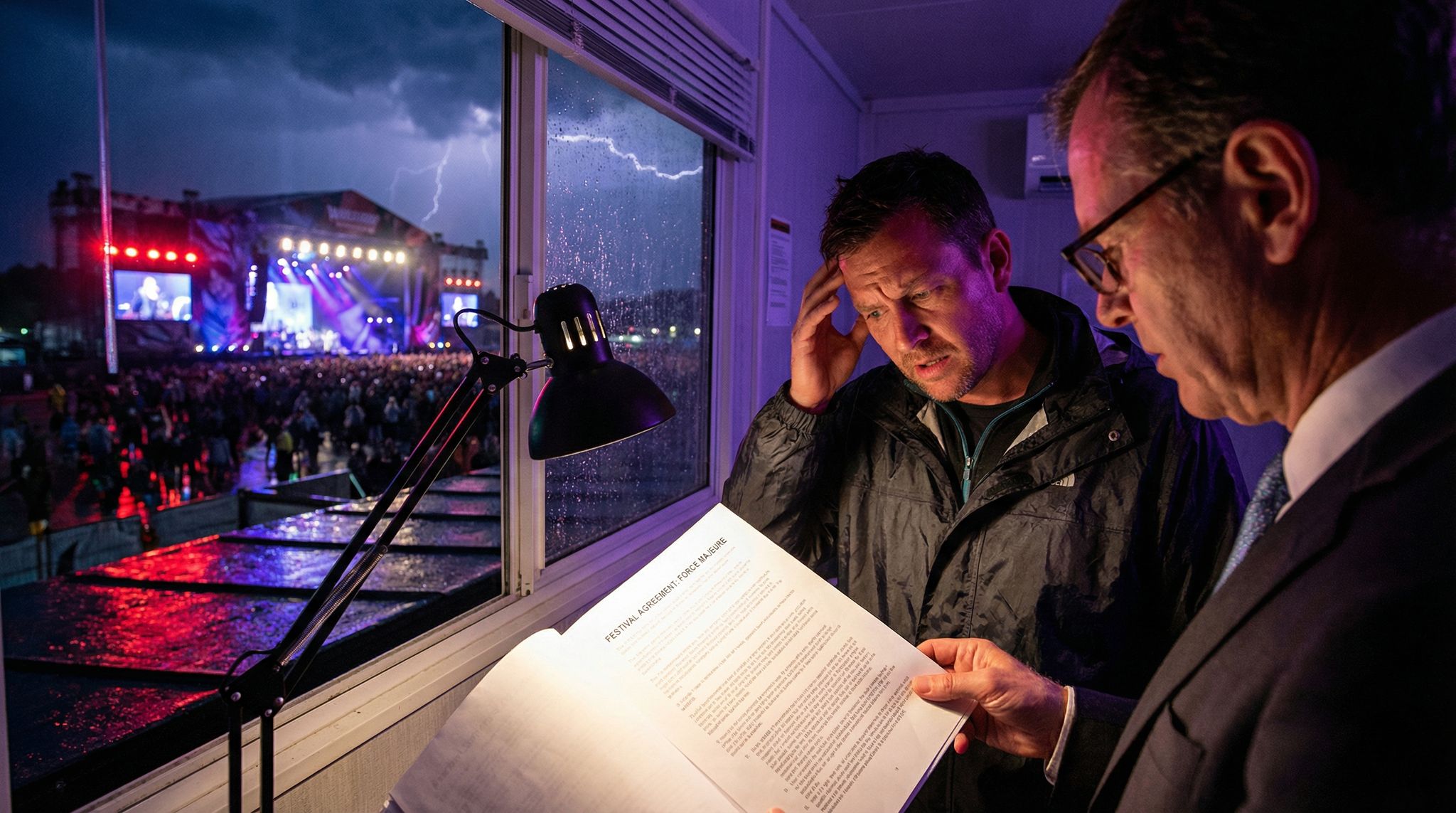
Outdoor festivals live at the mercy of Mother Nature. A sudden lightning storm or gale-force winds can force a shutdown in minutes, and global events like pandemics can wipe out entire seasons. That’s why robust weather and force majeure clauses are non-negotiable for festival contracts in 2026. These provisions predefine what happens if uncontrollable events make your festival impossible or unsafe, so you’re not scrambling or arguing when the skies turn or crises hit. A well-crafted clause can authorize you to pause or cancel for safety, limit financial liabilities, and give all parties clear expectations.
Free Tool: Size Your Festival Site
Zoned capacity planning for arena, campsite, parking and entry lanes — against UK Purple Guide and NFPA density standards. Finds your bottleneck zone.
Set Clear Weather Triggers in Your Contracts
A generic “rain or shine” promise on tickets isn’t enough – every festival should define specific weather thresholds that trigger delays, evacuations, or cancellations. Including these triggers in performer, vendor, and insurance agreements takes the guesswork out of safety decisions. For example, many veteran producers establish measurable weather thresholds in contracts (lightning within X miles, winds above Y mph, etc.) to dictate when the show must stop, creating weather force majeure clauses that actually work. This level of detail means everyone – artists, crews, vendors, and even fans – knows in advance that “if lightning strikes within 8 miles, we hold performances,” or “if wind gusts exceed 50 mph, stages will be cleared.”
By baking specific triggers into contracts and operation plans, you have legal cover to act swiftly. There’s no arguing with a clause that says “if sustained winds hit 40+ mph, the festival may shut down for safety.” This saved one U.S. festival in 2015: staff in Chicago’s Grant Park monitored approaching storms and, per pre-written terms with artists and city officials, evacuated tens of thousands when lightning drew close. Thanks to those preset conditions (and practiced plans), they safely resumed the show 90 minutes later. This illustrates how weather protocols determine if the event will resume and when temporary structures become unsafe. Attendees and artists understood the pause was necessary, because the trigger – lightning within 10 miles – had been openly established.
Planning a Festival?
Ticket Fairy's festival ticketing platform handles multi-day passes, RFID wristbands, and complex festival operations.
Aside from lightning and wind, define other local threats. Set rainfall thresholds (e.g. “>1 inch of rain per hour = potential evacuation”) if flooding or mud is a concern. At Australia’s Splendour in the Grass 2022, torrential rains turned the grounds into deep mud, forcing the first day’s cancellation when flash floods quickly create unsafe conditions. Because organizers had criteria and an emergency permit clause with authorities, they decisively pulled the plug and offered refunds for that day, noting mud depth in the main field effectively blocked access. This proves why fans literally couldn’t reach stages safely. The takeaway: spell out in your contracts and safety plans exactly what conditions justify halting the event. It not only protects attendees, it shields you from claims of “arbitrary” cancellation since you can point to objective criteria.
Don’t forget temperature extremes and natural disasters. If your festival is in a region prone to heatwaves, wildfire smoke, hurricanes, or earthquakes, include clauses for those too. For example, a heat index above a certain limit might trigger extended breaks, extra water distributions, or show postponement. Top festivals now often hire meteorologists or use Event Safety Alliance guidelines to customize these thresholds. Developing your weather safety plan helps the event identify how to proceed. The key is that your contract language supports your safety plan. It should allow you to pause or cancel performances when predetermined conditions are met, without breaching agreements. A clear weather clause aligns everyone on the priority: safety first, show second.
Update Force Majeure Clauses for Modern Risks
A force majeure clause is your event’s legal escape hatch for extraordinary events – but only if it’s written right. Many festivals treated force majeure as boilerplate in the past, listing vague “acts of God” and assuming it covered anything unimaginable. 2020 proved otherwise. In the wake of the pandemic, every festival organizer must ensure their force majeure definitions are up-to-date and unambiguous in covering things like epidemics, government shutdowns, and civil emergencies. Don’t rely on generic wording – explicitly include modern risks (pandemics, public health orders, cyber attacks on critical systems, etc.) that could derail your festival. It is crucial to avoid common mistakes in festival contracts regarding refunds and artist payouts.
Equally important is spelling out the consequences of a force majeure cancellation or delay, in each contract. Who bears what cost if, say, a government ban or natural disaster forces you to cancel? The clause should free you from liability for not delivering the event and ideally require pro-rated adjustments of obligations. For instance, ticketing terms might state that if the entire festival is canceled due to force majeure, ticket holders are entitled to a refund or credit (more on refund policies later). Artist and vendor contracts might state that neither party is considered in breach if force majeure applies – however, be careful how payments are handled in those cases. If you’re not precise, you could end up owing large fees even when the event doesn’t happen.
Free Tool: Will the Money Be There in Time?
Map your deposits and balances against when ticket money reaches you. See your lowest balance and how much you need to find before it arrives.
Real-world cautionary tale: In 2020, Virgin Fest LA had to cancel due to COVID-19. The promoters assumed their artist agreements’ force majeure clause would save them from paying full headliner fees. Instead, a subtle contract tweak backfired – and it cost them $5 million to one artist alone. Pop star Lizzo had a clause that said if she was “ready, willing, and able to perform,” she keeps her full guarantee even if the festival is canceled (unless it was her own illness or similar). The WME negotiated contracts did not specify exceptions for pandemics. When the pandemic hit and the show was axed by authorities, Lizzo’s team argued she was ready to play, so the fee should not be returned. In 2024 a California appeals court agreed, letting her keep the $5M deposit per the specific contract language. Many other artists refunded their advances in such scenarios, but because Virgin Fest had accepted that one “otherwise ready to perform” rider, they were on the hook. The lesson? Scrutinize every word in your force majeure and cancellation clauses, especially modifications snuck in by agents. A single phrase can shift financial risk onto your festival.
To avoid such nightmares, work with an experienced entertainment attorney or use industry-standard clauses as a baseline. Common practice for artist deals is: if the festival cancels due to force majeure, the artist keeps any deposit paid but not the full fee (unless already rendered services); if the artist cancels due to their own issue, they return any deposit to the promoter. Key elements of a cancellation clause should be explicit, but having them written prevents ambiguity. Make sure this logic is plainly stated. Some agents will push for favorable terms (like 50% due even if canceled, or full fee if they’ve arrived on-site). Negotiate a fair middle ground, but put it in writing. It is far better to avoid relying on goodwill or court battles. During the pandemic, festivals with clear force majeure clauses were able to terminate artist and vendor agreements without paying out the entire contract, whereas others ended up in disputes or owing large sums. Some festivals learned about disputes when COVID forced cancellations.
Need Festival Funding?
Get the capital you need to book headliners, secure venues, and scale your festival production.
Categorizing the Reasons for Festival Cancellation
To prevent costly legal ambiguity, your contracts must explicitly categorize the acceptable reasons for festival cancellation. Broadly, these fall into three buckets: unavoidable force majeure events (like extreme weather or government mandates), artist-driven breaches (such as a headliner failing to secure a visa), and promoter-elected business decisions (like low ticket sales or logistical failures). By clearly defining these distinct grounds for calling off an event, organizers can attach specific financial remedies to each scenario. For instance, an unavoidable act of God might trigger mutual walk-away rights, whereas a business-related cancellation requires the promoter to forfeit deposits. Documenting these specific cancellation drivers ensures that when the worst happens, the financial fallout is governed by pre-agreed terms rather than unpredictable litigation.
Finally, document the process around force majeure events. Your clauses might outline that you (the organizer) have sole discretion to declare a force majeure if certain conditions are met (or by following local government orders). Include any notification requirements (e.g. “Organizer will notify Artist in writing as soon as practicable of a force majeure cancellation”). The clearer and more mutual the understanding, the less room for conflict later. In summary, expect the unexpected and cement in your contracts what happens when it strikes. It’s far better to have these tough conversations upfront than legal battles after. As one festival legal advisor put it: “If we have to cancel, everyone should already know who eats the costs and who doesn’t, because the contract spells it out.”
Artist Exclusivity: Radius Clauses That Protect Your Lineup
If you’re paying top dollar for an artist to draw crowds to your festival, the last thing you want is them playing a nearby show right before (or after) your event and diluting the hype. This is where the radius clause comes in – a frequently overlooked but crucial part of artist contracts. A radius clause restricts a performer from appearing at other events in a defined geographic area and timeframe surrounding your festival. Done right, it protects your ticket sales and the artist’s exclusivity on your lineup. Done wrong (or not at all), you might find your headliner announced at a competing event down the road, siphoning off fans and diminishing your festival’s unique draw. A radius clause prevents performances in the same geographic area that could hurt your ticket sales.
Experienced promoters have long used radius clauses to secure a period of market exclusivity. For example, a mid-sized California festival might stipulate “Artist shall not perform any other concert within 100 miles of the festival site for 60 days before and 30 days after the event.” This means local fans can’t just catch that act at a different venue a week earlier – they’ll need to come to your festival. Newer festival organizers sometimes skip this clause, or set terms so vague they’re unenforceable. Those are painful mistakes. One North American festival learned it the hard way: they assumed a buzzworthy band wouldn’t book another regional show pre-fest, so they didn’t include a radius restriction. The band ended up playing a surprise club gig in a nearby city just days before the festival, and the expected last-minute ticket surge never materialized. Fans had already seen the act, and the festival lost out. Now that festival insists on radius clauses for all headliners and key acts – and agents usually understand, as it’s standard in the industry. Not including a reasonable radius clause ensures organizers and agents are on the same page.
Free Tool: Project Your Bar Revenue
Per-head spend benchmarks by event type turned into projected bar and food revenue, with a stock-mix estimate and gross-margin line. Free calculator.
Tailoring the Radius (and Knowing Its Limits)
Not all radius clauses need to be as sweeping as Coachella’s (which has infamously broad terms). In fact, overly broad clauses can backfire – they might scare off artists or even run afoul of competition laws. In 2018, Coachella’s radius policy became public in an antitrust lawsuit and triggered debate: it reportedly barred performers from any North American festival from December through May (a nearly 5-month span) and from playing shows in several Southern California counties during that time. Anschutz Entertainment Group related restrictions were significant. Smaller festivals like Portland’s Soul’d Out Festival argued this “monopolistic” clause hurt their lineups, and they challenged it in court. On June 10, Coachella’s exclusivity terms were linked to announcing Coachella as their primary appearance. (The case was eventually dismissed on jurisdictional grounds, but it put big festivals on notice.) The reality is radius clauses are common, but they must be reasonable to hold up. For instance, the Pitchfork Music Festival’s clause in Chicago has been more modest: covering festival appearances in the region for a couple of weeks before/after, plus a shorter local blackout. Then again, there’s no rule regarding the specific mile radius. Bonnaroo has used about a 300-mile, 4-month radius in the past. As of 2014, Bonnaroo’s radius clause covered 300 miles. Lollapalooza had a similar 300-mile rule and faced pushback when bands quietly violated it with unannounced gigs. Bands played at their own risk.
For an independent event planner, navigating these aggressive territorial holds is a major hurdle. When mega-festivals enforce massive blackout zones, smaller promoters in competitive hubs like Chicago or boutique organizers—similar to the team behind Soul’d Out events—often have to get creative with their booking strategies. Understanding the historical context of the Bonnaroo radius clause, which famously locked down a massive portion of the Southeast, helps modern organizers realize why negotiating carve-outs for specific venues or unannounced underplays is essential for a tour’s financial viability.
The takeaway is to calibrate your exclusivity to your needs and market norms. If you’re a destination festival drawing an international crowd, a broader radius (both in time and distance) could be justified. If you’re a community festival primarily for locals, you might only restrict other shows in the city or state for a month or two around your dates. Clearly define three things in the contract: distance, timeframe, and type of performance restricted. Keep it reasonable and standard. Distance can be in miles or kilometers from your venue (use a radius that covers the key metro areas where your audience comes from). Timeframe could be X days/weeks before and after your event. And type of performance should be specified – does it ban all live appearances, or only festival sets, or only ticketed concerts above a certain size? For example, an artist might be allowed to do a private corporate gig or a small “surprise” pop-up show if your clause only covers public concerts/festivals. Spell it out to avoid loopholes.
When negotiating with artists, be upfront about your radius expectations before confirming the booking. Top-tier headliners will often accept a reasonable clause, especially if you’re offering a premium fee in exchange for exclusivity (e.g., branding them as “UK Festival Exclusive” in your marketing – if so, absolutely ensure the contract bans any other UK festival that season). Up-and-coming acts might push back because they need as many gigs as possible; in such cases, perhaps shorten the blackout window or radius distance for those smaller-font artists. As one agent told Pitchfork, “everything is negotiable… not everybody ends up agreeing to abide by the full radius clause”, especially emerging artists. Radius clauses are ubiquitous in the festival industry to secure big name headliners. The key is to decide what’s critical for your event’s success. If you truly need an artist 100% exclusive, stand firm on it and be prepared to compensate for that privilege. If not, find a compromise (maybe they can play a show in the next state a week prior, but not in your state).
Pro Tip: Also consider announcement exclusivity. Some contracts include language that the artist won’t announce any other event during a certain period that could affect your ticket sales. For example, you might require that they don’t publicize a fall tour until after your summer festival, so fans don’t hold off thinking “I’ll catch them on tour instead.” This kind of clause is harder to get, but even a gentle agreement like “Artist will use best efforts not to announce a headlining show in [your city]before the festival” can help. At minimum, coordinate closely with booking agents – often they can schedule around your event if you communicate early.
In the end, a radius clause is about protecting the uniqueness of your lineup. It should be fair enough that artists sign it without too much drama, but strong enough to prevent undercutting your event. By paying attention to this fine print, you ensure that when fans buy a ticket to your festival, it’s truly the place to see those artists – not just one of many options. That exclusivity is part of what makes a festival ticket worth the price.
Let Fans Pay Over Time
Offer flexible payment plans that split ticket costs into manageable installments, making higher-priced events accessible and boosting conversions.
Artist Cancellations: No-Show Clauses and Backup Plans
Big festivals in 2026 routinely advertise dozens of artists, but what happens if a major act backs out last-minute? Without proper clauses, an artist cancellation can leave your festival eating costs or facing angry ticket holders (and sponsors). That’s why every artist performance agreement should include robust cancellation terms – covering both artist cancellation and festival cancellation or postponement. We touched on force majeure cases earlier, but not every cancellation is an “act of God.” Sometimes artists simply breach the deal, or a band member falls ill, or visa issues prevent travel. You need contingency language for those scenarios, too.
A solid artist contract will spell out that if an artist cancels without a valid force majeure reason, they must promptly return any deposit paid and may even be liable for certain costs or a cancellation fee. Key elements of a cancellation clause include a fee if cancellation is last-minute. Admittedly, big-name artists (or their agents) rarely agree to pay a penalty beyond returning the deposit, but it’s worth asking, especially for headliners. At minimum, the clause ensures you’re not out the deposit money on top of losing the act. For smaller artists, you might negotiate that cancellation within, say, 30 days of the event triggers a requirement to cover any reasonable replacement costs (for example, if you had to pay a new act $5,000 more, perhaps the original act covers that difference). Even if enforcement is tricky, having it in writing deters flaky behavior and sets expectations that backing out has consequences.
On the flip side, clarify what happens if you (the organizer) cancel or reschedule the festival for reasons other than force majeure. Typically, artist contracts state that if the event is canceled by the promoter (for business or any non-FM reason), the artist is entitled to keep the deposit but not the remaining balance of the fee. This way you can at least ensure you avoid confusion over payments. Some aggressive contracts might owe the artist a portion of the full fee if it’s a last-minute cancellation (to compensate for their time kept available). Know what you’re agreeing to here – during the early COVID cancellations, a few festivals that preemptively canceled without government orders found themselves owing partial fees because their contracts hadn’t clearly made those payments “non-applicable in event cancellation.” In any case, avoid vagueness. State the timelines and percentages: e.g., “If the festival is canceled by Organizer for any reason other than Artist’s breach or force majeure: if canceled more than 60 days out, Artist retains only the deposit; if within 60 days, Artist shall be paid 50% of the guarantee (inclusive of any deposit already paid).” This kind of staggered approach can be negotiated based on what artists will accept, but the key is to have something defined. It prevents disputes and preserves relationships – everyone knows the deal up front.
Real example: In 2019, a European festival had a marquee headliner pull out two weeks before the event due to “unforeseen circumstances.” Because the contract required it, the artist’s team returned the 50% deposit immediately, which the festival then used to help secure a late replacement (at a higher fee). The fest still took a loss on the swap, but the deposit clause at least gave them cash in hand to work with, and they avoided a cash flow crunch. Contrast that with the infamous Fyre Festival in 2017 – when headliners like Blink-182 bailed at the last minute, reports suggest there were no proper contracts or deposits to reclaim, leaving the organizers with no leverage and no show, ultimately resulting in refunds and lawsuits. Their policy was no contract, no leverage and ended up facing refunds. This matches the L85 policy regarding refunds.
Another smart inclusion is a “failure to perform” clause for artists. This isn’t just if they cancel entirely, but if they don’t fulfill the agreed set. For instance, if a performer is booked for a 90-minute headline set and only performs 20 minutes then walks off (or is too intoxicated to perform properly), what happens? While rare, these scenarios occur (remember when certain rock stars would storm off stage?). You can include language that if an artist fails to perform a minimum portion of their set due to their own actions (and not due to technical or safety stoppages), they will treat it as a cancellation – meaning a pro-rated refund of fee or not demanding remaining payment. Major artists likely won’t sign this clause, but it can be useful for smaller acts or novelty performers where there’s a concern about reliability.
Additionally, your contracts should address schedule adjustments caused by unforeseen delays. If a previous act runs long or a brief weather pause compresses your timeline, you need the contractual right to execute an agreement to shorten free entertainment or paid performances without breaching the deal. Relying on last minute terms and conditions hastily texted to an agent on the day of the show is a recipe for disaster; these contingencies must be formalized in the initial booking agreement.
Free Tool: How Many Tickets to Break Even?
Enter your venue, artist, production and marketing costs with your ticket price. See how many tickets cover your costs and how many you still need to sell.
Finally, always maintain a backup plan internally for key slots. Your contracts can even reflect this: consider adding a clause that the artist’s performance is subject to change in scheduling and that you reserve the right to substitute or rearrange the lineup in emergencies. This gives you flexibility if you need to shuffle set times or have a standby act ready. You wouldn’t announce this in public, but behind the scenes many festivals keep a shortlist of local bands or a DJ on call in case an act is a no-show on the day. It may not replace the headliner, but even a substitute performance (plus maybe a goodwill gesture like future discount for attendees) can smooth over a sudden cancellation. Communicate with your audience transparently if a change happens – it’s better they hear it from you with a solution than from rumors.
In summary, don’t leave artist cancellations to chance. Use your contracts to protect against both sides of the equation. You’ll sleep easier with clear terms that cover deposit returns, possible penalties, and procedures for lineup changes. It turns a potential festival-fatal crisis into a solvable problem. Attendees might buy tickets to see a specific artist, but if you handle a cancellation professionally – thanks to clauses that kept your festival financially intact – you can often preserve your event’s reputation and finish the show.
Vendor Agreements: Service Levels, Indemnities, and Other Lifesavers
Behind every successful festival is a small army of vendors and suppliers – staging companies, sound and lighting providers, tent installers, power generator renters, food and beverage vendors, merchandisers, and more. These third parties can make your event amazing… or cause chaos if they fail to deliver. Iron-clad vendor contracts are your safety net here. Too often, eager organizers confirm a vendor with just a quick quote or informal email, without formal terms. That’s risky. You should have written agreements with all key vendors that include Service Level Agreements (SLAs), performance standards, timelines, and clauses for indemnification, insurance, and remedies if things go wrong. It might feel like overkill for a food truck or a local stage crew, but when tens of thousands of attendees (and your permit and budget) depend on someone’s service, you need legal assurances.
Lock in Service Levels and Deliverables
An SLA in a vendor contract is basically a promise about quality and timing of service. It sets expectations: when will the vendor be set up and ready? What exactly will they provide? What happens if they’re late or underperform? By defining these, you can enforce them or seek remedies if expectations aren’t met. For example, specify that the stage sound company must complete build and sound-check by X hours before doors each day. Or a food vendor must have sufficient stock to serve an estimated Y customers per hour and remain open for all festival hours. These details keep vendors accountable. If a vendor knows there’s a contractual penalty or fee reduction for failing to meet the schedule or for running out of product, they’ll plan accordingly.
Consider the cautionary tales: a poorly managed “unlimited pizza” festival in London once ran out of pizza within hours – a key oven broke and the vendors hadn’t prepared backups, leaving angry attendees hungry and organizers facing a PR mess. These debacles underline the importance of solid agreements. In another case, a community food event expected 2,000 attendees but got 7,000, overwhelming vendors who weren’t contracted for that scale. Vendors failed to deliver when a crowd surged. Both debacles could have been mitigated by clearer capacity clauses and contingency plans in vendor agreements. Veteran festival producers include terms like minimum serving capacity, menu and pricing approvals, and operating hours requirements in every vendor contract. Setting minimum serving capacities and defining operating hours requirements prevents early closures. For instance, a clause might state “Vendor will stock inventory to serve at least 500 portions per day and will not cease operations before festival closing time without organizer’s permission. Early closure or stock depletion may result in a fee reduction or forfeiture of deposit.” It might sound heavy, but it’s fair: attendees paid expecting a full experience, and vendors need to uphold their end.
Enforcing standards doesn’t mean antagonizing your vendors. Frame it as ensuring a great event for everyone. Many festivals take a collaborative approach: include an SLA but also a plan to assist vendors if they’re struggling (e.g., festival staff/volunteers can help at booths if lines get too long, or you have spare equipment on standby for kitchen failures). The contract can mention this cooperation, but also give you the right to step in. For example, if a food vendor consistently has a 30-minute queue, you might reserve the right to send in additional runners to speed things up. The vendor should agree that’s okay, since ultimately it’s about customer service.
Free Tool: How Many Staff Do You Need?
Get a starting headcount for security, stewards, scanners, bar staff and first aid from your crowd size, event type and risk level.
Another overlooked area is vendor scheduling and access. Make sure contracts note when vendors can load in/out, what passes they get, and that they must comply with all festival rules (safety, waste disposal, noise limits, etc.). If a vendor breaks festival rules – say a craft stall selling unapproved merch or a food vendor using glass bottles when it’s banned – you need grounds to take corrective action or evict them if needed. A clause for “compliance with festival policies” gives you that leverage (ideally graduated: a warning for first infraction, then penalties). While you hope never to use it, if one vendor’s misconduct threatens your license (imagine a pyrotechnics supplier firing effects without permit), having the right to shut them down on the spot is essential.
These strict vendor guidelines aren’t just for massive mega-festivals. Whether you are organizing a 50,000-capacity electronic music event or drafting a local feria contract for a neighborhood street fair, the legal fundamentals remain identical. A community fair relies heavily on independent food stalls, craft merchants, and local artisans. Implementing a standardized vendor agreement for these smaller-scale events ensures that even a modest weekend gathering maintains strict health, safety, and operational standards.
Indemnification and Insurance: Covering Your Assets
Even with great vendors, accidents happen – a stage structure might collapse due to a vendor’s faulty setup, or a attendee could get food poisoning from a caterer. Who pays when something goes wrong? Without proper clauses, you as the event organizer could be left holding the bag, legally and financially. That’s why two clauses are lifesavers in vendor agreements: indemnity and insurance requirements.
Indemnity clause: This means the vendor agrees to indemnify and hold the festival harmless for any claims or losses arising from the vendor’s own actions or products. Indemnity clauses hold the festival harmless for vendor negligence. In plain English, if the vendor screws up and someone sues, the vendor must defend the festival and cover any costs or damages. For example, if a propane tank at a food stall (provided by the vendor) causes a fire that injures attendees, an indemnity clause forces that vendor to assume the liability for that incident, covering your legal fees and any payouts. Being a responsible producer is vital if a customer slips in front of a booth. These clauses might sound tough, but they are standard practice in events. A good indemnity is usually mutual to some degree – the vendor covers their negligence, you cover yours. It will typically carve out that the vendor doesn’t indemnify you if the problem was entirely the festival’s own doing. That’s fair. The key is to not leave a liability gap where a vendor-caused problem becomes your festival’s financial nightmare.
Insurance clause: Indemnity is only as good as the vendor’s ability to pay – which is why you also require vendors to carry adequate insurance and name your festival as an additional insured. This protects you financially and legally should accidents occur. For any significant vendor (especially those providing infrastructure, pyrotechnics, rides, alcohol, or anything high-risk), insist on a certificate of insurance before they step on site. Vendor insurance requirements stipulate coverage minimums and require that they add your festival as additional insured. Commonly, festivals require a general liability insurance policy with at least $1 million per occurrence (sometimes more for big events or dangerous activities). Being an additional insured on their policy means if their actions cause harm, their insurance will directly cover you as well. Stipulate that they add your festival as additional insured. Also set that their insurance is “primary and non-contributory” to yours, so their insurer pays first. This way, if something goes awry – a tent collapse, a vendor vehicle accident, a foodborne illness outbreak – you can tender the claim to their insurance instead of or before using yours.
Make these requirements crystal clear in the contract and give vendors a deadline to submit proof of insurance (e.g., no later than 2 weeks before the event). Do not let vendors load in if they haven’t provided a Certificate of Insurance – it’s your leverage to make sure they comply. If a small vendor truly has no insurance (which is a red flag), you might guide them to purchase a short-term event policy or, in rare cases, add them under your umbrella for a fee. But generally, any professional vendor should have coverage – if they don’t, think twice about hiring them.
When guiding these smaller partners, recommending dedicated event insurance for vendors is often the safest route. Many independent food trucks, craft artisans, or local merchants may not carry annual commercial liability policies. In these instances, requiring them to secure single event vendor insurance ensures they are covered for the specific duration of your festival without the financial burden of a year-round premium. These short-term policies typically cover general liability, property damage, and sometimes even liquor liability if they are serving alcohol. By standardizing this requirement and perhaps even partnering with a preferred insurance broker who can quickly issue these single-event policies, organizers can streamline the onboarding process while maintaining an airtight liability shield.
While mandating vendor coverage is crucial, the festival itself must hold comprehensive event public liability insurance. This overarching policy acts as the ultimate safety net for the organizer, covering third-party bodily injury or property damage claims that cannot be directly attributed to a specific vendor or contractor. Whether a patron trips over an unmarked cable in a common area or a sudden gust of wind damages a neighboring property, a robust public liability policy ensures the production company isn’t bankrupted by legal defense fees and settlement costs. When negotiating this master policy, experienced producers work closely with specialized brokers to ensure the coverage limits accurately reflect the festival’s capacity, location risks, and specific activities.
Some festivals also take a damage deposit from vendors – a refundable bond in case the vendor damages the venue or leaves a mess. This isn’t exactly a clause, but a contract can note a deposit (and conditions for forfeiture, like “if you damage festival property or violate certain rules, we keep your $500 deposit”). This aligns incentives for vendors to be careful and clean up. For example, if a food vendor spills oil everywhere or a crew leaves debris that you must pay extra to dispose of, you have funds on hand to cover it.
Between SLAs, indemnities, and insurance, your vendor contracts create a safety net that ensures one stall’s failure won’t sink the whole festival. They also professionalize the relationship – vendors are clear on their duties and the repercussions. The goal is not to be antagonistic; in fact, most great vendors appreciate clarity because it helps them succeed and return year after year. As a festival producer, you’re building a partnership where both sides know their obligations. And if a vendor balks at signing a detailed agreement, ask yourself why – reliable vendors are used to contracts. Better to lose a non-compliant vendor upfront than to deal with mayhem later with no legal recourse.
Ticketing Terms & Refund Policies: Don’t Forget Your Audience Contracts
Amid focusing on artists, crew, and vendors, it’s easy to forget that your attendees also enter a contract with you – the ticket purchase terms and conditions. This fine print may not seem glamorous, but it can save your festival’s reputation and finances when things go wrong. In 2026, ticket buyers are more aware of their rights (and vocal on social media) than ever. Clear, fair refund and cancellation policies in your terms of service are essential. They set expectations with fans and shield you from legal trouble under consumer protection laws. In many jurisdictions (UK, EU, parts of the US, Australia, etc.), if you don’t deliver the event as advertised, customers have a right to a refund one way or another. Consumer protection laws vary across regions depending on where attendees come from. The Consumer Rights Act and guidance dictate terms if fans can’t attend the new date. So it’s better to craft a policy on your terms rather than face chargebacks or lawsuits after the fact.
When writing your ticketing terms, first know the local laws. Some places require refunds for outright cancellations; others allow offering credit for postponements, etc. Make sure nothing in your policy blatantly contradicts legal rights (an “no refunds ever for any reason” policy, for example, won’t hold up in many regions). Note that credit card companies often side with consumers. Instead, use a balanced approach: state that the event is rain or shine, but outline what happens if you have to cancel a day or significantly change the lineup. For instance, you might say “If the festival is completely canceled (and not rescheduled), tickets will be refunded at face value (excluding shipping fees).” If only a portion is canceled (e.g., one day of a three-day event), explain your approach – perhaps partial refunds for that day’s ticketholders or pro-rated refunds for multi-day pass holders. By spelling it out, you avoid confusion and appear transparent.
Proactive communication is part of the contract with fans, too. In your terms (and certainly in your emergency comms plan) mention how you will inform attendees of any major disruptions and what options they have. Festivals have earned goodwill by being quick and clear after cancellations. For example, when a boutique food festival in Italy shut down mid-event due to sudden flash floods, organizers emailed all ticket holders that day with an explanation and a refund process. Attendees, though disappointed, widely praised the festival’s responsiveness and many pledged to return the next year. This builds word of mouth and loyal fans. Contrast that with events that go silent or try to deny refunds – they often face a far worse backlash than the storm or incident itself. Your refund policy is part of your public promise. If you honor it and communicate, you can actually strengthen loyalty amid a crisis.
Also, consider the mechanics: how quickly can you execute refunds or credits if needed? Lengthy delays anger customers and can violate credit card rules (card networks often mandate refunds within a certain timeframe if a service isn’t provided). It’s wise to partner with a ticketing platform that makes refunds straightforward. Modern event tech can automate a lot of this. For example, Ticket Fairy’s platform allows organizers to rapidly trigger refunds or credits and send updated communications to all ticket buyers in a few clicks. This allows you to manage refunds without jeopardizing your festival’s future. It also supports fan-to-fan resale, which you could enable if some attendees choose to sell their ticket when a headliner drops out (instead of refunding everyone). The takeaway: use technology in your favor so that if you need to make it right with thousands of customers, it’s logistically possible without destroying your cash flow.
For newer promoters, drafting these policies from scratch can feel overwhelming. Starting with a comprehensive event terms and conditions template is a smart operational shortcut. A solid baseline document will typically include standard boilerplate language for liability waivers, code of conduct expectations, and basic refund mechanics. However, never copy and paste a generic template without having legal counsel review it. Your final ticketing agreement must be customized to address the specific risks of your venue, local consumer protection statutes, and the unique operational realities of your festival.
One more life-saving clause to include in ticket terms is a limitation of liability and assumption of risk statement. This is standard at most large events: attendees acknowledge that live events carry certain risks (loud sound, strobe lights, physical activity, weather, etc.) and they attend at their own risk. You still owe a duty of care, but this wording can help mitigate lawsuits by showing the patron was informed. Most importantly, it should disclaim liability for things like schedule changes or artist cancellations – essentially “talent and schedule subject to change”. That prevents a suit for “I bought a ticket just for X artist who canceled.” If your terms clearly say lineup is subject to change without refund, those claims usually get dismissed (again, assuming you still delivered a comparable experience or followed whatever refund policy you promised for major changes).
In crafting these clauses, be transparent and humane: legalese is fine in the official terms, but also explain policies on your FAQ in plain language. If an extraordinary situation arises (global pandemic, etc.), consider bending your own rules to do right by fans. Many festivals in 2020 offered optional refunds or rollover tickets to next year plus perks – even if their policy didn’t strictly require a refund, the goodwill gained was enormous. In the long run, preserving your festival’s name is worth the immediate cost. Fans talk, and they stick with organizers who treat them fairly.
To sum up, don’t neglect the contract with your audience. It’s part legal shield, part PR tool. A clear refund and cancellation policy, prominently conveyed, will save you countless headaches when the unexpected happens. It sets the tone that your festival values its community. And in the live events business, a trusted reputation is your most valuable asset – one that no force majeure can take away.
Frequently Asked Questions
What is a radius clause in music festival contracts?
A radius clause restricts a performer from appearing at other concerts within a specific geographic area and timeframe surrounding a festival. These provisions protect ticket sales and lineup exclusivity by preventing artists from playing competing shows nearby, typically covering a set distance like 100 miles for 60 days.
What does a force majeure clause cover in festival contracts?
Force majeure clauses shield organizers from liability when extraordinary events like pandemics, government shutdowns, or natural disasters make hosting the festival impossible. Modern contracts must explicitly list these risks to avoid ambiguity regarding artist payouts and ticket refunds when cancellations occur due to uncontrollable circumstances.
How do festivals handle artist cancellations legally?
Robust contracts require artists to return deposits immediately if they cancel without a valid force majeure reason. Agreements should also specify that if the organizer cancels for business reasons, the artist retains the deposit but not the full fee, preventing disputes over remaining balances and protecting cash flow.
What weather conditions trigger a festival cancellation?
Specific weather thresholds, such as lightning within 8 miles or sustained winds exceeding 40 mph, legally trigger delays or evacuations. Defining these measurable criteria in contracts and safety plans removes guesswork, allowing organizers to pause operations immediately for safety without breaching performance agreements.
Why do festivals require vendor indemnity and insurance?
Indemnity clauses and insurance requirements transfer financial liability from the festival to the vendor if their negligence causes accidents or injuries. Requiring vendors to name the festival as an additional insured ensures the vendor’s policy covers legal costs and damages, protecting the event’s assets from third-party claims.
Are music festivals legally required to refund tickets for cancellations?
Consumer protection laws in many jurisdictions mandate refunds if an event is cancelled and not rescheduled. Festival terms and conditions must align with local laws while clearly outlining policies for partial cancellations or lineup changes to manage attendee expectations and avoid expensive credit card chargebacks.
How do Service Level Agreements (SLAs) protect festival organizers?
SLAs in vendor contracts define specific performance standards, such as minimum serving capacities, operating hours, and setup deadlines. These agreements allow organizers to enforce quality control and apply financial penalties or fee reductions if vendors fail to meet the promised service levels during the event.
What is the purpose of a “failure to perform” clause for artists?
A “failure to perform” clause protects organizers if an artist takes the stage but fails to complete a minimum portion of their set due to their own actions. This provision treats the incident as a cancellation, entitling the festival to pro-rated refunds or withholding remaining fees.
What are the most common legally valid reasons for festival cancellation?
The most common legally valid reasons for festival cancellation include severe weather threats (like lightning or high winds), force majeure events (such as pandemics or government-mandated shutdowns), and critical infrastructure failures. Contracts must explicitly define these scenarios so organizers can safely call off the event without facing breach-of-contract lawsuits from artists or vendors.
What are the essential elements of a standard festival contract?
A standard festival contract must include clear performance or service deliverables, payment schedules, force majeure definitions, cancellation policies, and liability indemnification. For an event planner organizing a festival, these agreements form the legal backbone that protects the event’s budget and reputation against unforeseen disruptions.
How does a radius clause impact an event planner in a major market like Chicago?
For an event planner in a dense, highly competitive market like Chicago, a radius clause is critical for maintaining lineup exclusivity. However, because major hubs host numerous venues and competing events, organizers must carefully negotiate the exact mileage and blackout dates to ensure the restriction is legally enforceable without completely stifling an artist’s regional touring viability.
Why should organizers avoid relying on last minute terms and conditions?
Introducing last minute terms and conditions on the day of the event creates massive legal vulnerabilities. Hastily drafted rules or text-message agreements lack formal mutual consent and are notoriously difficult to enforce in court. All operational expectations, safety protocols, and financial penalties must be locked into a signed contract weeks before load-in to ensure all parties have time to review and comply.
Should I use an event terms and conditions template for my festival?
Using a standardized event terms and conditions template is an excellent starting point for establishing your ticketing policies and liability waivers. However, organizers must customize any boilerplate document with a legal professional to ensure it complies with regional consumer protection laws, specific venue rules, and the unique risk profile of the festival.
What is single event vendor insurance and why is it necessary?
Single event vendor insurance is a short-term liability policy designed specifically for independent merchants, food trucks, and artisans who do not carry annual commercial coverage. Festival organizers require this specialized event insurance for vendors to ensure that any third-party property damage or bodily injury caused by the vendor’s operations during the festival is fully covered, protecting the main event’s master policy from claims.
What does event public liability insurance cover for a festival?
Event public liability insurance protects the festival organizer against financial losses from third-party claims of bodily injury or property damage. This overarching policy covers incidents that occur on the festival grounds, such as a slip-and-fall in a general admission area, ensuring the production company is shielded from devastating legal fees and settlement costs.