About OceanAir Travels
OceanAir Travels isn’t a conventional concert hall but rather Dubai’s premier desert travel company operating a unique camping venue, the **Al Khayma Camp** in the Lahbab (Al Awir) desert. Founded in 2007, OceanAir has established itself as a leader in UAE tourism, earning accolades such as a TripAdvisor 2020 Travelers’ Choice award for best Dubai experience . The signature Al Khayma camp (aka “Al Khama Camp by OceanAir”) was purpose-built as an open-air event site around 2010 (renovated 2020) . It can host up to about 400 guests at once , making it one of the larger desert camp venues in Dubai. What makes it notable is its design: the main seating area is literally raised on a 10-metre man-made hill, providing panoramic views of the surrounding Al Marmoom oasis and red dunes . The venue marries modern infrastructure with Arabian-style tents and decor, blending contemporary comfort with heritage flair . In practice, this means guests experience a “glamping”-style environment – plush carpeted majlis and dining tents – set under the stars. As part of OceanAir’s offerings, the camp has become a cultural icon in the local tourism scene, allowing visitors to sample Bedouin hospitality (arabic coffee welcomes, carpets, hookahs, falcons etc.) in a carefully managed setting. In short, OceanAir Travels uses this site as its main event spot for desert tours and private functions, and it plays an important role in Dubai’s adventure-travel community.
Events and Programming
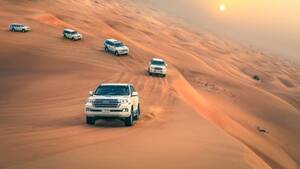
Instead of rock concerts or theatrical shows, OceanAir’s Al Khayma Camp is booked out for desert safaris, cultural experiences and private functions. Typical daily programming includes drive-out desert safaris from Dubai followed by on-site activities. For example, a popular evening tour (“Red Dunes Safari”) packs in an afternoon of thrilling 4×4 dune-bashing and sandboarding, then stops at Al Khayma Camp for live entertainment and dinner . The camp’s night program usually features an authentic BBQ buffet dinner (with vegetarian options available) , traditional performances (folk music, Tanoura/Yola dance, belly dance) and interactive activities like henna painting and falconry. One itinerary highlights that “heart-pounding dune bashing” is followed by Arabian cuisine, live BBQ, shisha (hookah) and even a falconry show and fire dance . Morning departures are also offered: a typical “morning safari” includes early desert drives, sandboarding and a camel ride before returning by noon, avoiding the heat . Special packages (often called “premium” or “overnight” safaris) can extend late into the night or include overnight camping in bedouin-style tents. Beyond the standard tour formats, the venue can be rented for private events: corporate retreats, team-building outings, product launches or even intimate desert weddings. Official descriptions list it as suitable for parties, conferences, seminars and networking events . In short, the calendar here revolves around desert adventures. Nearly every week will see one or more full-camp “safari” events (day or evening), rather than singular fixed concerts. Notable offerings include daily dune-surfing excursions, camel rides and live cultural shows – for example, one desert dinner program advertises “Traditional Yola dance, Falconry show & Mega Fire show” as part of the entertainment . (Typical ticket prices for these tours are in the few-hundred dirham range; for instance, one 5-hour evening safari is about £60–£70 per adult .) In recent years (2020–2025), OceanAir has kept a very high quality rating – for example, its premium dinner safari holds a 9.8/10 “Exceptional” score from over 1,100 reviews on a booking site . All programming is run by OceanAir’s guides and support staff, with events occurring daily (sat–fri) so long as weather permits. Overall, Al Khayma Camp’s schedule is dominated by these fully staged desert tours rather than concerts, making it a unique hybrid of cultural showcase and outdoor activity center.
Tickets and Booking
Since OceanAir is primarily a tour operator, tickets aren’t sold at a venue box office. Instead, you book through OceanAir directly (via their website or offices) or through travel agencies and online travel platforms. Tours typically go on sale well ahead of time, especially during peak season (winter months and holidays) when popularity is high. Tours often offer tiered options: for example, standard versus VIP packages (VIP might include front-row seating and table service during dinner ). Prices vary by package and season, but as a guideline many evening BBQ desert safaris range around AED 250–300 per adult (approximately £55–70) . Children or family rates may be available. Smaller daytime tours (no dinner) cost less. Inclusions usually cover round-trip hotel transfers from central Dubai, event dinner, and all activities listed. New tour listings often include things like “free cancellation,” online vouchers and instant confirmation as conveniences (for example an advertised tour notes “Free cancellation available” and “Mobile voucher (instant confirmation)” ). The safest way to secure a spot on busy days (weekends, holidays) is to book early online. OceanAir also accepts walk-in bookings at its travel agency offices in Dubai, but note that peak tours can sell out. Always verify details like meeting point and pickup time when booking. For larger corporate events or private bookings, OceanAir staff can arrange custom itineraries and pricing. In summary, tickets are obtained via tour booking channels (not at a live gate), prices run in the low hundreds of dirhams, and advance purchase is advised in busy seasons.
Seating and Layout
Al Khayma Camp is laid out as a large open-air desert amphitheater with dining and show areas under tents and around the base of the hill. There are no fixed seats: visitors typically sit on low cushioned benches or at dining tables facing the main performance area. The venue lists a **theater-style capacity of 400** attendees . In practice, guests may sit in rows of traditional majlises or at banquet-style tables for dinner. Because the camp is on a slope, even back rows have unobstructed sight lines over the front. For most tours, seating is unassigned general admission (first-come), but some VIP upgrades reserve front-facing tables or plush seating closer to the stage . (One VIP description explicitly mentions “comfortable seating for the show, and meals served at your table” .) From an acoustic standpoint the camp is wide open; wired sound and lighting rigs are used to project music and announcements. You’ll feel the desert breeze – there are no solid walls to muffle sound, so performances can spill out into the silence of the dunes. Most visitors gravitate toward seats facing west to watch the sunset over the dunes during dinner. Overall, the layout emphasizes an immersive 360° desert vista – for example, the entire venue “offers panoramic views” and controlled access thanks to its raised hilltop position . Just note that during shows there’s no strict “bad” spot – all clients have clear views of the entertainment area from wherever they settle in. Seating areas are typically lit by soft ambient lighting after sunset, creating an intimate campsite atmosphere under the stars.
Getting There and Parking
Al Khayma Camp is located deep in the Lahbab desert (near Al Awir in southern Dubai), not in the city center. The most convenient way in is by 4WD vehicle. If you’re driving yourself, set your GPS to “Al Khayma OceanAir Camp” or coordinates ~25.1756°N, 55.6267°E. The usual route is to take Sheikh Mohammed Bin Zayed Road (E311/E66) east from central Dubai toward Al Awir, then turn south onto Desert Road toward Lahbab. Traffic allows roughly a 30–40 minute drive: for example, a mapping tool indicates 44.4 km in about 32 minutes from Dubai Mall . Rideshare taxis (Uber/Careem) *can* make the trip, but expect a one-way fare on the order of AED 100–130 . Note that mainstream taxi drivers may not be fully sure of the camp’s off-road entrance, so reading coordinates or calling ahead is wise. There is no formal paved “parking lot” like in a city venue; tours typically park buses or guests’ cars along a gravel area by the entrance, so come prepared for an unpaved parking spot. Public transport to Lahbab is very limited. There is *no direct metro or bus* into the desert. One rough public route is to take the Red Line metro to Dubai Mall, then the 8-series bus from Burj Khalifa/ Dubai Mall Metro to Union Station, and finally RTA Bus E16 from Union Station to Habab (near Lahbab). In total that approach can take over 2½ hours one-way . Alternately, Rome2Rio notes a common bus connection: take bus 6 from Dubai Mall Bus Stop 6 to Oud Metha, then transfer to bus E16 getting you to Lahbab (Habab Roundabout) in about 2h37m . In practice, most visitors rely on the tour’s provided pickup at their hotels. Indeed, official tour info lists “selective hotel pickup” in Dubai , meaning you typically don’t need to drive or park yourself. If you do arrive by taxi or car, plan to meet the group van at the listed coordinate and park off the highway. Once off-road, a high-clearance vehicle is best recommended.
Inside the Venue
Entering Al Khayma Camp feels like stepping into a traditional Bedouin gathering, but with modern comforts. Guests are usually greeted by staff handing out hot Arabic coffee and dates or sweets – a classic desert welcome ritual . The camp ground is ringed with large tents and low tables where dinner will be served. Between activities, you’ll find open areas for watching performances or trying games like archery or sandboarding. Lighting is kept cozy (strings of lamps, lanterns at tables) once the sun sets, ensuring a warm, intimate mood. Expect a very relaxed, informal atmosphere – this isn’t a gilded ballroom. No dress code is enforced beyond local norms (casual attire is fine), but bring a light jacket after dusk as desert temps drop. The event is generally family-friendly, though children should be supervised around campfires or electrics. Note that the camp provides basic facilities: for example, separate men’s and women’s restrooms are available (unusual for a desert outing). Food and drink are served buffet-style: in typical OceanAir tours, a multi-course BBQ dinner is laid out under a tent (with vegetarian options often provided) . Tea, coffee and soft drinks are usually complimentary and self-service, and a staffed bar often offers alcoholic drinks (for those so inclined) during the meal. Shisha (flavored hookah) is another standard pick-up: one itinerary explicitly mentions a shisha lounge as part of the camp experience . You can move freely around the camp, mingle with other travelers, or step outside to walk in the dunes. Security is minimal – there are no gates except the natural perimeter of the desert – and OceanAir staff monitor the event. Phones generally have enough signal to call a taxi if needed (though Wi-Fi is usually not available), so feel free to take the classic desert photos. In short, inside Al Khayma you’ll find an immersive, well-organized desert party: food stalls, entertainment stage/front area, seating zones around the hill, and cultural performances all laid out under the open sky.
Nearby Amenities
Because Al Khayma Camp is in a remote area, nearby amenities are limited. There are *no restaurants or shops immediately adjacent to the camp*, aside from the camp’s own food and beverage service. If you have time before your departure, it’s common to dine in Dubai or at the airport area. The closest major facilities are back in Dubai: for example, hotels in Academic City or near Al Maktoum Airport are about 20–30 km away. Visitors often stay in Dubai city hotels (Downtown Dubai, Al Barsha, or near the Marina) and travel out for the safari. Alternatively, for an extended desert stay one could book accommodation at desert resorts like Bab Al Shams or Al Maha (both 10–15 minutes away by car) . Bab Al Shams Desert Resort & Spa offers mid-range lodging and al fresco dining, while Al Maha is a luxury desert resort with villas and its own traditional experiences. If you are looking for local bars or cafes *near Lahbab*, be aware that the nearest cafés and minimarts are several kilometers away. In practice, plan to arrive already refreshed from the city – for example breakfast or lunch in town – since the camp’s meal service happens after sunset. After the camp event ends (usually around 9–10pm), the only practical transport is by pre-arranged taxi/transfer back to Dubai. Public buses do not run out to the desert at night. In summary, the best preparation is to treat the camp as your destination: arrive fed and dressed for the weather, and rely on the tour’s included transportation to handle the rest.
What Makes This Venue Special
Al Khayma Camp by OceanAir stands out because it blends genuine desert culture with first-class event support. Architecturally it’s a one-of-a-kind – the camp’s raised platform on a 10m artificial hill offers sweeping 360° views that no natural dune alone could . This setting was intentionally designed for privacy and ambiance; guidebooks note that the hillside perch “provides a distinctive and secluded setting” ideal for private events . The use of converged contemporary and Arabian design also gives it a stylish edge: think modern lighting and sound equipment hidden among traditional tents and rugs. Culturally, the venue brings to life old Bedouin traditions (Arabic coffee ceremony, welcome Omani incense, camel rides and falconry demos) in a way that most urban attractions do not. For instance, one tour underlines falcon encounters and henna painting alongside its dinner programme , directly connecting guests with UAE heritage. Legendary moments often mentioned by visitors include the magical sunset over red dunes and the enchanting live performances under starlight (belly and Tanoura dances). OceanAir’s high ratings reflect that guests appreciate the authenticity – e.g. reviewers repeatedly praise the lavish BBQ dinner under genuine Bedouin canvas and the friendly guides. The venue’s cultural significance also ties to the local Lahbab/Lahboub area, where camel breeding is a proud tradition . By supporting local Bedouin tributes (coffee, dance, curses), the camp helps keep these intangible traditions alive in a modern context. In the community, having a polished desert-camp venue boosts eco-tourism and provides jobs for local guides and performers. In the end, artists and travellers love it because it feels every bit as adventurous as the tours themselves – you’re literally sleeping in the dunes, with the desert winds and camp drumbeats forming the night’s soundtrack. This unique fusion of adventure and cultural immersion is what sets OceanAir’s La Khayma desert experience apart from any ordinary event space .
Visitor Tips and Information
Accessibility: OceanAir explicitly advertises wheelchair-friendly tours . That means with notice they can arrange transport and seating to accommodate reduced mobility. The desert paths themselves are unpaved, so wheelchairs need extra space or assistance. Guests with any special needs should mention them when booking. Getting Dressed: Desert attire is low-key; most visitors wear long pants and T-shirts or light layers. In winter, nights can drop to ~15°C so bring a jacket or sweater; in summer, early morning or late evening safaris reward warm clothing prepared for cooler temperatures. Footwear should be closed-toe shoes or trainers (sand means heels or sandals are not ideal). Visitors sometimes make the mistake of wearing white or new shoes – the sand and dust can get anywhere, so something rugged is preferred. Also remember sun protection: sunglasses, hat and sunscreen are a must for daytime Sahara sun. Common Mistakes: Don’t underestimate travel time or temperature. Allow extra buffer if driving out yourself, as desert routes can be slower than GPS predicts. Don’t arrive at the last moment – tours leave promptly at the scheduled time (morning safaris often depart ~8am, evening tours ~3–4pm ). Check details before you go: for instance one dinner safari clearly notes a **15:15** (3:15pm) start . If you arrive late, you may miss the off-road ride. Food/Drink: The camp dinner is usually very filling (mixed grills, rice, salads, desserts, coffee/tea). If you have dietary restrictions, confirm in advance – the camp usually provides vegetarian and halal options , but no pig products. Alcohol is typically available for purchase during dinner (open bar or by-drink, as local law permits). Behavior: This is a family-friendly, respectful setting. Users are allowed to take photos freely, but be mindful of local norms (don’t photograph guests without permission, and open flames on stage should be enjoyed at safe distance). The camp enforces polite conduct, but casual clothing is fine – it’s not a formal gala, it’s a friendly desert party. Finally, bring a sense of adventure: battery packs for your camera/phone (no re-charging onsite), a modest tip for staff if they help carry items or serve-shisha, and an appetite for sand and spice. By planning ahead, following the guide’s instructions (especially for dune-bashing rides), and keeping an open mind, your visit to OceanAir’s Al Khayma Desert Camp will be safe, comfortable and unforgettable.
What is the capacity of OceanAir’s Al Khayma Desert Camp?
The Al Khayma desert camp by OceanAir can accommodate about 400 guests at once . Seating is flexible (outdoor cushions and tables), but the venue's maximum theatre-style capacity is listed as 400 .
How much do tickets or tours cost?
Ticket prices vary by package and season. As a guideline, an evening BBQ desert safari is around AED 250–300 per adult (roughly £55–70) . Morning-only safaris and child tickets cost less. Check current tour listings for exact rates and extras (VIP options, etc.). Advance booking often shows any discounts or holiday pricing.
Where and how can I buy tickets or book a tour?
Tours must be booked through OceanAir or authorized agents – there is no public box office at the camp itself. You can book online via the company’s booking system or reputable travel sites (instant voucher, mobile ticket formats are common ). Many people also book through Dubai hotel concierges or tour shops. Since events fill up on weekends and holidays, buy tickets at least a few weeks in advance. The tour price includes everything: hotel pickup, desert activities, and dinner.
How do I get to the Al Khayma Desert Camp by public transport?
Public transport is indirect. A feasible route is via Dubai Mall and Oud Metha: take a bus from Dubai Mall to Oud Metha, then transfer to RTA Bus E16 to reach Lahbab (Habab Roundabout). This journey takes roughly 2 hours 35 minutes . Most travelers instead arrange taxi or (more commonly) the tour’s own pickup from central Dubai hotels. The camp’s booking information always lists a hotel pickup service to simplify arrival.
Is there parking available if I drive myself?
There is no formal paved parking lot at the camp. If you drive in a 4x4, you’ll park near the entrance on a cleared desert area (no fee), but it’s basically a gravel pull-off. Most guests arrive by bus or arranged transport. Plan to meet the driver/bus at the directions provided by OceanAir. Ensure your vehicle has enough clearance for off-road sandy conditions or park at the paved staging area and join the tour’s vehicle from there.
What’s the best seat or viewing spot at the desert camp?
Seating is open-air, so every spot has a view of the stage and desert skyline. For sunset views, sit facing west (toward the dunes). For performances, any seat facing the main tent or stage area will do. Many tours let you walk around, so you can choose a vantage point. (VIP upgrades usually reserve front-row table seating near the performers .) Because the site is on a gentle slope, even the seats at the back of the camp enjoy panoramic vistas .
Are kids allowed and are there any age restrictions?
Yes – any age can attend. In fact, Lahbab desert tours have “no age limit” for entry . However, some activities (like quad biking or dune bashing) may have safety restrictions on small children or height requirements. Children under 4 years may not be allowed on the bumpy rides. The camp itself is family-friendly, with kid-appropriate entertainment. Just inform the tour operator so they can plan a child seat or adjust pickup times accordingly.
Is the camp accessible for wheelchairs or people with disabilities?
OceanAir lists *wheelchair-friendly experiences* among their offerings . This means they can provide modified vehicles for transfer and arrange seating for mobility-impaired guests. Note that the desert terrain is unpaved, so ensure your wheelchair is sturdy or bring assistance. The facility itself has basic ramps or flat entrances to accommodate wheelchairs. If you have special needs, mention it when booking so the company can make arrangements (like a larger bus with lift or reserved flat seating).
Are there any bag/policy or dress code rules?
There is no formal dress code – casual desert attire is fine. (Loose, modest clothing is recommended.) Comfort matters: avoid flip-flops or heels because of sand. Bags are generally unrestricted – treat it like an outdoor scale: no large luggage, and keep valuables close as you would anywhere. Photography is allowed (most guests take scenic photos), but be respectful when filming cultural performers. The camp enforces normal safety rules (no running near fires, etc.) but otherwise it’s very relaxed.
What food and drink options are available at the camp?
Meals are included in most tours: a multi-course Arabic BBQ buffet is served at dinner time . Vegetarian and halal options are always provided. Soft drinks, water and tea/coffee are typically complementary. Alcoholic beverages are often available for purchase during the dinner service (UAE law allows beer or wine at licensed events). Sheesha (hookah) pipes are also usually provided at communal tables . If staying overnight at a resort or wanting extra drinks, note that camp bars are very basic, so you may wish to buy specific snacks or drinks in Dubai before heading out (the camp experience is culinary-focused on its set menu).
Is there Wi-Fi and can I charge my devices at the camp?
The camp is in a remote area, so Wi-Fi is generally not available for guests. Mobile coverage (4G/5G) may be spotty; it’s safest to assume offline operations. There are power outlets at the facility (for lighting and music), but guest access is usually not provided. We recommend bringing fully charged phones and camera batteries – charge them in Dubai hotels just before departure. A small power bank is a useful back-up if you plan to take lots of photos.
Are photos and cameras allowed?
Yes, photography and video are generally allowed and common. Guests love snapping the sunset, the dunes and camp activities. Just respect performers’ privacy – ask before taking close-up photos of dancers or other tourists. Also use caution with flash (it can startle camels or distant wildlife). There are no restrictions on personal cameras, but avoid professional camera gear; the environment can be dusty. In practice, most visitors bring only their phone or a point-and-shoot. The night sky and fire shows make for great photos, so don’t forget your memory card!
Is there an age limit or are children welcome?
Children are welcome at Al Khayma Camp. In fact, the Lahbab desert experience has “no age limit” , so toddlers through seniors can enjoy it. The only caveat is for certain activities like dune-bashing “roller coaster” rides or quads, which may have height/age minimums (ask your tour provider). If traveling with kids, tour operators often offer child car seats or stroller-friendly pickup by arrangement. Otherwise it’s a family-friendly atmosphere – kids can ride camels, draw sand dunes with charcoal or just relax at the fire.
What time should I arrive, and how long does the event last?
Tours have fixed schedules. An evening BBQ safari typically starts in mid-afternoon (around 3–4pm) . The pickup/meeting time will be given when you book (for example, one entry notes a 15:15 start ). Guests usually arrive at camp by dusk. The experience then lasts through dinner and shows, generally ending by 10pm. Morning tours run roughly 8am–12pm . OceanAir will specify return or drop-off time – typically guests are back in city the same evening unless an overnight option was booked.
Are there restrooms and accessibility facilities on site?
Yes. Despite being a desert camp, there are basic restroom facilities on site. There are separate toilets for men and women . Although not a luxury spa, they are standard flush toilets (often in portable cabins). On the accessibility note, the campsite ground is flat in dining areas, so wheelchair users can move around where platforms are set up (ramps or level entries are provided). The staff also mention having rides with room for wheelchairs, as part of their wheelchair-friendly promise . Still, if you have special mobility needs, it’s smart to request assistance when you book so the staff can prepare the easiest access routes for you.