About Burj Khalifa
Burj Khalifa is not a conventional theatre, arena or concert hall. It is a mixed-use skyscraper, observation attraction, hotel, residential address, dining destination and enormous outdoor media canvas. It remains open under its original inaugurated name in Downtown Dubai, beside Dubai Mall and Dubai Fountain.
At 828 metres, Burj Khalifa has been the world’s tallest building since opening on 4 January 2010. Construction began with excavation in January 2004, the tower passed Taipei 101 in height during 2007, topped out in January 2009 and completed its exterior cladding that September. Originally developed as Burj Dubai, it was renamed Burj Khalifa during its inauguration in honour of Sheikh Khalifa bin Zayed Al Nahyan.
The public observation experience opened immediately after the inauguration. Following a brief closure during 2010, it reopened in April. Armani Hotel Dubai followed in April 2010, At.mosphere opened on Level 122 in 2011, the Level 148 SKY deck arrived in October 2014, Levels 124 and 125 were connected by a new spiral staircase in 2016, and The Lounge opened across Levels 152 to 154 in 2019. A major RGBW façade-lighting upgrade was completed in 2024, ahead of the building’s 15th anniversary in January 2025.
There is no single published “venue capacity” because visitors, hotel guests, residents and office occupants use separate entrances and lift systems. The tower contains approximately 900 residences, a 160-room hotel, 37 floors of corporate suites and several public hospitality and observation levels. Official and specialist floor counts differ by method: the tower has 163 recognised above-ground floors, while its internal level system includes 200 levels, around 160 of them habitable.
Events and Programming
Burj Khalifa books visual spectacles rather than conventional seated concerts. Its regular programming includes architectural illuminations, short audio-visual façade shows, cultural and national celebrations, commercial projections and the annual New Year’s Eve production. Live musicians, dancers, drummers and aerial performers are usually positioned around Burj Park, Dubai Opera Gardens, the boulevard and the lake rather than inside the observation decks.
In 2021, a New Year production themed around togetherness honoured frontline workers, followed by a season of five-minute laser, light and music shows featuring geometric, kaleidoscopic and retro-futuristic themes. The façade also marked the Expo 2020 countdown and presented a special Expo projection season. The New Year’s Eve show welcoming 2022, called “Eve of Wonders”, combined fireworks with the LED façade, lasers and Dubai Fountain choreography.
Programming in 2022 included a special Eid Al Fitr light production and another major New Year’s Eve spectacle. In 2023, the celebration welcoming 2024 introduced a managed, ticketed viewing area in Burj Park while keeping public Downtown viewing areas free. The wider programme included live entertainment, dining events and performances at surrounding Downtown venues.
In 2024, the façade hosted cultural projections including a documented Diwali activation. The new colour-changing RGBW architectural lights debuted for Eid Al Etihad on 1 December. On 31 December, the nine-minute “Beyond Dreams” production used original music, more than 15,600 pyrotechnic elements and over 200 lighting and laser beams, with performers appearing throughout Downtown before midnight.
The tower marked its 15th anniversary in January 2025. That year’s New Year programme welcoming 2026 expanded into a week of entertainment running from 31 December to 7 January, incorporating a theatrical parade, moving platforms, aerial acts, drones, fireworks and large-scale façade effects. A Bollywood presentation curated with Shah Rukh Khan was staged in the ticketed Burj Park area.
As of 14 August 2026, the principal announced future project is an international projection-design competition. Artists may submit original three-minute audio-visual works until 18 August 2026, with the selected design to appear on all or part of the façade on a date chosen later. No fully dated programme for New Year’s Eve 2027 or later has yet been published.
Tickets and Booking
Tickets are required for the observation decks, not for viewing the building from Downtown. Standard admission to Levels 124 and 125 generally starts around AED 180–200, while Level 148 packages begin around AED 399. The premium Lounge experience across Levels 152 to 154 can approach AED 770, depending on the session, inclusions and demand. Sunset normally commands the highest price.
Book a timed slot through the attraction’s authorised booking service or purchase at the Dubai Mall counter if inventory remains. Advance booking is advisable from November to March, during school holidays and for late-afternoon visits. Children under three enter free, and guests aged 16 or younger must remain with an adult. Current tickets permit cancellation up to 24 hours before the scheduled visit, although individual packages may have different conditions.
The attraction currently lists daytime operating hours of approximately 10am to 8pm, with earlier last-entry times for premium levels. Seasonal sunrise, evening and promotional sessions sometimes extend beyond the standard schedule, so the time printed on the ticket takes priority.
Seating and Layout
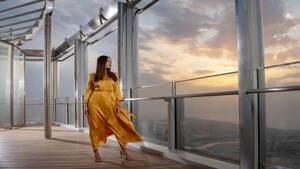
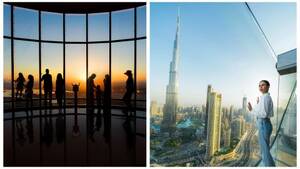
There is no auditorium seating chart. A visit is primarily a standing and walking experience, with limited lounge seating on premium levels. Level 124 has indoor viewing areas, telescopes and an outdoor terrace. Level 125 adds more space, 360-degree views and interiors influenced by Arabic mashrabiya patterns. Level 148, 555 metres above ground, provides a quieter lounge, guides, refreshments and an exclusive outdoor terrace. Levels 152 to 154 form The Lounge at approximately 585 metres.
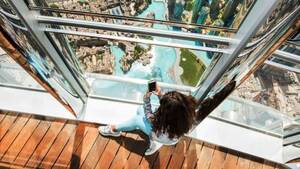
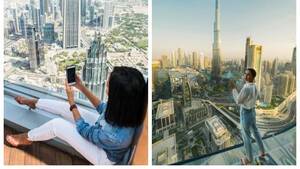
For open-air photographs, Level 124 or 148 is preferable to shooting through glass. Level 125 works well for visitors who want more indoor space. Level 148 is usually the better choice for a calmer atmosphere, while Levels 124 and 125 offer better value. At night, reflections from interior lighting can affect window photographs; dark clothing and positioning the camera close to the glass can help.
The highest point of the tower and its spire are not publicly accessible. Even The Lounge is still below the upper mechanical and communications levels.
Getting There and Parking
Burj Khalifa is at 1 Mohammed Bin Rashid Boulevard, Downtown Dubai. The At the Top entrance is inside Dubai Mall on the Lower Ground Floor. Follow the in-mall signs rather than attempting to enter through the hotel or residential lobbies. Fashion Parking P1 is the closest practical car park for the attraction.
The nearest Metro stop is Burj Khalifa/Dubai Mall on the Red Line. An air-conditioned pedestrian bridge connects the station with Level 2 of Dubai Mall, but the bridge and in-mall walk are lengthy. Allow 15–25 minutes from the train platform to the observation-deck check-in area, and longer during busy periods. Bus routes F13 and 27 also serve the district.
Dubai Mall uses ticketless paid parking in its Fashion, Grand and Cinema zones. The first four hours are free Monday to Thursday and the first six hours are free Friday to Sunday. The next weekday hour costs AED 20, with sharply increasing flat charges for longer stays. Zabeel and Fountain Views parking are presently exempt from the paid system, although they involve a longer walk. Parking conditions and tariffs may change.
For ride-hailing drop-off, P1 Fashion Parking Main Lobby is convenient. Pick-up points include Lower Ground near the telecommunications stores, P4 Fashion Lobby and P3 Zabeel. Regular taxis principally use P3 Zabeel. On New Year’s Eve, access roads may begin closing as early as 4pm, and parking does not guarantee vehicle access after closures start.
Inside the Venue
Visitors pass through ticket checks and airport-style security before joining the lift queue. Personal handbags and purses are allowed, but backpacks, sports bags, shopping bags, large luggage and pushchairs must be stored at the luggage counter near the entrance. Sharp objects and bulky electronic equipment may also be held. Outside food and drink are prohibited.
The observatory lifts are double-deck cabs travelling at up to 10 metres per second, with approximately 12–14 passengers per cab. The ascent includes synchronised visual and sound effects. Free Wi-Fi, viewing telescopes, souvenir photography, gift shops and light refreshments are available, although inclusions vary by ticket. Restrooms are provided within the visitor route.
There is no general coat check beyond the required luggage-storage facility. Dubai’s winter rarely calls for heavy outerwear, but the outdoor terraces can feel breezy compared with street level.
Nearby Amenities
Dining choices range from At.mosphere on Level 122 and the Armani Hotel’s restaurants to more than 200 outlets throughout Dubai Mall. Souk Al Bahar, across the pedestrian bridge, combines Arabesque architecture with restaurants overlooking Burj Lake. Licensed drinks are available at selected hotel lounges, including At.mosphere and Armani/Lounge; individual dress codes, age rules and minimum spends may apply.
Nearby hotels include Armani Hotel Dubai within the tower, Address Downtown, Palace Downtown, Address Dubai Mall, Address Sky View and Rove Downtown. Arrive at least 30–45 minutes before the ticket time, or earlier if travelling by Metro. Dubai Fountain currently presents afternoon shows and half-hourly evening performances, making it easy to combine the tower with a lakeside visit.
What Makes Burj Khalifa Special
The tower’s Y-shaped plan is an abstraction of the Hymenocallis flower and a response to wind, views and structural efficiency. Three wings buttress a hexagonal central core, while spiralling setbacks reduce the building’s mass as it rises. More than 40 wind-tunnel tests informed the final shape and orientation. The exterior uses approximately 26,000 individually cut glass panels with aluminium and textured stainless-steel cladding.
Construction used approximately 330,000 cubic metres of concrete and 39,000 tonnes of reinforcing steel. The 3.7-metre-thick foundation mat rests on 1.5-metre-wide, 43-metre-long piles. Condensation from the cooling system is collected for landscaping, while seven double-height mechanical zones distribute essential equipment through the building.
For production professionals, Burj Khalifa is a façade show system rather than a concert venue with a published permanent PA specification. The 2024 upgrade added individually addressable RGBW architectural fixtures that work alongside the media screen. Large events add temporary lasers, pyrotechnics and distributed sound systems throughout Downtown. The 2026 projection brief requires high-resolution video plus a separate audio master, demonstrating how the building is programmed as an audio-visual canvas.
Fireproof concrete surrounds the stairs, pressurised air-conditioned refuge areas occur every 25 floors, and selected lifts can support controlled evacuation. These systems are largely invisible to visitors but were essential innovations for a building of this height.
Visitor Tips and Information
The entire At the Top route is wheelchair accessible, with step-free movement and lift access. Dubai Mall offers wheelchairs through its concierge service and provides accessible parking and restrooms. “ADA compliance” is not the applicable legal classification in the UAE; visitors are described locally as People of Determination. Working service animals are not permitted on the observation tour, so travellers affected by that rule should plan alternative assistance.
Smart casual clothing is recommended. Dubai Mall asks visitors to dress respectfully, with shoulders and knees covered, avoid overt public displays of affection, keep pets outside and smoke only in designated areas. Small personal cameras and phones are routinely used, but commercial photography, professional shoots and branded use of Burj Khalifa imagery require prior authorisation.
Recent 2025–2026 visitor reports consistently praise the scale, lift ride and extraordinary daylight-to-night views. The most frequent criticism is long queuing around sunset, sometimes exceeding two hours in exceptional peak conditions, followed by another wait for descent. Early morning, opening-time and midday visits generally provide more space, while Level 148 receives better feedback from visitors prioritising comfort.
Economic and Cultural Impact
Burj Khalifa anchors the retail, hospitality, residential and cultural economy of Downtown Dubai and has become the city’s primary visual identifier. A pre-pandemic Dubai tourism report recorded 6.19 million Burj Khalifa visitors during 2019, while neighbouring Dubai Mall now receives more than 100 million visits annually. No reliable current figure isolates the tower’s total economic contribution, but its role in attracting visitors, broadcasts, investment and global events is substantial.
Frequently Asked Questions
Is Burj Khalifa a concert or performance venue?
Not in the conventional sense. There is no fixed stage, auditorium or public seating capacity inside Burj Khalifa. The building itself acts as a performance canvas for projections, lasers and architectural lighting. Associated singers, dancers, DJs and aerial performers normally appear in Burj Park, Dubai Opera Gardens or elsewhere around Downtown during major productions.
How long should I allow for an At the Top visit?
Allow approximately 90 minutes during quiet periods and two to three hours when queues are heavy. The observation time itself may be under an hour, but security, lift queues and the descent can add considerably more. Do not schedule a tightly timed dinner, airport transfer or another prepaid attraction immediately after a sunset booking.
What is the best time for clear views?
Morning usually brings the best balance of clearer air, cooler outdoor terraces and manageable crowds. Visibility varies with humidity, haze and dust, particularly in summer. Sunset provides both daylight and night views but is the busiest and most expensive period. After-dark visits emphasise city lights, although reflections can reduce photographs through indoor windows.
Is Level 148 worth the higher price?
Level 148 is most worthwhile for visitors who dislike crowds, want a smaller outdoor terrace or value priority handling, guided interpretation and refreshments. The height difference is noticeable but not transformative because Levels 124 and 125 are already exceptionally high. Families and budget-conscious visitors usually receive the essential experience from the standard decks.
Can visitors go to the actual top of Burj Khalifa?
No. The highest public experience is The Lounge across Levels 152 to 154, approximately 585 metres above ground. Level 148 is the highest conventional observation deck included in the SKY package. The upper mechanical floors, communications equipment and 828-metre spire are restricted operational areas and cannot be visited through any public ticket.
Can I buy tickets when I arrive?
A ticket counter operates at the Lower Ground entrance in Dubai Mall, but same-day availability is not guaranteed. Walk-up visitors may find that sunset, weekend or premium sessions are sold out. Advance timed booking is the safer option, particularly during winter, Eid holidays, school breaks and the Christmas-to-New-Year travel period.
What happens if I arrive late for my time slot?
Admission is sold for a specific date and time, and late entry is not guaranteed. Staff may place late visitors into a later queue if capacity permits, but popular sessions leave little flexibility. Allow extra time for the Metro bridge, Dubai Mall navigation and ticket checks, aiming to reach the attraction 30–45 minutes early.
Are pushchairs allowed on the observation decks?
Pushchairs and buggies must normally be left at the luggage room near the attraction entrance. Families should bring a baby carrier if practical, especially because peak queues may involve prolonged standing. Children younger than three receive free admission, while all children aged 16 or under must remain accompanied by an adult.
Can I bring a backpack, food or water?
Personal handbags and purses are allowed. Backpacks, shopping bags, sports bags, large luggage and similar items must be stored before the tour. Outside food and beverages are prohibited, including bottled drinks. Refreshments are sold within the visitor experience, with additional cafés and restaurants available on Dubai Mall’s Lower Ground Floor.
Is Burj Khalifa suitable for wheelchair users?
Yes. The public observation experience is wheelchair accessible, using step-free routes and lifts. Dubai Mall also supplies wheelchairs and has accessible parking and toilet facilities. Visitors requiring additional time should avoid the congested sunset period. Service animals are not admitted to the observation tour, an important restriction for travellers who usually rely on them.
Is there a dress code?
Smart casual clothing is recommended for At the Top, with respectful coverage suitable for a family attraction in the UAE. The observation decks are less formal than At.mosphere or Armani Hotel restaurants, which can impose stricter footwear and evening-wear rules. Bring a light layer if you are sensitive to strong indoor air conditioning.
Is photography allowed?
Personal phone and handheld-camera photography is a normal part of the experience. Large tripods, bulky equipment and professional production kits may be restricted or placed in storage. Commercial filming, advertising and branded use of the tower’s image require formal approval. For night photographs, use an outdoor terrace or hold the lens close to the glass to reduce reflections.
Is Dubai Mall parking free for Burj Khalifa visitors?
There is no separate parking validation for a standard observation ticket. Fashion, Grand and Cinema parking are free for four hours Monday to Thursday and six hours Friday to Sunday, after which charges rise quickly. Zabeel and Fountain Views parking are currently exempt from these fees but are farther from the attraction entrance.
How far is Burj Khalifa from the Metro station?
The air-conditioned bridge from Burj Khalifa/Dubai Mall Metro Station reaches Dubai Mall rather than the tower entrance itself. The complete journey from platform to At the Top check-in normally takes 15–25 minutes at a steady pace. Visitors with reduced mobility or young children should allow longer because the mall is exceptionally large.
Can I watch the New Year’s Eve show without a ticket?
Public viewing areas around Downtown Dubai have traditionally remained free and first come, first served, while Burj Park offers a separate paid experience. Expect security zones, enormous crowds and road closures beginning during the afternoon. Restaurant or hotel reservations may provide access badges, but those badges do not override road closures or guarantee vehicle entry.
Will poor weather or haze qualify me for a refund?
No visibility guarantee is offered. Dubai can experience humidity, dust and haze even when conditions at street level appear pleasant. Current terms state that the operator is not responsible for weather affecting views. If panoramic distance is your priority, choose a morning slot and check local conditions before setting out.