About Museum of the Future Dubai
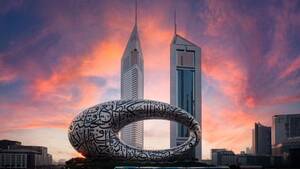
The Museum of the Future is an immersive science, technology and foresight attraction on Sheikh Zayed Road, beside Jumeirah Emirates Towers. It is not a conventional museum built around a historic collection. Instead, visitors follow a theatrical journey through imagined futures involving space exploration, ecology, biotechnology, wellness, robotics and emerging inventions. The main experience occupies five exhibition floors, with a dedicated children’s area, an auditorium and a large multipurpose event hall elsewhere in the building.
As of 15 August 2026, the museum remains open and trading under its established name, generally from 10am to 7pm with last admission at 5pm. However, visitors should note an important forthcoming change: the current exhibitions are expected to close in mid-September 2026 for a comprehensive replacement. A redesigned visitor journey, renewed identity and new generation of interactive exhibitions are planned for the first quarter of 2027. Exact closing and reopening dates had not been confirmed at the time of writing.
The building is 77 metres high and covers approximately 30,548 square metres. No reliable public figure has been issued for the museum’s total daily visitor capacity. For events, the confirmed capacities are up to 450 guests in the 1,640-square-metre Level 7 space and 321 people in the fixed-seat auditorium.
History and Development
The permanent museum grew from experimental “Museum of the Future” exhibitions presented alongside Dubai’s World Government Summit. A 2015 temporary experience examined the future of government services through immersive environments, interactive technology and speculative design. The permanent project was announced in March 2015, and Law No. 19 of 2015 established the institution. Dubai Future Foundation was subsequently launched in 2016, placing future foresight, innovation and the museum within a broader institutional programme.
Construction ran principally from June 2016 to September 2021, while interior exhibitions and audiovisual systems were fitted out before opening. The steel structure, containing about 2,400 diagonally intersecting members, was completed in 2018. The museum officially opened on 22 February 2022, a deliberately memorable date written as 22/02/2022. The 2021 period therefore represents construction and commissioning rather than normal public programming.
By its fourth anniversary in February 2026, the museum was approaching five million visitors. Its operators reported 620 events, conferences and talks, together with 224 educational programmes, workshops and interactive learning experiences since opening. The planned 2026–2027 transformation is the first complete replacement of the original visitor journey rather than a structural rebuilding of the landmark itself.
Events and Programming
The Museum of the Future books intellectual, educational and corporate programming more often than conventional concerts or theatrical productions. Its calendar centres on keynote talks, expert panels, technology demonstrations, film screenings, workshops, government summits, cultural discussions, children’s camps, wellness sessions and private launches. Public talks are frequently free with advance registration, while workshop charges vary. Private event and venue-hire prices are supplied individually.
The early Future Talks programme featured astronaut Hazzaa Al Mansoori, futurist Professor Greg Clark, mixed-reality specialist Alex Kipman, roboticist Professor Oussama Khatib, entrepreneur Changpeng Zhao and wellbeing author Deepak Chopra. Idris and Sabrina Elba discussed culture’s role in addressing global issues in 2023, while NASA administrator Bill Nelson appeared with Emirati astronauts Sultan Al Neyadi and Hazzaa Al Mansoori for a space-exploration session.
Other notable programming has included Climate Future Week, combining panels, workshops, film screenings, environmental photography and start-up discussions; events connected with the Dubai Calligraphy Biennale; robotics documentaries; and the annual Dubai Future Forum. The 2024 forum attracted more than 2,500 participants from around 100 countries, while the 2025 edition presented more than 70 sessions and immersive experiences involving over 200 speakers.
Recent workshops demonstrate the breadth of smaller-scale programming: creative writing, Arabic calligraphy, introductory 3D design, AI-assisted music, future medicine and Ramadan Majlis discussions. The 2026 calendar has also included jewellery and Islamic-art conversations, Level 7 yoga, Great Arab Minds masterclasses and a year-long history lecture series. The museum participated in the multi-venue 1 Billion Followers Summit, illustrating its ability to host major digital-media gatherings as well as specialist learning sessions.
The Dubai Future Forum has announced dates of 17–18 November 2026, but venue arrangements may be affected by the museum’s planned temporary closure. Beyond the 2027 relaunch, a permanent World Preservation Lab and BioVault has been announced to examine biotechnology, endangered-species protection and biodiversity.
Tickets and Booking
Standard museum admission is currently around AED169 for visitors aged four and above. Children under four enter free, as do People of Determination and one accompanying caregiver, although every visitor still requires an admission ticket or wristband. Seasonal promotions and flexible priority products may change the effective price, so AED169 should be treated as the usual general-admission benchmark rather than a permanent guarantee.
Tickets are issued for a specific date and entry time. Advance booking through the museum’s own sales channel is strongly recommended, particularly for weekends, school holidays and the final weeks before the 2026 closure. Same-day tickets may be available from lobby kiosks or the customer-service desk, but preferred times can sell out. If a visitor misses a slot, staff may offer the next available entry, subject to capacity.
General tickets are ordinarily non-transferable and non-refundable. An optional protection product may provide cancellation rights if its conditions and notice period are met. Visitors exchange tickets for wristbands or wearable access devices in the lobby and should keep them throughout the visit.
Seating and Layout
The everyday museum experience is primarily standing and walking rather than seated. Visitors normally begin with the upper-floor future journey and descend through the principal exhibitions: OSS Hope, the HEAL Institute and its biodiversity library, Al Waha wellness spaces, Tomorrow Today’s technology displays and Future Heroes on Level 1. Visits are self-guided along a managed route, with museum ambassadors positioned throughout.
The auditorium on Level P3 has premium fixed seating for up to 321 guests and a 13-by-4-metre screen. A public seat map, stage dimensions and named seating sections are not published. For screen-led presentations, the central middle rows will usually provide the most balanced perspective, although seating allocation depends on the event. Additional foyers support registration, refreshments and networking.
Level 7 is a 1,640-square-metre multipurpose hall accommodating up to 450 people. It is used for conferences, keynote sessions, workshops, receptions, wellness activities and private occasions. Layouts are event-specific; official materials do not publish separate capacities for banquet, classroom or standing-reception configurations.
Getting There and Parking
The museum’s formal address is Building 65, Sheikh Zayed Road, Trade Centre 2, Dubai, beside Jumeirah Emirates Towers. The easiest approach is Dubai Metro’s Red Line to Emirates Towers station. A covered link bridge runs directly from the station to the museum, avoiding the need to cross Sheikh Zayed Road at street level. Bus routes 27, 29 and X22 also serve the Emirates Towers area.
Drivers can use limited on-site self-parking or valet parking, both subject to availability and current charges. Published visitor materials have not been completely consistent about the tariff: some describe hourly charging, while an earlier museum map allowed ticket holders three complimentary hours followed by AED30 for each extra hour. Visitors should therefore budget for chargeable parking rather than relying on a free period.
Designated drop-off areas accommodate taxis and app-based rides. Bicycle and electric-scooter users can find racks around the self-parking area. The Metro is normally the most predictable choice because traffic on Sheikh Zayed Road and around the World Trade Centre can become slow during major exhibitions, conferences and evening events.
Inside the Venue
Entry begins in the soaring calligraphy-lined lobby, where visitors collect wristbands, pass security screening and wait for their timed journey. The lobby includes ticketing facilities, luggage storage, a retail shop and a café known for its robot barista. Separate men’s and women’s prayer rooms, baby-care facilities and washrooms are also available. Complimentary Wi-Fi operates across the museum.
Male and female washrooms are located on every floor and are accessible to People of Determination. Visitors may bring their own food for consumption in the lobby or garden areas, but food and drink are not allowed within the main exhibitions. Caregivers can carry snacks and drinks to the Future Heroes floor, though not beyond its entry barrier.
The typical full journey takes two to three hours, although visitors may remain longer during opening hours. Crowds can create delays around the opening “space journey”, lifts and popular interactive displays, so allowing at least three hours between arrival and another fixed booking is sensible.
Architecture, Sound and Production Technology
Killa Design created the torus-shaped architecture, with engineering by Buro Happold. The solid form symbolises humanity, the planted mound represents Earth and the central void represents the unknown future. Artist Mattar bin Lahej transformed quotations by Sheikh Mohammed bin Rashid Al Maktoum into the Arabic calligraphy covering both the windows and stainless-steel exterior.
The façade consists of 1,024 individually shaped panels covering approximately 17,600 square metres. Robotic manufacturing, parametric modelling and building-information modelling were used to resolve the curved geometry. Installation took more than 18 months, while roughly 14,000 metres of integrated lighting turns the calligraphy into a luminous night-time feature.
The building holds LEED Platinum certification. Around 30% of its power comes from solar generation, while an on-site system can recycle up to 70% of wastewater. The planted mound contains approximately 30 native species and functions as part of the building’s thermal strategy. Smart systems adjust lighting, temperature and air quality.
The auditorium’s permanent production infrastructure includes the 13-by-4-metre display, with specialist industry reporting identifying a 2.5mm-pixel-pitch LED installation and an L-Acoustics sound system. Elsewhere, the visitor experience uses highly localised multichannel audio, tactile bass, projection, scent and responsive lighting. Al Waha includes a reported 64-channel individually driven sound environment, while the simulated launch lift uses 14 audio channels and tactile shakers. A central command facility controls much of the museum’s audiovisual network. Exact house-lighting inventories, rigging loads, microphone packages and stage measurements are not publicly specified.
Accessibility and Inclusive Facilities
The museum states that all facilities are wheelchair accessible. Free wheelchairs are available from lobby docks, subject to availability, and accessible washrooms are provided on every floor. People of Determination receive free entry with one caregiver after presenting suitable proof of eligibility. Assistance dogs are permitted despite the general prohibition on animals.
Audio content is subtitled in Arabic and English, but the museum does not routinely provide sign-language interpreters or audio-description tours. The experience can include darkness, projections, ambient sound, scent, vibration and crowded interactive rooms, so sensory-sensitive visitors may prefer an early slot and may wish to carry ear protection.
The American ADA does not govern venues in the United Arab Emirates. Accessibility should instead be considered under UAE and Dubai requirements and the local People of Determination framework. The museum publishes practical accessibility commitments, but no separate public claim of “ADA certification” should be inferred.
Nearby Amenities
Jumeirah Emirates Towers is the closest hotel and dining complex, connected to the museum precinct. Its restaurants and lounges include Mundo, Gohan, La Cantine du Faubourg, Ninive, The Agency and Mi Amie, covering casual meals, business dining and evening drinks. One Central, on the opposite side of the area, offers additional cafés, restaurants and nightlife.
Nearby accommodation includes Jumeirah Emirates Towers, 25hours Hotel Dubai One Central, ibis One Central, Millennium Plaza Downtown and The Tower Plaza Hotel Dubai. These are convenient for visitors combining the museum with Dubai World Trade Centre or DIFC. The rooftop Monkey Bar at 25hours is a popular post-visit option because it overlooks the museum, although evening dress and age policies may apply.
What Makes This Venue Special
The museum’s defining achievement is the union of Arabic visual culture and computational architecture. Its inscriptions are functional windows rather than decoration applied after construction, allowing daylight to pass through handwritten ideas about creativity, innovation and humanity’s future. The building consequently works as architecture, public art and the museum’s largest exhibit at the same time.
Its cultural influence extends beyond tourism. By February 2023 it had welcomed more than one million visitors from 163 countries and hosted over 180 activations in its first year. By late 2024 it had passed three million visitors, and by February 2026 it was approaching five million. These audiences support nearby hotels, restaurants and transport services while strengthening Dubai’s profile in technology, design, architecture and international conference tourism.
Programmes such as Great Arab Minds, Ramadan Majlis, Future Talks and the Dubai Calligraphy Biennale also position the museum as a meeting place between regional heritage and global scientific debate. It has become a ceremonial venue for heads of state, ministers, astronauts, researchers, entrepreneurs and cultural figures, not merely a paid tourist attraction.
Visitor Tips and Recent Experiences
Recent visitor opinion is notably mixed. The architecture, lobby, Arabic calligraphy, terrace, biodiversity library and space-themed opening receive frequent praise, as do the modern facilities and helpful staff. Critical reviews commonly cite queues, high expectations created by the exterior and a feeling that some exhibits are more theatrical than scientifically detailed. Families with older children and teenagers often respond more positively than visitors expecting a collection of functioning futuristic inventions.
Arrive about 20–30 minutes before the booked time, use the Metro where possible and avoid scheduling another timed attraction immediately afterwards. Bags larger than 14 by 10 inches must be stored, and a fee may apply. Flash photography, tripods and selfie sticks are prohibited. Clothing should be respectful of UAE public-space customs. Children aged 15 and under must attend with a parent or guardian aged over 21; visitors aged 16 and above may enter independently.
Frequently Asked Questions
Is the Museum of the Future currently open?
Yes. As of 15 August 2026, it remains open under the Museum of the Future name. The present visitor journey is expected to close in mid-September 2026 for a major exhibition replacement, with reopening planned for the first quarter of 2027. Exact transition dates were still awaiting confirmation, so September visitors should pay particular attention to the date shown on their booking.
How much does Museum of the Future admission cost?
General admission is currently around AED169 for everyone aged four or older. Children under four, People of Determination and one accompanying caregiver qualify for free entry, although they must still obtain admission credentials. Priority products, temporary family offers, workshops and special activities may use different prices, so AED169 is best understood as the normal full-price museum ticket rather than a universal event rate.
Can I enter the lobby without buying an exhibition ticket?
The lobby functions as a public-facing arrival area containing the café, shop and customer-service facilities, and visitors have often been able to see portions of it without joining the exhibition journey. Access can nevertheless be restricted during busy periods, private events or operational changes. A museum ticket is required to proceed through the main timed exhibitions and reach ticketed features such as the upper-level terrace.
How far in advance should I book?
Book as soon as your Dubai itinerary is fixed, especially for weekends, school holidays and visits before the September 2026 closure. Entry is managed through timed slots, and same-day availability is not guaranteed. Early and late-afternoon sessions can disappear first when demand is strong. On-site kiosks sell remaining spaces, but relying on walk-up admission can produce a long wait or an unsuitable time.
How long should I allow for the visit?
Most visitors need two to three hours for the full exhibition route. Allow closer to three hours if you plan to read displays, use the interactive stations, visit the shop or stop at the café. Families may spend additional time in Future Heroes, while visitors mainly interested in architecture and photography sometimes finish sooner. Entry queues can add time even when you hold a reservation.
What is the closest Metro station?
Emirates Towers station on the Dubai Metro Red Line is the closest stop. Follow signs for the Museum of the Future and use the covered link bridge connecting the station directly with the building precinct. This route is easier and safer than attempting to cross Sheikh Zayed Road at street level. Dubai Metro stations include lifts, tactile guidance, accessible ticket facilities and wheelchair spaces.
Is parking available at the museum?
Limited self-parking and valet parking are available, but spaces are not guaranteed. Current museum information describes parking as chargeable, while an earlier visitor map listed three complimentary hours for ticket holders followed by AED30 per additional hour. Because published terms have differed, drivers should budget for a parking charge and avoid arriving immediately before their timed entry.
Is the museum suitable for young children?
All ages are welcome, and Level 1’s Future Heroes area is designed around play, exploration, collaboration and future skills. Very young children may find the longer introductory sequence, darker spaces and queues tiring. Children aged 15 or younger must be accompanied by a parent or guardian who is over 21. Families should allow time for breaks in the lobby or garden.
Can I take a pushchair inside?
The museum is step-free and served by lifts, making it navigable with a pushchair. However, timed group movements, lifts and busy interactive spaces can become crowded. Staff may direct visitors to particular routes or storage arrangements during peak periods. Bring a compact pushchair where possible and avoid hanging oversized bags from it, as all bags remain subject to screening and size restrictions.
What is the museum’s bag policy?
Bags larger than 14 by 10 inches are not allowed in the exhibitions. Backpacks, suitcases and oversized items must be left at the designated storage facility, where a fee may apply. Medical and baby bags can receive an exemption after inspection and tagging. Weapons, sharp objects and hazardous materials are prohibited, and security personnel may inspect any item brought into the building.
Can I take photographs and videos?
Personal photography and video are generally permitted using the existing light only. Flash, tripods and selfie sticks are prohibited, and temporary or special exhibitions may impose additional restrictions. Commercial filming and organised shoots require separate permission. The exterior is especially photogenic after sunset, when approximately 14,000 metres of integrated lighting illuminate the Arabic calligraphy across the curved façade.
Are food and drinks allowed?
Food brought from outside may be consumed in the lobby and garden, but not in the principal exhibition spaces. Water bottles and other refreshments should remain stored unless staff permit them in a designated area. Caregivers may bring suitable snacks and drinks to the Future Heroes floor, although they cannot be taken beyond its controlled entry point. A café operates in the main lobby.
Is there a dress code?
There is no formal eveningwear requirement for ordinary museum admission. Visitors are asked to wear clothing appropriate for a public place in the United Arab Emirates and respectful of local culture. Comfortable footwear is advisable because the route involves substantial standing and walking. Separate private galas, business conferences and nearby hotel bars may apply smart-casual or event-specific standards beyond the museum’s normal requirements.
Does the museum have luggage storage or a coat check?
A designated luggage drop-off area is available in the lobby, but it should not be treated as an unrestricted hotel-style left-luggage service. Oversized bags must be checked, and storage charges may apply. No separate public coat-check policy is advertised. Travellers should leave large suitcases at their hotel where possible and carry only a small bag that meets the 14-by-10-inch limit.
How accessible is the museum for wheelchair users?
The museum states that its facilities, parking areas and exhibition floors are wheelchair accessible. Complimentary wheelchairs are available from lobby docks on a first-come basis, and accessible washrooms are located throughout the building. People of Determination and one caregiver receive free entry with recognised proof of eligibility. Audio is subtitled in Arabic and English, but sign-language interpreters and audio-description tours are not routinely offered.
What is the capacity of the Museum of the Future auditorium?
The fixed-seat auditorium accommodates up to 321 guests and uses a 13-by-4-metre presentation screen. It is primarily designed for keynote addresses, panel discussions, seminars, film screenings and corporate presentations rather than large-scale concerts. The wider Level 7 multipurpose venue accommodates up to 450 guests. No official total daily capacity for the public museum journey has been published.
What will change when the museum reopens in 2027?
Every main exhibition in the original 2022 visitor journey is expected to be replaced. The reopened museum will present a renewed narrative, refreshed identity and more interactive examination of the scientific, technological and social forces shaping future decades. Development has incorporated more than 1,000 ideas submitted by people internationally. The World Preservation Lab and BioVault has also been announced as a future permanent installation.