Introduction
Coordinating multiple stages at a festival is akin to conducting an elaborate orchestra. With several performances happening in tandem, operational coordination becomes critical. From staggering set times to allow crowds to move between stages, to managing tech crews so one stage resets while another is live, a multi-stage festival requires meticulous planning. This article provides actionable advice for festival producers on mastering multi-stage coordination and quick changeovers, ensuring a seamless experience for festival-goers and performers alike.
Staggering Set Times for Smooth Crowd Flow
When a festival has multiple stages, scheduling set times carefully is essential. Staggering performances across stages prevents every stage from going quiet or loud all at once. For example, if the Main Stage act ends at 8:00 PM, schedule the Second Stage to start at 8:15 PM. This overlap buffer gives attendees time to walk to the next stage without feeling rushed or missing the opening of the next act. Staggered set times also ease crowd movement, reducing bottlenecks as large groups migrate from one area to another.
Strategic scheduling also minimizes sound overlap between nearby stages. By avoiding two loud bands playing at adjacent stages simultaneously, you prevent audio bleed that can diminish sound quality. Many successful festivals implement a rolling schedule: as soon as one stage falls silent for changeover, another stage comes alive with music. This continuous flow keeps energy levels high and the audience engaged at all times.
To further optimize this flow, organizers are increasingly turning to preference-based scheduling for concert-goers. By analyzing ticket buyer data, streaming habits, or app interactions, producers can identify overlapping fan bases. If data shows a high preference correlation between two mid-tier artists, scheduling them at different times—or on stages with clear pathways—ensures fans don’t have to choose. This data-driven approach to multi-venue music festivals helps maximize audience satisfaction and vendor foot traffic.
Data-Driven Event Marketing
Track ticket sales, demographics, marketing ROI, and social reach in real time. Exportable reports give you the insights to make smarter decisions.
Case in Point: Coordinating Headliners
Consider a large international festival that hosts two main stages. They plan their headliner times so that one stage’s headline act finishes shortly before the other stage’s headliner begins. This way, fans who want to catch both major acts have the chance to move over, and it prevents a mass exodus all at once from one stage area. Such scheduling finesse enhances the fan experience and reinforces safety by staggering the largest crowd movements. It’s a lesson many seasoned festival schedulers have learned: small timing adjustments can greatly improve comfort and safety.
Designing the Site for Easy Navigation
Even the best schedule falls flat if attendees cannot figure out how to navigate multi-stage music festival sites efficiently. Strategic site design is paramount. Producers must ensure clear, wide arteries between major stages, free of chokepoints like narrow bridges or dense vendor villages. Clear wayfinding signage, strategically placed lighting for night transitions, and digital map integrations in the festival app empower crowds to move swiftly and safely between sets, directly supporting the staggered schedule.
Planning a Festival?
Ticket Fairy's festival ticketing platform handles multi-day passes, RFID wristbands, and complex festival operations.
Coordinating Tech Crews Across Stages
Having multiple stages means there are several stage teams working in parallel. Each stage typically has its own stage manager, audio engineers, lighting operators, and stagehands. However, their work must be synchronized under a unified production plan. Strong communication between these teams is the backbone of multi-stage operations.
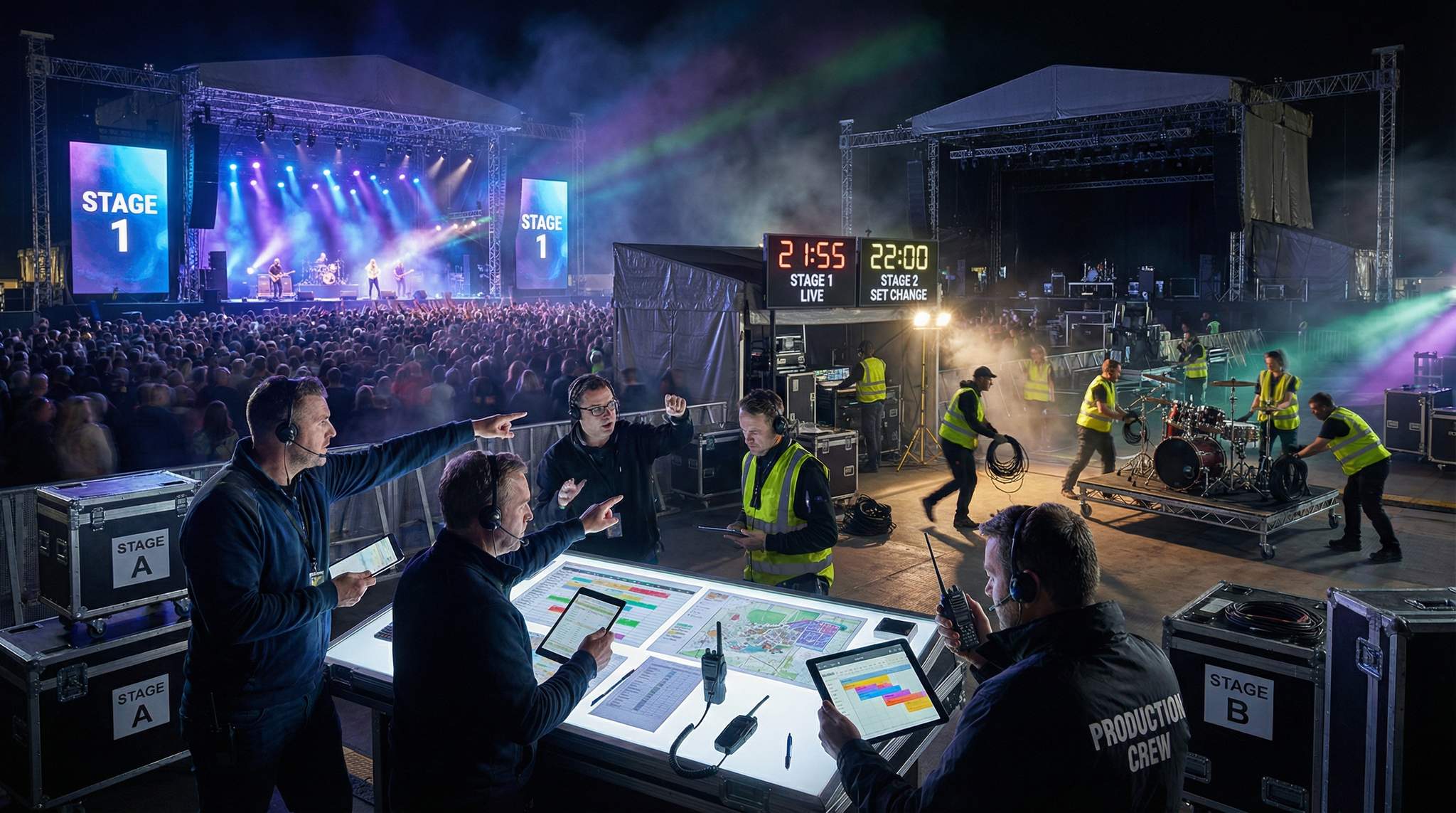
While Stage A is live, the crew at Stage B might be busy tearing down the previous set and prepping for the next act. For instance, at a major music festival, the moment one band finishes on Stage A, that stage’s crew springs into action breaking down instruments and setting up for the later act. Simultaneously, Stage B’s crew might be in a holding pattern, ready to go live as soon as Stage A falls quiet. This leapfrogging pattern requires each crew to know their exact cues and timing.
One practical approach is holding daily production meetings with all stage managers and technical department heads. In these briefings, the teams review the day’s schedule, flag any changes, and double-check that everyone is aligned. During the event, radio headsets and a designated communication channel allow stage managers to stay in constant contact. For example, if there’s a delay on Stage X due to a technical issue or an artist running overtime, the manager can alert others and adjust timing on the fly to avoid unplanned overlaps or awkward silences. The best festivals empower a central production coordinator to oversee all stages – much like an air traffic controller – ensuring each stage sticks to schedule and coordinating any necessary real-time changes safely.
The People Behind the Scenes
An often overlooked factor in multi-stage festivals is crew scheduling and well-being. Staggering stage times isn’t just for the crowd; it also affects crew workload. While one stage crew is under pressure doing a lightning-fast changeover, another stage’s crew may catch a short breather. Wise festival producers rotate staff or provide floaters – extra technicians who can assist whichever stage needs help at a given time. For instance, a floating audio tech might support Stage A’s monitor engineer during a challenging band setup, then move to Stage B if an issue arises there. This flexibility comes from strong team training and a culture where crews see themselves as part of one big production family rather than isolated stage teams.
Efficient Changeovers: Equipment and Logistics
The period between acts – the changeover – is where multi-stage festivals can really shine or stumble. A well-oiled changeover process means bands transition swiftly, keeping downtime minimal. To achieve this, meticulous logistics planning is required to ensure the right equipment, instruments, and people end up in the right place at the right time.
Standardize and Duplicate Gear: One proven strategy is using standardized backline equipment across stages. Providing a common drum kit, amplifiers, and microphone setup for most artists can drastically cut down swap time. When artists agree to use the festival’s backline gear, the crew only needs to make minor adjustments rather than swapping entire drum sets or amp stacks. Many experienced producers invest in duplicate gear – each stage has its own set of mics, monitors, and cables – so nothing has to be physically carted from one stage to another under time pressure. This not only saves precious minutes but also acts as a contingency; if a piece fails on one stage, you have spares on the other.
Need Festival Funding?
Get the capital you need to book headliners, secure venues, and scale your festival production.
Rolling Risers and Pre-set Stages: For festivals where stages are adjacent (or even for a single stage with space), rolling riser platforms are a game-changer. Imagine having Band B’s drum kit and keyboards already set up on a wheeled platform behind the curtain while Band A is performing out front. As soon as Band A finishes, the crew simply wheels out the next fully assembled setup, plugs in a few cables, and it’s showtime. Major rock festivals often employ twin stages side by side: as one stage hosts an act, the other stage right next to it is quietly being prepared with the next act’s equipment. In one notable European rock festival, this twin-stage design allowed changeovers as short as 5 minutes – the crowd barely had time to catch their breath before the next band kicked off!
Clear Stage Plots and Advance Information: Effective changeovers start weeks or months earlier with artist advances. Every performer should submit a stage plot and input list detailing their equipment needs and layout. Festival organizers who gather this information well in advance can identify potential conflicts (for example, two bands needing the same rare instrument or extra setup time) and plan accordingly. This preparation enables the technical staff to pre-mark stage positions (using tape marks on stage decks for where mic stands, monitors, and risers go for each act) and pre-configure console settings or monitor mixes as much as possible before the act takes the stage. When the day-of-show arrives, crews aren’t scrambling – they have a checklist and a map for each changeover, often rehearsed or walked through in advance.
Lighting and AV sync: Don’t forget that changeovers involve more than audio gear. Lighting cues and video content for each act should be pre-loaded and ready to go on separate consoles if each stage has its own, or queued up in a single system that can switch contexts quickly. Some festivals run separate lighting desks per stage so that one lighting operator can program the next act while another show is live. The same goes for LED screen content or special effects setups – they need to be coordinated so that when an act shifts, all technical elements align instantly.
Integrating Event Staging and AV Partners: Seamless changeovers rely heavily on the synergy between your structural staging providers and your audio-visual teams. When contracting event staging and AV services, ensure both vendors collaborate during the pre-production phase. The staging company needs to understand the weight loads of the AV rig, while the AV team must know the exact dimensions of the rolling risers and stage wings. A unified approach prevents day-of-show structural conflicts and ensures that video walls, PA systems, and lighting trusses are safely and efficiently integrated into the stage architecture.
Communication: The Secret Sauce of Scheduling
No matter how carefully you plan schedules and gear, clear communication keeps everything on track. Multi-stage festivals are dynamic environments – weather changes, artist delays, or technical hiccups can throw off timing. The difference between a minor hiccup and a show-stopping crisis is often how quickly and clearly the team communicates.
Radio Protocols: Equip all key personnel (stage managers, production managers, crew chiefs, security leads) with radios and establish protocols. For example, have a dedicated channel for stage management where any stage can call in “Stage 2 needs 5 more minutes for line-check” or “Stage 1 ready to go now.” By keeping chatter organized and professional, every crew hears what’s relevant without confusion. This constant communication loop allows on-the-fly adjustments. If Stage A is running late, Stage B might hold their start by a few minutes (communicate this to the artist and crowd as needed) to avoid overlapping sound or forcing fans to choose incompletely between sets.
Central Scheduling Hub: The most experienced festival producers establish a central command hub – often a production office or trailer – that tracks all stage schedules in real time. This hub is manned by someone (or a small team) who isn’t tied to one stage, but has oversight of the whole event. They monitor a master schedule board or software, update it with any changes, and communicate updates to all stages. Think of this as the air traffic control of the festival. When an unplanned change occurs, this central hub helps coordinate the response: maybe shifting a short acoustic set at a side stage to fill an unexpected longer gap on the main stage, or updating the audience via announcements and apps if a schedule change affects them.
Avoiding Downtime and Overlaps: Despite best efforts, overlaps or gaps can still happen if communication falters. One festival learned this the hard way when a quiet 20-minute gap on all stages occurred because each crew thought another stage had content scheduled. The audience was left in awkward silence, and vendors reported lulls in activity. The post-mortem revealed that a mis-communication in the schedule led to an unintended synchronous break. Since then, that festival’s organizers adopted a policy of triple-checking the master schedule for continuous programming and requiring each stage manager to sign off on their set times in coordination with the others. This story illustrates how vigilance and clarity in communication and scheduling can prevent embarrassing downtime.
On the flip side, overlapping major acts can be just as problematic. If two headline-caliber artists accidentally run simultaneously due to a delay or scheduling oversight, it can split the crowd or create undesirable sound bleed. Strong scheduling discipline – and the willingness to make tough calls like cutting a preceding set short if absolutely necessary – comes from a commitment to the overall festival experience above all. Veteran producers emphasize that “the show must go on – but in the right order.” In practice, this means always having a Plan B. Keep a small buffer in the schedule that you can use if things slip, and communicate any decisions instantly to all teams.
Tailoring Strategy to Festival Size and Type
Multi-stage coordination isn’t one-size-fits-all. The approach can differ for a small local festival versus a massive international one:
– Boutique & Local Festivals: These often operate with tighter budgets and possibly shared resources. For example, two small stages might share one drum kit or a single sound crew. In such cases, scheduling gaps between stage times becomes even more important to accommodate moving equipment or personnel. A local food and music fair might let one stage go quiet for 30 minutes while the community band sets up on the other stage, and that’s acceptable for the scale. The key here is communication to the audience – an emcee can keep the crowd engaged, announce the next act and direct attention smoothly to the stage that’s about to start.
– Large-Scale Festivals: Big festivals typically have dedicated gear and full teams for each stage, which enables near-continuous music. However, the complexity is higher – with as many as 5, 7, or even 10 stages running, a detailed run-of-show schedule is critical. Digital scheduling tools or festival management software often come into play to handle hundreds of set times and crew assignments. At this scale, you might also stagger genres – for instance, having the EDM stage run later into the night after the rock stages finish, so medical and security teams can concentrate support where the crowd currently is. Audience demographics and behaviors (e.g., older jazz festival audiences might appreciate slightly longer intermissions vs. youthful EDM crowds that prefer nonstop music) also influence how you coordinate multiple stages.
Regardless of festival size, certain principles hold true across the board: prepare thoroughly, communicate constantly, and stay adaptable. The most spectacular multi-stage festivals are those where the behind-the-scenes coordination is so smooth that attendees never even notice the complexity. They just enjoy a seamless parade of performances.
Frequently Asked Questions
Why is staggering set times important for multi-stage festivals?
Staggering set times prevents sound bleed between adjacent stages and eases crowd congestion by allowing attendees to move between areas without rushing. It ensures continuous music flow; for example, if one stage ends at 8:00 PM, another starts at 8:15 PM, keeping audience energy high and reducing bottlenecks during mass migrations.
How do production teams coordinate tech crews across multiple festival stages?
Production teams synchronize crews using a central production plan and constant radio communication. While one stage is live, crews at other stages prep for the next act in a leapfrogging pattern. Daily briefings and a central coordinator—acting like an air traffic controller—ensure teams align on cues and handle real-time adjustments efficiently.
What equipment helps speed up stage changeovers at music festivals?
Rolling risers and standardized backline gear significantly accelerate changeovers. Rolling risers allow crews to pre-assemble drum kits and keyboards behind the scenes, wheeling them out instantly when the previous act finishes. Additionally, using duplicate gear on each stage eliminates the need to transport equipment between stages under time pressure.
How can festivals prevent dead air or silence between sets?
Festivals prevent silence by implementing a rolling schedule where one stage activates immediately after another finishes. A central command hub monitors the master schedule in real-time to manage delays. If a gap occurs, organizers might shift a set or use a floater act to fill the time, ensuring continuous audience engagement.
How does advance planning with artists improve festival production logistics?
Collecting artist stage plots and input lists months in advance allows technical staff to identify equipment conflicts and pre-mark stage positions. This preparation enables crews to pre-configure console settings and lighting cues before the festival begins, ensuring that changeovers follow a rehearsed checklist rather than a frantic scramble on the day of the show.
How can festival organizers minimize sound bleed between adjacent stages?
Organizers minimize sound bleed by strategically scheduling performances so two loud bands do not play simultaneously on nearby stages. Staggering start and end times creates an overlap buffer, ensuring that when one stage is at peak volume, the adjacent stage is either silent for a changeover or hosting a quieter act.
Why is collaboration between event staging and AV teams crucial for festivals?
Collaboration ensures that structural stage designs safely support the weight and power requirements of audio-visual rigs. When staging and AV vendors coordinate during pre-production, it prevents day-of-show logistical conflicts, allowing for smoother equipment changeovers and a safer environment for both crews and performers.