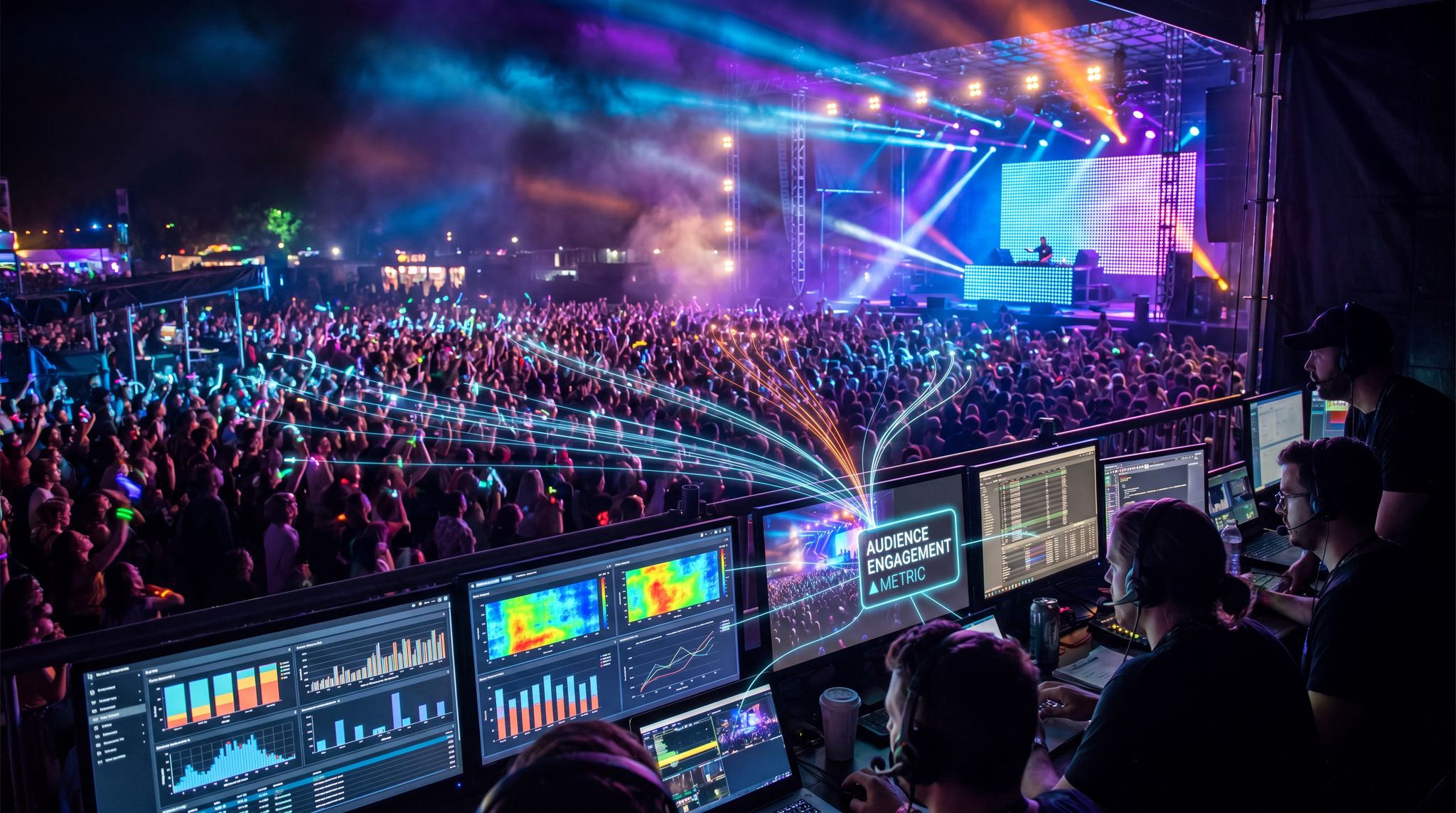
Massive stage structures, thundering sound, and dazzling lights – none of it happens by accident. Behind every successful festival is an expert technical production team planning and executing every detail of staging, sound, lighting, and AV (audio-visual) systems with precision. Festival technical production encompasses everything from designing safe, spectacular stages to delivering crystal-clear audio across a field, choreographing immersive lighting shows, and integrating special effects that wow the crowd. Whether it’s an intimate boutique gathering or a major multi-stage extravaganza, getting the technical elements right is crucial to creating an unforgettable (and safe) experience for attendees. This guide dives deep into the core components of festival technical production, revealing how veteran producers orchestrate the magic behind the scenes so that the show goes off without a hitch.
Table of Contents
- Stage Design & Structures
- Power & Electrical Systems
- Sound Systems & Front-of-House
- Sound Bleed & Noise Management
- Lighting & Video Systems
- Special Effects & Pyrotechnics
- Stage Operations & Changeovers
- Technical Operations & Communications
- Artist Technical Requirements & Backline
Stage Design & Structures
A festival’s main stage is the centerpiece of its world, combining artistic design with rock-solid engineering. Producers work with scenic designers to create stages that embody the festival’s theme – from whimsical art installations to towering LED facades – while ensuring the structure can support massive gear and withstand the elements. Achieving this balance requires early planning and often custom fabrication. For inspiration on blending creativity and practicality, producers examine how innovative festival stage designs incorporate scenic construction techniques that wow crowds but remain safe and functional.
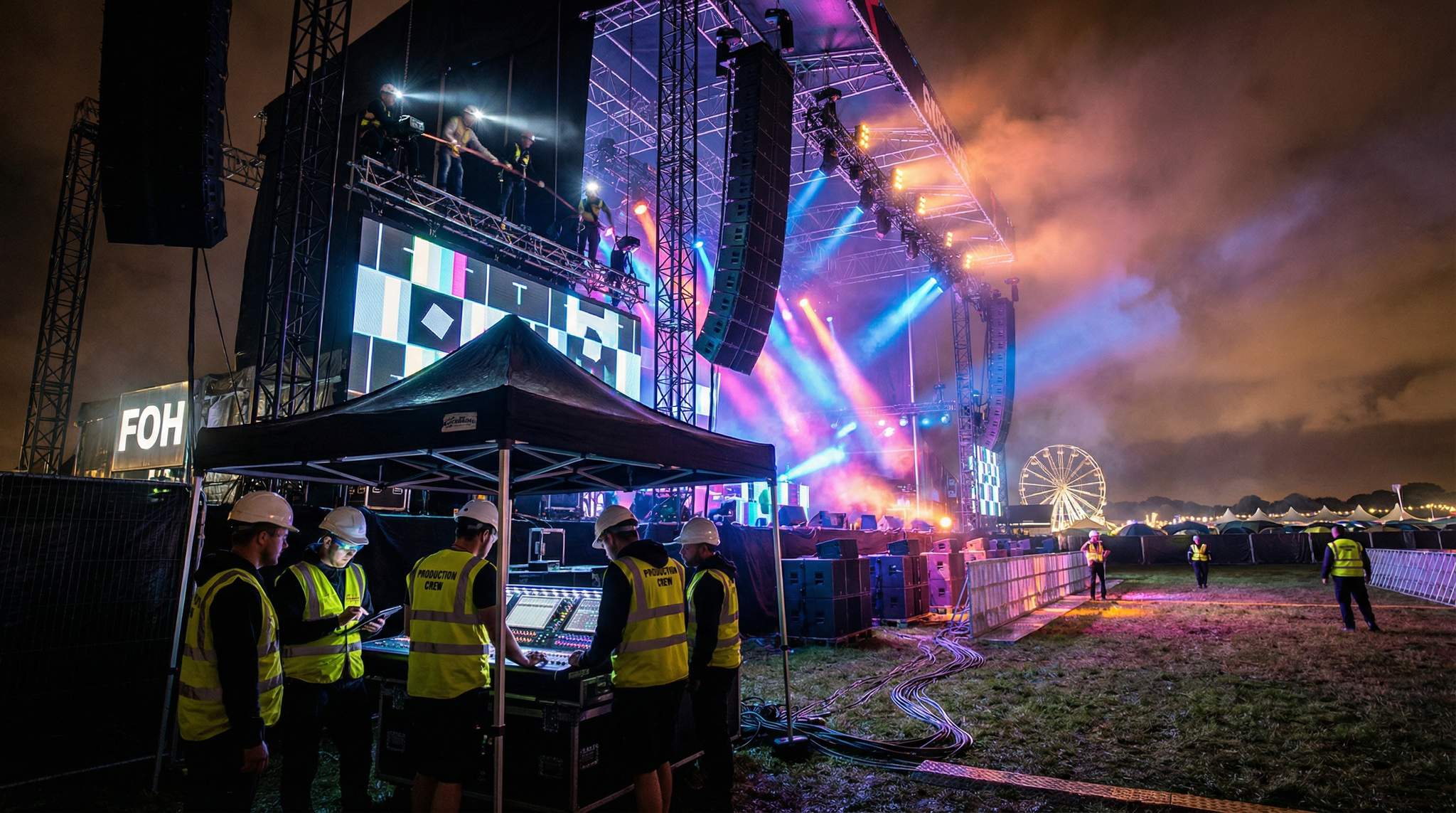
Staging isn’t just about looks; it’s a literal foundation for sound and lighting rigs. The stage must handle the weight of audio arrays, lighting trusses, video screens, and performers. Certified structural engineers and veteran riggers calculate load limits and implement safety factors for every overhead piece. Rigging refers to the system of trusses, motors, cables, and hardware that suspend lights and speakers above the stage. Following rigging best practices for hanging lights and speakers safely is non-negotiable – a single point of failure in a chain hoist or shackle can be catastrophic. Crews conduct daily safety inspections of all hoists, bolts, and support straps, and no equipment flies without proper rated hardware and secondary safety attachments (like safety cables on every lighting fixture).
Key Stat: The scale of modern festival stages is staggering. One major festival’s main stage stood 85 ft tall and 480 ft wide, built from over 1,000,000 pounds of scaffolding and transported on 470+ semi-trucks, according to production statistics from Midnight Rebels. Such mega-structures demand meticulous engineering and experienced crews to assemble.
All that structure must also survive Mother Nature. Outdoor festivals face wind, rain, and sometimes extreme weather that can quickly turn a beautiful stage into a dangerous situation. Wind is the single biggest threat to large stages – high gusts can catch stage roofs and backdrops like sails. Organizers develop detailed weather-safe stage structure protocols and wind discipline plans that specify actions at various wind speeds. For example, a festival might require lowering lighting rigs and scrims (decorative drapes) if gusts exceed 25 mph, pausing performances at 35 mph, and fully evacuating and securing the stage at 45+ mph.
Warning: Ignoring wind limits can be deadly. In 2023, a large event stage in Mexico collapsed after organizers neglected high-wind warnings – a tragedy that killed 9 people and injured nearly 200, as reported by AP News regarding the stage collapse. Every festival must enforce wind action triggers and never assume it won’t happen here.
Wind Action Plan – Example Triggers
| Wind Speed (mph) | Action Steps |
|---|---|
| 20 mph | Monitor conditions closely; secure loose scenic elements. |
| 30 mph | Stop using tall scenic props; consider delaying acts if gusts persist. Lower scrims and video walls as a precaution. |
| 40+ mph | Immediately pause performances and clear the stage. Lower the roof if possible. Evacuate audience near stages if structures are at risk until wind subsides. |
To execute these wind action plans effectively, production teams rely on precise, real-time data. The best wireless wind monitoring systems for multi-stage festivals utilize solar-powered or battery-operated anemometers mounted at the highest points of every stage roof and delay tower. Instead of relying on a single centralized weather station or delayed local airport forecasts, these multi-point wireless setups transmit continuous, localized wind speed and gust data directly to the Technical Operations Center (TOC) and individual stage managers’ tablets. By networking these sensors across the entire festival site, organizers can set automated alerts that trigger the exact moment a specific stage’s wind threshold is breached, allowing crews to initiate safe shutdown procedures long before a structural failure occurs.
Rain is another consideration – stages often include a roof and sometimes sidewalls to protect performers and gear, but heavy rain can still wreak havoc with electrical equipment if not sealed. Drainage on stage (such as slight slopes or drainage holes) prevents water pooling. In all cases, safety is paramount: if any structural element is in doubt, a show should be stopped. It’s better to disappoint fans with a delay than to risk a collapse. Stage design and structures, when done right, quietly do their job – the audience marvels at the spectacle without ever worrying that it could all come crashing down.
While traditional concert stage design often focuses on a single touring artist’s specific aesthetic, comprehensive festival production requires a more modular approach. A festival stage must accommodate multiple headliners, diverse genres, and rapid changeovers without losing its overarching visual identity. Production designers achieve this by building a neutral but visually striking base structure—often utilizing expansive LED volumes and programmable architectural lighting—that can be easily customized for each act’s touring package.
Free Tool: Size Your Festival Site
Zoned capacity planning for arena, campsite, parking and entry lanes — against UK Purple Guide and NFPA density standards. Finds your bottleneck zone.
When evaluating a touring act’s custom concert stage design against your festival’s infrastructure, advance communication is critical. A solo arena tour might rely on specialized automated lifts, massive custom thrusts, or unique scenic elements that simply cannot be struck in a 30-minute changeover. Veteran technical directors bridge this gap by working with the artist’s production team to adapt their bespoke setups into a “festival-friendly” format, utilizing the event’s universal rigging grids and standardized rolling risers while preserving the core visual impact of the performance.
Power & Electrical Systems
If stages are the heart of a festival, power is the lifeblood that keeps everything running. Providing electricity to a festival is a huge undertaking – large events can consume megawatts of power across multiple stages and facilities. In an open field with no grid connection, producers effectively build a temporary electric utility from scratch. The best practice is to create multiple power zones (essentially microgrids) within the festival: each stage or zone has its own dedicated generator and distribution network. By segmenting the festival into microgrids with redundancy, a failure in one world (like a tripped circuit on one stage) won’t cascade and blackout the entire event. For example, a main stage might run off two synchronized generators (one active, one backup), while the campground, food vendors, and lighting decor run on separate smaller units.
Power distribution must be engineered and managed by licensed electricians or power techs. They calculate the load of all equipment – sound systems, lighting rigs, video walls, refrigeration for vendors, phone charging stations, you name it – and then specify generators and cabling to handle those loads with a safety margin. Equipment is tied in via distribution units with circuit breakers, not cheap home extension cords. All cabling is rated for outdoor use, fully grounded, and often run on cable ramps or overhead rigs to keep it away from foot traffic and rain. Electrical safety on a festival site is critical: high voltages and wet, crowded conditions can be a deadly mix if not managed. Organizers follow strict power and electrical safety guidelines for stages – everything from using ground-fault protection on generators to regular fuel checks and fire extinguishers on hand near power units.
Key Stat: Large festivals consume astounding amounts of energy. Glastonbury Festival’s 230 onsite generators burned through over 60,000 liters of biofuel in 5 days to keep the stages, lights, and campsites powered, a feat detailed in Power Technology’s coverage of Glastonbury’s energy needs.
To supply power reliably, redundancy is built in wherever possible. Critical circuits (stage audio, emergency lighting, medical tents) often have backup generators or battery UPS systems that kick in if the main power fails. This strategy of powering many festival worlds with microgrids ensures that if one stage’s power trips, others remain unaffected. Power crews also actively monitor loads and fuel. In a central power ops center, they track generator output, fuel levels, and even noise from generators (to ensure ventilation and muffling). It’s a constant balancing act between load and supply – too little power and breakers trip; too much unused generator capacity and you’re wasting fuel and money.
Warning: Overloading a generator or mis-wiring a distro can cause catastrophic failure. Always calculate your power draw with a margin and never daisy-chain cords beyond their rating. A seemingly minor oversight – like an underrated cable connecting a food vendor – can overheat and start a fire.
Power strategies scale with the event. A small 500-person festival might get by with a single 50 kW generator, while a 50,000-person event will deploy a farm of generators and perhaps batteries or even grid tie-ins:
| Festival Scale | Typical Power Setup |
|---|---|
| Small (few hundred people) | 1–2 diesel generators (tent-shaded) totaling ~50–100 kW. A simple distribution for stage and lights, plus small units for vendors. Little redundancy, so backup fuel and quick repair capability are key. |
| Medium (5,000–10,000 attendees) | 3–5 generators split by zone (main stage, second stage, vendors, etc.), e.g. each 100–200 kW. Some redundancy (critical stages have backup generator or spare on standby). Professional distribution gear and on-site electricians to manage load balancing. |
| Large (25,000+ attendees) | Dozens of generators forming multiple microgrids. Main stages use synchronized generator banks or a direct grid connection with generator backup. Total power can exceed 2–5 MW. Full power management team monitors systems 24/7, with spare generators and fuel trucks on-site. |
No matter the size, a festival’s power plan must prioritize safety and continuity. Cables are kept away from public areas or heavily protected. All connections are weatherproofed. Generators are spaced out to reduce noise and fumes in audience areas, sometimes using hybrid systems (diesel generators charging battery banks) to improve efficiency and cut emissions. Ultimately, a well-designed electrical system hums in the background unnoticed by attendees – the lights stay bright and the sound stays loud, without any shocking surprises.
Planning a Festival?
Ticket Fairy's festival ticketing platform handles multi-day passes, RFID wristbands, and complex festival operations.
Sound Systems & Front-of-House
Great music is the soul of a festival, but delivering that music to thousands of people in an open field is an enormous technical challenge. Outdoor venues lack the walls and ceilings that help contain and reflect sound, so a festival’s sound system must be powerful and cleverly designed. Most large stages use line array speaker systems – tall hangs of speakers that project sound far and evenly. These arrays are positioned to cover the crowd width and frequently complemented by delay towers (additional speakers placed farther out and timed with slight delays so that sound reaches distant audiences in sync). The goal is uniform, high-quality audio from the front row to the back of the field. Sound engineers reference outdoor festival sound system design principles such as speaker alignment, tuning with digital EQs, and accounting for wind direction (which can carry sound away or cause it to fluctuate).
At the heart of audio control is the Front-of-House (FOH) position – typically a mixing booth tent located about two-thirds of the way back from the stage, centered on the main speakers. From here, the FOH audio engineer adjusts the mix for the audience using a large console, outboard effects, and monitoring systems. The FOH area often also hosts the lighting console and other control equipment, because it offers the clearest view of the stage. Setting up an efficient, well-protected FOH booth (with rainproof covering, stable power, and clear sightlines over the crowd) is essential. Veteran crew members follow front-of-house setup best practices to ensure the FOH is both a comfortable workspace and a functional command center for sound and lights.
Pro Tip: Aim to position the FOH mixing console around 2/3 of the audience depth, ideally elevated on a riser so the engineer has an unobstructed view of the stage and crowd. This placement ensures the audio engineer hears roughly what the majority of the audience hears, leading to a better mix for everyone.
While the FOH engineer focuses on what the audience hears, another critical element is stage monitoring – what the artists hear on stage. For bands and DJs to perform their best, they need customized mixes delivered through monitor wedge speakers or in-ear monitors. Larger festivals hire dedicated monitor engineers who work from a side-of-stage mixing console (or sometimes also at FOH for smaller stages) to manage these channels. The monitor mix for a rock band (with loud drum monitors and guitar amps) will differ vastly from that for an EDM DJ (who may only need a pair of side-fill speakers) or an acoustic act. Genre and artist preferences matter: a heavy metal band might demand roaring side-fills, whereas a singer-songwriter wants a clean, feedback-free acoustic mix. Experienced crews adapt FOH and monitor mixing approaches by genre to meet these different needs.
Free Tool: Project Your Bar Revenue
Per-head spend benchmarks by event type turned into projected bar and food revenue, with a stock-mix estimate and gross-margin line. Free calculator.
Every festival day usually begins with careful sound checks or line checks. Audio techs ring out the PA (eliminating any frequencies prone to feedback), adjust delay speakers timing, and test every microphone and DI box. During the show, the FOH engineer must balance mixing multiple acts (often with minimal changeover time) and dealing with environmental changes – for instance, crowd noise increases throughout the day, or a sudden wind gust might carry away high frequencies. Modern digital consoles allow engineers to save settings for each act to speed up changeovers. Still, live mixing is an art that requires sharp ears and quick reflexes.
Warning: Skipping a full sound system check or proper tuning can ruin the audience experience. What sounds fine at an empty venue might become a muddy, feedback-plagued mess once the crowd arrives. Always schedule time to calibrate and test the sound thoroughly – shooting pink noise through the speakers, walking the venue to catch dead zones, and adjusting EQs – before the gates open.
A well-designed festival sound system and skilled FOH team ensure that every guitar solo and every beat drop hits the audience with clarity and impact. When done right, attendees never think about the speakers or mixers – they’re simply immersed in great sound, from the front rail all the way to the food court.
Sound Bleed & Noise Management
One festival’s music can be another neighborhood’s noise complaint. Sound bleed – audio spilling over from one stage to another or beyond the festival grounds – is a major concern for multi-stage events, especially in urban or noise-sensitive areas. Without controls, the bass from a dance stage can carry for miles or drown out an adjacent acoustic act. Festival audio teams tackle this challenge through thoughtful system design and scheduling. They might orient stage speakers back-to-back (so each points away from the other), impose staggered set times for nearby stages, and use technology to focus sound where it’s wanted. For example, sound system design techniques to minimize bleed include using directional speaker cabinets and cardioid subwoofer arrays that cancel out low frequencies behind the stacks. By tuning arrays and carefully aiming them, engineers reduce how much unwanted sound projects to other areas.
In recent years, directional audio technology has offered a breakthrough in noise control. Advanced speaker systems can act like “sound spotlights,” greatly limiting dispersion outside a target area. Using ultrasonic modulation or dense driver arrays, these systems create narrow beams of sound for the audience zone, with a sharp drop-off beyond. Festivals have begun deploying directional speakers to create intimate audio zones to tackle this perennial challenge. The results are promising – in one case study, a park festival saw ambient noise in adjacent blocks drop from 90 dB to 60 dB after installing focused sound systems, as noted in case studies on using directional speakers to create intimate audio zones.
Key Stat: Cutting-edge directional PA systems can reduce off-site noise by up to 30 dB. In a real-world test, neighborhoods near an event measured sound levels around 60 dB – akin to normal conversation – whereas previously they suffered 90 dB during festival nights, highlighting the effectiveness of focused festival sound technology.
Traditional methods also remain important. Noise curfews are often built into festival permits, requiring the last loud act to end by a certain time (e.g. 11 PM) or volume limits to drop. Some events designate one stage for late-night shows and position it to minimize community impact (for instance, facing away from homes or using natural barriers like hills). Bass frequency control is crucial – low frequencies travel furthest, so using cardioid subwoofers (which direct bass forward and cancel it behind) can significantly cut down thump escaping the venue.
Pro Tip: Implement real-time sound monitoring at the perimeter of your event. Set up remote decibel meters at key points (e.g. nearest houses or across the venue fence) that feed into a monitoring system. If levels approach your agreed noise limit, the system can alert the audio team to dial things back before officials or neighbors complain.
When community noise limits are very strict, festival producers get creative. One popular solution is the silent disco concept – instead of blasting music through speakers, attendees don wireless headphones to dance to DJ sets with virtually no external noise. Originally a novelty, silent disco late-night sets can extend a festival’s music hours past curfew without violating any ordinances. Hundreds of people can be grooving in silence (to an outside observer) while enjoying loud music in their headphones. Some festivals hand out disposable earbud radios or high-quality headsets for these sessions.
Ultimately, managing sound bleed is about balancing all stakeholders’ needs – delivering an immersive experience for festival-goers while respecting other stages and the wider community. With smart planning, new tech, and cooperation with local authorities, festivals can keep the volume where it belongs: on the dance floor and nowhere else.
Beyond the main stages, organizers must also consider community noise mitigation for unscripted performance activities. Roaming art cars, immersive theater troupes, and impromptu acoustic sets often pop up in unexpected areas of the festival grounds. Because these acts don’t rely on fixed, directional PA systems, their sound can easily spill across property lines if left unchecked. To manage this, production teams establish designated zones for theatrical and interactive performances, utilizing natural acoustic barriers like dense tree lines or temporary sound-absorbing walls. By mapping out where these spontaneous moments can occur, festivals ensure that even the most unpredictable elements of the show don’t trigger noise complaints from neighboring residents.
For organizers looking to formalize these strategies, compiling a dedicated community noise mitigation book or standard operating procedure (SOP) manual is highly recommended. This living document should outline specific decibel limits for unscripted performance activities, map out approved acoustic zones, and detail the exact response protocols if a neighborhood complaint arises during an impromptu set. Having a documented noise mitigation playbook ensures that roaming performers and stage managers alike understand the boundaries, keeping the overall festival production compliant with local ordinances.
Lighting & Video Systems
As daylight fades, a festival truly comes alive with lighting and visual effects. Thoughtfully designed lighting transforms stages into immersive environments – it can turn a simple band performance into a dramatic spectacle or give a DJ’s set the feeling of a futuristic rave. Festival lighting designers start planning contemporaneously with stage design, ensuring the truss structures, fixtures, and power needed for lights are built into the stage from the outset. They consider each timeslot and artist: a folk act at sunset might get warm, subtle colors, while the headline EDM act after dark gets a barrage of moving beams, lasers, and strobing effects. A well-crafted lighting design for a festival is an art that balances the creative vision with practical factors like power consumption and programming time.
For festivals with multiple stages, consistency in visual quality is key. Attendees notice if one stage has top-of-the-line lighting and the smaller stage looks dim in comparison. Organizers strive for lighting and visual parity across stages – not that every stage has identical setups, but each feels considered and exciting in its own scale. For example, a 500-capacity stage might not have giant video walls, but it can still feature vibrant LED PAR cans and a couple of moving head lights orchestrated to give a dynamic show, rather than just a static wash. Meanwhile, the main stage might boast dozens of intelligent fixtures (spotlights, beam lights, multi-color LED panels) that are tightly choreographed to the music.
Need Festival Funding?
Get the capital you need to book headliners, secure venues, and scale your festival production.
Modern festivals heavily integrate video into their productions as well. Big stages often have LED screens flanking or backdrop the performers, which serve a dual purpose: live video feed (so even far-away audience members can see performers up close) and artistic visuals (animations, graphics, and effects that complement the music). Some events even employ dedicated VJs (video jockeys) who mix visuals in real time like another instrument in the performance. Adding large video screens and live streaming integration also means coordinating camera crews, video directors, and the broadcast infrastructure – essentially a mini TV studio on the festival grounds broadcasting to both screens on-site and potentially to viewers online.
Behind the scenes, lighting and video systems rely on robust technical infrastructure. Lighting consoles (often situated at FOH or in a dedicated control tower) send thousands of signals per second over DMX or network protocols to trigger each fixture’s intensity, color, and movement. It’s common to pre-program major lighting cues for headliners, but operators also perform live “busking” – manually adjusting lights in the moment – to respond to the energy of the show. Powerful media servers run video content for LED walls, synchronizing with the music’s BPM or triggering pre-set visuals when a certain song plays. All these systems are linked via timecode or controllers so that lighting changes and video content shifts can happen in perfect sync with each other and with the audio.
To manage complexity, crews often run rehearsals or virtual simulations. They might use previz software to program lighting scenes before even arriving on site. During the festival, a lighting director ensures each act’s lighting requirements (sometimes provided in advance or improvised on the spot) are executed, while a video director may cut camera feeds live on the big screens. Communication is constant – the stage manager might cue the lighting team for special moments, and artists often bring their own visual content that must be loaded and tested beforehand.
At the attendee level, the payoff is huge. When lights flash in sync with a drop, lasers paint the night sky overhead, and vibrant visuals animate behind the band, the crowd is completely absorbed in the moment. Good lighting and video don’t draw attention to the tech itself; instead, they amplify the music and mood. From a blinding rock-and-roll light show to a delicate array of festoon bulbs at a folk stage, the visuals set the tone and memory of the festival night.
Special Effects & Pyrotechnics
Nothing elicits awe from a crowd quite like a perfectly-timed burst of fireworks over a stage or a plume of flames shooting into the night sky. Special effects (SFX) in festivals encompass pyrotechnics (fireworks, flash pots, flame projectors), cryogenics (CO? or fog jets blasting cold clouds), confetti cannons, and even high-powered lasers. These effects provide thrilling visual accents, especially for headliner performances, but they come with significant risk and must be handled with extreme care and professionalism. Festivals that use SFX always hire licensed pyrotechnicians and special effects companies who understand the safety regulations and technical requirements. From calculating safe fallout zones for aerial shells to ensuring no flammable materials are near a flame jet, these experts turn explosive art into a precise science. Organizers should review best practices for implementing pyrotechnics safely at festivals and obtain all necessary permits (fire department, civil aviation for fireworks, etc.) well ahead of time.
Pyro and flame effects require careful choreography with the music. They are often controlled from the same production booth as lights (or a dedicated pyro control station backstage) and triggered via a firing system that can be automated by timecode or done manually by a pyrotechnician on cue. For example, a pyrotechnician might program a series of rooftop fireworks to launch precisely on the final beat of a DJ’s set, or fireballs to erupt on each chorus of a rock anthem. This means the pyro team needs clear communication with stage managers and artists so everyone knows when effects will fire – nothing should surprise the performers or crew on stage.
Safety is absolutely paramount. That includes keeping audiences at a safe distance (with safety perimeters marked and security ensuring nobody wanders into hazard zones), having fire extinguishers and emergency protocols on standby, and conducting test shots or dry runs if possible. Weather is a factor too – high winds can carry fireworks off course, so the pyro lead will cancel or modify a show if conditions aren’t safe. Likewise, some venues have decibel limits for fireworks booms or restrictions on open flame. The pyrotechnics plan is usually reviewed by local fire authorities before the event, and a fire marshal may be present during the show.
Key Stat: According to the U.S. Consumer Product Safety Commission, there were 11 deaths and an estimated 10,200 injuries related to fireworks in 2022, according to data from the U.S. Consumer Product Safety Commission. This sobering figure underscores why festival pyrotechnics must be handled by certified professionals with strict safety measures – there is zero room for error when working with explosives.
Not every festival can or should use traditional fireworks – alternatives are growing in popularity. Drone light shows, for instance, have emerged as a stunning and safer alternative to fireworks. Hundreds of illuminated drones can swarm in coordinated patterns to form shapes and visuals in the sky, and while they require expert programming, they eliminate fire risk and noise (aside from a gentle buzz). Other events opt for cold spark machines (which create sparkler-like fountains that are cool to the touch) instead of traditional gerb pyrotechnics, reducing fire danger while still giving a glittering effect. High-powered laser shows can also provide dramatic aerial visuals but must follow safety guidelines (such as not scanning lasers at eye level over the crowd without a variance and using only licensed laser operators) to avoid eye injuries.
Special effects extend to smaller touches too – bursts of confetti or biodegradable glitter during a climax, or low-lying fog rolling across the stage for atmosphere. Each of these effects requires coordination: confetti cannons need to be loaded with the right material (and cleanup crew prepared afterwards), fog machines consume lots of fluid and power, etc. All SFX also tie into the show’s rhythm; used judiciously, they amplify key moments rather than distract or become gimmicky.
Ultimately, special effects are the cherry on top of a festival production. When used appropriately, they create “wow” moments people will talk about for years – the firework finale that gave everyone goosebumps, or the surprise stream of confetti that made the crowd erupt in joy. By planning carefully and prioritizing safety, festival producers can add these high-impact elements to the show in a controlled, responsible way that leaves the audience breathless for all the right reasons.
Stage Operations & Changeovers
The show may look effortless from the audience, but behind the scenes a festival is a ballet of crews rapidly setting up and tearing down gear between acts. Stage operations covers all the logistics of running stages on a tight schedule – from coordinating multiple stage timetables to executing speedy set changeovers without errors. Large festivals employ a stage manager (or several) for each stage, whose job is to wrangle all the moving parts: ensuring artists are ready, backline gear is prepared, soundchecks happen on time, and the schedule is adhered to as closely as possible. Communication is constant via radios or intercoms linking stage managers, production control, and crew chiefs. A clear chain of command is in place so that when it’s time to strike one band’s setup and deploy the next, everyone knows their role.
For multi-stage events, coordination starts long before show day. The production team will craft staggered schedules and consider sound overlap – for instance, not having two neighboring stages both schedule their loudest acts at the same time. They also plan for shared resources: if one piece of gear (like a drum kit or a monitor console) must be moved between stages, the schedule accounts for that transit time. Carefully coordinating set times and changeovers across multiple stages ensures the overall festival flow works and that crew aren’t overextended running between stages.
When planning these schedules, a common question from production teams is, “What about Stage 2?” Secondary stages often feature tighter changeovers and fewer dedicated crew members than the main stage. To keep these auxiliary areas running smoothly, stage managers rely heavily on detailed documentation. They will often ask the technical director to draw up a comprehensive layout (or as international crews might request, hazme un plano) that maps out exact equipment footprints for every act. Providing more pictures, visual references, and precise stage plots in the advance packet ensures that the Stage 2 crew can execute rapid transitions just as flawlessly as the main stage team.
To further support these secondary areas, festival production teams should standardize the backline and power distribution across all auxiliary stages. When Stage 2 and Stage 3 utilize identical riser dimensions and power drop configurations, crew members can easily float between stages to assist during complex changeovers without needing to relearn the layout.
When it comes to changeovers – the brief period to swap one artist’s equipment for the next – efficiency is key. Festivals refine this process to an art form. Before a festival, technical staff will advance each artist’s stage plot (a diagram of instrument and mic placements) and input list. They often label the stage or use color-coded tape on the floor to mark where key pieces (drum riser, vocal mics, amp stands) should go for each act. Having duplicate gear can speed things up too: many festivals utilize rolling risers (platforms on wheels) with pre-set drum kits or keyboard rigs. While one band is playing, the next band’s drum set might be assembled on a riser just offstage; at changeover, it can be rolled into place in minutes. Quick-disconnects on cables and snake multicore systems allow entire harnesses of cables to be swapped swiftly rather than re-plugging dozens of lines.
Pro Tip: Use spike tape to mark placement for band gear on stage. During rehearsal or soundcheck, note exactly where the drum riser, mic stands, and monitors should be for each act and put down discreet tape marks. In the chaos of a 15-minute changeover, those markers are a lifesaver for the crew to get everything in the right spot on the first try.
Experienced crews also practice the choreography of a changeover, especially if an act has a complex setup. They might assign specific tasks: some team members handle clearing off the previous band’s equipment (carefully but quickly removing cables, amps, and stands), while others start placing the next band’s gear simultaneously. A stage timer is often displayed so everyone knows how many minutes remain before the next downbeat. For tricky transitions – say a full orchestra following a rock band – festivals may schedule a slightly longer break or have a small filler performance (like a DJ or an MC on another platform) to buy more time.
Rapid changeover techniques without inducing panic include prepping as much as possible offstage, using modular gear, and maintaining calm communication. The crew should have a contingency plan if something isn’t working (e.g., a backup amplifier ready to swap if one fails during line check). Stage managers keep an eye on the clock but also coordinate with the FOH and monitor engineers to ensure all lines are checked and sounding right before giving the “go” for the next act to start.
Even with precision planning, delays can happen – an artist might not be ready, a piece of equipment could malfunction, or weather could interrupt. In those cases, the production team might adjust on the fly: pushing set times, making stage announcements to keep the crowd informed, or shuffling the order of acts if absolutely necessary. Flexibility and composure under pressure are hallmarks of a great stage ops team.
When everything works well, the audience barely notices the stage crew at all – one act ends and minutes later, the next begins, as if by magic. But that “magic” is really the result of solid preparation, teamwork, and sometimes sweat dripping off brow as the crew races to set that last cymbal stand. Stage operations may happen in the shadows, but they are absolutely vital to a smooth festival experience.
Technical Operations & Communications
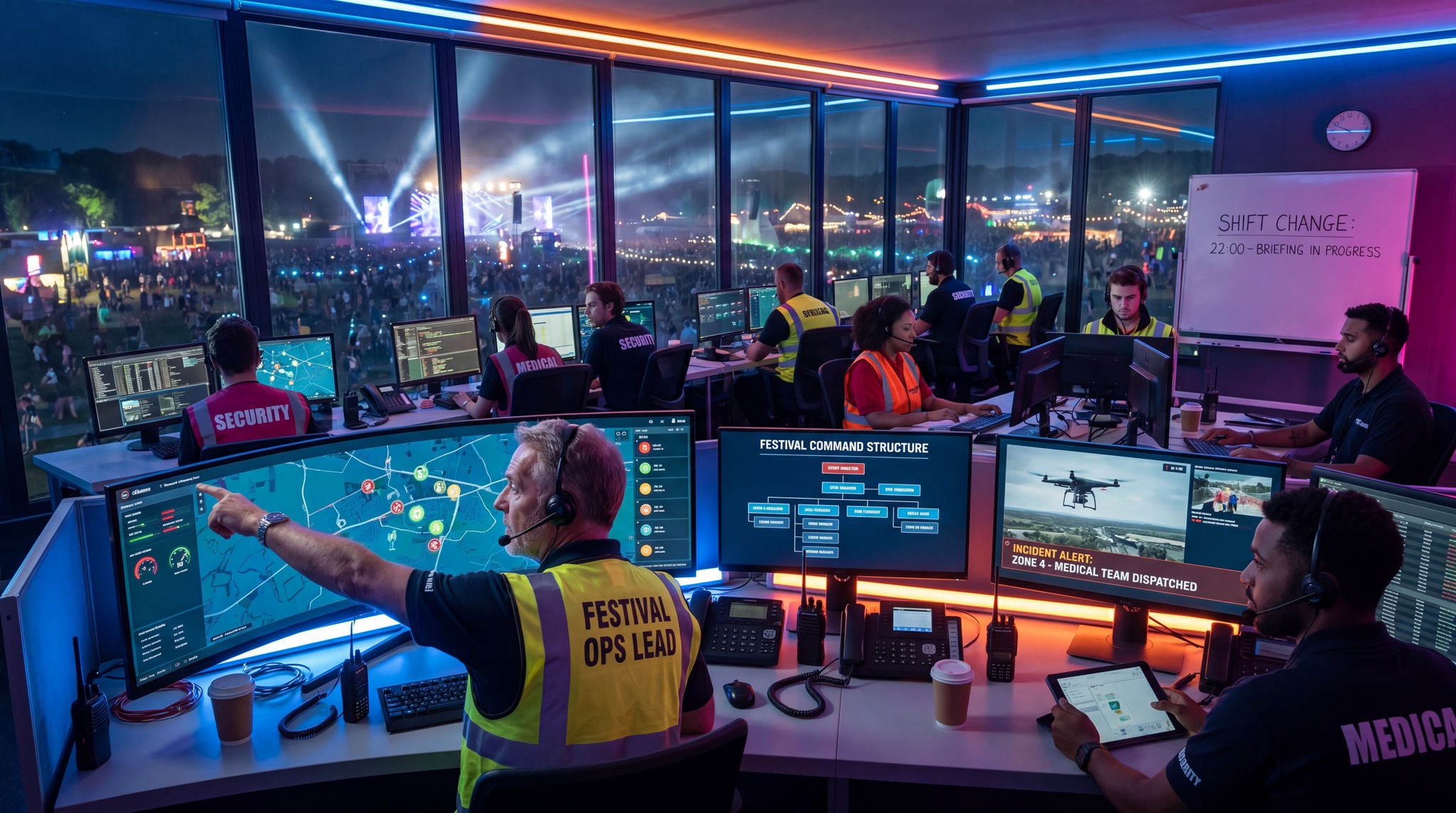
While each stage has its own crew focusing on immediate show needs, there’s often a higher-level technical nerve center overseeing the entire festival. Larger events establish a Technical Operations Center (sometimes called the TOC or “tech ops”) that acts as mission control for production. From this hub – which might be a trailer full of monitors and radios – the technical director and team monitor critical systems (power status, audio feeds, weather radar, network connectivity for cashless systems, etc.) and coordinate responses to any issues. Think of it as an air traffic control tower: if something goes wrong on a stage, the stage manager contacts tech ops, which can dispatch specialized help or enact contingency plans. A well-run Festival Technical Ops Center tracks signals, telemetry, and triage in real time so that a minor glitch doesn’t spiral into a show-stopping crisis.
Before a single piece of equipment is loaded onto the site, veteran producers compile comprehensive functional specifications for a music festival. This master document serves as the blueprint for all technical departments, detailing exact power requirements, staging dimensions, weight load capacities, and network bandwidth needs. By establishing these functional specs early in the planning phase, organizers ensure that every vendor—from the audio provider to the staging company—is bidding on and delivering against the exact same operational baseline, eliminating costly on-site surprises.
One major responsibility at this level is communications – ensuring all the different teams (audio, lighting, stage management, security, medical, etc.) can talk to each other instantly. Festivals use two-way radios with assigned channels for different departments, as well as intercom systems for production staff. Clear communication protocols (like radio etiquette and designated call signs for locations or roles) prevent chaos. Tech ops will have a communications plan where, for instance, Channel 1 serves as an ‘All Call’ channel for emergencies, Channel 2 is Stage 1 crew, Channel 3 is Stage 2 crew, and so on. In noisy festival environments, sometimes backup methods like text groups or runner staff are used in case radios fail. A reliable comms system is truly the backbone of live event management – when a critical message needs to get out (like a weather evacuation order or a medical emergency), there is no time to waste.
Another behind-the-scenes challenge is managing the wireless spectrum. Modern festivals are packed with wireless devices: microphones, in-ear monitor systems, crew radios, Wi-Fi for production, even artists’ gear. These can easily interfere with each other if not carefully coordinated. Many events employ an RF (radio frequency) coordinator whose job is to assign and monitor frequencies for all wireless kit on site. Coordinating RF across a “small city” festival ensures that the guitar wireless on Stage A isn’t accidentally using the same frequency as a microphone on Stage B or the security team’s radios. The RF coordinator will also scan for interference (like local TV station frequencies or rogue devices) and adjust systems as needed in real time. This prevents the nightmare scenario of a headline act’s microphone cutting out because a nearby wireless camera link or a pirate radio device overpowered it.
Technical operations is also about redundancy and readiness. For every crucial system, there should be a backup ready. Generators have spares or secondary units fueled up. The main stage sound console might have a backup console feeding the PA (or at least a plan to patch in a laptop with basic audio if the desk dies). Critical show laptops or media servers are often run in pairs (A/B systems) so that if one crashes, the other takes over seamlessly. Key crew often carry backup devices – spare radio batteries, extra copies of stage schedules, emergency flashlights, multi-tools – for unexpected situations.
Pro Tip: Maintain a ‘crash kit’ at the technical ops center containing emergency spares and tools: spare cables (XLR, power, fiber), adapters for every connector type, a soldering iron, gaffer tape, zip ties, extra radios, and even a backup laptop loaded with essential software (lighting, sound control programs, etc.). When something breaks or goes missing minutes before showtime, this kit can save the day by providing a quick replacement.
Even with all precautions, technical faults can still emerge – a mixer might glitch, a light fixture might fall out of sync, or an entire video wall could go dark. What separates a well-run festival is how fast and effectively these problems are addressed. Smart teams practice technical troubleshooting drills and have documentation on hand (signal flow charts, electrical diagrams, contact lists for vendor support). For instance, if audio goes out on Stage 2, tech ops might immediately radio, “Audio black on Stage 2 – dispatching backup generator and audio tech now,” while simultaneously checking if the issue is power-related or mixer-related. Having quick-fix protocols for common technical failures – like how to safely hot-swap an amplifier or reboot a lighting console without interrupting the show – can turn five minutes of panic into a barely noticeable blip.
Technical operations and communications are the guardians of the festival’s backbone. When they function smoothly, most audience members will never realize they exist – everything just works. But when a storm hits or a sound system fails, this behind-the-scenes team becomes the festival’s heroes, reacting swiftly to keep the experience on track. Their constant vigilance and coordination allow the artists and front-line crew to shine, confident that a safety net is in place for whatever surprises live production might throw their way.
Artist Technical Requirements & Backline
Long before any artist steps on a festival stage, there is a detailed negotiation and coordination process to make sure their technical needs will be met. This is known as technical advancing – the production team reviews each artist’s technical rider (a document listing their equipment requirements, stage layout, input list, and other needs) and works out the logistics of providing those items at the festival. Unlike a tour where a band carries all their own gear, at festivals the expectation is that core production (sound system, lighting, stage infrastructure) is provided, and often ‘backline’ instruments (like drum kits, amplifiers, keyboards) are provided or shared according to a prior agreement. Coordinating with artists’ production riders in advance is absolutely essential to avoid nasty surprises on show day (for example, a DJ showing up expecting CDJs when you only have turntables – a disaster if not caught ahead of time).
Festivals often hire a dedicated backline manager or backline rental company to supply and oversee shared gear. This person or team ensures that quality instruments and amps are available as promised. They set up drum kits to each drummer’s specifications (different cymbals, tuning, etc.), arrange instrument delivery to stages on time, and maintain the gear throughout the event (changing strings, drum heads, etc. as needed). Effective backline and instrument management keeps performances on schedule and artists satisfied: if a guitar goes out of tune or a keyboard malfunctions, the backline tech is right there with a replacement or a fix. These technicians are unsung heroes that can deal with everything from a blown guitar amp tube to a missing guitar strap in the blink of an eye.
Warning: Never ignore or skim over an artist’s technical rider. If an artist arrives to find promised equipment missing or wrong (e.g., the wrong type of mixer or too few mics for the drum kit), it can delay the show or even lead to a canceled set – and it certainly damages the festival’s reputation. Always clarify every line of the rider well in advance and communicate any necessary compromises to the artist’s team, so there are no nasty surprises on the day.
On the day of the festival, artist relations and stage crews work hand-in-hand to get musicians comfortable and ready to play. Each act is typically assigned a stage liaison or stage manager who welcomes them as they arrive backstage, goes over the schedule (“You have a 15-minute changeover, then a 45-minute set”), and confirms any last-minute changes (maybe the guitarist decided to use their own amp after all, or the vocalist has an issue and needs a different microphone). The stage crew double-checks that all the requested gear is in place: the right amplifiers are on stage, the keyboard stand is at correct height, the monitor mix is dialed in per the soundcheck. Flexibility is key – even with prior advancing, artists may make on-the-fly requests (“Can I get a taller mic stand?” or “We need an extra DI box for a laptop”). A well-prepared crew will have those items within arm’s reach.
Artists often travel light to festivals, sometimes only bringing personal instruments (guitars, drumsticks, etc.) and relying on the festival’s backline for heavy gear. This only works if the provided backline is high quality and exactly what was agreed. It’s common for festivals to offer a menu of standard options (e.g., “We have a Yamaha Stage Custom or a DW drum kit; which do you prefer?” or “Fender Twin Reverb and Marshall JCM800 amps available”). Any substitutions should be cleared by the artist ahead of time. On show day, backline techs typically set up the equipment as per each artist’s stage plot, sometimes even helping to mic the drums in the preferred way, etc., while the artist’s team might tune up instruments.
Pro Tip: Send each artist a thorough advance info pack a few weeks before the festival. Include the specifics of the stage they’ll play (dimensions, power hookups, monitor setup), a list of provided backline gear (with brands and models), and a draft schedule for soundcheck and performance. Ask them to reconfirm their needs against this info. Having everything clearly documented – and getting that final “looks good” from the artist’s team – means you’re far less likely to face last-minute requests or conflicts.
Finally, empathy and professionalism go a long way in artist relations. Festivals can be stressful for performers – quick turnarounds, unfamiliar gear, high expectations from fans. A solid technical team gives artists confidence that things will go smoothly. Little touches matter: have a guitar tech ready side-stage during the set in case a string breaks, or ensure the drum throne height is pre-adjusted exactly as per the rider note. When artists see that the festival crew is on top of these details, they can relax and deliver a great show. And if something does go awry, a calm stage team that solves the issue without drama will earn artists’ trust (and often their willingness to return in future years). In the end, successful technical production doesn’t just make the festival look and sound good to fans – it also earns the appreciation of the performers who know they are in good hands on your stage.
Essential Reading
- Festival Stage Design and Scenic Construction – A deep dive into creative stage concepts and how they’re built safely for festival environments.
- Powering Many Festival Worlds: Microgrids and Redundancy in Event Power Systems – Strategies for dividing a festival into multiple power zones, using backup generators, and avoiding electrical failures.
- Festival Sound Systems: Delivering Quality Audio Outdoors – Tips and techniques to achieve clear, powerful audio in open-air festival settings.
- Lighting Design for Festivals: Illuminating the Experience – How professional lighting designers plan and execute dynamic lighting shows for festival stages.
- Special Effects and Pyrotechnics: Safe Implementation at Festivals – Guidance on incorporating fireworks, flames, lasers, and other effects into events while maintaining strict safety standards.
- Festival Technical Ops Center: Signals, Telemetry, and Triage – Insight into the behind-the-scenes control hubs that monitor tech systems and coordinate fixes during festivals.
- Festival Backline and Instrument Management: Keeping Performances on Schedule and Artists Happy – Best practices for providing and managing instruments and gear for artists at multi-act events.
FAQ
What does festival technical production include?
Festival technical production covers all the behind-the-scenes systems that make an event run. This includes staging and structures, sound systems and audio engineering, lighting and visual effects, power generation and electrical distribution, and communication networks. It also involves technical logistics like coordinating equipment for artists (backline), managing special effects (like pyrotechnics), and ensuring safety and compliance in all these areas.
How far in advance should I plan technical production for a festival?
Planning the technical production should begin as early as possible – often 12 to 18 months before a large festival. Major elements like stage design, power infrastructure, and key equipment rentals are typically decided 6–12 months out. For smaller events, a shorter timeline (several months) can work, but even then, securing critical vendors (sound, lights, staging) at least 3–6 months in advance is wise. Early planning allows for proper permitting, budgeting, and time to resolve complex technical requirements.
How do festivals power their stages?
Most outdoor festivals use portable diesel generators to supply electricity. Each stage or area will have its own generator (or set of generators) sized for its needs, creating a mini “power grid” on site. These feed power distribution units that run cabling out to all the lights, audio gear, and vendor stalls. Larger festivals may use many generators across the site and include backup units for redundancy. If a venue has access to mains electricity (grid power), festivals might tap into that for some uses, but generators are the norm for flexibility. In all cases, certified electricians design and oversee the power setup to ensure it’s safe and sufficient.
How do festivals prevent sound bleed and noise complaints?
Festivals use several strategies to control sound bleed. First, stage layout and speaker aiming are planned so that stages direct sound away from each other and toward the ground/audience. They also implement volume limits and curfews – for example, wrapping up loud sets by curfew and lowering stage volumes after hours. Technologically, many events deploy cardioid subwoofers and even new directional speaker systems that focus audio tightly on the crowd to reduce spillover. Scheduling helps too: not having two loud acts on adjacent stages at the same time. To address community noise, festivals monitor decibel levels at the perimeter and may offer solutions like silent discos for late-night entertainment. Communication with local residents and adhering to permit conditions (like ending main shows by 11 PM) are also key to avoiding noise complaints.
What does FOH mean in festival production?
FOH stands for ‘Front of House’. In festival production, FOH refers to the location and team that controls the main sound and often lighting for a stage. It’s typically a mixing booth set up in the audience area (usually about two-thirds of the way back from the stage). The FOH audio engineer mixes the sound that the crowd hears through the PA system. There may also be lighting consoles and other control equipment at FOH. Essentially, FOH is the control center out in the audience where engineers ensure the show looks and sounds great for attendees.
What is ‘backline’ and why is it important?
‘Backline’ refers to the musical instruments and gear provided on stage for artists (e.g. drums, guitar amps, keyboards). In festival settings, bands often don’t carry all their own gear, so the festival provides backline equipment according to what was agreed in each artist’s technical rider. Good backline management is crucial because it means each artist has the gear they need, in working order, when they step on stage. If backline isn’t handled properly (for example, the wrong type of amp or a poorly tuned drum kit), it can negatively affect the performance or delay the show. That’s why festivals have dedicated backline techs to set up, maintain, and quickly swap out instruments as needed.
How do festivals use pyrotechnics safely?
Safety with pyrotechnics at festivals comes down to professional planning and strict adherence to regulations. Festivals hire licensed pyrotechnicians who design the fireworks or flame effects show and obtain permits from local authorities. There are safety perimeters keeping people at a safe distance, and all pyrotechnic devices are securely mounted and tested. The crew coordinates effect cues with the stage show (so no one on stage is caught off guard). They also monitor weather – for instance, high winds can cancel a fireworks launch for safety. Additionally, fire extinguishers and emergency protocols are in place whenever pyro is used. By following established safety guidelines and laws (like NFPA standards in the U.S.), festivals can add fireworks and other effects to the show with minimal risk.
How do festivals work from a technical perspective?
At their core, festivals work by temporarily transforming an empty field or venue into a fully functioning entertainment city. From a technical standpoint, this involves deploying massive temporary infrastructure: microgrids for power, heavy-duty staging and rigging, and complex audio-visual networks. Much of this borrows from traditional stagecraft—if you’ve ever wondered what tech in theatre involves, festival production scales those same principles (lighting design, sound engineering, set construction, and stage management) to a massive, outdoor, multi-stage environment. Every department coordinates through a central technical operations center to ensure the show runs safely and on schedule.
How does concert stage design differ from festival stage production?
While traditional concert stage design is typically tailored to a single touring artist’s specific vision and carried from venue to venue, overarching festival production requires a highly modular, multi-purpose approach. Festival stage production must provide a robust, weather-resistant infrastructure that can support the diverse technical riders of dozens of different artists over a single weekend. This means prioritizing flexible rigging grids, universal backline solutions, and adaptable lighting plots over highly specialized, single-use scenic elements.
How do you handle noise mitigation for unscripted performance activities?
Managing sound for unscripted performance activities—such as roaming art cars, pop-up acoustic sets, or immersive theater—requires proactive zoning. Festival organizers should designate specific areas where these spontaneous acts are permitted, utilizing natural acoustic barriers or temporary sound walls to contain the audio. Documenting these rules in a community noise mitigation book or SOP manual ensures that all performers and staff understand the volume limits and approved zones, preventing unexpected noise complaints from neighboring properties.
How do multi-stage festivals monitor wind speeds?
Modern event producers deploy wireless wind monitoring systems across the festival site to track localized weather conditions in real time. By mounting wireless anemometers at the peak of every stage roof, delay tower, and large scenic structure, technical operations teams receive continuous data on sustained winds and sudden gusts. This multi-point telemetry allows organizers to execute specific wind action plans—such as lowering lighting trusses or evacuating a stage—the moment safe thresholds are exceeded, rather than relying on generalized regional weather forecasts.
What should be included in the functional specifications for a music festival?
The functional specifications for a music festival should serve as a comprehensive technical blueprint for the event. This master document must detail exact staging dimensions, structural load capacities, power distribution requirements (including generator sizing and microgrid layouts), audio-visual network bandwidth, and site-wide communication protocols. By clearly defining these operational baselines early in the planning process, producers ensure all vendors and technical teams are aligned, which prevents costly logistical conflicts during the build.
Glossary
- Backline: The musical instruments and gear provided on stage for artists (e.g. drums, guitar amps, keyboards). Festivals supply backline so artists don’t have to bring heavy equipment.
- Decibel (dB): A unit measuring sound level or intensity. Festival sound levels and audio measurements are given in decibels; higher dB means louder sound.
- FOH (Front-of-House): The front-of-house mixing position and team in the audience area that controls the main sound (and often lighting) for the stage.
- Microgrid: In festival terms, a self-contained power network (usually one or more generators plus distribution) dedicated to a specific area or stage. Multiple microgrids make up the overall event power.
- Monitor Mix: The audio mix that performers hear on stage through monitor speakers or in-ear monitors. It’s a separate mix from what the audience hears, tailored so artists can hear themselves and the music clearly.
- Line Array: A type of speaker system where multiple loudspeaker elements are hung in a vertical line. Widely used at festivals, line arrays can project clear sound over long distances to cover large audiences.
- Rigging: The hardware and process of hanging and securing equipment (lights, speakers, etc.) above the stage. Involves trusses, motors, cables, and requires strict safety practices.
- Technical Rider: A document from an artist to the festival listing the technical requirements for their performance. It covers things like needed equipment, stage layout, input list, monitor preferences, and special requests.
- Sound Bleed: Unwanted sound spillover from one area or stage to another. At festivals, sound bleed usually refers to one stage’s music being heard at another stage or outside the venue, which producers try to minimize.
- Silent Disco: A type of event or stage where the music is broadcast via wireless headphones instead of speaker systems. Common at festivals for late-night sets; people dance to music they hear in headphones, keeping external noise very low.
- Delay Tower: A secondary speaker system placed further back in a large audience area to reinforce sound for people far from the stage. It plays with a slight time delay so the audio stays in sync with the main stage speakers.
- Stage Manager: The person in charge of running a stage’s show operations. They coordinate artist arrivals, supervise changeovers, cue technical crews, and ensure that the stage runs on schedule and according to plan.
Conclusion
The technical production of a festival is an enormous endeavor – part engineering, part art form. When done expertly, it creates the seamless experience that attendees cherish: stages that feel like other worlds, sound that hits your chest just right, lights that astonish, and no one ever thinking about the generators humming behind the scenes. Achieving this takes the coordination of hundreds of skilled professionals, months (even years) of preparation, and the foresight to anticipate anything that can go wrong.
From the smallest weekend gathering to the largest international festival, the principles remain the same: plan thoroughly, invest in quality infrastructure, respect safety above all, and have contingency plans for every scenario. The world’s top festival producers know that technical excellence isn’t about showing off flashy gear for its own sake – it’s about using technology cleverly and reliably to serve the audience experience and the artists’ vision.
Finally, festival technical production is a field of constant innovation. Each year brings new tools – more efficient power solutions, smarter sound systems, brighter and greener lighting, immersive audiovisual tech – all of which open up possibilities to elevate the live experience. Veteran producers stay curious and adapt, blending hard-earned practical wisdom with cutting-edge advancements. The result is that festivals keep getting more ambitious, yet when the hard work pays off, the magic feels effortless. As the last encore rings out and the lights dim, if the crowd is smiling and safe and none the wiser about the countless moving parts that made the night possible, the technical production team has truly done its job.